Introduction to statistics and data analysis 3rd
Edition Roxy Peck pdf download
https://ebookgate.com/product/introduction-to-statistics-and-
data-analysis-3rd-edition-roxy-peck/
Get Instant Ebook Downloads – Browse at https://ebookgate.com
Instant digital products (PDF, ePub, MOBI) available
Download now and explore formats that suit you...
Introduction to Statistics and Data Analysis Available
Titles Aplia 4th Edition Roxy Peck
https://ebookgate.com/product/introduction-to-statistics-and-data-
analysis-available-titles-aplia-4th-edition-roxy-peck/
ebookgate.com
Statistics The Exploration and Analysis of Data 6th
Edition Roxy Peck
https://ebookgate.com/product/statistics-the-exploration-and-analysis-
of-data-6th-edition-roxy-peck/
ebookgate.com
Mathematical Statistics and Data Analysis 3ed Duxbury
Advanced 3rd Edition John A. Rice
https://ebookgate.com/product/mathematical-statistics-and-data-
analysis-3ed-duxbury-advanced-3rd-edition-john-a-rice/
ebookgate.com
JMP start statistics a guide to statistics and data
analysis using JMP 4th ed Edition John Sall
https://ebookgate.com/product/jmp-start-statistics-a-guide-to-
statistics-and-data-analysis-using-jmp-4th-ed-edition-john-sall/
ebookgate.com
Symbolic Data Analysis Conceptual Statistics and Data
Mining Wiley Series in Computational Statistics 1st
Edition Lynne Billard
https://ebookgate.com/product/symbolic-data-analysis-conceptual-
statistics-and-data-mining-wiley-series-in-computational-
statistics-1st-edition-lynne-billard/
ebookgate.com
Statistics for Social Data Analysis 4th Edition David
Knoke
https://ebookgate.com/product/statistics-for-social-data-analysis-4th-
edition-david-knoke/
ebookgate.com
Qualitative Data An Introduction to Coding and Analysis
1st Edition Carl Auerbach
https://ebookgate.com/product/qualitative-data-an-introduction-to-
coding-and-analysis-1st-edition-carl-auerbach/
ebookgate.com
Statistics and Data Analysis for Nursing Research 2nd
Edition Denise Polit
https://ebookgate.com/product/statistics-and-data-analysis-for-
nursing-research-2nd-edition-denise-polit/
ebookgate.com
Introduction to Energy Analysis 3rd Edition Kornelis Blok
https://ebookgate.com/product/introduction-to-energy-analysis-3rd-
edition-kornelis-blok/
ebookgate.com
Introduction
to Statistics
and Data Analysis
This page intentionally left blank
Introduction
to Statistics
and Data Analysis
T h i r d E d i t i o n
Roxy Peck
California Polytechnic State University, San Luis Obispo
Chris Olsen
George Washington High School, Cedar Rapids, IA
Jay Devore
California Polytechnic State University, San Luis Obispo
Australia • Brazil • Canada • Mexico • Singapore • Spain • United Kingdom • United States
Introduction to Statistics and Data Analysis,
Third Edition
Roxy Peck, Chris Olsen, Jay Devore
Acquisitions Editor: Carolyn Crockett
Development Editor: Danielle Derbenti
Assistant Editor: Beth Gershman
Editorial Assistant: Ashley Summers
Technology Project Manager: Colin Blake
Marketing Manager: Joe Rogove
Marketing Assistant: Jennifer Liang
Marketing Communications Manager: Jessica Perry
Project Manager, Editorial Production: Jennifer Risden
Creative Director: Rob Hugel
Art Director: Vernon Boes
Print Buyer: Karen Hunt
Permissions Editor: Isabel Alves
Production Service: Newgen–Austin
Text Designer: Stuart Paterson
Photo Researcher: Gretchen Miller
Copy Editor: Nancy Dickson
Illustrator: Jade Myers; Newgen–India
Cover Designer: Stuart Paterson
Cover Image: Paul Chesley/Getty Images
Cover Printer: Courier Corporation/Kendallville
Compositor: Newgen–India
Printer: Courier Corporation/Kendallville
© 2008, 2005 Duxbury, an imprint of Thomson Brooks/Cole, a
part of The Thomson Corporation. Thomson, the Star logo, and
Brooks/Cole are trademarks used herein under license.
ALL RIGHTS RESERVED. No part of this work covered by the
copyright hereon may be reproduced or used in any form or by
any means—graphic, electronic, or mechanical, including photo-
copying, recording, taping, Web distribution, information storage
and retrieval systems, or in any other manner—without the writ-
ten permission of the publisher.
Printed in the United States of America
1 2 3 4 5 6 7 11 10 09 08 07
ExamView®
and ExamView Pro®
are registered trademarks
of FSCreations, Inc. Windows is a registered trademark of the
Microsoft Corporation used herein under license. Macintosh and
Power Macintosh are registered trademarks of Apple Computer,
Inc. Used herein under license.
Library of Congress Control Number: 2006933904
Student Edition:
ISBN-13: 978-0-495-11873-2
ISBN-10: 0-495-11873-7
Thomson Higher Education
10 Davis Drive
Belmont, CA 94002-3098
USA
For more information about our products, contact us at:
Thomson Learning Academic Resource Center
1-800-423-0563
For permission to use material from this text or product, submit a
request online at http://www.thomsonrights.com.
Any additional questions about permissions can be submitted by
e-mail to thomsonrights@thomson.com.
■ To my nephews, Jesse and Luke Smidt, who
bet I wouldn’t put their names in this book.
R. P.
■ To my wife, Sally, and my
daughter, Anna
C. O.
■ To Carol, Allie, and Teri.
J. D.
ROXY PECK is Associate Dean of the
College of Science and Mathematics
and Professor of Statistics at California
Polytechnic State University, San Luis
Obispo. Roxy has been on the faculty
at Cal Poly since 1979, serving for six
years as Chair of the Statistics Department before
becoming Associate Dean. She received an M.S. in
Mathematics and a Ph.D. in Applied Statistics from
the University of California, Riverside. Roxy is na-
tionally known in the area of statistics education,
and in 2003 she received the American Statistical
Association’s Founder’s Award, recognizing her con-
tributions to K–12 and undergraduate statistics edu-
cation. She is a Fellow of the American Statistical
Association and an elected member of the Interna-
tional Statistics Institute. Roxy has recently com-
pleted five years as the Chief Reader for the Ad-
vanced Placement Statistics Exam and currently
chairs the American Statistical Association’s Joint
Committee with the National Council of Teachers of
Mathematics on Curriculum in Statistics and Proba-
bility for Grades K–12. In addition to her texts in in-
troductory statistics, Roxy is also co-editor of Statisti-
cal Case Studies: A Collaboration Between Academe
and Industry and a member of the editorial board for
Statistics: A Guide to the Unknown, 4th edition. Out-
side the classroom and the office, Roxy likes to travel
and spends her spare time reading mystery novels.
She also collects Navajo rugs and heads to New Mex-
ico whenever she can find the time.
CHRIS OLSEN has taught statistics
at George Washington High School in
Cedar Rapids, Iowa, for over 25 years.
Chris is a past member of the Ad-
vanced Placement Statistics Test De-
velopment Committee and the author
of the Teacher’s Guide for Advanced Placement Sta-
tistics. He has been a table leader at the AP Statistics
reading for 6 years and since the summer of 1996 has
been a consultant to the College Board. Chris leads
workshops and institutes for AP Statistics teachers
in the United States and internationally. Chris was
the Iowa recipient of the Presidential Award for Ex-
cellence in Science and Mathematics Teaching in
1986. He was a regional winner of the IBM Com-
puter Teacher of the Year award in 1988 and received
the Siemens Award for Advanced Placement in math-
ematics in 1999. Chris is a frequent contributor to
the AP Statistics Electronic Discussion Group and
has reviewed materials for The Mathematics Teacher,
the AP Central web site, The American Statistician,
and the Journal of the American Statistical Associa-
tion. He currently writes a column for Stats maga-
zine. Chris graduated from Iowa State University
with a major in mathematics and, while acquiring
graduate degrees at the University of Iowa, concen-
trated on statistics, computer programming, psycho-
metrics, and test development. Currently, he divides
his duties between teaching and evaluation; in addi-
tion to teaching, he is the assessment facilitator for
the Cedar Rapids, Iowa, Community Schools. In his
spare time he enjoys reading and hiking. He and his
wife have a daughter, Anna, who is a graduate stu-
dent in Civil Engineering at Cal Tech.
JAY DEVORE earned his under-
graduate degree in Engineering Sci-
ence from the University of California
at Berkeley, spent a year at the Univer-
sity of Sheffield in England, and fin-
ished his Ph.D. in statistics at Stanford
University. He previously taught at the University of
Florida and at Oberlin College and has had visiting
appointments at Stanford, Harvard, the University
of Washington, and New York University. From 1998
to 2006, Jay served as Chair of the Statistics Depart-
ment at California Polytechnic State University, San
Luis Obispo. The Statistics Department at Cal Poly
has an international reputation for activities in sta-
tistics education. In addition to this book, Jay has
written several widely used engineering statistics
texts and is currently working on a book in applied
mathematical statistics. He is the recipient of a dis-
tinguished teaching award from Cal Poly and is a
Fellow of the American Statistical Association. In
his spare time, he enjoys reading, cooking and eating
good food, tennis, and travel to faraway places. He is
especially proud of his wife, Carol, a retired elemen-
tary school teacher, his daughter Allison, who works
for the Center for Women and Excellence in Boston,
and his daughter Teri, who is finishing a graduate
program in education at NYU.
■ About the Authors
vii
C o n t e n t s
1 The Role of Statistics and the Data Analysis Process 1
1.1 Three Reasons to Study Statistics 1
1.2 The Nature and Role of Variability 4
1.3 Statistics and the Data Analysis Process 7
1.4 Types of Data and Some Simple Graphical Displays 12
Activity 1.1 Head Sizes: Understanding Variability 22
Activity 1.2 Estimating Sizes 23
Activity 1.3 A Meaningful Paragraph 24
2 Collecting Data Sensibly 27
2.1 Statistical Studies: Observation and Experimentation 27
2.2 Sampling 32
2.3 Simple Comparative Experiments 42
2.4 More on Experimental Design 51
2.5 More on Observational Studies: Designing Surveys (Optional) 56
2.6 Interpreting and Communicating the Results of
Statistical Analyses 61
Activity 2.1 Designing a Sampling Plan 63
Activity 2.2 An Experiment to Test for the Stroop Effect 64
Activity 2.3 McDonald’s and the Next 100 Billion Burgers 64
Activity 2.4 Video Games and Pain Management 65
Graphing Calculator Explorations 69
3 Graphical Methods for Describing Data 75
3.1 Displaying Categorical Data: Comparative Bar Charts
and Pie Charts 76
3.2 Displaying Numerical Data: Stem-and-Leaf Displays 87
C o n t e n t s
viii ■ Contents
3.3 Displaying Numerical Data: Frequency Distributions
and Histograms 97
3.4 Displaying Bivariate Numerical Data 117
3.5 Interpreting and Communicating the Results of
Statistical Analyses 127
Activity 3.1 Locating States 134
Activity 3.2 Bean Counters! 134
Graphing Calculator Explorations 141
4 Numerical Methods for Describing Data 147
4.1 Describing the Center of a Data Set 148
4.2 Describing Variability in a Data Set 159
4.3 Summarizing a Data Set: Boxplots 169
4.4 Interpreting Center and Variability: Chebyshev’s Rule,
the Empirical Rule, and z Scores 176
4.5 Interpreting and Communicating the Results of
Statistical Analyses 186
Activity 4.1 Collecting and Summarizing Numerical Data 190
Activity 4.2 Airline Passenger Weights 190
Activity 4.3 Boxplot Shapes 190
Graphing Calculator Explorations 195
5 Summarizing Bivariate Data 199
5.1 Correlation 200
5.2 Linear Regression: Fitting a Line to Bivariate Data 210
5.3 Assessing the Fit of a Line 221
5.4 Nonlinear Relationships and Transformations 238
5.5 Logistic Regression (Optional) 255
5.6 Interpreting and Communicating the Results
of Statistical Analyses 264
Activity 5.1 Exploring Correlation and Regression 267
Activity 5.2 Age and Flexibility 268
Graphing Calculator Explorations 272
6 Probability 279
6.1 Chance Experiments and Events 279
6.2 Definition of Probability 288
■ Contents ix
6.3 Basic Properties of Probability 295
6.4 Conditional Probability 302
6.5 Independence 313
6.6 Some General Probability Rules 323
6.7 Estimating Probabilities Empirically Using Simulation 335
Activity 6.1 Kisses 347
Activity 6.2 A Crisis for European Sports Fans? 347
Activity 6.3 The “Hot Hand” in Basketball 347
Graphing Calculator Explorations 351
7 Random Variables and Probability Distributions 357
7.1 Random Variables 358
7.2 Probability Distributions for Discrete Random Variables 361
7.3 Probability Distributions for Continuous Random Variables 367
7.4 Mean and Standard Deviation of a Random Variable 372
7.5 Binomial and Geometric Distributions 386
7.6 Normal Distributions 397
7.7 Checking for Normality and Normalizing Transformations 414
7.8 Using the Normal Distribution to Approximate a
Discrete Distribution 425
Activity 7.1 Rotten Eggs? 429
Graphing Calculator Explorations 434
8 Sampling Variability and Sampling Distributions 445
8.1 Statistics and Sampling Variability 446
8.2 The Sampling Distribution of a Sample Mean 450
8.3 The Sampling Distribution of a Sample Proportion 461
Activity 8.1 Do Students Who Take the SATs Multiple Times Have
an Advantage in College Admissions? 468
Graphing Calculator Explorations 471
9 Estimation Using a Single Sample 475
9.1 Point Estimation 476
9.2 Large-Sample Confidence Interval for a Population Proportion 482
9.3 Confidence Interval for a Population Mean 495
x ■ Contents
9.4 Interpreting and Communicating the Results of
Statistical Analyses 508
Activity 9.1 Getting a Feel for Confidence Level 514
Activity 9.2 An Alternative Confidence Interval for a
Population Proportion 515
Activity 9.3 Verifying Signatures on a Recall Petition 516
Activity 9.4 A Meaningful Paragraph 516
Graphing Calculator Explorations 521
10 Hypothesis Testing Using a Single Sample 525
10.1 Hypotheses and Test Procedures 526
10.2 Errors in Hypotheses Testing 531
10.3 Large-Sample Hypothesis Tests for a Population Proportion 537
10.4 Hypotheses Tests for a Population Mean 550
10.5 Power and Probability of Type II Error 562
10.6 Interpreting and Communicating the Results of
Statistical Analyses 571
Activity 10.1 Comparing the t and z Distributions 574
Activity 10.2 A Meaningful Paragraph 575
Graphing Calculator Explorations 580
11 Comparing Two Populations or Treatments 583
11.1 Inferences Concerning the Difference Between Two Population
or Treatment Means Using Independent Samples 583
11.2 Inferences Concerning the Difference Between Two Population
or Treatment Means Using Paired Samples 606
11.3 Large Sample Inferences Concerning a Difference Between Two
Population or Treatment Proportions 619
11.4 Interpreting and Communicating the Results of
Statistical Analyses 629
Activity 11.1 Helium-Filled Footballs 632
Activity 11.2 Thinking About Data Collection 633
Activity 11.3 A Meaningful Paragraph 633
Graphing Calculator Explorations 641
■ Contents xi
12 The Analysis of Categorical Data and Goodness-of-
Fit Tests 647
12.1 Chi-Square Tests for Univariate Data 647
12.2 Tests for Homogeneity and Independence in a Two-
way Table 660
12.3 Interpreting and Communicating the Results of
Statistical Analyses 677
Activity 12.1 Pick a Number, Any Number . . . 680
Activity 12.2 Color and Perceived Taste 680
Graphing Calculator Explorations 685
13 Simple Linear Regression and Correlation:
Inferential Methods 689
13.1 Simple Linear Regression Model 690
13.2 Inferences About the Slope of the Population Regression Line 702
13.3 Checking Model Adequacy 713
13.4 Inferences Based on the Estimated Regression Line
(Optional) 725
13.5 Inferences About the Population Correlation Coefficient
(Optional) 734
13.6 Interpreting and Communicating the Results of
Statistical Analyses 737
Activity 13.1 Are Tall Women from “Big” Families? 739
Graphing Calculator Exploration 746
14 Multiple Regression Analysis 749
14.1 Multiple Regression Models 750
14.2 Fitting a Model and Assessing Its Utility 763
14.3 Inferences Based on an Estimated Model 14-1
14.4 Other Issues in Multiple Regression 14-13
14.5 Interpreting and Communicating the Results of
Statistical Analyses 14-26
Activity 14.1 Exploring the Relationship Between Number of
Predictors and Sample Size 780
Sections and/or chapter numbers in color can be found at www.thomsonedu.com/statistics/peck
xii ■ Contents
Sections and/or chapter numbers in color can be found at www.thomsonedu.com/statistics/peck
15 Analysis of Variance 783
15.1 Single-Factor ANOVA and the F Test 784
15.2 Multiple Comparisons 800
15.3 The F Test for a Randomized Block Experiment 15-1
15.4 Two-Factor ANOVA 15-9
15.5 Interpreting and Communicating the Results of
Statistical Analyses 15-22
Activity 15.1 Exploring Single-Factor ANOVA 808
Graphing Calculator Exploration 811
16 Nonparametric (Distribution-Free) Statistical Methods 16-1
16.1 Distribution-Free Procedures for Inferences About a Difference
Between Two Population or Treatment Means Using Independent
Samples (Optional) 16-1
16.2 Distribution-Free Procedures for Inferences About a Difference
Between Two Population or Treatment Means Using
Paired Samples 16-10
16.3 Distribution-Free ANOVA 16-23
Appendix A: Statistical Tables 813
Appendix B: References 833
Answers to Selected Odd-Numbered Exercises 835
Index I-1
P r e f a c e
xiii
In a nutshell, statistics is about understanding the role that variability plays in draw-
ing conclusions based on data. Introduction to Statistics and Data Analysis, Third Edi-
tion develops this crucial understanding of variability through its focus on the data
analysis process.
An Organization That Reflects the Data Analysis Process
Students are introduced early to the idea that data analysis is a process that begins with
careful planning, followed by data collection, data description using graphical and
numerical summaries, data analysis, and finally interpretation of results. This process
is described in detail in Chapter 1, and the ordering of topics in the first ten chapters
of the book mirrors this process: data collection, then data description, then statistical
inference.
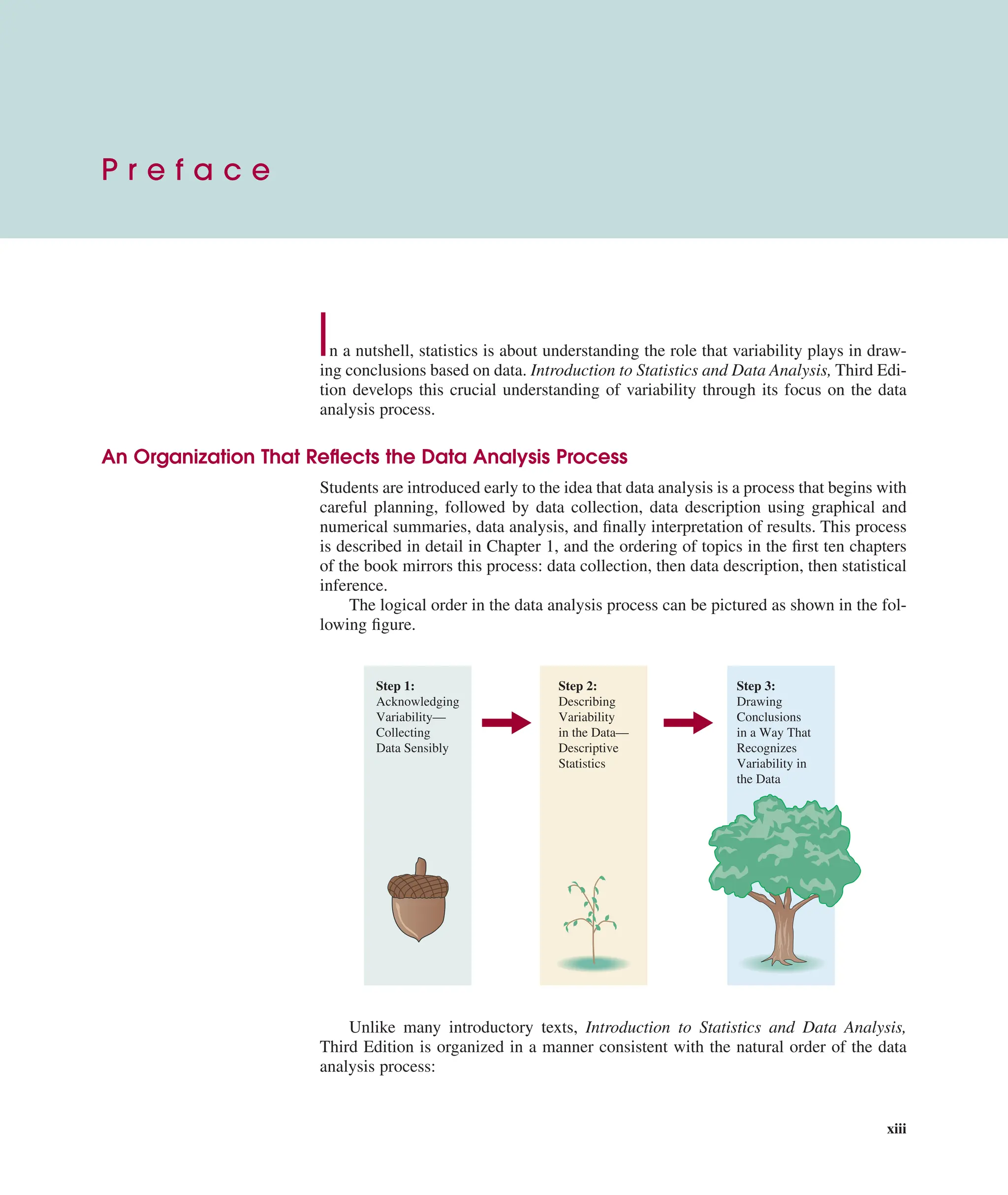
The logical order in the data analysis process can be pictured as shown in the fol-
lowing figure.
Unlike many introductory texts, Introduction to Statistics and Data Analysis,
Third Edition is organized in a manner consistent with the natural order of the data
analysis process:
Step 1:
Acknowledging
Variability—
Collecting
Data Sensibly
Step 2:
Describing
Variability
in the Data—
Descriptive
Statistics
Step 3:
Drawing
Conclusions
in a Way That
Recognizes
Variability in
the Data
xiv ■ Preface
The Importance of Context and Real Data
Statistics is not about numbers; it is about data—numbers in context. It is the context
that makes a problem meaningful and something worth considering. For example, ex-
ercises that ask students to compute the mean of 10 numbers or to construct a dotplot
or boxplot of 20 numbers without context are arithmetic and graphing exercises. They
become statistics problems only when a context gives them meaning and allows for in-
terpretation. While this makes for a text that may appear “wordy” when compared to
traditional mathematics texts, it is a critical and necessary component of a modern sta-
tistics text.
Examples and exercises with overly simple settings do not allow students to prac-
tice interpreting results in authentic situations or give students the experience neces-
sary to be able to use statistical methods in real settings. We believe that the exercises
and examples are a particular strength of this text, and we invite you to compare the
examples and exercises with those in other introductory statistics texts.
Many students are skeptical of the relevance and importance of statistics. Con-
trived problem situations and artificial data often reinforce this skepticism. A strategy
that we have employed successfully to motivate students is to present examples and
exercises that involve data extracted from journal articles, newspapers, and other pub-
lished sources. Most examples and exercises in the book are of this nature; they cover
a very wide range of disciplines and subject areas. These include, but are not limited
to, health and fitness, consumer research, psychology and aging, environmental re-
search, law and criminal justice, and entertainment.
A Focus on Interpretation and Communication
Most chapters include a section titled “Interpreting and Communicating the Results of
Statistical Analyses.” These sections include advice on how to best communicate the
results of a statistical analysis and also consider how to interpret statistical summaries
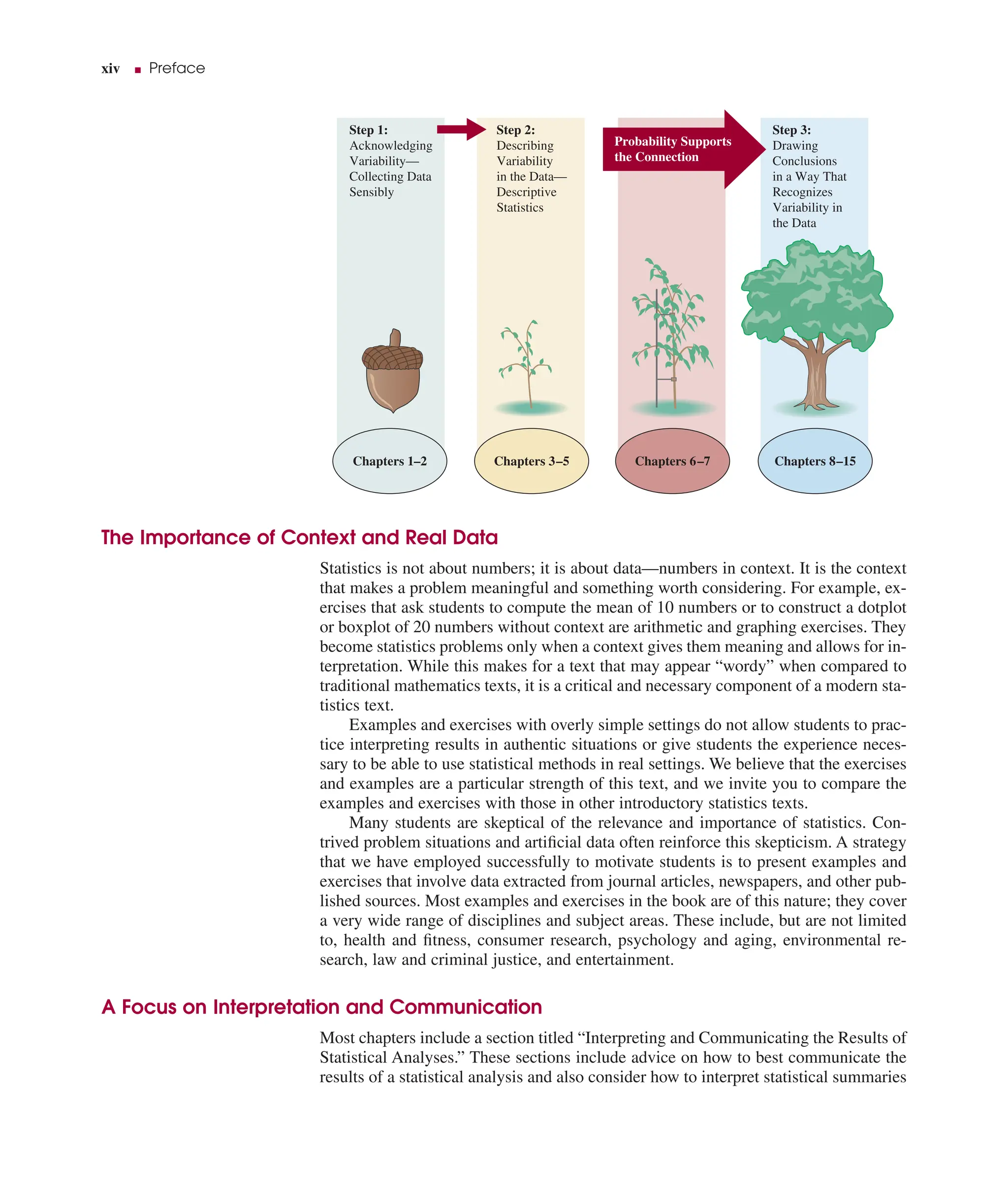
Step 1:
Acknowledging
Variability—
Collecting Data
Sensibly
Step 2:
Describing
Variability
in the Data—
Descriptive
Statistics
Probability Supports
the Connection
Step 3:
Drawing
Conclusions
in a Way That
Recognizes
Variability in
the Data
Chapters 1–2 Chapters 3–5 Chapters 8–15
Chapters 6–7
■ Preface xv
found in journals and other published sources. A subsection titled “A Word to the
Wise” reminds readers of things that must be considered in order to ensure that statis-
tical methods are employed in reasonable and appropriate ways.
Consistent with Recommendations for the Introductory Statistics Course Endorsed
by the American Statistical Association
In 2005, the American Statistical Association endorsed the report “College Guidelines
in Assessment and Instruction for Statistics Education (GAISE Guidelines),” which
included the following six recommendations for the introductory statistics course:
1. Emphasize statistical literacy and develop statistical thinking.
2. Use real data.
3. Stress conceptual understanding rather than mere knowledge of procedures.
4. Foster active learning in the classroom.
5. Use technology for developing conceptual understanding and analyzing data.
6. Use assessments to improve and evaluate student learning.
Introduction to Statistics and Data Analysis, Third Edition is consistent with these rec-
ommendations and supports the GAISE guidelines in the following ways:
1. Emphasize statistical literacy and develop statistical thinking.
Statistical literacy is promoted throughout the text in the many examples and exer-
cises that are drawn from the popular press. In addition, a focus on the role of vari-
ability, consistent use of context, and an emphasis on interpreting and communi-
cating results in context work together to help students develop skills in statistical
thinking.
2. Use real data.
The examples and exercises from Introduction to Statistics and Data Analysis,
Third Edition are context driven and reference sources that include the popular
press as well as journal articles.
3. Stress conceptual understanding rather than mere knowledge of procedures.
Nearly all exercises in Introduction to Statistics and Data Analysis, Third Edition
are multipart and ask students to go beyond just computation. They focus on inter-
pretation and communication, not just in the chapter sections specifically devoted
to this topic, but throughout the text. The examples and explanations are designed
to promote conceptual understanding. Hands-on activities in each chapter are also
constructed to strengthen conceptual understanding. Which brings us to . . .
4. Foster active learning in the classroom.
While this recommendation speaks more to pedagogy and classroom practice, In-
troduction to Statistics and Data Analysis, Third Edition provides 33 hands-on ac-
tivities in the text and additional activities in the accompanying instructor resources
that can be used in class or assigned to be completed outside of class. In addition,
accompanying online materials allow students to assess their understanding and de-
velop a personalized learning plan based on this assessment for each chapter.
5. Use technology for developing conceptual understanding and analyzing data.
The computer has brought incredible statistical power to the desktop of every in-
vestigator. The wide availability of statistical computer packages such as MINITAB,
S-Plus, JMP, and SPSS, and the graphical capabilities of the modern microcom-
puter have transformed both the teaching and learning of statistics. To highlight the
role of the computer in contemporary statistics, we have included sample output
xvi ■ Preface
throughout the book. In addition, numerous exercises contain data that can easily
be analyzed by computer, though our exposition firmly avoids a presupposition that
students have access to a particular statistical package. Technology manuals for
specific packages, such as MINITAB and SPSS, are available in the online materi-
als that accompany this text.
The appearance of hand-held calculators with significant statistical and graph-
ing capability has also changed statistics instruction in classrooms where access to
computers is still limited. The computer revolution of a previous generation is now
being writ small—or, possibly we should say, smaller—for the youngest generation
of investigators. There is not, as we write, anything approaching universal or even
wide agreement about the proper role for the graphing calculator in college statis-
tics classes, where access to a computer is more common. At the same time, for
tens of thousands of students in Advanced Placement Statistics in our high schools,
the graphing calculator is the only dependable access to statistical technology.
This text allows the instructor to balance the use of computers and calculators
in a manner consistent with his or her philosophy and presents the power of the cal-
culator in a series of Graphing Calculator Explorations. These are placed at the end
of each chapter, unobtrusive to those instructors whose technology preference is
the computer while still accessible to those instructors and students comfortable
with graphing calculator technology. As with computer packages, our exposition
avoids assuming the use of a particular calculator and presents the calculator capa-
bilities in a generic format; specifically, we do not teach particular keystroke se-
quences, believing that the best source for such specific information is the calcula-
tor manual. For those using a TI graphing calculator, there is a technology manual
available in the online materials that accompany this text. As much as possible, the
calculator explorations are independent of each other, allowing instructors to pick
and choose calculator topics that are more relevant to their particular courses.
6. Use assessments to improve and evaluate student learning.
Assessment materials in the form of a test bank, quizzes, and chapter exams are
available in the instructor resources that accompany this text. The items in the test
bank reflect the data-in-context philosophy of the text’s exercises and examples.
Advanced Placement Statistics
We have designed this book with a particular eye toward the syllabus of the Advanced
Placement Statistics course and the needs of high school teachers and students. Con-
cerns expressed and questions asked in teacher workshops and on theAP Statistics Elec-
tronic Discussion Group have strongly influenced our exposition of certain topics, es-
pecially in the area of experimental design and probability. We have taken great care to
provide precise definitions and clear examples of concepts that Advanced Placement
Statistics instructors have acknowledged as difficult for their students. We have also ex-
panded the variety of examples and exercises, recognizing the diverse potential futures
envisioned by very capable students who have not yet focused on a college major.
Topic Coverage
Our book can be used in courses as short as one quarter or as long as one year in du-
ration. Particularly in shorter courses, an instructor will need to be selective in decid-
ing which topics to include and which to set aside. The book divides naturally into four
major sections: collecting data and descriptive methods (Chapters 1–5), probability
material (Chapters 6–8), the basic one- and two-sample inferential techniques (Chap-
ters 9–12), and more advanced inferential methodology (Chapters 13–16). We include
■ Preface xvii
an early chapter (Chapter 5) on descriptive methods for bivariate numerical data. This
early exposure raises questions and issues that should stimulate student interest in the
subject; it is also advantageous for those teaching courses in which time constraints
preclude covering advanced inferential material. However, this chapter can easily be
postponed until the basics of inference have been covered, and then combined with
Chapter 13 for a unified treatment of regression and correlation.
With the possible exception of Chapter 5, Chapters 1–10 should be covered in or-
der. We anticipate that most instructors will then continue with two-sample inference
(Chapter 11) and methods for categorical data analysis (Chapter 12), although regres-
sion could be covered before either of these topics. Optional portions of Chapter 14
(multiple regression) and chapter 15 (analysis of variance) and Chapter 16 (nonpara-
metric methods) are included in the online materials that accompany this text.
A Note on Probability
The content of the probability chapters is consistent with the Advanced Placement Sta-
tistics course description. It includes both a traditional treatment of probability and
probability distributions at an introductory level, as well as a section on the use of sim-
ulation as a tool for estimating probabilities. For those who prefer a briefer and more
informal treatment of probability, the book Statistics: The Exploration and Analysis of
Data, by Roxy Peck and Jay Devore, may be a more appropriate choice. Except for
the treatment of probability and the omission of the Graphing Calculator Explorations,
it parallels the material in this text. Please contact your sales rep for more information
about this alternative and other alternative customized options available to you.
New to This Edition
There are a number of changes in the Third Edition, including the following:
■ More than 80 new examples and more than 180 new exercises that use data
from current journals and newspapers are included. In addition, more of the
exercises specifically ask students to write (for example, by requiring students to
explain their reasoning, interpret results, and comment on important features of an
analysis).
■ Examples and exercises that make use of data sets that can be accessed on-
line from the text website are designated by an icon in the text, as are ex-
amples that are further illustrated in the technology manuals (MINITAB, SPSS,
etc.) that are available in the online materials that accompany this text.
■ More than 90 exercises have video solutions, presented by Brian Kotz of Mont-
gomery College, which can be viewed online or downloaded for viewing later.
These exercises are designated by an icon in the text.
■ A number of new hands-on activities have been added to the end-of-chapter
activities. These activities can be used as a chapter capstone or can be integrated
at appropriate places as the chapter material is covered in class.
■ Students can now go online to test their understanding of the material covered
in each chapter and develop a personalized learning plan to assist them in ad-
dressing any areas of weakness.
■ A detailed description of the data analysis process now appears in Chapter 1.
Although the order of topics in the text generally mirrors the data collection
process with methods of data collection covered first, two graphical displays (dot-
plots and bar charts) are covered in Chapter 1 so that these simple graphical analy-
sis tools can be used in the conceptual development of experimental design and so
xviii ■ Preface
that students have some tools for summarizing the data they collect through sam-
pling and experimentation in the exercises, examples, and activities of Chapter 2.
■ A new optional section on logistic regression is now included in Chapter 5 for
those who would like more complete coverage of data analysis techniques for cat-
egorical data.
■ Advanced topics that are often omitted in a one-quarter or one-semester course,
such as inference and variable selection methods in multiple regression (Sections
14.3 and 14.4) and analysis of variance for randomized block and two-factor de-
signs (Sections 15.3 and 15.4), have been moved to the online materials that
accompany this text.
■ Coverage of distribution-free procedures for inferences about the difference
between two population or treatment means using independent samples (formerly
Section 11.4) has been moved to Chapter 16. This chapter, titled “Nonparametric
(Distribution-Free) Statistical Methods,” also includes new material on inferences
about the difference between two population or treatment means using paired
samples and distribution-free analysis of variance, and is available in the online
materials that accompany this text.
■ Updated materials for instructors. In addition to the usual instructor supple-
ments such as a complete solutions manual and a test bank, the following are also
available to instructors:
■ An Instructor’s Resource Binder, which contains additional examples that
can be incorporated into classroom presentations and cross-references to re-
sources such as Fathom, Workshop Statistics, and Against All Odds. Of partic-
ular interest to those teaching Advanced Placement Statistics, the binder also
includes additional data analysis questions of the type encountered on the free
response portion of the Advanced Placement exam, as well as a collection of
model responses.
■ For those who use student response systems in class, a set of “clicker” ques-
tions (see JoinIn™ on TurningPoint®
under Instructor Resources—Media) for
assessing student understanding is available.
Student Resources
■ Available Online
If your text includes a printed access card, you will have instant access to the follow-
ing resources referenced throughout your text:
■ ThomsonNOW™ (see below for a full description of this powerful study tool).
■ Complete step-by-step instructions for MINITAB, Excel, TI-83 Graphing Calcu-
lator, JMP, and SPSS indicated by the icon throughout the text.
■ Data sets formatted for MINITAB, Excel, SPSS, SAS, JMP, TI-83, Fathom, and
ASCII indicated by ● icon throughout the text.
■ Applets used in the Activities found in the text.
■ Print
Student Solutions Manual (ISBN 0-495-11876-1) by Mary Mortlock of California
Polytechnic State University, San Luis Obispo.
Check your work—and your understanding—with this manual, which provides
worked-out solutions to the odd-numbered problems in the text.
■ Preface xix
Activities Workbook (0-495-11883-4) by Roxy Peck.
Use this convenient workbook to take notes, record data, and cement your learning by
completing textbook and bonus activities for each chapter.
■ Media
ThomsonNOW™ Homework (0-495-39230-8)
Save time, learn more, and succeed in the course with this online suite of resources
(including an integrated eBook and Personalized Study plans) that give you the choices
and tools you need to study smarter and get the grade. Note: If your text did not in-
clude a printed access card for ThomsonNOW, it is available for purchase online at
http://www.thomsonedu.com.
Instructor Resources
■ Print
Annotated Instructor’s Edition (0-495-11888-5)
The Annotated Instructor’s Edition contains answers for all exercises, as well as an an-
notated table of contents with comments written by Roxy Peck.
Instructor’s Solutions Manual (0-495-11879-6) by Mary Mortlock of California
Polytechnic State University, San Luis Obispo.
This manual contains worked-out solutions to all of the problems in the text.
Instructor’s Resource Binder (0-495-11892-3) prepared by Chris Olsen.
Includes transparencies and Microsoft®
PowerPoint®
slides to make lecture and class
preparation quick and easy. New to this edition, we have added some Activities Work-
sheets authored by Carol Marchetti of Rochester Institute of Technology.
Test Bank (0-495-11880-X) by Josh Tabor of Wilson High School, Peter Flannagan-
Hyde of Phoenix Country Day School, and Chris Olsen.
Includes test questions for each section of the book.
Activities Workbook (0-495-11883-4) by Roxy Peck.
Students can take notes, record data, and complete activities in this ready-to-use work-
book, which includes activities from the textbook plus additional bonus activities for
each chapter.
■ Media
Enhanced WebAssign (ISBN 0-495-10963-0)
Enhanced WebAssign is the most widely used homework system in higher educa-
tion. Available for this title, Enhanced WebAssign allows you to assign, collect, grade,
and record homework assignments via the web. This proven homework system has
been enhanced to include links to the textbook sections, video examples, and problem-
specific tutorials. Enhanced WebAssign is more than a homework system—it is a com-
plete learning system for students.
ThomsonNOW™ Homework (0-495-39230-8)
ThomsonNOW’s Personalized Study plans allow students to study smarter by diag-
nosing their weak areas, and helping them focus on what they need to learn. Based on
responses to chapter specific pre-tests, the plans suggest a course of study for students,
xx ■ Preface
including many multimedia and interactive exercises to help students better learn the
material. After completing the study plan, they can take a post-test to measure their
progress and understanding.
ExamView®
Computerized Testing (0-495-11886-9)
Create, deliver, and customize tests and study guides (both print and online) in min-
utes with this easy-to-use assessment and tutorial system, which contains all questions
from the Test Bank in electronic format.
JoinIn™ on TurningPoint®
(0-495-11881-8)
The easiest student classroom response system to use, JoinIn features instant class-
room assessment and learning.
Acknowledgments
We are grateful for the thoughtful feedback from the following reviewers that has
helped to shape this text over the last two editions:
■ Reviewers of the Third Edition
Arun K. Agarwal
Grambling State University
Jacob Amidon
Finger Lakes Community College
Holly Ashton
Pikes Peak Community College
Barb Barnet
University of Wisconsin at
Platteville
Eddie Bevilacqua
State University of New York
College of Environmental Science
& Forestry
Piotr Bialas
Borough of Manhattan Community
College
Kelly Black
Union College
Gabriel Chandler
Connecticut College
Andy Chang
Youngstown State University
Jerry Chen
Suffolk Community College
Richard Chilcoat
Wartburg College
Marvin Creech
Chapman University
Ron Degges
North Dakota State University
Hemangini Deshmukh
Mercyhurst College
Ann Evans
University of Massachusetts at
Boston
Central Carolina Community College
Guangxiong Fang
Daniel Webster College
Sharon B. Finger
Nicholls State University
Steven Garren
James Madison University
Tyler Haynes
Saginaw Valley State University
Sonja Hensler
St. Petersburg College
Trish Hutchinson
Angelo State University
Bessie Kirkwood
Sweet Briar College
Jeff Kollath
Oregon State University
■ Preface xxi
Christopher Lacke
Rowan University
Michael Leitner
Louisiana State University
Zia Mahmood
College of DuPage
Art Mark
Georgoa Military College
David Mathiason
Rochester Institute of Technology
Bob Mattson
Eureka College
C. Mark Miller
York College
Megan Mocko
University of Florida
Kane Nashimoto
James Madison University
Helen Noble
San Diego State University
Broderick Oluyede
Georgia Southern University
Elaine Paris
Mercy College
Shelly Ray Parsons
Aims Community College
Judy Pennington-Price
Midway College
Hazard Community College
Jackson County High School
Michael I. Ratliff
Northern Arizona University
David R. Rauth
Duquesne University
Kevin J. Reeves
East Texas Baptist University
Robb Sinn
North Georgia College & State
University
Greg Sliwa
Broome Community College
Angela Stabley
Portland Community College
Jeffery D. Sykes
Ouachita Baptist University
Yolande Tra
Rochester Institute of Technology
Nathan Wetzel
University of Wisconsin Stevens
Point
Dr. Mark Wilson
West Virginia University Institute
of Technology
Yong Yu
Ohio State University
Toshiyuki Yuasa
University of Houston
■ Reviewers for the Second Edition
Jim Bohan
Manheim Township High School
Pat Buchanan
Pennsylvania State University
Mary Christman
American University
Iowa State University
Mark Glickman
Boston University
John Imbrie
University of Virginia
Pam Martin
Northeast Louisiana University
Paul Myers
Woodward Academy
Deanna Payton
Oklahoma State University
xxii ■ Preface
Michael Phelan
Chapman University
Alan Polansky
Northern Illinois University
Lawrence D. Ries
University of Missouri Columbia
Joe Ward
Health Careers High School
Additionally, we would like to express our thanks and gratitude to all who helped to
make this book possible:
■ Carolyn Crockett, our editor and friend, for her unflagging support and thought-
ful advice for more than a decade.
■ Danielle Derbenti, Beth Gershman, and Colin Blake at Thomson Brooks/Cole, for
the development of all of the ancillary materials details and for keeping us on
track.
■ Jennifer Risden, our project manager at Thomson Brooks/Cole, and Anne Seitz at
Hearthside Publishing Services, for artfully managing the myriad of details asso-
ciated with the production process.
■ Nancy Dickson for her careful copyediting.
■ Brian Kotz for all his hard work producing the video solutions.
■ Mary Mortlock for her diligence and care in producing the student and instructor
solutions manuals for this book.
■ Josh Tabor and Peter Flannagan-Hyde for their contributions to the test bank that
accompanies the book.
■ Beth Chance and Francisco Garcia for producing the applet used in the confidence
interval activities.
■ Gary McClelland for producing the applets from Seeing Statistics used in the re-
gression activities.
■ Bittner Development Group for checking the accuracy of the manuscript.
■ Rachel Dagdagan, a student at Cal Poly, for her help in the preparation of the
manuscript.
And, as always, we thank our families, friends, and colleagues for their continued
support.
Roxy Peck
Chris Olsen
Jay Devore
Context Driven
Applications
Real data examples and exercises
throughout the text are drawn from the
popular press, as well as journal articles.
Focus on Interpreting
and Communicating
Chapter sections on interpreting and
communicating results are designed to
emphasize the importance of being
able to interpret statistical output and
communicate its meaning to non-
statisticians. A subsection entitled “A
Word to the Wise” reminds students of
things that must be considered in order
to ensure that statistical methods are
used in reasonable and appropriate
ways.
........................................................................................................................................
4.5 Interpreting and Communicating the Results of
Statistical Analyses
As was the case with the graphical displays of Chapter 3, the primary function of the
descriptive tools introduced in this chapter is to help us better understand the variables
under study. If we have collected data on the amount of money students spend on text-
books at a particular university, most likely we did so because we wanted to learn
about the distribution of this variable (amount spent on textbooks) for the population
of interest (in this case, students at the university). Numerical measures of center and
spread and boxplots help to enlighten us, and they also allow us to communicate to
others what we have learned from the data.
■ A Word to the Wise: Cautions and Limitations ...............................................
When computing or interpreting numerical descriptive measures, you need to keep in
mind the following:
1. Measures of center don’t tell all. Although measures of center, such as the mean
and the median, do give us a sense of what might be considered a typical value for
a variable, this is only one characteristic of a data set. Without additional informa-
tion about variability and distribution shape, we don’t really know much about the
behavior of the variable.
2. Data distributions with different shapes can have the same mean and standard de-
viation. For example, consider the following two histograms:
▲
▲
. . . Emphasizes
Statistical Literacy and
Statistical Thinking
Page 31
Page 123
Page 186
Page 188
Peck, Olsen, Devore’s
Introduction to Statistics and Data Analysis, Third Edition . . .
■ E x e rc i s e s 2.1–2.9
2.1 ▼ The article “Television’s Value to Kids: It’s All in
How They Use It” (Seattle Times, July 6, 2005) described
a study in which researchers analyzed standardized test re-
sults and television viewing habits of 1700 children. They
found that children who averaged more than two hours of
television viewing per day when they were younger than
3 tended to score lower on measures of reading ability and
short term memory.
a. Is the study described an observational study or an
experiment?
b. Is it reasonable to conclude that watching two or more
hours of television is the cause of lower reading scores?
Explain.
..............................
..........................................................................................................................................
Example 3.22 Education Level and Income—Stay in School!
The time-series plot shown in Figure 3.34 appears on the U.S. Census Bureau web
site. It shows the average earnings of workers by educational level as a proportion of
the average earnings of a high school graduate over time. For example, we can see
from this plot that in 1993 the average earnings for people with bachelor’s degrees
was about 1.5 times the average for high school graduates. In that same year, the av-
erage earnings for those who were not high school graduates was only about 75%
xxiii
Peck, Olsen, Devore’s
Introduction to Statistics and Data Analysis, Third Edition . . .
Hands-on Activities in
Every Chapter
Thirty-three hands-on activities
in the text, and additional activities
in the accompanying instructor re-
sources, can be used to encour-
age active learning inside or
outside the classroom.
Graphing Calculator
Explorations
Found at the end of most chapters,
these explorations allow students to
actively experience technology
and promote statistical thinking.
E x p l o r a t i o n 3.3 Scaling the Histogram
When we constructed a histogram in the previous Exploration there were some num-
bers that we temporarily ignored in the view screen. We would like to return to those
numbers now because they can seriously affect the look of a histogram. When we left
the histogram the numbers in our view window were set as shown in Figure 3.43.
These settings place the view window over the calculator’s Cartesian system for ef-
fective viewing of the histogram from the data of Example 3.15.
We would now like to experiment a bit with the “Xscale.” In all statistical graphs
produced by the calculator the Xscale and Yscale choices will control the placement
of the little “tick” marks on the x and y axis. In Exploration 3.2, the XScale andYScale
were set at 5 and 1, respectively. The little tick marks on the x-axis were at multiples
of 5. (Because of the data, the x-axis tick marks were at multiples of 5 and the y-axis
didn’t appear.) Change the Xscale value to 2 and redraw the histogram.You should see
a graph similar to Figure 3.44. The y-axis tick marks now appear at multiples of 2, . . . .
Note that changing the Xscale has altered not only the tick marks but also the class
intervals for the histogram. The choice of class intervals can significantly change the
look and feel of the histogram. The choice of Xscale can affect judgments about the
shape of the histogram. Because of this possibility it is wise to look at a histogram
with varying choices of the Xscale value. If the shape appears very similar for differ-
ent choices of Xscale, you can interpret and describe the shape with more confidence.
However, if different Xscale choices alter the look of the histogram you should prob-
ably be more tentative.
Figure 3.43
Figure 3.44
A c t i v i t y 2.4 Video Games and Pain Management
Background: Video games have been used for pain man-
agement by doctors and therapists who believe that the
attention required to play a video game can distract the
player and thereby decrease the sensation of pain. The pa-
per “Video Games and Health” (British Medical Journal
[2005]:122–123) states:
“However, there has been no long term follow-up and
no robust randomized controlled trials of such inter-
ventions. Whether patients eventually tire of such
games is also unclear. Furthermore, it is not known
whether any distracting effect depends simply on con-
centrating on an interactive task or whether the con-
tent of games is also an important factor as there have
been no controlled trials comparing video games with
other distracters. Further research should examine
factors within games such as novelty, users’ prefer-
ences, and relative levels of challenge and should
compare video games with other potentially distract-
ing activities.”
1. Working with a partner, select one of the areas of po-
tential research suggested in the passage from the paper
and formulate a specific question that could be addressed
by performing an experiment.
2. Propose an experiment that would provide data to ad-
dress the question from Step 1. Be specific about how
subjects might be selected, what the experimental condi-
tions (treatments) would be, and what response would be
measured.
3. At the end of Section 2.3 there are 10 questions that
can be used to evaluate an experimental design. Answer
these 10 questions for the design proposed in Step 2.
4. After evaluating your proposed design, are there
any changes you would like to make to your design?
Explain.
▲
▲
Page 65
Page 144
. . . Encourages
Conceptual Understanding
and Active Learning
xxiv
. . . Uses Technology to
Develop Conceptual
Understanding
Applets Allow Students to
See the Concepts
Within the Activities, applets are
used to illustrate and promote a
deeper understanding of the key
statistical concepts.
. . . And Analyze Data
Real Data Sets
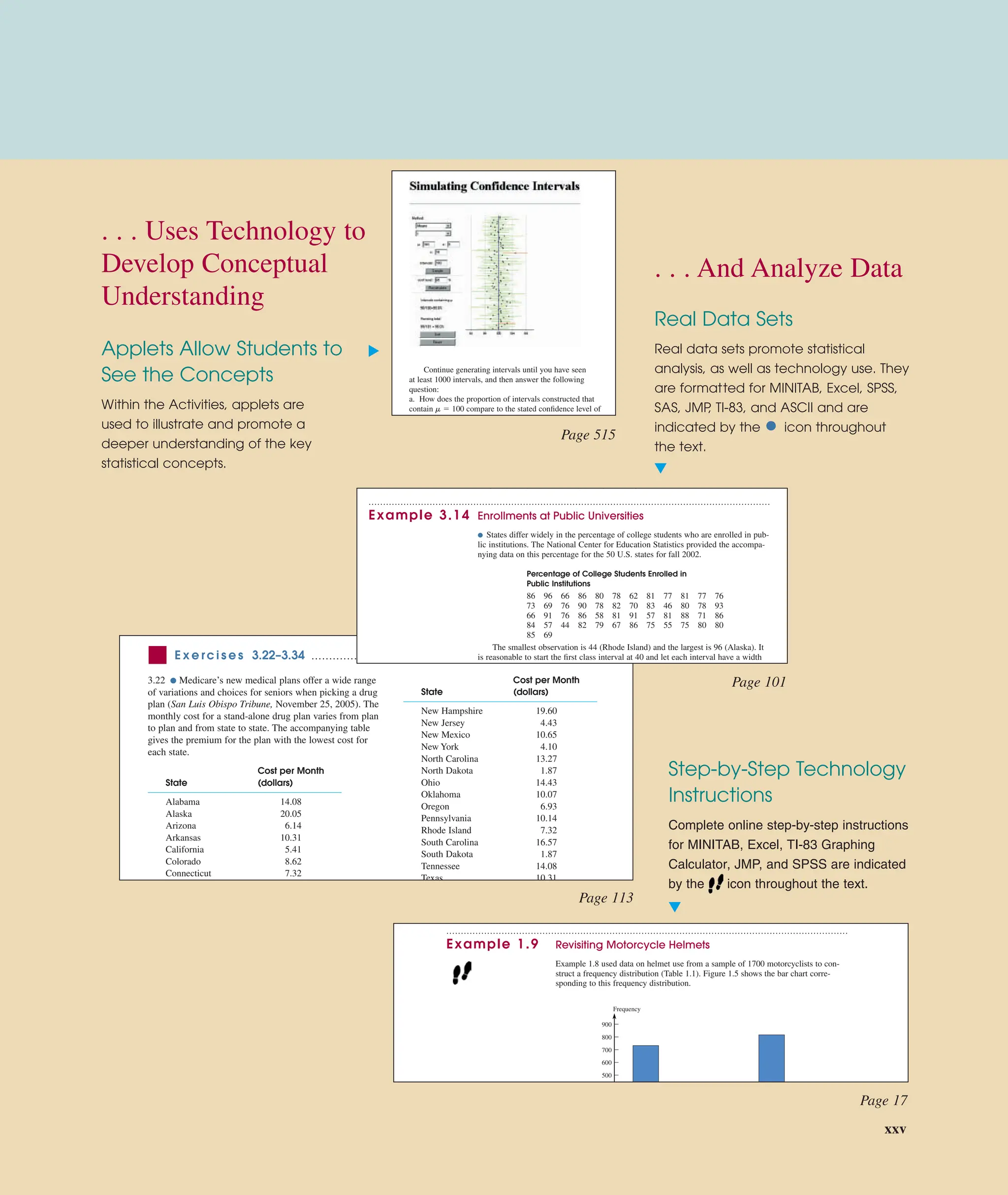
Real data sets promote statistical
analysis, as well as technology use. They
are formatted for MINITAB, Excel, SPSS,
SAS, JMP
, TI-83, and ASCII and are
indicated by the icon throughout
the text.
Continue generating intervals until you have seen
at least 1000 intervals, and then answer the following
question:
a. How does the proportion of intervals constructed that
contain m  100 compare to the stated confidence level of
3.22 ● Medicare’s new medical plans offer a wide range
of variations and choices for seniors when picking a drug
plan (San Luis Obispo Tribune, November 25, 2005). The
monthly cost for a stand-alone drug plan varies from plan
to plan and from state to state. The accompanying table
gives the premium for the plan with the lowest cost for
each state.
Cost per Month
State (dollars)
Alabama 14.08
Alaska 20.05
Arizona 6.14
Arkansas 10.31
California 5.41
Colorado 8.62
Connecticut 7.32
Cost per Month
State (dollars)
New Hampshire 19.60
New Jersey 4.43
New Mexico 10.65
New York 4.10
North Carolina 13.27
North Dakota 1.87
Ohio 14.43
Oklahoma 10.07
Oregon 6.93
Pennsylvania 10.14
Rhode Island 7.32
South Carolina 16.57
South Dakota 1.87
Tennessee 14.08
Texas 10.31
■ E x e rc i s e s 3.22–3.34 ...........................................................................................
27.0 would then fall in the class 27.0 to 27.5.
..........................................................................................................................................
Example 3.14 Enrollments at Public Universities
● States differ widely in the percentage of college students who are enrolled in pub-
lic institutions. The National Center for Education Statistics provided the accompa-
nying data on this percentage for the 50 U.S. states for fall 2002.
Percentage of College Students Enrolled in
Public Institutions
86 96 66 86 80 78 62 81 77 81 77 76
73 69 76 90 78 82 70 83 46 80 78 93
66 91 76 86 58 81 91 57 81 88 71 86
84 57 44 82 79 67 86 75 55 75 80 80
85 69
The smallest observation is 44 (Rhode Island) and the largest is 96 (Alaska). It
is reasonable to start the first class interval at 40 and let each interval have a width
..........................................................................................................................................
Example 1.9 Revisiting Motorcycle Helmets
Example 1.8 used data on helmet use from a sample of 1700 motorcyclists to con-
struct a frequency distribution (Table 1.1). Figure 1.5 shows the bar chart corre-
sponding to this frequency distribution.
500
600
700
800
900
Frequency
▲
▲
●
Page 515
Page 113
Page 17
Step-by-Step Technology
Instructions
Complete online step-by-step instructions
for MINITAB, Excel, TI-83 Graphing
Calculator, JMP, and SPSS are indicated
by the icon throughout the text.
▲
Page 101
xxv
Evaluate as You Teach
Using Clickers
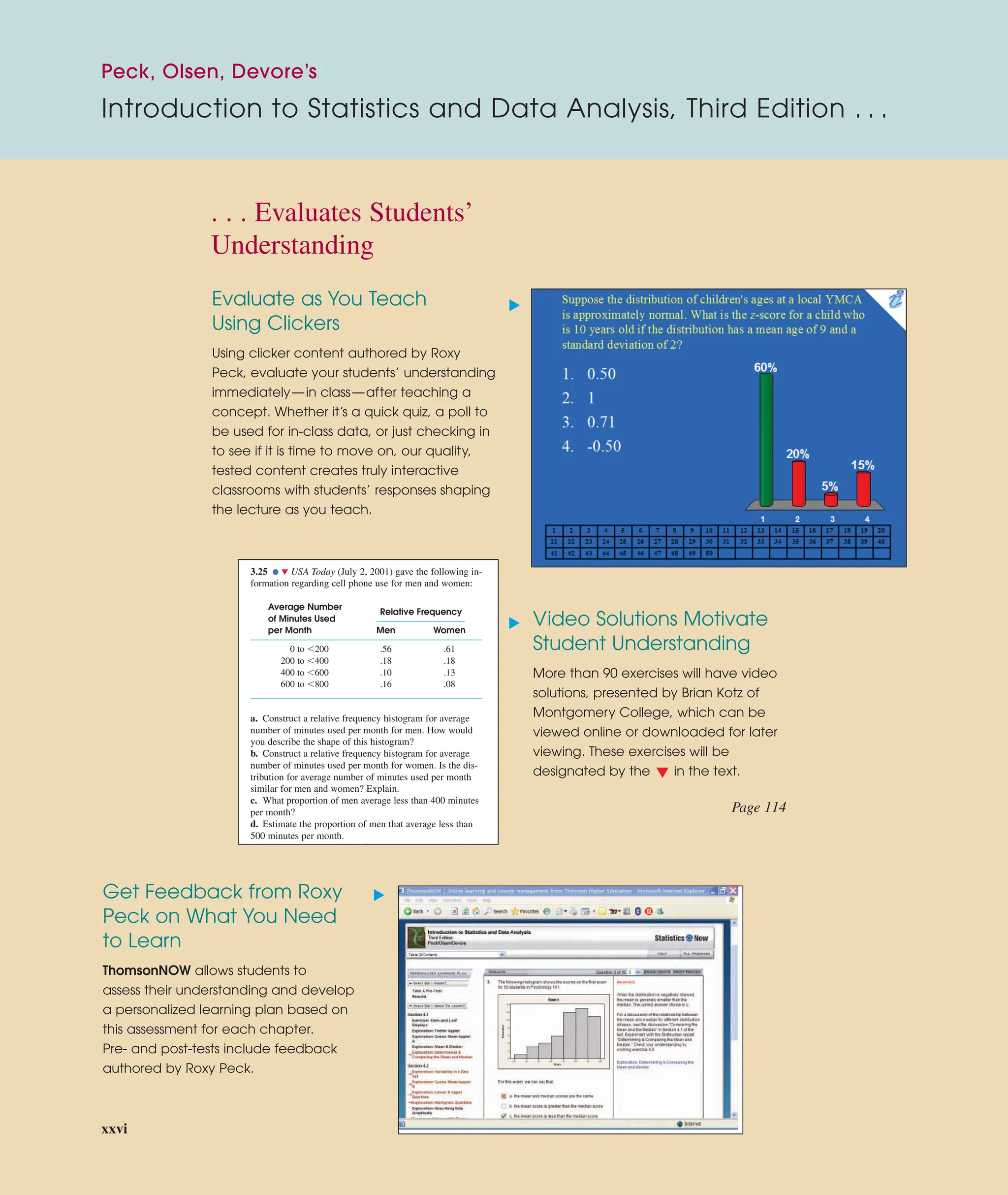
Using clicker content authored by Roxy
Peck, evaluate your students’ understanding
immediately—in class—after teaching a
concept. Whether it’s a quick quiz, a poll to
be used for in-class data, or just checking in
to see if it is time to move on, our quality,
tested content creates truly interactive
classrooms with students’ responses shaping
the lecture as you teach.
Video Solutions Motivate
Student Understanding
More than 90 exercises will have video
solutions, presented by Brian Kotz of
Montgomery College, which can be
viewed online or downloaded for later
viewing. These exercises will be
designated by the in the text.
Get Feedback from Roxy
Peck on What You Need
to Learn
ThomsonNOW allows students to
assess their understanding and develop
a personalized learning plan based on
this assessment for each chapter.
Pre- and post-tests include feedback
authored by Roxy Peck.
3.25 ● ▼ USA Today (July 2, 2001) gave the following in-
formation regarding cell phone use for men and women:
Average Number
of Minutes Used
Relative Frequency
per Month Men Women
0 to 200 .56 .61
200 to 400 .18 .18
400 to 600 .10 .13
600 to 800 .16 .08
a. Construct a relative frequency histogram for average
number of minutes used per month for men. How would
you describe the shape of this histogram?
b. Construct a relative frequency histogram for average
number of minutes used per month for women. Is the dis-
tribution for average number of minutes used per month
similar for men and women? Explain.
c. What proportion of men average less than 400 minutes
per month?
d. Estimate the proportion of men that average less than
500 minutes per month.
E i h i f h 450
▲
▲
▲
▲
Page 114
. . . Evaluates Students’
Understanding
Peck, Olsen, Devore’s
Introduction to Statistics and Data Analysis, Third Edition . . .
xxvi
Resources for Instructors*
PRINT
Annotated Instructor’s Edition
(0-495-11888-5)
Instructor’s Solutions Manual
(0-495-11879-6)
Instructor’s Resource Binder
(0-495-11892-3)
Test Bank (0-495-11880-X)
Activities Workbook (0-495-11883-4)
MEDIA
Enhanced WebAssign
(0-495-10963-0)
ThomsonNOW ™ Homework
(0-495-39230-8)
ExamView ® Computerized Testing
(0-495-11886-9)
JoinIn™ on TurningPoint ®
(0-495-11881-8)
Resources for Students*
AVAILABLE ONLINE
■ ThomsonNOW ™ Personalized
Study.
■ Step-by-step instructions for MINITAB, Excel, TI-83
Graphing Calculator, JMP
, and SPSS.
■ Data sets formatted for MINITAB, Excel, SPSS,
SAS, JMP
, TI-83, and ASCII.
■ Video solutions.
■ Applets used in the Activities.
PRINT
Student Solutions Manual
(0-495-11876-1)
Activities Workbook
(0-495-11883-4)
MEDIA
ThomsonNOW ™ Homework
(0-495-39230-8)
* See the full preface for complete descriptions.
xxvii
This page intentionally left blank
1
C h a p t e r 1
The Role of Statistics
and the Data Analysis
Process
Improve your understanding and save time! Visit http://www.thomsonedu.com/login where you will find:
■ Step-by-step instructions for MINITAB, Excel, TI-83, SPSS,
and JMP
■ Video solutions to selected exercises
■ Data sets available for selected examples and exercises
■ Exam-prep pre-tests that build a Personalized Learning
Plan based on your results so that you know exactly
what to study
■ Help from a live statistics tutor 24 hours a day
We encounter data and conclusions based on data every day. Statistics is the sci-
entific discipline that provides methods to help us make sense of data. Some people
are suspicious of conclusions based on statistical analyses. Extreme skeptics, usually
speaking out of ignorance, characterize the discipline as a subcategory of lying—
something used for deception rather than for positive ends. However, we believe that
statistical methods, used intelligently, offer a set of powerful tools for gaining insight
into the world around us. Statistical methods are used in business, medicine, agricul-
ture, social sciences, natural sciences, and applied sciences, such as engineering. The
widespread use of statistical analyses in diverse fields has led to increased recognition
that statistical literacy—a familiarity with the goals and methods of statistics—should
be a basic component of a well-rounded educational program.
The field of statistics teaches us how to make intelligent judgments and informed
decisions in the presence of uncertainty and variation. In this chapter, we consider the
nature and role of variability in statistical settings, introduce some basic terminology,
and look at some simple graphical displays for summarizing data.
........................................................................................................................................
1.1 Three Reasons to Study Statistics
Because statistical methods are used to organize, summarize, and draw conclusions
from data, a familiarity with statistical techniques and statistical literacy is vital in to-
day’s society. Everyone needs to have a basic understanding of statistics, and many
©
2006
Jupiterimages/Brand
x
Pictures/trbphoto
college majors require at least one course in statistics. There are three important rea-
sons why statistical literacy is important: (1) to be informed, (2) to understand issues
and be able to make sound decisions based on data, and (3) to be able to evaluate de-
cisions that affect your life. Let’s explore each reason in detail.
■ The First Reason: Being Informed ....................................................................
How do we decide whether claims based on numerical information are reasonable?
We are bombarded daily with numerical information in news, in advertisements, and
even in conversation. For example, here are a few of the items employing statistical
methods that were part of just two weeks’ news.
■ The increasing popularity of online shopping has many consumers using Internet
access at work to browse and shop online. In fact, the Monday after Thanksgiving
has been nicknamed “Cyber Monday” because of the large increase in online pur-
chases that occurs on that day. Data from a large-scale survey conducted in early
November, 2005, by a market research firm was used to compute estimates of the
percent of men and women who shop online while at work. The resulting esti-
mates probably won’t make most employers happy—42% of the men and 32% of
the women in the sample were shopping online at work! (Detroit Free Press and
San Luis Obispo Tribune, November 26, 2005)
■ A story in the New York Times titled “Students Ace State Tests, but Earn D’s From
U.S.” investigated discrepancies between state and federal standardized test re-
sults. When researchers compared state test results to the most recent results on
the National Assessment of Educational Progress (NAEP), they found that large
differences were common. For example, one state reported 89% of fourth graders
were proficient in reading based on the state test, while only 18% of fourth graders
in that state were considered proficient in reading on the federal test! An explana-
tion of these large discrepancies and potential consequences was discussed. (New
York Times, November 26, 2005)
■ Can dogs help patients with heart failure by reducing stress and anxiety? One of
the first scientific studies of the effect of therapeutic dogs found that a measure of
anxiety decreased by 24% for heart patients visited by a volunteer and dog, but
only by 10% for patients visited by just the volunteer. Decreases were also noted
in measures of stress and heart and lung pressure, leading researchers to conclude
that the use of therapeutic dogs is beneficial in the treatment of heart patients. (San
Luis Obispo Tribune, November 16, 2005)
■ Late in 2005, those eligible for Medicare had to decide which, if any, of the many
complex new prescription medication plans was right for them. To assist with this
decision, a program called PlanFinder that compares available options was made
available online. But are seniors online? Based on a survey conducted by the Los
Angeles Times, it was estimated that the percentage of senior citizens that go on-
line is only between 23% and 30%, causing concern over whether providing only
an online comparison is an effective way to assist seniors with this important de-
cision. (Los Angeles Times, November 27, 2005)
■ Are kids ruder today than in the past? An article titled “Kids Gone Wild” sum-
marized data from a survey conducted by the Associated Press. Nearly 70% of
those who participated in the survey said that people were ruder now than 20 years
ago, with kids being the biggest offenders. As evidence that this is a serious prob-
lem, the author of the article also referenced a 2004 study conducted by Public
Agenda, a public opinion research group. That study indicated that more than
2 C h a p t e r 1 ■ The Role of Statistics and the Data Analysis Process
one third of teachers had either seriously considered leaving teaching or knew a
colleague who left because of intolerable student behavior. (New York Times,
November 27, 2005)
■ When people take a vacation, do they really leave work behind? Data from a poll
conducted by Travelocity led to the following estimates: Approximately 40% of
travelers check work email while on vacation, about 33% take cell phones on va-
cation in order to stay connected with work, and about 25% bring a laptop com-
puter on vacation. The travel industry is paying attention—hotels, resorts, and
even cruise ships are now making it easier for “vacationers” to stay connected to
work. (San Luis Obispo Tribune, December 1, 2005)
■ How common is domestic violence? Based on interviews with 24,000 women in
10 different countries, a study conducted by the World Health Organization found
that the percentage of women who have been abused by a partner varied widely—
from 15% of women in Japan to 71% of women in Ethiopia. Even though the do-
mestic violence rate differed dramatically from country to country, in all of the
countries studied women who were victims of domestic violence were about
twice as likely as other women to be in poor health, even long after the violence
had stopped. (San Francisco Chronicle, November 25, 2005)
■ Does it matter how long children are bottle-fed? Based on a study of 2121 chil-
dren between the ages of 1 and 4, researchers at the Medical College of Wiscon-
sin concluded that there was an association between iron deficiency and the length
of time that a child is bottle-fed. They found that children who were bottle-fed
between the ages of 2 and 4 were three times more likely to be iron deficient than
those who stopped by the time they were 1 year old. (Milwaukee Journal Sentinel
and San Luis Obispo Tribune, November 26, 2005)
■ Parental involvement in schools is often regarded as an important factor in student
achievement. However, data from a study of low-income public schools in Cali-
fornia led researchers to conclude that other factors, such as prioritizing student
achievement, encouraging teacher collaboration and professional development,
and using assessment data to improve instruction, had a much greater impact on
the schools’ Academic Performance Index. (Washington Post and San Francisco
Chronicle, November 26, 2005)
To be an informed consumer of reports such as those described above, you must be
able to do the following:
1. Extract information from tables, charts, and graphs.
2. Follow numerical arguments.
3. Understand the basics of how data should be gathered, summarized, and analyzed
to draw statistical conclusions.
Your statistics course will help prepare you to perform these tasks.
■ The Second Reason: Making Informed Judgments .....................................
Throughout your personal and professional life, you will need to understand statisti-
cal information and make informed decisions using this information. To make these
decisions, you must be able to do the following:
1. Decide whether existing information is adequate or whether additional information
is required.
2. If necessary, collect more information in a reasonable and thoughtful way.
3. Summarize the available data in a useful and informative manner.
1.1 ■ Three Reasons to Study Statistics 3
4. Analyze the available data.
5. Draw conclusions, make decisions, and assess the risk of an incorrect decision.
People informally use these steps to make everyday decisions. Should you go out for
a sport that involves the risk of injury? Will your college club do better by trying to
raise funds with a benefit concert or with a direct appeal for donations? If you choose
a particular major, what are your chances of finding a job when you graduate? How
should you select a graduate program based on guidebook ratings that include infor-
mation on percentage of applicants accepted, time to obtain a degree, and so on? The
study of statistics formalizes the process of making decisions based on data and pro-
vides the tools for accomplishing the steps listed.
■ The Third Reason: Evaluating Decisions That Affect Your Life ......................
While you will need to make informed decisions based on data, it is also the case that
other people will use statistical methods to make decisions that affect you as an indi-
vidual. An understanding of statistical techniques will allow you to question and eval-
uate decisions that affect your well-being. Some examples are:
■ Many companies now require drug screening as a condition of employment. With
these screening tests there is a risk of a false-positive reading (incorrectly indicat-
ing drug use) or a false-negative reading (failure to detect drug use). What are the
consequences of a false result? Given the consequences, is the risk of a false re-
sult acceptable?
■ Medical researchers use statistical methods to make recommendations regarding
the choice between surgical and nonsurgical treatment of such diseases as coro-
nary heart disease and cancer. How do they weigh the risks and benefits to reach
such a recommendation?
■ University financial aid offices survey students on the cost of going to school and
collect data on family income, savings, and expenses. The resulting data are used
to set criteria for deciding who receives financial aid. Are the estimates they use
accurate?
■ Insurance companies use statistical techniques to set auto insurance rates, al-
though some states restrict the use of these techniques. Data suggest that young
drivers have more accidents than older ones. Should laws or regulations limit how
much more young drivers pay for insurance? What about the common practice of
charging higher rates for people who live in urban areas?
An understanding of elementary statistical methods can help you to evaluate
whether important decisions such as the ones just mentioned are being made in a rea-
sonable way.
We hope that this textbook will help you to understand the logic behind statistical
reasoning, prepare you to apply statistical methods appropriately, and enable you to
recognize when statistical arguments are faulty.
........................................................................................................................................
1.2 The Nature and Role of Variability
Statistics is a science whose focus is on collecting, analyzing, and drawing conclusions
from data. If we lived in a world where all measurements were identical for every in-
dividual, all three of these tasks would be simple. Imagine a population consisting of
4 C h a p t e r 1 ■ The Role of Statistics and the Data Analysis Process
all students at a particular university. Suppose that every student took the same num-
ber of units, spent exactly the same amount of money on textbooks this semester, and
favored increasing student fees to support expanding library services. For this popula-
tion, there is no variability in the number of units, amount spent on books, or student
opinion on the fee increase. A researcher studying a sample from this population to
draw conclusions about these three variables would have a particularly easy task. It
would not matter how many students the researcher included in the sample or how the
sampled students were selected. In fact, the researcher could collect information on
number of units, amount spent on books, and opinion on the fee increase by just stop-
ping the next student who happened to walk by the library. Because there is no vari-
ability in the population, this one individual would provide complete and accurate in-
formation about the population, and the researcher could draw conclusions based on
the sample with no risk of error.
The situation just described is obviously unrealistic. Populations with no variabil-
ity are exceedingly rare, and they are of little statistical interest because they present
no challenge! In fact, variability is almost universal. It is variability that makes life
(and the life of a statistician, in particular) interesting. We need to understand vari-
ability to be able to collect, analyze, and draw conclusions from data in a sensible way.
One of the primary uses of descriptive statistical methods is to increase our under-
standing of the nature of variability in a population.
Examples 1.1 and 1.2 illustrate how an understanding of variability is necessary
to draw conclusions based on data.
..........................................................................................................................................
Example 1.1 If the Shoe Fits
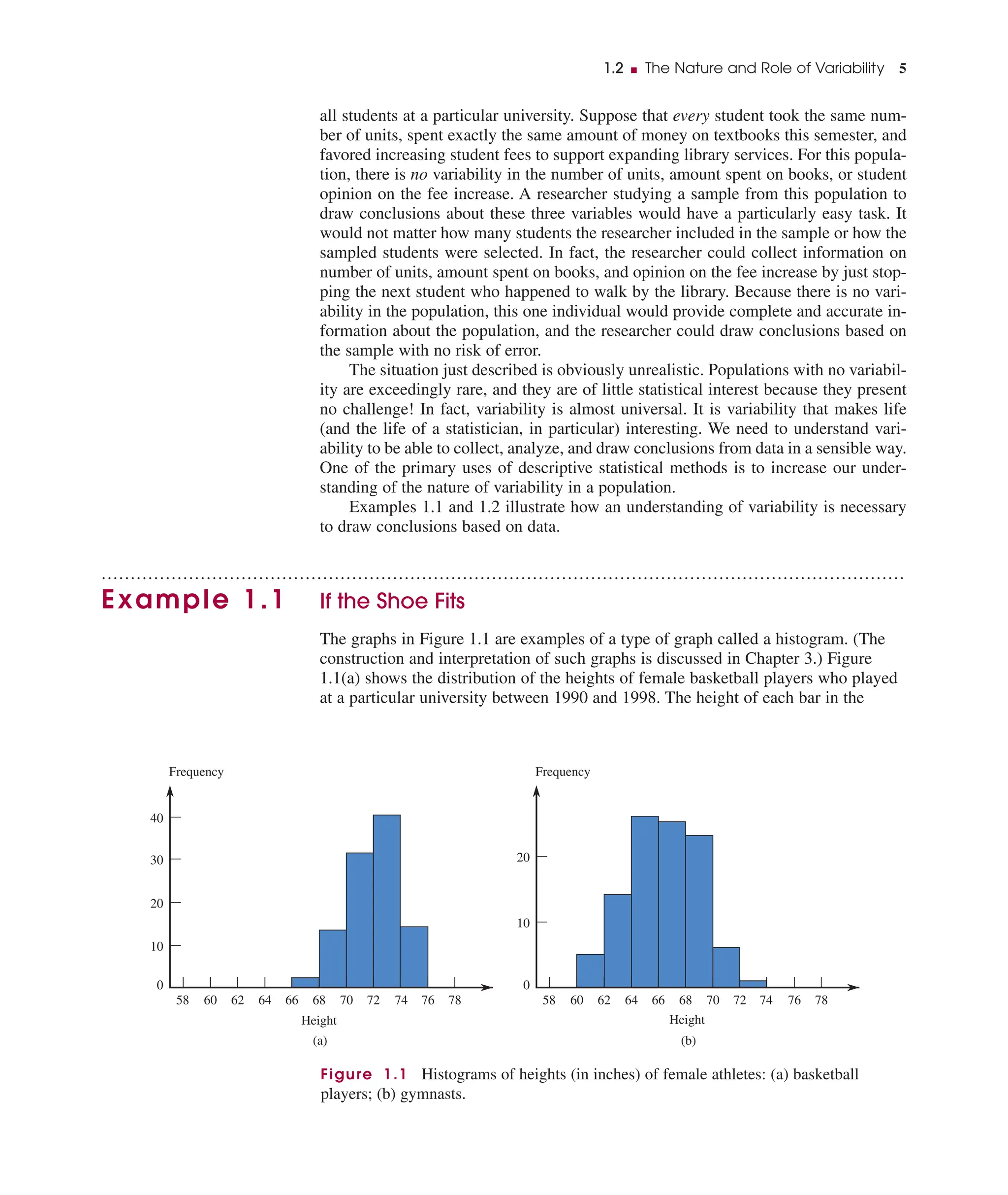
The graphs in Figure 1.1 are examples of a type of graph called a histogram. (The
construction and interpretation of such graphs is discussed in Chapter 3.) Figure
1.1(a) shows the distribution of the heights of female basketball players who played
at a particular university between 1990 and 1998. The height of each bar in the
1.2 ■ The Nature and Role of Variability 5
74
10
20
0
60
58 62 64 66 68 70 72 76 78
Height
Frequency
(b)
74
10
20
30
40
0
60
58 62 64 66 68 70 72 76 78
Height
Frequency
(a)
Figure 1.1 Histograms of heights (in inches) of female athletes: (a) basketball
players; (b) gymnasts.
graph indicates how many players’ heights were in the corresponding interval. For
example, 40 basketball players had heights between 72 in. and 74 in., whereas only
2 players had heights between 66 in. and 68 in. Figure 1.1(b) shows the distribution
of heights for members of the women’s gymnastics team over the same period. Both
histograms are based on the heights of 100 women.
The first histogram shows that the heights of female basketball players varied,
with most heights falling between 68 in. and 76 in. In the second histogram we see
that the heights of female gymnasts also varied, with most heights in the range of
60 in. to 72 in. It is also clear that there is more variation in the heights of the gym-
nasts than in the heights of the basketball players, because the gymnast histogram
spreads out more about its center than does the basketball histogram.
Now suppose that a tall woman (5 ft 11 in.) tells you she is looking for her sister
who is practicing with her team at the gym. Would you direct her to where the bas-
ketball team is practicing or to where the gymnastics team is practicing? What rea-
soning would you use to decide? If you found a pair of size 6 shoes left in the locker
room, would you first try to return them by checking with members of the basketball
team or the gymnastics team?
You probably answered that you would send the woman looking for her sister
to the basketball practice and that you would try to return the shoes to a gymnastics
team member. To reach these conclusions, you informally used statistical reasoning
that combined your own knowledge of the relationship between heights of siblings
and between shoe size and height with the information about the distributions of
heights presented in Figure 1.1. You might have reasoned that heights of siblings
tend to be similar and that a height as great as 5 ft 11 in., although not impossible,
would be unusual for a gymnast. On the other hand, a height as tall as 5 ft 11 in.
would be a common occurrence for a basketball player. Similarly, you might have
reasoned that tall people tend to have bigger feet and that short people tend to have
smaller feet. The shoes found were a small size, so it is more likely that they belong
to a gymnast than to a basketball player, because small heights and small feet are
usual for gymnasts and unusual for basketball players.
■
..........................................................................................................................................
Example 1.2 Monitoring Water Quality
As part of its regular water quality monitoring efforts, an environmental control
board selects five water specimens from a particular well each day. The concentra-
tion of contaminants in parts per million (ppm) is measured for each of the five
specimens, and then the average of the five measurements is calculated. The his-
togram in Figure 1.2 summarizes the average contamination values for 200 days.
Now suppose that a chemical spill has occurred at a manufacturing plant 1 mile
from the well. It is not known whether a spill of this nature would contaminate
groundwater in the area of the spill and, if so, whether a spill this distance from the
well would affect the quality of well water.
One month after the spill, five water specimens are collected from the well, and
the average contamination is 15.5 ppm. Considering the variation before the spill,
would you take this as convincing evidence that the well water was affected by the
spill? What if the calculated average was 17.4 ppm? 22.0 ppm? How is your reason-
ing related to the graph in Figure 1.2?
6 C h a p t e r 1 ■ The Role of Statistics and the Data Analysis Process
©
David
Chasey/Getty
Images
Before the spill, the average contaminant concentration varied from day to day.
An average of 15.5 ppm would not have been an unusual value, so seeing an average
of 15.5 ppm after the spill isn’t necessarily an indication that contamination has in-
creased. On the other hand, an average as large as 17.4 ppm is less common, and an
average as large as 22.0 ppm is not at all typical of the prespill values. In this case,
we would probably conclude that the well contamination level has increased.
■
In these two examples, reaching a conclusion required an understanding of vari-
ability. Understanding variability allows us to distinguish between usual and unusual
values. The ability to recognize unusual values in the presence of variability is the key
to most statistical procedures and is also what enables us to quantify the chance of be-
ing incorrect when a conclusion is based on sample data. These concepts will be de-
veloped further in subsequent chapters.
........................................................................................................................................
1.3 Statistics and the Data Analysis Process
Data and conclusions based on data appear regularly in a variety of settings: newspa-
pers, television and radio advertisements, magazines, and professional publications. In
business, industry, and government, informed decisions are often data driven. Statisti-
cal methods, used appropriately, allow us to draw reliable conclusions based on data.
Once data have been collected or once an appropriate data source has been iden-
tified, the next step in the data analysis process usually involves organizing and sum-
marizing the information. Tables, graphs, and numerical summaries allow increased
understanding and provide an effective way to present data. Methods for organizing
and summarizing data make up the branch of statistics called descriptive statistics.
After the data have been summarized, we often wish to draw conclusions or make
decisions based on the data. This usually involves generalizing from a small group of
individuals or objects that we have studied to a much larger group.
For example, the admissions director at a large university might be interested in
learning why some applicants who were accepted for the fall 2006 term failed to enroll
1.3 ■ Statistics and the Data Analysis Process 7
18
10
40
20
30
0
11
10 12 13 14 15 16 17 19
Average contamination
Frequency
Figure 1.2 Frequency of
contaminant concentration
(in parts per million) in
well water.
at the university. The population of interest to the director consists of all accepted ap-
plicants who did not enroll in the fall 2006 term. Because this population is large and
it may be difficult to contact all the individuals, the director might decide to collect
data from only 300 selected students. These 300 students constitute a sample.
The second major branch of statistics, inferential statistics, involves generalizing
from a sample to the population from which it was selected. When we generalize in this
way, we run the risk of an incorrect conclusion, because a conclusion about the popula-
tion is based on incomplete information. An important aspect in the development of in-
ferential techniques involves quantifying the chance of an incorrect conclusion.
■ The Data Analysis Process ................................................................................
Statistics involves the collection and analysis of data. Both tasks are critical. Raw data
without analysis are of little value, and even a sophisticated analysis cannot extract
meaningful information from data that were not collected in a sensible way.
■ Planning and Conducting a Statistical Study Scientific studies are undertaken to
answer questions about our world. Is a new flu vaccine effective in preventing illness?
Is the use of bicycle helmets on the rise? Are injuries that result from bicycle accidents
less severe for riders who wear helmets than for those who do not? How many credit
cards do college students have? Do engineering students pay more for textbooks than
do psychology students? Data collection and analysis allow researchers to answer
such questions.
The data analysis process can be viewed as a sequence of steps that lead from
planning to data collection to informed conclusions based on the resulting data. The
process can be organized into the following six steps:
1. Understanding the nature of the problem. Effective data analysis requires an un-
derstanding of the research problem. We must know the goal of the research and
what questions we hope to answer. It is important to have a clear direction before
gathering data to lessen the chance of being unable to answer the questions of in-
terest using the data collected.
2. Deciding what to measure and how to measure it. The next step in the process is
deciding what information is needed to answer the questions of interest. In some
D E F I N I T I O N
Descriptive statistics is the branch of statistics that includes methods for
organizing and summarizing data. Inferential statistics is the branch of sta-
tistics that involves generalizing from a sample to the population from which
it was selected and assessing the reliability of such generalizations.
D E F I N I T I O N
The entire collection of individuals or objects about which information is
desired is called the population of interest. A sample is a subset of the pop-
ulation, selected for study in some prescribed manner.
8 C h a p t e r 1 ■ The Role of Statistics and the Data Analysis Process
cases, the choice is obvious (e.g., in a study of the relationship between the weight
of a Division I football player and position played, you would need to collect data on
player weight and position), but in other cases the choice of information is not as
straightforward (e.g., in a study of the relationship between preferred learning style
and intelligence, how would you define learning style and measure it and what mea-
sure of intelligence would you use?). It is important to carefully define the variables
to be studied and to develop appropriate methods for determining their values.
3. Data collection. The data collection step is crucial. The researcher must first decide
whether an existing data source is adequate or whether new data must be collected.
Even if a decision is made to use existing data, it is important to understand how the
data were collected and for what purpose, so that any resulting limitations are also
fully understood and judged to be acceptable. If new data are to be collected, a care-
ful plan must be developed, because the type of analysis that is appropriate and the
subsequent conclusions that can be drawn depend on how the data are collected.
4. Data summarization and preliminary analysis. After the data are collected, the
next step usually involves a preliminary analysis that includes summarizing the
data graphically and numerically. This initial analysis provides insight into impor-
tant characteristics of the data and can provide guidance in selecting appropriate
methods for further analysis.
5. Formal data analysis. The data analysis step requires the researcher to select and
apply the appropriate inferential statistical methods. Much of this textbook is de-
voted to methods that can be used to carry out this step.
6. Interpretation of results. Several questions should be addressed in this final
step—for example, What conclusions can be drawn from the analysis? How do the
results of the analysis inform us about the stated research problem or question? and
How can our results guide future research? The interpretation step often leads to
the formulation of new research questions, which, in turn, leads back to the first
step. In this way, good data analysis is often an iterative process.
Example 1.3 illustrates the steps in the data analysis process.
..........................................................................................................................................
Example 1.3 A Proposed New Treatment for Alzheimer’s Disease
The article “Brain Shunt Tested to Treat Alzheimer’s” (San Francisco Chronicle,
October 23, 2002) summarizes the findings of a study that appeared in the journal
Neurology. Doctors at Stanford Medical Center were interested in determining
whether a new surgical approach to treating Alzheimer’s disease results in improved
memory functioning. The surgical procedure involves implanting a thin tube, called
a shunt, which is designed to drain toxins from the fluid-filled space that cushions
the brain. Eleven patients had shunts implanted and were followed for a year, receiv-
ing quarterly tests of memory function. Another sample of Alzheimer’s patients was
used as a comparison group. Those in the comparison group received the standard
care for Alzheimer’s disease. After analyzing the data from this study, the investiga-
tors concluded that the “results suggested the treated patients essentially held their
own in the cognitive tests while the patients in the control group steadily declined.
However, the study was too small to produce conclusive statistical evidence.” Based
on these results, a much larger 18-month study was planned. That study was to in-
clude 256 patients at 25 medical centers around the country.
This study illustrates the nature of the data analysis process. A clearly defined
research question and an appropriate choice of how to measure the variable of
1.3 ■ Statistics and the Data Analysis Process 9
interest (the cognitive tests used to measure memory function) preceded the data col-
lection. Assuming that a reasonable method was used to collect the data (we will see
how this can be evaluated in Chapter 2) and that appropriate methods of analysis
were employed, the investigators reached the conclusion that the surgical procedure
showed promise. However, they recognized the limitations of the study, especially
those resulting from the small number of patients in the group that received surgical
treatment, which in turn led to the design of a larger, more sophisticated study.
As is often the case, the data analysis cycle led to further research, and the process
began anew.
■
■ Evaluating a Research Study The six data analysis steps can also be used as a
guide for evaluating published research studies. The following questions should be ad-
dressed as part of a study evaluation:
■ What were the researchers trying to learn? What questions motivated their
research?
■ Was relevant information collected? Were the right things measured?
■ Were the data collected in a sensible way?
■ Were the data summarized in an appropriate way?
■ Was an appropriate method of analysis used, given the type of data and how the
data were collected?
■ Are the conclusions drawn by the researchers supported by the data analysis?
Example 1.4 illustrates how these questions can guide an evaluation of a research study.
..........................................................................................................................................
Example 1.4 Spray Away the Flu
The newspaper article “Spray Away Flu” (Omaha World-Herald, June 8, 1998) re-
ported on a study of the effectiveness of a new flu vaccine that is administered by
nasal spray rather than by injection. The article states that the “researchers gave the
spray to 1070 healthy children, 15 months to 6 years old, before the flu season two
winters ago. One percent developed confirmed influenza, compared with 18 percent
of the 532 children who received a placebo. And only one vaccinated child devel-
oped an ear infection after coming down with influenza. . . . Typically 30 percent to
40 percent of children with influenza later develop an ear infection.” The researchers
concluded that the nasal flu vaccine was effective in reducing the incidence of flu
and also in reducing the number of children with flu who subsequently develop ear
infections.
The researchers here were trying to find out whether the nasal flu vaccine was
effective in reducing the number of flu cases and in reducing the number of ear in-
fections in children who did get the flu. They recorded whether a child received the
nasal vaccine or a placebo. (A placebo is a treatment that is identical in appearance
to the treatment of interest but contains no active ingredients.) Whether or not the
child developed the flu and a subsequent ear infection was also noted. These are ap-
propriate determinations to make in order to answer the research question of interest.
We typically cannot tell much about the data collection process from a newspaper
article. As we will see in Section 2.3, to fully evaluate this study, we would also
want to know how the participating children were selected, how it was determined
10 C h a p t e r 1 ■ The Role of Statistics and the Data Analysis Process
■ E x e rc i s e s 1.1–1.9
1.1 Give a brief definition of the terms descriptive statis-
tics and inferential statistics.
1.2 Give a brief definition of the terms population and
sample.
1.3 Data from a poll conducted by Travelocity led to the
following estimates: Approximately 40% of travelers
check work email while on vacation, about 33% take cell
phones on vacation in order to stay connected with work,
and about 25% bring a laptop computer on vacation
(San Luis Obispo Tribune, December 1, 2005). Are the
given percentages population values or were they com-
puted from a sample?
1.4 Based on a study of 2121 children between the ages
of one and four, researchers at the Medical College of
Wisconsin concluded that there was an association be-
tween iron deficiency and the length of time that a child is
bottle-fed (Milwaukee Journal Sentinel, November 26,
2005). Describe the sample and the population of interest
for this study.
1.5 The student senate at a university with 15,000 stu-
dents is interested in the proportion of students who favor
a change in the grading system to allow for plus and mi-
nus grades (e.g., B, B, B, rather than just B). Two
hundred students are interviewed to determine their atti-
tude toward this proposed change. What is the population
of interest? What group of students constitutes the sample
in this problem?
1.6 The supervisors of a rural county are interested in the
proportion of property owners who support the construc-
tion of a sewer system. Because it is too costly to contact
all 7000 property owners, a survey of 500 owners (se-
lected at random) is undertaken. Describe the population
and sample for this problem.
1.7 ▼ Representatives of the insurance industry wished to
investigate the monetary loss resulting from earthquake
damage to single-family dwellings in Northridge, Califor-
nia, in January 1994. From the set of all single-family
homes in Northridge, 100 homes were selected for
inspection. Describe the population and sample for this
problem.
1.8 A consumer group conducts crash tests of new model
cars. To determine the severity of damage to 2006 Mazda
6s resulting from a 10-mph crash into a concrete wall, the
research group tests six cars of this type and assesses the
amount of damage. Describe the population and sample
for this problem.
1.9 A building contractor has a chance to buy an odd
lot of 5000 used bricks at an auction. She is interested
in determining the proportion of bricks in the lot that are
cracked and therefore unusable for her current project, but
she does not have enough time to inspect all 5000 bricks.
Instead, she checks 100 bricks to determine whether each
is cracked. Describe the population and sample for this
problem.
1.3 ■ Statistics and the Data Analysis Process 11
that a particular child received the vaccine or the placebo, and how the subsequent
diagnoses of flu and ear infection were made.
We will also have to delay discussion of the data analysis and the appropriate-
ness of the conclusions because we do not yet have the necessary tools to evaluate
these aspects of the study.
■
Many other interesting examples of statistical studies can be found in Statistics: A
Guide to the Unknown and in Forty Studies That Changed Psychology: Exploration
into the History of Psychological Research (the complete references for these two
books can be found in the back of the book).
.................................................................................................................
Bold exercises answered in back ● Data set available online but not required ▼ Video solution available
........................................................................................................................................
1.4 Types of Data and Some Simple Graphical Displays
Every discipline has its own particular way of using common words, and statistics is
no exception.You will recognize some of the terminology from previous math and sci-
ence courses, but much of the language of statistics will be new to you.
■ Describing Data .................................................................................................
The individuals or objects in any particular population typically possess many char-
acteristics that might be studied. Consider a group of students currently enrolled in a
statistics course. One characteristic of the students in the population is the brand of
calculator owned (Casio, Hewlett-Packard, Sharp, Texas Instruments, and so on). An-
other characteristic is the number of textbooks purchased that semester, and yet an-
other is the distance from the university to each student’s permanent residence. A vari-
able is any characteristic whose value may change from one individual or object to
another. For example, calculator brand is a variable, and so are number of textbooks
purchased and distance to the university. Data result from making observations either
on a single variable or simultaneously on two or more variables.
A univariate data set consists of observations on a single variable made on individ-
uals in a sample or population. There are two types of univariate data sets: categorical
and numerical. In the previous example, calculator brand is a categorical variable, be-
cause each student’s response to the query, “What brand of calculator do you own?” is
a category. The collection of responses from all these students forms a categorical data
set. The other two attributes, number of textbooks purchased and distance to the uni-
versity, are both numerical in nature. Determining the value of such a numerical vari-
able (by counting or measuring) for each student results in a numerical data set.
..........................................................................................................................................
Example 1.5 Airline Safety Violations
The Federal Aviation Administration (FAA) monitors airlines and can take adminis-
trative actions for safety violations. Information about the fines assessed by the FAA
appeared in the article “Just How Safe Is That Jet?” (USA Today, March 13, 2000).
Violations that could lead to a fine were categorized as Security (S), Maintenance (M),
Flight Operations (F), Hazardous Materials (H), or Other (O). Data for the variable
type of violation for 20 administrative actions are given in the following list (these
data are a subset of the data described in the article, but they are consistent with
summary values given in the paper; for a description of the full data set, see
Exercise 1.24):
S S M H M O S M S S
F S O M S M S M S M
D E F I N I T I O N
A data set consisting of observations on a single attribute is a univariate
data set. A univariate data set is categorical (or qualitative) if the individ-
ual observations are categorical responses. A univariate data set is numeri-
cal (or quantitative) if each observation is a number.
12 C h a p t e r 1 ■ The Role of Statistics and the Data Analysis Process
©
PhotoLink
/Getty
Images
1.4 ■ Types of Data and Some Simple Graphical Displays 13
● Data set available online
Because type of violation is a categorical (nonnumerical) response, this is a categori-
cal data set.
■
In Example 1.5, the data set consisted of observations on a single variable (type of
violation), so this is univariate data. In some studies, attention focuses simultaneously
on two different attributes. For example, both height (in inches) and weight (in pounds)
might be recorded for each individual in a group. The resulting data set consists of pairs
of numbers, such as (68, 146). This is called a bivariate data set. Multivariate data re-
sult from obtaining a category or value for each of two or more attributes (so bivariate
data are a special case of multivariate data). For example, multivariate data would result
from determining height, weight, pulse rate, and systolic blood pressure for each indi-
vidual in a group. Example 1.6 illustrates a bivariate data set.
..........................................................................................................................................
Example 1.6 Revisiting Airline Safety Violations
● The same article referenced in Example 1.5 (“Just How Safe Is That Jet?” USA
Today, March 13, 2000) gave data on both the number of violations and the average
fine per violation for the period 1985–1998 for 10 major airlines. The resulting bi-
variate data are given in the following table:
Number of Average Fine
Airline Violations per Violation ($)
Alaska 258 5038.760
America West 257 3112.840
American 1745 2693.410
Continental 973 5755.396
Delta 1280 3828.125
Northwest 1097 2643.573
Southwest 535 3925.234
TWA 642 2803.738
United 1110 2612.613
US Airways 891 3479.237
Each of the two variables considered here is numerical (rather than categorical).
■
■ Two Types of Numerical Data ..........................................................................
There are two different types of numerical data: discrete and continuous. Visualize a
number line (Figure 1.3) for locating values of the numerical variable being studied.
Each possible number (2, 3.125, 8.12976, etc.) corresponds to exactly one point on the
number line. Now suppose that the variable of interest is the number of cylinders of an
automobile engine. The possible values of 4, 6, and 8 are identified in Figure 1.4(a) by
the dots at the points marked 4, 6, and 8. These possible values are isolated from one an-
other on the line; around any possible value, we can place an interval that is small
enough that no other possible value is included in the interval. On the other hand, the
line segment in Figure 1.4(b) identifies a plausible set of possible values for the time it
takes a car to travel one-quarter mile. Here the possible values make up an entire inter-
val on the number line, and no possible value is isolated from the other possible values.
■
14 C h a p t e r 1 ■ The Role of Statistics and the Data Analysis Process
–3 –2 –1 0 1 2 3
Figure 1.3 A number
line.
Figure 1.4 Possible val-
ues of a variable: (a) num-
ber of cylinders; (b) quarter-
mile time.
0 2 4 6 8 0 5 10 15 20
(a) (b)
Discrete data usually arise when each observation is determined by counting (e.g.,
the number of classes for which a student is registered or the number of petals on a
certain type of flower).
..........................................................................................................................................
Example 1.7 Calls to a Drug Abuse Hotline
● The number of telephone calls per day to a drug abuse hotline is recorded for
12 days. The resulting data set is
3 0 4 3 1 0 6 2 0 0 1 2
Possible values for the variable number of calls are 0, 1, 2, 3, . . . ; these are
isolated points on the number line, so we have a sample consisting of discrete
numerical data.
■
The observations on the variable number of violations in Example 1.6 are also an
example of discrete numerical data. However, in the same example, the variable aver-
age fine per violation could be 3000, 3000.1, 3000.125, 3000.12476, or any other
value in an entire interval, so the observations on this variable provide an example of
continuous data. Other examples of continuous data result from determining task com-
pletion times, body temperatures, and package weights.
D E F I N I T I O N
A numerical variable results in discrete data if the possible values of the
variable correspond to isolated points on the number line. A numerical vari-
able results in continuous data if the set of possible values forms an entire
interval on the number line.
● Data set available online
In general, data are continuous when observations involve making measurements,
as opposed to counting. In practice, measuring instruments do not have infinite accu-
racy, so possible measured values, strictly speaking, do not form a continuum on the
number line. However, any number in the continuum could be a value of the variable.
The distinction between discrete and continuous data will be important in our discus-
sion of probability models.
■ Frequency Distributions and Bar Charts for Categorical Data ...................
An appropriate graphical or tabular display of data can be an effective way to sum-
marize and communicate information. When the data set is categorical, a common
way to present the data is in the form of a table, called a frequency distribution.
1.4 ■ Types of Data and Some Simple Graphical Displays 15
A frequency distribution for categorical data is a table that displays the possible categories
along with the associated frequencies and/or relative frequencies. The frequency for a particu-
lar category is the number of times the category appears in the data set. The relative frequency
for a particular category is the fraction or proportion of the observations resulting in the cate-
gory. It is calculated as
If the table includes relative frequencies, it is sometimes referred to as a relative frequency
distribution.
relative frequency 
frequency
number of observations in the data set
..........................................................................................................................................
Example 1.8 Motorcycle Helmets—Can You See Those Ears?
In 2003, the U.S. Department of Transportation established standards for motorcycle
helmets. To ensure a certain degree of safety, helmets should reach the bottom of the
motorcyclist’s ears. The report “Motorcycle Helmet Use in 2005—Overall Results”
(National Highway Traffic Safety Administration, August 2005) summarized data
collected in June of 2005 by observing 1700 motorcyclists nationwide at selected
roadway locations. Each time a motorcyclist passed by, the observer noted whether
the rider was wearing no helmet, a noncompliant helmet, or a compliant helmet. Us-
ing the coding
N  no helmet
NH  noncompliant helmet
CH  compliant helmet
a few of the observations were
CH N CH NH N CH CH CH N N
There were also 1690 additional observations, which we didn’t reproduce here!
In total, there were 731 riders who wore no helmet, 153 who wore a noncompliant
helmet, and 816 who wore a compliant helmet.
The corresponding frequency distribution is given in Table 1.1.
Table 1.1 Frequency Distribution for Helmet Use
Helmet Use Category Frequency Relative Frequency
No helmet 731 0.430 731/1700
Noncompliant helmet 153 0.090 153/1700
Compliant helmet 816 0.480
1700 1.000
From the frequency distribution, we can see that a large number of riders (43%)
were not wearing a helmet, but most of those who wore a helmet were wearing one
that met the Department of Transportation safety standard.
■
A frequency distribution gives a tabular display of a data set. It is also common to
display categorical data graphically. A bar chart is one of the most widely used types
of graphical displays for categorical data.
■ Bar Charts ...........................................................................................................
A bar chart is a graph of the frequency distribution of categorical data. Each category
in the frequency distribution is represented by a bar or rectangle, and the picture is
constructed in such a way that the area of each bar is proportional to the correspond-
ing frequency or relative frequency.
Should total 1,
but in some cases
may be slightly off
due to rounding
Total number
of observations
16 C h a p t e r 1 ■ The Role of Statistics and the Data Analysis Process
Bar Charts
When to Use Categorical data.
How to Construct
1. Draw a horizontal line, and write the category names or labels below the line at regularly
spaced intervals.
2. Draw a vertical line, and label the scale using either frequency or relative frequency.
3. Place a rectangular bar above each category label. The height is determined by the cate-
gory’s frequency or relative frequency, and all bars should have the same width. With the
same width, both the height and the area of the bar are proportional to frequency and rela-
tive frequency.
What to Look For
■ Frequently and infrequently occurring categories.
Another Random Scribd Document
with Unrelated Content
Good euen maister
roper.
Bon soir Monsieur le
cordier.
Goud ìuin mêster
Ròper.
The neigh. Le voisin. Dé néèb.
Good euen my frend. Bon soir mon amy. Goud ìuin mey frìnd.
Rich. Richard. Ri.
My maister deisireth
you to beare him
company to morow
at dyner.
Mon maistre vous
prie de luy faire
compagnie, demain
à disner.
Mey mêster deseires
you to bêr him
company tou màro
at diner.
The neigh. Le voisin. Dé nèèb.
How doth your
maister, and your
mistresse.
Comment se portent
vostre maistre, 
vostre maitresse.
Haù dous yor mèster,
and yor méstris?
Rich. Ric. Ri.
They be in good
health, thankes be to
God.
Ilz sont en bonne
santé Dieu mercy.
Dê by in goud hels,
tànks by tou God.
The neigh. Le voisin. Dé nèèb.
Where be them? Où sont-ilz? Houèr by dem?
Rich. Ric. Rich.
They be at home. Ils sont au logis. Dey by at hòm.
The neigh. Le voisin. Dé nèèb.
Haue me
recommaunded
Recommandez moy Hàf my
recommanded
To him. à luy. To him.
To her. à elle. To hèr.
To them. à eux. Tou dem.
And tell them, that I
will not misse.
Et leur dittes, que ie
n'y failliray pas.
And tel dem, dat ey
ouil not mis.
Rich. Rich. Ri.
I will tell them so:
God saue you Syr.
Ie le leur diray Dieu
vous gard Monsieur.
Ey ouil tem dem so:
God sàf y Ser.
The school. Le M. d'E. Dé scoùlmè.
And you also my
frend:
Et vous aussi mon
amy.
And you also mey
frìnd.
What newes? Quelles nouuelles? Houat nùùs?
Rich. Richart. Ri.
My maister, and my
mistresse desire you,
to dine to morow
with them.
Mon maistre  ma
maitresse vous
prient de disner
demain auec eux.
Mey mêster, and mey
mistres deseir you,
tou dein tou màro,
ouis dem.
The school. Le Mai. d'Ec. Dé schoùl.
I trouble them euery
foote: But sence
they will haue it so:
Ie les trouble
tousiours, mais puis
qu'ilz le veullent
ainsi,
Ey troubel dem eury
fout: Bout Sìns dê
ouil hàf it so:
I will come. I'yray. Ey ouil com.
Rich. Rich. Ri.
Fare you well Syr. A Dieu Monsieur. Far y ouel Ser.
The school. Le M. d'E. Dé scoùl.
God be wy my frend
Dicke.
A Dieu Richard mon
amy
God bouey mey frìnd
Dik.
Haue me
recommanded to
your maister, and to
your mistresse also.
Recommandez moy à
vostre maistre,  à
vostre maistresse
aussy.
Hàf my
recommanded tou
yor mêster, and tou
yor mestris àlso.
Ri. Rich. Ri.
I will tell them so. Ie leur diray ainsi. Ey ouil tel dem so.
The maist. Le mai. Dé maist.
Will they come? Viendront ilz. Ouil dé com?
Ri. Rich. Ri.
I Syr. Ouy Monsieur, Ey Ser.
They promised so. ilz ont ainsi promis. Dê promised so.
The neigh. Le voisin Dé nèèb.
God be here. Dieu soit ceans. God by hiér.
The mistresse. La Maistr. Dé mestr.
Good morow
neighbour.
Bon iour mon voisin Goud màro nèèbeur.
Here well come. Vous estés le bien
venu.
Hiér ouel com.
The neigh. Le voisin. Dé nèèb.
I thanke ye
mistresse.
Ie vous remercye,
Madmoyselle.
Ey tànk y mestris.
The school. Le M. D'Es. Dé scoùl.
God saue all the
company.
Dieu gard toute la
compagnye.
God sàf àl dé
company.
The maist. Le maist. Dé mèst.
Well come Syr. Bien venu, Monsieur. Ouel com Ser.
The school. Le Maistre. Dé scoùl.
I thanke you Syr. Ie vous remercye
Monsieur.
Ey tànk y Ser.
The maist. La Maitresse. Dé mestris.
Why is not come my
gossip your wife?
Que n'est venue ma
commere vostre
femme.
Houey is not com
mey gassip yor
oueif?
The school. Le M. d'Es. Dé scoùl.
She is very busie at
home.
Elle est fort
empeschée au logis,
Chy is very busé at
hòm.
She is gone forth. elle est allée dehors, Chy is gon fors.
Shee is gone to the
market.
elle est allée au
marché
Chy is gon tou dé
market.
The mist. La maistresse. Dé mest.
What to doe? Que faire. Houat tou dou.
The school. Le M. d'Es. Dé Scoùl.
She is gone thether
to buy sone egges.
Elle y est allée
achetter des oeufs.
Chy is gon déder tou
beì som égues.
A pigge. Vn cochon. A pigge.
Some nuttes. Des noix. Som nuts.
Some peasen. Des poix. Som péésen.
Som beanes. Des feues. Som bééns.
Some aotte meale. Du gruau Som oatmèl.
Some pudinges. Des boudins. Som poudings.
som saucerlings. Des saucisses. Som sàcerlings
Some apples. Des pommes. Some appels.
Some peares. Des poires. som pèèrs.
Some pease cottes. Des poix en gousse som péés cots.
Som cherises. Des cerises. som tcherises.
Some raisins. Du raisin. som rèsins.
Some figges. Des figues. som figues.
Some butter. Du beurre. som bouter.
Some rise. Du ris. som reis.
Some milke. Du laict. som milk.
Some plummes. Des prunes. som plommes.
Some prunes. Des pruneaux. som prùnes.
Some almondes Des amandes. som àlmonds.
Some turneps. Des naueaux. som turneps.
A pye, or a pasty. Vn pasté. a pei, or a pasté.
A caeke. Vn gasteau. a kêk.
A custarde. Vn flan. a costard.
Some oringes. Des orenges. som oringes.
Some lymones. Des citrons. som leimons.
A cabushe. Vn chou à pomme. a cabuch.
A henne. Vne poulle. a hen.
The mistr. La maistresse Dé mest.
Be her affaires so
great that she may
not come?
Sont ses affaires si
grandes qu'elle ne
puisse venir
By hêr affêres so
grét, dat chy mê not
com?
The school. Le M. d'Es. Dé scoùl.
I, in deede. Ouy en verité. Ey, in did.
The mist. La maist. Dé mést.
It shalbe then for an
other tyme.
Ce sera donc pour
vne autre fois.
It chàl by den for an
oder teìm.
The neigh. Le voisin. Dé nêèb.
Be it so. Il soit ainsi. Be it so.
The maist. Le Maistre. Dé mést.
You be all well come. Vous estés tous les
bien venuz:
You by àl ouel come:
Much good may it do
to you.
Bon prou vous face. Mitch gréty.
You see your fare. Vous voiez vostre
chere.
You sìi yor fêr.
The mist. Le Mai. Dé mést.
Pore here some
drinke.
Versez icy à boire. Pòr hiér som drink.
To you Syr. I
recommaunde you
my sonne.
A vous Monsieur, ie
vous recommande
mon Filz.
Tou you Sèr. Ey
recommànd you mey
sonne.
The school. Le M. d'Es. Dé scoùl.
I thanke your
mistresse:
Ie vous remercye,
Madamoyselle.
Ey tànk y mestris:
your some is
altogether
Vostre filz m'est tout
recommandé. C'est
Yor son is
àltougueder
recommanded vnto
me: He is a very
prety child.
vn tres-gentil enfant. recommanded ontou
my: He is a very
prety tcheild.
The mist. la Maistresse. Dé mést.
But a very shroude
boy.
Mais vn tres-mauuais
garçon.
Bout a very cheraùd
bouê.
The neigh. Le voisin. Dé nêèb.
He is the mothers
sonne.
C'est le filz de la
Mere.
Hy is dé moders son.
The mist. La més. Dé mèst.
I loue him in deede. Ie l'aime voirement. Ey lof him did.
The maist. Le Maistre. Dê mêst.
What newes? Quelles nouuelles? Houat nùùs?
The neigh. Le voisin. Dé nêèb.
There is no other
newes, but of the
sickenesse and the
dearth, which be
now a dayes almost
throughout all
Fraunce.
Il n'y a nulles
nouuelles, autres
que de la maladie 
de la cherté, qui sont
auiourd'huy presque
par toute la France.
Der is not oder nùùs,
bout of dé siknes,
and dé dêrs, houitch
by nàu a dês àlmost
teràut àl Fràns.
The maist. Le Maistre. Dé mèst.
It is Gods hand
which reuengeth the
iniurie done to his
Church.
C'est la main de
Dieu, qui venge
l'iniure faite à son
Eglise.
It is Gods hand,
houitch reuengés dé
iniurie don tou his
Tchéurtch.
The neigh. Le voisin. Dé nêèb.
you say true. Vous dites vray. you sê tru.
The maist. Le Maistre. Dé mêst.
I beleue, that there
scappes alwayes
some of them.
Ie croy qu'il en
eschappe tousiours
quelques vns.
Ey bilìf, dat dêr skêps
alouès som of dem.
The neigh. Le voi. Dé nègh.
Few, or none at all. Peu ou point du tout. Feù, or non at àl.
The maist. Le Mais. Dé mèst.
Is the number of
them great, that are
come ouer into this
countrey?
Le nombre en est-il
grand, de ceux qui
sont passez en ce
païs
Is dé nomber of dem
grét, dat àr com
òuer into dis contré.
The neigh. Le voi. Dé nèèb.
Very great: and
there be many of
them whiche doe liue
very hard, so great is
their pouertie.
Fort grand  y en a
beaucoup qui viuent
bien à peine, tant
leur pauureté est
grande.
Very grêt: and dêr by
many of dem houich
dou lif very hard, so
grét is dêr pouerté.
The maist. Le Mai. Dé mèst.
Truely, I take great
pitie of their
miserable estate: But
I hope that God will
remember them: for
he neuer forsaketh
them which doe
thrust in him.
vrayement i'ay grant
pitié de leur
miserable estat: Mais
i'espere que Dieu
aura memoire d'eux,
Car il n'abandonne
iamais, ceux qui
esperent en luy.
Trùlé ey tàk grêt pity
of dèr miserable
estêt: Bout ey hòp,
dat God ouil
remember dem: For
he néuer forsékes
dem houitch dou
trust in him.
The maist. Le maist. Dé mèst.
Commen Syrs, let
euery one take
rowme.
Ça messieurs, que
chacun prenne place.
Commen Sers, let
eury ouon tàk roùm.
Iames pray God. Iaques priez Dieu. Iéms, prê God.
Iames, sonne. Iaques, filz. Iémes son.
The eyes of all
thinges do looke vp,
and thrust in thee, O
Lord, thou geuest
Toutes choses
regardent à toy,
Seigneur, tu leur
donnes viande en
Dé eìs of al tings dou
louk op, and trust in
dy, O Lord, dau
giuest dem mét in
them meate in due
season: Thou
openest thy hand
and fillest with thy
blessing euery liuyng
thing:
duë saison: Tu
ouures ta main, 
remplis de tes
benedictions, toute
chose viuante
dùù sééson: dau
openest dey hand
and filest ouis dey
blessing eury liuing
ting:
Good Lord Blesse vs,
and all thy giftes,
which we do receaue
of thy bounteous
liberality through
Iesu Christ our Lord.
Bon Seigneur beny
nous,  tous les
dons lesquelz nous
receuons de ta large
liberalité, par Iesus
Christ nostre
Seigneur.
Goud Lord bles vs,
and àl dey gifts,
houitch ouy dou
recéf of dej bontieus
libéralité, terau IESV
Chreist aouor Lord.
The maist. Le maist. Dé mêst.
So be it. Ainsi soit il. So be it.
Mary daugh. Marye fille. Mary dààht.
Let vs eate, and
drinke,
acknowledging, that
all goodnesse doe
come of God.
Mangeons, Buuons,
recognoissans, que
tous biens, sont de
Dieu venans.
Let vs éét, and drink,
alknoledging, dat àl
goudnes dou com of
God.
In the name of the
Father, and of the
sonne, and of the
holy ghost.
Au nom du pere, 
du filz  du sainct
Esprit.
In dé nêm of dé
fàder, and of dè son,
and of dé holy gòst.
The school. Le M. d'Es. Dé scoùl.
It is a most true
saying.
C'est vn dit tres
ueritable.
It is a most tru
sêing.
The maist. Le maist. Dé mèst.
You spend the tyme
in talking, and you
eate nothing.
Vous passez le temps
en deuis  ne
mangez point.
You spend dé teìm in
tàlking and you éét
nòting.
Geue vs some whitte
bread.
Donnez nous du pain
blanc:
Gif vs som houeit
bréd.
Some manchet. Du pain de bouche. som haùsòld bréd:
Bring the second
course.
Apportez le second
seruice.
Bring dé second
couòrs.
Goe fetche the
fruite:
Allez querir le
dessert.
Go fetch dé frut.
Geue here a tarte,
and a custarde.
Baillez icy vne tarte,
 vne dariole.
Gif hiér a tàrt, and a
costard.
My frend, haue we
not a cake.
M'amye auons nous
pas vn gasteau?
Mey frìnd, hàf ouy
not a kêk?
The mist. La maist. Dé mest.
Here is one. En voy-cy vn. Hiér is ouon.
The maist. Le maist. Dé mést.
you be very litle
eaters:
Vous estes fort-petits
mangeurs.
You by very litle
ééters.
Take away, and pore
vs some wine:
Ostez d'icy,  nous
versez du vin.
Tàk aouê, and pouòr
vs som oueìn.
My sonne come say
graces.
Mon filz, venez dire
graces.
Mey son, com sê
graces.
Iames. Iaques. Iéms.
The kyng of eternall
glory, make vs
partakers of his
heauenly table.
Le Roy de gloire
eternelle, nous face
participans de sa
celeste table.
Dé king of eternal
glory, mêk vs
partàkers of his
héuinlé tàble.
The school. Le M. d'Es. Dé scoùl.
So be it. Ainsi soit-il. So by it.
Mary. Marie. Mêry.
God saue his
vniuersal Church our
Queene and the
Realme, and graunt
Dieu sauue son
Eglise vniuerselle,
nostre Royne, 
royaume  nous
God sàf his vniuersal
tchurch aouor Kuìn,
and dé réélme, and
vs peace, and truth
in Christ Iesus.
doint paix,  verité
en Iesus Christ.
grànt vs péés and
trus in Chreist Iesus.
The neigh. Le voisin. Dé nèèb.
So be it. Ainsi soit-il. So by it.
The maist. Le maist. Dé mèst.
God blesse you my
children:
Dieu vous benye mes
enfans:
God bles you mey
tchildren:
Syrs, come nere the
fier.
Messieurs, approchez
du feu.
Sers, com niér dé
feier:
There ayre of the fire
is alwayes good.
l'air du feu est
tousiours bon.
dé èèr of dé feier is
àlouês goud.
Make vs a good fire. Faites nous vn bon
feu.
Mêk vs a goud feier.
Bring a byllet, or
twayne.
Apportez vne
busche, ou deux
Bring a bylet or tou.
Now goe fetch a
Fagot and some
coales.
Maintenant allez
querir vn fagot  du
cherbon.
Naù go fetch a
faguet and som
còles.
The school. Le M. d'Es. Dé scoùl.
Syr, it is tyme to goe. Monsieur, il est
temps de se retirer.
Ser, It is teìm tou go.
The maist. Le maist. Dé mèst.
What hast haue you? Quelle haste auez
vous.
Houat hàst, hàf you?
The school. Le M. d'Es. Dé scoùl.
I must goe to my
schollers, to the end
they leese no tyme.
Il faut que i'aille à
mes escoliers, afin
qu'ilz ne perdent
point le temps.
Ey must go tou mey
scolers tou dé énd
dê lìjs no teìm.
The maist. Le maist. Dé mèst.
You haue yet tyme
enough.
Vous auez encores
temps assez.
You hàf yet teìm
enof.
The school. Le M. d'Es. Dé scoùl.
I pray you to geue
me leaue this once,
an other tyme you
shall commaund me.
Ie vous prye me
donner congé ceste
fois, vne autre fois
vous me
commanderez.
Ey prê you tou gif
my lééf, dis ouons,
an oder teìm you
chàl commaund my.
The maist. Le maist. Dé mêst.
Syr, you shalbe
alwayes, well come
to me:
Monsieur, vous me
serez tousiours bien
venu:
Ser, you chàlby
àlouès, ouel com tou
my:
I would be loth to let
you from your good
worke.
Ie serois bien marry
de vous empescher
de vostre bonne
oeuure.
Ey ould by làs tou let
you from yor goud
ouork.
The school. Le M. d'Es. Dé scoùl.
I thanke you sir:
Good euen
mistresse.
Grand mercy
Monsieur: Bon soir
Madamoiselle.
Ey tànk you ser:
Goud ìuin méstris.
The neigh. Le voisin. Dé nèèb.
God be wy sir, and
you also mistresse.
A Dieu Monsieur, 
vous aussi
Madamoiselle.
God boey ser, and
you also méstris.
I thanke you for your
good chere.
Ie vous remercie de
vostre bonne chere.
Ey tànk y for yor
goud tchiér.
The maist. Le maist. Dé mèst.
It is not worth
thankes, good euen
neighbour, you are
well come.
El' ne vaut pas le
remercier, Bon soir
voisin, Vous estes le
bien venu.
It is not ouors tànks:
Goud ìuin nèèbeur:
you àr ouel com.
The mistres. La maist. Dé mést.
Fare ye well Syrs:
We doe thanke you
A Dieu Messieurs,
nous vous
Far ouel sers: Oui
dou tànk y for yor
for your good
company.
remercions de vostre
bonne compagnye.
goud company.
Iames, Goe to
schoole, with your
maister.
Iaques allez à
l'Escole quand 
vostre maistre.
Iéms, Go tou scoùl
ouis yor mèster.
Iames. Iaques. Iéms.
Well mother, I goe. Bien ma mere i'y vay. Ouel moder ey go.
P P P
At playing. Au Ieu. At plêing.
Eter.
Iames.
Ierre.
Iaques.
ìter.
Iéms.
Thomas. Thomas. Tàmes.
Stephen. Estienne. Stìuin.
The scholemaister. Le precepteur. Dé scoùlemêster.
The Vsher. Le sousmaistre. Dé Oucher.
The seruaunt. Le seruiteur Dé seruant.
The school. Le precep. Dé scoùl.
What is it of the
clocke?
Quelle heure est il? Houat ist a clàk?
Peter. Pierre. Pìter.
It is almost two a
clocke.
Il est pres de deux
heures
It is àlmost toù a
clak.
Tyme to goe to play
if it please you to
geue vs leaue.
temps d'aller iouer
s'il vous plaist nous
donner congé.
Teìm tou go tou plê
if it pléés you tou gif
vs lééf.
The school. Le precep. Dé scoùl.
Children, Goe play:
But take heede that
you hurt not one an
other.
Enfans allez iouer:
Mais gardez de
blesser l'vn l'autre.
Tchildren, Go plê:
Bout tàk hìjd dat you
heurt not ouon an
oder.
Iames. Iaques. Iéms.
I thanke you maister. Grand mercy mon
Maistre.
Ey tànk y mèster.
The Vsher. Le sousmai. Dé Oucher.
Doe soe, that we
here no complaintes
on ye.
Faites que nous
n'oyons nulle
plaintes de vous.
Dou so dat ouy hier
no complaints on y.
Peter. Pierre. Pìter.
We will play quitely. Nous iouerons
paisiblement.
Ouy ouil plê kouittlê.
Stephen. Estienne. Stìuin.
What game shal we
play at?
A quel ieu iourons
nous.
Houat gêm chàl ouy
plé at?
Peter. Pierre. Pìter.
Let vs play at dyce. Iouons aux dez. Let vs plê at deìs.
Iames. Iaques. Iéms.
I did neuer learne to
play at dyce.
Ie n'apprins iamais à
iouer aux dez.
Ey did neuer lêrn tou
plê at deìs.
Peter. Pierre. Pìter.
Let vs then play at
tables.
Iouons donques aux
tables.
Let vs den plê at
tàbels.
Stephen. Estienne. Stìuin.
Our maister should
not be wel pleased
with all.
Nostre Maistre n'en
seroit point content.
Aouor mêster choùld
not be ouel plêsed
ouis àl.
Peter. Pier. Pìter.
Shall we then play at
boules?
Iourons nous
donques aux boules.
Chàl ouy den plê at
baùles?
Stephen. Estienne. Stìuin.
No: But we shall play
at tanyse, or els at
Cartes.
Non: mais nous
iourons à la paume,
ou bien aux cartes.
Nò: Bout ouy chàl
plê at tanis, or èls at
kêrtes.
Iames. Iaques. Iéms.
Let it be at Cartes,
we bestow our tyme
Aux cartes soit. Nous
emploions nostre
Let it by at kêrts ouy
bystaù aouor teìm in
in vayn: and I feare
much, that our
maister calles vs to
our bookes, before
we haue begon our
game.
temps en vain. Et
crains beaucoup que
nostre maistre nous
appelle pour aller à
noz liures, auant que
nous aions
Commencé nostre
ieu.
vaìn: and ey fêr
mutch, dat aouor
mêster càls vs tou
aouor bouks, bifòr
ouy hàf bygon aouor
gêm.
Peter. Pierre. Pìter.
Let vs then play for
pynes.
Iouons donques pour
des esplingues.
Let vs den plê for
pines.
Stephen. Estienne. Stìuin.
Let it be so: But let
vs hast to begin.
Bien soit: Mais
hastons nous de
commencer.
Let it by so: Bout let
vs hàst tou byguin.
Shall we play at
Trumpe?
Iourons nous à la
Triomfe?
Chàl ouy plê at
Tromp.
Peter. Pierre. Pìter.
Yea. Ouy. Yé.
Stephen. Estienne. Stìuin.
How shall we play? Comment iourons
nous?
Haù chàl ouy plê?
Peter. Pierre. Pìter.
The kyng shalbe
worth six pynes, The
Queene, foure:
Le roy vaudra six
esplingues, La Roine
quatre.
Dé king chàl by
ouors six pines. Dê
Quìn, faor:
The knaue, two: and
eche carte one: and
who haue the asse
shall rubbe.
Le varlet deux 
chaque carte vne: 
qui aura l'ar, pillera
Dé kenéf, toù: and
etch kêrt ouon: and
hoù chàl hàf dé às
chàl rob.
Thomas. Thomas. Tames.
You say well: Vous dittes bien you say ouel:
We will play my
brother, and I
agaynst Stephen and
against you.
nous iouerons mon
frere  moy contre
Estiene  contre
vous.
ouy ouil plê mey
broder, and ey
against Stìuin, and
against you.
Peter. Pierre. Pìter.
Will you haue it so
Stephen?
Le voulez vous ainsi
Estiene.
Ouil you hàf it so,
Stìuin.
Stephen. Estiene. Stìuin.
Yea. Ouy. Yé.
Thomas. Thomas. Tames.
Let vs begin then. Commençons donc: Let vs begin den.
Who shal deale? Qui donnera. Hoù chàl déél?
Peter. Pierre. Pìter.
The same shall
deale, that shall cut
the fayrest carte.
Celuy donnera qui
couppera la plus
haute carte
Dé sêm chàl déél,
dat chàl cout dé
fêrest kêrt.
Iames. Iaques. Iéms.
Let vs see then: Who
shall deale.
Voions donc qui
donnera.
Let vs sij den hoù
chàl déél.
Stephen. Estiene. Stìuin.
I must deale: for I
did cut a kyng.
Ie donneray: Car I'ay
couppé vn Roy.
Ey must déél: for ey
did cout a kyng.
Iames. Iaques. Iéms.
Deale twelue a
peece.
Donnez en à chacun
douze.
Déél touelf a pìjs.
Thomas. Thomas. Tames.
Nine for euery man
is enough.
C'est assez de
chacun neuf.
Neìn for eury man is
enof.
Peter. Pierre. Pìter.
Well deale then. Bien donnez donc. Ouel déél den.
Stephen. Estiene. Stìuin.
I dealt right. The
trumpe is. Of
clubbes.
I'ay donné
droitement, la
triumphe est de
trefles.
Ey dêlt reict: Dé
tromp. Of cloubs.
Of hartes. De coeurs. Of harts.
Of speades. De piques. Of spêds.
Of dyamondes. De carreaux. Of deiamands.
Peter. Pierre Pìter.
I rubbe: But you
dealt all to them.
Ie pille: Mais vous
leur auez tout
donné.
Ey rob: Bout you dêlt
àl tou dem.
Stephen. Estiene. Stìuin.
I can not mende it: Ie n'y sçaurois que
faire.
Ey can not mend it:
The cartes did rise
so.
Les cartes sont ainsi
venues.
Dé kêrtes did reìs so.
Peter. Pierre. Pìter.
You did not shufle
them wel.
Vous ne les auez pas
bien meslées.
You did not chofel
dem ouel.
Stephen. Estiene. Stìuin.
But I haue. Sy ay. Bout ey hàf.
Thomas. Thomas. Tames.
You doe owe me
euery man two
pinnes, for the knaue
that I haue.
Vous me deuez
chacun deux
esplingues, pour le
varlet que i'ay.
You dou aù my eury
man toù pines, for
dé knêf dat ey hàf.
Stephen. Estiene. Stìuin.
Let see. Voions le. Let sij.
Thomas. Thomas. Tames.
Here it is. Voy-le-la. Hiêr it is.
Iames Iaques. Iéms.
And you do owe me
euery man ten, for
the king, and the
Queene
Et vous m'en deuez
chacun dix, pour le
Roy  la Roine.
And you dou aù my
eury man ten, for dé
king, and dé kuìn.
Peter. Pierre. Pìter.
Show them. Monstrez-les. Chaù dem.
Iames. Iaques. Iéms.
Here be them. Les voyla. Hiér by dem.
Peter. Pierre. Pìter.
Notwithstandyng all
your fayre cartes, I
haue the game: And
you do owe me
euery man, for six
cartes.
Neantmoins toutes
voz belles cartes,
I'ay la partie: Et
m'en deuez chacun
pour six cartes
Notouistanding àl yor
fêr kêrts, Ey hàf dé
guêm: and you dou
aù my eury man, for
six kêrts.
The seruaunt. Le ser. Dé seruant.
Children, Come to
you bookes: The
schoolmaister doth
tary for you in the
schoole.
Enfans venez à voz
liures: le precepteur
vous attend à
l'Escole.
Tchildren: Com tou
yor bouks: Dé
scoùlmêster dous
taré for you in dê
scoùl.
Peter. Pierre. Pìter.
We doe but begyn to
play.
Nous ne faisons que
commencer à iouer.
Ouy dou bout biguin
tou plê.
Do you call vs all
ready?
Nous appellez vous
desia.
Dou you càl vs
àlredy.
you ieste I beleue. Vous vous moquez
comme ie croy.
You iest ey bilìf.
The seruaunt. Le ser. Dé seruant.
I doe not: Non fay. Ey dou not:
Come I pray you,
least you be beaten.
Venez ie vous prye,
que ne soiez batus.
Com ey prê, lest you
by bétin.
Peter. Pierre. Pìter.
Let vs goe then, and
we shall make an
end an other tyme.
Allons donc  nous
acheuerons vne
autre fois.
Let vs go den and
ouy chàl mèk an énd
an oder teìm.
Iames. Iaque. Iéms.
Our maister
commeth himselfe
for vs.
Nostre precepteur
vient luy mesme
pour nous.
Aouor mêster coms
himselfe for vs.
The school. Le precep. Dé scoùl.
Will you neuer be
weary of playing:
Serez vous iamais las
de iouer?
Ouil you neuer be
ouéry of plêing:
To your bookes, and
learne well your
lessons: Then goe
you home quietly.
A voz liures, et 
aprenez bien voz
leçons, puis vous en
allez au logis
paisiblement.
Tou yor bouks, and
lèrne ouel den go
you hòm koueietlé.
Peter. Pierre. Pìter.
So shall we doe
maister.
Aussi ferons nous
mon maistre.
So chàl ouy dou
mèster.
Iames. Iaque. Iéms.
Good euen maister. Bon soir mon
Maistre.
Goud ìuin mèster.
The school. Le prece. Dé scoùl.
Where is your
cutsie?
Où est vostre
reuerence
Houèr is yor keursi?
you forget it
alwayes:
Vous l'oubliez
tousiours.
You forguet it alouês.
Haue me
recommaunded to
your parents, and be
Recommandez moy à
voz parents: Et soiez
Hàf my
recommanded tou
yor pàrents, and by
here to morow
betymes.
icy demain de bonne
heure.
hiér tou màro by
teìms.
Welcome to Our Bookstore - The Ultimate Destination for Book Lovers
Are you passionate about books and eager to explore new worlds of
knowledge? At our website, we offer a vast collection of books that
cater to every interest and age group. From classic literature to
specialized publications, self-help books, and children’s stories, we
have it all! Each book is a gateway to new adventures, helping you
expand your knowledge and nourish your soul
Experience Convenient and Enjoyable Book Shopping Our website is more
than just an online bookstore—it’s a bridge connecting readers to the
timeless values of culture and wisdom. With a sleek and user-friendly
interface and a smart search system, you can find your favorite books
quickly and easily. Enjoy special promotions, fast home delivery, and
a seamless shopping experience that saves you time and enhances your
love for reading.
Let us accompany you on the journey of exploring knowledge and
personal growth!
ebookgate.com
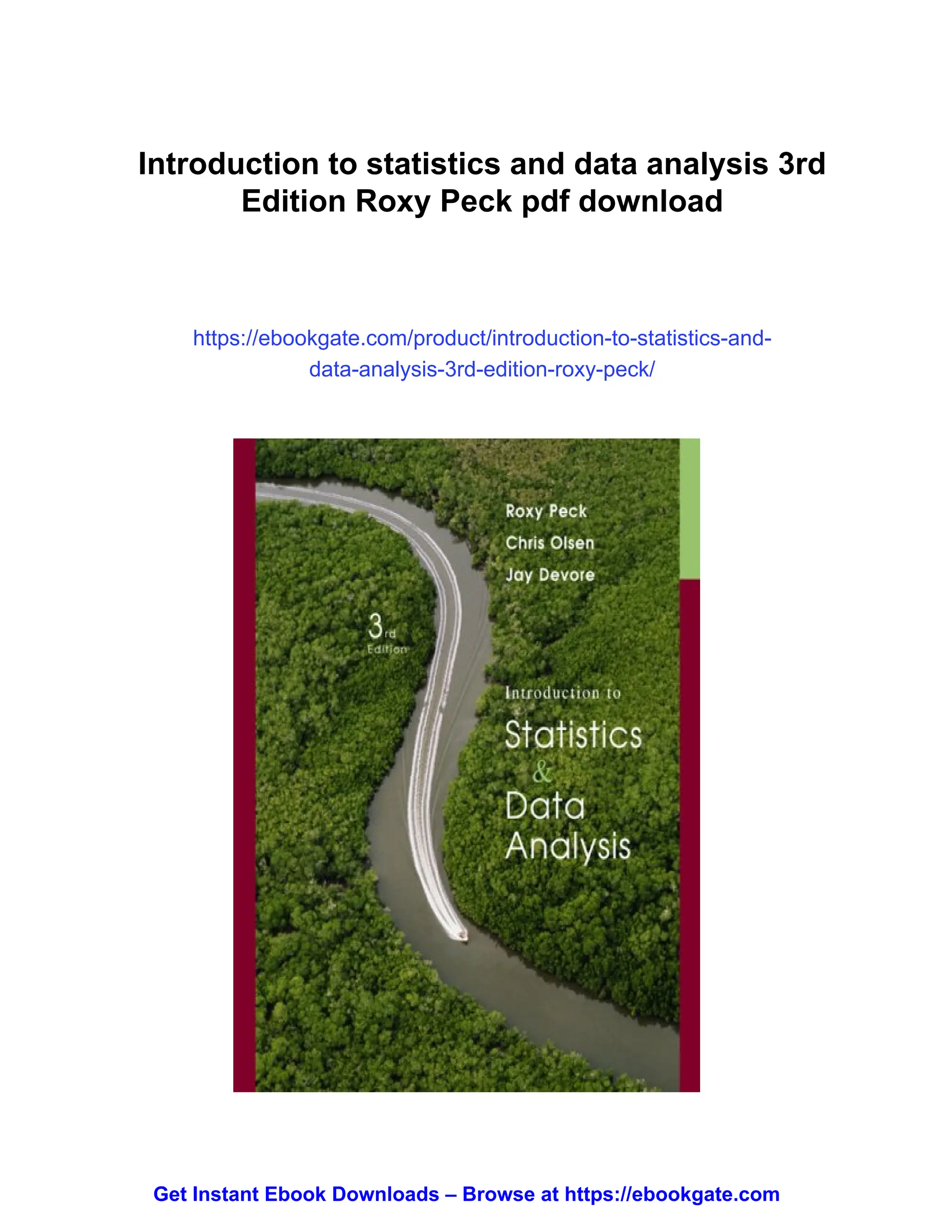
Introduction to statistics and data analysis 3rd Edition Roxy Peck

  • 1.
    Introduction to statisticsand data analysis 3rd Edition Roxy Peck pdf download https://ebookgate.com/product/introduction-to-statistics-and- data-analysis-3rd-edition-roxy-peck/ Get Instant Ebook Downloads – Browse at https://ebookgate.com
  • 2.
    Instant digital products(PDF, ePub, MOBI) available Download now and explore formats that suit you... Introduction to Statistics and Data Analysis Available Titles Aplia 4th Edition Roxy Peck https://ebookgate.com/product/introduction-to-statistics-and-data- analysis-available-titles-aplia-4th-edition-roxy-peck/ ebookgate.com Statistics The Exploration and Analysis of Data 6th Edition Roxy Peck https://ebookgate.com/product/statistics-the-exploration-and-analysis- of-data-6th-edition-roxy-peck/ ebookgate.com Mathematical Statistics and Data Analysis 3ed Duxbury Advanced 3rd Edition John A. Rice https://ebookgate.com/product/mathematical-statistics-and-data- analysis-3ed-duxbury-advanced-3rd-edition-john-a-rice/ ebookgate.com JMP start statistics a guide to statistics and data analysis using JMP 4th ed Edition John Sall https://ebookgate.com/product/jmp-start-statistics-a-guide-to- statistics-and-data-analysis-using-jmp-4th-ed-edition-john-sall/ ebookgate.com

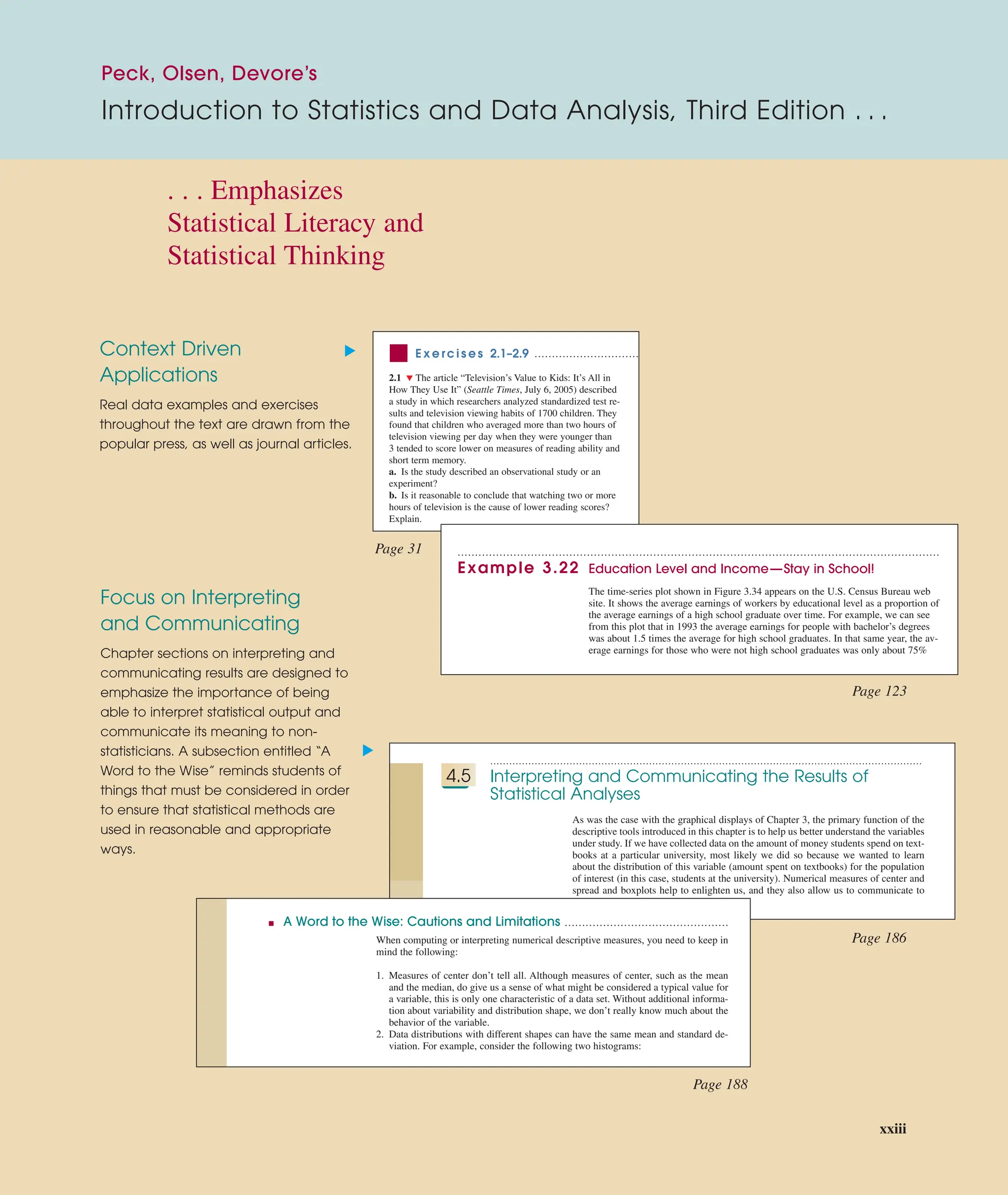
  • 3.
    Symbolic Data AnalysisConceptual Statistics and Data Mining Wiley Series in Computational Statistics 1st Edition Lynne Billard https://ebookgate.com/product/symbolic-data-analysis-conceptual- statistics-and-data-mining-wiley-series-in-computational- statistics-1st-edition-lynne-billard/ ebookgate.com Statistics for Social Data Analysis 4th Edition David Knoke https://ebookgate.com/product/statistics-for-social-data-analysis-4th- edition-david-knoke/ ebookgate.com Qualitative Data An Introduction to Coding and Analysis 1st Edition Carl Auerbach https://ebookgate.com/product/qualitative-data-an-introduction-to- coding-and-analysis-1st-edition-carl-auerbach/ ebookgate.com Statistics and Data Analysis for Nursing Research 2nd Edition Denise Polit https://ebookgate.com/product/statistics-and-data-analysis-for- nursing-research-2nd-edition-denise-polit/ ebookgate.com Introduction to Energy Analysis 3rd Edition Kornelis Blok https://ebookgate.com/product/introduction-to-energy-analysis-3rd- edition-kornelis-blok/ ebookgate.com
  • 6.
  • 7.
  • 8.
    Introduction to Statistics and DataAnalysis T h i r d E d i t i o n Roxy Peck California Polytechnic State University, San Luis Obispo Chris Olsen George Washington High School, Cedar Rapids, IA Jay Devore California Polytechnic State University, San Luis Obispo Australia • Brazil • Canada • Mexico • Singapore • Spain • United Kingdom • United States
  • 9.
    Introduction to Statisticsand Data Analysis, Third Edition Roxy Peck, Chris Olsen, Jay Devore Acquisitions Editor: Carolyn Crockett Development Editor: Danielle Derbenti Assistant Editor: Beth Gershman Editorial Assistant: Ashley Summers Technology Project Manager: Colin Blake Marketing Manager: Joe Rogove Marketing Assistant: Jennifer Liang Marketing Communications Manager: Jessica Perry Project Manager, Editorial Production: Jennifer Risden Creative Director: Rob Hugel Art Director: Vernon Boes Print Buyer: Karen Hunt Permissions Editor: Isabel Alves Production Service: Newgen–Austin Text Designer: Stuart Paterson Photo Researcher: Gretchen Miller Copy Editor: Nancy Dickson Illustrator: Jade Myers; Newgen–India Cover Designer: Stuart Paterson Cover Image: Paul Chesley/Getty Images Cover Printer: Courier Corporation/Kendallville Compositor: Newgen–India Printer: Courier Corporation/Kendallville © 2008, 2005 Duxbury, an imprint of Thomson Brooks/Cole, a part of The Thomson Corporation. Thomson, the Star logo, and Brooks/Cole are trademarks used herein under license. ALL RIGHTS RESERVED. No part of this work covered by the copyright hereon may be reproduced or used in any form or by any means—graphic, electronic, or mechanical, including photo- copying, recording, taping, Web distribution, information storage and retrieval systems, or in any other manner—without the writ- ten permission of the publisher. Printed in the United States of America 1 2 3 4 5 6 7 11 10 09 08 07 ExamView® and ExamView Pro® are registered trademarks of FSCreations, Inc. Windows is a registered trademark of the Microsoft Corporation used herein under license. Macintosh and Power Macintosh are registered trademarks of Apple Computer, Inc. Used herein under license. Library of Congress Control Number: 2006933904 Student Edition: ISBN-13: 978-0-495-11873-2 ISBN-10: 0-495-11873-7 Thomson Higher Education 10 Davis Drive Belmont, CA 94002-3098 USA For more information about our products, contact us at: Thomson Learning Academic Resource Center 1-800-423-0563 For permission to use material from this text or product, submit a request online at http://www.thomsonrights.com. Any additional questions about permissions can be submitted by e-mail to thomsonrights@thomson.com.
  • 10.
    ■ To mynephews, Jesse and Luke Smidt, who bet I wouldn’t put their names in this book. R. P. ■ To my wife, Sally, and my daughter, Anna C. O. ■ To Carol, Allie, and Teri. J. D.
  • 11.
    ROXY PECK isAssociate Dean of the College of Science and Mathematics and Professor of Statistics at California Polytechnic State University, San Luis Obispo. Roxy has been on the faculty at Cal Poly since 1979, serving for six years as Chair of the Statistics Department before becoming Associate Dean. She received an M.S. in Mathematics and a Ph.D. in Applied Statistics from the University of California, Riverside. Roxy is na- tionally known in the area of statistics education, and in 2003 she received the American Statistical Association’s Founder’s Award, recognizing her con- tributions to K–12 and undergraduate statistics edu- cation. She is a Fellow of the American Statistical Association and an elected member of the Interna- tional Statistics Institute. Roxy has recently com- pleted five years as the Chief Reader for the Ad- vanced Placement Statistics Exam and currently chairs the American Statistical Association’s Joint Committee with the National Council of Teachers of Mathematics on Curriculum in Statistics and Proba- bility for Grades K–12. In addition to her texts in in- troductory statistics, Roxy is also co-editor of Statisti- cal Case Studies: A Collaboration Between Academe and Industry and a member of the editorial board for Statistics: A Guide to the Unknown, 4th edition. Out- side the classroom and the office, Roxy likes to travel and spends her spare time reading mystery novels. She also collects Navajo rugs and heads to New Mex- ico whenever she can find the time. CHRIS OLSEN has taught statistics at George Washington High School in Cedar Rapids, Iowa, for over 25 years. Chris is a past member of the Ad- vanced Placement Statistics Test De- velopment Committee and the author of the Teacher’s Guide for Advanced Placement Sta- tistics. He has been a table leader at the AP Statistics reading for 6 years and since the summer of 1996 has been a consultant to the College Board. Chris leads workshops and institutes for AP Statistics teachers in the United States and internationally. Chris was the Iowa recipient of the Presidential Award for Ex- cellence in Science and Mathematics Teaching in 1986. He was a regional winner of the IBM Com- puter Teacher of the Year award in 1988 and received the Siemens Award for Advanced Placement in math- ematics in 1999. Chris is a frequent contributor to the AP Statistics Electronic Discussion Group and has reviewed materials for The Mathematics Teacher, the AP Central web site, The American Statistician, and the Journal of the American Statistical Associa- tion. He currently writes a column for Stats maga- zine. Chris graduated from Iowa State University with a major in mathematics and, while acquiring graduate degrees at the University of Iowa, concen- trated on statistics, computer programming, psycho- metrics, and test development. Currently, he divides his duties between teaching and evaluation; in addi- tion to teaching, he is the assessment facilitator for the Cedar Rapids, Iowa, Community Schools. In his spare time he enjoys reading and hiking. He and his wife have a daughter, Anna, who is a graduate stu- dent in Civil Engineering at Cal Tech. JAY DEVORE earned his under- graduate degree in Engineering Sci- ence from the University of California at Berkeley, spent a year at the Univer- sity of Sheffield in England, and fin- ished his Ph.D. in statistics at Stanford University. He previously taught at the University of Florida and at Oberlin College and has had visiting appointments at Stanford, Harvard, the University of Washington, and New York University. From 1998 to 2006, Jay served as Chair of the Statistics Depart- ment at California Polytechnic State University, San Luis Obispo. The Statistics Department at Cal Poly has an international reputation for activities in sta- tistics education. In addition to this book, Jay has written several widely used engineering statistics texts and is currently working on a book in applied mathematical statistics. He is the recipient of a dis- tinguished teaching award from Cal Poly and is a Fellow of the American Statistical Association. In his spare time, he enjoys reading, cooking and eating good food, tennis, and travel to faraway places. He is especially proud of his wife, Carol, a retired elemen- tary school teacher, his daughter Allison, who works for the Center for Women and Excellence in Boston, and his daughter Teri, who is finishing a graduate program in education at NYU. ■ About the Authors
  • 12.
    vii C o nt e n t s 1 The Role of Statistics and the Data Analysis Process 1 1.1 Three Reasons to Study Statistics 1 1.2 The Nature and Role of Variability 4 1.3 Statistics and the Data Analysis Process 7 1.4 Types of Data and Some Simple Graphical Displays 12 Activity 1.1 Head Sizes: Understanding Variability 22 Activity 1.2 Estimating Sizes 23 Activity 1.3 A Meaningful Paragraph 24 2 Collecting Data Sensibly 27 2.1 Statistical Studies: Observation and Experimentation 27 2.2 Sampling 32 2.3 Simple Comparative Experiments 42 2.4 More on Experimental Design 51 2.5 More on Observational Studies: Designing Surveys (Optional) 56 2.6 Interpreting and Communicating the Results of Statistical Analyses 61 Activity 2.1 Designing a Sampling Plan 63 Activity 2.2 An Experiment to Test for the Stroop Effect 64 Activity 2.3 McDonald’s and the Next 100 Billion Burgers 64 Activity 2.4 Video Games and Pain Management 65 Graphing Calculator Explorations 69 3 Graphical Methods for Describing Data 75 3.1 Displaying Categorical Data: Comparative Bar Charts and Pie Charts 76 3.2 Displaying Numerical Data: Stem-and-Leaf Displays 87 C o n t e n t s
  • 13.
    viii ■ Contents 3.3Displaying Numerical Data: Frequency Distributions and Histograms 97 3.4 Displaying Bivariate Numerical Data 117 3.5 Interpreting and Communicating the Results of Statistical Analyses 127 Activity 3.1 Locating States 134 Activity 3.2 Bean Counters! 134 Graphing Calculator Explorations 141 4 Numerical Methods for Describing Data 147 4.1 Describing the Center of a Data Set 148 4.2 Describing Variability in a Data Set 159 4.3 Summarizing a Data Set: Boxplots 169 4.4 Interpreting Center and Variability: Chebyshev’s Rule, the Empirical Rule, and z Scores 176 4.5 Interpreting and Communicating the Results of Statistical Analyses 186 Activity 4.1 Collecting and Summarizing Numerical Data 190 Activity 4.2 Airline Passenger Weights 190 Activity 4.3 Boxplot Shapes 190 Graphing Calculator Explorations 195 5 Summarizing Bivariate Data 199 5.1 Correlation 200 5.2 Linear Regression: Fitting a Line to Bivariate Data 210 5.3 Assessing the Fit of a Line 221 5.4 Nonlinear Relationships and Transformations 238 5.5 Logistic Regression (Optional) 255 5.6 Interpreting and Communicating the Results of Statistical Analyses 264 Activity 5.1 Exploring Correlation and Regression 267 Activity 5.2 Age and Flexibility 268 Graphing Calculator Explorations 272 6 Probability 279 6.1 Chance Experiments and Events 279 6.2 Definition of Probability 288
  • 14.
    ■ Contents ix 6.3Basic Properties of Probability 295 6.4 Conditional Probability 302 6.5 Independence 313 6.6 Some General Probability Rules 323 6.7 Estimating Probabilities Empirically Using Simulation 335 Activity 6.1 Kisses 347 Activity 6.2 A Crisis for European Sports Fans? 347 Activity 6.3 The “Hot Hand” in Basketball 347 Graphing Calculator Explorations 351 7 Random Variables and Probability Distributions 357 7.1 Random Variables 358 7.2 Probability Distributions for Discrete Random Variables 361 7.3 Probability Distributions for Continuous Random Variables 367 7.4 Mean and Standard Deviation of a Random Variable 372 7.5 Binomial and Geometric Distributions 386 7.6 Normal Distributions 397 7.7 Checking for Normality and Normalizing Transformations 414 7.8 Using the Normal Distribution to Approximate a Discrete Distribution 425 Activity 7.1 Rotten Eggs? 429 Graphing Calculator Explorations 434 8 Sampling Variability and Sampling Distributions 445 8.1 Statistics and Sampling Variability 446 8.2 The Sampling Distribution of a Sample Mean 450 8.3 The Sampling Distribution of a Sample Proportion 461 Activity 8.1 Do Students Who Take the SATs Multiple Times Have an Advantage in College Admissions? 468 Graphing Calculator Explorations 471 9 Estimation Using a Single Sample 475 9.1 Point Estimation 476 9.2 Large-Sample Confidence Interval for a Population Proportion 482 9.3 Confidence Interval for a Population Mean 495
  • 15.
    x ■ Contents 9.4Interpreting and Communicating the Results of Statistical Analyses 508 Activity 9.1 Getting a Feel for Confidence Level 514 Activity 9.2 An Alternative Confidence Interval for a Population Proportion 515 Activity 9.3 Verifying Signatures on a Recall Petition 516 Activity 9.4 A Meaningful Paragraph 516 Graphing Calculator Explorations 521 10 Hypothesis Testing Using a Single Sample 525 10.1 Hypotheses and Test Procedures 526 10.2 Errors in Hypotheses Testing 531 10.3 Large-Sample Hypothesis Tests for a Population Proportion 537 10.4 Hypotheses Tests for a Population Mean 550 10.5 Power and Probability of Type II Error 562 10.6 Interpreting and Communicating the Results of Statistical Analyses 571 Activity 10.1 Comparing the t and z Distributions 574 Activity 10.2 A Meaningful Paragraph 575 Graphing Calculator Explorations 580 11 Comparing Two Populations or Treatments 583 11.1 Inferences Concerning the Difference Between Two Population or Treatment Means Using Independent Samples 583 11.2 Inferences Concerning the Difference Between Two Population or Treatment Means Using Paired Samples 606 11.3 Large Sample Inferences Concerning a Difference Between Two Population or Treatment Proportions 619 11.4 Interpreting and Communicating the Results of Statistical Analyses 629 Activity 11.1 Helium-Filled Footballs 632 Activity 11.2 Thinking About Data Collection 633 Activity 11.3 A Meaningful Paragraph 633 Graphing Calculator Explorations 641
  • 16.
    ■ Contents xi 12The Analysis of Categorical Data and Goodness-of- Fit Tests 647 12.1 Chi-Square Tests for Univariate Data 647 12.2 Tests for Homogeneity and Independence in a Two- way Table 660 12.3 Interpreting and Communicating the Results of Statistical Analyses 677 Activity 12.1 Pick a Number, Any Number . . . 680 Activity 12.2 Color and Perceived Taste 680 Graphing Calculator Explorations 685 13 Simple Linear Regression and Correlation: Inferential Methods 689 13.1 Simple Linear Regression Model 690 13.2 Inferences About the Slope of the Population Regression Line 702 13.3 Checking Model Adequacy 713 13.4 Inferences Based on the Estimated Regression Line (Optional) 725 13.5 Inferences About the Population Correlation Coefficient (Optional) 734 13.6 Interpreting and Communicating the Results of Statistical Analyses 737 Activity 13.1 Are Tall Women from “Big” Families? 739 Graphing Calculator Exploration 746 14 Multiple Regression Analysis 749 14.1 Multiple Regression Models 750 14.2 Fitting a Model and Assessing Its Utility 763 14.3 Inferences Based on an Estimated Model 14-1 14.4 Other Issues in Multiple Regression 14-13 14.5 Interpreting and Communicating the Results of Statistical Analyses 14-26 Activity 14.1 Exploring the Relationship Between Number of Predictors and Sample Size 780 Sections and/or chapter numbers in color can be found at www.thomsonedu.com/statistics/peck
  • 17.
    xii ■ Contents Sectionsand/or chapter numbers in color can be found at www.thomsonedu.com/statistics/peck 15 Analysis of Variance 783 15.1 Single-Factor ANOVA and the F Test 784 15.2 Multiple Comparisons 800 15.3 The F Test for a Randomized Block Experiment 15-1 15.4 Two-Factor ANOVA 15-9 15.5 Interpreting and Communicating the Results of Statistical Analyses 15-22 Activity 15.1 Exploring Single-Factor ANOVA 808 Graphing Calculator Exploration 811 16 Nonparametric (Distribution-Free) Statistical Methods 16-1 16.1 Distribution-Free Procedures for Inferences About a Difference Between Two Population or Treatment Means Using Independent Samples (Optional) 16-1 16.2 Distribution-Free Procedures for Inferences About a Difference Between Two Population or Treatment Means Using Paired Samples 16-10 16.3 Distribution-Free ANOVA 16-23 Appendix A: Statistical Tables 813 Appendix B: References 833 Answers to Selected Odd-Numbered Exercises 835 Index I-1
  • 18.
    P r ef a c e xiii In a nutshell, statistics is about understanding the role that variability plays in draw- ing conclusions based on data. Introduction to Statistics and Data Analysis, Third Edi- tion develops this crucial understanding of variability through its focus on the data analysis process. An Organization That Reflects the Data Analysis Process Students are introduced early to the idea that data analysis is a process that begins with careful planning, followed by data collection, data description using graphical and numerical summaries, data analysis, and finally interpretation of results. This process is described in detail in Chapter 1, and the ordering of topics in the first ten chapters of the book mirrors this process: data collection, then data description, then statistical inference. The logical order in the data analysis process can be pictured as shown in the fol- lowing figure. Unlike many introductory texts, Introduction to Statistics and Data Analysis, Third Edition is organized in a manner consistent with the natural order of the data analysis process: Step 1: Acknowledging Variability— Collecting Data Sensibly Step 2: Describing Variability in the Data— Descriptive Statistics Step 3: Drawing Conclusions in a Way That Recognizes Variability in the Data
  • 19.
    xiv ■ Preface TheImportance of Context and Real Data Statistics is not about numbers; it is about data—numbers in context. It is the context that makes a problem meaningful and something worth considering. For example, ex- ercises that ask students to compute the mean of 10 numbers or to construct a dotplot or boxplot of 20 numbers without context are arithmetic and graphing exercises. They become statistics problems only when a context gives them meaning and allows for in- terpretation. While this makes for a text that may appear “wordy” when compared to traditional mathematics texts, it is a critical and necessary component of a modern sta- tistics text. Examples and exercises with overly simple settings do not allow students to prac- tice interpreting results in authentic situations or give students the experience neces- sary to be able to use statistical methods in real settings. We believe that the exercises and examples are a particular strength of this text, and we invite you to compare the examples and exercises with those in other introductory statistics texts. Many students are skeptical of the relevance and importance of statistics. Con- trived problem situations and artificial data often reinforce this skepticism. A strategy that we have employed successfully to motivate students is to present examples and exercises that involve data extracted from journal articles, newspapers, and other pub- lished sources. Most examples and exercises in the book are of this nature; they cover a very wide range of disciplines and subject areas. These include, but are not limited to, health and fitness, consumer research, psychology and aging, environmental re- search, law and criminal justice, and entertainment. A Focus on Interpretation and Communication Most chapters include a section titled “Interpreting and Communicating the Results of Statistical Analyses.” These sections include advice on how to best communicate the results of a statistical analysis and also consider how to interpret statistical summaries Step 1: Acknowledging Variability— Collecting Data Sensibly Step 2: Describing Variability in the Data— Descriptive Statistics Probability Supports the Connection Step 3: Drawing Conclusions in a Way That Recognizes Variability in the Data Chapters 1–2 Chapters 3–5 Chapters 8–15 Chapters 6–7
  • 20.
    ■ Preface xv foundin journals and other published sources. A subsection titled “A Word to the Wise” reminds readers of things that must be considered in order to ensure that statis- tical methods are employed in reasonable and appropriate ways. Consistent with Recommendations for the Introductory Statistics Course Endorsed by the American Statistical Association In 2005, the American Statistical Association endorsed the report “College Guidelines in Assessment and Instruction for Statistics Education (GAISE Guidelines),” which included the following six recommendations for the introductory statistics course: 1. Emphasize statistical literacy and develop statistical thinking. 2. Use real data. 3. Stress conceptual understanding rather than mere knowledge of procedures. 4. Foster active learning in the classroom. 5. Use technology for developing conceptual understanding and analyzing data. 6. Use assessments to improve and evaluate student learning. Introduction to Statistics and Data Analysis, Third Edition is consistent with these rec- ommendations and supports the GAISE guidelines in the following ways: 1. Emphasize statistical literacy and develop statistical thinking. Statistical literacy is promoted throughout the text in the many examples and exer- cises that are drawn from the popular press. In addition, a focus on the role of vari- ability, consistent use of context, and an emphasis on interpreting and communi- cating results in context work together to help students develop skills in statistical thinking. 2. Use real data. The examples and exercises from Introduction to Statistics and Data Analysis, Third Edition are context driven and reference sources that include the popular press as well as journal articles. 3. Stress conceptual understanding rather than mere knowledge of procedures. Nearly all exercises in Introduction to Statistics and Data Analysis, Third Edition are multipart and ask students to go beyond just computation. They focus on inter- pretation and communication, not just in the chapter sections specifically devoted to this topic, but throughout the text. The examples and explanations are designed to promote conceptual understanding. Hands-on activities in each chapter are also constructed to strengthen conceptual understanding. Which brings us to . . . 4. Foster active learning in the classroom. While this recommendation speaks more to pedagogy and classroom practice, In- troduction to Statistics and Data Analysis, Third Edition provides 33 hands-on ac- tivities in the text and additional activities in the accompanying instructor resources that can be used in class or assigned to be completed outside of class. In addition, accompanying online materials allow students to assess their understanding and de- velop a personalized learning plan based on this assessment for each chapter. 5. Use technology for developing conceptual understanding and analyzing data. The computer has brought incredible statistical power to the desktop of every in- vestigator. The wide availability of statistical computer packages such as MINITAB, S-Plus, JMP, and SPSS, and the graphical capabilities of the modern microcom- puter have transformed both the teaching and learning of statistics. To highlight the role of the computer in contemporary statistics, we have included sample output
  • 21.
    xvi ■ Preface throughoutthe book. In addition, numerous exercises contain data that can easily be analyzed by computer, though our exposition firmly avoids a presupposition that students have access to a particular statistical package. Technology manuals for specific packages, such as MINITAB and SPSS, are available in the online materi- als that accompany this text. The appearance of hand-held calculators with significant statistical and graph- ing capability has also changed statistics instruction in classrooms where access to computers is still limited. The computer revolution of a previous generation is now being writ small—or, possibly we should say, smaller—for the youngest generation of investigators. There is not, as we write, anything approaching universal or even wide agreement about the proper role for the graphing calculator in college statis- tics classes, where access to a computer is more common. At the same time, for tens of thousands of students in Advanced Placement Statistics in our high schools, the graphing calculator is the only dependable access to statistical technology. This text allows the instructor to balance the use of computers and calculators in a manner consistent with his or her philosophy and presents the power of the cal- culator in a series of Graphing Calculator Explorations. These are placed at the end of each chapter, unobtrusive to those instructors whose technology preference is the computer while still accessible to those instructors and students comfortable with graphing calculator technology. As with computer packages, our exposition avoids assuming the use of a particular calculator and presents the calculator capa- bilities in a generic format; specifically, we do not teach particular keystroke se- quences, believing that the best source for such specific information is the calcula- tor manual. For those using a TI graphing calculator, there is a technology manual available in the online materials that accompany this text. As much as possible, the calculator explorations are independent of each other, allowing instructors to pick and choose calculator topics that are more relevant to their particular courses. 6. Use assessments to improve and evaluate student learning. Assessment materials in the form of a test bank, quizzes, and chapter exams are available in the instructor resources that accompany this text. The items in the test bank reflect the data-in-context philosophy of the text’s exercises and examples. Advanced Placement Statistics We have designed this book with a particular eye toward the syllabus of the Advanced Placement Statistics course and the needs of high school teachers and students. Con- cerns expressed and questions asked in teacher workshops and on theAP Statistics Elec- tronic Discussion Group have strongly influenced our exposition of certain topics, es- pecially in the area of experimental design and probability. We have taken great care to provide precise definitions and clear examples of concepts that Advanced Placement Statistics instructors have acknowledged as difficult for their students. We have also ex- panded the variety of examples and exercises, recognizing the diverse potential futures envisioned by very capable students who have not yet focused on a college major. Topic Coverage Our book can be used in courses as short as one quarter or as long as one year in du- ration. Particularly in shorter courses, an instructor will need to be selective in decid- ing which topics to include and which to set aside. The book divides naturally into four major sections: collecting data and descriptive methods (Chapters 1–5), probability material (Chapters 6–8), the basic one- and two-sample inferential techniques (Chap- ters 9–12), and more advanced inferential methodology (Chapters 13–16). We include
  • 22.
    ■ Preface xvii anearly chapter (Chapter 5) on descriptive methods for bivariate numerical data. This early exposure raises questions and issues that should stimulate student interest in the subject; it is also advantageous for those teaching courses in which time constraints preclude covering advanced inferential material. However, this chapter can easily be postponed until the basics of inference have been covered, and then combined with Chapter 13 for a unified treatment of regression and correlation. With the possible exception of Chapter 5, Chapters 1–10 should be covered in or- der. We anticipate that most instructors will then continue with two-sample inference (Chapter 11) and methods for categorical data analysis (Chapter 12), although regres- sion could be covered before either of these topics. Optional portions of Chapter 14 (multiple regression) and chapter 15 (analysis of variance) and Chapter 16 (nonpara- metric methods) are included in the online materials that accompany this text. A Note on Probability The content of the probability chapters is consistent with the Advanced Placement Sta- tistics course description. It includes both a traditional treatment of probability and probability distributions at an introductory level, as well as a section on the use of sim- ulation as a tool for estimating probabilities. For those who prefer a briefer and more informal treatment of probability, the book Statistics: The Exploration and Analysis of Data, by Roxy Peck and Jay Devore, may be a more appropriate choice. Except for the treatment of probability and the omission of the Graphing Calculator Explorations, it parallels the material in this text. Please contact your sales rep for more information about this alternative and other alternative customized options available to you. New to This Edition There are a number of changes in the Third Edition, including the following: ■ More than 80 new examples and more than 180 new exercises that use data from current journals and newspapers are included. In addition, more of the exercises specifically ask students to write (for example, by requiring students to explain their reasoning, interpret results, and comment on important features of an analysis). ■ Examples and exercises that make use of data sets that can be accessed on- line from the text website are designated by an icon in the text, as are ex- amples that are further illustrated in the technology manuals (MINITAB, SPSS, etc.) that are available in the online materials that accompany this text. ■ More than 90 exercises have video solutions, presented by Brian Kotz of Mont- gomery College, which can be viewed online or downloaded for viewing later. These exercises are designated by an icon in the text. ■ A number of new hands-on activities have been added to the end-of-chapter activities. These activities can be used as a chapter capstone or can be integrated at appropriate places as the chapter material is covered in class. ■ Students can now go online to test their understanding of the material covered in each chapter and develop a personalized learning plan to assist them in ad- dressing any areas of weakness. ■ A detailed description of the data analysis process now appears in Chapter 1. Although the order of topics in the text generally mirrors the data collection process with methods of data collection covered first, two graphical displays (dot- plots and bar charts) are covered in Chapter 1 so that these simple graphical analy- sis tools can be used in the conceptual development of experimental design and so
  • 23.
    xviii ■ Preface thatstudents have some tools for summarizing the data they collect through sam- pling and experimentation in the exercises, examples, and activities of Chapter 2. ■ A new optional section on logistic regression is now included in Chapter 5 for those who would like more complete coverage of data analysis techniques for cat- egorical data. ■ Advanced topics that are often omitted in a one-quarter or one-semester course, such as inference and variable selection methods in multiple regression (Sections 14.3 and 14.4) and analysis of variance for randomized block and two-factor de- signs (Sections 15.3 and 15.4), have been moved to the online materials that accompany this text. ■ Coverage of distribution-free procedures for inferences about the difference between two population or treatment means using independent samples (formerly Section 11.4) has been moved to Chapter 16. This chapter, titled “Nonparametric (Distribution-Free) Statistical Methods,” also includes new material on inferences about the difference between two population or treatment means using paired samples and distribution-free analysis of variance, and is available in the online materials that accompany this text. ■ Updated materials for instructors. In addition to the usual instructor supple- ments such as a complete solutions manual and a test bank, the following are also available to instructors: ■ An Instructor’s Resource Binder, which contains additional examples that can be incorporated into classroom presentations and cross-references to re- sources such as Fathom, Workshop Statistics, and Against All Odds. Of partic- ular interest to those teaching Advanced Placement Statistics, the binder also includes additional data analysis questions of the type encountered on the free response portion of the Advanced Placement exam, as well as a collection of model responses. ■ For those who use student response systems in class, a set of “clicker” ques- tions (see JoinIn™ on TurningPoint® under Instructor Resources—Media) for assessing student understanding is available. Student Resources ■ Available Online If your text includes a printed access card, you will have instant access to the follow- ing resources referenced throughout your text: ■ ThomsonNOW™ (see below for a full description of this powerful study tool). ■ Complete step-by-step instructions for MINITAB, Excel, TI-83 Graphing Calcu- lator, JMP, and SPSS indicated by the icon throughout the text. ■ Data sets formatted for MINITAB, Excel, SPSS, SAS, JMP, TI-83, Fathom, and ASCII indicated by ● icon throughout the text. ■ Applets used in the Activities found in the text. ■ Print Student Solutions Manual (ISBN 0-495-11876-1) by Mary Mortlock of California Polytechnic State University, San Luis Obispo. Check your work—and your understanding—with this manual, which provides worked-out solutions to the odd-numbered problems in the text.
  • 24.
    ■ Preface xix ActivitiesWorkbook (0-495-11883-4) by Roxy Peck. Use this convenient workbook to take notes, record data, and cement your learning by completing textbook and bonus activities for each chapter. ■ Media ThomsonNOW™ Homework (0-495-39230-8) Save time, learn more, and succeed in the course with this online suite of resources (including an integrated eBook and Personalized Study plans) that give you the choices and tools you need to study smarter and get the grade. Note: If your text did not in- clude a printed access card for ThomsonNOW, it is available for purchase online at http://www.thomsonedu.com. Instructor Resources ■ Print Annotated Instructor’s Edition (0-495-11888-5) The Annotated Instructor’s Edition contains answers for all exercises, as well as an an- notated table of contents with comments written by Roxy Peck. Instructor’s Solutions Manual (0-495-11879-6) by Mary Mortlock of California Polytechnic State University, San Luis Obispo. This manual contains worked-out solutions to all of the problems in the text. Instructor’s Resource Binder (0-495-11892-3) prepared by Chris Olsen. Includes transparencies and Microsoft® PowerPoint® slides to make lecture and class preparation quick and easy. New to this edition, we have added some Activities Work- sheets authored by Carol Marchetti of Rochester Institute of Technology. Test Bank (0-495-11880-X) by Josh Tabor of Wilson High School, Peter Flannagan- Hyde of Phoenix Country Day School, and Chris Olsen. Includes test questions for each section of the book. Activities Workbook (0-495-11883-4) by Roxy Peck. Students can take notes, record data, and complete activities in this ready-to-use work- book, which includes activities from the textbook plus additional bonus activities for each chapter. ■ Media Enhanced WebAssign (ISBN 0-495-10963-0) Enhanced WebAssign is the most widely used homework system in higher educa- tion. Available for this title, Enhanced WebAssign allows you to assign, collect, grade, and record homework assignments via the web. This proven homework system has been enhanced to include links to the textbook sections, video examples, and problem- specific tutorials. Enhanced WebAssign is more than a homework system—it is a com- plete learning system for students. ThomsonNOW™ Homework (0-495-39230-8) ThomsonNOW’s Personalized Study plans allow students to study smarter by diag- nosing their weak areas, and helping them focus on what they need to learn. Based on responses to chapter specific pre-tests, the plans suggest a course of study for students,
  • 25.
    xx ■ Preface includingmany multimedia and interactive exercises to help students better learn the material. After completing the study plan, they can take a post-test to measure their progress and understanding. ExamView® Computerized Testing (0-495-11886-9) Create, deliver, and customize tests and study guides (both print and online) in min- utes with this easy-to-use assessment and tutorial system, which contains all questions from the Test Bank in electronic format. JoinIn™ on TurningPoint® (0-495-11881-8) The easiest student classroom response system to use, JoinIn features instant class- room assessment and learning. Acknowledgments We are grateful for the thoughtful feedback from the following reviewers that has helped to shape this text over the last two editions: ■ Reviewers of the Third Edition Arun K. Agarwal Grambling State University Jacob Amidon Finger Lakes Community College Holly Ashton Pikes Peak Community College Barb Barnet University of Wisconsin at Platteville Eddie Bevilacqua State University of New York College of Environmental Science & Forestry Piotr Bialas Borough of Manhattan Community College Kelly Black Union College Gabriel Chandler Connecticut College Andy Chang Youngstown State University Jerry Chen Suffolk Community College Richard Chilcoat Wartburg College Marvin Creech Chapman University Ron Degges North Dakota State University Hemangini Deshmukh Mercyhurst College Ann Evans University of Massachusetts at Boston Central Carolina Community College Guangxiong Fang Daniel Webster College Sharon B. Finger Nicholls State University Steven Garren James Madison University Tyler Haynes Saginaw Valley State University Sonja Hensler St. Petersburg College Trish Hutchinson Angelo State University Bessie Kirkwood Sweet Briar College Jeff Kollath Oregon State University
  • 26.
    ■ Preface xxi ChristopherLacke Rowan University Michael Leitner Louisiana State University Zia Mahmood College of DuPage Art Mark Georgoa Military College David Mathiason Rochester Institute of Technology Bob Mattson Eureka College C. Mark Miller York College Megan Mocko University of Florida Kane Nashimoto James Madison University Helen Noble San Diego State University Broderick Oluyede Georgia Southern University Elaine Paris Mercy College Shelly Ray Parsons Aims Community College Judy Pennington-Price Midway College Hazard Community College Jackson County High School Michael I. Ratliff Northern Arizona University David R. Rauth Duquesne University Kevin J. Reeves East Texas Baptist University Robb Sinn North Georgia College & State University Greg Sliwa Broome Community College Angela Stabley Portland Community College Jeffery D. Sykes Ouachita Baptist University Yolande Tra Rochester Institute of Technology Nathan Wetzel University of Wisconsin Stevens Point Dr. Mark Wilson West Virginia University Institute of Technology Yong Yu Ohio State University Toshiyuki Yuasa University of Houston ■ Reviewers for the Second Edition Jim Bohan Manheim Township High School Pat Buchanan Pennsylvania State University Mary Christman American University Iowa State University Mark Glickman Boston University John Imbrie University of Virginia Pam Martin Northeast Louisiana University Paul Myers Woodward Academy Deanna Payton Oklahoma State University
  • 27.
    xxii ■ Preface MichaelPhelan Chapman University Alan Polansky Northern Illinois University Lawrence D. Ries University of Missouri Columbia Joe Ward Health Careers High School Additionally, we would like to express our thanks and gratitude to all who helped to make this book possible: ■ Carolyn Crockett, our editor and friend, for her unflagging support and thought- ful advice for more than a decade. ■ Danielle Derbenti, Beth Gershman, and Colin Blake at Thomson Brooks/Cole, for the development of all of the ancillary materials details and for keeping us on track. ■ Jennifer Risden, our project manager at Thomson Brooks/Cole, and Anne Seitz at Hearthside Publishing Services, for artfully managing the myriad of details asso- ciated with the production process. ■ Nancy Dickson for her careful copyediting. ■ Brian Kotz for all his hard work producing the video solutions. ■ Mary Mortlock for her diligence and care in producing the student and instructor solutions manuals for this book. ■ Josh Tabor and Peter Flannagan-Hyde for their contributions to the test bank that accompanies the book. ■ Beth Chance and Francisco Garcia for producing the applet used in the confidence interval activities. ■ Gary McClelland for producing the applets from Seeing Statistics used in the re- gression activities. ■ Bittner Development Group for checking the accuracy of the manuscript. ■ Rachel Dagdagan, a student at Cal Poly, for her help in the preparation of the manuscript. And, as always, we thank our families, friends, and colleagues for their continued support. Roxy Peck Chris Olsen Jay Devore
  • 28.
    Context Driven Applications Real dataexamples and exercises throughout the text are drawn from the popular press, as well as journal articles. Focus on Interpreting and Communicating Chapter sections on interpreting and communicating results are designed to emphasize the importance of being able to interpret statistical output and communicate its meaning to non- statisticians. A subsection entitled “A Word to the Wise” reminds students of things that must be considered in order to ensure that statistical methods are used in reasonable and appropriate ways. ........................................................................................................................................ 4.5 Interpreting and Communicating the Results of Statistical Analyses As was the case with the graphical displays of Chapter 3, the primary function of the descriptive tools introduced in this chapter is to help us better understand the variables under study. If we have collected data on the amount of money students spend on text- books at a particular university, most likely we did so because we wanted to learn about the distribution of this variable (amount spent on textbooks) for the population of interest (in this case, students at the university). Numerical measures of center and spread and boxplots help to enlighten us, and they also allow us to communicate to others what we have learned from the data. ■ A Word to the Wise: Cautions and Limitations ............................................... When computing or interpreting numerical descriptive measures, you need to keep in mind the following: 1. Measures of center don’t tell all. Although measures of center, such as the mean and the median, do give us a sense of what might be considered a typical value for a variable, this is only one characteristic of a data set. Without additional informa- tion about variability and distribution shape, we don’t really know much about the behavior of the variable. 2. Data distributions with different shapes can have the same mean and standard de- viation. For example, consider the following two histograms: ▲ ▲ . . . Emphasizes Statistical Literacy and Statistical Thinking Page 31 Page 123 Page 186 Page 188 Peck, Olsen, Devore’s Introduction to Statistics and Data Analysis, Third Edition . . . ■ E x e rc i s e s 2.1–2.9 2.1 ▼ The article “Television’s Value to Kids: It’s All in How They Use It” (Seattle Times, July 6, 2005) described a study in which researchers analyzed standardized test re- sults and television viewing habits of 1700 children. They found that children who averaged more than two hours of television viewing per day when they were younger than 3 tended to score lower on measures of reading ability and short term memory. a. Is the study described an observational study or an experiment? b. Is it reasonable to conclude that watching two or more hours of television is the cause of lower reading scores? Explain. .............................. .......................................................................................................................................... Example 3.22 Education Level and Income—Stay in School! The time-series plot shown in Figure 3.34 appears on the U.S. Census Bureau web site. It shows the average earnings of workers by educational level as a proportion of the average earnings of a high school graduate over time. For example, we can see from this plot that in 1993 the average earnings for people with bachelor’s degrees was about 1.5 times the average for high school graduates. In that same year, the av- erage earnings for those who were not high school graduates was only about 75% xxiii
  • 29.
    Peck, Olsen, Devore’s Introductionto Statistics and Data Analysis, Third Edition . . . Hands-on Activities in Every Chapter Thirty-three hands-on activities in the text, and additional activities in the accompanying instructor re- sources, can be used to encour- age active learning inside or outside the classroom. Graphing Calculator Explorations Found at the end of most chapters, these explorations allow students to actively experience technology and promote statistical thinking. E x p l o r a t i o n 3.3 Scaling the Histogram When we constructed a histogram in the previous Exploration there were some num- bers that we temporarily ignored in the view screen. We would like to return to those numbers now because they can seriously affect the look of a histogram. When we left the histogram the numbers in our view window were set as shown in Figure 3.43. These settings place the view window over the calculator’s Cartesian system for ef- fective viewing of the histogram from the data of Example 3.15. We would now like to experiment a bit with the “Xscale.” In all statistical graphs produced by the calculator the Xscale and Yscale choices will control the placement of the little “tick” marks on the x and y axis. In Exploration 3.2, the XScale andYScale were set at 5 and 1, respectively. The little tick marks on the x-axis were at multiples of 5. (Because of the data, the x-axis tick marks were at multiples of 5 and the y-axis didn’t appear.) Change the Xscale value to 2 and redraw the histogram.You should see a graph similar to Figure 3.44. The y-axis tick marks now appear at multiples of 2, . . . . Note that changing the Xscale has altered not only the tick marks but also the class intervals for the histogram. The choice of class intervals can significantly change the look and feel of the histogram. The choice of Xscale can affect judgments about the shape of the histogram. Because of this possibility it is wise to look at a histogram with varying choices of the Xscale value. If the shape appears very similar for differ- ent choices of Xscale, you can interpret and describe the shape with more confidence. However, if different Xscale choices alter the look of the histogram you should prob- ably be more tentative. Figure 3.43 Figure 3.44 A c t i v i t y 2.4 Video Games and Pain Management Background: Video games have been used for pain man- agement by doctors and therapists who believe that the attention required to play a video game can distract the player and thereby decrease the sensation of pain. The pa- per “Video Games and Health” (British Medical Journal [2005]:122–123) states: “However, there has been no long term follow-up and no robust randomized controlled trials of such inter- ventions. Whether patients eventually tire of such games is also unclear. Furthermore, it is not known whether any distracting effect depends simply on con- centrating on an interactive task or whether the con- tent of games is also an important factor as there have been no controlled trials comparing video games with other distracters. Further research should examine factors within games such as novelty, users’ prefer- ences, and relative levels of challenge and should compare video games with other potentially distract- ing activities.” 1. Working with a partner, select one of the areas of po- tential research suggested in the passage from the paper and formulate a specific question that could be addressed by performing an experiment. 2. Propose an experiment that would provide data to ad- dress the question from Step 1. Be specific about how subjects might be selected, what the experimental condi- tions (treatments) would be, and what response would be measured. 3. At the end of Section 2.3 there are 10 questions that can be used to evaluate an experimental design. Answer these 10 questions for the design proposed in Step 2. 4. After evaluating your proposed design, are there any changes you would like to make to your design? Explain. ▲ ▲ Page 65 Page 144 . . . Encourages Conceptual Understanding and Active Learning xxiv
  • 30.
    . . .Uses Technology to Develop Conceptual Understanding Applets Allow Students to See the Concepts Within the Activities, applets are used to illustrate and promote a deeper understanding of the key statistical concepts. . . . And Analyze Data Real Data Sets Real data sets promote statistical analysis, as well as technology use. They are formatted for MINITAB, Excel, SPSS, SAS, JMP , TI-83, and ASCII and are indicated by the icon throughout the text. Continue generating intervals until you have seen at least 1000 intervals, and then answer the following question: a. How does the proportion of intervals constructed that contain m 100 compare to the stated confidence level of 3.22 ● Medicare’s new medical plans offer a wide range of variations and choices for seniors when picking a drug plan (San Luis Obispo Tribune, November 25, 2005). The monthly cost for a stand-alone drug plan varies from plan to plan and from state to state. The accompanying table gives the premium for the plan with the lowest cost for each state. Cost per Month State (dollars) Alabama 14.08 Alaska 20.05 Arizona 6.14 Arkansas 10.31 California 5.41 Colorado 8.62 Connecticut 7.32 Cost per Month State (dollars) New Hampshire 19.60 New Jersey 4.43 New Mexico 10.65 New York 4.10 North Carolina 13.27 North Dakota 1.87 Ohio 14.43 Oklahoma 10.07 Oregon 6.93 Pennsylvania 10.14 Rhode Island 7.32 South Carolina 16.57 South Dakota 1.87 Tennessee 14.08 Texas 10.31 ■ E x e rc i s e s 3.22–3.34 ........................................................................................... 27.0 would then fall in the class 27.0 to 27.5. .......................................................................................................................................... Example 3.14 Enrollments at Public Universities ● States differ widely in the percentage of college students who are enrolled in pub- lic institutions. The National Center for Education Statistics provided the accompa- nying data on this percentage for the 50 U.S. states for fall 2002. Percentage of College Students Enrolled in Public Institutions 86 96 66 86 80 78 62 81 77 81 77 76 73 69 76 90 78 82 70 83 46 80 78 93 66 91 76 86 58 81 91 57 81 88 71 86 84 57 44 82 79 67 86 75 55 75 80 80 85 69 The smallest observation is 44 (Rhode Island) and the largest is 96 (Alaska). It is reasonable to start the first class interval at 40 and let each interval have a width .......................................................................................................................................... Example 1.9 Revisiting Motorcycle Helmets Example 1.8 used data on helmet use from a sample of 1700 motorcyclists to con- struct a frequency distribution (Table 1.1). Figure 1.5 shows the bar chart corre- sponding to this frequency distribution. 500 600 700 800 900 Frequency ▲ ▲ ● Page 515 Page 113 Page 17 Step-by-Step Technology Instructions Complete online step-by-step instructions for MINITAB, Excel, TI-83 Graphing Calculator, JMP, and SPSS are indicated by the icon throughout the text. ▲ Page 101 xxv
  • 31.
    Evaluate as YouTeach Using Clickers Using clicker content authored by Roxy Peck, evaluate your students’ understanding immediately—in class—after teaching a concept. Whether it’s a quick quiz, a poll to be used for in-class data, or just checking in to see if it is time to move on, our quality, tested content creates truly interactive classrooms with students’ responses shaping the lecture as you teach. Video Solutions Motivate Student Understanding More than 90 exercises will have video solutions, presented by Brian Kotz of Montgomery College, which can be viewed online or downloaded for later viewing. These exercises will be designated by the in the text. Get Feedback from Roxy Peck on What You Need to Learn ThomsonNOW allows students to assess their understanding and develop a personalized learning plan based on this assessment for each chapter. Pre- and post-tests include feedback authored by Roxy Peck. 3.25 ● ▼ USA Today (July 2, 2001) gave the following in- formation regarding cell phone use for men and women: Average Number of Minutes Used Relative Frequency per Month Men Women 0 to 200 .56 .61 200 to 400 .18 .18 400 to 600 .10 .13 600 to 800 .16 .08 a. Construct a relative frequency histogram for average number of minutes used per month for men. How would you describe the shape of this histogram? b. Construct a relative frequency histogram for average number of minutes used per month for women. Is the dis- tribution for average number of minutes used per month similar for men and women? Explain. c. What proportion of men average less than 400 minutes per month? d. Estimate the proportion of men that average less than 500 minutes per month. E i h i f h 450 ▲ ▲ ▲ ▲ Page 114 . . . Evaluates Students’ Understanding Peck, Olsen, Devore’s Introduction to Statistics and Data Analysis, Third Edition . . . xxvi
  • 32.
    Resources for Instructors* PRINT AnnotatedInstructor’s Edition (0-495-11888-5) Instructor’s Solutions Manual (0-495-11879-6) Instructor’s Resource Binder (0-495-11892-3) Test Bank (0-495-11880-X) Activities Workbook (0-495-11883-4) MEDIA Enhanced WebAssign (0-495-10963-0) ThomsonNOW ™ Homework (0-495-39230-8) ExamView ® Computerized Testing (0-495-11886-9) JoinIn™ on TurningPoint ® (0-495-11881-8) Resources for Students* AVAILABLE ONLINE ■ ThomsonNOW ™ Personalized Study. ■ Step-by-step instructions for MINITAB, Excel, TI-83 Graphing Calculator, JMP , and SPSS. ■ Data sets formatted for MINITAB, Excel, SPSS, SAS, JMP , TI-83, and ASCII. ■ Video solutions. ■ Applets used in the Activities. PRINT Student Solutions Manual (0-495-11876-1) Activities Workbook (0-495-11883-4) MEDIA ThomsonNOW ™ Homework (0-495-39230-8) * See the full preface for complete descriptions. xxvii
  • 33.
  • 34.
    1 C h ap t e r 1 The Role of Statistics and the Data Analysis Process Improve your understanding and save time! Visit http://www.thomsonedu.com/login where you will find: ■ Step-by-step instructions for MINITAB, Excel, TI-83, SPSS, and JMP ■ Video solutions to selected exercises ■ Data sets available for selected examples and exercises ■ Exam-prep pre-tests that build a Personalized Learning Plan based on your results so that you know exactly what to study ■ Help from a live statistics tutor 24 hours a day We encounter data and conclusions based on data every day. Statistics is the sci- entific discipline that provides methods to help us make sense of data. Some people are suspicious of conclusions based on statistical analyses. Extreme skeptics, usually speaking out of ignorance, characterize the discipline as a subcategory of lying— something used for deception rather than for positive ends. However, we believe that statistical methods, used intelligently, offer a set of powerful tools for gaining insight into the world around us. Statistical methods are used in business, medicine, agricul- ture, social sciences, natural sciences, and applied sciences, such as engineering. The widespread use of statistical analyses in diverse fields has led to increased recognition that statistical literacy—a familiarity with the goals and methods of statistics—should be a basic component of a well-rounded educational program. The field of statistics teaches us how to make intelligent judgments and informed decisions in the presence of uncertainty and variation. In this chapter, we consider the nature and role of variability in statistical settings, introduce some basic terminology, and look at some simple graphical displays for summarizing data. ........................................................................................................................................ 1.1 Three Reasons to Study Statistics Because statistical methods are used to organize, summarize, and draw conclusions from data, a familiarity with statistical techniques and statistical literacy is vital in to- day’s society. Everyone needs to have a basic understanding of statistics, and many © 2006 Jupiterimages/Brand x Pictures/trbphoto
  • 35.
    college majors requireat least one course in statistics. There are three important rea- sons why statistical literacy is important: (1) to be informed, (2) to understand issues and be able to make sound decisions based on data, and (3) to be able to evaluate de- cisions that affect your life. Let’s explore each reason in detail. ■ The First Reason: Being Informed .................................................................... How do we decide whether claims based on numerical information are reasonable? We are bombarded daily with numerical information in news, in advertisements, and even in conversation. For example, here are a few of the items employing statistical methods that were part of just two weeks’ news. ■ The increasing popularity of online shopping has many consumers using Internet access at work to browse and shop online. In fact, the Monday after Thanksgiving has been nicknamed “Cyber Monday” because of the large increase in online pur- chases that occurs on that day. Data from a large-scale survey conducted in early November, 2005, by a market research firm was used to compute estimates of the percent of men and women who shop online while at work. The resulting esti- mates probably won’t make most employers happy—42% of the men and 32% of the women in the sample were shopping online at work! (Detroit Free Press and San Luis Obispo Tribune, November 26, 2005) ■ A story in the New York Times titled “Students Ace State Tests, but Earn D’s From U.S.” investigated discrepancies between state and federal standardized test re- sults. When researchers compared state test results to the most recent results on the National Assessment of Educational Progress (NAEP), they found that large differences were common. For example, one state reported 89% of fourth graders were proficient in reading based on the state test, while only 18% of fourth graders in that state were considered proficient in reading on the federal test! An explana- tion of these large discrepancies and potential consequences was discussed. (New York Times, November 26, 2005) ■ Can dogs help patients with heart failure by reducing stress and anxiety? One of the first scientific studies of the effect of therapeutic dogs found that a measure of anxiety decreased by 24% for heart patients visited by a volunteer and dog, but only by 10% for patients visited by just the volunteer. Decreases were also noted in measures of stress and heart and lung pressure, leading researchers to conclude that the use of therapeutic dogs is beneficial in the treatment of heart patients. (San Luis Obispo Tribune, November 16, 2005) ■ Late in 2005, those eligible for Medicare had to decide which, if any, of the many complex new prescription medication plans was right for them. To assist with this decision, a program called PlanFinder that compares available options was made available online. But are seniors online? Based on a survey conducted by the Los Angeles Times, it was estimated that the percentage of senior citizens that go on- line is only between 23% and 30%, causing concern over whether providing only an online comparison is an effective way to assist seniors with this important de- cision. (Los Angeles Times, November 27, 2005) ■ Are kids ruder today than in the past? An article titled “Kids Gone Wild” sum- marized data from a survey conducted by the Associated Press. Nearly 70% of those who participated in the survey said that people were ruder now than 20 years ago, with kids being the biggest offenders. As evidence that this is a serious prob- lem, the author of the article also referenced a 2004 study conducted by Public Agenda, a public opinion research group. That study indicated that more than 2 C h a p t e r 1 ■ The Role of Statistics and the Data Analysis Process
  • 36.
    one third ofteachers had either seriously considered leaving teaching or knew a colleague who left because of intolerable student behavior. (New York Times, November 27, 2005) ■ When people take a vacation, do they really leave work behind? Data from a poll conducted by Travelocity led to the following estimates: Approximately 40% of travelers check work email while on vacation, about 33% take cell phones on va- cation in order to stay connected with work, and about 25% bring a laptop com- puter on vacation. The travel industry is paying attention—hotels, resorts, and even cruise ships are now making it easier for “vacationers” to stay connected to work. (San Luis Obispo Tribune, December 1, 2005) ■ How common is domestic violence? Based on interviews with 24,000 women in 10 different countries, a study conducted by the World Health Organization found that the percentage of women who have been abused by a partner varied widely— from 15% of women in Japan to 71% of women in Ethiopia. Even though the do- mestic violence rate differed dramatically from country to country, in all of the countries studied women who were victims of domestic violence were about twice as likely as other women to be in poor health, even long after the violence had stopped. (San Francisco Chronicle, November 25, 2005) ■ Does it matter how long children are bottle-fed? Based on a study of 2121 chil- dren between the ages of 1 and 4, researchers at the Medical College of Wiscon- sin concluded that there was an association between iron deficiency and the length of time that a child is bottle-fed. They found that children who were bottle-fed between the ages of 2 and 4 were three times more likely to be iron deficient than those who stopped by the time they were 1 year old. (Milwaukee Journal Sentinel and San Luis Obispo Tribune, November 26, 2005) ■ Parental involvement in schools is often regarded as an important factor in student achievement. However, data from a study of low-income public schools in Cali- fornia led researchers to conclude that other factors, such as prioritizing student achievement, encouraging teacher collaboration and professional development, and using assessment data to improve instruction, had a much greater impact on the schools’ Academic Performance Index. (Washington Post and San Francisco Chronicle, November 26, 2005) To be an informed consumer of reports such as those described above, you must be able to do the following: 1. Extract information from tables, charts, and graphs. 2. Follow numerical arguments. 3. Understand the basics of how data should be gathered, summarized, and analyzed to draw statistical conclusions. Your statistics course will help prepare you to perform these tasks. ■ The Second Reason: Making Informed Judgments ..................................... Throughout your personal and professional life, you will need to understand statisti- cal information and make informed decisions using this information. To make these decisions, you must be able to do the following: 1. Decide whether existing information is adequate or whether additional information is required. 2. If necessary, collect more information in a reasonable and thoughtful way. 3. Summarize the available data in a useful and informative manner. 1.1 ■ Three Reasons to Study Statistics 3
  • 37.
    4. Analyze theavailable data. 5. Draw conclusions, make decisions, and assess the risk of an incorrect decision. People informally use these steps to make everyday decisions. Should you go out for a sport that involves the risk of injury? Will your college club do better by trying to raise funds with a benefit concert or with a direct appeal for donations? If you choose a particular major, what are your chances of finding a job when you graduate? How should you select a graduate program based on guidebook ratings that include infor- mation on percentage of applicants accepted, time to obtain a degree, and so on? The study of statistics formalizes the process of making decisions based on data and pro- vides the tools for accomplishing the steps listed. ■ The Third Reason: Evaluating Decisions That Affect Your Life ...................... While you will need to make informed decisions based on data, it is also the case that other people will use statistical methods to make decisions that affect you as an indi- vidual. An understanding of statistical techniques will allow you to question and eval- uate decisions that affect your well-being. Some examples are: ■ Many companies now require drug screening as a condition of employment. With these screening tests there is a risk of a false-positive reading (incorrectly indicat- ing drug use) or a false-negative reading (failure to detect drug use). What are the consequences of a false result? Given the consequences, is the risk of a false re- sult acceptable? ■ Medical researchers use statistical methods to make recommendations regarding the choice between surgical and nonsurgical treatment of such diseases as coro- nary heart disease and cancer. How do they weigh the risks and benefits to reach such a recommendation? ■ University financial aid offices survey students on the cost of going to school and collect data on family income, savings, and expenses. The resulting data are used to set criteria for deciding who receives financial aid. Are the estimates they use accurate? ■ Insurance companies use statistical techniques to set auto insurance rates, al- though some states restrict the use of these techniques. Data suggest that young drivers have more accidents than older ones. Should laws or regulations limit how much more young drivers pay for insurance? What about the common practice of charging higher rates for people who live in urban areas? An understanding of elementary statistical methods can help you to evaluate whether important decisions such as the ones just mentioned are being made in a rea- sonable way. We hope that this textbook will help you to understand the logic behind statistical reasoning, prepare you to apply statistical methods appropriately, and enable you to recognize when statistical arguments are faulty. ........................................................................................................................................ 1.2 The Nature and Role of Variability Statistics is a science whose focus is on collecting, analyzing, and drawing conclusions from data. If we lived in a world where all measurements were identical for every in- dividual, all three of these tasks would be simple. Imagine a population consisting of 4 C h a p t e r 1 ■ The Role of Statistics and the Data Analysis Process
  • 38.
    all students ata particular university. Suppose that every student took the same num- ber of units, spent exactly the same amount of money on textbooks this semester, and favored increasing student fees to support expanding library services. For this popula- tion, there is no variability in the number of units, amount spent on books, or student opinion on the fee increase. A researcher studying a sample from this population to draw conclusions about these three variables would have a particularly easy task. It would not matter how many students the researcher included in the sample or how the sampled students were selected. In fact, the researcher could collect information on number of units, amount spent on books, and opinion on the fee increase by just stop- ping the next student who happened to walk by the library. Because there is no vari- ability in the population, this one individual would provide complete and accurate in- formation about the population, and the researcher could draw conclusions based on the sample with no risk of error. The situation just described is obviously unrealistic. Populations with no variabil- ity are exceedingly rare, and they are of little statistical interest because they present no challenge! In fact, variability is almost universal. It is variability that makes life (and the life of a statistician, in particular) interesting. We need to understand vari- ability to be able to collect, analyze, and draw conclusions from data in a sensible way. One of the primary uses of descriptive statistical methods is to increase our under- standing of the nature of variability in a population. Examples 1.1 and 1.2 illustrate how an understanding of variability is necessary to draw conclusions based on data. .......................................................................................................................................... Example 1.1 If the Shoe Fits The graphs in Figure 1.1 are examples of a type of graph called a histogram. (The construction and interpretation of such graphs is discussed in Chapter 3.) Figure 1.1(a) shows the distribution of the heights of female basketball players who played at a particular university between 1990 and 1998. The height of each bar in the 1.2 ■ The Nature and Role of Variability 5 74 10 20 0 60 58 62 64 66 68 70 72 76 78 Height Frequency (b) 74 10 20 30 40 0 60 58 62 64 66 68 70 72 76 78 Height Frequency (a) Figure 1.1 Histograms of heights (in inches) of female athletes: (a) basketball players; (b) gymnasts.
  • 39.
    graph indicates howmany players’ heights were in the corresponding interval. For example, 40 basketball players had heights between 72 in. and 74 in., whereas only 2 players had heights between 66 in. and 68 in. Figure 1.1(b) shows the distribution of heights for members of the women’s gymnastics team over the same period. Both histograms are based on the heights of 100 women. The first histogram shows that the heights of female basketball players varied, with most heights falling between 68 in. and 76 in. In the second histogram we see that the heights of female gymnasts also varied, with most heights in the range of 60 in. to 72 in. It is also clear that there is more variation in the heights of the gym- nasts than in the heights of the basketball players, because the gymnast histogram spreads out more about its center than does the basketball histogram. Now suppose that a tall woman (5 ft 11 in.) tells you she is looking for her sister who is practicing with her team at the gym. Would you direct her to where the bas- ketball team is practicing or to where the gymnastics team is practicing? What rea- soning would you use to decide? If you found a pair of size 6 shoes left in the locker room, would you first try to return them by checking with members of the basketball team or the gymnastics team? You probably answered that you would send the woman looking for her sister to the basketball practice and that you would try to return the shoes to a gymnastics team member. To reach these conclusions, you informally used statistical reasoning that combined your own knowledge of the relationship between heights of siblings and between shoe size and height with the information about the distributions of heights presented in Figure 1.1. You might have reasoned that heights of siblings tend to be similar and that a height as great as 5 ft 11 in., although not impossible, would be unusual for a gymnast. On the other hand, a height as tall as 5 ft 11 in. would be a common occurrence for a basketball player. Similarly, you might have reasoned that tall people tend to have bigger feet and that short people tend to have smaller feet. The shoes found were a small size, so it is more likely that they belong to a gymnast than to a basketball player, because small heights and small feet are usual for gymnasts and unusual for basketball players. ■ .......................................................................................................................................... Example 1.2 Monitoring Water Quality As part of its regular water quality monitoring efforts, an environmental control board selects five water specimens from a particular well each day. The concentra- tion of contaminants in parts per million (ppm) is measured for each of the five specimens, and then the average of the five measurements is calculated. The his- togram in Figure 1.2 summarizes the average contamination values for 200 days. Now suppose that a chemical spill has occurred at a manufacturing plant 1 mile from the well. It is not known whether a spill of this nature would contaminate groundwater in the area of the spill and, if so, whether a spill this distance from the well would affect the quality of well water. One month after the spill, five water specimens are collected from the well, and the average contamination is 15.5 ppm. Considering the variation before the spill, would you take this as convincing evidence that the well water was affected by the spill? What if the calculated average was 17.4 ppm? 22.0 ppm? How is your reason- ing related to the graph in Figure 1.2? 6 C h a p t e r 1 ■ The Role of Statistics and the Data Analysis Process © David Chasey/Getty Images
  • 40.
    Before the spill,the average contaminant concentration varied from day to day. An average of 15.5 ppm would not have been an unusual value, so seeing an average of 15.5 ppm after the spill isn’t necessarily an indication that contamination has in- creased. On the other hand, an average as large as 17.4 ppm is less common, and an average as large as 22.0 ppm is not at all typical of the prespill values. In this case, we would probably conclude that the well contamination level has increased. ■ In these two examples, reaching a conclusion required an understanding of vari- ability. Understanding variability allows us to distinguish between usual and unusual values. The ability to recognize unusual values in the presence of variability is the key to most statistical procedures and is also what enables us to quantify the chance of be- ing incorrect when a conclusion is based on sample data. These concepts will be de- veloped further in subsequent chapters. ........................................................................................................................................ 1.3 Statistics and the Data Analysis Process Data and conclusions based on data appear regularly in a variety of settings: newspa- pers, television and radio advertisements, magazines, and professional publications. In business, industry, and government, informed decisions are often data driven. Statisti- cal methods, used appropriately, allow us to draw reliable conclusions based on data. Once data have been collected or once an appropriate data source has been iden- tified, the next step in the data analysis process usually involves organizing and sum- marizing the information. Tables, graphs, and numerical summaries allow increased understanding and provide an effective way to present data. Methods for organizing and summarizing data make up the branch of statistics called descriptive statistics. After the data have been summarized, we often wish to draw conclusions or make decisions based on the data. This usually involves generalizing from a small group of individuals or objects that we have studied to a much larger group. For example, the admissions director at a large university might be interested in learning why some applicants who were accepted for the fall 2006 term failed to enroll 1.3 ■ Statistics and the Data Analysis Process 7 18 10 40 20 30 0 11 10 12 13 14 15 16 17 19 Average contamination Frequency Figure 1.2 Frequency of contaminant concentration (in parts per million) in well water.
  • 41.
    at the university.The population of interest to the director consists of all accepted ap- plicants who did not enroll in the fall 2006 term. Because this population is large and it may be difficult to contact all the individuals, the director might decide to collect data from only 300 selected students. These 300 students constitute a sample. The second major branch of statistics, inferential statistics, involves generalizing from a sample to the population from which it was selected. When we generalize in this way, we run the risk of an incorrect conclusion, because a conclusion about the popula- tion is based on incomplete information. An important aspect in the development of in- ferential techniques involves quantifying the chance of an incorrect conclusion. ■ The Data Analysis Process ................................................................................ Statistics involves the collection and analysis of data. Both tasks are critical. Raw data without analysis are of little value, and even a sophisticated analysis cannot extract meaningful information from data that were not collected in a sensible way. ■ Planning and Conducting a Statistical Study Scientific studies are undertaken to answer questions about our world. Is a new flu vaccine effective in preventing illness? Is the use of bicycle helmets on the rise? Are injuries that result from bicycle accidents less severe for riders who wear helmets than for those who do not? How many credit cards do college students have? Do engineering students pay more for textbooks than do psychology students? Data collection and analysis allow researchers to answer such questions. The data analysis process can be viewed as a sequence of steps that lead from planning to data collection to informed conclusions based on the resulting data. The process can be organized into the following six steps: 1. Understanding the nature of the problem. Effective data analysis requires an un- derstanding of the research problem. We must know the goal of the research and what questions we hope to answer. It is important to have a clear direction before gathering data to lessen the chance of being unable to answer the questions of in- terest using the data collected. 2. Deciding what to measure and how to measure it. The next step in the process is deciding what information is needed to answer the questions of interest. In some D E F I N I T I O N Descriptive statistics is the branch of statistics that includes methods for organizing and summarizing data. Inferential statistics is the branch of sta- tistics that involves generalizing from a sample to the population from which it was selected and assessing the reliability of such generalizations. D E F I N I T I O N The entire collection of individuals or objects about which information is desired is called the population of interest. A sample is a subset of the pop- ulation, selected for study in some prescribed manner. 8 C h a p t e r 1 ■ The Role of Statistics and the Data Analysis Process
  • 42.
    cases, the choiceis obvious (e.g., in a study of the relationship between the weight of a Division I football player and position played, you would need to collect data on player weight and position), but in other cases the choice of information is not as straightforward (e.g., in a study of the relationship between preferred learning style and intelligence, how would you define learning style and measure it and what mea- sure of intelligence would you use?). It is important to carefully define the variables to be studied and to develop appropriate methods for determining their values. 3. Data collection. The data collection step is crucial. The researcher must first decide whether an existing data source is adequate or whether new data must be collected. Even if a decision is made to use existing data, it is important to understand how the data were collected and for what purpose, so that any resulting limitations are also fully understood and judged to be acceptable. If new data are to be collected, a care- ful plan must be developed, because the type of analysis that is appropriate and the subsequent conclusions that can be drawn depend on how the data are collected. 4. Data summarization and preliminary analysis. After the data are collected, the next step usually involves a preliminary analysis that includes summarizing the data graphically and numerically. This initial analysis provides insight into impor- tant characteristics of the data and can provide guidance in selecting appropriate methods for further analysis. 5. Formal data analysis. The data analysis step requires the researcher to select and apply the appropriate inferential statistical methods. Much of this textbook is de- voted to methods that can be used to carry out this step. 6. Interpretation of results. Several questions should be addressed in this final step—for example, What conclusions can be drawn from the analysis? How do the results of the analysis inform us about the stated research problem or question? and How can our results guide future research? The interpretation step often leads to the formulation of new research questions, which, in turn, leads back to the first step. In this way, good data analysis is often an iterative process. Example 1.3 illustrates the steps in the data analysis process. .......................................................................................................................................... Example 1.3 A Proposed New Treatment for Alzheimer’s Disease The article “Brain Shunt Tested to Treat Alzheimer’s” (San Francisco Chronicle, October 23, 2002) summarizes the findings of a study that appeared in the journal Neurology. Doctors at Stanford Medical Center were interested in determining whether a new surgical approach to treating Alzheimer’s disease results in improved memory functioning. The surgical procedure involves implanting a thin tube, called a shunt, which is designed to drain toxins from the fluid-filled space that cushions the brain. Eleven patients had shunts implanted and were followed for a year, receiv- ing quarterly tests of memory function. Another sample of Alzheimer’s patients was used as a comparison group. Those in the comparison group received the standard care for Alzheimer’s disease. After analyzing the data from this study, the investiga- tors concluded that the “results suggested the treated patients essentially held their own in the cognitive tests while the patients in the control group steadily declined. However, the study was too small to produce conclusive statistical evidence.” Based on these results, a much larger 18-month study was planned. That study was to in- clude 256 patients at 25 medical centers around the country. This study illustrates the nature of the data analysis process. A clearly defined research question and an appropriate choice of how to measure the variable of 1.3 ■ Statistics and the Data Analysis Process 9
  • 43.
    interest (the cognitivetests used to measure memory function) preceded the data col- lection. Assuming that a reasonable method was used to collect the data (we will see how this can be evaluated in Chapter 2) and that appropriate methods of analysis were employed, the investigators reached the conclusion that the surgical procedure showed promise. However, they recognized the limitations of the study, especially those resulting from the small number of patients in the group that received surgical treatment, which in turn led to the design of a larger, more sophisticated study. As is often the case, the data analysis cycle led to further research, and the process began anew. ■ ■ Evaluating a Research Study The six data analysis steps can also be used as a guide for evaluating published research studies. The following questions should be ad- dressed as part of a study evaluation: ■ What were the researchers trying to learn? What questions motivated their research? ■ Was relevant information collected? Were the right things measured? ■ Were the data collected in a sensible way? ■ Were the data summarized in an appropriate way? ■ Was an appropriate method of analysis used, given the type of data and how the data were collected? ■ Are the conclusions drawn by the researchers supported by the data analysis? Example 1.4 illustrates how these questions can guide an evaluation of a research study. .......................................................................................................................................... Example 1.4 Spray Away the Flu The newspaper article “Spray Away Flu” (Omaha World-Herald, June 8, 1998) re- ported on a study of the effectiveness of a new flu vaccine that is administered by nasal spray rather than by injection. The article states that the “researchers gave the spray to 1070 healthy children, 15 months to 6 years old, before the flu season two winters ago. One percent developed confirmed influenza, compared with 18 percent of the 532 children who received a placebo. And only one vaccinated child devel- oped an ear infection after coming down with influenza. . . . Typically 30 percent to 40 percent of children with influenza later develop an ear infection.” The researchers concluded that the nasal flu vaccine was effective in reducing the incidence of flu and also in reducing the number of children with flu who subsequently develop ear infections. The researchers here were trying to find out whether the nasal flu vaccine was effective in reducing the number of flu cases and in reducing the number of ear in- fections in children who did get the flu. They recorded whether a child received the nasal vaccine or a placebo. (A placebo is a treatment that is identical in appearance to the treatment of interest but contains no active ingredients.) Whether or not the child developed the flu and a subsequent ear infection was also noted. These are ap- propriate determinations to make in order to answer the research question of interest. We typically cannot tell much about the data collection process from a newspaper article. As we will see in Section 2.3, to fully evaluate this study, we would also want to know how the participating children were selected, how it was determined 10 C h a p t e r 1 ■ The Role of Statistics and the Data Analysis Process
  • 44.
    ■ E xe rc i s e s 1.1–1.9 1.1 Give a brief definition of the terms descriptive statis- tics and inferential statistics. 1.2 Give a brief definition of the terms population and sample. 1.3 Data from a poll conducted by Travelocity led to the following estimates: Approximately 40% of travelers check work email while on vacation, about 33% take cell phones on vacation in order to stay connected with work, and about 25% bring a laptop computer on vacation (San Luis Obispo Tribune, December 1, 2005). Are the given percentages population values or were they com- puted from a sample? 1.4 Based on a study of 2121 children between the ages of one and four, researchers at the Medical College of Wisconsin concluded that there was an association be- tween iron deficiency and the length of time that a child is bottle-fed (Milwaukee Journal Sentinel, November 26, 2005). Describe the sample and the population of interest for this study. 1.5 The student senate at a university with 15,000 stu- dents is interested in the proportion of students who favor a change in the grading system to allow for plus and mi- nus grades (e.g., B, B, B, rather than just B). Two hundred students are interviewed to determine their atti- tude toward this proposed change. What is the population of interest? What group of students constitutes the sample in this problem? 1.6 The supervisors of a rural county are interested in the proportion of property owners who support the construc- tion of a sewer system. Because it is too costly to contact all 7000 property owners, a survey of 500 owners (se- lected at random) is undertaken. Describe the population and sample for this problem. 1.7 ▼ Representatives of the insurance industry wished to investigate the monetary loss resulting from earthquake damage to single-family dwellings in Northridge, Califor- nia, in January 1994. From the set of all single-family homes in Northridge, 100 homes were selected for inspection. Describe the population and sample for this problem. 1.8 A consumer group conducts crash tests of new model cars. To determine the severity of damage to 2006 Mazda 6s resulting from a 10-mph crash into a concrete wall, the research group tests six cars of this type and assesses the amount of damage. Describe the population and sample for this problem. 1.9 A building contractor has a chance to buy an odd lot of 5000 used bricks at an auction. She is interested in determining the proportion of bricks in the lot that are cracked and therefore unusable for her current project, but she does not have enough time to inspect all 5000 bricks. Instead, she checks 100 bricks to determine whether each is cracked. Describe the population and sample for this problem. 1.3 ■ Statistics and the Data Analysis Process 11 that a particular child received the vaccine or the placebo, and how the subsequent diagnoses of flu and ear infection were made. We will also have to delay discussion of the data analysis and the appropriate- ness of the conclusions because we do not yet have the necessary tools to evaluate these aspects of the study. ■ Many other interesting examples of statistical studies can be found in Statistics: A Guide to the Unknown and in Forty Studies That Changed Psychology: Exploration into the History of Psychological Research (the complete references for these two books can be found in the back of the book). ................................................................................................................. Bold exercises answered in back ● Data set available online but not required ▼ Video solution available
  • 45.
    ........................................................................................................................................ 1.4 Types ofData and Some Simple Graphical Displays Every discipline has its own particular way of using common words, and statistics is no exception.You will recognize some of the terminology from previous math and sci- ence courses, but much of the language of statistics will be new to you. ■ Describing Data ................................................................................................. The individuals or objects in any particular population typically possess many char- acteristics that might be studied. Consider a group of students currently enrolled in a statistics course. One characteristic of the students in the population is the brand of calculator owned (Casio, Hewlett-Packard, Sharp, Texas Instruments, and so on). An- other characteristic is the number of textbooks purchased that semester, and yet an- other is the distance from the university to each student’s permanent residence. A vari- able is any characteristic whose value may change from one individual or object to another. For example, calculator brand is a variable, and so are number of textbooks purchased and distance to the university. Data result from making observations either on a single variable or simultaneously on two or more variables. A univariate data set consists of observations on a single variable made on individ- uals in a sample or population. There are two types of univariate data sets: categorical and numerical. In the previous example, calculator brand is a categorical variable, be- cause each student’s response to the query, “What brand of calculator do you own?” is a category. The collection of responses from all these students forms a categorical data set. The other two attributes, number of textbooks purchased and distance to the uni- versity, are both numerical in nature. Determining the value of such a numerical vari- able (by counting or measuring) for each student results in a numerical data set. .......................................................................................................................................... Example 1.5 Airline Safety Violations The Federal Aviation Administration (FAA) monitors airlines and can take adminis- trative actions for safety violations. Information about the fines assessed by the FAA appeared in the article “Just How Safe Is That Jet?” (USA Today, March 13, 2000). Violations that could lead to a fine were categorized as Security (S), Maintenance (M), Flight Operations (F), Hazardous Materials (H), or Other (O). Data for the variable type of violation for 20 administrative actions are given in the following list (these data are a subset of the data described in the article, but they are consistent with summary values given in the paper; for a description of the full data set, see Exercise 1.24): S S M H M O S M S S F S O M S M S M S M D E F I N I T I O N A data set consisting of observations on a single attribute is a univariate data set. A univariate data set is categorical (or qualitative) if the individ- ual observations are categorical responses. A univariate data set is numeri- cal (or quantitative) if each observation is a number. 12 C h a p t e r 1 ■ The Role of Statistics and the Data Analysis Process © PhotoLink /Getty Images
  • 46.
    1.4 ■ Typesof Data and Some Simple Graphical Displays 13 ● Data set available online Because type of violation is a categorical (nonnumerical) response, this is a categori- cal data set. ■ In Example 1.5, the data set consisted of observations on a single variable (type of violation), so this is univariate data. In some studies, attention focuses simultaneously on two different attributes. For example, both height (in inches) and weight (in pounds) might be recorded for each individual in a group. The resulting data set consists of pairs of numbers, such as (68, 146). This is called a bivariate data set. Multivariate data re- sult from obtaining a category or value for each of two or more attributes (so bivariate data are a special case of multivariate data). For example, multivariate data would result from determining height, weight, pulse rate, and systolic blood pressure for each indi- vidual in a group. Example 1.6 illustrates a bivariate data set. .......................................................................................................................................... Example 1.6 Revisiting Airline Safety Violations ● The same article referenced in Example 1.5 (“Just How Safe Is That Jet?” USA Today, March 13, 2000) gave data on both the number of violations and the average fine per violation for the period 1985–1998 for 10 major airlines. The resulting bi- variate data are given in the following table: Number of Average Fine Airline Violations per Violation ($) Alaska 258 5038.760 America West 257 3112.840 American 1745 2693.410 Continental 973 5755.396 Delta 1280 3828.125 Northwest 1097 2643.573 Southwest 535 3925.234 TWA 642 2803.738 United 1110 2612.613 US Airways 891 3479.237 Each of the two variables considered here is numerical (rather than categorical). ■ ■ Two Types of Numerical Data .......................................................................... There are two different types of numerical data: discrete and continuous. Visualize a number line (Figure 1.3) for locating values of the numerical variable being studied. Each possible number (2, 3.125, 8.12976, etc.) corresponds to exactly one point on the number line. Now suppose that the variable of interest is the number of cylinders of an automobile engine. The possible values of 4, 6, and 8 are identified in Figure 1.4(a) by
  • 47.
    the dots atthe points marked 4, 6, and 8. These possible values are isolated from one an- other on the line; around any possible value, we can place an interval that is small enough that no other possible value is included in the interval. On the other hand, the line segment in Figure 1.4(b) identifies a plausible set of possible values for the time it takes a car to travel one-quarter mile. Here the possible values make up an entire inter- val on the number line, and no possible value is isolated from the other possible values. ■ 14 C h a p t e r 1 ■ The Role of Statistics and the Data Analysis Process –3 –2 –1 0 1 2 3 Figure 1.3 A number line. Figure 1.4 Possible val- ues of a variable: (a) num- ber of cylinders; (b) quarter- mile time. 0 2 4 6 8 0 5 10 15 20 (a) (b) Discrete data usually arise when each observation is determined by counting (e.g., the number of classes for which a student is registered or the number of petals on a certain type of flower). .......................................................................................................................................... Example 1.7 Calls to a Drug Abuse Hotline ● The number of telephone calls per day to a drug abuse hotline is recorded for 12 days. The resulting data set is 3 0 4 3 1 0 6 2 0 0 1 2 Possible values for the variable number of calls are 0, 1, 2, 3, . . . ; these are isolated points on the number line, so we have a sample consisting of discrete numerical data. ■ The observations on the variable number of violations in Example 1.6 are also an example of discrete numerical data. However, in the same example, the variable aver- age fine per violation could be 3000, 3000.1, 3000.125, 3000.12476, or any other value in an entire interval, so the observations on this variable provide an example of continuous data. Other examples of continuous data result from determining task com- pletion times, body temperatures, and package weights. D E F I N I T I O N A numerical variable results in discrete data if the possible values of the variable correspond to isolated points on the number line. A numerical vari- able results in continuous data if the set of possible values forms an entire interval on the number line. ● Data set available online
  • 48.
    In general, dataare continuous when observations involve making measurements, as opposed to counting. In practice, measuring instruments do not have infinite accu- racy, so possible measured values, strictly speaking, do not form a continuum on the number line. However, any number in the continuum could be a value of the variable. The distinction between discrete and continuous data will be important in our discus- sion of probability models. ■ Frequency Distributions and Bar Charts for Categorical Data ................... An appropriate graphical or tabular display of data can be an effective way to sum- marize and communicate information. When the data set is categorical, a common way to present the data is in the form of a table, called a frequency distribution. 1.4 ■ Types of Data and Some Simple Graphical Displays 15 A frequency distribution for categorical data is a table that displays the possible categories along with the associated frequencies and/or relative frequencies. The frequency for a particu- lar category is the number of times the category appears in the data set. The relative frequency for a particular category is the fraction or proportion of the observations resulting in the cate- gory. It is calculated as If the table includes relative frequencies, it is sometimes referred to as a relative frequency distribution. relative frequency frequency number of observations in the data set .......................................................................................................................................... Example 1.8 Motorcycle Helmets—Can You See Those Ears? In 2003, the U.S. Department of Transportation established standards for motorcycle helmets. To ensure a certain degree of safety, helmets should reach the bottom of the motorcyclist’s ears. The report “Motorcycle Helmet Use in 2005—Overall Results” (National Highway Traffic Safety Administration, August 2005) summarized data collected in June of 2005 by observing 1700 motorcyclists nationwide at selected roadway locations. Each time a motorcyclist passed by, the observer noted whether the rider was wearing no helmet, a noncompliant helmet, or a compliant helmet. Us- ing the coding N no helmet NH noncompliant helmet CH compliant helmet a few of the observations were CH N CH NH N CH CH CH N N There were also 1690 additional observations, which we didn’t reproduce here! In total, there were 731 riders who wore no helmet, 153 who wore a noncompliant helmet, and 816 who wore a compliant helmet.
  • 49.
    The corresponding frequencydistribution is given in Table 1.1. Table 1.1 Frequency Distribution for Helmet Use Helmet Use Category Frequency Relative Frequency No helmet 731 0.430 731/1700 Noncompliant helmet 153 0.090 153/1700 Compliant helmet 816 0.480 1700 1.000 From the frequency distribution, we can see that a large number of riders (43%) were not wearing a helmet, but most of those who wore a helmet were wearing one that met the Department of Transportation safety standard. ■ A frequency distribution gives a tabular display of a data set. It is also common to display categorical data graphically. A bar chart is one of the most widely used types of graphical displays for categorical data. ■ Bar Charts ........................................................................................................... A bar chart is a graph of the frequency distribution of categorical data. Each category in the frequency distribution is represented by a bar or rectangle, and the picture is constructed in such a way that the area of each bar is proportional to the correspond- ing frequency or relative frequency. Should total 1, but in some cases may be slightly off due to rounding Total number of observations 16 C h a p t e r 1 ■ The Role of Statistics and the Data Analysis Process Bar Charts When to Use Categorical data. How to Construct 1. Draw a horizontal line, and write the category names or labels below the line at regularly spaced intervals. 2. Draw a vertical line, and label the scale using either frequency or relative frequency. 3. Place a rectangular bar above each category label. The height is determined by the cate- gory’s frequency or relative frequency, and all bars should have the same width. With the same width, both the height and the area of the bar are proportional to frequency and rela- tive frequency. What to Look For ■ Frequently and infrequently occurring categories.
  • 50.
    Another Random ScribdDocument with Unrelated Content
  • 51.
    Good euen maister roper. Bonsoir Monsieur le cordier. Goud ìuin mêster Ròper. The neigh. Le voisin. Dé néèb. Good euen my frend. Bon soir mon amy. Goud ìuin mey frìnd. Rich. Richard. Ri. My maister deisireth you to beare him company to morow at dyner. Mon maistre vous prie de luy faire compagnie, demain à disner. Mey mêster deseires you to bêr him company tou màro at diner. The neigh. Le voisin. Dé nèèb. How doth your maister, and your mistresse. Comment se portent vostre maistre, vostre maitresse. Haù dous yor mèster, and yor méstris? Rich. Ric. Ri. They be in good health, thankes be to God. Ilz sont en bonne santé Dieu mercy. Dê by in goud hels, tànks by tou God. The neigh. Le voisin. Dé nèèb. Where be them? Où sont-ilz? Houèr by dem? Rich. Ric. Rich. They be at home. Ils sont au logis. Dey by at hòm. The neigh. Le voisin. Dé nèèb. Haue me recommaunded Recommandez moy Hàf my recommanded To him. à luy. To him. To her. à elle. To hèr. To them. à eux. Tou dem. And tell them, that I will not misse. Et leur dittes, que ie n'y failliray pas. And tel dem, dat ey ouil not mis. Rich. Rich. Ri.
  • 52.
    I will tellthem so: God saue you Syr. Ie le leur diray Dieu vous gard Monsieur. Ey ouil tem dem so: God sàf y Ser. The school. Le M. d'E. Dé scoùlmè. And you also my frend: Et vous aussi mon amy. And you also mey frìnd. What newes? Quelles nouuelles? Houat nùùs? Rich. Richart. Ri. My maister, and my mistresse desire you, to dine to morow with them. Mon maistre ma maitresse vous prient de disner demain auec eux. Mey mêster, and mey mistres deseir you, tou dein tou màro, ouis dem. The school. Le Mai. d'Ec. Dé schoùl. I trouble them euery foote: But sence they will haue it so: Ie les trouble tousiours, mais puis qu'ilz le veullent ainsi, Ey troubel dem eury fout: Bout Sìns dê ouil hàf it so: I will come. I'yray. Ey ouil com. Rich. Rich. Ri. Fare you well Syr. A Dieu Monsieur. Far y ouel Ser. The school. Le M. d'E. Dé scoùl. God be wy my frend Dicke. A Dieu Richard mon amy God bouey mey frìnd Dik. Haue me recommanded to your maister, and to your mistresse also. Recommandez moy à vostre maistre, à vostre maistresse aussy. Hàf my recommanded tou yor mêster, and tou yor mestris àlso. Ri. Rich. Ri. I will tell them so. Ie leur diray ainsi. Ey ouil tel dem so. The maist. Le mai. Dé maist. Will they come? Viendront ilz. Ouil dé com? Ri. Rich. Ri.
  • 53.
    I Syr. OuyMonsieur, Ey Ser. They promised so. ilz ont ainsi promis. Dê promised so. The neigh. Le voisin Dé nèèb. God be here. Dieu soit ceans. God by hiér. The mistresse. La Maistr. Dé mestr. Good morow neighbour. Bon iour mon voisin Goud màro nèèbeur. Here well come. Vous estés le bien venu. Hiér ouel com. The neigh. Le voisin. Dé nèèb. I thanke ye mistresse. Ie vous remercye, Madmoyselle. Ey tànk y mestris. The school. Le M. D'Es. Dé scoùl. God saue all the company. Dieu gard toute la compagnye. God sàf àl dé company. The maist. Le maist. Dé mèst. Well come Syr. Bien venu, Monsieur. Ouel com Ser. The school. Le Maistre. Dé scoùl. I thanke you Syr. Ie vous remercye Monsieur. Ey tànk y Ser. The maist. La Maitresse. Dé mestris. Why is not come my gossip your wife? Que n'est venue ma commere vostre femme. Houey is not com mey gassip yor oueif? The school. Le M. d'Es. Dé scoùl. She is very busie at home. Elle est fort empeschée au logis, Chy is very busé at hòm. She is gone forth. elle est allée dehors, Chy is gon fors. Shee is gone to the market. elle est allée au marché Chy is gon tou dé market.
  • 54.
    The mist. Lamaistresse. Dé mest. What to doe? Que faire. Houat tou dou. The school. Le M. d'Es. Dé Scoùl. She is gone thether to buy sone egges. Elle y est allée achetter des oeufs. Chy is gon déder tou beì som égues. A pigge. Vn cochon. A pigge. Some nuttes. Des noix. Som nuts. Some peasen. Des poix. Som péésen. Som beanes. Des feues. Som bééns. Some aotte meale. Du gruau Som oatmèl. Some pudinges. Des boudins. Som poudings. som saucerlings. Des saucisses. Som sàcerlings Some apples. Des pommes. Some appels. Some peares. Des poires. som pèèrs. Some pease cottes. Des poix en gousse som péés cots. Som cherises. Des cerises. som tcherises. Some raisins. Du raisin. som rèsins. Some figges. Des figues. som figues. Some butter. Du beurre. som bouter. Some rise. Du ris. som reis. Some milke. Du laict. som milk. Some plummes. Des prunes. som plommes. Some prunes. Des pruneaux. som prùnes. Some almondes Des amandes. som àlmonds. Some turneps. Des naueaux. som turneps. A pye, or a pasty. Vn pasté. a pei, or a pasté. A caeke. Vn gasteau. a kêk. A custarde. Vn flan. a costard. Some oringes. Des orenges. som oringes. Some lymones. Des citrons. som leimons.
  • 55.
    A cabushe. Vnchou à pomme. a cabuch. A henne. Vne poulle. a hen. The mistr. La maistresse Dé mest. Be her affaires so great that she may not come? Sont ses affaires si grandes qu'elle ne puisse venir By hêr affêres so grét, dat chy mê not com? The school. Le M. d'Es. Dé scoùl. I, in deede. Ouy en verité. Ey, in did. The mist. La maist. Dé mést. It shalbe then for an other tyme. Ce sera donc pour vne autre fois. It chàl by den for an oder teìm. The neigh. Le voisin. Dé nêèb. Be it so. Il soit ainsi. Be it so. The maist. Le Maistre. Dé mést. You be all well come. Vous estés tous les bien venuz: You by àl ouel come: Much good may it do to you. Bon prou vous face. Mitch gréty. You see your fare. Vous voiez vostre chere. You sìi yor fêr. The mist. Le Mai. Dé mést. Pore here some drinke. Versez icy à boire. Pòr hiér som drink. To you Syr. I recommaunde you my sonne. A vous Monsieur, ie vous recommande mon Filz. Tou you Sèr. Ey recommànd you mey sonne. The school. Le M. d'Es. Dé scoùl. I thanke your mistresse: Ie vous remercye, Madamoyselle. Ey tànk y mestris: your some is altogether Vostre filz m'est tout recommandé. C'est Yor son is àltougueder
  • 56.
    recommanded vnto me: Heis a very prety child. vn tres-gentil enfant. recommanded ontou my: He is a very prety tcheild. The mist. la Maistresse. Dé mést. But a very shroude boy. Mais vn tres-mauuais garçon. Bout a very cheraùd bouê. The neigh. Le voisin. Dé nêèb. He is the mothers sonne. C'est le filz de la Mere. Hy is dé moders son. The mist. La més. Dé mèst. I loue him in deede. Ie l'aime voirement. Ey lof him did. The maist. Le Maistre. Dê mêst. What newes? Quelles nouuelles? Houat nùùs? The neigh. Le voisin. Dé nêèb. There is no other newes, but of the sickenesse and the dearth, which be now a dayes almost throughout all Fraunce. Il n'y a nulles nouuelles, autres que de la maladie de la cherté, qui sont auiourd'huy presque par toute la France. Der is not oder nùùs, bout of dé siknes, and dé dêrs, houitch by nàu a dês àlmost teràut àl Fràns. The maist. Le Maistre. Dé mèst. It is Gods hand which reuengeth the iniurie done to his Church. C'est la main de Dieu, qui venge l'iniure faite à son Eglise. It is Gods hand, houitch reuengés dé iniurie don tou his Tchéurtch. The neigh. Le voisin. Dé nêèb. you say true. Vous dites vray. you sê tru. The maist. Le Maistre. Dé mêst. I beleue, that there scappes alwayes some of them. Ie croy qu'il en eschappe tousiours quelques vns. Ey bilìf, dat dêr skêps alouès som of dem.
  • 57.
    The neigh. Levoi. Dé nègh. Few, or none at all. Peu ou point du tout. Feù, or non at àl. The maist. Le Mais. Dé mèst. Is the number of them great, that are come ouer into this countrey? Le nombre en est-il grand, de ceux qui sont passez en ce païs Is dé nomber of dem grét, dat àr com òuer into dis contré. The neigh. Le voi. Dé nèèb. Very great: and there be many of them whiche doe liue very hard, so great is their pouertie. Fort grand y en a beaucoup qui viuent bien à peine, tant leur pauureté est grande. Very grêt: and dêr by many of dem houich dou lif very hard, so grét is dêr pouerté. The maist. Le Mai. Dé mèst. Truely, I take great pitie of their miserable estate: But I hope that God will remember them: for he neuer forsaketh them which doe thrust in him. vrayement i'ay grant pitié de leur miserable estat: Mais i'espere que Dieu aura memoire d'eux, Car il n'abandonne iamais, ceux qui esperent en luy. Trùlé ey tàk grêt pity of dèr miserable estêt: Bout ey hòp, dat God ouil remember dem: For he néuer forsékes dem houitch dou trust in him. The maist. Le maist. Dé mèst. Commen Syrs, let euery one take rowme. Ça messieurs, que chacun prenne place. Commen Sers, let eury ouon tàk roùm. Iames pray God. Iaques priez Dieu. Iéms, prê God. Iames, sonne. Iaques, filz. Iémes son. The eyes of all thinges do looke vp, and thrust in thee, O Lord, thou geuest Toutes choses regardent à toy, Seigneur, tu leur donnes viande en Dé eìs of al tings dou louk op, and trust in dy, O Lord, dau giuest dem mét in
  • 58.
    them meate indue season: Thou openest thy hand and fillest with thy blessing euery liuyng thing: duë saison: Tu ouures ta main, remplis de tes benedictions, toute chose viuante dùù sééson: dau openest dey hand and filest ouis dey blessing eury liuing ting: Good Lord Blesse vs, and all thy giftes, which we do receaue of thy bounteous liberality through Iesu Christ our Lord. Bon Seigneur beny nous, tous les dons lesquelz nous receuons de ta large liberalité, par Iesus Christ nostre Seigneur. Goud Lord bles vs, and àl dey gifts, houitch ouy dou recéf of dej bontieus libéralité, terau IESV Chreist aouor Lord. The maist. Le maist. Dé mêst. So be it. Ainsi soit il. So be it. Mary daugh. Marye fille. Mary dààht. Let vs eate, and drinke, acknowledging, that all goodnesse doe come of God. Mangeons, Buuons, recognoissans, que tous biens, sont de Dieu venans. Let vs éét, and drink, alknoledging, dat àl goudnes dou com of God. In the name of the Father, and of the sonne, and of the holy ghost. Au nom du pere, du filz du sainct Esprit. In dé nêm of dé fàder, and of dè son, and of dé holy gòst. The school. Le M. d'Es. Dé scoùl. It is a most true saying. C'est vn dit tres ueritable. It is a most tru sêing. The maist. Le maist. Dé mèst. You spend the tyme in talking, and you eate nothing. Vous passez le temps en deuis ne mangez point. You spend dé teìm in tàlking and you éét nòting.
  • 59.
    Geue vs somewhitte bread. Donnez nous du pain blanc: Gif vs som houeit bréd. Some manchet. Du pain de bouche. som haùsòld bréd: Bring the second course. Apportez le second seruice. Bring dé second couòrs. Goe fetche the fruite: Allez querir le dessert. Go fetch dé frut. Geue here a tarte, and a custarde. Baillez icy vne tarte, vne dariole. Gif hiér a tàrt, and a costard. My frend, haue we not a cake. M'amye auons nous pas vn gasteau? Mey frìnd, hàf ouy not a kêk? The mist. La maist. Dé mest. Here is one. En voy-cy vn. Hiér is ouon. The maist. Le maist. Dé mést. you be very litle eaters: Vous estes fort-petits mangeurs. You by very litle ééters. Take away, and pore vs some wine: Ostez d'icy, nous versez du vin. Tàk aouê, and pouòr vs som oueìn. My sonne come say graces. Mon filz, venez dire graces. Mey son, com sê graces. Iames. Iaques. Iéms. The kyng of eternall glory, make vs partakers of his heauenly table. Le Roy de gloire eternelle, nous face participans de sa celeste table. Dé king of eternal glory, mêk vs partàkers of his héuinlé tàble. The school. Le M. d'Es. Dé scoùl. So be it. Ainsi soit-il. So by it. Mary. Marie. Mêry. God saue his vniuersal Church our Queene and the Realme, and graunt Dieu sauue son Eglise vniuerselle, nostre Royne, royaume nous God sàf his vniuersal tchurch aouor Kuìn, and dé réélme, and
  • 60.
    vs peace, andtruth in Christ Iesus. doint paix, verité en Iesus Christ. grànt vs péés and trus in Chreist Iesus. The neigh. Le voisin. Dé nèèb. So be it. Ainsi soit-il. So by it. The maist. Le maist. Dé mèst. God blesse you my children: Dieu vous benye mes enfans: God bles you mey tchildren: Syrs, come nere the fier. Messieurs, approchez du feu. Sers, com niér dé feier: There ayre of the fire is alwayes good. l'air du feu est tousiours bon. dé èèr of dé feier is àlouês goud. Make vs a good fire. Faites nous vn bon feu. Mêk vs a goud feier. Bring a byllet, or twayne. Apportez vne busche, ou deux Bring a bylet or tou. Now goe fetch a Fagot and some coales. Maintenant allez querir vn fagot du cherbon. Naù go fetch a faguet and som còles. The school. Le M. d'Es. Dé scoùl. Syr, it is tyme to goe. Monsieur, il est temps de se retirer. Ser, It is teìm tou go. The maist. Le maist. Dé mèst. What hast haue you? Quelle haste auez vous. Houat hàst, hàf you? The school. Le M. d'Es. Dé scoùl. I must goe to my schollers, to the end they leese no tyme. Il faut que i'aille à mes escoliers, afin qu'ilz ne perdent point le temps. Ey must go tou mey scolers tou dé énd dê lìjs no teìm. The maist. Le maist. Dé mèst. You haue yet tyme enough. Vous auez encores temps assez. You hàf yet teìm enof.
  • 61.
    The school. LeM. d'Es. Dé scoùl. I pray you to geue me leaue this once, an other tyme you shall commaund me. Ie vous prye me donner congé ceste fois, vne autre fois vous me commanderez. Ey prê you tou gif my lééf, dis ouons, an oder teìm you chàl commaund my. The maist. Le maist. Dé mêst. Syr, you shalbe alwayes, well come to me: Monsieur, vous me serez tousiours bien venu: Ser, you chàlby àlouès, ouel com tou my: I would be loth to let you from your good worke. Ie serois bien marry de vous empescher de vostre bonne oeuure. Ey ould by làs tou let you from yor goud ouork. The school. Le M. d'Es. Dé scoùl. I thanke you sir: Good euen mistresse. Grand mercy Monsieur: Bon soir Madamoiselle. Ey tànk you ser: Goud ìuin méstris. The neigh. Le voisin. Dé nèèb. God be wy sir, and you also mistresse. A Dieu Monsieur, vous aussi Madamoiselle. God boey ser, and you also méstris. I thanke you for your good chere. Ie vous remercie de vostre bonne chere. Ey tànk y for yor goud tchiér. The maist. Le maist. Dé mèst. It is not worth thankes, good euen neighbour, you are well come. El' ne vaut pas le remercier, Bon soir voisin, Vous estes le bien venu. It is not ouors tànks: Goud ìuin nèèbeur: you àr ouel com. The mistres. La maist. Dé mést. Fare ye well Syrs: We doe thanke you A Dieu Messieurs, nous vous Far ouel sers: Oui dou tànk y for yor
  • 62.
    for your good company. remercionsde vostre bonne compagnye. goud company. Iames, Goe to schoole, with your maister. Iaques allez à l'Escole quand vostre maistre. Iéms, Go tou scoùl ouis yor mèster. Iames. Iaques. Iéms. Well mother, I goe. Bien ma mere i'y vay. Ouel moder ey go.
  • 64.
    P P P Atplaying. Au Ieu. At plêing. Eter. Iames. Ierre. Iaques. ìter. Iéms. Thomas. Thomas. Tàmes. Stephen. Estienne. Stìuin. The scholemaister. Le precepteur. Dé scoùlemêster. The Vsher. Le sousmaistre. Dé Oucher. The seruaunt. Le seruiteur Dé seruant. The school. Le precep. Dé scoùl. What is it of the clocke? Quelle heure est il? Houat ist a clàk? Peter. Pierre. Pìter. It is almost two a clocke. Il est pres de deux heures It is àlmost toù a clak. Tyme to goe to play if it please you to geue vs leaue. temps d'aller iouer s'il vous plaist nous donner congé. Teìm tou go tou plê if it pléés you tou gif vs lééf. The school. Le precep. Dé scoùl. Children, Goe play: But take heede that you hurt not one an other. Enfans allez iouer: Mais gardez de blesser l'vn l'autre. Tchildren, Go plê: Bout tàk hìjd dat you heurt not ouon an oder. Iames. Iaques. Iéms. I thanke you maister. Grand mercy mon Maistre. Ey tànk y mèster. The Vsher. Le sousmai. Dé Oucher.
  • 65.
    Doe soe, thatwe here no complaintes on ye. Faites que nous n'oyons nulle plaintes de vous. Dou so dat ouy hier no complaints on y. Peter. Pierre. Pìter. We will play quitely. Nous iouerons paisiblement. Ouy ouil plê kouittlê. Stephen. Estienne. Stìuin. What game shal we play at? A quel ieu iourons nous. Houat gêm chàl ouy plé at? Peter. Pierre. Pìter. Let vs play at dyce. Iouons aux dez. Let vs plê at deìs. Iames. Iaques. Iéms. I did neuer learne to play at dyce. Ie n'apprins iamais à iouer aux dez. Ey did neuer lêrn tou plê at deìs. Peter. Pierre. Pìter. Let vs then play at tables. Iouons donques aux tables. Let vs den plê at tàbels. Stephen. Estienne. Stìuin. Our maister should not be wel pleased with all. Nostre Maistre n'en seroit point content. Aouor mêster choùld not be ouel plêsed ouis àl. Peter. Pier. Pìter. Shall we then play at boules? Iourons nous donques aux boules. Chàl ouy den plê at baùles? Stephen. Estienne. Stìuin. No: But we shall play at tanyse, or els at Cartes. Non: mais nous iourons à la paume, ou bien aux cartes. Nò: Bout ouy chàl plê at tanis, or èls at kêrtes. Iames. Iaques. Iéms. Let it be at Cartes, we bestow our tyme Aux cartes soit. Nous emploions nostre Let it by at kêrts ouy bystaù aouor teìm in
  • 66.
    in vayn: andI feare much, that our maister calles vs to our bookes, before we haue begon our game. temps en vain. Et crains beaucoup que nostre maistre nous appelle pour aller à noz liures, auant que nous aions Commencé nostre ieu. vaìn: and ey fêr mutch, dat aouor mêster càls vs tou aouor bouks, bifòr ouy hàf bygon aouor gêm. Peter. Pierre. Pìter. Let vs then play for pynes. Iouons donques pour des esplingues. Let vs den plê for pines. Stephen. Estienne. Stìuin. Let it be so: But let vs hast to begin. Bien soit: Mais hastons nous de commencer. Let it by so: Bout let vs hàst tou byguin. Shall we play at Trumpe? Iourons nous à la Triomfe? Chàl ouy plê at Tromp. Peter. Pierre. Pìter. Yea. Ouy. Yé. Stephen. Estienne. Stìuin. How shall we play? Comment iourons nous? Haù chàl ouy plê? Peter. Pierre. Pìter. The kyng shalbe worth six pynes, The Queene, foure: Le roy vaudra six esplingues, La Roine quatre. Dé king chàl by ouors six pines. Dê Quìn, faor: The knaue, two: and eche carte one: and who haue the asse shall rubbe. Le varlet deux chaque carte vne: qui aura l'ar, pillera Dé kenéf, toù: and etch kêrt ouon: and hoù chàl hàf dé às chàl rob. Thomas. Thomas. Tames. You say well: Vous dittes bien you say ouel:
  • 67.
    We will playmy brother, and I agaynst Stephen and against you. nous iouerons mon frere moy contre Estiene contre vous. ouy ouil plê mey broder, and ey against Stìuin, and against you. Peter. Pierre. Pìter. Will you haue it so Stephen? Le voulez vous ainsi Estiene. Ouil you hàf it so, Stìuin. Stephen. Estiene. Stìuin. Yea. Ouy. Yé. Thomas. Thomas. Tames. Let vs begin then. Commençons donc: Let vs begin den. Who shal deale? Qui donnera. Hoù chàl déél? Peter. Pierre. Pìter. The same shall deale, that shall cut the fayrest carte. Celuy donnera qui couppera la plus haute carte Dé sêm chàl déél, dat chàl cout dé fêrest kêrt. Iames. Iaques. Iéms. Let vs see then: Who shall deale. Voions donc qui donnera. Let vs sij den hoù chàl déél. Stephen. Estiene. Stìuin. I must deale: for I did cut a kyng. Ie donneray: Car I'ay couppé vn Roy. Ey must déél: for ey did cout a kyng. Iames. Iaques. Iéms. Deale twelue a peece. Donnez en à chacun douze. Déél touelf a pìjs. Thomas. Thomas. Tames. Nine for euery man is enough. C'est assez de chacun neuf. Neìn for eury man is enof. Peter. Pierre. Pìter. Well deale then. Bien donnez donc. Ouel déél den.
  • 68.
    Stephen. Estiene. Stìuin. Idealt right. The trumpe is. Of clubbes. I'ay donné droitement, la triumphe est de trefles. Ey dêlt reict: Dé tromp. Of cloubs. Of hartes. De coeurs. Of harts. Of speades. De piques. Of spêds. Of dyamondes. De carreaux. Of deiamands. Peter. Pierre Pìter. I rubbe: But you dealt all to them. Ie pille: Mais vous leur auez tout donné. Ey rob: Bout you dêlt àl tou dem. Stephen. Estiene. Stìuin. I can not mende it: Ie n'y sçaurois que faire. Ey can not mend it: The cartes did rise so. Les cartes sont ainsi venues. Dé kêrtes did reìs so. Peter. Pierre. Pìter. You did not shufle them wel. Vous ne les auez pas bien meslées. You did not chofel dem ouel. Stephen. Estiene. Stìuin. But I haue. Sy ay. Bout ey hàf. Thomas. Thomas. Tames. You doe owe me euery man two pinnes, for the knaue that I haue. Vous me deuez chacun deux esplingues, pour le varlet que i'ay. You dou aù my eury man toù pines, for dé knêf dat ey hàf. Stephen. Estiene. Stìuin. Let see. Voions le. Let sij. Thomas. Thomas. Tames. Here it is. Voy-le-la. Hiêr it is.
  • 69.
    Iames Iaques. Iéms. Andyou do owe me euery man ten, for the king, and the Queene Et vous m'en deuez chacun dix, pour le Roy la Roine. And you dou aù my eury man ten, for dé king, and dé kuìn. Peter. Pierre. Pìter. Show them. Monstrez-les. Chaù dem. Iames. Iaques. Iéms. Here be them. Les voyla. Hiér by dem. Peter. Pierre. Pìter. Notwithstandyng all your fayre cartes, I haue the game: And you do owe me euery man, for six cartes. Neantmoins toutes voz belles cartes, I'ay la partie: Et m'en deuez chacun pour six cartes Notouistanding àl yor fêr kêrts, Ey hàf dé guêm: and you dou aù my eury man, for six kêrts. The seruaunt. Le ser. Dé seruant. Children, Come to you bookes: The schoolmaister doth tary for you in the schoole. Enfans venez à voz liures: le precepteur vous attend à l'Escole. Tchildren: Com tou yor bouks: Dé scoùlmêster dous taré for you in dê scoùl. Peter. Pierre. Pìter. We doe but begyn to play. Nous ne faisons que commencer à iouer. Ouy dou bout biguin tou plê. Do you call vs all ready? Nous appellez vous desia. Dou you càl vs àlredy. you ieste I beleue. Vous vous moquez comme ie croy. You iest ey bilìf. The seruaunt. Le ser. Dé seruant. I doe not: Non fay. Ey dou not:
  • 70.
    Come I prayyou, least you be beaten. Venez ie vous prye, que ne soiez batus. Com ey prê, lest you by bétin. Peter. Pierre. Pìter. Let vs goe then, and we shall make an end an other tyme. Allons donc nous acheuerons vne autre fois. Let vs go den and ouy chàl mèk an énd an oder teìm. Iames. Iaque. Iéms. Our maister commeth himselfe for vs. Nostre precepteur vient luy mesme pour nous. Aouor mêster coms himselfe for vs. The school. Le precep. Dé scoùl. Will you neuer be weary of playing: Serez vous iamais las de iouer? Ouil you neuer be ouéry of plêing: To your bookes, and learne well your lessons: Then goe you home quietly. A voz liures, et aprenez bien voz leçons, puis vous en allez au logis paisiblement. Tou yor bouks, and lèrne ouel den go you hòm koueietlé. Peter. Pierre. Pìter. So shall we doe maister. Aussi ferons nous mon maistre. So chàl ouy dou mèster. Iames. Iaque. Iéms. Good euen maister. Bon soir mon Maistre. Goud ìuin mèster. The school. Le prece. Dé scoùl. Where is your cutsie? Où est vostre reuerence Houèr is yor keursi? you forget it alwayes: Vous l'oubliez tousiours. You forguet it alouês. Haue me recommaunded to your parents, and be Recommandez moy à voz parents: Et soiez Hàf my recommanded tou yor pàrents, and by
  • 71.
    here to morow betymes. icydemain de bonne heure. hiér tou màro by teìms.
  • 73.
    Welcome to OurBookstore - The Ultimate Destination for Book Lovers Are you passionate about books and eager to explore new worlds of knowledge? At our website, we offer a vast collection of books that cater to every interest and age group. From classic literature to specialized publications, self-help books, and children’s stories, we have it all! Each book is a gateway to new adventures, helping you expand your knowledge and nourish your soul Experience Convenient and Enjoyable Book Shopping Our website is more than just an online bookstore—it’s a bridge connecting readers to the timeless values of culture and wisdom. With a sleek and user-friendly interface and a smart search system, you can find your favorite books quickly and easily. Enjoy special promotions, fast home delivery, and a seamless shopping experience that saves you time and enhances your love for reading. Let us accompany you on the journey of exploring knowledge and personal growth! ebookgate.com