(eBook PDF) Basic Business Statistics: Concepts and Applications 12th Edition
(eBook PDF) Basic Business Statistics: Concepts and Applications 12th Edition
(eBook PDF) Basic Business Statistics: Concepts and Applications 12th Edition
(eBook PDF) Basic Business Statistics: Concepts and Applications 12th Edition
(eBook PDF) Basic Business Statistics: Concepts and Applications 12th Edition
1.
(eBook PDF) BasicBusiness Statistics: Concepts
and Applications 12th Edition download
https://ebookluna.com/product/ebook-pdf-basic-business-
statistics-concepts-and-applications-12th-edition/
Download full version ebook from https://ebookluna.com
3.
To our wives,
RhodaB., Marilyn L., and, Patti K.,
and to our children,
Kathy, Lori, Sharyn, Ed, Rudy, and Rhonda
4.
About the Authors
viii
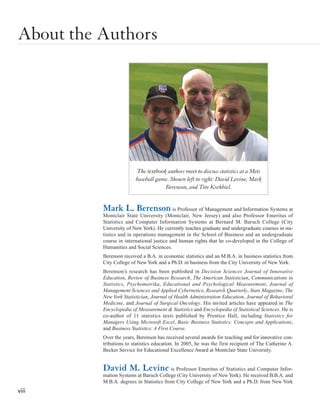
Thetextbook authors meet to discuss statistics at a Mets
baseball game. Shown left to right: David Levine, Mark
Berenson, and Tim Krehbiel.
Mark L. Berenson is Professor of Management and Information Systems at
Montclair State University (Montclair, New Jersey) and also Professor Emeritus of
Statistics and Computer Information Systems at Bernard M. Baruch College (City
University of New York). He currently teaches graduate and undergraduate courses in sta-
tistics and in operations management in the School of Business and an undergraduate
course in international justice and human rights that he co-developed in the College of
Humanities and Social Sciences.
Berenson received a B.A. in economic statistics and an M.B.A. in business statistics from
City College of New York and a Ph.D. in business from the City University of New York.
Berenson’s research has been published in Decision Sciences Journal of Innovative
Education, Review of Business Research, The American Statistician, Communications in
Statistics, Psychometrika, Educational and Psychological Measurement, Journal of
Management Sciences and Applied Cybernetics, Research Quarterly, Stats Magazine, The
New York Statistician, Journal of Health Administration Education, Journal of Behavioral
Medicine, and Journal of Surgical Oncology. His invited articles have appeared in The
Encyclopedia of Measurement & Statistics and Encyclopedia of Statistical Sciences. He is
co-author of 11 statistics texts published by Prentice Hall, including Statistics for
Managers Using Microsoft Excel, Basic Business Statistics: Concepts and Applications,
and Business Statistics: A First Course.
Over the years, Berenson has received several awards for teaching and for innovative con-
tributions to statistics education. In 2005, he was the first recipient of The Catherine A.
Becker Service for Educational Excellence Award at Montclair State University.
David M. Levine is Professor Emeritus of Statistics and Computer Infor-
mation Systems at Baruch College (City University of New York). He received B.B.A. and
M.B.A. degrees in Statistics from City College of New York and a Ph.D. from New York
5.
ABOUT THE AUTHORSix
University in Industrial Engineering and Operations Research. He is nationally recognized
as a leading innovator in statistics education and is the co-author of 14 books, including
such best-selling statistics textbooks as Statistics for Managers Using Microsoft Excel,
Basic Business Statistics: Concepts and Applications, Business Statistics: A First Course,
and Applied Statistics for Engineers and Scientists Using Microsoft Excel and Minitab.
He also is the co-author of EvenYou Can Learn Statistics: A Guide for Everyone Who Has
Ever Been Afraid of Statistics, currently in its 2nd edition, Six Sigma for Green Belts and
Champions and Design for Six Sigma for Green Belts and Champions, and the author of
Statistics for Six Sigma Green Belts, all published by FT Press, a Pearson imprint, and
Quality Management, 3rd edition, McGraw-Hill/Irwin. He is also the author of Video
Review of Statistics and Video Review of Probability, both published by Video Aided
Instruction, and the statistics module of the MBA primer published by Cengage Learning.
He has published articles in various journals, including Psychometrika, The American
Statistician, Communications in Statistics, Decision Sciences Journal of Innovative
Education, Multivariate Behavioral Research, Journal of Systems Management, Quality
Progress, and The American Anthropologist, and given numerous talks at the Decision
Sciences Institute (DSI), American Statistical Association (ASA), and Making Statistics
More Effective in Schools and Business (MSMESB) conferences. Levine has also received
several awards for outstanding teaching and curriculum development from Baruch College.
Timothy C. Krehbiel is Professor of Management and Senior Associate
Dean of the Farmer School of Business at Miami University in Oxford, Ohio. He teaches
undergraduate and graduate courses in business statistics. In 1996, he received the presti-
gious Instructional Innovation Award from the Decision Sciences Institute. He has also
received the Farmer School of Business Effective Educator Award and has twice been
named MBA professor of the year.
Krehbiel’s research interests span many areas of business and applied statistics. His work
has appeared in numerous journals, including Quality Management Journal, Ecological
Economics, International Journal of Production Research, Journal of Purchasing and
Supply Management, Journal of Applied Business Research, Journal of Marketing
Management, Communications in Statistics, Decision Sciences Journal of Innovative
Education, Journal of Education for Business, Marketing Education Review, Journal of
Accounting Education, and Teaching Statistics. He is a co-author of three statistics text-
books published by Prentice Hall: Business Statistics: A First Course, Basic Business
Statistics, and Statistics for Managers Using Microsoft Excel. Krehbiel is also a co-author
of the book Sustainability Perspectives in Business and Resources.
Krehbiel graduated summa cum laude with a B.A. in history from McPherson College and
earned an M.S. and a Ph.D. in statistics from the University of Wyoming.
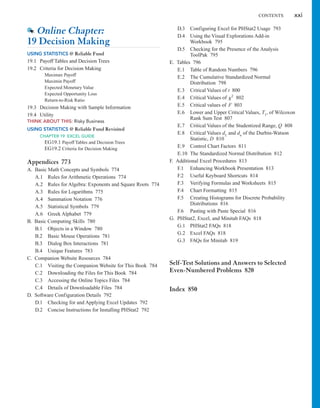
Brief Contents
Preface xxiii
1Introduction 2
2 Organizing and Visualizing Data 26
3 Numerical Descriptive Measures 94
4 Basic Probability 144
5 Discrete Probability Distributions 180
6 The Normal Distribution and Other Continuous Distributions 216
7 Sampling and Sampling Distributions 248
8 Confidence Interval Estimation 278
9 Fundamentals of Hypothesis Testing: One-Sample Tests 324
10 Two-Sample Tests 364
11 Analysis of Variance 414
12 Chi-Square Tests and Nonparametric Tests 466
13 Simple Linear Regression 520
14 Introduction to Multiple Regression 576
15 Multiple Regression Model Building 628
16 Time-Series Forecasting 664
17 Statistical Applications in Quality Management 716
18 A Road Map for Analyzing Data 762
Online Chapter: 19 Decision Making
Appendices A–G 773
Self-Test Solutions and Answers to Selected Even-Numbered Problems 820
Index 850
xi
Contents
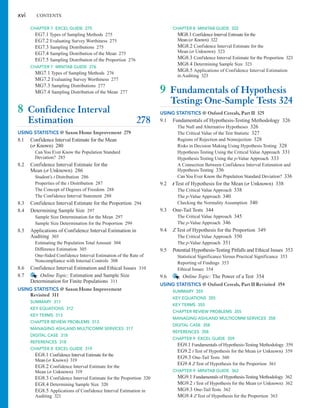
xiii
Preface xxiii
1 Introduction2
USING STATISTICS @ Good Tunes & More 3
1.1 Why Learn Statistics 4
1.2 Statistics in Business 4
1.3 Basic Vocabulary of Statistics 5
1.4 Identifying Type of Variables 7
Measurement Scales 7
1.5 Statistical Applications for Desktop
Computing 10
1.6 How to Use This Book 11
Checklist for Getting Started 11
USING STATISTICS @ Good Tunes & More Revisited 13
SUMMARY 13
KEY TERMS 13
CHAPTER REVIEW PROBLEMS 13
END-OF-CHAPTER CASES 15
LEARNING WITH THE DIGITAL CASES 15
REFERENCES 16
CHAPTER 1 EXCEL GUIDE 17
EG1.1 Getting Started with Excel 17
EG1.2 Entering Data and Variable Type 18
EG1.3 Opening and Saving Workbooks 18
EG1.4 Creating and Copying Worksheets 19
EG1.5 Printing Worksheets 19
EG1.6 Worksheet Entries and References 20
EG1.7 Absolute and Relative Cell References 21
EG1.8 Entering Formulas into Worksheets 21
EG1.9 Using Appendices D and F 21
CHAPTER 1 MINITAB GUIDE 22
MG1.1 Getting Started With Minitab 22
MG1.2 Entering Data and Variable Type 22
MG1.3 Opening and Saving Worksheets and
Projects 23
MG1.4 Creating and Copying Worksheets 24
MG1.5 Printing Parts of a Project 24
MG1.6 Worksheet Entries and References 24
MG1.7 Using Appendices D and F 25
2 Organizing and Visualizing
Data 26
USING STATISTICS @ Choice Is Yours, Part I 27
2.1 Data Collection 28
ORGANIZING DATA 29
2.2 Organizing Categorical Data 30
The Summary Table 30
The Contingency Table 30
2.3 Organizing Numerical Data 33
Stacked and Unstacked Data 33
The Ordered Array 34
The Frequency Distribution 35
The Relative Frequency Distribution and the Percentage
Distribution 37
The Cumulative Distribution 38
VISUALIZING DATA 41
2.4 Visualizing Categorical Data 41
The Bar Chart 42
The Pie Chart 43
The Pareto Chart 44
The Side-by-Side Bar Chart 46
2.5 Visualizing Numerical Data 49
The Stem-and-Leaf Display 49
The Histogram 50
The Percentage Polygon 51
The Cumulative Percentage Polygon (Ogive) 53
2.6 Visualizing Two Numerical Variables 56
The Scatter Plot 56
The Time-Series Plot 58
2.7 Organizing Multidimensional Data 60
Multidimensional Contingency Tables 60
Adding Numerical Variables 61
2.8 Misuses and Common Errors in Visualizing Data 63
USING STATISTICS @ Choice Is Yours, Part I Revisited 66
SUMMARY 67
KEY EQUATIONS 67
KEY TERMS 68
CHAPTER REVIEW PROBLEMS 68
MANAGING ASHLAND MULTICOMM SERVICES 74
DIGITAL CASE 75
REFERENCES 75
CHAPTER 2 EXCEL GUIDE 76
EG2.2 Organizing Categorical Data 76
EG2.3 Organizing Numerical Data 78
EG2.4 Visualizing Categorical Data 80
EG2.5 Visualizing Numerical Data 82
EG2.6 Visualizing Two Numerical Variables 84
EG2.7 Organizing Multidimensional Data 85
CHAPTER 2 MINITAB GUIDE 87
MG2.2 Organizing Categorical Data 87
MG2.3 Organizing Numerical Data 87
MG2.4 Visualizing Categorical Data 88
MG2.5 Visualizing Numerical Data 89
MG2.6 Visualizing Two Numerical Variables 92
MG2.7 Organizing Multidimensional Data 93
10.
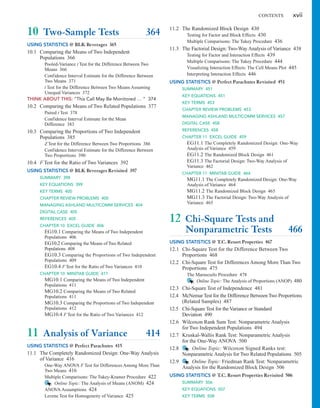
3 Numerical Descriptive
Measures94
USING STATISTICS @ Choice Is Yours, Part II 95
3.1 Central Tendency 96
The Mean 96
The Median 98
The Mode 99
The Geometric Mean 100
3.2 Variation and Shape 101
The Range 102
The Variance and the Standard Deviation 102
The Coefficient of Variation 106
Z Scores 107
Shape 108
VISUAL EXPLORATIONS: Exploring Descriptive
Statistics 110
3.3 Exploring Numerical Data 113
Quartiles 113
The Interquartile Range 115
The Five-Number Summary 115
The Boxplot 117
3.4 Numerical Descriptive Measures for a Population 120
The Population Mean 121
The Population Variance and Standard Deviation 121
The Empirical Rule 122
The Chebyshev Rule 123
3.5 The Covariance and the Coefficient of
Correlation 125
The Covariance 125
The Coefficient of Correlation 127
3.6 Descriptive Statistics: Pitfalls and Ethical Issues 131
USING STATISTICS @ Choice Is Yours, Part II Revisited 131
SUMMARY 132
KEY EQUATIONS 132
KEY TERMS 133
CHAPTER REVIEW PROBLEMS 133
MANAGING ASHLAND MULTICOMM SERVICES 138
DIGITAL CASE 138
REFERENCES 138
CHAPTER 3 EXCEL GUIDE 139
EG3.1 Central Tendency 139
EG3.2 Variation and Shape 139
EG3.3 Exploring Numerical Data 140
EG3.4 Numerical Descriptive Measures for a
Population 140
EG3.5 The Covariance and the Coefficient of
Correlation 141
CHAPTER 3 MINITAB GUIDE 141
MG3.1 Central Tendency 141
MG3.2 Variation and Shape 142
MG3.3 Exploring Numerical Data 142
MG3.4 Numerical Descriptive Measures for a
Population 143
MG3.5 The Covariance and the Coefficient of
Correlation 143
4 Basic Probability 144
USING STATISTICS @ M&R Electronics World 145
4.1 Basic Probability Concepts 146
Events and Sample Spaces 147
Contingency Tables and Venn Diagrams 148
Simple Probability 149
Joint Probability 150
Marginal Probability 150
General Addition Rule 151
4.2 Conditional Probability 155
Computing Conditional Probabilities 155
Decision Trees 156
Independence 158
Multiplication Rules 159
Marginal Probability Using the General Multiplication
Rule 160
4.3 Bayes’Theorem 163
THINK ABOUT THIS: Divine Providence and Spam 166
4.4 Counting Rules 167
Counting Rule 1 167
Counting Rule 2 168
Counting Rule 3 168
Counting Rule 4 169
Counting Rule 5 169
4.5 Ethical Issues and Probability 171
USING STATISTICS @ M&R Electronics World Revisited 172
SUMMARY 172
KEY EQUATIONS 172
KEY TERMS 173
CHAPTER REVIEW PROBLEMS 173
DIGITAL CASE 175
REFERENCES 176
CHAPTER 4 EXCEL GUIDE 177
EG4.1 Basic Probability Concepts 177
EG4.2 Conditional Probability 177
EG4.3 Bayes’Theorem 177
EG4.4 Counting Rules 178
CHAPTER 4 MINITAB GUIDE 178
MG4.1 Basic Probability Concepts 178
MG4.2 Conditional Probability 178
MG4.3 Bayes’Theorem 178
MG4.4 Counting Rules 178
5 Discrete Probability
Distributions 180
USING STATISTICS @ Saxon Home Improvement 181
5.1 The Probability Distribution for a Discrete Random
Variable 182
Expected Value of a Discrete Random Variable 182
Variance and Standard Deviation of a Discrete Random
Variable 183
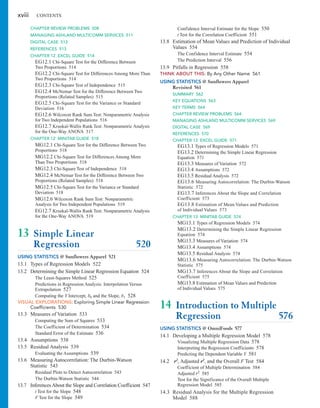
xiv CONTENTS
11.
5.2 Covariance andIts Application in Finance 185
Covariance 185
Expected Value, Variance, and Standard Deviation of the
Sum of Two Random Variables 187
Portfolio Expected Return and Portfolio Risk 187
5.3 Binomial Distribution 190
5.4 Poisson Distribution 197
5.5 Hypergeometric Distribution 201
5.6 Online Topic Using the Poisson Distribution
to Approximate the Binomial Distribution 204
USING STATISTICS @ Saxon Home Improvement
Revisited 205
SUMMARY 205
KEY EQUATIONS 205
KEY TERMS 206
CHAPTER REVIEW PROBLEMS 206
MANAGING ASHLAND MULTICOMM SERVICES 209
DIGITAL CASE 210
REFERENCES 210
CHAPTER 5 EXCEL GUIDE 211
EG5.1 The Probability Distribution for a Discrete Random
Variable 211
EG5.2 Covariance and Its Application in Finance 211
EG5.3 Binomial Distribution 212
EG5.4 Poisson Distribution 212
EG5.5 Hypergeometric Distribution 213
CHAPTER 5 MINITAB GUIDE 214
MG5.1 The Probability Distribution for a Discrete Random
Variable 214
MG5.2 Covariance and Its Application in Finance 214
MG5.3 Binomial Distribution 214
MG5.4 Poisson Distribution 214
MG5.5 Hypergeometric Distribution 215
6 The Normal Distribution
and Other Continuous
Distributions 216
USING STATISTICS @ OurCampus! 217
6.1 Continuous Probability Distributions 218
6.2 The Normal Distribution 218
Computing Normal Probabilities 220
THINK ABOUT THIS: What Is Normal? 228
VISUAL EXPLORATIONS: Exploring the Normal
Distribution 229
6.3 Evaluating Normality 230
Comparing Data Characteristics to Theoretical
Properties 231
Constructing the Normal Probability Plot 232
6.4 The Uniform Distribution 235
6.5 The Exponential Distribution 237
6.6 Online Topic: The Normal Approximation to the
Binomial Distribution 240
USING STATISTICS @ OurCampus! Revisited 240
SUMMARY 240
KEY EQUATIONS 241
KEY TERMS 241
CHAPTER REVIEW PROBLEMS 241
MANAGING ASHLAND MULTICOMM SERVICES 244
DIGITAL CASE 244
REFERENCES 244
CHAPTER 6 EXCEL GUIDE 245
EG6.1 Continuous Probability Distributions 245
EG6.2 The Normal Distribution 245
EG6.3 Evaluating Normality 245
EG6.4 The Uniform Distribution 246
EG6.5 The Exponential Distribution 246
CHAPTER 6 MINITAB GUIDE 246
MG6.1 Continuous Probability Distributions 246
MG6.2 The Normal Distribution 246
MG6.3 Evaluating Normality 247
MG6.4 The Uniform Distribution 247
MG6.5 The Exponential Distribution 247
7 Sampling and Sampling
Distributions 248
USING STATISTICS @ Oxford Cereals 249
7.1 Types of Sampling Methods 250
Simple Random Samples 251
Systematic Samples 253
Stratified Samples 253
Cluster Samples 254
7.2 Evaluating Survey Worthiness 255
Survey Error 255
Ethical Issues 256
THINK ABOUT THIS: New Media Surveys/Old Sampling
Problem 256
7.3 Sampling Distributions 258
7.4 Sampling Distribution of the Mean 258
The Unbiased Property of the Sample Mean 258
Standard Error of the Mean 260
Sampling from Normally Distributed Populations 261
Sampling from Non-Normally Distributed Populations—
The Central Limit Theorem 264
VISUAL EXPLORATIONS: Exploring Sampling Distributions 265
7.5 Sampling Distribution of the Proportion 266
7.6 Online Topic: Sampling from Finite
Populations 269
USING STATISTICS @ Oxford Cereals Revisited 270
SUMMARY 270
KEY EQUATIONS 270
KEY TERMS 271
CHAPTER REVIEW PROBLEMS 271
MANAGING ASHLAND MULTICOMM SERVICES 273
DIGITAL CASE 273
REFERENCES 274
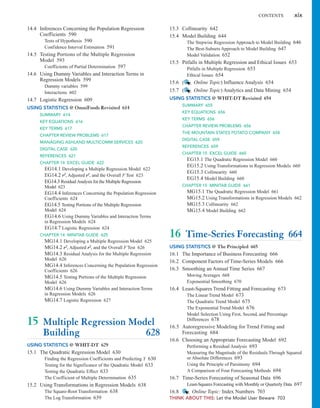
CONTENTS xv
12.
CHAPTER 8 MINITABGUIDE 322
MG8.1 Confidence Interval Estimate for the
Mean ( Known) 322
MG8.2 Confidence Interval Estimate for the
Mean ( Unknown) 323
MG8.3 Confidence Interval Estimate for the Proportion 323
MG8.4 Determining Sample Size 323
MG8.5 Applications of Confidence Interval Estimation
in Auditing 323
9 Fundamentals of Hypothesis
Testing: One-Sample Tests 324
USING STATISTICS @ Oxford Cereals, Part II 325
9.1 Fundamentals of Hypothesis-Testing Methodology 326
The Null and Alternative Hypotheses 326
The Critical Value of the Test Statistic 327
Regions of Rejection and Nonrejection 328
Risks in Decision Making Using Hypothesis Testing 328
Hypothesis Testing Using the Critical Value Approach 331
Hypothesis Testing Using the p-Value Approach 333
A Connection Between Confidence Interval Estimation and
Hypothesis Testing 336
CanYou Ever Know the Population Standard Deviation? 336
9.2 t Test of Hypothesis for the Mean ( Unknown) 338
The Critical Value Approach 338
The p-Value Approach 340
Checking the Normality Assumption 340
9.3 One-Tail Tests 344
The Critical Value Approach 345
The p-Value Approach 346
9.4 Z Test of Hypothesis for the Proportion 349
The Critical Value Approach 350
The p-Value Approach 351
9.5 Potential Hypothesis-Testing Pitfalls and Ethical Issues 353
Statistical Significance Versus Practical Significance 353
Reporting of Findings 353
Ethical Issues 354
9.6 Online Topic: The Power of a Test 354
USING STATISTICS @ Oxford Cereals, Part II Revisited 354
SUMMARY 355
KEY EQUATIONS 355
KEY TERMS 355
CHAPTER REVIEW PROBLEMS 355
MANAGING ASHLAND MULTICOMM SERVICES 358
DIGITAL CASE 358
REFERENCES 358
CHAPTER 9 EXCEL GUIDE 359
EG9.1 Fundamentals of Hypothesis-Testing Methodology 359
EG9.2 t Test of Hypothesis for the Mean ( Unknown) 359
EG9.3 One-Tail Tests 360
EG9.4 Z Test of Hypothesis for the Proportion 361
CHAPTER 9 MINITAB GUIDE 362
MG9.1 Fundamentals of Hypothesis-Testing Methodology 362
MG9.2 t Test of Hypothesis for the Mean ( Unknown) 362
MG9.3 One-Tail Tests 362
MG9.4 Z Test of Hypothesis for the Proportion 363
s
s
s
s
s
xvi CONTENTS
CHAPTER 7 EXCEL GUIDE 275
EG7.1 Types of Sampling Methods 275
EG7.2 Evaluating Survey Worthiness 275
EG7.3 Sampling Distributions 275
EG7.4 Sampling Distribution of the Mean 275
EG7.5 Sampling Distribution of the Proportion 276
CHAPTER 7 MINITAB GUIDE 276
MG7.1 Types of Sampling Methods 276
MG7.2 Evaluating Survey Worthiness 277
MG7.3 Sampling Distributions 277
MG7.4 Sampling Distribution of the Mean 277
8 Confidence Interval
Estimation 278
USING STATISTICS @ Saxon Home Improvement 279
8.1 Confidence Interval Estimate for the Mean
( Known) 280
Can You Ever Know the Population Standard
Deviation? 285
8.2 Confidence Interval Estimate for the
Mean ( Unknown) 286
Student’s t Distribution 286
Properties of the t Distribution 287
The Concept of Degrees of Freedom 288
The Confidence Interval Statement 288
8.3 Confidence Interval Estimate for the Proportion 294
8.4 Determining Sample Size 297
Sample Size Determination for the Mean 297
Sample Size Determination for the Proportion 299
8.5 Applications of Confidence Interval Estimation in
Auditing 303
Estimating the Population Total Amount 304
Difference Estimation 305
One-Sided Confidence Interval Estimation of the Rate of
Noncompliance with Internal Controls 308
8.6 Confidence Interval Estimation and Ethical Issues 310
8.7 Online Topic: Estimation and Sample Size
Determination for Finite Populations 311
USING STATISTICS @ Saxon Home Improvement
Revisited 311
SUMMARY 311
KEY EQUATIONS 312
KEY TERMS 313
CHAPTER REVIEW PROBLEMS 313
MANAGING ASHLAND MULTICOMM SERVICES 317
DIGITAL CASE 318
REFERENCES 318
CHAPTER 8 EXCEL GUIDE 319
EG8.1 Confidence Interval Estimate for the
Mean ( Known) 319
EG8.2 Confidence Interval Estimate for the
Mean ( Unknown) 319
EG8.3 Confidence Interval Estimate for the Proportion 320
EG8.4 Determining Sample Size 320
EG8.5 Applications of Confidence Interval Estimation in
Auditing 321
s
s
s
s
13.
CONTENTS xvii
11.2 TheRandomized Block Design 430
Testing for Factor and Block Effects 430
Multiple Comparisons: The Tukey Procedure 436
11.3 The Factorial Design: Two-Way Analysis of Variance 438
Testing for Factor and Interaction Effects 439
Multiple Comparisons: The Tukey Procedure 444
Visualizing Interaction Effects: The Cell Means Plot 445
Interpreting Interaction Effects 446
USING STATISTICS @ Perfect Parachutes Revisited 451
SUMMARY 451
KEY EQUATIONS 451
KEY TERMS 453
CHAPTER REVIEW PROBLEMS 453
MANAGING ASHLAND MULTICOMM SERVICES 457
DIGITAL CASE 458
REFERENCES 458
CHAPTER 11 EXCEL GUIDE 459
EG11.1 The Completely Randomized Design: One-Way
Analysis of Variance 459
EG11.2 The Randomized Block Design 461
EG11.3 The Factorial Design: Two-Way Analysis of
Variance 462
CHAPTER 11 MINITAB GUIDE 464
MG11.1 The Completely Randomized Design: One-Way
Analysis of Variance 464
MG11.2 The Randomized Block Design 465
MG11.3 The Factorial Design: Two-Way Analysis of
Variance 465
12 Chi-Square Tests and
Nonparametric Tests 466
USING STATISTICS @ T.C. Resort Properties 467
12.1 Chi-Square Test for the Difference Between Two
Proportions 468
12.2 Chi-Square Test for Differences Among More Than Two
Proportions 475
The Marascuilo Procedure 478
Online Topic: The Analysis of Proportions (ANOP) 480
12.3 Chi-Square Test of Independence 481
12.4 McNemar Test for the Difference Between Two Proportions
(Related Samples) 487
12.5 Chi-Square Test for the Variance or Standard
Deviation 490
12.6 Wilcoxon Rank Sum Test: Nonparametric Analysis
for Two Independent Populations 494
12.7 Kruskal-Wallis Rank Test: Nonparametric Analysis
for the One-Way ANOVA 500
12.8 Online Topic: Wilcoxon Signed Ranks test:
Nonparametric Analysis for Two Related Populations 505
12.9 Online Topic: Friedman Rank Test: Nonparametric
Analysis for the Randomized Block Design 506
10 Two-Sample Tests 364
USING STATISTICS @ BLK Beverages 365
10.1 Comparing the Means of Two Independent
Populations 366
Pooled-Variance t Test for the Difference Between Two
Means 366
Confidence Interval Estimate for the Difference Between
Two Means 371
t Test for the Difference Between Two Means Assuming
Unequal Variances 372
THINK ABOUT THIS: “This Call May Be Monitored ... ” 374
10.2 Comparing the Means of Two Related Populations 377
Paired t Test 378
Confidence Interval Estimate for the Mean
Difference 383
10.3 Comparing the Proportions of Two Independent
Populations 385
Z Test for the Difference Between Two Proportions 386
Confidence Interval Estimate for the Difference Between
Two Proportions 390
10.4 F Test for the Ratio of Two Variances 392
USING STATISTICS @ BLK Beverages Revisited 397
SUMMARY 398
KEY EQUATIONS 399
KEY TERMS 400
CHAPTER REVIEW PROBLEMS 400
MANAGING ASHLAND MULTICOMM SERVICES 404
DIGITAL CASE 405
REFERENCES 405
CHAPTER 10 EXCEL GUIDE 406
EG10.1 Comparing the Means of Two Independent
Populations 406
EG10.2 Comparing the Means of Two Related
Populations 408
EG10.3 Comparing the Proportions of Two Independent
Populations 409
EG10.4 F Test for the Ratio of Two Variances 410
CHAPTER 10 MINITAB GUIDE 411
MG10.1 Comparing the Means of Two Independent
Populations 411
MG10.2 Comparing the Means of Two Related
Populations 411
MG10.3 Comparing the Proportions of Two Independent
Populations 412
MG10.4 F Test for the Ratio of Two Variances 412
11 Analysis of Variance 414
USING STATISTICS @ Perfect Parachutes 415
11.1 The Completely Randomized Design: One-Way Analysis
of Variance 416
One-Way ANOVA F Test for Differences Among More Than
Two Means 416
Multiple Comparisons: The Tukey-Kramer Procedure 422
Online Topic: The Analysis of Means (ANOM) 424
ANOVA Assumptions 424
Levene Test for Homogeneity of Variance 425
USING STATISTICS @ T.C. Resort Properties Revisited 506
SUMMARY 506
KEY EQUATIONS 507
KEY TERMS 508
14.
xviii CONTENTS
Confidence IntervalEstimate for the Slope 550
t Test for the Correlation Coefficient 551
13.8 Estimation of Mean Values and Prediction of Individual
Values 554
The Confidence Interval Estimate 554
The Prediction Interval 556
13.9 Pitfalls in Regression 558
THINK ABOUT THIS: By Any Other Name 561
USING STATISTICS @ Sunflowers Apparel
Revisited 561
SUMMARY 562
KEY EQUATIONS 563
KEY TERMS 564
CHAPTER REVIEW PROBLEMS 564
MANAGING ASHLAND MULTICOMM SERVICES 569
DIGITAL CASE 569
REFERENCES 570
CHAPTER 13 EXCEL GUIDE 571
EG13.1 Types of Regression Models 571
EG13.2 Determining the Simple Linear Regression
Equation 571
EG13.3 Measures of Variation 572
EG13.4 Assumptions 572
EG13.5 Residual Analysis 572
EG13.6 Measuring Autocorrelation: The Durbin-Watson
Statistic 572
EG13.7 Inferences About the Slope and Correlation
Coefficient 573
EG13.8 Estimation of Mean Values and Prediction
of Individual Values 573
CHAPTER 13 MINITAB GUIDE 574
MG13.1 Types of Regression Models 574
MG13.2 Determining the Simple Linear Regression
Equation 574
MG13.3 Measures of Variation 574
MG13.4 Assumptions 574
MG13.5 Residual Analysis 574
MG13.6 Measuring Autocorrelation: The Durbin-Watson
Statistic 575
MG13.7 Inferences About the Slope and Correlation
Coefficient 575
MG13.8 Estimation of Mean Values and Prediction
of Individual Values 575
14 Introduction to Multiple
Regression 576
USING STATISTICS @ OmniFoods 577
14.1 Developing a Multiple Regression Model 578
Visualizing Multiple Regression Data 578
Interpreting the Regression Coefficients 578
Predicting the Dependent Variable Y 581
14.2 r2, Adjusted r2, and the Overall F Test 584
Coefficient of Multiple Determination 584
Adjusted r2 585
Test for the Significance of the Overall Multiple
Regression Model 585
14.3 Residual Analysis for the Multiple Regression
Model 588
CHAPTER REVIEW PROBLEMS 508
MANAGING ASHLAND MULTICOMM SERVICES 511
DIGITAL CASE 512
REFERENCES 513
CHAPTER 12 EXCEL GUIDE 514
EG12.1 Chi-Square Test for the Difference Between
Two Proportions 514
EG12.2 Chi-Square Test for Differences Among More Than
Two Proportions 514
EG12.3 Chi-Square Test of Independence 515
EG12.4 McNemar Test for the Difference Between Two
Proportions (Related Samples) 515
EG12.5 Chi-Square Test for the Variance or Standard
Deviation 516
EG12.6 Wilcoxon Rank Sum Test: Nonparametric Analysis
for Two Independent Populations 516
EG12.7 Kruskal-Wallis Rank Test: Nonparametric Analysis
for the One-Way ANOVA 517
CHAPTER 12 MINITAB GUIDE 518
MG12.1 Chi-Square Test for the Difference Between Two
Proportions 518
MG12.2 Chi-Square Test for Differences Among More
Than Two Proportions 518
MG12.3 Chi-Square Test of Independence 518
MG12.4 McNemar Test for the Difference Between Two
Proportions (Related Samples) 518
MG12.5 Chi-Square Test for the Variance or Standard
Deviation 518
MG12.6 Wilcoxon Rank Sum Test: Nonparametric
Analysis for Two Independent Populations 519
EG12.7 Kruskal-Wallis Rank Test: Nonparametric Analysis
for the One-Way ANOVA 519
13 Simple Linear
Regression 520
USING STATISTICS @ Sunflowers Apparel 521
13.1 Types of Regression Models 522
13.2 Determining the Simple Linear Regression Equation 524
The Least-Squares Method 525
Predictions in Regression Analysis: Interpolation Versus
Extrapolation 527
Computing the Y Intercept, and the Slope, 528
VISUAL EXPLORATIONS: Exploring Simple Linear Regression
Coefficients 530
13.3 Measures of Variation 533
Computing the Sum of Squares 533
The Coefficient of Determination 534
Standard Error of the Estimate 536
13.4 Assumptions 538
13.5 Residual Analysis 539
Evaluating the Assumptions 539
13.6 Measuring Autocorrelation: The Durbin-Watson
Statistic 543
Residual Plots to Detect Autocorrelation 543
The Durbin-Watson Statistic 544
13.7 InferencesAbout the Slope and Correlation Coefficient 547
t Test for the Slope 548
F Test for the Slope 549
b1
b0
15.
CONTENTS xix
15.3 Collinearity642
15.4 Model Building 644
The Stepwise Regression Approach to Model Building 646
The Best-Subsets Approach to Model Building 647
Model Validation 652
15.5 Pitfalls in Multiple Regression and Ethical Issues 653
Pitfalls in Multiple Regression 653
Ethical Issues 654
15.6 ( Online Topic) Influence Analysis 654
15.7 ( Online Topic) Analytics and Data Mining 654
USING STATISTICS @ WHIT-DT Revisited 654
SUMMARY 655
KEY EQUATIONS 656
KEY TERMS 656
CHAPTER REVIEW PROBLEMS 656
THE MOUNTAIN STATES POTATO COMPANY 658
DIGITAL CASE 659
REFERENCES 659
CHAPTER 15 EXCEL GUIDE 660
EG15.1 The Quadratic Regression Model 660
EG15.2 Using Transformations in Regression Models 660
EG15.3 Collinearity 660
EG15.4 Model Building 660
CHAPTER 15 MINITAB GUIDE 661
MG15.1 The Quadratic Regression Model 661
MG15.2 Using Transformations in Regression Models 662
MG15.3 Collinearity 662
MG15.4 Model Building 662
16 Time-Series Forecasting 664
USING STATISTICS @ The Principled 665
16.1 The Importance of Business Forecasting 666
16.2 Component Factors of Time-Series Models 666
16.3 Smoothing an Annual Time Series 667
Moving Averages 668
Exponential Smoothing 670
16.4 Least-Squares Trend Fitting and Forecasting 673
The Linear Trend Model 673
The Quadratic Trend Model 675
The Exponential Trend Model 676
Model Selection Using First, Second, and Percentage
Differences 678
16.5 Autoregressive Modeling for Trend Fitting and
Forecasting 684
16.6 Choosing an Appropriate Forecasting Model 692
Performing a Residual Analysis 693
Measuring the Magnitude of the Residuals Through Squared
or Absolute Differences 693
Using the Principle of Parsimony 694
A Comparison of Four Forecasting Methods 694
16.7 Time-Series Forecasting of Seasonal Data 696
Least-Squares Forecasting with Monthly or Quarterly Data 697
16.8 Online Topic: Index Numbers 703
THINK ABOUT THIS: Let the Model User Beware 703
14.4 Inferences Concerning the Population Regression
Coefficients 590
Tests of Hypothesis 590
Confidence Interval Estimation 591
14.5 Testing Portions of the Multiple Regression
Model 593
Coefficients of Partial Determination 597
14.6 Using Dummy Variables and Interaction Terms in
Regression Models 599
Dummy variables 599
Interactions 602
14.7 Logistic Regression 609
USING STATISTICS @ OmniFoods Revisited 614
SUMMARY 614
KEY EQUATIONS 616
KEY TERMS 617
CHAPTER REVIEW PROBLEMS 617
MANAGING ASHLAND MULTICOMM SERVICES 620
DIGITAL CASE 620
REFERENCES 621
CHAPTER 14 EXCEL GUIDE 622
EG14.1 Developing a Multiple Regression Model 622
EG14.2 r2, Adjusted r2, and the Overall F Test 623
EG14.3 ResidualAnalysis for the Multiple Regression
Model 623
EG14.4 Inferences Concerning the Population Regression
Coefficients 624
EG14.5 Testing Portions of the Multiple Regression
Model 624
EG14.6 Using Dummy Variables and Interaction Terms
in Regression Models 624
EG14.7 Logistic Regression 624
CHAPTER 14 MINITAB GUIDE 625
MG14.1 Developing a Multiple Regression Model 625
MG14.2 r2, Adjusted r2, and the Overall F Test 626
MG14.3 Residual Analysis for the Multiple Regression
Model 626
MG14.4 Inferences Concerning the Population Regression
Coefficients 626
MG14.5 Testing Portions of the Multiple Regression
Model 626
MG14.6 Using Dummy Variables and Interaction Terms
in Regression Models 626
MG14.7 Logistic Regression 627
15 Multiple Regression Model
Building 628
USING STATISTICS @ WHIT-DT 629
15.1 The Quadratic Regression Model 630
Finding the Regression Coefficients and Predicting Y 630
Testing for the Significance of the Quadratic Model 633
Testing the Quadratic Effect 633
The Coefficient of Multiple Determination 635
15.2 Using Transformations in Regression Models 638
The Square-Root Transformation 638
The Log Transformation 639
16.
xx CONTENTS
MANAGING ASHLANDMULTICOMM SERVICES 753
REFERENCES 754
CHAPTER 17 EXCEL GUIDE 755
EG17.1 The Theory of Control Charts 755
EG17.2 Control Chart for the Proportion: The p Chart 755
EG17.3 The Red Bead Experiment: Understanding Process
Variability 756
EG17.4 Control Chart for an Area of Opportunity: The c
Chart 756
EG17.5 Control Charts for the Range and the Mean 757
EG17.6 Process Capability 758
EG17.7 Total Quality Management 759
EG17.8 Six Sigma 759
CHAPTER 17 MINITAB GUIDE 759
MG17.1 The Theory of Control Charts 759
MG17.2 Control Chart for the Proportion:
The p Chart 759
MG17.3 The Red Bead Experiment: Understanding
Process Variability 759
MG17.4 Control Chart for an Area of Opportunity: The c
Chart 756
MG17.5 Control Charts for the Range and the Mean 760
MG17.6 Process Capability 761
MG17.7 Total Quality Management 761
MG17.8 Six Sigma 761
18 A Roadmap for Analyzing
Data 762
USING STATISTICS @ YourBusiness 763
18.1 Analyzing Numerical Variables 765
How to Describe the Characteristics of a Numerical
Variable 766
How to Draw Conclusions About the Population Mean
or Standard Deviation 766
How to Determine Whether the Mean or Standard Deviation
Differs Depending on the Group 766
How to Determine Which Factors Affect the Value of
a Variable 767
How to Predict the Value of a Variable Based on the Value
of Other Variables 767
How to Determine Whether the Values of a Variable Are
Stable over Time 767
18.2 Analyzing Categorical Variables 767
How to Describe the Proportion of Items of Interest in Each
Category 768
How to Reach Conclusions About the Proportion of Items
of Interest 768
How to Determine Whether the Proportion of Items
of Interest Differs Depending on the Group 768
How to Predict the Proportion of Items of Interest Based
on the Value of Other Variables 768
How to Determine Whether the Proportion of Items
of Interest Is Stable over Time 769
USING STATISTICS @ YourBusiness Revisited 769
DIGITAL CASE 769
CHAPTER REVIEW PROBLEMS 769
USING STATISTICS @ The Principled Revisited 703
SUMMARY 704
KEY EQUATIONS 704
KEY TERMS 705
CHAPTER REVIEW PROBLEMS 706
MANAGING ASHLAND MULTICOMM SERVICES 707
DIGITAL CASE 708
REFERENCES 708
CHAPTER 16 EXCEL GUIDE 709
EG16.1 The Importance of Business Forecasting 709
EG16.2 Component Factors of Time-Series Models 709
EG16.3 Smoothing an Annual Time Series 709
EG16.4 Least-Squares Trend Fitting and Forecasting 710
EG16.5 Autoregressive Modeling for Trend Fitting and
Forecasting 711
EG16.6 Choosing an Appropriate Forecasting Model 711
EG16.7 Time-Series Forecasting of Seasonal Data 712
CHAPTER 16 MINITAB GUIDE 713
MG16.1 The Importance of Business Forecasting 713
MG16.2 Component Factors of Time-Series Models 713
MG16.3 Smoothing an Annual Time Series 713
MG16.4 Least-Squares Trend Fitting and Forecasting 713
MG16.5 Autoregressive Modeling for Trend Fitting and
Forecasting 714
MG16.6 Choosing an Appropriate Forecasting Model 714
MG16.7 Time-Series Forecasting of Seasonal Data 714
17 Statistical Applications in
Quality Management 716
USING STATISTICS @ Beachcomber Hotel 717
17.1 The Theory of Control Charts 718
17.2 Control Chart for the Proportion: The p Chart 720
17.3 The Red Bead Experiment: Understanding Process
Variability 726
17.4 Control Chart for an Area of Opportunity: The c
Chart 728
17.5 Control Charts for the Range and the Mean 732
The R Chart 732
The Chart 734
17.6 Process Capability 737
Customer Satisfaction and Specification Limits 737
Capability Indices 739
CPL, CPU, and Cpk 740
17.7 Total Quality Management 742
17.8 Six Sigma 744
The DMAIC Model 744
Roles in a Six Sigma Organization 745
USING STATISTICS @ Beachcomber Hotel Revisited 746
SUMMARY 747
KEY EQUATIONS 747
KEY TERMS 748
CHAPTER REVIEW PROBLEMS 748
THE HARNSWELL SEWING MACHINE COMPANY CASE 751
X
17.
CONTENTS xxi
D.3 ConfiguringExcel for PHStat2 Usage 793
D.4 Using the Visual Explorations Add-in
Workbook 795
D.5 Checking for the Presence of the Analysis
ToolPak 795
E. Tables 796
E.1 Table of Random Numbers 796
E.2 The Cumulative Standardized Normal
Distribution 798
E.3 Critical Values of t 800
E.4 Critical Values of 802
E.5 Critical values of F 803
E.6 Lower and Upper Critical Values, T1, of Wilcoxon
Rank Sum Test 807
E.7 Critical Values of the Studentized Range, Q 808
E.8 Critical Values dL and du of the Durbin-Watson
Statistic, D 810
E.9 Control Chart Factors 811
E.10 The Standardized Normal Distribution 812
F. Additional Excel Procedures 813
F.1 Enhancing Workbook Presentation 813
F.2 Useful Keyboard Shortcuts 814
F.3 Verifying Formulas and Worksheets 815
F.4 Chart Formatting 815
F.5 Creating Histograms for Discrete Probability
Distributions 816
F.6 Pasting with Paste Special 816
G. PHStat2, Excel, and Minitab FAQs 818
G.1 PHStat2 FAQs 818
G.2 Excel FAQs 818
G.3 FAQs for Minitab 819
Self-Test Solutions and Answers to Selected
Even-Numbered Problems 820
Index 850
x2
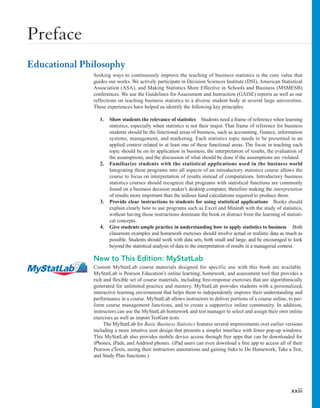
Online Chapter:
19 Decision Making
USING STATISTICS @ Reliable Fund
19.1 Payoff Tables and Decision Trees
19.2 Criteria for Decision Making
Maximax Payoff
Maximin Payoff
Expected Monetary Value
Expected Opportunity Loss
Return-to-Risk Ratio
19.3 Decision Making with Sample Information
19.4 Utility
THINK ABOUT THIS: Risky Business
USING STATISTICS @ Reliable Fund Revisited
CHAPTER 19 EXCEL GUIDE
EG19.1 Payoff Tables and Decision Trees
EG19.2 Criteria for Decision Making
Appendices 773
A. Basic Math Concepts and Symbols 774
A.1 Rules for Arithmetic Operations 774
A.2 Rules for Algebra: Exponents and Square Roots 774
A.3 Rules for Logarithms 775
A.4 Summation Notation 776
A.5 Statistical Symbols 779
A.6 Greek Alphabet 779
B. Basic Computing Skills 780
B.1 Objects in a Window 780
B.2 Basic Mouse Operations 781
B.3 Dialog Box Interactions 781
B.4 Unique Features 783
C. Companion Website Resources 784
C.1 Visiting the Companion Website for This Book 784
C.2 Downloading the Files for This Book 784
C.3 Accessing the Online Topics Files 784
C.4 Details of Downloadable Files 784
D. Software Configuration Details 792
D.1 Checking for and Applying Excel Updates 792
D.2 Concise Instructions for Installing PHStat2 792
Preface
Educational Philosophy
Seeking waysto continuously improve the teaching of business statistics is the core value that
guides our works. We actively participate in Decision Sciences Institute (DSI), American Statistical
Association (ASA), and Making Statistics More Effective in Schools and Business (MSMESB)
conferences. We use the Guidelines for Assessment and Instruction (GAISE) reports as well as our
reflections on teaching business statistics to a diverse student body at several large universities.
These experiences have helped us identify the following key principles:
1. Show students the relevance of statistics Students need a frame of reference when learning
statistics, especially when statistics is not their major. That frame of reference for business
students should be the functional areas of business, such as accounting, finance, information
systems, management, and marketing. Each statistics topic needs to be presented in an
applied context related to at least one of these functional areas. The focus in teaching each
topic should be on its application in business, the interpretation of results, the evaluation of
the assumptions, and the discussion of what should be done if the assumptions are violated.
2. Familiarize students with the statistical applications used in the business world
Integrating these programs into all aspects of an introductory statistics course allows the
course to focus on interpretation of results instead of computations. Introductory business
statistics courses should recognize that programs with statistical functions are commonly
found on a business decision maker’s desktop computer, therefore making the interpretation
of results more important than the tedious hand calculations required to produce them.
3. Provide clear instructions to students for using statistical applications Books should
explain clearly how to use programs such as Excel and Minitab with the study of statistics,
without having those instructions dominate the book or distract from the learning of statisti-
cal concepts.
4. Give students ample practice in understanding how to apply statistics to business Both
classroom examples and homework exercises should involve actual or realistic data as much as
possible. Students should work with data sets, both small and large, and be encouraged to look
beyond the statistical analysis of data to the interpretation of results in a managerial context.
New to This Edition: MyStatLab
Custom MyStatLab course materials designed for specific use with this book are available.
MyStatLab is Pearson Education’s online learning, homework, and assessment tool that provides a
rich and flexible set of course materials, including free-response exercises that are algorithmically
generated for unlimited practice and mastery. MyStatLab provides students with a personalized,
interactive learning environment that helps them to independently improve their understanding and
performance in a course. MyStatLab allows instructors to deliver portions of a course online, to per-
form course management functions, and to create a supportive online community. In addition,
instructors can use the MyStatLab homework and test manager to select and assign their own online
exercises as well as import TestGen tests.
The MyStatLab for Basic Business Statistics features several improvements over earlier versions
including a more intuitive user design that presents a simpler interface with fewer pop-up windows.
This MyStatLab also provides mobile device access through free apps that can be downloaded for
iPhones, iPads, and Andriod phones. (iPad users can even download a free app to access all of their
Pearson eTexts, seeing their instructors annotations and gaining links to Do Homework, Take a Test,
and Study Plan functions.)
xxiii
20.
xxiv PREFACE
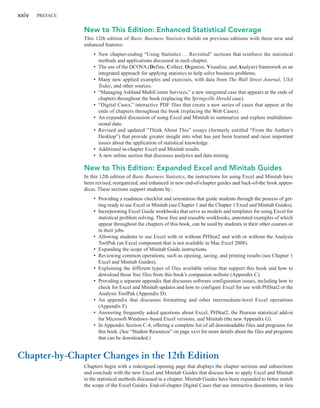
New toThis Edition: Enhanced Statistical Coverage
This 12th edition of Basic Business Statistics builds on previous editions with these new and
enhanced features:
• New chapter-ending “Using Statistics ... Revisited” sections that reinforce the statistical
methods and applications discussed in each chapter.
• The use of the DCOVA (Define, Collect, Organize, Visualize, and Analyze) framework as an
integrated approach for applying statistics to help solve business problems.
• Many new applied examples and exercises, with data from The Wall Street Journal, USA
Today, and other sources.
• “Managing Ashland MultiComm Services,” a new integrated case that appears at the ends of
chapters throughout the book (replacing the Springville Herald case).
• “Digital Cases,” interactive PDF files that create a new series of cases that appear at the
ends of chapters throughout the book (replacing the Web Cases).
• An expanded discussion of using Excel and Minitab to summarize and explore multidimen-
sional data.
• Revised and updated “Think About This” essays (formerly entitled “From the Author’s
Desktop”) that provide greater insight into what has just been learned and raise important
issues about the application of statistical knowledge.
• Additional in-chapter Excel and Minitab results.
• A new online section that discusses analytics and data mining.
New to This Edition: Expanded Excel and Minitab Guides
In this 12th edition of Basic Business Statistics, the instructions for using Excel and Minitab have
been revised, reorganized, and enhanced in new end-of-chapter guides and back-of-the book appen-
dices. These sections support students by:
• Providing a readiness checklist and orientation that guide students through the process of get-
ting ready to use Excel or Minitab (see Chapter 1 and the Chapter 1 Excel and Minitab Guides).
• Incorporating Excel Guide workbooks that serve as models and templates for using Excel for
statistical problem solving. These free and reusable workbooks, annotated examples of which
appear throughout the chapters of this book, can be used by students in their other courses or
in their jobs.
• Allowing students to use Excel with or without PHStat2 and with or without the Analysis
ToolPak (an Excel component that is not available in Mac Excel 2008).
• Expanding the scope of Minitab Guide instructions.
• Reviewing common operations, such as opening, saving, and printing results (see Chapter 1
Excel and Minitab Guides).
• Explaining the different types of files available online that support this book and how to
download those free files from this book’s companion website (Appendix C).
• Providing a separate appendix that discusses software configuration issues, including how to
check for Excel and Minitab updates and how to configure Excel for use with PHStat2 or the
Analysis ToolPak (Appendix D).
• An appendix that discusses formatting and other intermediate-level Excel operations
(Appendix F).
• Answering frequently asked questions about Excel, PHStat2, the Pearson statistical add-in
for Microsoft Windows–based Excel versions, and Minitab (the new Appendix G).
• In Appendix Section C.4, offering a complete list of all downloadable files and programs for
this book. (See “Student Resources” on page xxvi for more details about the files and programs
that can be downloaded.)
Chapter-by-Chapter Changes in the 12th Edition
Chapters begin with a redesigned opening page that displays the chapter sections and subsections
and conclude with the new Excel and Minitab Guides that discuss how to apply Excel and Minitab
to the statistical methods discussed in a chapter. Minitab Guides have been expanded to better match
the scope of the Excel Guides. End-of-chapter Digital Cases that use interactive documents, in lieu
As soon ashe reached the palace he went in search of his niece that
he might at once present her with the protective amulet, which was
to preserve her from the snares and lures of Popery.
The rooms were overcrowded with people; everywhere was
confusion and excitement. No one, from the scullions to the
Electress, talked of anything but the wedding; preparations for
receiving the guests, the coming and going of armourers, tailors,
cooks, confectioners, filled the air with noise and bustle; the
stewards and heralds were overwhelmed with work; loud disputes as
to the arrangements for the feasts and tourneys echoed in the
corridors; the pages and valets were too excited to be useful; and
the women did nothing but chatter about clothes.
As the Elector made his way through the confusion and thought of
the cost of his share in all this elaborate merry-making, he, too,
began to be sick of this wedding, to wish it well over and his niece
safely in the Netherlands.
He found the Lady Anne in the dark, lofty, antechamber of her
apartments. Here the confusion of the palace had culminated, the
whole room was strewn with dresses, hats, cloaks, and bales of
stuff; waiting-women, serving-women, and tailors were running here
and there displaying, explaining, and arranging their wares.
Near the tall, pointed Gothic window stood a structure of polished
wood the shape of a gallows, and on this elegant gibbet hung
several brilliantly dressed dolls, swinging by their necks like so many
gay little corpses.
They were the models showing the bride the completed splendours
of some of her bridal gowns, and she stood near them, pulling them
out on their strings and examining them; the strong sunlight was
over her and them and lying in a pool of gold at her feet.
Anne of Saxony, the heroine of this important and long-debated
marriage, whose name was now in every one's mouth, and whose
approaching union to a Papist noble had roused the compassionate
chivalry of others beside Vanderlinden's two apprentices, was now
23.
sixteen years ofage. Being the sole child of the great Elector
Maurice, she would, if a boy, have been in the place her uncle now
held. Connected by her mother's side with the Hesses, she was of
the finest blood in Germany, and numbered most of the great
families among her kinsmen; and her early orphanage, her high
rank, the glory of her father's fame, and this famous marriage
project had made of her a heroine in the eyes of Lutheran Germany.
The maiden who stood turning over the dressmaker's dolls looked,
however, far from a heroine of any manner of romance.
She was of medium height, and her whole body was twisted,
crooked in shoulder and hip; when she walked she halted in the
fashion known in her country as the devil's limp; her figure was thin,
undeveloped; her face pale, her features commonplace, save for the
mouth, which was abnormally wide and loose though closed with a
certain firmness; her eyes were light, large, and expressive; her hair
dull, between brown and flaxen, and growing in a straight ugly
fashion from her high brows.
In her whole person there was not one charm nor grace, ill-health
had robbed her even of the bloom of her early youth, nor did her
manners or her expression compensate for her defects; her gestures
were awkward and ungraceful, her voice shrill, and her look
conveyed the utmost arrogance and unbridled temper.
She was indeed both so unattractive and so unamiable, that the
Elector had used her defects with the Landgrave as an argument to
induce him to consent to her marriage.
"There will not be too many suitors for one crooked in mind and
body," he had said, and, looking at her now as she stood eagerly
snatching at the swinging dolls, his scruples and regrets at having
found her a Papist husband banished in satisfaction at having found
her any husband at all.
"Gracious uncle," said Anne, giving him a quick glance, "I am very
much occupied."
24.
Augustus took nonotice of this rebuke, he was used to her curtness.
She considered herself his superior, and her haughtiness, her
tempers, and her unreasonableness had often caused the Electress
to beseech her husband to hasten, at any cost, the marriage which
would relieve them of her.
"I have brought you the jewel which Vanderlinden made for you," he
said, and held out the little box-wood case.
Anne turned from the dolls and came forward with some interest.
She wore a long gown of tawny coloured cloth, and a white lawn
wimple; the heaviness of her attire added to her years but hardly
disguised her deformity.
She took the jewel-case with hands that trembled a little, her lips
were dry, her eyes bright, in her cheeks an unusual flush showed;
excitement burnt her like a fever, her whole poor distorted body was
quivering.
The Elector saw this, and a strange sort of pity for his brother's only
child touched him; after all she was but a girl, and this was three
days before her wedding.
"Dear niece," he said, putting his great hand gently on her crooked
shoulder, "may that amulet preserve your faith pure in the strange
land and keep you safe in body and spirit."
Anne laughed affectedly and gazed critically at the jewel in her palm.
"It is not very beautiful," she remarked.
"It is very potent, and I hope you will always wear it," replied her
uncle anxiously. "And every time you look at it, remember you were
born and bred in the Reformed Faith."
"As to that," said Anne, "His Highness himself said I was to read
Amadis de Gaul and play the lute and enjoy such diversions as were
fitted to one of my station, and not trouble my head about matters
of religion."
25.
Anne had oftenquoted this remark of her future husband, and the
Elector frowned to hear it again on her lips.
"The Prince spoke as a man to a child," he returned, "but you are no
longer a child and cannot reason as one. His Highness has promised
to respect your faith, and you must respect it also in heart and in
spirit, Anne."
The girl carelessly placed the amulet round her neck.
"Oh, I shall do very well, dear uncle," she replied. "I am quite
content to trust to His Highness."
"But it is you yourself who must keep the faith alive within you when
in the midst of idolaters," said the Lutheran Prince sternly.
"You speak like Grandfather Hesse!" cried the girl peevishly. "I
believe you regret my marriage already, but, as I wrote His
Highness, God wills it, and the Devil shall not hinder it!"
His frown deepened and a flush of anger mounted to his cheek.
"I shall regret it if you behave like a wilful child, dear niece."
"I have put on your amulet," returned Anne ungraciously. "What else
would you? And my serving-women wait——"
"I shall not keep you from them," interrupted the Elector, "but
remember that there are more serious matters than gowns and
chains appertaining to this marriage."
With that he turned away, for he saw that to argue further with the
bride was useless, since her natural pride and vanity had been
augmented past reason by the excitement and importance of her
present position.
Anne was, indeed, almost beside herself. For three years she had
been bent on this marriage with all the passion of which she was
capable. She wanted her freedom, she wanted increased grandeur,
she wanted the enjoyments of the gay court of Brussels—of which
she had heard so much—and she believed herself violently
26.
enamoured of thegorgeous cavalier whom she had seen once on
the occasion of his visit to Dresden and who was to be her husband.
She watched with pleasure the departure of her uncle, and
impatiently called the tailor who was responsible for the dolls. She
had some fault to find with each of them: one model had the skirt
too long, in another the colour was hideous, the gold lacing of a
third did not please her. These objections were taken at random, for
she was far too overwrought to consider or even notice the details of
the beautiful little dresses.
When the man had bowed himself out with his small gallows full of
puppets, Anne sank into one of the deep chairs of blue-and-yellow
velvet; her back ached from standing, her head throbbed, her heavy
gown dragged at her shoulders, she had not slept for several nights
and her whole feeble body was fatigued, but she would spare
neither herself nor those who had to please her humour.
Gowns, petticoats, mantles, caps, hoods, gloves, shoes, jewels,
every ornament or trinket luxury could devise was brought before
her for her inspection. She had been most extravagant in her
purchases, and it was already said that when her debts and the
feasts had been paid, there would not be anything left of the
hundred thousand thalers that formed her dowry. Her thin, feverish
fingers handled the brocades and velvets, the silks and lawns, the
girdles and chains with a kind of eager energy, as if these things
were so many weapons she was piling up against fate.
And so unconsciously she regarded them, she meant to be the
grandest lady at the Court of the Regent; her whole small soul was
centred on this childish ambition and had no room for any other
emotion save a fierce, jealous, but inchoate desire that her brilliant
husband should love her. She thought all this bravery would help her
accomplish both ends, and therefore devoted all her passionate
interest to these splendours of silvered silk, Venetian velvet, cloaks
of miniver and red fox, skirts of many coloured brocade, doeskin
fringed gloves and shoes sewn with gold thread.
27.
At last herweakness could endure no more; with an hysteric
petulance that bordered on tears she dismissed every one, and,
taking the arm of her favourite waiting-woman, she limped through
the bowing ranks of tailors, jewellers, and sewing-maids into her
inner and private chamber.
There she dropped into the cushion-piled chair near the window that
stood open on the sunshine, and so sat, looking huddled and
dwarfish, her right hand, sparkling with the hard brilliance of an
emerald ring, supporting her aching head, her feet resting on a great
footstool, her knees drawn up.
The waiting-woman stood at the end of the huge crimson-curtained
bed, waiting the pleasure of her mistress.
She was a tall girl, subdued, quiet, patient—qualities to which she
owned the dangerous favour of capricious Anne's preference. Her
father had served under the Elector Maurice, but returning to his
native city, Ghent in the Netherlands, he had been executed as a
heretic under the rule of the late Regent, and his entire property
confiscated. His wife had fled with her child to the Saxon Court,
where she had soon after died of her miseries, leaving her daughter
under the protection of the Electress.
Such was the short, sad experience of Rénèe le Meung, which had
left her reliant, reserved, self-effacing, humble, but passionately
attached to the faith for which her parents and her happiness had
been sacrificed, and of an earnest gravity beyond her years.
She endured the whims and caprices, the tempers and tyrannies of
Anne with more than the usual submission of the dependant, and
her lack of vanity and her indifference made her a foil that was
precious to the arrogance of her mistress.
Rénèe was beautiful with the opulent beauty of her country, but she
ignored it, and she had no lover, so Anne was content to ignore it
too. Besides, her own vanity was too great for her to be aware how
her own unattractiveness was heightened by the loveliness of the
graceful Fleming, with her crimson-brown hair and eyes, her rose
28.
complexion, her whiteskin, and exact features, though she was so
plain in her dress, so grave in her manner, so always and completely
in the background that many besides her mistress might have
discounted this beauty that lacked all flash and allure.
As she stood now, outwardly patiently at attention, her thoughts
were far away, returning, as always, to the dear past when she had
had a home and those who loved her, the times when she had heard
her father laugh, her mother sing, when she had herself been full of
life and hope and all pleasantness; her present situation, that of an
exile employed by charity, she forgot—she seemed for a moment
free, as she had once been behind the loved walls of Ghent——
"Rénèe," said Anne, opening her eyes, "the Prince wrote to know
what my colours were. When he enters Leipsic he will have a
thousand knights and gentlemen with him—is it not magnificent?"
The waiting-woman closed her thoughts.
"Indeed, Your Grace is very fortunate," she answered quietly, taking
up her wearisome part of confidante. She endured Anne's futile
vanities not so much from good humour as from sheer indifference;
her disinterest in her present life was her surest buckler against
what she had to endure.
"He is indeed a very splendid cavalier," said Anne, with vast
satisfaction, "and he made me such fine speeches and compliments.
I wish you had seen him when he came to Dresden, but you will
soon see him now. And I am higher born than he, for he is only a
Count in Germany. Yet he is a sovereign Prince too, and I shall give
way to no one at the Court of Brussels. Is it not all very pleasant?"
So the girl chattered on in her shrill, high voice, and the waiting-
woman dutifully assented to all she said; but Rénèe's calm, Rénèe's
self-effacement, usually so grateful to Anne, to-day offended her.
She wanted a more human interest shown in her affairs, some
excitement, some envy, some jealousy.
"You talk as if you were sick!" she cried fretfully. "Do you not care at
all about my wedding?"
29.
Rénèe flushed atthe rare personal address; it was seldom Anne
spoke to her as to another human being.
"Of course I care," she answered gravely, "but how can I comment
on matters so much above me?"
Anne was mollified.
"Would you not like a husband, rich and handsome?" she asked,
trying to provoke the flattery of the other's envy.
"I?" asked Rénèe, in genuine surprise. "Who will ever marry me?"
Anne smiled.
"Perhaps some day I shall find some one for you. How old are you?"
"Twenty-five, Your Grace."
"That is not very young! Nearly ten years older than I am! Is it not
very fine to be married at sixteen? Would you not like to be married
soon?"
"I would never marry any but a Lutheran," replied Rénèe calmly.
Anne flushed, and her bright eyes flashed with amazing fury.
"Ah! You, too, dare to blame me because the Prince is a Papist!" she
exclaimed.
"Nay," said Rénèe gently. "I know there are reasons of State."
"Reasons of State?" shrieked Anne. "I love him and he loves me! You
are jealous because you will never have such a knight!"
"Never, truly," replied the waiting-woman with undiminished
sweetness. "It is only great ladies like Your Grace who can wed with
such as the Prince of Orange."
"You would not marry save with a Lutheran," said Anne. "Then you
would not marry the Prince?"
"That is a jest—to suppose such a thing."
"Ay, but would you?" insisted Anne.
30.
Rénèe's native courageand honesty flashed through her long
reserve, her self-effacement.
"I would not wed with a Papist were he the Emperor himself," she
replied firmly.
"You proud hard creature!" cried Anne, vexed to tears. "But it is all a
lie—a jealous lie, you would wed the first Papist who asked you."
Rénèe was silent.
"Wait until you see the Prince," insisted Anne childishly. "There is no
one like him—no one."
"So I have always heard," said Rénèe sincerely.
"Did you ever see his first wife?" asked Anne abruptly. "Was she
pretty? Did he care for her?"
"I never saw the first Princess, Your Grace. They were very young
when they married, and she died very soon."
"Well, I am sure he has forgotten her. If you are so afraid of the
Papists and hate them so, why do you come with me to Brussels?"
she added maliciously.
The bitter truth, "I must go where I can earn my bread," rose to
Rénèe's lips, but she suppressed it and merely replied, "I am not
afraid of any one corrupting my faith, Your Grace, and I shall be with
a Protestant mistress."
"I suppose you would rather stay here," said Anne, "if you could find
some Lutheran to marry, but you are not very young and you have
red hair, therefore you must make the best of it and come to
Brussels."
Rénèe was absolutely unmoved by her mistress's rudeness; she
hardly heard the words.
"Have you any relations in Brussels?" asked Anne.
"No," replied the waiting-woman, "nor any in the Netherlands. I
think—we are all scattered—wandering, or still for ever in the
31.
grave;" then quicklychanging a subject on which she had been
betrayed into speaking with feeling, she asked, "Has His Grace's
alchemist's experiment succeeded? It was to be known whether or
no this week."
"The Elector said nothing to me of it," replied Anne fretfully. "He
gave me a silly little jewel Vanderlinden made. Of course the
experiment has failed."
"Poor alchemist!" said Rénèe. A vast pity for all endeavour, all
disappointment, was now her strongest feeling; the grief of others
had more power to move her than her own distress.
Anne began to moan that her head was aching beyond bearing; she
indeed looked ill. There was something tragic in her frailty and her
excitement, her deformity and her vanity.
Rénèe went to fetch the sweet wine and comfits for which she called
and which were her usual medicine; as always, she drank greedily
and soon fell heavily asleep.
The waiting-woman put back the engraved silver plate and tankard
on the black sideboard, and crept softly to the window where the
August sun might fall on her face.
She turned her full gentle eyes with a great pity on the wretched
little figure of her mistress, whose thin hands were nervously
twitching, even in her sleep.
What could this marriage promise?—the groom one of King Philip's
courtiers, worldly, handsome, able; the bride this miserable, fretful,
ignorant child, mad with vanity, sick with excitement, diseased in
body, unbalanced in mind. Rénèe, who knew Anne as few did, was
almost sorry for the Papist Prince who could not know her at all.
"And for such a union they rejoice and dance and hold their jousts!"
thought the waiting-woman wearily.
She gazed out into the sunny air, it was near late afternoon and very
peaceful.
32.
Rénèe did notsee the towers of Leipsic; her mind spread the world
before her like a great map painted with bright pictures—great
tyrants slaughtering, burning, oppressing; poor people flying
homeless, dying unnoticed—everywhere wrong, violence, cruelty—
and no one to rise against it, no one to defy such a man as King
Philip.
Every one was for himself, his private gain; even the Protestant
Princes of Germany who had stood for the faith of Martin Luther,
they put their own convenience first, as in this marriage which the
Elector had urged forward for his personal interest. There was a
Protestant monarch on the throne of England, but she remained
friendly with Catholic potentates and raised no finger to help those
of her faith so horribly persecuted.
"Always policy, ambition, self-seeking," thought Rénèe wearily. "Is
there not one in all the world would stand for his God, his country
only? Not one to be the champion of liberty of faith?"
Not one, she believed; they kept the gaudy show of chivalry in the
tourneys and jousts, but the spirit of it was long since lost. There
were no more knights, there was no one to stand forward for the
weak and the miserable, the humble and the helpless; the Reformed
Faith had produced saints and martyrs but not yet a champion or a
protector.
"They all bow to circumstance, these great princes and nobles,"
thought Rénèe; "there is not one of them who would endanger the
tenth part of his possessions for the cause of the poor Protestants,
for liberty, for country—not one."
She leant her sick head against the mullions and closed her eyes; life
seemed so long, so futile, the world so wrong, so ugly.
"There have been heroes," the eternal romance of youth whispered
in her heart. "Why should not one come now when he is so needed,
ah, so sorely needed?"
She opened her eyes on the sun, on the hot, silent city with the
languorous air of festival and holiday.
33.
"If I evermet such an one, or knew of him, how I would worship
him!"
Love she never thought of; she did not believe that it was possible
for her to ever love, but she knew that she would gladly die for one
who would champion her persecuted faith, her oppressed country—
very gladly die, or live, in happy abnegation in his service.
The clock struck six; the tire-women entered to rouse Anne and
dress her for supper; it was René's one time of freedom. She
hastened away before her mistress's peevish caprice should have
decided to detain her, and went forth into the clean, bright streets.
34.
L
CHAPTER III
LOUIS OFNASSAU
eipsic was unfamiliar to Rénèe le Meung, she did not know where
the sunny streets she chose would lead her, but as she knew no
one and had no object in her walk, this did not trouble her. She
walked slowly, enjoying the sun, which was the only thing left her to
enjoy.
She did not seem a lady of the court, so simple and even poor was
her dark green kirtle and mantle, so unpretentious her whole
appearance; even if she had wished to follow some degree of
fashion she was unable to, for her sole resource was what was given
her as waiting-woman to the Elector's niece, and that was little
enough.
But she was utterly unconscious of her plainness of attire as she
walked unnoticed by the hurrying crowd that now and then pushed
her against the wall or the street posts in their haste.
Every one was full of the wedding and the subsequent festivities; the
name of Anne and of her groom was on every lip; there seemed no
room in Leipsic for anything but rejoicing. The air of gaiety, of
idleness, and holiday was accentuated by the great glory of the late
afternoon sun which filled the air with golden motes, blazed in
golden flame in the casement windows, gleamed on the
weathercocks, and filled the upper boughs of the elms and chestnuts
in the squares and gardens.
As Rénèe was turning into one of these squares she met the
Elector's alchemist walking thoughtfully under the shade of the trees
with a small brass-covered book in his hand.
35.
She would havepassed and left him to his meditations, but he
chanced to see her and instantly paused and saluted her. He had a
kindness for her; she had always been gentle and interested in his
work when they had chanced to meet.
"This may remind you," he said, holding out the little volume, "of
that wonderful Book given by a Jew to the great Nicolas Flamel by
which he finally discovered the secret of secrets. Does he not
describe it as with brass covers, leaves of bark engraved with an iron
pencil, and symbolic pictures finely coloured?"
"And he discovered the stone?" asked Rénèe.
"Ay," answered Vanderlinden wistfully, "and in evidence of it may be
seen his statue to this day in Paris, together with fourteen churches
and seven hospitals that he founded with the gold he
manufactured."
"And the secret died with him?"
"He disclosed it to no one," admitted the alchemist. "I bought this
book in memory of his—it cost but two florins and I doubt it is worth
more."
He put the book under his arm and asked Rénèe if she would see his
house, which was but a few yards away; he had taken, he said, for
his stay in Leipsic, the dwelling of another alchemistral philosopher
who had lately gone travelling; this man had had a shop for
perfumery, soaps, and engraved gems which he—Vanderlinden—was
continuing to hold open, and where he did some little trade among
those gathered in Leipsic for the wedding.
"I would rather have stayed in Dresden," he added, "and concluded
my experiment there, but His Princely Grace insisting on my coming
hither, though not paying my expenses of the road, so I am obliged
to make what I can with these washes and unguents."
"I am sorry the experiment failed," said Rénèe gently. The
occupation of the alchemist seemed to her more worthy than that of
36.
most other men;at least he had set his aim high, and was searching
for what would benefit mankind as much as it would himself.
"Perhaps the next may succeed," answered the alchemist diffidently,
"but I doubt if God hath reserved this great honour for me—this high
favour."
They turned towards the house, which was situated at the corner of
the square, and entered the shop—a room which was opposite the
parlour where Vanderlinden had received the Elector.
This room faced west, and the full light of the setting sun poured
through the broad low window on to the shelves where stood the
pots, bottles, cases, boxes, vases containing the alchemist's wares,
and on to the long smooth counter where the glittering scales
gleamed, and where two men were leaning over a tray of engraved
gems such as are used for signet rings.
He behind the counter was the alchemist's foremost assistant, the
companion of all his wanderings, and the sharer of his fortunes—a
lean, silent Frenchman, named Duprès, who was a noted spirit
raiser, and possessed a mother-of-pearl table on which he could
bring the angels to discourse with him, and a tablet of polished jet in
which he could foresee future events.
He was now engaged in holding a violet stone, clear and pure as
crystal and engraved with the first labour of Hercules, against the
strong sunlight, which flashed through it, giving a glorious strength
of colour to the little square gem.
The customer was a young cavalier, not much over twenty,
splendidly vested in black velvet cross cut over stiff white satin; a
cloak of orange cloth hung from one shoulder, fastened across the
breast with cords of gold, three ruffs encircled his throat, the
topmost or master ruff being edged with silver lace and touching his
ears.
His appearance was singularly charming; though rather below the
average height, he was extremely graceful, and he carried his small,
well-shaped head with the noble carriage of a fine stag; his features
37.
were aristocratic andaquiline, and expressed gaiety, frankness, and
good humour; his thick, dark-brown hair fell in waves on to his ruff,
and was curled low on to the brow.
His well-formed right hand lay open on the counter, palm upwards,
and was filled with the sparkle and light of yellow and red stones.
Rénèe knew this young seigneur well; he was Louis of Nassau, the
brother and envoy of Anne's bridegroom, whose mouthpiece and
proxy he had been during the three years of the negotiations.
The waiting-woman, with her instinct and training of self-
effacement, was drawing back at sight of the young Count, but with
his usual gay friendliness he rose and addressed her, asking her
opinion of the jewels before him.
"I am a poor judge of such things," smiled Rénèe. "I do not know
why I am here at all, save that I was asked very courteously."
She came and stood by the counter, looking, with her habitual utter
indifference, at Louis of Nassau; she did not know much of him nor
had they ever spoken together further than a few words, but she did
not like him despite his courtesy, his charm, his undeniable
attraction.
And this dislike was because he, a Protestant himself, had been
eagerly forwarding the marriage of his Papist brother with Protestant
Anne, because he was known to be looking for a wealthy bride
himself, and because she judged him frivolous, extravagant, and
thoughtless.
"Will you be glad, seigneur," she asked with a flicker of curiosity,
"when His Highness, your brother's wedding is really accomplished?"
He raised his fresh young face quickly.
"If I shall be glad?" he said, and for the first time Rénèe noticed the
lines of fatigue and anxiety beneath the brilliant eyes and on the fair
brow.
38.
"We shall allbe glad," said Duprès, with the freedom he always
assumed, "when the little lady is safely in the Netherlands."
"Not I," said Rénèe. "I would rather live in Saxony than Brussels."
"Does the Lady Anne hold that opinion?" asked the Count.
The question at first amazed Rénèe, then she swiftly recalled how
Anne had been shut away and guarded by the Elector (her sickly
unattractiveness being more hedged about than beauty, for fear
reports of her should reach and disgust her prospective husband),
and that Louis could only have obtained rare glimpses of her, and
never have had an opportunity to know her temper nor her mind as
the waiting-woman knew both.
"My mistress is very glad to go to Brussels, and very devoted to His
Highness," she answered conventionally, adding, with more feeling,
"She is very young, princely Count, and frail, and the excitement of
these days exalts her spirit."
"She does not regret Saxony, I think," remarked the alchemist,
"which is well for the future tranquillity of His Highness."
"Nor is she afraid of a Papist Court, eh?" asked the young Count with
a frank laugh. "I believe the maiden thinks more of her gowns and
her new titles than of the sermons and prayer books she leaves
behind."
He spoke carelessly, slipping a ring with a dark honey coloured stone
on his finger the while. Rénèe wondered at him.
"Her Grace will remain of the Reformed Faith," she said.
"'But she will live Catholicly,'" quoted the Count with a smile. He
spoke as if he was pleased (as indeed he was) that the laborious
negotiations had ended in the Prince getting what he had been
striving for from the first, namely, the lady without any conditions as
to her faith, for a Protestant wife was obviously impossible for a
noble of King Philip. Rénèe had watched the troubled course of the
tangled diplomacies of guardian and suitor with equal disdain for the
Elector who gave his niece to a Papist for his own convenience and
39.
the Prince whotook a bride, who was to him a heretic, merely
because it suited his ambitions.
Louis of Nassau noticed her silence; he had remarked before that
she was strangely quiet and also that she was exceedingly comely.
His glance, quick to appreciate and admire fair women, now fell
kindly over her graceful figure, her face so finely coloured and so
delicate in line, the rose carnation of lip and cheek, the glow of the
heavy, carelessly dressed hair.
"I wonder what you think of?" he said.
Rénèe started at the personal address, she had been so long a mere
part of the background that when one treated her as an individual it
always confused her.
"What should I think of, princely Count?" she answered. "Foolish
things, of course."
Louis handed the ring and the violet gem to Duprès, who packed
them into little cases of cedar wood.
"You do not look as if your thoughts were foolish," he replied, with
more gravity than she had ever associated with him.
"Nay, I think she is a very wise lady, noble seigneur," said the
alchemist.
"Your thoughts, then?" smiled Louis of Nassau.
Rénèe's deep-set indifference to all things overcame her momentary
confusion.
"I am too good a Protestant to rejoice at this marriage," she replied
quietly, "and my thoughts were all sad ones, noble Count, and did
not in any way touch your high policies."
Louis of Nassau answered gently; he knew something of her history.
"It is all a question of policy certainly," he paid her the compliment
of sincere speaking. "The marriage suits the Elector and my brother
—the lady too, I think—and religious differences are easily
accommodated among people of sense. The Prince is no fanatic—
40.
your faith willbe protected as long as you are in his household. He,
too, was bred a Protestant."
Rénèe could make no answer; she knew the Prince had left his faith
when the splendid heritages, rank, and honours of his cousin René
of Orange had fallen to him—his father had sent the German
Protestant to the Emperor's Court to become a Papist, and almost a
Spaniard. Rénèe saw nothing splendid in any of this—it was a piece
with the rest of the world.
"You dislike my brother?" asked Louis shrewdly.
"I like no one," said the waiting-woman calmly.
"Have you seen the Prince?"
"Nay; when His Highness came to Dresden I was very ill."
"I thought that you had not seen him," remarked Louis. "No one
who has seen him dislikes him."
"You put me in the wrong," protested Rénèe. "Who am I to judge
great ones? Take no heed of me, gracious Count. I am looking for a
hero, and that is as hard to find as the holy stone," she added, with
a smile at the alchemist.
"You have been reading Amadis de Gaul, or Charlemagne and his
paladins—fie, I did not think it of your gravity," jested Louis of
Nassau.
Rénèe flushed into animation, and it was like the sudden blooming
of a tightly closed flower, so did the quick flash of her feeling light
her features into beauty.
"There were such men," she said, "and might be again, surely—do
you not believe so, Magister? And never were they more needed
than now——"
She checked herself sharply and the lovely flush faded. She turned
away and picked up one of the slender glass bottles of essences
Vanderlinden had placed before her.
41.
Louis of Nassaulooked at her curiously. "She is beautiful," he
thought.
"Perhaps one day you will find your hero and Vanderlinden his
stone," he said, and the sun flickered like a caress over his brilliant
person and his pleasant young face.
"Perhaps? Nay, surely," replied the alchemist. "Or if we do not,
another will. For both are there as surely as God is in heaven."
"You, too, think the world needs some knight, some paladin?" asked
the Count, drawing on his white gloves stitched with gold.
"I have travelled much," replied the alchemist, "and could not avoid
seeing, albeit that I was ever engaged in abstruse studies, the great
horrid cruelties and wrongs abroad, especially under the reign of His
Majesty King Philip, in whose dominions God grant me never to set
foot again. I was in England, princely seigneur, while he was King of
that country, and I did see things that made me weary of life. So,
too, in Spain from whence I fled hastily. And, lately, it is no better in
the Netherlands; indeed there are few places where a man can think
as he please and speak freely, save only in these states of Germany."
Louis of Nassau looked thoughtfully at the speaker, and then at
Rénèe whose fair head was bent over the rows of alabaster pots and
bottles of twisted glass and crystal. He had never lived under a
tyrant, his brief joyous life had passed in absolute freedom, and with
him his faith was not the result of conviction but of heritage. Still the
old man's words and the girl's eloquent face were not without effect
on him; some emotion strange and vague echoed in his heart, and
he sighed as he took the two little boxes from Duprès.
"There are many changes abroad," he said. "Who knows but that
this hero may appear to put straight all these tangled wrongs."
He took up his high-crowned white hat with the cluster of black
plumes, and, saluting all very pleasantly, left the shop.
"There goes no hero there at least," said Duprès softly, glancing
through the window at the Count, who glittered in the sun without.
42.
Welcome to ourwebsite – the ideal destination for book lovers and
knowledge seekers. With a mission to inspire endlessly, we offer a
vast collection of books, ranging from classic literary works to
specialized publications, self-development books, and children's
literature. Each book is a new journey of discovery, expanding
knowledge and enriching the soul of the reade
Our website is not just a platform for buying books, but a bridge
connecting readers to the timeless values of culture and wisdom. With
an elegant, user-friendly interface and an intelligent search system,
we are committed to providing a quick and convenient shopping
experience. Additionally, our special promotions and home delivery
services ensure that you save time and fully enjoy the joy of reading.
Let us accompany you on the journey of exploring knowledge and
personal growth!
ebookluna.com