Topic:
Introduction To Statistics
Objectives:
• Statistics
• History of statistics
• Importance of statistics
• Basic Definition
Population
Sample
Parameter
Estimator
Statistics:
• Latin word, ‘Status’ which means, ‘‘knowledge about state.’’
• Plural of statistics is ‘statistic’
• Branch of science that deals with the scientific method is called statistics.
• i.e. Arm forces, Population, Graphical area etc.
• A single numerical quantity computed from sample is defined as statistic.
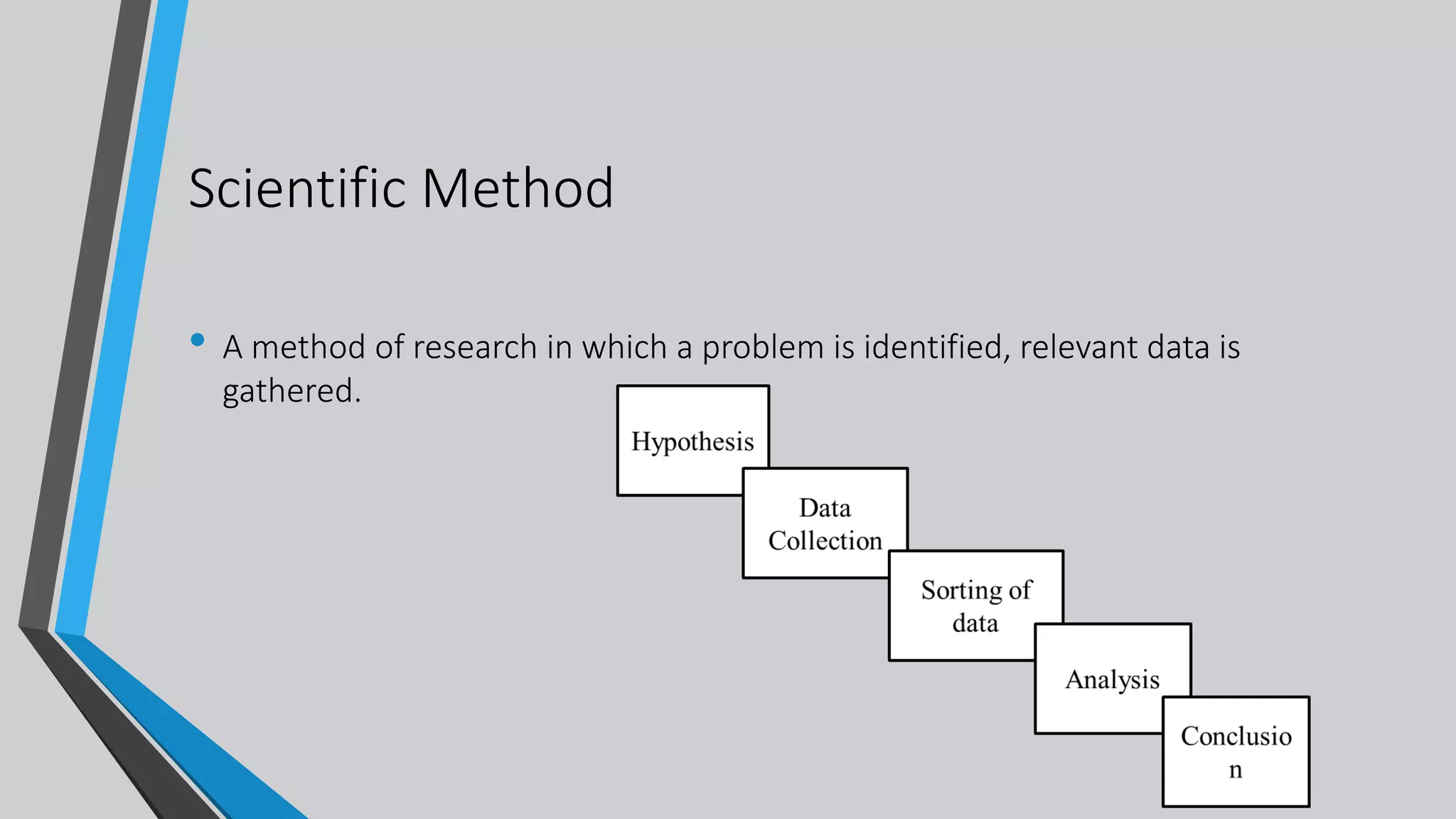
Scientific Method
• A method of research in which a problem is identified, relevant data is
gathered.
History of Statistics
• In past, kings and rulers used Statistics.
• Information about lands and population of state
• Gottfried Achenwall (1719-1772)
• Sir Ronald Aylmer Fisher (1890-1962)
• Modern statistics
• Francis Galton
Std. deviation
Correlation
Regression
Applications of Statistics
• Engineering
• Economics
• Business
• Environment
• Physics
• Chemistry
• Biology
• Medical and so on.
Importance in daily life
• Every day we are bombarded with different type of data
• If you can't distinguish good from faulty reasoning, then you do manipulation
• Statistics provides tools that you need in order to react the information
H.G. Wells says that,
“Statistical thinking will one day as necessary for citizenship as the ability to read and
write”
Characteristics of Statistics
• Statistics of aggregate facts
• Statistics of numerical expressed
• Statistics are affected by variety of causes
• Statistics are collected in systematic manners
• Statistics are placed in the relation to each other
Some Basic Concepts
• Population
• Sample
• Parameter
• Estimator
Population
• Totality of objects under a particular place is called population.
• Population size denoted by ‘‘N’’
• Population mean is denoted by ‘‘µ’’
Examples:
• All students studying at UOG
• All registered voters in Pakistan
• All parts produced today
Sample
• Sub and representative part of population is called sample.
• Sample size is denoted by ‘n’
• Sample mean is denoted by ‘‘X̅’’
Examples:
• 100 voters at random for interview
• Only students of Management of Sciences Departments
Parameter
• The result computed from population is defined as parameter.
Estimator
• The result computed from sample is defined as sample.
Topic:
Types of Statistics
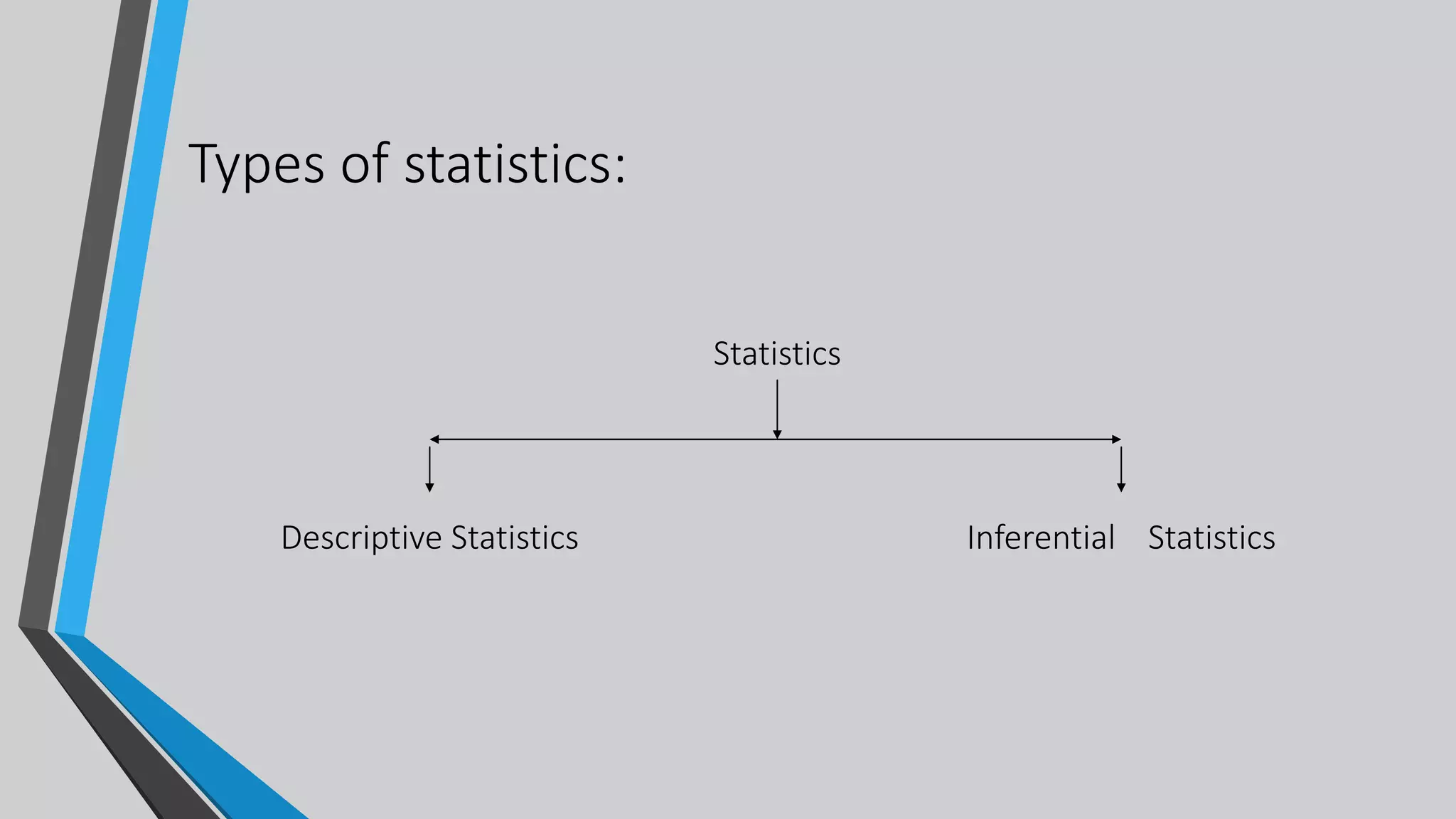
Types of statistics:
Statistics
Descriptive Statistics Inferential Statistics
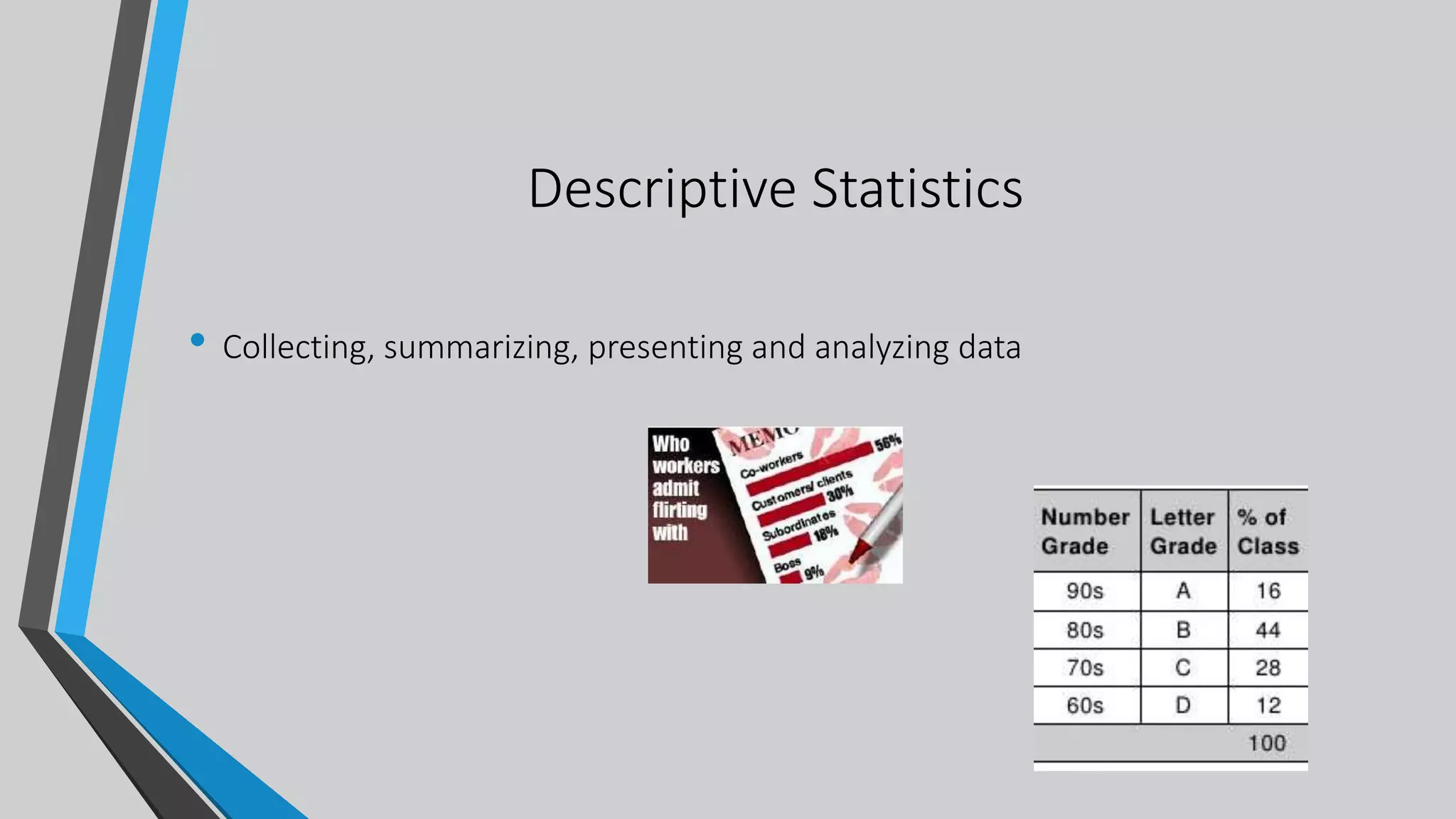
Descriptive Statistics
• Collecting, summarizing, presenting and analyzing data
Why we need descriptive statistics?
• Visualize what the data was showing
• Present data in a more meaningful way
• Simpler interpretation of data
Types of Descriptive Statistics
• Measure of frequency:* Count, percent, frequency...
• Measure of Central tendency:* mean, median, mode...
• Measure of Dispersion or Variation:*Range, Variance, Standard Deviation…
• Measure of Position:* Percentile Ranks, Quartiles Ranks…
Inferential Statistics
• Data collecting from a small group
• draw conclusion about a larger group
Examples:
• Accounting department of a large firm will select a sample of the invoices to
check for a accuracy for all the company
Why we need inferential statistics?
• To infer from the sample data
• To make judgment of probability that an observe difference between groups
Topic:
Variables
What is variable?
• Values varies from one observation to another
• Also known as data item
Example:
• Gender
• Age
• Height
• Weight
• Area
• Grades
• Blood group
• Temperature
Types of variables:
• Qualitative variables
• Quantitative variables
Continuous
Discrete
Qualitative Variables:
• Assume only verbal response
• Also called Categorical variables
• It describes data that fits into categories
• Examples
Eye colors (blue, green, red, etc.)
Grades (A+, A, B+, B, B-, etc.)
Blood groups (O+, O-, A+, A-, etc.)
Gender (Male and Female)
Quantitative Variables:
• Assume only numerical response
• They represent a measureable quantity
• Examples
Height
Weight
Age
Temperature
Types of quantitative variables:
• Two types
Discrete variables
Continuous variables
Discrete variables:
• Assume only rounded digits
• Examples
Numbers of employments
Numbers of students
Numbers of siblings
Continuous variables:
• Assume only decimal or fractional digits
• Examples
Age
Weight
Height
Temperature
Topic:
Level Of Measurements
What is level of measurements?
• Developed by Psychologist S.S Stevens
• Describes the nature of Information within the values assigned to variables
• Also called Scales Of Measure
Historical Background:
• He proposed his typology in 1946 titled as “On The Theory Of Scales Of
Measurements”
• He claimed that “That all measurement in science was conducted using four
different types of scales”
Scales:
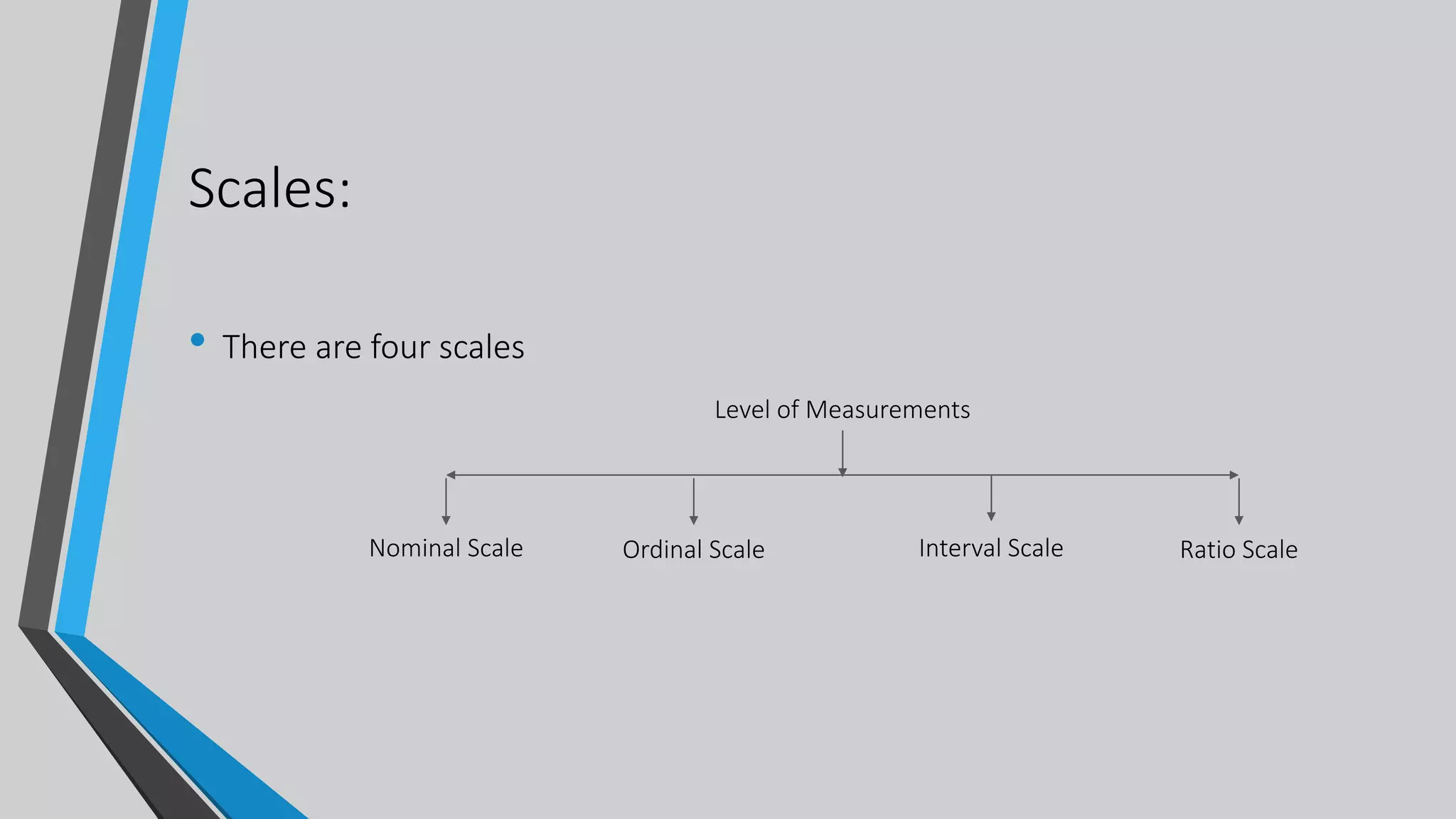
• There are four scales
Level of Measurements
Nominal Scale Ordinal Scale Interval Scale Ratio Scale
1. Nominal Scale
• Used to measure Qualitative Data
• Differentiate b/w items or subjects based only on there names or categories
• Numbers may be used to represent variable but Numbers don’t have
numerical values
Examples
• Gender
• Parts of speech
• Religion
• Bacteria
• Eukarya
• Style
2. Ordinal Scale:
• Ordinal Data
• Distinguish from Nominal scale by having ranking
• Can be ordered
• Differences are meaningless
Examples
• Race
• Grading system
• Designation
• Health
• Courts
3. Interval Scale:
• Used for measurements of Quantitative data
• Doesn't include the true zero values
• Differences are meaningful
Examples
• Temperature
• Location
• Date (A.D or B.C)
• IQ score
4. Ratio Scale
• Used for measurement of quantitative data
• Kind of interval scale
• Ratios are defined
• A ratio scale possesses a meaningful (unique and non-arbitrary) zero value
Examples
• Mass
• Height
• length
Topic:
Methods of Data Collection
What is data ?
• Collection of raw facts and figures
• Process of collecting relevant information
Types of data collection
• There are two types :
• Primary data
• Secondary data
Primary data
• Information collected at first round
• Did not undergo any statistical treatment
Methods include in this type are:
1. Direct personal investigation
2. By observing
3. By questioner method
Significance of primary data
• Reliability
• Availability of wide range of techniques
• Control
Limitations
1. Cost
2. Time
3. Large data
Secondary method
• Already collected
• Undergone through statistical treatment
Ways to access :
• Official government data
i.e. NADRA
• Semi-official
i.e. banks
Secondary Method(cont.)
• Publications
i.e. newspaper , books
• Reports
i.e. Birth , death rate etc.
Significance of S.D
• Economic
• Quickness
• Availability
<-->
THANKS
ANY QUESTION

introduction to statistics

  • 2.
  • 3.
    Objectives: • Statistics • Historyof statistics • Importance of statistics • Basic Definition Population Sample Parameter Estimator
  • 4.
    Statistics: • Latin word,‘Status’ which means, ‘‘knowledge about state.’’ • Plural of statistics is ‘statistic’ • Branch of science that deals with the scientific method is called statistics. • i.e. Arm forces, Population, Graphical area etc. • A single numerical quantity computed from sample is defined as statistic.
  • 5.
    Scientific Method • Amethod of research in which a problem is identified, relevant data is gathered.
  • 6.
    History of Statistics •In past, kings and rulers used Statistics. • Information about lands and population of state • Gottfried Achenwall (1719-1772) • Sir Ronald Aylmer Fisher (1890-1962) • Modern statistics • Francis Galton Std. deviation Correlation Regression
  • 7.
    Applications of Statistics •Engineering • Economics • Business • Environment • Physics • Chemistry • Biology • Medical and so on.
  • 8.
    Importance in dailylife • Every day we are bombarded with different type of data • If you can't distinguish good from faulty reasoning, then you do manipulation • Statistics provides tools that you need in order to react the information H.G. Wells says that, “Statistical thinking will one day as necessary for citizenship as the ability to read and write”
  • 9.
    Characteristics of Statistics •Statistics of aggregate facts • Statistics of numerical expressed • Statistics are affected by variety of causes • Statistics are collected in systematic manners • Statistics are placed in the relation to each other
  • 10.
    Some Basic Concepts •Population • Sample • Parameter • Estimator
  • 11.
    Population • Totality ofobjects under a particular place is called population. • Population size denoted by ‘‘N’’ • Population mean is denoted by ‘‘µ’’
  • 12.
    Examples: • All studentsstudying at UOG • All registered voters in Pakistan • All parts produced today
  • 13.
    Sample • Sub andrepresentative part of population is called sample. • Sample size is denoted by ‘n’ • Sample mean is denoted by ‘‘X̅’’ Examples: • 100 voters at random for interview • Only students of Management of Sciences Departments
  • 14.
    Parameter • The resultcomputed from population is defined as parameter.
  • 15.
    Estimator • The resultcomputed from sample is defined as sample.
  • 16.
  • 17.
    Types of statistics: Statistics DescriptiveStatistics Inferential Statistics
  • 18.
    Descriptive Statistics • Collecting,summarizing, presenting and analyzing data
  • 19.
    Why we needdescriptive statistics? • Visualize what the data was showing • Present data in a more meaningful way • Simpler interpretation of data
  • 20.
    Types of DescriptiveStatistics • Measure of frequency:* Count, percent, frequency... • Measure of Central tendency:* mean, median, mode... • Measure of Dispersion or Variation:*Range, Variance, Standard Deviation… • Measure of Position:* Percentile Ranks, Quartiles Ranks…
  • 21.
    Inferential Statistics • Datacollecting from a small group • draw conclusion about a larger group Examples: • Accounting department of a large firm will select a sample of the invoices to check for a accuracy for all the company
  • 22.
    Why we needinferential statistics? • To infer from the sample data • To make judgment of probability that an observe difference between groups
  • 23.
  • 24.
    What is variable? •Values varies from one observation to another • Also known as data item
  • 25.
    Example: • Gender • Age •Height • Weight • Area • Grades • Blood group • Temperature
  • 26.
    Types of variables: •Qualitative variables • Quantitative variables Continuous Discrete
  • 27.
    Qualitative Variables: • Assumeonly verbal response • Also called Categorical variables • It describes data that fits into categories • Examples Eye colors (blue, green, red, etc.) Grades (A+, A, B+, B, B-, etc.) Blood groups (O+, O-, A+, A-, etc.) Gender (Male and Female)
  • 28.
    Quantitative Variables: • Assumeonly numerical response • They represent a measureable quantity • Examples Height Weight Age Temperature
  • 29.
    Types of quantitativevariables: • Two types Discrete variables Continuous variables
  • 30.
    Discrete variables: • Assumeonly rounded digits • Examples Numbers of employments Numbers of students Numbers of siblings
  • 31.
    Continuous variables: • Assumeonly decimal or fractional digits • Examples Age Weight Height Temperature
  • 32.
  • 33.
    What is levelof measurements? • Developed by Psychologist S.S Stevens • Describes the nature of Information within the values assigned to variables • Also called Scales Of Measure
  • 34.
    Historical Background: • Heproposed his typology in 1946 titled as “On The Theory Of Scales Of Measurements” • He claimed that “That all measurement in science was conducted using four different types of scales”
  • 35.
    Scales: • There arefour scales Level of Measurements Nominal Scale Ordinal Scale Interval Scale Ratio Scale
  • 36.
    1. Nominal Scale •Used to measure Qualitative Data • Differentiate b/w items or subjects based only on there names or categories • Numbers may be used to represent variable but Numbers don’t have numerical values
  • 37.
    Examples • Gender • Partsof speech • Religion • Bacteria • Eukarya • Style
  • 38.
    2. Ordinal Scale: •Ordinal Data • Distinguish from Nominal scale by having ranking • Can be ordered • Differences are meaningless
  • 39.
    Examples • Race • Gradingsystem • Designation • Health • Courts
  • 40.
    3. Interval Scale: •Used for measurements of Quantitative data • Doesn't include the true zero values • Differences are meaningful
  • 41.
    Examples • Temperature • Location •Date (A.D or B.C) • IQ score
  • 42.
    4. Ratio Scale •Used for measurement of quantitative data • Kind of interval scale • Ratios are defined • A ratio scale possesses a meaningful (unique and non-arbitrary) zero value
  • 43.
  • 44.
  • 45.
    What is data? • Collection of raw facts and figures • Process of collecting relevant information
  • 46.
    Types of datacollection • There are two types : • Primary data • Secondary data
  • 47.
    Primary data • Informationcollected at first round • Did not undergo any statistical treatment Methods include in this type are: 1. Direct personal investigation 2. By observing 3. By questioner method
  • 48.
    Significance of primarydata • Reliability • Availability of wide range of techniques • Control Limitations 1. Cost 2. Time 3. Large data
  • 49.
    Secondary method • Alreadycollected • Undergone through statistical treatment Ways to access : • Official government data i.e. NADRA • Semi-official i.e. banks
  • 50.
    Secondary Method(cont.) • Publications i.e.newspaper , books • Reports i.e. Birth , death rate etc.
  • 51.
    Significance of S.D •Economic • Quickness • Availability <-->
  • 52.