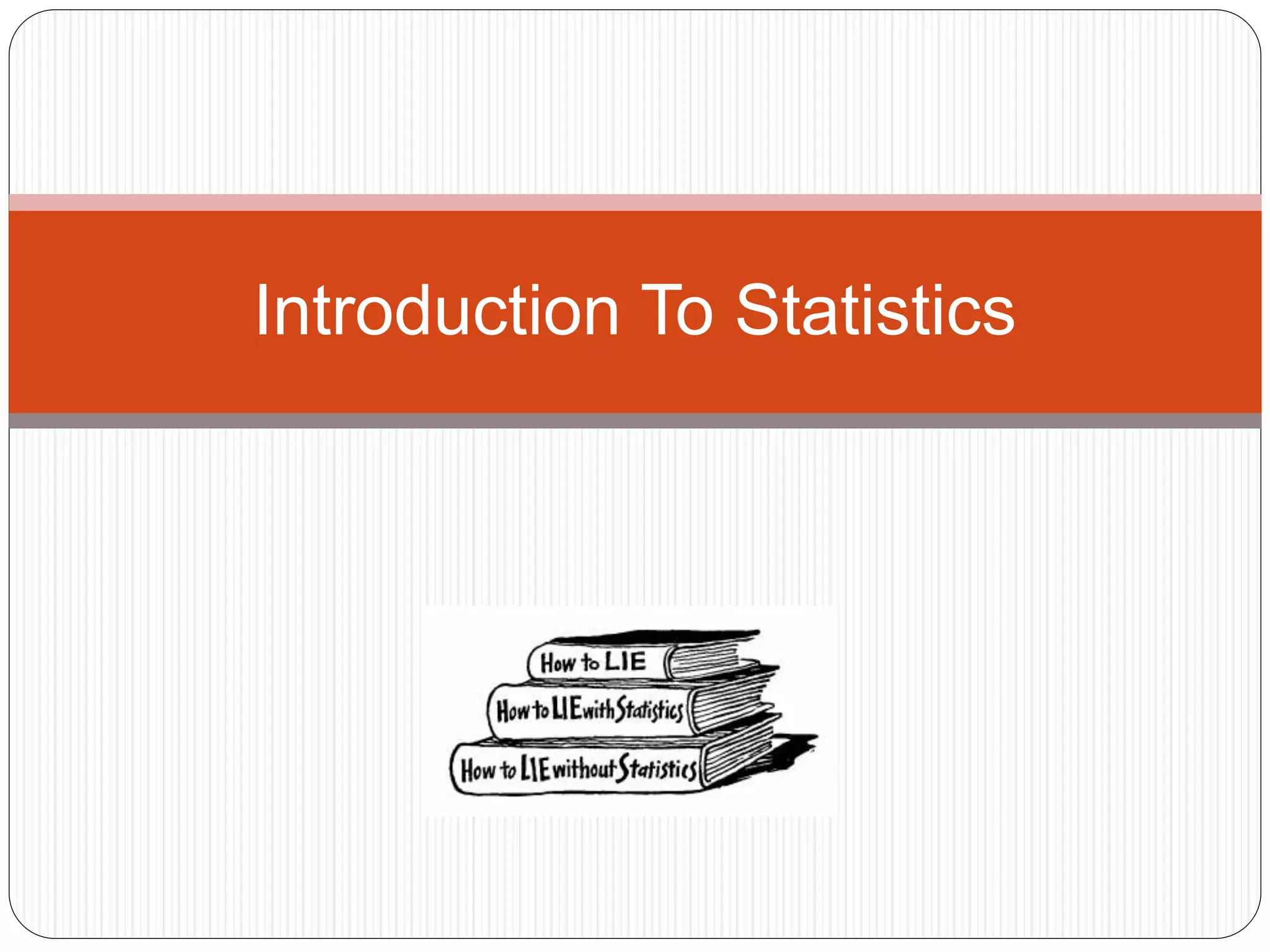
Introduction To Statistics
Why study statistics?
1. Data are everywhere
2. Statistical techniques are used to make many
decisions that affect our lives
3. No matter what your career, you will make
professional decisions that involve data. An
understanding of statistical methods will help
you make these decisions efectively
Applications of statistical concepts in
the business world
 Finance – correlation and regression, index
numbers, time series analysis
 Marketing – hypothesis testing, chi-square tests,
nonparametric statistics
 Personel – hypothesis testing, chi-square tests,
nonparametric tests
 Operating management – hypothesis testing,
estimation, analysis of variance, time series
analysis
Statistics
 The science of collectiong, organizing,
presenting, analyzing, and interpreting data to
assist in making more effective decisions
 Statistical analysis – used to manipulate
summarize, and investigate data, so that useful
decision-making information results.
Types of statistics
 Descriptive statistics – Methods of organizing,
summarizing, and presenting data in an
informative way
 Inferential statistics – The methods used to
determine something about a population on the
basis of a sample
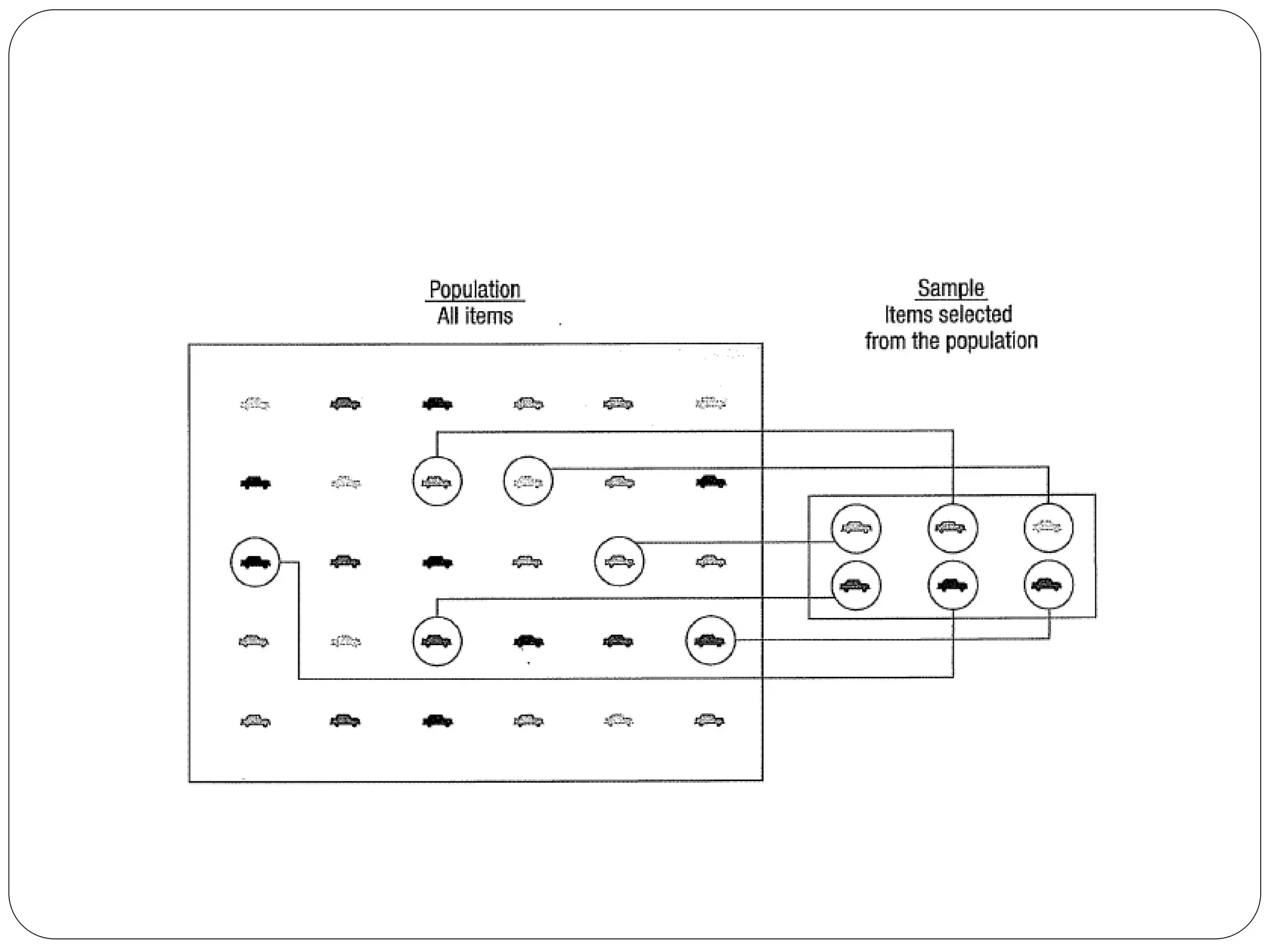
 Population –The entire set of individuals or objects
of interest or the measurements obtained from all
individuals or objects of interest
 Sample – A portion, or part, of the population of
interest
Inferential Statistics
 Estimation
 e.g., Estimate the population
mean weight using the sample
mean weight
 Hypothesis testing
 e.g., Test the claim that the
population mean weight is 70 kg
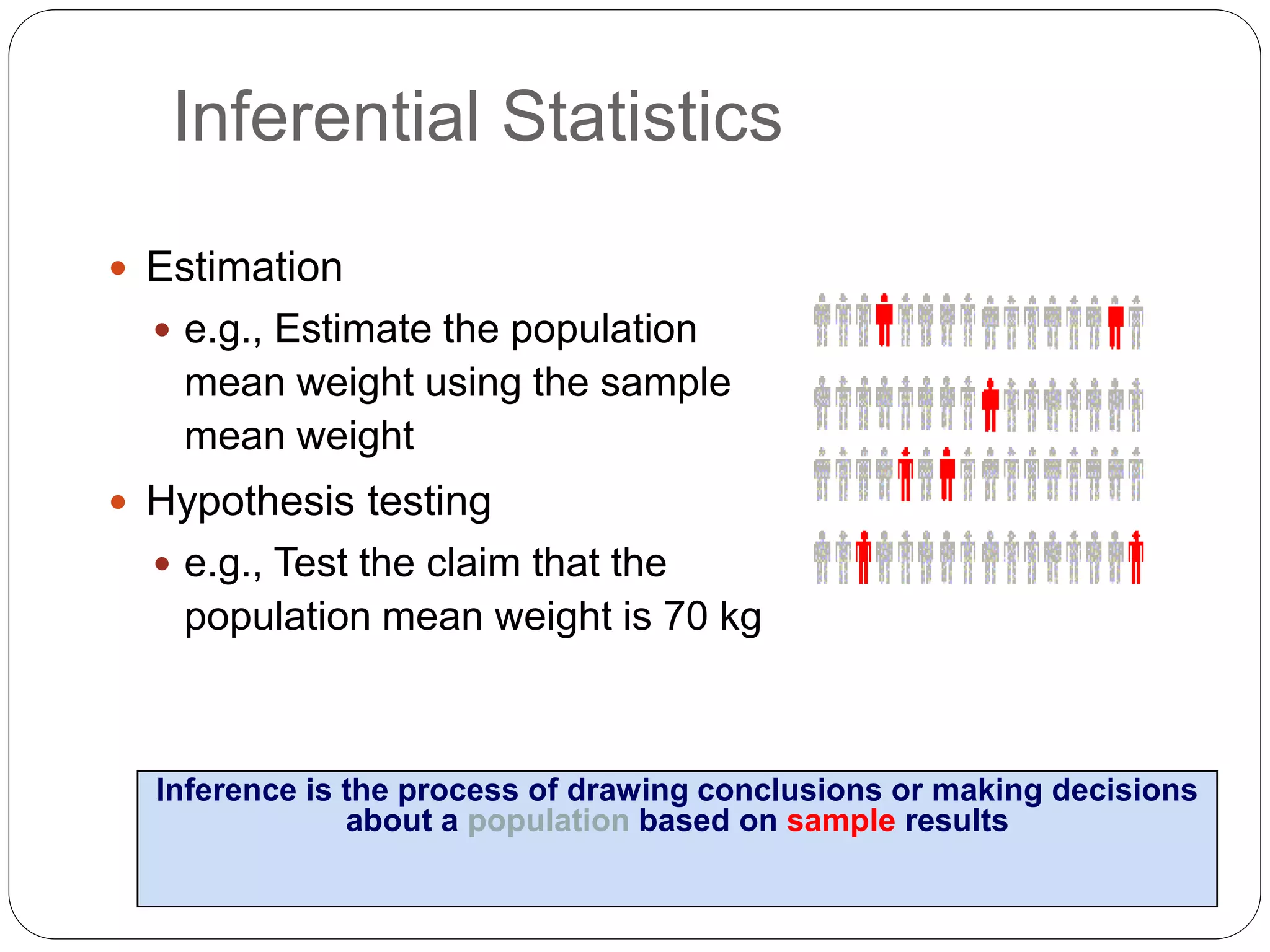
Inference is the process of drawing conclusions or making decisions
about a population based on sample results
Sampling
a sample should have the same characteristics
as the population it is representing.
Sampling can be:
 with replacement: a member of the population
may be chosen more than once (picking the
candy from the bowl)
 without replacement: a member of the
population may be chosen only once (lottery
ticket)
Sampling methods
Sampling methods can be:
 random (each member of the population has an equal
chance of being selected)
 nonrandom
The actual process of sampling causes sampling
errors. For example, the sample may not be large
enough or representative of the population. Factors not
related to the sampling process cause nonsampling
errors. A defective counting device can cause a
nonsampling error.
Random sampling methods
 simple random sample (each sample of the same
size has an equal chance of being selected)
 stratified sample (divide the population into groups
called strata and then take a sample from each
stratum)
 cluster sample (divide the population into strata and
then randomly select some of the strata. All the
members from these strata are in the cluster sample.)
 systematic sample (randomly select a starting point
and take every n-th piece of data from a listing of the
population)
Descriptive Statistics
 Collect data
 e.g., Survey
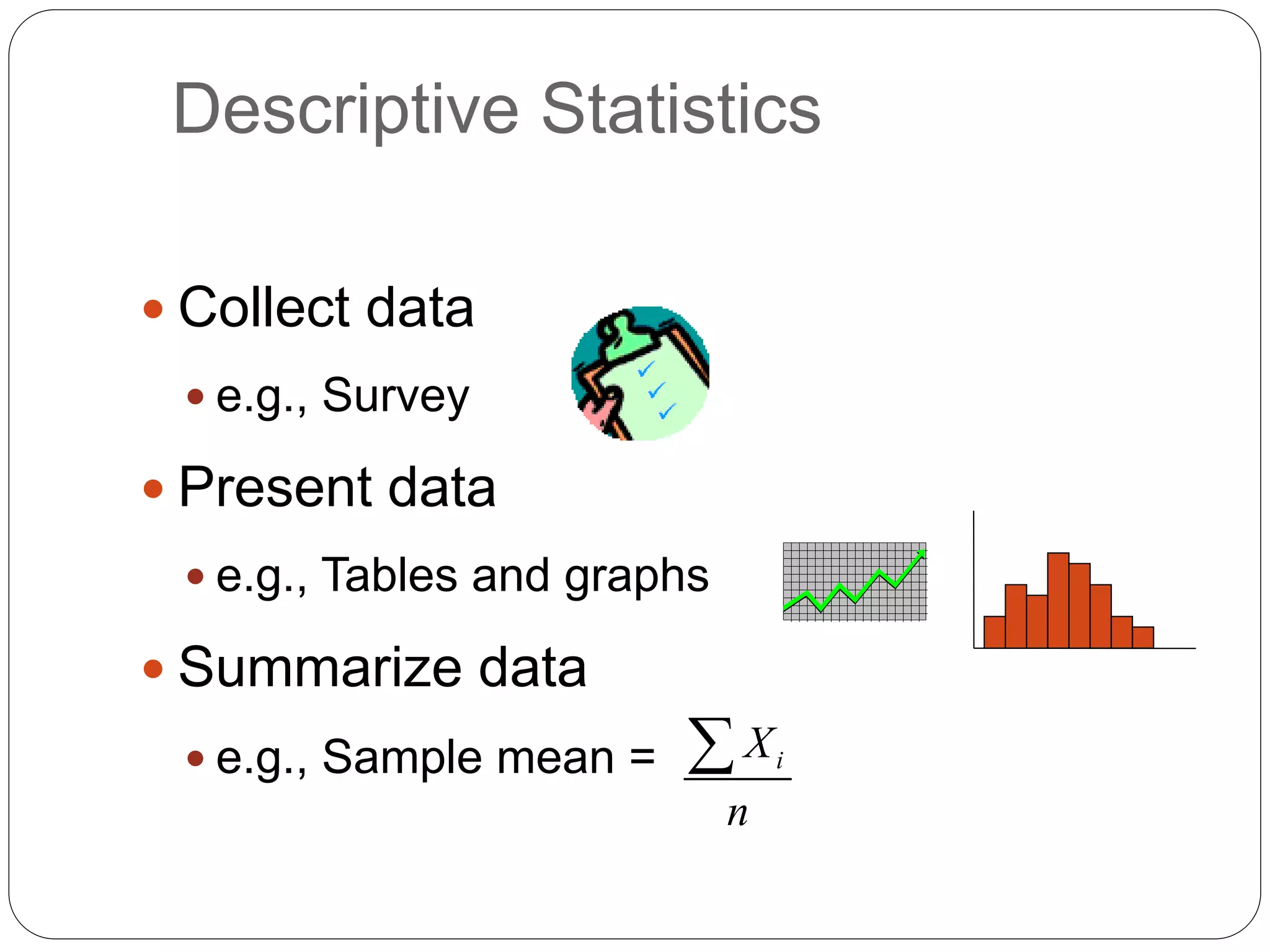
 Present data
 e.g., Tables and graphs
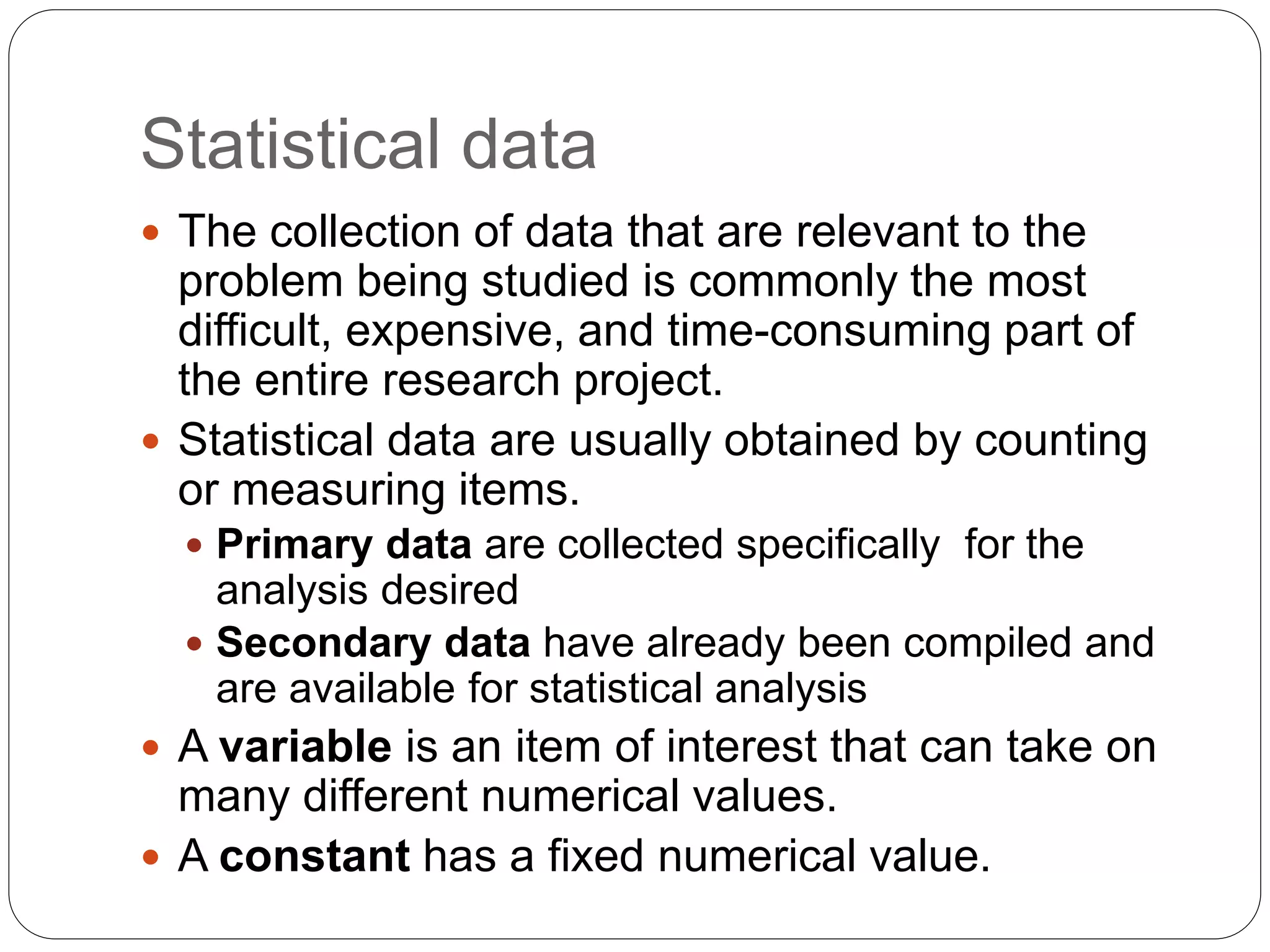
 Summarize data
 e.g., Sample mean = i
X
n

Statistical data
 The collection of data that are relevant to the
problem being studied is commonly the most
difficult, expensive, and time-consuming part of
the entire research project.
 Statistical data are usually obtained by counting
or measuring items.
 Primary data are collected specifically for the
analysis desired
 Secondary data have already been compiled and
are available for statistical analysis
 A variable is an item of interest that can take on
many different numerical values.
 A constant has a fixed numerical value.
Data
Statistical data are usually obtained by counting or
measuring items. Most data can be put into the
following categories:
 Qualitative - data are measurements that each
fail into one of several categories. (hair color,
ethnic groups and other attributes of the
population)
 quantitative - data are observations that are
measured on a numerical scale (distance traveled
to college, number of children in a family, etc.)
Qualitative data
Qualitative data are generally described by words or
letters. They are not as widely used as quantitative data
because many numerical techniques do not apply to the
qualitative data. For example, it does not make sense to
find an average hair color or blood type.
Qualitative data can be separated into two subgroups:
 dichotomic (if it takes the form of a word with two
options (gender - male or female)
 polynomic (if it takes the form of a word with more
than two options (education - primary school,
secondary school and university).
Quantitative data
Quantitative data are always numbers and are the
result of counting or measuring attributes of a
population.
Quantitative data can be separated into two
subgroups:
 discrete (if it is the result of counting (the number of
students of a given ethnic group in a class, the
number of books on a shelf, ...)
 continuous (if it is the result of measuring (distance
traveled, weight of luggage, …)
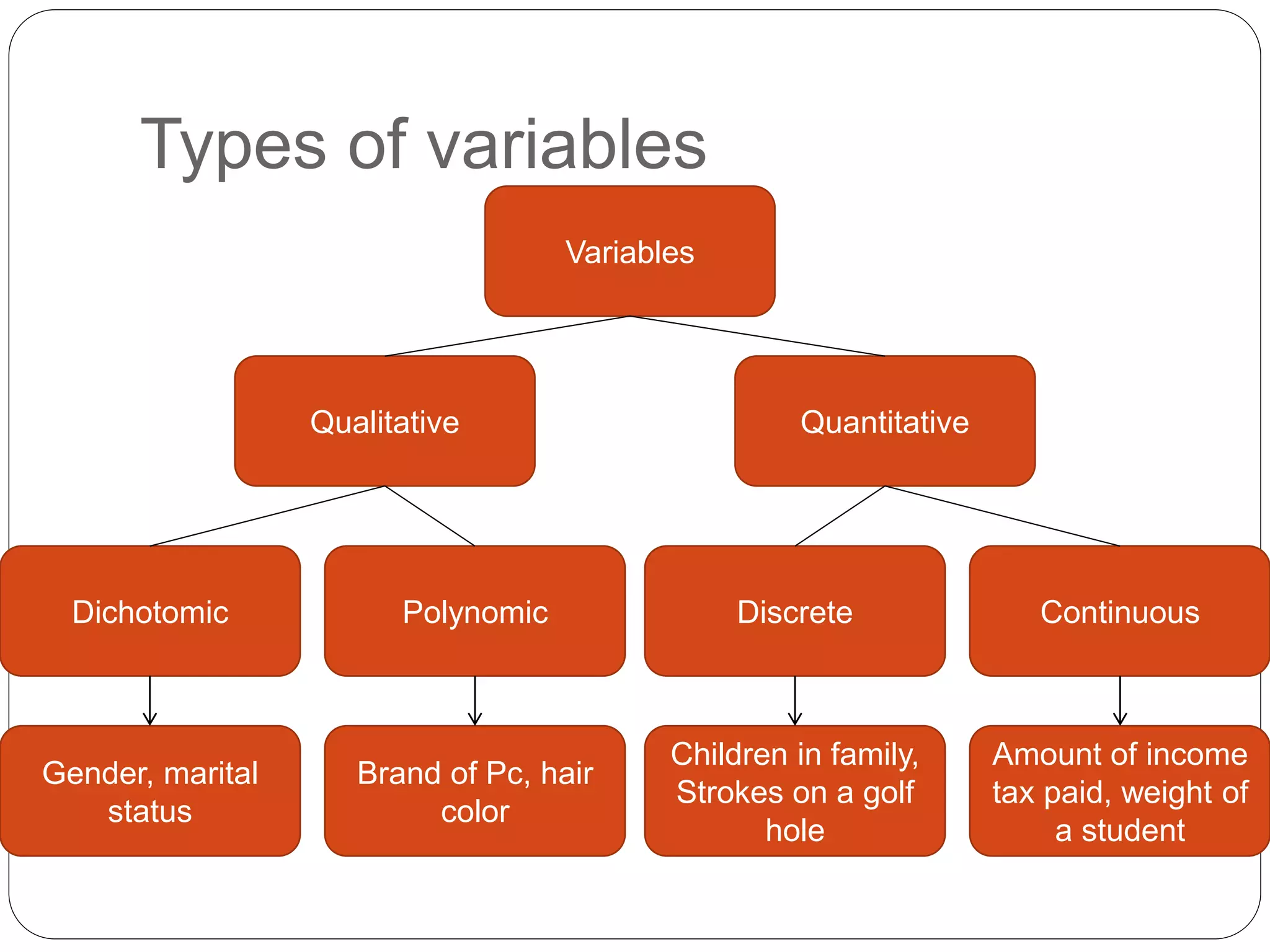
Types of variables
Variables
Quantitative
Qualitative
Dichotomic Polynomic Discrete Continuous
Gender, marital
status
Brand of Pc, hair
color
Children in family,
Strokes on a golf
hole
Amount of income
tax paid, weight of
a student
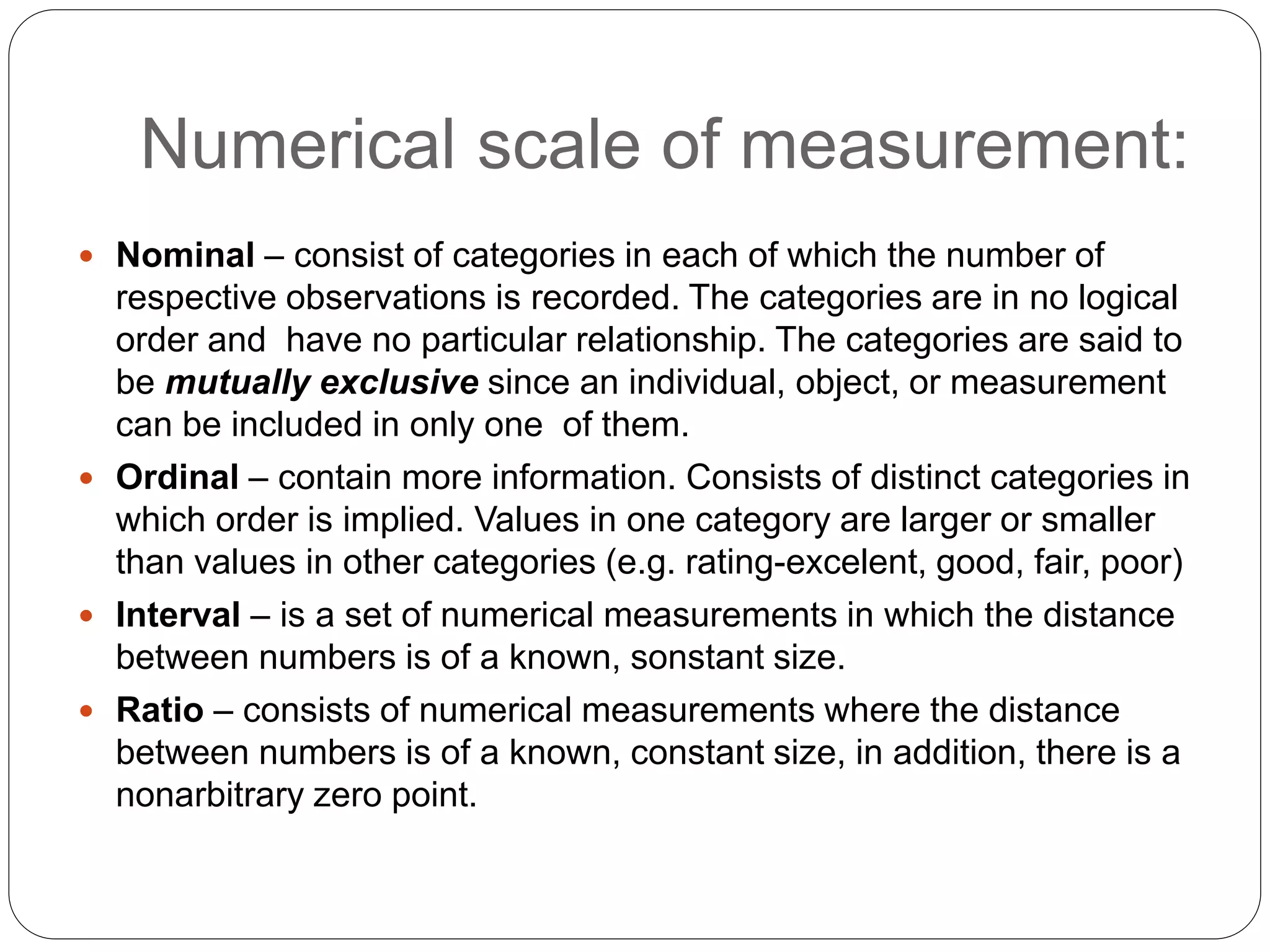
Numerical scale of measurement:
 Nominal – consist of categories in each of which the number of
respective observations is recorded. The categories are in no logical
order and have no particular relationship. The categories are said to
be mutually exclusive since an individual, object, or measurement
can be included in only one of them.
 Ordinal – contain more information. Consists of distinct categories in
which order is implied. Values in one category are larger or smaller
than values in other categories (e.g. rating-excelent, good, fair, poor)
 Interval – is a set of numerical measurements in which the distance
between numbers is of a known, sonstant size.
 Ratio – consists of numerical measurements where the distance
between numbers is of a known, constant size, in addition, there is a
nonarbitrary zero point.
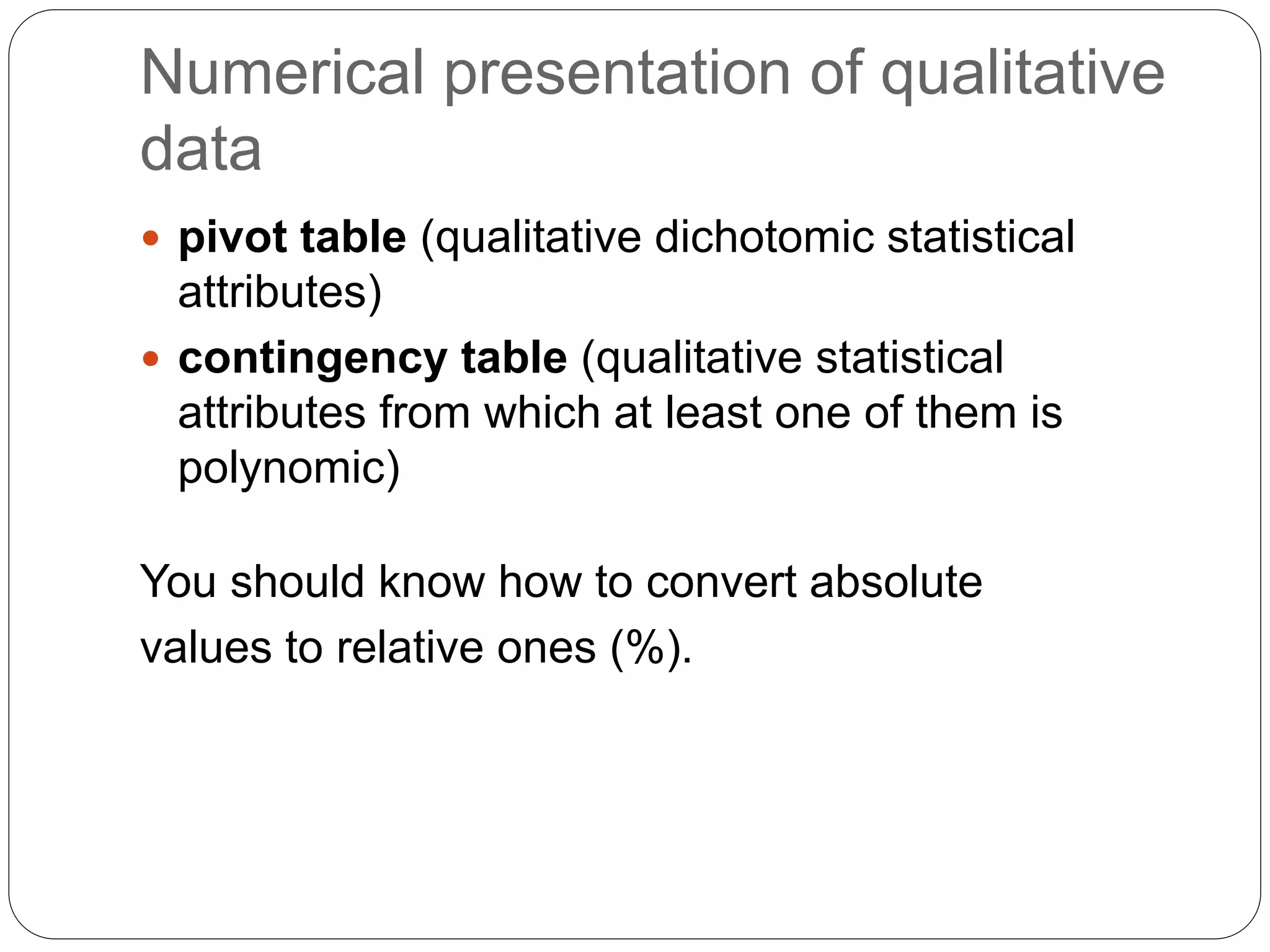
Numerical presentation of qualitative
data
 pivot table (qualitative dichotomic statistical
attributes)
 contingency table (qualitative statistical
attributes from which at least one of them is
polynomic)
You should know how to convert absolute
values to relative ones (%).

Introduction-To-Statistics-18032022-010747pm (1).ppt

  • 1.
  • 2.
    Why study statistics? 1.Data are everywhere 2. Statistical techniques are used to make many decisions that affect our lives 3. No matter what your career, you will make professional decisions that involve data. An understanding of statistical methods will help you make these decisions efectively
  • 3.
    Applications of statisticalconcepts in the business world  Finance – correlation and regression, index numbers, time series analysis  Marketing – hypothesis testing, chi-square tests, nonparametric statistics  Personel – hypothesis testing, chi-square tests, nonparametric tests  Operating management – hypothesis testing, estimation, analysis of variance, time series analysis
  • 4.
    Statistics  The scienceof collectiong, organizing, presenting, analyzing, and interpreting data to assist in making more effective decisions  Statistical analysis – used to manipulate summarize, and investigate data, so that useful decision-making information results.
  • 5.
    Types of statistics Descriptive statistics – Methods of organizing, summarizing, and presenting data in an informative way  Inferential statistics – The methods used to determine something about a population on the basis of a sample  Population –The entire set of individuals or objects of interest or the measurements obtained from all individuals or objects of interest  Sample – A portion, or part, of the population of interest
  • 7.
    Inferential Statistics  Estimation e.g., Estimate the population mean weight using the sample mean weight  Hypothesis testing  e.g., Test the claim that the population mean weight is 70 kg Inference is the process of drawing conclusions or making decisions about a population based on sample results
  • 8.
    Sampling a sample shouldhave the same characteristics as the population it is representing. Sampling can be:  with replacement: a member of the population may be chosen more than once (picking the candy from the bowl)  without replacement: a member of the population may be chosen only once (lottery ticket)
  • 9.
    Sampling methods Sampling methodscan be:  random (each member of the population has an equal chance of being selected)  nonrandom The actual process of sampling causes sampling errors. For example, the sample may not be large enough or representative of the population. Factors not related to the sampling process cause nonsampling errors. A defective counting device can cause a nonsampling error.
  • 10.
    Random sampling methods simple random sample (each sample of the same size has an equal chance of being selected)  stratified sample (divide the population into groups called strata and then take a sample from each stratum)  cluster sample (divide the population into strata and then randomly select some of the strata. All the members from these strata are in the cluster sample.)  systematic sample (randomly select a starting point and take every n-th piece of data from a listing of the population)
  • 11.
    Descriptive Statistics  Collectdata  e.g., Survey  Present data  e.g., Tables and graphs  Summarize data  e.g., Sample mean = i X n 
  • 12.
    Statistical data  Thecollection of data that are relevant to the problem being studied is commonly the most difficult, expensive, and time-consuming part of the entire research project.  Statistical data are usually obtained by counting or measuring items.  Primary data are collected specifically for the analysis desired  Secondary data have already been compiled and are available for statistical analysis  A variable is an item of interest that can take on many different numerical values.  A constant has a fixed numerical value.
  • 13.
    Data Statistical data areusually obtained by counting or measuring items. Most data can be put into the following categories:  Qualitative - data are measurements that each fail into one of several categories. (hair color, ethnic groups and other attributes of the population)  quantitative - data are observations that are measured on a numerical scale (distance traveled to college, number of children in a family, etc.)
  • 14.
    Qualitative data Qualitative dataare generally described by words or letters. They are not as widely used as quantitative data because many numerical techniques do not apply to the qualitative data. For example, it does not make sense to find an average hair color or blood type. Qualitative data can be separated into two subgroups:  dichotomic (if it takes the form of a word with two options (gender - male or female)  polynomic (if it takes the form of a word with more than two options (education - primary school, secondary school and university).
  • 15.
    Quantitative data Quantitative dataare always numbers and are the result of counting or measuring attributes of a population. Quantitative data can be separated into two subgroups:  discrete (if it is the result of counting (the number of students of a given ethnic group in a class, the number of books on a shelf, ...)  continuous (if it is the result of measuring (distance traveled, weight of luggage, …)
  • 16.
    Types of variables Variables Quantitative Qualitative DichotomicPolynomic Discrete Continuous Gender, marital status Brand of Pc, hair color Children in family, Strokes on a golf hole Amount of income tax paid, weight of a student
  • 17.
    Numerical scale ofmeasurement:  Nominal – consist of categories in each of which the number of respective observations is recorded. The categories are in no logical order and have no particular relationship. The categories are said to be mutually exclusive since an individual, object, or measurement can be included in only one of them.  Ordinal – contain more information. Consists of distinct categories in which order is implied. Values in one category are larger or smaller than values in other categories (e.g. rating-excelent, good, fair, poor)  Interval – is a set of numerical measurements in which the distance between numbers is of a known, sonstant size.  Ratio – consists of numerical measurements where the distance between numbers is of a known, constant size, in addition, there is a nonarbitrary zero point.
  • 19.
    Numerical presentation ofqualitative data  pivot table (qualitative dichotomic statistical attributes)  contingency table (qualitative statistical attributes from which at least one of them is polynomic) You should know how to convert absolute values to relative ones (%).