Introduction to solidarity economy - Another economy is possible - Miguel Yasuyuki Hirota [email_address] http://www.olccjp.net/  Kuala Lumpur, 14 th  Feb 2011
Contents Self-introduction What is the Solidarity Economy (SE)?: Democratisation of our economy SE’s development all over the world Key strategies for SE’s further development
My self-introduction Originally student of Latin America:  good at Spanish and Portuguese 1999: learned about  complementary currencies  > Researches on global experiences, 3 books already published in Japanese 2001: visited Argentina and learned about barter clubs: a local professor  taught me SE Have given presentations in different countries  (Argentina, Brazil, Colombia, Ecuador, France, South Korea, Malaysia, Mexico, New Zealand, the Philippines, Portugal, Spain, Taiwan, Thailand) OLCCJP:  http://www.olccjp.net/ Also work for  SE’s promotion
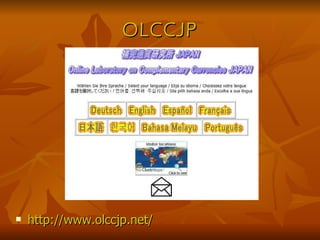
OLCCJP http://www.olccjp.net/
Contents Self-introduction What is the Solidarity Economy (SE)?: Democratisation of our economy SE’s development all over the world Key strategies for SE’s further development
What is Solidarity? (1) What does “solidarity” mean? Solidarity:  a word quite commonly used in French, Spanish and Portuguese but not so much in English Meaning:  ”Circumstantial adhesion to others’ cause or enterprise”  (Real Academia Española) Other definitions:  ”A horizontal relationship among those who build up a group, an association or a community under the conditions of equality”  which is built  ”because of the force or intensity of mutual cohesion” , i.e.  ”particularly committed and determined bond”  (Luis Razeto)
What is Solidarity? (2) Some people have gone away from the original meaning:  What is the original use for the word “solidarity”? (Luis Razeto) a)  solidness of the group’s interaction which leads to build the fact or the reality of solidarity b)  equal situation and commitment or duty among all the solidarity-based participants c)  everybody’s relationship through mutuality, reciprocity and participation in a group or community d)  intensity of mutual union as something strong, defined, established by true causes e)  the stable (not occasional) and permanent character of solidarity-based cohesion
False-friends of Solidarity “ False-friends” of solidarity:  understanding them as solidarity undermines the very principle of solidarity Excessive assistance:  disturbs people’s autonomy Charity donations:  occasional and not based on the principle of equal commitment
Use of the word Solidarity in the Western history Middle Ages:  Only meant the strong relationship within a guild 19th and 20th century:  Used both by labour unions  (for common cause and shared interested on the basis of mutual help)  and the Church  (fraternity among “children of God”) Sociology: Durkheim found out that  the more individualist the modern society turns to be, the more solidarity are sought for  as we’re getting more and more interdependent
What’s solidarity economy? What is the non-solidarity economy (capitalism)? Maximisation of profits for shareholders  > environmental protection and workers are of secondary importance, strengthened by the neoliberalism G. Soros: “International trade and global financial markets are very good at generating wealth,  but they cannot take care of other social needs , such as the preservation of peace, alleviation of poverty, protection of the environment, labour conditions, or human rights –  what are generally called ‘public goods’ ” (On Globalization, 2003) SE:  economy which allows workers and consumers to take part in its management (civil society economy) > democratisation of economy
Democratisation of labour Workers’ coop : businesses possessed and run horizontally by their own workers.  No employer hires no employee there Social enterprises : those businesses which preferentially employ the handicapped, long-term unemployed people and others who find it hard to get hired, although as wholly democratised as workers’ coops
Democratisation of consumption Shopping huge corporations’ goods at malls : cheap and convenient, but… Consumers’ coop : allows consumers to get what they want (especially organic food) Teikei (CSA) : a system in which consumers help farmers in different ways (sometimes they visit farms to work there) Fair trade : improvement of farmers’ life standard by paying a fair price for their produces
Democratisation of finance / money Where will our money go when we deposit it at commercial banks? : You’ll never know which businesses are financed by the bank you put money Ethical banks : savers can decide which project to finance Social currencies : use of parallel means of exchange to stimulate local economy
Democratisation of  the public sector’s budget To whom does the money at KL City Hall belong? Of course residents at KL Participatory budget : KL residents make decisions on how to spend the KL City Hall’s budget!! Started in Porto Alegre, Brazil and later spread into other Latin American and European countries
Democratisation of knowledge Different IT : stimulates access to a bunch of information and international intellectual exchanges Basic software such as OS (especially Microsoft Windows) and Microsoft Office : Microsoft enjoys the monopoly on what is essential for our digital life Freeware : software produced without the aim to make profits > introduction of IT in a more democratic way
Summary Ethical banks:  savers decide whom to finance Workers’ coop:  workers = owners run the business Consumers’ coop:  provides what members want Social enterprises:  hires the handicapped, long-term unemployed etc. for their social inclusion Fair trade:  consumers support economic activities without exploiting farmers Participatory budget:  KL people decide how to spend KL City Hall’s budget Social currency:  civil society control money = means of exchange Freeware:  indispensable software (like OS and Open Office) available for free
Contents Self-introduction What is the Solidarity Economy (SE)?: Democratisation of our economy SE’s development all over the world Key strategies for SE’s further development
Global development Latin Europe (France, Italy & Spain), Québec:  the concept of  social economy  (coops, non-profits, mutual unions, foundations) exists since 1960s, allowing some room for non-capitalist economies Latin America:  neoliberalism since 1980s > widening income gap > different economic activities to struggle against poverty > SE RIPESS  ( 1997-), World Social Forum (2001-), Alliance 21 > ALOE(2001-):  strengthens exchanges between Latin Europe, Latin America and other parts of the world Extension to non-Latin countries:  Asia, Africa, Canada, US, Germany, Austria
Regional developments Brazil:   National Secretary of Solidarity Economy  (SENAES) and  Brazilian Forum of Solidarity Economy  (FBES) promotes SE Asia:  1 st  Forum in Oct 2007 at Manila, 2 nd  Forum in Nov 2009 at Tokyo and 3 rd  Forum in Nov 2011 at KL.  Asian Alliance for Solidarity Economy  (AA4SE) US:  the 1 st  US Social Forum in June 2007 at Atlanta highlighted SE, 1 st  US Forum of SE at Amherst, MA in March 2009, some discussions at the 2 nd  US Social Forum at Detroit last June Spain:  REAS provides information about SE in Spain and Latin America
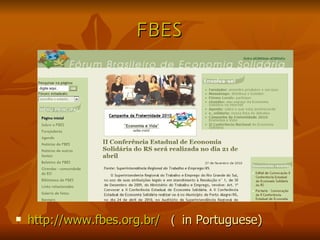
FBES http://www.fbes.org.br/  ( in Portuguese)
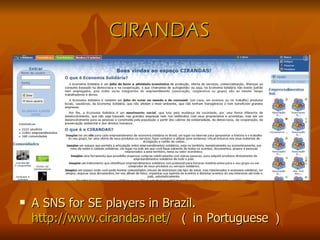
CIRANDAS A SNS for SE players in Brazil.   http://www.cirandas.net/  ( in Portuguese )
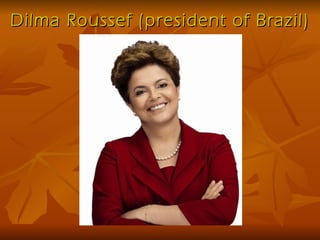
Dilma Roussef (president of Brazil)
Dilma’s promises (1) 1:  Consolidate the integration of the National Policy of Solidarity Economy with Brazil’s sustainable development strategies  2:  Constitute the National System of Solidarity Economy to stimulate the strengthening of SE and to enable the articulation among different levels of the government 3:  Ensure resources for financing programmes and actions to SE enterprises 4:  Complete legal instruments which make SE enterprises feasible and facilitate their formalisation 5:  Promote an institutional atmosphere favourable for the development of SE, completing the procedure to access to public resources, credit and formalisation of enterprises
Dilma’s promises (2) 6:  Complete the access to the knowledge and to the technology: - Nurture technology and innovation targeted for the SE, underlining social technology projects; - Promote policies of training, technical assessment and professional qualification which are adequate to the SE enterprises; - Broaden the access to the education, at all the levels, of the workers of SE enterprises 7:  Develop and nurture mechanisms of solidarity finance which are adequate to the financing of working capital, of costs and for the purchase of equips and infrastructure of SE enterprises 8:  Nurture initiatives of SE commercialisation and strengthen mechanisms which facilitate the access to the public purchases of goods and services
Dilma’s compromises (3) 9:  Develop the SE as policy for productive inclusion, economic emancipation and generation of work and income targeted to the public benefitting from social programmes  10:  Recognise and nurture the SE in the strategies of international integration, especially in Latin America (Mercosur and Unasur) and Africa 11:  Strengthen the interdisciplinarity of public policies of the SE in articulation with the different sectors and policies of the government 12:  Give continuity to the completion of government policies for the SE, warranting resources and investing in the capacity for the elaboration, management and execution of public policies for this sector 13:  Strengthen the National Council of Solidarity Economy as promoter of the National Conferences of Solidarity Economy and of the participation, of the social control and accompanying of policies and programmes of SE
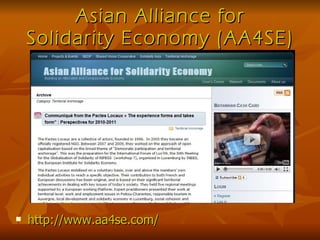
Asian Alliance for Solidarity Economy (AA4SE) http://www.aa4se.com/
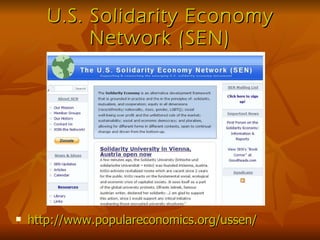
U.S. Solidarity Economy Network (SEN) http://www.populareconomics.org/ussen/
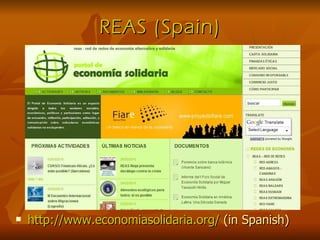
REAS (Spain) http://www.economiasolidaria.org/  (in Spanish)
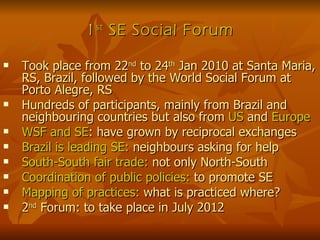
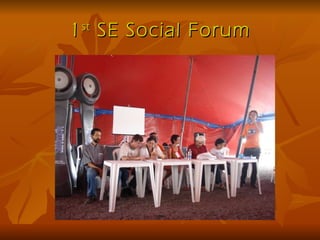
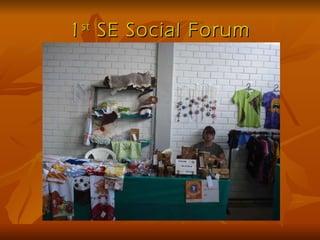
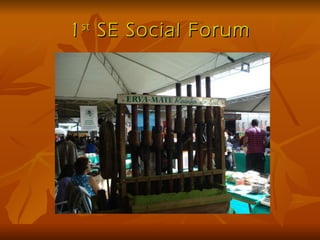
1 st  SE Social Forum Took place from 22 nd  to 24 th  Jan 2010 at Santa Maria, RS, Brazil, followed by the World Social Forum at Porto Alegre, RS Hundreds of participants, mainly from Brazil and neighbouring countries but also from  US  and  Europe WSF and SE : have grown by reciprocal exchanges Brazil is leading SE:  neighbours asking for help South-South fair trade:  not only North-South Coordination of public policies:  to promote SE Mapping of practices:  what is practiced where? 2 nd  Forum: to take place in July 2012
1 st  SE Social Forum
SE in Japan Consumer’s coops:  annual turnover of 3.4 trillion yen (125 billion ringgits, 2.82% of retail industry) Workers’ coops:  hires 11,000 people all over Japan, annual turnover of 25.7 billion yen (about 950 million ringgits) Food security:  CSA, nutrition-education programmes, local production and consumption Elderly care:  non-profits all over the country
What’s at stake in Japan Lack of self-identity as SE players:  no promotional activities by SE players > lack of relationship with international movements Lack of national network:  there exists no network to include the whole SE players > virtually no influence at all on the Japanese society SE by the high-middle class:  plenty of activities by the well-off (consumers’ coop and elderly care) while little is done against poverty
Social enterprises in East Asia South Korea:  Social Enterprise Promotion Act implemented in 2007, with hundreds of social enterprises being recognised by the gov’t Hong Kong:  organises Social Enterprise Summit since 2008 http://www.social-enterprise.org.hk /
Contents Self-introduction What is the Solidarity Economy (SE)?: Democratisation of our economy SE’s development all over the world Key strategies for SE’s further development
For further development of SE in Asia Need for national networks:  to link different stakeholders and  share the identity of “SE players” SOLECOPEDIA:  a wiki on SE Linkage with Latin America:  South-South cooperation
Need for national networks Identity as SE player:  need to work not only at their own field (fair trade, ethical finance etc.) but also for a wider perspective of SE Sharing info:  sharing news on what’s happening all over the world, such as webinar Interdisciplinary exchanges:  ethical banks, fair trade, consumers’ coops, workers’ coops etc. exchange to build cooperations Strategies and action plans to promote SE:  presentation of SE at related conferences, movements to formulate laws to promote SE, etc.
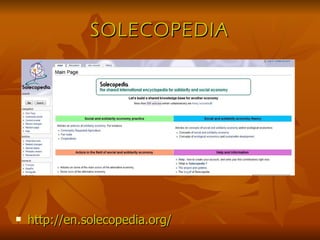
SOLECOPEDIA http://en.solecopedia.org/
Linkage with Latin America Latin America:  where SE has been recognised more and more, with supports from gov’ts Spanish and Portuguese:  fundamental in keeping in touch with Latin Americans
Thank you for your attention!! e-mail: mig@olccjp.net skype: migjp2003 URL: http://www.olccjp.net

Introduction to Solidarity Economy

  • 1.
    Introduction to solidarityeconomy - Another economy is possible - Miguel Yasuyuki Hirota [email_address] http://www.olccjp.net/ Kuala Lumpur, 14 th Feb 2011
  • 2.
    Contents Self-introduction Whatis the Solidarity Economy (SE)?: Democratisation of our economy SE’s development all over the world Key strategies for SE’s further development
  • 3.
    Contents Self-introduction Whatis the Solidarity Economy (SE)?: Democratisation of our economy SE’s development all over the world Key strategies for SE’s further development
  • 4.
    My self-introduction Originallystudent of Latin America: good at Spanish and Portuguese 1999: learned about complementary currencies > Researches on global experiences, 3 books already published in Japanese 2001: visited Argentina and learned about barter clubs: a local professor taught me SE Have given presentations in different countries (Argentina, Brazil, Colombia, Ecuador, France, South Korea, Malaysia, Mexico, New Zealand, the Philippines, Portugal, Spain, Taiwan, Thailand) OLCCJP: http://www.olccjp.net/ Also work for SE’s promotion
  • 5.
  • 6.
    Contents Self-introduction Whatis the Solidarity Economy (SE)?: Democratisation of our economy SE’s development all over the world Key strategies for SE’s further development
  • 7.
    What is Solidarity?(1) What does “solidarity” mean? Solidarity: a word quite commonly used in French, Spanish and Portuguese but not so much in English Meaning: ”Circumstantial adhesion to others’ cause or enterprise” (Real Academia Española) Other definitions: ”A horizontal relationship among those who build up a group, an association or a community under the conditions of equality” which is built ”because of the force or intensity of mutual cohesion” , i.e. ”particularly committed and determined bond” (Luis Razeto)
  • 8.
    What is Solidarity?(2) Some people have gone away from the original meaning: What is the original use for the word “solidarity”? (Luis Razeto) a) solidness of the group’s interaction which leads to build the fact or the reality of solidarity b) equal situation and commitment or duty among all the solidarity-based participants c) everybody’s relationship through mutuality, reciprocity and participation in a group or community d) intensity of mutual union as something strong, defined, established by true causes e) the stable (not occasional) and permanent character of solidarity-based cohesion
  • 9.
    False-friends of Solidarity“ False-friends” of solidarity: understanding them as solidarity undermines the very principle of solidarity Excessive assistance: disturbs people’s autonomy Charity donations: occasional and not based on the principle of equal commitment
  • 10.
    Use of theword Solidarity in the Western history Middle Ages: Only meant the strong relationship within a guild 19th and 20th century: Used both by labour unions (for common cause and shared interested on the basis of mutual help) and the Church (fraternity among “children of God”) Sociology: Durkheim found out that the more individualist the modern society turns to be, the more solidarity are sought for as we’re getting more and more interdependent
  • 11.
    What’s solidarity economy?What is the non-solidarity economy (capitalism)? Maximisation of profits for shareholders > environmental protection and workers are of secondary importance, strengthened by the neoliberalism G. Soros: “International trade and global financial markets are very good at generating wealth, but they cannot take care of other social needs , such as the preservation of peace, alleviation of poverty, protection of the environment, labour conditions, or human rights – what are generally called ‘public goods’ ” (On Globalization, 2003) SE: economy which allows workers and consumers to take part in its management (civil society economy) > democratisation of economy
  • 12.
    Democratisation of labourWorkers’ coop : businesses possessed and run horizontally by their own workers. No employer hires no employee there Social enterprises : those businesses which preferentially employ the handicapped, long-term unemployed people and others who find it hard to get hired, although as wholly democratised as workers’ coops
  • 13.
    Democratisation of consumptionShopping huge corporations’ goods at malls : cheap and convenient, but… Consumers’ coop : allows consumers to get what they want (especially organic food) Teikei (CSA) : a system in which consumers help farmers in different ways (sometimes they visit farms to work there) Fair trade : improvement of farmers’ life standard by paying a fair price for their produces
  • 14.
    Democratisation of finance/ money Where will our money go when we deposit it at commercial banks? : You’ll never know which businesses are financed by the bank you put money Ethical banks : savers can decide which project to finance Social currencies : use of parallel means of exchange to stimulate local economy
  • 15.
    Democratisation of the public sector’s budget To whom does the money at KL City Hall belong? Of course residents at KL Participatory budget : KL residents make decisions on how to spend the KL City Hall’s budget!! Started in Porto Alegre, Brazil and later spread into other Latin American and European countries
  • 16.
    Democratisation of knowledgeDifferent IT : stimulates access to a bunch of information and international intellectual exchanges Basic software such as OS (especially Microsoft Windows) and Microsoft Office : Microsoft enjoys the monopoly on what is essential for our digital life Freeware : software produced without the aim to make profits > introduction of IT in a more democratic way
  • 17.
    Summary Ethical banks: savers decide whom to finance Workers’ coop: workers = owners run the business Consumers’ coop: provides what members want Social enterprises: hires the handicapped, long-term unemployed etc. for their social inclusion Fair trade: consumers support economic activities without exploiting farmers Participatory budget: KL people decide how to spend KL City Hall’s budget Social currency: civil society control money = means of exchange Freeware: indispensable software (like OS and Open Office) available for free
  • 18.
    Contents Self-introduction Whatis the Solidarity Economy (SE)?: Democratisation of our economy SE’s development all over the world Key strategies for SE’s further development
  • 19.
    Global development LatinEurope (France, Italy & Spain), Québec: the concept of social economy (coops, non-profits, mutual unions, foundations) exists since 1960s, allowing some room for non-capitalist economies Latin America: neoliberalism since 1980s > widening income gap > different economic activities to struggle against poverty > SE RIPESS ( 1997-), World Social Forum (2001-), Alliance 21 > ALOE(2001-): strengthens exchanges between Latin Europe, Latin America and other parts of the world Extension to non-Latin countries: Asia, Africa, Canada, US, Germany, Austria
  • 20.
    Regional developments Brazil: National Secretary of Solidarity Economy (SENAES) and Brazilian Forum of Solidarity Economy (FBES) promotes SE Asia: 1 st Forum in Oct 2007 at Manila, 2 nd Forum in Nov 2009 at Tokyo and 3 rd Forum in Nov 2011 at KL. Asian Alliance for Solidarity Economy (AA4SE) US: the 1 st US Social Forum in June 2007 at Atlanta highlighted SE, 1 st US Forum of SE at Amherst, MA in March 2009, some discussions at the 2 nd US Social Forum at Detroit last June Spain: REAS provides information about SE in Spain and Latin America
  • 21.
  • 22.
    CIRANDAS A SNSfor SE players in Brazil.   http://www.cirandas.net/ ( in Portuguese )
  • 23.
  • 24.
    Dilma’s promises (1)1: Consolidate the integration of the National Policy of Solidarity Economy with Brazil’s sustainable development strategies 2: Constitute the National System of Solidarity Economy to stimulate the strengthening of SE and to enable the articulation among different levels of the government 3: Ensure resources for financing programmes and actions to SE enterprises 4: Complete legal instruments which make SE enterprises feasible and facilitate their formalisation 5: Promote an institutional atmosphere favourable for the development of SE, completing the procedure to access to public resources, credit and formalisation of enterprises
  • 25.
    Dilma’s promises (2)6: Complete the access to the knowledge and to the technology: - Nurture technology and innovation targeted for the SE, underlining social technology projects; - Promote policies of training, technical assessment and professional qualification which are adequate to the SE enterprises; - Broaden the access to the education, at all the levels, of the workers of SE enterprises 7: Develop and nurture mechanisms of solidarity finance which are adequate to the financing of working capital, of costs and for the purchase of equips and infrastructure of SE enterprises 8: Nurture initiatives of SE commercialisation and strengthen mechanisms which facilitate the access to the public purchases of goods and services
  • 26.
    Dilma’s compromises (3)9: Develop the SE as policy for productive inclusion, economic emancipation and generation of work and income targeted to the public benefitting from social programmes 10: Recognise and nurture the SE in the strategies of international integration, especially in Latin America (Mercosur and Unasur) and Africa 11: Strengthen the interdisciplinarity of public policies of the SE in articulation with the different sectors and policies of the government 12: Give continuity to the completion of government policies for the SE, warranting resources and investing in the capacity for the elaboration, management and execution of public policies for this sector 13: Strengthen the National Council of Solidarity Economy as promoter of the National Conferences of Solidarity Economy and of the participation, of the social control and accompanying of policies and programmes of SE
  • 27.
    Asian Alliance forSolidarity Economy (AA4SE) http://www.aa4se.com/
  • 28.
    U.S. Solidarity EconomyNetwork (SEN) http://www.populareconomics.org/ussen/
  • 29.
  • 30.
    1 st SE Social Forum Took place from 22 nd to 24 th Jan 2010 at Santa Maria, RS, Brazil, followed by the World Social Forum at Porto Alegre, RS Hundreds of participants, mainly from Brazil and neighbouring countries but also from US and Europe WSF and SE : have grown by reciprocal exchanges Brazil is leading SE: neighbours asking for help South-South fair trade: not only North-South Coordination of public policies: to promote SE Mapping of practices: what is practiced where? 2 nd Forum: to take place in July 2012
  • 31.
    1 st SE Social Forum
  • 32.
    1 st SE Social Forum
  • 33.
    1 st SE Social Forum
  • 34.
    1 st SE Social Forum
  • 35.
    SE in JapanConsumer’s coops: annual turnover of 3.4 trillion yen (125 billion ringgits, 2.82% of retail industry) Workers’ coops: hires 11,000 people all over Japan, annual turnover of 25.7 billion yen (about 950 million ringgits) Food security: CSA, nutrition-education programmes, local production and consumption Elderly care: non-profits all over the country
  • 36.
    What’s at stakein Japan Lack of self-identity as SE players: no promotional activities by SE players > lack of relationship with international movements Lack of national network: there exists no network to include the whole SE players > virtually no influence at all on the Japanese society SE by the high-middle class: plenty of activities by the well-off (consumers’ coop and elderly care) while little is done against poverty
  • 37.
    Social enterprises inEast Asia South Korea: Social Enterprise Promotion Act implemented in 2007, with hundreds of social enterprises being recognised by the gov’t Hong Kong: organises Social Enterprise Summit since 2008 http://www.social-enterprise.org.hk /
  • 38.
    Contents Self-introduction Whatis the Solidarity Economy (SE)?: Democratisation of our economy SE’s development all over the world Key strategies for SE’s further development
  • 39.
    For further developmentof SE in Asia Need for national networks: to link different stakeholders and share the identity of “SE players” SOLECOPEDIA: a wiki on SE Linkage with Latin America: South-South cooperation
  • 40.
    Need for nationalnetworks Identity as SE player: need to work not only at their own field (fair trade, ethical finance etc.) but also for a wider perspective of SE Sharing info: sharing news on what’s happening all over the world, such as webinar Interdisciplinary exchanges: ethical banks, fair trade, consumers’ coops, workers’ coops etc. exchange to build cooperations Strategies and action plans to promote SE: presentation of SE at related conferences, movements to formulate laws to promote SE, etc.
  • 41.
  • 42.
    Linkage with LatinAmerica Latin America: where SE has been recognised more and more, with supports from gov’ts Spanish and Portuguese: fundamental in keeping in touch with Latin Americans
  • 43.
    Thank you foryour attention!! e-mail: mig@olccjp.net skype: migjp2003 URL: http://www.olccjp.net