INTRODUCTION TO REINFORCED CONCRETE
CE 535 /D
CONCRETE AND REINFORCED CONCRETE
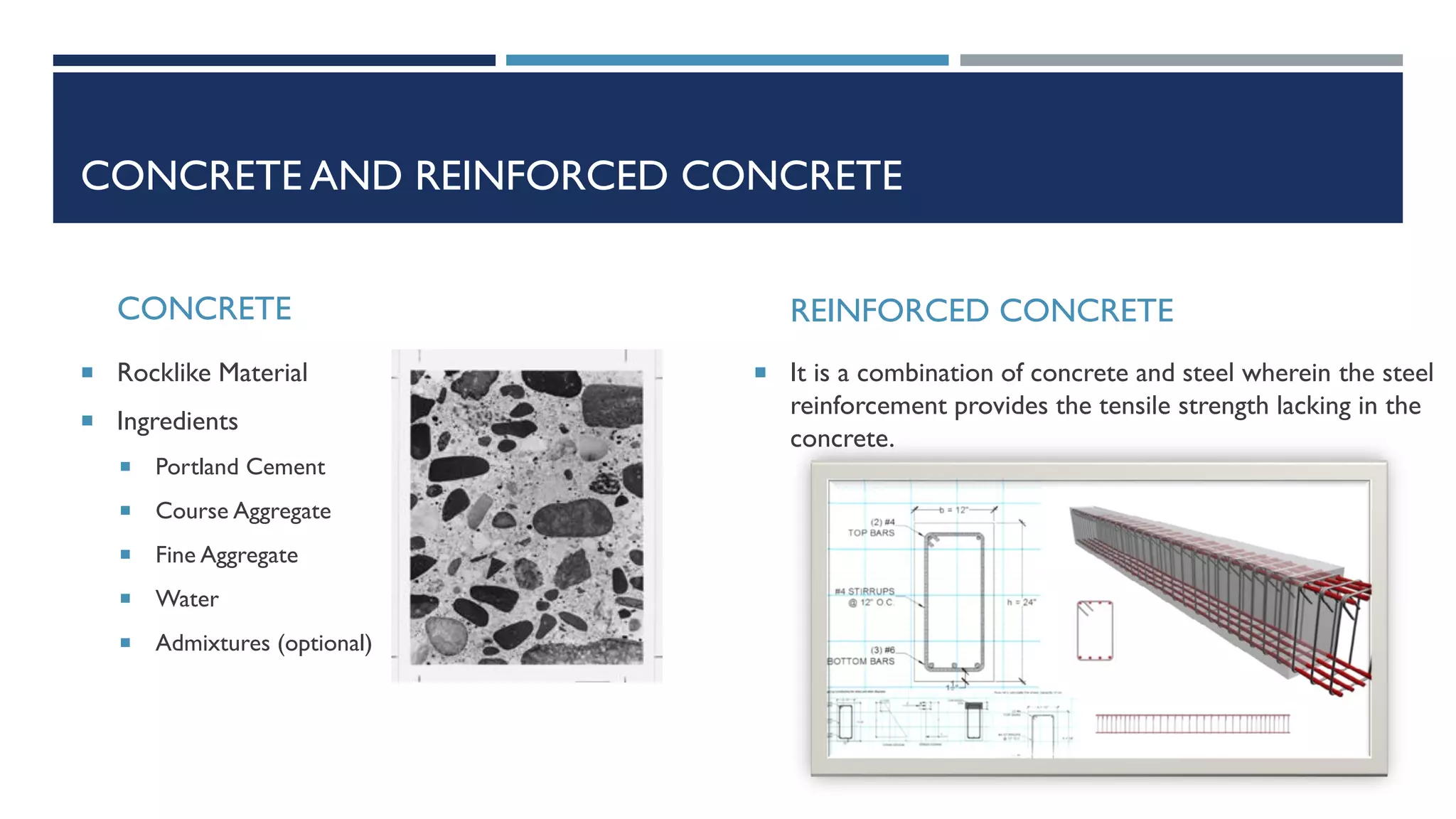
CONCRETE
 Rocklike Material
 Ingredients
 Portland Cement
 Course Aggregate
 Fine Aggregate
 Water
 Admixtures (optional)
REINFORCED CONCRETE
 It is a combination of concrete and steel wherein the steel
reinforcement provides the tensile strength lacking in the
concrete.
ADVANTAGES OF REINFORCED CONCRETE AS A
STRUCTURAL MATERIAL
1. High compressive strength
2. Great resistance to the actions of fire and water.
3. Very rigid.
4. Low-maintenance material
5. Very long service life
6. Only economical material available for footings, floor
slabs, basement walls, piers, and similar applications.
7. Formed into different shapes.
8. Inexpensive local materials.
9. Lower grade of skilled labor is required for erection
DISADVANTAGES OF REINFORCED CONCRETE AS A
STRUCTURAL MATERIAL
1. Very low tensile strength
2. Formwork is very expensive.
3. The low strength per unit of weight of concrete
leads to heavy members.
4. The properties of concrete vary widely because of
variations in its proportioning and mixing.
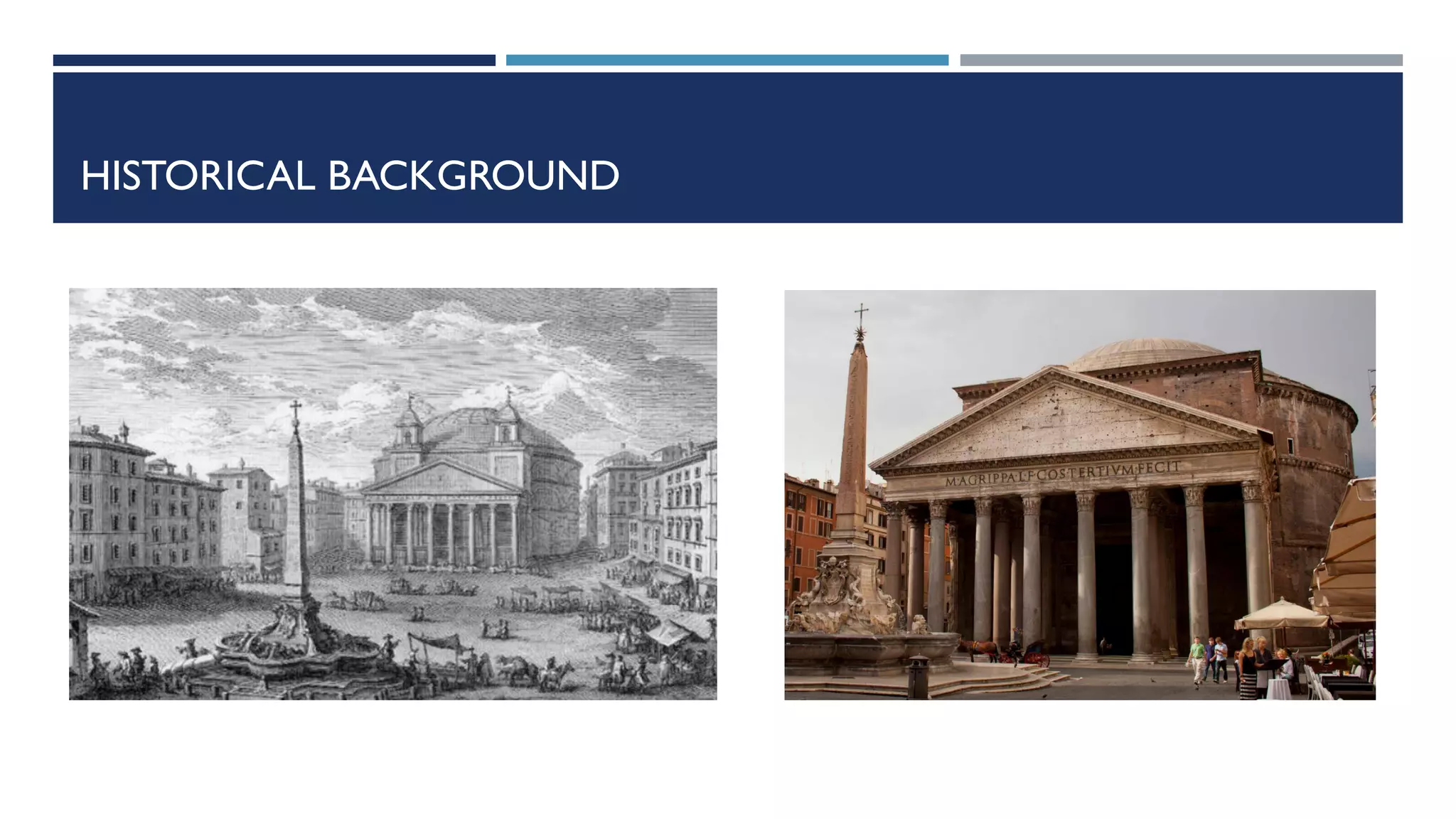
HISTORICAL BACKGROUND
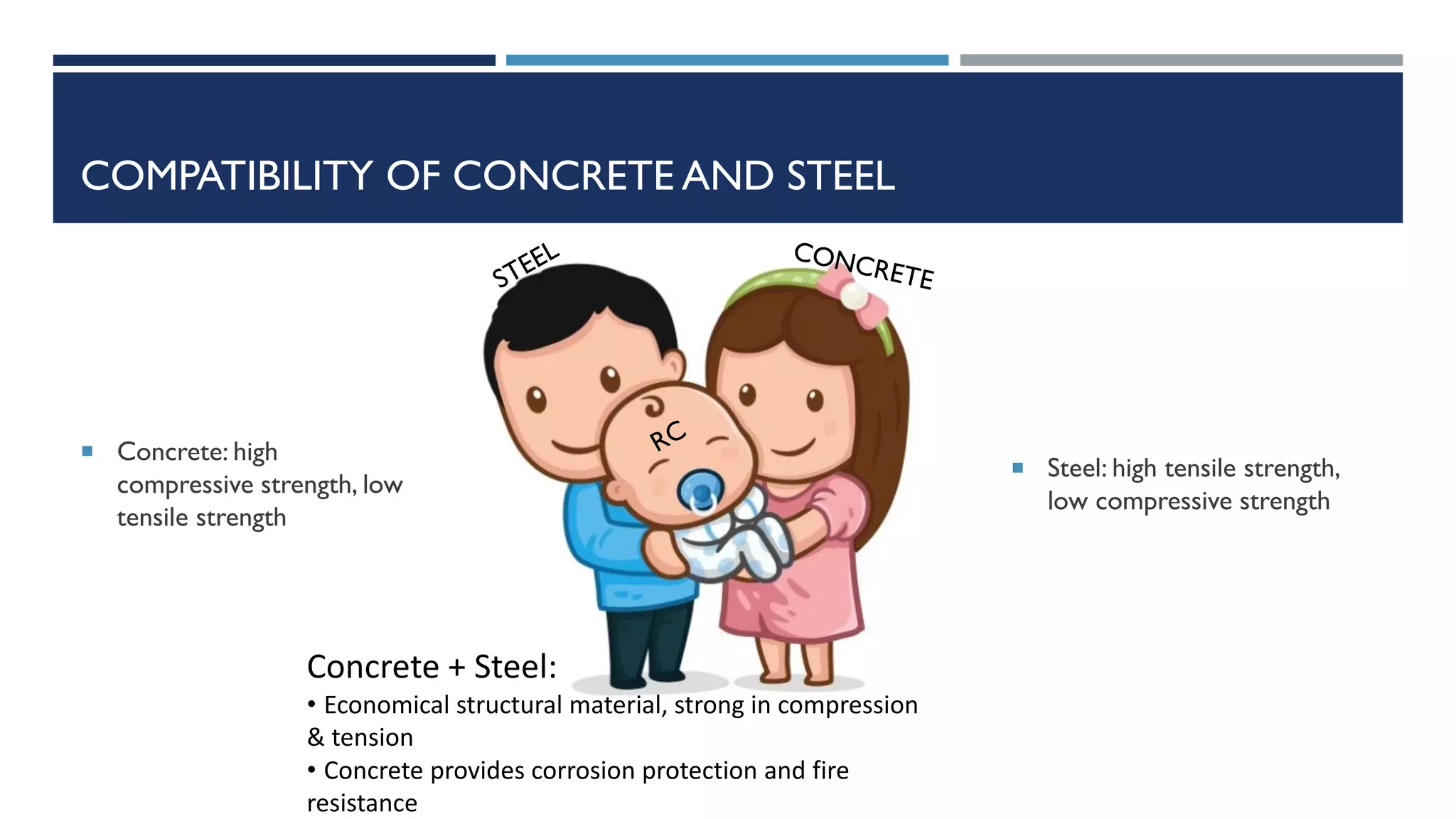
COMPATIBILITY OF CONCRETE AND STEEL
 Concrete: high
compressive strength, low
tensile strength
 Steel: high tensile strength,
low compressive strength
Concrete + Steel:
• Economical structural material, strong in compression
& tension
• Concrete provides corrosion protection and fire
resistance
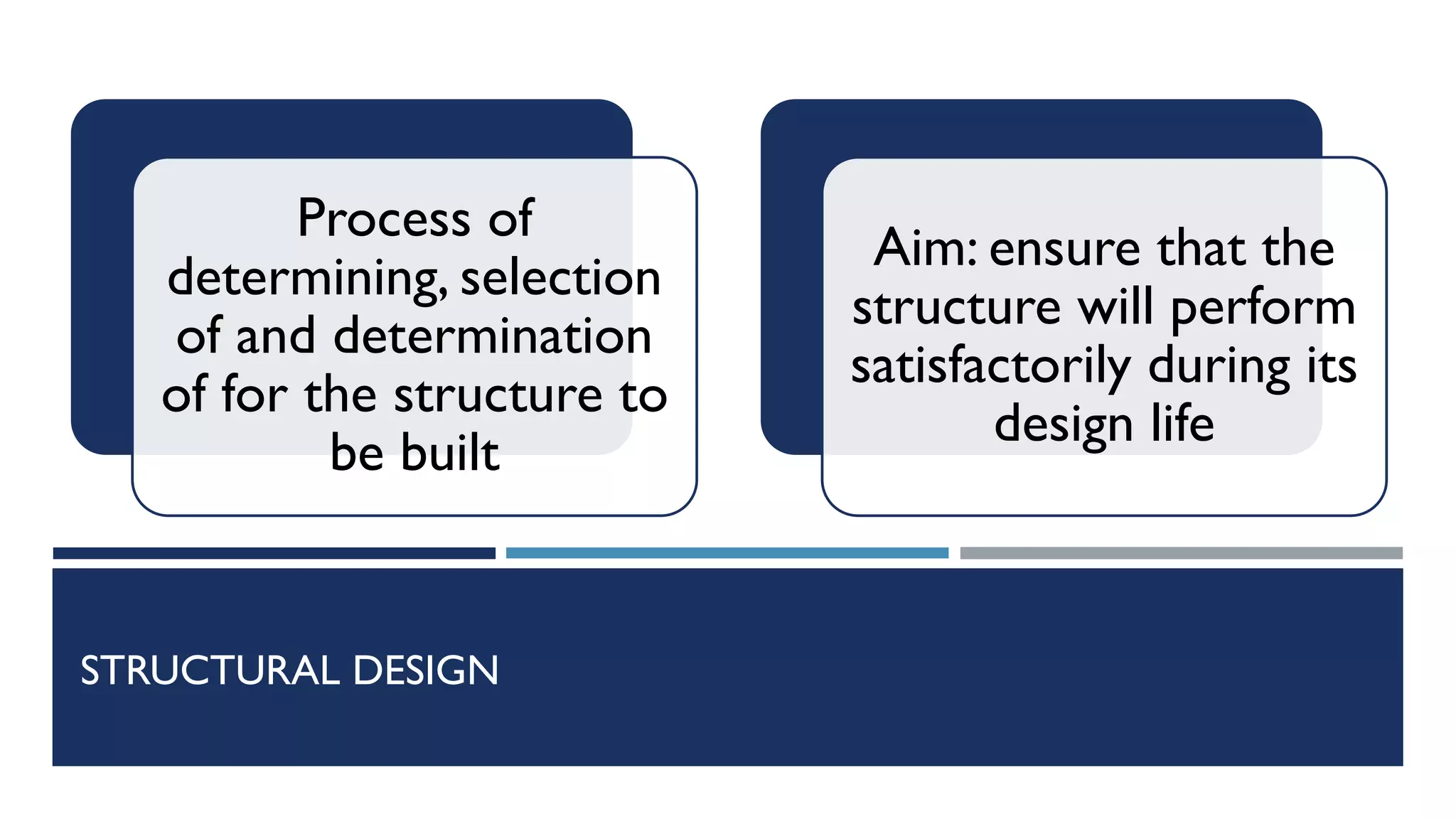
STRUCTURAL DESIGN
Process of
determining, selection
of and determination
of for the structure to
be built
Aim: ensure that the
structure will perform
satisfactorily during its
design life
STRUCTURAL DESIGN PURPOSES
Fitness for purpose Safety and reliability
Economy Maintability
FITNESS FOR PURPOSE
Arrangement of spaces, spans, ceiling height, access and traffic flow must
complement the intended use.
The structure should fit its environment and be aesthetically pleasing
SAFETY AND RELIABILITY
Structure must be strong to safely support all anticipated loadings
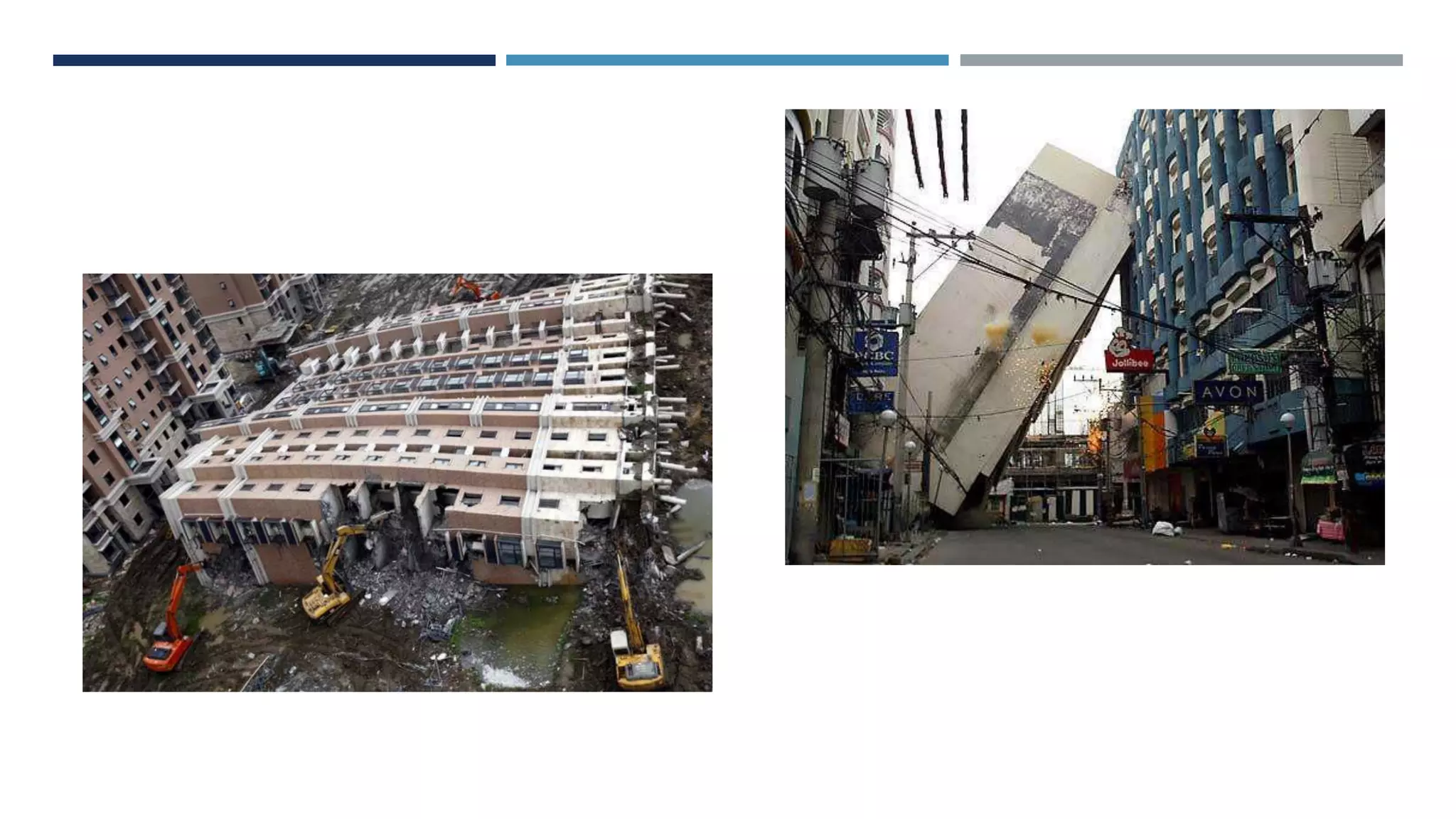
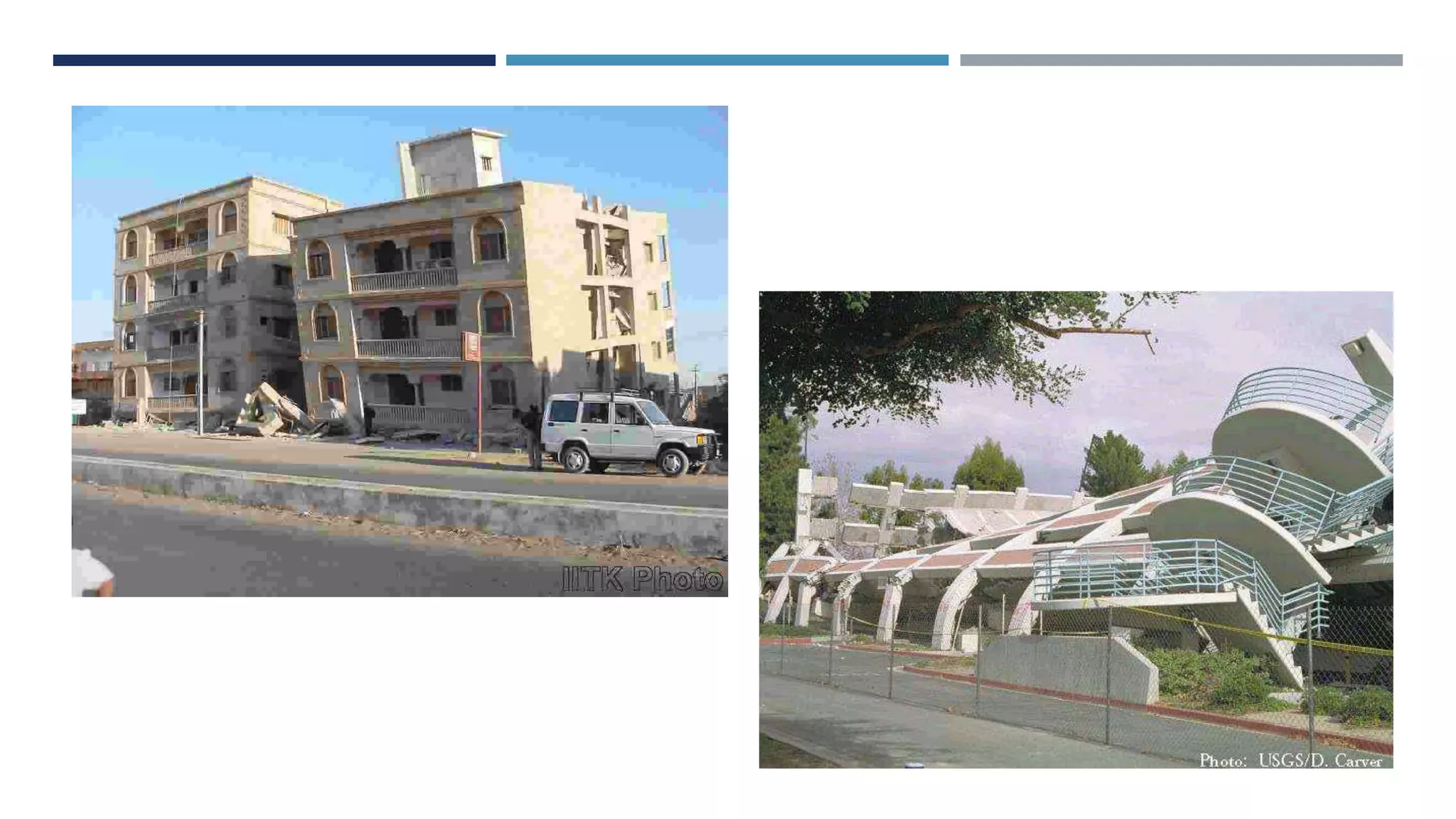
Structure must not deflect, overturn, tilt, vibrate or crack in a manner
that impairs its usefulness
ECONOMY
Overall cost of structure
should not exceed the client’s
budget
Designer should take into
account: cost of materials,
buildability, construction time,
cost of temporary structures
and maintenance costs
MAINTAINABILITY
STRUCTURE SHOULD BE
DESIGNEDTO REQUIRE A
MINIMUM MAINTENANCE,
CAN BE MAINTAINED IN A SIMPLE
FASHION
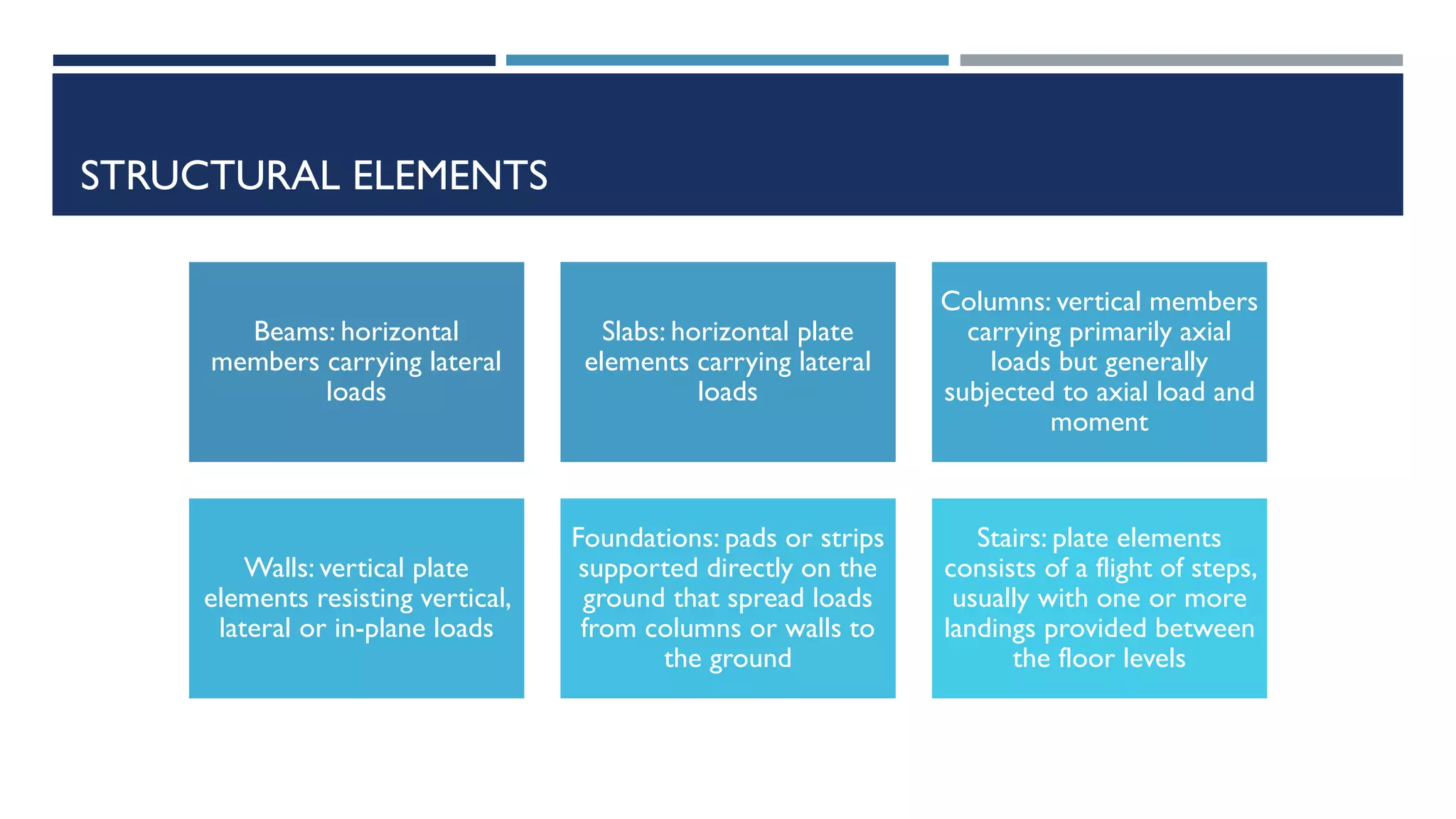
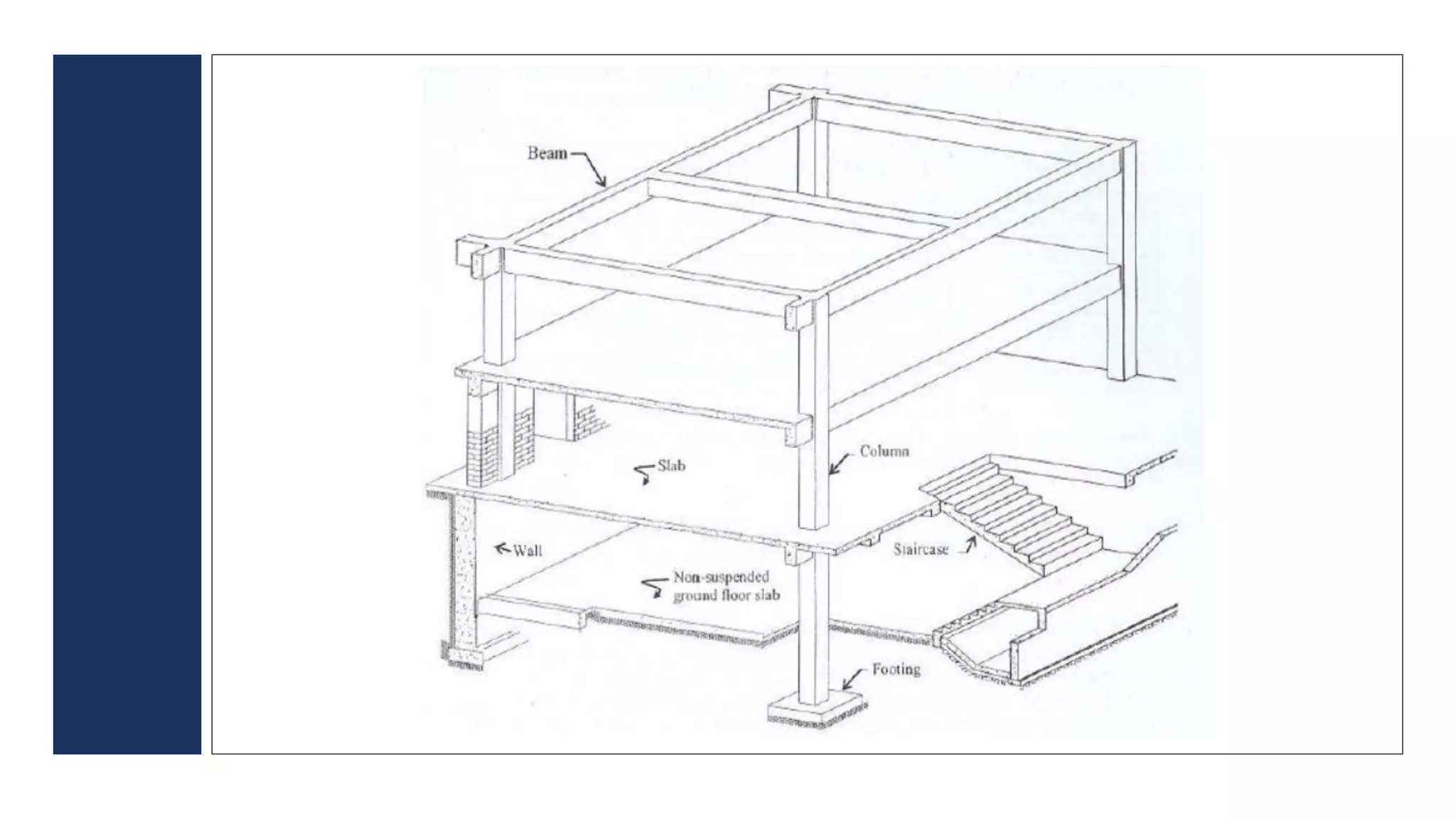
STRUCTURAL ELEMENTS
Beams: horizontal
members carrying lateral
loads
Slabs: horizontal plate
elements carrying lateral
loads
Columns: vertical members
carrying primarily axial
loads but generally
subjected to axial load and
moment
Walls: vertical plate
elements resisting vertical,
lateral or in-plane loads
Foundations: pads or strips
supported directly on the
ground that spread loads
from columns or walls to
the ground
Stairs: plate elements
consists of a flight of steps,
usually with one or more
landings provided between
the floor levels
DESIGN CODES
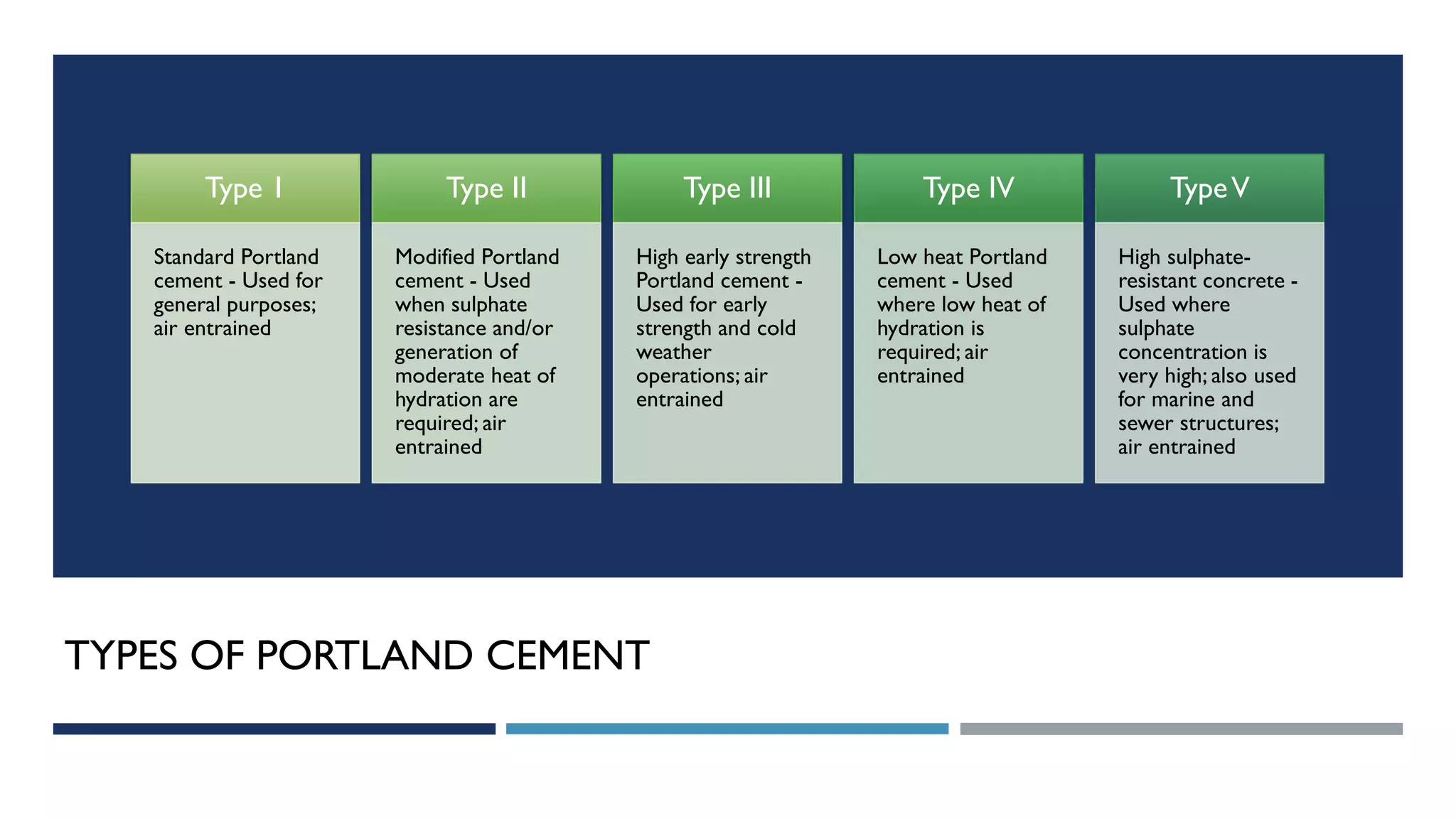
TYPES OF PORTLAND CEMENT
Type 1
Standard Portland
cement - Used for
general purposes;
air entrained
Type II
Modified Portland
cement - Used
when sulphate
resistance and/or
generation of
moderate heat of
hydration are
required; air
entrained
Type III
High early strength
Portland cement -
Used for early
strength and cold
weather
operations; air
entrained
Type IV
Low heat Portland
cement - Used
where low heat of
hydration is
required; air
entrained
TypeV
High sulphate-
resistant concrete -
Used where
sulphate
concentration is
very high; also used
for marine and
sewer structures;
air entrained
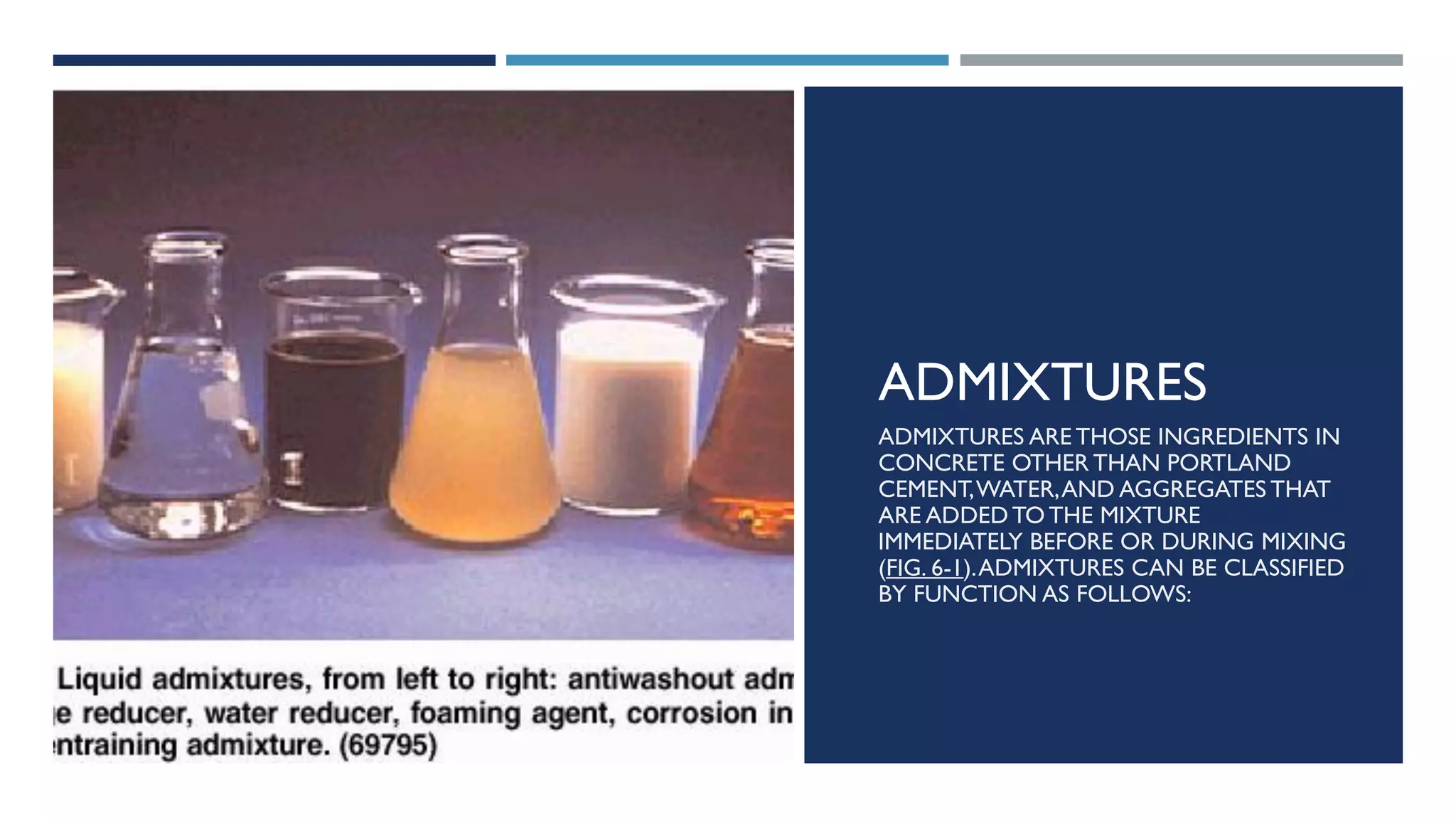
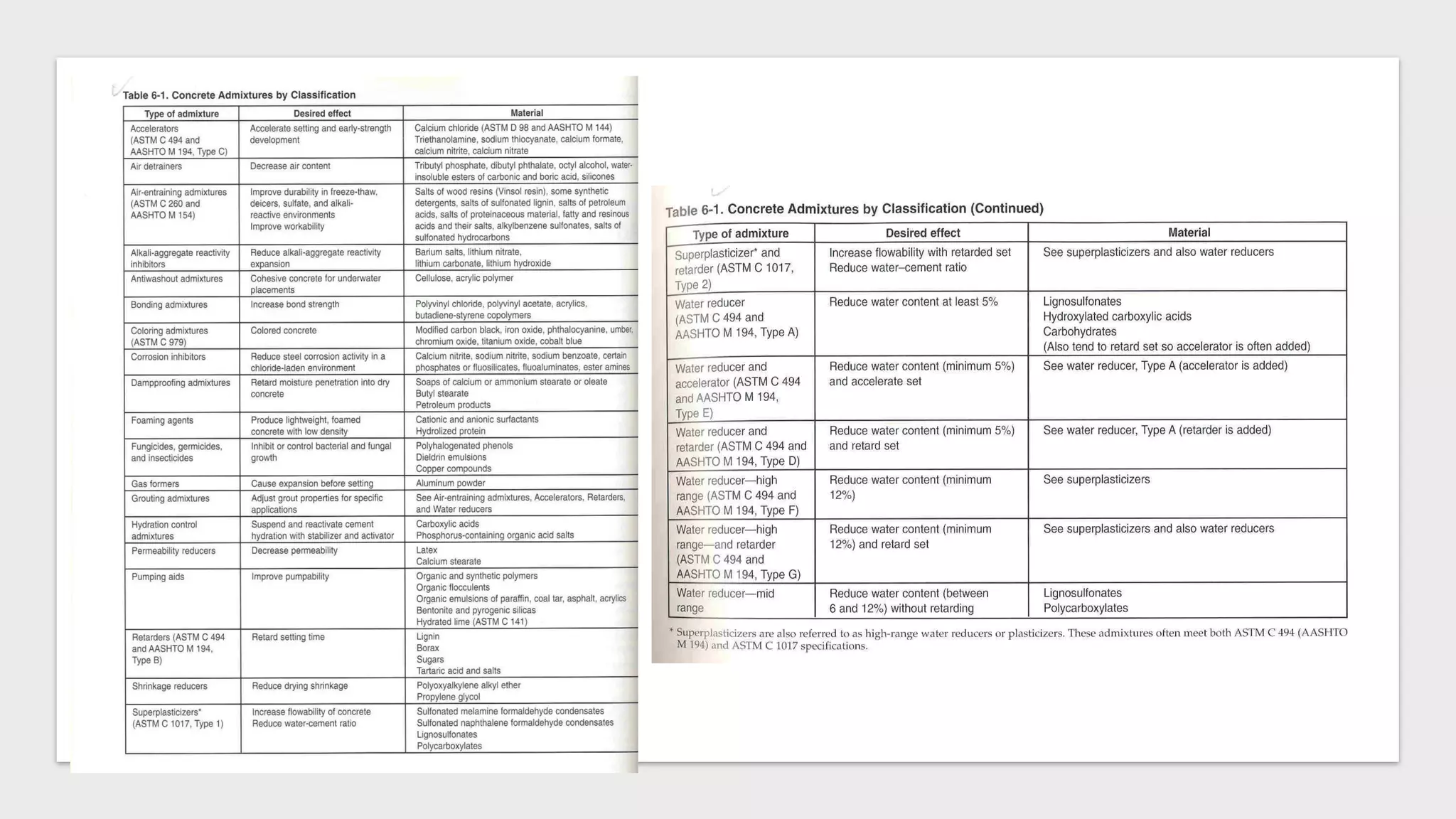
ADMIXTURES
ADMIXTURES ARE THOSE INGREDIENTS IN
CONCRETE OTHER THAN PORTLAND
CEMENT,WATER,AND AGGREGATES THAT
ARE ADDED TO THE MIXTURE
IMMEDIATELY BEFORE OR DURING MIXING
(FIG. 6-1).ADMIXTURES CAN BE CLASSIFIED
BY FUNCTION AS FOLLOWS:
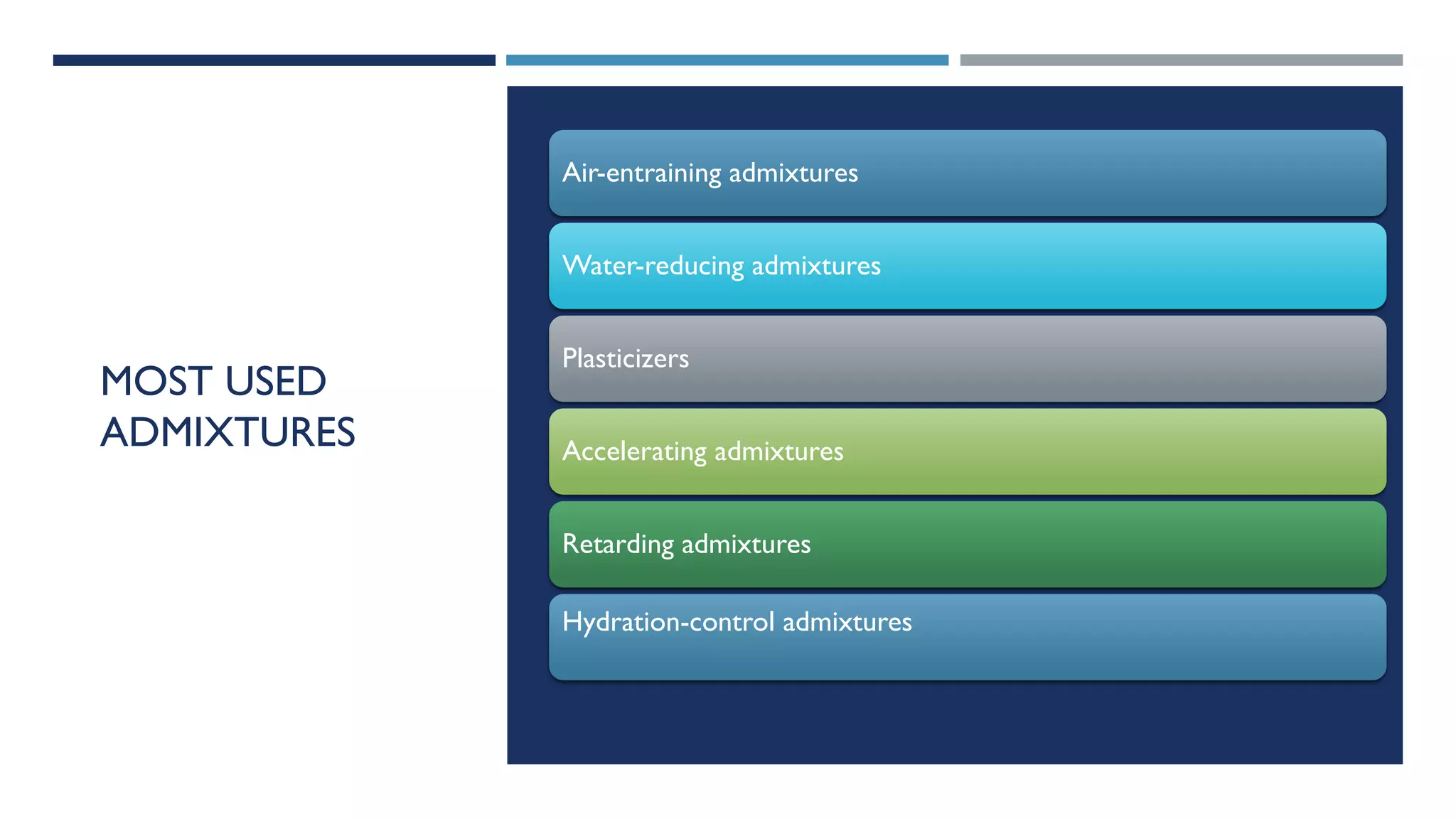
MOST USED
ADMIXTURES
Air-entraining admixtures
Water-reducing admixtures
Plasticizers
Accelerating admixtures
Retarding admixtures
Hydration-control admixtures
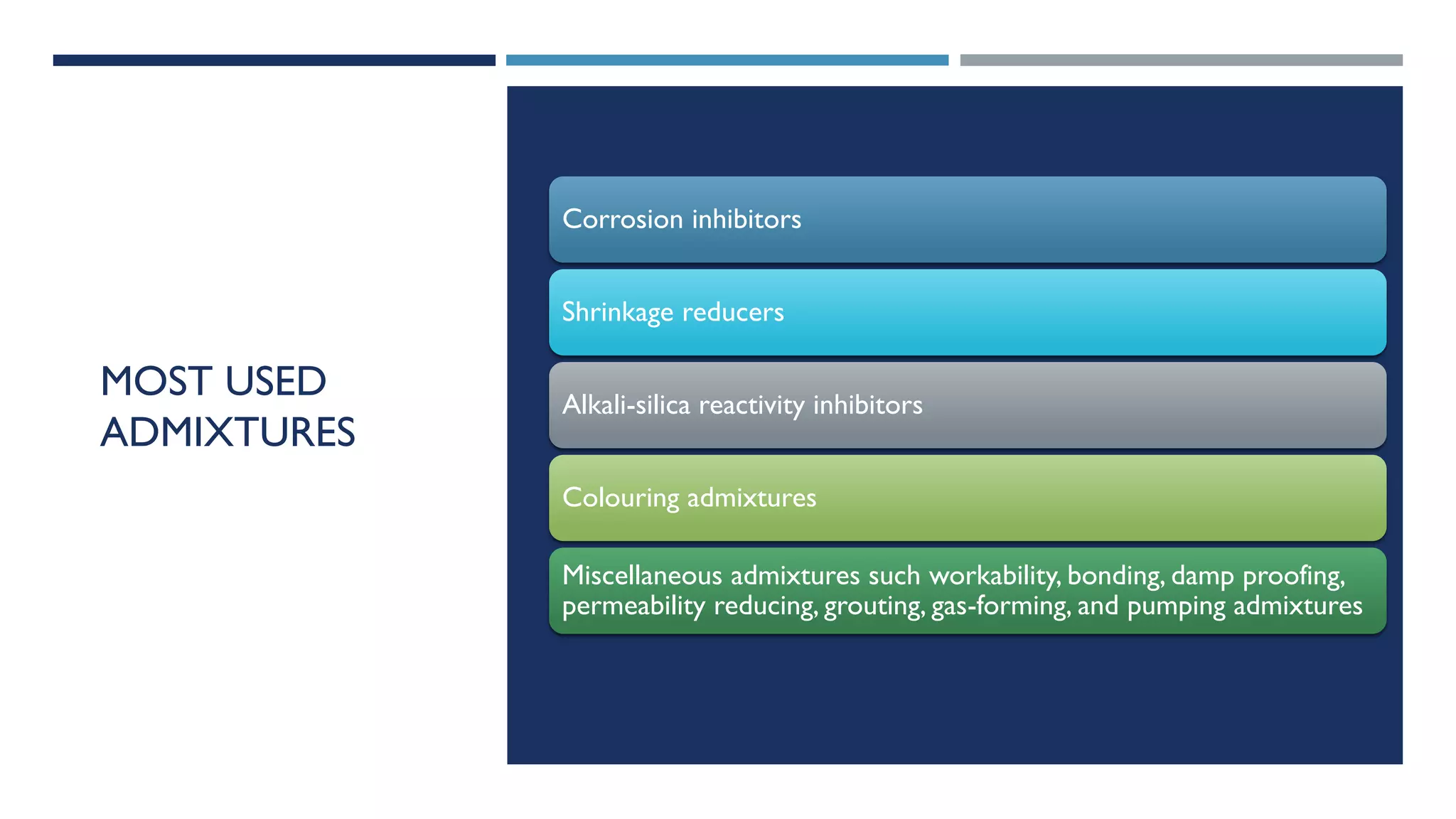
MOST USED
ADMIXTURES
Corrosion inhibitors
Shrinkage reducers
Alkali-silica reactivity inhibitors
Colouring admixtures
Miscellaneous admixtures such workability, bonding, damp proofing,
permeability reducing, grouting, gas-forming, and pumping admixtures
THE MAJOR REASONS FOR USING ADMIXTURES ARE:
To reduce the cost of concrete
construction
To achieve certain properties in
concrete more effectively
than by other means
To maintain the quality of concrete
during the stages of mixing,
transporting, placing, and curing in
adverse weather conditions
To overcome certain emergencies
during concreting operations
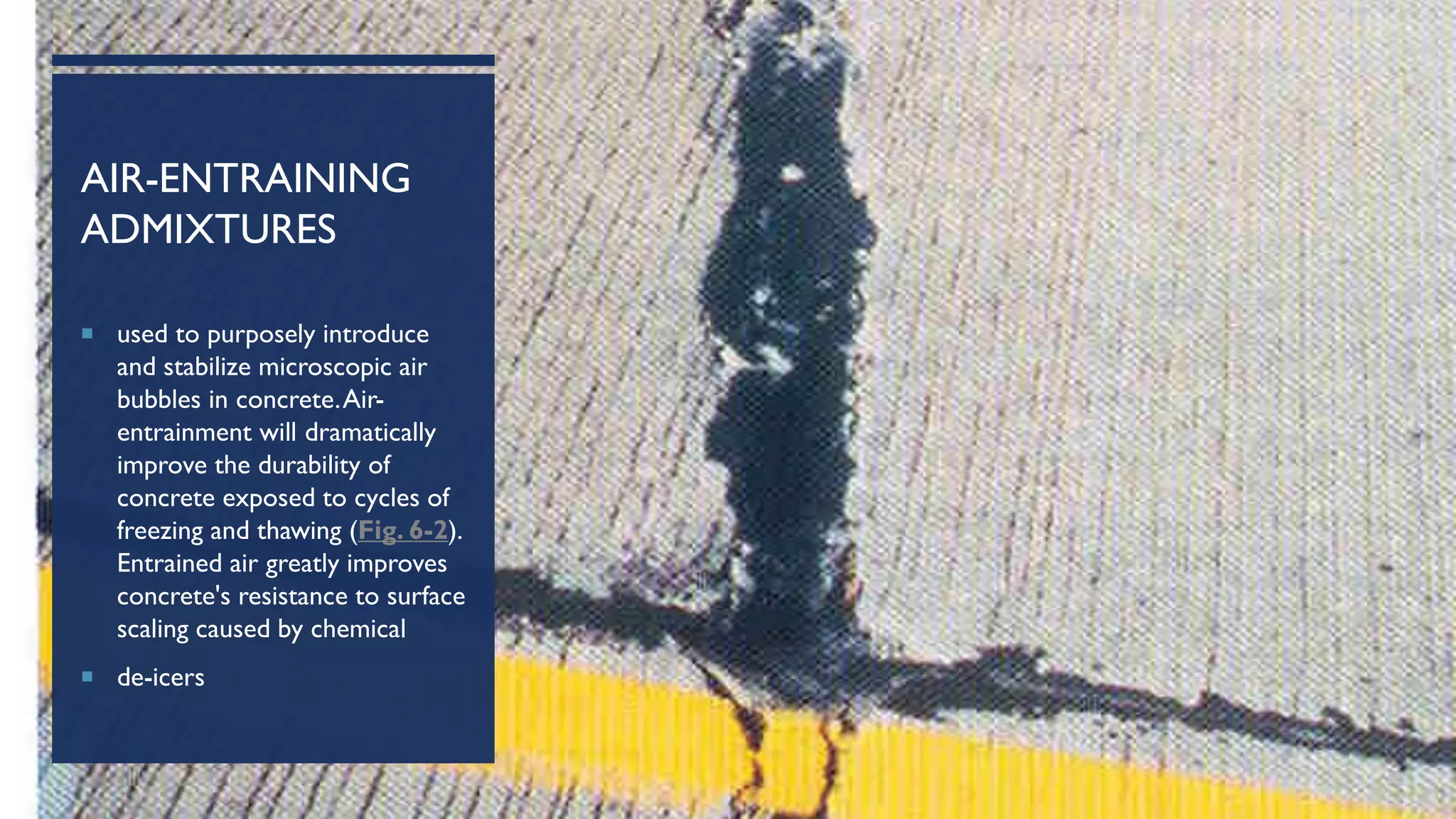
AIR-ENTRAINING
ADMIXTURES
 used to purposely introduce
and stabilize microscopic air
bubbles in concrete.Air-
entrainment will dramatically
improve the durability of
concrete exposed to cycles of
freezing and thawing (Fig. 6-2).
Entrained air greatly improves
concrete's resistance to surface
scaling caused by chemical
 de-icers
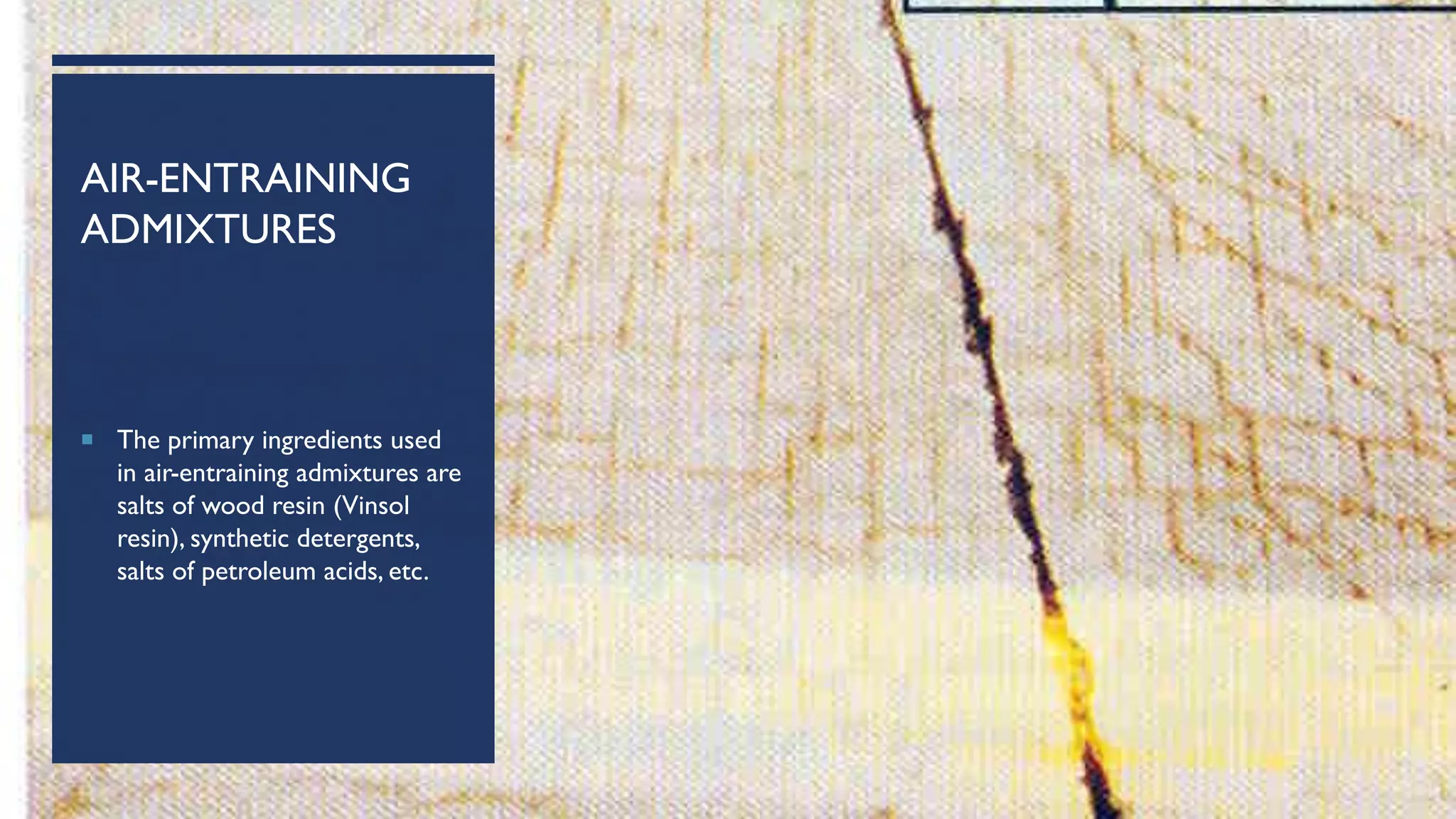
AIR-ENTRAINING
ADMIXTURES
 The primary ingredients used
in air-entraining admixtures are
salts of wood resin (Vinsol
resin), synthetic detergents,
salts of petroleum acids, etc.
WATER-REDUCING ADMIXTURES
used to reduce the quantity of
mixing water required to produce
concrete of a certain slump, reduce
water-cementing materials ratio,
reduce cement content, or increase
slump.
Typical water reducers reduce the
water content by approximately 5%
to 10%.
WATER-
REDUCING
ADMIXTURES
MATERIALS:
LIGNOSULFONATES.
CARBOHYDRATES.
HYDROXYLATED
CARBOXYLIC ACIDS.
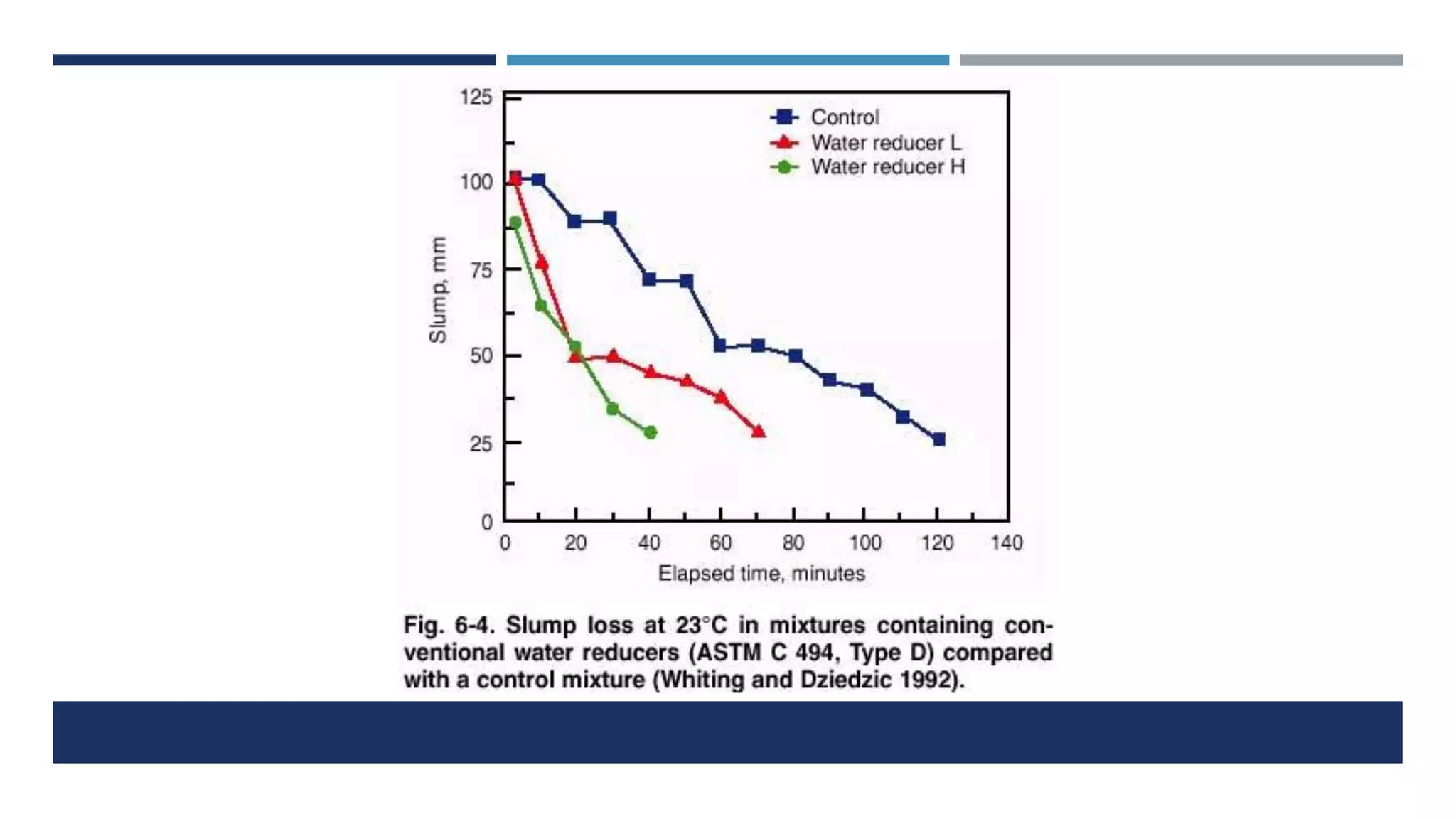
The effectiveness of water reducers on concrete is a function of
their chemical composition, concrete temperature, cement
composition and fineness, cement content, and the presence of
other admixtures.
SUPERPLASTICIZERS
(HIGH-RANGE
WATER REDUCERS)
These admixtures are added to
concrete with a low-to-normal
slump and water-cementing
materials ratio to make high-
slump flowing concrete.
Flowing concrete is a highly
fluid but workable concrete
that can be placed with little or
no vibration or compaction
while still remaining essentially
free of excessive bleeding or
segregation.
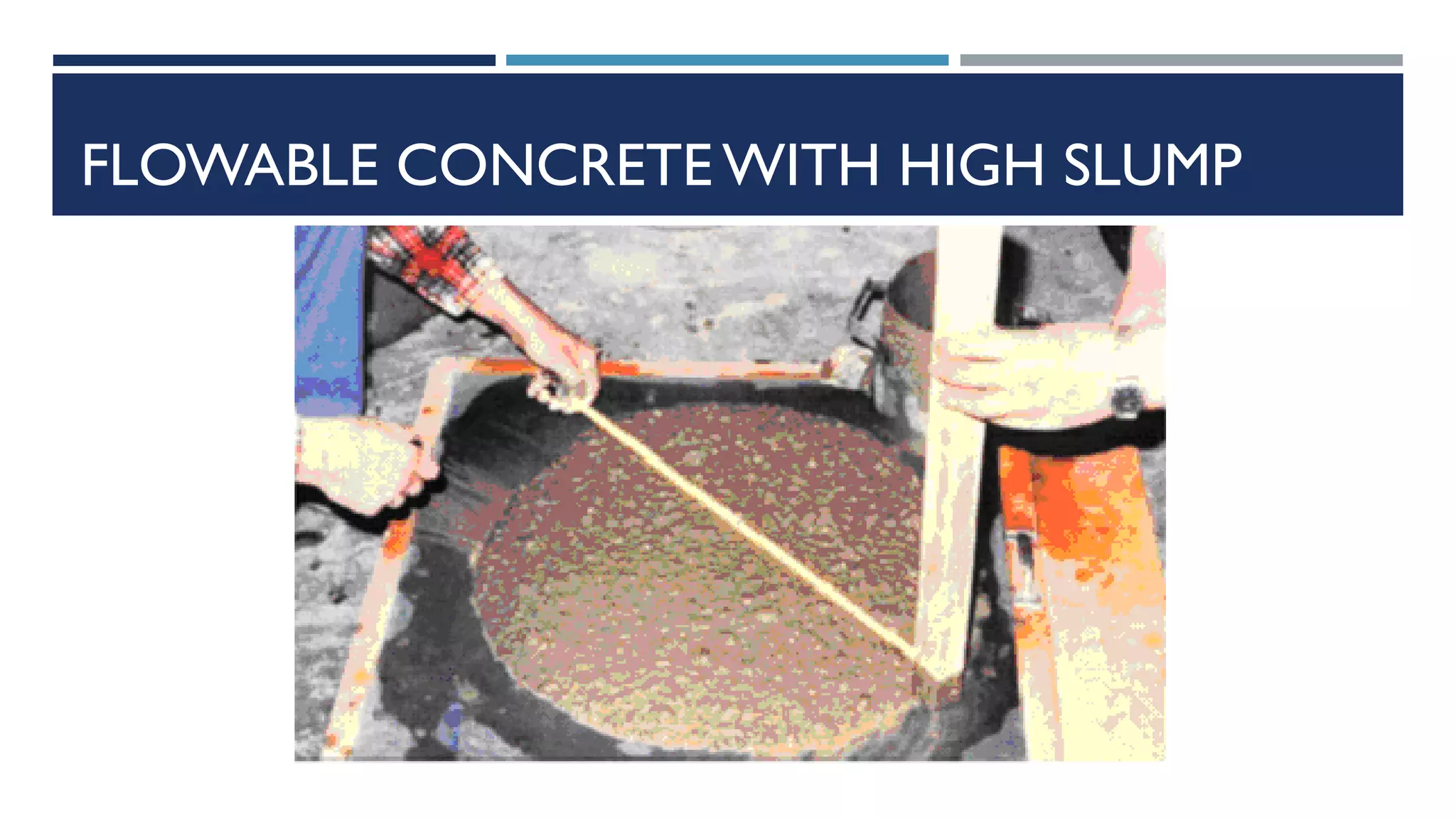
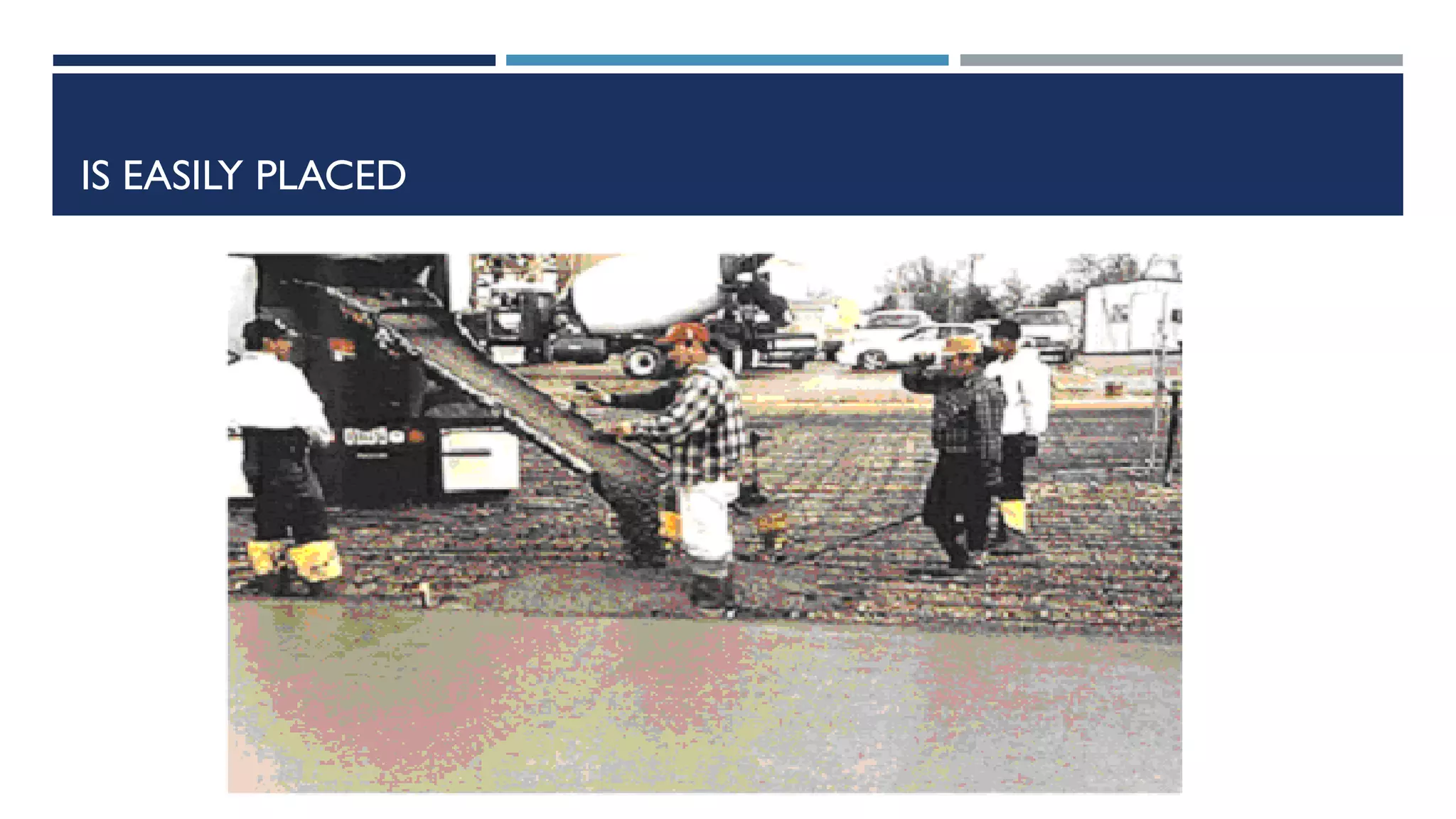
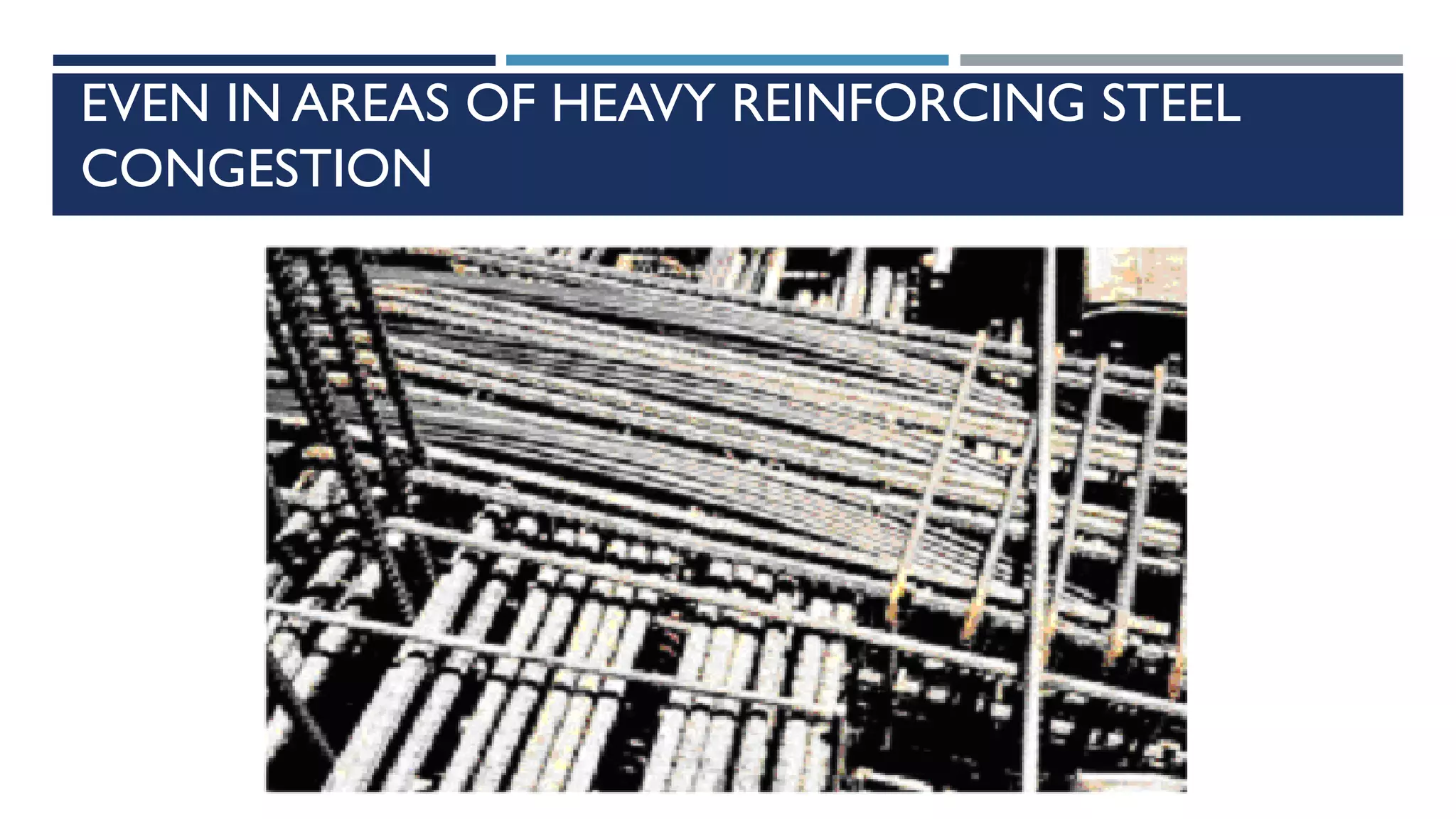
APPLICATIONS WHERE FLOWING CONCRETE IS USED:
thin-section
placements,
areas of closely spaced
and congested
reinforcing steel,
pumped concrete to
reduce pump pressure,
thereby increasing lift
and distance capacity,
areas where
conventional
consolidation methods
are impractical or can
not be used, and
for reducing handling
costs.
FLOWABLE CONCRETE WITH HIGH SLUMP
IS EASILY PLACED
EVEN IN AREAS OF HEAVY REINFORCING STEEL
CONGESTION
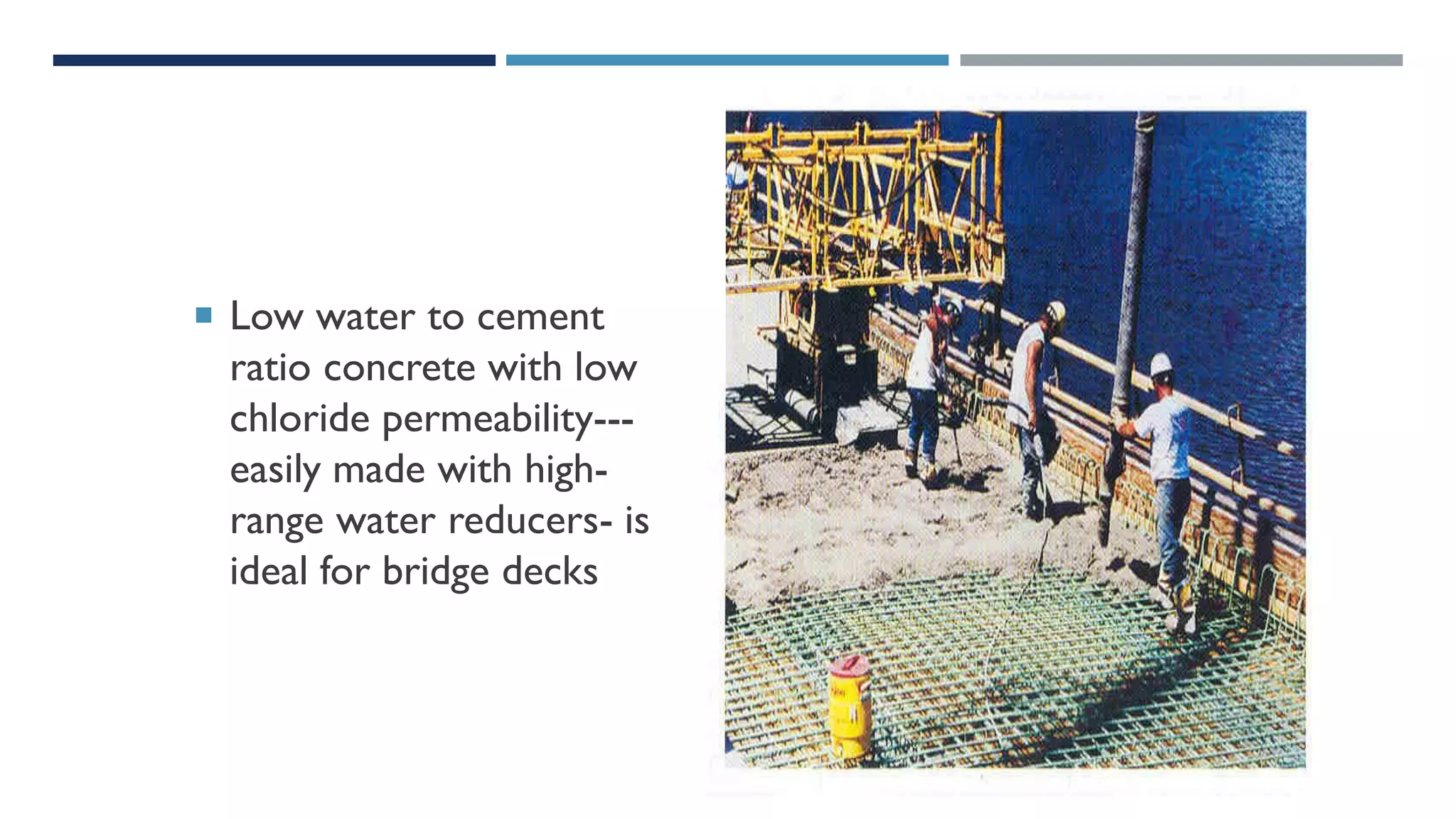
 Low water to cement
ratio concrete with low
chloride permeability---
easily made with high-
range water reducers- is
ideal for bridge decks
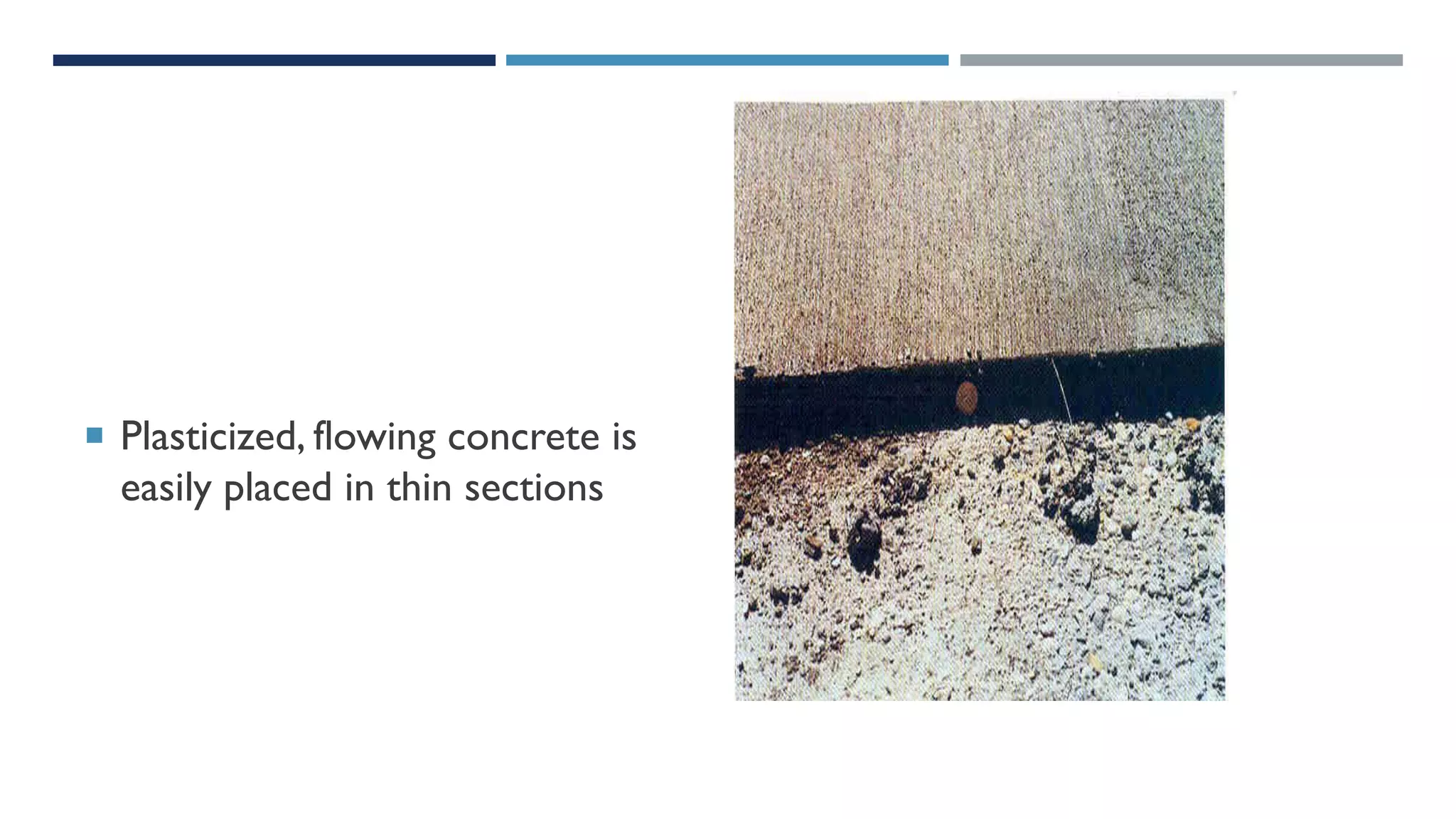
 Plasticized, flowing concrete is
easily placed in thin sections
SUPERPLASTICIZERS (HIGH-RANGE WATER REDUCERS)
 Typical superplasticizers include:
 Sulfonated melamine formaldehyde condensates.
 Sulfonated naphthalene formaldehyde condensate.
 Lignosulfonates.
 Polycarboxylates.
SUPERPLASTICIZERS (HIGH-RANGE WATER
REDUCERS)
 bleed significantly less than control concretes of equally high slump and
higher water content.
 High-slump, low-water-content, plasticized concrete has less drying
shrinkage than a high-slump, high-water-content conventional concrete.
 has similar or higher drying shrinkage than conventional low-slump,
low-water-content concrete.
 The effectiveness of the plasticizer is increased with an increasing
amount of cement and fines in the concrete.
RETARDING ADMIXTURES
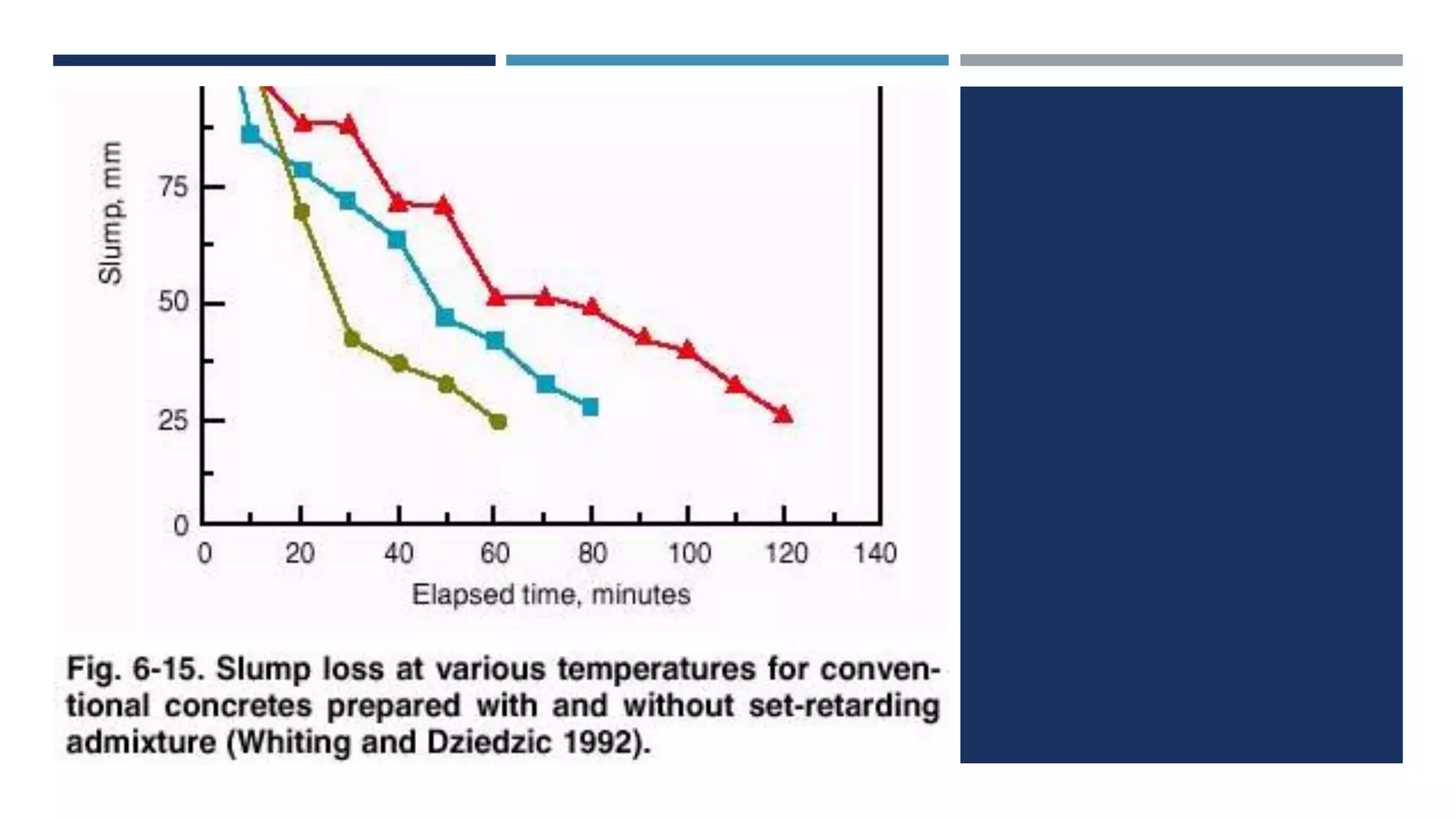
 used to retard the rate of setting of concrete at high temperatures of
fresh concrete (30°C or more).
 One of the most practical methods of counteracting this effect is to
reduce the temperature of the concrete by cooling the mixing water or
the aggregates.
 Retarders do not decrease the initial temperature of concrete.
 The bleeding rate and capacity of plastic concrete is increased with
retarders.
RETARDING ADMIXTURES
 The typical materials used as retarders are:
 Lignin,
 Borax,
 Sugars,
 Tartaric acid and salts.
RETARDING ADMIXTURES
 Retarders are used to:
1. offset the accelerating effect of hot weather on the setting of concrete,
2. delay the initial set of concrete when difficult or unusual conditions of
placement occur,
3. delay the set for special finishing processes such as an exposed aggregate
surface.
RETARDING
ADMIXTURES
some reduction in strength at early ages (one to three
days) accompanies the use of retarders.
The effects of these materials on the other properties of
concrete, such as shrinkage, may not be predictable.
Therefore, acceptance tests of retarders should be
made with actual job materials under anticipated
job conditions.
ACCELERATING
ADMIXTURES
used to accelerate strength development
of concrete at an early age.
Typical Materials are:
• Calcium chloride: most commonly used for plain
concrete.
• Triethanolamine.
• Calcium formate.
• Calcium nitrate.
• Calcium nitrite.
CORROSION INHIBITORS
CORROSION
INHIBITORS
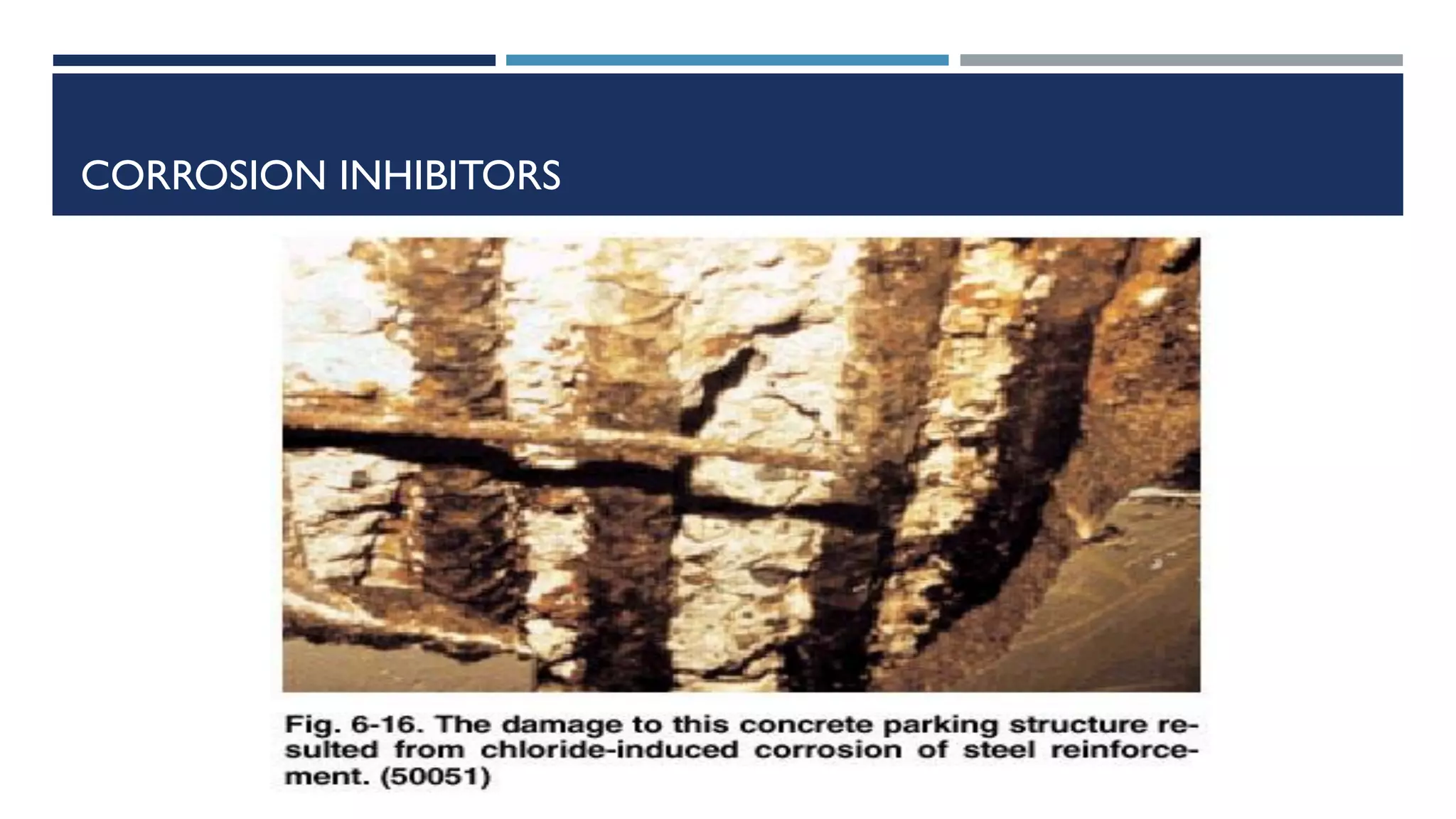
The chlorides can cause corrosion of steel reinforcement
in concrete.
Ferrous oxide and ferric oxide form on the surface of
reinforcing steel in concrete.
Ferrous oxide reacts with chlorides to form complexes
that move away from the steel to form rust.The chloride
ions continue to attack the steel until the passivating oxide
layer is destroyed.
CORROSION
INHIBITORS
Corrosion-inhibiting admixtures chemically
arrest the corrosion reaction.
Commercially available corrosion
inhibitors include:
• calcium nitrite,
• sodium nitrite,
• dimethyl ethanolamine,
• amines,
• phosphates,
• ester amines.
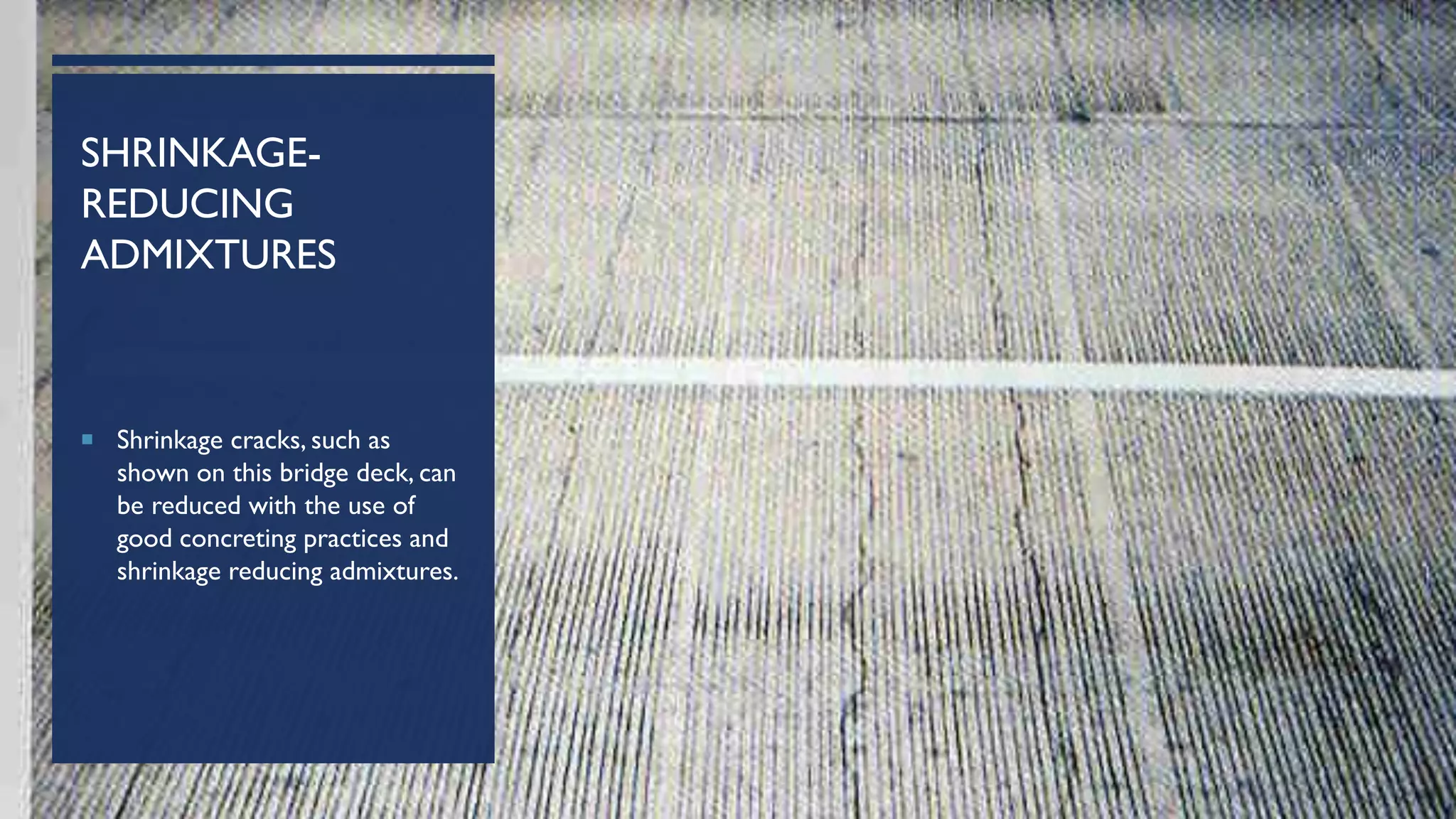
SHRINKAGE-
REDUCING
ADMIXTURES
 Shrinkage cracks, such as
shown on this bridge deck, can
be reduced with the use of
good concreting practices and
shrinkage reducing admixtures.
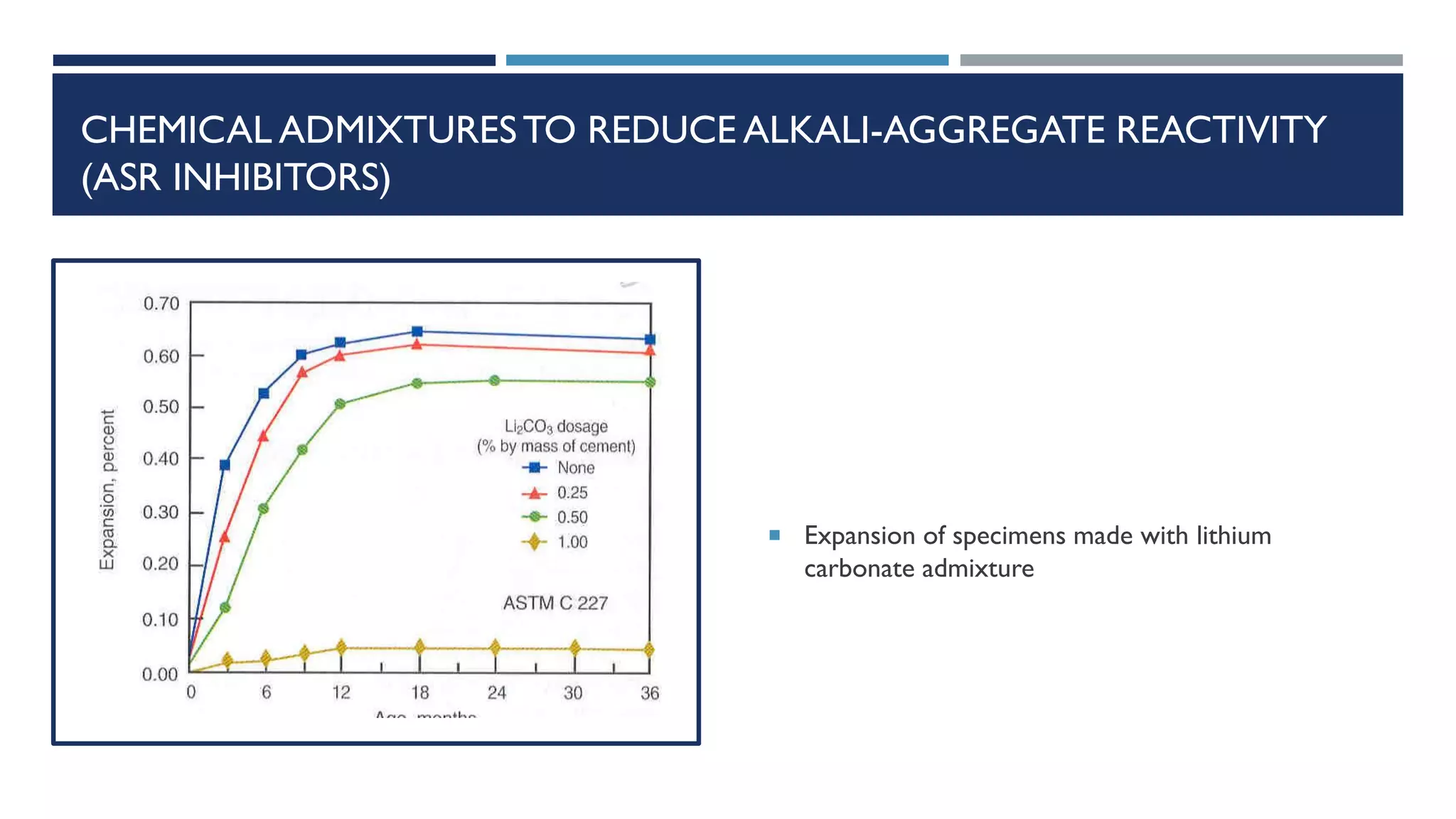
CHEMICAL ADMIXTURESTO REDUCE ALKALI-AGGREGATE REACTIVITY
(ASR INHIBITORS)
 Expansion of specimens made with lithium
carbonate admixture
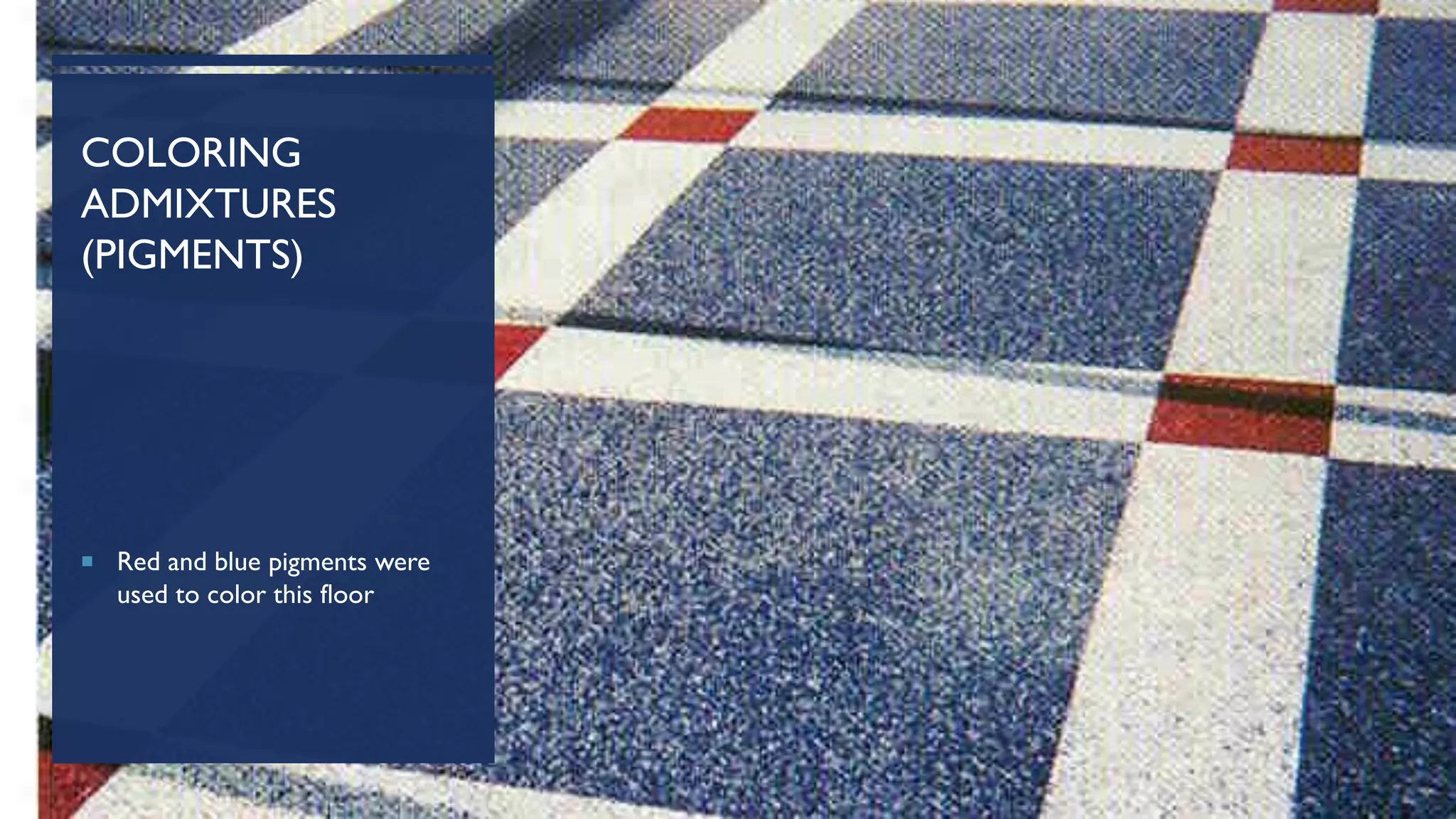
COLORING
ADMIXTURES
(PIGMENTS)
 Red and blue pigments were
used to color this floor

INTRODUCTION TO RC.pdf

  • 1.
    INTRODUCTION TO REINFORCEDCONCRETE CE 535 /D
  • 2.
    CONCRETE AND REINFORCEDCONCRETE CONCRETE  Rocklike Material  Ingredients  Portland Cement  Course Aggregate  Fine Aggregate  Water  Admixtures (optional) REINFORCED CONCRETE  It is a combination of concrete and steel wherein the steel reinforcement provides the tensile strength lacking in the concrete.
  • 3.
    ADVANTAGES OF REINFORCEDCONCRETE AS A STRUCTURAL MATERIAL 1. High compressive strength 2. Great resistance to the actions of fire and water. 3. Very rigid. 4. Low-maintenance material 5. Very long service life 6. Only economical material available for footings, floor slabs, basement walls, piers, and similar applications. 7. Formed into different shapes. 8. Inexpensive local materials. 9. Lower grade of skilled labor is required for erection
  • 4.
    DISADVANTAGES OF REINFORCEDCONCRETE AS A STRUCTURAL MATERIAL 1. Very low tensile strength 2. Formwork is very expensive. 3. The low strength per unit of weight of concrete leads to heavy members. 4. The properties of concrete vary widely because of variations in its proportioning and mixing.
  • 5.
  • 6.
    COMPATIBILITY OF CONCRETEAND STEEL  Concrete: high compressive strength, low tensile strength  Steel: high tensile strength, low compressive strength Concrete + Steel: • Economical structural material, strong in compression & tension • Concrete provides corrosion protection and fire resistance
  • 7.
    STRUCTURAL DESIGN Process of determining,selection of and determination of for the structure to be built Aim: ensure that the structure will perform satisfactorily during its design life
  • 8.
    STRUCTURAL DESIGN PURPOSES Fitnessfor purpose Safety and reliability Economy Maintability
  • 9.
    FITNESS FOR PURPOSE Arrangementof spaces, spans, ceiling height, access and traffic flow must complement the intended use. The structure should fit its environment and be aesthetically pleasing
  • 10.
    SAFETY AND RELIABILITY Structuremust be strong to safely support all anticipated loadings Structure must not deflect, overturn, tilt, vibrate or crack in a manner that impairs its usefulness
  • 13.
    ECONOMY Overall cost ofstructure should not exceed the client’s budget Designer should take into account: cost of materials, buildability, construction time, cost of temporary structures and maintenance costs
  • 14.
    MAINTAINABILITY STRUCTURE SHOULD BE DESIGNEDTOREQUIRE A MINIMUM MAINTENANCE, CAN BE MAINTAINED IN A SIMPLE FASHION
  • 15.
    STRUCTURAL ELEMENTS Beams: horizontal memberscarrying lateral loads Slabs: horizontal plate elements carrying lateral loads Columns: vertical members carrying primarily axial loads but generally subjected to axial load and moment Walls: vertical plate elements resisting vertical, lateral or in-plane loads Foundations: pads or strips supported directly on the ground that spread loads from columns or walls to the ground Stairs: plate elements consists of a flight of steps, usually with one or more landings provided between the floor levels
  • 17.
  • 18.
    TYPES OF PORTLANDCEMENT Type 1 Standard Portland cement - Used for general purposes; air entrained Type II Modified Portland cement - Used when sulphate resistance and/or generation of moderate heat of hydration are required; air entrained Type III High early strength Portland cement - Used for early strength and cold weather operations; air entrained Type IV Low heat Portland cement - Used where low heat of hydration is required; air entrained TypeV High sulphate- resistant concrete - Used where sulphate concentration is very high; also used for marine and sewer structures; air entrained
  • 19.
    ADMIXTURES ADMIXTURES ARE THOSEINGREDIENTS IN CONCRETE OTHER THAN PORTLAND CEMENT,WATER,AND AGGREGATES THAT ARE ADDED TO THE MIXTURE IMMEDIATELY BEFORE OR DURING MIXING (FIG. 6-1).ADMIXTURES CAN BE CLASSIFIED BY FUNCTION AS FOLLOWS:
  • 20.
    MOST USED ADMIXTURES Air-entraining admixtures Water-reducingadmixtures Plasticizers Accelerating admixtures Retarding admixtures Hydration-control admixtures
  • 21.
    MOST USED ADMIXTURES Corrosion inhibitors Shrinkagereducers Alkali-silica reactivity inhibitors Colouring admixtures Miscellaneous admixtures such workability, bonding, damp proofing, permeability reducing, grouting, gas-forming, and pumping admixtures
  • 23.
    THE MAJOR REASONSFOR USING ADMIXTURES ARE: To reduce the cost of concrete construction To achieve certain properties in concrete more effectively than by other means To maintain the quality of concrete during the stages of mixing, transporting, placing, and curing in adverse weather conditions To overcome certain emergencies during concreting operations
  • 24.
    AIR-ENTRAINING ADMIXTURES  used topurposely introduce and stabilize microscopic air bubbles in concrete.Air- entrainment will dramatically improve the durability of concrete exposed to cycles of freezing and thawing (Fig. 6-2). Entrained air greatly improves concrete's resistance to surface scaling caused by chemical  de-icers
  • 25.
    AIR-ENTRAINING ADMIXTURES  The primaryingredients used in air-entraining admixtures are salts of wood resin (Vinsol resin), synthetic detergents, salts of petroleum acids, etc.
  • 26.
    WATER-REDUCING ADMIXTURES used toreduce the quantity of mixing water required to produce concrete of a certain slump, reduce water-cementing materials ratio, reduce cement content, or increase slump. Typical water reducers reduce the water content by approximately 5% to 10%.
  • 27.
    WATER- REDUCING ADMIXTURES MATERIALS: LIGNOSULFONATES. CARBOHYDRATES. HYDROXYLATED CARBOXYLIC ACIDS. The effectivenessof water reducers on concrete is a function of their chemical composition, concrete temperature, cement composition and fineness, cement content, and the presence of other admixtures.
  • 29.
    SUPERPLASTICIZERS (HIGH-RANGE WATER REDUCERS) These admixturesare added to concrete with a low-to-normal slump and water-cementing materials ratio to make high- slump flowing concrete. Flowing concrete is a highly fluid but workable concrete that can be placed with little or no vibration or compaction while still remaining essentially free of excessive bleeding or segregation.
  • 30.
    APPLICATIONS WHERE FLOWINGCONCRETE IS USED: thin-section placements, areas of closely spaced and congested reinforcing steel, pumped concrete to reduce pump pressure, thereby increasing lift and distance capacity, areas where conventional consolidation methods are impractical or can not be used, and for reducing handling costs.
  • 31.
  • 32.
  • 33.
    EVEN IN AREASOF HEAVY REINFORCING STEEL CONGESTION
  • 34.
     Low waterto cement ratio concrete with low chloride permeability--- easily made with high- range water reducers- is ideal for bridge decks
  • 35.
     Plasticized, flowingconcrete is easily placed in thin sections
  • 36.
    SUPERPLASTICIZERS (HIGH-RANGE WATERREDUCERS)  Typical superplasticizers include:  Sulfonated melamine formaldehyde condensates.  Sulfonated naphthalene formaldehyde condensate.  Lignosulfonates.  Polycarboxylates.
  • 37.
    SUPERPLASTICIZERS (HIGH-RANGE WATER REDUCERS) bleed significantly less than control concretes of equally high slump and higher water content.  High-slump, low-water-content, plasticized concrete has less drying shrinkage than a high-slump, high-water-content conventional concrete.  has similar or higher drying shrinkage than conventional low-slump, low-water-content concrete.  The effectiveness of the plasticizer is increased with an increasing amount of cement and fines in the concrete.
  • 38.
    RETARDING ADMIXTURES  usedto retard the rate of setting of concrete at high temperatures of fresh concrete (30°C or more).  One of the most practical methods of counteracting this effect is to reduce the temperature of the concrete by cooling the mixing water or the aggregates.  Retarders do not decrease the initial temperature of concrete.  The bleeding rate and capacity of plastic concrete is increased with retarders.
  • 39.
    RETARDING ADMIXTURES  Thetypical materials used as retarders are:  Lignin,  Borax,  Sugars,  Tartaric acid and salts.
  • 41.
    RETARDING ADMIXTURES  Retardersare used to: 1. offset the accelerating effect of hot weather on the setting of concrete, 2. delay the initial set of concrete when difficult or unusual conditions of placement occur, 3. delay the set for special finishing processes such as an exposed aggregate surface.
  • 42.
    RETARDING ADMIXTURES some reduction instrength at early ages (one to three days) accompanies the use of retarders. The effects of these materials on the other properties of concrete, such as shrinkage, may not be predictable. Therefore, acceptance tests of retarders should be made with actual job materials under anticipated job conditions.
  • 43.
    ACCELERATING ADMIXTURES used to acceleratestrength development of concrete at an early age. Typical Materials are: • Calcium chloride: most commonly used for plain concrete. • Triethanolamine. • Calcium formate. • Calcium nitrate. • Calcium nitrite.
  • 44.
  • 45.
    CORROSION INHIBITORS The chlorides cancause corrosion of steel reinforcement in concrete. Ferrous oxide and ferric oxide form on the surface of reinforcing steel in concrete. Ferrous oxide reacts with chlorides to form complexes that move away from the steel to form rust.The chloride ions continue to attack the steel until the passivating oxide layer is destroyed.
  • 46.
    CORROSION INHIBITORS Corrosion-inhibiting admixtures chemically arrestthe corrosion reaction. Commercially available corrosion inhibitors include: • calcium nitrite, • sodium nitrite, • dimethyl ethanolamine, • amines, • phosphates, • ester amines.
  • 47.
    SHRINKAGE- REDUCING ADMIXTURES  Shrinkage cracks,such as shown on this bridge deck, can be reduced with the use of good concreting practices and shrinkage reducing admixtures.
  • 48.
    CHEMICAL ADMIXTURESTO REDUCEALKALI-AGGREGATE REACTIVITY (ASR INHIBITORS)  Expansion of specimens made with lithium carbonate admixture
  • 49.
    COLORING ADMIXTURES (PIGMENTS)  Red andblue pigments were used to color this floor