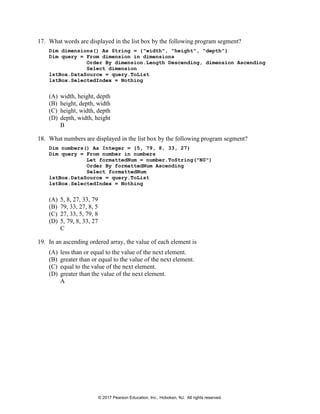
Introduction to Programming Using Visual Basic 10th Edition Schneider Test Bank
Introduction to Programming Using Visual Basic 10th Edition Schneider Test Bank
Introduction to Programming Using Visual Basic 10th Edition Schneider Test Bank
Introduction to Programming Using Visual Basic 10th Edition Schneider Test Bank
Introduction to Programming Using Visual Basic 10th Edition Schneider Test Bank
1.
Download the fullversion and explore a variety of test banks
or solution manuals at https://testbankdeal.com
Introduction to Programming Using Visual Basic
10th Edition Schneider Test Bank
_____ Follow the link below to get your download now _____
https://testbankdeal.com/product/introduction-to-
programming-using-visual-basic-10th-edition-schneider-test-
bank/
Access testbankdeal.com now to download high-quality
test banks or solution manuals
2.
We have selectedsome products that you may be interested in
Click the link to download now or visit testbankdeal.com
for more options!.
Introduction to Programming Using Visual Basic 10th
Edition Schneider Solutions Manual
https://testbankdeal.com/product/introduction-to-programming-using-
visual-basic-10th-edition-schneider-solutions-manual/
Introduction to Programming Using Visual Basic 2012 9th
Edition Schneider Test Bank
https://testbankdeal.com/product/introduction-to-programming-using-
visual-basic-2012-9th-edition-schneider-test-bank/
Introduction to Programming Using Visual Basic 2012 9th
Edition Schneider Solutions Manual
https://testbankdeal.com/product/introduction-to-programming-using-
visual-basic-2012-9th-edition-schneider-solutions-manual/
Organizational Behavior 18th Edition Robbins Solutions
Manual
https://testbankdeal.com/product/organizational-behavior-18th-edition-
robbins-solutions-manual/
3.
Food and Culture7th Edition Sucher Solutions Manual
https://testbankdeal.com/product/food-and-culture-7th-edition-sucher-
solutions-manual/
Principles of Macroeconomics 7th Edition Gregory Mankiw
Solutions Manual
https://testbankdeal.com/product/principles-of-macroeconomics-7th-
edition-gregory-mankiw-solutions-manual/
Financial Accounting A Critical Approach Canadian 4th
Edition Friedlan Test Bank
https://testbankdeal.com/product/financial-accounting-a-critical-
approach-canadian-4th-edition-friedlan-test-bank/
Seeing Young Children A Guide to Observing and Recording
Behavior 6th Edition Bentzen Test Bank
https://testbankdeal.com/product/seeing-young-children-a-guide-to-
observing-and-recording-behavior-6th-edition-bentzen-test-bank/
Matching Supply with Demand An Introduction to Operations
Management 3rd Edition Cachon Solutions Manual
https://testbankdeal.com/product/matching-supply-with-demand-an-
introduction-to-operations-management-3rd-edition-cachon-solutions-
manual/
4.
Bensons Microbiological ApplicationsLaboratory Manual
Complete Version 14th Edition Brown Solutions Manual
https://testbankdeal.com/product/bensons-microbiological-applications-
laboratory-manual-complete-version-14th-edition-brown-solutions-
manual/
offence. He declaredthe abolition of all penal laws, all religious test-
oaths, and even oaths of allegiance on the assumption of civil office.
He extended the same rights to the people of Ireland and Scotland
as to those of England, and enjoined the bishops to announce in
their churches that liberty of conscience was henceforth the law of
the land. Here, 'tis said, he made his first royal blunder. Proclaiming
liberty of conscience from a pulpit is hardly in accordance with that
right of denouncing heresy and schism, which every church, whether
founded on human will or divine right, has asserted from the days of
Abram. But, then, on the other hand, the Church of England, which
had been proclaiming that and every thing else the royal reformers
of the last century chose to dictate, might have announced this
liberal measure of a king, the goodness of whose motives were well
understood. But they denounced the innovation as a license to sin,
though he intended only to have it announced that persecution for
conscience sake had ceased in his dominions. The order was obeyed
by some of the bishops, but by the majority it was stubbornly
resisted. The king prosecuted for contumacy. The judges in some
cases executed the royal mandate and the bishops were imprisoned;
in others they refused, and bishops and judges joined issue in a
passive resistance. Still the king bated not a tittle of the principle laid
down. The establishment of civil and religious liberty for all classes
and denominations had been the great object of his life, and he was
not to be driven from his purpose. He believed that the majority of
the nobles were tired of persecution for conscience sake, and wished
for a restoration of social harmony. He believed that the masses
yearned for it, and he calculated on their loyalty. He believed that
the Restoration was a proof that legitimacy would never again be
assailed, and he took no precautions against conspiracy; nay, he
scouted the warnings of his friends, that one was ripening among
the members of his council, and that even his own children were
spies upon his actions, and plotting his destruction. But an event
soon transpired that removed his incredulity, and awakened him to a
sense of the difficulties and dangers that beset him.
35.
The first rebellionof the Duke of Monmouth and its result have
already been noticed. On its suppression, the chief conspirators,
Shaftesbury and Argyle, fled to the continent. The former died
shortly after, but the latter linked his fortune to that of Monmouth,
plotted on, and gave direction to the ambition of this English
favorite. Repairing to Holland, it is said that they received both
counsel and a promise of aid from the Prince of Orange to attempt
another invasion. After the death of Charles, William detached
himself from this conspiracy, for his own pretensions to the British
throne had become greater than those of Monmouth, and indeed it
is hard to reconcile the conduct of William unless we accept a
charge, which is not without supporters, and which is greatly to that
Prince's discredit:—that of urging the wayward Duke to his
destruction, and thus removing an obstacle to his own ambition.
However that be, William disconnected himself from the conspiracy,
and Monmouth soon after retired to Brussels, where he was joined
by Argyle and continued his preparations for an invasion. Getting
counsel and assistance from his partisans in England and Scotland,
he prepared for a descent at the earliest opportunity; and the
excitement created by the troubles between King James and the
bishops gave him at once both a hope and a pretext. With a fleet of
three ships and one hundred followers, he landed at Lyme, in
Dorsetshire, and in a few days he had a following of above two
thousand men. He proclaimed the king a traitor and a popish
usurper, and called on the country to rise in opposition to his rule. At
Taunton he was presented with a pair of colors and a copy of the
Bible, by twenty young ladies, and assumed the title of king. Here
his army increased to six thousand. At Sedgemoor he attacked the
royal forces under Feversham and Churchill, and was completely
overthrown; and, flying for shelter through the country, he was
taken and finally executed. His evil genius, Argyle, met with a similar
fate; the greatest rigor was exercised against the scattered refugees
of this ill-advised rebellion, and many of the nobles of the land were
attainted of treason.
36.
This event openedthe eyes of the king to the dangers by which he
was surrounded. The army had shown signs of disaffection. Many of
the leaders of the Protestant party in Ireland and Scotland were
known to be connected with this conspiracy; even the members of
his council were more than suspected of complicity; and he saw that
his rule could only be established by the introduction of a Catholic
element into the army. Since the passage of the "Test Act," nearly all
the Catholic officers of the army and navy had been removed. Many
of these were men of distinguished ability, and he now determined
to recall them to the service. Accordingly, in his speech to Parliament
on the 9th of November, 1685, in allusion to the rebellion of
Monmouth, he introduced the proposition in the following words:
"Let no man take exception, that there are some officers in the army
not qualified, according to the late Test, for their employments; the
gentlemen, I must tell you, are most of them well-known to me, and
having formerly served me on several occasions (and always
approved the loyalty of their principles by their practice), I think
them now fit to be employed under me; and will deal plainly with
you, that after having the benefit of their services in such time of
need and danger, I will neither expose them to disgrace, nor myself
to the want of them, if there should be another rebellion to make
them necessary to me. I am afraid some men may be so wicked, to
hope and expect that a difference may happen between you and me
upon this occasion. * * * I will not apprehend that such a misfortune
can befall us as a division, or even a coldness between me and you;
nor that any thing can shake you in your steadiness and loyalty to
me, who, by God's blessing, will ever make you all returns of
kindness and protection, with a resolution to venture even my own
life in the defence of the true interests of this kingdom."
It is scarcely necessary to say that this met the opposition of
Parliament; and so far from being received in the liberal and loyal
spirit which the king seems to have anticipated, it was denounced as
a measure for the abolition of the Protestant religion. The revocation
of the "Edict of Nantes," by Louis XIV., occurring about the same
time, had filled England with Protestant refugees, which gave
37.
strength to thearguments of the opposition, and excited a spirit of
retaliation in the English people. The king, however, persevered, and
tested the legality of the "Test," in the person of Sir Edward Hales,
who had held the commission of colonel in the army, and who had
lately become a Catholic. The judges decided in his favor, but the
king was accused of intimidation. This opened the way to reform in
the army, and gratified the Catholics, but it raised the spirit of
opposition among the bishops and leaders of the High Church party
in a corresponding degree. Not deterred by this opposition, the king
persevered in his measures of redress; and called Dissenters and
Catholics to office wherever opportunity occurred; and, says Hume,
"Not content with this violent and dangerous innovation, he
appointed certain regulators to examine the qualifications of
electors, and directions were given them to exclude all such as
adhered to the test and penal statutes." In all of which one fails to
see, notwithstanding the exaggeration of Hume, any attempt at
injustice, or proscription. It was in fact, from beginning to end, an
effort to establish equality and right on the one part, and to preserve
and perpetuate an odious ascendency on the other. That many of
the steps taken by the king to reach his object may have been
imprudent, and must, from the surrounding circumstances, have met
with bitter opposition, is not to be wondered at; but that his views
were right, and his object wise and magnanimous, cannot be
denied. The exclusion of Nonconformists, from social and legal
equality, in a former reign, produced a civil war, which most
Protestant writers vindicate as necessary, and it is hard to see why
the same writers advocate the permanent exclusion of the Catholics,
who were certainly entitled to equal consideration. Meanwhile the
opposition ran high, and the High Church party being now united by
the death of Monmouth, took council throughout the three
kingdoms, and determined to call in William Henry, Prince of Orange,
as their last hope to preserve their cherished and glorious
ascendency.
The title—Prince of Orange—is derived from the town of Orange
(ancient Awrasio), in the southeast of France, department of
38.
Vaucluse. In themiddle ages this town was the capital of a
principality, which for a considerable period belonged to the house of
Nassau; and William Henry was then the incumbent both of the title
and the domain. After his death the title passed to his heir, the King
of Prussia, and is still retained in the royal family of Holland; but the
principality whence the title is derived, has been since ceded to
France. The father of William, who was Stadtholder of the Dutch
provinces, died in 1650, and the office, which was not inherent, but
elective, remained in abeyance, under the management of the
brothers De Witt, until 1672, when England and France declared war
against Holland. William laid claim to the office of his father, but was
opposed by the De Witts. The emergency pointed out William as the
choice of those opposed to the claims of France, and the De Witts,
still opposing, became the victims of an assassination, said to have
been concocted by William. This placed William at the head both of
civil and military affairs, which, however unscrupulous were the
means of attainment, he conducted with great ability, and saved
Holland from subjugation to the French king. From 1672 to 1677, the
war continued with various success. At the close of that year's
campaign, William visited England by invitation, and Charles, in
order to terminate a war which was unpopular with the majority of
his nobles, acceded to the proposal of his counsellors, to pave the
way for an alliance with Holland, by espousing Mary, the eldest
daughter of James, then Duke of York, to the Stadtholder. This
marriage, which took place shortly after, gave William, who was then
both nephew and son-in-law to James, the right of heir-presumptive;
and, the immediate result of it was a peace between England and
Holland, at Nimeguen, in 1678.
William was a very ill-favored prince, weak of body, ungraceful in
gait and manner, and of a forbidding countenance at once
expressive of cruelty and unscrupulousness. He was not a
statesman, nor yet an able diplomatist, but possessed a keenness of
perception, that enabled him to see through the motives of men, a
reticence of habit, which protected him from importunity, and a will
subservient to the call of ambition. Yet though he was the
39.
acknowledged head ofthe Protestant league, and conformed to the
ceremonies of exterior worship, he was a most confirmed sceptic,
and averse to all religious disquisition. He, however, possessed those
qualities which the enemies of James most desired. He was
ambitious of power, an able soldier, the ostensible champion of
Protestantism, and the irreconcilable enemy of the French monarch.
From the time of his marriage with Mary, he was ambitious of the
English throne, chiefly, 'tis said, that he might check the power of his
detested enemy, Louis, and the connection gave him a valid title,
should the king, his father-in-law, die without legitimate male issue.
The Duke of Monmouth, who was an English favorite, being
removed, and the Duke of Berwick, the natural son of James, and
nephew of Lord Churchill, afterwards Duke of Marlborough,
cherishing no such pretensions, William's fears were quieted, and it
is even said that he received the first advances of the High Church
party with indifference. But rumors of the queen's pregnancy excited
the fears of William; he became apprehensive, listened to their
appeals, a conspiracy was set on foot through the agency of Bishop
Burnet, Sydney, Peyton, and Gwynne, and he began to organize a
military force for the invasion of England. The materials were ready
to his hand. "The Thirty Years' War" had overspread Europe with
adventurers from every nation, and he soon gathered to his
standard an army of the most daring spirits of the age, consisting of
Dutch, Danes, Swedes, Huguenots, and Germans, always ready and
eager for any enterprise that offered fame or fortune to their arms.
On the 10th of June, 1688, while these preparations were carried
stealthily forward, the Queen of England gave birth to a son. This
event removed all hesitation on the part of the Prince of Orange,
and precipitated "the Revolution." From this time forward
negotiations between the Prince and the English conspirators were
pressed with earnestness and vigor; every concession demanded by
the Prince was yielded without question by the agents of the Church
party, and he bound himself to the invasion and the maintenance of
Protestant supremacy. Still the utmost secrecy was observed on both
sides, and the Earl of Sunderland, who was in the king's confidence,
40.
and at thesame time in league with William, kept the one impressed
with a sense of security, and apprised the other of all that transpired
in the national councils.
An incident which occurred at this time may serve to show the
animus of party spirit, and illustrate the intriguing and unscrupulous
character of William. It had been prearranged between the Prince
and his English partisans, that in case the queen gave birth to a son
it should be declared suppositious. Accordingly, William prepared an
instrument to that effect, to be published on his arrival in England;
and yet, with characteristic duplicity, he dispatched Zuylestein,
ostensibly to congratulate the king on the birth of his son,—the
Prince of Wales,—but covertly to complete arrangements with the
heads of the conspiracy in England.3 By such artifices the king was
kept in complete ignorance of the storm gathering around him, until
the summer had nearly passed, when Talbot, Earl of Tyrconnell,—
then deputy for Ireland,—received information from the captain of a
Dutch trading vessel, of the extensive preparations going on in
Holland, and of the designs of the Prince of Orange on the English
throne.4
Tyrconnell lost no time in communicating this intelligence to
the king; and a letter which he received shortly after from his
minister at the Hague, informing him that a powerful invasion must
be soon expected, followed by private information from the French
king to the same effect, at last opened his eyes to his real situation.
M. Bonrepos, the envoy of Louis, who brought this intelligence,
accompanied it with the offer of 30,000 French troops, to suppress
the invasion before it could make head; but as the evil counsel of
Sunderland still prevailed, on the ground that such an armament
from France would excite the indignation of his English soldiers, and
precipitate the catastrophe which he wished to avoid, the generous
offer of Louis was declined. James continued in a state of the
greatest bewilderment. All the boldness and decision of his earlier
years seemed to have deserted him; and at a time when only men
of approved loyalty should be trusted, he recalled to his service the
contumacious officials of the late reign, and so paved the way for
the success of the impending Revolution.
41.
Preliminaries being arrangedbetween William and his English
adherents, by the beginning of October, 1688, he collected his forces
at Holvoetsluys, a port in the south of Holland, lying over against the
eastern coast of England, and, under the advice of Bishop Burnet,
put to sea toward the end of the same month. His armament
consisted of fifty ships of war, twenty frigates, four hundred
transports, and some smaller craft, carrying 14,000 men, with arms
and equipments for 20,000 more. The van and rear of this fleet were
commanded by Admiral Herbert and Vice-Admiral Evertzen,
respectively, having the Prince of Orange and his military adherents
in the centre. All the ships carried the English flag, having the arms
of the Prince emblazoned at the top, with the words:
"RELIGION AND LIBERTY,"
and at the bottom with the device of the house of Nassau,
"I WILL MAINTAIN."
In his train were many English, Irish, and Scotch refugees, and three
hundred Huguenot officers, the principal of whom were Marshal
Schomberg; his son, Count Schomberg; Caillemotte and his brother
Ruvigny; Mellioneire, Cambon, Tettau, and others of approved valor
and of great military experience.
During the voyage a storm arose, the whole fleet was scattered,
some of the ships foundered at sea, and the rest had to put back for
several days. William, however, continued his course, and arrived
safe at Torbay, in the county of Devon, on the 5th of November,
1688, with about 700 followers. It being the anniversary of the
Gunpowder Plot, he availed himself of the circumstance, and
appealing to the passions and prejudices of the people, stated the
object of his invasion to be the protection of the Protestant religion
from the machinations of "Popery." But this not having the desired
effect, he felt somewhat disconcerted, and after spending a few
days in the exercise of his marines and being joined by the
remainder of his forces, he made the necessary disposition and took
up his march for Exeter. Here, finding that the country gentlemen
42.
and clergy ofthe Established Church fled at his approach, and that
none of the leading conspirators came to meet him, he began to
think that he had been deceived by false promises; and with a
presence of mind that rarely deserted him, he at once had recourse
to intimidation. Accusing them of their twofold treachery, he
apprised them of his intention of furnishing the king with a list of
their names, and of then returning to Holland and abandoning them
to their fate. This soon aroused them to a sense of their position.
Lords Colchester and Godfrey fled from London in the night and
joined his standard; others came in after these, and with a force
continually increasing as he went, he continued his march towards
London.
Upon receiving information of William's descent upon the English
coast, King James mustered an army of 30,000 men, and marched
towards Salisbury to oppose him. On the way, Lord Cornbury, under
pretence of attacking an outpost of the enemy, took his own
regiment and three others and abandoned the royal cause: further
on, the Duke of Grafton, Colonel Barclay, and Lord Churchill,
Lieutenant-General of the Guards, openly deserted. Seeing the
defection continue, the king retired to Andover, whence Prince
George of Denmark, the young Duke of Ormond, and other
distinguished personages, fled in the night, and joined the standard
of the invader. Overwhelmed with shame and confusion he returned
to London, but here he found that his daughter, Anne, under
pretence of fearing his anger on account of her husband's defection,
had left the palace and taken refuge with his enemies. He had
always been a most affectionate and indulgent father. The
ingratitude of his elder daughter, though it pressed heavily on his
heart, was borne with becoming fortitude, but that of the younger,
not having the same extenuating causes, outraged all the dearest
sensibilities of the father; his spirit was broken, and, weeping in his
bereavement, he exclaimed: "God help me, my own children have
forsaken me!" His queen and infant son demanding his first
attention, he committed them to the care of the Count de Lausun,
by whom they were conveyed in safety to France, and dispatching
43.
Lord Feversham witha letter of remonstrance to William, he
determined to remain in London himself, and bide the issue of
events. But contrary to honorable usage, Feversham was
imprisoned, the palace was surrounded by Dutch guards, in the
night, and the king was notified that he should quit London by 12
o'clock next day. Accordingly, he was sent under arrest to Rochester,
whence he escaped to Picardy, and arrived at St. Germains on the
25th of December, deserted by all his family but the Duke of
Berwick, and the Grand Prior Fitzjames.
The departure of the king was a signal for the uprising of the
London mob; the Catholic inhabitants were forced to seek refuge in
flight; their property was marked out for destruction; the houses of
the Spanish and Florentine envoys were rifled, and William entered
the city by the blaze of the few religious houses which had been
erected during the short reign of the expatriate king. He lost no time
in arranging his terms of settlement with his new subjects and in
opening negotiations with the leaders of the Church party in Ireland
and Scotland. On the 12th of February, the Princess Mary joined him
in England, and they were proclaimed king and queen; the Prince of
Wales was debarred the right of succession, William was invested in
the administration, and his children by Mary—should he be blessed
with any—were to be endowed with the right of succession.
44.
CHAPTER III.
EVENTS PRECEDINGHOSTILITIES
IN IRELAND.—THE PREPARATORY
MEASURES OF TYRCONNELL.
Leaving William of Orange in undisputed possession of the English
throne, and King James a suppliant at the French court for the
support which he had so unwisely declined previous to the invasion,
it is necessary to reconsider the condition of Ireland before
presenting her part in this great politico-religious drama.
Of the three generations which had passed, antecedent to the
events under consideration, each had witnessed a war more
protracted and devastating than any which marked her history since
the invasion. These were the wars of Desmond and Tyrone, and the
war of the Irish Confederates of 1641; each of which was followed
by a wholesale confiscation and plantation of the country with a
population antagonistic to every interest of the native race. Through
these violent changes four-fifths of the ancient chieftainries had
changed proprietors, and those which were undisturbed by each
successive military convulsion, the court of claims and the acts of
attainder and settlement that continued down to the death of
Charles II., had well-nigh sequestrated. The surface of the country is
computed at ten millions and a half of acres; and of these, says
Newenham, "Upon the final execution of the acts of settlement and
explanation, it appears that 7,800,000 acres were set out by the
court of claims, principally if not wholly, in the exclusion of the old
Irish proprietors." It is scarce necessary to remark that if the above
45.
estimate of theisland—which is taken from Dr. Petty's survey—
includes the waste and water, the arable land had passed to the
undertakers, and the waste and water were the portion of the old
Irish proprietors.
The loss of liberty, too, had outstripped the loss of lands, for liberty
and law had first to be silenced that these wholesale robberies might
go unquestioned. Education had been proscribed, and ignorance had
increased exceedingly. True, those of the "better sort" might have
received an education at the hands of the Establishment, by
forswearing their religious convictions and pandering to the spirit of
the times, but the Catholic schools and colleges of the land had been
suppressed; expatriation was the consequence of all attempts at the
education of youth in the religious principles of their fathers, and
death the penalty of return after banishment. Nearly all those who
still retained any vestige of their patrimonial estates, had purchased
them at the sacrifice of their religious convictions, and those who
haply retained both, had done so through the friendly interference of
some powerful minions of the English court, who were few and far
between. There were still a few other exceptions to this general rule,
which deserve a casual notice. The descendants of the early settlers
of the Pale, though still adhering to the Catholic faith, had been held
by the English Government as a distinct element from the native
race. On questions pertaining to the English tenure of the island they
had antagonistic interests. Through each successive convulsion they
had been treated with greater leniency, and had received much
more consideration on the adjustment and final settlement. Their
condition was, therefore, less intolerable than that of the native
chiefs; they had privileges without rights, while the latter had neither
rights nor privileges. But then there was a counterbalancing
influence; the native gentry had local popularity; while the Palesmen
had Government consideration;—both felt their religious grievances
in common, and between them there was a mutual forbearance, and
an exchange of kindly offices.
Such was the condition of the descendants of the Normans, and of
the fast waning septs of the ancient race; but, the people!—they had
46.
no consideration, nationalnor local; no protection but their poverty
and their native tongue: no right but that of animal existence, and
that only on sufferance! Yet, through all, they had retained the
noblest characteristics of manhood; tenacious memory, stubborn
will, unselfish love of country, unshaken fidelity to their faith; and
who could doubt that they would now—true to their instincts—be
the last refuge of a just king in adversity.
When James ascended the throne, on the 16th of February, 1685,
the Earl of Ormond was deputy for Ireland. He had taken a leading
part in the most exciting scenes of the last fifty years. Gifted with
the highest graces of mind and person, he had figured, in early life,
as one of the most important personages of the English court, and
had won the highest favors of Charles I., and his queen, Henrietta.
His powers of diplomacy and statesmanship were kept in continual
exercise during the latter years of that reign; but though gifted with
talents to excel in each, in each he was signally unsuccessful; and all
the evils that befell that king and eventuated in the extinction of his
house, may be fairly traced to the one leading passion of Ormond,—
an implacable hatred of the Irish Catholics. It would seem as if all
the enmity of all the reformers, from Elizabeth to Cromwell, had in
him found an exponent, and in directing his deadly malice against
them, he was over-successful: he accomplished their ruin, but
virtually consigned his patron and sovereign to the scaffold.
His after life was ignoble and inglorious. He became prodigal of
honor, tenacious of power, and served as trimmer and timeserver in
turn, to Royalists and Parliamentarians alike. But whether in the
service of his king or in complicity with his enemies, he held his
political principles subservient to his worldly interest, and was
consistent only in one passion, his religious intolerance. The
character of this statesman had become odious to James long before
his accession to the throne; and believing that no wholesome
measures of redress could be introduced into Ireland, while one so
notorious for his duplicity and hatred of its people remained at the
head of affairs, he lost no time in recalling him. He then deputed the
government to two Lords-Justices: Boyle, the Protestant primate,
47.
and Forbes, Earlof Granard, each of whom had attained a high
degree of popularity with the people of all religious denominations.
He had reason to believe that these appointments would be received
in the spirit which dictated them, and prove a measure of general
satisfaction. Upon the Catholic population it had the desired effect;
but with the High Church party and the Nonconformists it was quite
different. The hatred and jealousy that existed between them was
only secondary to their mutual hatred of the Catholics, and these
appointments kindled anew the ire of each party against the other.
The Puritans were dissatisfied with Boyle, alleging that his
Protestantism savored of "Popery;" and the Churchmen averred that
Granard was a favorer of the sectaries, and an enemy to the
"Establishment."
In order to harmonize all interests and carry out his measures of
redress, James sent over the Earl of Clarendon as deputy, and with
him Colonel Richard Talbot, an Irishman and a Catholic, as
Lieutenant-General of the militia. But whether it was that Clarendon
was opposed to the policy of the king, or that he felt unable to give
effect to his measures of redress in a country so divided in
sentiment, he retired shortly after, and Talbot was created Earl of
Tyrconnell and appointed deputy in his stead. In Tyrconnell were
then united the civil and military power, and of all the king's subjects
who at that time accorded with his religious and political views,
there could scarcely be chosen one better adapted to give practical
effect to the reforms which he had extended to Ireland.
Richard Talbot, Earl, and afterwards Duke of Tyrconnell, is one of the
noblest characters in Irish history. He was a loyal subject of the king,
whom he served with characteristic loyalty, and though of Norman
descent, he was as national in heart as the most devoted of the
native race. Of noble presence,5 courtly manners, untarnished honor,
unshrinking courage, indomitable will, and fervid patriotism, he was
old enough to remember the Revolution of 1641, had been a
sympathetic observer of the sufferings that succeeded, and all the
energies of his mind, from his first introduction to royal favor to the
end of his career, were directed to effect the civil and religious liberty
48.
of his country.Had James been a timeserving king, from Tyrconnell
he would have received no adulation; as he was sincere and
steadfast in his pledges to the Catholics, Tyrconnell was his devoted
servant. As deputy and commander-in-chief, his powers for good
were more than ordinary, and he stretched them to the utmost
tension that justice permitted. His task was delicate and dangerous;
but he discarded the delicacy and braved the danger, as though he
alone felt the awakened energy of a whole people. Imprudent they
term him; but looking through his chequered life, and reviewing the
scenes he had witnessed in youth, we cannot acquiesce in the
decision. The circumstances by which he was surrounded brooked
no delay, and what is termed imprudence by our recent annalists,
would, if viewed in the light of his time, appear the wisest
statesmanship; and it must be generally conceded, that if the king
was as bold and intrepid as Tyrconnell, the usurpation of William
would have been as abortive as that of Monmouth.
I have turned aside from the course of direct narrative to dedicate a
page to the memory of this much-maligned statesman. It is deemed
a duty obligatory, because there is a tendency, even among Irish
nationalists, to offer him as a sacrifice on the altar of conciliation.
Truth may be unpalatable, but it is always wholesome, and without
due reverence for it, there will be no incentive to do and suffer for
noble ends. The religious martyr finds his reward above, but the
patriot's reward is the blessing of posterity, and history should never
divert a people's heart from those who labored for their good, albeit
their efforts were unsuccessful. Richard Talbot, Duke of Tyrconnell, is
a name to be on the tongue of every Irish child, and his deeds a
memory in the heart of every Irish patriot. He survived the battle of
Aughrim, at which he was present, but a short time; and he should
have died there, and gone to rest on that mournfully historic field,
where rest some of the best and bravest that Ireland ever nurtured
on her bosom. His character would then be complete. He labored for
them through life; they were worthy of his companionship in death.
Of the parliament which he assembled in Dublin, after the removal
of religious disabilities, the majority in the lower house were of the
49.
Catholic faith, andas the measures which were introduced during
that session afford ample testimony that they were keenly alive to
the higher duties of legislation, a brief outline of them is here
submitted in the order of their political importance:
First.—An act removing all political disabilities from the natives of
Ireland.
Second.—An act against removing writs of error from the Irish to the
English courts.
Third.—An act of indemnity to Catholics who had been declared
innocent by the Court of Claims.
Fourth.—An act to encourage strangers to settle and plant in the
kingdom of Ireland.
Fifth.—An act investing in his majesty the goods of absentees.
Sixth.—An act for the advancement and improvement of trade, and
the encouragement of ship-building.
Seventh.—An act declaring that the Parliament of England cannot
bind Ireland.
The last was a virtual repeal of "Poyning's Law," an act passed
during the reign of Henry VII. in a parliament convoked at Drogheda
by Sir Edward Poyning, in 1494, and which provided "that no
parliament could be held in Ireland until the chief governor and
council had first certified to the king under the great seal of the
land, as well the causes and considerations, as the acts designed to
pass, and until the same should be approved by the king and council
of England."
All these acts were known to be so just and salutary, that it was
hoped they would at once meet the unanimous approval of the
English king and his council. But they were all, or nearly all,
negatived by the council; and the king himself, though he gave his
assent to all the others, rejected that repealing the law of Poyning.
It had met with great opposition in the upper house of the Irish
Parliament, for though it was a law which placed Ireland under the
50.
complete legislative controlof England, there was in the "higher
estate" then, as to-day, a spirit of subserviency to the English
interest, and the king was as jealous of his royal prerogatives as any
of his predecessors. But this act was afterwards repealed, when
nearly one hundred years more of bitter experience had proved its
ruinous effect on the country, and eighteen years of unparalleled
prosperity was the consequence. This subject is, however, out of the
course of our narrative, and is only referred to as showing that the
repeal of Poyning's law did not originate with Grattan or the
volunteers of 1782, but had been the principal object of the
statesmen of ante-Jacobite times, as the repeal of the Union has
been in our own days.
No body of legislators ever understood the wants of a country better
than that parliament did the necessities of Ireland. And well might
they understand them, for their impoverished country and broken
fortunes bore striking and melancholy evidence of the evil effects of
foreign legislation aided by a subsidized native oligarchy inimical to
every interest but their own. For three generations the people had
known no respite from robbery and proscription. Over two hundred
thousand of them had passed into exile, or had been consigned to
penal servitude in the colonies within the last fifty years. Then, as
to-day, the population, though small, was deemed "surplus," while
outlawry and banishment suppressed all manifestations of a national
spirit. The chiefs were detached from their clans, and the clans, in
losing their former protectors, had found but deadly enemies in their
new taskmasters. The old feudal system was nearly extinct, even in
the districts least visited by English adventure, and this Parliament
had realized the stern necessity of reconstructing a nation out of the
elements at its disposal. The troubles that surrounded the king gave
it a temporary power, which it wielded for the removal of grievances
becoming chronic in the land, but "no act of a proscriptive or
retaliatory character stains the parliamentary records of that
period."6
Measures of redress now followed in quick succession. Political and
religious disabilities were removed from all denominations, without
51.
distinction; and thepeople were not slow in availing themselves of
their long-lost privileges. Catholic churches were once more opened
to the service of God, and local schools began to appear throughout
the country. Catholic judges, mayors, and sheriffs took their places
wherever opportunity offered, and the people felt a gratification
corresponding to their altered condition. But, throughout all, they
acted with a forbearance and dignity worthy of a people long tried in
adversity; they expressed no exultation at their sudden
emancipation, and no spirit of retaliation was manifested that might
give alarm to their Protestant countrymen.
The Protestant officials of that day, who held the liberty of the
country, as it were, in lien, threw many obstructions in the way of
these reforms. Among the foremost of these were Topham and
Coghill, masters-in-chancery, and the Chancellor himself, and they
were removed for open contumacy, and on what then appeared
"good and sufficient reasons,"—throwing the legal technicalities of
an odious system in the way of a people's emancipation from the
penal servitude of ages.
Early in 1686, Tyrconnell issued a proclamation in accordance with
that of the king, that all classes of his majesty's subjects were
allowed to serve in the army, accompanied by an order that the
arms which had hitherto been given out should be returned to the
king's stores, preparatory to a reorganization of the militia. The
militia of the country, which at that time must have numbered about
20,000, were exclusively Protestant, and were officered by men of
the most proscriptive tendencies, and apart from those regularly
enrolled, the whole Protestant population were under arms, subject
to the call of local leaders at a moment's notice. Being, almost to a
man, opposed to the measures of Catholic redress then being
instituted by the king, would appear sufficient motive for this action
on the part of the deputy. For the last generation they had been the
rigorous executors of the acts of attainder and settlement; the
memories they awakened could scarcely be conducive to good order
or a feeling of public security: not being national, they were
regarded with distrust, and were held as unsafe guardians of the
52.
liberty which theyopenly denounced. Many of their leaders were
known to be implicated in Monmouth's rebellion, and as a
precautionary measure, it became necessary to infuse a spirit of
loyalty among them by the introduction of a Catholic element. To
accomplish this seems to have been the great trouble of the deputy.
Men there were, to any number, ready at his call, but arms were
wanting, and the revenue of the country was scarce sufficient to
defray the expenses of the civil government. There was, therefore,
no other resource but to call in the arms for a redistribution, and to
organize a body of native troops from whom exclusion would be
excluded. This measure created great alarm, among a party who
had been so long dominant; and, if in its accomplishment, any
denomination were excluded who felt a liberal sentiment towards the
great body of the people, there would have been cause for just
apprehension, but such does not appear on the record of the period.
All test oaths were abolished according to the proclamation of the
king, and all denominations, without distinction, were invited to join
the new organization. The Catholic people responded with
promptitude and alacrity, and an army of about 8,000 men, was
soon enrolled from the old royalist corps scattered through the
country; a few regiments more sprang up from the remnants of the
native clans, and with these the deputy felt able to execute the laws,
and garrison a few of the most important military stations in the
kingdom.
On the other hand, the Protestant militia, feeling jealous that men so
long outside the pale of all law, should at once be endowed with the
high privilege of freemen, shunned the organizations, and many of
their prominent officers, retiring to Holland, took service under the
Prince of Orange, then conspiring for the overthrow of their rightful
sovereign.
In this age and clime, such intolerance may seem greatly
exaggerated, if not altogether incredible. But stepping down through
the successive changes of ninety years, we find that the Volunteers
of 1782, with the light of the American Revolution before them, were
quite as exclusive. Up to the day when, on Essex-Bridge, the
53.
regiment of LordAltamont held its way through the ranks of his
Britannic majesty,7 and a revolution appeared imminent, the
proposition to allow Catholics to bear arms in the native militia, even
as private soldiers, had been scouted with contempt. The provisions
of Catholic Emancipation are not yet accepted there, for we have
seen the "Test Act" revived as late as 1864, in Dublin, to the
exclusion of a Catholic alderman. Before such evidences, doubt
vanishes, and we are able to appreciate the position of Tyrconnell,
and the necessity for intrepid action in the premises. No man had a
greater share of praise and censure from contemporary historians
than he, and he is still a subject of each as the minds of men incline
to either side in the issues that then distracted the country. His
precipitancy in removing the restraints on religion, and in giving too
active an impulse to the popular will, has come in for its share of
condemnation. He is also criticized for a too pompous display of his
dual power, as Viceroy and Commander-in-Chief: but we should
remember that they who censure his hasty measures of redress, are
those who persistently oppose all redress; that his manner of life as
Viceroy was simple and unostentatious as compared with that of his
successors in office, and that his dual power was conferred on him,
when the king's brother-in-law, Clarendon, had deserted him, and
there was no other man capable and at the same time willing to
assume that critical position.
Tyrconnell, however, was not a man to be diverted from his purpose
by either threat or criticism, and so he pursued his course
unshrinking. His country demanded redress and he hearkened to her
call. The emancipation of his co-religionists was necessary, and he
endeavored to effect it: but in doing so he infringed no civil or
religious right of others: none were denied equality before the law,
and none were removed from office except for open contumacy or
covert treason. No doubt he had to brave obloquy and opposition;
but who could serve that country and that king at that particular
crisis, and escape the shafts of malignity?
In the summer of 1688, when the conspiracy of the Prince of Orange
became known to Tyrconnell, in the manner already indicated, he
54.
lost no timein communicating his intelligence to the king. It was
received with incredulity, for the evil counsel of Earl Sunderland still
held sway over every other representation. How could he believe
that his affectionate son-in-law, who had made him a prompt tender
of military assistance to suppress the rebellion of Monmouth, could
have been prompted by any but the most honorable and filial
motives? Had he not offered to lead his forces in person, and to
protect the capital and the inmates of the royal palace?
But the urgency of the occasion emboldened Tyrconnell, and he at
last succeeded in arousing the king's suspicions. He urged the
necessity of an immediate alliance with France, and though in this
he was not able to move the fixed impression left by the wily
secretary, he prevailed so far on the king as to accept the greater
part of the forces he had raised for the protection of Ireland; and so
they were immediately sent over and placed at the royal service.
Tyrconnell then formed the bold design, without the knowledge of
the king, of placing Ireland under the protection of France. The
proposition was well received by Louis, but events culminated with
such rapidity during the autumn of 1688, that no time was left for
diplomacy, for it required the undivided attention of Tyrconnell to
repress the spirit of disaffection throughout Ulster as the winter
approached. The leaders of the Protestant party in Ireland were alive
to all that was taking place, and premonitory symptoms of open
revolt were apparent to all. In Ulster, Lord Blaney, Rawdon,
Skeffington, Keames, Kelso, and Walker, who had kept a close
correspondence with the Prince of Orange since the death of
Monmouth, sounded the alarm, and called their followers to arms.
Every action or word of the deputy was seized on to excite the
passions and fears of their people, and every counter-effort on his
part to allay the growing excitement was futile. The time was
propitious, and they seized on every event to magnify their danger.
The alarm became wide-spread, and the old hatred that so often left
the country a prey to foreign adventure was revived in all its
bitterness. Fanaticism overruled common sense, and the people
were divided.
55.
A report wasindustriously circulated that a massacre of the entire
Protestant population of the country was arranged for the 9th of
December, with a minuteness of detail that convinced the most
incredulous. This was about the date that was to usher in the Prince
of Orange. The conspirators knew it, but the people were ignorant.
The utmost consternation prevailed; the Protestant people in
considerable numbers abandoned their homes, flocked to the sea-
shore, and stowing themselves away in the hold of every available
craft that presented, passed over to England, while the boldest of
them fled to the North to join the standard of William's adherents.
Those who reached England awakened the liveliest sympathy for the
condition of their Irish brethren, and the most bitter indignation
against "the murdering Irish." The arrival of William at Whitehall was
the signal for a general onslaught on the English Catholics, and the
Irish residents there had to take refuge in immediate flight. The
regiments imprudently sent there at the suggestion of Tyrconnell,
being placed in small detachments throughout the country, were
forced into the usurper's service, or, trying to make their way home,
were set upon in detail, and slaughtered mercilessly in the streets
and by-ways wherever they passed. Some few fought or forced their
way to the seaboard, and through the kindly offices of the English
Jacobites, made their way back in the most wretched condition.8
The news of William's arrival soon spread throughout Ireland and
Scotland. In the former country this event had been anticipated: the
people had already arrayed themselves into two parties known
through succeeding times as Williamites and Jacobites. In the latter
a convention was called, and after much angry opposition, the
covenanters declared that James's flight was a virtual abdication,
and that he had consequently "forefaulted" his right to the throne
and the allegiance of his subjects of Scotland, which they tendered
to William. A respectable portion, however, headed by the
Archbishop of Glasgow, the Duke of Gordon, the Earl of Balcarras,
and Graham of Claverhouse (Viscount Dundee) supported the
Jacobite cause and took up arms in defence of their lawful king.
56.
On the 7thof December the gates of Derry were closed against the
Earl of Antrim's regiment of Highlanders sent thither by Tyrconnell
on the invitation of its governor, and the call to arms was sounded
through all the province of Ulster. Blaney, Walker, Keames, Kelso,
Skeffington, and Rawdon called a convention, and assuming their
right to dispose of the country, tendered its allegiance to William.
They then entered into a league "for the maintenance of the
Protestant religion and the dependency of Ireland upon England,"
and placed themselves at the head of the military organizations
formed throughout the province: and Enniskillen, Culmore, Sligo,
Coleraine—nearly all the important posts from Down to Donegal, and
from Cavan to Antrim—were seized on and garrisoned in the name
of the Prince of Orange.
It is scarcely necessary to say, that the 9th of December came and
passed without any manifestation of that murderous design
attributed to the Catholics. The conspiracy was on the other side,
and manifested itself in the following manner. Major Poor, who had
served in a dragoon regiment under Cromwell, had got the
command of two companies of cavalry, from "The League." With this
force he commenced a series of raids on the inhabitants of Louth,
and levied a tax of £500 on the tenantry of Lord Bellew. Hearing of
this, Bellew sent his son, a youth of eighteen, with a company of
dragoons, to assist the farmers in resisting the tax. These troops
met and fought for some time with the most determined bravery,
until Bellew, closing with the Major, killed him with a blow of his
pistol on the head, when the troops of the Major took flight, leaving
their dead and wounded behind them. This was the first act of open
hostility: it aroused the Catholic people to the necessity of defensive
measures, and quickened that martial spirit, never extinguished;
their hearts responded to the war-note of the times; but what could
the spirit do, but chafe at delay? Their country was impoverished,
and they had neither arms nor organization.
57.
CHAPTER IV.
FROM THECOMMENCEMENT OF
HOSTILITIES TO THE LANDING OF
KING JAMES IN IRELAND.
Tyrconnell, seeing that a civil war could no longer be averted in
Ireland, bitterly regretted the loss of those troops that he had sent
to England. A few well-equipped regiments: those of Mountcashel,
Clancarty, Lord Antrim, Lord Bellew, and his own, about three
thousand,—were all that remained in the country. Men by thousands
daily presented themselves for enrollment, but they were destitute
of every thing that constitutes the soldier, "excepting courage and
good will," and he had neither money nor arms to equip them. The
Williamite organization grew more powerful and extended, day by
day. Along with the province of Ulster, it soon embraced the counties
of Longford, Meath, and Dublin; its leaders, in the mean time,
feigning to treat with Tyrconnell, while privately soliciting arms and
succors from the Prince of Orange. Tyrconnell at last determined to
make a final appeal to the country, and for this purpose issued
colonels' commissions to the heads of the old Catholic houses and
the loyal Palesmen of Leinster. The effect was electric. With a
common impulse they rushed to his standard, and threw the wrecks
of their former fortunes in the balance. In a short time, the
regiments of McMahon, O'Reilley, MacDonnell, Maguinness, Maguire,
O'Donnell, Nugent, Loutrell, Fitzgerald, Felix O'Neil, Gordon O'Neil,
Cormac O'Neil, Bryan O'Neil, Sir Neale O'Neil, Clare, Galway,
58.
O'Moore, O'Dempsey, andothers were in the field, to the number of
20,000, nearly all recruited from their respective households.
But the people having been long deprived of the right to bear arms,
were necessarily unprovided with them, and the state to which the
country had been reduced by the misgovernment and oppression of
the last forty years, rendered them unable to provide any other than
the rudest weapons, hastily improvised. They had, therefore, to be
armed and provisioned at the individual expense of their leaders,
and it was found impossible to equip and sustain the multitudes that
presented themselves for service. The murmurs of the people were
loud and deep, but there was no remedy. The organizations of the
Council, all well armed, and supplied with the necessaries of war,
were wide-spread throughout the country, and were levying, in the
name of the Prince of Orange, on the Catholic people of Ulster, and
even the eastern and southern provinces had to yield to their
exactions. Notwithstanding all this, thousands had to be dismissed to
their unprotected homes, with promises that a little time would
remove those difficulties. It was represented, as it was indeed
believed by all, that an immense armament was fitting out in France,
to accompany the king, who was daily expected to arrive; that his
presence would rectify every thing, and afford them the means and
opportunity of giving active proof of their patriotism; and with these
promises, though chafing at delay, they retired to watch the current
of events, and bide the arrival of their king. The new regiments were
reduced to a limited standard of about 250 each, so that 12,000
men, including those already enrolled, were rendered fit for service,
and with this force Tyrconnell opened the campaign of 1689.
Carrickfergus and Charlemont in the north, and all the forts on the
Shannon, from Lough Allen to the estuary, were still in the
possession of the Irish, and each had to be reinforced and put in a
better state of defence: the town of Kilkenny, and the cities of Cork
and Waterford, had each to receive its quota of troops; Dundalk, an
important seaport, had to be secured against the excursions of the
insurgents of Monaghan and Armagh; and the metropolis could not
dispense with the few veteran regiments that had been stationed
59.
there since theinauguration of the deputy. After the distribution of
his forces among these posts, Tyrconnell found at his disposal a
small army of 6,000 men available for the field, and, dividing it into
three corps, he gave the command of one to Lieutenant-General
Justin McCarthy, to operate in Munster, where Inchiquin had raised
the standard of revolt; one to Lieutenant-General Richard Hamilton,
for the reduction of the rebel garrisons from Dundalk to Derry; and
another, a co-operative force of about 1,000 men, was placed under
Lord Galmoy, to give countenance to the outlying posts around
Cavan and Enniskillen.—The limits prescribed these pages preclude a
detailed account of these expeditions, although each presents some
of the most striking and agreeable events of that period. McCarthy,
at the head of 2,000 regulars and a few hundred followers, reduced,
in a few days, the rebels of Castle-Martyr and Bandon, and turning
his attention to Inchiquin, who was plundering and laying waste the
country, from the Shannon to the Blackwater, he drove him back on
his stronghold in Clare, and marched uncontrolled from the Fergus
to the Barrow. The Williamites of Munster, surprised by these events
and the rapidity of their execution, laid down their arms, returned to
their homes, and all apprehension of future trouble in that quarter
was at an end:—for this important service McCarthy henceforth
received the title of "Pacificator of Munster."
When the rumor of William's conspiracy first became known to the
Earl of Tyrconnell in the preceding year, he sent General Hamilton,
as already indicated, with about four thousand men, for the service
of James in England. After the invasion of William this force was
either slain, dispersed, or forced into his service, and their general,
contrary to the usages of war, and to the terms accorded to the
other adherents of the king, was detained a prisoner. Being an Irish
gentleman by birth, of great family influence, and one of the best
cavalry officers of his time, William saw in him one who, if weaned
from his allegiance to the king, would be a powerful agent of
success to his designs on Ireland, and accordingly, 'tis said, made
overtures to that effect. History, however, is not clear as to the
nature of these proposals, nor of the manner in which they were
60.
met by Hamilton.This much at least is known, that he was released
from captivity, was sent with proposals of an accommodation to
Tyrconnell, but on arriving in Ireland he urged the most determined
opposition to William, and was appointed to lead the expedition
against the rebellion in Ulster.
Leaving Drogheda on the 8th of March, with a force of about two
thousand men, he marched through Dundalk and Newry, and on the
13th took up a position between Loughbrickland and the river Bann,
and sent out Colonel Butler to take a reconnoissance of the enemy,
said to be in force between him and the Laggan. The service was
one of extreme peril, and required the utmost courage and address:
—he was in the midst of a mountainous country, surrounded by a
wary foe, and the slightest misconduct on his part, was sure to
result in the capture or destruction of the main body.
The task was, however, performed to the satisfaction of the general:
the enemy were found strongly intrenched at Dromore-Iveagh, on
the north side of the Laggan, to the number of 8,000 men, under
the command of Hugh Montgomery, Lord Mount Alexander. It was
soon decided to attack them; so breaking camp with the dawn, on
the morning of the 14th, Hamilton crossed the Bann and advanced
boldly on their position. The cavalry regiment of Montgomery
advanced to meet him, but after the first charge of Hamilton's
dragoons they fell back in confusion on the main body, and his
infantry having also crossed the river, a general attack was ordered.
The enemy, however, did not wait the assault, for Montgomery
himself running away, his men followed the example, and a
complete rout succeeded. The Irish remained masters of the
encampment. Montgomery continued his flight to Hillsborough, into
which he threw a few companies, and ordering the bulk of his forces
to Coleraine, embarked at Donaghadee, and sailed for England. This
was the first time the forces of "The Council" met the Irish in the
field. They had been organizing and levying on the country for
months; they were well armed; had an intrenched position of their
own selection, behind a deep and rapid river, and the result was the
61.
loss of theircamp equipage, four hundred slain, and that disgraceful
flight known in the history of the period as "The Break of Dromore."
After stopping here for a day to rest his men and secure the
advantages of his victory, Hamilton pushed on to Hillsborough, the
headquarters of the Council, while Sir Arthur Rawdon advanced
rapidly from Lisburn to its relief, at the head of 4,000 men. Rawdon,
however, only arrived in the vicinity to find the place in the
possession of Hamilton, and to see its paroled garrison making their
way home across the country. On learning that Rawdon was in the
neighborhood, the Irish troops advanced to meet him, but he,
ordering his men to make the best of their way towards Coleraine,
abandoned them to their fate, and, like Mount Alexander, embarked
for England.
The capture of Hillsborough was of great service to the Irish cause.
It had been the headquarters of the "Council" since its formation,
and was the repository of its papers, plans, and secret
correspondence with William; but, above all, it contained immense
stores of provisions, wrung from the inhabitants of the surrounding
country since the preceding winter. The evacuation of Dungannon,
on the west side of Lough Neagh, a fine central position of the
Williamites, and one of their chief depots for provisions and military
stores, followed closely on that of Hillsborough; and Hamilton,
pursuing the retreating insurgents through Belfast, Antrim, and
Ballymena, drove them in on Coleraine, and halted to recruit his little
army in the town of Ballymoney, within a few miles of their only
remaining stronghold in Antrim. While here, he was assailed by a
strong force sent out to cover the movements of a foraging party,
but he attacked them so vigorously that he drove them within the
gates of the town, inflicting a severe loss, and capturing all the
booty collected in their excursion.
Thus, in less than a fortnight after his departure from Drogheda, all
the eastern counties of Ulster—Armagh, Down, Antrim, and the
greater part of Tyrone—were reduced to obedience; but, as he was
now about to approach the walled town of Derry, he halted for a few
62.
days in hiscareer, to await artillery and reinforcements from the
capital.
In whatever light this campaign is considered—whether from a
Williamite or a Jacobite point of view—it confers immortal honor on
Hamilton and his little band, for it can scarcely be dignified by the
name of an army. In a season of unusual severity, in the face of a
vigilant foe, four times his number, and established in the strongest
positions that could be selected, he, by vigilance and audacity,
baffled all attempts at surprise, and with an insignificant loss, and
without a single repulse, cleared the greater part of the province
from the grasp of an enemy that a few days before had uttered
defiance before the gates of Dundalk, and bore away their booty
undisturbed within sight of the capital.
The co-operative force, under Galmoy, was scarce less successful.
The scene of his operations embraced Monaghan, Cavan, and
Fermanagh, where the leading rebels, Lord Blaney and Gustavus
Hamilton, carried fire and sword wherever they went. The first to
arouse the infatuated people, by the cry of religion, they were the
persistent violators of all religious precepts. The total extirpation of
the Catholics could alone appease them, and to this end they kept
the minds of their followers inflamed by every species of
misrepresentation and calumny. The people were driven from their
homes, and wholesale murder and rapine, with crimes too revolting
for detail, marked their course among the doomed fugitives. In the
few months that had elapsed since the advent of the Prince of
Orange in England, this section of country had become almost
desolate. Few were to be seen but the destroyers let loose over it, or
the stealthy Rapparees, that tracked their steps, to wreak a deadly
revenge for the crimes that rendered them at once both homeless
and merciless. But the contest was unequal; the unarmed people
were forced to give way before the trained-bands of Hamilton and
Blaney, when Galmoy entered on the scene, to add fresh fuel to the
flame. He soon roused the flagging spirit of the Jacobites. Blaney
and Hamilton, now joined by Wolseley, put forth all their strength to
oppose him, but they were met by measures as arbitrary and
63.
Welcome to ourwebsite – the perfect destination for book lovers and
knowledge seekers. We believe that every book holds a new world,
offering opportunities for learning, discovery, and personal growth.
That’s why we are dedicated to bringing you a diverse collection of
books, ranging from classic literature and specialized publications to
self-development guides and children's books.
More than just a book-buying platform, we strive to be a bridge
connecting you with timeless cultural and intellectual values. With an
elegant, user-friendly interface and a smart search system, you can
quickly find the books that best suit your interests. Additionally,
our special promotions and home delivery services help you save time
and fully enjoy the joy of reading.
Join us on a journey of knowledge exploration, passion nurturing, and
personal growth every day!
testbankdeal.com