INTRODUCTION TO MUTUAL FUNDS. PRELIM TOPICS. NOTES FOR STUDENTS . THIS WILL HELP STUDENTS TO EASILY UNDERSTAND THE MUTUAL FUNDS. IT INCLUDES ALL THE IMPORTANT INFORMATION ABOUT THIS SUBJECT.
Today's
Highlight
6
7
8
Characteristics of MutualFunds
Advantages and Disadvantages of
Mutual Funds
History of Mutual Funds
9
10
Evolution of Mutual Funds
Industry
Regulatory Framework for
Mutual Funds
4.
Most of thepeople put their money in the bank. It is their
sole strategy of weathering emergencies and meeting
their future needs. Savings in bank may not be enough to
buy the so called “financial security”. To put it simply,
financial security means having enough money to fund
your lifestyle, as well as work toward your financial
goals. Those financial goals may include retirement,
education, income protection, and important life
milestones. Fortunately, there are other ways to make
money grow aside from saving. And one of the best
solutions is to invest in mutual funds.
Investing in mutual funds provides an easy way to
participate in the stock market and other investment
markets. Anyone with a stable income or extra cash can
start doing it. But before you start investing in mutual
funds, you should know first the basics of mutual fund
investment.
5.
Mutual Funds arepools of money collected from
many investors for the purpose of investing in stocks,
bonds, or other securities. Mutual funds are owned by
a group of investors and managed by professionals.
In other words, a mutual fund is a collection of
securities owned by a group of investors and
managed by a fund manager.
• Common pool of funds contributed by investors and
invested in accordance with the objectives.
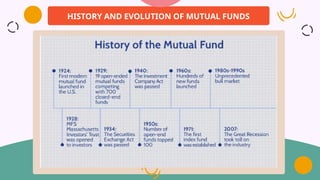
• Investments are held in a trust of which the investors
alone are the joint beneficial owners.
• Trustees oversee the management by investment
manager.
Definition of Mutual
Funds
6.
STOCKS – atype of security that gives stockholders a
share of ownership in a company. A share in the
ownership of a company.
- also called as equities
- entitles the holder to a fixed dividend
BONDS – is a fixed-income investment that represents
a loan from an investor to a borrower.
- It is a contract between the investor and the
borrower, where the borrower uses the money to
fund its operation and the investors receives interest
on the investment.
- government bonds or corporate bonds
sovereign bonds – are debt securities issued by a
national government to finance public spending,
infrastructure projects, or manage national debt. They
function as loans from investors to the government,
promising to pay back the principal amount at a specific
maturity date, along with regular interest payments
(coupons).
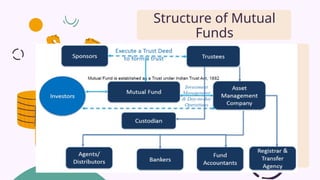
Sponsors
o The sponsorof a mutual fund establishes the fund and
registers the fund with the SEC before the security can be
sold. The sponsor is also known as the fund underwriter.
o Are the entities that establish mutual funds typically
financial institutions with strong credentials.
o The sponsor is the promoter of the mutual fund. The
sponsor brings in capital and creates a mutual fund trust
and sets up the AMC.
o They provide initial capital (playing a crucial role in fund
establishment), appoint trustees and establish the AMC
Trustees
o is a holding service who has administrative power for
managing the money, property or assets used in mutual
funds. The trustee can be an individual person, member of
the board of directors, and appointed company or a bank.
Structure of Mutual
Funds
9.
Trustees
o An individualor organization which holds or manages
and invests assets for the benefit of retirement fund
members.
o A Trustee is a person who acts as a custodian for the
assets held within a Trust. He or she is responsible for
managing and administering the finances of a Trust per the
instructions given. Often, the person who creates the Trust
is the Trustee until they can no longer fill the role due to
incapacitation or death.
o A trustee can be an individual, such as a family member,
friend, or trusted advisor (e.g., lawyer or accountant) or an
institution, such as a bank or trust company.
o Are appointed by the AMC and receive fees from the
AMC. Their primary objective has to be protecting the
interest of the AMC. Primary responsibility of the trustee is
Structure of Mutual
Funds
10.
Investors
• Mutual fundsare ideal for investors who either lack large
sums for investment, or for those who neither have the
inclination nor the time to research the market yet want to
grow their wealth. The money collected in mutual funds is
invested by professional fund managers in line with the
scheme's stated objective.
Asset Management Company (AMC)
• investment manager of the mutual fund who is appointed by
the trustees
• Trustees and AMC enter into an investment management
agreement.
• AMC of one mutual fund cannot be an AMC or trustee of
another fund.
• AMCs cannot engage in any business other than that of
financial advisory and investment management
Structure of Mutual
Funds
11.
Agent/Distributors
• is anindividual or financial intermediaries who helps investors
buy, sell, and manage mutual funds. Also known as mutual
fund agents.
• basically, an agent supplying goods to a retailer
• any firm or an individual who facilitates buying and selling of
units w/in a mutual fund b/w AMC and interested investors.
Bankers
• buy and sell securities or commodities in investment and
trading firms or provide financial services to business and
individuals.
• may advise customers about stocks, bonds, mutual funds,
commodities, and market conditions
Structure of Mutual
Funds
12.
Fund Accountant
• isa specialized career path for finance professionals
• oversee the daily accounting requirements of investments
portfolios, these include but are not limited to, mutual,
institutional, and hedge funds, real estate and securities
• conducts a standard accounting of funds and other
investment portfolios and is responsible for administering the
activities involved
• establishes systematic structure of the necessary processes
and practices
Registrar & Transfer Agency/Agents (RTA)
• are the thrusts or institutions that register and maintain
detailed records of the transactions of investors for the
convenience of mutual fund houses.
Structure of Mutual
Funds
13.
Registrar & TransferAgency/Agents (RTA)
• they act as intermediaries between mutual fund companies
and investors, ensuring smooth transactions and record
keeping
• responsible for maintaining accurate and up-to-date records of
all the investors of the company or the AMC
• Maintains a comprehensive database containing extensive
investor information.
Structure of Mutual
Funds
14.
When you purchasea mutual fund, you are
pooling money with other investors. The
money pooled together by you and other
investors are managed by a fund manager
who invests in financial assets such as
stocks, bonds, etc. The mutual fund is
managed on a daily basis. Below is a
diagram of how mutual funds work:
Understanding How
Mutual Funds Work
Mutual Funds continueto be among the most
popular investing tools for both individual and
professional investors who seek to beat the
market or simply access a broad swath of
investments rather than purchase stocks or
bonds individually.
Ideal for investors seeking professional
management, instant diversification, and
lower risks compared to picking individual
stocks. They suit beginners, long-term
investors, and those wanting to build wealth
for retirement, as funds offer easy access to a
broad range of assets.
Who would invest in
Mutual Funds?
Classification - Basedon Structure
Open Ended Funds are schemes that continuously offer
different units to investors. Also known as a diversified
Portfolio of pooled investors funds with the ability to
Issue an infinite number of shares.
o No fixed maturity date
o Accept continuous sale and re-purchase requests
o Transactions are NAV-based
o Unit capital is not fixed
Closed Ended Funds are mutual funds that provide new units to
Investors for a limited time.
o Run for a specific period
o Offered in a New Fund Offer (NFO) but are closed for further
purchases after NFO
o Unit capital is kept constant
Classification of
Mutual Funds
20.
Interval Funds isa non-traditional type of closed-end
mutual fund that periodically offers to buy back a
percentage of outstanding shares from stockholders.
Shareholders are not, however, often required to sell
their shares back to the fund.
o Variant of closed-ended funds
o Becomes open-ended at specific intervals
o Have to be mandatorily listed
Classification of
Mutual Funds
21.
Classification - Basedon Investment Objective
Debt Funds is a mutual fund scheme that invests
in fixed-income investments, such as Corporate or
Government bonds, corporate debt securities & money
market instruments, etc. that offer capital appreciation.
o Invest in short and long term debt instruments (bonds)
o Aim to provide regular income
Equity Funds is a type of mutual fund that specifically invests
in stock. Either actively managed by a fund manager or
passively managed (meaning there’s no fund manager to
handle your investment). An equity fund is a investment fund
Classification of
Mutual Funds
22.
that buy’s ownershipin a company in a form of
stocks.
o Invest in equity securities (stocks)
o Aim to provide growth and capital appreciation
over long term
Hybrid Funds is an investment vehicle that combines both
stocks and bonds in its portfolio.
o Invest in a combination of equity and debt securities
(stocks and bonds)
o Proportion of equity and debt may vary
o Aim to provide for both income and capital appreciation.
Classification of
Mutual Funds
23.
Classification - Basedon Investment Style
Passive Funds is an investment vehicle that tracks a
market index or a specific market segment, to determine
what to invest.
o Replicate a market index
o Invest in same securities and in same proportion as that
of index
o No active selection of any stock / sector
o Expenses are lower
o Portfolio is modified every time index composition changes.
Classification of
Mutual Funds
24.
Active Funds –the job of an active fund manager is to
pick and choose investments with the aim of delivering
a performance that beats the funds stated benchmark
or index.
o Invests in securities and sectors that may offer a better
return than the index
o Actively manage the allocation to market
securities and cash
o May perform better or worse than the market index
o Incur a higher cost than passive funds
- active funds have a fund manager who selects
stocks and bonds to buy and sell, while passive funds follow
a benchmark index and replicate its performance.
Classification of
Mutual Funds
25.
1. Money MarketFunds
Money market funds invest in short-term fixed-
income securities. Examples of short-term fixed-
income securities would be government bonds,
Treasury bills, commercial paper, and certificates
of deposit. These types of funds are generally a
safer investment but with a lower potential
return than other mutual funds.
2. Fixed Income Funds
Fixed income funds buy investments that pay a
fixed rate of return. This type of mutual fund
focuses on getting returns coming into the fund
primarily through interest.
Common Types of
Mutual Funds
26.
3. Equity Funds
Equityfunds invest in stocks. Furthermore, there
are different types of equity funds such as funds
that specialize in growth stocks, value stocks,
large-cap stocks, mid-cap stocks, small-cap
stocks, or a combination of these stocks.
4. Balanced Funds
Balanced funds invest in a mix of equities and
fixed-income securities – typically in a 40% equity
60% fixed income ratio. The aim of these funds is
to generate higher returns but also mitigate risk
through fixed-income securities.
Common Types of
Mutual Funds
27.
5. Index Funds
Indexfunds aim to track the performance of a
specific index. For example, the S&P, or TSX.
Index funds follow the index and go up when the
index goes up and goes down when the index
goes down. Index funds are popular as they
typically require a lower management fee
compared to other funds (due to the manager
not needing to do as much research).
6. Specialty Funds
Specialty funds focus on a very small part of a
market such as energy, telecommunications,
healthcare, industrials, etc.
Common Types of
Mutual Funds
28.
• SEC-registered investmentcompanies
An investment firm which is registered
with the SEC and complies with certain
stated legal requirements.
• Mobilizing Small Savings
It is a trust that pools the savings of a
number of investors who share a common
financial goal. It collects the savings from
the small investors, invest them in
government and other corporate securities
and earn income through interest and
dividends, besides capital gains.
Characteristics of Mutual
Funds
29.
• Investment Avenue
Thereare different ways that you can
invest your money. This is one of the
attractive features that mutual funds have
to offer.
• Professional Management
Mutual funds are managed by full-time,
professional fund managers who have the
expertise, experience, and resources to
actively buy, sell, and manage
investments. The fund managers do the
research, select the securities and monitor
the performance all for the benefits of the
investors.
Characteristics of Mutual
Funds
30.
• Diversified Investment
Thesaying “ do not put all your eggs in
one basket” perfectly fits mutual funds as
spreading investment across multiple
securities and asset categories lowers risk.
Mutual funds are inherently diversified.
• Better Liquidity
Mutual Fund investors can easily
redeem their shares at any time, for the
current net asset value (NAV) plus any
redemption fees. Also, funds can be
withdrawn or redeemed to meet any
emergency.
Characteristics of Mutual
Funds
31.
• Reduced Risk
Mutualfunds can help investors access
the financial market's growth
opportunities.
Low-risk mutual funds are those
investment options that carry minimal risk
and a stable return assurance.
• Investment Protection
An investor protection fund may
compensate investors for losses in the
event of the bankruptcy of an investment
dealer or a mutual fund dealer. It does not
cover losses resulting from the changing
market value of securities, unsuitable
investments, or the default by an issuer of
Characteristics of Mutual
Funds
32.
• Switching Facility
Switchingof funds means moving the
money from an investment scheme to
another investment scheme.
Mutual fund switching refers to
transitioning between debt and equity
funds or from regular to direct mutual
fund plans to manage risk or enhance
returns. Essentially, it involves moving
from one mutual fund scheme to another
when the current scheme underperforms.
Characteristics of Mutual
Funds
33.
• Tax Benefit
Witha long-term investment in mutual
funds, you can pay less taxes due to their
high tax efficiency. In mutual fund, you can
also get income tax deductions by
investing in specific funds while earning
high returns.
• Low Transaction Cost
Because a mutual fund buys and sells
large amounts of securities at a time, its
transaction costs are lower than what an
individual would pay for securities
transactions. A mutual fund can invest in
certain assets or take larger positions than
a smaller investor could.
Characteristics of Mutual
Funds
34.
Mutual funds arealso affordable for
every earning individual. You need to pay a
small amount, known as the expense ratio,
to your fund houses to invest in mutual
funds and the costs are less than other
managed funds.
• Economic Development
There is an increase in capital goods,
labor force, technology, and human capital
can all contribute to economic growth.
Mutual funds offer diversification or access
to a wider variety of investments than an
individual investor could afford to buy.
Investing with a group offers economies of
scale, decreasing your costs.
Characteristics of Mutual
Funds
35.
There are severalkey benefits to investing in
a mutual fund:
1. Professional Management
Mutual funds are actively managed by a
professional who constantly monitors the
fund’s portfolio. In addition, the manager
can devote more time selecting
investments than a retail investor would.
2. Investment Diversification
Mutual funds allow for investment
diversification. A mutual fund invests in
several asset classes and not just a single
stock or bond.
Advantages of Mutual
Funds
36.
3. Liquidity
Mutual fundspossess high liquidity. In
general, you are able to sell your mutual
funds within a short period of time if
needed.
4. Transparency
Mutual funds are subject to industry
regulations meant to ensure
accountability
and fairness for investors.
Advantages of Mutual
Funds
37.
5. Affordability
Mutual fundas an investment vehicle is
also
available for small investors who do not
have significant amounts of money to
invest.
6. Flexibility to Invest in Smaller Amount
The most important benefit is its flexible
nature. Investors need not put in a huge
amount of money to invest in a Mutual
Fund.
Investment can be as per the cash flow
position.
Advantages of Mutual
Funds
38.
7. Lower Cost
Ina Mutual Fund, funds are collected from many
investors, and then the same is used to purchase
securities. These funds are however invested in assets
which therefore helps one save on transaction and
other costs as compared to a single transaction. The
savings are passed on to the investors as lower costs
of investing in Mutual Funds.
8. Accessibility - Mutual Funds are Easy to Buy
Mutual Funds are easily accessible and you can
start investing and buy mutual funds from
anywhere in the world. This makes mutual funds
universally available and easily accessible.
Advantages of Mutual
Funds
39.
Disadvantages of
Mutual Funds
Thereare important disadvantages to consider
when investing in a mutual fund:
1. Management Fees and Operating Expenses
Mutual funds typically charge a high MER
(management fee and operating expenses). This
would lower the overall return. For example, if
the mutual fund posted a 1-year return of 10%,
the MER would lower this return.
40.
Disadvantages of
Mutual Funds
2.Loss of Control
Since mutual funds are managed by a manager,
there is a loss of control when investing in a
mutual fund. Remember that you are giving
someone else your money to manage to when
investing in a mutual fund.
3. Poor Performance
Mutual fund returns are not guaranteed. In
fact,
according to research, a large majority of
mutual funds fail to beat major market indexes.
In addition, mutual funds are not insured
against
41.
Disadvantages of
Mutual Funds
4.Dilution
Due to dilution, it is not recommended to invest
in too many Mutual Funds at the same time.
Diversification, although saves an investor from
major losses, also restricts one from making a
higher profit.
5. Cost to Manage the Mutual Fund scheme
Market Analysts or Fund Managers manage and
operate the mutual funds. These Fund Managers
work for the fund houses that manage huge
investments every day. This requires a lot of
efficiencies, expertise, and experience in the
subject matter.
42.
Disadvantages of
Mutual Funds
6.Risk
Investments in mutual funds are subject to
market risk. The risk of losses faced by all types of
securities in the financial markets cannot be
reduced by diversification. Market risks may
occur due to many macro and microeconomic
factors. For example, equity mutual funds are
subject to volatility risk owing to fluctuations in
the stock market whereas debt mutual funds are
subject to interest rate risk which is caused by
fluctuations in the interest rates and so on.
43.
Disadvantages of
Mutual Funds
7.Over-Diversification
In the quest to diversify your investments, you
may invest in mutual funds, which invest in a vast
number of stocks, leading to over-diversification.
Not all the stocks of a portfolio would deliver high
returns all the time. You may end up investing in
two mutual funds holding similar portfolios
which may then lead to over-diversification. It is
advisable to study the mutual fund portfolio
before you invest.
44.
Mutual funds didn'treally capture the
attention of American investors until the
1980s and 1990s, when investors in them
hit record highs and realized incredible
returns. They are now mainstream
investments and form the core of
individual retirement accounts. However,
the idea of pooling assets for investment
purposes has been around for centuries.
The First Mutual Funds
Historians are uncertain of the origins of
investment funds, although many look to
the Dutch as the early innovators who
created the first closed-end investment
companies.
HISTORY AND EVOLUTION OF MUTUAL FUNDS
Subhamoy Das, in his economics textbook
"Perspectives on Financial Services,"
traces an early appearance of the mutual
fund to Dutch merchant Adriaan van
Ketwich, who created an investment trust
in 1774. "Van Ketwich probably believed
that diversification would appeal to
investors with minimal capital. The name
of van Ketwich's fund, Eendragt Maakt
Magt, translates into 'unity creates
strength,'" the book explains.
Other examples followed, including an
investment trust launched in Switzerland
in 1849 and similar vehicles formed in
Scotland in the 1880s.
Regulatory Framework for
MutualFund
Philippine Regulation of Mutual Funds
• Investment Company Act (ICA) or Republic Act
(RA) 2629 governs the creation, regulation,
licensing and monitoring of investment
companies such as mutual funds in the
Philippines.
• Securities and Exchange Commission (SEC)
- is the regulatory agency in charge of
ensuring
that registered investment companies
comply
with the provisions of the ICA
- also ensures that 7 these companies adhere
to other relevant laws such as the Revised
Securities Act (Batas Pambansa Blg. 178) and