INTRODUCTION TO MPI BASICS
MPI (Message Passing Interface) facilitates communication and
coordination among parallel processes across multiple processors or
computing nodes, supporting parallel and distributed computing.
KEY CONCEPTS
• MPI Definition:
• Standardized functions for message passing.
• Enables process communication and synchronization.
• Processes:
• Multiple parallel processes in MPI programs.
• Each process has its own address space and context.
• Message Passing:
• Communication achieved through message exchange.
• Processes send and receive messages.
• Scalability:
• Efficient scaling across distributed memory systems.
• Supports parallel execution on thousands of processors.
IMPLEMENTATION OF MPI
• MPI Libraries:
• MPI is implemented through libraries.
• These libraries provide the necessary functions and routines for message passing in MPI programs.
• Common MPI Implementations:
• Examples of popular MPI implementations include:
• MPICH
• Open MPI
• Intel MPI
• These implementations offer platform-independent support for parallel and distributed computing.
• Compatibility Across Platforms:
• MPI implementations are available for a wide range of platforms, including:
• Desktop workstations
• Compute clusters
• Supercomputers
• Cloud environments
• This ensures that MPI-based applications can run seamlessly across different hardware and software
configurations.
COMPATIBILITY ACROSS PLATFORMS:
Platform-Independent: MPI implementations run on various hardware and software
environments. This ensures that MPI-based applications can be developed and deployed
across different computing platforms without significant modifications.
• Benefits:
• Desktops: Efficient resource utilization for scientific tasks.
• Clusters: Utilizes distributed computing for large-scale computations.
• Supercomputers: Enables high-performance computing across thousands of
processors.
• Cloud: Access scalable resources for parallel computing and data processing.
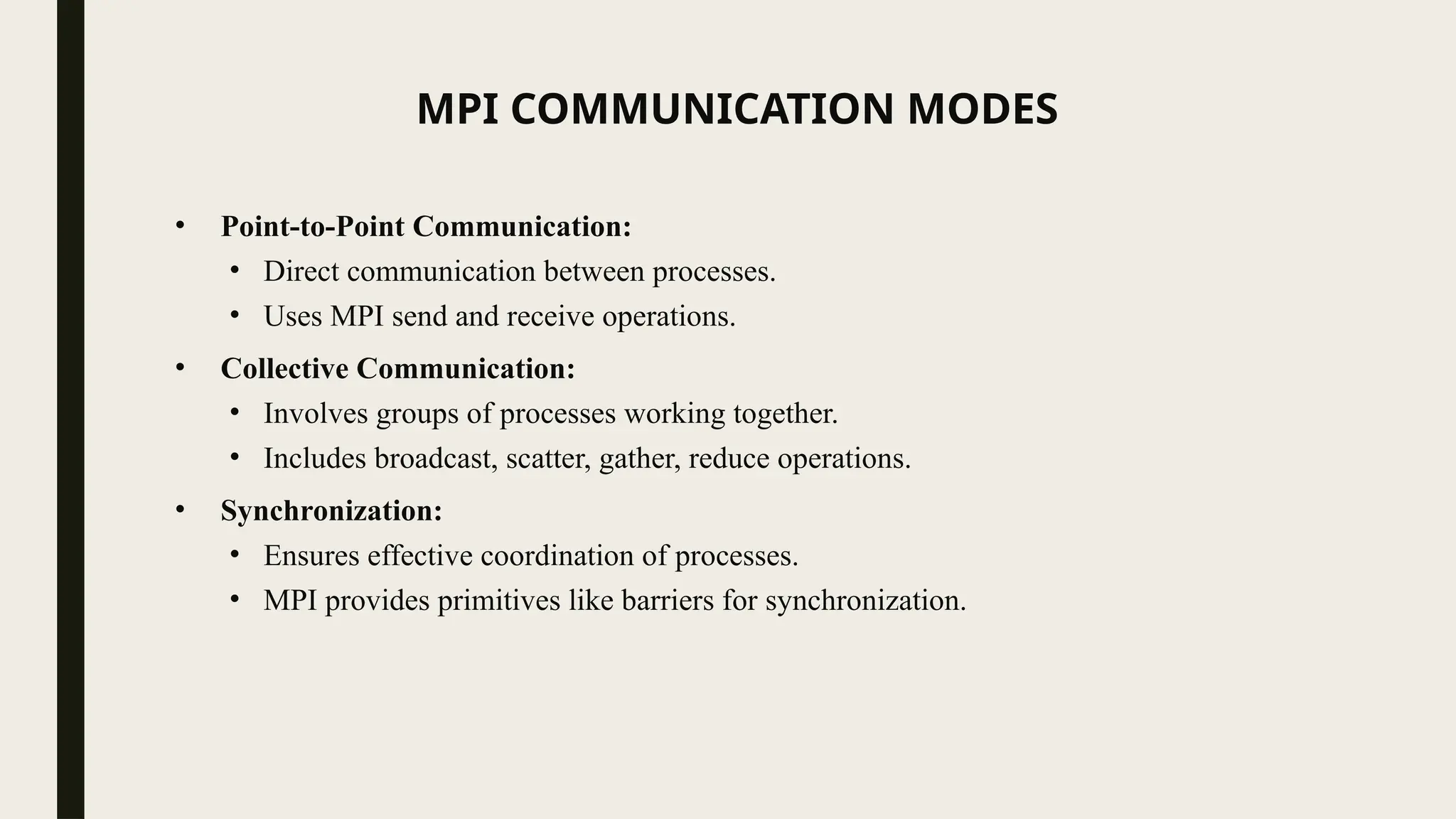
MPI COMMUNICATION MODES
• Point-to-Point Communication:
• Direct communication between processes.
• Uses MPI send and receive operations.
• Collective Communication:
• Involves groups of processes working together.
• Includes broadcast, scatter, gather, reduce operations.
• Synchronization:
• Ensures effective coordination of processes.
• MPI provides primitives like barriers for synchronization.
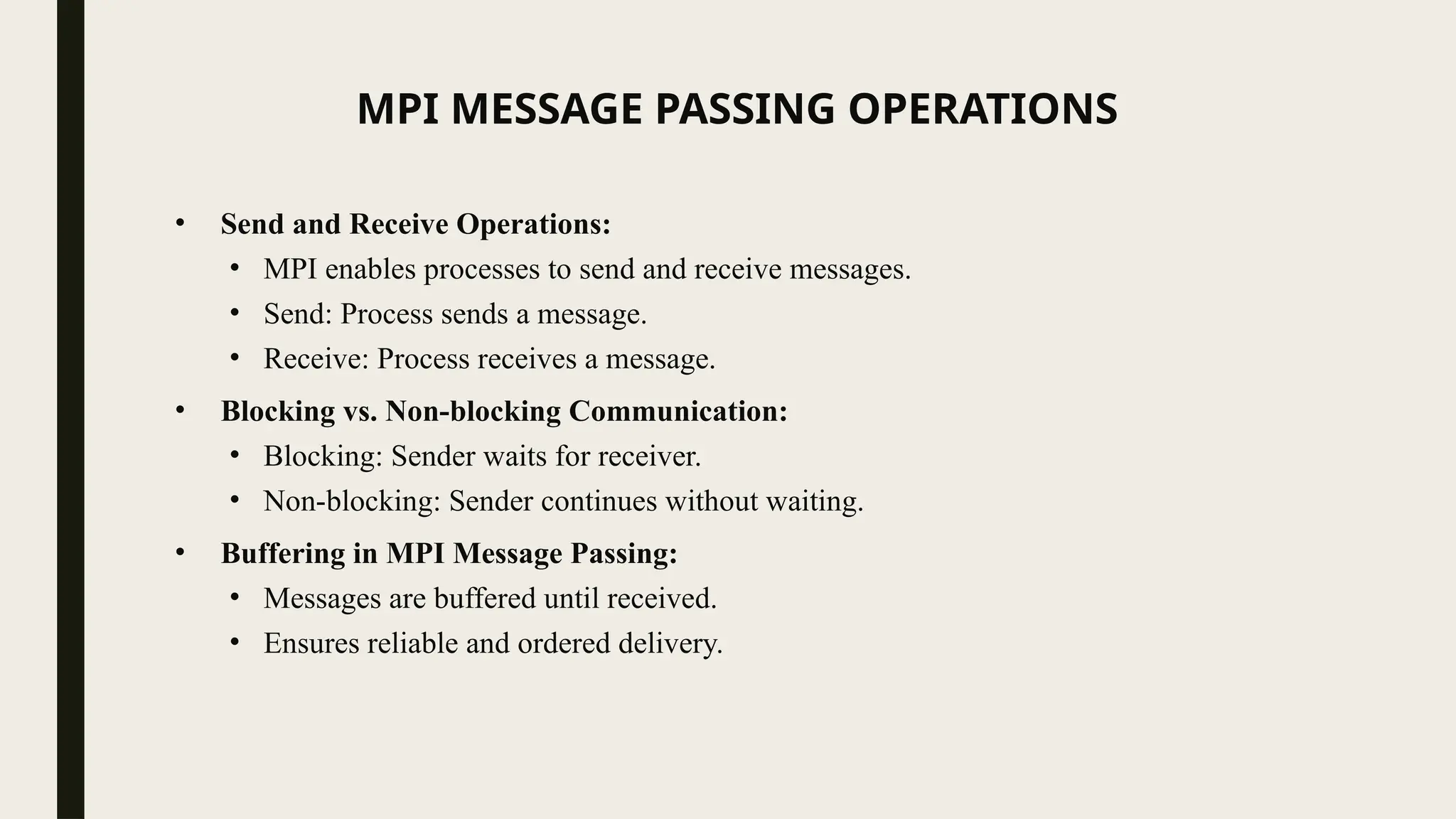
MPI MESSAGE PASSING OPERATIONS
• Send and Receive Operations:
• MPI enables processes to send and receive messages.
• Send: Process sends a message.
• Receive: Process receives a message.
• Blocking vs. Non-blocking Communication:
• Blocking: Sender waits for receiver.
• Non-blocking: Sender continues without waiting.
• Buffering in MPI Message Passing:
• Messages are buffered until received.
• Ensures reliable and ordered delivery.
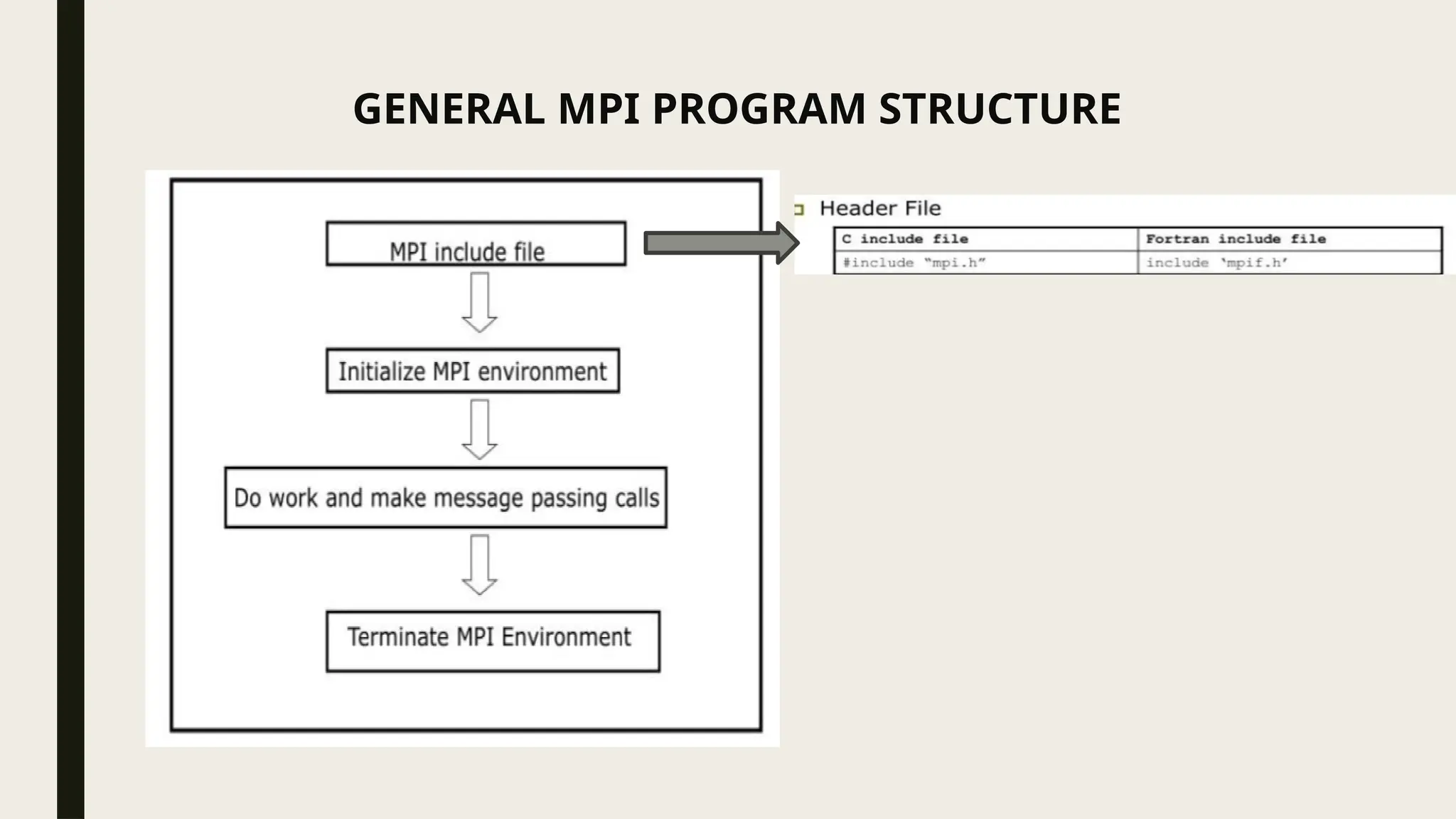
GENERAL MPI PROGRAM STRUCTURE
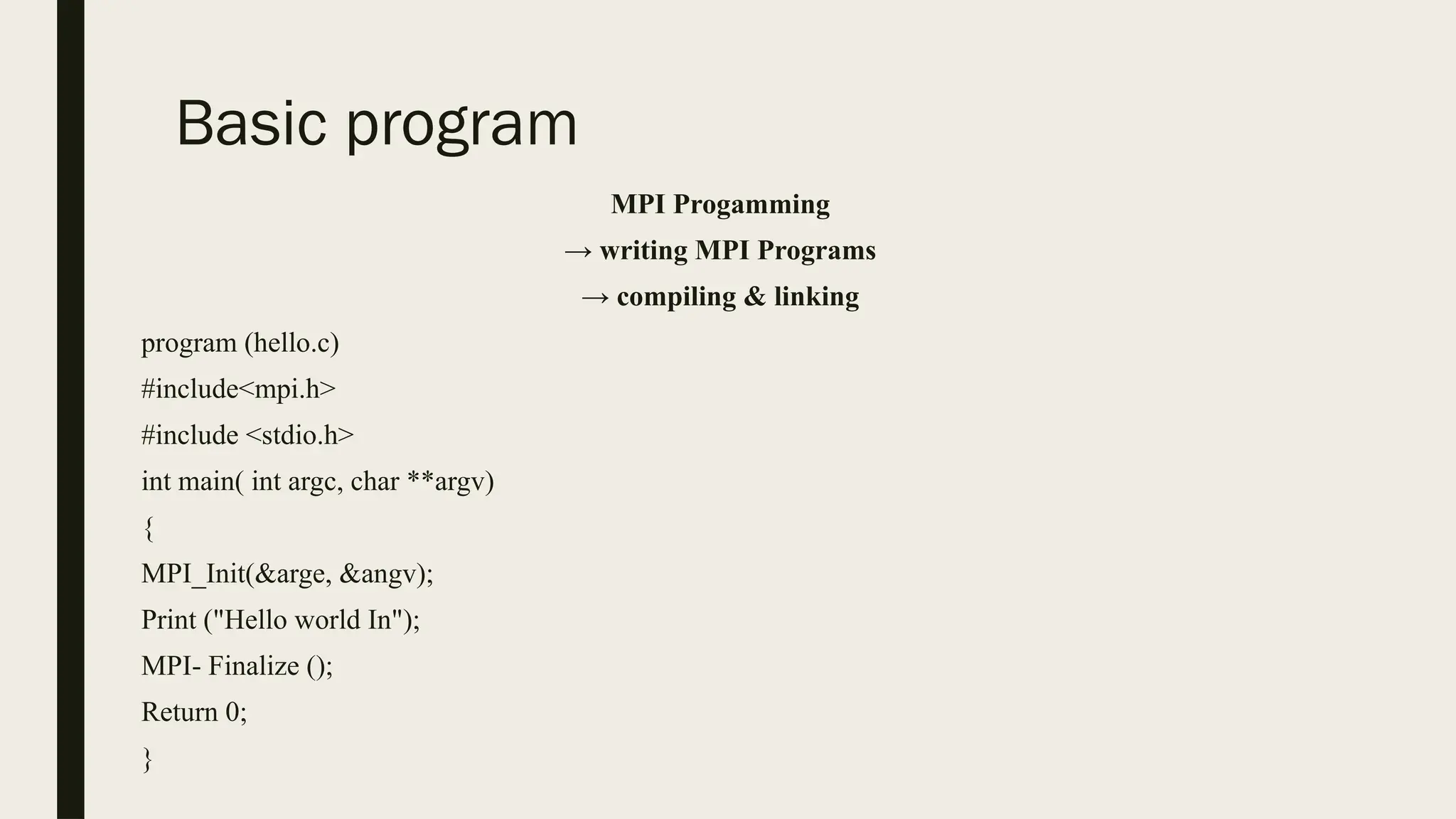
Basic program
MPI Progamming
→ writing MPI Programs
→ compiling & linking
program (hello.c)
#include<mpi.h>
#include <stdio.h>
int main( int argc, char **argv)
{
MPI_Init(&arge, &angv);
Print ("Hello world In");
MPI- Finalize ();
Return 0;
}

Introduction to MPI Basics easy way.pptx

  • 1.
    INTRODUCTION TO MPIBASICS MPI (Message Passing Interface) facilitates communication and coordination among parallel processes across multiple processors or computing nodes, supporting parallel and distributed computing.
  • 2.
    KEY CONCEPTS • MPIDefinition: • Standardized functions for message passing. • Enables process communication and synchronization. • Processes: • Multiple parallel processes in MPI programs. • Each process has its own address space and context. • Message Passing: • Communication achieved through message exchange. • Processes send and receive messages. • Scalability: • Efficient scaling across distributed memory systems. • Supports parallel execution on thousands of processors.
  • 3.
    IMPLEMENTATION OF MPI •MPI Libraries: • MPI is implemented through libraries. • These libraries provide the necessary functions and routines for message passing in MPI programs. • Common MPI Implementations: • Examples of popular MPI implementations include: • MPICH • Open MPI • Intel MPI • These implementations offer platform-independent support for parallel and distributed computing. • Compatibility Across Platforms: • MPI implementations are available for a wide range of platforms, including: • Desktop workstations • Compute clusters • Supercomputers • Cloud environments • This ensures that MPI-based applications can run seamlessly across different hardware and software configurations.
  • 4.
    COMPATIBILITY ACROSS PLATFORMS: Platform-Independent:MPI implementations run on various hardware and software environments. This ensures that MPI-based applications can be developed and deployed across different computing platforms without significant modifications. • Benefits: • Desktops: Efficient resource utilization for scientific tasks. • Clusters: Utilizes distributed computing for large-scale computations. • Supercomputers: Enables high-performance computing across thousands of processors. • Cloud: Access scalable resources for parallel computing and data processing.
  • 5.
    MPI COMMUNICATION MODES •Point-to-Point Communication: • Direct communication between processes. • Uses MPI send and receive operations. • Collective Communication: • Involves groups of processes working together. • Includes broadcast, scatter, gather, reduce operations. • Synchronization: • Ensures effective coordination of processes. • MPI provides primitives like barriers for synchronization.
  • 6.
    MPI MESSAGE PASSINGOPERATIONS • Send and Receive Operations: • MPI enables processes to send and receive messages. • Send: Process sends a message. • Receive: Process receives a message. • Blocking vs. Non-blocking Communication: • Blocking: Sender waits for receiver. • Non-blocking: Sender continues without waiting. • Buffering in MPI Message Passing: • Messages are buffered until received. • Ensures reliable and ordered delivery.
  • 7.
  • 8.
    Basic program MPI Progamming →writing MPI Programs → compiling & linking program (hello.c) #include<mpi.h> #include <stdio.h> int main( int argc, char **argv) { MPI_Init(&arge, &angv); Print ("Hello world In"); MPI- Finalize (); Return 0; }