Introduction to logistics systems planning and
control 1st Edition Gianpaolo Ghiani pdf

download
https://ebookfinal.com/download/introduction-to-logistics-
systems-planning-and-control-1st-edition-gianpaolo-ghiani/
Explore and download more ebooks or textbooks
at ebookfinal.com
We have selected some products that you may be interested in
Click the link to download now or visit ebookfinal.com
for more options!.
Integral Logistics Management Planning and Control of
Comprehensive Supply Chains 2nd Edition Paul Schönsleben
https://ebookfinal.com/download/integral-logistics-management-
planning-and-control-of-comprehensive-supply-chains-2nd-edition-paul-
schonsleben/
Stability and Control of Aircraft Systems Introduction to
Classical Feedback Control 1st Edition Roy Langton
https://ebookfinal.com/download/stability-and-control-of-aircraft-
systems-introduction-to-classical-feedback-control-1st-edition-roy-
langton/
Introduction to Linear Control Systems 1st Edition Yazdan
Bavafa-Toosi
https://ebookfinal.com/download/introduction-to-linear-control-
systems-1st-edition-yazdan-bavafa-toosi/
Looking at Logistics A Practical Introduction to Logistics
and Supply Chain Management 3rd Edition Philip Price
https://ebookfinal.com/download/looking-at-logistics-a-practical-
introduction-to-logistics-and-supply-chain-management-3rd-edition-
philip-price/
Control Systems 1st Edition U.A.Bakshi
https://ebookfinal.com/download/control-systems-1st-edition-u-a-
bakshi/
Introduction to Management of Reverse Logistics and Closed
Loop Supply Chain Processes 1st Edition Donald F. Blumberg
https://ebookfinal.com/download/introduction-to-management-of-reverse-
logistics-and-closed-loop-supply-chain-processes-1st-edition-donald-f-
blumberg/
Strategic Marketing Third Edition Planning and Control
Graeme Drummond
https://ebookfinal.com/download/strategic-marketing-third-edition-
planning-and-control-graeme-drummond/
Introduction to Financial Models for Management and
Planning John P. Daley
https://ebookfinal.com/download/introduction-to-financial-models-for-
management-and-planning-john-p-daley/
Introduction to Dynamical Systems 1st Edition Michael Brin
https://ebookfinal.com/download/introduction-to-dynamical-systems-1st-
edition-michael-brin/
Introduction to logistics systems planning and control 1st
Edition Gianpaolo Ghiani Digital Instant Download
Author(s): Gianpaolo Ghiani
ISBN(s): 9780470849170, 0470091657
Edition: 1
File Details: PDF, 2.62 MB
Year: 2004
Language: english
Introduction to Logistics Systems Planning and Control
Introduction to Logistics Systems Planning and Control G. Ghiani, G. Laporte and R. Musmanno
© 2004 John Wiley & Sons, Ltd ISBN: 0-470-84916-9 (HB) 0-470-84917-7 (PB)
WILEY-INTERSCIENCE SERIES IN SYSTEMS AND OPTIMIZATION
Advisory Editors
Sheldon Ross
Department of Industrial Engineering and Operations Research, University of California,
Berkeley, CA 94720, USA
Richard Weber
Statistical Laboratory, Centre for Mathematical Sciences, Cambridge University,
Wilberforce Road, Cambridge CB3 0WB
BATHER – Decision Theory: An Introduction to Dynamic Programming and Sequential
Decisions
CHAO/MIYAZAWA/PINEDO – Queueing Networks: Customers, Signals and Product Form
Solutions
COURCOUBETIS/WEBER – Pricing Communication Networks: Economics, Technology
and Modelling
DEB – Multi-Objective Optimization using Evolutionary Algorithms
GERMAN – Performance Analysis of Communication Systems: Modeling with
Non-Markovian Stochastic Petri Nets
GHIANI/LAPORTE/MUSMANNO – Introduction to Logistics Systems Planning and
Control
KALL/WALLACE – Stochastic Programming
KAMP/HASLER – Recursive Neural Networks for Associative Memory
KIBZUN/KAN – Stochastic Programming Problems with Probability and Quantile Functions
RUSTEM – Algorithms for Nonlinear Programming and Multiple-Objective Decisions
WHITTLE – Optimal Control: Basics and Beyond
WHITTLE – Neural Nets and Chaotic Carriers
The concept of a system as an entity in its own right has emerged with increasing force in the
past few decades in, for example, the areas of electrical and control engineering, economics,
ecology, urban structures, automation theory, operational research and industry. The more
definite concept of a large-scale system is implicit in these applications, but is particularly
evident in such fields as the study of communication networks, computer networks, and neural
networks. The Wiley-Interscience Series in Systems and Optimization has been established
to serve the needs of researchers in these rapidly developing fields. It is intended for works
concerned with the developments in quantitative systems theory, applications of such theory
in areas of interest, or associated methodology.
Introduction to Logistics Systems Planning and Control
Gianpaolo Ghiani
Department of Innovation Engineering,
University of Lecce, Italy
Gilbert Laporte
Canada Research Chair in Distribution Management,
HEC Montréal, Canada
Roberto Musmanno
Department of Electronics, Informatics and Systems,
University of Calabria, Italy
Copyright © 2004 John Wiley & Sons Ltd, The Atrium, Southern Gate, Chichester,
West Sussex PO19 8SQ, England
Phone (+44) 1243 779777
Email (for orders and customer service enquiries): cs-books@wiley.co.uk
Visit our Home Page on www.wileyeurope.com or www.wiley.com
All Rights Reserved. No part of this publication may be reproduced, stored in a retrieval system or
transmitted in any form or by any means, electronic, mechanical, photocopying, recording, scanning or
otherwise, except under the terms of the Copyright, Designs and Patents Act 1988 or under the terms of
a licence issued by the Copyright Licensing Agency Ltd, 90 Tottenham Court Road, London W1T 4LP,
UK, without the permission in writing of the Publisher. Requests to the Publisher should be addressed
to the Permissions Department, John Wiley & Sons Ltd, The Atrium, Southern Gate, Chichester, West
Sussex PO19 8SQ, England, or emailed to permreq@wiley.co.uk, or faxed to (+44) 1243 770571.
Thispublicationisdesignedtoprovideaccurateandauthoritativeinformationinregardtothesubjectmatter
covered. It is sold on the understanding that the Publisher is not engaged in rendering professional services.
If professional advice or other expert assistance is required, the services of a competent professional should
be sought.
Other Wiley Editorial Offices
John Wiley & Sons Inc., 111 River Street, Hoboken, NJ 07030, USA
Jossey-Bass, 989 Market Street, San Francisco, CA 94103-1741, USA
Wiley-VCH Verlag GmbH, Boschstr. 12, D-69469 Weinheim, Germany
John Wiley & Sons Australia Ltd, 33 Park Road, Milton, Queensland 4064, Australia
John Wiley & Sons (Asia) Pte Ltd, 2 Clementi Loop #02-01, Jin Xing Distripark, Singapore 129809
John Wiley & Sons Canada Ltd, 22 Worcester Road, Etobicoke, Ontario, Canada M9W 1L1
Wiley also publishes its books in a variety of electronic formats. Some content that appears in print may
not be available in electronic books.
Library of Congress Cataloguing-in-Publication Data
Ghiani, Gianpaolo.
Introduction to logistics systems planning and control / Gianpaolo Ghiani,
Gilbert Laporte, Roberto Musmanno.
p. cm. – (Wiley-Interscience series in systems and optimization)
Includes bibliographical references and index.
ISBN 0-470-84916-9 (alk. paper) – ISBN 0-470-84917-7 (pbk.: alk. paper)
1. Materials management. 2. Materials handling. I. Laporte, Gilbert. II. Musmanno, Roberto. III. Title.
IV. Series.
TS161.G47 2003
658.7–dc22 2003057594
British Library Cataloguing in Publication Data
A catalogue record for this book is available from the British Library
ISBN 0-470-84916-9 (Cloth)
0-470-84917-7 (Paper)
Produced from L
ATEX files supplied by the authors, typeset by T&T Productions Ltd, London.
Printed and bound in Great Britain by TJ International, Padstow, Cornwall.
This book is printed on acid-free paper responsibly manufactured from sustainable forestry
in which at least two trees are planted for each one used for paper production.
To Laura
To Ann and Cathy
To Maria Carmela, Francesco and Andrea
Contents
Foreword xiii
Preface xv
Abbreviations xvi
Problems and Website xix
Acknowledgements xxi
About the Authors xxiii
1 Introducing Logistics Systems 1
1.1 Introduction 1
1.2 How Logistics Systems Work 6
1.2.1 Order processing 6
1.2.2 Inventory management 6
1.2.3 Freight transportation 9
1.3 Logistics Managerial Issues 14
1.4 Emerging Trends in Logistics 16
1.5 Logistics Decisions 18
1.5.1 Decision support methods 18
1.5.2 Outline of the book 20
1.6 Questions and Problems 20
1.7 Annotated Bibliography 22
2 Forecasting Logistics Requirements 25
2.1 Introduction 25
2.2 Demand Forecasting Methods 28
2.2.1 Qualitative methods 28
2.2.2 Quantitative methods 29
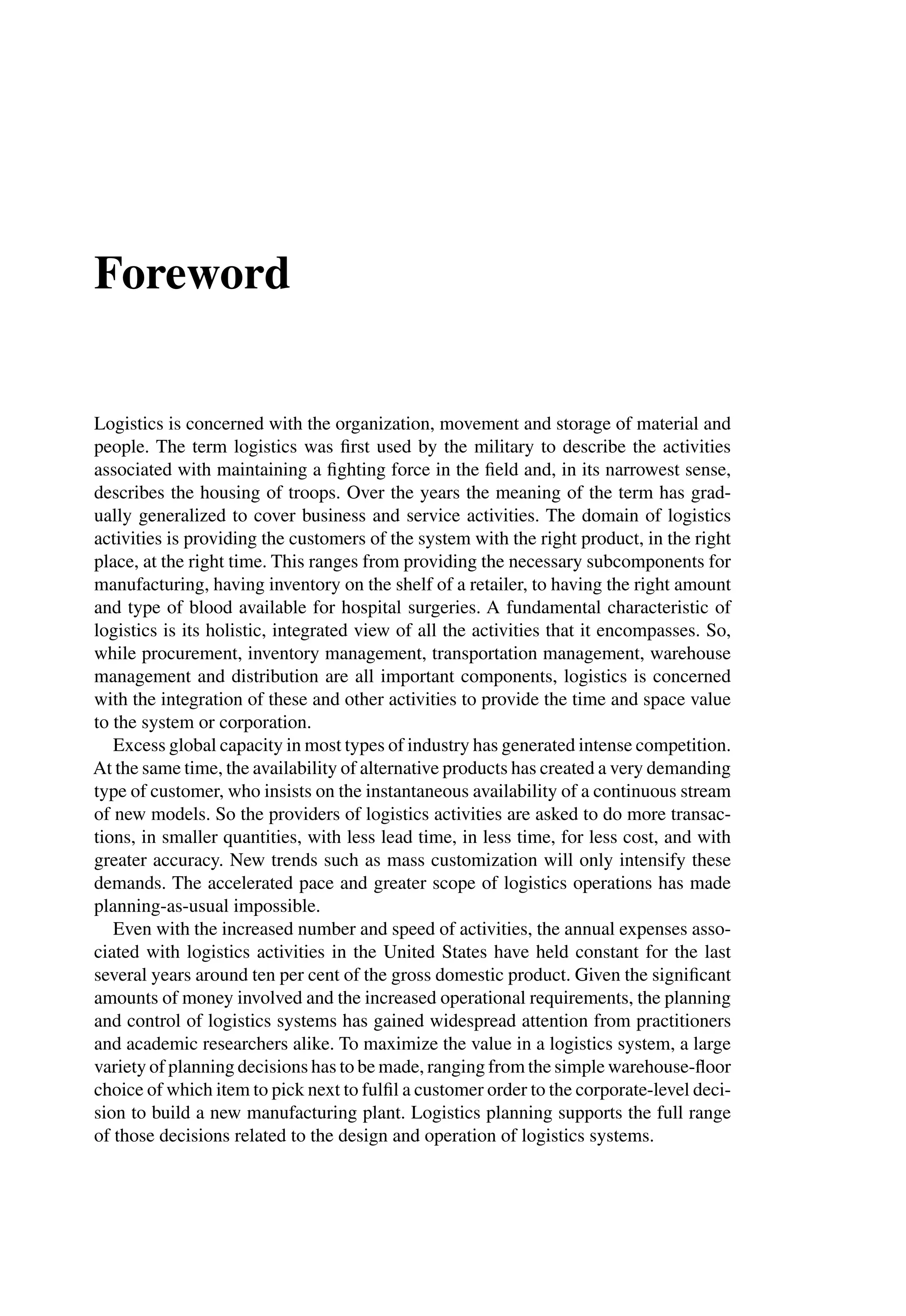
viii CONTENTS
2.2.3 Notation 30
2.3 Causal Methods 30
2.4 Time Series Extrapolation 33
2.4.1 Time series decomposition method 34
2.5 Further Time Series Extrapolation Methods: the Constant
Trend Case 41
2.5.1 Elementary technique 42
2.5.2 Moving average method 44
2.5.3 Exponential smoothing method 48
2.5.4 Choice of the smoothing constant 49
2.5.5 The demand forecasts for the subsequent time periods 49
2.6 Further Time Series Extrapolation Methods: the Linear
Trend Case 50
2.6.1 Elementary technique 50
2.6.2 Linear regression method 51
2.6.3 Double moving average method 52
2.6.4 The Holt method 53
2.7 Further Time Series Extrapolation Methods: the Seasonal
Effect Case 54
2.7.1 Elementary technique 55
2.7.2 Revised exponential smoothing method 56
2.7.3 The Winters method 58
2.8 Advanced Forecasting Methods 61
2.9 Selection and Control of Forecasting Methods 64
2.9.1 Accuracy measures 64
2.9.2 Forecast control 65
2.10 Questions and Problems 67
2.11 Annotated Bibliography 72
3 Designing the Logistics Network 73
3.1 Introduction 73
3.2 Classification of Location Problems 74
3.3 Single-Echelon Single-Commodity Location Models 77
3.3.1 Linear transportation costs and facility fixed costs 79
3.3.2 Linear transportation costs and concave piecewise
linear facility operating costs 90
3.4 Two-Echelon Multicommodity Location Models 95
3.5 Logistics Facility Location in the Public Sector 107
3.5.1 p-centre models 108
3.5.2 The location-covering model 111
3.6 Data Aggregation 115
3.7 Questions and Problems 118
3.8 Annotated Bibliography 119
CONTENTS ix
4 Solving Inventory Management Problems 121
4.1 Introduction 121
4.2 Relevant Costs 121
4.3 Classification of Inventory Management Models 123
4.4 Single Stocking Point: Single-Commodity Inventory
Models under Constant Demand Rate 123
4.4.1 Noninstantaneous resupply 124
4.4.2 Instantaneous resupply 128
4.4.3 Reorder point 130
4.5 Single Stocking Point: Single-Commodity Inventory
Models under Deterministic Time-Varying Demand Rate 130
4.6 Models with Discounts 132
4.6.1 Quantity-discounts-on-all-units 132
4.6.2 Incremental quantity discounts 134
4.7 Single Stocking Point: Multicommodity Inventory Models 136
4.7.1 Models with capacity constraints 136
4.7.2 Models with joint costs 138
4.8 Stochastic Models 141
4.8.1 The Newsboy Problem 141
4.8.2 The (s, S) policy for single period problems 142
4.8.3 The reorder point policy 143
4.8.4 The periodic review policy 145
4.8.5 The (s, S) policy 146
4.8.6 The two-bin policy 147
4.9 Selecting an Inventory Policy 148
4.10 Multiple Stocking Point Models 149
4.11 Slow-Moving Item Models 152
4.12 Policy Robustness 153
4.13 Questions and Problems 154
4.14 Annotated Bibliography 155
5 Designing and Operating a Warehouse 157
5.1 Introduction 157
5.1.1 Internal warehouse structure and operations 159
5.1.2 Storage media 160
5.1.3 Storage/retrieval transport mechanisms and policies 161
5.1.4 Decisions support methodologies 165
5.2 Warehouse Design 165
5.2.1 Selecting the storage medium and the
storage/retrieval transport mechanism 166
5.2.2 Sizing the receiving and shipment subsystems 166
5.2.3 Sizing the storage subsystems 166
5.3 Tactical Decisions 174
x CONTENTS
5.3.1 Product allocation 174
5.4 Operational Decisions 180
5.4.1 Batch formation 181
5.4.2 Order picker routing 184
5.4.3 Packing problems 185
5.5 Questions and Problems 195
5.6 Annotated Bibliography 198
6 Planning and Managing Long-Haul Freight
Transportation 199
6.1 Introduction 199
6.2 Relevant Costs 200
6.3 Classification of Transportation Problems 201
6.4 Fleet Composition 204
6.5 Freight Traffic Assignment Problems 206
6.5.1 Minimum-cost flow formulation 207
6.5.2 Linear single-commodity minimum-cost flow problems 209
6.5.3 Linear multicommodity minimum-cost flow problems 217
6.6 Service Network Design Problems 224
6.6.1 Fixed-charge network design models 225
6.6.2 The linear fixed-charge network design model 226
6.7 Shipment Consolidation and Dispatching 233
6.8 Freight Terminal Design and Operations 236
6.8.1 Design issues 236
6.8.2 Tactical and operational issues 237
6.9 Vehicle Allocation Problems 239
6.10 The Dynamic Driver Assignment Problem 241
6.11 Questions and Problems 243
6.12 Annotated Bibliography 244
7 Planning and Managing Short-Haul Freight
Transportation 247
7.1 Introduction 247
7.2 Vehicle Routing Problems 249
7.3 The Travelling Salesman Problem 252
7.3.1 The asymmetric travelling salesman problem 252
7.3.2 The symmetric travelling salesman problem 257
7.4 The Node Routing Problem with Capacity and Length
Constraints 265
7.4.1 Constructive heuristics 269
7.5 The Node Routing and Scheduling Problem with Time Windows 273
7.5.1 An insertion heuristic 274
CONTENTS xi
7.5.2 A unified tabu search procedure for constrained
node routing problems 278
7.6 Arc Routing Problems 281
7.6.1 The Chinese postman problem 281
7.6.2 The rural postman problem 286
7.7 Real-Time Vehicle Routing and Dispatching 291
7.8 Integrated Location and Routing 294
7.9 Vendor-Managed Inventory Routing 294
7.10 Questions and Problems 296
7.11 Annotated Bibliography 297
8 Linking Theory to Practice 299
8.1 Introduction 299
8.2 Shipment Consolidation and Dispatching at ExxonMobil
Chemical 300
8.3 Distribution Management at Pfizer 302
8.3.1 The Logistics System 303
8.3.2 The Italian ALFA10 distribution system 305
8.4 Freight Rail Transportation at Railion 307
8.5 Yard Management at the Gioia Tauro Marine Terminal 308
8.6 Municipal Solid Waste Collection and Disposal
Management at the Regional Municipality of
Hamilton-Wentworth 312
8.7 Demand Forecasting at Adriatica Accumulatori 312
8.8 Distribution Logistics Network Design at DowBrands 314
8.9 Container Warehouse Location at Hardcastle 317
8.10 Inventory Management at Wolferine 321
8.11 Airplane Loading at FedEx 322
8.12 Container Loading at Waterworld 324
8.12.1 Packing rolls into containers 324
8.12.2 Packing pallets into containers 325
8.13 Air Network Design at Intexpress 325
8.14 Bulk-Cargo Ship Scheduling Problem at the US Navy 330
8.15 Meter Reader Routing and Scheduling at Socal 332
8.16 Annotated Bibliography 334
8.17 Further Case Studies 336
Index 339
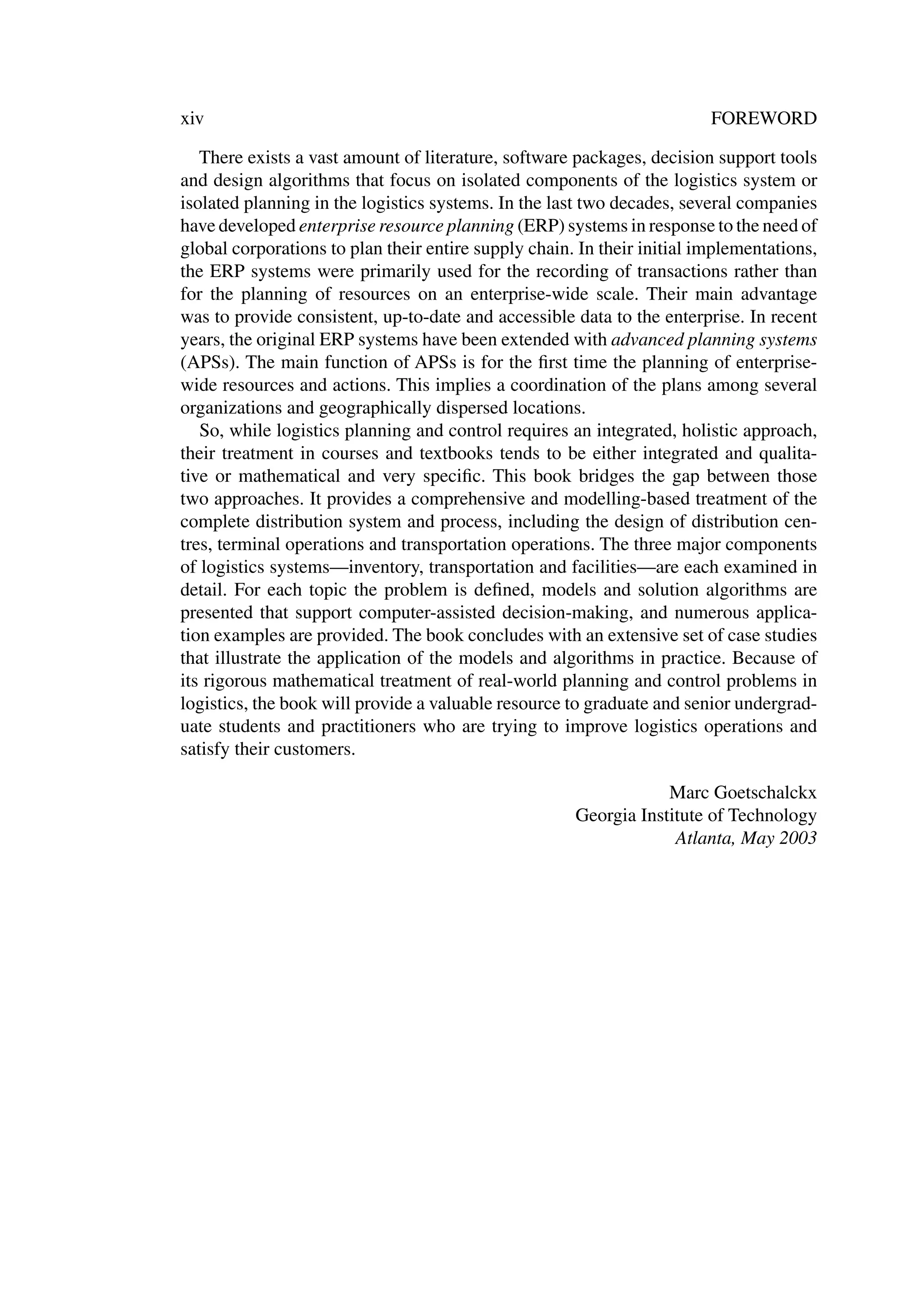
Foreword
Logistics is concerned with the organization, movement and storage of material and
people. The term logistics was first used by the military to describe the activities
associated with maintaining a fighting force in the field and, in its narrowest sense,
describes the housing of troops. Over the years the meaning of the term has grad-
ually generalized to cover business and service activities. The domain of logistics
activities is providing the customers of the system with the right product, in the right
place, at the right time. This ranges from providing the necessary subcomponents for
manufacturing, having inventory on the shelf of a retailer, to having the right amount
and type of blood available for hospital surgeries. A fundamental characteristic of
logistics is its holistic, integrated view of all the activities that it encompasses. So,
while procurement, inventory management, transportation management, warehouse
management and distribution are all important components, logistics is concerned
with the integration of these and other activities to provide the time and space value
to the system or corporation.
Excess global capacity in most types of industry has generated intense competition.
At the same time, the availability of alternative products has created a very demanding
type of customer, who insists on the instantaneous availability of a continuous stream
of new models. So the providers of logistics activities are asked to do more transac-
tions, in smaller quantities, with less lead time, in less time, for less cost, and with
greater accuracy. New trends such as mass customization will only intensify these
demands. The accelerated pace and greater scope of logistics operations has made
planning-as-usual impossible.
Even with the increased number and speed of activities, the annual expenses asso-
ciated with logistics activities in the United States have held constant for the last
several years around ten per cent of the gross domestic product. Given the significant
amounts of money involved and the increased operational requirements, the planning
and control of logistics systems has gained widespread attention from practitioners
and academic researchers alike. To maximize the value in a logistics system, a large
variety of planning decisions has to be made, ranging from the simple warehouse-floor
choice of which item to pick next to fulfil a customer order to the corporate-level deci-
sion to build a new manufacturing plant. Logistics planning supports the full range
of those decisions related to the design and operation of logistics systems.
xiv FOREWORD
There exists a vast amount of literature, software packages, decision support tools
and design algorithms that focus on isolated components of the logistics system or
isolated planning in the logistics systems. In the last two decades, several companies
have developed enterprise resource planning (ERP) systems in response to the need of
global corporations to plan their entire supply chain. In their initial implementations,
the ERP systems were primarily used for the recording of transactions rather than
for the planning of resources on an enterprise-wide scale. Their main advantage
was to provide consistent, up-to-date and accessible data to the enterprise. In recent
years, the original ERP systems have been extended with advanced planning systems
(APSs). The main function of APSs is for the first time the planning of enterprise-
wide resources and actions. This implies a coordination of the plans among several
organizations and geographically dispersed locations.
So, while logistics planning and control requires an integrated, holistic approach,
their treatment in courses and textbooks tends to be either integrated and qualita-
tive or mathematical and very specific. This book bridges the gap between those
two approaches. It provides a comprehensive and modelling-based treatment of the
complete distribution system and process, including the design of distribution cen-
tres, terminal operations and transportation operations. The three major components
of logistics systems—inventory, transportation and facilities—are each examined in
detail. For each topic the problem is defined, models and solution algorithms are
presented that support computer-assisted decision-making, and numerous applica-
tion examples are provided. The book concludes with an extensive set of case studies
that illustrate the application of the models and algorithms in practice. Because of
its rigorous mathematical treatment of real-world planning and control problems in
logistics, the book will provide a valuable resource to graduate and senior undergrad-
uate students and practitioners who are trying to improve logistics operations and
satisfy their customers.
Marc Goetschalckx
Georgia Institute of Technology
Atlanta, May 2003
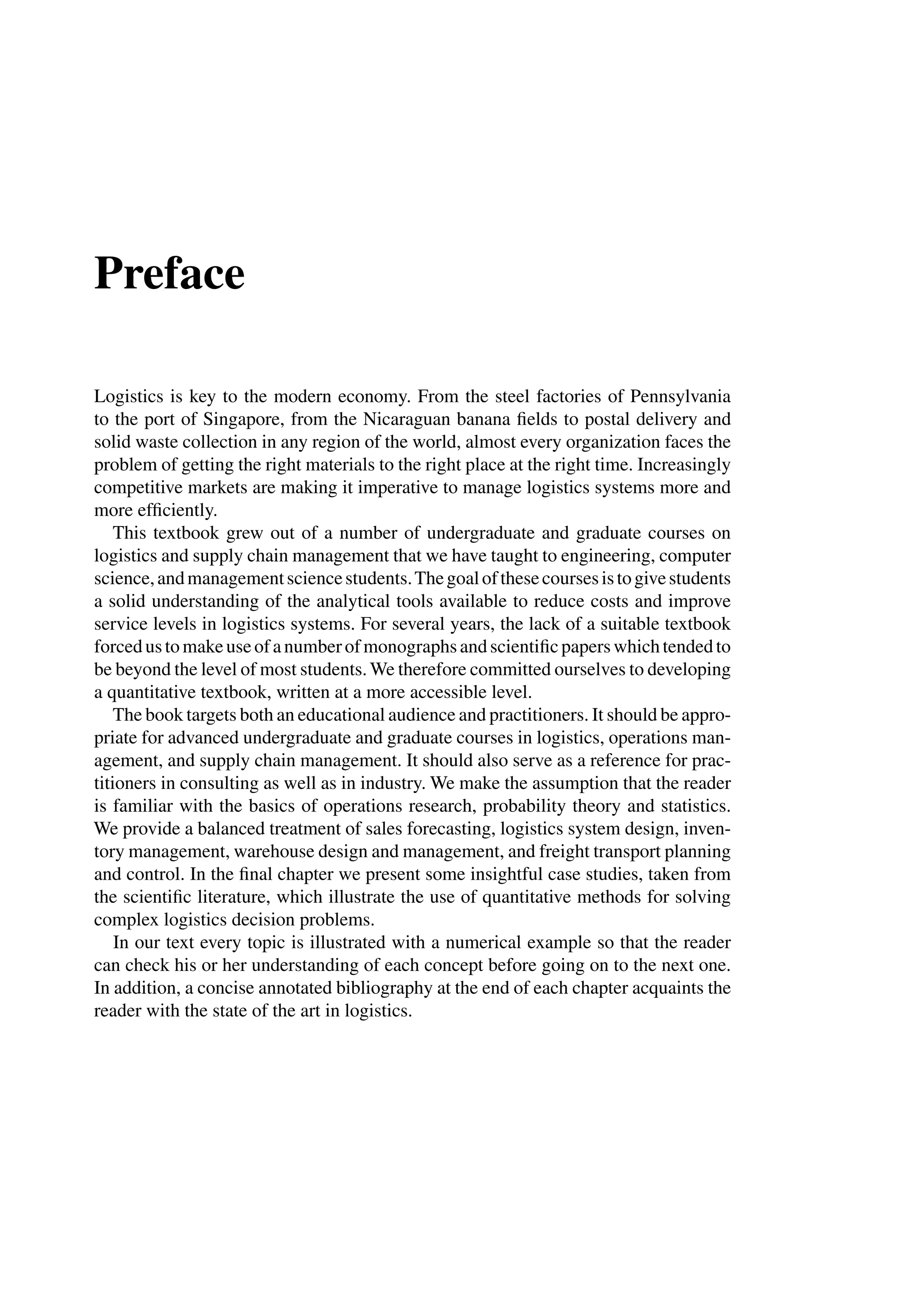
Preface
Logistics is key to the modern economy. From the steel factories of Pennsylvania
to the port of Singapore, from the Nicaraguan banana fields to postal delivery and
solid waste collection in any region of the world, almost every organization faces the
problem of getting the right materials to the right place at the right time. Increasingly
competitive markets are making it imperative to manage logistics systems more and
more efficiently.
This textbook grew out of a number of undergraduate and graduate courses on
logistics and supply chain management that we have taught to engineering, computer
science,andmanagementsciencestudents.Thegoalofthesecoursesistogivestudents
a solid understanding of the analytical tools available to reduce costs and improve
service levels in logistics systems. For several years, the lack of a suitable textbook
forcedustomakeuseofanumberofmonographsandscientificpaperswhichtendedto
be beyond the level of most students. We therefore committed ourselves to developing
a quantitative textbook, written at a more accessible level.
The book targets both an educational audience and practitioners. It should be appro-
priate for advanced undergraduate and graduate courses in logistics, operations man-
agement, and supply chain management. It should also serve as a reference for prac-
titioners in consulting as well as in industry. We make the assumption that the reader
is familiar with the basics of operations research, probability theory and statistics.
We provide a balanced treatment of sales forecasting, logistics system design, inven-
tory management, warehouse design and management, and freight transport planning
and control. In the final chapter we present some insightful case studies, taken from
the scientific literature, which illustrate the use of quantitative methods for solving
complex logistics decision problems.
In our text every topic is illustrated with a numerical example so that the reader
can check his or her understanding of each concept before going on to the next one.
In addition, a concise annotated bibliography at the end of each chapter acquaints the
reader with the state of the art in logistics.
Abbreviations
1-BP One-Dimensional Bin Packing
2-BP Two-Dimensional Bin Packing
3-BP Three-Dimensional Bin Packing
3PL Third Party Logistics
AP Assignment Problem
ARP Arc Routing Problem
AS/RS Automated Storage and Retrieval System
ATSP Asymmetric Travelling Salesman Problem
B2B Business To Business
B2C Business To Consumers
BF Best Fit
BFD Best Fit Decreasing
BL Bottom Left
CDC Central Distribution Centre
CPL Capacitated Plant Location
CPP Chinese Postman Problem
DC Distribution Centre
DDAP Dynamic Driver Assignment Problem
EDI Electronic Data Interchange
EOQ Economic Order Quantity
EU European Union
FBF Finite Best Fit
FCFS First Come First Served
FCND Fixed Charge Network Design
FF First Fit
FFD First Fit Decreasing
FFF Finite First Fit
GIS Geographic Information System
GDP Gross Domestic Product
GPS Global Positioning Systems
IP Integer Programming
ABBREVIATIONS xvii
IRP Inventory-Routing Problem
ITR Inventory Turnover Ratio
KPI Key Performance Indicator
LB Lower Bound
LFND Linear Fixed Charge Network Design
LMCF Linear Single-Commodity Minimum-Cost Flow
LMMCF Linear Multicommodity Minimum-Cost Flow
LP Linear Programming
LTL Less-Than-Truckload
MAD Mean Absolute Deviation
MAPD Mean Absolute Percentage Deviation
MIP Mixed-Integer Programming
MMCF Multicommodity Minimum-Cost Flow
MRP Manufacturing Resource Planning
MSrTP Minimum-cost Spanning r-Tree Problem
MSE Mean Squared Error
MTA Make-To-Assembly
MTO Make-To-Order
MTS Make-To-Stock
NAFTA North America Free Trade Agreement
NF Network Flow
NLP Nonlinear Programming
NMFC National Motor Freight Classification
NRP Node Routing Problem
NRPCL Node Routing Problem with Capacity and Length Constraints
NRPSC Node Routing Problem—Set Covering
NRPSP Node Routing Problem—Set Partitioning
NRSPTW Node Routing and Scheduling Problem With Time Windows
PCB Printed Circuit Board
POPITT Points Of Presence In The Territory
RDC Regional Distribution Centre
RPP Rural Postman Problem
RTSP Road Travelling Salesman Problem
S/R Storage And Retrieval
SC Set Covering
SCOR Supply Chain Operations References
SESC Single-Echelon Single-Commodity
SKU Stock Keeping Unit
SPL Simple Plant Location
STSP Symmetric Travelling Salesman Problem
TAP Traffic Assignment Problem
xviii ABBREVIATIONS
TEMC Two-Echelon Multicommodity
TEU Twenty-foot Equivalent Unit
TL Truckload
TS Tabu Search
TSP Travelling Salesman Problem
UB Upper Bound
VAP Vehicle Allocation Problem
VMR Vendor-Managed Resupplying
VRDP Vehicle Routing and Dispatching Problem
VRP Vehicle Routing Problem
VRSP Vehicle Routing and Scheduling Problem
W/RPS Walk/Ride and Pick Systems
ZIO Zero Inventory Ordering
Problems and Website
This textbook contains questions and problems at the end of every chapter. Some
are discussion questions while others focus on modelling or algorithmic issues. The
answers to these problems are available on the book’s website
http://wileylogisticsbook.dii.unile.it,
which also contains additional material (FAQs, software, further modelling exercises,
links to other websites, etc.).
Acknowledgements
We thank all the individuals and organizations who helped in one way or another to
produce this textbook. First and most of all, we would like to thank Professor Lucio
Grandinetti (University of Calabria) for his encouragement and support. We are grate-
ful to the reviewers whose comments were invaluable in improving the organization
and presentation of the book. We are also indebted to Fabio Fiscaletti (Pfizer Phar-
maceuticals Group) and Luca Lenzi (ExxonMobil Chemical), who provided several
helpful ideas. In addition, we thank HEC Montréal for its financial support. Our thanks
also go to Maria Teresa Guaglianone, Francesca Vocaturo and Sandro Zacchino for
their technical assistance, and to Nicole Paradis for carefully editing and proofreading
the material. Finally, the book would not have taken shape without the very capable
assistance of Rob Calver, our editor at Wiley.
About the Authors
Gianpaolo Ghiani isAssociate Professor of Operations Research at the University of
Lecce, Italy. His main research interests lie in the field of combinatorial optimization,
particularly in vehicle routing, location and layout problems. He has published in a
variety of journals, including Mathematical Programming, Operations Research Let-
ters,Networks,TransportationScience,OptimizationMethodsandSoftware,Comput-
ers and Operations Research, International Transactions in Operational Research,
European Journal of Operational Research, Journal of the Operational Research
Society, Parallel Computing and Journal of Intelligent Manufacturing Systems. His
doctoral thesis was awarded the Transportation Science Dissertation Award from
INFORMS in 1998. He is an editorial board member of Computers & Operations
Research.
Gilbert Laporte obtained his PhD in Operations Research at the London School
of Economics in 1975. He is Professor of Operations Research at HEC Montréal,
Director of the Canada Research Chair in Distribution Management, and Adjunct
Professor at the University of Alberta. He is also a member of GERAD, of the Centre
for Research on Transportation (serving as director from 1987 to 1991), and Fellow
of the Center for Management of Operations and Logistics, University of Texas at
Austin. He has authored or coauthored several books, as well as more than 225 sci-
entific articles in combinatorial optimization, mostly in the areas of vehicle routing,
location, districting and timetabling. He is the current editor of Computers & Opera-
tions Research and served as editor of Transportation Science from 1995 to 2002. He
has received many scientific awards including the Pergamon Prize (United Kingdom),
the Merit Award of the Canadian Operational Research Society, the CORS Practice
Prize on two occasions, the Jacques-Rousseau Prize for Interdisciplinarity, as well
as the President’s medal of the Operational Research Society (United Kingdom). In
1998 he became a member of the Royal Society of Canada.
Roberto Musmanno is Professor of Operations Research at the University of Cal-
abria, Italy. His major research interests lie in logistics, network optimization and
parallel computing. He has published in a variety of journals, including Operations
Research, Transportation Science, Computational Optimization and Applications,
Optimization Methods & Software, Journal of Optimization Theory and Applica-
tions, Optimization and Parallel Computing. He is also a member of the Scientific
Discovering Diverse Content Through
Random Scribd Documents
XVIII
History repeats itself all the time in Wall Street. Do you remember a
story I told you about covering my shorts at the time Stratton had
corn cornered? Well, another time I used practically the same tactics
in the stock market. The stock was Tropical Trading. I have made
money bulling it and also bearing it. It always was an active stock
and a favourite with adventurous traders. The inside coterie has
been accused time and again by the newspapers of being more
concerned over the fluctuations in the stock than with encouraging
permanent investment in it. The other day one of the ablest brokers
I know asserted that not even Daniel Drew in Erie or H. O.
Havemeyer in Sugar developed so perfect a method for milking the
market for a stock as President Mulligan and his friends have done in
Tropical Trading. Many times they have encouraged the bears to sell
TT short and then have proceeded to squeeze them with business-
like thoroughness. There was no more vindictiveness about the
process than is felt by a hydraulic press—or no more squeamishness,
either.
Of course, there have been people who have spoken about
certain “unsavory incidents” in the market career of TT stock. But I
dare say these critics were suffering from the squeezing. Why do the
room traders, who have suffered so often from the loaded dice of
the insiders, continue to go up against the game? Well, for one thing
they like action and they certainly get it in Tropical Trading. No
prolonged spells of dullness. No reasons asked or given. No time
wasted. No patience strained by waiting for the tipped movement to
begin. Always enough stock to go around—except when the short
interest is big enough to make the scarcity worthwhile. One born
every minute!
It so happened some time ago that I was in Florida on my usual
winter vacation. I was fishing and enjoying myself without any
thought of the markets excepting when we received a batch of
newspapers. One morning when the semi-weekly mail came in I
looked at the stock quotations and saw that Tropical Trading was
selling at 155. The last time I’d seen a quotation in it, I think, was
around 140. My opinion was that we were going into a bear market
and I was biding my time before going short of stocks. But there
was no mad rush. That was why I was fishing and out of hearing of
the ticker. I knew that I’d be back home when the real call came. In
the meanwhile nothing that I did or failed to do would hurry matters
a bit.
The behaviour of Tropical Trading was the outstanding feature of
the market, according to the newspapers I got that morning. It
served to crystallise my general bearishness because I thought it
particularly asinine for the insiders to run up the price of TT in the
face of the heaviness of the general list. There are times when the
milking process must be suspended. What is abnormal is seldom a
desirable factor in a trader’s calculations and it looked to me as if the
marking up of that stock were a capital blunder. Nobody can make
blunders of that magnitude with impunity; not in the stock market.
After I got through reading the newspapers I went back to my
fishing but I kept thinking of what the insiders in Tropical Trading
were trying to do. That they were bound to fail was as certain as
that a man is bound to smash himself if he jumps from the roof of a
twenty-story building without a parachute. I couldn’t think of
anything else and finally I gave up trying to fish and sent off a
telegram to my brokers to sell 2000 shares of TT at the market.
After that I was able to go back to my fishing. I did pretty well.
That afternoon I received the reply to my telegram by special
courier. My brokers reported that they had sold the 2000 shares of
Tropical Trading at 153. So far so good. I was selling short on a
declining market, which was as it should be. But I could not fish any
more. I was too far away from a quotation board. I discovered this
after I began to think of all the reasons why Tropical Trading should
go down with the rest of the market instead of going up on inside
manipulation. I therefore left my fishing camp and returned to Palm
Beach; or, rather, to the direct wire to New York.
The moment I got to Palm Beach and saw what the misguided
insiders were still trying to do, I let them have a second lot of 2000
TT. Back came the report and I sold another 2000 shares. The
market behaved excellently. That is, it declined on my selling.
Everything being satisfactory I went out and had a chair ride. But I
wasn’t happy. The more I thought the unhappier it made me to think
that I hadn’t sold more. So back I went to the broker’s office and
sold another 2000 shares.
I was happy only when I was selling that stock. Presently I was
short 10,000 shares. Then I decided to return to New York. I had
business to do now. My fishing I would do some other time.
When I arrived in New York I made it a point to get a line on the
company’s business, actual and prospective. What I learned
strengthened my conviction that the insiders had been worse than
reckless in jacking up the price at a time when such an advance was
not justified either by the tone of the general market or by the
company’s earnings.
The rise, illogical and ill-timed though it was, had developed
some public following and this doubtless encouraged the insiders to
pursue their unwise tactics. Therefore I sold more stock. The
insiders ceased their folly. So I tested the market again and again, in
accordance with my trading methods, until finally I was short 30,000
shares of the stock of the Tropical Trading Company. By then the
price was 133.
I had been warned that the TT insiders knew the exact
whereabouts of every stock certificate in the Street and the precise
dimensions and identity of the short interest as well as other facts of
tactical importance. They were able men and shrewd traders.
Altogether it was a dangerous combination to go up against. But
facts are facts and the strongest of all allies are conditions.
Of course, on the way down from 153 to 133 the short interest
had grown and the public that buys on reactions began to argue as
usual: That stock had been considered a good purchase at 153 and
higher. Now 20 points lower, it was necessarily a much better
purchase. Same stock; same dividend rate; same officers; same
business. Great bargain!
The public’s purchases reduced the floating supply and the
insiders, knowing that a lot of room traders were short, thought the
time propitious for a squeezing. The price was duly run up to 150. I
daresay there was plenty of covering but I stayed pat. Why shouldn’t
I? The insiders might know that a short line of 30,000 shares had
not been taken in but why should that frighten me? The reasons that
had impelled me to begin selling at 153 and keep at it on the way
down to 133, not only still existed but were stronger than ever. The
insiders might desire to force me to cover but they adduced no
convincing arguments. Fundamental conditions were fighting for me.
It was not difficult to be both fearless and patient. A speculator must
have faith in himself and in his judgment. The late Dickson G. Watts,
ex-President of the New York Cotton Exchange and famous author of
“Speculation as a Fine Art,” says that courage in a speculator is
merely confidence to act on the decision of his mind. With me, I
cannot fear to be wrong because I never think I am wrong until I am
proven wrong. In fact, I am uncomfortable unless I am capitalising
my experience. The course of the market at a given time does not
necessarily prove me wrong. It is the character of the advance—or
of the decline—that determines for me the correctness or the fallacy
of my market position. I can only rise by knowledge. If I fall it must
be by my own blunders.
There was nothing in the character of the rally from 133 to 150
to frighten me into covering and presently the stock, as was to be
expected, started down again. It broke 140 before the inside clique
began to give it support. Their buying was coincident with a flood of
bull rumors about the stock. The company, we heard, was making
perfectly fabulous profits, and the earnings justified an increase in
the regular dividend rate. Also, the short interest was said to be
perfectly huge and the squeeze of the century was about to be
inflicted on the bear party in general and in particular on a certain
operator who was more than over-extended. I couldn’t begin to tell
you all I heard as they ran the price up ten points.
The manipulation did not seem particularly dangerous to me but
when the price touched 149 I decided that it was not wise to let the
Street accept as true all the bull statements that were floating
around. Of course, there was nothing that I or any other rank
outsider could say that would carry conviction either to the
frightened shorts or to those credulous customers of commission
houses that trade on hearsay tips. The most effective retort
courteous is that which the tape alone can print. People will believe
that when they will not believe an affidavit from any living man,
much less one from a chap who is short 30,000 shares. So I used
the same tactics that I did at the time of the Stratton corner in corn,
when I sold oats to make the traders bearish on corn. Experience
and memory again.
When the insiders jacked up the price of Tropical Trading with a
view to frightening the shorts I didn’t try to check the rise by selling
that stock. I was already short 30,000 shares of it which was as big
a percentage of the floating supply as I thought wise to be short of.
I did not propose to put my head into the noose so obligingly held
open for me—the second rally was really an urgent invitation. What I
did when TT touched 149 was to sell about 10,000 shares of
Equatorial Commercial Corporation. This company owned a large
block of Tropical Trading.
Equatorial Commercial, which was not as active a stock as TT,
broke badly on my selling, as I had foreseen; and, of course, my
purpose was achieved. When the traders—and the customers of the
commission houses who had listened to the uncontradicted bull dope
on TT—saw that the rise in Tropical synchronised with heavy selling
and a sharp break in Equatorial, they naturally concluded that the
strength of TT was merely a smoke-screen—a manipulated advance
obviously designed to facilitate inside liquidation in Equatorial
Commercial, which was largest holder of TT stock. It must be both
long stock and inside stock in Equatorial, because no outsider would
dream of selling so much short stock at the very moment when
Tropical Trading was so very strong. So they sold Tropical Trading
and checked the rise in that stock, the insiders very properly not
wishing to take all the stock that was pressed for sale. The moment
the insiders took away their support the price of TT declined. The
traders and principal commission houses now sold some Equatorial
also and I took in my short line in that at a small profit. I hadn’t sold
it to make money out of the operation but to check the rise in TT.
Time and again the Tropical Trading insiders and their hard-
working publicity man flooded the Street with all manner of bull
items and tried to put up the price. And every time they did I sold
Equatorial Commercial short and covered it with TT reacted and
carried EC with it. It took the wind out of the manipulators’ sails.
The price of TT finally went down to 125 and the short interest really
grew so big that the insiders were enabled to run it up 20 or 25
points. This time it was a legitimate enough drive against an over-
extended short interest; but while I foresaw the rally I did not cover,
not wishing to lose my position. Before Equatorial Commercial could
advance in sympathy with the rise in TT I sold a raft of it short—with
the usual results. This gave the lie to the bull talk in TT which had
got quite boisterous after the latest sensational rise.
By this time the general market had grown quite weak. As I told
you, it was the conviction that we were in a bear market that started
me selling TT short in the fishing-camp in Florida. I was short of
quite a few other stocks but TT was my pet. Finally, general
conditions proved too much for the inside clique to defy and TT hit
the toboggan slide. It went below 120 for the first time in years;
then below 110; below par; and still I did not cover. One day when
the entire market was extremely weak Tropical Trading broke 90 and
on the demoralisation I covered. Same old reason! I had the
opportunity—the big market and the weakness and the excess of
sellers over buyers. I may tell you, even at the risk of appearing to
be monotonously bragging of my cleverness, that I took in my
30,000 shares of TT at practically the lowest prices of the
movement. But I wasn’t thinking of covering at the bottom. I was
intent on turning my paper profits into cash without losing much of
the profit in the changing.
I stood pat throughout because I knew my position was sound. I
wasn’t bucking the trend of the market or going against basic
conditions but the reverse, and that was what made me so sure of
the failure of an over-confident inside clique. What they tried to do
others had tried before and it had always failed. The frequent rallies,
even when I knew as well as anybody that they were due, could not
frighten me. I knew I’d do much better in the end by staying pat
than by trying to cover to put out a new short line at a higher price.
By sticking to the position that I felt was right I made over a million
dollars. I was not indebted to hunches or to skillful tape reading or
to stubborn courage. It was a dividend declared by my faith in my
judgment and not by my cleverness or by my vanity. Knowledge is
power and power need not fear lies—not even when the tape prints
them. The retraction follows pretty quickly.
A year later, TT was jacked up again to 150 and hung around
there for a couple of weeks. The entire market was entitled to a
good reaction for it had risen uninterruptedly and it did not bull any
longer. I know because I tested it. Now, the group to which TT
belonged had been suffering from very poor business and I couldn’t
see anything to bull those stocks on anyhow, even if the rest of the
market were due for a rise, which it wasn’t. So I began to sell
Tropical Trading. I intended to put out 10,000 shares in all. The price
broke on my selling. I couldn’t see that there was any support
whatever. Then suddenly, the character of the buying changed.
I am not trying to make myself out a wizard when I assure you
that I could tell the moment support came in. It instantly struck me
that if the insiders in that stock, who never felt a moral obligation to
keep the price up, were now buying the stock in the face of a
declining general market there must be a reason. They were not
ignorant asses nor philanthropists nor yet bankers concerned with
keeping the price up to sell more securities over the counter. The
price rose notwithstanding my selling and the selling of others. At
153 I covered my 10,000 shares and at 156 I actually went long
because by that time the tape told me the line of least resistance
was upward. I was bearish on the general market but I was
confronted by a trading condition in a certain stock and not by a
speculative theory in general. The price went out of sight, above
200. It was the sensation of the year. I was flattered by reports
spoken and printed that I had been squeezed out of eight or nine
millions of dollars. As a matter of fact, instead of being short I was
long of TT all the way up. In fact, I held on a little too long and let
some of my paper profits get away. Do you wish to know why I did?
Because I thought the TT insiders would naturally do what I would
have done had I been in their place. But that was something I had
no business to think because my business is to trade—that is, to
stick to the facts before me and not to what I think other people
ought to do.
XIX
I do not know when or by whom the word “manipulation” was first
used in connection with what really are no more than common
merchandising processes applied to the sale in bulk of securities on
the Stock Exchange. Rigging the market to facilitate cheap
purchases of a stock which it is desired to accumulate is also
manipulation. But it is different. It may not be necessary to stoop to
illegal practices, but it would be difficult to avoid doing what some
would think illegitimate. How are you going to buy a big block of a
stock in a bull market without putting up the price on yourself? That
would be the problem. How can it be solved? It depends upon so
many things that you can’t give a general solution unless you say:
possibly by means of very adroit manipulation. For instance? Well, it
would depend upon conditions. You can’t give any closer answer
than that.
I am profoundly interested in all phases of my business, and of
course I learn from the experience of others as well as from my
own. But it is very difficult to learn how to manipulate stocks to-day
from such yarns as are told of an afternoon in the brokers’ offices
after the close. Most of the tricks, devices and expedients of bygone
days are obsolete and futile; or illegal and impracticable. Stock
Exchange rules and conditions have changed, and the story—even
the accurately detailed story—of what Daniel Drew or Jacob Little or
Jay Gould could do fifty or seventy-five years ago is scarcely worth
listening to. The manipulator to-day has no more need to consider
what they did and how they did it than a cadet at West Point need
study archery as practiced by the ancients in order to increase his
working knowledge of ballistics.
On the other hand there is profit in studying the human factors
—the ease with which human beings believe what it pleases them to
believe; and how they allow themselves—indeed, urge themselves—
to be influenced by their cupidity or by the dollar-cost of the average
man’s carelessness. Fear and hope remain the same; therefore the
study of the psychology of speculators is as valuable as it ever was.
Weapons change, but strategy remains strategy, on the New York
Stock Exchange as on the battlefield. I think the clearest summing
up of the whole thing was expressed by Thomas F. Woodlock when
he declared: “The principles of successful stock speculation are
based on the supposition that people will continue in the future to
make the mistakes that they have made in the past.”
In booms, which is when the public is in the market in the
greatest numbers, there is never any need of subtlety, so there is no
sense of wasting time discussing either manipulation or speculation
during such times; it would be like trying to find the difference in
raindrops that are falling synchronously on the same roof across the
street. The sucker has always tried to get something for nothing,
and the appeal in all booms is always frankly to the gambling instinct
aroused by cupidity and spurred by a pervasive prosperity. People
who look for easy money invariably pay for the privilege of proving
conclusively that it cannot be found on this sordid earth. At first,
when I listened to the accounts of old-time deals and devices I used
to think that people were more gullible in the 1860’s and ’70’s than
in the 1900’s. But I was sure to read in the newspapers that very
day or the next something about the latest Ponzi or the bust-up of
some bucketing broker and about the millions of sucker money gone
to join the silent majority of vanished savings.
When I first came to New York there was a great fuss made
about wash sales and matched orders, for all that such practices
were forbidden by the Stock Exchange. At times the washing was
too crude to deceive anyone. The brokers had no hesitation in
saying that “the laundry was active” whenever anybody tried to
wash up some stock or other, and, as I have said before, more than
once they had what were frankly referred to as “bucket-shop drives,”
when a stock was offered down two or three points in a jiffy just to
establish the decline on the tape and wipe up the myriad shoe-string
traders who were long of the stock in the bucket shops. As for
matched orders, they were always used with some misgivings by
reason of the difficulty of coordinating and synchronising operations
by brokers, all such business being against Stock Exchange rules. A
few years ago a famous operator canceled the selling but not the
buying part of his matched orders, and the result was that an
innocent broker ran up the price twenty-five points or so in a few
minutes, only to see it break with equal celerity as soon as his
buying ceased. The original intention was to create an appearance of
activity. Bad business, playing with such unreliable weapons. You
see, you can’t take your best brokers into your confidence—not if
you want them to remain members of the New York Stock Exchange.
Then also, the taxes have made all practices involving fictitious
transactions much more expensive than they used to be in the old
times.
The dictionary definition of manipulation includes corners. Now,
a corner might be the result of manipulation or it might be the result
of competitive buying, as, for instance, the Northern Pacific corner
on May 9, 1901, which certainly was not manipulation. The Stutz
corner was expensive to everybody concerned, both in money and in
prestige. And it was not a deliberately engineered corner, at that.
As a matter of fact very few of the great corners were profitable
to the engineers of them. Both Commodore Vanderbilt’s Harlem
corners paid big, but the old chap deserved the millions he made out
of a lot of short sports, crooked legislators and aldermen who tried
to double-cross him. On the other hand, Jay Gould lost in his
Northwestern corner. Deacon S. V. White made a million in his
Lackawanna corner, but Jim Keene dropped a million in the Hannibal
& St. Joe deal. The financial success of a corner of course depends
upon the marketing of the accumulated holdings at higher than cost,
and the short interest has to be of some magnitude for that to
happen easily.
I used to wonder why corners were so popular among the big
operators of a half-century ago. They were men of ability and
experience, wide-awake and not prone to childlike trust in the
philanthropy of their fellow traders. Yet they used to get stung with
an astonishing frequency. A wise old broker told me that all the big
operators of the ’60’s and ’70’s had one ambition, and that was to
work a corner. In many cases this was the offspring of vanity; in
others, of the desire for revenge. At all events, to be pointed out as
the man who had successfully cornered this or the other stock was
in reality recognition of brains, boldness and boodle. It gave the
cornerer the right to be haughty. He accepted the plaudits of his
fellows as fully earned. It was more than the prospective money
profit that prompted the engineers of corners to do their damnedest.
It was the vanity complex asserting itself among cold-blooded
operators.
Dog certainly ate dog in those days with relish and ease. I think
I told you before that I have managed to escape being squeezed
more than once, not because of the possession of a mysterious
ticker-sense but because I can generally tell the moment the
character of the buying in the stock makes it imprudent for me to be
short of it. This I do by common-sense tests, which must have been
tried in the old times also. Old Daniel Drew used to squeeze the boys
with some frequency and make them pay high prices for the Erie
“sheers” they had sold short to him. He was himself squeezed by
Commodore Vanderbilt in Erie, and when old Drew begged for mercy
the Commodore grimly quoted the Great Bear’s own deathless
distich:
He that sells what isn’t hisn
Must buy it back or go to prisn.
Wall Street remembers very little of an operator who for more
than a generation was one of its Titans. His chief claim to
immortality seems to be the phrase “watering stock.”
Addison G. Jerome was the acknowledged king of the Public
Board in the spring of 1863. His market tips, they tell me, were
considered as good as cash in bank. From all accounts he was a
great trader and made millions. He was liberal, to the point of
extravagance and had a great following in the Street—until Henry
Keep, known as William the Silent, squeezed him out of all his
millions in the Old Southern corner. Keep, by the way, was the
brother-in-law of Gov. Roswell P. Flower.
In most of the old corners the manipulation consisted chiefly of
not letting the other man know that you were cornering the stock
which he was variously invited to sell short. It therefore was aimed
chiefly at fellow professionals, for the general public does not take
kindly to the short side of the account. The reasons that prompted
these wise professionals to put out short lines in such stocks were
pretty much the same as prompts them to do the same thing to-day.
Apart from the selling by faith-breaking politicians in the Harlem
corner of the Commodore, I gather from the stories I have read that
the professional traders sold the stock because it was too high. And
the reason they thought it was too high was that it never before had
sold so high; and that made it too high to buy; and if it was too high
to buy it was just right to sell. That sounds pretty modern, doesn’t
it? They were thinking of the price, and the Commodore was
thinking of the value! And so, for years afterwards, old-timers tell me
that people used to say, “He went short of Harlem!” whenever they
wished to describe abject poverty.
Many years ago I happened to be speaking to one of Jay Gould’s
old brokers. He assured me earnestly that Mr. Gould not only was a
most unusual man—it was of him that old Daniel Drew shiveringly
remarked, “His touch is Death!”—but that he was head and
shoulders above all other manipulators past and present. He must
have been a financial wizard indeed to have done what he did; there
can be no question of that. Even at this distance I can see that he
had an amazing knack for adapting himself to new conditions, and
that is valuable in a trader. He varied his methods of attack and
defense without a pang because he was more concerned with the
manipulation of properties than with stock speculation. He
manipulated for investment rather than for a market turn. He early
saw that the big money was in owning the railroads instead of
rigging their securities on the floor of the Stock Exchange. He
utilised the stock market of course. But I suspect it was because that
was the quickest and easiest way to quick and easy money and he
needed many millions, just as old Collis P. Huntington was always
hard up because he always needed twenty or thirty millions more
than the bankers were willing to lend him. Vision without money
means heartaches; with money, it means achievement; and that
means power; and that means money; and that means
achievement; and so on, over and over and over.
Of course manipulation was not confined to the great figures of
those days. There were scores of minor manipulators. I remember a
story an old broker told me about the manners and morals of the
early ’60’s. He said:
“The earliest recollection I have of Wall Street is of my first visit
to the financial district. My father had some business to attend to
there and for some reason or other took me with him. We came
down Broadway and I remember turning off at Wall Street. We
walked down Wall and just as we came to Broad or, rather, Nassau
Street, to the corner where the Bankers’ Trust Company’s building
now stands, I saw a crowd following two men. The first was walking
eastward, trying to look unconcerned. He was followed by the other,
a red-faced man who was wildly waving his hat with one hand and
shaking the other fist in the air. He was yelling to beat the band:
‘Shylock! Shylock! What’s the price of money? Shylock! Shylock!’ I
could see heads sticking out of windows. They didn’t have
skyscrapers in those days, but I was sure the second- and third-
story rubbernecks would tumble out. My father asked what was the
matter, and somebody answered something I didn’t hear. I was too
busy keeping a death clutch on my father’s hand so that the jostling
wouldn’t separate us. The crowd was growing, as street crowds do,
and I wasn’t comfortable. Wild-eyed men came running down from
Nassau Street and up from Broad as well as east and west on Wall
Street. After we finally got out of the jam my father explained to me
that the man who was shouting ‘Shylock’ was So-and-So. I have
forgotten the name, but he was the biggest operator in clique stocks
in the city and was understood to have made—and lost—more
money than any other man in Wall Street with the exception of
Jacob Little. I remember Jacob Little’s name because I thought it
was a funny name for a man to have. The other man, the Shylock,
was a notorious locker-up of money. His name has also gone from
me. But I remember he was tall and thin and pale. In those days the
cliques used to lock up money by borrowing it or, rather, by reducing
the amount available to Stock Exchange borrowers. They would
borrow it and get a certified check. They wouldn’t actually take the
money out and use it. Of course that was rigging. It was a form of
manipulation, I think.”
I agree with the old chap. It was a phase of manipulation that
we don’t have nowadays.
XX
I myself never spoke to any of the great stock manipulators that the
Street still talks about. I don’t mean leaders; I mean manipulators.
They were all before my time, although when I first came to New
York, James R. Keene, greatest of them all, was in his prime. But I
was a mere youngster then, exclusively concerned with duplicating,
in a reputable broker’s office, the success I had enjoyed in the
bucket shops of my native city. And, then, too, at the time Keene
was busy with the U.S. Steel stocks—his manipulative masterpiece—
I had no experience with manipulation, no real knowledge of it or of
its value or meaning, and, for that matter, no great need of such
knowledge. If I thought about it at all I suppose I must have
regarded it as a well-dressed form of thimble-rigging, of which the
lowbrow form was such tricks as had been tried on me in the bucket
shops. Such talk as I since have heard on the subject has consisted
in great part of surmises and suspicions; of guesses rather than
intelligent analyses.
More than one man who knew him well has told me that Keene
was the boldest and most brilliant operator that ever worked in Wall
Street. That is saying a great deal, for there have been some great
traders. Their names are now all but forgotten, but nevertheless
they were kings in their day—for a day! They were pulled up out of
obscurity into the sunlight of financial fame by the ticker tape—and
the little paper ribbon didn’t prove strong enough to keep them
suspended there long enough for them to become historical fixtures.
At all events Keene was by all odds the best manipulator of his day—
and it was a long and exciting day.
He capitalized his knowledge of the game, his experience as an
operator and his talents when he sold his services to the Havemeyer
brothers, who wanted him to develop a market for the Sugar stocks.
He was broke at the time or he would have continued to trade on his
own hook; and he was some plunger! He was successful with Sugar;
made the shares trading favourites, and that made them easily
vendible. After that, he was asked time and again to take charge of
pools. I am told that in these pool operations he never asked nor
accepted a fee, but paid for his share like the other members of the
pool. The market conduct of the stock, of course, was exclusively in
his charge. Often there was talk of treachery—on both sides. His
feud with the Whitney-Ryan clique arose from such accusations. It is
not difficult for a manipulator to be misunderstood by his associates.
They don’t see his needs as he himself does. I know this from my
own experience.
It is a matter of regret that Keene did not leave an accurate
record of his greatest exploit—the successful manipulation of the
U.S. Steel shares in the spring of 1901. As I understand it, Keene
never had an interview with J. P. Morgan about it. Morgan’s firm
dealt with or through Talbot J. Taylor & Co., at whose office Keene
made his headquarters. Talbot Taylor was Keene’s son-in-law. I am
assured that Keene’s fee for his work consisted of the pleasure he
derived from the work. That he made millions trading in the market
he helped to put up that spring is well known. He told a friend of
mine that in the course of a few weeks he sold in the open market
for the underwriters’ syndicate more than seven hundred and fifty
thousand shares. Not bad when you consider two things: That they
were new and untried stocks of a corporation whose capitalization
was greater than the entire debt of the United States at that time;
and second, that men like D. G. Reid, W. B. Leeds, the Moore
brothers, Henry Phipps, H. C. Frick and the other Steel magnates
also sold hundreds of thousands of shares to the public at the same
time in the same market that Keene helped to create.
Of course, general conditions favoured him. Not only actual
business but sentiment and his unlimited financial backing made
possible his success. What we had was not merely a big bull market
but a boom and a state of mind not likely to be seen again. The
undigested-securities panic came later, when Steel common, which
Keene had marked up to 55 in 1901, sold at 10 in 1903 and at 8⅞ in
1904.
We can’t analyse Keene’s manipulative campaigns. His books are
not available; the adequately detailed record is nonexistent. For
example, it would be interesting to see how he worked in
Amalgamated Copper. H. H. Rogers and William Rockefeller had tried
to dispose of their surplus stock in the market and had failed. Finally
they asked Keene to market their line, and he agreed. Bear in mind
that H. H. Rogers was one of the ablest business men of his day in
Wall Street and that William Rockefeller was the boldest speculator
of the entire Standard Oil coterie. They had practically unlimited
resources and vast prestige as well as years of experience in the
stock-market game. And yet they had to go to Keene. I mention this
to show you that there are some tasks which it requires a specialist
to perform. Here was a widely touted stock, sponsored by America’s
greatest capitalists, that could not be sold except at a great sacrifice
of money and prestige. Rogers and Rockefeller were intelligent
enough to decide that Keene alone might help them.
Keene began to work at once. He had a bull market to work in
and sold two hundred and twenty thousand shares of Amalgamated
at around par. After he disposed of the insiders’ line the public kept
on buying and the price went ten points higher. Indeed the insiders
got bullish on the stock they had sold when they saw how eagerly
the public was taking it. There was a story that Rogers actually
advised Keene to go long of Amalgamated. It is scarcely credible
that Rogers meant to unload on Keene. He was too shrewd a man
not to know that Keene was no bleating lamb. Keene worked as he
always did—that is, doing his big selling on the way down after the
big rise. Of course his tactical moves were directed by his needs and
by the minor currents that changed from day to day. In the stock
market, as in warfare, it is well to keep in mind the difference
between strategy and tactics.
One of Keene’s confidential men—he is the best fly fisherman I
know—told me only the other day that during the Amalgamated
campaign Keene would find himself almost out of stock one day—
that is, out of the stock he had been forced to take in marking up
the price; and on the next day he would buy back thousands of
shares. On the day after that, he would sell on balance. Then he
would leave the market absolutely alone, to see how it would take
care of itself and also to accustom it to do so. When it came to the
actual marketing of the line he did what I told you: he sold it on the
way down. The trading public is always looking for a rally, and,
besides, there is the covering by the shorts.
The man who was closest to Keene during that deal told me that
after Keene sold the Rogers-Rockefeller line for something like
twenty or twenty-five million dollars in cash Rogers sent him a check
for two hundred thousand. This reminds you of the millionaire’s wife
who gave the Metropolitan Opera House scrub-woman fifty cents
reward for finding the one-hundred-thousand-dollar pearl necklace.
Keene sent the check back with a polite note saying he was not a
stock broker and that he was glad to have been of some service to
them. They kept the check and wrote him that they would be glad to
work with him again. Shortly after that it was that H. H. Rogers gave
Keene the friendly tip to buy Amalgamated at around 130!
A brilliant operator, James R. Keene! His private secretary told
me that when the market was going his way Mr. Keene was irascible;
and those who knew him say his irascibility was expressed in
sardonic phrases that lingered long in the memory of his hearers.
But when he was losing he was in the best of humour, a polished
man of the world, agreeable, epigrammatic, interesting.
He had in superlative degree the qualities of mind that are
associated with successful speculators anywhere. That he did not
argue with the tape is plain. He was utterly fearless but never
reckless. He could and did turn in a twinkling, if he found he was
wrong.
Since his day there have been so many changes in Stock
Exchange rules and so much more rigorous enforcement of old rules,
so many new taxes on stock sales and profits, and so on, that the
game seems different. Devices that Keene could use with skill and
profit can no longer be utilised. Also, we are assured, the business
morality of Wall Street is on a higher plane. Nevertheless it is fair to
say that in any period of our financial history Keene would have
been a great manipulator because he was a great stock operator and
knew the game of speculation from the ground up. He achieved
what he did because conditions at the time permitted him to do so.
He would have been as successful in his undertakings in 1922 as he
was in 1901 or in 1876, when he first came to New York from
California and made nine million dollars in two years. There are men
whose gait is far quicker than the mob’s. They are bound to lead—
no matter how much the mob changes.
As a matter of fact, the change is by no means as radical as
you’d imagine. The rewards are not so great, for it is no longer
pioneer work and therefore it is not pioneer’s pay. But in certain
respects manipulation is easier than it was; in other ways much
harder than in Keene’s day.
There is no question that advertising is an art, and manipulation
is the art of advertising through the medium of the tape. The tape
should tell the story the manipulator wishes its readers to see. The
truer the story the more convincing it is bound to be, and the more
convincing it is the better the advertising is. A manipulator to-day,
for instance, has not only to make a stock look strong but also to
make it be strong. Manipulation therefore must be based on sound
trading principles. That is what made Keene such a marvellous
manipulator; he was a consummate trader to begin with.
The word “manipulation” has come to have an ugly sound. It
needs an alias. I do not think there is anything so very mysterious or
crooked about the process itself when it has for an object the selling
of a stock in bulk, provided, of course, that such operations are not
accompanied by misrepresentation. There is little question that a
manipulator necessarily seeks his buyers among speculators. He
turns to men who are looking for big returns on their capital and are
therefore willing to run a greater than normal business risk. I can’t
have much sympathy for the man who, knowing this, nevertheless
blames others for his own failure to make easy money. He is a devil
of a clever fellow when he wins. But when he loses money the other
fellow was a crook; a manipulator! In such moments and from such
lips the word connotes the use of marked cards. But this is not so.
Usually the object of manipulation is to develop marketability—
that is, the ability to dispose of fair-sized blocks at some price at any
time. Of course a pool, by reason of a reversal of general market
conditions, may find itself unable to sell except at a sacrifice too
great to be pleasing. They then may decide to employ a
professional, believing that his skill and experience will enable him to
conduct an orderly retreat instead of suffering an appalling rout.
You will notice that I do not speak of manipulation designed to
permit considerable accumulation of a stock as cheaply as possible,
as, for instance, in buying for control, because this does not happen
often nowadays.
When Jay Gould wished to cinch his control of Western Union
and decided to buy a big block of the stock, Washington E. Connor,
who had not been seen on the floor of the Stock Exchange for years,
suddenly showed up in person at the Western Union Post. He began
to bid for Western Union. The traders to a man laughed—at his
stupidity in thinking them so simple—and they cheerfully sold him all
the stock he wanted to buy. It was too raw a trick, to think he could
put up the price by acting as though Mr. Gould wanted to buy
Western Union. Was that manipulation? I think I can only answer
that by saying “No; and yes!”
In the majority of cases the object of manipulation is, as I said,
to sell stock to the public at the best possible price. It is not alone a
question of selling but of distributing. It is obviously better in every
way for a stock to be held by a thousand people than by one man—
better for the market in it. So it is not alone the sale at a good price
but the character of the distribution that a manipulator must
consider.
There is no sense in marking up the price to a very high level if
you cannot induce the public to take it off your hands later.
Whenever inexperienced manipulators try to unload at the top and
fail, old-timers look mighty wise and tell you that you can lead a
horse to water but you cannot make him drink. Original devils! As a
matter of fact, it is well to remember a rule of manipulation, a rule
that Keene and his able predecessors well knew. It is this: Stocks are
manipulated to the highest point possible and then sold to the public
on the way down.
Let me begin at the beginning. Assume that there is some one—
an underwriting syndicate or a pool or an individual—that has a
block of stock which it is desired to sell at the best price possible. It
is a stock duly listed on the New York Stock Exchange. The best
place for selling it ought to be the open market, and the best buyer
ought to be the general public. The negotiations for the sale are in
charge of a man. He—or some present or former associate—has
tried to sell the stock on the Stock Exchange and has not succeeded.
He is—or soon becomes—sufficiently familiar with stock-market
operations to realise that more experience and greater aptitude for
the work are needed than he possesses. He knows personally or by
hearsay several men who have been successful in their handling of
similar deals, and he decides to avail himself of their professional
skill. He seeks one of them as he would seek a physician if he were
ill or an engineer if he needed that kind of expert.
Suppose he has heard of me as a man who knows the game.
Well, I take it that he tries to find out all he can about me. He then
arranges for an interview, and in due time calls at my office.
Of course, the chances are that I know about the stock and
what it represents. It is my business to know. That is how I make
my living. My visitor tells me what he and his associates wish to do,
and asks me to undertake the deal.
It is then my turn to talk. I ask for whatever information I deem
necessary to give me a clear understanding of what I am asked to
undertake. I determine the value and estimate the market
possibilities of that stock. That and my reading of current conditions
in turn help me to gauge the likelihood of success for the proposed
operation.
If my information inclines me to a favourable view I accept the
proposition and tell him then and there what my terms will be for my
services. If he in turn accepts my terms—the honorarium and the
conditions—I begin my work at once.
I generally ask and receive calls on a block of stock. I insist upon
graduated calls as the fairest to all concerned. The price of the call
begins at a little below the prevailing market price and goes up; say,
for example, that I get calls on one hundred thousand shares and
the stock is quoted at 40. I begin with a call for some thousands of
shares at 35, another at 37, another at 40, and at 45 and 50, and so
on up to 75 or 80.
If as the result of my professional work—my manipulation—the
price goes up, and if at the highest level there is a good demand for
the stock so that I can sell fair-sized blocks of it I of course call the
stock. I am making money; but so are my clients making money.
This is as it should be. If my skill is what they are paying for they
ought to get value. Of course, there are times when a pool may be
wound up at a loss, but that is seldom, for I do not undertake the
work unless I see my way clear to a profit. This year I was not so
fortunate in one or two deals, and I did not make a profit. There are
reasons, but that is another story, to be told later—perhaps.
The first step in a bull movement in a stock is to advertise the
fact that there is a bull movement on. Sounds silly, doesn’t it? Well,
think a moment. It isn’t as silly as it sounded, is it? The most
effective way to advertise what, in effect, are your honourable
intentions is to make the stock active and strong. After all is said and
done, the greatest publicity agent in the wide world is the ticker, and
by far the best advertising medium is the tape. I do not need to put
out any literature for my clients. I do not have to inform the daily
press as to the value of the stock or to work the financial reviews for
notices about the company’s prospects. Neither do I have to get a
following. I accomplish all these highly desirable things by merely
making the stock active. When there is activity there is a
synchronous demand for explanations; and that means, of course,
that the necessary reasons—for publication—supply themselves
without the slightest aid from me.
Activity is all that the floor traders ask. They will buy or sell any
stock at any level if only there is a free market for it. They will deal
in thousands of shares wherever they see activity, and their
aggregate capacity is considerable. It necessarily happens that they
constitute the manipulator’s first crop of buyers. They will follow you
all the way up and they thus are a great help at all the stages of the
operation. I understand that James R. Keene used habitually to
employ the most active of the room traders, both to conceal the
source of the manipulation and also because he knew that they were
by far the best business-spreaders and tip-distributors. He often
gave calls to them—verbal calls—above the market, so that they
might do some helpful work before they could cash in. He made
them earn their profit. To get a professional following I myself have
never had to do more than to make a stock active. Traders don’t ask
for more. It is well, of course, to remember that these professionals
on the floor of the Exchange buy stocks with the intention of selling
them at a profit. They do not insist on its being a big profit; but it
must be a quick profit.
I make the stock active in order to draw the attention of
speculators to it, for the reasons I have given. I buy it and I sell it
and the traders follow suit. The selling pressure is not apt to be
strong where a man has as much speculatively held stock sewed up
—in calls—as I insist on having. The buying, therefore, prevails over
the selling, and the public follows the lead not so much of the
manipulator as of the room traders. It comes in as a buyer. This
highly desirable demand I fill—that is, I sell stock on balance. If the
demand is what it ought to be it will absorb more than the amount
of stock I was compelled to accumulate in the earlier stages of the
manipulation; and when this happens I sell the stock short—that is,
technically. In other words, I sell more stock than I actually hold. It
is perfectly safe for me to do so since I am really selling against my
calls. Of course, when the demand from the public slackens, the
stock ceases to advance. Then I wait.
Say, then, that the stock has ceased to advance. There comes a
weak day. The entire market may develop a reactionary tendency or
some sharp-eyed trader may perceive that there are no buying
orders to speak of in my stock, and he sells it, and his fellows follow.
Whatever the reason may be, my stock starts to go down. Well, I
begin to buy it. I give it the support that a stock ought to have if it is
in good odour with its own sponsors. And more: I am able to
support it without accumulating it—that is, without increasing the
amount I shall have to sell later on. Observe that I do this without
decreasing my financial resources. Of course what I am really doing
is covering stock I sold short at higher prices when the demand from
the public or from the traders or from both enabled me to do it. It is
always well to make it plain to the traders—and to the public, also—
that there is a demand for the stock on the way down. That tends to
check both reckless short selling by the professionals and liquidation
by frightened holders—which is the selling you usually see when a
stock gets weaker and weaker, which in turn is what a stock does
when it is not supported. These covering purchases of mine
constitute what I call the stabilising process.
As the market broadens I of course sell stock on the way up, but
never enough to check the rise. This is in strict accordance with my
stabilising plans. It is obvious that the more stock I sell on a
reasonable and orderly advance the more I encourage the
conservative speculators, who are more numerous than the reckless
room traders; and in addition the more support I shall be able to
give to the stock on the inevitable weak days. By always being short
I always am in a position to support the stock without danger to
myself. As a rule I begin my selling at a price that will show me a
profit. But I often sell without having a profit, simply to create or to
increase what I may call my riskless buying power. My business is
not alone to put up the price or to sell a big block of stock for a
client but to make money for myself. That is why I do not ask my
clients to finance my operations. My fee is contingent upon my
success.
Of course what I have described is not my invariable practice. I
neither have nor adhere to an inflexible system. I modify my terms
and conditions according to circumstances.
A stock which it is desired to distribute should be manipulated to
the highest possible point and then sold. I repeat this both because
it is fundamental and because the public apparently believes that the
selling is all done at the top. Sometimes a stock gets waterlogged,
as it were; it doesn’t go up. That is the time to sell. The price
naturally will go down on your selling rather further than you wish,
but you can generally nurse it back. As long as a stock that I am
manipulating goes up on my buying I know I am hunky, and if need
be I buy it with confidence and use my own money without fear—
precisely as I would any other stock that acts the same way. It is the
line of least resistance. You remember my trading theories about
that line, don’t you? Well, when the price line of least resistance is
established I follow it, not because I am manipulating that particular
stock at that particular moment but because I am a stock operator
at all times.
When my buying does not put the stock up I stop buying and
then proceed to sell it down; and that also is exactly what I would
do with that same stock if I did not happen to be manipulating it.
The principal marketing of the stock, as you know, is done on the
way down. It is perfectly astonishing how much stock a man can get
rid of on a decline.
I repeat that at no time during the manipulation do I forget to
be a stock trader. My problems as a manipulator, after all, are the
same that confront me as an operator. All manipulation comes to an
end when the manipulator cannot make a stock do what he wants it
to do. When the stock you are manipulating doesn’t act as it should,
quit. Don’t argue with the tape. Do not seek to lure the profit back.
Quit while the quitting is good—and cheap.
XXI
I am well aware that all these generalities do not sound especially
impressive. Generalities seldom do. Possibly I may succeed better if I
give a concrete example. I’ll tell you how I marked up the price of a
stock 30 points, and in so doing accumulated only seven thousand
shares and developed a market that would absorb almost any
amount of stock.
It was Imperial Steel. The stock had been brought out by
reputable people and it had been fairly well tipped as a property of
value. About 30 per cent of the capital stock was placed with the
general public through various Wall Street houses, but there had
been no significant activity in the shares after they were listed. From
time to time somebody would ask about it and one or another
insider—members of the original underwriting syndicate—would say
that the company’s earnings were better than expected and the
prospects more than encouraging. This was true enough and very
good as far as it went, but not exactly thrilling. The speculative
appeal was absent, and from the investor’s point of view the price
stability and dividend permanency of the stock were not yet
demonstrated. It was a stock that never behaved sensationally. It
was so gentlemanly that no corroborative rise ever followed the
insiders’ eminently truthful reports. On the other hand, neither did
the price decline.
Imperial Steel remained unhonoured and unsung and untipped,
content to be one of those stocks that don’t go down because
nobody sells and that nobody sells because nobody likes to go short
of a stock that is not well distributed; the seller is too much at the
mercy of the loaded-up inside clique. Similarly, there is no
inducement to buy such a stock. To the investor Imperial Steel
therefore remained a speculation. To the speculator it was a dead
one—the kind that makes an investor of you against your will by the
simple expedient of falling into a trance the moment you go long of
it. The chap who is compelled to lug a corpse a year or two always
loses more than the original cost of the deceased; he is sure to find
himself tied up with it when some really good things come his way.
One day the foremost member of the Imperial Steel syndicate,
acting for himself and associates, came to see me. They wished to
create a market for the stock, of which they controlled the
undistributed 70 per cent. They wanted me to dispose of their
holdings at better prices than they thought they would obtain if they
tried to sell in the open market. They wanted to know on what terms
I would undertake the job.
I told him that I would let him know in a few days. Then I
looked into the property. I had experts go over the various
departments of the company—industrial, commercial and financial.
They made reports to me which were unbiased. I wasn’t looking for
the good or the bad points, but for the facts, such as they were.
The reports showed that it was a valuable property. The
prospects justified purchases of the stock at the prevailing market
price—if the investor were willing to wait a little. Under the
circumstances an advance in the price would in reality be the
commonest and most legitimate of all market movements—to wit,
the process of discounting the future. There was therefore no reason
that I could see why I should not conscientiously and confidently
undertake the bull manipulation of Imperial Steel.
I let my man know my mind and he called at my office to talk
the deal over in detail. I told him what my terms were. For my
services I asked no cash, but calls on one hundred thousand shares
of the Imperial Steel stock. The price of the calls ran up from 70 to
100. That may seem like a big fee to some. But they should consider
that the insiders were certain they themselves could not sell one
hundred thousand shares, or even fifty thousand shares, at 70.
There was no market for the stock. All the talk about wonderful
earnings and excellent prospects had not brought in buyers, not to
any great extent. In addition, I could not get my fee in cash without
my clients first making some millions of dollars. What I stood to
make was not an exorbitant selling commission. It was a fair
contingent fee.
Knowing that the stock had real value and that general market
conditions were bullish and therefore favourable for an advance in all
good stocks, I figured that I ought to do pretty well. My clients were
encouraged by the opinions I expressed, agreed to my terms at
once, and the deal began with pleasant feelings all around.
I proceeded to protect myself as thoroughly as I could. The
syndicate owned or controlled about 70 per cent of the outstanding
stock. I had them deposit their 70 per cent under a trust agreement.
I didn’t propose to be used as a dumping ground for the big holders.
With the majority holdings thus securely tied up, I still had 30 per
cent of scattered holdings to consider, but that was a risk I had to
take. Experienced speculators do not expect ever to engage in
utterly riskless ventures. As a matter of fact, it was not much more
likely that all the untrusteed stock would be thrown on the market at
one fell swoop than that all the policyholders of a life-insurance
company would die at the same hour, the same day. There are
unprinted actuarial tables of stock-market risks as well as of human
mortality.
Having protected myself from some of the avoidable dangers of
a stock-market deal of that sort, I was ready to begin my campaign.
Its objective was to make my calls valuable. To do this I must put up
the price and develop a market in which I could sell one hundred
thousand shares—the stock in which I held options.
The first thing I did was to find out how much stock was likely to
come on the market on an advance. This was easily done through
my brokers, who had no trouble in ascertaining what stock was for
sale at or a little above the market. I don’t know whether the
specialists told them what orders they had on their books or not.
Welcome to our website – the ideal destination for book lovers and
knowledge seekers. With a mission to inspire endlessly, we offer a
vast collection of books, ranging from classic literary works to
specialized publications, self-development books, and children's
literature. Each book is a new journey of discovery, expanding
knowledge and enriching the soul of the reade
Our website is not just a platform for buying books, but a bridge
connecting readers to the timeless values of culture and wisdom. With
an elegant, user-friendly interface and an intelligent search system,
we are committed to providing a quick and convenient shopping
experience. Additionally, our special promotions and home delivery
services ensure that you save time and fully enjoy the joy of reading.
Let us accompany you on the journey of exploring knowledge and
personal growth!
ebookfinal.com

Introduction to logistics systems planning and control 1st Edition Gianpaolo Ghiani
  • 1.
    Introduction to logisticssystems planning and control 1st Edition Gianpaolo Ghiani pdf download https://ebookfinal.com/download/introduction-to-logistics- systems-planning-and-control-1st-edition-gianpaolo-ghiani/ Explore and download more ebooks or textbooks at ebookfinal.com

  • 2.
    We have selectedsome products that you may be interested in Click the link to download now or visit ebookfinal.com for more options!. Integral Logistics Management Planning and Control of Comprehensive Supply Chains 2nd Edition Paul Schönsleben https://ebookfinal.com/download/integral-logistics-management- planning-and-control-of-comprehensive-supply-chains-2nd-edition-paul- schonsleben/ Stability and Control of Aircraft Systems Introduction to Classical Feedback Control 1st Edition Roy Langton https://ebookfinal.com/download/stability-and-control-of-aircraft- systems-introduction-to-classical-feedback-control-1st-edition-roy- langton/ Introduction to Linear Control Systems 1st Edition Yazdan Bavafa-Toosi https://ebookfinal.com/download/introduction-to-linear-control- systems-1st-edition-yazdan-bavafa-toosi/ Looking at Logistics A Practical Introduction to Logistics and Supply Chain Management 3rd Edition Philip Price https://ebookfinal.com/download/looking-at-logistics-a-practical- introduction-to-logistics-and-supply-chain-management-3rd-edition- philip-price/
  • 3.
    Control Systems 1stEdition U.A.Bakshi https://ebookfinal.com/download/control-systems-1st-edition-u-a- bakshi/ Introduction to Management of Reverse Logistics and Closed Loop Supply Chain Processes 1st Edition Donald F. Blumberg https://ebookfinal.com/download/introduction-to-management-of-reverse- logistics-and-closed-loop-supply-chain-processes-1st-edition-donald-f- blumberg/ Strategic Marketing Third Edition Planning and Control Graeme Drummond https://ebookfinal.com/download/strategic-marketing-third-edition- planning-and-control-graeme-drummond/ Introduction to Financial Models for Management and Planning John P. Daley https://ebookfinal.com/download/introduction-to-financial-models-for- management-and-planning-john-p-daley/ Introduction to Dynamical Systems 1st Edition Michael Brin https://ebookfinal.com/download/introduction-to-dynamical-systems-1st- edition-michael-brin/
  • 5.
    Introduction to logisticssystems planning and control 1st Edition Gianpaolo Ghiani Digital Instant Download Author(s): Gianpaolo Ghiani ISBN(s): 9780470849170, 0470091657 Edition: 1 File Details: PDF, 2.62 MB Year: 2004 Language: english

  • 7.
    Introduction to LogisticsSystems Planning and Control Introduction to Logistics Systems Planning and Control G. Ghiani, G. Laporte and R. Musmanno © 2004 John Wiley & Sons, Ltd ISBN: 0-470-84916-9 (HB) 0-470-84917-7 (PB)
  • 8.
    WILEY-INTERSCIENCE SERIES INSYSTEMS AND OPTIMIZATION Advisory Editors Sheldon Ross Department of Industrial Engineering and Operations Research, University of California, Berkeley, CA 94720, USA Richard Weber Statistical Laboratory, Centre for Mathematical Sciences, Cambridge University, Wilberforce Road, Cambridge CB3 0WB BATHER – Decision Theory: An Introduction to Dynamic Programming and Sequential Decisions CHAO/MIYAZAWA/PINEDO – Queueing Networks: Customers, Signals and Product Form Solutions COURCOUBETIS/WEBER – Pricing Communication Networks: Economics, Technology and Modelling DEB – Multi-Objective Optimization using Evolutionary Algorithms GERMAN – Performance Analysis of Communication Systems: Modeling with Non-Markovian Stochastic Petri Nets GHIANI/LAPORTE/MUSMANNO – Introduction to Logistics Systems Planning and Control KALL/WALLACE – Stochastic Programming KAMP/HASLER – Recursive Neural Networks for Associative Memory KIBZUN/KAN – Stochastic Programming Problems with Probability and Quantile Functions RUSTEM – Algorithms for Nonlinear Programming and Multiple-Objective Decisions WHITTLE – Optimal Control: Basics and Beyond WHITTLE – Neural Nets and Chaotic Carriers The concept of a system as an entity in its own right has emerged with increasing force in the past few decades in, for example, the areas of electrical and control engineering, economics, ecology, urban structures, automation theory, operational research and industry. The more definite concept of a large-scale system is implicit in these applications, but is particularly evident in such fields as the study of communication networks, computer networks, and neural networks. The Wiley-Interscience Series in Systems and Optimization has been established to serve the needs of researchers in these rapidly developing fields. It is intended for works concerned with the developments in quantitative systems theory, applications of such theory in areas of interest, or associated methodology.
  • 9.
    Introduction to LogisticsSystems Planning and Control Gianpaolo Ghiani Department of Innovation Engineering, University of Lecce, Italy Gilbert Laporte Canada Research Chair in Distribution Management, HEC Montréal, Canada Roberto Musmanno Department of Electronics, Informatics and Systems, University of Calabria, Italy

  • 10.
    Copyright © 2004John Wiley & Sons Ltd, The Atrium, Southern Gate, Chichester, West Sussex PO19 8SQ, England Phone (+44) 1243 779777 Email (for orders and customer service enquiries): cs-books@wiley.co.uk Visit our Home Page on www.wileyeurope.com or www.wiley.com All Rights Reserved. No part of this publication may be reproduced, stored in a retrieval system or transmitted in any form or by any means, electronic, mechanical, photocopying, recording, scanning or otherwise, except under the terms of the Copyright, Designs and Patents Act 1988 or under the terms of a licence issued by the Copyright Licensing Agency Ltd, 90 Tottenham Court Road, London W1T 4LP, UK, without the permission in writing of the Publisher. Requests to the Publisher should be addressed to the Permissions Department, John Wiley & Sons Ltd, The Atrium, Southern Gate, Chichester, West Sussex PO19 8SQ, England, or emailed to permreq@wiley.co.uk, or faxed to (+44) 1243 770571. Thispublicationisdesignedtoprovideaccurateandauthoritativeinformationinregardtothesubjectmatter covered. It is sold on the understanding that the Publisher is not engaged in rendering professional services. If professional advice or other expert assistance is required, the services of a competent professional should be sought. Other Wiley Editorial Offices John Wiley & Sons Inc., 111 River Street, Hoboken, NJ 07030, USA Jossey-Bass, 989 Market Street, San Francisco, CA 94103-1741, USA Wiley-VCH Verlag GmbH, Boschstr. 12, D-69469 Weinheim, Germany John Wiley & Sons Australia Ltd, 33 Park Road, Milton, Queensland 4064, Australia John Wiley & Sons (Asia) Pte Ltd, 2 Clementi Loop #02-01, Jin Xing Distripark, Singapore 129809 John Wiley & Sons Canada Ltd, 22 Worcester Road, Etobicoke, Ontario, Canada M9W 1L1 Wiley also publishes its books in a variety of electronic formats. Some content that appears in print may not be available in electronic books. Library of Congress Cataloguing-in-Publication Data Ghiani, Gianpaolo. Introduction to logistics systems planning and control / Gianpaolo Ghiani, Gilbert Laporte, Roberto Musmanno. p. cm. – (Wiley-Interscience series in systems and optimization) Includes bibliographical references and index. ISBN 0-470-84916-9 (alk. paper) – ISBN 0-470-84917-7 (pbk.: alk. paper) 1. Materials management. 2. Materials handling. I. Laporte, Gilbert. II. Musmanno, Roberto. III. Title. IV. Series. TS161.G47 2003 658.7–dc22 2003057594 British Library Cataloguing in Publication Data A catalogue record for this book is available from the British Library ISBN 0-470-84916-9 (Cloth) 0-470-84917-7 (Paper) Produced from L ATEX files supplied by the authors, typeset by T&T Productions Ltd, London. Printed and bound in Great Britain by TJ International, Padstow, Cornwall. This book is printed on acid-free paper responsibly manufactured from sustainable forestry in which at least two trees are planted for each one used for paper production.
  • 11.
    To Laura To Annand Cathy To Maria Carmela, Francesco and Andrea
  • 12.
    Contents Foreword xiii Preface xv Abbreviationsxvi Problems and Website xix Acknowledgements xxi About the Authors xxiii 1 Introducing Logistics Systems 1 1.1 Introduction 1 1.2 How Logistics Systems Work 6 1.2.1 Order processing 6 1.2.2 Inventory management 6 1.2.3 Freight transportation 9 1.3 Logistics Managerial Issues 14 1.4 Emerging Trends in Logistics 16 1.5 Logistics Decisions 18 1.5.1 Decision support methods 18 1.5.2 Outline of the book 20 1.6 Questions and Problems 20 1.7 Annotated Bibliography 22 2 Forecasting Logistics Requirements 25 2.1 Introduction 25 2.2 Demand Forecasting Methods 28 2.2.1 Qualitative methods 28 2.2.2 Quantitative methods 29
  • 13.
    viii CONTENTS 2.2.3 Notation30 2.3 Causal Methods 30 2.4 Time Series Extrapolation 33 2.4.1 Time series decomposition method 34 2.5 Further Time Series Extrapolation Methods: the Constant Trend Case 41 2.5.1 Elementary technique 42 2.5.2 Moving average method 44 2.5.3 Exponential smoothing method 48 2.5.4 Choice of the smoothing constant 49 2.5.5 The demand forecasts for the subsequent time periods 49 2.6 Further Time Series Extrapolation Methods: the Linear Trend Case 50 2.6.1 Elementary technique 50 2.6.2 Linear regression method 51 2.6.3 Double moving average method 52 2.6.4 The Holt method 53 2.7 Further Time Series Extrapolation Methods: the Seasonal Effect Case 54 2.7.1 Elementary technique 55 2.7.2 Revised exponential smoothing method 56 2.7.3 The Winters method 58 2.8 Advanced Forecasting Methods 61 2.9 Selection and Control of Forecasting Methods 64 2.9.1 Accuracy measures 64 2.9.2 Forecast control 65 2.10 Questions and Problems 67 2.11 Annotated Bibliography 72 3 Designing the Logistics Network 73 3.1 Introduction 73 3.2 Classification of Location Problems 74 3.3 Single-Echelon Single-Commodity Location Models 77 3.3.1 Linear transportation costs and facility fixed costs 79 3.3.2 Linear transportation costs and concave piecewise linear facility operating costs 90 3.4 Two-Echelon Multicommodity Location Models 95 3.5 Logistics Facility Location in the Public Sector 107 3.5.1 p-centre models 108 3.5.2 The location-covering model 111 3.6 Data Aggregation 115 3.7 Questions and Problems 118 3.8 Annotated Bibliography 119
  • 14.
    CONTENTS ix 4 SolvingInventory Management Problems 121 4.1 Introduction 121 4.2 Relevant Costs 121 4.3 Classification of Inventory Management Models 123 4.4 Single Stocking Point: Single-Commodity Inventory Models under Constant Demand Rate 123 4.4.1 Noninstantaneous resupply 124 4.4.2 Instantaneous resupply 128 4.4.3 Reorder point 130 4.5 Single Stocking Point: Single-Commodity Inventory Models under Deterministic Time-Varying Demand Rate 130 4.6 Models with Discounts 132 4.6.1 Quantity-discounts-on-all-units 132 4.6.2 Incremental quantity discounts 134 4.7 Single Stocking Point: Multicommodity Inventory Models 136 4.7.1 Models with capacity constraints 136 4.7.2 Models with joint costs 138 4.8 Stochastic Models 141 4.8.1 The Newsboy Problem 141 4.8.2 The (s, S) policy for single period problems 142 4.8.3 The reorder point policy 143 4.8.4 The periodic review policy 145 4.8.5 The (s, S) policy 146 4.8.6 The two-bin policy 147 4.9 Selecting an Inventory Policy 148 4.10 Multiple Stocking Point Models 149 4.11 Slow-Moving Item Models 152 4.12 Policy Robustness 153 4.13 Questions and Problems 154 4.14 Annotated Bibliography 155 5 Designing and Operating a Warehouse 157 5.1 Introduction 157 5.1.1 Internal warehouse structure and operations 159 5.1.2 Storage media 160 5.1.3 Storage/retrieval transport mechanisms and policies 161 5.1.4 Decisions support methodologies 165 5.2 Warehouse Design 165 5.2.1 Selecting the storage medium and the storage/retrieval transport mechanism 166 5.2.2 Sizing the receiving and shipment subsystems 166 5.2.3 Sizing the storage subsystems 166 5.3 Tactical Decisions 174
  • 15.
    x CONTENTS 5.3.1 Productallocation 174 5.4 Operational Decisions 180 5.4.1 Batch formation 181 5.4.2 Order picker routing 184 5.4.3 Packing problems 185 5.5 Questions and Problems 195 5.6 Annotated Bibliography 198 6 Planning and Managing Long-Haul Freight Transportation 199 6.1 Introduction 199 6.2 Relevant Costs 200 6.3 Classification of Transportation Problems 201 6.4 Fleet Composition 204 6.5 Freight Traffic Assignment Problems 206 6.5.1 Minimum-cost flow formulation 207 6.5.2 Linear single-commodity minimum-cost flow problems 209 6.5.3 Linear multicommodity minimum-cost flow problems 217 6.6 Service Network Design Problems 224 6.6.1 Fixed-charge network design models 225 6.6.2 The linear fixed-charge network design model 226 6.7 Shipment Consolidation and Dispatching 233 6.8 Freight Terminal Design and Operations 236 6.8.1 Design issues 236 6.8.2 Tactical and operational issues 237 6.9 Vehicle Allocation Problems 239 6.10 The Dynamic Driver Assignment Problem 241 6.11 Questions and Problems 243 6.12 Annotated Bibliography 244 7 Planning and Managing Short-Haul Freight Transportation 247 7.1 Introduction 247 7.2 Vehicle Routing Problems 249 7.3 The Travelling Salesman Problem 252 7.3.1 The asymmetric travelling salesman problem 252 7.3.2 The symmetric travelling salesman problem 257 7.4 The Node Routing Problem with Capacity and Length Constraints 265 7.4.1 Constructive heuristics 269 7.5 The Node Routing and Scheduling Problem with Time Windows 273 7.5.1 An insertion heuristic 274
  • 16.
    CONTENTS xi 7.5.2 Aunified tabu search procedure for constrained node routing problems 278 7.6 Arc Routing Problems 281 7.6.1 The Chinese postman problem 281 7.6.2 The rural postman problem 286 7.7 Real-Time Vehicle Routing and Dispatching 291 7.8 Integrated Location and Routing 294 7.9 Vendor-Managed Inventory Routing 294 7.10 Questions and Problems 296 7.11 Annotated Bibliography 297 8 Linking Theory to Practice 299 8.1 Introduction 299 8.2 Shipment Consolidation and Dispatching at ExxonMobil Chemical 300 8.3 Distribution Management at Pfizer 302 8.3.1 The Logistics System 303 8.3.2 The Italian ALFA10 distribution system 305 8.4 Freight Rail Transportation at Railion 307 8.5 Yard Management at the Gioia Tauro Marine Terminal 308 8.6 Municipal Solid Waste Collection and Disposal Management at the Regional Municipality of Hamilton-Wentworth 312 8.7 Demand Forecasting at Adriatica Accumulatori 312 8.8 Distribution Logistics Network Design at DowBrands 314 8.9 Container Warehouse Location at Hardcastle 317 8.10 Inventory Management at Wolferine 321 8.11 Airplane Loading at FedEx 322 8.12 Container Loading at Waterworld 324 8.12.1 Packing rolls into containers 324 8.12.2 Packing pallets into containers 325 8.13 Air Network Design at Intexpress 325 8.14 Bulk-Cargo Ship Scheduling Problem at the US Navy 330 8.15 Meter Reader Routing and Scheduling at Socal 332 8.16 Annotated Bibliography 334 8.17 Further Case Studies 336 Index 339
  • 17.
    Foreword Logistics is concernedwith the organization, movement and storage of material and people. The term logistics was first used by the military to describe the activities associated with maintaining a fighting force in the field and, in its narrowest sense, describes the housing of troops. Over the years the meaning of the term has grad- ually generalized to cover business and service activities. The domain of logistics activities is providing the customers of the system with the right product, in the right place, at the right time. This ranges from providing the necessary subcomponents for manufacturing, having inventory on the shelf of a retailer, to having the right amount and type of blood available for hospital surgeries. A fundamental characteristic of logistics is its holistic, integrated view of all the activities that it encompasses. So, while procurement, inventory management, transportation management, warehouse management and distribution are all important components, logistics is concerned with the integration of these and other activities to provide the time and space value to the system or corporation. Excess global capacity in most types of industry has generated intense competition. At the same time, the availability of alternative products has created a very demanding type of customer, who insists on the instantaneous availability of a continuous stream of new models. So the providers of logistics activities are asked to do more transac- tions, in smaller quantities, with less lead time, in less time, for less cost, and with greater accuracy. New trends such as mass customization will only intensify these demands. The accelerated pace and greater scope of logistics operations has made planning-as-usual impossible. Even with the increased number and speed of activities, the annual expenses asso- ciated with logistics activities in the United States have held constant for the last several years around ten per cent of the gross domestic product. Given the significant amounts of money involved and the increased operational requirements, the planning and control of logistics systems has gained widespread attention from practitioners and academic researchers alike. To maximize the value in a logistics system, a large variety of planning decisions has to be made, ranging from the simple warehouse-floor choice of which item to pick next to fulfil a customer order to the corporate-level deci- sion to build a new manufacturing plant. Logistics planning supports the full range of those decisions related to the design and operation of logistics systems.
  • 18.
    xiv FOREWORD There existsa vast amount of literature, software packages, decision support tools and design algorithms that focus on isolated components of the logistics system or isolated planning in the logistics systems. In the last two decades, several companies have developed enterprise resource planning (ERP) systems in response to the need of global corporations to plan their entire supply chain. In their initial implementations, the ERP systems were primarily used for the recording of transactions rather than for the planning of resources on an enterprise-wide scale. Their main advantage was to provide consistent, up-to-date and accessible data to the enterprise. In recent years, the original ERP systems have been extended with advanced planning systems (APSs). The main function of APSs is for the first time the planning of enterprise- wide resources and actions. This implies a coordination of the plans among several organizations and geographically dispersed locations. So, while logistics planning and control requires an integrated, holistic approach, their treatment in courses and textbooks tends to be either integrated and qualita- tive or mathematical and very specific. This book bridges the gap between those two approaches. It provides a comprehensive and modelling-based treatment of the complete distribution system and process, including the design of distribution cen- tres, terminal operations and transportation operations. The three major components of logistics systems—inventory, transportation and facilities—are each examined in detail. For each topic the problem is defined, models and solution algorithms are presented that support computer-assisted decision-making, and numerous applica- tion examples are provided. The book concludes with an extensive set of case studies that illustrate the application of the models and algorithms in practice. Because of its rigorous mathematical treatment of real-world planning and control problems in logistics, the book will provide a valuable resource to graduate and senior undergrad- uate students and practitioners who are trying to improve logistics operations and satisfy their customers. Marc Goetschalckx Georgia Institute of Technology Atlanta, May 2003
  • 19.
    Preface Logistics is keyto the modern economy. From the steel factories of Pennsylvania to the port of Singapore, from the Nicaraguan banana fields to postal delivery and solid waste collection in any region of the world, almost every organization faces the problem of getting the right materials to the right place at the right time. Increasingly competitive markets are making it imperative to manage logistics systems more and more efficiently. This textbook grew out of a number of undergraduate and graduate courses on logistics and supply chain management that we have taught to engineering, computer science,andmanagementsciencestudents.Thegoalofthesecoursesistogivestudents a solid understanding of the analytical tools available to reduce costs and improve service levels in logistics systems. For several years, the lack of a suitable textbook forcedustomakeuseofanumberofmonographsandscientificpaperswhichtendedto be beyond the level of most students. We therefore committed ourselves to developing a quantitative textbook, written at a more accessible level. The book targets both an educational audience and practitioners. It should be appro- priate for advanced undergraduate and graduate courses in logistics, operations man- agement, and supply chain management. It should also serve as a reference for prac- titioners in consulting as well as in industry. We make the assumption that the reader is familiar with the basics of operations research, probability theory and statistics. We provide a balanced treatment of sales forecasting, logistics system design, inven- tory management, warehouse design and management, and freight transport planning and control. In the final chapter we present some insightful case studies, taken from the scientific literature, which illustrate the use of quantitative methods for solving complex logistics decision problems. In our text every topic is illustrated with a numerical example so that the reader can check his or her understanding of each concept before going on to the next one. In addition, a concise annotated bibliography at the end of each chapter acquaints the reader with the state of the art in logistics.
  • 20.
    Abbreviations 1-BP One-Dimensional BinPacking 2-BP Two-Dimensional Bin Packing 3-BP Three-Dimensional Bin Packing 3PL Third Party Logistics AP Assignment Problem ARP Arc Routing Problem AS/RS Automated Storage and Retrieval System ATSP Asymmetric Travelling Salesman Problem B2B Business To Business B2C Business To Consumers BF Best Fit BFD Best Fit Decreasing BL Bottom Left CDC Central Distribution Centre CPL Capacitated Plant Location CPP Chinese Postman Problem DC Distribution Centre DDAP Dynamic Driver Assignment Problem EDI Electronic Data Interchange EOQ Economic Order Quantity EU European Union FBF Finite Best Fit FCFS First Come First Served FCND Fixed Charge Network Design FF First Fit FFD First Fit Decreasing FFF Finite First Fit GIS Geographic Information System GDP Gross Domestic Product GPS Global Positioning Systems IP Integer Programming
  • 21.
    ABBREVIATIONS xvii IRP Inventory-RoutingProblem ITR Inventory Turnover Ratio KPI Key Performance Indicator LB Lower Bound LFND Linear Fixed Charge Network Design LMCF Linear Single-Commodity Minimum-Cost Flow LMMCF Linear Multicommodity Minimum-Cost Flow LP Linear Programming LTL Less-Than-Truckload MAD Mean Absolute Deviation MAPD Mean Absolute Percentage Deviation MIP Mixed-Integer Programming MMCF Multicommodity Minimum-Cost Flow MRP Manufacturing Resource Planning MSrTP Minimum-cost Spanning r-Tree Problem MSE Mean Squared Error MTA Make-To-Assembly MTO Make-To-Order MTS Make-To-Stock NAFTA North America Free Trade Agreement NF Network Flow NLP Nonlinear Programming NMFC National Motor Freight Classification NRP Node Routing Problem NRPCL Node Routing Problem with Capacity and Length Constraints NRPSC Node Routing Problem—Set Covering NRPSP Node Routing Problem—Set Partitioning NRSPTW Node Routing and Scheduling Problem With Time Windows PCB Printed Circuit Board POPITT Points Of Presence In The Territory RDC Regional Distribution Centre RPP Rural Postman Problem RTSP Road Travelling Salesman Problem S/R Storage And Retrieval SC Set Covering SCOR Supply Chain Operations References SESC Single-Echelon Single-Commodity SKU Stock Keeping Unit SPL Simple Plant Location STSP Symmetric Travelling Salesman Problem TAP Traffic Assignment Problem
  • 22.
    xviii ABBREVIATIONS TEMC Two-EchelonMulticommodity TEU Twenty-foot Equivalent Unit TL Truckload TS Tabu Search TSP Travelling Salesman Problem UB Upper Bound VAP Vehicle Allocation Problem VMR Vendor-Managed Resupplying VRDP Vehicle Routing and Dispatching Problem VRP Vehicle Routing Problem VRSP Vehicle Routing and Scheduling Problem W/RPS Walk/Ride and Pick Systems ZIO Zero Inventory Ordering
  • 23.
    Problems and Website Thistextbook contains questions and problems at the end of every chapter. Some are discussion questions while others focus on modelling or algorithmic issues. The answers to these problems are available on the book’s website http://wileylogisticsbook.dii.unile.it, which also contains additional material (FAQs, software, further modelling exercises, links to other websites, etc.).
  • 24.
    Acknowledgements We thank allthe individuals and organizations who helped in one way or another to produce this textbook. First and most of all, we would like to thank Professor Lucio Grandinetti (University of Calabria) for his encouragement and support. We are grate- ful to the reviewers whose comments were invaluable in improving the organization and presentation of the book. We are also indebted to Fabio Fiscaletti (Pfizer Phar- maceuticals Group) and Luca Lenzi (ExxonMobil Chemical), who provided several helpful ideas. In addition, we thank HEC Montréal for its financial support. Our thanks also go to Maria Teresa Guaglianone, Francesca Vocaturo and Sandro Zacchino for their technical assistance, and to Nicole Paradis for carefully editing and proofreading the material. Finally, the book would not have taken shape without the very capable assistance of Rob Calver, our editor at Wiley.
  • 25.
    About the Authors GianpaoloGhiani isAssociate Professor of Operations Research at the University of Lecce, Italy. His main research interests lie in the field of combinatorial optimization, particularly in vehicle routing, location and layout problems. He has published in a variety of journals, including Mathematical Programming, Operations Research Let- ters,Networks,TransportationScience,OptimizationMethodsandSoftware,Comput- ers and Operations Research, International Transactions in Operational Research, European Journal of Operational Research, Journal of the Operational Research Society, Parallel Computing and Journal of Intelligent Manufacturing Systems. His doctoral thesis was awarded the Transportation Science Dissertation Award from INFORMS in 1998. He is an editorial board member of Computers & Operations Research. Gilbert Laporte obtained his PhD in Operations Research at the London School of Economics in 1975. He is Professor of Operations Research at HEC Montréal, Director of the Canada Research Chair in Distribution Management, and Adjunct Professor at the University of Alberta. He is also a member of GERAD, of the Centre for Research on Transportation (serving as director from 1987 to 1991), and Fellow of the Center for Management of Operations and Logistics, University of Texas at Austin. He has authored or coauthored several books, as well as more than 225 sci- entific articles in combinatorial optimization, mostly in the areas of vehicle routing, location, districting and timetabling. He is the current editor of Computers & Opera- tions Research and served as editor of Transportation Science from 1995 to 2002. He has received many scientific awards including the Pergamon Prize (United Kingdom), the Merit Award of the Canadian Operational Research Society, the CORS Practice Prize on two occasions, the Jacques-Rousseau Prize for Interdisciplinarity, as well as the President’s medal of the Operational Research Society (United Kingdom). In 1998 he became a member of the Royal Society of Canada. Roberto Musmanno is Professor of Operations Research at the University of Cal- abria, Italy. His major research interests lie in logistics, network optimization and parallel computing. He has published in a variety of journals, including Operations Research, Transportation Science, Computational Optimization and Applications, Optimization Methods & Software, Journal of Optimization Theory and Applica- tions, Optimization and Parallel Computing. He is also a member of the Scientific
  • 26.
    Discovering Diverse ContentThrough Random Scribd Documents
  • 28.
    XVIII History repeats itselfall the time in Wall Street. Do you remember a story I told you about covering my shorts at the time Stratton had corn cornered? Well, another time I used practically the same tactics in the stock market. The stock was Tropical Trading. I have made money bulling it and also bearing it. It always was an active stock and a favourite with adventurous traders. The inside coterie has been accused time and again by the newspapers of being more concerned over the fluctuations in the stock than with encouraging permanent investment in it. The other day one of the ablest brokers I know asserted that not even Daniel Drew in Erie or H. O. Havemeyer in Sugar developed so perfect a method for milking the market for a stock as President Mulligan and his friends have done in Tropical Trading. Many times they have encouraged the bears to sell TT short and then have proceeded to squeeze them with business- like thoroughness. There was no more vindictiveness about the process than is felt by a hydraulic press—or no more squeamishness, either. Of course, there have been people who have spoken about certain “unsavory incidents” in the market career of TT stock. But I dare say these critics were suffering from the squeezing. Why do the room traders, who have suffered so often from the loaded dice of the insiders, continue to go up against the game? Well, for one thing they like action and they certainly get it in Tropical Trading. No prolonged spells of dullness. No reasons asked or given. No time wasted. No patience strained by waiting for the tipped movement to begin. Always enough stock to go around—except when the short
  • 29.
    interest is bigenough to make the scarcity worthwhile. One born every minute! It so happened some time ago that I was in Florida on my usual winter vacation. I was fishing and enjoying myself without any thought of the markets excepting when we received a batch of newspapers. One morning when the semi-weekly mail came in I looked at the stock quotations and saw that Tropical Trading was selling at 155. The last time I’d seen a quotation in it, I think, was around 140. My opinion was that we were going into a bear market and I was biding my time before going short of stocks. But there was no mad rush. That was why I was fishing and out of hearing of the ticker. I knew that I’d be back home when the real call came. In the meanwhile nothing that I did or failed to do would hurry matters a bit. The behaviour of Tropical Trading was the outstanding feature of the market, according to the newspapers I got that morning. It served to crystallise my general bearishness because I thought it particularly asinine for the insiders to run up the price of TT in the face of the heaviness of the general list. There are times when the milking process must be suspended. What is abnormal is seldom a desirable factor in a trader’s calculations and it looked to me as if the marking up of that stock were a capital blunder. Nobody can make blunders of that magnitude with impunity; not in the stock market. After I got through reading the newspapers I went back to my fishing but I kept thinking of what the insiders in Tropical Trading were trying to do. That they were bound to fail was as certain as that a man is bound to smash himself if he jumps from the roof of a twenty-story building without a parachute. I couldn’t think of anything else and finally I gave up trying to fish and sent off a telegram to my brokers to sell 2000 shares of TT at the market. After that I was able to go back to my fishing. I did pretty well. That afternoon I received the reply to my telegram by special courier. My brokers reported that they had sold the 2000 shares of Tropical Trading at 153. So far so good. I was selling short on a
  • 30.
    declining market, whichwas as it should be. But I could not fish any more. I was too far away from a quotation board. I discovered this after I began to think of all the reasons why Tropical Trading should go down with the rest of the market instead of going up on inside manipulation. I therefore left my fishing camp and returned to Palm Beach; or, rather, to the direct wire to New York. The moment I got to Palm Beach and saw what the misguided insiders were still trying to do, I let them have a second lot of 2000 TT. Back came the report and I sold another 2000 shares. The market behaved excellently. That is, it declined on my selling. Everything being satisfactory I went out and had a chair ride. But I wasn’t happy. The more I thought the unhappier it made me to think that I hadn’t sold more. So back I went to the broker’s office and sold another 2000 shares. I was happy only when I was selling that stock. Presently I was short 10,000 shares. Then I decided to return to New York. I had business to do now. My fishing I would do some other time. When I arrived in New York I made it a point to get a line on the company’s business, actual and prospective. What I learned strengthened my conviction that the insiders had been worse than reckless in jacking up the price at a time when such an advance was not justified either by the tone of the general market or by the company’s earnings. The rise, illogical and ill-timed though it was, had developed some public following and this doubtless encouraged the insiders to pursue their unwise tactics. Therefore I sold more stock. The insiders ceased their folly. So I tested the market again and again, in accordance with my trading methods, until finally I was short 30,000 shares of the stock of the Tropical Trading Company. By then the price was 133. I had been warned that the TT insiders knew the exact whereabouts of every stock certificate in the Street and the precise dimensions and identity of the short interest as well as other facts of
  • 31.
    tactical importance. Theywere able men and shrewd traders. Altogether it was a dangerous combination to go up against. But facts are facts and the strongest of all allies are conditions. Of course, on the way down from 153 to 133 the short interest had grown and the public that buys on reactions began to argue as usual: That stock had been considered a good purchase at 153 and higher. Now 20 points lower, it was necessarily a much better purchase. Same stock; same dividend rate; same officers; same business. Great bargain! The public’s purchases reduced the floating supply and the insiders, knowing that a lot of room traders were short, thought the time propitious for a squeezing. The price was duly run up to 150. I daresay there was plenty of covering but I stayed pat. Why shouldn’t I? The insiders might know that a short line of 30,000 shares had not been taken in but why should that frighten me? The reasons that had impelled me to begin selling at 153 and keep at it on the way down to 133, not only still existed but were stronger than ever. The insiders might desire to force me to cover but they adduced no convincing arguments. Fundamental conditions were fighting for me. It was not difficult to be both fearless and patient. A speculator must have faith in himself and in his judgment. The late Dickson G. Watts, ex-President of the New York Cotton Exchange and famous author of “Speculation as a Fine Art,” says that courage in a speculator is merely confidence to act on the decision of his mind. With me, I cannot fear to be wrong because I never think I am wrong until I am proven wrong. In fact, I am uncomfortable unless I am capitalising my experience. The course of the market at a given time does not necessarily prove me wrong. It is the character of the advance—or of the decline—that determines for me the correctness or the fallacy of my market position. I can only rise by knowledge. If I fall it must be by my own blunders. There was nothing in the character of the rally from 133 to 150 to frighten me into covering and presently the stock, as was to be expected, started down again. It broke 140 before the inside clique
  • 32.
    began to giveit support. Their buying was coincident with a flood of bull rumors about the stock. The company, we heard, was making perfectly fabulous profits, and the earnings justified an increase in the regular dividend rate. Also, the short interest was said to be perfectly huge and the squeeze of the century was about to be inflicted on the bear party in general and in particular on a certain operator who was more than over-extended. I couldn’t begin to tell you all I heard as they ran the price up ten points. The manipulation did not seem particularly dangerous to me but when the price touched 149 I decided that it was not wise to let the Street accept as true all the bull statements that were floating around. Of course, there was nothing that I or any other rank outsider could say that would carry conviction either to the frightened shorts or to those credulous customers of commission houses that trade on hearsay tips. The most effective retort courteous is that which the tape alone can print. People will believe that when they will not believe an affidavit from any living man, much less one from a chap who is short 30,000 shares. So I used the same tactics that I did at the time of the Stratton corner in corn, when I sold oats to make the traders bearish on corn. Experience and memory again. When the insiders jacked up the price of Tropical Trading with a view to frightening the shorts I didn’t try to check the rise by selling that stock. I was already short 30,000 shares of it which was as big a percentage of the floating supply as I thought wise to be short of. I did not propose to put my head into the noose so obligingly held open for me—the second rally was really an urgent invitation. What I did when TT touched 149 was to sell about 10,000 shares of Equatorial Commercial Corporation. This company owned a large block of Tropical Trading. Equatorial Commercial, which was not as active a stock as TT, broke badly on my selling, as I had foreseen; and, of course, my purpose was achieved. When the traders—and the customers of the commission houses who had listened to the uncontradicted bull dope
  • 33.
    on TT—saw thatthe rise in Tropical synchronised with heavy selling and a sharp break in Equatorial, they naturally concluded that the strength of TT was merely a smoke-screen—a manipulated advance obviously designed to facilitate inside liquidation in Equatorial Commercial, which was largest holder of TT stock. It must be both long stock and inside stock in Equatorial, because no outsider would dream of selling so much short stock at the very moment when Tropical Trading was so very strong. So they sold Tropical Trading and checked the rise in that stock, the insiders very properly not wishing to take all the stock that was pressed for sale. The moment the insiders took away their support the price of TT declined. The traders and principal commission houses now sold some Equatorial also and I took in my short line in that at a small profit. I hadn’t sold it to make money out of the operation but to check the rise in TT. Time and again the Tropical Trading insiders and their hard- working publicity man flooded the Street with all manner of bull items and tried to put up the price. And every time they did I sold Equatorial Commercial short and covered it with TT reacted and carried EC with it. It took the wind out of the manipulators’ sails. The price of TT finally went down to 125 and the short interest really grew so big that the insiders were enabled to run it up 20 or 25 points. This time it was a legitimate enough drive against an over- extended short interest; but while I foresaw the rally I did not cover, not wishing to lose my position. Before Equatorial Commercial could advance in sympathy with the rise in TT I sold a raft of it short—with the usual results. This gave the lie to the bull talk in TT which had got quite boisterous after the latest sensational rise. By this time the general market had grown quite weak. As I told you, it was the conviction that we were in a bear market that started me selling TT short in the fishing-camp in Florida. I was short of quite a few other stocks but TT was my pet. Finally, general conditions proved too much for the inside clique to defy and TT hit the toboggan slide. It went below 120 for the first time in years; then below 110; below par; and still I did not cover. One day when the entire market was extremely weak Tropical Trading broke 90 and
  • 34.
    on the demoralisationI covered. Same old reason! I had the opportunity—the big market and the weakness and the excess of sellers over buyers. I may tell you, even at the risk of appearing to be monotonously bragging of my cleverness, that I took in my 30,000 shares of TT at practically the lowest prices of the movement. But I wasn’t thinking of covering at the bottom. I was intent on turning my paper profits into cash without losing much of the profit in the changing. I stood pat throughout because I knew my position was sound. I wasn’t bucking the trend of the market or going against basic conditions but the reverse, and that was what made me so sure of the failure of an over-confident inside clique. What they tried to do others had tried before and it had always failed. The frequent rallies, even when I knew as well as anybody that they were due, could not frighten me. I knew I’d do much better in the end by staying pat than by trying to cover to put out a new short line at a higher price. By sticking to the position that I felt was right I made over a million dollars. I was not indebted to hunches or to skillful tape reading or to stubborn courage. It was a dividend declared by my faith in my judgment and not by my cleverness or by my vanity. Knowledge is power and power need not fear lies—not even when the tape prints them. The retraction follows pretty quickly. A year later, TT was jacked up again to 150 and hung around there for a couple of weeks. The entire market was entitled to a good reaction for it had risen uninterruptedly and it did not bull any longer. I know because I tested it. Now, the group to which TT belonged had been suffering from very poor business and I couldn’t see anything to bull those stocks on anyhow, even if the rest of the market were due for a rise, which it wasn’t. So I began to sell Tropical Trading. I intended to put out 10,000 shares in all. The price broke on my selling. I couldn’t see that there was any support whatever. Then suddenly, the character of the buying changed. I am not trying to make myself out a wizard when I assure you that I could tell the moment support came in. It instantly struck me
  • 35.
    that if theinsiders in that stock, who never felt a moral obligation to keep the price up, were now buying the stock in the face of a declining general market there must be a reason. They were not ignorant asses nor philanthropists nor yet bankers concerned with keeping the price up to sell more securities over the counter. The price rose notwithstanding my selling and the selling of others. At 153 I covered my 10,000 shares and at 156 I actually went long because by that time the tape told me the line of least resistance was upward. I was bearish on the general market but I was confronted by a trading condition in a certain stock and not by a speculative theory in general. The price went out of sight, above 200. It was the sensation of the year. I was flattered by reports spoken and printed that I had been squeezed out of eight or nine millions of dollars. As a matter of fact, instead of being short I was long of TT all the way up. In fact, I held on a little too long and let some of my paper profits get away. Do you wish to know why I did? Because I thought the TT insiders would naturally do what I would have done had I been in their place. But that was something I had no business to think because my business is to trade—that is, to stick to the facts before me and not to what I think other people ought to do.
  • 36.
    XIX I do notknow when or by whom the word “manipulation” was first used in connection with what really are no more than common merchandising processes applied to the sale in bulk of securities on the Stock Exchange. Rigging the market to facilitate cheap purchases of a stock which it is desired to accumulate is also manipulation. But it is different. It may not be necessary to stoop to illegal practices, but it would be difficult to avoid doing what some would think illegitimate. How are you going to buy a big block of a stock in a bull market without putting up the price on yourself? That would be the problem. How can it be solved? It depends upon so many things that you can’t give a general solution unless you say: possibly by means of very adroit manipulation. For instance? Well, it would depend upon conditions. You can’t give any closer answer than that. I am profoundly interested in all phases of my business, and of course I learn from the experience of others as well as from my own. But it is very difficult to learn how to manipulate stocks to-day from such yarns as are told of an afternoon in the brokers’ offices after the close. Most of the tricks, devices and expedients of bygone days are obsolete and futile; or illegal and impracticable. Stock Exchange rules and conditions have changed, and the story—even the accurately detailed story—of what Daniel Drew or Jacob Little or Jay Gould could do fifty or seventy-five years ago is scarcely worth listening to. The manipulator to-day has no more need to consider what they did and how they did it than a cadet at West Point need study archery as practiced by the ancients in order to increase his working knowledge of ballistics.
  • 37.
    On the otherhand there is profit in studying the human factors —the ease with which human beings believe what it pleases them to believe; and how they allow themselves—indeed, urge themselves— to be influenced by their cupidity or by the dollar-cost of the average man’s carelessness. Fear and hope remain the same; therefore the study of the psychology of speculators is as valuable as it ever was. Weapons change, but strategy remains strategy, on the New York Stock Exchange as on the battlefield. I think the clearest summing up of the whole thing was expressed by Thomas F. Woodlock when he declared: “The principles of successful stock speculation are based on the supposition that people will continue in the future to make the mistakes that they have made in the past.” In booms, which is when the public is in the market in the greatest numbers, there is never any need of subtlety, so there is no sense of wasting time discussing either manipulation or speculation during such times; it would be like trying to find the difference in raindrops that are falling synchronously on the same roof across the street. The sucker has always tried to get something for nothing, and the appeal in all booms is always frankly to the gambling instinct aroused by cupidity and spurred by a pervasive prosperity. People who look for easy money invariably pay for the privilege of proving conclusively that it cannot be found on this sordid earth. At first, when I listened to the accounts of old-time deals and devices I used to think that people were more gullible in the 1860’s and ’70’s than in the 1900’s. But I was sure to read in the newspapers that very day or the next something about the latest Ponzi or the bust-up of some bucketing broker and about the millions of sucker money gone to join the silent majority of vanished savings. When I first came to New York there was a great fuss made about wash sales and matched orders, for all that such practices were forbidden by the Stock Exchange. At times the washing was too crude to deceive anyone. The brokers had no hesitation in saying that “the laundry was active” whenever anybody tried to wash up some stock or other, and, as I have said before, more than once they had what were frankly referred to as “bucket-shop drives,”
  • 38.
    when a stockwas offered down two or three points in a jiffy just to establish the decline on the tape and wipe up the myriad shoe-string traders who were long of the stock in the bucket shops. As for matched orders, they were always used with some misgivings by reason of the difficulty of coordinating and synchronising operations by brokers, all such business being against Stock Exchange rules. A few years ago a famous operator canceled the selling but not the buying part of his matched orders, and the result was that an innocent broker ran up the price twenty-five points or so in a few minutes, only to see it break with equal celerity as soon as his buying ceased. The original intention was to create an appearance of activity. Bad business, playing with such unreliable weapons. You see, you can’t take your best brokers into your confidence—not if you want them to remain members of the New York Stock Exchange. Then also, the taxes have made all practices involving fictitious transactions much more expensive than they used to be in the old times. The dictionary definition of manipulation includes corners. Now, a corner might be the result of manipulation or it might be the result of competitive buying, as, for instance, the Northern Pacific corner on May 9, 1901, which certainly was not manipulation. The Stutz corner was expensive to everybody concerned, both in money and in prestige. And it was not a deliberately engineered corner, at that. As a matter of fact very few of the great corners were profitable to the engineers of them. Both Commodore Vanderbilt’s Harlem corners paid big, but the old chap deserved the millions he made out of a lot of short sports, crooked legislators and aldermen who tried to double-cross him. On the other hand, Jay Gould lost in his Northwestern corner. Deacon S. V. White made a million in his Lackawanna corner, but Jim Keene dropped a million in the Hannibal & St. Joe deal. The financial success of a corner of course depends upon the marketing of the accumulated holdings at higher than cost, and the short interest has to be of some magnitude for that to happen easily.
  • 39.
    I used towonder why corners were so popular among the big operators of a half-century ago. They were men of ability and experience, wide-awake and not prone to childlike trust in the philanthropy of their fellow traders. Yet they used to get stung with an astonishing frequency. A wise old broker told me that all the big operators of the ’60’s and ’70’s had one ambition, and that was to work a corner. In many cases this was the offspring of vanity; in others, of the desire for revenge. At all events, to be pointed out as the man who had successfully cornered this or the other stock was in reality recognition of brains, boldness and boodle. It gave the cornerer the right to be haughty. He accepted the plaudits of his fellows as fully earned. It was more than the prospective money profit that prompted the engineers of corners to do their damnedest. It was the vanity complex asserting itself among cold-blooded operators. Dog certainly ate dog in those days with relish and ease. I think I told you before that I have managed to escape being squeezed more than once, not because of the possession of a mysterious ticker-sense but because I can generally tell the moment the character of the buying in the stock makes it imprudent for me to be short of it. This I do by common-sense tests, which must have been tried in the old times also. Old Daniel Drew used to squeeze the boys with some frequency and make them pay high prices for the Erie “sheers” they had sold short to him. He was himself squeezed by Commodore Vanderbilt in Erie, and when old Drew begged for mercy the Commodore grimly quoted the Great Bear’s own deathless distich: He that sells what isn’t hisn Must buy it back or go to prisn. Wall Street remembers very little of an operator who for more than a generation was one of its Titans. His chief claim to immortality seems to be the phrase “watering stock.”
  • 40.
    Addison G. Jeromewas the acknowledged king of the Public Board in the spring of 1863. His market tips, they tell me, were considered as good as cash in bank. From all accounts he was a great trader and made millions. He was liberal, to the point of extravagance and had a great following in the Street—until Henry Keep, known as William the Silent, squeezed him out of all his millions in the Old Southern corner. Keep, by the way, was the brother-in-law of Gov. Roswell P. Flower. In most of the old corners the manipulation consisted chiefly of not letting the other man know that you were cornering the stock which he was variously invited to sell short. It therefore was aimed chiefly at fellow professionals, for the general public does not take kindly to the short side of the account. The reasons that prompted these wise professionals to put out short lines in such stocks were pretty much the same as prompts them to do the same thing to-day. Apart from the selling by faith-breaking politicians in the Harlem corner of the Commodore, I gather from the stories I have read that the professional traders sold the stock because it was too high. And the reason they thought it was too high was that it never before had sold so high; and that made it too high to buy; and if it was too high to buy it was just right to sell. That sounds pretty modern, doesn’t it? They were thinking of the price, and the Commodore was thinking of the value! And so, for years afterwards, old-timers tell me that people used to say, “He went short of Harlem!” whenever they wished to describe abject poverty. Many years ago I happened to be speaking to one of Jay Gould’s old brokers. He assured me earnestly that Mr. Gould not only was a most unusual man—it was of him that old Daniel Drew shiveringly remarked, “His touch is Death!”—but that he was head and shoulders above all other manipulators past and present. He must have been a financial wizard indeed to have done what he did; there can be no question of that. Even at this distance I can see that he had an amazing knack for adapting himself to new conditions, and that is valuable in a trader. He varied his methods of attack and defense without a pang because he was more concerned with the
  • 41.
    manipulation of propertiesthan with stock speculation. He manipulated for investment rather than for a market turn. He early saw that the big money was in owning the railroads instead of rigging their securities on the floor of the Stock Exchange. He utilised the stock market of course. But I suspect it was because that was the quickest and easiest way to quick and easy money and he needed many millions, just as old Collis P. Huntington was always hard up because he always needed twenty or thirty millions more than the bankers were willing to lend him. Vision without money means heartaches; with money, it means achievement; and that means power; and that means money; and that means achievement; and so on, over and over and over. Of course manipulation was not confined to the great figures of those days. There were scores of minor manipulators. I remember a story an old broker told me about the manners and morals of the early ’60’s. He said: “The earliest recollection I have of Wall Street is of my first visit to the financial district. My father had some business to attend to there and for some reason or other took me with him. We came down Broadway and I remember turning off at Wall Street. We walked down Wall and just as we came to Broad or, rather, Nassau Street, to the corner where the Bankers’ Trust Company’s building now stands, I saw a crowd following two men. The first was walking eastward, trying to look unconcerned. He was followed by the other, a red-faced man who was wildly waving his hat with one hand and shaking the other fist in the air. He was yelling to beat the band: ‘Shylock! Shylock! What’s the price of money? Shylock! Shylock!’ I could see heads sticking out of windows. They didn’t have skyscrapers in those days, but I was sure the second- and third- story rubbernecks would tumble out. My father asked what was the matter, and somebody answered something I didn’t hear. I was too busy keeping a death clutch on my father’s hand so that the jostling wouldn’t separate us. The crowd was growing, as street crowds do, and I wasn’t comfortable. Wild-eyed men came running down from Nassau Street and up from Broad as well as east and west on Wall
  • 42.
    Street. After wefinally got out of the jam my father explained to me that the man who was shouting ‘Shylock’ was So-and-So. I have forgotten the name, but he was the biggest operator in clique stocks in the city and was understood to have made—and lost—more money than any other man in Wall Street with the exception of Jacob Little. I remember Jacob Little’s name because I thought it was a funny name for a man to have. The other man, the Shylock, was a notorious locker-up of money. His name has also gone from me. But I remember he was tall and thin and pale. In those days the cliques used to lock up money by borrowing it or, rather, by reducing the amount available to Stock Exchange borrowers. They would borrow it and get a certified check. They wouldn’t actually take the money out and use it. Of course that was rigging. It was a form of manipulation, I think.” I agree with the old chap. It was a phase of manipulation that we don’t have nowadays.
  • 43.
    XX I myself neverspoke to any of the great stock manipulators that the Street still talks about. I don’t mean leaders; I mean manipulators. They were all before my time, although when I first came to New York, James R. Keene, greatest of them all, was in his prime. But I was a mere youngster then, exclusively concerned with duplicating, in a reputable broker’s office, the success I had enjoyed in the bucket shops of my native city. And, then, too, at the time Keene was busy with the U.S. Steel stocks—his manipulative masterpiece— I had no experience with manipulation, no real knowledge of it or of its value or meaning, and, for that matter, no great need of such knowledge. If I thought about it at all I suppose I must have regarded it as a well-dressed form of thimble-rigging, of which the lowbrow form was such tricks as had been tried on me in the bucket shops. Such talk as I since have heard on the subject has consisted in great part of surmises and suspicions; of guesses rather than intelligent analyses. More than one man who knew him well has told me that Keene was the boldest and most brilliant operator that ever worked in Wall Street. That is saying a great deal, for there have been some great traders. Their names are now all but forgotten, but nevertheless they were kings in their day—for a day! They were pulled up out of obscurity into the sunlight of financial fame by the ticker tape—and the little paper ribbon didn’t prove strong enough to keep them suspended there long enough for them to become historical fixtures. At all events Keene was by all odds the best manipulator of his day— and it was a long and exciting day.
  • 44.
    He capitalized hisknowledge of the game, his experience as an operator and his talents when he sold his services to the Havemeyer brothers, who wanted him to develop a market for the Sugar stocks. He was broke at the time or he would have continued to trade on his own hook; and he was some plunger! He was successful with Sugar; made the shares trading favourites, and that made them easily vendible. After that, he was asked time and again to take charge of pools. I am told that in these pool operations he never asked nor accepted a fee, but paid for his share like the other members of the pool. The market conduct of the stock, of course, was exclusively in his charge. Often there was talk of treachery—on both sides. His feud with the Whitney-Ryan clique arose from such accusations. It is not difficult for a manipulator to be misunderstood by his associates. They don’t see his needs as he himself does. I know this from my own experience. It is a matter of regret that Keene did not leave an accurate record of his greatest exploit—the successful manipulation of the U.S. Steel shares in the spring of 1901. As I understand it, Keene never had an interview with J. P. Morgan about it. Morgan’s firm dealt with or through Talbot J. Taylor & Co., at whose office Keene made his headquarters. Talbot Taylor was Keene’s son-in-law. I am assured that Keene’s fee for his work consisted of the pleasure he derived from the work. That he made millions trading in the market he helped to put up that spring is well known. He told a friend of mine that in the course of a few weeks he sold in the open market for the underwriters’ syndicate more than seven hundred and fifty thousand shares. Not bad when you consider two things: That they were new and untried stocks of a corporation whose capitalization was greater than the entire debt of the United States at that time; and second, that men like D. G. Reid, W. B. Leeds, the Moore brothers, Henry Phipps, H. C. Frick and the other Steel magnates also sold hundreds of thousands of shares to the public at the same time in the same market that Keene helped to create. Of course, general conditions favoured him. Not only actual business but sentiment and his unlimited financial backing made
  • 45.
    possible his success.What we had was not merely a big bull market but a boom and a state of mind not likely to be seen again. The undigested-securities panic came later, when Steel common, which Keene had marked up to 55 in 1901, sold at 10 in 1903 and at 8⅞ in 1904. We can’t analyse Keene’s manipulative campaigns. His books are not available; the adequately detailed record is nonexistent. For example, it would be interesting to see how he worked in Amalgamated Copper. H. H. Rogers and William Rockefeller had tried to dispose of their surplus stock in the market and had failed. Finally they asked Keene to market their line, and he agreed. Bear in mind that H. H. Rogers was one of the ablest business men of his day in Wall Street and that William Rockefeller was the boldest speculator of the entire Standard Oil coterie. They had practically unlimited resources and vast prestige as well as years of experience in the stock-market game. And yet they had to go to Keene. I mention this to show you that there are some tasks which it requires a specialist to perform. Here was a widely touted stock, sponsored by America’s greatest capitalists, that could not be sold except at a great sacrifice of money and prestige. Rogers and Rockefeller were intelligent enough to decide that Keene alone might help them. Keene began to work at once. He had a bull market to work in and sold two hundred and twenty thousand shares of Amalgamated at around par. After he disposed of the insiders’ line the public kept on buying and the price went ten points higher. Indeed the insiders got bullish on the stock they had sold when they saw how eagerly the public was taking it. There was a story that Rogers actually advised Keene to go long of Amalgamated. It is scarcely credible that Rogers meant to unload on Keene. He was too shrewd a man not to know that Keene was no bleating lamb. Keene worked as he always did—that is, doing his big selling on the way down after the big rise. Of course his tactical moves were directed by his needs and by the minor currents that changed from day to day. In the stock market, as in warfare, it is well to keep in mind the difference between strategy and tactics.
  • 46.
    One of Keene’sconfidential men—he is the best fly fisherman I know—told me only the other day that during the Amalgamated campaign Keene would find himself almost out of stock one day— that is, out of the stock he had been forced to take in marking up the price; and on the next day he would buy back thousands of shares. On the day after that, he would sell on balance. Then he would leave the market absolutely alone, to see how it would take care of itself and also to accustom it to do so. When it came to the actual marketing of the line he did what I told you: he sold it on the way down. The trading public is always looking for a rally, and, besides, there is the covering by the shorts. The man who was closest to Keene during that deal told me that after Keene sold the Rogers-Rockefeller line for something like twenty or twenty-five million dollars in cash Rogers sent him a check for two hundred thousand. This reminds you of the millionaire’s wife who gave the Metropolitan Opera House scrub-woman fifty cents reward for finding the one-hundred-thousand-dollar pearl necklace. Keene sent the check back with a polite note saying he was not a stock broker and that he was glad to have been of some service to them. They kept the check and wrote him that they would be glad to work with him again. Shortly after that it was that H. H. Rogers gave Keene the friendly tip to buy Amalgamated at around 130! A brilliant operator, James R. Keene! His private secretary told me that when the market was going his way Mr. Keene was irascible; and those who knew him say his irascibility was expressed in sardonic phrases that lingered long in the memory of his hearers. But when he was losing he was in the best of humour, a polished man of the world, agreeable, epigrammatic, interesting. He had in superlative degree the qualities of mind that are associated with successful speculators anywhere. That he did not argue with the tape is plain. He was utterly fearless but never reckless. He could and did turn in a twinkling, if he found he was wrong.
  • 47.
    Since his daythere have been so many changes in Stock Exchange rules and so much more rigorous enforcement of old rules, so many new taxes on stock sales and profits, and so on, that the game seems different. Devices that Keene could use with skill and profit can no longer be utilised. Also, we are assured, the business morality of Wall Street is on a higher plane. Nevertheless it is fair to say that in any period of our financial history Keene would have been a great manipulator because he was a great stock operator and knew the game of speculation from the ground up. He achieved what he did because conditions at the time permitted him to do so. He would have been as successful in his undertakings in 1922 as he was in 1901 or in 1876, when he first came to New York from California and made nine million dollars in two years. There are men whose gait is far quicker than the mob’s. They are bound to lead— no matter how much the mob changes. As a matter of fact, the change is by no means as radical as you’d imagine. The rewards are not so great, for it is no longer pioneer work and therefore it is not pioneer’s pay. But in certain respects manipulation is easier than it was; in other ways much harder than in Keene’s day. There is no question that advertising is an art, and manipulation is the art of advertising through the medium of the tape. The tape should tell the story the manipulator wishes its readers to see. The truer the story the more convincing it is bound to be, and the more convincing it is the better the advertising is. A manipulator to-day, for instance, has not only to make a stock look strong but also to make it be strong. Manipulation therefore must be based on sound trading principles. That is what made Keene such a marvellous manipulator; he was a consummate trader to begin with. The word “manipulation” has come to have an ugly sound. It needs an alias. I do not think there is anything so very mysterious or crooked about the process itself when it has for an object the selling of a stock in bulk, provided, of course, that such operations are not accompanied by misrepresentation. There is little question that a
  • 48.
    manipulator necessarily seekshis buyers among speculators. He turns to men who are looking for big returns on their capital and are therefore willing to run a greater than normal business risk. I can’t have much sympathy for the man who, knowing this, nevertheless blames others for his own failure to make easy money. He is a devil of a clever fellow when he wins. But when he loses money the other fellow was a crook; a manipulator! In such moments and from such lips the word connotes the use of marked cards. But this is not so. Usually the object of manipulation is to develop marketability— that is, the ability to dispose of fair-sized blocks at some price at any time. Of course a pool, by reason of a reversal of general market conditions, may find itself unable to sell except at a sacrifice too great to be pleasing. They then may decide to employ a professional, believing that his skill and experience will enable him to conduct an orderly retreat instead of suffering an appalling rout. You will notice that I do not speak of manipulation designed to permit considerable accumulation of a stock as cheaply as possible, as, for instance, in buying for control, because this does not happen often nowadays. When Jay Gould wished to cinch his control of Western Union and decided to buy a big block of the stock, Washington E. Connor, who had not been seen on the floor of the Stock Exchange for years, suddenly showed up in person at the Western Union Post. He began to bid for Western Union. The traders to a man laughed—at his stupidity in thinking them so simple—and they cheerfully sold him all the stock he wanted to buy. It was too raw a trick, to think he could put up the price by acting as though Mr. Gould wanted to buy Western Union. Was that manipulation? I think I can only answer that by saying “No; and yes!” In the majority of cases the object of manipulation is, as I said, to sell stock to the public at the best possible price. It is not alone a question of selling but of distributing. It is obviously better in every way for a stock to be held by a thousand people than by one man— better for the market in it. So it is not alone the sale at a good price
  • 49.
    but the characterof the distribution that a manipulator must consider. There is no sense in marking up the price to a very high level if you cannot induce the public to take it off your hands later. Whenever inexperienced manipulators try to unload at the top and fail, old-timers look mighty wise and tell you that you can lead a horse to water but you cannot make him drink. Original devils! As a matter of fact, it is well to remember a rule of manipulation, a rule that Keene and his able predecessors well knew. It is this: Stocks are manipulated to the highest point possible and then sold to the public on the way down. Let me begin at the beginning. Assume that there is some one— an underwriting syndicate or a pool or an individual—that has a block of stock which it is desired to sell at the best price possible. It is a stock duly listed on the New York Stock Exchange. The best place for selling it ought to be the open market, and the best buyer ought to be the general public. The negotiations for the sale are in charge of a man. He—or some present or former associate—has tried to sell the stock on the Stock Exchange and has not succeeded. He is—or soon becomes—sufficiently familiar with stock-market operations to realise that more experience and greater aptitude for the work are needed than he possesses. He knows personally or by hearsay several men who have been successful in their handling of similar deals, and he decides to avail himself of their professional skill. He seeks one of them as he would seek a physician if he were ill or an engineer if he needed that kind of expert. Suppose he has heard of me as a man who knows the game. Well, I take it that he tries to find out all he can about me. He then arranges for an interview, and in due time calls at my office. Of course, the chances are that I know about the stock and what it represents. It is my business to know. That is how I make my living. My visitor tells me what he and his associates wish to do, and asks me to undertake the deal.
  • 50.
    It is thenmy turn to talk. I ask for whatever information I deem necessary to give me a clear understanding of what I am asked to undertake. I determine the value and estimate the market possibilities of that stock. That and my reading of current conditions in turn help me to gauge the likelihood of success for the proposed operation. If my information inclines me to a favourable view I accept the proposition and tell him then and there what my terms will be for my services. If he in turn accepts my terms—the honorarium and the conditions—I begin my work at once. I generally ask and receive calls on a block of stock. I insist upon graduated calls as the fairest to all concerned. The price of the call begins at a little below the prevailing market price and goes up; say, for example, that I get calls on one hundred thousand shares and the stock is quoted at 40. I begin with a call for some thousands of shares at 35, another at 37, another at 40, and at 45 and 50, and so on up to 75 or 80. If as the result of my professional work—my manipulation—the price goes up, and if at the highest level there is a good demand for the stock so that I can sell fair-sized blocks of it I of course call the stock. I am making money; but so are my clients making money. This is as it should be. If my skill is what they are paying for they ought to get value. Of course, there are times when a pool may be wound up at a loss, but that is seldom, for I do not undertake the work unless I see my way clear to a profit. This year I was not so fortunate in one or two deals, and I did not make a profit. There are reasons, but that is another story, to be told later—perhaps. The first step in a bull movement in a stock is to advertise the fact that there is a bull movement on. Sounds silly, doesn’t it? Well, think a moment. It isn’t as silly as it sounded, is it? The most effective way to advertise what, in effect, are your honourable intentions is to make the stock active and strong. After all is said and done, the greatest publicity agent in the wide world is the ticker, and by far the best advertising medium is the tape. I do not need to put
  • 51.
    out any literaturefor my clients. I do not have to inform the daily press as to the value of the stock or to work the financial reviews for notices about the company’s prospects. Neither do I have to get a following. I accomplish all these highly desirable things by merely making the stock active. When there is activity there is a synchronous demand for explanations; and that means, of course, that the necessary reasons—for publication—supply themselves without the slightest aid from me. Activity is all that the floor traders ask. They will buy or sell any stock at any level if only there is a free market for it. They will deal in thousands of shares wherever they see activity, and their aggregate capacity is considerable. It necessarily happens that they constitute the manipulator’s first crop of buyers. They will follow you all the way up and they thus are a great help at all the stages of the operation. I understand that James R. Keene used habitually to employ the most active of the room traders, both to conceal the source of the manipulation and also because he knew that they were by far the best business-spreaders and tip-distributors. He often gave calls to them—verbal calls—above the market, so that they might do some helpful work before they could cash in. He made them earn their profit. To get a professional following I myself have never had to do more than to make a stock active. Traders don’t ask for more. It is well, of course, to remember that these professionals on the floor of the Exchange buy stocks with the intention of selling them at a profit. They do not insist on its being a big profit; but it must be a quick profit. I make the stock active in order to draw the attention of speculators to it, for the reasons I have given. I buy it and I sell it and the traders follow suit. The selling pressure is not apt to be strong where a man has as much speculatively held stock sewed up —in calls—as I insist on having. The buying, therefore, prevails over the selling, and the public follows the lead not so much of the manipulator as of the room traders. It comes in as a buyer. This highly desirable demand I fill—that is, I sell stock on balance. If the demand is what it ought to be it will absorb more than the amount
  • 52.
    of stock Iwas compelled to accumulate in the earlier stages of the manipulation; and when this happens I sell the stock short—that is, technically. In other words, I sell more stock than I actually hold. It is perfectly safe for me to do so since I am really selling against my calls. Of course, when the demand from the public slackens, the stock ceases to advance. Then I wait. Say, then, that the stock has ceased to advance. There comes a weak day. The entire market may develop a reactionary tendency or some sharp-eyed trader may perceive that there are no buying orders to speak of in my stock, and he sells it, and his fellows follow. Whatever the reason may be, my stock starts to go down. Well, I begin to buy it. I give it the support that a stock ought to have if it is in good odour with its own sponsors. And more: I am able to support it without accumulating it—that is, without increasing the amount I shall have to sell later on. Observe that I do this without decreasing my financial resources. Of course what I am really doing is covering stock I sold short at higher prices when the demand from the public or from the traders or from both enabled me to do it. It is always well to make it plain to the traders—and to the public, also— that there is a demand for the stock on the way down. That tends to check both reckless short selling by the professionals and liquidation by frightened holders—which is the selling you usually see when a stock gets weaker and weaker, which in turn is what a stock does when it is not supported. These covering purchases of mine constitute what I call the stabilising process. As the market broadens I of course sell stock on the way up, but never enough to check the rise. This is in strict accordance with my stabilising plans. It is obvious that the more stock I sell on a reasonable and orderly advance the more I encourage the conservative speculators, who are more numerous than the reckless room traders; and in addition the more support I shall be able to give to the stock on the inevitable weak days. By always being short I always am in a position to support the stock without danger to myself. As a rule I begin my selling at a price that will show me a profit. But I often sell without having a profit, simply to create or to
  • 53.
    increase what Imay call my riskless buying power. My business is not alone to put up the price or to sell a big block of stock for a client but to make money for myself. That is why I do not ask my clients to finance my operations. My fee is contingent upon my success. Of course what I have described is not my invariable practice. I neither have nor adhere to an inflexible system. I modify my terms and conditions according to circumstances. A stock which it is desired to distribute should be manipulated to the highest possible point and then sold. I repeat this both because it is fundamental and because the public apparently believes that the selling is all done at the top. Sometimes a stock gets waterlogged, as it were; it doesn’t go up. That is the time to sell. The price naturally will go down on your selling rather further than you wish, but you can generally nurse it back. As long as a stock that I am manipulating goes up on my buying I know I am hunky, and if need be I buy it with confidence and use my own money without fear— precisely as I would any other stock that acts the same way. It is the line of least resistance. You remember my trading theories about that line, don’t you? Well, when the price line of least resistance is established I follow it, not because I am manipulating that particular stock at that particular moment but because I am a stock operator at all times. When my buying does not put the stock up I stop buying and then proceed to sell it down; and that also is exactly what I would do with that same stock if I did not happen to be manipulating it. The principal marketing of the stock, as you know, is done on the way down. It is perfectly astonishing how much stock a man can get rid of on a decline. I repeat that at no time during the manipulation do I forget to be a stock trader. My problems as a manipulator, after all, are the same that confront me as an operator. All manipulation comes to an end when the manipulator cannot make a stock do what he wants it to do. When the stock you are manipulating doesn’t act as it should,
  • 54.
    quit. Don’t arguewith the tape. Do not seek to lure the profit back. Quit while the quitting is good—and cheap.
  • 55.
    XXI I am wellaware that all these generalities do not sound especially impressive. Generalities seldom do. Possibly I may succeed better if I give a concrete example. I’ll tell you how I marked up the price of a stock 30 points, and in so doing accumulated only seven thousand shares and developed a market that would absorb almost any amount of stock. It was Imperial Steel. The stock had been brought out by reputable people and it had been fairly well tipped as a property of value. About 30 per cent of the capital stock was placed with the general public through various Wall Street houses, but there had been no significant activity in the shares after they were listed. From time to time somebody would ask about it and one or another insider—members of the original underwriting syndicate—would say that the company’s earnings were better than expected and the prospects more than encouraging. This was true enough and very good as far as it went, but not exactly thrilling. The speculative appeal was absent, and from the investor’s point of view the price stability and dividend permanency of the stock were not yet demonstrated. It was a stock that never behaved sensationally. It was so gentlemanly that no corroborative rise ever followed the insiders’ eminently truthful reports. On the other hand, neither did the price decline. Imperial Steel remained unhonoured and unsung and untipped, content to be one of those stocks that don’t go down because nobody sells and that nobody sells because nobody likes to go short of a stock that is not well distributed; the seller is too much at the mercy of the loaded-up inside clique. Similarly, there is no
  • 56.
    inducement to buysuch a stock. To the investor Imperial Steel therefore remained a speculation. To the speculator it was a dead one—the kind that makes an investor of you against your will by the simple expedient of falling into a trance the moment you go long of it. The chap who is compelled to lug a corpse a year or two always loses more than the original cost of the deceased; he is sure to find himself tied up with it when some really good things come his way. One day the foremost member of the Imperial Steel syndicate, acting for himself and associates, came to see me. They wished to create a market for the stock, of which they controlled the undistributed 70 per cent. They wanted me to dispose of their holdings at better prices than they thought they would obtain if they tried to sell in the open market. They wanted to know on what terms I would undertake the job. I told him that I would let him know in a few days. Then I looked into the property. I had experts go over the various departments of the company—industrial, commercial and financial. They made reports to me which were unbiased. I wasn’t looking for the good or the bad points, but for the facts, such as they were. The reports showed that it was a valuable property. The prospects justified purchases of the stock at the prevailing market price—if the investor were willing to wait a little. Under the circumstances an advance in the price would in reality be the commonest and most legitimate of all market movements—to wit, the process of discounting the future. There was therefore no reason that I could see why I should not conscientiously and confidently undertake the bull manipulation of Imperial Steel. I let my man know my mind and he called at my office to talk the deal over in detail. I told him what my terms were. For my services I asked no cash, but calls on one hundred thousand shares of the Imperial Steel stock. The price of the calls ran up from 70 to 100. That may seem like a big fee to some. But they should consider that the insiders were certain they themselves could not sell one hundred thousand shares, or even fifty thousand shares, at 70.
  • 57.
    There was nomarket for the stock. All the talk about wonderful earnings and excellent prospects had not brought in buyers, not to any great extent. In addition, I could not get my fee in cash without my clients first making some millions of dollars. What I stood to make was not an exorbitant selling commission. It was a fair contingent fee. Knowing that the stock had real value and that general market conditions were bullish and therefore favourable for an advance in all good stocks, I figured that I ought to do pretty well. My clients were encouraged by the opinions I expressed, agreed to my terms at once, and the deal began with pleasant feelings all around. I proceeded to protect myself as thoroughly as I could. The syndicate owned or controlled about 70 per cent of the outstanding stock. I had them deposit their 70 per cent under a trust agreement. I didn’t propose to be used as a dumping ground for the big holders. With the majority holdings thus securely tied up, I still had 30 per cent of scattered holdings to consider, but that was a risk I had to take. Experienced speculators do not expect ever to engage in utterly riskless ventures. As a matter of fact, it was not much more likely that all the untrusteed stock would be thrown on the market at one fell swoop than that all the policyholders of a life-insurance company would die at the same hour, the same day. There are unprinted actuarial tables of stock-market risks as well as of human mortality. Having protected myself from some of the avoidable dangers of a stock-market deal of that sort, I was ready to begin my campaign. Its objective was to make my calls valuable. To do this I must put up the price and develop a market in which I could sell one hundred thousand shares—the stock in which I held options. The first thing I did was to find out how much stock was likely to come on the market on an advance. This was easily done through my brokers, who had no trouble in ascertaining what stock was for sale at or a little above the market. I don’t know whether the specialists told them what orders they had on their books or not.
  • 58.
    Welcome to ourwebsite – the ideal destination for book lovers and knowledge seekers. With a mission to inspire endlessly, we offer a vast collection of books, ranging from classic literary works to specialized publications, self-development books, and children's literature. Each book is a new journey of discovery, expanding knowledge and enriching the soul of the reade Our website is not just a platform for buying books, but a bridge connecting readers to the timeless values of culture and wisdom. With an elegant, user-friendly interface and an intelligent search system, we are committed to providing a quick and convenient shopping experience. Additionally, our special promotions and home delivery services ensure that you save time and fully enjoy the joy of reading. Let us accompany you on the journey of exploring knowledge and personal growth! ebookfinal.com