Introduction to Islamic Banking:
Principles, Concept & Practice
A K M Rabiul Islam
SEVP & Head
Islamic Banking Division
What Is Islamic Banking?
Islamic banking, also referred to as Islamic finance or Shariah-compliant finance or
financial activities that adhere to Shariah (Islamic law). Two fundamental principles of
Islamic banking are the sharing of profit and loss and the prohibition of the collection
and payment of interest by lenders and investors.
Key Features of Islamic Banking
➢ Islamic banking, also referred to as Islamic finance or Shariah-compliant finance,
refers to finance or banking activities that adhere to Shariah (Islamic law).
➢ Two fundamental principles of Islamic banking are the sharing of profit and loss
and the prohibition of the collection and payment of interest by lenders and
investors.
➢ Islamic banks make a profit through equity participation, which requires a
borrower to give the bank a share in their profits rather than paying interest.
Interest in Islam
The Quranic term that describes interest is Riba meaning increase. In lending and
borrowing Riba is the additional amount of money which the lender charges for the use
of his money. Riba is calculated as a fixed percentage of the amount lent in terms of the
length of time used. Such increase of money at a predetermined rate is prohibited in
Islam.
However, trade also causes increase of money. This increase occurs in the form of profit.
Profit is the additional amount of money asked by the seller over the cost price of his
commodity and accepted by the buyer while buying it. Profit may be calculated as a
fixed percentage of cost price. However, the amount of profit does not increase in terms
of time.
There are two types of Riba in Islam —Riba an-Nasia and Riba al-Fadl.
➢ Riba an-Nasia : The additional amount of money or commodity a lender charges
upon the amount or commodity lent for the period of usage of the money or the
commodity for a period of time is Riba an-Nasia.
Suppose, a lender lends Tk. 1,00,000/- to a borrower for one year on the
condition of returning the amount with additional amount of Tk. 15,000/- after
that that period. This Tk. 15,000/- is Riba an-Nasia. In essence, the lending
terms can be expressed as 15% interest per anum. If the borrower fails to repay
the amount in one year and takes further time, the interest on the amount will
be calculated at this rate for that additional time. Thus additional amount
increases in terms of time and becomes interest from the viewpoint of Islamic
Economics. Riba an-Nasia is not confined in monetary transactions alone. If
goods are transacted in the same way, Riba an-Nasia will take place. Suppose,
a lender has lent 100 kg salt to a borrower at the condition of returning the same
along with an additional amount of 5 kg in 4 months. The additional 5 kg salt is
Riba an-Nasia.
➢ Riba al-Fadl occurs in exchange of larger amount of inferior goods for smaller
amount of superior ones.
Comparative Analysis between Interest and Profit
1. Interest is a predetermined amount, either expressed as a percentage or as a lump
sum, which a borrower pays above the actual amount he borrowed. On the other hand,
profit is a sum received by the owner of an asset, enterprise or investment by way of
carrying out businesses.
2. Interest can be calculated on daily, weekly, monthly or yearly (annual) basis.
However, profit can only be calculated when a round of business is finished.
3. Interest rates are the products of interplay between demand and supply of money in
an economy while profit is largely a product of demand and supply of goods and services.
4. The concept of interest relates to lending and borrowing while the concept of
profit relates to sales and businesses.
5. Since interest is predetermined, there is no risk for the lender. But in the case of
capital investment, the investor has risks of loss.
Objectives and Functions of Islamic Banking
The final objective of Islamic banking is to establish a banking system without interest
with an ultimate goal of bringing in optimum allocation of resources among people,
income and employment generation, poverty alleviation, sustained well-
being of human beings. With these objectives and goals in view, Islamic banking
promotes business ethics and norms in banking operations that includes resisting
finance to haram products and services.
The functions of an Islamic bank are directed in achieving these objectives in the long
run. In order to avoid interest in all its manifestation,
➢ Islamic banking resorts as far as to buy- sale mechanisms while financing
traders.
➢ At the core of Islamic banking there is business, of which the bank is a partner
and the client that needs capital for that business is the other partner and the
profit or loss that comes off that business is legitimately and obligatorily
shared by these two partners subject to their agreement. This is the core
function of Islamic banking.
➢ Islamic banks participate in businesses, renting out land, buildings, factories,
machinery, equipment, etc. to industrialists as per Islamic business principles.
➢ It also rents out and sells consumer items to households and pays tuition fees to
students as an Islamic business firm.
➢ It implements foreign trade, transacts foreign currencies, offers guarantees,
manages funds and liquidity, provides ancillary banking services avoiding
interest and speculative income.
Operational Mechanism of Islamic Banking
In banking terms, the money taken by the bank is deposit, the money given by the
bank is loans and advance and the charge levied on the use of the money is interest.
Interest is determined as a percentage of the amount given with relation to the period of
time it has been used for. In a brief, banking is the service of making funds flow from
the surplus units to the deficit ones in exchange for interest.
Islamic banking is also driving funds in the same route without imposing any interest,
because interest is prohibited in Islam.
❖ While collecting deposit, a Shariah-based bank receives funds from clients, as
their business agents, to conduct business on behalf of them on the condition of
sharing returns with them. Then these funds are used for another round of
business, or trade, to generate profit from it.
❖ Typically, a Shariah-based bank trades goods with customers, as a trader or their
agent, or gets involved in partnership businesses, as their partner, or co- owns a
productive property with them and earned profit
❖ This is how two rounds of businesses or trades implement the core banking
operation in Islamic banking system averting interest in any of its manifestations.
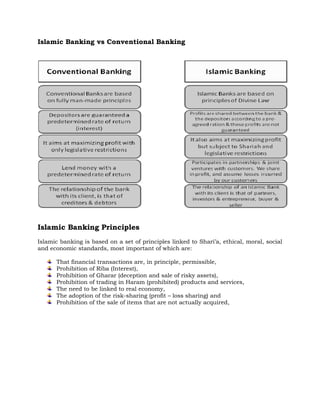
Islamic Banking vs Conventional Banking
Islamic Banking Principles
Islamic banking is based on a set of principles linked to Shari’a, ethical, moral, social
and economic standards, most important of which are:
That financial transactions are, in principle, permissible,
Prohibition of Riba (Interest),
Prohibition of Gharar (deception and sale of risky assets),
Prohibition of trading in Haram (prohibited) products and services,
The need to be linked to real economy,
The adoption of the risk-sharing (profit – loss sharing) and
Prohibition of the sale of items that are not actually acquired,
Deposit Mobilization Process in Islamic Banking
Deposit in Islamic Banking comes from two main ways—funds laid by customers
in the hands of Islamic banker for safekeeping [Al-wadiah] and funds invested by
customers with Islamic banker to run business with on profit-sharing contracts
[Mudaraba].
In Al-Wadia contracts, customers lay funds in Islamic banks for safekeeping without
intention of receiving any additional amount for the funds. These accounts are popularly
called al-Wadia Current Accounts as well. The features of al-Wadia Account—
1) There are two parties in an al-Wadia contract—depositor (al-Mudi) and safe-keeper
(al-Mustauda). In the context of the bank, the depositor is the client and the safe-keeper
is the bank and the money that is kept for safekeeping is deposit (al-Wadia).
2) The main intention of the client to lay money with the bank under this contract is
safe-keeping and returning immediately on demand.
3) The depositor allows the bank to invest the money elsewhere, of course subject to the
Shariah principles, for the benefits of the bank only, not for any direct benefit of the
client.
4) The bank is not bound to share the profit earned from the investment of the deposit
with its depositor.
5) For safekeeping of the money, on-demand withdrawal facilities and other banking
services related to it, the bank can charge fees.
6) Since accounts conducted on the al-Wadia contract serve all the purpose of the
current accounts of a conventional bank, al-Wadiah accounts are a Shariah-based
equivalent of conventional current accounts.
Mudaraba is a business contract between two parties, where one party provides funds
and the other party provides managerial skill and experience for an enterprise. The party
providing fund is Saahib al-Maal and the party employing managerial skill is Mudarib.
The features of the Mudarabah Account—
1) Both the parties to Mudarabah contract should be capable of appointing agents and
accepting agency.
2) Any of the parties can terminate the contract unilaterally unless the Mudarib
has already started the business. In that case the termination of the Mudaraba contract
can only be done on mutual consent.
3) There should be a definite agreement between the parties as to the ratio on which the
profit is to be distributed between the parties. However, the profit cannot be a lump sum
or a percentage of the capital.
4) The ratio of profit distribution should be fixed at the time of agreement. However, the
ratio can be altered on mutual consent of the both parties at any subsequent time.
5) The losses of the Mudarabah are borne by the Saahib al-Maal alone. The Mudarib
does not bear any loss unless it arises out of his breach of terms and conditions. The
managerial resources such as time, skills, etc. of the Mudarib are considered his loss.
Investment modes in Islamic Banking
The modes of investment in Islamic banking can be broadly categorized in three
groups—(i) partnership-based modes (Musharaka), (iii) Ijarah-based modes and (iii)
buy-sale-based modes.
Musharaka
The Arabic term Musharakah means taking part or joining. In business, it refers to a
partnership where two or more persons provide capital to conduct a business jointly on
the contract of sharing profits and loss together. Features of Musharakah—
1) The contribution of the capital by the partners may be equal or unequal.
2) Musharakah is based on the principle of entitlement to return proportionate
to the risk exposure.
3) In Musharakah, labour, skill, management, goodwill, creditworthiness, connections
whichever are contributory to the profitability of the business can be considered
capital in addition to money and the partner or partners that provide such capital are
entitled to the profit of business equally with the partners providing financial capital.
4) Every partner has the right to take part in the management of the business.
5) Each partner works in the Musharakah on behalf of himself and as an agent of the
partner or partners.
6) The partners may appoint workers to perform their tasks on payment.
7) In general, the profit/loss would be distributed as per the proportion of the capital
each partner has provided.
Bai Murabaha
Murabaha is a contract between a buyer and a seller where the seller buys a certain
product to a buyer at a cost plus a negotiated price payable on the spot or on some date
in the future in lump sum or by instalments. The profit may either be fixed as a lump
sum based on the cost or as a percentage of the cost. Features of Bai Murabaha—
1) The bank as the seller of the commodity must possess it whether physical or
constructive.
2) Murabaha is a real buy-sale of commodities, not financing the customer for his
payment of utility bills, tuition fees, wages, or the like.
3) The sale contract must be a valid one.
4) Murabaha is not financing a customer to purchase goods, rather it is selling of goods
by the bank to the customer on the facility of deferred payment.
5) The payment for the commodity may be deferred or on spot.
Bai Muajjal
Bai Muajjal is almost like Bai Murabaha excepting the requirement of disclosing
the cost price and profit separately on the seller’s part. Through Bai Muajjal mode, bank
can provide credit facilities, i.e. selling goods in credit to customers of a wide range—
household utensils, electronics, etc. to consumers; merchandise, supplies, etc. to
traders; raw materials, machine equipment, etc. to manufacturers, seeds, fertilizer,
etc. to farmers, and even Umrah packages, education expenses, etc. as long as the
services are provided in packages.
Bai Salam
Bai Salam is an advance sale-purchase where the buyer pays for the commodity in
advance and the seller delivers it in a future time which is specified in the agreement
between them. Important Features of Bai Salam—
1) If the commodity or product is ready for sale, Bai Salam shall not be valid
in the Shariah.
2) It is permissible to obtain security as mortgage, guarantee or
hypothecation from the seller to cover the risks of non-supply or partial
supply of the commodity or supply of defective products.
3) The manufacturer or cultivator client may be made agent of the bank to sell
the commodities delivered to the bank. However, a separate agency agreement
shall be executed between the bank and the client.
4) The exact time and place for the delivery of the commodity, cost of its
transportation, godown rents for its storage and insurance premiums
must be specified properly
5) Price shall be paid to the seller client in full at the contract execution
time.
6) Delivery of the commodity can be at one time or in instalments within the
specified period of time.
7) If the seller client delivers commodity less than what was contracted, the
buyer bank is entitled to getting back the portion of the advance equivalent
to the price of undelivered quantity.
8) In case of default in delivery, the guarantor is liable to deliver the
commodity.
9) The seller client of the product is not liable to disclose the cost and
profit of the commodity separately.
10) The bank may either receive the commodity and resell it or authorize the
seller client to find another buyer for it.
11) The bank may direct the seller client to deliver the commodity directly to a
third party whom the bank has parallelly contracted for selling it.
12) The bank can sell the commodity at a higher price.
Bai Istisna—
Bai Istisna is derived from Arabic term sana that means manufacturing. Thus, Bai
Istisna implies buy-sale of manufactured or produced goods and thereby implies
deferred delivery. Main features of Bai Istisna’a—
1) The kind, type, material, quality, and quantity of the commodity must be specified.
2) The commodity must be of the kind that is manufactured like garments, furniture,
tools, cars, not grown like corn, wheat, fruit or any natural products.
3) The payment of the price may be in instalments or in full and may be payable at the
time of contract, delivery, or any future time agreed upon between the buyers and
sellers.
4) It is the responsibility of the manufacturer to supply the materials. If the buyer
supplies the materials, it would be Ijarah and not Istisna’a.
5) The buyer has the right to obtain collaterals from the manufacturer buyer to secure
the payment, if done in advance.
6) The manufacturer has the right to secure collaterals from the buyers as guarantee of
the payment in case of deferred payment.
7) It is permitted for the buyer to stipulate penalty clauses in the contract against breach
of the contract by the manufacturer.
8) If it is not stipulated in the contract that the manufacturer with whom the contract
has been executed shall manufacture the commodity by himself, he can contract with
another manufacturer for the goods specified in the first contract.
Ijara
Ijara means wages, rents or remuneration. Thus, Ijara as a mode of transaction implies
giving an asset on rent, employing somebody on remuneration or wages and hiring on
rent. In Islamic banking, Ijara allows an Islamic bank to let out equipment,
machinery, industrial projects, vehicles, real estates, infrastructure projects to its
industrialist customer or consumer customer for rents payable periodically to the bank
over a longer period and thereby enables the bank to make short, medium or long term
investment.
Quard al-Hasana
Quard al-Hasana is a finance given to beneficiaries without profit. Since bank deals with
public money, it has to consider earning money to pay dividends to the shareholders,
profits to depositors, remunerations to the staff, etc. as a commercial organization.
This is why an Islamic bank practises Quard al- Hasana in a selective way like for
students, distressed people, under-privileged sections of people, ultra-weak
entrepreneurs, etc. Some Islamic banks have provision to provide interest-free loans to
their valued depositors.

Introduction to Islamic Banking, concept, principal, practice .pdf

  • 1.
    Introduction to IslamicBanking: Principles, Concept & Practice A K M Rabiul Islam SEVP & Head Islamic Banking Division What Is Islamic Banking? Islamic banking, also referred to as Islamic finance or Shariah-compliant finance or financial activities that adhere to Shariah (Islamic law). Two fundamental principles of Islamic banking are the sharing of profit and loss and the prohibition of the collection and payment of interest by lenders and investors. Key Features of Islamic Banking ➢ Islamic banking, also referred to as Islamic finance or Shariah-compliant finance, refers to finance or banking activities that adhere to Shariah (Islamic law). ➢ Two fundamental principles of Islamic banking are the sharing of profit and loss and the prohibition of the collection and payment of interest by lenders and investors. ➢ Islamic banks make a profit through equity participation, which requires a borrower to give the bank a share in their profits rather than paying interest. Interest in Islam The Quranic term that describes interest is Riba meaning increase. In lending and borrowing Riba is the additional amount of money which the lender charges for the use of his money. Riba is calculated as a fixed percentage of the amount lent in terms of the length of time used. Such increase of money at a predetermined rate is prohibited in Islam. However, trade also causes increase of money. This increase occurs in the form of profit. Profit is the additional amount of money asked by the seller over the cost price of his commodity and accepted by the buyer while buying it. Profit may be calculated as a fixed percentage of cost price. However, the amount of profit does not increase in terms of time. There are two types of Riba in Islam —Riba an-Nasia and Riba al-Fadl. ➢ Riba an-Nasia : The additional amount of money or commodity a lender charges upon the amount or commodity lent for the period of usage of the money or the commodity for a period of time is Riba an-Nasia. Suppose, a lender lends Tk. 1,00,000/- to a borrower for one year on the condition of returning the amount with additional amount of Tk. 15,000/- after
  • 2.
    that that period.This Tk. 15,000/- is Riba an-Nasia. In essence, the lending terms can be expressed as 15% interest per anum. If the borrower fails to repay the amount in one year and takes further time, the interest on the amount will be calculated at this rate for that additional time. Thus additional amount increases in terms of time and becomes interest from the viewpoint of Islamic Economics. Riba an-Nasia is not confined in monetary transactions alone. If goods are transacted in the same way, Riba an-Nasia will take place. Suppose, a lender has lent 100 kg salt to a borrower at the condition of returning the same along with an additional amount of 5 kg in 4 months. The additional 5 kg salt is Riba an-Nasia. ➢ Riba al-Fadl occurs in exchange of larger amount of inferior goods for smaller amount of superior ones. Comparative Analysis between Interest and Profit 1. Interest is a predetermined amount, either expressed as a percentage or as a lump sum, which a borrower pays above the actual amount he borrowed. On the other hand, profit is a sum received by the owner of an asset, enterprise or investment by way of carrying out businesses. 2. Interest can be calculated on daily, weekly, monthly or yearly (annual) basis. However, profit can only be calculated when a round of business is finished. 3. Interest rates are the products of interplay between demand and supply of money in an economy while profit is largely a product of demand and supply of goods and services. 4. The concept of interest relates to lending and borrowing while the concept of profit relates to sales and businesses. 5. Since interest is predetermined, there is no risk for the lender. But in the case of capital investment, the investor has risks of loss. Objectives and Functions of Islamic Banking The final objective of Islamic banking is to establish a banking system without interest with an ultimate goal of bringing in optimum allocation of resources among people, income and employment generation, poverty alleviation, sustained well- being of human beings. With these objectives and goals in view, Islamic banking promotes business ethics and norms in banking operations that includes resisting finance to haram products and services.
  • 3.
    The functions ofan Islamic bank are directed in achieving these objectives in the long run. In order to avoid interest in all its manifestation, ➢ Islamic banking resorts as far as to buy- sale mechanisms while financing traders. ➢ At the core of Islamic banking there is business, of which the bank is a partner and the client that needs capital for that business is the other partner and the profit or loss that comes off that business is legitimately and obligatorily shared by these two partners subject to their agreement. This is the core function of Islamic banking. ➢ Islamic banks participate in businesses, renting out land, buildings, factories, machinery, equipment, etc. to industrialists as per Islamic business principles. ➢ It also rents out and sells consumer items to households and pays tuition fees to students as an Islamic business firm. ➢ It implements foreign trade, transacts foreign currencies, offers guarantees, manages funds and liquidity, provides ancillary banking services avoiding interest and speculative income. Operational Mechanism of Islamic Banking In banking terms, the money taken by the bank is deposit, the money given by the bank is loans and advance and the charge levied on the use of the money is interest. Interest is determined as a percentage of the amount given with relation to the period of time it has been used for. In a brief, banking is the service of making funds flow from the surplus units to the deficit ones in exchange for interest. Islamic banking is also driving funds in the same route without imposing any interest, because interest is prohibited in Islam. ❖ While collecting deposit, a Shariah-based bank receives funds from clients, as their business agents, to conduct business on behalf of them on the condition of sharing returns with them. Then these funds are used for another round of business, or trade, to generate profit from it. ❖ Typically, a Shariah-based bank trades goods with customers, as a trader or their agent, or gets involved in partnership businesses, as their partner, or co- owns a productive property with them and earned profit ❖ This is how two rounds of businesses or trades implement the core banking operation in Islamic banking system averting interest in any of its manifestations.
  • 4.
    Islamic Banking vsConventional Banking Islamic Banking Principles Islamic banking is based on a set of principles linked to Shari’a, ethical, moral, social and economic standards, most important of which are: That financial transactions are, in principle, permissible, Prohibition of Riba (Interest), Prohibition of Gharar (deception and sale of risky assets), Prohibition of trading in Haram (prohibited) products and services, The need to be linked to real economy, The adoption of the risk-sharing (profit – loss sharing) and Prohibition of the sale of items that are not actually acquired,
  • 5.
    Deposit Mobilization Processin Islamic Banking Deposit in Islamic Banking comes from two main ways—funds laid by customers in the hands of Islamic banker for safekeeping [Al-wadiah] and funds invested by customers with Islamic banker to run business with on profit-sharing contracts [Mudaraba]. In Al-Wadia contracts, customers lay funds in Islamic banks for safekeeping without intention of receiving any additional amount for the funds. These accounts are popularly called al-Wadia Current Accounts as well. The features of al-Wadia Account— 1) There are two parties in an al-Wadia contract—depositor (al-Mudi) and safe-keeper (al-Mustauda). In the context of the bank, the depositor is the client and the safe-keeper is the bank and the money that is kept for safekeeping is deposit (al-Wadia). 2) The main intention of the client to lay money with the bank under this contract is safe-keeping and returning immediately on demand. 3) The depositor allows the bank to invest the money elsewhere, of course subject to the Shariah principles, for the benefits of the bank only, not for any direct benefit of the client. 4) The bank is not bound to share the profit earned from the investment of the deposit with its depositor. 5) For safekeeping of the money, on-demand withdrawal facilities and other banking services related to it, the bank can charge fees. 6) Since accounts conducted on the al-Wadia contract serve all the purpose of the current accounts of a conventional bank, al-Wadiah accounts are a Shariah-based equivalent of conventional current accounts. Mudaraba is a business contract between two parties, where one party provides funds and the other party provides managerial skill and experience for an enterprise. The party providing fund is Saahib al-Maal and the party employing managerial skill is Mudarib. The features of the Mudarabah Account— 1) Both the parties to Mudarabah contract should be capable of appointing agents and accepting agency. 2) Any of the parties can terminate the contract unilaterally unless the Mudarib has already started the business. In that case the termination of the Mudaraba contract can only be done on mutual consent. 3) There should be a definite agreement between the parties as to the ratio on which the profit is to be distributed between the parties. However, the profit cannot be a lump sum or a percentage of the capital.
  • 6.
    4) The ratioof profit distribution should be fixed at the time of agreement. However, the ratio can be altered on mutual consent of the both parties at any subsequent time. 5) The losses of the Mudarabah are borne by the Saahib al-Maal alone. The Mudarib does not bear any loss unless it arises out of his breach of terms and conditions. The managerial resources such as time, skills, etc. of the Mudarib are considered his loss. Investment modes in Islamic Banking The modes of investment in Islamic banking can be broadly categorized in three groups—(i) partnership-based modes (Musharaka), (iii) Ijarah-based modes and (iii) buy-sale-based modes. Musharaka The Arabic term Musharakah means taking part or joining. In business, it refers to a partnership where two or more persons provide capital to conduct a business jointly on the contract of sharing profits and loss together. Features of Musharakah— 1) The contribution of the capital by the partners may be equal or unequal. 2) Musharakah is based on the principle of entitlement to return proportionate to the risk exposure. 3) In Musharakah, labour, skill, management, goodwill, creditworthiness, connections whichever are contributory to the profitability of the business can be considered capital in addition to money and the partner or partners that provide such capital are entitled to the profit of business equally with the partners providing financial capital. 4) Every partner has the right to take part in the management of the business. 5) Each partner works in the Musharakah on behalf of himself and as an agent of the partner or partners. 6) The partners may appoint workers to perform their tasks on payment. 7) In general, the profit/loss would be distributed as per the proportion of the capital each partner has provided.
  • 7.
    Bai Murabaha Murabaha isa contract between a buyer and a seller where the seller buys a certain product to a buyer at a cost plus a negotiated price payable on the spot or on some date in the future in lump sum or by instalments. The profit may either be fixed as a lump sum based on the cost or as a percentage of the cost. Features of Bai Murabaha— 1) The bank as the seller of the commodity must possess it whether physical or constructive. 2) Murabaha is a real buy-sale of commodities, not financing the customer for his payment of utility bills, tuition fees, wages, or the like. 3) The sale contract must be a valid one. 4) Murabaha is not financing a customer to purchase goods, rather it is selling of goods by the bank to the customer on the facility of deferred payment. 5) The payment for the commodity may be deferred or on spot. Bai Muajjal Bai Muajjal is almost like Bai Murabaha excepting the requirement of disclosing the cost price and profit separately on the seller’s part. Through Bai Muajjal mode, bank can provide credit facilities, i.e. selling goods in credit to customers of a wide range— household utensils, electronics, etc. to consumers; merchandise, supplies, etc. to traders; raw materials, machine equipment, etc. to manufacturers, seeds, fertilizer, etc. to farmers, and even Umrah packages, education expenses, etc. as long as the services are provided in packages. Bai Salam Bai Salam is an advance sale-purchase where the buyer pays for the commodity in advance and the seller delivers it in a future time which is specified in the agreement between them. Important Features of Bai Salam— 1) If the commodity or product is ready for sale, Bai Salam shall not be valid in the Shariah. 2) It is permissible to obtain security as mortgage, guarantee or hypothecation from the seller to cover the risks of non-supply or partial supply of the commodity or supply of defective products. 3) The manufacturer or cultivator client may be made agent of the bank to sell the commodities delivered to the bank. However, a separate agency agreement shall be executed between the bank and the client.
  • 8.
    4) The exacttime and place for the delivery of the commodity, cost of its transportation, godown rents for its storage and insurance premiums must be specified properly 5) Price shall be paid to the seller client in full at the contract execution time. 6) Delivery of the commodity can be at one time or in instalments within the specified period of time. 7) If the seller client delivers commodity less than what was contracted, the buyer bank is entitled to getting back the portion of the advance equivalent to the price of undelivered quantity. 8) In case of default in delivery, the guarantor is liable to deliver the commodity. 9) The seller client of the product is not liable to disclose the cost and profit of the commodity separately. 10) The bank may either receive the commodity and resell it or authorize the seller client to find another buyer for it. 11) The bank may direct the seller client to deliver the commodity directly to a third party whom the bank has parallelly contracted for selling it. 12) The bank can sell the commodity at a higher price. Bai Istisna— Bai Istisna is derived from Arabic term sana that means manufacturing. Thus, Bai Istisna implies buy-sale of manufactured or produced goods and thereby implies deferred delivery. Main features of Bai Istisna’a— 1) The kind, type, material, quality, and quantity of the commodity must be specified. 2) The commodity must be of the kind that is manufactured like garments, furniture, tools, cars, not grown like corn, wheat, fruit or any natural products. 3) The payment of the price may be in instalments or in full and may be payable at the time of contract, delivery, or any future time agreed upon between the buyers and sellers. 4) It is the responsibility of the manufacturer to supply the materials. If the buyer supplies the materials, it would be Ijarah and not Istisna’a. 5) The buyer has the right to obtain collaterals from the manufacturer buyer to secure the payment, if done in advance. 6) The manufacturer has the right to secure collaterals from the buyers as guarantee of the payment in case of deferred payment. 7) It is permitted for the buyer to stipulate penalty clauses in the contract against breach of the contract by the manufacturer. 8) If it is not stipulated in the contract that the manufacturer with whom the contract has been executed shall manufacture the commodity by himself, he can contract with another manufacturer for the goods specified in the first contract.
  • 9.
    Ijara Ijara means wages,rents or remuneration. Thus, Ijara as a mode of transaction implies giving an asset on rent, employing somebody on remuneration or wages and hiring on rent. In Islamic banking, Ijara allows an Islamic bank to let out equipment, machinery, industrial projects, vehicles, real estates, infrastructure projects to its industrialist customer or consumer customer for rents payable periodically to the bank over a longer period and thereby enables the bank to make short, medium or long term investment. Quard al-Hasana Quard al-Hasana is a finance given to beneficiaries without profit. Since bank deals with public money, it has to consider earning money to pay dividends to the shareholders, profits to depositors, remunerations to the staff, etc. as a commercial organization. This is why an Islamic bank practises Quard al- Hasana in a selective way like for students, distressed people, under-privileged sections of people, ultra-weak entrepreneurs, etc. Some Islamic banks have provision to provide interest-free loans to their valued depositors.