Introduction to innovation
Definitions
Dimensions
Drivers
Developments
What is innovation?
• Innovation is the process and outcome of creating
something new, which is also of value.
• Innovation involves the whole process from
opportunity identification, ideation or invention to
development, prototyping, production marketing
and sales, while entrepreneurship only needs to
involve commercialization (Schumpeter).
What is innovation?
• Today it is said to involve the capacity to quickly
adapt by adopting new innovations (products,
processes, strategies, organization, etc)
• Also, traditionally the focus has been on new
products or processes, but recently new business
models have come into focus, i.e. the way a firm
delivers value and secures profits.
What is innovation?
• Schumpeter argued that innovation comes
about through new combinations made by
an entrepreneur, resulting in
– a new product,
– a new process,
– opening of new market,
– new way of organizing the business
– new sources of supply
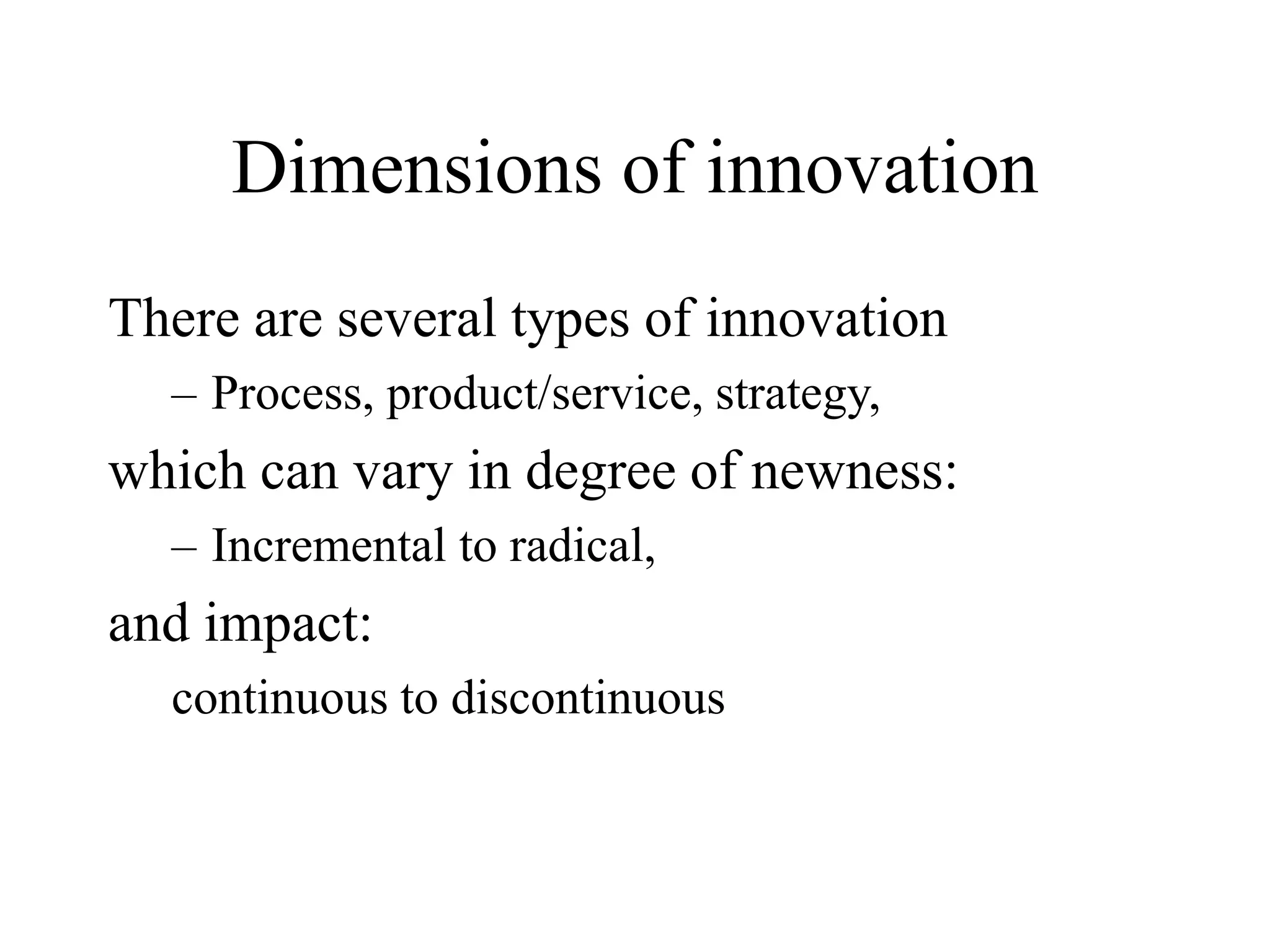
Dimensions of innovation
There are several types of innovation
– Process, product/service, strategy,
which can vary in degree of newness:
– Incremental to radical,
and impact:
continuous to discontinuous
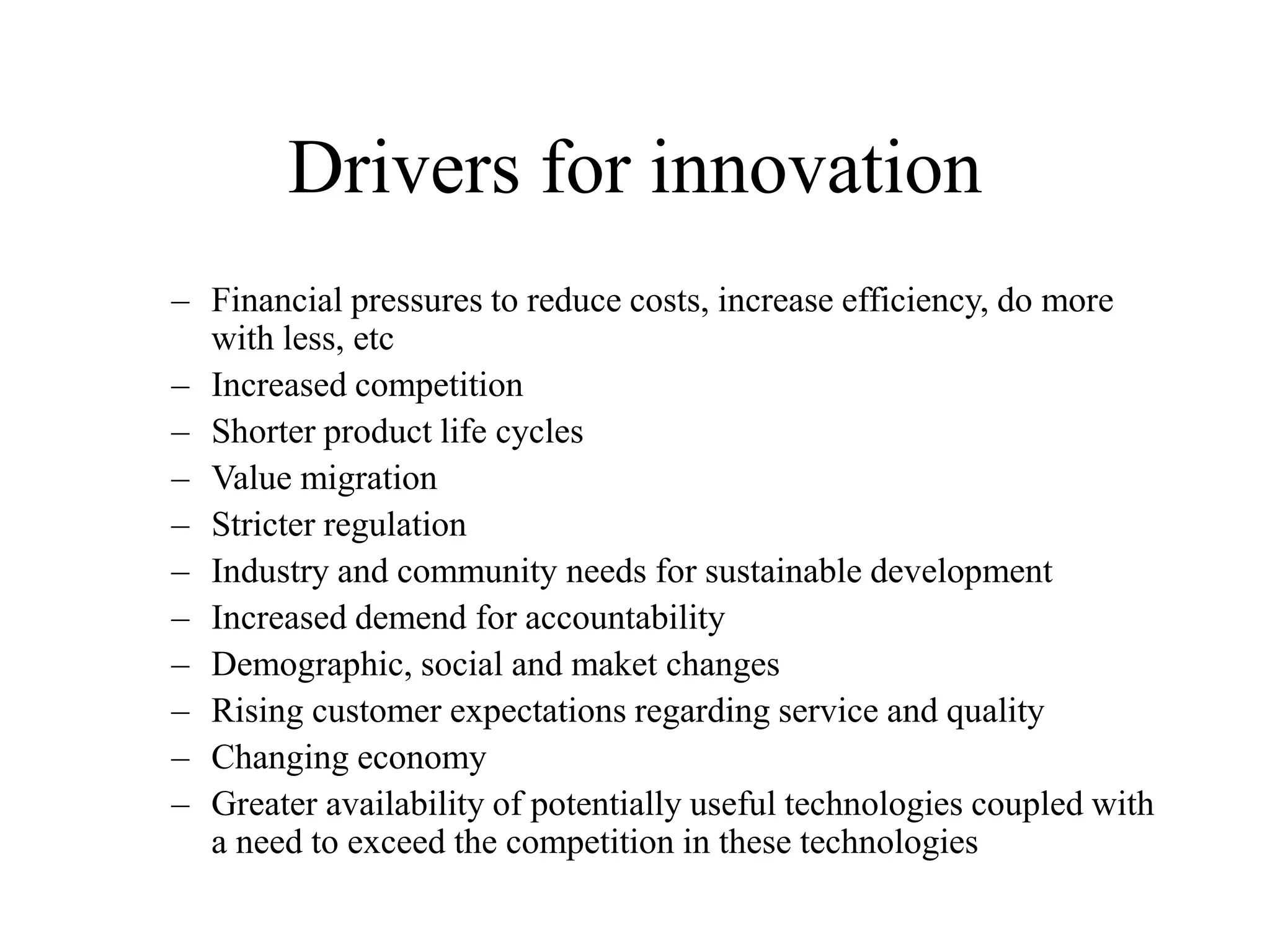
Drivers for innovation
– Financial pressures to reduce costs, increase efficiency, do more
with less, etc
– Increased competition
– Shorter product life cycles
– Value migration
– Stricter regulation
– Industry and community needs for sustainable development
– Increased demend for accountability
– Demographic, social and maket changes
– Rising customer expectations regarding service and quality
– Changing economy
– Greater availability of potentially useful technologies coupled with
a need to exceed the competition in these technologies
What is innovation?
• Gary Hamel argued that today’s market
place is hostile to incumbents, who now
needs to conduct radical business
innovation:
– Radically reconceiving products and services,
not just developing new products and services
– Redefining market space
– Redrawing industry boundaries
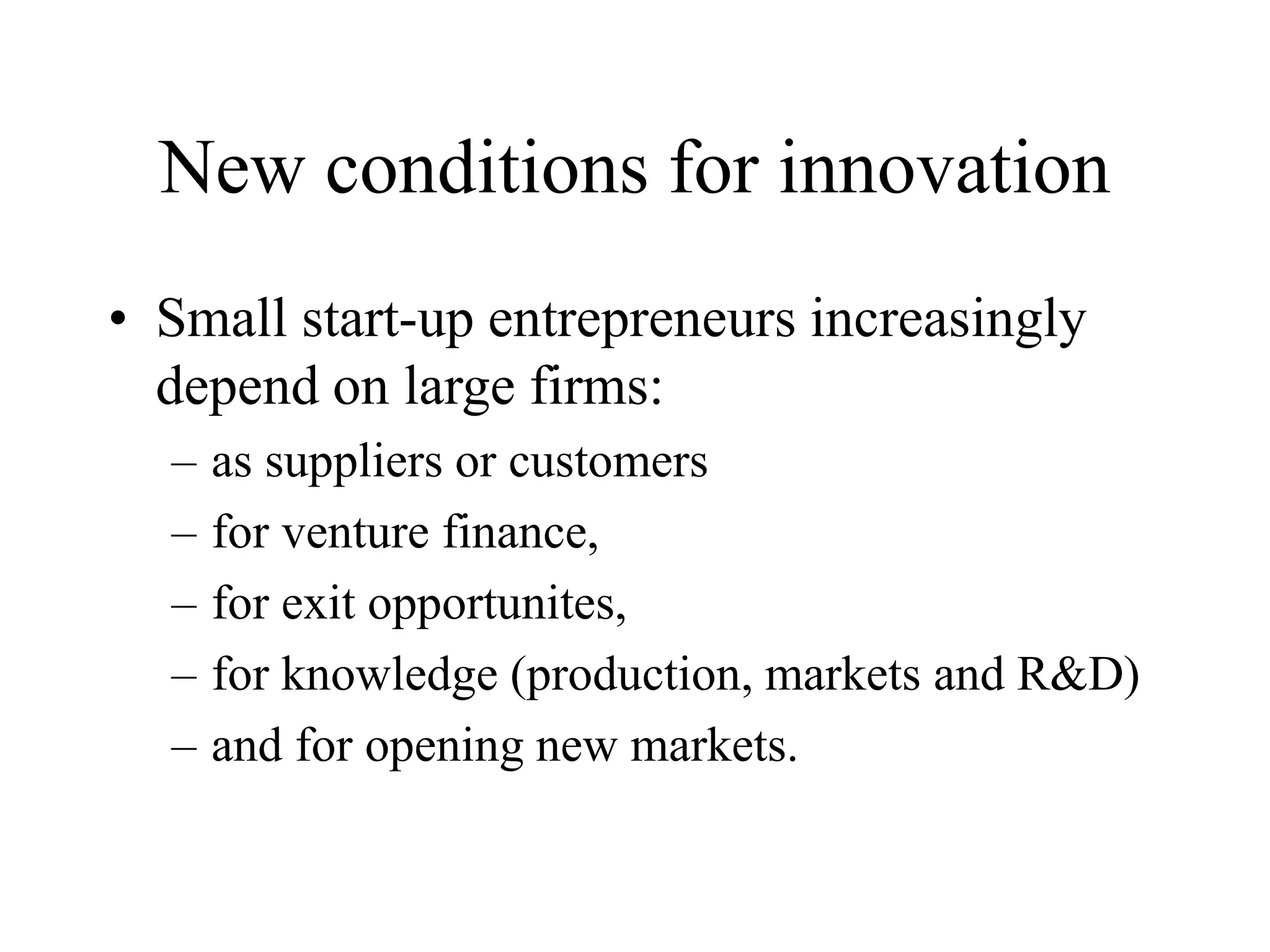
New conditions for innovation
• Small start-up entrepreneurs increasingly
depend on large firms:
– as suppliers or customers
– for venture finance,
– for exit opportunites,
– for knowledge (production, markets and R&D)
– and for opening new markets.
New conditions for innovation
• Large firms increasingly depend on small
start-ups
– for NPD,
– as suppliers of new knowledge (which they cannot
develop themselves),
– or organizational renewal, for experimentation with
busienss models,
– for opening new markets, etc
New developments in innovation
raises new issues and problems
• Greater emphasis on commercializing scientific
discoveries, particularly in IT and the bio-sciences
• Speed and potential value of scientific progress leads to
emphasis on solid and well-designed portfolios of
research projects
• Universites as active drivers of innovation: Academic
entrepreneurship and the entrepreneurial university
• University-industry partnerships
• Increased search for radical innovation and top-line
growth.

Introduction to innovation meetings .ppt

  • 1.
  • 2.
    What is innovation? •Innovation is the process and outcome of creating something new, which is also of value. • Innovation involves the whole process from opportunity identification, ideation or invention to development, prototyping, production marketing and sales, while entrepreneurship only needs to involve commercialization (Schumpeter).
  • 3.
    What is innovation? •Today it is said to involve the capacity to quickly adapt by adopting new innovations (products, processes, strategies, organization, etc) • Also, traditionally the focus has been on new products or processes, but recently new business models have come into focus, i.e. the way a firm delivers value and secures profits.
  • 4.
    What is innovation? •Schumpeter argued that innovation comes about through new combinations made by an entrepreneur, resulting in – a new product, – a new process, – opening of new market, – new way of organizing the business – new sources of supply
  • 5.
    Dimensions of innovation Thereare several types of innovation – Process, product/service, strategy, which can vary in degree of newness: – Incremental to radical, and impact: continuous to discontinuous
  • 6.
    Drivers for innovation –Financial pressures to reduce costs, increase efficiency, do more with less, etc – Increased competition – Shorter product life cycles – Value migration – Stricter regulation – Industry and community needs for sustainable development – Increased demend for accountability – Demographic, social and maket changes – Rising customer expectations regarding service and quality – Changing economy – Greater availability of potentially useful technologies coupled with a need to exceed the competition in these technologies
  • 7.
    What is innovation? •Gary Hamel argued that today’s market place is hostile to incumbents, who now needs to conduct radical business innovation: – Radically reconceiving products and services, not just developing new products and services – Redefining market space – Redrawing industry boundaries
  • 8.
    New conditions forinnovation • Small start-up entrepreneurs increasingly depend on large firms: – as suppliers or customers – for venture finance, – for exit opportunites, – for knowledge (production, markets and R&D) – and for opening new markets.
  • 9.
    New conditions forinnovation • Large firms increasingly depend on small start-ups – for NPD, – as suppliers of new knowledge (which they cannot develop themselves), – or organizational renewal, for experimentation with busienss models, – for opening new markets, etc
  • 10.
    New developments ininnovation raises new issues and problems • Greater emphasis on commercializing scientific discoveries, particularly in IT and the bio-sciences • Speed and potential value of scientific progress leads to emphasis on solid and well-designed portfolios of research projects • Universites as active drivers of innovation: Academic entrepreneurship and the entrepreneurial university • University-industry partnerships • Increased search for radical innovation and top-line growth.