Introduction to
Imperative
Sentences
Imperative sentences are direct commands or requests that tell the
listener to do something. They play a crucial role in communication
by providing clear directives and shaping the actions of the receiver.
by Arnes Ginting
What are Imperative
Sentences?
1 Direct Commands
Imperative sentences
give a direct instruction
or order, such as "Pass
the salt" or "Close the
door."
2 Requests
They can also be used to
make polite requests, like
"Please turn off the
lights" or "Could you help
me with this?"
3 Suggestions
Imperatives can offer suggestions, such as "Try a different
approach" or "Consider this option."
Structure of Imperative Sentences
Basic Structure
Imperative sentences typically start
with a verb and do not include a
subject. For example, "Finish your
homework" or "Walk the dog."
Subjects
The subject (you) is often implied
but can be included for emphasis,
like "You take out the trash."
Polite Phrases
Imperative sentences can begin
with polite phrases like "Please,"
"Would you," or "Could you" to
make the command more
courteous.
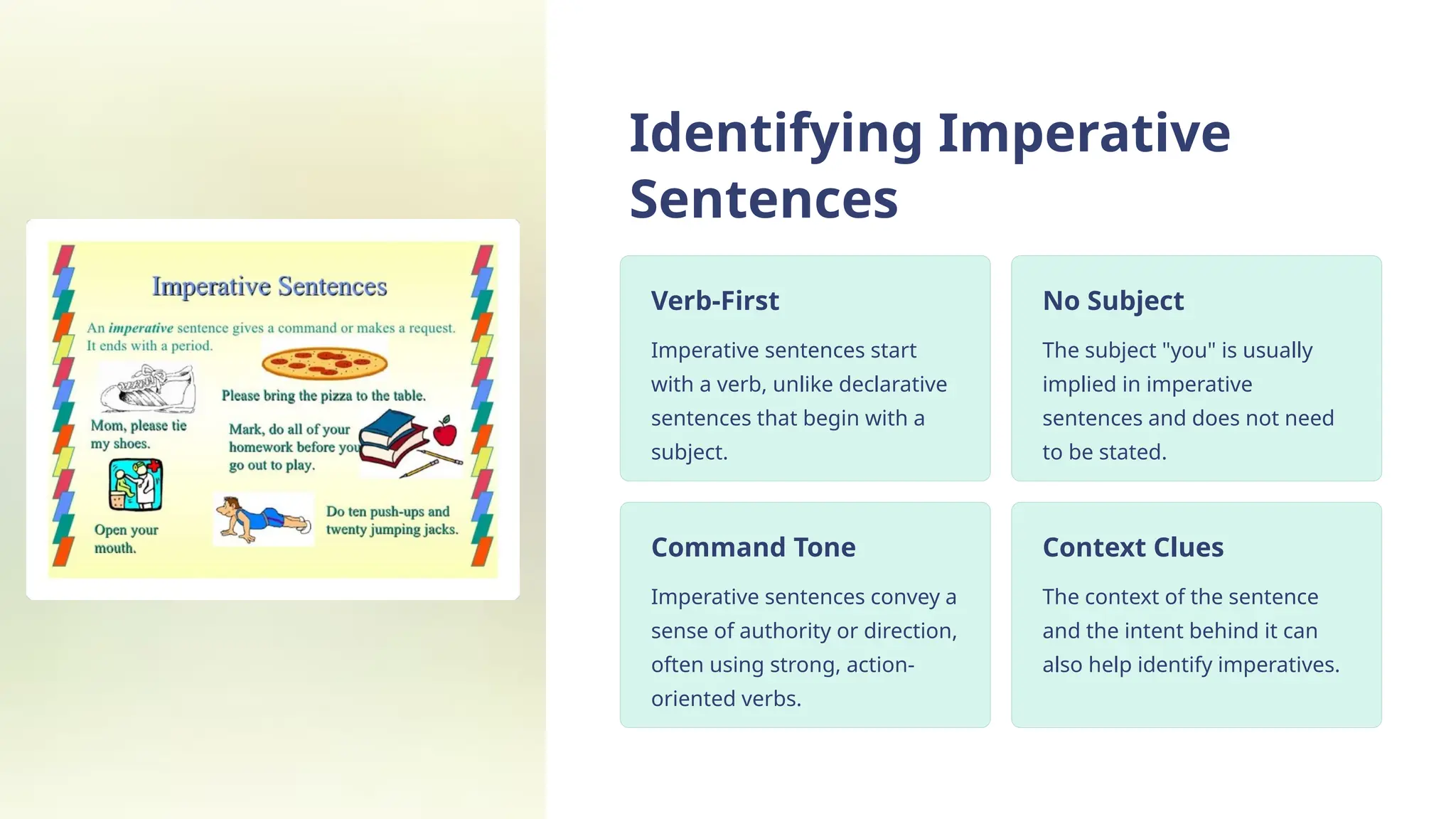
Identifying Imperative
Sentences
Verb-First
Imperative sentences start
with a verb, unlike declarative
sentences that begin with a
subject.
No Subject
The subject "you" is usually
implied in imperative
sentences and does not need
to be stated.
Command Tone
Imperative sentences convey a
sense of authority or direction,
often using strong, action-
oriented verbs.
Context Clues
The context of the sentence
and the intent behind it can
also help identify imperatives.
Purposes of Imperative Sentences
Giving Orders
Imperative sentences are
commonly used to issue
commands, direct actions, or
instruct someone to do something.
Making Requests
Imperatives can also be used to
politely ask someone to do
something, rather than demanding
it.
Offering Advice
Imperatives can provide
suggestions, recommendations, or
advice, like "Try this new recipe" or
"Consider a different approach."
Polite vs. Commanding Imperative Sentences
1
Polite Imperatives
Use phrases like "Please," "Would you," or "Could you" to
make commands more courteous and less demanding.
2
Neutral Imperatives
Simple verb-first sentences without any politeness phrases,
such as "Open the door" or "Turn off the light."
3
Commanding Imperatives
Assertive, direct instructions that leave no room for
negotiation, like "Stop that immediately" or "You must finish
this right now."
Avoiding Overuse of
Imperative Sentences
1 Balance
Use imperative sentences
judiciously to avoid sounding
bossy or overbearing.
2 Variety
Mix in other sentence types
like declaratives and
interrogatives to create more
diverse and natural-sounding
communication.
3 Alternatives
Rephrase imperatives as
suggestions,
recommendations, or
questions to make them less
demanding.
4 Context
Consider the situation and
relationship with the listener
when deciding how forceful
or polite to be with
imperatives.
Conclusion and Key
Takeaways
Direct
Imperative sentences provide
clear, direct instructions or
commands.
Polite
Imperative phrasing can be
softened with politeness markers
to make requests more courteous.
Versatile
Imperatives can be used for a
variety of purposes, from giving
orders to offering advice.
Balance
Imperative sentences should be
used judiciously to avoid sounding
overbearing.

Introduction-to-Imperative-Sentences.pptx

  • 1.
    Introduction to Imperative Sentences Imperative sentencesare direct commands or requests that tell the listener to do something. They play a crucial role in communication by providing clear directives and shaping the actions of the receiver. by Arnes Ginting
  • 2.
    What are Imperative Sentences? 1Direct Commands Imperative sentences give a direct instruction or order, such as "Pass the salt" or "Close the door." 2 Requests They can also be used to make polite requests, like "Please turn off the lights" or "Could you help me with this?" 3 Suggestions Imperatives can offer suggestions, such as "Try a different approach" or "Consider this option."
  • 3.
    Structure of ImperativeSentences Basic Structure Imperative sentences typically start with a verb and do not include a subject. For example, "Finish your homework" or "Walk the dog." Subjects The subject (you) is often implied but can be included for emphasis, like "You take out the trash." Polite Phrases Imperative sentences can begin with polite phrases like "Please," "Would you," or "Could you" to make the command more courteous.
  • 4.
    Identifying Imperative Sentences Verb-First Imperative sentencesstart with a verb, unlike declarative sentences that begin with a subject. No Subject The subject "you" is usually implied in imperative sentences and does not need to be stated. Command Tone Imperative sentences convey a sense of authority or direction, often using strong, action- oriented verbs. Context Clues The context of the sentence and the intent behind it can also help identify imperatives.
  • 5.
    Purposes of ImperativeSentences Giving Orders Imperative sentences are commonly used to issue commands, direct actions, or instruct someone to do something. Making Requests Imperatives can also be used to politely ask someone to do something, rather than demanding it. Offering Advice Imperatives can provide suggestions, recommendations, or advice, like "Try this new recipe" or "Consider a different approach."
  • 6.
    Polite vs. CommandingImperative Sentences 1 Polite Imperatives Use phrases like "Please," "Would you," or "Could you" to make commands more courteous and less demanding. 2 Neutral Imperatives Simple verb-first sentences without any politeness phrases, such as "Open the door" or "Turn off the light." 3 Commanding Imperatives Assertive, direct instructions that leave no room for negotiation, like "Stop that immediately" or "You must finish this right now."
  • 7.
    Avoiding Overuse of ImperativeSentences 1 Balance Use imperative sentences judiciously to avoid sounding bossy or overbearing. 2 Variety Mix in other sentence types like declaratives and interrogatives to create more diverse and natural-sounding communication. 3 Alternatives Rephrase imperatives as suggestions, recommendations, or questions to make them less demanding. 4 Context Consider the situation and relationship with the listener when deciding how forceful or polite to be with imperatives.
  • 8.
    Conclusion and Key Takeaways Direct Imperativesentences provide clear, direct instructions or commands. Polite Imperative phrasing can be softened with politeness markers to make requests more courteous. Versatile Imperatives can be used for a variety of purposes, from giving orders to offering advice. Balance Imperative sentences should be used judiciously to avoid sounding overbearing.