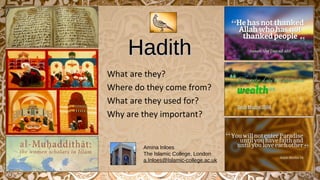
HadithHadith
What are they?
Where do they come from?
What are they used for?
Why are they important?
Amina Inloes
The Islamic College, London
a.Inloes@Islamic-college.ac.uk
Islamic scriptural sourcesIslamic scriptural sources
Qur’an (‘the reading’)
•Considered to be divine revelation
•One book
•Considered 100% authentic
•Transcribed in the 7th
century AD
•Frequently memorized
•Same for all sects
•Read devotionally and for other purposes
•Non-linear style of organization
•Main ideas rather than details
•In poetic/rhythmic Arabic, often recited
melodiously
•Reads in the perspective of the divine
Hadith (‘the speech’)
•What the Prophet Muhammad, his family, and his companions said, did, and silently allowed
•Many, many books
•Varying views on reliability
•Used to be memorized by hadith scholars
•Mostly transcribed in the 8th
-9th
centuries
•Differing books used by different sects
•Used mostly for teaching, preaching, history, deriving religious law, and interpreting the Qur’an
•Usually arranged by subject
•Detail-oriented
•In Arabic prose, not usually recited melodiously
•Reads in the perspective of humans
Sample subjectsSample subjects
Qur’an (‘the reading’)
•Nature of Allah (God)
•Ethics
•Heaven and Hell
•Response to prayer
•Stories of the ancient prophets (main ideas)
•Main topics of religious law
•Unseen beings such as angels and Satan
•The creation of humanity
•The nature of this world
•The transience of life
•Polemical arguments with Jews, Christians,
polytheists, and those who do not believe in a
creator or in the afterlife
Hadith (‘the speech’)
•Those things, plus…
•What the Prophet did in his daily life
•What happened during the Prophet’s time
•Detailed stories of the ancient prophets
•Religious law (detailed)
•Advice for daily life, hygiene, family life, clothing,
•Plants, animals, and work; business and trade; rules for warfare
•Prayers
•Ethics
•The end of the world
•Shi‘i collections: the intellect; esoteric matters; interfaith, intrafaith, and theological debates
Blessed be the One who made constellations in the heavens,
and placed therein a lamp and moon giving light – who made
the night and day follow each other for those who would praise
Him or be grateful to Him.
And the servants of (Allah) the most merciful are those who
walk in the earth humbly, and when the ignorant speak to
them, they say, Peace.
They spend the night adoring their Lord, bowing and standing.
They say, “Our Lord! Save us from the wrath of Hell, for Hell is a
severe affliction. It is an evil abode and place of rest.”
When the spend, they are neither extravagant nor tight-fisted,
but between the two.
They do not invoke any other god apart from Allah, and do not
slay the life that Allah has made sacred except in just cause, and
do not commit adultery….
(If they do that) they will dwell in hell, unless they repent,
believe, and do good deeds, for Allah will change the evil of
such people into good, and Allah is forgiving and merciful.
(Qur’an 25:61-71)
• Narrated Ibn Abbas: The Prophet embraced me and said, “O
Allah! Teach him the Book (the Qur’an).” (Bukhari)
• Allah's Apostle said, "Allah will not be merciful to those who
are not merciful to mankind.“ (Bukhari)
• A person asked Allah's Apostle, "What should a person wear
during hajj?" He replied, "He should not wear shirts,
trousers, a hooded cloak, or clothes which are dyed with
saffron or perfumed. Whoever does not find sandals to
wear can wear leather socks, but these should be cut short
so as not to cover the ankles.” (Bukhari)
• Anas ibn Malik said: “A tailor invited Allah's Apostle to a
meal which he had prepared. I went along with Allah's
Apostle and saw him seeking to eat the pieces of gourd
from the various sides of the dish. Since that day I have
liked to eat gourd.” (Bukhari)
• Malik related to me … that some people asked the
Messenger of Allah (for wealth), and he gave some to them.
Then they asked him again, and he gave more to them until
he used up what he had. Then he said, “Whatever, I have, I
will not hoard from you. Whoever is patient, Allah will help
him. Whoever tries to be independent, Allah will enrich him.
Whoever tries to be patient, Allah will give him patience,
and no one is given a better or vaster gift than patience.”
(Muwatta’)
Anatomy of a hadithAnatomy of a hadith
Chain of narration (isnad): From Muhammad ibn Ya’qub al-Kulayni, from Muhammad ibn al-Hasan
and ‘Ali ibn Muhammad, from Sahl ibn Ziyad and Muhammad ibn Yahya, from Ahmad ibn
Muhammad, from Ja’far ibn Muhammad al-‘Ash’ari, from ‘Abd Allah ibn Maymun al-Qaddah; and
from ‘Ali ibn Ibrahim, from his father, from Hammad ibn ‘Isa, from al-Qaddah, from Abu ‘Abd Allah,
who said that the Messenger of Allah said: <- Who is reported to have said it and passed it on?
Main text (matn): “When someone proceeds on a path in the pursuit of knowledge, God
makes him proceed therewith on a path to Paradise. The angels spread their wings for the
seekers of knowledge out of delight. Every creature of the heaven and the earth asks
forgiveness for the seeker of knowledge, even the fish in the sea. The merit of the learned
over the mere worshipper is like the merit of the moon over the stars on a night with a full
moon. The learned are the heirs of the prophets, for the prophets did not leave behind a
legacy of wealth rather left behind knowledge. So whoever partakes of it derives a
plenteous benefit.” <- What did they say, or what happened?
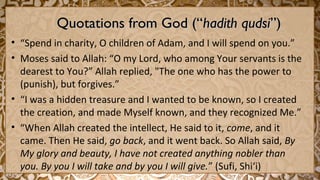
Quotations from God (“Quotations from God (“hadith qudsihadith qudsi”)”)
• “Spend in charity, O children of Adam, and I will spend on you.”
• Moses said to Allah: “O my Lord, who among Your servants is the
dearest to You?” Allah replied, "The one who has the power to
(punish), but forgives.”
• “I was a hidden treasure and I wanted to be known, so I created
the creation, and made Myself known, and they recognized Me.”
• “When Allah created the intellect, He said to it, come, and it
came. Then He said, go back, and it went back. So Allah said, By
My glory and beauty, I have not created anything nobler than
you. By you I will take and by you I will give.” (Sufi, Shi‘i)
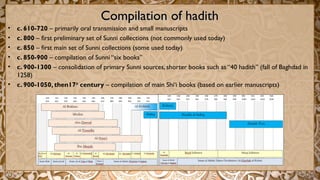
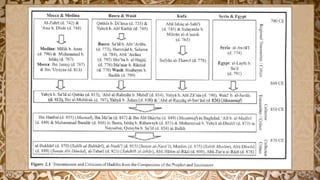
Compilation of hadithCompilation of hadith
• c. 610-720 – primarily oral transmission and small manuscripts
• c. 800 – first preliminary set of Sunni collections (not commonly used today)
• c. 850 – first main set of Sunni collections (some used today)
• c. 850-900 – compilation of Sunni “six books”
• c. 900-1300 – consolidation of primary Sunni sources, shorter books such as “40 hadith” (fall of Baghdad in
1258)
• c. 900-1050, then17th
century – compilation of main Shi‘i books (based on earlier manuscripts)
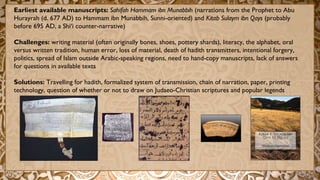
Earliest available manuscripts: Sahifah Hammam ibn Munabbih (narrations from the Prophet to Abu
Hurayrah (d. 677 AD) to Hammam ibn Munabbih, Sunni-oriented) and Kitab Sulaym ibn Qays (probably
before 695 AD, a Shi‘i counter-narrative)
Challenges: writing material (often originally bones, shoes, pottery shards), literacy, the alphabet, oral
versus written tradition, human error, loss of material, death of hadith transmitters, intentional forgery,
politics, spread of Islam outside Arabic-speaking regions, need to hand-copy manuscripts, lack of answers
for questions in available texts
Solutions: Travelling for hadith, formalized system of transmission, chain of narration, paper, printing
technology, question of whether or not to draw on Judaeo-Christian scriptures and popular legends
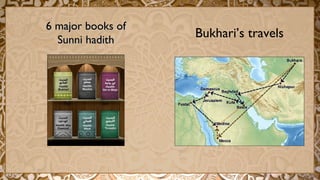
Bukhari’s travels
6 major books of6 major books of
Sunni hadithSunni hadith
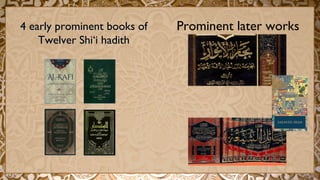
Prominent later works4 early prominent books of4 early prominent books of
Twelver Shi‘i hadithTwelver Shi‘i hadith
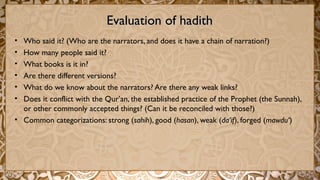
Evaluation of hadithEvaluation of hadith
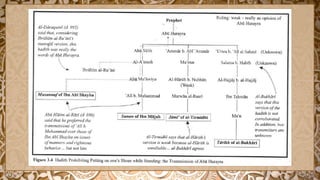
• Who said it? (Who are the narrators, and does it have a chain of narration?)
• How many people said it?
• What books is it in?
• Are there different versions?
• What do we know about the narrators? Are there any weak links?
• Does it conflict with the Qur’an, the established practice of the Prophet (the Sunnah),
or other commonly accepted things? (Can it be reconciled with those?)
• Common categorizations: strong (sahih), good (hasan), weak (da‘if), forged (mawdu‘)
Cultural legacy of hadithCultural legacy of hadith
• Living link to the Prophet via transmitters
• A way for the believer to live present with the Prophet
• Derivation of religious law
• Detailed “science” of hadith
• Response to questions of life
• Mystical/Sufi transmissions of narrations
• “Authentication” of hadith via dreams or mystical experiences?
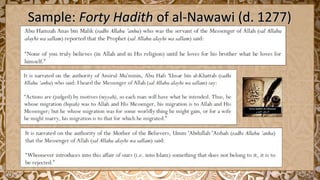
Sample:Sample: Forty HadithForty Hadith of al-Nawawi (d. 1277)of al-Nawawi (d. 1277)
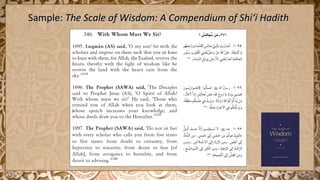
Sample:Sample: The Scale of Wisdom: A Compendium of Shi‘i HadithThe Scale of Wisdom: A Compendium of Shi‘i Hadith
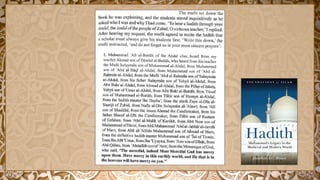
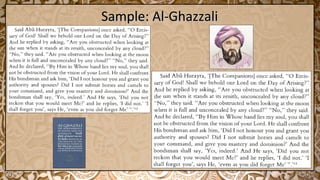
Sample: Al-GhazzaliSample: Al-Ghazzali
Introduction to Hadith

Introduction to Hadith

  • 1.
    HadithHadith What are they? Wheredo they come from? What are they used for? Why are they important? Amina Inloes The Islamic College, London a.Inloes@Islamic-college.ac.uk
  • 2.
    Islamic scriptural sourcesIslamicscriptural sources Qur’an (‘the reading’) •Considered to be divine revelation •One book •Considered 100% authentic •Transcribed in the 7th century AD •Frequently memorized •Same for all sects •Read devotionally and for other purposes •Non-linear style of organization •Main ideas rather than details •In poetic/rhythmic Arabic, often recited melodiously •Reads in the perspective of the divine Hadith (‘the speech’) •What the Prophet Muhammad, his family, and his companions said, did, and silently allowed •Many, many books •Varying views on reliability •Used to be memorized by hadith scholars •Mostly transcribed in the 8th -9th centuries •Differing books used by different sects •Used mostly for teaching, preaching, history, deriving religious law, and interpreting the Qur’an •Usually arranged by subject •Detail-oriented •In Arabic prose, not usually recited melodiously •Reads in the perspective of humans
  • 3.
    Sample subjectsSample subjects Qur’an(‘the reading’) •Nature of Allah (God) •Ethics •Heaven and Hell •Response to prayer •Stories of the ancient prophets (main ideas) •Main topics of religious law •Unseen beings such as angels and Satan •The creation of humanity •The nature of this world •The transience of life •Polemical arguments with Jews, Christians, polytheists, and those who do not believe in a creator or in the afterlife Hadith (‘the speech’) •Those things, plus… •What the Prophet did in his daily life •What happened during the Prophet’s time •Detailed stories of the ancient prophets •Religious law (detailed) •Advice for daily life, hygiene, family life, clothing, •Plants, animals, and work; business and trade; rules for warfare •Prayers •Ethics •The end of the world •Shi‘i collections: the intellect; esoteric matters; interfaith, intrafaith, and theological debates
  • 4.
    Blessed be theOne who made constellations in the heavens, and placed therein a lamp and moon giving light – who made the night and day follow each other for those who would praise Him or be grateful to Him. And the servants of (Allah) the most merciful are those who walk in the earth humbly, and when the ignorant speak to them, they say, Peace. They spend the night adoring their Lord, bowing and standing. They say, “Our Lord! Save us from the wrath of Hell, for Hell is a severe affliction. It is an evil abode and place of rest.” When the spend, they are neither extravagant nor tight-fisted, but between the two. They do not invoke any other god apart from Allah, and do not slay the life that Allah has made sacred except in just cause, and do not commit adultery…. (If they do that) they will dwell in hell, unless they repent, believe, and do good deeds, for Allah will change the evil of such people into good, and Allah is forgiving and merciful. (Qur’an 25:61-71) • Narrated Ibn Abbas: The Prophet embraced me and said, “O Allah! Teach him the Book (the Qur’an).” (Bukhari) • Allah's Apostle said, "Allah will not be merciful to those who are not merciful to mankind.“ (Bukhari) • A person asked Allah's Apostle, "What should a person wear during hajj?" He replied, "He should not wear shirts, trousers, a hooded cloak, or clothes which are dyed with saffron or perfumed. Whoever does not find sandals to wear can wear leather socks, but these should be cut short so as not to cover the ankles.” (Bukhari) • Anas ibn Malik said: “A tailor invited Allah's Apostle to a meal which he had prepared. I went along with Allah's Apostle and saw him seeking to eat the pieces of gourd from the various sides of the dish. Since that day I have liked to eat gourd.” (Bukhari) • Malik related to me … that some people asked the Messenger of Allah (for wealth), and he gave some to them. Then they asked him again, and he gave more to them until he used up what he had. Then he said, “Whatever, I have, I will not hoard from you. Whoever is patient, Allah will help him. Whoever tries to be independent, Allah will enrich him. Whoever tries to be patient, Allah will give him patience, and no one is given a better or vaster gift than patience.” (Muwatta’)
  • 5.
    Anatomy of ahadithAnatomy of a hadith Chain of narration (isnad): From Muhammad ibn Ya’qub al-Kulayni, from Muhammad ibn al-Hasan and ‘Ali ibn Muhammad, from Sahl ibn Ziyad and Muhammad ibn Yahya, from Ahmad ibn Muhammad, from Ja’far ibn Muhammad al-‘Ash’ari, from ‘Abd Allah ibn Maymun al-Qaddah; and from ‘Ali ibn Ibrahim, from his father, from Hammad ibn ‘Isa, from al-Qaddah, from Abu ‘Abd Allah, who said that the Messenger of Allah said: <- Who is reported to have said it and passed it on? Main text (matn): “When someone proceeds on a path in the pursuit of knowledge, God makes him proceed therewith on a path to Paradise. The angels spread their wings for the seekers of knowledge out of delight. Every creature of the heaven and the earth asks forgiveness for the seeker of knowledge, even the fish in the sea. The merit of the learned over the mere worshipper is like the merit of the moon over the stars on a night with a full moon. The learned are the heirs of the prophets, for the prophets did not leave behind a legacy of wealth rather left behind knowledge. So whoever partakes of it derives a plenteous benefit.” <- What did they say, or what happened?
  • 6.
    Quotations from God(“Quotations from God (“hadith qudsihadith qudsi”)”) • “Spend in charity, O children of Adam, and I will spend on you.” • Moses said to Allah: “O my Lord, who among Your servants is the dearest to You?” Allah replied, "The one who has the power to (punish), but forgives.” • “I was a hidden treasure and I wanted to be known, so I created the creation, and made Myself known, and they recognized Me.” • “When Allah created the intellect, He said to it, come, and it came. Then He said, go back, and it went back. So Allah said, By My glory and beauty, I have not created anything nobler than you. By you I will take and by you I will give.” (Sufi, Shi‘i)
  • 8.
    Compilation of hadithCompilationof hadith • c. 610-720 – primarily oral transmission and small manuscripts • c. 800 – first preliminary set of Sunni collections (not commonly used today) • c. 850 – first main set of Sunni collections (some used today) • c. 850-900 – compilation of Sunni “six books” • c. 900-1300 – consolidation of primary Sunni sources, shorter books such as “40 hadith” (fall of Baghdad in 1258) • c. 900-1050, then17th century – compilation of main Shi‘i books (based on earlier manuscripts)
  • 9.
    Earliest available manuscripts:Sahifah Hammam ibn Munabbih (narrations from the Prophet to Abu Hurayrah (d. 677 AD) to Hammam ibn Munabbih, Sunni-oriented) and Kitab Sulaym ibn Qays (probably before 695 AD, a Shi‘i counter-narrative) Challenges: writing material (often originally bones, shoes, pottery shards), literacy, the alphabet, oral versus written tradition, human error, loss of material, death of hadith transmitters, intentional forgery, politics, spread of Islam outside Arabic-speaking regions, need to hand-copy manuscripts, lack of answers for questions in available texts Solutions: Travelling for hadith, formalized system of transmission, chain of narration, paper, printing technology, question of whether or not to draw on Judaeo-Christian scriptures and popular legends
  • 11.
    Bukhari’s travels 6 majorbooks of6 major books of Sunni hadithSunni hadith
  • 12.
    Prominent later works4early prominent books of4 early prominent books of Twelver Shi‘i hadithTwelver Shi‘i hadith
  • 13.
    Evaluation of hadithEvaluationof hadith • Who said it? (Who are the narrators, and does it have a chain of narration?) • How many people said it? • What books is it in? • Are there different versions? • What do we know about the narrators? Are there any weak links? • Does it conflict with the Qur’an, the established practice of the Prophet (the Sunnah), or other commonly accepted things? (Can it be reconciled with those?) • Common categorizations: strong (sahih), good (hasan), weak (da‘if), forged (mawdu‘)
  • 15.
    Cultural legacy ofhadithCultural legacy of hadith • Living link to the Prophet via transmitters • A way for the believer to live present with the Prophet • Derivation of religious law • Detailed “science” of hadith • Response to questions of life • Mystical/Sufi transmissions of narrations • “Authentication” of hadith via dreams or mystical experiences?
  • 17.
    Sample:Sample: Forty HadithFortyHadith of al-Nawawi (d. 1277)of al-Nawawi (d. 1277)
  • 18.
    Sample:Sample: The Scaleof Wisdom: A Compendium of Shi‘i HadithThe Scale of Wisdom: A Compendium of Shi‘i Hadith
  • 19.