INTRODUCTION TO
FORENSIC MEDICINE
DR ATWINE RAYMOND
(MBChB, MMed Path)
GENERAL CONCEPTS
•Forensic medicine- branch of medicine that deals with
application of medical knowledge to the investigation
of crime, particularly in establishing the causes of
injury or death.
Autopsy Vs Necropsy VS post-mortem examination
• is a highly specialized surgical procedure that consists of a
thorough examination of a corpse by dissection to determine
the1 cause and manner of death or 2to evaluate
any disease or injury that may be present for research or
3.educational purposes.
• Autopsies are performed for either legal or medical purposes.
For example, a forensic autopsy is carried out when the cause of
death may be a criminal matter, while a clinical or academic
autopsy is performed to find the medical cause of death and is
used in cases of unknown or uncertain death, or for research
purposes
Types of autopsy
• Medico-Legal Autopsy or Forensic which is performed on the
instructions of the legal authority responsible for the investigation of
sudden, suspicious, obscure, unnatural, litigious or criminal deaths,
deaths without medical assistance or during surgical procedures. In
most systems the permission of the relatives is not required.
Clinical or Pathological autopsies is one in which the medical
attendants, with the consent of relatives, seek to learn the extent of
the disease for which they were treating the deceased patient. Can be
used for research purposes
Anatomical or academic autopsies are performed by students of
anatomy for study purpose only
Cause of death
• The cause of death is the injury or disease, or a combination of
the two, responsible for initiating the events leading to the
individual’s death.
• The time interval between the initiating condition (i.e.,
proximate cause of death) and the actual death of the individual
(i.e., immediate cause) may be brief or prolonged.
• If the time interval is prolonged, sequelae (e.g., pulmonary
emboli or bronchopneumonia) may develop that can be directly
or indirectly due to the initiating condition and are termed
intermediate cause(s) of death
• Examples of causes of death
− Coronary artery atherosclerosis
− Blunt force injury of head
− Gunshot wound of head
− Hanging
Mechanism of Death
• Physiologic derangement or biochemical disturbance initiated by
the cause of death that is incompatible with life.
♦ Examples of mechanism of death
− Ventricular fibrillation
− Respiratory arrest
− Exsanguination
- Asphyxiation
Manner of Death
• Circumstances in which the cause of death arose
• There are five manners of death in most jurisdictions, which can
be separated into three general categories:
− Natural
− Unnatural, which includes homicide, suicide, and accident
− Undetermined/uncertain; when the manner of death is
undetermined, there are two or more possible competing manners
of death (e.g., homicide versus suicide), and one of the possible
competing manners of death may be natural
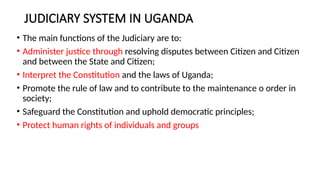
JUDICIARY SYSTEM IN UGANDA
• The main functions of the Judiciary are to:
• Administer justice through resolving disputes between Citizen and Citizen
and between the State and Citizen;
• Interpret the Constitution and the laws of Uganda;
• Promote the rule of law and to contribute to the maintenance o order in
society;
• Safeguard the Constitution and uphold democratic principles;
• Protect human rights of individuals and groups
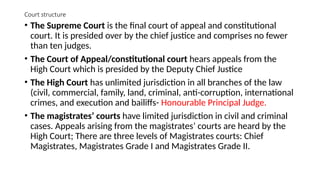
Court structure
• The Supreme Court is the final court of appeal and constitutional
court. It is presided over by the chief justice and comprises no fewer
than ten judges.
• The Court of Appeal/constitutional court hears appeals from the
High Court which is presided by the Deputy Chief Justice
• The High Court has unlimited jurisdiction in all branches of the law
(civil, commercial, family, land, criminal, anti-corruption, international
crimes, and execution and bailiffs- Honourable Principal Judge.
• The magistrates’ courts have limited jurisdiction in civil and criminal
cases. Appeals arising from the magistrates’ courts are heard by the
High Court; There are three levels of Magistrates courts: Chief
Magistrates, Magistrates Grade I and Magistrates Grade II.

INTRODUCTION TO FORENSIC MEDiiICINE.pptx

  • 1.
    INTRODUCTION TO FORENSIC MEDICINE DRATWINE RAYMOND (MBChB, MMed Path)
  • 2.
    GENERAL CONCEPTS •Forensic medicine-branch of medicine that deals with application of medical knowledge to the investigation of crime, particularly in establishing the causes of injury or death.
  • 3.
    Autopsy Vs NecropsyVS post-mortem examination • is a highly specialized surgical procedure that consists of a thorough examination of a corpse by dissection to determine the1 cause and manner of death or 2to evaluate any disease or injury that may be present for research or 3.educational purposes. • Autopsies are performed for either legal or medical purposes. For example, a forensic autopsy is carried out when the cause of death may be a criminal matter, while a clinical or academic autopsy is performed to find the medical cause of death and is used in cases of unknown or uncertain death, or for research purposes
  • 4.
    Types of autopsy •Medico-Legal Autopsy or Forensic which is performed on the instructions of the legal authority responsible for the investigation of sudden, suspicious, obscure, unnatural, litigious or criminal deaths, deaths without medical assistance or during surgical procedures. In most systems the permission of the relatives is not required. Clinical or Pathological autopsies is one in which the medical attendants, with the consent of relatives, seek to learn the extent of the disease for which they were treating the deceased patient. Can be used for research purposes Anatomical or academic autopsies are performed by students of anatomy for study purpose only
  • 5.
    Cause of death •The cause of death is the injury or disease, or a combination of the two, responsible for initiating the events leading to the individual’s death. • The time interval between the initiating condition (i.e., proximate cause of death) and the actual death of the individual (i.e., immediate cause) may be brief or prolonged. • If the time interval is prolonged, sequelae (e.g., pulmonary emboli or bronchopneumonia) may develop that can be directly or indirectly due to the initiating condition and are termed intermediate cause(s) of death
  • 6.
    • Examples ofcauses of death − Coronary artery atherosclerosis − Blunt force injury of head − Gunshot wound of head − Hanging
  • 7.
    Mechanism of Death •Physiologic derangement or biochemical disturbance initiated by the cause of death that is incompatible with life. ♦ Examples of mechanism of death − Ventricular fibrillation − Respiratory arrest − Exsanguination - Asphyxiation
  • 8.
    Manner of Death •Circumstances in which the cause of death arose • There are five manners of death in most jurisdictions, which can be separated into three general categories: − Natural − Unnatural, which includes homicide, suicide, and accident − Undetermined/uncertain; when the manner of death is undetermined, there are two or more possible competing manners of death (e.g., homicide versus suicide), and one of the possible competing manners of death may be natural
  • 9.
    JUDICIARY SYSTEM INUGANDA • The main functions of the Judiciary are to: • Administer justice through resolving disputes between Citizen and Citizen and between the State and Citizen; • Interpret the Constitution and the laws of Uganda; • Promote the rule of law and to contribute to the maintenance o order in society; • Safeguard the Constitution and uphold democratic principles; • Protect human rights of individuals and groups
  • 10.
    Court structure • TheSupreme Court is the final court of appeal and constitutional court. It is presided over by the chief justice and comprises no fewer than ten judges. • The Court of Appeal/constitutional court hears appeals from the High Court which is presided by the Deputy Chief Justice • The High Court has unlimited jurisdiction in all branches of the law (civil, commercial, family, land, criminal, anti-corruption, international crimes, and execution and bailiffs- Honourable Principal Judge. • The magistrates’ courts have limited jurisdiction in civil and criminal cases. Appeals arising from the magistrates’ courts are heard by the High Court; There are three levels of Magistrates courts: Chief Magistrates, Magistrates Grade I and Magistrates Grade II.