Chapter One
Introduction to Data Structures and Algorithms
A program is written in order to solve a problem. A solution to a problem actually
consists of two things:
1. A way to organize the data
2. Sequence of steps to solve the problem
 The way data are organized in a computers memory is said to be Data Structure.
 sequence of computational steps to solve a problem is said to be an Algorithm.
Therefore, a program is nothing but data structures plus algorithms.
 the first step to solve the problem is obtaining ones own abstract view, or model, of
the problem. This process of modeling is called abstraction
 The model defines an abstract view to the problem. This implies that the model
focuses only on problem related stuff and that a programmer tries to define the
properties of the problem.
 These properties include
 The data which are affected and
 The operations that are involved in the problem
1
1.1 Abstract Data Types
With abstraction you create a well-defined entity that
can be properly handled. These entities define the data
structure of the program.
An entity with the properties just described is called an
abstract data type (ADT).
An ADT consists of an abstract data structure and
operations. Put in other terms, an ADT is an abstraction
of a data structure.
The ADT specifies:
1. What can be stored in the Abstract Data Type
2. What operations can be done on/by the Abstract Data Type?2
ADT…
For example, if we are going to model employees of
an organization:
This ADT stores employees with their relevant attributes and
discarding irrelevant attributes.
This ADT supports hiring, firing, retiring, operations.
A data structure is a language construct that the programmer
has defined in order to implement an abstract data type.
There are lots of formalized and standard Abstract data types
such as Stacks, Queues, Trees, etc.
3
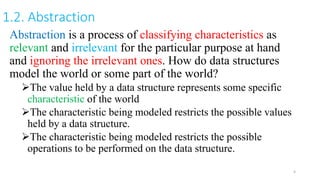
1.2. Abstraction
Abstraction is a process of classifying characteristics as
relevant and irrelevant for the particular purpose at hand
and ignoring the irrelevant ones. How do data structures
model the world or some part of the world?
The value held by a data structure represents some specific
characteristic of the world
The characteristic being modeled restricts the possible values
held by a data structure.
The characteristic being modeled restricts the possible
operations to be performed on the data structure.
4
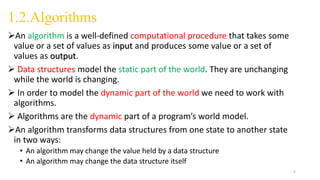
1.2.Algorithms
An algorithm is a well-defined computational procedure that takes some
value or a set of values as input and produces some value or a set of
values as output.
 Data structures model the static part of the world. They are unchanging
while the world is changing.
 In order to model the dynamic part of the world we need to work with
algorithms.
 Algorithms are the dynamic part of a program’s world model.
An algorithm transforms data structures from one state to another state
in two ways:
• An algorithm may change the value held by a data structure
• An algorithm may change the data structure itself
5
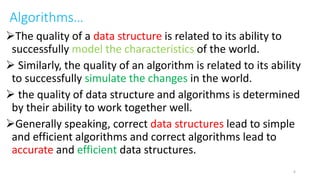
Algorithms…
The quality of a data structure is related to its ability to
successfully model the characteristics of the world.
 Similarly, the quality of an algorithm is related to its ability
to successfully simulate the changes in the world.
 the quality of data structure and algorithms is determined
by their ability to work together well.
Generally speaking, correct data structures lead to simple
and efficient algorithms and correct algorithms lead to
accurate and efficient data structures.
6
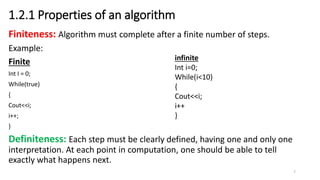
1.2.1 Properties of an algorithm
Finiteness: Algorithm must complete after a finite number of steps.
Example:
Finite
Int I = 0;
While(true)
{
Cout<<i;
i++;
}
Definiteness: Each step must be clearly defined, having one and only one
interpretation. At each point in computation, one should be able to tell
exactly what happens next.
infinite
Int i=0;
While(i<10)
{
Cout<<i;
i++
}
7
Properties of an algorithm…
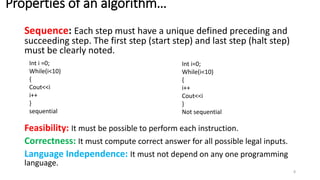
Sequence: Each step must have a unique defined preceding and
succeeding step. The first step (start step) and last step (halt step)
must be clearly noted.
Feasibility: It must be possible to perform each instruction.
Correctness: It must compute correct answer for all possible legal inputs.
Language Independence: It must not depend on any one programming
language.
Int i =0;
While(i<10)
{
Cout<<i
i++
}
sequential
Int i=0;
While(i<10)
{
i++
Cout<<i
}
Not sequential
8
1.2.1 Properties of an algorithm…
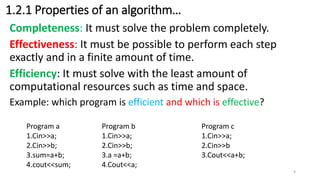
Completeness: It must solve the problem completely.
Effectiveness: It must be possible to perform each step
exactly and in a finite amount of time.
Efficiency: It must solve with the least amount of
computational resources such as time and space.
Example: which program is efficient and which is effective?
Program a
1.Cin>>a;
2.Cin>>b;
3.sum=a+b;
4.cout<<sum;
Program b
1.Cin>>a;
2.Cin>>b;
3.a =a+b;
4.Cout<<a;
Program c
1.Cin>>a;
2.Cin>>b
3.Cout<<a+b;
9
Properties of an algorithm…
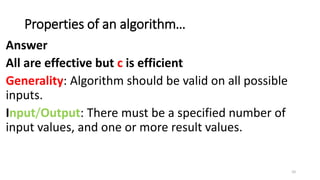
Answer
All are effective but c is efficient
Generality: Algorithm should be valid on all possible
inputs.
Input/Output: There must be a specified number of
input values, and one or more result values.
10
Chapter two
Algorithm Analysis
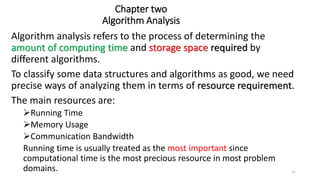
Algorithm analysis refers to the process of determining the
amount of computing time and storage space required by
different algorithms.
To classify some data structures and algorithms as good, we need
precise ways of analyzing them in terms of resource requirement.
The main resources are:
Running Time
Memory Usage
Communication Bandwidth
Running time is usually treated as the most important since
computational time is the most precious resource in most problem
domains. 11
Algorithm Analysis Concepts…
There are two approaches to measure the efficiency of
algorithms:
1. Empirical: Programming competing algorithms and
trying them on different instances.
2. Theoretical: Determining the quantity of resources
required mathematically (Execution time, memory
space, etc.) needed by each algorithm.
12
Algorithm Analysis Concepts…
1. Empirical analysis
However, it is difficult to use actual clock-time as a consistent
measure of an algorithm’s efficiency, because clock-time can vary
based on many factors.
For example:
Specific processor speed
1.7GHz ==> 10s
2.7GHz ==> 15s
Current processor load
Only the work 10s
With printing and internet browsing 15s
Specific data for a particular run of the program
Input Size
Input Properties
Operating Environment
Multi tasking or single tasking 13
Algorithm Analysis Concepts…
2. Theoretical Analysis: Determining the quantity of resources
required mathematically (Execution time, memory space, etc.)
needed by each algorithm.
Analyze an algorithm according to the number of basic
operations(time units).required rather than according to
absolute amount of time involved.
We use theoretical approach to determine the efficiency of an
algorithm because:
the number of operations does not vary under different
conditions.
It is independent of operating platforms.
It helps to determine the complexity of an algorithm. 14
2.1 Complexity Analysis
Complexity Analysis is the systematic study of the cost of
computation, measured either in time units or in operations
performed, or in the amount of storage space required.
The goal is to have a meaningful measure that permits comparison
of algorithms independent of operating platform.
There are two things to consider:
Time Complexity: Determine the approximate number of operations
required to solve a problem of size n.
Space Complexity: Determine the approximate memory required to
solve a problem of size n.
15
Complexity Analysis…
Complexity analysis involves two distinct phases:
Algorithm Analysis: Analysis of the algorithm or data structure
to produce a function T (n) that describes the algorithm in
terms of the operations performed in order to measure the
complexity of the algorithm.
Order of Magnitude Analysis: Analysis of the function T (n) to
determine the general complexity category to which it belongs.
There is no generally accepted set of rules for algorithm
analysis. However, an exact count of operations is commonly
used.
16
2.2 Analysis Rules
1. We assume an arbitrary time unit.
2. Execution of one of the following operations takes time 1:
Assignment Operation(i=0;)
Single Input/output Operation(cin>>a;/cout<<a;)
Single Boolean Operations(i>=10;)
Single Arithmetic Operations(a+b;)
Function Return(return ;)
17
Analysis Rules…
3. Running time of a selection statement (if, switch) is the time for the condition
evaluation + the maximum of the running times for the individual clauses in the
selection.
Example:
int sum = 0;
if(a>b)
{
sum= a+b;
Cout>>sum;
}
else
{
cout<<b;
}
T(n)= 1+1+max(3,1) =5 18
Analysis Rules…
4.Loops: Running time for a loop is equal to the
running time for the statements inside the loop *
number of iterations. The total running time of a
statement inside a group of nested loops is the
running time of the statements multiplied by the
product of the sizes of all the loops.
For nested loops, analyze inside out.
Always assume that the loop executes the maximum
number of iterations possible.
19
Analysis Rules…
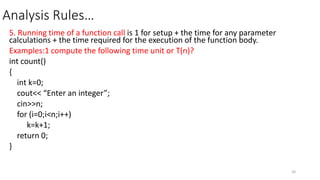
5. Running time of a function call is 1 for setup + the time for any parameter
calculations + the time required for the execution of the function body.
Examples:1 compute the following time unit or T(n)?
int count()
{
int k=0;
cout<< “Enter an integer”;
cin>>n;
for (i=0;i<n;i++)
k=k+1;
return 0;
}
20
Analysis Rules…
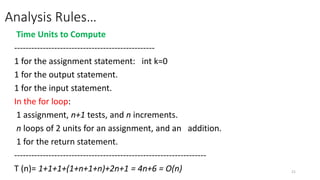
Time Units to Compute
-------------------------------------------------
1 for the assignment statement: int k=0
1 for the output statement.
1 for the input statement.
In the for loop:
1 assignment, n+1 tests, and n increments.
n loops of 2 units for an assignment, and an addition.
1 for the return statement.
-------------------------------------------------------------------
T (n)= 1+1+1+(1+n+1+n)+2n+1 = 4n+6 = O(n) 21
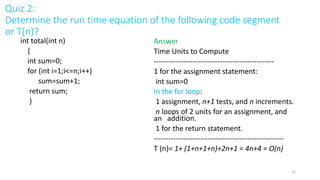
Quiz.2:
Determine the run time equation of the following code segment
or T(n)?
int total(int n)
{
int sum=0;
for (int i=1;i<=n;i++)
sum=sum+1;
return sum;
}
Answer
Time Units to Compute
-------------------------------------------------
1 for the assignment statement:
int sum=0
In the for loop:
1 assignment, n+1 tests, and n increments.
n loops of 2 units for an assignment, and
an addition.
1 for the return statement.
-----------------------------------------------------
T (n)= 1+ (1+n+1+n)+2n+1 = 4n+4 = O(n)
22
Formal Approach to Analysis
In the above examples we have seen that analysis is a bit complex. However, it can be
simplified by using some formal approach in which case we can ignore initializations,
loop control, and book keeping.
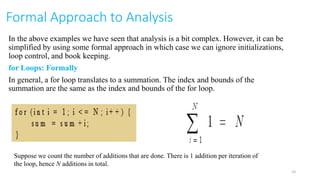
for Loops: Formally
In general, a for loop translates to a summation. The index and bounds of the
summation are the same as the index and bounds of the for loop.
Suppose we count the number of additions that are done. There is 1 addition per iteration of
the loop, hence N additions in total.
23
Formal Approach to Analysis…
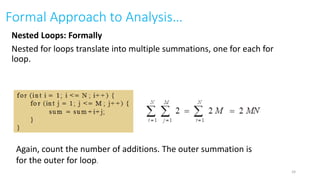
Nested Loops: Formally
Nested for loops translate into multiple summations, one for each for
loop.
Again, count the number of additions. The outer summation is
for the outer for loop.
24
Formal Approach to Analysis…
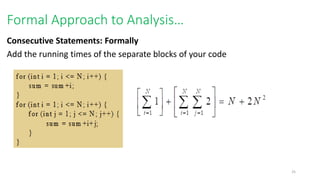
Consecutive Statements: Formally
Add the running times of the separate blocks of your code
25
Categories of Algorithm Analysis
Algorithms may be examined under different situations to correctly
determine their efficiency for accurate comparison.
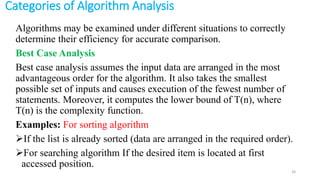
Best Case Analysis
Best case analysis assumes the input data are arranged in the most
advantageous order for the algorithm. It also takes the smallest
possible set of inputs and causes execution of the fewest number of
statements. Moreover, it computes the lower bound of T(n), where
T(n) is the complexity function.
Examples: For sorting algorithm
If the list is already sorted (data are arranged in the required order).
For searching algorithm If the desired item is located at first
accessed position.
26
Categories of Algorithm Analysis…
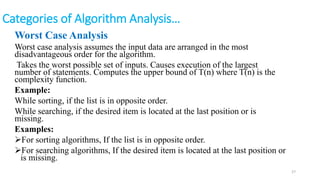
Worst Case Analysis
Worst case analysis assumes the input data are arranged in the most
disadvantageous order for the algorithm.
Takes the worst possible set of inputs. Causes execution of the largest
number of statements. Computes the upper bound of T(n) where T(n) is the
complexity function.
Example:
While sorting, if the list is in opposite order.
While searching, if the desired item is located at the last position or is
missing.
Examples:
For sorting algorithms, If the list is in opposite order.
For searching algorithms, If the desired item is located at the last position or
is missing.
27
Worst Case Analysis…
Worst case analysis is the most common analysis because, it
provides the upper bound for all input (even for bad ones).
Average case analysis is often difficult to determine and define.
 If situations are in their best case, no need to develop algorithms
because data arrangements are in the best situation.
Best case analysis can not be used to estimate complexity. We are
interested in the worst case time since it provides a bound for all
input-this is called the “Big-Oh” estimate.
28
Categories of Algorithm Analysis…
Average Case Analysis
Determine the average of the running time overall permutation of input data.
Takes an average set of inputs.
It also assumes random input size.
It causes average number of executions.
Computes the optimal bound of T(n) where T(n) is the complexity function.
Sometimes average cases are as bad as worst cases and as good as best cases.
Examples:
For sorting algorithms, While sorting, considering any arrangement (order of input
data).
For searching algorithms While searching, if the desired item is located at any
location or is missing.
29

Introduction to Data Structure and algorithm.pptx

  • 1.
    Chapter One Introduction toData Structures and Algorithms A program is written in order to solve a problem. A solution to a problem actually consists of two things: 1. A way to organize the data 2. Sequence of steps to solve the problem  The way data are organized in a computers memory is said to be Data Structure.  sequence of computational steps to solve a problem is said to be an Algorithm. Therefore, a program is nothing but data structures plus algorithms.  the first step to solve the problem is obtaining ones own abstract view, or model, of the problem. This process of modeling is called abstraction  The model defines an abstract view to the problem. This implies that the model focuses only on problem related stuff and that a programmer tries to define the properties of the problem.  These properties include  The data which are affected and  The operations that are involved in the problem 1
  • 2.
    1.1 Abstract DataTypes With abstraction you create a well-defined entity that can be properly handled. These entities define the data structure of the program. An entity with the properties just described is called an abstract data type (ADT). An ADT consists of an abstract data structure and operations. Put in other terms, an ADT is an abstraction of a data structure. The ADT specifies: 1. What can be stored in the Abstract Data Type 2. What operations can be done on/by the Abstract Data Type?2
  • 3.
    ADT… For example, ifwe are going to model employees of an organization: This ADT stores employees with their relevant attributes and discarding irrelevant attributes. This ADT supports hiring, firing, retiring, operations. A data structure is a language construct that the programmer has defined in order to implement an abstract data type. There are lots of formalized and standard Abstract data types such as Stacks, Queues, Trees, etc. 3
  • 4.
    1.2. Abstraction Abstraction isa process of classifying characteristics as relevant and irrelevant for the particular purpose at hand and ignoring the irrelevant ones. How do data structures model the world or some part of the world? The value held by a data structure represents some specific characteristic of the world The characteristic being modeled restricts the possible values held by a data structure. The characteristic being modeled restricts the possible operations to be performed on the data structure. 4
  • 5.
    1.2.Algorithms An algorithm isa well-defined computational procedure that takes some value or a set of values as input and produces some value or a set of values as output.  Data structures model the static part of the world. They are unchanging while the world is changing.  In order to model the dynamic part of the world we need to work with algorithms.  Algorithms are the dynamic part of a program’s world model. An algorithm transforms data structures from one state to another state in two ways: • An algorithm may change the value held by a data structure • An algorithm may change the data structure itself 5
  • 6.
    Algorithms… The quality ofa data structure is related to its ability to successfully model the characteristics of the world.  Similarly, the quality of an algorithm is related to its ability to successfully simulate the changes in the world.  the quality of data structure and algorithms is determined by their ability to work together well. Generally speaking, correct data structures lead to simple and efficient algorithms and correct algorithms lead to accurate and efficient data structures. 6
  • 7.
    1.2.1 Properties ofan algorithm Finiteness: Algorithm must complete after a finite number of steps. Example: Finite Int I = 0; While(true) { Cout<<i; i++; } Definiteness: Each step must be clearly defined, having one and only one interpretation. At each point in computation, one should be able to tell exactly what happens next. infinite Int i=0; While(i<10) { Cout<<i; i++ } 7
  • 8.
    Properties of analgorithm… Sequence: Each step must have a unique defined preceding and succeeding step. The first step (start step) and last step (halt step) must be clearly noted. Feasibility: It must be possible to perform each instruction. Correctness: It must compute correct answer for all possible legal inputs. Language Independence: It must not depend on any one programming language. Int i =0; While(i<10) { Cout<<i i++ } sequential Int i=0; While(i<10) { i++ Cout<<i } Not sequential 8
  • 9.
    1.2.1 Properties ofan algorithm… Completeness: It must solve the problem completely. Effectiveness: It must be possible to perform each step exactly and in a finite amount of time. Efficiency: It must solve with the least amount of computational resources such as time and space. Example: which program is efficient and which is effective? Program a 1.Cin>>a; 2.Cin>>b; 3.sum=a+b; 4.cout<<sum; Program b 1.Cin>>a; 2.Cin>>b; 3.a =a+b; 4.Cout<<a; Program c 1.Cin>>a; 2.Cin>>b 3.Cout<<a+b; 9
  • 10.
    Properties of analgorithm… Answer All are effective but c is efficient Generality: Algorithm should be valid on all possible inputs. Input/Output: There must be a specified number of input values, and one or more result values. 10
  • 11.
    Chapter two Algorithm Analysis Algorithmanalysis refers to the process of determining the amount of computing time and storage space required by different algorithms. To classify some data structures and algorithms as good, we need precise ways of analyzing them in terms of resource requirement. The main resources are: Running Time Memory Usage Communication Bandwidth Running time is usually treated as the most important since computational time is the most precious resource in most problem domains. 11
  • 12.
    Algorithm Analysis Concepts… Thereare two approaches to measure the efficiency of algorithms: 1. Empirical: Programming competing algorithms and trying them on different instances. 2. Theoretical: Determining the quantity of resources required mathematically (Execution time, memory space, etc.) needed by each algorithm. 12
  • 13.
    Algorithm Analysis Concepts… 1.Empirical analysis However, it is difficult to use actual clock-time as a consistent measure of an algorithm’s efficiency, because clock-time can vary based on many factors. For example: Specific processor speed 1.7GHz ==> 10s 2.7GHz ==> 15s Current processor load Only the work 10s With printing and internet browsing 15s Specific data for a particular run of the program Input Size Input Properties Operating Environment Multi tasking or single tasking 13
  • 14.
    Algorithm Analysis Concepts… 2.Theoretical Analysis: Determining the quantity of resources required mathematically (Execution time, memory space, etc.) needed by each algorithm. Analyze an algorithm according to the number of basic operations(time units).required rather than according to absolute amount of time involved. We use theoretical approach to determine the efficiency of an algorithm because: the number of operations does not vary under different conditions. It is independent of operating platforms. It helps to determine the complexity of an algorithm. 14
  • 15.
    2.1 Complexity Analysis ComplexityAnalysis is the systematic study of the cost of computation, measured either in time units or in operations performed, or in the amount of storage space required. The goal is to have a meaningful measure that permits comparison of algorithms independent of operating platform. There are two things to consider: Time Complexity: Determine the approximate number of operations required to solve a problem of size n. Space Complexity: Determine the approximate memory required to solve a problem of size n. 15
  • 16.
    Complexity Analysis… Complexity analysisinvolves two distinct phases: Algorithm Analysis: Analysis of the algorithm or data structure to produce a function T (n) that describes the algorithm in terms of the operations performed in order to measure the complexity of the algorithm. Order of Magnitude Analysis: Analysis of the function T (n) to determine the general complexity category to which it belongs. There is no generally accepted set of rules for algorithm analysis. However, an exact count of operations is commonly used. 16
  • 17.
    2.2 Analysis Rules 1.We assume an arbitrary time unit. 2. Execution of one of the following operations takes time 1: Assignment Operation(i=0;) Single Input/output Operation(cin>>a;/cout<<a;) Single Boolean Operations(i>=10;) Single Arithmetic Operations(a+b;) Function Return(return ;) 17
  • 18.
    Analysis Rules… 3. Runningtime of a selection statement (if, switch) is the time for the condition evaluation + the maximum of the running times for the individual clauses in the selection. Example: int sum = 0; if(a>b) { sum= a+b; Cout>>sum; } else { cout<<b; } T(n)= 1+1+max(3,1) =5 18
  • 19.
    Analysis Rules… 4.Loops: Runningtime for a loop is equal to the running time for the statements inside the loop * number of iterations. The total running time of a statement inside a group of nested loops is the running time of the statements multiplied by the product of the sizes of all the loops. For nested loops, analyze inside out. Always assume that the loop executes the maximum number of iterations possible. 19
  • 20.
    Analysis Rules… 5. Runningtime of a function call is 1 for setup + the time for any parameter calculations + the time required for the execution of the function body. Examples:1 compute the following time unit or T(n)? int count() { int k=0; cout<< “Enter an integer”; cin>>n; for (i=0;i<n;i++) k=k+1; return 0; } 20
  • 21.
    Analysis Rules… Time Unitsto Compute ------------------------------------------------- 1 for the assignment statement: int k=0 1 for the output statement. 1 for the input statement. In the for loop: 1 assignment, n+1 tests, and n increments. n loops of 2 units for an assignment, and an addition. 1 for the return statement. ------------------------------------------------------------------- T (n)= 1+1+1+(1+n+1+n)+2n+1 = 4n+6 = O(n) 21
  • 22.
    Quiz.2: Determine the runtime equation of the following code segment or T(n)? int total(int n) { int sum=0; for (int i=1;i<=n;i++) sum=sum+1; return sum; } Answer Time Units to Compute ------------------------------------------------- 1 for the assignment statement: int sum=0 In the for loop: 1 assignment, n+1 tests, and n increments. n loops of 2 units for an assignment, and an addition. 1 for the return statement. ----------------------------------------------------- T (n)= 1+ (1+n+1+n)+2n+1 = 4n+4 = O(n) 22
  • 23.
    Formal Approach toAnalysis In the above examples we have seen that analysis is a bit complex. However, it can be simplified by using some formal approach in which case we can ignore initializations, loop control, and book keeping. for Loops: Formally In general, a for loop translates to a summation. The index and bounds of the summation are the same as the index and bounds of the for loop. Suppose we count the number of additions that are done. There is 1 addition per iteration of the loop, hence N additions in total. 23
  • 24.
    Formal Approach toAnalysis… Nested Loops: Formally Nested for loops translate into multiple summations, one for each for loop. Again, count the number of additions. The outer summation is for the outer for loop. 24
  • 25.
    Formal Approach toAnalysis… Consecutive Statements: Formally Add the running times of the separate blocks of your code 25
  • 26.
    Categories of AlgorithmAnalysis Algorithms may be examined under different situations to correctly determine their efficiency for accurate comparison. Best Case Analysis Best case analysis assumes the input data are arranged in the most advantageous order for the algorithm. It also takes the smallest possible set of inputs and causes execution of the fewest number of statements. Moreover, it computes the lower bound of T(n), where T(n) is the complexity function. Examples: For sorting algorithm If the list is already sorted (data are arranged in the required order). For searching algorithm If the desired item is located at first accessed position. 26
  • 27.
    Categories of AlgorithmAnalysis… Worst Case Analysis Worst case analysis assumes the input data are arranged in the most disadvantageous order for the algorithm. Takes the worst possible set of inputs. Causes execution of the largest number of statements. Computes the upper bound of T(n) where T(n) is the complexity function. Example: While sorting, if the list is in opposite order. While searching, if the desired item is located at the last position or is missing. Examples: For sorting algorithms, If the list is in opposite order. For searching algorithms, If the desired item is located at the last position or is missing. 27
  • 28.
    Worst Case Analysis… Worstcase analysis is the most common analysis because, it provides the upper bound for all input (even for bad ones). Average case analysis is often difficult to determine and define.  If situations are in their best case, no need to develop algorithms because data arrangements are in the best situation. Best case analysis can not be used to estimate complexity. We are interested in the worst case time since it provides a bound for all input-this is called the “Big-Oh” estimate. 28
  • 29.
    Categories of AlgorithmAnalysis… Average Case Analysis Determine the average of the running time overall permutation of input data. Takes an average set of inputs. It also assumes random input size. It causes average number of executions. Computes the optimal bound of T(n) where T(n) is the complexity function. Sometimes average cases are as bad as worst cases and as good as best cases. Examples: For sorting algorithms, While sorting, considering any arrangement (order of input data). For searching algorithms While searching, if the desired item is located at any location or is missing. 29