INTRODUCTION TO
DATA SCIENCE
• Data Science is the field that uses scientific
methods, processes, algorithms, and systems to
extract knowledge from structured and
unstructured data.
• It combines concepts from statistics, computer
science, and domain expertise to solve complex
problems and make data-driven decisions.
• Applications: Healthcare, Finance, Marketing,
Retail, etc.
WHAT IS DATA SCIENCE?
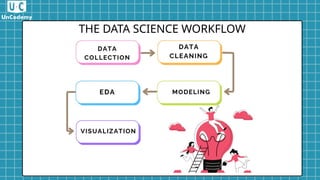
• Data Collection: Gathering data from various sources (e.g., databases,
sensors, web scraping).
• Data Cleaning: Removing duplicates, handling missing values, and
correcting errors.
• Exploratory Data Analysis (EDA): Analyzing data to find trends,
patterns, and anomalies.
• Modeling: Applying machine learning algorithms to predict outcomes
or classify data.
• Data Visualization: Presenting findings visually (charts, graphs,
dashboards).
KEY COMPONENTS OF DATA SCIENCE
THE DATA SCIENCE WORKFLOW
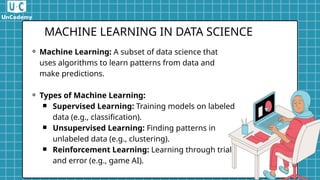
⚬ Machine Learning: A subset of data science that
uses algorithms to learn patterns from data and
make predictions.
⚬ Types of Machine Learning:
■ Supervised Learning: Training models on labeled
data (e.g., classification).
■ Unsupervised Learning: Finding patterns in
unlabeled data (e.g., clustering).
■ Reinforcement Learning: Learning through trial
and error (e.g., game AI).
MACHINE LEARNING IN DATA SCIENCE
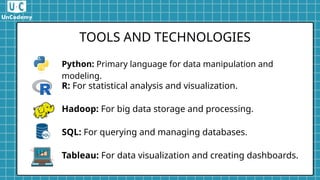
TOOLS AND TECHNOLOGIES
Python: Primary language for data manipulation and
modeling.
R: For statistical analysis and visualization.
SQL: For querying and managing databases.
Hadoop: For big data storage and processing.
Tableau: For data visualization and creating dashboards.
• Data Quality: Incomplete, inconsistent, or noisy data.
• Overfitting: When models become too complex and fit
the noise rather than the signal.
• Model Interpretability: Difficulty in understanding and
explaining complex models (e.g., deep learning).
• Scalability: Handling large volumes of data efficiently.
CHALLENGES IN DATA SCIENCE
CONCLUSION
• Data Science is a powerful field that transforms data into
valuable insights.
• Its applications continue to grow across various industries.
• The field offers exciting career opportunities but also presents
challenges, requiring continuous learning and adaptation.
!!THANK YOU!!

Introduction to Data Science: Key Concepts and Applications

  • 1.
  • 2.
    • Data Scienceis the field that uses scientific methods, processes, algorithms, and systems to extract knowledge from structured and unstructured data. • It combines concepts from statistics, computer science, and domain expertise to solve complex problems and make data-driven decisions. • Applications: Healthcare, Finance, Marketing, Retail, etc. WHAT IS DATA SCIENCE?
  • 3.
    • Data Collection:Gathering data from various sources (e.g., databases, sensors, web scraping). • Data Cleaning: Removing duplicates, handling missing values, and correcting errors. • Exploratory Data Analysis (EDA): Analyzing data to find trends, patterns, and anomalies. • Modeling: Applying machine learning algorithms to predict outcomes or classify data. • Data Visualization: Presenting findings visually (charts, graphs, dashboards). KEY COMPONENTS OF DATA SCIENCE
  • 4.
  • 5.
    ⚬ Machine Learning:A subset of data science that uses algorithms to learn patterns from data and make predictions. ⚬ Types of Machine Learning: ■ Supervised Learning: Training models on labeled data (e.g., classification). ■ Unsupervised Learning: Finding patterns in unlabeled data (e.g., clustering). ■ Reinforcement Learning: Learning through trial and error (e.g., game AI). MACHINE LEARNING IN DATA SCIENCE
  • 6.
    TOOLS AND TECHNOLOGIES Python:Primary language for data manipulation and modeling. R: For statistical analysis and visualization. SQL: For querying and managing databases. Hadoop: For big data storage and processing. Tableau: For data visualization and creating dashboards.
  • 7.
    • Data Quality:Incomplete, inconsistent, or noisy data. • Overfitting: When models become too complex and fit the noise rather than the signal. • Model Interpretability: Difficulty in understanding and explaining complex models (e.g., deep learning). • Scalability: Handling large volumes of data efficiently. CHALLENGES IN DATA SCIENCE
  • 8.
    CONCLUSION • Data Scienceis a powerful field that transforms data into valuable insights. • Its applications continue to grow across various industries. • The field offers exciting career opportunities but also presents challenges, requiring continuous learning and adaptation.
  • 9.