Good Morning &
Welcome
We'll explore the fundamentals of Data Modeling and the E-R
Model.
Prepare for clear, actionable insights tailored for both technical
and non-technical audiences.
Presents by: Shiva Kumar Shah
Introduction to Data
Modeling
• Introduction to Data Modeling & E-R Model
• Data modeling is the blueprint for designing databases
• It defines how data is stored, organized, and connected
Ensures efficiency, accuracy, and scalability in complex systems
• Different types: Hierarchical, Network, Relational
E-R Model is key for conceptual design
• Today’s focus:
• Core concepts and components of the E-R Model
• Why it's important for both developers and non-technical
stakeholders
What is the E-R Model?
The E-R Model is a high-level conceptual data model that represents real-world elements as entities and models
their associations as relationships. Entities are objects like customers or products, while attributes define their
properties such as names or prices. Relationships describe how entities interact or relate, and cardinality specifies
the nature of these connections—ranging from one-to-one to many-to-many.
E-R diagrams serve as the visual language for this model, making complex data structures understandable at a
glance, which is especially useful in early database design phases.
Entities
Real-world objects like customers,
products, or employees.
Attributes
Details that describe each entity,
such as a product’s price or a
customer’s ID.
Relationships
How entities associate with each
other, for example, orders placed
by customers.
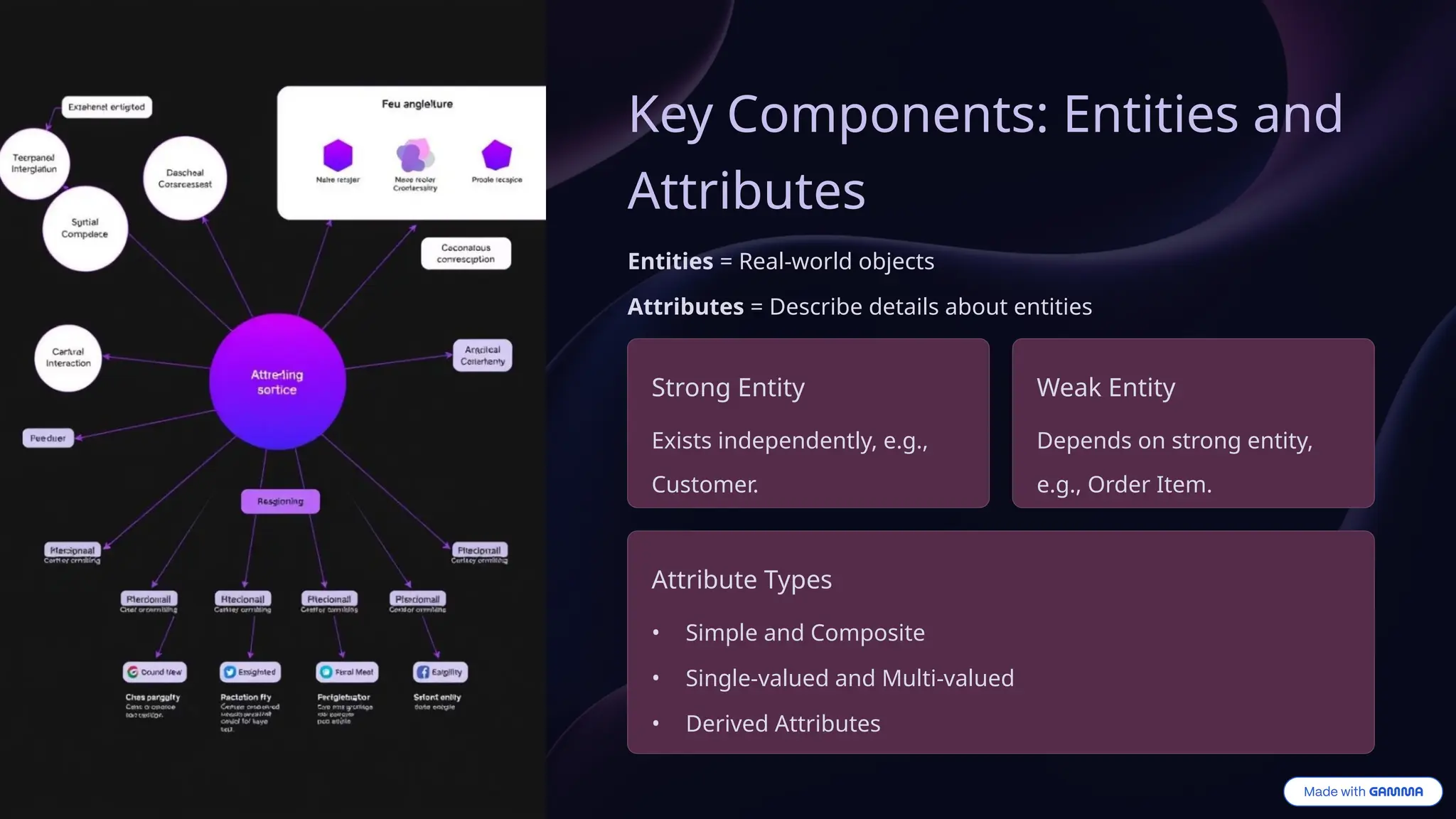
Key Components: Entities and
Attributes
Entities = Real-world objects
Attributes = Describe details about entities
Strong Entity
Exists independently, e.g.,
Customer.
Weak Entity
Depends on strong entity,
e.g., Order Item.
Attribute Types
• Simple and Composite
• Single-valued and Multi-valued
• Derived Attributes
Key Components: Relationships and Cardinality
Relationships illustrate associations between entities, such as a Customer placing an Order. Cardinality defines
how many instances of one entity relate to another, critical for accurate modeling. These include one-to-one (a
person has one passport), one-to-many (a customer places multiple orders), many-to-one, and many-to-many
(students enrolled in multiple courses).
Participation indicates whether all or some instances of an entity participate in a relationship, either totally or
partially. This level of detail captures real-world constraints, ensuring the database reflects true business rules.
1 One-to-One (1:1)
Each entity instance relates
to only one instance in the
other set.
2 One-to-Many (1:N)
One entity relates to multiple
instances in another set.
3 Many-to-Many (N:M)
Multiple entities on both
sides relate to each other.
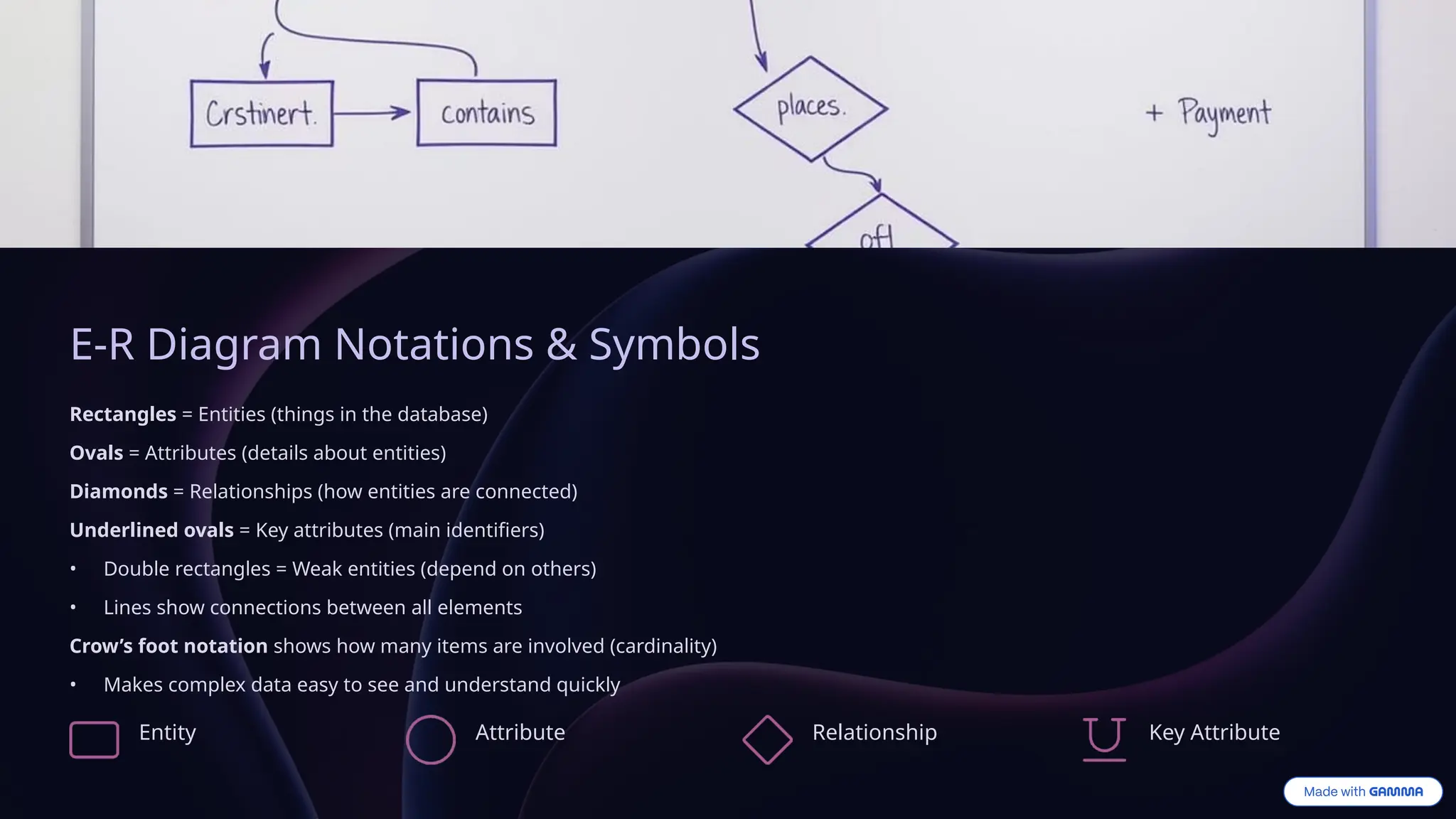
E-R Diagram Notations & Symbols
Rectangles = Entities (things in the database)
Ovals = Attributes (details about entities)
Diamonds = Relationships (how entities are connected)
Underlined ovals = Key attributes (main identifiers)
• Double rectangles = Weak entities (depend on others)
• Lines show connections between all elements
Crow’s foot notation shows how many items are involved (cardinality)
• Makes complex data easy to see and understand quickly
Entity Attribute Relationship Key Attribute
E-R Model vs. Other Data Models
Different models serve different needs:
Hierarchical: Tree-like, but struggles with complex links
Network: More flexible, but harder to manage
Relational: Common today, uses tables but can be less intuitive at first
Object-Oriented: Great for complex data, used in specialized cases
E-R Model stands out for its clear, easy-to-understand design
• Ideal for early planning and stakeholder communication
• Provides a strong, flexible base for building any type of database
Hierarchical
Tree-like, simple but
limited.
Network
Flexible but complex to
manage.
Relational
Table-based, widely used.
Object-Oriented
Handles complex data
types.
Advantages of the E-R Model
The E-R model's simplicity makes it accessible for both technical teams and stakeholders, facilitating clearer communication during database design. It
provides a strong foundation for relational database development, guiding the logical structuring of data.
Its flexibility allows for easy adaptation to changing business needs and integration with other models. This adaptability ensures that evolving data
relationships and rules can be accommodated without redesigning the entire database.
Clarity
Straightforward visualization fosters understanding.
Communication
Bridges gap between technical and business teams.
Flexibility
Adapts well to evolving business requirements.
Foundation
Supports relational database design effectively.
Conclusion: Why Choose the
E-R Model?
• Combines simplicity and power, making it easy to understand
and use
• Clearly communicates complex relationships, even to non-
technical stakeholders
• Reduces misunderstandings and design errors early in the
process
• Helps avoid costly changes later by aligning the design with
business needs from the start
• Streamlines development and improves overall database
planning and documentation
Thank You for Your Attention
&
joining us today.

Introduction to Data Modeling and Its Types.pptx

  • 1.
    Good Morning & Welcome We'llexplore the fundamentals of Data Modeling and the E-R Model. Prepare for clear, actionable insights tailored for both technical and non-technical audiences. Presents by: Shiva Kumar Shah
  • 2.
    Introduction to Data Modeling •Introduction to Data Modeling & E-R Model • Data modeling is the blueprint for designing databases • It defines how data is stored, organized, and connected Ensures efficiency, accuracy, and scalability in complex systems • Different types: Hierarchical, Network, Relational E-R Model is key for conceptual design • Today’s focus: • Core concepts and components of the E-R Model • Why it's important for both developers and non-technical stakeholders
  • 3.
    What is theE-R Model? The E-R Model is a high-level conceptual data model that represents real-world elements as entities and models their associations as relationships. Entities are objects like customers or products, while attributes define their properties such as names or prices. Relationships describe how entities interact or relate, and cardinality specifies the nature of these connections—ranging from one-to-one to many-to-many. E-R diagrams serve as the visual language for this model, making complex data structures understandable at a glance, which is especially useful in early database design phases. Entities Real-world objects like customers, products, or employees. Attributes Details that describe each entity, such as a product’s price or a customer’s ID. Relationships How entities associate with each other, for example, orders placed by customers.
  • 4.
    Key Components: Entitiesand Attributes Entities = Real-world objects Attributes = Describe details about entities Strong Entity Exists independently, e.g., Customer. Weak Entity Depends on strong entity, e.g., Order Item. Attribute Types • Simple and Composite • Single-valued and Multi-valued • Derived Attributes
  • 5.
    Key Components: Relationshipsand Cardinality Relationships illustrate associations between entities, such as a Customer placing an Order. Cardinality defines how many instances of one entity relate to another, critical for accurate modeling. These include one-to-one (a person has one passport), one-to-many (a customer places multiple orders), many-to-one, and many-to-many (students enrolled in multiple courses). Participation indicates whether all or some instances of an entity participate in a relationship, either totally or partially. This level of detail captures real-world constraints, ensuring the database reflects true business rules. 1 One-to-One (1:1) Each entity instance relates to only one instance in the other set. 2 One-to-Many (1:N) One entity relates to multiple instances in another set. 3 Many-to-Many (N:M) Multiple entities on both sides relate to each other.
  • 6.
    E-R Diagram Notations& Symbols Rectangles = Entities (things in the database) Ovals = Attributes (details about entities) Diamonds = Relationships (how entities are connected) Underlined ovals = Key attributes (main identifiers) • Double rectangles = Weak entities (depend on others) • Lines show connections between all elements Crow’s foot notation shows how many items are involved (cardinality) • Makes complex data easy to see and understand quickly Entity Attribute Relationship Key Attribute
  • 7.
    E-R Model vs.Other Data Models Different models serve different needs: Hierarchical: Tree-like, but struggles with complex links Network: More flexible, but harder to manage Relational: Common today, uses tables but can be less intuitive at first Object-Oriented: Great for complex data, used in specialized cases E-R Model stands out for its clear, easy-to-understand design • Ideal for early planning and stakeholder communication • Provides a strong, flexible base for building any type of database Hierarchical Tree-like, simple but limited. Network Flexible but complex to manage. Relational Table-based, widely used. Object-Oriented Handles complex data types.
  • 8.
    Advantages of theE-R Model The E-R model's simplicity makes it accessible for both technical teams and stakeholders, facilitating clearer communication during database design. It provides a strong foundation for relational database development, guiding the logical structuring of data. Its flexibility allows for easy adaptation to changing business needs and integration with other models. This adaptability ensures that evolving data relationships and rules can be accommodated without redesigning the entire database. Clarity Straightforward visualization fosters understanding. Communication Bridges gap between technical and business teams. Flexibility Adapts well to evolving business requirements. Foundation Supports relational database design effectively.
  • 9.
    Conclusion: Why Choosethe E-R Model? • Combines simplicity and power, making it easy to understand and use • Clearly communicates complex relationships, even to non- technical stakeholders • Reduces misunderstandings and design errors early in the process • Helps avoid costly changes later by aligning the design with business needs from the start • Streamlines development and improves overall database planning and documentation
  • 10.
    Thank You forYour Attention & joining us today.