Module 5: Will Your
Future Be in
Cybersecurity?
Introduction to Cybersecurity (I2CS)
© 2020 Cisco and/or its affiliates. All rights reserved. Cisco Confidential
Module Objectives
Module Title: Will Your Future Be in Cybersecurity?
Module Objective: Access a variety of information and resources to explore the different career options in
cybersecurity.
Topic Title Topic Objective
Legal and Ethical Issues
Identify some of the personal and corporate legal issues that can arise
when working in cybersecurity.
Education and Careers
Identify what professional certifications and next steps they need to
take to follow a career in cybersecurity.
9
© 2020 Cisco and/or its affiliates. All rights reserved. Cisco Confidential
5.1 Legal and Ethical Issues
10
© 2020 Cisco and/or its affiliates. All rights reserved. Cisco Confidential
Legal and Ethical Issues
Legal Issues in Cybersecurity
To protect against attacks, cybersecurity professionals must have the same skills as attackers.
However, cybersecurity professionals use their skills within the bounds of the law.
Personal legal issues
• You may have the opportunity and skills to hack another person's computer or network at work or
home. But there is an old saying, 'Just because you can does not mean you should.' Most hacks
leave tracks that can trace back to you.
• Cybersecurity professionals develop many skills which have a positive or illegal use. There is
always a huge demand for those who choose to put their cyber skills to good use within legal
bounds.
11
© 2020 Cisco and/or its affiliates. All rights reserved. Cisco Confidential
Legal and Ethical Issues
Legal Issues in Cybersecurity (Cont.)
Corporate legal issues
• Businesses and organizations must abide by the cybersecurity laws that most countries have.
• Punishment for breaking cybersecurity laws while doing your job may take place for the
organization; in some cases, you could lose your job. In other instances, prosecution, fines, and
sentencing could happen.
• If you are unsure whether an action or behavior might be illegal, assume it is unlawful and does
not do it. Always check with the legal or HR department in the organization.
12
© 2020 Cisco and/or its affiliates. All rights reserved. Cisco Confidential
Legal and Ethical Issues
Legal Issues in Cybersecurity (Cont.)
International law and cybersecurity
• International cybersecurity law is a constantly evolving field. Cyber attacks occur in cyberspace,
an electronic space created, maintained, and owned by the public and private entities. There are
no traditional geographic boundaries in cyberspace. To further complicate issues, it is much easier
to mask the source of an attack in cyberwarfare than in conventional warfare.
• The global society is still debating how best to deal with cyberspace. Country practice, opinio juris
(a sense on behalf of a country that it is bound to the law in question), and any treaties drafted will
shape international cybersecurity law.
13
© 2020 Cisco and/or its affiliates. All rights reserved. Cisco Confidential
Legal and Ethical Issues
Ethical Issues in Cybersecurity
• Think back to the pen test you carried out for @Apollo. This test revealed that one of your
colleagues, who started at the same time as you, was responsible for a data breach. You are
thinking of not including this in your report as they might get in trouble.
• Ask yourself the following questions to help you decide on the best course of action.
• Is it legal?
• Does your action comply with @Apollo policy?
• Will your action be favorable for @Apollo and its stakeholders?
• Would it be okay if everyone in @Apollo took this action?
• Would the outcome of your action represent @Apollo in a positive light in a news headline?
14
© 2020 Cisco and/or its affiliates. All rights reserved. Cisco Confidential
Legal and Ethical Issues
Corporate Ethical Issues
• Many professional IT organizations, such as the Information Systems Security Association (ISSA),
have published Codes of Ethics to help guide employee actions and behaviors.
• Cisco also has a team devoted exclusively to ethical business conduct and a Code of Business
Conduct to help employees make business decisions and resolve any issues they may encounter.
15
© 2020 Cisco and/or its affiliates. All rights reserved. Cisco Confidential
5.2 Education and Careers
16
© 2020 Cisco and/or its affiliates. All rights reserved. Cisco Confidential
Education and Careers
Become a Cybersecurity Guru
• You have excelled as an entry-level Security Analyst at @Apollo, but there are many
cybersecurity jobs to consider.
• Even if you are beginning your cybersecurity career, it’s a good idea to look at job search engines,
such as Indeed, LinkedIn, Monster, and CareerBuilder, to get a sense of what jobs are available
all over the world!
17
© 2020 Cisco and/or its affiliates. All rights reserved. Cisco Confidential
Education and Careers
Professional Certifications
Cybersecurity certifications are an excellent way to verify your skills and knowledge and boost your
career.
• Microsoft Technology Associate (MTA) Security Fundamentals: This certification aims at high
school and early college students and those interested in a career change.
• Palo Alto Networks Certified Cybersecurity Associate: This is an entry-level certification for
newcomers preparing to start their careers in the cybersecurity field.
• ISACA CSX Cybersecurity Fundamentals Certificate: This certification gears toward recent
post-secondary graduates and those interested in a career change. This certificate does not
expire or require periodic recertification.
18
© 2020 Cisco and/or its affiliates. All rights reserved. Cisco Confidential
Education and Careers
Professional Certifications (Cont.)
• CompTIA Security+: This entry-level security certification meets the U.S. Department of Defense
Directive 8570.01-M requirements, which is an essential item for anyone looking to work in IT
security for the federal government.
• EC Council Certified Ethical Hacker (CEH): This certification tests your understanding and
knowledge of looking for weaknesses and vulnerabilities in target systems using the same
knowledge and tools as a malicious hacker but lawfully and legitimately.
• ISC2 Certified Information Systems Security Professional (CISSP): This is the most
recognizable and popular security certification. To take the exam, you must have at least five
years of relevant industry experience.
• Cisco Certified CyberOps Associate: This certification validates the skills required of associate-
level cybersecurity analysts within security operations centers.
19
© 2020 Cisco and/or its affiliates. All rights reserved. Cisco Confidential
Education and Careers
Cybersecurity Career Pathways
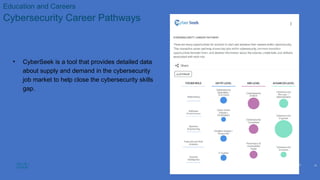
• CyberSeek is a tool that provides detailed data
about supply and demand in the cybersecurity
job market to help close the cybersecurity skills
gap.
20
© 2020 Cisco and/or its affiliates. All rights reserved. Cisco Confidential
5.3 Module Quiz
21
© 2020 Cisco and/or its affiliates. All rights reserved. Cisco Confidential
Will Your Future Be in Cybersecurity?
What Did I Learn in this Module?
• To protect against attacks, cybersecurity professionals must have the same skills as attackers.
However, cybersecurity professionals use their skills within the bounds of the law.
• Personal legal issues: You may have the opportunity and skills to hack another person's
computer or network at work or home. But there is an old saying, 'Just because you can does not
mean you should.' Most hacks leave tracks that can trace back to you.
• Corporate legal issues: Businesses and organizations must abide by the cybersecurity laws that
most countries have.
• International cybersecurity law is a constantly evolving field. Cyber attacks occur in cyberspace,
an electronic space created, maintained, and owned by the public and private entities. There are
no traditional geographic boundaries in cyberspace. To further complicate issues, it is much easier
to mask the source of an attack in cyberwarfare than in conventional warfare.
22
© 2020 Cisco and/or its affiliates. All rights reserved. Cisco Confidential
Will Your Future Be in Cybersecurity?
What Did I Learn in this Module? (Cont.)
• Many professional IT organizations, such as the Information Systems Security Association (ISSA),
have published Codes of Ethics to help guide employee actions and behaviors.
• Microsoft Technology Associate (MTA) Security Fundamentals: This certification aims at high
school and early college students and those interested in a career change.
• Palo Alto Networks Certified Cybersecurity Associate: This is an entry-level certification for
newcomers preparing to start their careers in the cybersecurity field.
• ISACA CSX Cybersecurity Fundamentals Certificate: This certification gears toward recent
post-secondary graduates and those interested in a career change. This certificate does not
expire or require periodic recertification.
23
© 2020 Cisco and/or its affiliates. All rights reserved. Cisco Confidential
Will Your Future Be in Cybersecurity?
What Did I Learn in this Module? (Cont.)
• CompTIA Security+: This entry-level security certification meets the U.S. Department of Defense
Directive 8570.01-M requirements, which is an essential item for anyone looking to work in IT
security for the federal government.
• EC Council Certified Ethical Hacker (CEH): This certification tests your understanding and
knowledge of looking for weaknesses and vulnerabilities in target systems using the same
knowledge and tools as a malicious hacker but lawfully and legitimately.
• ISC2 Certified Information Systems Security Professional (CISSP): This is the most
recognizable and popular security certification. To take the exam, you must have at least five
years of relevant industry experience.
• Cisco Certified CyberOps Associate: This certification validates the skills required of associate-
level cybersecurity analysts within security operations centers.
24
© 2020 Cisco and/or its affiliates. All rights reserved. Cisco Confidential
Will Your Future Be in Cybersecurity?
What Did I Learn in this Module? (Cont.)
• CyberSeek is a tool that provides detailed data about supply and demand in the cybersecurity job
market to help close the cybersecurity skills gap.
25

Introduction to Cybersecurity v3.0 - Module5.pptx

  • 1.
    Module 5: WillYour Future Be in Cybersecurity? Introduction to Cybersecurity (I2CS)
  • 2.
    © 2020 Ciscoand/or its affiliates. All rights reserved. Cisco Confidential Module Objectives Module Title: Will Your Future Be in Cybersecurity? Module Objective: Access a variety of information and resources to explore the different career options in cybersecurity. Topic Title Topic Objective Legal and Ethical Issues Identify some of the personal and corporate legal issues that can arise when working in cybersecurity. Education and Careers Identify what professional certifications and next steps they need to take to follow a career in cybersecurity. 9
  • 3.
    © 2020 Ciscoand/or its affiliates. All rights reserved. Cisco Confidential 5.1 Legal and Ethical Issues 10
  • 4.
    © 2020 Ciscoand/or its affiliates. All rights reserved. Cisco Confidential Legal and Ethical Issues Legal Issues in Cybersecurity To protect against attacks, cybersecurity professionals must have the same skills as attackers. However, cybersecurity professionals use their skills within the bounds of the law. Personal legal issues • You may have the opportunity and skills to hack another person's computer or network at work or home. But there is an old saying, 'Just because you can does not mean you should.' Most hacks leave tracks that can trace back to you. • Cybersecurity professionals develop many skills which have a positive or illegal use. There is always a huge demand for those who choose to put their cyber skills to good use within legal bounds. 11
  • 5.
    © 2020 Ciscoand/or its affiliates. All rights reserved. Cisco Confidential Legal and Ethical Issues Legal Issues in Cybersecurity (Cont.) Corporate legal issues • Businesses and organizations must abide by the cybersecurity laws that most countries have. • Punishment for breaking cybersecurity laws while doing your job may take place for the organization; in some cases, you could lose your job. In other instances, prosecution, fines, and sentencing could happen. • If you are unsure whether an action or behavior might be illegal, assume it is unlawful and does not do it. Always check with the legal or HR department in the organization. 12
  • 6.
    © 2020 Ciscoand/or its affiliates. All rights reserved. Cisco Confidential Legal and Ethical Issues Legal Issues in Cybersecurity (Cont.) International law and cybersecurity • International cybersecurity law is a constantly evolving field. Cyber attacks occur in cyberspace, an electronic space created, maintained, and owned by the public and private entities. There are no traditional geographic boundaries in cyberspace. To further complicate issues, it is much easier to mask the source of an attack in cyberwarfare than in conventional warfare. • The global society is still debating how best to deal with cyberspace. Country practice, opinio juris (a sense on behalf of a country that it is bound to the law in question), and any treaties drafted will shape international cybersecurity law. 13
  • 7.
    © 2020 Ciscoand/or its affiliates. All rights reserved. Cisco Confidential Legal and Ethical Issues Ethical Issues in Cybersecurity • Think back to the pen test you carried out for @Apollo. This test revealed that one of your colleagues, who started at the same time as you, was responsible for a data breach. You are thinking of not including this in your report as they might get in trouble. • Ask yourself the following questions to help you decide on the best course of action. • Is it legal? • Does your action comply with @Apollo policy? • Will your action be favorable for @Apollo and its stakeholders? • Would it be okay if everyone in @Apollo took this action? • Would the outcome of your action represent @Apollo in a positive light in a news headline? 14
  • 8.
    © 2020 Ciscoand/or its affiliates. All rights reserved. Cisco Confidential Legal and Ethical Issues Corporate Ethical Issues • Many professional IT organizations, such as the Information Systems Security Association (ISSA), have published Codes of Ethics to help guide employee actions and behaviors. • Cisco also has a team devoted exclusively to ethical business conduct and a Code of Business Conduct to help employees make business decisions and resolve any issues they may encounter. 15
  • 9.
    © 2020 Ciscoand/or its affiliates. All rights reserved. Cisco Confidential 5.2 Education and Careers 16
  • 10.
    © 2020 Ciscoand/or its affiliates. All rights reserved. Cisco Confidential Education and Careers Become a Cybersecurity Guru • You have excelled as an entry-level Security Analyst at @Apollo, but there are many cybersecurity jobs to consider. • Even if you are beginning your cybersecurity career, it’s a good idea to look at job search engines, such as Indeed, LinkedIn, Monster, and CareerBuilder, to get a sense of what jobs are available all over the world! 17
  • 11.
    © 2020 Ciscoand/or its affiliates. All rights reserved. Cisco Confidential Education and Careers Professional Certifications Cybersecurity certifications are an excellent way to verify your skills and knowledge and boost your career. • Microsoft Technology Associate (MTA) Security Fundamentals: This certification aims at high school and early college students and those interested in a career change. • Palo Alto Networks Certified Cybersecurity Associate: This is an entry-level certification for newcomers preparing to start their careers in the cybersecurity field. • ISACA CSX Cybersecurity Fundamentals Certificate: This certification gears toward recent post-secondary graduates and those interested in a career change. This certificate does not expire or require periodic recertification. 18
  • 12.
    © 2020 Ciscoand/or its affiliates. All rights reserved. Cisco Confidential Education and Careers Professional Certifications (Cont.) • CompTIA Security+: This entry-level security certification meets the U.S. Department of Defense Directive 8570.01-M requirements, which is an essential item for anyone looking to work in IT security for the federal government. • EC Council Certified Ethical Hacker (CEH): This certification tests your understanding and knowledge of looking for weaknesses and vulnerabilities in target systems using the same knowledge and tools as a malicious hacker but lawfully and legitimately. • ISC2 Certified Information Systems Security Professional (CISSP): This is the most recognizable and popular security certification. To take the exam, you must have at least five years of relevant industry experience. • Cisco Certified CyberOps Associate: This certification validates the skills required of associate- level cybersecurity analysts within security operations centers. 19
  • 13.
    © 2020 Ciscoand/or its affiliates. All rights reserved. Cisco Confidential Education and Careers Cybersecurity Career Pathways • CyberSeek is a tool that provides detailed data about supply and demand in the cybersecurity job market to help close the cybersecurity skills gap. 20
  • 14.
    © 2020 Ciscoand/or its affiliates. All rights reserved. Cisco Confidential 5.3 Module Quiz 21
  • 15.
    © 2020 Ciscoand/or its affiliates. All rights reserved. Cisco Confidential Will Your Future Be in Cybersecurity? What Did I Learn in this Module? • To protect against attacks, cybersecurity professionals must have the same skills as attackers. However, cybersecurity professionals use their skills within the bounds of the law. • Personal legal issues: You may have the opportunity and skills to hack another person's computer or network at work or home. But there is an old saying, 'Just because you can does not mean you should.' Most hacks leave tracks that can trace back to you. • Corporate legal issues: Businesses and organizations must abide by the cybersecurity laws that most countries have. • International cybersecurity law is a constantly evolving field. Cyber attacks occur in cyberspace, an electronic space created, maintained, and owned by the public and private entities. There are no traditional geographic boundaries in cyberspace. To further complicate issues, it is much easier to mask the source of an attack in cyberwarfare than in conventional warfare. 22
  • 16.
    © 2020 Ciscoand/or its affiliates. All rights reserved. Cisco Confidential Will Your Future Be in Cybersecurity? What Did I Learn in this Module? (Cont.) • Many professional IT organizations, such as the Information Systems Security Association (ISSA), have published Codes of Ethics to help guide employee actions and behaviors. • Microsoft Technology Associate (MTA) Security Fundamentals: This certification aims at high school and early college students and those interested in a career change. • Palo Alto Networks Certified Cybersecurity Associate: This is an entry-level certification for newcomers preparing to start their careers in the cybersecurity field. • ISACA CSX Cybersecurity Fundamentals Certificate: This certification gears toward recent post-secondary graduates and those interested in a career change. This certificate does not expire or require periodic recertification. 23

  • 17.
    © 2020 Ciscoand/or its affiliates. All rights reserved. Cisco Confidential Will Your Future Be in Cybersecurity? What Did I Learn in this Module? (Cont.) • CompTIA Security+: This entry-level security certification meets the U.S. Department of Defense Directive 8570.01-M requirements, which is an essential item for anyone looking to work in IT security for the federal government. • EC Council Certified Ethical Hacker (CEH): This certification tests your understanding and knowledge of looking for weaknesses and vulnerabilities in target systems using the same knowledge and tools as a malicious hacker but lawfully and legitimately. • ISC2 Certified Information Systems Security Professional (CISSP): This is the most recognizable and popular security certification. To take the exam, you must have at least five years of relevant industry experience. • Cisco Certified CyberOps Associate: This certification validates the skills required of associate- level cybersecurity analysts within security operations centers. 24
  • 18.
    © 2020 Ciscoand/or its affiliates. All rights reserved. Cisco Confidential Will Your Future Be in Cybersecurity? What Did I Learn in this Module? (Cont.) • CyberSeek is a tool that provides detailed data about supply and demand in the cybersecurity job market to help close the cybersecurity skills gap. 25

Editor's Notes

  • #1 Introduction to Cybersecurity Module 5: Will Your Future Be in Cybersecurity?
  • #8 Introduction to Cybersecurity Module 5: Will Your Future Be in Cybersecurity?
  • #9 5: Will Your Future Be in Cybersecurity?
  • #10 5: Will Your Future Be in Cybersecurity? 5.1: Legal and Ethical Issues
  • #11 5: Will Your Future Be in Cybersecurity? 5.1: Legal and Ethical Issues 5.1.1: Legal Issues in Cybersecurity Avatar
  • #12 5: Will Your Future Be in Cybersecurity? 5.1: Legal and Ethical Issues 5.1.1: Legal Issues in Cybersecurity (Cont.)
  • #13 5: Will Your Future Be in Cybersecurity? 5.1: Legal and Ethical Issues 5.1.1: Legal Issues in Cybersecurity (Cont.) Avatar
  • #14 5: Will Your Future Be in Cybersecurity? 5.1: Legal and Ethical Issues 5.1.2: Ethical Issues in Cybersecurity 5.1.3: Check Your Understanding – How Did You Answer?
  • #15 5: Will Your Future Be in Cybersecurity? 5.1: Legal and Ethical Issues 5.1.4: Corporate Ethical Issues
  • #16 5: Will Your Future Be in Cybersecurity? 5.2: Education and Careers Avatar
  • #17 5: Will Your Future Be in Cybersecurity? 5.2: Education and Careers 5.2.1: Become a Cybersecurity Guru
  • #18 5: Will Your Future Be in Cybersecurity? 5.2: Education and Careers 5.2.2: Professional Certifications Avatar
  • #19 5: Will Your Future Be in Cybersecurity? 5.2: Education and Careers 5.2.2: Professional Certifications (Cont.) Avatar
  • #20 5: Will Your Future Be in Cybersecurity? 5.2: Education and Careers 5.2.3: Cybersecurity Career Pathways
  • #21 5: Will Your Future Be in Cybersecurity? 5.3: Module Quiz
  • #22 5: Will Your Future Be in Cybersecurity? What Did I Learn in this Module?
  • #23 5: Will Your Future Be in Cybersecurity? What Did I Learn in this Module? (Cont.)
  • #24 5: Will Your Future Be in Cybersecurity? What Did I Learn in this Module? (Cont.)
  • #25 5: Will Your Future Be in Cybersecurity? What Did I Learn in this Module? (Cont.)
  • #26 5: Will Your Future Be in Cybersecurity? New Terms and Commands