Cybersecurity
Training for
Teachers (CTT)
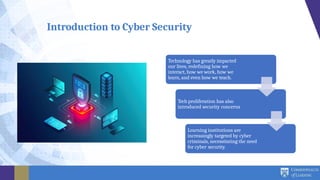
Technology has greatly impacted
our lives, redefining how we
interact, how we work, how we
learn, and even how we teach.
Tech proliferation has also
introduced security concerns
Learning institutions are
increasingly targeted by cyber
criminals, necessitating the need
for cyber security.
Introduction to Cyber Security
What is Cyber Security?
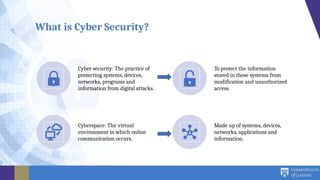
Cyber security: The practice of
protecting systems, devices,
networks, programs and
information from digital attacks.
To protect the information
stored in these systems from
modification and unauthorized
access.
Cyberspace: The virtual
environment in which online
communication occurs.
Made up of systems, devices,
networks, applications and
information.
Why is Cyber Security Important?
The main objective of cyber security is to protect devices, systems, and information from
modification and unauthorized access and ensure they are available when we need to access
and use them.
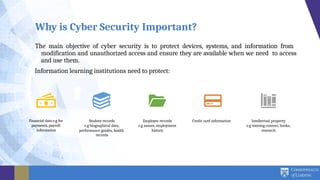
Information learning institutions need to protect:
Financial data e.g fee
payments, payroll
information
Student records
e.g biographical data,
performance grades, health
records
Employee records
e.g names, employment
history
Credit card information Intellectual property
e.g training content, books,
research
Cyber Security Statistics in Learning Institutions
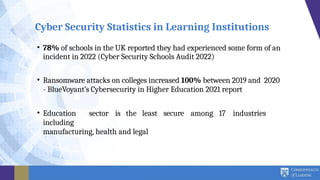
• 78% of schools in the UK reported they had experienced some form of an
incident in 2022 (Cyber Security Schools Audit 2022)
• Ransomware attacks on colleges increased 100% between 2019 and 2020
- BlueVoyant’s Cybersecurity in Higher Education 2021 report
• Education sector is the least secure among 17 industries
including
manufacturing, health and legal
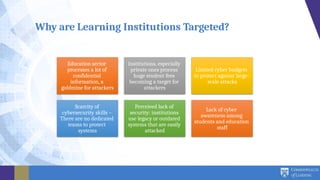
Why are Learning Institutions Targeted?
Education sector
processes a lot of
confidential
information, a
goldmine for attackers
Institutions, especially
private ones process
huge student fees
becoming a target for
attackers
Limited cyber budgets
to protect against large-
scale attacks
Scarcity of
cybersecurity skills –
There are no dedicated
teams to protect
systems
Perceived lack of
security: institutions
use legacy or outdated
systems that are easily
attacked
Lack of cyber
awareness among
students and education
staff
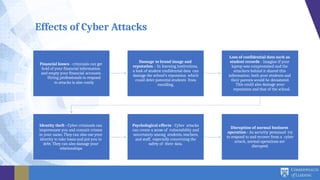
Effects of Cyber Attacks
Financial losses - criminals can get
hold of your financial information
and empty your financial accounts.
Hiring professionals to respond
to attacks is also costly
Damage to brand image and
reputation – In learning institutions,
a leak of student confidential data can
damage the school’s reputation which
could deter potential students from
enrolling.
Loss of confidential data such as
student records - Imagine if your
laptop was compromised and the
attackers behind it shared this
information; both your students and
their parents would be devastated.
This could also damage your
reputation and that of the school.
Identity theft - Cyber criminals can
impersonate you and commit crimes
in your name. They can also use your
identity to take loans and put you in
debt. They can also damage your
relationships.
Psychological effects - Cyber attacks
can create a sense of vulnerability and
uncertainty among students, teachers,
and staff, especially concerning the
safety of their data.
Disruption of normal business
operation - As security personnel try
to respond to and recover from a cyber
attack, normal operations are
disrupted.
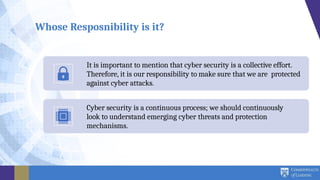
Whose Resposnibility is it?
It is important to mention that cyber security is a collective effort.
Therefore, it is our responsibility to make sure that we are protected
against cyber attacks.
Cyber security is a continuous process; we should continuously
look to understand emerging cyber threats and protection
mechanisms.

Introduction to Cyber Security Slides.pptx

  • 1.
  • 2.
    Technology has greatlyimpacted our lives, redefining how we interact, how we work, how we learn, and even how we teach. Tech proliferation has also introduced security concerns Learning institutions are increasingly targeted by cyber criminals, necessitating the need for cyber security. Introduction to Cyber Security
  • 3.
    What is CyberSecurity? Cyber security: The practice of protecting systems, devices, networks, programs and information from digital attacks. To protect the information stored in these systems from modification and unauthorized access. Cyberspace: The virtual environment in which online communication occurs. Made up of systems, devices, networks, applications and information.
  • 4.
    Why is CyberSecurity Important? The main objective of cyber security is to protect devices, systems, and information from modification and unauthorized access and ensure they are available when we need to access and use them. Information learning institutions need to protect: Financial data e.g fee payments, payroll information Student records e.g biographical data, performance grades, health records Employee records e.g names, employment history Credit card information Intellectual property e.g training content, books, research
  • 5.
    Cyber Security Statisticsin Learning Institutions • 78% of schools in the UK reported they had experienced some form of an incident in 2022 (Cyber Security Schools Audit 2022) • Ransomware attacks on colleges increased 100% between 2019 and 2020 - BlueVoyant’s Cybersecurity in Higher Education 2021 report • Education sector is the least secure among 17 industries including manufacturing, health and legal
  • 6.
    Why are LearningInstitutions Targeted? Education sector processes a lot of confidential information, a goldmine for attackers Institutions, especially private ones process huge student fees becoming a target for attackers Limited cyber budgets to protect against large- scale attacks Scarcity of cybersecurity skills – There are no dedicated teams to protect systems Perceived lack of security: institutions use legacy or outdated systems that are easily attacked Lack of cyber awareness among students and education staff
  • 7.
    Effects of CyberAttacks Financial losses - criminals can get hold of your financial information and empty your financial accounts. Hiring professionals to respond to attacks is also costly Damage to brand image and reputation – In learning institutions, a leak of student confidential data can damage the school’s reputation which could deter potential students from enrolling. Loss of confidential data such as student records - Imagine if your laptop was compromised and the attackers behind it shared this information; both your students and their parents would be devastated. This could also damage your reputation and that of the school. Identity theft - Cyber criminals can impersonate you and commit crimes in your name. They can also use your identity to take loans and put you in debt. They can also damage your relationships. Psychological effects - Cyber attacks can create a sense of vulnerability and uncertainty among students, teachers, and staff, especially concerning the safety of their data. Disruption of normal business operation - As security personnel try to respond to and recover from a cyber attack, normal operations are disrupted.
  • 8.
    Whose Resposnibility isit? It is important to mention that cyber security is a collective effort. Therefore, it is our responsibility to make sure that we are protected against cyber attacks. Cyber security is a continuous process; we should continuously look to understand emerging cyber threats and protection mechanisms.