UNIT-1
P.RAMA SANTOSH NAIDU
ASSISTANT PROFESSOR
MVGR(A)-CSE
SUBJECT
(CRYPTOGRAPHY AND INFORMATIOON SECURITY)
INTRODUCTION TO CRYPTOGRAPHY & SECURITY
P.RAMA SANTOSH NAIDU, MVGR(A)-CSE
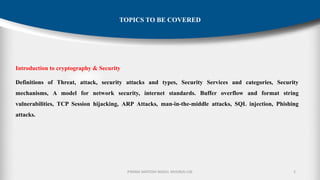
Introduction to cryptography & Security
Definitions of Threat, attack, security attacks and types, Security Services and categories, Security
mechanisms, A model for network security, internet standards. Buffer overflow and format string
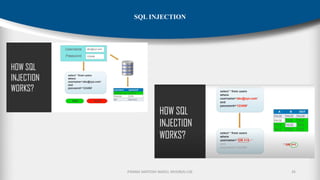
vulnerabilities, TCP Session hijacking, ARP Attacks, man-in-the-middle attacks, SQL injection, Phishing
attacks.
TOPICS TO BE COVERED
2
P.RAMA SANTOSH NAIDU, MVGR(A)-CSE
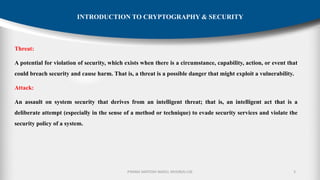
Threat:
A potential for violation of security, which exists when there is a circumstance, capability, action, or event that
could breach security and cause harm. That is, a threat is a possible danger that might exploit a vulnerability.
Attack:
An assault on system security that derives from an intelligent threat; that is, an intelligent act that is a
deliberate attempt (especially in the sense of a method or technique) to evade security services and violate the
security policy of a system.
INTRODUCTION TO CRYPTOGRAPHY & SECURITY
3
P.RAMA SANTOSH NAIDU, MVGR(A)-CSE
INTRODUCTION TO CRYPTOGRAPHY & SECURITY
4
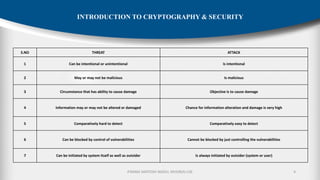
S.NO THREAT ATTACK
1 Can be intentional or unintentional Is intentional
2 May or may not be malicious Is malicious
3 Circumstance that has ability to cause damage Objective is to cause damage
4 Information may or may not be altered or damaged Chance for information alteration and damage is very high
5 Comparatively hard to detect Comparatively easy to detect
6 Can be blocked by control of vulnerabilities Cannot be blocked by just controlling the vulnerabilities
7 Can be initiated by system itself as well as outsider Is always initiated by outsider (system or user)
P.RAMA SANTOSH NAIDU, MVGR(A)-CSE
Security Attacks:
Any action that compromises the security of information owned by an organization.
Types of Security Attacks:
SECURITY ATTACKS
5
TYPES OF ATTACKS
PASSIVE
ATTACKS
ACTIVE
ATTACKS
Release of
Message
Contents
Traffic
Analysis
masquerade Modification of messages
Replay
Repudiation
Denial of
Service
P.RAMA SANTOSH NAIDU, MVGR(A)-CSE
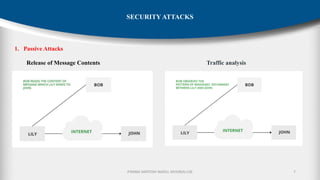
1. Passive Attacks
A Passive attack attempts to learn or make use of information from the system but does not affect system
resources. Passive Attacks are in the nature of eavesdropping on or monitoring transmission. The goal of the
opponent is to obtain information that is being transmitted.
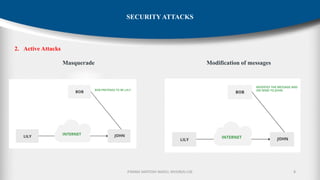
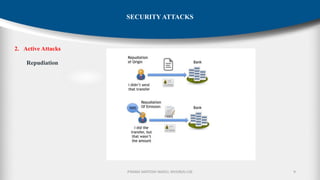
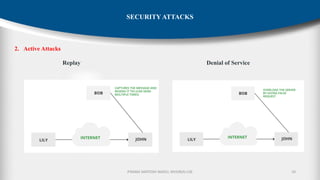
2. Active Attacks
An Active attack attempts to alter system resources or affect their operations. Active attacks involve some
modification of the data stream or the creation of false statements.
6
SECURITY ATTACKS
P.RAMA SANTOSH NAIDU, MVGR(A)-CSE
1. Passive Attacks
Release of Message Contents Traffic analysis
7
SECURITY ATTACKS
P.RAMA SANTOSH NAIDU, MVGR(A)-CSE
2. Active Attacks
Masquerade Modification of messages
8
SECURITY ATTACKS
P.RAMA SANTOSH NAIDU, MVGR(A)-CSE
2. Active Attacks
Repudiation
9
SECURITY ATTACKS
P.RAMA SANTOSH NAIDU, MVGR(A)-CSE
2. Active Attacks
Replay Denial of Service
10
SECURITY ATTACKS
P.RAMA SANTOSH NAIDU, MVGR(A)-CSE 11
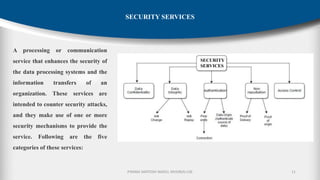
SECURITY SERVICES
A processing or communication
service that enhances the security of
the data processing systems and the
information transfers of an
organization. These services are
intended to counter security attacks,
and they make use of one or more
security mechanisms to provide the
service. Following are the five
categories of these services:
SECURITY
SERVICES
P.RAMA SANTOSH NAIDU, MVGR(A)-CSE 12
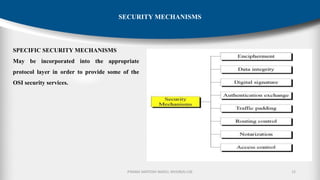
SECURITY MECHANISMS
SPECIFIC SECURITY MECHANISMS
May be incorporated into the appropriate
protocol layer in order to provide some of the
OSI security services.
P.RAMA SANTOSH NAIDU, MVGR(A)-CSE 13
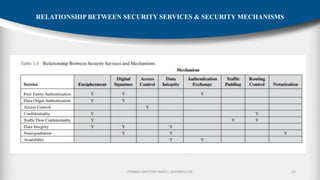
RELATIONSHIP BETWEEN SECURITY SERVICES & SECURITY MECHANISMS
P.RAMA SANTOSH NAIDU, MVGR(A)-CSE 14
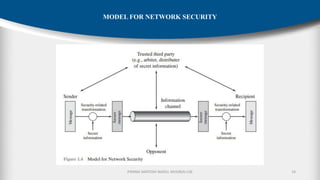
MODEL FOR NETWORK SECURITY
P.RAMA SANTOSH NAIDU, MVGR(A)-CSE 15
INTERNET STANDARDS
Internet Standard: These are technically matured standards that define the protocols and formats of messages.
The fundamental standards are those which form the Internet Protocol (IP).
The organizations of Internet Standards are
1. Internet Engineering Task Force (IETF)
2. Internet Society (ISOC)
3. Internet Architecture Board (IAB)
4. Internet Research Task Force (IRTF)
5. World Wide Web Consortium (W3C)
P.RAMA SANTOSH NAIDU, MVGR(A)-CSE 16
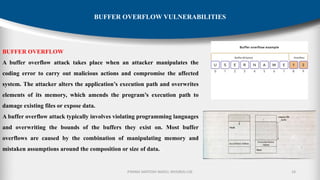
BUFFER OVERFLOW VULNERABILITIES
BUFFER OVERFLOW
A buffer overflow attack takes place when an attacker manipulates the
coding error to carry out malicious actions and compromise the affected
system. The attacker alters the application’s execution path and overwrites
elements of its memory, which amends the program’s execution path to
damage existing files or expose data.
A buffer overflow attack typically involves violating programming languages
and overwriting the bounds of the buffers they exist on. Most buffer
overflows are caused by the combination of manipulating memory and
mistaken assumptions around the composition or size of data.
P.RAMA SANTOSH NAIDU, MVGR(A)-CSE 17
TYPES OF BUFFER OVERFLOW ATTACKS
✓ Stack overflow attack
✓ Heap overflow attack
✓ Integer overflow attack
✓ Unicode overflow
BUFFER OVERFLOW VULNERABILITIES
P.RAMA SANTOSH NAIDU, MVGR(A)-CSE 18
How to prevent buffer overflow attacks?
✓ Choose programming language wisely.
✓ Avoid risky library files
✓ Validate input
✓ Filter malicious input
✓ Test applications pre-deployment
✓ Enable runtime protections
✓ Use executable space protection
BUFFER OVERFLOW VULNERABILITIES
P.RAMA SANTOSH NAIDU, MVGR(A)-CSE 19
FORMAT STRING VULNERABILITIES
#include <stdio.h>
void main(int argc, char **argv)
{
// This line is safe
printf("%sn", argv[1]);
// This line is vulnerable
printf(argv[1]);
}
Safe Code
The line printf("%s", argv[1]); in the example is safe, if you compile the program
and run it:
./example "Hello World %s%s%s%s%s%s"
The printf in the first line will not interpret the “%s%s%s%s%s%s” in the input
string, and the output will be: “Hello World %s%s%s%s%s%s”
Vulnerable Code
The line printf(argv[1]); in the example is vulnerable, if you compile the program
and run it:
./example "Hello World %s%s%s%s%s%s"
The printf in the second line will interpret the %s%s%s%s%s%s in the input
string as a reference to string pointers, so it will try to interpret every %s as a
pointer to a string, starting from the location of the buffer (probably on the Stack).
At some point, it will get to an invalid address, and attempting to access it will
cause the program to crash.
P.RAMA SANTOSH NAIDU, MVGR(A)-CSE 20
FORMAT STRING VULNERABILITIES
TYPES OF FORMAT STRING ATTACKS
✓ Denial of Service Attacks(DoS)
✓ Writing Attacks
✓ Reading Attacks
P.RAMA SANTOSH NAIDU, MVGR(A)-CSE 21
FORMAT STRING VULNERABILITIES
PREVENTING FORMAT STRING VULNERABILITIES
✓ Always specify a format string as part of program, not as an input. Most format string vulnerabilities are
solved by specifying “%s” as format string and not using the data string as format string
✓ If possible, make the format string a constant. Extract all the variable parts as other arguments to the
call. Difficult to do with some internationalization libraries
P.RAMA SANTOSH NAIDU, MVGR(A)-CSE 22
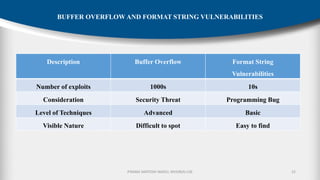
BUFFER OVERFLOW AND FORMAT STRING VULNERABILITIES
Description Buffer Overflow Format String
Vulnerabilities
Number of exploits 1000s 10s
Consideration Security Threat Programming Bug
Level of Techniques Advanced Basic
Visible Nature Difficult to spot Easy to find
P.RAMA SANTOSH NAIDU, MVGR(A)-CSE 23
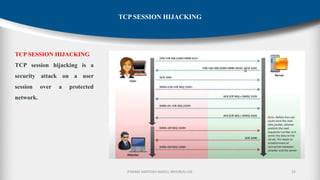
TCP SESSION HIJACKING
TCP session hijacking is a
security attack on a user
session over a protected
network.
P.RAMA SANTOSH NAIDU, MVGR(A)-CSE 24
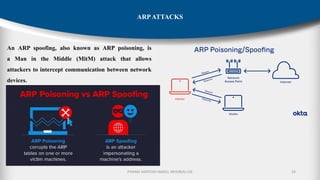
ARPATTACKS
An ARP spoofing, also known as ARP poisoning, is
a Man in the Middle (MitM) attack that allows
attackers to intercept communication between network
devices.
P.RAMA SANTOSH NAIDU, MVGR(A)-CSE 25
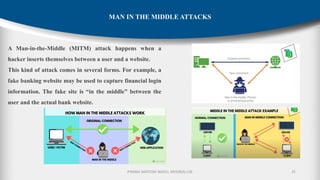
MAN IN THE MIDDLE ATTACKS
A Man-in-the-Middle (MITM) attack happens when a
hacker inserts themselves between a user and a website.
This kind of attack comes in several forms. For example, a
fake banking website may be used to capture financial login
information. The fake site is “in the middle” between the
user and the actual bank website.
P.RAMA SANTOSH NAIDU, MVGR(A)-CSE 26
MAN IN THE MIDDLE ATTACKS
✓ IP spoofing
✓ DNS spoofing
✓ HTTPS spoofing
✓ SSL hijacking
✓ Email hijacking
✓ Wi-Fi eavesdropping
✓ Stealing browser cookies
P.RAMA SANTOSH NAIDU, MVGR(A)-CSE 27
MAN IN THE MIDDLE ATTACKS
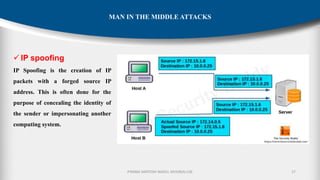
✓ IP spoofing
IP Spoofing is the creation of IP
packets with a forged source IP
address. This is often done for the
purpose of concealing the identity of
the sender or impersonating another
computing system.
P.RAMA SANTOSH NAIDU, MVGR(A)-CSE 28
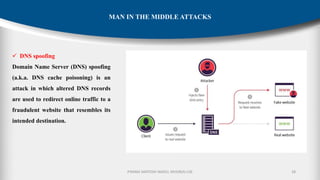
MAN IN THE MIDDLE ATTACKS
✓ DNS spoofing
Domain Name Server (DNS) spoofing
(a.k.a. DNS cache poisoning) is an
attack in which altered DNS records
are used to redirect online traffic to a
fraudulent website that resembles its
intended destination.
P.RAMA SANTOSH NAIDU, MVGR(A)-CSE 29
MAN IN THE MIDDLE ATTACKS
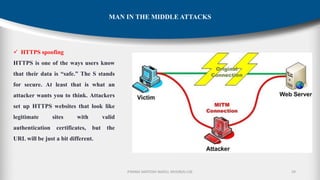
✓ HTTPS spoofing
HTTPS is one of the ways users know
that their data is “safe.” The S stands
for secure. At least that is what an
attacker wants you to think. Attackers
set up HTTPS websites that look like
legitimate sites with valid
authentication certificates, but the
URL will be just a bit different.
P.RAMA SANTOSH NAIDU, MVGR(A)-CSE 30
MAN IN THE MIDDLE ATTACKS
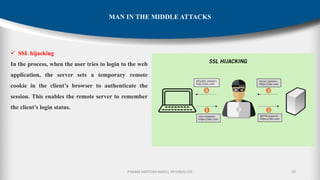
✓ SSL hijacking
In the process, when the user tries to login to the web
application, the server sets a temporary remote
cookie in the client’s browser to authenticate the
session. This enables the remote server to remember
the client’s login status.
P.RAMA SANTOSH NAIDU, MVGR(A)-CSE 31
MAN IN THE MIDDLE ATTACKS
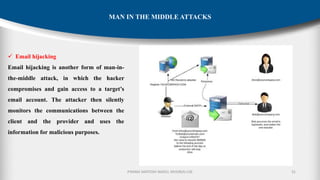
✓ Email hijacking
Email hijacking is another form of man-in-
the-middle attack, in which the hacker
compromises and gain access to a target’s
email account. The attacker then silently
monitors the communications between the
client and the provider and uses the
information for malicious purposes.
P.RAMA SANTOSH NAIDU, MVGR(A)-CSE 32
MAN IN THE MIDDLE ATTACKS
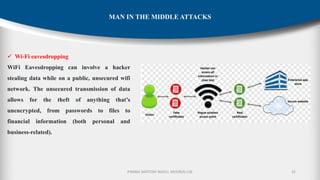
✓ Wi-Fi eavesdropping
WiFi Eavesdropping can involve a hacker
stealing data while on a public, unsecured wifi
network. The unsecured transmission of data
allows for the theft of anything that’s
unencrypted, from passwords to files to
financial information (both personal and
business-related).
P.RAMA SANTOSH NAIDU, MVGR(A)-CSE 33
MAN IN THE MIDDLE ATTACKS
✓ Stealing browser cookies
▪ To understand the risk of stolen browser cookies, you need to understand what one is. A browser
cookie is a small piece of information a website stores on your computer.
▪ For example, an online retailer might store the personal information you enter and shopping cart items
you’ve selected on a cookie so you don’t have to re-enter that information when you return.
▪ A cybercriminal can hijack these browser cookies. Since cookies store information from your browsing
session, attackers can gain access to your passwords, address, and other sensitive information.
P.RAMA SANTOSH NAIDU, MVGR(A)-CSE 34
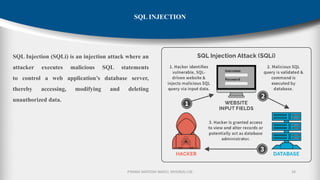
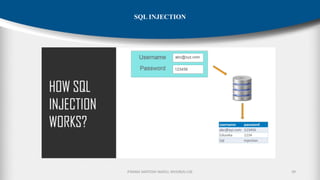
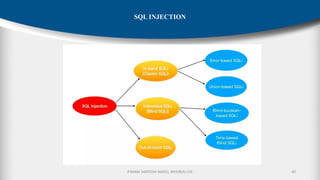
SQL INJECTION
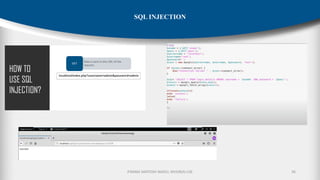
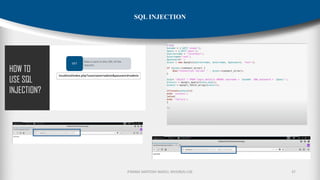
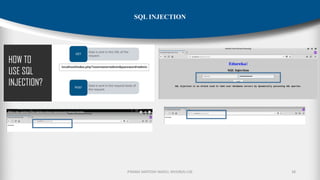
SQL Injection (SQLi) is an injection attack where an
attacker executes malicious SQL statements
to control a web application’s database server,
thereby accessing, modifying and deleting
unauthorized data.
P.RAMA SANTOSH NAIDU, MVGR(A)-CSE 35
SQL INJECTION
P.RAMA SANTOSH NAIDU, MVGR(A)-CSE 36
SQL INJECTION
P.RAMA SANTOSH NAIDU, MVGR(A)-CSE 37
SQL INJECTION
P.RAMA SANTOSH NAIDU, MVGR(A)-CSE 38
SQL INJECTION
P.RAMA SANTOSH NAIDU, MVGR(A)-CSE 39
SQL INJECTION
P.RAMA SANTOSH NAIDU, MVGR(A)-CSE 40
SQL INJECTION
P.RAMA SANTOSH NAIDU, MVGR(A)-CSE 41
SQL INJECTION
How to prevent SQL Injection?
✓ Regular Scanning
✓ Training & Awareness
✓ Filter User Input
✓ Use Whitelist-based Filters
✓ Use Updated Web Technologies
P.RAMA SANTOSH NAIDU, MVGR(A)-CSE 42
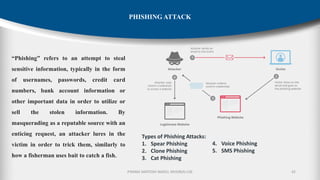
PHISHING ATTACK
“Phishing” refers to an attempt to steal
sensitive information, typically in the form
of usernames, passwords, credit card
numbers, bank account information or
other important data in order to utilize or
sell the stolen information. By
masquerading as a reputable source with an
enticing request, an attacker lures in the
victim in order to trick them, similarly to
how a fisherman uses bait to catch a fish.
Types of Phishing Attacks:
1. Spear Phishing
2. Clone Phishing
3. Cat Phishing
4. Voice Phishing
5. SMS Phishing
P.RAMA SANTOSH NAIDU, MVGR(A)-CSE
THANK YOU!
P.RAMA SANTOSH NAIDU
ASSISTANT PROFESSOR
MVGR(A)-CSE
43

INTRODUCTION TO CRYPTOGRAPHY & SECURITY

  • 1.
    UNIT-1 P.RAMA SANTOSH NAIDU ASSISTANTPROFESSOR MVGR(A)-CSE SUBJECT (CRYPTOGRAPHY AND INFORMATIOON SECURITY) INTRODUCTION TO CRYPTOGRAPHY & SECURITY
  • 2.
    P.RAMA SANTOSH NAIDU,MVGR(A)-CSE Introduction to cryptography & Security Definitions of Threat, attack, security attacks and types, Security Services and categories, Security mechanisms, A model for network security, internet standards. Buffer overflow and format string vulnerabilities, TCP Session hijacking, ARP Attacks, man-in-the-middle attacks, SQL injection, Phishing attacks. TOPICS TO BE COVERED 2
  • 3.
    P.RAMA SANTOSH NAIDU,MVGR(A)-CSE Threat: A potential for violation of security, which exists when there is a circumstance, capability, action, or event that could breach security and cause harm. That is, a threat is a possible danger that might exploit a vulnerability. Attack: An assault on system security that derives from an intelligent threat; that is, an intelligent act that is a deliberate attempt (especially in the sense of a method or technique) to evade security services and violate the security policy of a system. INTRODUCTION TO CRYPTOGRAPHY & SECURITY 3
  • 4.
    P.RAMA SANTOSH NAIDU,MVGR(A)-CSE INTRODUCTION TO CRYPTOGRAPHY & SECURITY 4 S.NO THREAT ATTACK 1 Can be intentional or unintentional Is intentional 2 May or may not be malicious Is malicious 3 Circumstance that has ability to cause damage Objective is to cause damage 4 Information may or may not be altered or damaged Chance for information alteration and damage is very high 5 Comparatively hard to detect Comparatively easy to detect 6 Can be blocked by control of vulnerabilities Cannot be blocked by just controlling the vulnerabilities 7 Can be initiated by system itself as well as outsider Is always initiated by outsider (system or user)
  • 5.
    P.RAMA SANTOSH NAIDU,MVGR(A)-CSE Security Attacks: Any action that compromises the security of information owned by an organization. Types of Security Attacks: SECURITY ATTACKS 5 TYPES OF ATTACKS PASSIVE ATTACKS ACTIVE ATTACKS Release of Message Contents Traffic Analysis masquerade Modification of messages Replay Repudiation Denial of Service
  • 6.
    P.RAMA SANTOSH NAIDU,MVGR(A)-CSE 1. Passive Attacks A Passive attack attempts to learn or make use of information from the system but does not affect system resources. Passive Attacks are in the nature of eavesdropping on or monitoring transmission. The goal of the opponent is to obtain information that is being transmitted. 2. Active Attacks An Active attack attempts to alter system resources or affect their operations. Active attacks involve some modification of the data stream or the creation of false statements. 6 SECURITY ATTACKS
  • 7.
    P.RAMA SANTOSH NAIDU,MVGR(A)-CSE 1. Passive Attacks Release of Message Contents Traffic analysis 7 SECURITY ATTACKS
  • 8.
    P.RAMA SANTOSH NAIDU,MVGR(A)-CSE 2. Active Attacks Masquerade Modification of messages 8 SECURITY ATTACKS
  • 9.
    P.RAMA SANTOSH NAIDU,MVGR(A)-CSE 2. Active Attacks Repudiation 9 SECURITY ATTACKS
  • 10.
    P.RAMA SANTOSH NAIDU,MVGR(A)-CSE 2. Active Attacks Replay Denial of Service 10 SECURITY ATTACKS
  • 11.
    P.RAMA SANTOSH NAIDU,MVGR(A)-CSE 11 SECURITY SERVICES A processing or communication service that enhances the security of the data processing systems and the information transfers of an organization. These services are intended to counter security attacks, and they make use of one or more security mechanisms to provide the service. Following are the five categories of these services: SECURITY SERVICES
  • 12.
    P.RAMA SANTOSH NAIDU,MVGR(A)-CSE 12 SECURITY MECHANISMS SPECIFIC SECURITY MECHANISMS May be incorporated into the appropriate protocol layer in order to provide some of the OSI security services.
  • 13.
    P.RAMA SANTOSH NAIDU,MVGR(A)-CSE 13 RELATIONSHIP BETWEEN SECURITY SERVICES & SECURITY MECHANISMS
  • 14.
    P.RAMA SANTOSH NAIDU,MVGR(A)-CSE 14 MODEL FOR NETWORK SECURITY
  • 15.
    P.RAMA SANTOSH NAIDU,MVGR(A)-CSE 15 INTERNET STANDARDS Internet Standard: These are technically matured standards that define the protocols and formats of messages. The fundamental standards are those which form the Internet Protocol (IP). The organizations of Internet Standards are 1. Internet Engineering Task Force (IETF) 2. Internet Society (ISOC) 3. Internet Architecture Board (IAB) 4. Internet Research Task Force (IRTF) 5. World Wide Web Consortium (W3C)
  • 16.
    P.RAMA SANTOSH NAIDU,MVGR(A)-CSE 16 BUFFER OVERFLOW VULNERABILITIES BUFFER OVERFLOW A buffer overflow attack takes place when an attacker manipulates the coding error to carry out malicious actions and compromise the affected system. The attacker alters the application’s execution path and overwrites elements of its memory, which amends the program’s execution path to damage existing files or expose data. A buffer overflow attack typically involves violating programming languages and overwriting the bounds of the buffers they exist on. Most buffer overflows are caused by the combination of manipulating memory and mistaken assumptions around the composition or size of data.
  • 17.
    P.RAMA SANTOSH NAIDU,MVGR(A)-CSE 17 TYPES OF BUFFER OVERFLOW ATTACKS ✓ Stack overflow attack ✓ Heap overflow attack ✓ Integer overflow attack ✓ Unicode overflow BUFFER OVERFLOW VULNERABILITIES
  • 18.
    P.RAMA SANTOSH NAIDU,MVGR(A)-CSE 18 How to prevent buffer overflow attacks? ✓ Choose programming language wisely. ✓ Avoid risky library files ✓ Validate input ✓ Filter malicious input ✓ Test applications pre-deployment ✓ Enable runtime protections ✓ Use executable space protection BUFFER OVERFLOW VULNERABILITIES
  • 19.
    P.RAMA SANTOSH NAIDU,MVGR(A)-CSE 19 FORMAT STRING VULNERABILITIES FORMAT STRING VULNERABILITIES #include <stdio.h> void main(int argc, char **argv) { // This line is safe printf("%sn", argv[1]); // This line is vulnerable printf(argv[1]); } Safe Code The line printf("%s", argv[1]); in the example is safe, if you compile the program and run it: ./example "Hello World %s%s%s%s%s%s" The printf in the first line will not interpret the “%s%s%s%s%s%s” in the input string, and the output will be: “Hello World %s%s%s%s%s%s” Vulnerable Code The line printf(argv[1]); in the example is vulnerable, if you compile the program and run it: ./example "Hello World %s%s%s%s%s%s" The printf in the second line will interpret the %s%s%s%s%s%s in the input string as a reference to string pointers, so it will try to interpret every %s as a pointer to a string, starting from the location of the buffer (probably on the Stack). At some point, it will get to an invalid address, and attempting to access it will cause the program to crash.
  • 20.
    P.RAMA SANTOSH NAIDU,MVGR(A)-CSE 20 FORMAT STRING VULNERABILITIES TYPES OF FORMAT STRING ATTACKS ✓ Denial of Service Attacks(DoS) ✓ Writing Attacks ✓ Reading Attacks
  • 21.
    P.RAMA SANTOSH NAIDU,MVGR(A)-CSE 21 FORMAT STRING VULNERABILITIES PREVENTING FORMAT STRING VULNERABILITIES ✓ Always specify a format string as part of program, not as an input. Most format string vulnerabilities are solved by specifying “%s” as format string and not using the data string as format string ✓ If possible, make the format string a constant. Extract all the variable parts as other arguments to the call. Difficult to do with some internationalization libraries
  • 22.
    P.RAMA SANTOSH NAIDU,MVGR(A)-CSE 22 BUFFER OVERFLOW AND FORMAT STRING VULNERABILITIES Description Buffer Overflow Format String Vulnerabilities Number of exploits 1000s 10s Consideration Security Threat Programming Bug Level of Techniques Advanced Basic Visible Nature Difficult to spot Easy to find
  • 23.
    P.RAMA SANTOSH NAIDU,MVGR(A)-CSE 23 TCP SESSION HIJACKING TCP SESSION HIJACKING TCP session hijacking is a security attack on a user session over a protected network.
  • 24.
    P.RAMA SANTOSH NAIDU,MVGR(A)-CSE 24 ARPATTACKS An ARP spoofing, also known as ARP poisoning, is a Man in the Middle (MitM) attack that allows attackers to intercept communication between network devices.
  • 25.
    P.RAMA SANTOSH NAIDU,MVGR(A)-CSE 25 MAN IN THE MIDDLE ATTACKS A Man-in-the-Middle (MITM) attack happens when a hacker inserts themselves between a user and a website. This kind of attack comes in several forms. For example, a fake banking website may be used to capture financial login information. The fake site is “in the middle” between the user and the actual bank website.
  • 26.
    P.RAMA SANTOSH NAIDU,MVGR(A)-CSE 26 MAN IN THE MIDDLE ATTACKS ✓ IP spoofing ✓ DNS spoofing ✓ HTTPS spoofing ✓ SSL hijacking ✓ Email hijacking ✓ Wi-Fi eavesdropping ✓ Stealing browser cookies
  • 27.
    P.RAMA SANTOSH NAIDU,MVGR(A)-CSE 27 MAN IN THE MIDDLE ATTACKS ✓ IP spoofing IP Spoofing is the creation of IP packets with a forged source IP address. This is often done for the purpose of concealing the identity of the sender or impersonating another computing system.
  • 28.
    P.RAMA SANTOSH NAIDU,MVGR(A)-CSE 28 MAN IN THE MIDDLE ATTACKS ✓ DNS spoofing Domain Name Server (DNS) spoofing (a.k.a. DNS cache poisoning) is an attack in which altered DNS records are used to redirect online traffic to a fraudulent website that resembles its intended destination.
  • 29.
    P.RAMA SANTOSH NAIDU,MVGR(A)-CSE 29 MAN IN THE MIDDLE ATTACKS ✓ HTTPS spoofing HTTPS is one of the ways users know that their data is “safe.” The S stands for secure. At least that is what an attacker wants you to think. Attackers set up HTTPS websites that look like legitimate sites with valid authentication certificates, but the URL will be just a bit different.
  • 30.
    P.RAMA SANTOSH NAIDU,MVGR(A)-CSE 30 MAN IN THE MIDDLE ATTACKS ✓ SSL hijacking In the process, when the user tries to login to the web application, the server sets a temporary remote cookie in the client’s browser to authenticate the session. This enables the remote server to remember the client’s login status.
  • 31.
    P.RAMA SANTOSH NAIDU,MVGR(A)-CSE 31 MAN IN THE MIDDLE ATTACKS ✓ Email hijacking Email hijacking is another form of man-in- the-middle attack, in which the hacker compromises and gain access to a target’s email account. The attacker then silently monitors the communications between the client and the provider and uses the information for malicious purposes.
  • 32.
    P.RAMA SANTOSH NAIDU,MVGR(A)-CSE 32 MAN IN THE MIDDLE ATTACKS ✓ Wi-Fi eavesdropping WiFi Eavesdropping can involve a hacker stealing data while on a public, unsecured wifi network. The unsecured transmission of data allows for the theft of anything that’s unencrypted, from passwords to files to financial information (both personal and business-related).
  • 33.
    P.RAMA SANTOSH NAIDU,MVGR(A)-CSE 33 MAN IN THE MIDDLE ATTACKS ✓ Stealing browser cookies ▪ To understand the risk of stolen browser cookies, you need to understand what one is. A browser cookie is a small piece of information a website stores on your computer. ▪ For example, an online retailer might store the personal information you enter and shopping cart items you’ve selected on a cookie so you don’t have to re-enter that information when you return. ▪ A cybercriminal can hijack these browser cookies. Since cookies store information from your browsing session, attackers can gain access to your passwords, address, and other sensitive information.
  • 34.
    P.RAMA SANTOSH NAIDU,MVGR(A)-CSE 34 SQL INJECTION SQL Injection (SQLi) is an injection attack where an attacker executes malicious SQL statements to control a web application’s database server, thereby accessing, modifying and deleting unauthorized data.
  • 35.
    P.RAMA SANTOSH NAIDU,MVGR(A)-CSE 35 SQL INJECTION
  • 36.
    P.RAMA SANTOSH NAIDU,MVGR(A)-CSE 36 SQL INJECTION
  • 37.
    P.RAMA SANTOSH NAIDU,MVGR(A)-CSE 37 SQL INJECTION
  • 38.
    P.RAMA SANTOSH NAIDU,MVGR(A)-CSE 38 SQL INJECTION
  • 39.
    P.RAMA SANTOSH NAIDU,MVGR(A)-CSE 39 SQL INJECTION
  • 40.
    P.RAMA SANTOSH NAIDU,MVGR(A)-CSE 40 SQL INJECTION
  • 41.
    P.RAMA SANTOSH NAIDU,MVGR(A)-CSE 41 SQL INJECTION How to prevent SQL Injection? ✓ Regular Scanning ✓ Training & Awareness ✓ Filter User Input ✓ Use Whitelist-based Filters ✓ Use Updated Web Technologies
  • 42.
    P.RAMA SANTOSH NAIDU,MVGR(A)-CSE 42 PHISHING ATTACK “Phishing” refers to an attempt to steal sensitive information, typically in the form of usernames, passwords, credit card numbers, bank account information or other important data in order to utilize or sell the stolen information. By masquerading as a reputable source with an enticing request, an attacker lures in the victim in order to trick them, similarly to how a fisherman uses bait to catch a fish. Types of Phishing Attacks: 1. Spear Phishing 2. Clone Phishing 3. Cat Phishing 4. Voice Phishing 5. SMS Phishing
  • 43.
    P.RAMA SANTOSH NAIDU,MVGR(A)-CSE THANK YOU! P.RAMA SANTOSH NAIDU ASSISTANT PROFESSOR MVGR(A)-CSE 43