Introduction to Course
Prepared By
Mr. Hule Kuldeep
Objectives & Announcements
Objectives:
 After end of the session you may understands.....
1.What is Cyber Security?
2.What is Forensics Sciences?
3.Also understand various approaches of Cyber Security.
4.Need of this Course
5.The course structure & their objectives & outcomes
Announcements:
1.Cyber Security
2.Forensics Sciences
3.Need of Cyber Security & Forensics Sciences
4.Roadmap to Forensics Sciences
5.Course Structure
6.Course Objectives & Outcomes
7.Course Contents Unit-wise
8.Practical Course Contents
Sunday, July 21, 2024
2
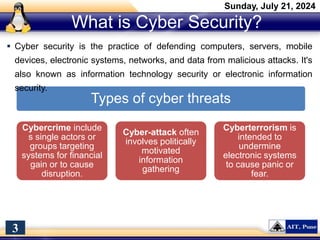
What is Cyber Security?
Types of cyber threats
Cybercrime include
s single actors or
groups targeting
systems for financial
gain or to cause
disruption.
Cyber-attack often
involves politically
motivated
information
gathering
Cyberterrorism is
intended to
undermine
electronic systems
to cause panic or
fear.
 Cyber security is the practice of defending computers, servers, mobile
devices, electronic systems, networks, and data from malicious attacks. It's
also known as information technology security or electronic information
security.
Sunday, July 21, 2024
3
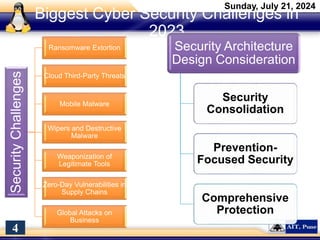
Biggest Cyber Security Challenges in
2023
Security
Challenges
Ransomware Extortion
Cloud Third-Party Threats
Mobile Malware
Wipers and Destructive
Malware
Weaponization of
Legitimate Tools
Zero-Day Vulnerabilities in
Supply Chains
Global Attacks on
Business
Sunday, July 21, 2024
4
Security Architecture
Design Consideration
Security
Consolidation
Prevention-
Focused Security
Comprehensive
Protection
What is Digital Forensics Sciences?
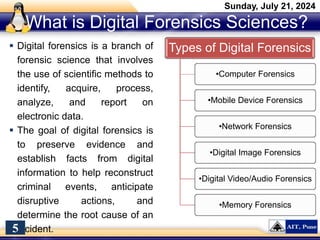
 Digital forensics is a branch of
forensic science that involves
the use of scientific methods to
identify, acquire, process,
analyze, and report on
electronic data.
 The goal of digital forensics is
to preserve evidence and
establish facts from digital
information to help reconstruct
criminal events, anticipate
disruptive actions, and
determine the root cause of an
incident.
Sunday, July 21, 2024
5
Types of Digital Forensics
•Computer Forensics
•Mobile Device Forensics
•Network Forensics
•Digital Image Forensics
•Digital Video/Audio Forensics
•Memory Forensics
What is Digital Forensics
Sciences?
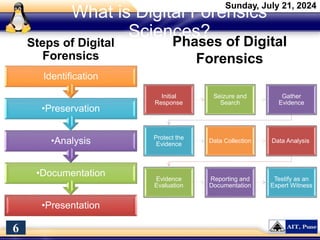
Steps of Digital
Forensics
•Presentation
•Documentation
•Analysis
•Preservation
Identification
Phases of Digital
Forensics
Sunday, July 21, 2024
6
Initial
Response
Seizure and
Search
Gather
Evidence
Protect the
Evidence
Data Collection Data Analysis
Evidence
Evaluation
Reporting and
Documentation
Testify as an
Expert Witness
Reasons for studying CSDF
Sunday, July 21, 2024
7
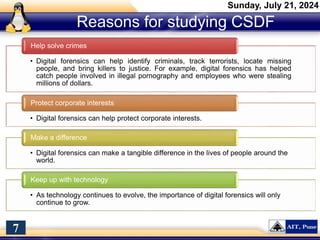
• Digital forensics can help identify criminals, track terrorists, locate missing
people, and bring killers to justice. For example, digital forensics has helped
catch people involved in illegal pornography and employees who were stealing
millions of dollars.
Help solve crimes
• Digital forensics can help protect corporate interests.
Protect corporate interests
• Digital forensics can make a tangible difference in the lives of people around the
world.
Make a difference
• As technology continues to evolve, the importance of digital forensics will only
continue to grow.
Keep up with technology
Data Structures and Algorithms Career Scope
Career Scope
Software
Engineering
Data Science &
Analytics
Machine Learning &
Artificial Intelligence
System Design &
Architecture
Competitive
Programming
Game Development
Web & Mobile
Applications
Sunday, July 21, 2024
8
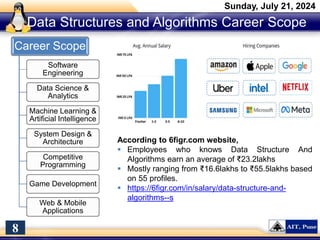
According to 6figr.com website,
 Employees who knows Data Structure And
Algorithms earn an average of ₹23.2lakhs
 Mostly ranging from ₹16.6lakhs to ₹55.5lakhs based
on 55 profiles.
 https://6figr.com/in/salary/data-structure-and-
algorithms--s
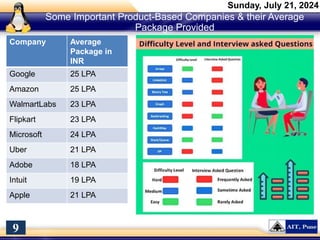
Some Important Product-Based Companies & their Average
Package Provided
Sunday, July 21, 2024
9
Company Average
Package in
INR
Google 25 LPA
Amazon 25 LPA
WalmartLabs 23 LPA
Flipkart 23 LPA
Microsoft 24 LPA
Uber 21 LPA
Adobe 18 LPA
Intuit 19 LPA
Apple 21 LPA
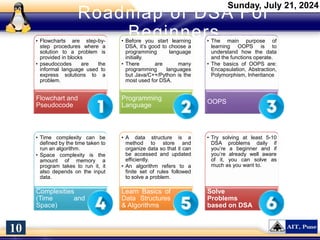
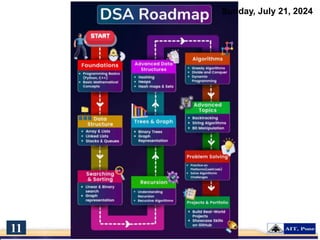
Roadmap of DSA For
Beginners
• Flowcharts are step-by-
step procedures where a
solution to a problem is
provided in blocks
• pseudocodes are the
informal language used to
express solutions to a
problem.
Flowchart and
Pseudocode
• Before you start learning
DSA, it’s good to choose a
programming language
initially.
• There are many
programming languages
but Java/C++/Python is the
most used for DSA.
Programming
Language
• The main purpose of
learning OOPS is to
understand how the data
and the functions operate.
• The basics of OOPS are:
Encapsulation, Abstraction,
Polymorphism, Inheritance
OOPS
• Time complexity can be
defined by the time taken to
run an algorithm.
• Space complexity is the
amount of memory a
program takes to run it, it
also depends on the input
data.
Complexities
(Time and
Space)
• A data structure is a
method to store and
organize data so that it can
be accessed and updated
efficiently.
• An algorithm refers to a
finite set of rules followed
to solve a problem.
Learn Basics of
Data Structures
& Algorithms
• Try solving at least 5-10
DSA problems daily if
you’re a beginner and if
you’re already well aware
of it, you can solve as
much as you want to.
Solve
Problems
based on DSA
Sunday, July 21, 2024
10
Sunday, July 21, 2024
11
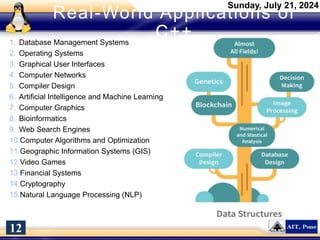
Real-World Applications of
C++
1. Database Management Systems
2. Operating Systems
3. Graphical User Interfaces
4. Computer Networks
5. Compiler Design
6. Artificial Intelligence and Machine Learning
7. Computer Graphics
8. Bioinformatics
9. Web Search Engines
10.Computer Algorithms and Optimization
11.Geographic Information Systems (GIS)
12.Video Games
13.Financial Systems
14.Cryptography
15.Natural Language Processing (NLP)
Sunday, July 21, 2024
12
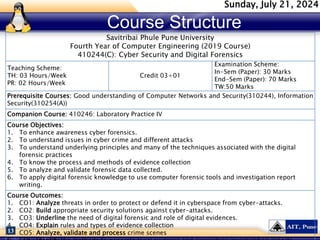
Course Structure
Savitribai Phule Pune University
Fourth Year of Computer Engineering (2019 Course)
410244(C): Cyber Security and Digital Forensics
Teaching Scheme:
TH: 03 Hours/Week
PR: 02 Hours/Week
Credit 03+01
Examination Scheme:
In-Sem (Paper): 30 Marks
End-Sem (Paper): 70 Marks
TW:50 Marks
Prerequisite Courses: Good understanding of Computer Networks and Security(310244), Information
Security(310254(A))
Companion Course: 410246: Laboratory Practice IV
Course Objectives:
1. To enhance awareness cyber forensics.
2. To understand issues in cyber crime and different attacks
3. To understand underlying principles and many of the techniques associated with the digital
forensic practices
4. To know the process and methods of evidence collection
5. To analyze and validate forensic data collected.
6. To apply digital forensic knowledge to use computer forensic tools and investigation report
writing.
Course Outcomes:
1. CO1: Analyze threats in order to protect or defend it in cyberspace from cyber-attacks.
2. CO2: Build appropriate security solutions against cyber-attacks.
3. CO3: Underline the need of digital forensic and role of digital evidences.
4. CO4: Explain rules and types of evidence collection
5. CO5: Analyze, validate and process crime scenes
Sunday, July 21, 2024
13
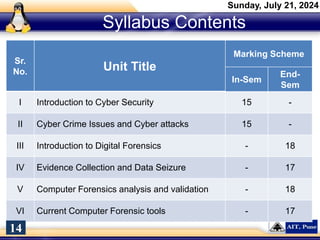
Syllabus Contents
Sr.
No. Unit Title
Marking Scheme
In-Sem
End-
Sem
I Introduction to Cyber Security 15 -
II Cyber Crime Issues and Cyber attacks 15 -
III Introduction to Digital Forensics - 18
IV Evidence Collection and Data Seizure - 17
V Computer Forensics analysis and validation - 18
VI Current Computer Forensic tools - 17
Sunday, July 21, 2024
14
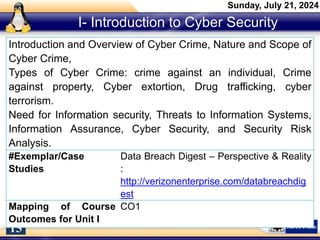
I- Introduction to Cyber Security
Sunday, July 21, 2024
15
Introduction and Overview of Cyber Crime, Nature and Scope of
Cyber Crime,
Types of Cyber Crime: crime against an individual, Crime
against property, Cyber extortion, Drug trafficking, cyber
terrorism.
Need for Information security, Threats to Information Systems,
Information Assurance, Cyber Security, and Security Risk
Analysis.
#Exemplar/Case
Studies
Data Breach Digest – Perspective & Reality
:
http://verizonenterprise.com/databreachdig
est
Mapping of Course
Outcomes for Unit I
CO1
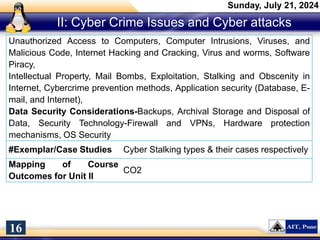
II: Cyber Crime Issues and Cyber attacks
Unauthorized Access to Computers, Computer Intrusions, Viruses, and
Malicious Code, Internet Hacking and Cracking, Virus and worms, Software
Piracy,
Intellectual Property, Mail Bombs, Exploitation, Stalking and Obscenity in
Internet, Cybercrime prevention methods, Application security (Database, E-
mail, and Internet),
Data Security Considerations-Backups, Archival Storage and Disposal of
Data, Security Technology-Firewall and VPNs, Hardware protection
mechanisms, OS Security
#Exemplar/Case Studies Cyber Stalking types & their cases respectively
Mapping of Course
Outcomes for Unit II
CO2
Sunday, July 21, 2024
16
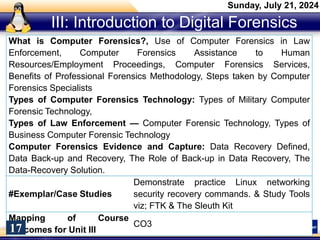
III: Introduction to Digital Forensics
What is Computer Forensics?, Use of Computer Forensics in Law
Enforcement, Computer Forensics Assistance to Human
Resources/Employment Proceedings, Computer Forensics Services,
Benefits of Professional Forensics Methodology, Steps taken by Computer
Forensics Specialists
Types of Computer Forensics Technology: Types of Military Computer
Forensic Technology,
Types of Law Enforcement — Computer Forensic Technology, Types of
Business Computer Forensic Technology
Computer Forensics Evidence and Capture: Data Recovery Defined,
Data Back-up and Recovery, The Role of Back-up in Data Recovery, The
Data-Recovery Solution.
#Exemplar/Case Studies
Demonstrate practice Linux networking
security recovery commands. & Study Tools
viz; FTK & The Sleuth Kit
Mapping of Course
Outcomes for Unit III
CO3
Sunday, July 21, 2024
17
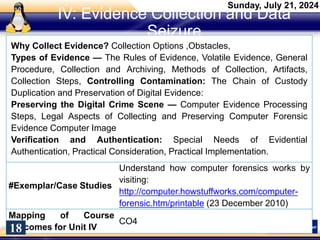
IV: Evidence Collection and Data
Seizure
Why Collect Evidence? Collection Options ,Obstacles,
Types of Evidence — The Rules of Evidence, Volatile Evidence, General
Procedure, Collection and Archiving, Methods of Collection, Artifacts,
Collection Steps, Controlling Contamination: The Chain of Custody
Duplication and Preservation of Digital Evidence:
Preserving the Digital Crime Scene — Computer Evidence Processing
Steps, Legal Aspects of Collecting and Preserving Computer Forensic
Evidence Computer Image
Verification and Authentication: Special Needs of Evidential
Authentication, Practical Consideration, Practical Implementation.
#Exemplar/Case Studies
Understand how computer forensics works by
visiting:
http://computer.howstuffworks.com/computer-
forensic.htm/printable (23 December 2010)
Mapping of Course
Outcomes for Unit IV
CO4
Sunday, July 21, 2024
18
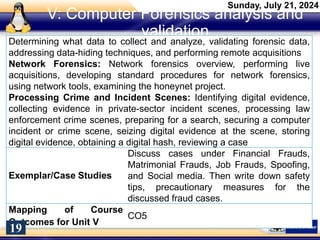
V: Computer Forensics analysis and
validation
Determining what data to collect and analyze, validating forensic data,
addressing data-hiding techniques, and performing remote acquisitions
Network Forensics: Network forensics overview, performing live
acquisitions, developing standard procedures for network forensics,
using network tools, examining the honeynet project.
Processing Crime and Incident Scenes: Identifying digital evidence,
collecting evidence in private-sector incident scenes, processing law
enforcement crime scenes, preparing for a search, securing a computer
incident or crime scene, seizing digital evidence at the scene, storing
digital evidence, obtaining a digital hash, reviewing a case
Exemplar/Case Studies
Discuss cases under Financial Frauds,
Matrimonial Frauds, Job Frauds, Spoofing,
and Social media. Then write down safety
tips, precautionary measures for the
discussed fraud cases.
Mapping of Course
Outcomes for Unit V
CO5
Sunday, July 21, 2024
19
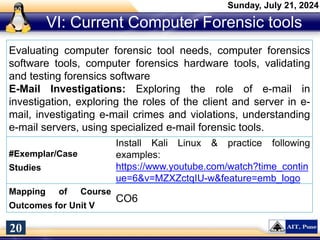
VI: Current Computer Forensic tools
Evaluating computer forensic tool needs, computer forensics
software tools, computer forensics hardware tools, validating
and testing forensics software
E-Mail Investigations: Exploring the role of e-mail in
investigation, exploring the roles of the client and server in e-
mail, investigating e-mail crimes and violations, understanding
e-mail servers, using specialized e-mail forensic tools.
#Exemplar/Case
Studies
Install Kali Linux & practice following
examples:
https://www.youtube.com/watch?time_contin
ue=6&v=MZXZctqIU-w&feature=emb_logo
Mapping of Course
Outcomes for Unit V
CO6
Sunday, July 21, 2024
20
Part II: Laboratory Practices[CSDF]
(410244(C))
Suggested List of Laboratory Experiments
Sr.
No.
Group 1
1.
Write a program for Tracking Emails & Investigating Email Crimes. i.e. Write a
program to
analyze e–mail header
2. Implement a program to generate & verify CAPTCHA image
3.
Write a computer forensic application program for Recovering permanent Deleted Files
and
Deleted Partitions
4. Write a program for Log Capturing and Event Correlation
5. Study and Implementation of Honeypot.
Sr.
No.
Group 2
1.
Mini–project: Perform the following steps:
a. Go to the National Child Exploitation Coordination Centre (NCECC) Web site at
http://www.ncecc.ca
b. Click on the Reporting child exploitation link.
c. Read “How to Report Internet Pornography or Internet Luring Related to Children.”
2.
Mini- Project: Perform the following steps:
a. Go to http://www.usdoj.gov/criminal/cybercrime/cyberstalking.htm.
Sunday, July 21, 2024
21
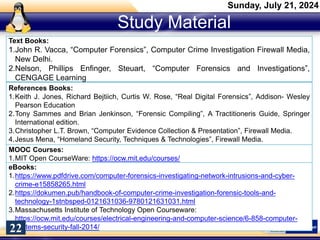
Study Material
Text Books:
1.John R. Vacca, “Computer Forensics”, Computer Crime Investigation Firewall Media,
New Delhi.
2.Nelson, Phillips Enfinger, Steuart, “Computer Forensics and Investigations”,
CENGAGE Learning
References Books:
1.Keith J. Jones, Richard Bejtiich, Curtis W. Rose, “Real Digital Forensics”, Addison- Wesley
Pearson Education
2.Tony Sammes and Brian Jenkinson, “Forensic Compiling”, A Tractitioneris Guide, Springer
International edition.
3.Christopher L.T. Brown, “Computer Evidence Collection & Presentation”, Firewall Media.
4.Jesus Mena, “Homeland Security, Techniques & Technologies”, Firewall Media.
MOOC Courses:
1.MIT Open CourseWare: https://ocw.mit.edu/courses/
eBooks:
1.https://www.pdfdrive.com/computer-forensics-investigating-network-intrusions-and-cyber-
crime-e15858265.html
2.https://dokumen.pub/handbook-of-computer-crime-investigation-forensic-tools-and-
technology-1stnbsped-0121631036-9780121631031.html
3.Massachusetts Institute of Technology Open Courseware:
https://ocw.mit.edu/courses/electrical-engineering-and-computer-science/6-858-computer-
systems-security-fall-2014/
Sunday, July 21, 2024
22
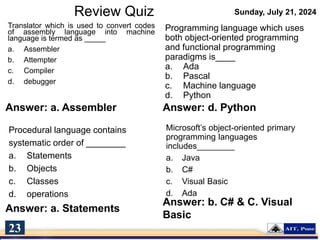
Review Quiz Sunday, July 21, 2024
Translator which is used to convert codes
of assembly language into machine
language is termed as _____
a. Assembler
b. Attempter
c. Compiler
d. debugger
Programming language which uses
both object-oriented programming
and functional programming
paradigms is____
a. Ada
b. Pascal
c. Machine language
d. Python
Answer: a. Assembler
Procedural language contains
systematic order of ________
a. Statements
b. Objects
c. Classes
d. operations
Answer: d. Python
Microsoft’s object-oriented primary
programming languages
includes________
a. Java
b. C#
c. Visual Basic
d. Ada
23
Answer: a. Statements
Answer: b. C# & C. Visual
Basic
Sunday, July 21, 2024
For any query: Email: kuldeephule@aitpune.edu.in
Contact No:8668277166
Web portal: www.hulekuldeep.weebly.com
24

Introduction to Course_1 for Cyber Security

  • 1.
  • 2.
    Objectives & Announcements Objectives: After end of the session you may understands..... 1.What is Cyber Security? 2.What is Forensics Sciences? 3.Also understand various approaches of Cyber Security. 4.Need of this Course 5.The course structure & their objectives & outcomes Announcements: 1.Cyber Security 2.Forensics Sciences 3.Need of Cyber Security & Forensics Sciences 4.Roadmap to Forensics Sciences 5.Course Structure 6.Course Objectives & Outcomes 7.Course Contents Unit-wise 8.Practical Course Contents Sunday, July 21, 2024 2
  • 3.
    What is CyberSecurity? Types of cyber threats Cybercrime include s single actors or groups targeting systems for financial gain or to cause disruption. Cyber-attack often involves politically motivated information gathering Cyberterrorism is intended to undermine electronic systems to cause panic or fear.  Cyber security is the practice of defending computers, servers, mobile devices, electronic systems, networks, and data from malicious attacks. It's also known as information technology security or electronic information security. Sunday, July 21, 2024 3
  • 4.
    Biggest Cyber SecurityChallenges in 2023 Security Challenges Ransomware Extortion Cloud Third-Party Threats Mobile Malware Wipers and Destructive Malware Weaponization of Legitimate Tools Zero-Day Vulnerabilities in Supply Chains Global Attacks on Business Sunday, July 21, 2024 4 Security Architecture Design Consideration Security Consolidation Prevention- Focused Security Comprehensive Protection
  • 5.
    What is DigitalForensics Sciences?  Digital forensics is a branch of forensic science that involves the use of scientific methods to identify, acquire, process, analyze, and report on electronic data.  The goal of digital forensics is to preserve evidence and establish facts from digital information to help reconstruct criminal events, anticipate disruptive actions, and determine the root cause of an incident. Sunday, July 21, 2024 5 Types of Digital Forensics •Computer Forensics •Mobile Device Forensics •Network Forensics •Digital Image Forensics •Digital Video/Audio Forensics •Memory Forensics
  • 6.
    What is DigitalForensics Sciences? Steps of Digital Forensics •Presentation •Documentation •Analysis •Preservation Identification Phases of Digital Forensics Sunday, July 21, 2024 6 Initial Response Seizure and Search Gather Evidence Protect the Evidence Data Collection Data Analysis Evidence Evaluation Reporting and Documentation Testify as an Expert Witness
  • 7.
    Reasons for studyingCSDF Sunday, July 21, 2024 7 • Digital forensics can help identify criminals, track terrorists, locate missing people, and bring killers to justice. For example, digital forensics has helped catch people involved in illegal pornography and employees who were stealing millions of dollars. Help solve crimes • Digital forensics can help protect corporate interests. Protect corporate interests • Digital forensics can make a tangible difference in the lives of people around the world. Make a difference • As technology continues to evolve, the importance of digital forensics will only continue to grow. Keep up with technology
  • 8.
    Data Structures andAlgorithms Career Scope Career Scope Software Engineering Data Science & Analytics Machine Learning & Artificial Intelligence System Design & Architecture Competitive Programming Game Development Web & Mobile Applications Sunday, July 21, 2024 8 According to 6figr.com website,  Employees who knows Data Structure And Algorithms earn an average of ₹23.2lakhs  Mostly ranging from ₹16.6lakhs to ₹55.5lakhs based on 55 profiles.  https://6figr.com/in/salary/data-structure-and- algorithms--s
  • 9.
    Some Important Product-BasedCompanies & their Average Package Provided Sunday, July 21, 2024 9 Company Average Package in INR Google 25 LPA Amazon 25 LPA WalmartLabs 23 LPA Flipkart 23 LPA Microsoft 24 LPA Uber 21 LPA Adobe 18 LPA Intuit 19 LPA Apple 21 LPA
  • 10.
    Roadmap of DSAFor Beginners • Flowcharts are step-by- step procedures where a solution to a problem is provided in blocks • pseudocodes are the informal language used to express solutions to a problem. Flowchart and Pseudocode • Before you start learning DSA, it’s good to choose a programming language initially. • There are many programming languages but Java/C++/Python is the most used for DSA. Programming Language • The main purpose of learning OOPS is to understand how the data and the functions operate. • The basics of OOPS are: Encapsulation, Abstraction, Polymorphism, Inheritance OOPS • Time complexity can be defined by the time taken to run an algorithm. • Space complexity is the amount of memory a program takes to run it, it also depends on the input data. Complexities (Time and Space) • A data structure is a method to store and organize data so that it can be accessed and updated efficiently. • An algorithm refers to a finite set of rules followed to solve a problem. Learn Basics of Data Structures & Algorithms • Try solving at least 5-10 DSA problems daily if you’re a beginner and if you’re already well aware of it, you can solve as much as you want to. Solve Problems based on DSA Sunday, July 21, 2024 10
  • 11.
  • 12.
    Real-World Applications of C++ 1.Database Management Systems 2. Operating Systems 3. Graphical User Interfaces 4. Computer Networks 5. Compiler Design 6. Artificial Intelligence and Machine Learning 7. Computer Graphics 8. Bioinformatics 9. Web Search Engines 10.Computer Algorithms and Optimization 11.Geographic Information Systems (GIS) 12.Video Games 13.Financial Systems 14.Cryptography 15.Natural Language Processing (NLP) Sunday, July 21, 2024 12
  • 13.
    Course Structure Savitribai PhulePune University Fourth Year of Computer Engineering (2019 Course) 410244(C): Cyber Security and Digital Forensics Teaching Scheme: TH: 03 Hours/Week PR: 02 Hours/Week Credit 03+01 Examination Scheme: In-Sem (Paper): 30 Marks End-Sem (Paper): 70 Marks TW:50 Marks Prerequisite Courses: Good understanding of Computer Networks and Security(310244), Information Security(310254(A)) Companion Course: 410246: Laboratory Practice IV Course Objectives: 1. To enhance awareness cyber forensics. 2. To understand issues in cyber crime and different attacks 3. To understand underlying principles and many of the techniques associated with the digital forensic practices 4. To know the process and methods of evidence collection 5. To analyze and validate forensic data collected. 6. To apply digital forensic knowledge to use computer forensic tools and investigation report writing. Course Outcomes: 1. CO1: Analyze threats in order to protect or defend it in cyberspace from cyber-attacks. 2. CO2: Build appropriate security solutions against cyber-attacks. 3. CO3: Underline the need of digital forensic and role of digital evidences. 4. CO4: Explain rules and types of evidence collection 5. CO5: Analyze, validate and process crime scenes Sunday, July 21, 2024 13
  • 14.
    Syllabus Contents Sr. No. UnitTitle Marking Scheme In-Sem End- Sem I Introduction to Cyber Security 15 - II Cyber Crime Issues and Cyber attacks 15 - III Introduction to Digital Forensics - 18 IV Evidence Collection and Data Seizure - 17 V Computer Forensics analysis and validation - 18 VI Current Computer Forensic tools - 17 Sunday, July 21, 2024 14
  • 15.
    I- Introduction toCyber Security Sunday, July 21, 2024 15 Introduction and Overview of Cyber Crime, Nature and Scope of Cyber Crime, Types of Cyber Crime: crime against an individual, Crime against property, Cyber extortion, Drug trafficking, cyber terrorism. Need for Information security, Threats to Information Systems, Information Assurance, Cyber Security, and Security Risk Analysis. #Exemplar/Case Studies Data Breach Digest – Perspective & Reality : http://verizonenterprise.com/databreachdig est Mapping of Course Outcomes for Unit I CO1
  • 16.
    II: Cyber CrimeIssues and Cyber attacks Unauthorized Access to Computers, Computer Intrusions, Viruses, and Malicious Code, Internet Hacking and Cracking, Virus and worms, Software Piracy, Intellectual Property, Mail Bombs, Exploitation, Stalking and Obscenity in Internet, Cybercrime prevention methods, Application security (Database, E- mail, and Internet), Data Security Considerations-Backups, Archival Storage and Disposal of Data, Security Technology-Firewall and VPNs, Hardware protection mechanisms, OS Security #Exemplar/Case Studies Cyber Stalking types & their cases respectively Mapping of Course Outcomes for Unit II CO2 Sunday, July 21, 2024 16
  • 17.
    III: Introduction toDigital Forensics What is Computer Forensics?, Use of Computer Forensics in Law Enforcement, Computer Forensics Assistance to Human Resources/Employment Proceedings, Computer Forensics Services, Benefits of Professional Forensics Methodology, Steps taken by Computer Forensics Specialists Types of Computer Forensics Technology: Types of Military Computer Forensic Technology, Types of Law Enforcement — Computer Forensic Technology, Types of Business Computer Forensic Technology Computer Forensics Evidence and Capture: Data Recovery Defined, Data Back-up and Recovery, The Role of Back-up in Data Recovery, The Data-Recovery Solution. #Exemplar/Case Studies Demonstrate practice Linux networking security recovery commands. & Study Tools viz; FTK & The Sleuth Kit Mapping of Course Outcomes for Unit III CO3 Sunday, July 21, 2024 17
  • 18.
    IV: Evidence Collectionand Data Seizure Why Collect Evidence? Collection Options ,Obstacles, Types of Evidence — The Rules of Evidence, Volatile Evidence, General Procedure, Collection and Archiving, Methods of Collection, Artifacts, Collection Steps, Controlling Contamination: The Chain of Custody Duplication and Preservation of Digital Evidence: Preserving the Digital Crime Scene — Computer Evidence Processing Steps, Legal Aspects of Collecting and Preserving Computer Forensic Evidence Computer Image Verification and Authentication: Special Needs of Evidential Authentication, Practical Consideration, Practical Implementation. #Exemplar/Case Studies Understand how computer forensics works by visiting: http://computer.howstuffworks.com/computer- forensic.htm/printable (23 December 2010) Mapping of Course Outcomes for Unit IV CO4 Sunday, July 21, 2024 18
  • 19.
    V: Computer Forensicsanalysis and validation Determining what data to collect and analyze, validating forensic data, addressing data-hiding techniques, and performing remote acquisitions Network Forensics: Network forensics overview, performing live acquisitions, developing standard procedures for network forensics, using network tools, examining the honeynet project. Processing Crime and Incident Scenes: Identifying digital evidence, collecting evidence in private-sector incident scenes, processing law enforcement crime scenes, preparing for a search, securing a computer incident or crime scene, seizing digital evidence at the scene, storing digital evidence, obtaining a digital hash, reviewing a case Exemplar/Case Studies Discuss cases under Financial Frauds, Matrimonial Frauds, Job Frauds, Spoofing, and Social media. Then write down safety tips, precautionary measures for the discussed fraud cases. Mapping of Course Outcomes for Unit V CO5 Sunday, July 21, 2024 19
  • 20.
    VI: Current ComputerForensic tools Evaluating computer forensic tool needs, computer forensics software tools, computer forensics hardware tools, validating and testing forensics software E-Mail Investigations: Exploring the role of e-mail in investigation, exploring the roles of the client and server in e- mail, investigating e-mail crimes and violations, understanding e-mail servers, using specialized e-mail forensic tools. #Exemplar/Case Studies Install Kali Linux & practice following examples: https://www.youtube.com/watch?time_contin ue=6&v=MZXZctqIU-w&feature=emb_logo Mapping of Course Outcomes for Unit V CO6 Sunday, July 21, 2024 20
  • 21.
    Part II: LaboratoryPractices[CSDF] (410244(C)) Suggested List of Laboratory Experiments Sr. No. Group 1 1. Write a program for Tracking Emails & Investigating Email Crimes. i.e. Write a program to analyze e–mail header 2. Implement a program to generate & verify CAPTCHA image 3. Write a computer forensic application program for Recovering permanent Deleted Files and Deleted Partitions 4. Write a program for Log Capturing and Event Correlation 5. Study and Implementation of Honeypot. Sr. No. Group 2 1. Mini–project: Perform the following steps: a. Go to the National Child Exploitation Coordination Centre (NCECC) Web site at http://www.ncecc.ca b. Click on the Reporting child exploitation link. c. Read “How to Report Internet Pornography or Internet Luring Related to Children.” 2. Mini- Project: Perform the following steps: a. Go to http://www.usdoj.gov/criminal/cybercrime/cyberstalking.htm. Sunday, July 21, 2024 21
  • 22.
    Study Material Text Books: 1.JohnR. Vacca, “Computer Forensics”, Computer Crime Investigation Firewall Media, New Delhi. 2.Nelson, Phillips Enfinger, Steuart, “Computer Forensics and Investigations”, CENGAGE Learning References Books: 1.Keith J. Jones, Richard Bejtiich, Curtis W. Rose, “Real Digital Forensics”, Addison- Wesley Pearson Education 2.Tony Sammes and Brian Jenkinson, “Forensic Compiling”, A Tractitioneris Guide, Springer International edition. 3.Christopher L.T. Brown, “Computer Evidence Collection & Presentation”, Firewall Media. 4.Jesus Mena, “Homeland Security, Techniques & Technologies”, Firewall Media. MOOC Courses: 1.MIT Open CourseWare: https://ocw.mit.edu/courses/ eBooks: 1.https://www.pdfdrive.com/computer-forensics-investigating-network-intrusions-and-cyber- crime-e15858265.html 2.https://dokumen.pub/handbook-of-computer-crime-investigation-forensic-tools-and- technology-1stnbsped-0121631036-9780121631031.html 3.Massachusetts Institute of Technology Open Courseware: https://ocw.mit.edu/courses/electrical-engineering-and-computer-science/6-858-computer- systems-security-fall-2014/ Sunday, July 21, 2024 22
  • 23.
    Review Quiz Sunday,July 21, 2024 Translator which is used to convert codes of assembly language into machine language is termed as _____ a. Assembler b. Attempter c. Compiler d. debugger Programming language which uses both object-oriented programming and functional programming paradigms is____ a. Ada b. Pascal c. Machine language d. Python Answer: a. Assembler Procedural language contains systematic order of ________ a. Statements b. Objects c. Classes d. operations Answer: d. Python Microsoft’s object-oriented primary programming languages includes________ a. Java b. C# c. Visual Basic d. Ada 23 Answer: a. Statements Answer: b. C# & C. Visual Basic
  • 24.
    Sunday, July 21,2024 For any query: Email: kuldeephule@aitpune.edu.in Contact No:8668277166 Web portal: www.hulekuldeep.weebly.com 24

Editor's Notes

  • #4 https://www.kaspersky.co.in/resource-center/definitions/what-is-cyber-security
  • #5 https://www.checkpoint.com/cyber-hub/cyber-security/what-is-cybersecurity/biggest-cyber-security-challenges-in-2023/
  • #6 Nowadays, there are numerous programming languages are becoming more general & all purpose, but these languages have their specialties, and each language has its own advantages & disadvantages.
  • #7 Nowadays, there are numerous programming languages are becoming more general & all purpose, but these languages have their specialties, and each language has its own advantages & disadvantages.
  • #8 Nowadays, there are numerous programming languages are becoming more general & all purpose, but these languages have their specialties, and each language has its own advantages & disadvantages.
  • #9 https://www.scholarhat.com/training/data-structures-algorithms-certification-training
  • #10 https://www.scholarhat.com/training/data-structures-algorithms-certification-training
  • #13 Database Management Systems - Data structures are used to store and organize large amounts of data in a structured manner. For example, a relational database uses tables and indices to store data, and a NoSQL database uses document-oriented or key-value data structures. Operating Systems - Data structures are used to manage resources, such as memory allocation and process scheduling. For example, a priority queue data structure can be used to manage the scheduling of processes in an operating system. Graphical User Interfaces - Data structures are used to store and display hierarchical data, such as the file system in a computer's file explorer. For example, a tree data structure can be used to represent the file hierarchy in a file explorer. Computer Networks - Data structures are used to store information about network topology and to implement routing algorithms. For example, a graph data structure can be used to represent a computer network, with nodes representing devices and edges representing connections between devices. Compiler Design - Data structures are used to store and process the syntax and semantics of programming languages. For example, a parse tree data structure can be used to represent the structure of a program and to generate intermediate code. Artificial Intelligence and Machine Learning - Data structures are used to store and manipulate large amounts of data in order to train algorithms and make predictions. For example, a decision tree data structure can be used in a machine learning algorithm to make predictions based on input data. Computer Graphics - Data structures are used to store and manipulate geometric models for rendering and animation. For example, a 3D mesh data structure can be used to represent a 3D object in computer graphics. Bioinformatics - Data structures are used to store and analyze large amounts of biological data, such as DNA sequences and protein structures. For example, a suffix tree data structure can be used to efficiently store and search for patterns in DNA sequences. Web Search Engines - Data structures are used to store and retrieve large amounts of web pages and to rank them based on relevance. For example, an inverted index data structure can be used to store keywords and their corresponding web pages, allowing for fast searching and retrieval. Computer Algorithms and Optimization - Data structures are used to design and analyze algorithms for solving complex problems. For example, a priority queue data structure can be used in Dijkstra's algorithm for finding the shortest path in a graph. Geographic Information Systems (GIS) - Data structures are used to store and analyze geographical data, such as maps, satellite images, and census data. For example, a quadtree data structure can be used to efficiently store and search for geographical features, such as cities or roads. Video Games - Data structures are used to store and manipulate game objects and their interactions. For example, a spatial partitioning data structure can be used to efficiently search for and detect collisions between game objects. Financial Systems - Data structures are used to store and manage financial data, such as stock prices and transaction history. For example, a balanced binary search tree data structure can be used to efficiently store and retrieve stock prices. Cryptography - Data structures are used to store and process encrypted data and to implement cryptographic algorithms. For example, a hash table data structure can be used to store and look up values for encryption and decryption. Natural Language Processing (NLP) - Data structures are used to store and process large amounts of text data, such as for text classification, sentiment analysis, and text generation. For example, a trie data structure can be used to efficiently store and search for words in a large text corpus.