Introduction to Global Commission Unbundling
Market Structure Change: Upending the Status Quo
Risks and Rewards
July 2012
Frost
Consulting
How do the economics of the institutional equity market work?
Frost
Consulting
2
Equity Commissions
The “Currency” of the Institutional Equity Business
Frost
Consulting
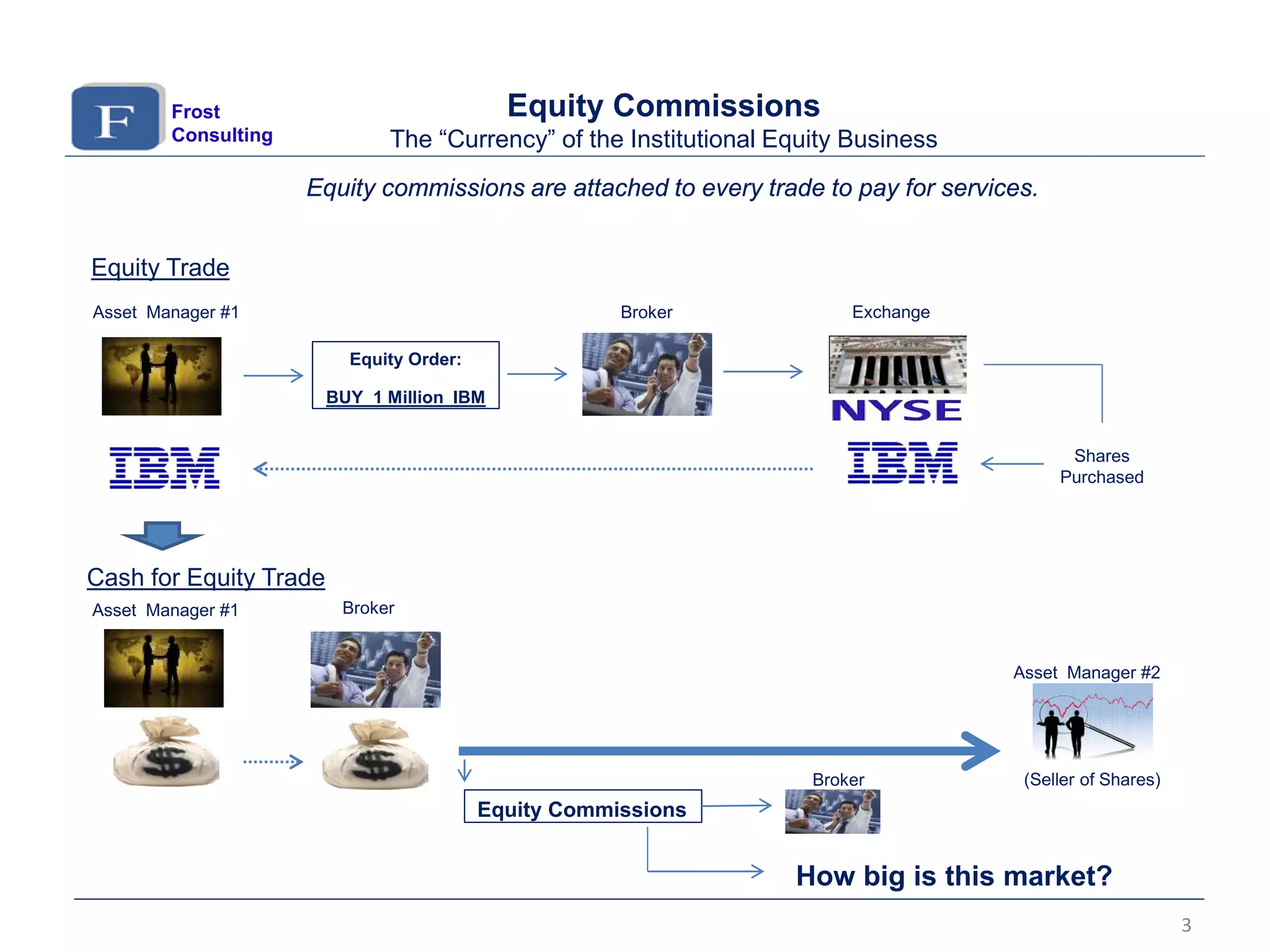
Equity commissions are attached to every trade to pay for services.
Asset Manager #1
Equity Order:
BUY 1 Million IBM
Broker
Equity Trade
Shares
Purchased
Exchange
Equity Commissions
How big is this market?
Cash for Equity Trade
Asset Manager #1 Broker
Asset Manager #2
(Seller of Shares)Broker
3
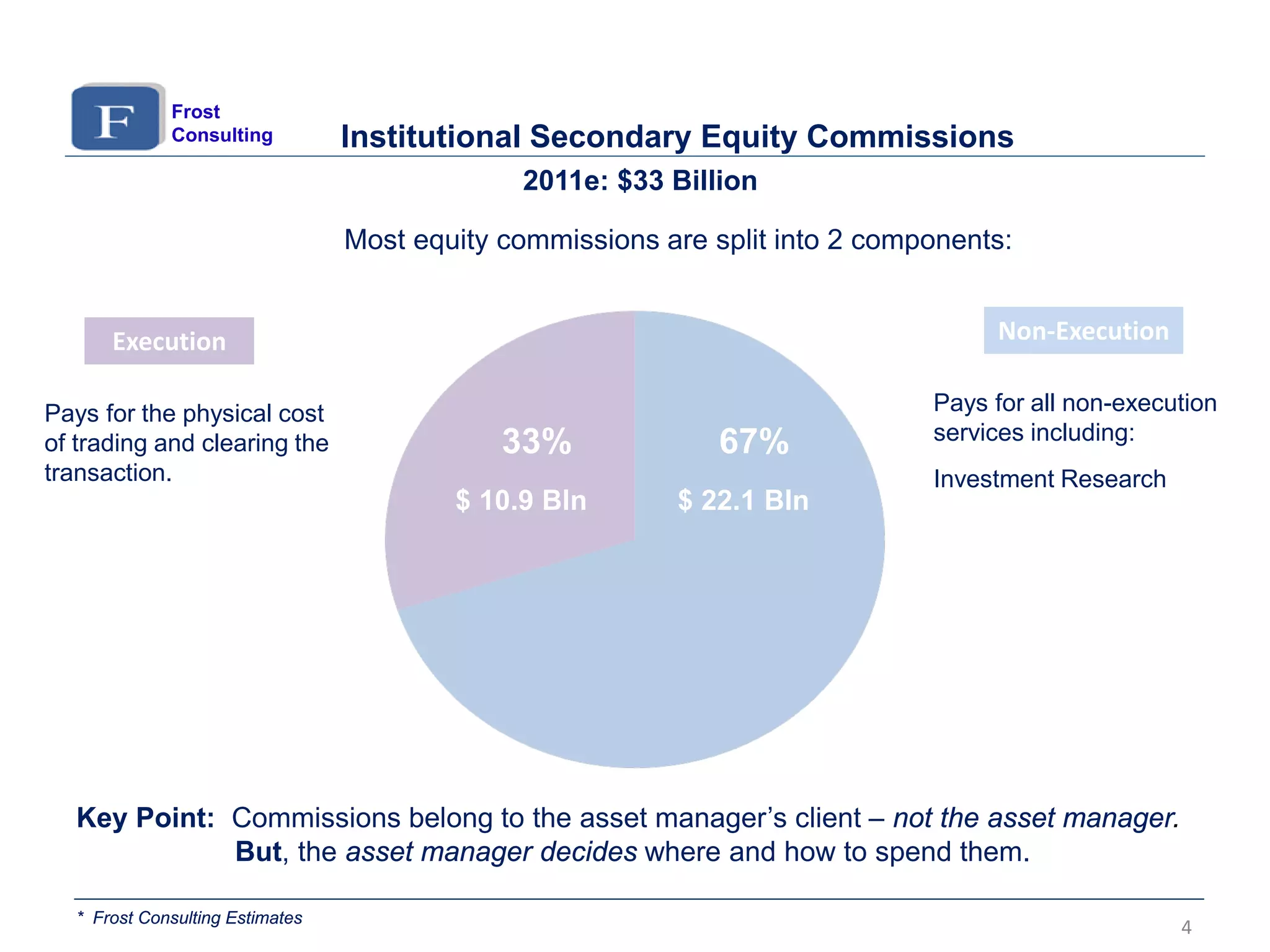
33%
$ 10.9 Bln
Execution
67%
$ 22.1 Bln
Non-Execution
Pays for the physical cost
of trading and clearing the
transaction.
Pays for all non-execution
services including:
Investment Research
Institutional Secondary Equity Commissions
4
Frost
Consulting
Most equity commissions are split into 2 components:
2011e: $33 Billion
Key Point: Commissions belong to the asset manager’s client – not the asset manager.
But, the asset manager decides where and how to spend them.
* Frost Consulting Estimates
Key Points:
 Asset managers use commissions to buy goods and services, because it’s not their money. It belongs to their
asset owner clients. (Pension Funds/Mutual Funds)
 Consequently, the majority of research purchased by asset managers (~$20 billion per annum) is bought via
commissions.
 In the bundled commission environment, the 2 commission components (execution and non-execution) are
inseparable and are captured by the broker executing the equity trade.
 Therefore, the only way for asset managers to buy research (and related services) using their client’s money, was
to buy them from companies with an equity execution capability (investment banks/brokers).
 It was the act of equity execution which generated the commissions which could be used to buy goods and
services.
 This meant that investment banks/brokers had a very high market share of asset manager research spending.
 For the last 30 years most asset managers have bought research from fewer than 100 investment banks. Even
though thousands of other types of research producers generate information that could aid asset manager
investment decisions, these could only be purchased with the asset manager’s own funds, rather than with their
clients’ money.
The Bundled Commission Environment
Frost
Consulting
5
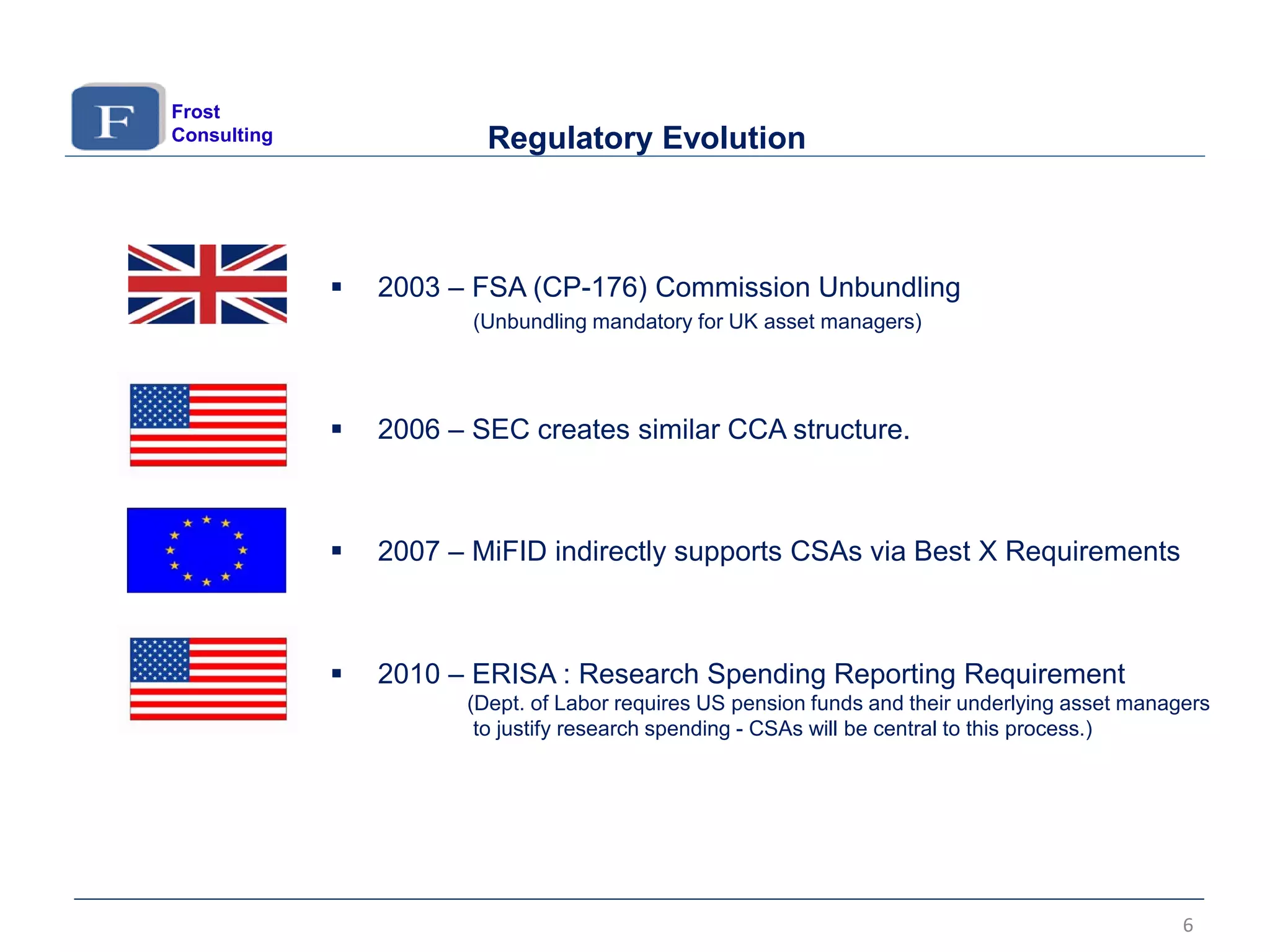
 2003 – FSA (CP-176) Commission Unbundling
(Unbundling mandatory for UK asset managers)
 2006 – SEC creates similar CCA structure.
 2007 – MiFID indirectly supports CSAs via Best X Requirements
 2010 – ERISA : Research Spending Reporting Requirement
(Dept. of Labor requires US pension funds and their underlying asset managers
to justify research spending - CSAs will be central to this process.)
6
Regulatory Evolution
Frost
Consulting
 Regulatory changes (Commission Sharing Agreements: CSAs) now allow asset managers to unbundle or split their
brokerage commissions between the execution and the non-execution components. The execution portion goes to
the broker executing the trade. The non-execution portion goes into a separate account.
 The accumulated funds in the separate account can be used to buy research from any type of research producer
(not just brokers), just like a regular bank checking/current account.
 The de-regulation of commissions means that the asset managers’ content universe is now virtually limitless
because they can use commissions to buy new sources of research without having to pay for it via an additional
equity execution relationship. As a result, forward-looking asset managers are rapidly adding research sources and
reducing the number of equity execution relationships.
 This ends the 35 year-old oligopoly of investment banks over asset manager research spending.
 Asset owners, asset managers and investment banks will have to adjust their strategies to maximize returns in this
new regulatory environment.
Commission Unbundling:
Significant Implications for All Market Participants
Frost
Consulting
7
$21.4 Bln $9.1 Bln
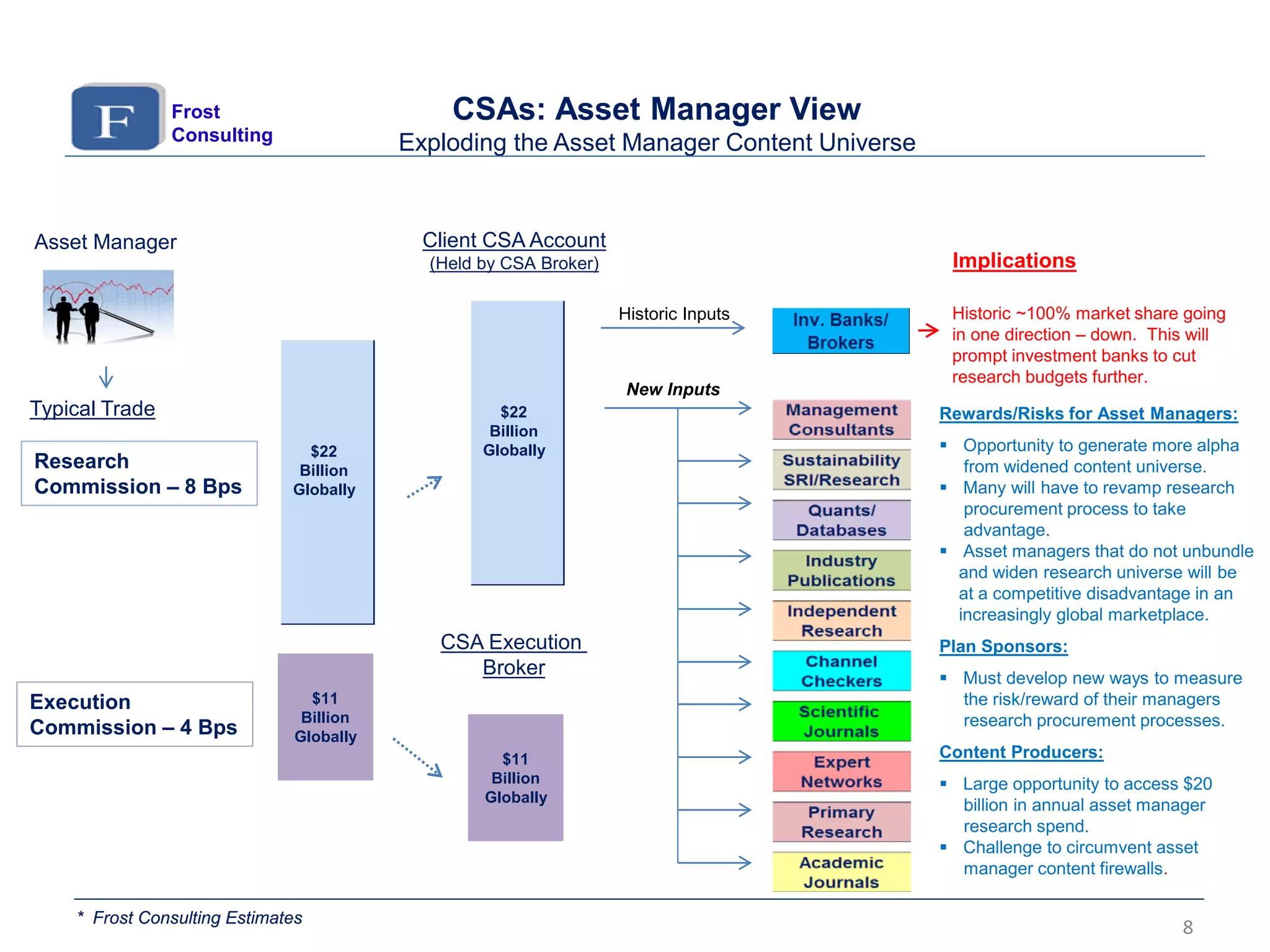
CSAs: Asset Manager View
Exploding the Asset Manager Content Universe
Typical Trade
Client CSA Account
(Held by CSA Broker)
CSA Execution
Broker
Research
Commission – 8 Bps
Execution
Commission – 4 Bps
8
$22
Billion
Globally
Historic Inputs
New Inputs
$11
Billion
Globally
Frost
Consulting
Asset Manager
$22
Billion
Globally
$11
Billion
Globally
Historic ~100% market share going
in one direction – down. This will
prompt investment banks to cut
research budgets further.
Implications
Rewards/Risks for Asset Managers:
 Opportunity to generate more alpha
from widened content universe.
 Many will have to revamp research
procurement process to take
advantage.
 Asset managers that do not unbundle
and widen research universe will be
at a competitive disadvantage in an
increasingly global marketplace.
Plan Sponsors:
 Must develop new ways to measure
the risk/reward of their managers
research procurement processes.
Content Producers:
 Large opportunity to access $20
billion in annual asset manager
research spend.
 Challenge to circumvent asset
manager content firewalls.
* Frost Consulting Estimates
Bundled
Research Universe Unbundled Research Universe
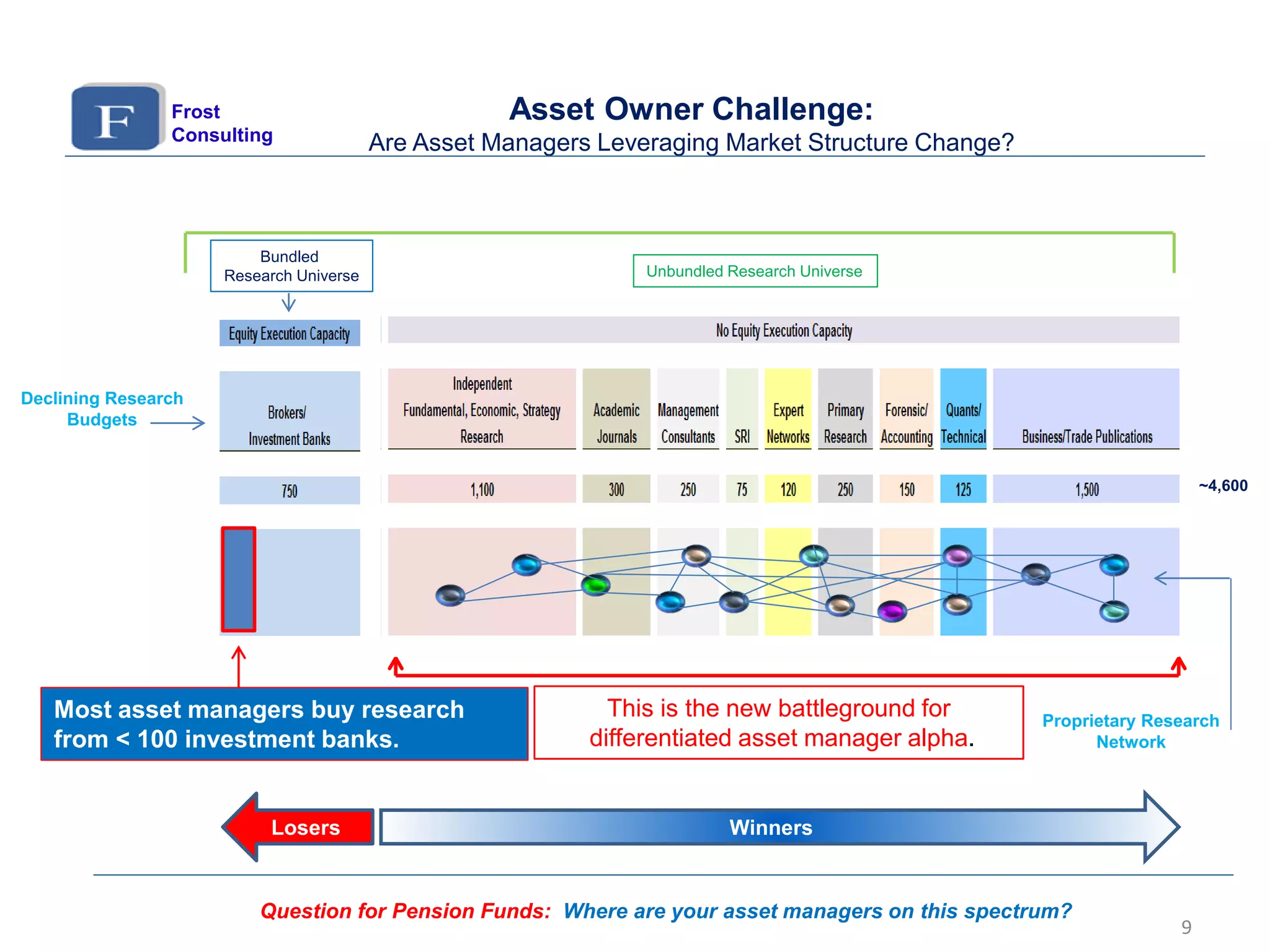
Most asset managers buy research
from < 100 investment banks.
This is the new battleground for
differentiated asset manager alpha.
Question for Pension Funds: Where are your asset managers on this spectrum?
~4,600
Asset Owner Challenge:
Are Asset Managers Leveraging Market Structure Change?
Frost
Consulting
Declining Research
Budgets
Proprietary Research
Network
Losers Winners
9
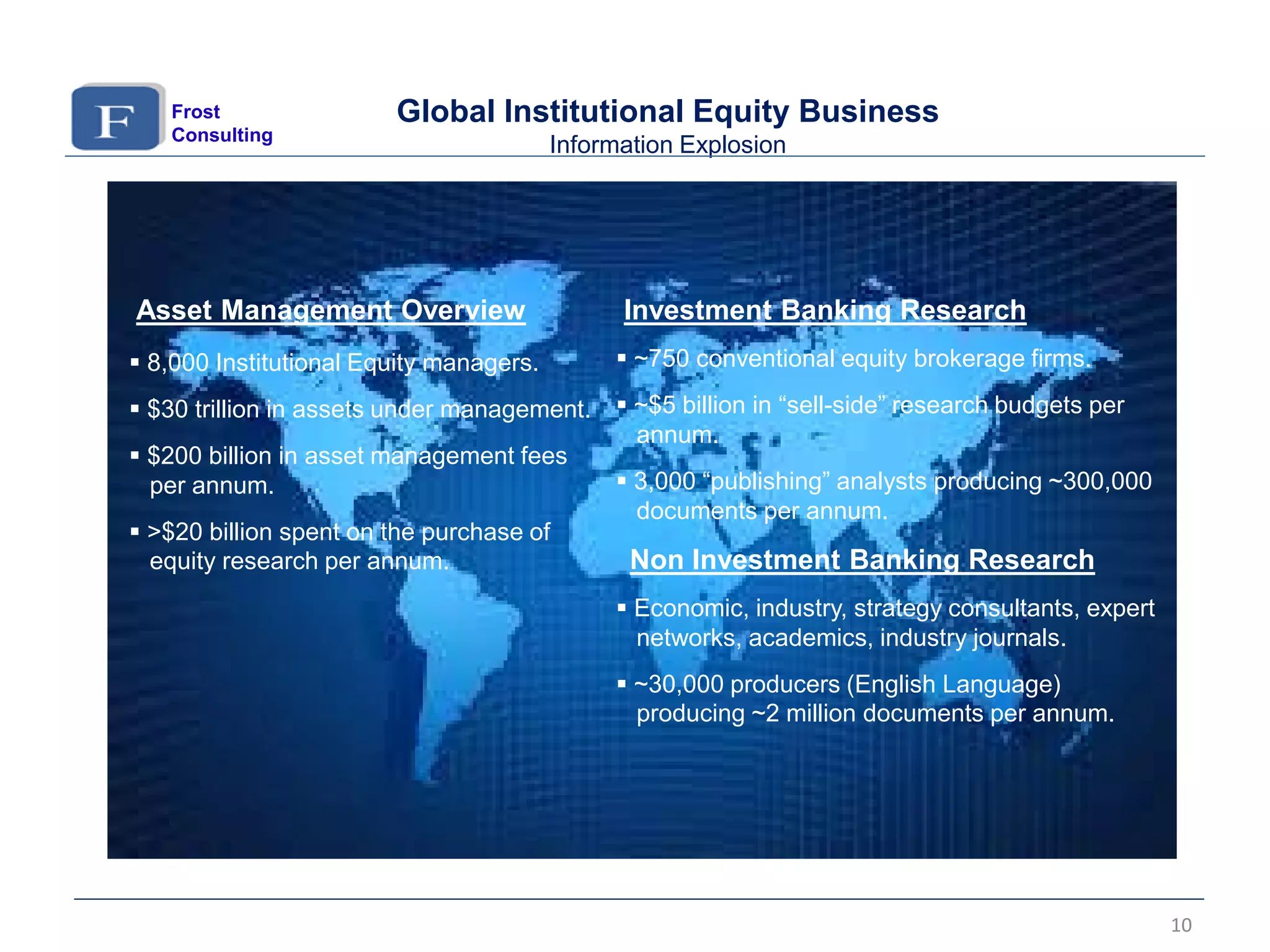
Asset Management Overview
 8,000 Institutional Equity managers.
 $30 trillion in assets under management.
 $200 billion in asset management fees
per annum.
 >$20 billion spent on the purchase of
equity research per annum.
Investment Banking Research
 ~750 conventional equity brokerage firms.
 ~$5 billion in “sell-side” research budgets per
annum.
 3,000 “publishing” analysts producing ~300,000
documents per annum.
Non Investment Banking Research
 Economic, industry, strategy consultants, expert
networks, academics, industry journals.
 ~30,000 producers (English Language)
producing ~2 million documents per annum.
Global Institutional Equity Business
Information Explosion
Frost
Consulting
10
Global CSAs:
Penetration Rates
Operational Challenges
Increasing Regulatory Scrutiny
Frost
Consulting
11
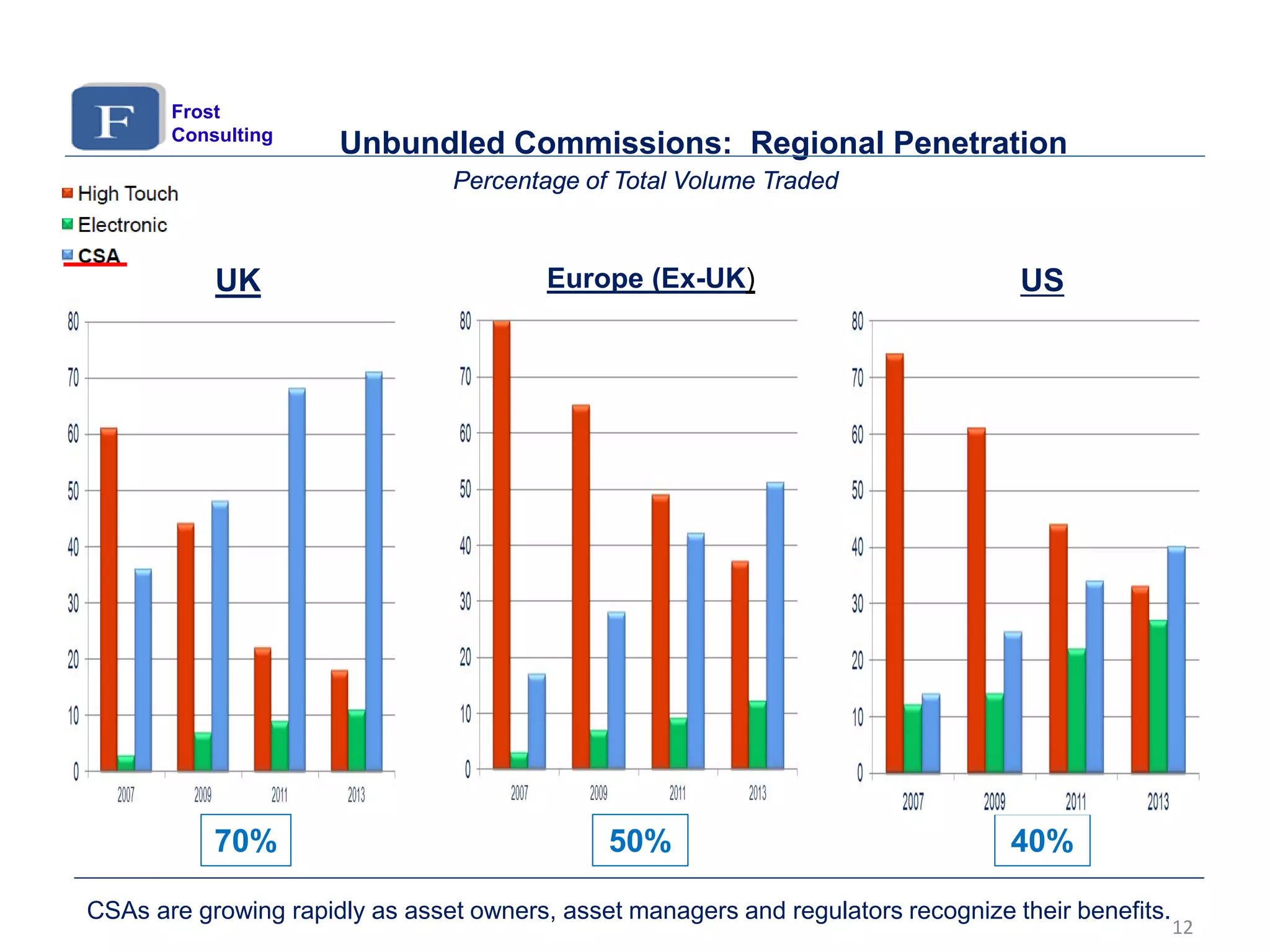
Percentage of Total Volume Traded
50% 40%
Unbundled Commissions: Regional Penetration
CSAs are growing rapidly as asset owners, asset managers and regulators recognize their benefits.
12
Frost
Consulting
70%
Europe (Ex-UK) USUK
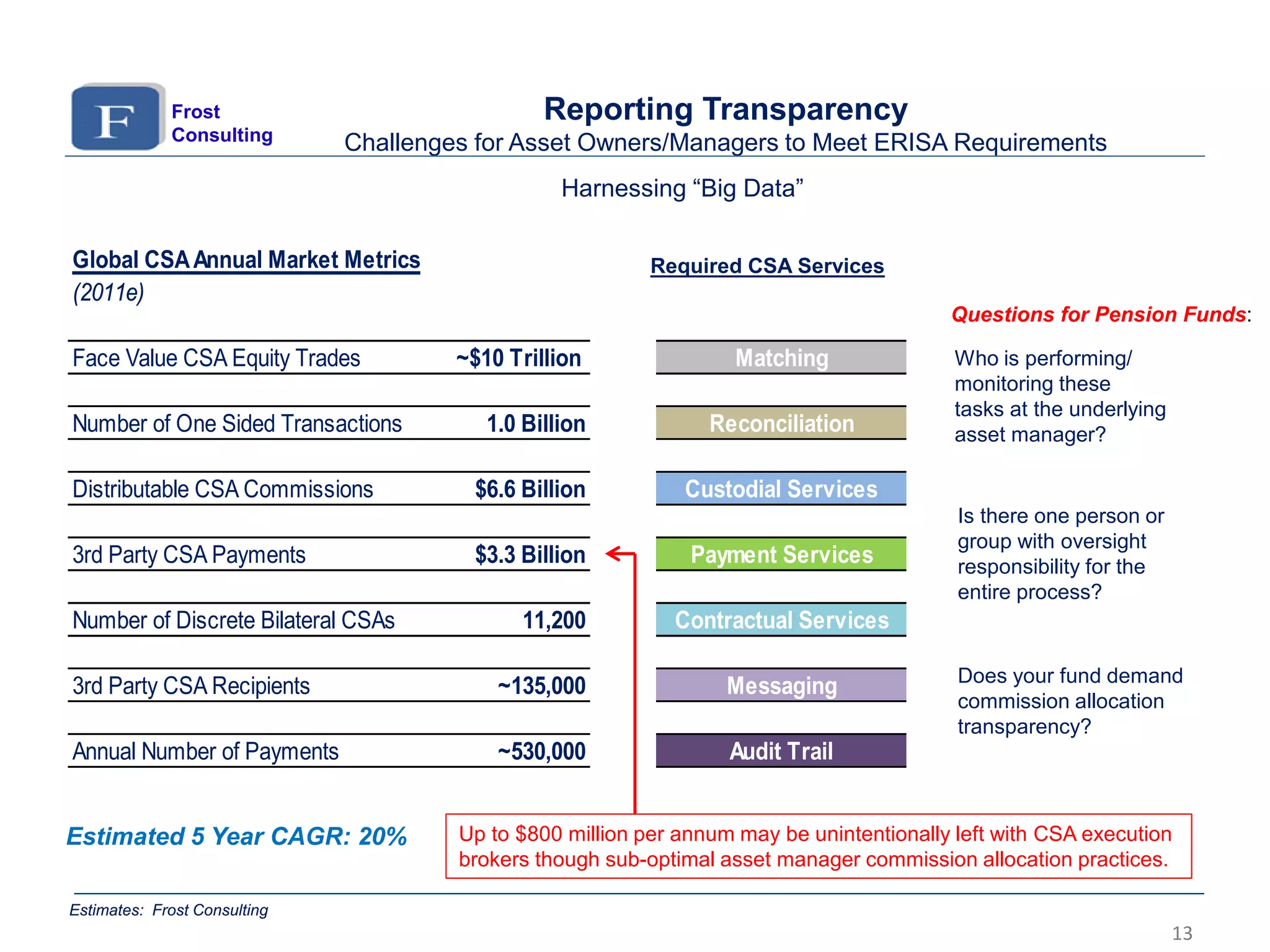
Estimated 5 Year CAGR: 20%
CSAs: Required Services
Who is performing/
monitoring these
tasks at the underlying
asset manager?
Reporting Transparency
Challenges for Asset Owners/Managers to Meet ERISA Requirements
Harnessing “Big Data”
Is there one person or
group with oversight
responsibility for the
entire process?
Up to $800 million per annum may be unintentionally left with CSA execution
brokers though sub-optimal asset manager commission allocation practices.
Does your fund demand
commission allocation
transparency?
Questions for Pension Funds:
Global CSAAnnual Market Metrics CSAServices Market
(2011e)
Face Value CSA Equity Trades ~$10 Trillion
Number of One Sided Transactions 1.0 Billion
Distributable CSA Commissions $6.6 Billion
3rd Party CSA Payments $3.3 Billion
Number of Discrete Bilateral CSAs 11,200
3rd Party CSA Recipients ~135,000
Annual Number of Payments ~530,000
Contractual Services
Messaging
Audit Trail
Matching
Reconciliation
Custodial Services
Payment Services
Estimates: Frost Consulting
13
Required CSA Services
Frost
Consulting
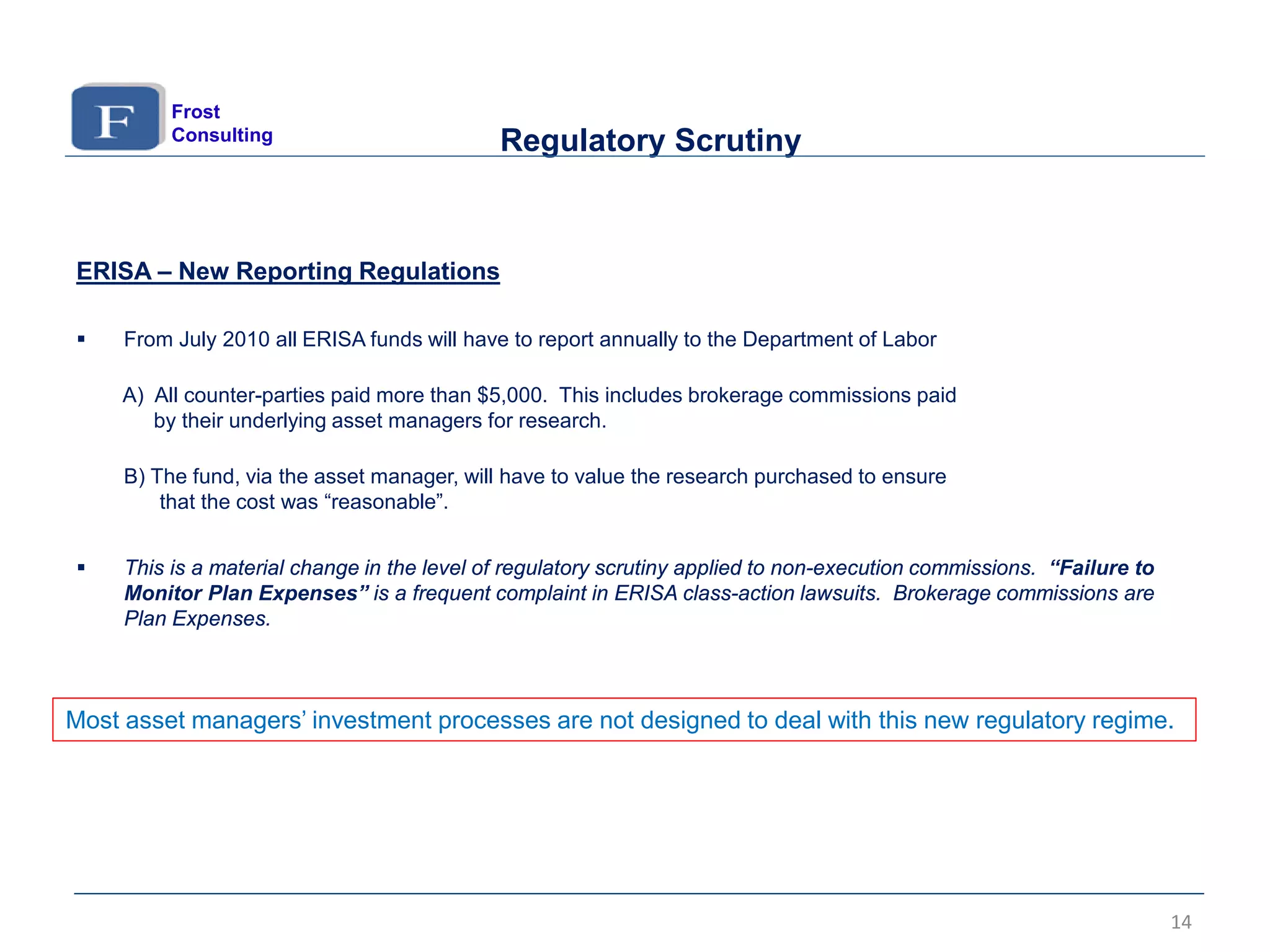
ERISA – New Reporting Regulations
 From July 2010 all ERISA funds will have to report annually to the Department of Labor
A) All counter-parties paid more than $5,000. This includes brokerage commissions paid
by their underlying asset managers for research.
B) The fund, via the asset manager, will have to value the research purchased to ensure
that the cost was “reasonable”.
 This is a material change in the level of regulatory scrutiny applied to non-execution commissions. “Failure to
Monitor Plan Expenses” is a frequent complaint in ERISA class-action lawsuits. Brokerage commissions are
Plan Expenses.
14
Regulatory Scrutiny
Most asset managers’ investment processes are not designed to deal with this new regulatory regime.
Frost
Consulting
15
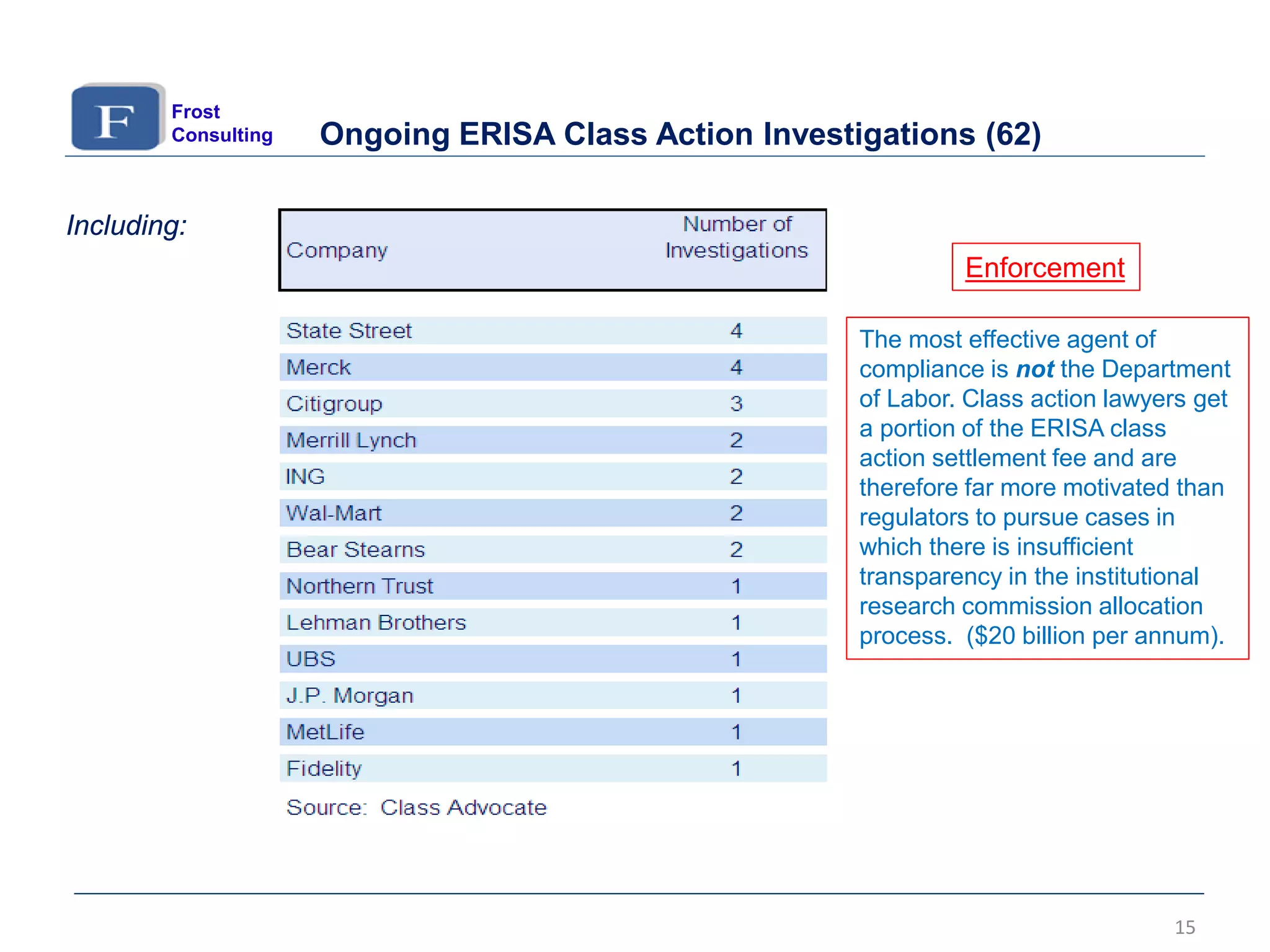
Including:
Ongoing ERISA Class Action Investigations (62)
The most effective agent of
compliance is not the Department
of Labor. Class action lawyers get
a portion of the ERISA class
action settlement fee and are
therefore far more motivated than
regulators to pursue cases in
which there is insufficient
transparency in the institutional
research commission allocation
process. ($20 billion per annum).
Enforcement
Frost
Consulting
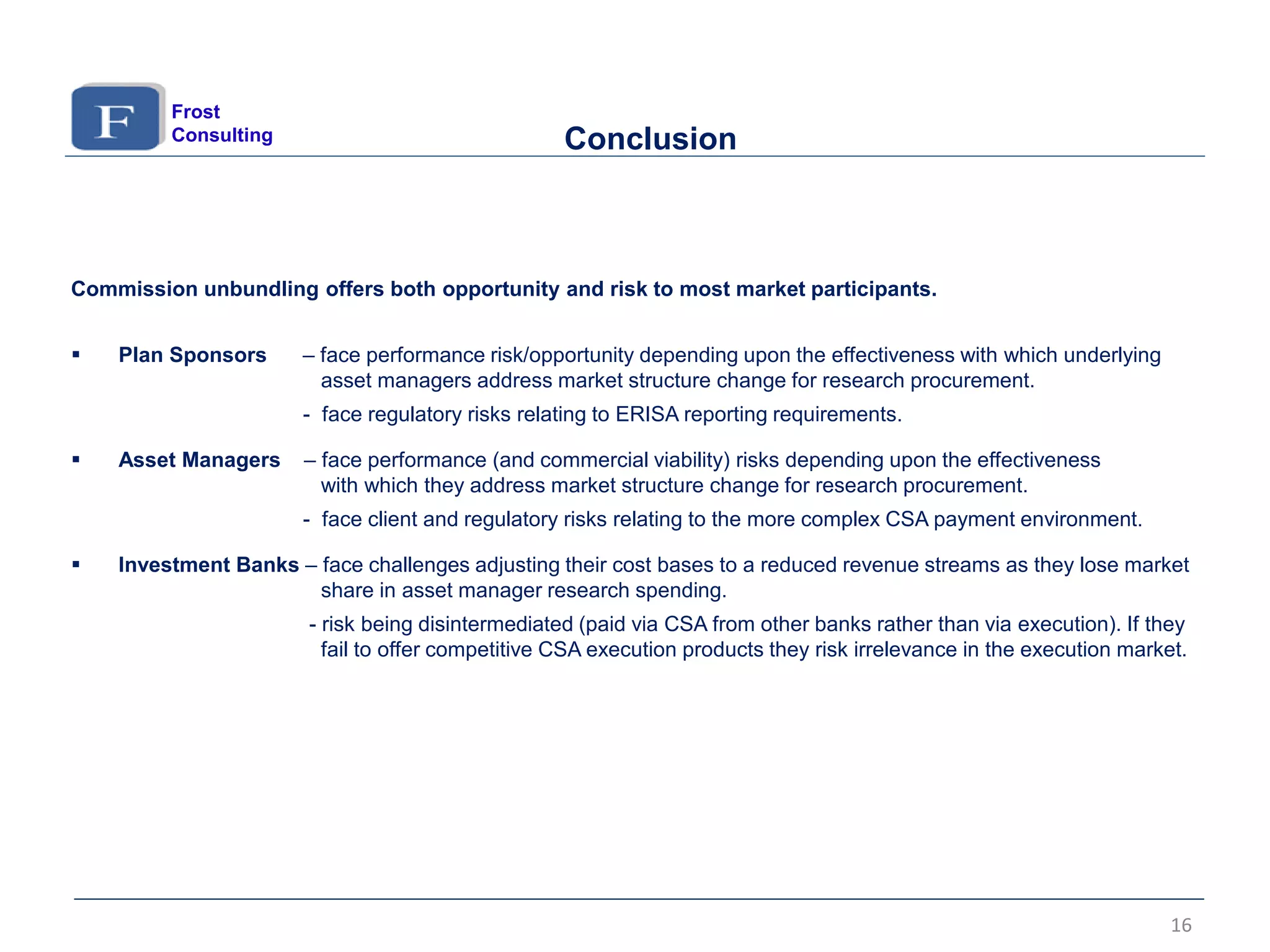
Commission unbundling offers both opportunity and risk to most market participants.
 Plan Sponsors – face performance risk/opportunity depending upon the effectiveness with which underlying
asset managers address market structure change for research procurement.
- face regulatory risks relating to ERISA reporting requirements.
 Asset Managers – face performance (and commercial viability) risks depending upon the effectiveness
with which they address market structure change for research procurement.
- face client and regulatory risks relating to the more complex CSA payment environment.
 Investment Banks – face challenges adjusting their cost bases to a reduced revenue streams as they lose market
share in asset manager research spending.
- risk being disintermediated (paid via CSA from other banks rather than via execution). If they
fail to offer competitive CSA execution products they risk irrelevance in the execution market.
Conclusion
Frost
Consulting
16
17
For more information please contact:
Neil Scarth
UK cell +(44) 774 865 2356
neil.scarth@frostconsulting.co.uk
Legal Disclaimer Notice
This document has been produced by Frost Consulting, LLC. Everything in this document is provided "AS IS: and without warranty of any kind. We have made every effort to
offer current, correct and clearly expressed information as possible. Inadvertent errors can occur and changes will be made when any error is brought to our attention. By
providing this document, Frost Consulting, LLC shall not be held liable, or undertake any responsibility whatsoever, for the content of third party information. All content and
material on this site is the exclusive property of Frost Consulting, LLC, and may not be republished without expressed written permission.
Frost
Consulting
Additional information/analysis at:
www.frostconsulting.co.uk

Introduction to commission unbundling

  • 1.
    Introduction to GlobalCommission Unbundling Market Structure Change: Upending the Status Quo Risks and Rewards July 2012 Frost Consulting
  • 2.
    How do theeconomics of the institutional equity market work? Frost Consulting 2
  • 3.
    Equity Commissions The “Currency”of the Institutional Equity Business Frost Consulting Equity commissions are attached to every trade to pay for services. Asset Manager #1 Equity Order: BUY 1 Million IBM Broker Equity Trade Shares Purchased Exchange Equity Commissions How big is this market? Cash for Equity Trade Asset Manager #1 Broker Asset Manager #2 (Seller of Shares)Broker 3
  • 4.
    33% $ 10.9 Bln Execution 67% $22.1 Bln Non-Execution Pays for the physical cost of trading and clearing the transaction. Pays for all non-execution services including: Investment Research Institutional Secondary Equity Commissions 4 Frost Consulting Most equity commissions are split into 2 components: 2011e: $33 Billion Key Point: Commissions belong to the asset manager’s client – not the asset manager. But, the asset manager decides where and how to spend them. * Frost Consulting Estimates
  • 5.
    Key Points:  Assetmanagers use commissions to buy goods and services, because it’s not their money. It belongs to their asset owner clients. (Pension Funds/Mutual Funds)  Consequently, the majority of research purchased by asset managers (~$20 billion per annum) is bought via commissions.  In the bundled commission environment, the 2 commission components (execution and non-execution) are inseparable and are captured by the broker executing the equity trade.  Therefore, the only way for asset managers to buy research (and related services) using their client’s money, was to buy them from companies with an equity execution capability (investment banks/brokers).  It was the act of equity execution which generated the commissions which could be used to buy goods and services.  This meant that investment banks/brokers had a very high market share of asset manager research spending.  For the last 30 years most asset managers have bought research from fewer than 100 investment banks. Even though thousands of other types of research producers generate information that could aid asset manager investment decisions, these could only be purchased with the asset manager’s own funds, rather than with their clients’ money. The Bundled Commission Environment Frost Consulting 5
  • 6.
     2003 –FSA (CP-176) Commission Unbundling (Unbundling mandatory for UK asset managers)  2006 – SEC creates similar CCA structure.  2007 – MiFID indirectly supports CSAs via Best X Requirements  2010 – ERISA : Research Spending Reporting Requirement (Dept. of Labor requires US pension funds and their underlying asset managers to justify research spending - CSAs will be central to this process.) 6 Regulatory Evolution Frost Consulting
  • 7.
     Regulatory changes(Commission Sharing Agreements: CSAs) now allow asset managers to unbundle or split their brokerage commissions between the execution and the non-execution components. The execution portion goes to the broker executing the trade. The non-execution portion goes into a separate account.  The accumulated funds in the separate account can be used to buy research from any type of research producer (not just brokers), just like a regular bank checking/current account.  The de-regulation of commissions means that the asset managers’ content universe is now virtually limitless because they can use commissions to buy new sources of research without having to pay for it via an additional equity execution relationship. As a result, forward-looking asset managers are rapidly adding research sources and reducing the number of equity execution relationships.  This ends the 35 year-old oligopoly of investment banks over asset manager research spending.  Asset owners, asset managers and investment banks will have to adjust their strategies to maximize returns in this new regulatory environment. Commission Unbundling: Significant Implications for All Market Participants Frost Consulting 7
  • 8.
    $21.4 Bln $9.1Bln CSAs: Asset Manager View Exploding the Asset Manager Content Universe Typical Trade Client CSA Account (Held by CSA Broker) CSA Execution Broker Research Commission – 8 Bps Execution Commission – 4 Bps 8 $22 Billion Globally Historic Inputs New Inputs $11 Billion Globally Frost Consulting Asset Manager $22 Billion Globally $11 Billion Globally Historic ~100% market share going in one direction – down. This will prompt investment banks to cut research budgets further. Implications Rewards/Risks for Asset Managers:  Opportunity to generate more alpha from widened content universe.  Many will have to revamp research procurement process to take advantage.  Asset managers that do not unbundle and widen research universe will be at a competitive disadvantage in an increasingly global marketplace. Plan Sponsors:  Must develop new ways to measure the risk/reward of their managers research procurement processes. Content Producers:  Large opportunity to access $20 billion in annual asset manager research spend.  Challenge to circumvent asset manager content firewalls. * Frost Consulting Estimates
  • 9.
    Bundled Research Universe UnbundledResearch Universe Most asset managers buy research from < 100 investment banks. This is the new battleground for differentiated asset manager alpha. Question for Pension Funds: Where are your asset managers on this spectrum? ~4,600 Asset Owner Challenge: Are Asset Managers Leveraging Market Structure Change? Frost Consulting Declining Research Budgets Proprietary Research Network Losers Winners 9
  • 10.
    Asset Management Overview 8,000 Institutional Equity managers.  $30 trillion in assets under management.  $200 billion in asset management fees per annum.  >$20 billion spent on the purchase of equity research per annum. Investment Banking Research  ~750 conventional equity brokerage firms.  ~$5 billion in “sell-side” research budgets per annum.  3,000 “publishing” analysts producing ~300,000 documents per annum. Non Investment Banking Research  Economic, industry, strategy consultants, expert networks, academics, industry journals.  ~30,000 producers (English Language) producing ~2 million documents per annum. Global Institutional Equity Business Information Explosion Frost Consulting 10
  • 11.
    Global CSAs: Penetration Rates OperationalChallenges Increasing Regulatory Scrutiny Frost Consulting 11
  • 12.
    Percentage of TotalVolume Traded 50% 40% Unbundled Commissions: Regional Penetration CSAs are growing rapidly as asset owners, asset managers and regulators recognize their benefits. 12 Frost Consulting 70% Europe (Ex-UK) USUK
  • 13.
    Estimated 5 YearCAGR: 20% CSAs: Required Services Who is performing/ monitoring these tasks at the underlying asset manager? Reporting Transparency Challenges for Asset Owners/Managers to Meet ERISA Requirements Harnessing “Big Data” Is there one person or group with oversight responsibility for the entire process? Up to $800 million per annum may be unintentionally left with CSA execution brokers though sub-optimal asset manager commission allocation practices. Does your fund demand commission allocation transparency? Questions for Pension Funds: Global CSAAnnual Market Metrics CSAServices Market (2011e) Face Value CSA Equity Trades ~$10 Trillion Number of One Sided Transactions 1.0 Billion Distributable CSA Commissions $6.6 Billion 3rd Party CSA Payments $3.3 Billion Number of Discrete Bilateral CSAs 11,200 3rd Party CSA Recipients ~135,000 Annual Number of Payments ~530,000 Contractual Services Messaging Audit Trail Matching Reconciliation Custodial Services Payment Services Estimates: Frost Consulting 13 Required CSA Services Frost Consulting
  • 14.
    ERISA – NewReporting Regulations  From July 2010 all ERISA funds will have to report annually to the Department of Labor A) All counter-parties paid more than $5,000. This includes brokerage commissions paid by their underlying asset managers for research. B) The fund, via the asset manager, will have to value the research purchased to ensure that the cost was “reasonable”.  This is a material change in the level of regulatory scrutiny applied to non-execution commissions. “Failure to Monitor Plan Expenses” is a frequent complaint in ERISA class-action lawsuits. Brokerage commissions are Plan Expenses. 14 Regulatory Scrutiny Most asset managers’ investment processes are not designed to deal with this new regulatory regime. Frost Consulting
  • 15.
    15 Including: Ongoing ERISA ClassAction Investigations (62) The most effective agent of compliance is not the Department of Labor. Class action lawyers get a portion of the ERISA class action settlement fee and are therefore far more motivated than regulators to pursue cases in which there is insufficient transparency in the institutional research commission allocation process. ($20 billion per annum). Enforcement Frost Consulting
  • 16.
    Commission unbundling offersboth opportunity and risk to most market participants.  Plan Sponsors – face performance risk/opportunity depending upon the effectiveness with which underlying asset managers address market structure change for research procurement. - face regulatory risks relating to ERISA reporting requirements.  Asset Managers – face performance (and commercial viability) risks depending upon the effectiveness with which they address market structure change for research procurement. - face client and regulatory risks relating to the more complex CSA payment environment.  Investment Banks – face challenges adjusting their cost bases to a reduced revenue streams as they lose market share in asset manager research spending. - risk being disintermediated (paid via CSA from other banks rather than via execution). If they fail to offer competitive CSA execution products they risk irrelevance in the execution market. Conclusion Frost Consulting 16
  • 17.
    17 For more informationplease contact: Neil Scarth UK cell +(44) 774 865 2356 neil.scarth@frostconsulting.co.uk Legal Disclaimer Notice This document has been produced by Frost Consulting, LLC. Everything in this document is provided "AS IS: and without warranty of any kind. We have made every effort to offer current, correct and clearly expressed information as possible. Inadvertent errors can occur and changes will be made when any error is brought to our attention. By providing this document, Frost Consulting, LLC shall not be held liable, or undertake any responsibility whatsoever, for the content of third party information. All content and material on this site is the exclusive property of Frost Consulting, LLC, and may not be republished without expressed written permission. Frost Consulting Additional information/analysis at: www.frostconsulting.co.uk