Trees
• What is a Tree?
• Tree terminology
• Why trees?
• General Trees and their implementation
• N-ary Trees
• N-ary Trees implementation
• Implementing trees
• Binary trees
• Binary trees implementation
• Application of Binary trees
What is a Tree?
• A tree, is a finite set of nodes together with a finite set of directed
edges that define parent-child relationships. Each directed edge
connects a parent to its child. Example:
Nodes={A,B,C,D,E,f,G,H}
Edges={(A,B),(A,E),(B,F),(B,G),(B,H),
(E,C),(E,D)}
• A directed path from node m1 to node mk is a list of nodes m1, m2, . .
. , mk such that each is the parent of the next node in the list. The
length of such a path is k - 1.
• Example: A, E, C is a directed path of length 2.
A
B
E
C
D F H G
What is a Tree? (contd.)
• A tree satisfies the following properties:
1. It has one designated node, called the root, that has no parent.
2. Every node, except the root, has exactly one parent.
3. A node may have zero or more children.
4. There is a unique directed path from the root to each node.
5
2
4 1 6
3
5
2
4 1 6
3
5
2
4
1
6
3
tree Not a tree Not a tree
Tree Terminology
• Ordered tree: A tree in which the children of each node are linearly
ordered (usually from left to right).
• Ancestor of a node v: Any node, including v itself, on the path from
the root to the node.
• Proper ancestor of a node v: Any node, excluding v, on the path
from the root to the node.
A
C
B
E
D F G
Ancestors of G
proper ancestors of E
An Ordered Tree
Tree Terminology (Contd.)
• Descendant of a node v: Any node, including v itself, on any path
from the node to a leaf node (i.e., a node with no children).
• Proper descendant of a node v: Any node, excluding v, on any
path from the node to a leaf node.
• Subtree of a node v: A tree rooted at a child of v.
Descendants of a node C
A
C
B
E
D F G
Proper descendants
of node B
A
C
B
E
D F G
subtrees of node A
Tree Terminology (Contd.)
A
A
B
D
H
C
E
F
G
J
I
proper ancestors of node H
proper descendants
of node C
subtrees of A
A
A
B
D
H
C
E
F
G
J
I
parent of node D
child of node D
grandfather of nodes I,J
grandchildren of node C
Empty tree: A tree in which the root node key is null and all subtree references
are null.
Tree Terminology (Contd.)
• Degree: The number of non-empty subtrees of a node
– Each of node D and B
has degree 1.
– Each of node A and E
has degree 2.
– Node C has degree 3.
– Each of node F,G,H,I,J has degree 0.
• Leaf: A node with degree 0.
• Internal or interior node: a node with degree greater than 0.
• Siblings: Nodes that have the same parent.
• Size: The number of nodes in a tree.
A
A
B
D
H
C
E
F
G
J
I
An Ordered Tree
with size of 10
Siblings
of E
Siblings of A
Tree Terminology (Contd.)
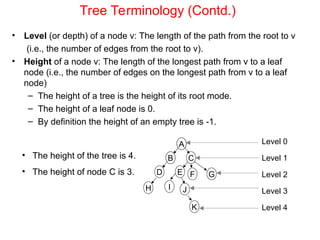
• Level (or depth) of a node v: The length of the path from the root to v
(i.e., the number of edges from the root to v).
• Height of a node v: The length of the longest path from v to a leaf
node (i.e., the number of edges on the longest path from v to a leaf
node)
– The height of a tree is the height of its root mode.
– The height of a leaf node is 0.
– By definition the height of an empty tree is -1.
A
A
B
D
H
C
E F G
J
I
K
Level 0
Level 1
Level 2
Level 3
Level 4
• The height of the tree is 4.
• The height of node C is 3.
Why Trees?
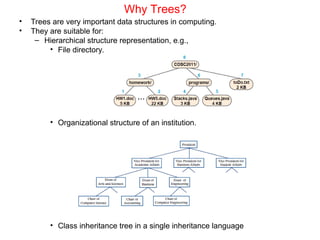
• Trees are very important data structures in computing.
• They are suitable for:
– Hierarchical structure representation, e.g.,
• File directory.
• Organizational structure of an institution.
• Class inheritance tree in a single inheritance language
Why Trees? (Contd.)
• Textbook Organization
– Problem representation, e.g.,
• Expression trees.
• Decision trees.
• Game trees.
– Efficient algorithmic solutions, e.g.,
• Search trees.
• Efficient priority queues via heaps.
General Trees and their Implementation
• In a general tree, there is no limit to the number of children that a
node can have.
• Representing a general tree by linked lists:
– Each node has a linked list of the subtrees of that node.
– Each element of the linked list is a subtree of the current node
public class GeneralTree extends AbstractContainer
implements Comparable{
protected Object key ;
protected int degree ;
protected MyLinkedList list ;
// . . .
}
General Trees and their Implementation (Contd.)
Two representations of a general tree. The second representation uses
less memory; however it may require more node access time.
representation1
representation2
N-ary Trees
• An N-ary tree is an ordered tree that is either:
1. Empty, or
2. It consists of a root node and at most N non-empty N-ary
subtrees.
• It follows that the degree of each node in an N-ary tree is at most N.
• Example of N-ary trees:
5
7
2
5
9 2-ary (binary) tree
B
F
J
D
D
C G A
E
B
3-ary (tertiary)tree
N-ary Trees Implementation
public class NaryTree extends AbstractContainer
implements Comparable {
protected Object key ;
protected int degree ;
protected NaryTree[ ] subtree ;
// creates an empty tree
public NaryTree(int degree){
key = null ; this.degree = degree ;
subtree = null ;
}
public NaryTree(int degree, Object key){
this.key = key ;
this.degree = degree ;
subtree = new NaryTree[degree] ;
for(int i = 0; i < degree; i++)
subtree[i] = new NaryTree(degree);
}
// . . .
}
Binary Trees
• A binary tree is an N-ary tree for which N = 2.
• Thus, a binary tree is either:
1. An empty tree, or
2. A tree consisting of a root node and at most two non-empty
binary subtrees.
5
7
2
5
9
Example
:
Binary Trees (Contd.)
• A two-tree is either an empty binary tree or a binary tree in which
each non-leaf node has two non-empty subtrees.
• An example of a two-tree:
• An example of a binary tree that is not a two-tree:
Binary Trees (Contd.)
• A full binary tree is either an empty binary tree or a binary tree in
which each level k, k > 0, has 2k
nodes.
– A full binary tree is a two-tree in which all the leaves have the
same depth.
• An example of a full binary tree:
Binary Trees (Contd.)
• For a non-empty full binary tree with n nodes and height h:
2 h
= (n + 1) / 2
 h = log 2 ((n + 1) / 2))
= log2(n + 1) - 1
 A full binary tree has height that is logarithmic in n, where n
is the number of nodes in the tree
Binary Trees (Contd.)
• A complete binary tree is either an empty binary tree or a binary tree in
which:
1. Each level k, k > 0, other than the last level contains the maximum
number of nodes for that level, that is 2k
.
2. The last level may or may not contain the maximum number of nodes.
3. The nodes in the last level are filled from left to right.
• Thus, every full binary tree is a complete binary tree, but the opposite is
not true.
• An example of a complete and a non-complete binary tree:
Complete non-complete
Binary Trees (Contd.)
Example showing the growth of a complete binary tree:
Note: The height of a complete binary tree with n nodes is h = log
⌊ 2(n)⌋
Note: The literature contains contradicting definitions for full and
complete
binary trees. In this course we will use the definitions in slide 17 and 18
Binary Trees (Contd.)
• For a binary tree of height h :
– Maximum number of nodes is h + 1 (for a linear tree)
– Minimum number of nodes is (for a full tree)
• For a binary tree with n nodes:
– Maximum height is n – 1 (for a linear tree)
– Minimum height is log2(n + 1) – 1 (for a full tree)
1
2
2 1
0

 

 h
h
i
i
• Example of a linear tree:
Binary Trees Implementation
left
key
right
+
a *
d
-
b c
public class BinaryTree
extends AbstractContainer implements Comparable{
protected Object key ;
protected BinaryTree left, right ;
public BinaryTree(Object key,
BinaryTree left,
BinaryTree right){
this.key = key ;
this.left = left ;
this.right = right ;
}
// creates empty binary tree
public BinaryTree( ) {
this(null, null, null) ;
}
// creates leaf node
public BinaryTree(Object key){
this(key, new BinaryTree( ),
new BinaryTree( ));
}
// . . .
}
Example: A binary tree
representing a + (b - c) * d
Binary Trees Implementation (Contd.)
null
null
null
A tree such as:
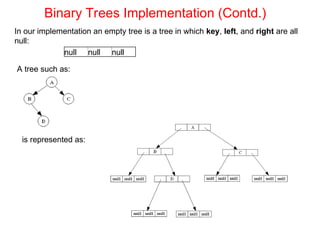
In our implementation an empty tree is a tree in which key, left, and right are all
null:
is represented as:
Binary Trees Implementation (Contd.)
In most of the literature, the tree:
is represented as:
Binary Trees Implementation (Contd.)
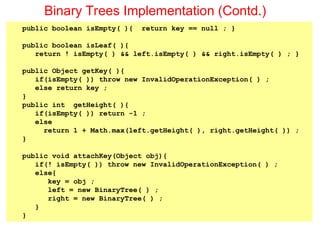
public boolean isEmpty( ){ return key == null ; }
public boolean isLeaf( ){
return ! isEmpty( ) && left.isEmpty( ) && right.isEmpty( ) ; }
public Object getKey( ){
if(isEmpty( )) throw new InvalidOperationException( ) ;
else return key ;
}
public int getHeight( ){
if(isEmpty( )) return -1 ;
else
return 1 + Math.max(left.getHeight( ), right.getHeight( )) ;
}
public void attachKey(Object obj){
if(! isEmpty( )) throw new InvalidOperationException( ) ;
else{
key = obj ;
left = new BinaryTree( ) ;
right = new BinaryTree( ) ;
}
}
Binary Trees Implementation (Contd.)
public Object detachKey( ){
if(! isLeaf( )) throw new InvalidOperationException( ) ;
else {
Object obj = key ;
key = null ;
left = null ;
right = null ;
return obj ;
}
}
public BinaryTree getLeft( ){
if(isEmpty( )) throw new InvalidOperationException( ) ;
else return left ;
}
public BinaryTree getRight( ){
if(isEmpty( )) throw new InvalidOperationException( ) ;
else return right ;
}
Applications of Binary Trees
Binary trees have many important uses. Three examples are:
1. Binary decision trees
• Internal nodes are conditions. Leaf nodes denote decisions.
2. Expression Trees
Condition1
Condition2
Condition3
decision1
decision2
decision3
decision4
false
false
false
True
True
True
+
a *
d
-
b c
Applications of Binary Trees (Contd.)
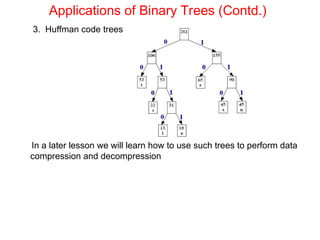
3. Huffman code trees
In a later lesson we will learn how to use such trees to perform data
compression and decompression

Introduction To Binary Search Trees .ppt

  • 1.
    Trees • What isa Tree? • Tree terminology • Why trees? • General Trees and their implementation • N-ary Trees • N-ary Trees implementation • Implementing trees • Binary trees • Binary trees implementation • Application of Binary trees
  • 2.
    What is aTree? • A tree, is a finite set of nodes together with a finite set of directed edges that define parent-child relationships. Each directed edge connects a parent to its child. Example: Nodes={A,B,C,D,E,f,G,H} Edges={(A,B),(A,E),(B,F),(B,G),(B,H), (E,C),(E,D)} • A directed path from node m1 to node mk is a list of nodes m1, m2, . . . , mk such that each is the parent of the next node in the list. The length of such a path is k - 1. • Example: A, E, C is a directed path of length 2. A B E C D F H G
  • 3.
    What is aTree? (contd.) • A tree satisfies the following properties: 1. It has one designated node, called the root, that has no parent. 2. Every node, except the root, has exactly one parent. 3. A node may have zero or more children. 4. There is a unique directed path from the root to each node. 5 2 4 1 6 3 5 2 4 1 6 3 5 2 4 1 6 3 tree Not a tree Not a tree
  • 4.
    Tree Terminology • Orderedtree: A tree in which the children of each node are linearly ordered (usually from left to right). • Ancestor of a node v: Any node, including v itself, on the path from the root to the node. • Proper ancestor of a node v: Any node, excluding v, on the path from the root to the node. A C B E D F G Ancestors of G proper ancestors of E An Ordered Tree
  • 5.
    Tree Terminology (Contd.) •Descendant of a node v: Any node, including v itself, on any path from the node to a leaf node (i.e., a node with no children). • Proper descendant of a node v: Any node, excluding v, on any path from the node to a leaf node. • Subtree of a node v: A tree rooted at a child of v. Descendants of a node C A C B E D F G Proper descendants of node B A C B E D F G subtrees of node A
  • 6.
    Tree Terminology (Contd.) A A B D H C E F G J I properancestors of node H proper descendants of node C subtrees of A A A B D H C E F G J I parent of node D child of node D grandfather of nodes I,J grandchildren of node C Empty tree: A tree in which the root node key is null and all subtree references are null.
  • 7.
    Tree Terminology (Contd.) •Degree: The number of non-empty subtrees of a node – Each of node D and B has degree 1. – Each of node A and E has degree 2. – Node C has degree 3. – Each of node F,G,H,I,J has degree 0. • Leaf: A node with degree 0. • Internal or interior node: a node with degree greater than 0. • Siblings: Nodes that have the same parent. • Size: The number of nodes in a tree. A A B D H C E F G J I An Ordered Tree with size of 10 Siblings of E Siblings of A
  • 8.
    Tree Terminology (Contd.) •Level (or depth) of a node v: The length of the path from the root to v (i.e., the number of edges from the root to v). • Height of a node v: The length of the longest path from v to a leaf node (i.e., the number of edges on the longest path from v to a leaf node) – The height of a tree is the height of its root mode. – The height of a leaf node is 0. – By definition the height of an empty tree is -1. A A B D H C E F G J I K Level 0 Level 1 Level 2 Level 3 Level 4 • The height of the tree is 4. • The height of node C is 3.
  • 9.
    Why Trees? • Treesare very important data structures in computing. • They are suitable for: – Hierarchical structure representation, e.g., • File directory. • Organizational structure of an institution. • Class inheritance tree in a single inheritance language
  • 10.
    Why Trees? (Contd.) •Textbook Organization – Problem representation, e.g., • Expression trees. • Decision trees. • Game trees. – Efficient algorithmic solutions, e.g., • Search trees. • Efficient priority queues via heaps.
  • 11.
    General Trees andtheir Implementation • In a general tree, there is no limit to the number of children that a node can have. • Representing a general tree by linked lists: – Each node has a linked list of the subtrees of that node. – Each element of the linked list is a subtree of the current node public class GeneralTree extends AbstractContainer implements Comparable{ protected Object key ; protected int degree ; protected MyLinkedList list ; // . . . }
  • 12.
    General Trees andtheir Implementation (Contd.) Two representations of a general tree. The second representation uses less memory; however it may require more node access time. representation1 representation2
  • 13.
    N-ary Trees • AnN-ary tree is an ordered tree that is either: 1. Empty, or 2. It consists of a root node and at most N non-empty N-ary subtrees. • It follows that the degree of each node in an N-ary tree is at most N. • Example of N-ary trees: 5 7 2 5 9 2-ary (binary) tree B F J D D C G A E B 3-ary (tertiary)tree
  • 14.
    N-ary Trees Implementation publicclass NaryTree extends AbstractContainer implements Comparable { protected Object key ; protected int degree ; protected NaryTree[ ] subtree ; // creates an empty tree public NaryTree(int degree){ key = null ; this.degree = degree ; subtree = null ; } public NaryTree(int degree, Object key){ this.key = key ; this.degree = degree ; subtree = new NaryTree[degree] ; for(int i = 0; i < degree; i++) subtree[i] = new NaryTree(degree); } // . . . }
  • 15.
    Binary Trees • Abinary tree is an N-ary tree for which N = 2. • Thus, a binary tree is either: 1. An empty tree, or 2. A tree consisting of a root node and at most two non-empty binary subtrees. 5 7 2 5 9 Example :
  • 16.
    Binary Trees (Contd.) •A two-tree is either an empty binary tree or a binary tree in which each non-leaf node has two non-empty subtrees. • An example of a two-tree: • An example of a binary tree that is not a two-tree:
  • 17.
    Binary Trees (Contd.) •A full binary tree is either an empty binary tree or a binary tree in which each level k, k > 0, has 2k nodes. – A full binary tree is a two-tree in which all the leaves have the same depth. • An example of a full binary tree:
  • 18.
    Binary Trees (Contd.) •For a non-empty full binary tree with n nodes and height h: 2 h = (n + 1) / 2  h = log 2 ((n + 1) / 2)) = log2(n + 1) - 1  A full binary tree has height that is logarithmic in n, where n is the number of nodes in the tree
  • 19.
    Binary Trees (Contd.) •A complete binary tree is either an empty binary tree or a binary tree in which: 1. Each level k, k > 0, other than the last level contains the maximum number of nodes for that level, that is 2k . 2. The last level may or may not contain the maximum number of nodes. 3. The nodes in the last level are filled from left to right. • Thus, every full binary tree is a complete binary tree, but the opposite is not true. • An example of a complete and a non-complete binary tree: Complete non-complete
  • 20.
    Binary Trees (Contd.) Exampleshowing the growth of a complete binary tree: Note: The height of a complete binary tree with n nodes is h = log ⌊ 2(n)⌋ Note: The literature contains contradicting definitions for full and complete binary trees. In this course we will use the definitions in slide 17 and 18
  • 21.
    Binary Trees (Contd.) •For a binary tree of height h : – Maximum number of nodes is h + 1 (for a linear tree) – Minimum number of nodes is (for a full tree) • For a binary tree with n nodes: – Maximum height is n – 1 (for a linear tree) – Minimum height is log2(n + 1) – 1 (for a full tree) 1 2 2 1 0      h h i i • Example of a linear tree:
  • 22.
    Binary Trees Implementation left key right + a* d - b c public class BinaryTree extends AbstractContainer implements Comparable{ protected Object key ; protected BinaryTree left, right ; public BinaryTree(Object key, BinaryTree left, BinaryTree right){ this.key = key ; this.left = left ; this.right = right ; } // creates empty binary tree public BinaryTree( ) { this(null, null, null) ; } // creates leaf node public BinaryTree(Object key){ this(key, new BinaryTree( ), new BinaryTree( )); } // . . . } Example: A binary tree representing a + (b - c) * d
  • 23.
    Binary Trees Implementation(Contd.) null null null A tree such as: In our implementation an empty tree is a tree in which key, left, and right are all null: is represented as:
  • 24.
    Binary Trees Implementation(Contd.) In most of the literature, the tree: is represented as:
  • 25.
    Binary Trees Implementation(Contd.) public boolean isEmpty( ){ return key == null ; } public boolean isLeaf( ){ return ! isEmpty( ) && left.isEmpty( ) && right.isEmpty( ) ; } public Object getKey( ){ if(isEmpty( )) throw new InvalidOperationException( ) ; else return key ; } public int getHeight( ){ if(isEmpty( )) return -1 ; else return 1 + Math.max(left.getHeight( ), right.getHeight( )) ; } public void attachKey(Object obj){ if(! isEmpty( )) throw new InvalidOperationException( ) ; else{ key = obj ; left = new BinaryTree( ) ; right = new BinaryTree( ) ; } }
  • 26.
    Binary Trees Implementation(Contd.) public Object detachKey( ){ if(! isLeaf( )) throw new InvalidOperationException( ) ; else { Object obj = key ; key = null ; left = null ; right = null ; return obj ; } } public BinaryTree getLeft( ){ if(isEmpty( )) throw new InvalidOperationException( ) ; else return left ; } public BinaryTree getRight( ){ if(isEmpty( )) throw new InvalidOperationException( ) ; else return right ; }
  • 27.
    Applications of BinaryTrees Binary trees have many important uses. Three examples are: 1. Binary decision trees • Internal nodes are conditions. Leaf nodes denote decisions. 2. Expression Trees Condition1 Condition2 Condition3 decision1 decision2 decision3 decision4 false false false True True True + a * d - b c
  • 28.
    Applications of BinaryTrees (Contd.) 3. Huffman code trees In a later lesson we will learn how to use such trees to perform data compression and decompression