www.ugm.ac.idLocally	Rooted,	Globally	Respected
Artificial	Intelligence	–	Department	of	Electrical	Engineering	and	Information	Technology Dr.	Sunu	Wibirama	
Introduction to Artificial Intelligence
Dr. Sunu Wibirama 

sunu@ugm.ac.id
Department of Electrical Engineering 

and Information Technology

Faculty of Engineering

Universitas Gadjah Mada
Short profile
▪ Dr. Sunu Wibirama
Teknik Elektro, Universitas Gadjah Mada 

Yogyakarta, Indonesia (S.T.) – 2007


Dept. Electronics, King Mongkut’s Institute

of Technology Ladkrabang, Bangkok,

Thailand (M.Eng.) – 2010


Graduate School of Science and Technology,

Tokai University, Tokyo, Japan

(Dr.Eng.) – 2014
sunu@ugm.ac.id
http://sunu.staff.ugm.ac.id
http://bit.ly/gazetracking
Affiliation: 

Intelligent Systems RG

Dept. of Electrical Engineering & 

Information Technology 

Faculty of Engineering 

Universitas Gadjah Mada

Area of research
• eye-gaze tracking
• computer vision
• human-computer interaction
• user experience
• human factors and safety in 3D
technology and virtual reality
http://sunu.staff.ugm.ac.id
Goal of this introductory session
• Understanding basic concept of artificial intelligence (AI) 

• Differentiating AI with machine learning and deep learning

• Identifying various applications of AI that support daily activities

• Pointing out some milestones in history of AI

• Comparing basic differences of machine learning and deep learning
Overview of the lecture
• Part 1: Industrial Revolution 4.0 and Artificial Intelligence

• Part 2: History of Turing Machine and Current Status of Artificial Intelligence

• Part 3: Introduction to Machine Learning 

• Part 4: The Rise of Deep Neural Network
The Fourth Industrial
Revolution
http://www.gartner.com/smarterwithgartner/gartner-top-10-strategic-technology-trends-for-2018
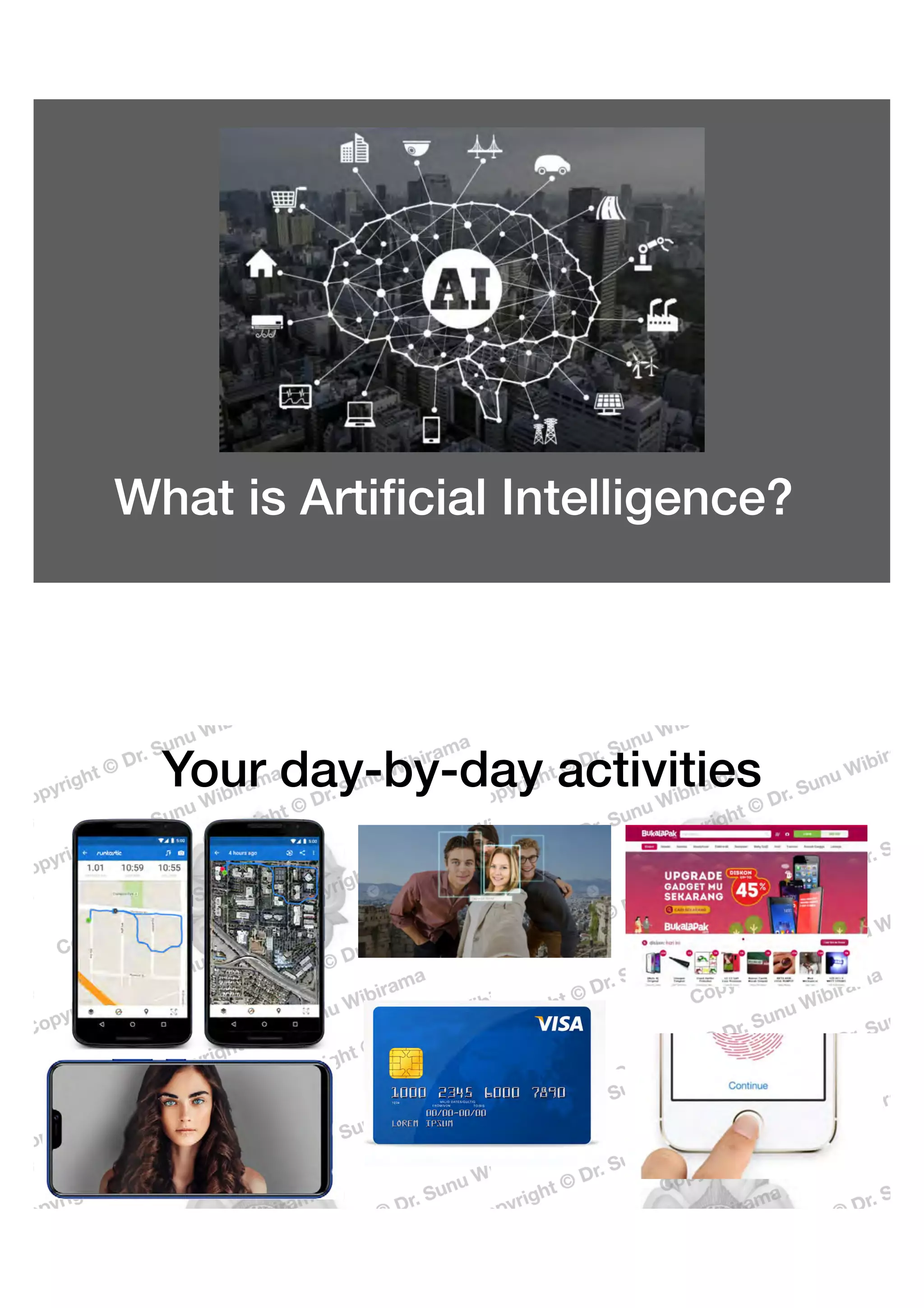
What is Artificial Intelligence?
Your day-by-day activities
Artificial intelligence (AI)
• Intelligence: the ability to acquire and apply knowledge

• Artificial intelligence is created to simulates human intelligence processes
by machines, especially computer systems. 

• These processes include learning, decision-making, and self-correction.
Particular applications of AI include expert systems (e.g., Google Maps),
speech recognition (e.g.,: Apple Siri) and machine vision 

(e.g., Facebook’s face recognition).
Can you find one example of AI
technology that you encounter in
your life?
Short quiz
End of Part 1
www.ugm.ac.idLocally	Rooted,	Globally	Respected
Artificial	Intelligence	–	Department	of	Electrical	Engineering	and	Information	Technology Dr.	Sunu	Wibirama	
Introduction to Artificial Intelligence 

(part 2)
Dr. Sunu Wibirama 

sunu@ugm.ac.id
Department of Electrical Engineering 

and Information Technology

Faculty of Engineering

Universitas Gadjah Mada
History of Turing Machine and
Current Status of Artificial
Intelligence
AI - some years ago
Alan Turing - The father 

of modern computer system
The original Enigma 

machine used by 

Nazi squad — 

collection of 

Museum of Science 

and Industry, Chicago US
(my personal photo

collection © 2014)
AI - some years ago
Alan Turing has developed 

a Turing Test in 1950 

while working in 

University of Manchester, UK.
The "standard interpretation" of the
Turing test, in which player C (the
interrogator) is given the task of
trying to determine which player – A
or B – is a computer and which is a
human. The interrogator is limited to
using the responses to written
questions to make the
determination
AI - some years ago
IBM's Watson beat two Jeopardy champions
in a special edition of game show in 2011
AI - Google I/O2018
What do you think? 

Has AI passed the Turing Test?
Short quiz
End of Part 2
www.ugm.ac.idLocally	Rooted,	Globally	Respected
Artificial	Intelligence	–	Department	of	Electrical	Engineering	and	Information	Technology Dr.	Sunu	Wibirama	
Introduction to Artificial Intelligence 

(part 3a)
Dr. Sunu Wibirama 

sunu@ugm.ac.id
Department of Electrical Engineering 

and Information Technology

Faculty of Engineering

Universitas Gadjah Mada
Introduction to

Machine Learning
(Michael Copeland, 2016)
Machine	Learning
“A	computer	program	is	said	to	learn	from	
experience	(E)	with	some	class	of	tasks	(T)	
and	a	performance	measure	(P)	if	its	
performance	at	tasks	in	T	as	measured	by	P	
improves	with	E”

(Tom	Mitchell,	1997)
Some	important	terminologies
• Training/Evolution set
– Set of data to discover potentially predictive relationships.
• Instances
– A sample is an item to process (e.g. classify). It can be a document, a
picture, a sound, a video, a row in database or CSV file, or whatever
you can describe with a fixed set of quantitative traits.
• Features / attributes
– The number of features or distinct traits that can be used to
describe each item in a quantitative manner.
• Feature vector
– is an n-dimensional vector of numerical features that represent some
object.
• Feature extraction
– Preparation of feature vector
– transforms the data in the high-dimensional space to a space of
fewer dimensions.
(class / label)
(features)
(instance)
www.ugm.ac.idLocally	Rooted,	Globally	Respected
Artificial	Intelligence	–	Department	of	Electrical	Engineering	and	Information	Technology Dr.	Sunu	Wibirama	
Introduction to Artificial Intelligence 

(part 3b)
Dr. Sunu Wibirama 

sunu@ugm.ac.id
Department of Electrical Engineering 

and Information Technology

Faculty of Engineering

Universitas Gadjah Mada
Apple
What	do	you	mean	by
Simple	example
Learning	with	experience	(supervised)
Features:	
1.	Color:	Radish/Red	
2.	Type	:	Fruit	
3.	Shape		
etc…
Features:	
1.	Sky	Blue	
2.	Logo	
3.	Shape		
etc…
Features:	
1.	Yellow	
2.	Fruit	
3.	Shape		
etc…
Class : red apple Class : apple logo Class : green apple
Now, what is this?
Human can make an inference almost
effortlessly, but you cannot expect the
same thing on computer.
We train a computer with training data
and we expect the computer to make
inference over new (test) data.
How machine learning works (simplified)
Machine Learning for 

Vehicle Plate Number Recognition
DIP DIP
DIP
Researcher:
D.Sihombing, H.A. Nugroho, S. Wibirama (2015)
A. Prasetyo, S. Wibirama, N.A. Setiawan (2016)
Machine learning
Machine learning for traffic monitoring
Researcher:
D.A. Kurniawan, S. Wibirama, N.A. Setiawan (2016)
Machine learning in medical eye tracking
San Diego, US
Industrial partner:
Artificial Intelligence in Autonomous Navigation
DARPA Grand Challenge 

Stanley autonomous car
Google intelligent car
Let's see a video about a mind
blowing self-driving car....
If AI can drive a car, do you think that
in future we do not need human
drivers for public transports anymore?
Short quiz
End of Part 3
www.ugm.ac.idLocally	Rooted,	Globally	Respected
Artificial	Intelligence	–	Department	of	Electrical	Engineering	and	Information	Technology Dr.	Sunu	Wibirama	
Introduction to Artificial Intelligence 

(part 4a)
Dr. Sunu Wibirama 

sunu@ugm.ac.id
Department of Electrical Engineering 

and Information Technology

Faculty of Engineering

Universitas Gadjah Mada
Recent advance in Machine Learning: 

The Rise of Deep Neural Network
(Michael Copeland, 2016)
Click to start!
Basic concept of neural network algorithm
Neural networks was used to recognize
hand writing in a bank check (LeCun,1999)
The Hype is Real for Sure...
Even the Twilight's girl has published a Deep Learning paper
The Rise of Deep Learning in Silicon Valley
• 2012 was the first year that neural nets grew to prominence
• Alex Krizhevsky, Ilya Sutskever, and Geoffrey Hinton used them to win that
year’s ImageNet competition (basically, it is the annual olympics of computer
vision)
• They dropped the classification error record from 26.2% to 15.3%,
a remarkable improvement at the time.

• Ever since then, a host of companies have been using deep learning at the
core of their services:
• Facebook uses neural nets for their automatic tagging algorithms
• Google for their photo search
• Amazon for their product recommendations
• Pinterest for their home feed personalization
• Instagram for their search infrastructure.
Mind-blowing citations in 6 years
21645 papers have cited them since 2012
To whom you can refer
Dr. Yann LeCun

Head, Facebook AI Lab
Prof. Geoffrey Hinton

Canadian Institute
for Advanced Research /
Google Brain
Prof. Yoshua Bengio

Montreal Institute

for Learning Algorithm
Dr. Andrew Ng

Coursera, Baidu, 

Stanford University
pic of andrew ng
https://www.cifar.ca/research/learning-in-machine-and-brains/
Canadian Institute for Advanced Research (CIFAR)
Facebook AI Laboratory
Google Brain
https://www.thestar.com/news/gta/2017/03/28/new-toronto-institute-aims-to-be-
worldwide-supplier-of-artificial-intelligence-capability.html
News on 28 March 2017
Nvidia Deep Learning Institute
www.ugm.ac.idLocally	Rooted,	Globally	Respected
Artificial	Intelligence	–	Department	of	Electrical	Engineering	and	Information	Technology Dr.	Sunu	Wibirama	
Introduction to Artificial Intelligence 

(part 4b)
Dr. Sunu Wibirama 

sunu@ugm.ac.id
Department of Electrical Engineering 

and Information Technology

Faculty of Engineering

Universitas Gadjah Mada
Machine Learning vs. Deep Learning
What are the core differences?
Workflow of Traditional Machine Learning
Most machine learning research works try
to develop novel features for more accurate performance
Deep Learning
Pros and cons
Source: Introducing Deep Learning with
Matlab (Mathworks, 2018)
Summary
• Artificial intelligence has been used in so many applications. Practically,
we are surrounded by AI technologies, in so many forms. 

• Machine learning is a sub-field of AI that focuses on giving ability to a
computer to learn from data without explicitly being programmed by a
human. 

• Deep-learning is a new form of neural network research. It is now the most
popular algorithm of machine learning technology used in various
companies.
Q and A

Introduction to Artificial Intelligence - Pengenalan Kecerdasan Buatan

  • 1.
    www.ugm.ac.idLocally Rooted, Globally Respected Artificial Intelligence – Department of Electrical Engineering and Information Technology Dr. Sunu Wibirama Introduction toArtificial Intelligence Dr. Sunu Wibirama 
 sunu@ugm.ac.id Department of Electrical Engineering 
 and Information Technology
 Faculty of Engineering
 Universitas Gadjah Mada Short profile ▪ Dr. Sunu Wibirama Teknik Elektro, Universitas Gadjah Mada 
 Yogyakarta, Indonesia (S.T.) – 2007
 
 Dept. Electronics, King Mongkut’s Institute
 of Technology Ladkrabang, Bangkok,
 Thailand (M.Eng.) – 2010
 
 Graduate School of Science and Technology,
 Tokai University, Tokyo, Japan
 (Dr.Eng.) – 2014 sunu@ugm.ac.id http://sunu.staff.ugm.ac.id http://bit.ly/gazetracking Affiliation: 
 Intelligent Systems RG
 Dept. of Electrical Engineering & 
 Information Technology 
 Faculty of Engineering 
 Universitas Gadjah Mada
 Area of research • eye-gaze tracking • computer vision • human-computer interaction • user experience • human factors and safety in 3D technology and virtual reality
  • 2.
    http://sunu.staff.ugm.ac.id Goal of thisintroductory session • Understanding basic concept of artificial intelligence (AI) • Differentiating AI with machine learning and deep learning • Identifying various applications of AI that support daily activities • Pointing out some milestones in history of AI • Comparing basic differences of machine learning and deep learning
  • 3.
    Overview of thelecture • Part 1: Industrial Revolution 4.0 and Artificial Intelligence • Part 2: History of Turing Machine and Current Status of Artificial Intelligence • Part 3: Introduction to Machine Learning • Part 4: The Rise of Deep Neural Network The Fourth Industrial Revolution
  • 4.
  • 5.
    What is ArtificialIntelligence? Your day-by-day activities
  • 6.
    Artificial intelligence (AI) •Intelligence: the ability to acquire and apply knowledge • Artificial intelligence is created to simulates human intelligence processes by machines, especially computer systems. • These processes include learning, decision-making, and self-correction. Particular applications of AI include expert systems (e.g., Google Maps), speech recognition (e.g.,: Apple Siri) and machine vision 
 (e.g., Facebook’s face recognition). Can you find one example of AI technology that you encounter in your life? Short quiz
  • 7.
    End of Part1 www.ugm.ac.idLocally Rooted, Globally Respected Artificial Intelligence – Department of Electrical Engineering and Information Technology Dr. Sunu Wibirama Introduction to Artificial Intelligence 
 (part 2) Dr. Sunu Wibirama 
 sunu@ugm.ac.id Department of Electrical Engineering 
 and Information Technology
 Faculty of Engineering
 Universitas Gadjah Mada
  • 8.
    History of TuringMachine and Current Status of Artificial Intelligence AI - some years ago Alan Turing - The father 
 of modern computer system The original Enigma 
 machine used by 
 Nazi squad — 
 collection of 
 Museum of Science 
 and Industry, Chicago US (my personal photo
 collection © 2014)
  • 9.
    AI - someyears ago Alan Turing has developed 
 a Turing Test in 1950 
 while working in 
 University of Manchester, UK. The "standard interpretation" of the Turing test, in which player C (the interrogator) is given the task of trying to determine which player – A or B – is a computer and which is a human. The interrogator is limited to using the responses to written questions to make the determination AI - some years ago IBM's Watson beat two Jeopardy champions in a special edition of game show in 2011
  • 10.
    AI - GoogleI/O2018 What do you think? 
 Has AI passed the Turing Test? Short quiz
  • 11.
    End of Part2 www.ugm.ac.idLocally Rooted, Globally Respected Artificial Intelligence – Department of Electrical Engineering and Information Technology Dr. Sunu Wibirama Introduction to Artificial Intelligence 
 (part 3a) Dr. Sunu Wibirama 
 sunu@ugm.ac.id Department of Electrical Engineering 
 and Information Technology
 Faculty of Engineering
 Universitas Gadjah Mada
  • 12.
  • 13.
    Machine Learning “A computer program is said to learn from experience (E) with some class of tasks (T) and a performance measure (P) if its performance at tasks in T as measured by P improves with E”
 (Tom Mitchell, 1997) Some important terminologies • Training/Evolution set –Set of data to discover potentially predictive relationships. • Instances – A sample is an item to process (e.g. classify). It can be a document, a picture, a sound, a video, a row in database or CSV file, or whatever you can describe with a fixed set of quantitative traits. • Features / attributes – The number of features or distinct traits that can be used to describe each item in a quantitative manner. • Feature vector – is an n-dimensional vector of numerical features that represent some object. • Feature extraction – Preparation of feature vector – transforms the data in the high-dimensional space to a space of fewer dimensions.
  • 14.
    (class / label) (features) (instance) www.ugm.ac.idLocally Rooted, Globally Respected Artificial Intelligence – Department of Electrical Engineering and Information TechnologyDr. Sunu Wibirama Introduction to Artificial Intelligence 
 (part 3b) Dr. Sunu Wibirama 
 sunu@ugm.ac.id Department of Electrical Engineering 
 and Information Technology
 Faculty of Engineering
 Universitas Gadjah Mada
  • 15.
  • 16.
    Now, what isthis? Human can make an inference almost effortlessly, but you cannot expect the same thing on computer. We train a computer with training data and we expect the computer to make inference over new (test) data. How machine learning works (simplified)
  • 17.
    Machine Learning for
 Vehicle Plate Number Recognition DIP DIP DIP Researcher: D.Sihombing, H.A. Nugroho, S. Wibirama (2015) A. Prasetyo, S. Wibirama, N.A. Setiawan (2016) Machine learning Machine learning for traffic monitoring Researcher: D.A. Kurniawan, S. Wibirama, N.A. Setiawan (2016)
  • 18.
    Machine learning inmedical eye tracking San Diego, US Industrial partner: Artificial Intelligence in Autonomous Navigation DARPA Grand Challenge 
 Stanley autonomous car Google intelligent car
  • 19.
    Let's see avideo about a mind blowing self-driving car....
  • 20.
    If AI candrive a car, do you think that in future we do not need human drivers for public transports anymore? Short quiz End of Part 3
  • 21.
    www.ugm.ac.idLocally Rooted, Globally Respected Artificial Intelligence – Department of Electrical Engineering and Information Technology Dr. Sunu Wibirama Introduction toArtificial Intelligence 
 (part 4a) Dr. Sunu Wibirama 
 sunu@ugm.ac.id Department of Electrical Engineering 
 and Information Technology
 Faculty of Engineering
 Universitas Gadjah Mada Recent advance in Machine Learning: 
 The Rise of Deep Neural Network
  • 22.
    (Michael Copeland, 2016) Clickto start! Basic concept of neural network algorithm
  • 23.
    Neural networks wasused to recognize hand writing in a bank check (LeCun,1999) The Hype is Real for Sure... Even the Twilight's girl has published a Deep Learning paper
  • 24.
    The Rise ofDeep Learning in Silicon Valley • 2012 was the first year that neural nets grew to prominence • Alex Krizhevsky, Ilya Sutskever, and Geoffrey Hinton used them to win that year’s ImageNet competition (basically, it is the annual olympics of computer vision) • They dropped the classification error record from 26.2% to 15.3%, a remarkable improvement at the time.
 • Ever since then, a host of companies have been using deep learning at the core of their services: • Facebook uses neural nets for their automatic tagging algorithms • Google for their photo search • Amazon for their product recommendations • Pinterest for their home feed personalization • Instagram for their search infrastructure. Mind-blowing citations in 6 years 21645 papers have cited them since 2012
  • 25.
    To whom youcan refer Dr. Yann LeCun
 Head, Facebook AI Lab Prof. Geoffrey Hinton
 Canadian Institute for Advanced Research / Google Brain Prof. Yoshua Bengio
 Montreal Institute
 for Learning Algorithm Dr. Andrew Ng
 Coursera, Baidu, 
 Stanford University pic of andrew ng https://www.cifar.ca/research/learning-in-machine-and-brains/ Canadian Institute for Advanced Research (CIFAR)
  • 26.
  • 27.
  • 28.
    www.ugm.ac.idLocally Rooted, Globally Respected Artificial Intelligence – Department of Electrical Engineering and Information Technology Dr. Sunu Wibirama Introduction toArtificial Intelligence 
 (part 4b) Dr. Sunu Wibirama 
 sunu@ugm.ac.id Department of Electrical Engineering 
 and Information Technology
 Faculty of Engineering
 Universitas Gadjah Mada Machine Learning vs. Deep Learning What are the core differences?
  • 29.
    Workflow of TraditionalMachine Learning Most machine learning research works try to develop novel features for more accurate performance
  • 31.
  • 33.
    Pros and cons Source:Introducing Deep Learning with Matlab (Mathworks, 2018) Summary • Artificial intelligence has been used in so many applications. Practically, we are surrounded by AI technologies, in so many forms. • Machine learning is a sub-field of AI that focuses on giving ability to a computer to learn from data without explicitly being programmed by a human. • Deep-learning is a new form of neural network research. It is now the most popular algorithm of machine learning technology used in various companies.
  • 34.