Introduction to
Artificial
Intelligence
Artificial intelligence (AI) is the simulation of human intelligence processes by
computers. AI systems are designed to perform tasks that typically require
human intelligence, such as learning, problem-solving, and decision-making.
by Roshana Udayakumar
RU
What is AI?
AI encompasses a wide range of technologies and techniques that enable computers to learn from data, reason logically, and interact
with the world in intelligent ways.
Machine Learning
Computers learn from data without explicit programming,
improving performance over time.
Deep Learning
AI models with multiple layers of artificial neural networks,
capable of complex pattern recognition.
Natural Language Processing
Computers understand and process human language,
allowing for communication and interaction.
Computer Vision
Computers "see" and interpret images and videos, enabling
applications like facial recognition and object detection.
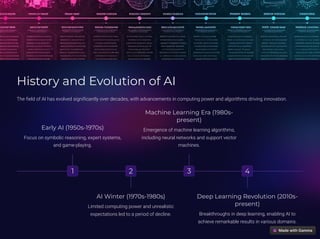
History and Evolution of AI
The field of AI has evolved significantly over decades, with advancements in computing power and algorithms driving innovation.
1
Early AI (1950s-1970s)
Focus on symbolic reasoning, expert systems,
and game-playing.
2
AI Winter (1970s-1980s)
Limited computing power and unrealistic
expectations led to a period of decline.
3
Machine Learning Era (1980s-
present)
Emergence of machine learning algorithms,
including neural networks and support vector
machines.
4
Deep Learning Revolution (2010s-
present)
Breakthroughs in deep learning, enabling AI to
achieve remarkable results in various domains.
Fundamental Techniques
in AI
AI techniques involve a wide range of approaches to enable machines to
exhibit intelligent behavior.
1 Supervised Learning
Training models on labeled
data to predict outputs based
on inputs.
2 Unsupervised
Learning
Discovering patterns and
structures in unlabeled data
without explicit guidance.
3 Reinforcement
Learning
Learning through trial and
error, receiving rewards for
desired actions and penalties
for undesired actions.
4 Knowledge
Representation
Encoding knowledge in a
structured format for
computers to understand and
reason about.

Introduction-to-Artificial-Intelligence.pdf

  • 1.
    Introduction to Artificial Intelligence Artificial intelligence(AI) is the simulation of human intelligence processes by computers. AI systems are designed to perform tasks that typically require human intelligence, such as learning, problem-solving, and decision-making. by Roshana Udayakumar RU
  • 2.
    What is AI? AIencompasses a wide range of technologies and techniques that enable computers to learn from data, reason logically, and interact with the world in intelligent ways. Machine Learning Computers learn from data without explicit programming, improving performance over time. Deep Learning AI models with multiple layers of artificial neural networks, capable of complex pattern recognition. Natural Language Processing Computers understand and process human language, allowing for communication and interaction. Computer Vision Computers "see" and interpret images and videos, enabling applications like facial recognition and object detection.
  • 3.
    History and Evolutionof AI The field of AI has evolved significantly over decades, with advancements in computing power and algorithms driving innovation. 1 Early AI (1950s-1970s) Focus on symbolic reasoning, expert systems, and game-playing. 2 AI Winter (1970s-1980s) Limited computing power and unrealistic expectations led to a period of decline. 3 Machine Learning Era (1980s- present) Emergence of machine learning algorithms, including neural networks and support vector machines. 4 Deep Learning Revolution (2010s- present) Breakthroughs in deep learning, enabling AI to achieve remarkable results in various domains.
  • 4.
    Fundamental Techniques in AI AItechniques involve a wide range of approaches to enable machines to exhibit intelligent behavior. 1 Supervised Learning Training models on labeled data to predict outputs based on inputs. 2 Unsupervised Learning Discovering patterns and structures in unlabeled data without explicit guidance. 3 Reinforcement Learning Learning through trial and error, receiving rewards for desired actions and penalties for undesired actions. 4 Knowledge Representation Encoding knowledge in a structured format for computers to understand and reason about.