Introduction
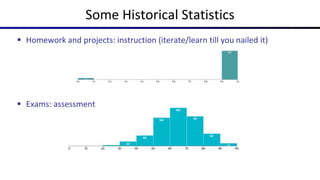
 Homework and projects: instruction (iterate/learn till you nailed it)
 Exams: assessment
Some Historical Statistics
Today
 What is artificial intelligence?
 Past: how did the ideas in AI come about?
 Present: what is the state of the art?
 Future: will robots take over the world?
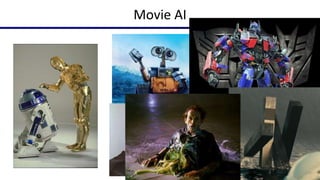
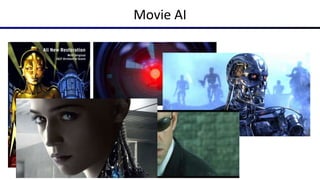
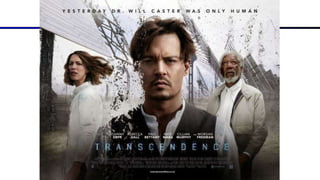
Movie AI
Movie AI
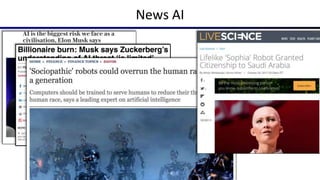
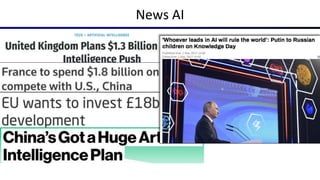
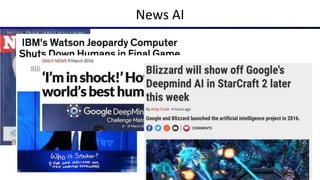
News AI
News AI
News AI
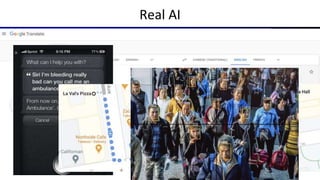
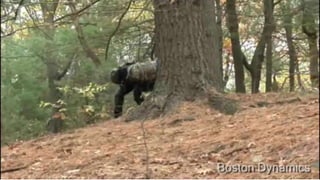
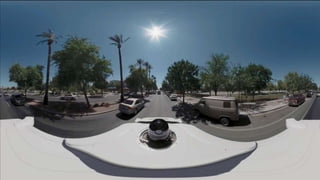
Real AI
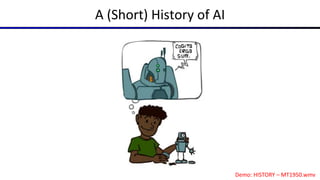
A (Short) History of AI
Demo: HISTORY – MT1950.wmv
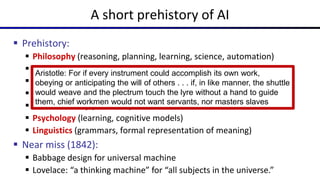
A short prehistory of AI
 Prehistory:
 Philosophy (reasoning, planning, learning, science, automation)
 Mathematics (logic, probability, optimization)
 Neuroscience (neurons, adaptation)
 Economics (rationality, game theory)
 Control theory (feedback)
 Psychology (learning, cognitive models)
 Linguistics (grammars, formal representation of meaning)
 Near miss (1842):
 Babbage design for universal machine
 Lovelace: “a thinking machine” for “all subjects in the universe.”
Aristotle: For if every instrument could accomplish its own work,
obeying or anticipating the will of others . . . if, in like manner, the shuttle
would weave and the plectrum touch the lyre without a hand to guide
them, chief workmen would not want servants, nor masters slaves
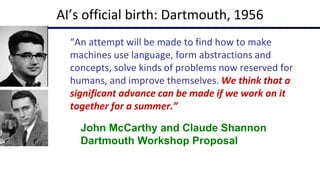
“An attempt will be made to find how to make
machines use language, form abstractions and
concepts, solve kinds of problems now reserved for
humans, and improve themselves. We think that a
significant advance can be made if we work on it
together for a summer.”
John McCarthy and Claude Shannon
Dartmouth Workshop Proposal
AI’s official birth: Dartmouth, 1956
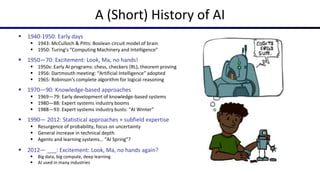
A (Short) History of AI
 1940-1950: Early days
 1943: McCulloch & Pitts: Boolean circuit model of brain
 1950: Turing's “Computing Machinery and Intelligence”
 1950—70: Excitement: Look, Ma, no hands!
 1950s: Early AI programs: chess, checkers (RL), theorem proving
 1956: Dartmouth meeting: “Artificial Intelligence” adopted
 1965: Robinson's complete algorithm for logical reasoning
 1970—90: Knowledge-based approaches
 1969—79: Early development of knowledge-based systems
 1980—88: Expert systems industry booms
 1988—93: Expert systems industry busts: “AI Winter”
 1990— 2012: Statistical approaches + subfield expertise
 Resurgence of probability, focus on uncertainty
 General increase in technical depth
 Agents and learning systems… “AI Spring”?
 2012— ___: Excitement: Look, Ma, no hands again?
 Big data, big compute, deep learning
 AI used in many industries
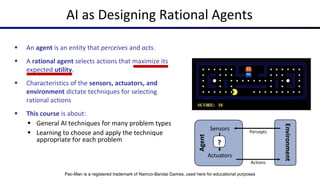
AI as Designing Rational Agents
 An agent is an entity that perceives and acts.
 A rational agent selects actions that maximize its
expected utility.
 Characteristics of the sensors, actuators, and
environment dictate techniques for selecting
rational actions
 This course is about:
 General AI techniques for many problem types
 Learning to choose and apply the technique
appropriate for each problem
Agent
?
Sensors
Actuators
Environment
Percepts
Actions
Pac-Man is a registered trademark of Namco-Bandai Games, used here for educational purposes
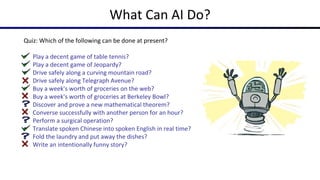
What Can AI Do?
Quiz: Which of the following can be done at present?
 Play a decent game of table tennis?
 Play a decent game of Jeopardy?
 Drive safely along a curving mountain road?
 Drive safely along Telegraph Avenue?
 Buy a week's worth of groceries on the web?
 Buy a week's worth of groceries at Berkeley Bowl?
 Discover and prove a new mathematical theorem?
 Converse successfully with another person for an hour?
 Perform a surgical operation?
 Translate spoken Chinese into spoken English in real time?
 Fold the laundry and put away the dishes?
 Write an intentionally funny story?
Unintentionally Funny Stories
Once upon a time there was a dishonest fox
and a vain crow. One day the crow was sitting
in his tree, holding a piece of cheese in his
mouth. He noticed that he was holding the
piece of cheese. He became hungry and
swallowed the cheese. The fox walked over to
the crow. The End.
[Schank, Tale-Spin, 1984]
What do you get when you cross a dog and a vampire?
A bungee
What do you get when you cross a cow with a rhino?
A bungee with a dog
What do you get when you cross a street and a cow?
A bungee with a bungee and a rhino
What do you get when you cross a pig with a cow with a party?
Because the engineers with a dog
Future
 We are doing AI…
 To create intelligent systems
 The more intelligent, the better
 To gain a better understanding of human intelligence
 To magnify those benefits that flow from it
 E.g., net present value of human-level AI ≥ $13,500T
 Might help us avoid war and ecological catastrophes, achieve immortality and
expand throughout the universe
 What if we succeed?
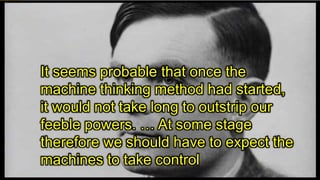
It seems probable that once the
machine thinking method had started,
it would not take long to outstrip our
feeble powers. … At some stage
therefore we should have to expect the
machines to take control
 AI that is incredibly good at achieving something other than
what we really want
 AI, economics, statistics, operations research, control theory all
assume utility to be fixed, known, and exogenously specified
 Machines are intelligent to the extent that their actions can be
expected to achieve their objectives
 Machines are beneficial to the extent that their actions can be
expected to achieve our objectives
What’s bad about better AI?
1. The machine’s only objective is to maximize the realization of
human preferences
2. The robot is initially uncertain about what those preferences are
3. Human behavior provides evidence about human preferences
A new model for AI
The standard model of AI is a special case, where the human can
exactly and correctly program the objective into the machine

Introduction to AI.pptx

  • 1.
  • 2.
     Homework andprojects: instruction (iterate/learn till you nailed it)  Exams: assessment Some Historical Statistics
  • 3.
    Today  What isartificial intelligence?  Past: how did the ideas in AI come about?  Present: what is the state of the art?  Future: will robots take over the world?
  • 4.
  • 5.
  • 7.
  • 8.
  • 9.
  • 10.
  • 15.
    A (Short) Historyof AI Demo: HISTORY – MT1950.wmv
  • 16.
    A short prehistoryof AI  Prehistory:  Philosophy (reasoning, planning, learning, science, automation)  Mathematics (logic, probability, optimization)  Neuroscience (neurons, adaptation)  Economics (rationality, game theory)  Control theory (feedback)  Psychology (learning, cognitive models)  Linguistics (grammars, formal representation of meaning)  Near miss (1842):  Babbage design for universal machine  Lovelace: “a thinking machine” for “all subjects in the universe.” Aristotle: For if every instrument could accomplish its own work, obeying or anticipating the will of others . . . if, in like manner, the shuttle would weave and the plectrum touch the lyre without a hand to guide them, chief workmen would not want servants, nor masters slaves
  • 17.
    “An attempt willbe made to find how to make machines use language, form abstractions and concepts, solve kinds of problems now reserved for humans, and improve themselves. We think that a significant advance can be made if we work on it together for a summer.” John McCarthy and Claude Shannon Dartmouth Workshop Proposal AI’s official birth: Dartmouth, 1956
  • 18.
    A (Short) Historyof AI  1940-1950: Early days  1943: McCulloch & Pitts: Boolean circuit model of brain  1950: Turing's “Computing Machinery and Intelligence”  1950—70: Excitement: Look, Ma, no hands!  1950s: Early AI programs: chess, checkers (RL), theorem proving  1956: Dartmouth meeting: “Artificial Intelligence” adopted  1965: Robinson's complete algorithm for logical reasoning  1970—90: Knowledge-based approaches  1969—79: Early development of knowledge-based systems  1980—88: Expert systems industry booms  1988—93: Expert systems industry busts: “AI Winter”  1990— 2012: Statistical approaches + subfield expertise  Resurgence of probability, focus on uncertainty  General increase in technical depth  Agents and learning systems… “AI Spring”?  2012— ___: Excitement: Look, Ma, no hands again?  Big data, big compute, deep learning  AI used in many industries
  • 19.
    AI as DesigningRational Agents  An agent is an entity that perceives and acts.  A rational agent selects actions that maximize its expected utility.  Characteristics of the sensors, actuators, and environment dictate techniques for selecting rational actions  This course is about:  General AI techniques for many problem types  Learning to choose and apply the technique appropriate for each problem Agent ? Sensors Actuators Environment Percepts Actions Pac-Man is a registered trademark of Namco-Bandai Games, used here for educational purposes
  • 20.
    What Can AIDo? Quiz: Which of the following can be done at present?  Play a decent game of table tennis?  Play a decent game of Jeopardy?  Drive safely along a curving mountain road?  Drive safely along Telegraph Avenue?  Buy a week's worth of groceries on the web?  Buy a week's worth of groceries at Berkeley Bowl?  Discover and prove a new mathematical theorem?  Converse successfully with another person for an hour?  Perform a surgical operation?  Translate spoken Chinese into spoken English in real time?  Fold the laundry and put away the dishes?  Write an intentionally funny story?
  • 21.
    Unintentionally Funny Stories Onceupon a time there was a dishonest fox and a vain crow. One day the crow was sitting in his tree, holding a piece of cheese in his mouth. He noticed that he was holding the piece of cheese. He became hungry and swallowed the cheese. The fox walked over to the crow. The End. [Schank, Tale-Spin, 1984] What do you get when you cross a dog and a vampire? A bungee What do you get when you cross a cow with a rhino? A bungee with a dog What do you get when you cross a street and a cow? A bungee with a bungee and a rhino What do you get when you cross a pig with a cow with a party? Because the engineers with a dog
  • 22.
    Future  We aredoing AI…  To create intelligent systems  The more intelligent, the better  To gain a better understanding of human intelligence  To magnify those benefits that flow from it  E.g., net present value of human-level AI ≥ $13,500T  Might help us avoid war and ecological catastrophes, achieve immortality and expand throughout the universe  What if we succeed?
  • 23.
    It seems probablethat once the machine thinking method had started, it would not take long to outstrip our feeble powers. … At some stage therefore we should have to expect the machines to take control
  • 24.
     AI thatis incredibly good at achieving something other than what we really want  AI, economics, statistics, operations research, control theory all assume utility to be fixed, known, and exogenously specified  Machines are intelligent to the extent that their actions can be expected to achieve their objectives  Machines are beneficial to the extent that their actions can be expected to achieve our objectives What’s bad about better AI?
  • 25.
    1. The machine’sonly objective is to maximize the realization of human preferences 2. The robot is initially uncertain about what those preferences are 3. Human behavior provides evidence about human preferences A new model for AI The standard model of AI is a special case, where the human can exactly and correctly program the objective into the machine

Editor's Notes

  • #3 With 100% on HW, projects; 73% on exams is enough for an A
  • #5 You can type into chat when you recognize the robot (just once!) C3PO, what does he do? Essentially google translate, (but with anxiety disorder!) R2D2 – what does he do, yeah, not so sure These are all good
  • #6 Futura/Maria HAL Termainator Agent Smith Ava
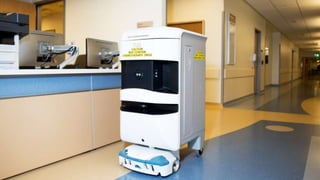
  • #12 Robots help nurses in hospitals deliver stuff to different rooms
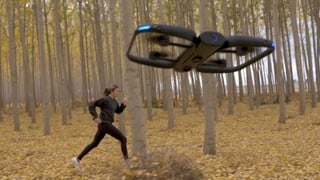
  • #13 Or drones that record cooll videos of us as we do outdoor activities Or in my case,
  • #21 Mountain road example: https://www.wired.com/2010/11/audis-robotic-car-climbs-pikes-peak/