191MEEA ADDITIVE MANUFACTURING
UNIT-I
Introduction: Overview – Need - Development of Additive Manufacturing Technology -
Principle – AM Process Chain- Classification –Rapid Prototyping- Rapid Tooling – Rapid
Manufacturing – Applications Benefits –Case studies.
2.
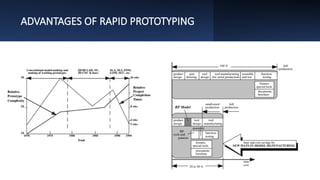
Prototyping fundamentals
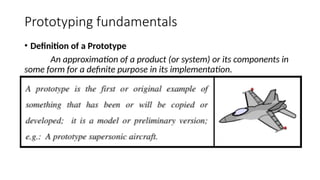
• Definitionof a Prototype
An approximation of a product (or system) or its components in
some form for a definite purpose in its implementation.
3.
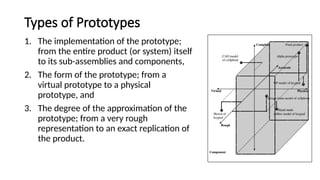
Types of Prototypes
1.The implementation of the prototype;
from the entire product (or system) itself
to its sub-assemblies and components,
2. The form of the prototype; from a
virtual prototype to a physical
prototype, and
3. The degree of the approximation of the
prototype; from a very rough
representation to an exact replication of
the product.
4.
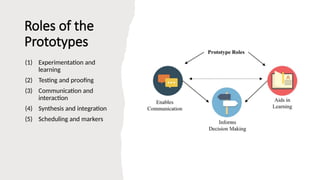
Roles of the
Prototypes
(1)Experimentation and
learning
(2) Testing and proofing
(3) Communication and
interaction
(4) Synthesis and integration
(5) Scheduling and markers
EN-MME/ Th. Sahner10
Additive Manufacturing
Advantages:
Design complexity and freedom:
The advent of 3D printing has seen a proliferation of products (designed in digital environments), which involve levels of complexity that
simply could not be produced physically in any other way. While this advantage has been taken up by designers and artists to impressive
visual effect, it has also made a significant impact on industrial applications, whereby applications are being developed to materialize
complex components that are proving to be both lighter and stronger than their predecessors.
Speed:
You can create complex parts within hours , with limited human resources. Only machine operator is needed for loading the data and the
powder material, start the process and finally for the finishing. During the manufacturing process no operator is needed.
Customisation
3D printing processes allow for mass customisation — the ability to personalize products according to individual needs and requirements.
Even within the same build chamber, the nature of 3D printing means that numerous products can be manufactured at the same time
according to the end-users requirements at no additional process cost.
Tool-less
For industrial manufacturing, one of the most cost-, time- and labour-intensive stages of the product development process is the production
of the tools. For low to medium volume applications, industrial 3D printing — or additive manufacturing — can eliminate the need for tool
production and, therefore, the costs, lead times and labour associated with it. This is an extremely attractive proposition, that an increasing
number or manufacturers are taking advantage of. Furthermore, because of the complexity advantages stated above, products and
components can be designed specifically to avoid assembly requirements with intricate geometry and complex features further eliminating
the labour and costs associated with assembly processes.
Extreme Lightweight design
AM enable weight reduction via topological optimization
11.
EN-MME/ Th. Sahner11
Additive Manufacturing
Advantages:
Sustainable / Environmentally Friendly
3D printing is also emerging as an energy-efficient technology that can provide environmental efficiencies in terms of both the
manufacturing process itself, utilising up to 90% of standard materials, and, therefore, creating less waste, but also throughout an additively
manufactured product’s operating life, by way of lighter and stronger design that imposes a reduced carbon footprint compared with
traditionally manufactured products.
No storage cost
Since 3D printers can “print” products as and when needed, and does not cost more than mass manufacturing, no expense on storage of
goods is required.
Increased employment opportunities
Widespread use of 3D printing technology will increase the demand for designers and technicians to operate 3D printers and create
blueprints for products.
12.
EN-MME/ Th. Sahner12
Additive Manufacturing Limitations
Questionable Accuracy
3D printing is primarily a prototyping technology, meaning that parts created via the technology are mainly test parts. As with any viable
test part, the dimensions have to be precise in order for engineers to get an accurate read on whether or not a part is feasible. While 3D
printers have made advances in accuracy in recent years, many of the plastic materials still come with an accuracy disclaimer. For
instance, many materials print to either +/- 0.1 mm in accuracy, meaning there is room for error.
Support material removal
When production volumes are small, the removal of support material is usually not a big issue. When the volumes are much higher, it
becomes an important consideration. Support material that is physically attached is of most concern.
Limitations of raw material
At present, 3D printers can work with approximately 100 different raw materials. This is insignificant when compared with the enormous
range of raw materials used in traditional manufacturing. More research is required to devise methods to enable 3D printed products to be
more durable and robust.
Considerable effort required for application design and for setting process parameters
Complex set of around 180 material, process and other parameters and specific design required to fully profit from the technology
Material cost:
Today, the cost of most materials for additive systems ( Powder ) is slightly greater than that of those used for traditional manufacturing .
Material properties:
A limited choice of materials is available. Actually, materials and there properties (e.g., tensile property, tensile strength, yield strength,
and fatigue) have not been fully characterized. Also, in terms of surface quality, even the best RM processes need perhaps secondary
machining and polishing to reach acceptable tolerance and surface finish.
13.
EN-MME/ Th. Sahner13
Additive Manufacturing
Short introduction to the technology
Disadvantages:
Intellectual property issues
The ease with which replicas can be created using 3D technology raises issues over intellectual property rights. The availability of
blueprints online free of cost may change with for-profit organizations wanting to generate profits from this new technology.
Limitations of size
3D printing technology is currently limited by size constraints. Very large objects are still not feasible when built using 3D printers.
Cost of printers
The cost of buying a 3D printer still does not make its purchase by the average householder feasible. Also, different 3D printers are
required in order to print different types of objects. Also, printers that can manufacture in color are costlier than those that print
monochrome objects.
Unchecked production of dangerous items
Liberator, the world’s first 3D printed functional gun, showed how easy it was to produce one’s own weapons, provided one had access to
the design and a 3D printer. Governments will need to devise ways and means to check this dangerous tendency.
14.
EN-MME/ Th. Sahner14
Additive Manufacturing
As of today, AM applications have been developed in various industries
AM Revenues per industry segment (2012)
CONSUMER PROD./
ELECTRONICS
AUTOMOTIVE MEDICAL/DENTAL
AEROSPACE TOOLS/MOLDS OTHER
370 [EUR m] 380 [EUR m]
320 [EUR m]
180 [EUR m] 230 [EUR m] 330 [EUR m]
Source: Wohlers Associates; Expert interviews; Roland Berger
15.
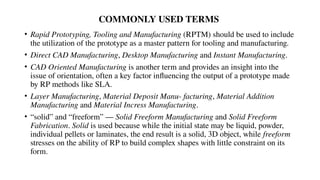
COMMONLY USED TERMS
•Rapid Prototyping, Tooling and Manufacturing (RPTM) should be used to include
the utilization of the prototype as a master pattern for tooling and manufacturing.
• Direct CAD Manufacturing, Desktop Manufacturing and Instant Manufacturing.
• CAD Oriented Manufacturing is another term and provides an insight into the
issue of orientation, often a key factor influencing the output of a prototype made
by RP methods like SLA.
• Layer Manufacturing, Material Deposit Manu- facturing, Material Addition
Manufacturing and Material Incress Manufacturing.
• “solid” and “freeform” — Solid Freeform Manufacturing and Solid Freeform
Fabrication. Solid is used because while the initial state may be liquid, powder,
individual pellets or laminates, the end result is a solid, 3D object, while freeform
stresses on the ability of RP to build complex shapes with little constraint on its
form.
16.
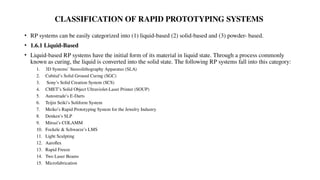
CLASSIFICATION OF RAPIDPROTOTYPING SYSTEMS
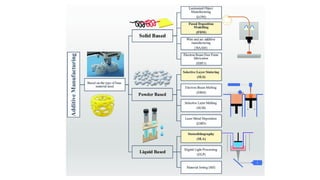
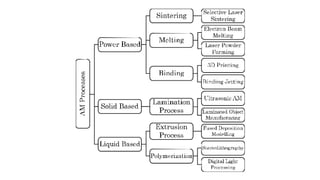
• RP systems can be easily categorized into (1) liquid-based (2) solid-based and (3) powder- based.
• 1.6.1 Liquid-Based
• Liquid-based RP systems have the initial form of its material in liquid state. Through a process commonly
known as curing, the liquid is converted into the solid state. The following RP systems fall into this category:
1. 3D Systems’ Stereolithography Apparatus (SLA)
2. Cubital’s Solid Ground Curing (SGC)
3. Sony’s Solid Creation System (SCS)
4. CMET’s Solid Object Ultraviolet-Laser Printer (SOUP)
5. Autostrade’s E-Darts
6. Teijin Seiki’s Soliform System
7. Meiko’s Rapid Prototyping System for the Jewelry Industry
8. Denken’s SLP
9. Mitsui’s COLAMM
10. Fockele & Schwarze’s LMS
11. Light Sculpting
12. Aaroflex
13. Rapid Freeze
14. Two Laser Beams
15. Microfabrication
17.
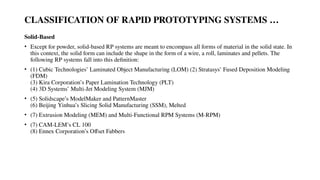
CLASSIFICATION OF RAPIDPROTOTYPING SYSTEMS …
Solid-Based
• Except for powder, solid-based RP systems are meant to encompass all forms of material in the solid state. In
this context, the solid form can include the shape in the form of a wire, a roll, laminates and pellets. The
following RP systems fall into this definition:
• (1) Cubic Technologies’ Laminated Object Manufacturing (LOM) (2) Stratasys’ Fused Deposition Modeling
(FDM)
(3) Kira Corporation’s Paper Lamination Technology (PLT)
(4) 3D Systems’ Multi-Jet Modeling System (MJM)
• (5) Solidscape’s ModelMaker and PatternMaster
(6) Beijing Yinhua’s Slicing Solid Manufacturing (SSM), Melted
• (7) Extrusion Modeling (MEM) and Multi-Functional RPM Systems (M-RPM)
• (7) CAM-LEM’s CL 100
(8) Ennex Corporation’s Offset Fabbers
18.
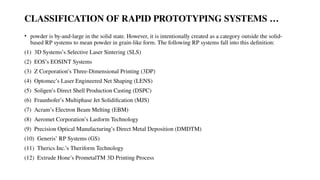
CLASSIFICATION OF RAPIDPROTOTYPING SYSTEMS …
• powder is by-and-large in the solid state. However, it is intentionally created as a category outside the solid-
based RP systems to mean powder in grain-like form. The following RP systems fall into this definition:
(1) 3D Systems’s Selective Laser Sintering (SLS)
(2) EOS’s EOSINT Systems
(3) Z Corporation’s Three-Dimensional Printing (3DP)
(4) Optomec’s Laser Engineered Net Shaping (LENS)
(5) Soligen’s Direct Shell Production Casting (DSPC)
(6) Fraunhofer’s Multiphase Jet Solidification (MJS)
(7) Acram’s Electron Beam Melting (EBM)
(8) Aeromet Corporation’s Lasform Technology
(9) Precision Optical Manufacturing’s Direct Metal Deposition (DMDTM)
(10) Generis’ RP Systems (GS)
(11) Therics Inc.’s Theriform Technology
(12) Extrude Hone’s PrometalTM 3D Printing Process

![EN-MME/ Th. Sahner 14
Additive Manufacturing
As of today, AM applications have been developed in various industries
AM Revenues per industry segment (2012)
CONSUMER PROD./
ELECTRONICS
AUTOMOTIVE MEDICAL/DENTAL
AEROSPACE TOOLS/MOLDS OTHER
370 [EUR m] 380 [EUR m]
320 [EUR m]
180 [EUR m] 230 [EUR m] 330 [EUR m]
Source: Wohlers Associates; Expert interviews; Roland Berger](https://image.slidesharecdn.com/unit1-260217034832-0d55586d/85/Introduction-to-additive-manufacturing-AM-14-320.jpg)