INTRODUCTION TO 80386
MICROPROCESSOR
- Submitted By-
Prasenjit Chandrakant More
Rajesh Santosh Walke
INDEX
• Introduction to 80386
• 80386 DX & SX
• Features of 80386
• Internal Organization of 80386
• Registers
INTRODUCTION
• A Component that iplements memory.
• A Electronic circuit that functions as the CPU of Computer.
• October 1985
• Two versions
• 80386 DX
• 80386 SX
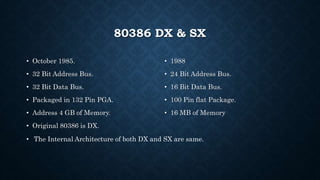
80386 DX & SX
• October 1985.
• 32 Bit Address Bus.
• 32 Bit Data Bus.
• Packaged in 132 Pin PGA.
• Address 4 GB of Memory.
• Original 80386 is DX.
• 1988
• 24 Bit Address Bus.
• 16 Bit Data Bus.
• 100 Pin flat Package.
• 16 MB of Memory
• The Internal Architecture of both DX and SX are same.
FEATURES OF 80386
• 32 Bit Microprocessor. It has 32 bit ALU.
• 4 GB of Physical Memory.
• 64 TB of Virtual Memory.
• Integrated Memory Management Unit.
• 32 bit data bus and 32 bit address bus.
• It offers a 3 stage pipelining.
• Multitasking.
• Protection Mechanism.
• Hardware Debugging Support.
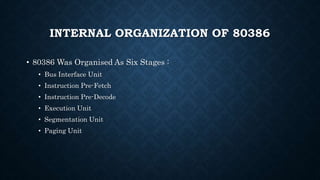
INTERNAL ORGANIZATION OF 80386
• 80386 Was Organised As Six Stages :
• Bus Interface Unit
• Instruction Pre-Fetch
• Instruction Pre-Decode
• Execution Unit
• Segmentation Unit
• Paging Unit
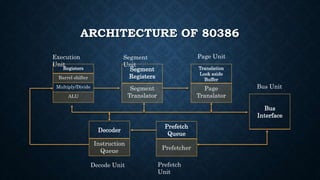
ARCHITECTURE OF 80386
Segment
Registers
Segment
Translator
Translation
Look aside
Buffer
Page
Translator
Prefetch
Queue
Prefetcher
Decoder
Instruction
Queue
Registers
Barrel shifter
Multiply/Divide
ALU
Bus
Interface
Page Unit
Prefetch
Unit
Segment
Unit
Decode Unit
Execution
Unit
Bus Unit
REGISTERS OF 80386
• 80386 has 32 registers which are grouped to 7 types.
• General Purpose Registers.
• Index Registers and pointers.
• Segment Registers.
• Flag Registers.
• Control Registers.
• Debug Registers.
• Test Registers.
THANK YOU !

Introduction To 80386 Microprocessor p.pptx

  • 1.
    INTRODUCTION TO 80386 MICROPROCESSOR -Submitted By- Prasenjit Chandrakant More Rajesh Santosh Walke
  • 2.
    INDEX • Introduction to80386 • 80386 DX & SX • Features of 80386 • Internal Organization of 80386 • Registers
  • 3.
    INTRODUCTION • A Componentthat iplements memory. • A Electronic circuit that functions as the CPU of Computer. • October 1985 • Two versions • 80386 DX • 80386 SX
  • 4.
    80386 DX &SX • October 1985. • 32 Bit Address Bus. • 32 Bit Data Bus. • Packaged in 132 Pin PGA. • Address 4 GB of Memory. • Original 80386 is DX. • 1988 • 24 Bit Address Bus. • 16 Bit Data Bus. • 100 Pin flat Package. • 16 MB of Memory • The Internal Architecture of both DX and SX are same.
  • 5.
    FEATURES OF 80386 •32 Bit Microprocessor. It has 32 bit ALU. • 4 GB of Physical Memory. • 64 TB of Virtual Memory. • Integrated Memory Management Unit. • 32 bit data bus and 32 bit address bus. • It offers a 3 stage pipelining. • Multitasking. • Protection Mechanism. • Hardware Debugging Support.
  • 6.
    INTERNAL ORGANIZATION OF80386 • 80386 Was Organised As Six Stages : • Bus Interface Unit • Instruction Pre-Fetch • Instruction Pre-Decode • Execution Unit • Segmentation Unit • Paging Unit
  • 7.
    ARCHITECTURE OF 80386 Segment Registers Segment Translator Translation Lookaside Buffer Page Translator Prefetch Queue Prefetcher Decoder Instruction Queue Registers Barrel shifter Multiply/Divide ALU Bus Interface Page Unit Prefetch Unit Segment Unit Decode Unit Execution Unit Bus Unit
  • 8.
    REGISTERS OF 80386 •80386 has 32 registers which are grouped to 7 types. • General Purpose Registers. • Index Registers and pointers. • Segment Registers. • Flag Registers. • Control Registers. • Debug Registers. • Test Registers.
  • 9.