1
EAST AFRICAN
LEARNING LANDSCAPE
REGIONAL KNOWLEDGE
EXCHANGE
Krista Heiner and Chris Planicka, EcoAgriculture Partners
Regional Knowledge Exchange
AICAD, Kenya
June 2, 2015
2
What is a landscape
and what is integrated
landscape management?
3
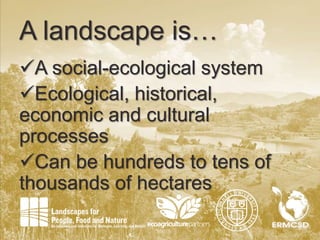
A landscape is…
A social-ecological system
Ecological, historical,
economic and cultural
processes
Can be hundreds to tens of
thousands of hectares
4
Integrated landscape
management (ILM) is…
Shaped by shared objectives
Practices contribute toward multi-objecti
Interactions managed to increase syner
Collaborative, community-engaged
processes
Supportive enabling environment
Purpose of the project
Strengthen capacity of civil
society to engage in and
implement integrated landscape
management (ILM)
Improve the effectiveness of ILM
initiatives in East Africa
Increase knowledge sharing among
leaders of ILM
5
Bird’s eye view of project activities
6
Landscape dialogues
Measuring landscape performance
National policy dialogues
Strengthening multi-stakeholder platforms
Site visits and producer knowledge
exchanges
Mini-grants for implementing ILM
7
Our Network: the Landscapes for People,
Food and Nature Initiative (LPFN)
Co-Organizers
http://peoplefoodandnature.org/
Some LPFN strategic partners
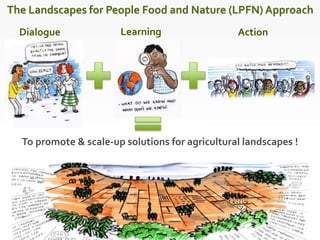
The Landscapes for People Food and Nature (LPFN) Approach
To promote & scale-up solutions for agricultural landscapes !
Dialogue Learning Action
Connect to the LPFN Learning Network
Where landscape leaders share experiences, find tools
and resources, and address challenges together.
● http://peoplefoodandnature.org/learning-network/
● To submit your landscape profile or for any other questions,
contact: cplanicka@ecoagriculture.org
Purpose of this meeting
Gather leaders from Ethiopia,
Kenya and Tanzania
Exchange knowledge on &
experiences with ILM
Learn about a few tools for
improving ILM
13
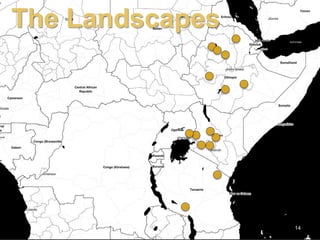
The Landscapes
14

East African Learning Landscape Regional Knowledge Exchange

  • 1.
    1 EAST AFRICAN LEARNING LANDSCAPE REGIONALKNOWLEDGE EXCHANGE Krista Heiner and Chris Planicka, EcoAgriculture Partners Regional Knowledge Exchange AICAD, Kenya June 2, 2015
  • 2.
    2 What is alandscape and what is integrated landscape management?
  • 3.
    3 A landscape is… Asocial-ecological system Ecological, historical, economic and cultural processes Can be hundreds to tens of thousands of hectares
  • 4.
    4 Integrated landscape management (ILM)is… Shaped by shared objectives Practices contribute toward multi-objecti Interactions managed to increase syner Collaborative, community-engaged processes Supportive enabling environment
  • 5.
    Purpose of theproject Strengthen capacity of civil society to engage in and implement integrated landscape management (ILM) Improve the effectiveness of ILM initiatives in East Africa Increase knowledge sharing among leaders of ILM 5
  • 6.
    Bird’s eye viewof project activities 6 Landscape dialogues Measuring landscape performance National policy dialogues Strengthening multi-stakeholder platforms Site visits and producer knowledge exchanges Mini-grants for implementing ILM
  • 7.
  • 8.
    Our Network: theLandscapes for People, Food and Nature Initiative (LPFN) Co-Organizers http://peoplefoodandnature.org/
  • 9.
  • 10.
    The Landscapes forPeople Food and Nature (LPFN) Approach To promote & scale-up solutions for agricultural landscapes ! Dialogue Learning Action
  • 12.
    Connect to theLPFN Learning Network Where landscape leaders share experiences, find tools and resources, and address challenges together. ● http://peoplefoodandnature.org/learning-network/ ● To submit your landscape profile or for any other questions, contact: cplanicka@ecoagriculture.org
  • 13.
    Purpose of thismeeting Gather leaders from Ethiopia, Kenya and Tanzania Exchange knowledge on & experiences with ILM Learn about a few tools for improving ILM 13
  • 14.

Editor's Notes

  • #2 I founded EcoAgriculture Partners in 2002 as a coalition housed within the organization Forest Trends, for whom I then worked, because we looked at the places where deforestation and biodiversity loss were happening fastest, and looked at the places where people were most reliant on agriculture for their incomes, and were most struggling to make ends meet, and saw that these places were the same places. We can’t address biodiversity loss, or ecosystem degradation, or environmental collapse, or whatever you want to call it, without addressing how we do agriculture and rural development. So for more than a decade now, EcoAgriculture Partners has focused on helping local communities manage their own landscapes to accomplish both goals, writ large. Healthy environment and improved local livelihoods through agriculture. What we came to call Landscapes for People, Food and Nature.
  • #3 There are a lot of terms to keep track of in the ever more vociferous and contentious food and agriculture debate. It is a great thing that regular people, consumers, eaters, are demanding more from their food system besides ever-present cheap calories, and so are keeping a very watchful eye on the corporations who have profited most from a system designed to deliver those cheap calories at high environmental cost. Costs that have been largely born by the workers, the farm communities, and our fellow species, rather than by the corporations responsible. And so it is critical that new “industry buzzwords” be discussed openly and approached skeptically. Such has been the recent response to the widespread appearance of the term “Climate-Smart Agriculture,” bandied about recently by no less important personages than President Obama and World Bank President Jim Yong Kim. There is even a US-supported Global Climate-Smart Agriculture Alliance, for which I sit on the steering committee.
  • #4  This project takes place under a larger initiative known as the landscapes for people, food and nature initiative
  • #5  This project takes place under a larger initiative known as the landscapes for people, food and nature initiative
  • #7 The effects of climate change on agricultural yields, on average, is difficult to model, as there are many variables to consider and scientists differ in their estimation of each’s relative importance to yields. Of course, agriculture is a highly local endeavor, and impacts, both positive and negative, from a warming climate, increased atmospheric Carbon Dioxide levels, shifting weather patterns, severe weather events, and other climate change driven factors will not be evenly distributed. One recent study published in the journal Nature Climate Change found that: “Weather events at the equator will become more extreme with 2C of warming, meaning tropical countries already dealing with frail infrastructure and poverty will experience more than 50 times as many extremely hot days and 2.5 times as many rainy ones.” Preparing agriculture to deal with climate change, to take advantage of positive effects and survive the worst, is called adaptation. Of course, the lack of scientific consensus about the impacts of climate change on agriculture has hampered investment to prepare communities for potential impacts. Meanwhile, many agricultural areas are already being hit hard by climate change impacts; just look at the Drought in California, or the devastating storms and flooding in Bangladesh and Pakistan.
  • #8  This project takes place under a larger initiative known as the landscapes for people, food and nature initiative
  • #15 Krista, can you add dots for the Kenyan landscapes?