Heath Buck
Do you need to introduce the
Senior Managers and Certification Regime?
Introduction:
• The SMCR will be extending in 2018 - Firms need to be prepared!
• There will be a lot of additional work for HR and Compliance departments.
• This report outlines some of the tasks that can be initiated to ensure a smooth introduction.
• I am immediately available for assistance in the HR introduction of SMCR. If you would like to get in
touch, please contact me:
• Tel: 07702 156199
• Email: heathbuck@yahoo.co.uk
• https://uk.linkedin.com/in/heathbuck
13th February 2017
Heath Buck
Executive Summary
The Senior Managers and Certification Regime (SMCR) was implemented on 7th March 2016 for firms that accept
deposits and dual regulated investment firms (the larger firms). It will be extended to all authorised firms in 2018
(expected: early 2018).
Consultation for the extended regime is continuing but the outcome is likely to have significant overlap with the
current regime with a level of adjustment and proportionality to take into account the smaller size and business
models of the firms impacted.
Extensive work will be required to introduce the SMCR therefore steps should be taken now to facilitate the
introduction with coordination coming from HR and Compliance.
As a result of the changes being brought by the extension of SMCR, a positive approach now can ensure compliance
with the regime. This presentation is designed to give some tips on how to get ahead of the agenda.
If you need help with the HR aspects of SMCR, then please get in touch: heathbuck@yahoo.co.uk
Heath Buck
The Regulations
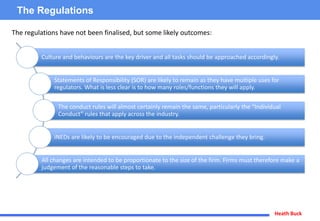
Culture and behaviours are the key driver and all tasks should be approached accordingly.
Statements of Responsibility (SOR) are likely to remain as they have multiple uses for
regulators. What is less clear is to how many roles/functions they will apply.
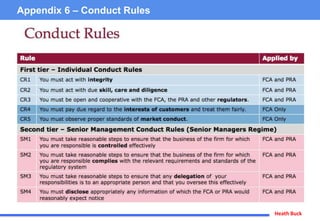
The conduct rules will almost certainly remain the same, particularly the “Individual
Conduct” rules that apply across the industry.
iNEDs are likely to be encouraged due to the independent challenge they bring.
All changes are intended to be proportionate to the size of the firm. Firms must therefore make a
judgement of the reasonable steps to take.
The regulations have not been finalised, but some likely outcomes:
Heath Buck
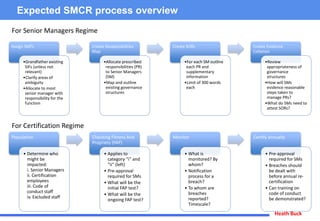
Expected SMCR process overview
Assign SMFs
•Grandfather existing
SIFs (unless not
relevant)
•Clarify areas of
ambiguity
•Allocate to most
senior manager with
responsibility for the
function
Create Responsibilities
Map
•Allocate prescribed
responsibilities (PR)
to Senior Managers
(SM)
•Map and outline
existing governance
structures
Create SORs
•For each SM outline
each PR and
supplementary
information
•Limit of 300 words
each
Create Evidence
Collation
•Review
appropriateness of
governance
structures
•How will SMs
evidence reasonable
steps taken to
manage PRs?
•What do SMs need to
attest SORs?
For Senior Managers Regime
For Certification Regime
Population
• Determine who
might be
impacted:
i. Senior Managers
ii. Certification
employees
iii. Code of
conduct staff
iv. Excluded staff
Checking Fitness And
Propriety (FAP)
• Applies to
category “i” and
“ii” (left)
• Pre-approval
required for SMs
• What will be the
initial FAP test?
• What will be the
ongoing FAP test?
Monitor
• What is
monitored? By
whom?
• Notification
process for a
breach?
• To whom are
breaches
reported?
Timescale?
Certify annually
• Pre-approval
required for SMs
• Breaches should
be dealt with
before annual re-
certification
• Can training on
code of conduct
be demonstrated?
Heath Buck
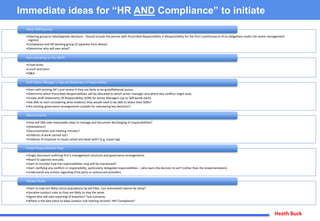
Immediate ideas for “HR AND Compliance” to initiate
•Steering group to take/approve decisions - Should include the person with Prescribed Responsibility A (Responsibility for the firm’s performance of its obligations under the senior management
regime).
•Compliance and HR working group (if separate from above).
•Determine who will own what?
Setup SMCR groups.
•Email shots.
•Lunch and learn.
•Q&A.
Start educating on the SMCR.
•Start with existing SIF’s and review if they are likely to be grandfathered across.
•Determine which Prescribed Responsibilities will be allocated to which senior manager and where any conflicts might exist.
•Create draft Statements Of Responsibility (SOR) for Senior Managers (up to 300 words each).
•Ask SMs to start considering what evidence they would need to be able to attest their SORs?
•Are existing governance arrangements suitable for overseeing key decisions?
Draft Senior Manager’s map and Statement of Responsibility.
•How will SMs take reasonable steps to manage and document discharging of responsibilities?
•Attestations?
•Documentation and meeting minutes?
•Evidence of work carried out?
•Evidence of response to issues raised and dealt with? (e.g. issues log)
Measurements.
•Single document outlining firm’s management structure and governance arrangements
•Board to approve annually.
•Start to consider how the responsibilities map will be maintained?
•Start clarifying any conflicts in responsibility, particularly delegated responsibilities – who owns the decision to act? (rather than the implementation)
•Understand any actions regarding third party or outsourced providers.
Create Responsibilities Map.
•Start to map out likely in/out populations by job titles. Can automated reports be setup?
•Socialise conduct rules as they are likely to stay the same.
•Agree who will own reporting of breaches? Test scenarios.
•Where is the best place to keep conduct rule training records? HR? Compliance?
Conduct Rules
Heath Buck
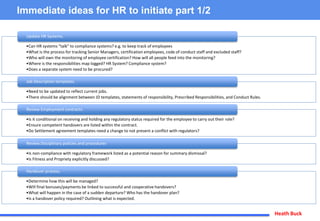
Immediate ideas for HR to initiate part 1/2
•Can HR systems “talk” to compliance systems? e.g. to keep track of employees
•What is the process for tracking Senior Managers, certification employees, code of conduct staff and excluded staff?
•Who will own the monitoring of employee certification? How will all people feed into the monitoring?
•Where is the responsibilities map logged? HR System? Compliance system?
•Does a separate system need to be procured?
Update HR Systems.
•Need to be updated to reflect current jobs.
•There should be alignment between JD templates, statements of responsibility, Prescribed Responsibilities, and Conduct Rules.
Job Description templates.
•Is it conditional on receiving and holding any regulatory status required for the employee to carry out their role?
•Ensure competent handovers are listed within the contract.
•Do Settlement agreement templates need a change to not present a conflict with regulators?
Review Employment contracts.
•Is non-compliance with regulatory framework listed as a potential reason for summary dismissal?
•Is Fitness and Propriety explicitly discussed?
Review Disciplinary policies and procedures
•Determine how this will be managed?
•Will final bonuses/payments be linked to successful and cooperative handovers?
•What will happen in the case of a sudden departure? Who has the handover plan?
•Is a handover policy required? Outlining what is expected.
Handover process.
Heath Buck
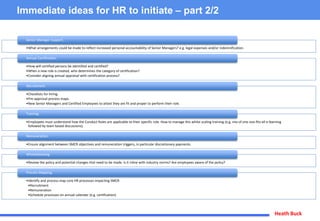
Immediate ideas for HR to initiate – part 2/2
•What arrangements could be made to reflect increased personal accountability of Senior Managers? e.g. legal expenses and/or indemnification.
Senior Manager Support.
•How will certified persons be identified and certified?
•When a new role is created, who determines the category of certification?
•Consider aligning annual appraisal with certification process?
Annual Certification.
•Checklists for hiring.
•Pre-approval process maps.
•New Senior Managers and Certified Employees to attest they are fit and proper to perform their role.
Recruitment.
•Employees must understand how the Conduct Rules are applicable to their specific role. How to manage this whilst scaling training (e.g. mix of one-size-fits-all e-learning
followed by team based discussions).
Training.
•Ensure alignment between SMCR objectives and remuneration triggers, in particular discretionary payments.
Remuneration.
•Review the policy and potential changes that need to be made. Is it inline with industry norms? Are employees aware of the policy?
Whistleblowing.
•Identify and process map core HR processes impacting SMCR
•Recruitment
•Remuneration
•Schedule processes on annual calendar (e.g. certification).
Process Mapping.
Heath Buck
Culture Matters
The FCA stated…
“Culture is a priority for the FCA, one of our seven business plan priorities for 2016/17.”
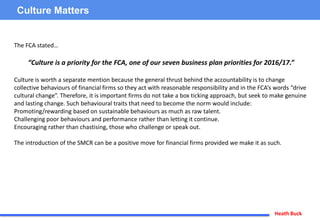
Culture is worth a separate mention because the general thrust behind the accountability is to change
collective behaviours of financial firms so they act with reasonable responsibility and in the FCA’s words “drive
cultural change”. Therefore, it is important firms do not take a box ticking approach, but seek to make genuine
and lasting change. Such behavioural traits that need to become the norm would include:
Promoting/rewarding based on sustainable behaviours as much as raw talent.
Challenging poor behaviours and performance rather than letting it continue.
Encouraging rather than chastising, those who challenge or speak out.
The introduction of the SMCR can be a positive move for financial firms provided we make it as such.
Heath Buck
Project Planning
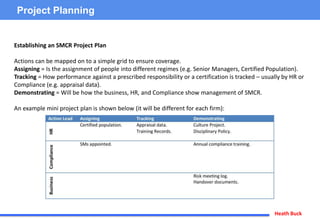
Establishing an SMCR Project Plan
Actions can be mapped on to a simple grid to ensure coverage.
Assigning = Is the assignment of people into different regimes (e.g. Senior Managers, Certified Population).
Tracking = How performance against a prescribed responsibility or a certification is tracked – usually by HR or
Compliance (e.g. appraisal data).
Demonstrating = Will be how the business, HR, and Compliance show management of SMCR.
An example mini project plan is shown below (it will be different for each firm):
Heath Buck
Appendix 1 – Senior Management Functions
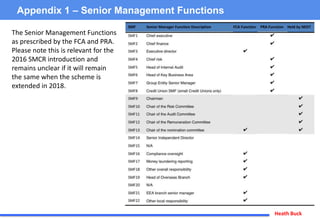
The Senior Management Functions
as prescribed by the FCA and PRA.
Please note this is relevant for the
2016 SMCR introduction and
remains unclear if it will remain
the same when the scheme is
extended in 2018.
Heath Buck
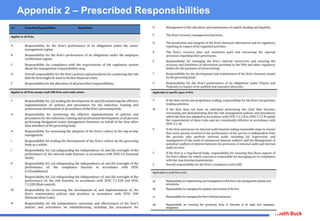
Appendix 2 – Prescribed Responsibilities
Heath Buck
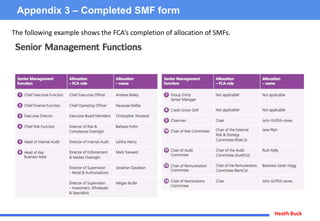
Appendix 3 – Completed SMF form
The following example shows the FCA’s completion of allocation of SMFs.
Heath Buck
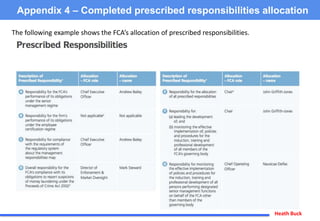
Appendix 4 – Completed prescribed responsibilities allocation
The following example shows the FCA’s allocation of prescribed responsibilities.
Heath Buck
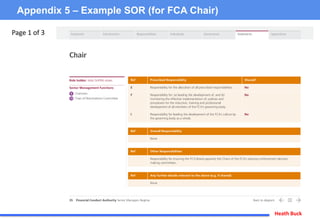
Appendix 5 – Example SOR (for FCA Chair)
Page 1 of 3
Heath Buck
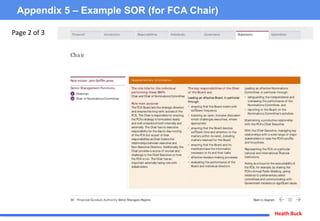
Appendix 5 – Example SOR (for FCA Chair)
Page 2 of 3
Heath Buck
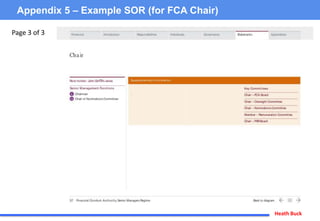
Appendix 5 – Example SOR (for FCA Chair)
Page 3 of 3
Heath Buck
Appendix 6 – Conduct Rules

Introducing SMCR from an HR perspective

  • 1.
    Heath Buck Do youneed to introduce the Senior Managers and Certification Regime? Introduction: • The SMCR will be extending in 2018 - Firms need to be prepared! • There will be a lot of additional work for HR and Compliance departments. • This report outlines some of the tasks that can be initiated to ensure a smooth introduction. • I am immediately available for assistance in the HR introduction of SMCR. If you would like to get in touch, please contact me: • Tel: 07702 156199 • Email: heathbuck@yahoo.co.uk • https://uk.linkedin.com/in/heathbuck 13th February 2017
  • 2.
    Heath Buck Executive Summary TheSenior Managers and Certification Regime (SMCR) was implemented on 7th March 2016 for firms that accept deposits and dual regulated investment firms (the larger firms). It will be extended to all authorised firms in 2018 (expected: early 2018). Consultation for the extended regime is continuing but the outcome is likely to have significant overlap with the current regime with a level of adjustment and proportionality to take into account the smaller size and business models of the firms impacted. Extensive work will be required to introduce the SMCR therefore steps should be taken now to facilitate the introduction with coordination coming from HR and Compliance. As a result of the changes being brought by the extension of SMCR, a positive approach now can ensure compliance with the regime. This presentation is designed to give some tips on how to get ahead of the agenda. If you need help with the HR aspects of SMCR, then please get in touch: heathbuck@yahoo.co.uk
  • 3.
    Heath Buck The Regulations Cultureand behaviours are the key driver and all tasks should be approached accordingly. Statements of Responsibility (SOR) are likely to remain as they have multiple uses for regulators. What is less clear is to how many roles/functions they will apply. The conduct rules will almost certainly remain the same, particularly the “Individual Conduct” rules that apply across the industry. iNEDs are likely to be encouraged due to the independent challenge they bring. All changes are intended to be proportionate to the size of the firm. Firms must therefore make a judgement of the reasonable steps to take. The regulations have not been finalised, but some likely outcomes:
  • 4.
    Heath Buck Expected SMCRprocess overview Assign SMFs •Grandfather existing SIFs (unless not relevant) •Clarify areas of ambiguity •Allocate to most senior manager with responsibility for the function Create Responsibilities Map •Allocate prescribed responsibilities (PR) to Senior Managers (SM) •Map and outline existing governance structures Create SORs •For each SM outline each PR and supplementary information •Limit of 300 words each Create Evidence Collation •Review appropriateness of governance structures •How will SMs evidence reasonable steps taken to manage PRs? •What do SMs need to attest SORs? For Senior Managers Regime For Certification Regime Population • Determine who might be impacted: i. Senior Managers ii. Certification employees iii. Code of conduct staff iv. Excluded staff Checking Fitness And Propriety (FAP) • Applies to category “i” and “ii” (left) • Pre-approval required for SMs • What will be the initial FAP test? • What will be the ongoing FAP test? Monitor • What is monitored? By whom? • Notification process for a breach? • To whom are breaches reported? Timescale? Certify annually • Pre-approval required for SMs • Breaches should be dealt with before annual re- certification • Can training on code of conduct be demonstrated?
  • 5.
    Heath Buck Immediate ideasfor “HR AND Compliance” to initiate •Steering group to take/approve decisions - Should include the person with Prescribed Responsibility A (Responsibility for the firm’s performance of its obligations under the senior management regime). •Compliance and HR working group (if separate from above). •Determine who will own what? Setup SMCR groups. •Email shots. •Lunch and learn. •Q&A. Start educating on the SMCR. •Start with existing SIF’s and review if they are likely to be grandfathered across. •Determine which Prescribed Responsibilities will be allocated to which senior manager and where any conflicts might exist. •Create draft Statements Of Responsibility (SOR) for Senior Managers (up to 300 words each). •Ask SMs to start considering what evidence they would need to be able to attest their SORs? •Are existing governance arrangements suitable for overseeing key decisions? Draft Senior Manager’s map and Statement of Responsibility. •How will SMs take reasonable steps to manage and document discharging of responsibilities? •Attestations? •Documentation and meeting minutes? •Evidence of work carried out? •Evidence of response to issues raised and dealt with? (e.g. issues log) Measurements. •Single document outlining firm’s management structure and governance arrangements •Board to approve annually. •Start to consider how the responsibilities map will be maintained? •Start clarifying any conflicts in responsibility, particularly delegated responsibilities – who owns the decision to act? (rather than the implementation) •Understand any actions regarding third party or outsourced providers. Create Responsibilities Map. •Start to map out likely in/out populations by job titles. Can automated reports be setup? •Socialise conduct rules as they are likely to stay the same. •Agree who will own reporting of breaches? Test scenarios. •Where is the best place to keep conduct rule training records? HR? Compliance? Conduct Rules
  • 6.
    Heath Buck Immediate ideasfor HR to initiate part 1/2 •Can HR systems “talk” to compliance systems? e.g. to keep track of employees •What is the process for tracking Senior Managers, certification employees, code of conduct staff and excluded staff? •Who will own the monitoring of employee certification? How will all people feed into the monitoring? •Where is the responsibilities map logged? HR System? Compliance system? •Does a separate system need to be procured? Update HR Systems. •Need to be updated to reflect current jobs. •There should be alignment between JD templates, statements of responsibility, Prescribed Responsibilities, and Conduct Rules. Job Description templates. •Is it conditional on receiving and holding any regulatory status required for the employee to carry out their role? •Ensure competent handovers are listed within the contract. •Do Settlement agreement templates need a change to not present a conflict with regulators? Review Employment contracts. •Is non-compliance with regulatory framework listed as a potential reason for summary dismissal? •Is Fitness and Propriety explicitly discussed? Review Disciplinary policies and procedures •Determine how this will be managed? •Will final bonuses/payments be linked to successful and cooperative handovers? •What will happen in the case of a sudden departure? Who has the handover plan? •Is a handover policy required? Outlining what is expected. Handover process.
  • 7.
    Heath Buck Immediate ideasfor HR to initiate – part 2/2 •What arrangements could be made to reflect increased personal accountability of Senior Managers? e.g. legal expenses and/or indemnification. Senior Manager Support. •How will certified persons be identified and certified? •When a new role is created, who determines the category of certification? •Consider aligning annual appraisal with certification process? Annual Certification. •Checklists for hiring. •Pre-approval process maps. •New Senior Managers and Certified Employees to attest they are fit and proper to perform their role. Recruitment. •Employees must understand how the Conduct Rules are applicable to their specific role. How to manage this whilst scaling training (e.g. mix of one-size-fits-all e-learning followed by team based discussions). Training. •Ensure alignment between SMCR objectives and remuneration triggers, in particular discretionary payments. Remuneration. •Review the policy and potential changes that need to be made. Is it inline with industry norms? Are employees aware of the policy? Whistleblowing. •Identify and process map core HR processes impacting SMCR •Recruitment •Remuneration •Schedule processes on annual calendar (e.g. certification). Process Mapping.
  • 8.
    Heath Buck Culture Matters TheFCA stated… “Culture is a priority for the FCA, one of our seven business plan priorities for 2016/17.” Culture is worth a separate mention because the general thrust behind the accountability is to change collective behaviours of financial firms so they act with reasonable responsibility and in the FCA’s words “drive cultural change”. Therefore, it is important firms do not take a box ticking approach, but seek to make genuine and lasting change. Such behavioural traits that need to become the norm would include: Promoting/rewarding based on sustainable behaviours as much as raw talent. Challenging poor behaviours and performance rather than letting it continue. Encouraging rather than chastising, those who challenge or speak out. The introduction of the SMCR can be a positive move for financial firms provided we make it as such.
  • 9.
    Heath Buck Project Planning Establishingan SMCR Project Plan Actions can be mapped on to a simple grid to ensure coverage. Assigning = Is the assignment of people into different regimes (e.g. Senior Managers, Certified Population). Tracking = How performance against a prescribed responsibility or a certification is tracked – usually by HR or Compliance (e.g. appraisal data). Demonstrating = Will be how the business, HR, and Compliance show management of SMCR. An example mini project plan is shown below (it will be different for each firm):
  • 10.
    Heath Buck Appendix 1– Senior Management Functions The Senior Management Functions as prescribed by the FCA and PRA. Please note this is relevant for the 2016 SMCR introduction and remains unclear if it will remain the same when the scheme is extended in 2018.
  • 11.
    Heath Buck Appendix 2– Prescribed Responsibilities
  • 12.
    Heath Buck Appendix 3– Completed SMF form The following example shows the FCA’s completion of allocation of SMFs.
  • 13.
    Heath Buck Appendix 4– Completed prescribed responsibilities allocation The following example shows the FCA’s allocation of prescribed responsibilities.
  • 14.
    Heath Buck Appendix 5– Example SOR (for FCA Chair) Page 1 of 3
  • 15.
    Heath Buck Appendix 5– Example SOR (for FCA Chair) Page 2 of 3
  • 16.
    Heath Buck Appendix 5– Example SOR (for FCA Chair) Page 3 of 3
  • 17.
    Heath Buck Appendix 6– Conduct Rules