Introduction to
Introduction to
Literature
Literature
Why do we
Why do we
read?
read?
Information Fun
But is all fiction
But is all fiction
literature?
literature?
Literature is concerned with the
content and the form, in other
words not only the story but the
way it is written.
What is literature?
What is literature?
Literature: A body of written works. The name
is often applied to those imaginative works of
poetry and prose distinguished by the intentions
of their authors and the excellence of their
execution. (Encyclopedia Britannica,
Micropedia)
• Literature: The collective writings proper to
any language or nations. The term literature is
site of ideological conflict; it may refer to those
canonical works in the genres, ie., traditional
works considered to be artistic or it may also
refer to the total sum of writings, including
letters, memoirs, comics, historical writings, etc.
(adapted from the Cambridge Encyclopedia)
or
or
• Literature: An intimate experience of an
author carefully expressed in concrete images
through the use of structure, imaginative style
and luxurious metaphors. It is not practical or
logical communication, but an aesthetic
experience.
Anderson Imbert, Enrique (1992) Teoría y técnica del cuento, Barcelona,
Editorial Ariel
•Literature: A collection of writings, which
reflect the experience of class struggle in a
society. The history of literature is, therefore, a
reflection on changing material, economic and
social conditions in that society.
See: Marx, Karl and Engels, Freidrich, Communism: The production of the
form of intercourse itself, in Rice, Philip and Waugh Patricia (2001) Modern
literary theory: A reader (4th Ed), London, Arnold
“Thus is revealed the total existence of writing: a
text is made up of multiple writings, drawn from
many cultures and entering into mutual relations
of dialogue, parody, contestation, but there is
one place where this multiplicity is focussed and
that place is the reader, not ......... the author.”
From Barthes, Roland, The death of the author, in Rice, Philip and Waugh
Patricia (2001) Modern literary theory: A reader (4th Ed), London, Arnold
LITERATURE
LITERATURE
• All writing in prose and poetry
having permanent value,
excellent format, an imaginative
or critical characteristic, and
heightened emotional effect.
Literature
Literature
• Literature is referred to as the entirety of
written expression, with the restriction that
not every written document can be
categorized as literature in the more exact
sense of the word. (Klarer p.1)
LITERATURE
LITERATURE
• Etymologically: the Latin word “litteratura” is
derived from “littera” (letter), which is the
smallest element of alphabetical writing.
• The word text is related to “textile” and can be
translated as “fabric”: just as single threads form
a fabric, so words and sentences form a
meaningful and coherent text.
LITERATURE
LITERATURE
• Literature or text as cultural and
historical phenomena and to
investigate the conditions of
their production and reception.
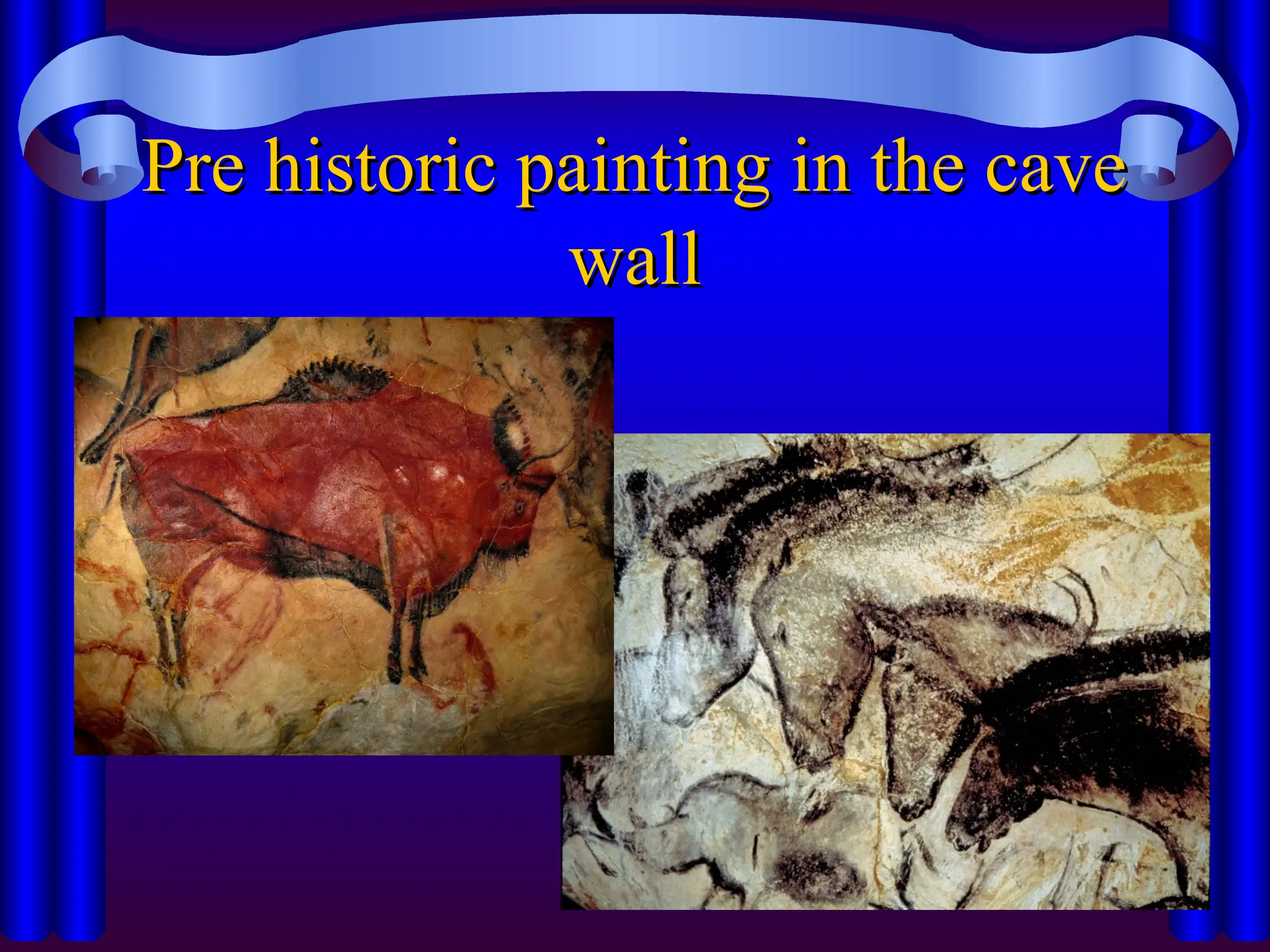
Pre historic painting in the cave
wall
wall
The Beginning of Literature
• Not only pictorial but Acoustic
• Spoken words  Signs
• Oral traditions
• Integral Parts of Literature
• Before writing developed as a system of signs,
whether pictographs or alphabets, “texts” were
passed on orally.
• The predecessor of literary expression, called
“oral poetry,”
• In 21st
century, Audio-literature and the lyrics of
songs display the acoustic features of literary
phenomena through the medium of radio and other
sound carriers.
• In the Middle Ages the visual component of
writing was highly privileged in such forms
as richly decorated handwritten
manuscripts, the arrival of the modern age -
along with the invention of the printing
press- made the visual element disappear or
reduced it to a few illustrations in the text.
• Only in DRAMA  union between the
spoken word and visual expression
• DRAMA, which is viewed as literature,
combines the acoustic and the visual
elements.
• The symbiosis of word and image
culminates in FILM.
• FILM is interesting for textual studies, since
word and picture are recorded and, as in a
book, can be looked up at any time.
• Methods of literary and textual criticism
are, therefore, frequently applied to the
cinema and acoustic media.
• Computer hypertexts and networks/ the Internet
are the latest hybrids of the textual and various
media  writing is linked to sounds, pictures or
even video clips within an interdependent
network.
• The written medium is obviously the main
concern in the study of literature or texts  the
stage, painting, film, music or even computer
networks.
GENRE
GENRE
• A Genre is a French word
meaning “type” or “kind” of
literature.
Genre
Genre
• The genres of literature we will
study are poetry, drama, fiction
(short story, non-fiction, and
novel) and film.
Prose and Poetry
Prose and Poetry
• Prose and poetry are two kinds
of writing formats in standard
American English.
Prose
Prose
• Prose is straight writing in
paragraph form (e.g. newspaper,
novels, magazines).
Poetry
Poetry
• Poetry is a particular
arrangement of words on a page
for heightened emotional effect.
Fiction and Nonfiction
• All writing falls into one of
these two categories:
–Fiction
–Nonfiction
Fiction
Fiction
Fiction is not true. It is drawn
from the imagination of the
author.
Nonfiction
Nonfiction
• Nonfiction is true. It is based
on real events or facts.
LITERARY GENRES
LITERARY GENRES
 Fiction
• Ancient: Fables, Tales
• Modern: Novels & Short Stories
• Poetry
• Drama
• Biography and Autobiography
• The Essay
• Film
A Fable
A Fable
• The Oak and the Reeds
A VERY LARGE OAK was uprooted by the wind
and thrown across a stream. It fell among some
Reeds, which it thus addressed: "I wonder how you,
who are so light and weak, are not entirely crushed
by these strong winds." They replied, "You fight
and contend with the wind, and consequently you
are destroyed; while we on the contrary bend before
the least breath of air, and therefore remain
unbroken, and escape." Stoop to conquer.
Fiction
Fiction
•Ancient: Fables, Tales
–Not Realistic
–No details
–Quick and simple plots
–Nonhuman characters
–They aim at a quick and simple moral
(lesson)
Modern Fiction (
Modern Fiction (Men in The Sun
Men in The Sun)
)
• It was not too uncomfortable riding on the back
of the huge lorry. Although the sun was pouring
its inferno down on them without any respite, the
breeze that they felt because of the lorry’s speed
lessened the intensity of the heat. Abu Qais had
climbed up on top with Marwan, and they sat
side by side on the edge of the tank. They had
drawn lots, and it was Assad’s turn to sit beside
the driver-----------
Modern Fiction
Modern Fiction
• Novels & Short Stories
– Verisimilitude: Realistic (life-like) presentation of events
– Real (human characters)
– Minute details
– Not reality but an illusion of reality
– Modern fiction is the genre of the Middle Class. The
Industrial Revolution created the Middle Class and the
novel became the new form of literature which
represented the difficulties encountering Middle Class
people.
History, Biography/Autobiography
& Fiction
& Fiction
• History: an objective presentation of reality
• Biography/Autobiography: a subjective
presentation of reality.
• Fiction: An illusion of reality.
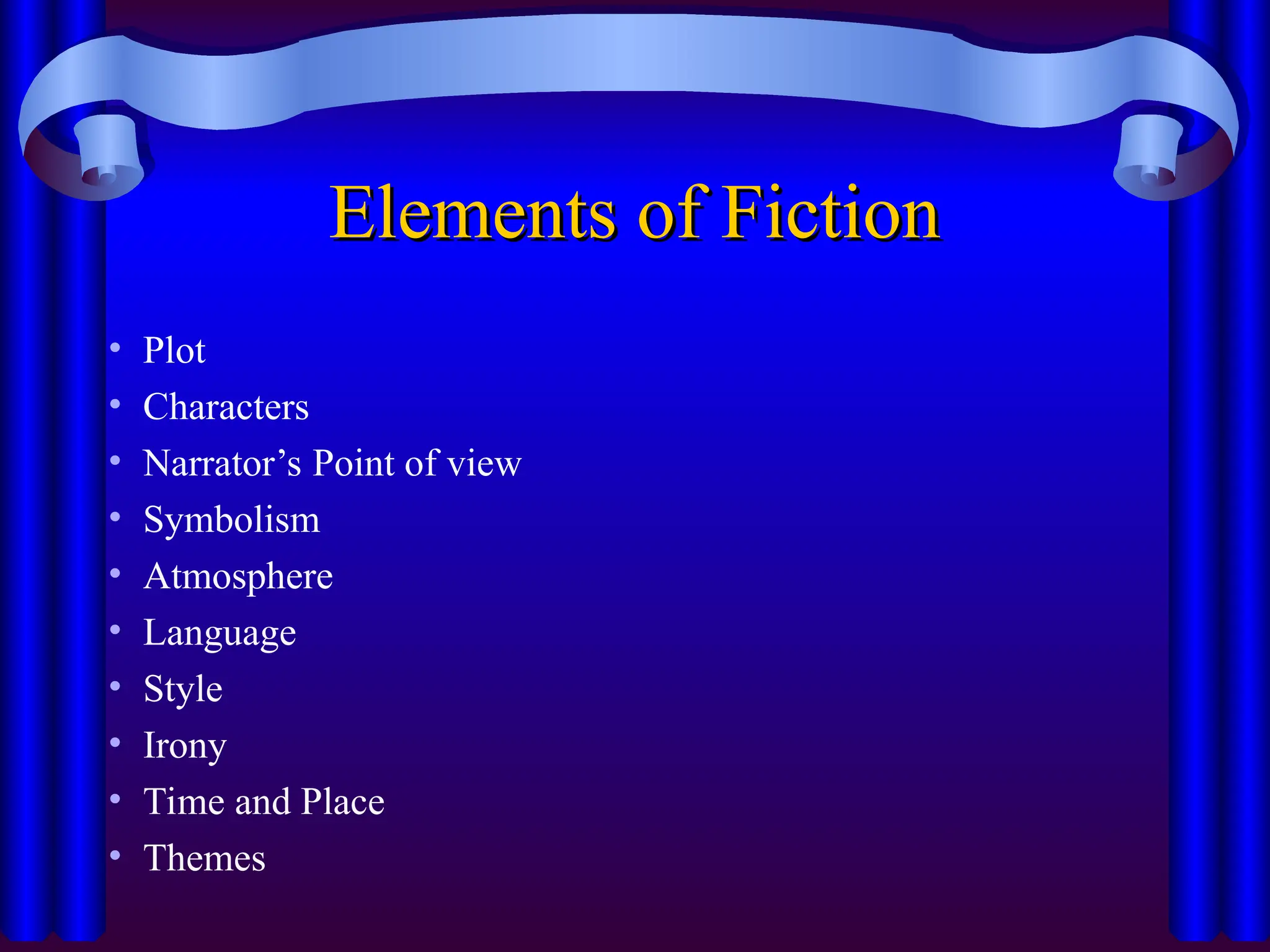
Elements of Fiction
Elements of Fiction
• Plot
• Characters
• Narrator’s Point of view
• Symbolism
• Atmosphere
• Language
• Style
• Irony
• Time and Place
• Themes
Plot
Plot
• Plot:
A plot in fiction is the arrangement of events in
a story. It has an exposition, a conflict
(complication of events and a conclusion), and
a resolution.
Plots differ with reference to the above
arrangements. For example: there are stories
which do not have a climax or a resolution.
The arrangement of the parts of the plot is the
writer’s choice
Characters
Characters
• There are Flat and Round characters.
• A Round character: a major character
(usually the protagonist) who experiences
change.
• A Flat character: a minor character
Narrator
Narrator
Narrator’s point of view:
First Person
Third Person:
A Narrator can also be:
Omniscient
Partially omniscient
Objective
Dramatic
POINT OF VIEW
POINT OF VIEW
SECTION
SECTION
Point of View
Point of View
• a term used to describe the way
in which the reader is presented
with the story; also defined as
the vantage point from which
the author presents the story.
Point of View
Point of View
• I. First Person point of view
(Uses personal pronouns: I,
me, mine, we, us, our)
- the narrator is the main
character who tells his/her
own story.
Point of View
Point of View
• II. Third Person point of view
(Uses personal pronouns: he,
she, it, they, them, etc.)
- This narrator is an outside
narrator.
Third Person Point of View
• A. Third Person: Objective
–This narrator is like a news
reporter. He tells us the facts
only. He cannot enter into the
thoughts of the characters.
Third Person Point of View
• B. Third Person: Limited
–This narrator can see into the
mind of only one character.
Third Person Point of View
• C. Third Person: Omniscient
–This narrator can relate the
thoughts of all the characters.
Objective Point of View
• The objective point of view is the point of
view from a distanced, informational
perspective, as in a news report.
Subjective Point of View
• The subjective point of view involves a
personal perspective.
The Stream of Consciousness
Technique
Technique
One modern and sophisticated technique of
narration is the Stream of Consciousness Technique.
In the S of C techniques the writer introduces to us a
narrator who oscillates between past, present and
future in a haphazard manner; without attention to
the chronological sequence of events
Some critics describe the S of C techniques as
“human mind at work”; human mind is not rhythmic
in its perception of things
Aesthetic Distance
Aesthetic Distance
• We need to be aware of the difference between
the author/writer and the narrator: they are not
the same.
• The aesthetic distance is the distance that the
writer maintains between himself and the
narrator.
• Students usually confuse the narrator with the
writer. In fiction the author does not appear in
the story or the novel. It is the narrator who
tells the story.
Narrator/Author
Narrator/Author
• What if the narrator is the same as the
Author?
• The work then becomes an autobiography
and not fiction.
Symbolism
Symbolism
• There are conventional symbols: symbols
that are used by many writers and that are
known to almost all people. The Dove: a
symbol of Peace
• There are private symbols that are used by
one writer in one work of literature
• Symbols are naturally known to allow for
different interpretations.
Atmosphere
Atmosphere
• The atmosphere of the story is generally
created by the author and it contributes to
the meaning of the story. An atmosphere
can be described as dark, sunny, gloomy,
rainy, silent, boisterous ---etc.
• A protagonist who initiates a journey at
night may be seen as a fearless adventurer
or a gloomy ignorant mishap
Language
Language
The language of a story or a novel may be one
of the concerns of the critic. The language of a
story may be described as slang, standard,
difficult, poetic, prosaic ---etc.
The language of a story may not be described
as difficult if we, as foreign readers, find very
many new words. This reality may be
attributed to our language proficiency and not
the difficulty of the language of the story
Style
Style
• Style is the way the writer presents his/her
story
• The style of a story can be described as lucid,
boring, tense, complicated, sophisticated ---
etc.
• A writer may choose at certain episodes to
use long sentences; short sentences at other
episodes.
Time and Place
Time and Place
• Writers usually locate their stories within a
specific time and place
• Awareness of the time and place of a story
illuminates our perception
• A story located in London during the post
World War era may inform our reading of that
story.
Irony
Irony
• The simple definition of irony entails
saying something and meaning just the
opposite of what is said.
• The whole story or parts of it can be ironic.
• If one says “I love having four exams in one
day), s/he certainly means the opposite of
what s/he says.
Themes
Themes
The theme of the story is the message that the
writer aims at conveying to us.
The message that the writer intends to convey
to us may not be the same message that we
find. This reality is referred to as the
intentional fallacy.
A writer may intend to present to us the
negative consequences of prejudice and we as
readers may find the same work a terrible
source of prejudice.
intro to literature aaas dasdad edadfawdafa

  • 1.
  • 2.
    Why do we Whydo we read? read?
  • 3.
  • 4.
    But is allfiction But is all fiction literature? literature?
  • 6.
    Literature is concernedwith the content and the form, in other words not only the story but the way it is written.
  • 7.
  • 8.
    Literature: A bodyof written works. The name is often applied to those imaginative works of poetry and prose distinguished by the intentions of their authors and the excellence of their execution. (Encyclopedia Britannica, Micropedia)
  • 9.
    • Literature: Thecollective writings proper to any language or nations. The term literature is site of ideological conflict; it may refer to those canonical works in the genres, ie., traditional works considered to be artistic or it may also refer to the total sum of writings, including letters, memoirs, comics, historical writings, etc. (adapted from the Cambridge Encyclopedia)
  • 10.
  • 11.
    • Literature: Anintimate experience of an author carefully expressed in concrete images through the use of structure, imaginative style and luxurious metaphors. It is not practical or logical communication, but an aesthetic experience. Anderson Imbert, Enrique (1992) Teoría y técnica del cuento, Barcelona, Editorial Ariel
  • 12.
    •Literature: A collectionof writings, which reflect the experience of class struggle in a society. The history of literature is, therefore, a reflection on changing material, economic and social conditions in that society. See: Marx, Karl and Engels, Freidrich, Communism: The production of the form of intercourse itself, in Rice, Philip and Waugh Patricia (2001) Modern literary theory: A reader (4th Ed), London, Arnold
  • 13.
    “Thus is revealedthe total existence of writing: a text is made up of multiple writings, drawn from many cultures and entering into mutual relations of dialogue, parody, contestation, but there is one place where this multiplicity is focussed and that place is the reader, not ......... the author.” From Barthes, Roland, The death of the author, in Rice, Philip and Waugh Patricia (2001) Modern literary theory: A reader (4th Ed), London, Arnold
  • 14.
    LITERATURE LITERATURE • All writingin prose and poetry having permanent value, excellent format, an imaginative or critical characteristic, and heightened emotional effect.
  • 15.
    Literature Literature • Literature isreferred to as the entirety of written expression, with the restriction that not every written document can be categorized as literature in the more exact sense of the word. (Klarer p.1)
  • 16.
    LITERATURE LITERATURE • Etymologically: theLatin word “litteratura” is derived from “littera” (letter), which is the smallest element of alphabetical writing. • The word text is related to “textile” and can be translated as “fabric”: just as single threads form a fabric, so words and sentences form a meaningful and coherent text.
  • 17.
    LITERATURE LITERATURE • Literature ortext as cultural and historical phenomena and to investigate the conditions of their production and reception.
  • 18.
    Pre historic paintingin the cave Pre historic painting in the cave wall wall
  • 19.
    The Beginning ofLiterature The Beginning of Literature • Not only pictorial but Acoustic • Spoken words  Signs • Oral traditions • Integral Parts of Literature
  • 20.
    • Before writingdeveloped as a system of signs, whether pictographs or alphabets, “texts” were passed on orally. • The predecessor of literary expression, called “oral poetry,” • In 21st century, Audio-literature and the lyrics of songs display the acoustic features of literary phenomena through the medium of radio and other sound carriers.
  • 21.
    • In theMiddle Ages the visual component of writing was highly privileged in such forms as richly decorated handwritten manuscripts, the arrival of the modern age - along with the invention of the printing press- made the visual element disappear or reduced it to a few illustrations in the text.
  • 22.
    • Only inDRAMA  union between the spoken word and visual expression • DRAMA, which is viewed as literature, combines the acoustic and the visual elements. • The symbiosis of word and image culminates in FILM.
  • 23.
    • FILM isinteresting for textual studies, since word and picture are recorded and, as in a book, can be looked up at any time. • Methods of literary and textual criticism are, therefore, frequently applied to the cinema and acoustic media.
  • 24.
    • Computer hypertextsand networks/ the Internet are the latest hybrids of the textual and various media  writing is linked to sounds, pictures or even video clips within an interdependent network. • The written medium is obviously the main concern in the study of literature or texts  the stage, painting, film, music or even computer networks.
  • 25.
    GENRE GENRE • A Genreis a French word meaning “type” or “kind” of literature.
  • 26.
    Genre Genre • The genresof literature we will study are poetry, drama, fiction (short story, non-fiction, and novel) and film.
  • 27.
    Prose and Poetry Proseand Poetry • Prose and poetry are two kinds of writing formats in standard American English.
  • 28.
    Prose Prose • Prose isstraight writing in paragraph form (e.g. newspaper, novels, magazines).
  • 29.
    Poetry Poetry • Poetry isa particular arrangement of words on a page for heightened emotional effect.
  • 30.
    Fiction and Nonfiction Fictionand Nonfiction • All writing falls into one of these two categories: –Fiction –Nonfiction
  • 31.
    Fiction Fiction Fiction is nottrue. It is drawn from the imagination of the author.
  • 32.
    Nonfiction Nonfiction • Nonfiction istrue. It is based on real events or facts.
  • 33.
    LITERARY GENRES LITERARY GENRES Fiction • Ancient: Fables, Tales • Modern: Novels & Short Stories • Poetry • Drama • Biography and Autobiography • The Essay • Film
  • 34.
    A Fable A Fable •The Oak and the Reeds A VERY LARGE OAK was uprooted by the wind and thrown across a stream. It fell among some Reeds, which it thus addressed: "I wonder how you, who are so light and weak, are not entirely crushed by these strong winds." They replied, "You fight and contend with the wind, and consequently you are destroyed; while we on the contrary bend before the least breath of air, and therefore remain unbroken, and escape." Stoop to conquer.
  • 35.
    Fiction Fiction •Ancient: Fables, Tales –NotRealistic –No details –Quick and simple plots –Nonhuman characters –They aim at a quick and simple moral (lesson)
  • 36.
    Modern Fiction ( ModernFiction (Men in The Sun Men in The Sun) ) • It was not too uncomfortable riding on the back of the huge lorry. Although the sun was pouring its inferno down on them without any respite, the breeze that they felt because of the lorry’s speed lessened the intensity of the heat. Abu Qais had climbed up on top with Marwan, and they sat side by side on the edge of the tank. They had drawn lots, and it was Assad’s turn to sit beside the driver-----------
  • 37.
    Modern Fiction Modern Fiction •Novels & Short Stories – Verisimilitude: Realistic (life-like) presentation of events – Real (human characters) – Minute details – Not reality but an illusion of reality – Modern fiction is the genre of the Middle Class. The Industrial Revolution created the Middle Class and the novel became the new form of literature which represented the difficulties encountering Middle Class people.
  • 38.
    History, Biography/Autobiography History, Biography/Autobiography &Fiction & Fiction • History: an objective presentation of reality • Biography/Autobiography: a subjective presentation of reality. • Fiction: An illusion of reality.
  • 39.
    Elements of Fiction Elementsof Fiction • Plot • Characters • Narrator’s Point of view • Symbolism • Atmosphere • Language • Style • Irony • Time and Place • Themes
  • 40.
    Plot Plot • Plot: A plotin fiction is the arrangement of events in a story. It has an exposition, a conflict (complication of events and a conclusion), and a resolution. Plots differ with reference to the above arrangements. For example: there are stories which do not have a climax or a resolution. The arrangement of the parts of the plot is the writer’s choice
  • 41.
    Characters Characters • There areFlat and Round characters. • A Round character: a major character (usually the protagonist) who experiences change. • A Flat character: a minor character
  • 42.
    Narrator Narrator Narrator’s point ofview: First Person Third Person: A Narrator can also be: Omniscient Partially omniscient Objective Dramatic
  • 43.
    POINT OF VIEW POINTOF VIEW SECTION SECTION
  • 44.
    Point of View Pointof View • a term used to describe the way in which the reader is presented with the story; also defined as the vantage point from which the author presents the story.
  • 45.
    Point of View Pointof View • I. First Person point of view (Uses personal pronouns: I, me, mine, we, us, our) - the narrator is the main character who tells his/her own story.
  • 46.
    Point of View Pointof View • II. Third Person point of view (Uses personal pronouns: he, she, it, they, them, etc.) - This narrator is an outside narrator.
  • 47.
    Third Person Pointof View Third Person Point of View • A. Third Person: Objective –This narrator is like a news reporter. He tells us the facts only. He cannot enter into the thoughts of the characters.
  • 48.
    Third Person Pointof View Third Person Point of View • B. Third Person: Limited –This narrator can see into the mind of only one character.
  • 49.
    Third Person Pointof View Third Person Point of View • C. Third Person: Omniscient –This narrator can relate the thoughts of all the characters.
  • 50.
    Objective Point ofView Objective Point of View • The objective point of view is the point of view from a distanced, informational perspective, as in a news report.
  • 51.
    Subjective Point ofView Subjective Point of View • The subjective point of view involves a personal perspective.
  • 52.
    The Stream ofConsciousness The Stream of Consciousness Technique Technique One modern and sophisticated technique of narration is the Stream of Consciousness Technique. In the S of C techniques the writer introduces to us a narrator who oscillates between past, present and future in a haphazard manner; without attention to the chronological sequence of events Some critics describe the S of C techniques as “human mind at work”; human mind is not rhythmic in its perception of things
  • 53.
    Aesthetic Distance Aesthetic Distance •We need to be aware of the difference between the author/writer and the narrator: they are not the same. • The aesthetic distance is the distance that the writer maintains between himself and the narrator. • Students usually confuse the narrator with the writer. In fiction the author does not appear in the story or the novel. It is the narrator who tells the story.
  • 54.
    Narrator/Author Narrator/Author • What ifthe narrator is the same as the Author? • The work then becomes an autobiography and not fiction.
  • 55.
    Symbolism Symbolism • There areconventional symbols: symbols that are used by many writers and that are known to almost all people. The Dove: a symbol of Peace • There are private symbols that are used by one writer in one work of literature • Symbols are naturally known to allow for different interpretations.
  • 56.
    Atmosphere Atmosphere • The atmosphereof the story is generally created by the author and it contributes to the meaning of the story. An atmosphere can be described as dark, sunny, gloomy, rainy, silent, boisterous ---etc. • A protagonist who initiates a journey at night may be seen as a fearless adventurer or a gloomy ignorant mishap
  • 57.
    Language Language The language ofa story or a novel may be one of the concerns of the critic. The language of a story may be described as slang, standard, difficult, poetic, prosaic ---etc. The language of a story may not be described as difficult if we, as foreign readers, find very many new words. This reality may be attributed to our language proficiency and not the difficulty of the language of the story
  • 58.
    Style Style • Style isthe way the writer presents his/her story • The style of a story can be described as lucid, boring, tense, complicated, sophisticated --- etc. • A writer may choose at certain episodes to use long sentences; short sentences at other episodes.
  • 59.
    Time and Place Timeand Place • Writers usually locate their stories within a specific time and place • Awareness of the time and place of a story illuminates our perception • A story located in London during the post World War era may inform our reading of that story.
  • 60.
    Irony Irony • The simpledefinition of irony entails saying something and meaning just the opposite of what is said. • The whole story or parts of it can be ironic. • If one says “I love having four exams in one day), s/he certainly means the opposite of what s/he says.
  • 61.
    Themes Themes The theme ofthe story is the message that the writer aims at conveying to us. The message that the writer intends to convey to us may not be the same message that we find. This reality is referred to as the intentional fallacy. A writer may intend to present to us the negative consequences of prejudice and we as readers may find the same work a terrible source of prejudice.