Introduction to Laravel 4
Benson Liang
What will be discussed


Introduction



Installation



The MVC Layers



Authentication



IoC Container



Facade



Service Provider
Introduction


The Creator



Objectives of Laravel



The Base



Closures



The Syntactic Sugar
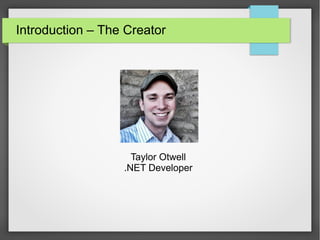
Introduction – The Creator

Taylor Otwell
.NET Developer
Introduction – Objectives of Laravel


Get started on a project FAST



Fun to develop with



Promote S.O.L.I.D design patterns


Singe Responsibility Principle (SRP)



Open/Closed Principle (OCP)



Liskov Substitution Principle (LSP)



Interface Segregation Principle (ISP)



Dependency Inversion Principle (DIP)
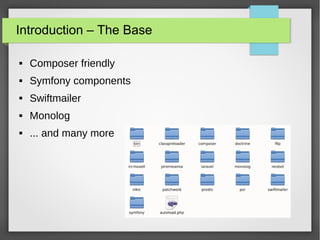
Introduction – The Base


Composer friendly



Symfony components



Swiftmailer



Monolog



... and many more
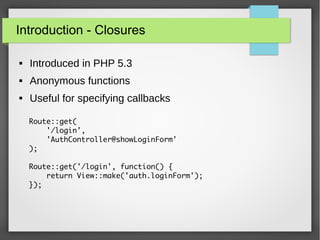
Introduction - Closures


Introduced in PHP 5.3



Anonymous functions



Useful for specifying callbacks
Route::get(
'/login',
'AuthController@showLoginForm'
);
Route::get('/login', function() {
return View::make('auth.loginForm');
});
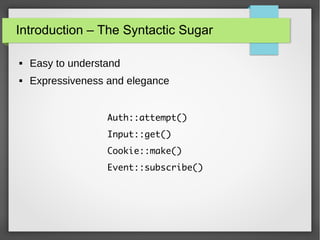
Introduction – The Syntactic Sugar


Easy to understand



Expressiveness and elegance
Auth::attempt()
Input::get()
Cookie::make()
Event::subscribe()
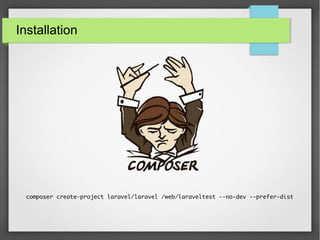
Installation

composer create-project laravel/laravel /web/laraveltest --no-dev --prefer-dist
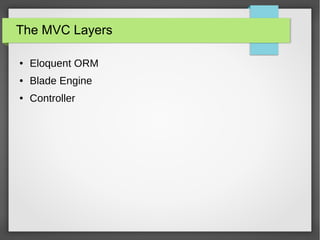
The MVC Layers
●

Eloquent ORM

●

Blade Engine

●

Controller
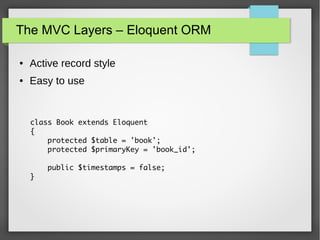
The MVC Layers – Eloquent ORM
●

Active record style

●

Easy to use

class Book extends Eloquent
{
protected $table = 'book';
protected $primaryKey = 'book_id';
public $timestamps = false;
}
The MVC Layers – Eloquent ORM
●

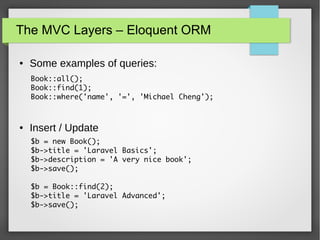
Some examples of queries:
Book::all();
Book::find(1);
Book::where('name', '=', 'Michael Cheng');

●

Insert / Update
$b = new Book();
$b->title = 'Laravel Basics';
$b->description = 'A very nice book';
$b->save();
$b = Book::find(2);
$b->title = 'Laravel Advanced';
$b->save();
The MVC Layers – Eloquent ORM
●

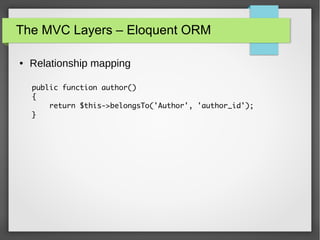
Relationship mapping
public function author()
{
return $this->belongsTo('Author', 'author_id');
}
The MVC Layers – Eloquent ORM
●

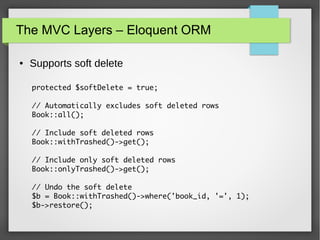
Supports soft delete
protected $softDelete = true;
// Automatically excludes soft deleted rows
Book::all();
// Include soft deleted rows
Book::withTrashed()->get();
// Include only soft deleted rows
Book::onlyTrashed()->get();
// Undo the soft delete
$b = Book::withTrashed()->where('book_id, '=', 1);
$b->restore();
The MVC Layers – Eloquent ORM
●

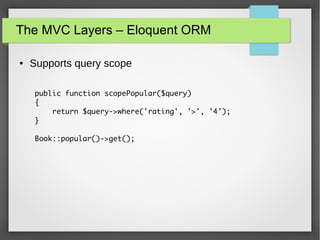
Supports query scope
public function scopePopular($query)
{
return $query->where('rating', '>', '4');
}
Book::popular()->get();
The MVC Layers – Eloquent ORM
●

Supports accessors and mutators
// Accessor
public function getGenderAttribute($value)
{
return ($value == 'm') ? 'Male' : 'Female';
}
// Mutator
public function setNameAttribute($value)
{
$this->attributes['name'] = strtolower($value);
}
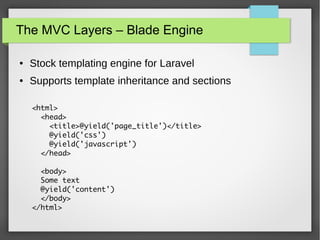
The MVC Layers – Blade Engine
●

Stock templating engine for Laravel

●

Supports template inheritance and sections
<html>
<head>
<title>@yield('page_title')</title>
@yield('css')
@yield('javascript')
</head>
<body>
Some text
@yield('content')
</body>
</html>
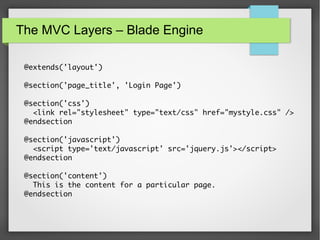
The MVC Layers – Blade Engine
@extends('layout')
@section('page_title', 'Login Page')
@section('css')
<link rel="stylesheet" type="text/css" href="mystyle.css" />
@endsection
@section('javascript')
<script type='text/javascript' src='jquery.js'></script>
@endsection
@section('content')
This is the content for a particular page.
@endsection
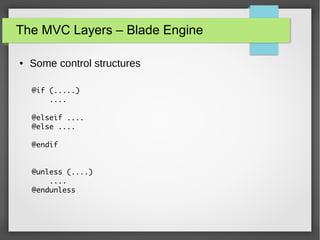
The MVC Layers – Blade Engine
●

Some control structures
@if (.....)
....
@elseif ....
@else ....
@endif

@unless (....)
....
@endunless
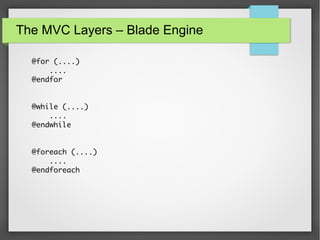
The MVC Layers – Blade Engine
@for (....)
....
@endfor

@while (....)
....
@endwhile
@foreach (....)
....
@endforeach
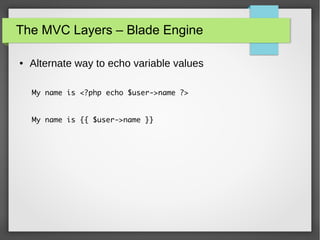
The MVC Layers – Blade Engine
●

Alternate way to echo variable values
My name is <?php echo $user->name ?>
My name is {{ $user->name }}
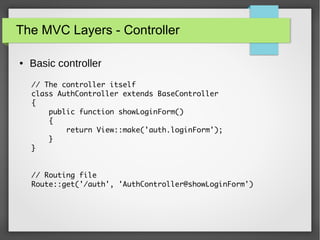
The MVC Layers - Controller
●

Basic controller
// The controller itself
class AuthController extends BaseController
{
public function showLoginForm()
{
return View::make('auth.loginForm');
}
}
// Routing file
Route::get('/auth', 'AuthController@showLoginForm')
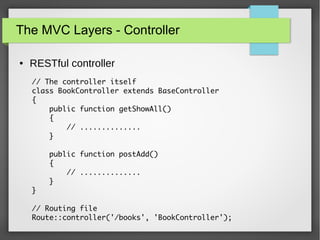
The MVC Layers - Controller
●

RESTful controller
// The controller itself
class BookController extends BaseController
{
public function getShowAll()
{
// ..............
}
public function postAdd()
{
// ..............
}
}
// Routing file
Route::controller('/books', 'BookController');
The MVC Layers - Controller


Resource controller
–

Generated using Artisan CLI

–

Allows easy RESTful implementation
The MVC Layers - Controller


Resource controller


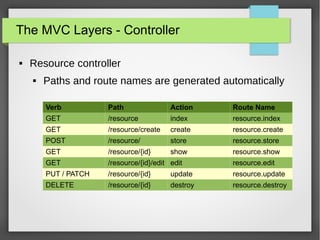
Paths and route names are generated automatically
Verb

Path

Action

Route Name

GET

/resource

index

resource.index

GET

/resource/create

create

resource.create

POST

/resource/

store

resource.store

GET

/resource/{id}

show

resource.show

GET

/resource/{id}/edit edit

resource.edit

PUT / PATCH

/resource/{id}

update

resource.update

DELETE

/resource/{id}

destroy

resource.destroy
The MVC Layers
●

Simple demo
Authentication
●



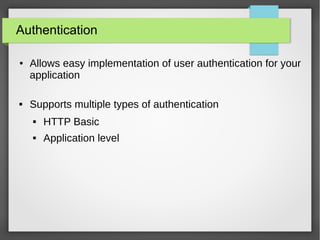
Allows easy implementation of user authentication for your
application
Supports multiple types of authentication


HTTP Basic



Application level
Authentication – Application Level
●

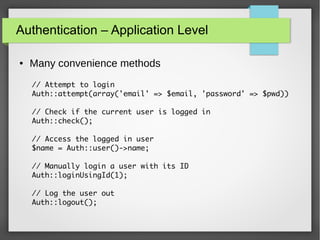
Many convenience methods
// Attempt to login
Auth::attempt(array('email' => $email, 'password' => $pwd))
// Check if the current user is logged in
Auth::check();
// Access the logged in user
$name = Auth::user()->name;
// Manually login a user with its ID
Auth::loginUsingId(1);
// Log the user out
Auth::logout();
Authentication – Application Level


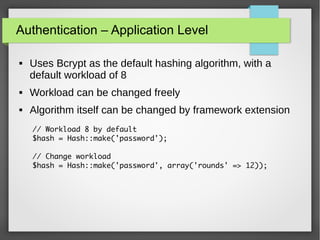
Uses Bcrypt as the default hashing algorithm, with a
default workload of 8



Workload can be changed freely



Algorithm itself can be changed by framework extension
// Workload 8 by default
$hash = Hash::make('password');
// Change workload
$hash = Hash::make('password', array('rounds' => 12));
IoC Container








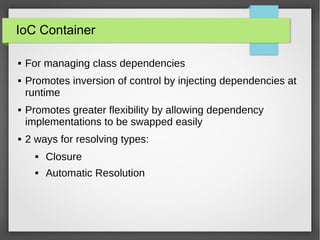
For managing class dependencies
Promotes inversion of control by injecting dependencies at
runtime
Promotes greater flexibility by allowing dependency
implementations to be swapped easily
2 ways for resolving types:


Closure



Automatic Resolution
IoC Container


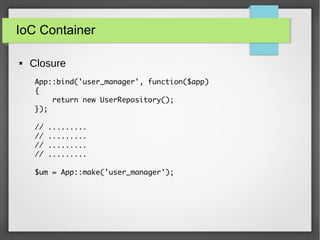
Closure
App::bind('user_manager', function($app)
{
return new UserRepository();
});
//
//
//
//

.........
.........
.........
.........

$um = App::make('user_manager');
IoC Container


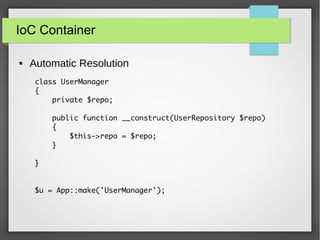
Automatic Resolution
class UserManager
{
private $repo;
public function __construct(UserRepository $repo)
{
$this->repo = $repo;
}
}
$u = App::make('UserManager');
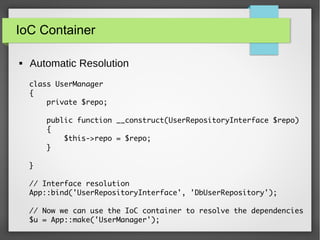
IoC Container


Automatic Resolution
class UserManager
{
private $repo;
public function __construct(UserRepositoryInterface $repo)
{
$this->repo = $repo;
}
}
// Interface resolution
App::bind('UserRepositoryInterface', 'DbUserRepository');
// Now we can use the IoC container to resolve the dependencies
$u = App::make('UserManager');
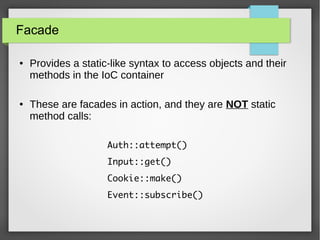
Facade
●

●

Provides a static-like syntax to access objects and their
methods in the IoC container
These are facades in action, and they are NOT static
method calls:
Auth::attempt()
Input::get()
Cookie::make()
Event::subscribe()
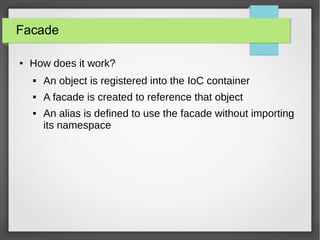
Facade
●

How does it work?


An object is registered into the IoC container



A facade is created to reference that object



An alias is defined to use the facade without importing
its namespace
Service Provider
●

●

A great way to add reusable components into your
application
Custom authentication driver, database driver, support
modules etc etc etc...
Service Provider
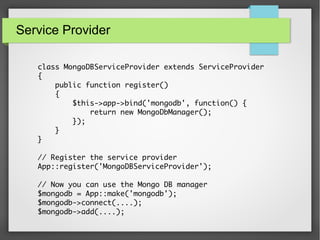
class MongoDBServiceProvider extends ServiceProvider
{
public function register()
{
$this->app->bind('mongodb', function() {
return new MongoDbManager();
});
}
}
// Register the service provider
App::register('MongoDBServiceProvider');
// Now you can use the Mongo DB manager
$mongodb = App::make('mongodb');
$mongodb->connect(....);
$mongodb->add(....);
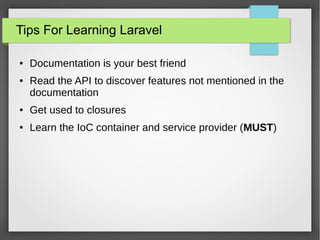
Tips For Learning Laravel
●

●

Documentation is your best friend
Read the API to discover features not mentioned in the
documentation

●

Get used to closures

●

Learn the IoC container and service provider (MUST)

Intro to Laravel 4

  • 1.
  • 2.
    What will bediscussed  Introduction  Installation  The MVC Layers  Authentication  IoC Container  Facade  Service Provider
  • 3.
    Introduction  The Creator  Objectives ofLaravel  The Base  Closures  The Syntactic Sugar
  • 4.
    Introduction – TheCreator Taylor Otwell .NET Developer
  • 5.
    Introduction – Objectivesof Laravel  Get started on a project FAST  Fun to develop with  Promote S.O.L.I.D design patterns  Singe Responsibility Principle (SRP)  Open/Closed Principle (OCP)  Liskov Substitution Principle (LSP)  Interface Segregation Principle (ISP)  Dependency Inversion Principle (DIP)
  • 6.
    Introduction – TheBase  Composer friendly  Symfony components  Swiftmailer  Monolog  ... and many more
  • 7.
    Introduction - Closures  Introducedin PHP 5.3  Anonymous functions  Useful for specifying callbacks Route::get( '/login', 'AuthController@showLoginForm' ); Route::get('/login', function() { return View::make('auth.loginForm'); });
  • 8.
    Introduction – TheSyntactic Sugar  Easy to understand  Expressiveness and elegance Auth::attempt() Input::get() Cookie::make() Event::subscribe()
  • 9.
    Installation composer create-project laravel/laravel/web/laraveltest --no-dev --prefer-dist
  • 10.
    The MVC Layers ● EloquentORM ● Blade Engine ● Controller
  • 11.
    The MVC Layers– Eloquent ORM ● Active record style ● Easy to use class Book extends Eloquent { protected $table = 'book'; protected $primaryKey = 'book_id'; public $timestamps = false; }
  • 12.
    The MVC Layers– Eloquent ORM ● Some examples of queries: Book::all(); Book::find(1); Book::where('name', '=', 'Michael Cheng'); ● Insert / Update $b = new Book(); $b->title = 'Laravel Basics'; $b->description = 'A very nice book'; $b->save(); $b = Book::find(2); $b->title = 'Laravel Advanced'; $b->save();
  • 13.
    The MVC Layers– Eloquent ORM ● Relationship mapping public function author() { return $this->belongsTo('Author', 'author_id'); }
  • 14.
    The MVC Layers– Eloquent ORM ● Supports soft delete protected $softDelete = true; // Automatically excludes soft deleted rows Book::all(); // Include soft deleted rows Book::withTrashed()->get(); // Include only soft deleted rows Book::onlyTrashed()->get(); // Undo the soft delete $b = Book::withTrashed()->where('book_id, '=', 1); $b->restore();
  • 15.
    The MVC Layers– Eloquent ORM ● Supports query scope public function scopePopular($query) { return $query->where('rating', '>', '4'); } Book::popular()->get();
  • 16.
    The MVC Layers– Eloquent ORM ● Supports accessors and mutators // Accessor public function getGenderAttribute($value) { return ($value == 'm') ? 'Male' : 'Female'; } // Mutator public function setNameAttribute($value) { $this->attributes['name'] = strtolower($value); }
  • 17.
    The MVC Layers– Blade Engine ● Stock templating engine for Laravel ● Supports template inheritance and sections <html> <head> <title>@yield('page_title')</title> @yield('css') @yield('javascript') </head> <body> Some text @yield('content') </body> </html>
  • 18.
    The MVC Layers– Blade Engine @extends('layout') @section('page_title', 'Login Page') @section('css') <link rel="stylesheet" type="text/css" href="mystyle.css" /> @endsection @section('javascript') <script type='text/javascript' src='jquery.js'></script> @endsection @section('content') This is the content for a particular page. @endsection
  • 19.
    The MVC Layers– Blade Engine ● Some control structures @if (.....) .... @elseif .... @else .... @endif @unless (....) .... @endunless
  • 20.
    The MVC Layers– Blade Engine @for (....) .... @endfor @while (....) .... @endwhile @foreach (....) .... @endforeach
  • 21.
    The MVC Layers– Blade Engine ● Alternate way to echo variable values My name is <?php echo $user->name ?> My name is {{ $user->name }}
  • 22.
    The MVC Layers- Controller ● Basic controller // The controller itself class AuthController extends BaseController { public function showLoginForm() { return View::make('auth.loginForm'); } } // Routing file Route::get('/auth', 'AuthController@showLoginForm')
  • 23.
    The MVC Layers- Controller ● RESTful controller // The controller itself class BookController extends BaseController { public function getShowAll() { // .............. } public function postAdd() { // .............. } } // Routing file Route::controller('/books', 'BookController');
  • 24.
    The MVC Layers- Controller  Resource controller – Generated using Artisan CLI – Allows easy RESTful implementation
  • 25.
    The MVC Layers- Controller  Resource controller  Paths and route names are generated automatically Verb Path Action Route Name GET /resource index resource.index GET /resource/create create resource.create POST /resource/ store resource.store GET /resource/{id} show resource.show GET /resource/{id}/edit edit resource.edit PUT / PATCH /resource/{id} update resource.update DELETE /resource/{id} destroy resource.destroy
  • 26.
  • 27.
    Authentication ●  Allows easy implementationof user authentication for your application Supports multiple types of authentication  HTTP Basic  Application level
  • 28.
    Authentication – ApplicationLevel ● Many convenience methods // Attempt to login Auth::attempt(array('email' => $email, 'password' => $pwd)) // Check if the current user is logged in Auth::check(); // Access the logged in user $name = Auth::user()->name; // Manually login a user with its ID Auth::loginUsingId(1); // Log the user out Auth::logout();
  • 29.
    Authentication – ApplicationLevel  Uses Bcrypt as the default hashing algorithm, with a default workload of 8  Workload can be changed freely  Algorithm itself can be changed by framework extension // Workload 8 by default $hash = Hash::make('password'); // Change workload $hash = Hash::make('password', array('rounds' => 12));
  • 30.
    IoC Container     For managingclass dependencies Promotes inversion of control by injecting dependencies at runtime Promotes greater flexibility by allowing dependency implementations to be swapped easily 2 ways for resolving types:  Closure  Automatic Resolution
  • 31.
    IoC Container  Closure App::bind('user_manager', function($app) { returnnew UserRepository(); }); // // // // ......... ......... ......... ......... $um = App::make('user_manager');
  • 32.
    IoC Container  Automatic Resolution classUserManager { private $repo; public function __construct(UserRepository $repo) { $this->repo = $repo; } } $u = App::make('UserManager');
  • 33.
    IoC Container  Automatic Resolution classUserManager { private $repo; public function __construct(UserRepositoryInterface $repo) { $this->repo = $repo; } } // Interface resolution App::bind('UserRepositoryInterface', 'DbUserRepository'); // Now we can use the IoC container to resolve the dependencies $u = App::make('UserManager');
  • 34.
    Facade ● ● Provides a static-likesyntax to access objects and their methods in the IoC container These are facades in action, and they are NOT static method calls: Auth::attempt() Input::get() Cookie::make() Event::subscribe()
  • 35.
    Facade ● How does itwork?  An object is registered into the IoC container  A facade is created to reference that object  An alias is defined to use the facade without importing its namespace
  • 36.
    Service Provider ● ● A greatway to add reusable components into your application Custom authentication driver, database driver, support modules etc etc etc...
  • 37.
    Service Provider class MongoDBServiceProviderextends ServiceProvider { public function register() { $this->app->bind('mongodb', function() { return new MongoDbManager(); }); } } // Register the service provider App::register('MongoDBServiceProvider'); // Now you can use the Mongo DB manager $mongodb = App::make('mongodb'); $mongodb->connect(....); $mongodb->add(....);
  • 38.
    Tips For LearningLaravel ● ● Documentation is your best friend Read the API to discover features not mentioned in the documentation ● Get used to closures ● Learn the IoC container and service provider (MUST)