Chapter 3
Playing with Numbers
At the end of this lesson you will be able to:
2
 Identify factors and multiples of a number
 State the properties of factors and multiples
 Classify numbers as prime, composite even and odd
 Test divisibility of numbers
 Express numbers as product of their prime factors
 Compute HCF and LCM
3
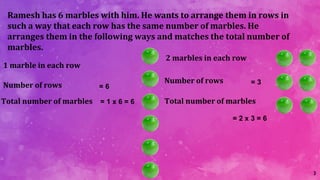
Ramesh has 6 marbles with him. He wants to arrange them in rows in
such a way that each row has the same number of marbles. He
arranges them in the following ways and matches the total number of
marbles.
Number of rows
1 marble in each row
Total number of marbles
= 6
= 1 x 6 = 6
2 marbles in each row
Number of rows = 3
Total number of marbles
= 2 x 3 = 6
4
Number of rows
3 marbles in each row
Total number of marbles
= 2
= 3 x 2 = 6
He could not think of any arrangement in which each row had 4 marbles or 5
marbles.So the only possible arrangement left was with all the 6 marbles in a row
From these calculations, Ramesh observes that 6 can be written as a product of
two numbers in different ways such as
6 = 6 x 1 6 = 2 x 3 6 = 3 x 2 6 = 1 x 6
Number of rows
Total number of marbles
= 1
= 1 x 6 = 6
5
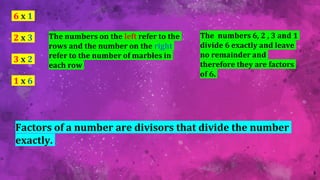
6 x 1
2 x 3
3 x 2
1 x 6
The numbers on the left refer to the
rows and the number on the right
refer to the number of marbles in
each row
The numbers 6, 2 , 3 and 1
divide 6 exactly and leave
no remainder and
therefore they are factors
of 6.
Factors of a number are divisors that divide the number
exactly.
6
Finding the factors of a number by
division.
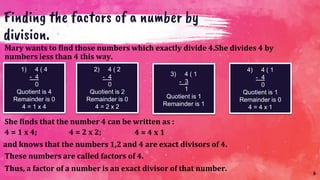
Mary wants to find those numbers which exactly divide 4.She divides 4 by
numbers less than 4 this way.
1) 4 ( 4
- 4
0
Quotient is 4
Remainder is 0
4 = 1 x 4
2) 4 ( 2
- 4
0
Quotient is 2
Remainder is 0
4 = 2 x 2
3) 4 ( 1
- 3
1
Quotient is 1
Remainder is 1
4) 4 ( 1
- 4
0
Quotient is 1
Remainder is 0
4 = 4 x 1
She finds that the number 4 can be written as :
4 = 1 x 4; 4 = 2 x 2; 4 = 4 x 1
and knows that the numbers 1,2 and 4 are exact divisors of 4.
These numbers are called factors of 4.
Thus, a factor of a number is an exact divisor of that number.
Multiples
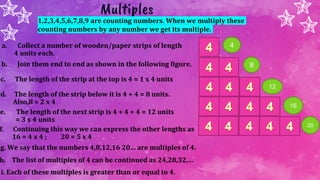
1,2,3,4,5,6,7,8,9 are counting numbers. When we multiply these
counting numbers by any number we get its multiple.
a. Collect a number of wooden/paper strips of length
4 units each.
b. Join them end to end as shown in the following figure.
c. The length of the strip at the top is 4 = 1 x 4 units
d. The length of the strip below it is 4 + 4 = 8 units.
Also,8 = 2 x 4
e. The length of the next strip is 4 + 4 + 4 = 12 units
= 3 x 4 units
f. Continuing this way we can express the other lengths as
16 = 4 x 4 ; 20 = 5 x 4
g. We say that the numbers 4,8,12,16 20… are multiples of 4.
h. The list of multiples of 4 can be continued as 24,28,32,…
i. Each of these multiples is greater than or equal to 4.
4
8
16
20
12
8
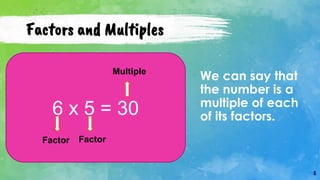
Factors and Multiples
6 x 5 = 30
Multiple
Factor Factor
We can say that
the number is a
multiple of each
of its factors.
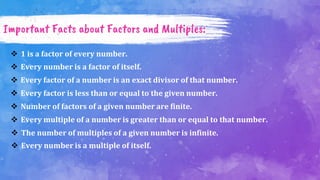
Important Facts about Factors and Multiples:
 1 is a factor of every number.
 Every number is a factor of itself.
 Every factor of a number is an exact divisor of that number.
 Every factor is less than or equal to the given number.
 Number of factors of a given number are finite.
 Every multiple of a number is greater than or equal to that number.
 The number of multiples of a given number is infinite.
 Every number is a multiple of itself.
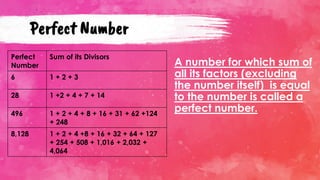
Perfect Number
A number for which sum of
all its factors (excluding
the number itself) is equal
to the number is called a
perfect number.
Perfect
Number
Sum of its Divisors
6 1 + 2 + 3
28 1 +2 + 4 + 7 + 14
496 1 + 2 + 4 + 8 + 16 + 31 + 62 +124
+ 248
8,128 1 + 2 + 4 +8 + 16 + 32 + 64 + 127
+ 254 + 508 + 1,016 + 2,032 +
4,064

intro to factors.pptx

  • 1.
  • 2.
    At the endof this lesson you will be able to: 2  Identify factors and multiples of a number  State the properties of factors and multiples  Classify numbers as prime, composite even and odd  Test divisibility of numbers  Express numbers as product of their prime factors  Compute HCF and LCM
  • 3.
    3 Ramesh has 6marbles with him. He wants to arrange them in rows in such a way that each row has the same number of marbles. He arranges them in the following ways and matches the total number of marbles. Number of rows 1 marble in each row Total number of marbles = 6 = 1 x 6 = 6 2 marbles in each row Number of rows = 3 Total number of marbles = 2 x 3 = 6
  • 4.
    4 Number of rows 3marbles in each row Total number of marbles = 2 = 3 x 2 = 6 He could not think of any arrangement in which each row had 4 marbles or 5 marbles.So the only possible arrangement left was with all the 6 marbles in a row From these calculations, Ramesh observes that 6 can be written as a product of two numbers in different ways such as 6 = 6 x 1 6 = 2 x 3 6 = 3 x 2 6 = 1 x 6 Number of rows Total number of marbles = 1 = 1 x 6 = 6
  • 5.
    5 6 x 1 2x 3 3 x 2 1 x 6 The numbers on the left refer to the rows and the number on the right refer to the number of marbles in each row The numbers 6, 2 , 3 and 1 divide 6 exactly and leave no remainder and therefore they are factors of 6. Factors of a number are divisors that divide the number exactly.
  • 6.
    6 Finding the factorsof a number by division. Mary wants to find those numbers which exactly divide 4.She divides 4 by numbers less than 4 this way. 1) 4 ( 4 - 4 0 Quotient is 4 Remainder is 0 4 = 1 x 4 2) 4 ( 2 - 4 0 Quotient is 2 Remainder is 0 4 = 2 x 2 3) 4 ( 1 - 3 1 Quotient is 1 Remainder is 1 4) 4 ( 1 - 4 0 Quotient is 1 Remainder is 0 4 = 4 x 1 She finds that the number 4 can be written as : 4 = 1 x 4; 4 = 2 x 2; 4 = 4 x 1 and knows that the numbers 1,2 and 4 are exact divisors of 4. These numbers are called factors of 4. Thus, a factor of a number is an exact divisor of that number.
  • 7.
    Multiples 1,2,3,4,5,6,7,8,9 are countingnumbers. When we multiply these counting numbers by any number we get its multiple. a. Collect a number of wooden/paper strips of length 4 units each. b. Join them end to end as shown in the following figure. c. The length of the strip at the top is 4 = 1 x 4 units d. The length of the strip below it is 4 + 4 = 8 units. Also,8 = 2 x 4 e. The length of the next strip is 4 + 4 + 4 = 12 units = 3 x 4 units f. Continuing this way we can express the other lengths as 16 = 4 x 4 ; 20 = 5 x 4 g. We say that the numbers 4,8,12,16 20… are multiples of 4. h. The list of multiples of 4 can be continued as 24,28,32,… i. Each of these multiples is greater than or equal to 4. 4 8 16 20 12
  • 8.
    8 Factors and Multiples 6x 5 = 30 Multiple Factor Factor We can say that the number is a multiple of each of its factors.
  • 9.
    Important Facts aboutFactors and Multiples:  1 is a factor of every number.  Every number is a factor of itself.  Every factor of a number is an exact divisor of that number.  Every factor is less than or equal to the given number.  Number of factors of a given number are finite.  Every multiple of a number is greater than or equal to that number.  The number of multiples of a given number is infinite.  Every number is a multiple of itself.
  • 10.
    Perfect Number A numberfor which sum of all its factors (excluding the number itself) is equal to the number is called a perfect number. Perfect Number Sum of its Divisors 6 1 + 2 + 3 28 1 +2 + 4 + 7 + 14 496 1 + 2 + 4 + 8 + 16 + 31 + 62 +124 + 248 8,128 1 + 2 + 4 +8 + 16 + 32 + 64 + 127 + 254 + 508 + 1,016 + 2,032 + 4,064