Intro to
Domain Driven
Design
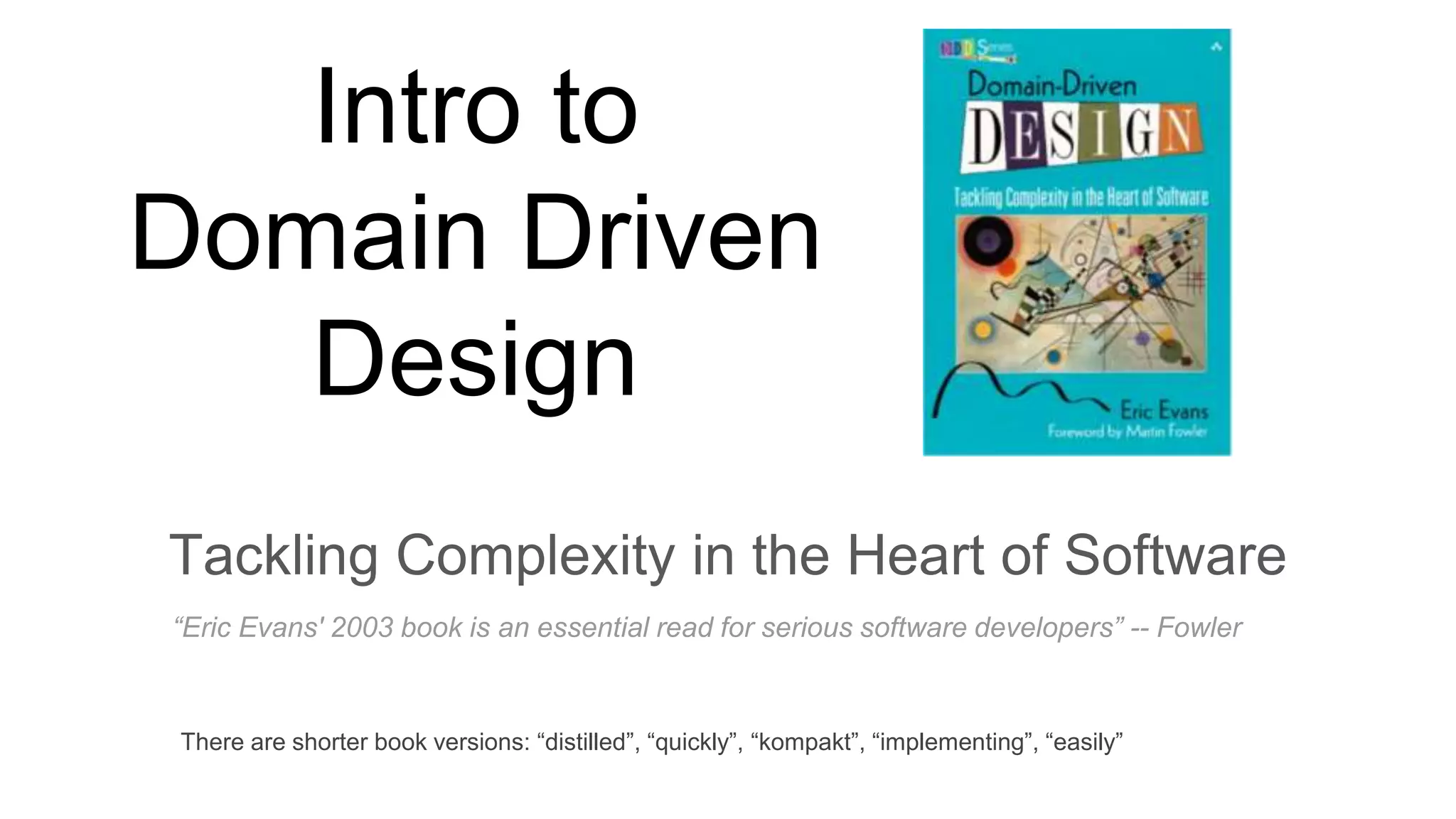
Tackling Complexity in the Heart of Software
“Eric Evans' 2003 book is an essential read for serious software developers” -- Fowler
There are shorter book versions: “distilled”, “quickly”, “kompakt”, “implementing”, “easily”
WIIFM
● Get to know a development approach for complex domains
● Closer internal stakeholder collaboration
● Better architecture (loosely-coupled, cohesive)
○ Easier to change
○ Safer to change - less incidents due to inter-team misalignments
● Companies that exercise DDD were more successful for a long time
● Can be the basis of future breaking of a monolith
● Additional paths of refactoring, not only technical
Images from the DDD book and Martin Fowler’s website
Model
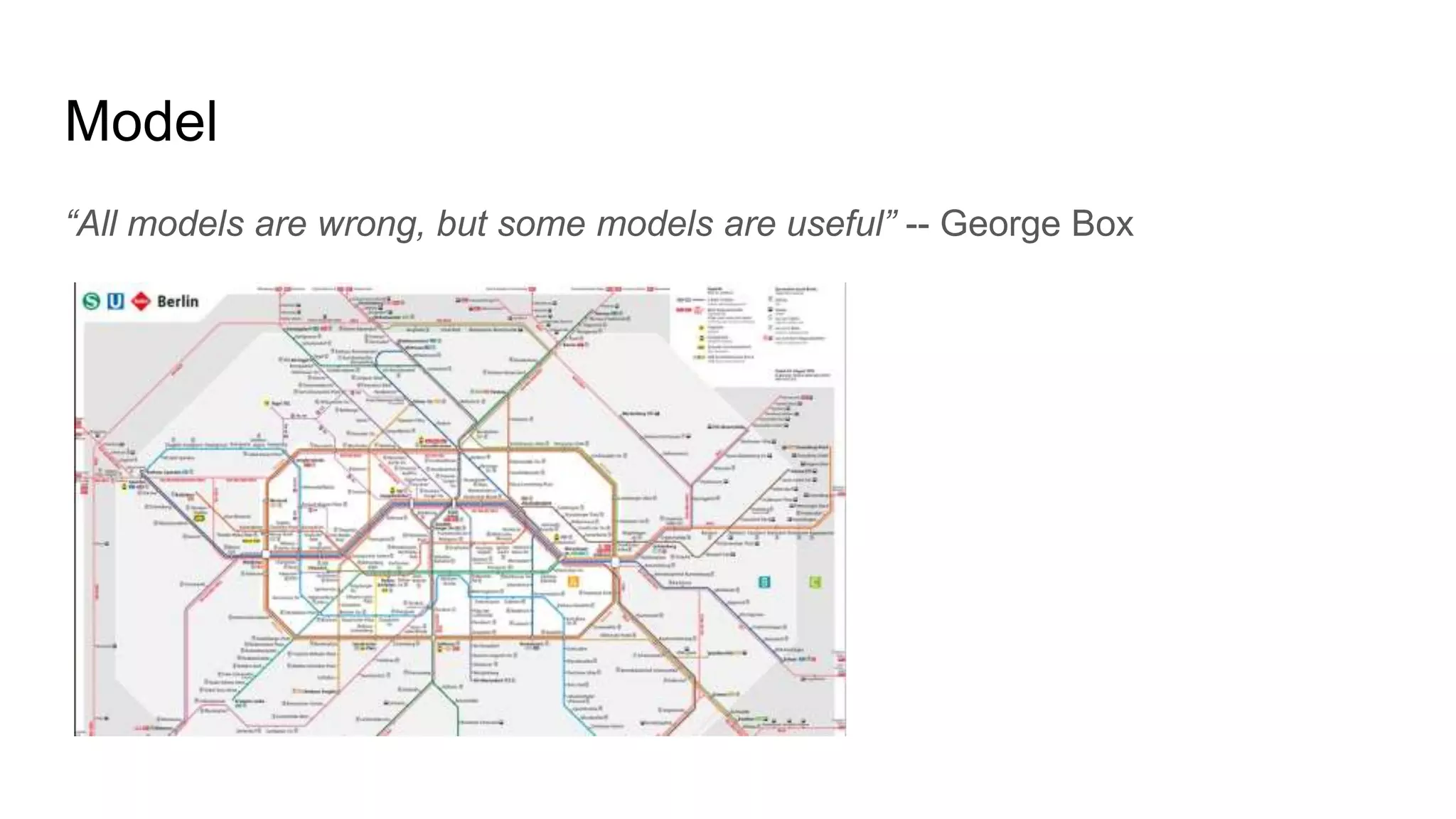
“All models are wrong, but some models are useful” -- George Box
Ubiquitous Language
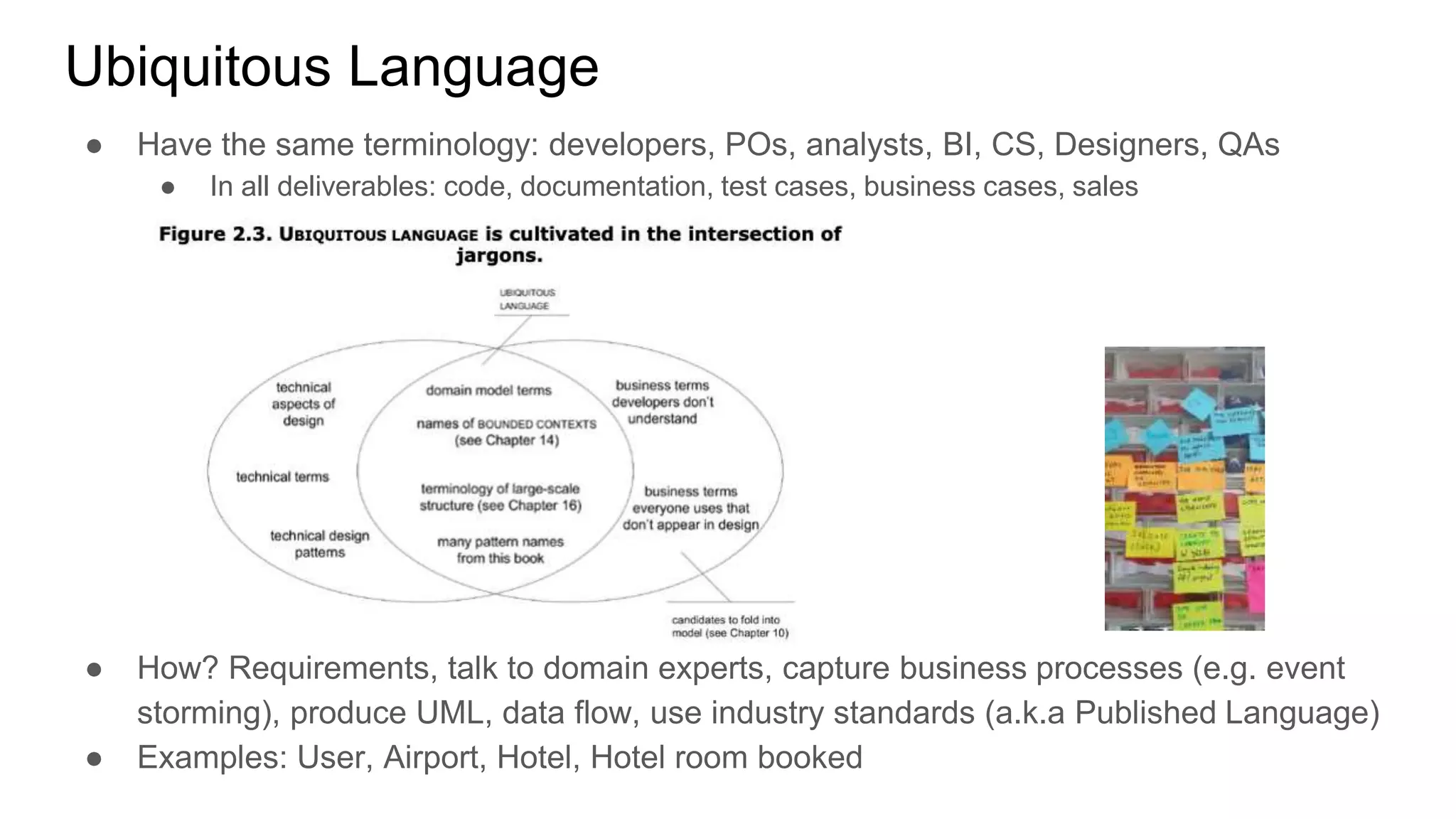
● Have the same terminology: developers, POs, analysts, BI, CS, Designers, QAs
● In all deliverables: code, documentation, test cases, business cases, sales
● How? Requirements, talk to domain experts, capture business processes (e.g. event
storming), produce UML, data flow, use industry standards (a.k.a Published Language)
● Examples: User, Airport, Hotel, Hotel room booked
Isolating the domain in the code
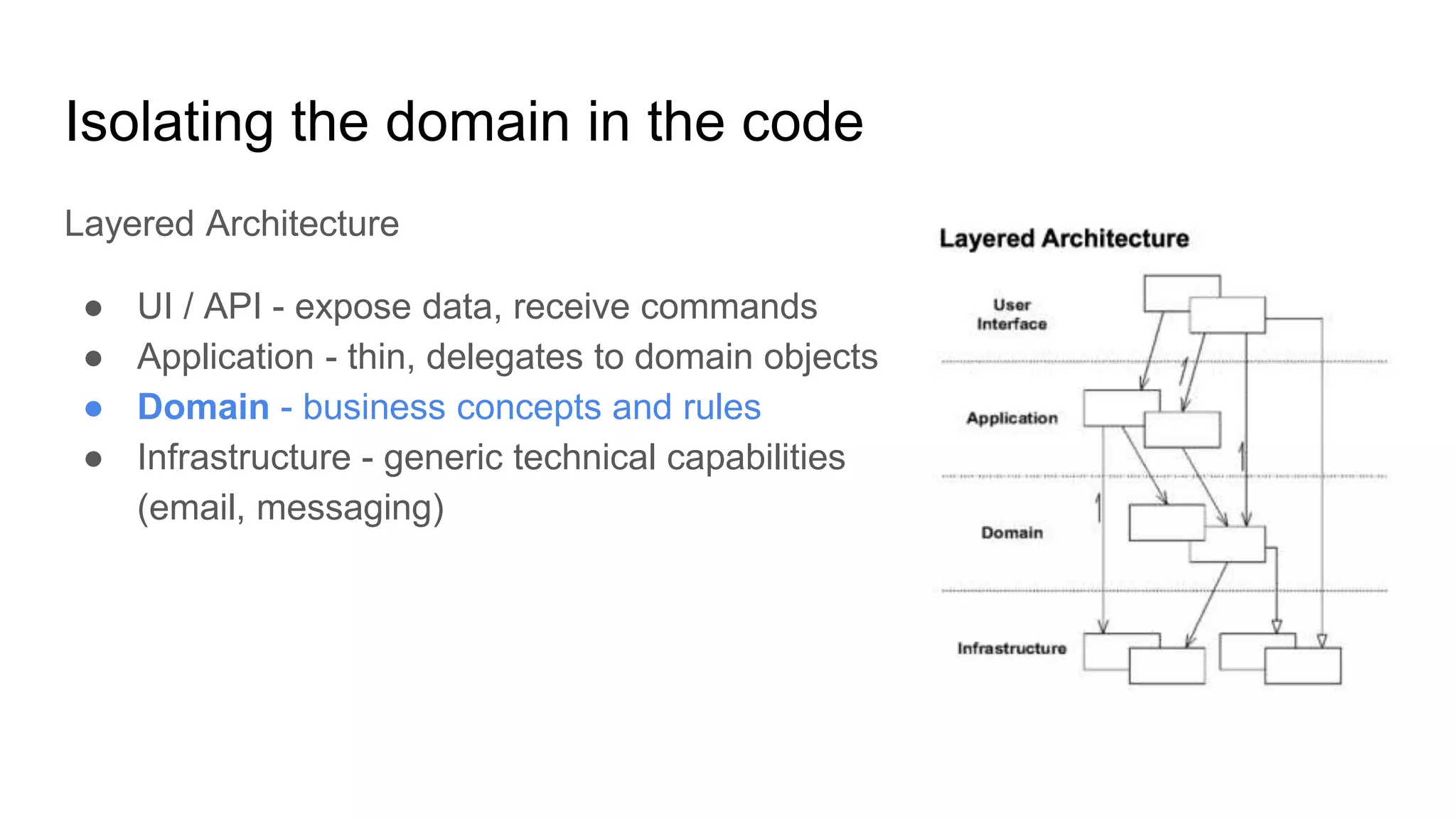
Layered Architecture
● UI / API - expose data, receive commands
● Application - thin, delegates to domain objects
● Domain - business concepts and rules
● Infrastructure - generic technical capabilities
(email, messaging)
Building Blocks
● Entity
○ Has identity, is persisted, is mutable
○ Examples: marked bills, hotel
● Value Object
○ Defined by its attributes, is immutable, depends on Entity
○ Example: unmarked bills, company address
● Aggregate - group of entities and value objects.
○ Example: Purchase (the root), invoice, transactions
● Service
○ Domain business process, has no state
○ Example: book a room
● Factory
○ A common design pattern for encapsulating the building (non-trivial) objects
○ Example: Computer object
Storing and retrieving (working with database)
● Repository (aggregates persistence)
A common persistence design pattern (in contrast to Rails’ ActiveRecord)
○ Retrieve collections and associations
■ Example: retrieve all applications with status “pending” and their associated recruiters
○ Store “unit of work”
■ Example: store a purchase with its invoice and transactions
● ORM (Object/Relational Mapping)
○ Map between in-memory objects and the database
○ Reduce cognitive load
Building Blocks Summary
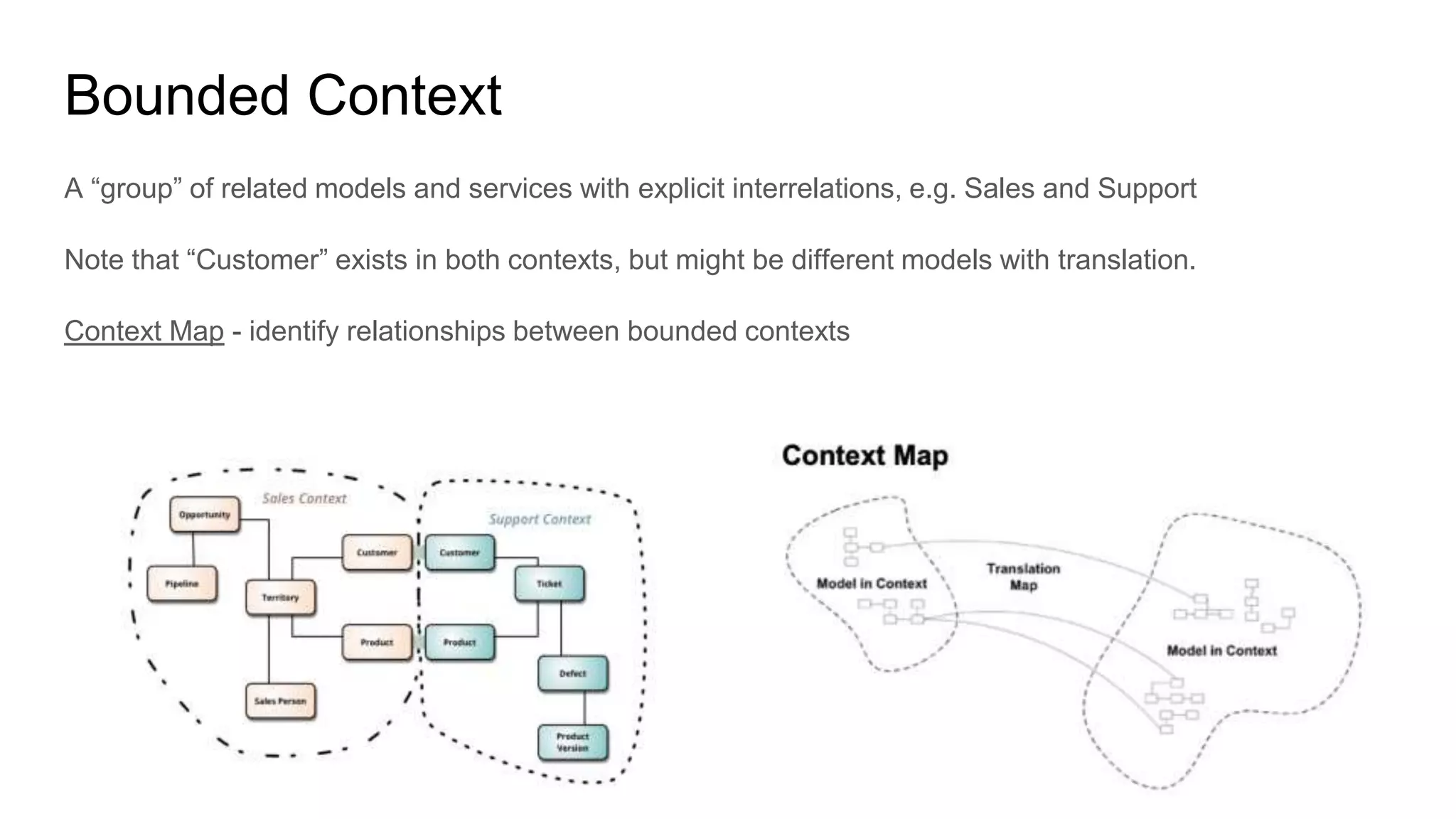
Bounded Context
A “group” of related models and services with explicit interrelations, e.g. Sales and Support
Note that “Customer” exists in both contexts, but might be different models with translation.
Context Map - identify relationships between bounded contexts
Inter-Team relationships
● Shared kernel
● Customer-supplier
● Conformist
● Separate ways
● Anticorruption layer
Conway’s Law: Any organization that designs a system, will produce a design whose structure is a copy of the organization's communication
structure
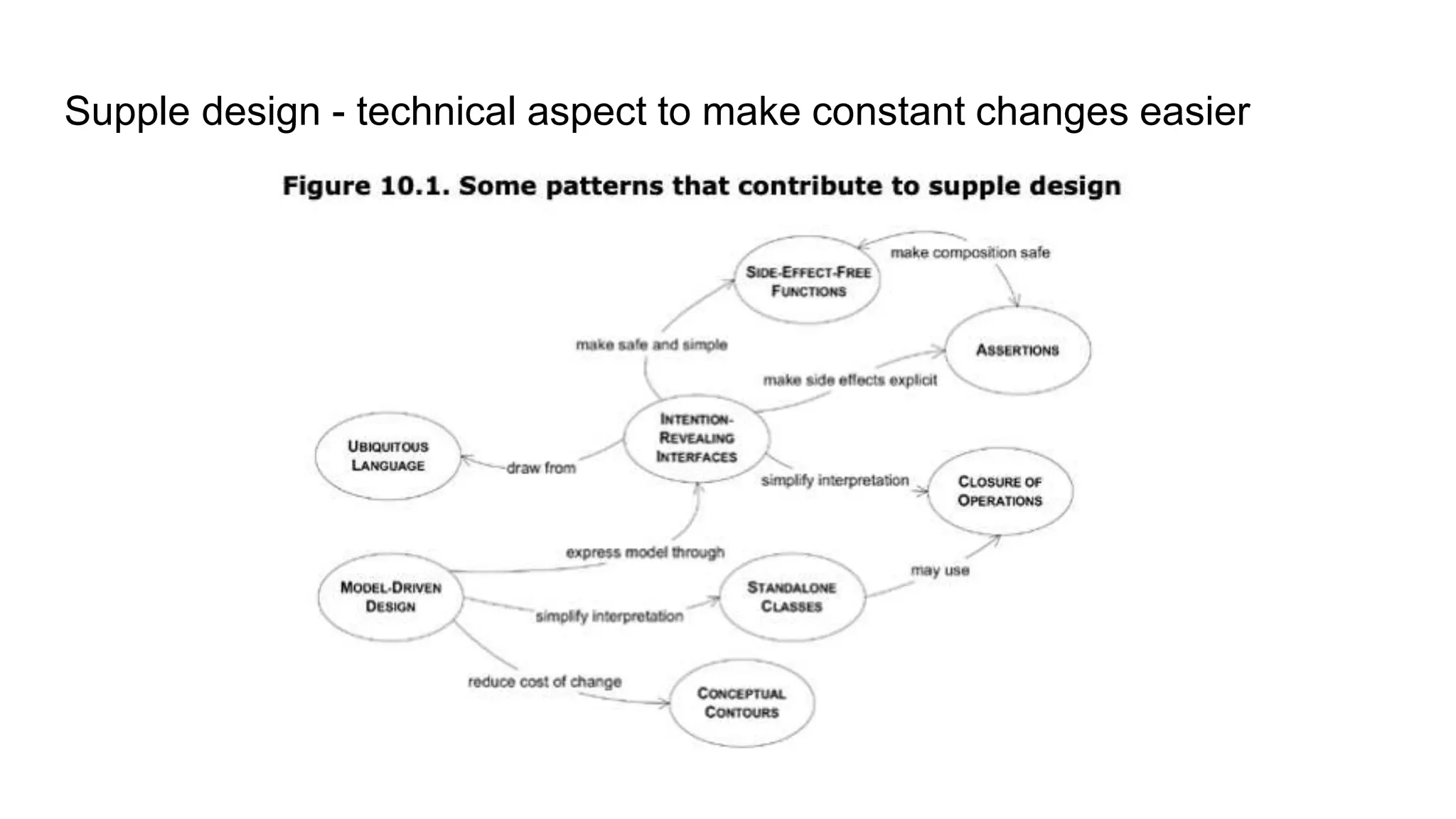
Supple design - technical aspect to make constant changes easier
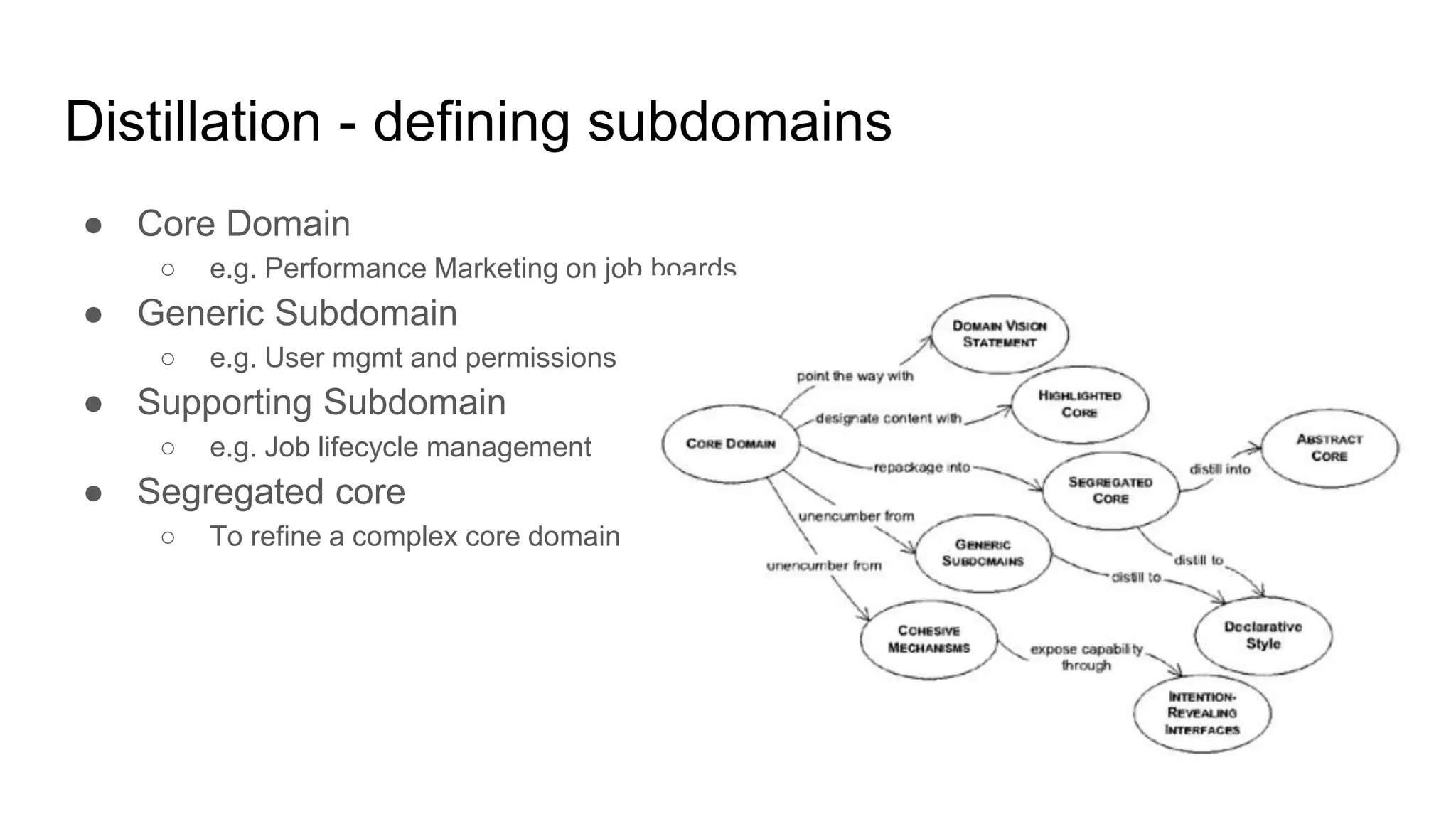
Distillation - defining subdomains
● Core Domain
○ e.g. Performance Marketing on job boards
● Generic Subdomain
○ e.g. User mgmt and permissions
● Supporting Subdomain
○ e.g. Job lifecycle management
● Segregated core
○ To refine a complex core domain
Additional terminology
● Domain Events
○ Important events for domain experts (in code or not, inside bounded context or between)
● Event driven (architecture)
○ Components react to events emitted to a messaging solution
● Event sourcing (architecture)
○ Event driven where only events are stored, not current states
● Services / Microservices (architecture)
○ Can compose a bounded context, also third party services
● Design patterns
○ Examples: Anti corruption layer, composition, abstract factory, factory method, strategy,
adapter
● CQRS
○ Objects that read are not the objects that write
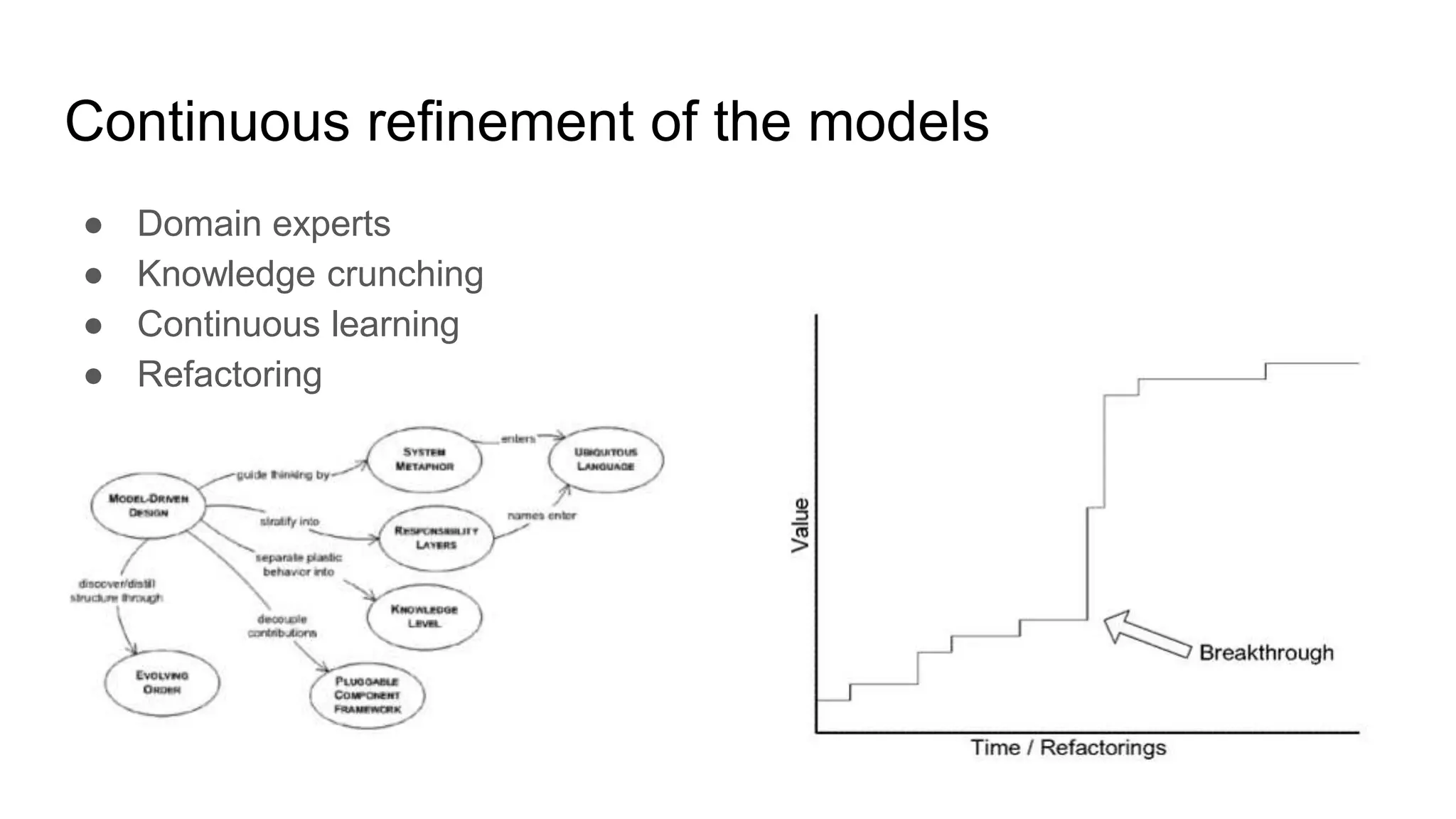
Continuous refinement of the models
● Domain experts
● Knowledge crunching
● Continuous learning
● Refactoring
Common Anti-patterns
● Implicit communications between cores/bounded contexts thru database
● Coupling unrelated objects / decoupling related objects
● Hidden business rules (Utils, small methods)
● Business logic in wrong layers: UI / Controller / DB
Within Ruby and Rails Ecosystem
● Ruby Modules ✅
● MVC ✅
● Thin controllers, service objects ✅
● ActiveRecord X (but can build repositories that call ActiveRecord scopes)
● ORM ✅
● CI ✅
● Automated tests ✅
● Refactoring ✅
● Messaging solutions ✅
How to start?
● Read the book
● Give an internal tech talk
● Discuss with team members, other teams, stakeholders
● Talk to domain experts
● Have event storming
● Identify one bounded context, refactor into namespaces
● Limit direct communication to/from this bounded context
● Refactor from domain perspective, not only technical
How to start?
● Elevate domain concepts and create explicit policy objects (e.g. VAT)
● Move logic only into domain objects
● In architecture evolution, keep DDD in mind
Resources
● The DDD book
● Eric Evans Talk
● Object Oriented Software Construction - Bertrand Meyer
● Working Effectively with Legacy Code - Robert C. Martin
● Design Patterns. Elements of Reusable Object-Oriented
Software - Erich Gamma
● https://github.com/ddd-crew/ddd-starter-modelling-process
● CQRS

Intro to Domain Driven Design

  • 1.
    Intro to Domain Driven Design TacklingComplexity in the Heart of Software “Eric Evans' 2003 book is an essential read for serious software developers” -- Fowler There are shorter book versions: “distilled”, “quickly”, “kompakt”, “implementing”, “easily”
  • 2.
    WIIFM ● Get toknow a development approach for complex domains ● Closer internal stakeholder collaboration ● Better architecture (loosely-coupled, cohesive) ○ Easier to change ○ Safer to change - less incidents due to inter-team misalignments ● Companies that exercise DDD were more successful for a long time ● Can be the basis of future breaking of a monolith ● Additional paths of refactoring, not only technical Images from the DDD book and Martin Fowler’s website
  • 3.
    Model “All models arewrong, but some models are useful” -- George Box
  • 4.
    Ubiquitous Language ● Havethe same terminology: developers, POs, analysts, BI, CS, Designers, QAs ● In all deliverables: code, documentation, test cases, business cases, sales ● How? Requirements, talk to domain experts, capture business processes (e.g. event storming), produce UML, data flow, use industry standards (a.k.a Published Language) ● Examples: User, Airport, Hotel, Hotel room booked
  • 5.
    Isolating the domainin the code Layered Architecture ● UI / API - expose data, receive commands ● Application - thin, delegates to domain objects ● Domain - business concepts and rules ● Infrastructure - generic technical capabilities (email, messaging)
  • 6.
    Building Blocks ● Entity ○Has identity, is persisted, is mutable ○ Examples: marked bills, hotel ● Value Object ○ Defined by its attributes, is immutable, depends on Entity ○ Example: unmarked bills, company address ● Aggregate - group of entities and value objects. ○ Example: Purchase (the root), invoice, transactions ● Service ○ Domain business process, has no state ○ Example: book a room ● Factory ○ A common design pattern for encapsulating the building (non-trivial) objects ○ Example: Computer object
  • 7.
    Storing and retrieving(working with database) ● Repository (aggregates persistence) A common persistence design pattern (in contrast to Rails’ ActiveRecord) ○ Retrieve collections and associations ■ Example: retrieve all applications with status “pending” and their associated recruiters ○ Store “unit of work” ■ Example: store a purchase with its invoice and transactions ● ORM (Object/Relational Mapping) ○ Map between in-memory objects and the database ○ Reduce cognitive load
  • 8.
  • 9.
    Bounded Context A “group”of related models and services with explicit interrelations, e.g. Sales and Support Note that “Customer” exists in both contexts, but might be different models with translation. Context Map - identify relationships between bounded contexts
  • 10.
    Inter-Team relationships ● Sharedkernel ● Customer-supplier ● Conformist ● Separate ways ● Anticorruption layer Conway’s Law: Any organization that designs a system, will produce a design whose structure is a copy of the organization's communication structure
  • 11.
    Supple design -technical aspect to make constant changes easier
  • 12.
    Distillation - definingsubdomains ● Core Domain ○ e.g. Performance Marketing on job boards ● Generic Subdomain ○ e.g. User mgmt and permissions ● Supporting Subdomain ○ e.g. Job lifecycle management ● Segregated core ○ To refine a complex core domain
  • 13.
    Additional terminology ● DomainEvents ○ Important events for domain experts (in code or not, inside bounded context or between) ● Event driven (architecture) ○ Components react to events emitted to a messaging solution ● Event sourcing (architecture) ○ Event driven where only events are stored, not current states ● Services / Microservices (architecture) ○ Can compose a bounded context, also third party services ● Design patterns ○ Examples: Anti corruption layer, composition, abstract factory, factory method, strategy, adapter ● CQRS ○ Objects that read are not the objects that write
  • 14.
    Continuous refinement ofthe models ● Domain experts ● Knowledge crunching ● Continuous learning ● Refactoring
  • 15.
    Common Anti-patterns ● Implicitcommunications between cores/bounded contexts thru database ● Coupling unrelated objects / decoupling related objects ● Hidden business rules (Utils, small methods) ● Business logic in wrong layers: UI / Controller / DB
  • 16.
    Within Ruby andRails Ecosystem ● Ruby Modules ✅ ● MVC ✅ ● Thin controllers, service objects ✅ ● ActiveRecord X (but can build repositories that call ActiveRecord scopes) ● ORM ✅ ● CI ✅ ● Automated tests ✅ ● Refactoring ✅ ● Messaging solutions ✅
  • 17.
    How to start? ●Read the book ● Give an internal tech talk ● Discuss with team members, other teams, stakeholders ● Talk to domain experts ● Have event storming ● Identify one bounded context, refactor into namespaces ● Limit direct communication to/from this bounded context ● Refactor from domain perspective, not only technical
  • 18.
    How to start? ●Elevate domain concepts and create explicit policy objects (e.g. VAT) ● Move logic only into domain objects ● In architecture evolution, keep DDD in mind
  • 19.
    Resources ● The DDDbook ● Eric Evans Talk ● Object Oriented Software Construction - Bertrand Meyer ● Working Effectively with Legacy Code - Robert C. Martin ● Design Patterns. Elements of Reusable Object-Oriented Software - Erich Gamma ● https://github.com/ddd-crew/ddd-starter-modelling-process ● CQRS