Professor In Charge: Dr Amsaprabhaa Mathivaanan
Shiv Nadar University Chennai
R Hridya Shree (220111011086)
Sannidhay Jangam
(220111011100)
Introduction To Spark SQL
2.
• Apache Sparkis a lightning-fast, open-source cluster computing
technology designed for big data analytics, offering exceptional
performance through in-memory computation and support for a wide
array of workloads including batch, streaming, interactive, graph, and
machine learning processing.
Introduction To Spark SQL
3.
• Spark wascreated at UC Berkeley’s AMPLab to overcome limitations
of Hadoop MapReduce, especially the delays and complexity in
query execution and iterative algorithms.
• It was open-sourced and later became an Apache top-level project,
marking milestones in unified DataFrame/Dataset APIs and
distributed machine learning support.
• The need for Spark grew from the requirement to process real-time
streams as well as batch data, respond quickly to queries, and
efficiently use system memory.
Evolution and Motivation
4.
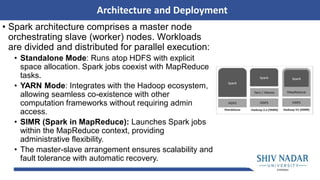
• Spark architecturecomprises a master node
orchestrating slave (worker) nodes. Workloads
are divided and distributed for parallel execution:
• Standalone Mode: Runs atop HDFS with explicit
space allocation. Spark jobs coexist with MapReduce
tasks.
• YARN Mode: Integrates with the Hadoop ecosystem,
allowing seamless co-existence with other
computation frameworks without requiring admin
access.
• SIMR (Spark in MapReduce): Launches Spark jobs
within the MapReduce context, providing
administrative flexibility.
• The master-slave arrangement ensures scalability and
fault tolerance with automatic recovery.
Architecture and Deployment
5.
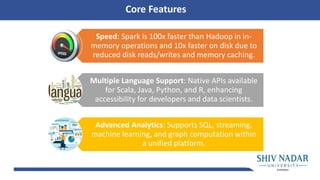
Speed: Spark is100x faster than Hadoop in in-
memory operations and 10x faster on disk due to
reduced disk reads/writes and memory caching.
Multiple Language Support: Native APIs available
for Scala, Java, Python, and R, enhancing
accessibility for developers and data scientists.
Advanced Analytics: Supports SQL, streaming,
machine learning, and graph computation within
a unified platform.
Core Features
6.
Major Components
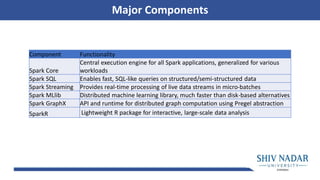
Component Functionality
SparkCore
Central execution engine for all Spark applications, generalized for various
workloads
Spark SQL Enables fast, SQL-like queries on structured/semi-structured data
Spark Streaming Provides real-time processing of live data streams in micro-batches
Spark MLlib Distributed machine learning library, much faster than disk-based alternatives
Spark GraphX API and runtime for distributed graph computation using Pregel abstraction
SparkR Lightweight R package for interactive, large-scale data analysis
7.
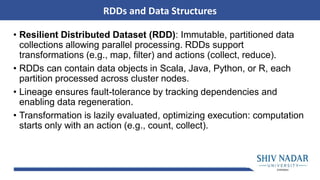
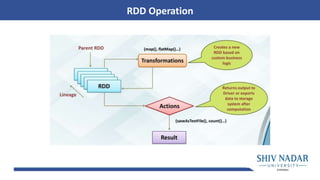
• Resilient DistributedDataset (RDD): Immutable, partitioned data
collections allowing parallel processing. RDDs support
transformations (e.g., map, filter) and actions (collect, reduce).
• RDDs can contain data objects in Scala, Java, Python, or R, each
partition processed across cluster nodes.
• Lineage ensures fault-tolerance by tracking dependencies and
enabling data regeneration.
• Transformation is lazily evaluated, optimizing execution: computation
starts only with an action (e.g., count, collect).
RDDs and Data Structures
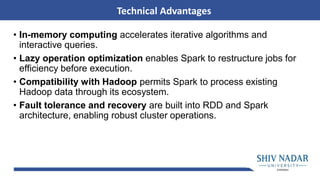
• In-memory computingaccelerates iterative algorithms and
interactive queries.
• Lazy operation optimization enables Spark to restructure jobs for
efficiency before execution.
• Compatibility with Hadoop permits Spark to process existing
Hadoop data through its ecosystem.
• Fault tolerance and recovery are built into RDD and Spark
architecture, enabling robust cluster operations.
Technical Advantages
10.
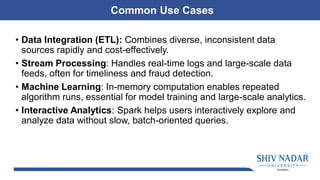
• Data Integration(ETL): Combines diverse, inconsistent data
sources rapidly and cost-effectively.
• Stream Processing: Handles real-time logs and large-scale data
feeds, often for timeliness and fraud detection.
• Machine Learning: In-memory computation enables repeated
algorithm runs, essential for model training and large-scale analytics.
• Interactive Analytics: Spark helps users interactively explore and
analyze data without slow, batch-oriented queries.
Common Use Cases
11.
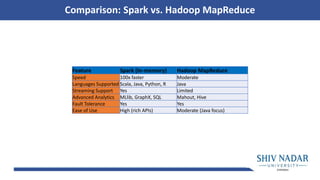
Comparison: Spark vs.Hadoop MapReduce
Feature Spark (In-memory) Hadoop MapReduce
Speed 100x faster Moderate
Languages Supported Scala, Java, Python, R Java
Streaming Support Yes Limited
Advanced Analytics MLlib, GraphX, SQL Mahout, Hive
Fault Tolerance Yes Yes
Ease of Use High (rich APIs) Moderate (Java focus)