Intravenous fluid
therapy during
anesthesia
By Dr. Ahamd Y. Alansi
January 2018 1
Headlines:
• Why it is important to know about fluids
therapy?
• Definitions
• Fluids compartments
• Assessment of dehydrated patient
• Options of fluids replacement
• Calculations
2
Why it is important to know about fluids
therapy?
•To compensate fluid deficits
•To maintain electrolyte balance
•To correct Acid–base disorders
•To treat some disease e.g. renal
3
Definitions :
• (SI):The system of international units
• Mole :One mole of a substance represents 6.02 ×
10 23 molecules
• Molarity: the number of moles of solute per liter of
solution.
• Molality : moles of solute per kilogram of solvent.
• Equivalency is used for ionize: is the number of
moles multiplied by its charge (valence).
4
Definitions :
• Osmosis is the net movement of water across a
semipermeable membrane as a result of a difference
in non-diffusible solute concentrations between the
two sides.
• Osmotic pressure is the pressure that must be
applied to the side with more solute to prevent a net
movement of water across the membrane to dilute
the solute.
5
Definitions :
• Osmolarity of a solution is equal to the number of
osmoles per liter of solution,
• Osmolality equals the number of osmoles per kilogram
of solvent.
• Tonicity, a term that is often used interchangeably with
osmolarity and osmolality, refers to the effect a
solution has on cell volume.
• An isotonic solution has no effect on cell volume,
• hypotonic increase cell volume.
• hypertonic decrease cell volume.
6
Fluids compartments:
• potassium is the most important
determinant of intracellular
osmotic pressure, sodium is the
most important determinant of
extracellular osmotic pressure
7
Fluids compartments:
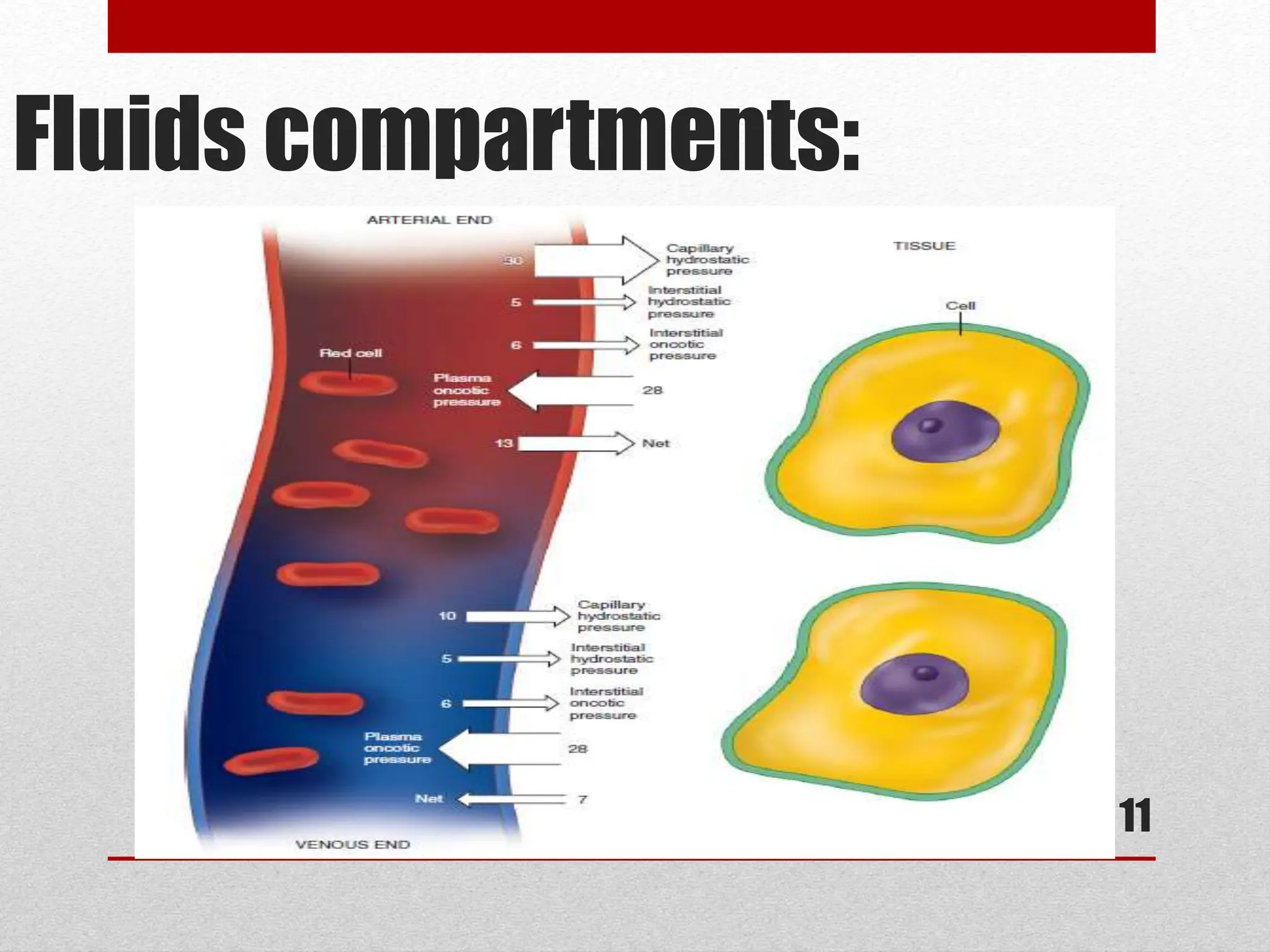
• When interstitial fluid and pressure increase
rapidly, it appears clinically as edema.
• Most electrolytes (small ions) freely pass
between plasma and the interstitium, resulting in
nearly identical electrolyte composition
• Plasma proteins (mainly albumin) are the only
osmotically active solutes in fluid not normally
exchanged between plasma and interstitial fluid.
8
Fluids compartments:
• The rate of diffusion of a substance across a
membrane depends upon:
• (1) permeability of that substance through that
membrane.
• (2) concentration difference for that substance
between the two sides.
• (3) pressure difference between either side
because pressure imparts greater kinetic energy.
• (4) electrical potential across the membrane for
charged substances. 9
Fluids compartments:
• Diffusion between interstitial fluid and ICF may
take place by one of several mechanisms:
• (1) directly through the lipid bilayer of the cell
membrane, eg. Oxygen, CO2, water, and lipid-soluble molecules
• (2) through protein channels within the
membrane eg.Cations such as Na+, K+, and Ca2+
• (3) by reversible binding to a carrier protein that
can traverse the membrane (facilitated diffusion)
eg. Glucose and amino acids 10
Fluids compartments:
11
Assessment of dehydrated patient:
12
History:
• Recent oral intake
• vomiting
• Diarrhea
• gastrointestinal preparation before bowel surgery
• recent significant blood loss
• wound drainage
• intravenous fluid intake
• recent hemodialysis
Assessment of dehydrated patient:
13
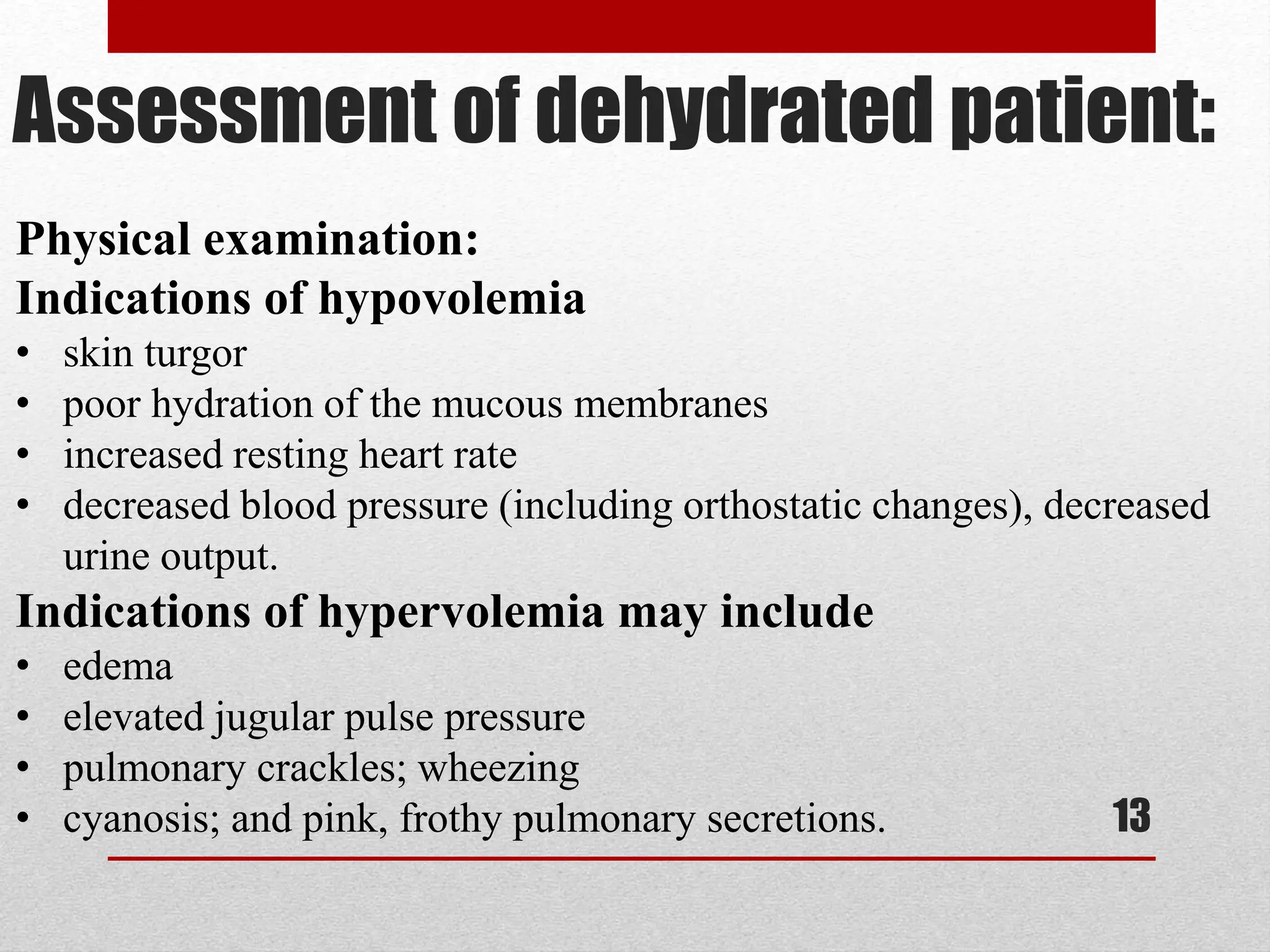
Physical examination:
Indications of hypovolemia
• skin turgor
• poor hydration of the mucous membranes
• increased resting heart rate
• decreased blood pressure (including orthostatic changes), decreased
urine output.
Indications of hypervolemia may include
• edema
• elevated jugular pulse pressure
• pulmonary crackles; wheezing
• cyanosis; and pink, frothy pulmonary secretions.
Assessment of dehydrated patient:
14
Assessment of dehydrated patient:
15
Laboratory evaluation:
• rising hematocrit (acute blood loss will not result in an
acute change of hematocrit)
• metabolic acidosis
• urinary specific gravity greater that 1.010
• urinary sodium less than 10 mEq/L,
• hypernatremia
• ratio of blood urea nitrogen to creatinine > 10:1.
Hemodynamic measurements:
• Central venous pressure (CVP)
• Pulmonary artery (PA) catheter
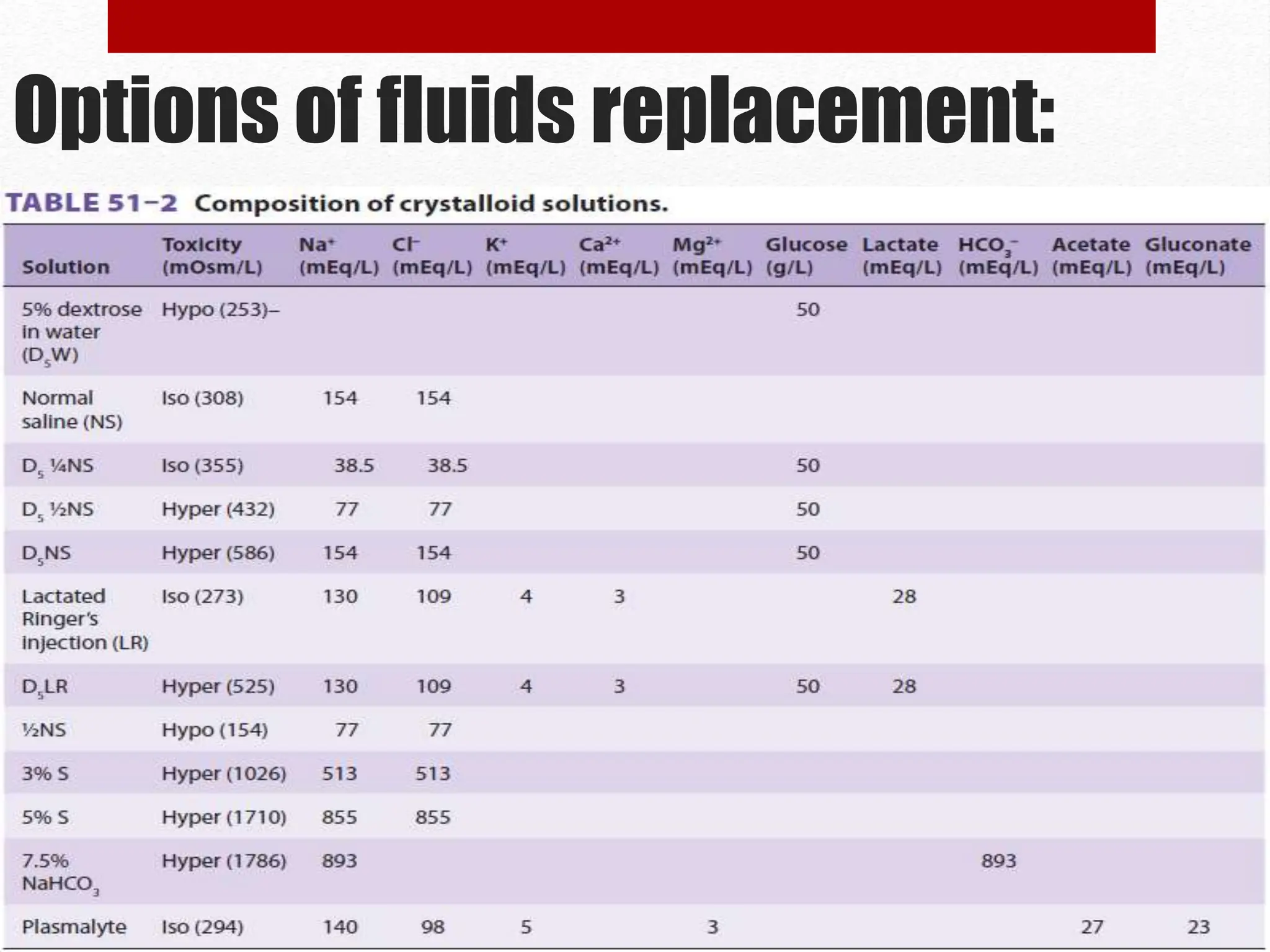
Options of fluids replacement:
16
Crystalloid solutions: (The intravascular half-life is between 20-30 min.)
• initial resuscitation fluid in hemorrhagic and septic shock, burns, and
traumatic brain injuries
• NPO >>>hypotonic solutions e.g. DW5% specially pediatric
• If losses involve water, electrolytes (i.e., blood loss), replacement is with
isotonic electrolyte solutions.
Colloid solutions: (The intravascular half-life is between 3 and 6 hours).
• derived either from plasma proteins or synthetic glucose polymers.
• Crystalloid versus colloid an ongoing debate
• albumin (5% and 25%) is justified in the hypoalbuminemia or large burns
(large protein loss).
• risk of antiplatelet effects & should not be administered > 20 mL/kg/day.
• The dextrans have also been found to be antigenic and can produce
anaphylactoid reactions.
Options of fluids replacement:
17
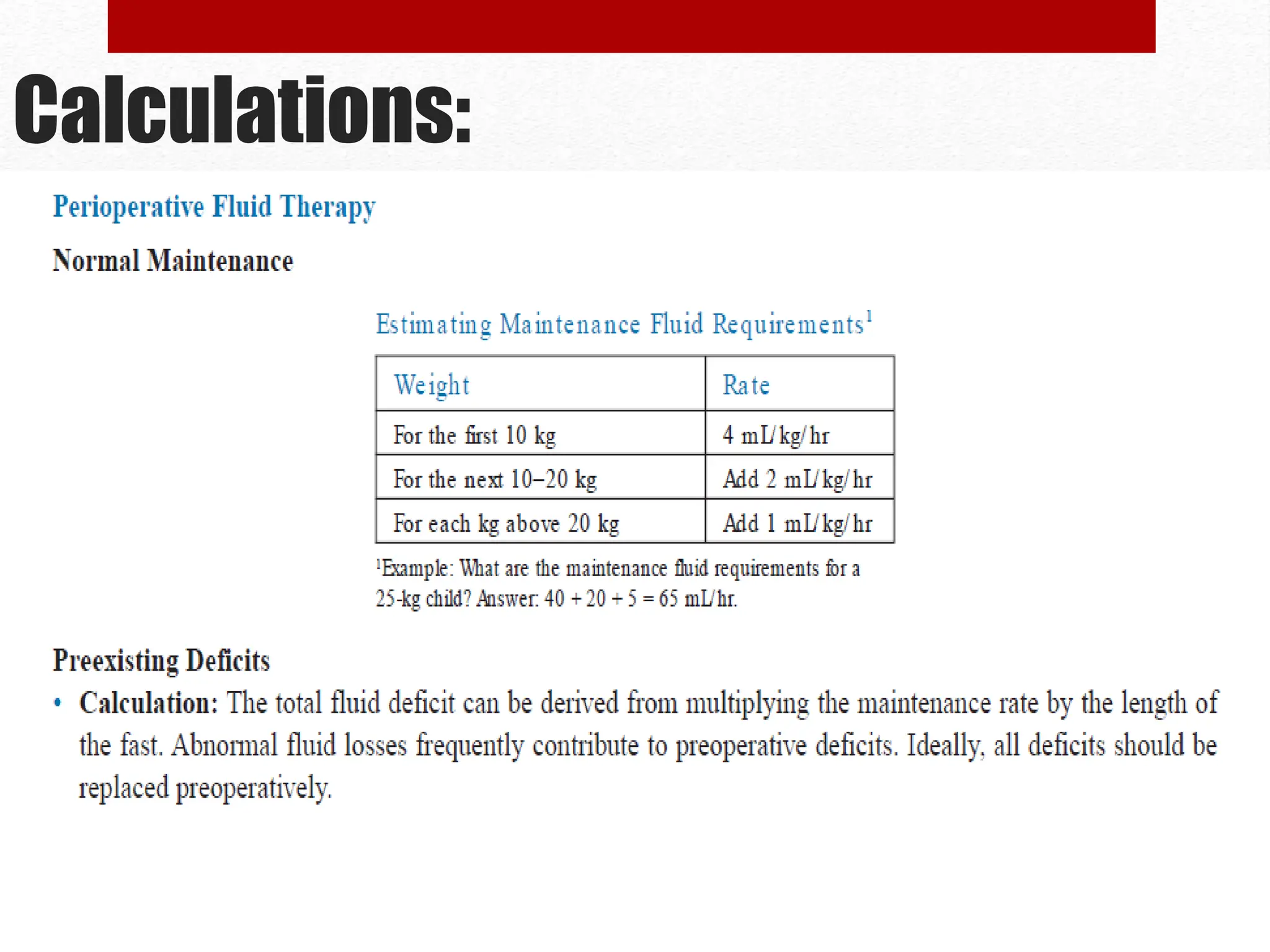
Calculations:
18
‫الستماعكم‬ ‫شكرا‬ 19

Intravenous fluid therapy during anesthesia.pptx

  • 1.
    Intravenous fluid therapy during anesthesia ByDr. Ahamd Y. Alansi January 2018 1
  • 2.
    Headlines: • Why itis important to know about fluids therapy? • Definitions • Fluids compartments • Assessment of dehydrated patient • Options of fluids replacement • Calculations 2
  • 3.
    Why it isimportant to know about fluids therapy? •To compensate fluid deficits •To maintain electrolyte balance •To correct Acid–base disorders •To treat some disease e.g. renal 3
  • 4.
    Definitions : • (SI):Thesystem of international units • Mole :One mole of a substance represents 6.02 × 10 23 molecules • Molarity: the number of moles of solute per liter of solution. • Molality : moles of solute per kilogram of solvent. • Equivalency is used for ionize: is the number of moles multiplied by its charge (valence). 4
  • 5.
    Definitions : • Osmosisis the net movement of water across a semipermeable membrane as a result of a difference in non-diffusible solute concentrations between the two sides. • Osmotic pressure is the pressure that must be applied to the side with more solute to prevent a net movement of water across the membrane to dilute the solute. 5
  • 6.
    Definitions : • Osmolarityof a solution is equal to the number of osmoles per liter of solution, • Osmolality equals the number of osmoles per kilogram of solvent. • Tonicity, a term that is often used interchangeably with osmolarity and osmolality, refers to the effect a solution has on cell volume. • An isotonic solution has no effect on cell volume, • hypotonic increase cell volume. • hypertonic decrease cell volume. 6
  • 7.
    Fluids compartments: • potassiumis the most important determinant of intracellular osmotic pressure, sodium is the most important determinant of extracellular osmotic pressure 7
  • 8.
    Fluids compartments: • Wheninterstitial fluid and pressure increase rapidly, it appears clinically as edema. • Most electrolytes (small ions) freely pass between plasma and the interstitium, resulting in nearly identical electrolyte composition • Plasma proteins (mainly albumin) are the only osmotically active solutes in fluid not normally exchanged between plasma and interstitial fluid. 8
  • 9.
    Fluids compartments: • Therate of diffusion of a substance across a membrane depends upon: • (1) permeability of that substance through that membrane. • (2) concentration difference for that substance between the two sides. • (3) pressure difference between either side because pressure imparts greater kinetic energy. • (4) electrical potential across the membrane for charged substances. 9
  • 10.
    Fluids compartments: • Diffusionbetween interstitial fluid and ICF may take place by one of several mechanisms: • (1) directly through the lipid bilayer of the cell membrane, eg. Oxygen, CO2, water, and lipid-soluble molecules • (2) through protein channels within the membrane eg.Cations such as Na+, K+, and Ca2+ • (3) by reversible binding to a carrier protein that can traverse the membrane (facilitated diffusion) eg. Glucose and amino acids 10
  • 11.
  • 12.
    Assessment of dehydratedpatient: 12 History: • Recent oral intake • vomiting • Diarrhea • gastrointestinal preparation before bowel surgery • recent significant blood loss • wound drainage • intravenous fluid intake • recent hemodialysis
  • 13.
    Assessment of dehydratedpatient: 13 Physical examination: Indications of hypovolemia • skin turgor • poor hydration of the mucous membranes • increased resting heart rate • decreased blood pressure (including orthostatic changes), decreased urine output. Indications of hypervolemia may include • edema • elevated jugular pulse pressure • pulmonary crackles; wheezing • cyanosis; and pink, frothy pulmonary secretions.
  • 14.
  • 15.
    Assessment of dehydratedpatient: 15 Laboratory evaluation: • rising hematocrit (acute blood loss will not result in an acute change of hematocrit) • metabolic acidosis • urinary specific gravity greater that 1.010 • urinary sodium less than 10 mEq/L, • hypernatremia • ratio of blood urea nitrogen to creatinine > 10:1. Hemodynamic measurements: • Central venous pressure (CVP) • Pulmonary artery (PA) catheter
  • 16.
    Options of fluidsreplacement: 16 Crystalloid solutions: (The intravascular half-life is between 20-30 min.) • initial resuscitation fluid in hemorrhagic and septic shock, burns, and traumatic brain injuries • NPO >>>hypotonic solutions e.g. DW5% specially pediatric • If losses involve water, electrolytes (i.e., blood loss), replacement is with isotonic electrolyte solutions. Colloid solutions: (The intravascular half-life is between 3 and 6 hours). • derived either from plasma proteins or synthetic glucose polymers. • Crystalloid versus colloid an ongoing debate • albumin (5% and 25%) is justified in the hypoalbuminemia or large burns (large protein loss). • risk of antiplatelet effects & should not be administered > 20 mL/kg/day. • The dextrans have also been found to be antigenic and can produce anaphylactoid reactions.
  • 17.
    Options of fluidsreplacement: 17
  • 18.
  • 19.