Interview
Interview
• face to face encounter usually
  between two people in order to
  exchange information

• insights from people who
  specialize in a particular field
Interview
• provides a different perspective
  about your research not available
  from printed sources

• alternative source of information
Stages of Interview

 1. Pre-interview
 2. Interview Proper
 3. Post-interview
Pre-interview
1. Determine your purpose of
   interview

2. Research about the topic

3. Choose the interviewee
Pre-interview
4. Prepare for the interview

5. Prepare an Interview
 Guide
Interview Proper
  1. Opening
  2. Body
  3. Closing
Interview Proper
• Opening
     -tone of the interview is set

     -establish rapport

     -introduce yourself, say your
     purpose, describe the scope
Interview Proper
• Body
  -main part of the interview
Interview Proper
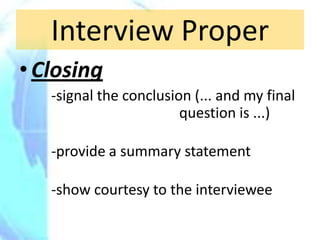
• Closing
   -signal the conclusion (... and my final
                        question is ...)

   -provide a summary statement

   -show courtesy to the interviewee
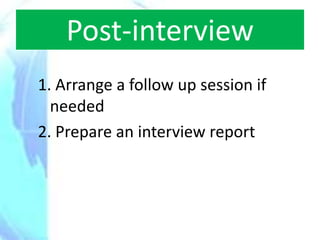
Post-interview
1. Arrange a follow up session if
  needed
2. Prepare an interview report
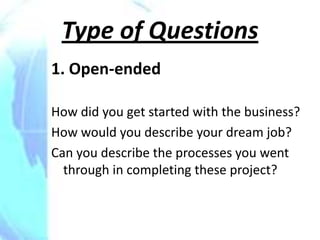
Type of Questions
1. Open-ended

How did you get started with the business?
How would you describe your dream job?
Can you describe the processes you went
  through in completing these project?
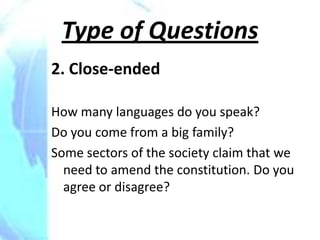
Type of Questions
2. Close-ended

How many languages do you speak?
Do you come from a big family?
Some sectors of the society claim that we
  need to amend the constitution. Do you
  agree or disagree?
Type of Questions
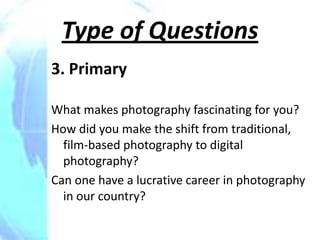
3. Primary

What makes photography fascinating for you?
How did you make the shift from traditional,
  film-based photography to digital
  photography?
Can one have a lucrative career in photography
  in our country?
Type of Questions
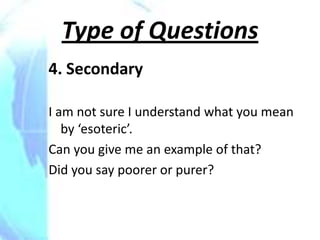
4. Secondary

I am not sure I understand what you mean
   by ‘esoteric’.
Can you give me an example of that?
Did you say poorer or purer?
Type of Questions
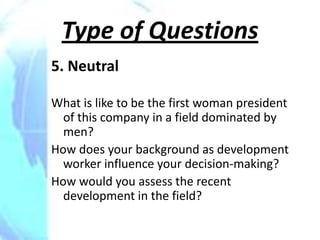
5. Neutral

What is like to be the first woman president
  of this company in a field dominated by
  men?
How does your background as development
  worker influence your decision-making?
How would you assess the recent
  development in the field?
Type of Questions
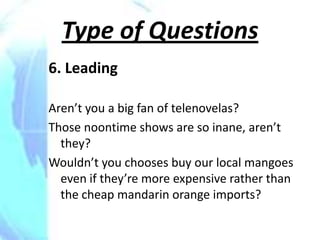
6. Leading

Aren’t you a big fan of telenovelas?
Those noontime shows are so inane, aren’t
  they?
Wouldn’t you chooses buy our local mangoes
  even if they’re more expensive rather than
  the cheap mandarin orange imports?
Type of Questions
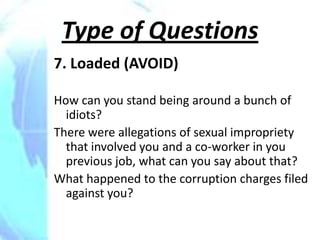
7. Loaded (AVOID)

How can you stand being around a bunch of
  idiots?
There were allegations of sexual impropriety
  that involved you and a co-worker in you
  previous job, what can you say about that?
What happened to the corruption charges filed
  against you?
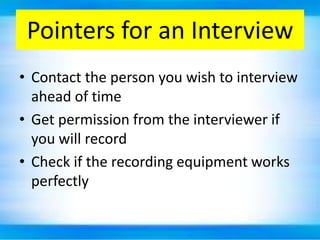
Pointers for an Interview
• Contact the person you wish to interview
  ahead of time
• Get permission from the interviewer if
  you will record
• Check if the recording equipment works
  perfectly
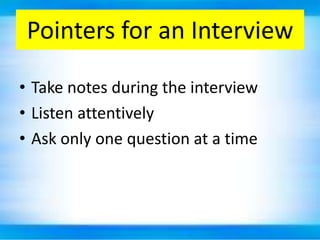
Pointers for an Interview

• Take notes during the interview
• Listen attentively
• Ask only one question at a time
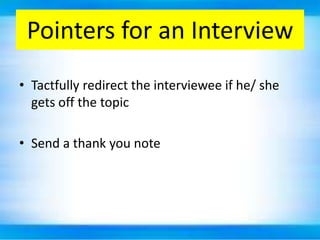
Pointers for an Interview
• Tactfully redirect the interviewee if he/ she
  gets off the topic

• Send a thank you note
Preparing an Interview Report
• Begin with a brief background about the
  interview situation (where, when, why,
  who)
• Focus on the main discussion of the
  heart of the interview
• Use a quotation when the interviewer
  said something striking
Preparing an Interview Report
• Outline the main points discussed

• Paraphrase important ideas

• Use direct quotations
Preparing an Interview Report
• Ensure smooth flow of ideas

• Reinforce the closing by the highlights of the
  interview

• Summarize key points

• Reiterate a central message
References:
Plata, S. et.al. (2006). Research:
  Process and Product Workbook.
  Laguna: Trailblazer Publications.

Interview

  • 1.
  • 2.
    Interview • face toface encounter usually between two people in order to exchange information • insights from people who specialize in a particular field
  • 3.
    Interview • provides adifferent perspective about your research not available from printed sources • alternative source of information
  • 4.
    Stages of Interview 1. Pre-interview 2. Interview Proper 3. Post-interview
  • 5.
    Pre-interview 1. Determine yourpurpose of interview 2. Research about the topic 3. Choose the interviewee
  • 6.
    Pre-interview 4. Prepare forthe interview 5. Prepare an Interview Guide
  • 7.
    Interview Proper 1. Opening 2. Body 3. Closing
  • 8.
    Interview Proper • Opening -tone of the interview is set -establish rapport -introduce yourself, say your purpose, describe the scope
  • 9.
    Interview Proper • Body -main part of the interview
  • 10.
    Interview Proper • Closing -signal the conclusion (... and my final question is ...) -provide a summary statement -show courtesy to the interviewee
  • 11.
    Post-interview 1. Arrange afollow up session if needed 2. Prepare an interview report
  • 12.
    Type of Questions 1.Open-ended How did you get started with the business? How would you describe your dream job? Can you describe the processes you went through in completing these project?
  • 13.
    Type of Questions 2.Close-ended How many languages do you speak? Do you come from a big family? Some sectors of the society claim that we need to amend the constitution. Do you agree or disagree?
  • 14.
    Type of Questions 3.Primary What makes photography fascinating for you? How did you make the shift from traditional, film-based photography to digital photography? Can one have a lucrative career in photography in our country?
  • 15.
    Type of Questions 4.Secondary I am not sure I understand what you mean by ‘esoteric’. Can you give me an example of that? Did you say poorer or purer?
  • 16.
    Type of Questions 5.Neutral What is like to be the first woman president of this company in a field dominated by men? How does your background as development worker influence your decision-making? How would you assess the recent development in the field?
  • 17.
    Type of Questions 6.Leading Aren’t you a big fan of telenovelas? Those noontime shows are so inane, aren’t they? Wouldn’t you chooses buy our local mangoes even if they’re more expensive rather than the cheap mandarin orange imports?
  • 18.
    Type of Questions 7.Loaded (AVOID) How can you stand being around a bunch of idiots? There were allegations of sexual impropriety that involved you and a co-worker in you previous job, what can you say about that? What happened to the corruption charges filed against you?
  • 19.
    Pointers for anInterview • Contact the person you wish to interview ahead of time • Get permission from the interviewer if you will record • Check if the recording equipment works perfectly
  • 20.
    Pointers for anInterview • Take notes during the interview • Listen attentively • Ask only one question at a time
  • 21.
    Pointers for anInterview • Tactfully redirect the interviewee if he/ she gets off the topic • Send a thank you note
  • 22.
    Preparing an InterviewReport • Begin with a brief background about the interview situation (where, when, why, who) • Focus on the main discussion of the heart of the interview • Use a quotation when the interviewer said something striking
  • 23.
    Preparing an InterviewReport • Outline the main points discussed • Paraphrase important ideas • Use direct quotations
  • 24.
    Preparing an InterviewReport • Ensure smooth flow of ideas • Reinforce the closing by the highlights of the interview • Summarize key points • Reiterate a central message
  • 25.
    References: Plata, S. et.al.(2006). Research: Process and Product Workbook. Laguna: Trailblazer Publications.