Oxbridge Musical
Intervals
Intervals
Prerequisites
You will have learned about pitch, the position of
notes on and around the musical stave, and ledger
lines.
What you will cover in this session:
• Intervals
• Harmonic and Melodic Intervals
• Tones and Semitones
Intervals
An interval is a number that relates to the distance in pitch
between two notes.
In order to correctly determine the distance between the
two notes, and therefore correctly identify the interval
between those two notes, we begin counting from the first
note up to and including the second note, and including any
line or space that occurs between the two notes. For
example, the interval from E to B is a 5th. We work this out
by counting from E up to B:
Intervals
Intervals are usually numbered between 1 and 8. Intervals between 1
and 8 are called Simple Intervals. Intervals higher than an 8th are
called Compound Intervals. For this grade, we need only learn about
Simple Intervals.
Intervals
The example below shows how the simple intervals are
numbered from 1 to 8. In this example middle C is regarded as
the 1st note:
Intervals
Although numbers are used to represent the distance in pitch
between two notes, there are two cases in which a word can
also be used to represent the distance in pitch between two
notes. These words are Unison and Octave.
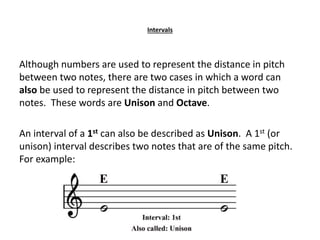
An interval of a 1st can also be described as Unison. A 1st (or
unison) interval describes two notes that are of the same pitch.
For example:
Intervals
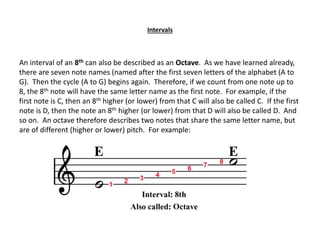
An interval of an 8th can also be described as an Octave. As we have learned already,
there are seven note names (named after the first seven letters of the alphabet (A to
G). Then the cycle (A to G) begins again. Therefore, if we count from one note up to
8, the 8th note will have the same letter name as the first note. For example, if the
first note is C, then an 8th higher (or lower) from that C will also be called C. If the first
note is D, then the note an 8th higher (or lower) from that D will also be called D. And
so on. An octave therefore describes two notes that share the same letter name, but
are of different (higher or lower) pitch. For example:

Intervals - Oxbridge Musical

  • 1.
  • 2.
    Intervals Prerequisites You will havelearned about pitch, the position of notes on and around the musical stave, and ledger lines. What you will cover in this session: • Intervals • Harmonic and Melodic Intervals • Tones and Semitones
  • 3.
    Intervals An interval isa number that relates to the distance in pitch between two notes. In order to correctly determine the distance between the two notes, and therefore correctly identify the interval between those two notes, we begin counting from the first note up to and including the second note, and including any line or space that occurs between the two notes. For example, the interval from E to B is a 5th. We work this out by counting from E up to B:
  • 4.
    Intervals Intervals are usuallynumbered between 1 and 8. Intervals between 1 and 8 are called Simple Intervals. Intervals higher than an 8th are called Compound Intervals. For this grade, we need only learn about Simple Intervals.
  • 5.
    Intervals The example belowshows how the simple intervals are numbered from 1 to 8. In this example middle C is regarded as the 1st note:
  • 6.
    Intervals Although numbers areused to represent the distance in pitch between two notes, there are two cases in which a word can also be used to represent the distance in pitch between two notes. These words are Unison and Octave. An interval of a 1st can also be described as Unison. A 1st (or unison) interval describes two notes that are of the same pitch. For example:
  • 7.
    Intervals An interval ofan 8th can also be described as an Octave. As we have learned already, there are seven note names (named after the first seven letters of the alphabet (A to G). Then the cycle (A to G) begins again. Therefore, if we count from one note up to 8, the 8th note will have the same letter name as the first note. For example, if the first note is C, then an 8th higher (or lower) from that C will also be called C. If the first note is D, then the note an 8th higher (or lower) from that D will also be called D. And so on. An octave therefore describes two notes that share the same letter name, but are of different (higher or lower) pitch. For example: