K.L.E.S.
K. L. E. Society’s
K. L. E. Institute of Technology, Hubballi - 27
Department of Civil Engineering
(NBAAccredited)
INTER/INTRA INSTITUTIONAL INTERSHIP
(21INT49)
PRESENTED BY:
Deeksha G Ramani
2KE21CV006
Sem III
Civil Dept. KLEIT Hubballi
SUBMITTED TO:
Internship coordinator
Mr. Shabarish. V. Patil
Assistant Professor
CHAPTER – 01 :COMPANY PROFILE
 Hubballi-Dharwad Smart City Limited is a Public incorporated on March 10, 2017, and is
classified as a non-governmental company.
 Its authorized share capital is Rs. 2,000,000,000, and its paid-up capital is Rs. 1,000,000.
 The company has ten directors, with Suresh Balachandra Itnal as the current Director.
 The most recently appointed director is Narasimhaiah Manjushree, who was appointed on
August 30, 2022.
 The company is connected to 13 other companies through its directors
CHAPTER – 02 :BACKGROUND OF PROJECT
 The institutional internship for civil engineering students provides hands-on experience and
develops professional skills while working on diverse civil engineering projects that contribute
to a community's development and well-being.
 The assigned projects depend on the institution's partnerships and networks. Students need to
manage their time, adhere to safety measures, industry standards, and ethical considerations
while working on projects.
 The internship experience strengthens problem-solving, communication, and analytical skills
while building professional networks and understanding the role of civil engineers in society
and industry.
 Graduates who have completed the institutional internship are better equipped to handle future
job responsibilities and integrate new industry processes.
CHAPTER – 03 :TASK PERFORMED
• Hubballi-Dharwad Smart City limited
• Basic introduction to building materials testing lab.
• Online course of Python
• Departmental Activity
• Unnat Bharat Abhiyaan Survey
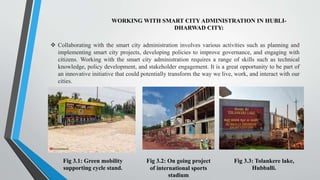
WORKING WITH SMART CITY ADMINISTRATION IN HUBLI-
DHARWAD CITY:
Fig 3.1: Green mobility
supporting cycle stand.
Fig 3.3: Tolankere lake,
Hubballi.
 Collaborating with the smart city administration involves various activities such as planning and
implementing smart city projects, developing policies to improve governance, and engaging with
citizens. Working with the smart city administration requires a range of skills such as technical
knowledge, policy development, and stakeholder engagement. It is a great opportunity to be part of
an innovative initiative that could potentially transform the way we live, work, and interact with our
cities.
Fig 3.2: On going project
of international sports
stadium
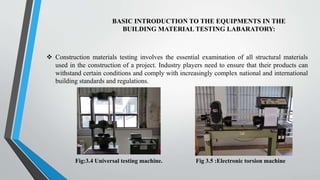
BASIC INTRODUCTION TO THE EQUIPMENTS IN THE
BUILDING MATERIAL TESTING LABARATORY:
 Construction materials testing involves the essential examination of all structural materials
used in the construction of a project. Industry players need to ensure that their products can
withstand certain conditions and comply with increasingly complex national and international
building standards and regulations.
Fig:3.4 Universal testing machine. Fig 3.5 :Electronic torsion machine
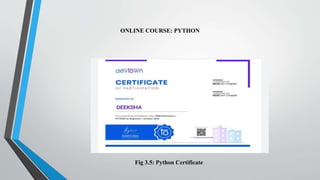
ONLINE COURSE: PYTHON
Fig 3.5: Python Certificate
DEPARTMENTALACTIVITIES:
01) Quiz competition
02) Debate competition
03) Essay writing
04) Group discussion
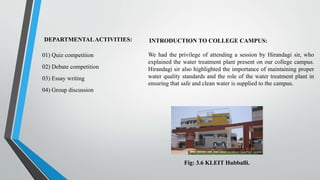
INTRODUCTION TO COLLEGE CAMPUS:
We had the privilege of attending a session by Hirandagi sir, who
explained the water treatment plant present on our college campus.
Hirandagi sir also highlighted the importance of maintaining proper
water quality standards and the role of the water treatment plant in
ensuring that safe and clean water is supplied to the campus.
Fig: 3.6 KLEIT Hubballi.
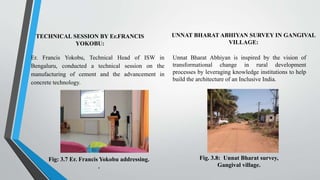
TECHNICAL SESSION BY Er.FRANCIS
YOKOBU:
Er. Francis Yokobu, Technical Head of ISW in
Bengaluru, conducted a technical session on the
manufacturing of cement and the advancement in
concrete technology.
UNNAT BHARAT ABHIYAN SURVEY IN GANGIVAL
VILLAGE:
Unnat Bharat Abhiyan is inspired by the vision of
transformational change in rural development
processes by leveraging knowledge institutions to help
build the architecture of an Inclusive India.
Fig: 3.7 Er. Francis Yokobu addressing.
.
Fig. 3.8: Unnat Bharat survey,
Gangival village.
CHAPTER – 04 : REFLECTION
 I was fortunate enough to work on various projects, including BMT equipment, smart city administration. These
projects were not only beneficial for developing technical skills, but they also helped me gain a better understanding
of the practical aspects of civil engineering.
 But one of the highlights of the internship was the technical session by engineer Francis Yokobu. He explained new
emerging technologies and modern techniques such as 3D printing, Building Information Modeling (BIM), and
Internet of Things (IoT). This talk was engaging and informative, and I learned how these futuristic technologies
could revolutionize the construction industry.
 Furthermore, I had the opportunity to conduct an Unnat Bharat Survey in the Gangival village, which enabled me to
appreciate the challenges faced by rural India. This experience gave me an insight into the nation-building process,
as I witnessed firsthand the development of rural areas.
CHAPTER – 05 : CONCLUSION
 The institutional internship was an enriching and enlightening experience, providing a wide
array of projects, site visits, and technical sessions that developed their technical knowledge
while also providing personal and professional development opportunities.
 The BMT equipment, smart city administration, demonstrated the practical application of skills
within the civil engineering profession.
 A technical session introduced emerging technologies, and an Unnat Bharat survey enabled
firsthand observation of rural development.
 The experience provided practical experience, networking, and problem-solving,
communication, and ethical considerations skills crucial to a civil engineering context, ensuring
valuable knowledge and skills were acquired for future career development.

Internship preparation (VTU.. 21 scheme)

  • 1.
    K.L.E.S. K. L. E.Society’s K. L. E. Institute of Technology, Hubballi - 27 Department of Civil Engineering (NBAAccredited) INTER/INTRA INSTITUTIONAL INTERSHIP (21INT49) PRESENTED BY: Deeksha G Ramani 2KE21CV006 Sem III Civil Dept. KLEIT Hubballi SUBMITTED TO: Internship coordinator Mr. Shabarish. V. Patil Assistant Professor
  • 2.
    CHAPTER – 01:COMPANY PROFILE  Hubballi-Dharwad Smart City Limited is a Public incorporated on March 10, 2017, and is classified as a non-governmental company.  Its authorized share capital is Rs. 2,000,000,000, and its paid-up capital is Rs. 1,000,000.  The company has ten directors, with Suresh Balachandra Itnal as the current Director.  The most recently appointed director is Narasimhaiah Manjushree, who was appointed on August 30, 2022.  The company is connected to 13 other companies through its directors
  • 3.
    CHAPTER – 02:BACKGROUND OF PROJECT  The institutional internship for civil engineering students provides hands-on experience and develops professional skills while working on diverse civil engineering projects that contribute to a community's development and well-being.  The assigned projects depend on the institution's partnerships and networks. Students need to manage their time, adhere to safety measures, industry standards, and ethical considerations while working on projects.  The internship experience strengthens problem-solving, communication, and analytical skills while building professional networks and understanding the role of civil engineers in society and industry.  Graduates who have completed the institutional internship are better equipped to handle future job responsibilities and integrate new industry processes.
  • 4.
    CHAPTER – 03:TASK PERFORMED • Hubballi-Dharwad Smart City limited • Basic introduction to building materials testing lab. • Online course of Python • Departmental Activity • Unnat Bharat Abhiyaan Survey
  • 5.
    WORKING WITH SMARTCITY ADMINISTRATION IN HUBLI- DHARWAD CITY: Fig 3.1: Green mobility supporting cycle stand. Fig 3.3: Tolankere lake, Hubballi.  Collaborating with the smart city administration involves various activities such as planning and implementing smart city projects, developing policies to improve governance, and engaging with citizens. Working with the smart city administration requires a range of skills such as technical knowledge, policy development, and stakeholder engagement. It is a great opportunity to be part of an innovative initiative that could potentially transform the way we live, work, and interact with our cities. Fig 3.2: On going project of international sports stadium
  • 6.
    BASIC INTRODUCTION TOTHE EQUIPMENTS IN THE BUILDING MATERIAL TESTING LABARATORY:  Construction materials testing involves the essential examination of all structural materials used in the construction of a project. Industry players need to ensure that their products can withstand certain conditions and comply with increasingly complex national and international building standards and regulations. Fig:3.4 Universal testing machine. Fig 3.5 :Electronic torsion machine
  • 7.
    ONLINE COURSE: PYTHON Fig3.5: Python Certificate
  • 8.
    DEPARTMENTALACTIVITIES: 01) Quiz competition 02)Debate competition 03) Essay writing 04) Group discussion INTRODUCTION TO COLLEGE CAMPUS: We had the privilege of attending a session by Hirandagi sir, who explained the water treatment plant present on our college campus. Hirandagi sir also highlighted the importance of maintaining proper water quality standards and the role of the water treatment plant in ensuring that safe and clean water is supplied to the campus. Fig: 3.6 KLEIT Hubballi.
  • 9.
    TECHNICAL SESSION BYEr.FRANCIS YOKOBU: Er. Francis Yokobu, Technical Head of ISW in Bengaluru, conducted a technical session on the manufacturing of cement and the advancement in concrete technology. UNNAT BHARAT ABHIYAN SURVEY IN GANGIVAL VILLAGE: Unnat Bharat Abhiyan is inspired by the vision of transformational change in rural development processes by leveraging knowledge institutions to help build the architecture of an Inclusive India. Fig: 3.7 Er. Francis Yokobu addressing. . Fig. 3.8: Unnat Bharat survey, Gangival village.
  • 10.
    CHAPTER – 04: REFLECTION  I was fortunate enough to work on various projects, including BMT equipment, smart city administration. These projects were not only beneficial for developing technical skills, but they also helped me gain a better understanding of the practical aspects of civil engineering.  But one of the highlights of the internship was the technical session by engineer Francis Yokobu. He explained new emerging technologies and modern techniques such as 3D printing, Building Information Modeling (BIM), and Internet of Things (IoT). This talk was engaging and informative, and I learned how these futuristic technologies could revolutionize the construction industry.  Furthermore, I had the opportunity to conduct an Unnat Bharat Survey in the Gangival village, which enabled me to appreciate the challenges faced by rural India. This experience gave me an insight into the nation-building process, as I witnessed firsthand the development of rural areas.
  • 11.
    CHAPTER – 05: CONCLUSION  The institutional internship was an enriching and enlightening experience, providing a wide array of projects, site visits, and technical sessions that developed their technical knowledge while also providing personal and professional development opportunities.  The BMT equipment, smart city administration, demonstrated the practical application of skills within the civil engineering profession.  A technical session introduced emerging technologies, and an Unnat Bharat survey enabled firsthand observation of rural development.  The experience provided practical experience, networking, and problem-solving, communication, and ethical considerations skills crucial to a civil engineering context, ensuring valuable knowledge and skills were acquired for future career development.