Sociotechnical
Implications of RAG for
Information Access
Bhaskar Mitra
Dagstuhl Seminar: Retrieval-
Augmented Generation – The Future of
Search? (2025)
What societal risks comes to your mind
when you think about RAG for information
access?
Question for the audience
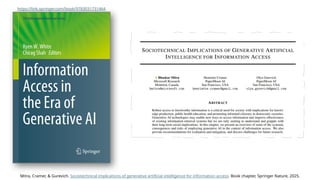
https://link.springer.com/book/9783031731464
Mitra, Cramer, & Gurevich. Sociotechnical implications of generative artificial intelligence for information access. Book chapter, Springer Nature, 2025.
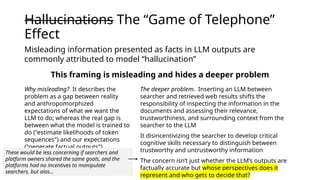
Hallucinations The “Game of Telephone”
Effect
Why misleading? It describes the
problem as a gap between reality
and anthropomorphized
expectations of what we want the
LLM to do; whereas the real gap is
between what the model is trained to
do ("estimate likelihoods of token
sequences") and our expectations
("generate factual outputs")
The deeper problem. Inserting an LLM between
searcher and retrieved web results shifts the
responsibility of inspecting the information in the
documents and assessing their relevance,
trustworthiness, and surrounding context from the
searcher to the LLM
It disincentivizing the searcher to develop critical
cognitive skills necessary to distinguish between
trustworthy and untrustworthy information
The concern isn’t just whether the LLM’s outputs are
factually accurate but whose perspectives does it
represent and who gets to decide that?
Misleading information presented as facts in LLM outputs are
commonly attributed to model “hallucination”
This framing is misleading and hides a deeper problem
These would be less concerning if searchers and
platform owners shared the same goals, and the
platforms had no incentives to manipulate
searchers, but alas

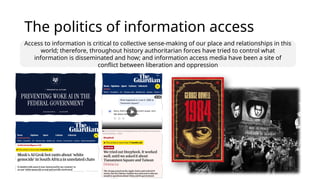
The politics of information access
Access to information is critical to collective sense-making of our place and relationships in this
world; therefore, throughout history authoritarian forces have tried to control what
information is disseminated and how; and information access media have been a site of
conflict between liberation and oppression
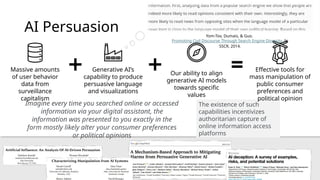
AI Persuasion
Imagine every time you searched online or accessed
information via your digital assistant, the
information was presented to you exactly in the
form mostly likely alter your consumer preferences
or political opinions
The existence of such
capabilities incentivizes
authoritarian capture of
online information access
platforms
Massive amounts
of user behavior
data from
surveillance
capitalism
Generative AI’s
capability to produce
persuasive language
and visualizations
Effective tools for
mass manipulation of
public consumer
preferences and
political opinion
Our ability to align
generative AI models
towards specific
values
Yom-Tov, Dumais, & Guo.
Promoting Civil Discourse Through Search Engine Diversity. In
SSCR, 2014.
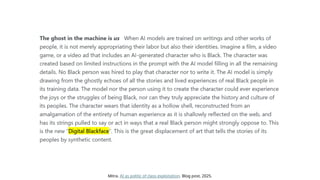
Mitra. AI as politic of class exploitation. Blog post, 2025.
Big Technofascism
https://www.uwindsor.ca/law/3450/werobot-2025
https://www.uwindsor.ca/law/sites/
uwindsor.ca.law/files/resistingtechnofascism-
web.pdf
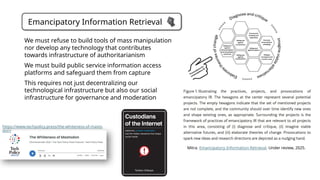
Emancipatory Information Retrieval
Mitra. Emancipatory Information Retrieval. Under review, 2025.
https://www.techpolicy.press/the-whiteness-of-masto
don/
We must refuse to build tools of mass manipulation
nor develop any technology that contributes
towards infrastructure of authoritarianism
We must build public service information access
platforms and safeguard them from capture
This requires not just decentralizing our
technological infrastructure but also our social
infrastructure for governance and moderation
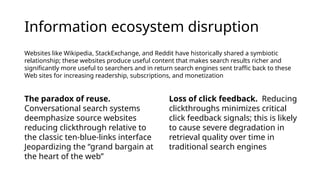
Information ecosystem disruption
Websites like Wikipedia, StackExchange, and Reddit have historically shared a symbiotic
relationship; these websites produce useful content that makes search results richer and
significantly more useful to searchers and in return search engines sent traffic back to these
Web sites for increasing readership, subscriptions, and monetization
The paradox of reuse.
Conversational search systems
deemphasize source websites
reducing clickthrough relative to
the classic ten-blue-links interface
Jeopardizing the “grand bargain at
the heart of the web”
Loss of click feedback. Reducing
clickthroughs minimizes critical
click feedback signals; this is likely
to cause severe degradation in
retrieval quality over time in
traditional search engines
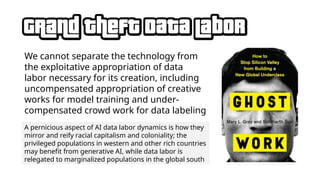
We cannot separate the technology from
the exploitative appropriation of data
labor necessary for its creation, including
uncompensated appropriation of creative
works for model training and under-
compensated crowd work for data labeling
A pernicious aspect of AI data labor dynamics is how they
mirror and reify racial capitalism and coloniality; the
privileged populations in western and other rich countries
may benefit from generative AI, while data labor is
relegated to marginalized populations in the global south
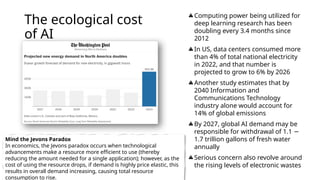
The ecological cost
of AI
Computing power being utilized for
deep learning research has been
doubling every 3.4 months since
2012
In US, data centers consumed more
than 4% of total national electricity
in 2022, and that number is
projected to grow to 6% by 2026
Another study estimates that by
2040 Information and
Communications Technology
industry alone would account for
14% of global emissions
By 2027, global AI demand may be
responsible for withdrawal of 1.1 −
1.7 trillion gallons of fresh water
annually
Serious concern also revolve around
the rising levels of electronic wastes
Mind the Jevons Paradox
In economics, the Jevons paradox occurs when technological
advancements make a resource more efficient to use (thereby
reducing the amount needed for a single application); however, as the
cost of using the resource drops, if demand is highly price elastic, this
results in overall demand increasing, causing total resource
consumption to rise.
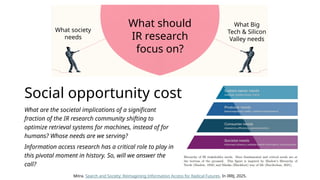
Social opportunity cost
What are the societal implications of a significant
fraction of the IR research community shifting to
optimize retrieval systems for machines, instead of for
humans? Whose needs are we serving?
Information access research has a critical role to play in
this pivotal moment in history. So, will we answer the
call?
What society
needs
What Big
Tech & Silicon
Valley needs
What should
IR research
focus on?
Mitra. Search and Society: Reimagining Information Access for Radical Futures. In IRRJ, 2025.
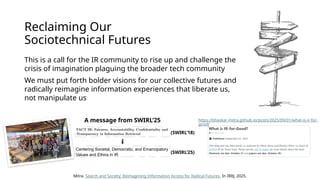
Reclaiming Our
Sociotechnical Futures
This is a call for the IR community to rise up and challenge the
crisis of imagination plaguing the broader tech community
We must put forth bolder visions for our collective futures and
radically reimagine information experiences that liberate us,
not manipulate us
Mitra. Search and Society: Reimagining Information Access for Radical Futures. In IRRJ, 2025.
(SWIRL’18)
(SWIRL’25)
A message from SWIRL’25 https://bhaskar-mitra.github.io/posts/2025/09/01/what-is-ir-for-
good/
“The exercise of imagination is
dangerous to those who profit
from the way things are
because it has the power to
show that the way things are is
not permanent, not universal,
not necessary.”
– Ursula K. Le Guin

Internet Download Manager (IDM) Free key

  • 1.
    Sociotechnical Implications of RAGfor Information Access Bhaskar Mitra Dagstuhl Seminar: Retrieval- Augmented Generation – The Future of Search? (2025)
  • 2.
    What societal riskscomes to your mind when you think about RAG for information access? Question for the audience
  • 3.
    https://link.springer.com/book/9783031731464 Mitra, Cramer, &Gurevich. Sociotechnical implications of generative artificial intelligence for information access. Book chapter, Springer Nature, 2025.
  • 4.
    Hallucinations The “Gameof Telephone” Effect Why misleading? It describes the problem as a gap between reality and anthropomorphized expectations of what we want the LLM to do; whereas the real gap is between what the model is trained to do ("estimate likelihoods of token sequences") and our expectations ("generate factual outputs") The deeper problem. Inserting an LLM between searcher and retrieved web results shifts the responsibility of inspecting the information in the documents and assessing their relevance, trustworthiness, and surrounding context from the searcher to the LLM It disincentivizing the searcher to develop critical cognitive skills necessary to distinguish between trustworthy and untrustworthy information The concern isn’t just whether the LLM’s outputs are factually accurate but whose perspectives does it represent and who gets to decide that? Misleading information presented as facts in LLM outputs are commonly attributed to model “hallucination” This framing is misleading and hides a deeper problem These would be less concerning if searchers and platform owners shared the same goals, and the platforms had no incentives to manipulate searchers, but alas

  • 5.
    The politics ofinformation access Access to information is critical to collective sense-making of our place and relationships in this world; therefore, throughout history authoritarian forces have tried to control what information is disseminated and how; and information access media have been a site of conflict between liberation and oppression
  • 6.
    AI Persuasion Imagine everytime you searched online or accessed information via your digital assistant, the information was presented to you exactly in the form mostly likely alter your consumer preferences or political opinions The existence of such capabilities incentivizes authoritarian capture of online information access platforms Massive amounts of user behavior data from surveillance capitalism Generative AI’s capability to produce persuasive language and visualizations Effective tools for mass manipulation of public consumer preferences and political opinion Our ability to align generative AI models towards specific values Yom-Tov, Dumais, & Guo. Promoting Civil Discourse Through Search Engine Diversity. In SSCR, 2014.
  • 7.
    Mitra. AI aspolitic of class exploitation. Blog post, 2025.
  • 8.
  • 9.
  • 10.
    Emancipatory Information Retrieval Mitra.Emancipatory Information Retrieval. Under review, 2025. https://www.techpolicy.press/the-whiteness-of-masto don/ We must refuse to build tools of mass manipulation nor develop any technology that contributes towards infrastructure of authoritarianism We must build public service information access platforms and safeguard them from capture This requires not just decentralizing our technological infrastructure but also our social infrastructure for governance and moderation
  • 11.
    Information ecosystem disruption Websiteslike Wikipedia, StackExchange, and Reddit have historically shared a symbiotic relationship; these websites produce useful content that makes search results richer and significantly more useful to searchers and in return search engines sent traffic back to these Web sites for increasing readership, subscriptions, and monetization The paradox of reuse. Conversational search systems deemphasize source websites reducing clickthrough relative to the classic ten-blue-links interface Jeopardizing the “grand bargain at the heart of the web” Loss of click feedback. Reducing clickthroughs minimizes critical click feedback signals; this is likely to cause severe degradation in retrieval quality over time in traditional search engines
  • 12.
    We cannot separatethe technology from the exploitative appropriation of data labor necessary for its creation, including uncompensated appropriation of creative works for model training and under- compensated crowd work for data labeling A pernicious aspect of AI data labor dynamics is how they mirror and reify racial capitalism and coloniality; the privileged populations in western and other rich countries may benefit from generative AI, while data labor is relegated to marginalized populations in the global south
  • 13.
    The ecological cost ofAI Computing power being utilized for deep learning research has been doubling every 3.4 months since 2012 In US, data centers consumed more than 4% of total national electricity in 2022, and that number is projected to grow to 6% by 2026 Another study estimates that by 2040 Information and Communications Technology industry alone would account for 14% of global emissions By 2027, global AI demand may be responsible for withdrawal of 1.1 − 1.7 trillion gallons of fresh water annually Serious concern also revolve around the rising levels of electronic wastes Mind the Jevons Paradox In economics, the Jevons paradox occurs when technological advancements make a resource more efficient to use (thereby reducing the amount needed for a single application); however, as the cost of using the resource drops, if demand is highly price elastic, this results in overall demand increasing, causing total resource consumption to rise.
  • 14.
    Social opportunity cost Whatare the societal implications of a significant fraction of the IR research community shifting to optimize retrieval systems for machines, instead of for humans? Whose needs are we serving? Information access research has a critical role to play in this pivotal moment in history. So, will we answer the call? What society needs What Big Tech & Silicon Valley needs What should IR research focus on? Mitra. Search and Society: Reimagining Information Access for Radical Futures. In IRRJ, 2025.
  • 15.
    Reclaiming Our Sociotechnical Futures Thisis a call for the IR community to rise up and challenge the crisis of imagination plaguing the broader tech community We must put forth bolder visions for our collective futures and radically reimagine information experiences that liberate us, not manipulate us Mitra. Search and Society: Reimagining Information Access for Radical Futures. In IRRJ, 2025. (SWIRL’18) (SWIRL’25) A message from SWIRL’25 https://bhaskar-mitra.github.io/posts/2025/09/01/what-is-ir-for- good/
  • 16.
    “The exercise ofimagination is dangerous to those who profit from the way things are because it has the power to show that the way things are is not permanent, not universal, not necessary.” – Ursula K. Le Guin