International Events Management
An Introduction
Learning Objectives
At the end of this session you should be able to:
• Describe what it means to take an international approach
to events management.
• Identify key changes in the global environment, which
are impacting events and event organizations.
• Use strategic planning tools to identify and analyze the
environment in which international events take place.
• Understand how event organizations can formulate
strategic responses to global changes.
• Appreciate how culture and customs can dictate how
event organizations operate.
International Events
“...large-scale events which attract
international audiences and media
attention and meet a variety of
economic objectives for the
destinations in which they are
hosted.”
Key Characteristics
• Explicit focus on attracting international
audiences
• Have significant impact on their host
communities (e.g. Social, political,
physical and environmental and
tourism/economic impacts)
• Attract international or global media
attention
• Have specific economic imperatives
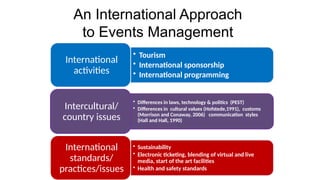
An International Approach
to Events Management
• Tourism
• International sponsorship
• International programming
International
activities
• Differences in laws, technology & politics (PEST)
• Differences in cultural values (Hofstede,1991), customs
(Morrison and Conaway, 2006) communication styles
(Hall and Hall, 1990)
Intercultural/
country issues
• Sustainability
• Electronic ticketing, blending of virtual and live
media, start of the art facilities
• Health and safety standards
International
standards/
practices/issues
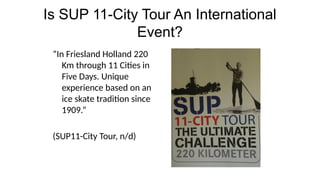
Is SUP 11-City Tour An International
Event?
“In Friesland Holland 220
Km through 11 Cities in
Five Days. Unique
experience based on an
ice skate tradition since
1909.”
(SUP11-City Tour, n/d)
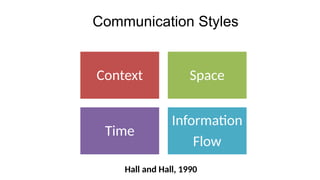
Communication Styles
Context Space
Time
Information
Flow
Hall and Hall, 1990
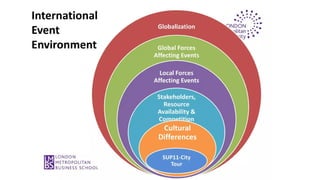
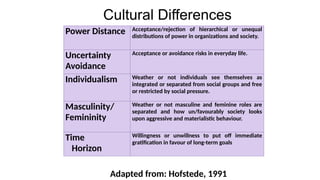
Cultural Differences
Power Distance Acceptance/rejection of hierarchical or unequal
distributions of power in organizations and society.
Uncertainty
Avoidance
Acceptance or avoidance risks in everyday life.
Individualism Weather or not individuals see themselves as
integrated or separated from social groups and free
or restricted by social pressure.
Masculinity/
Femininity
Weather or not masculine and feminine roles are
separated and how un/favourably society looks
upon aggressive and materialistic behaviour.
Time
Horizon
Willingness or unwillness to put off immediate
gratification in favour of long-term goals
Adapted from: Hofstede, 1991
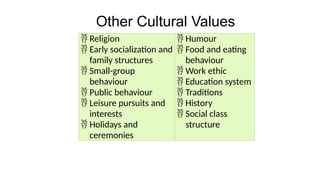
Other Cultural Values
 Religion
 Early socialization and
family structures
 Small-group
behaviour
 Public behaviour
 Leisure pursuits and
interests
 Holidays and
ceremonies
 Humour
 Food and eating
behaviour
 Work ethic
 Education system
 Traditions
 History
 Social class
structure
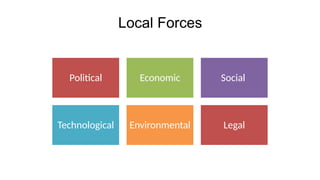
Local Forces
Political Economic Social
Technological Environmental Legal
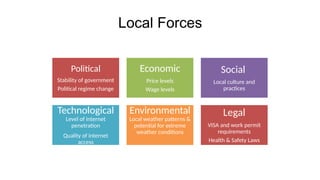
Local Forces
Political
Stability of government
Political regime change
Economic
Price levels
Wage levels
Social
Local culture and
practices
Technological
Level of internet
penetration
Quality of internet
access
Environmental
Local weather patterns &
potential for extreme
weather conditions
Legal
VISA and work permit
requirements
Health & Safety Laws
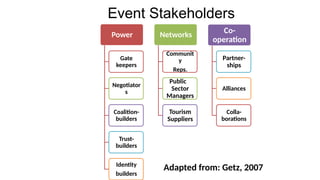
Power
Gate
keepers
Negotiator
s
Coalition-
builders
Trust-
builders
Identity
builders
Networks
Communit
y
Reps.
Public
Sector
Managers
Tourism
Suppliers
Co-
operation
Partner-
ships
Alliances
Colla-
borations
Event Stakeholders
Adapted from: Getz, 2007
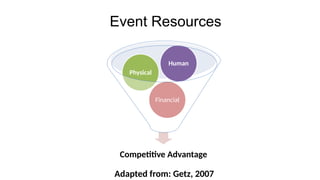
Event Resources
Competitive Advantage
Financial
Physical
Human
Adapted from: Getz, 2007
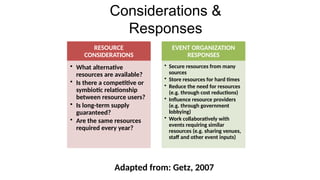
Considerations &
Responses
RESOURCE
CONSIDERATIONS
• What alternative
resources are available?
• Is there a competitive or
symbiotic relationship
between resource users?
• Is long-term supply
guaranteed?
• Are the same resources
required every year?
EVENT ORGANIZATION
RESPONSES
• Secure resources from many
sources
• Store resources for hard times
• Reduce the need for resources
(e.g. through cost reductions)
• Influence resource providers
(e.g. through government
lobbying)
• Work collaboratively with
events requiring similar
resources (e.g. sharing venues,
staff and other event inputs)
Adapted from: Getz, 2007
Competition
• CHALLENGES • OPPORTUNITES
Globalization
A term which refers to a number of
processes which have enabled
companies, products, people,
money and information to move
more freely and quickly around the
world.
(Morrison, 2006)
Global Forces
Political
Economic
Social
Technological
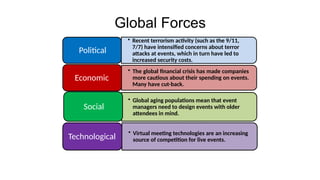
Global Forces
• Recent terrorism activity (such as the 9/11,
7/7) have intensified concerns about terror
attacks at events, which in turn have led to
increased security costs.
Political
• The global financial crisis has made companies
more cautious about their spending on events.
Many have cut-back.
Economic
• Global aging populations mean that event
managers need to design events with older
attendees in mind.
Social
• Virtual meeting technologies are an increasing
source of competition for live events.
Technological
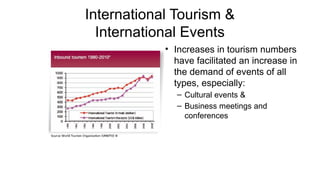
International Tourism &
International Events
• Increases in tourism numbers
have facilitated an increase in
the demand of events of all
types, especially:
– Cultural events &
– Business meetings and
conferences
Developments in Internet Technologies &
Live Music
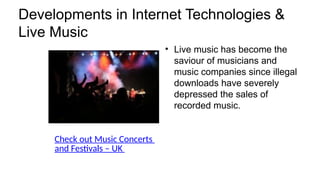
• Live music has become the
saviour of musicians and
music companies since illegal
downloads have severely
depressed the sales of
recorded music.
Check out Music Concerts
and Festivals – UK
Increase in International Organisations &
MICE
• Today the worldwide
MICE market is worth
about £400 million
thanks in large part to
the proliferation of
international
organisations.
References
• Ferdinand, N. and Wesner, S. (forthcoming) The International Event
Environment in N. Ferdinand and P. Kitchin (Eds.)
• Hall, E. & Hall, M. (1990) Understanding Cultural Differences. Yarmouth:
Intercultural Press.
• Hofstede, G. (1991). Cultures and Organizations: Software of the Mind.
New York: Mc-Graw-Hill.
• Keynote (2010). Music Industry. Keynote [online] Retrieved from
https://www.keynote.co.uk/market-intelligence/view/product/2324/musi
c-industry?highlight=music&utm_source=kn.reports.search
• Mintel (2010a). Music Concerts and Festivals – UK. Mintel [online]
Retrieved from
http://0academic.mintel.com.emu.londonmet.ac.uk/sinatra/oxygen_acad
emic/search_results/show&/display/id=479850
References cont’d
• Morrison, J. (2006). The International Business Environment: Global
and Local Market Places in a Changing World (Second Edition). New
York: Palgrave Macmillan
• Thomas Cook Retail Limited (n/d). Key dates. Thomas Cook Retail
Limited [online] Retrieved from
http://www.thomascook.com/about-us/thomas-cook-history/key-
dates/
• Towner, J. (1996). An Historical Geography of Recreation and
Tourism in the Western World 1540-1940. Chichester: John Wiley.
• Trennert, R. A. (1993). Selling Indian education at world's fairs and
expositions, 1893-1904. American Indian Quarterly, 11(3), 203-220.
• UNWTO (2010). UNWTO World Tourism Barometer. 8 (3), 1-64.
Activity
• In groups of two to three:
– Highlight the aspects of the event that make it international
– What have the event organizers done right or wrong in terms or their
international approach?
– Suggest ways in which you could improve the event organiser’s
international approach
– Display your answers in poster form

internationaleventsmanagement1-120905075812-phpapp02.pptx

  • 1.
  • 2.
    Learning Objectives At theend of this session you should be able to: • Describe what it means to take an international approach to events management. • Identify key changes in the global environment, which are impacting events and event organizations. • Use strategic planning tools to identify and analyze the environment in which international events take place. • Understand how event organizations can formulate strategic responses to global changes. • Appreciate how culture and customs can dictate how event organizations operate.
  • 3.
    International Events “...large-scale eventswhich attract international audiences and media attention and meet a variety of economic objectives for the destinations in which they are hosted.”
  • 4.
    Key Characteristics • Explicitfocus on attracting international audiences • Have significant impact on their host communities (e.g. Social, political, physical and environmental and tourism/economic impacts) • Attract international or global media attention • Have specific economic imperatives
  • 5.
    An International Approach toEvents Management • Tourism • International sponsorship • International programming International activities • Differences in laws, technology & politics (PEST) • Differences in cultural values (Hofstede,1991), customs (Morrison and Conaway, 2006) communication styles (Hall and Hall, 1990) Intercultural/ country issues • Sustainability • Electronic ticketing, blending of virtual and live media, start of the art facilities • Health and safety standards International standards/ practices/issues
  • 6.
    Is SUP 11-CityTour An International Event? “In Friesland Holland 220 Km through 11 Cities in Five Days. Unique experience based on an ice skate tradition since 1909.” (SUP11-City Tour, n/d)
  • 8.
  • 9.
    Cultural Differences Power DistanceAcceptance/rejection of hierarchical or unequal distributions of power in organizations and society. Uncertainty Avoidance Acceptance or avoidance risks in everyday life. Individualism Weather or not individuals see themselves as integrated or separated from social groups and free or restricted by social pressure. Masculinity/ Femininity Weather or not masculine and feminine roles are separated and how un/favourably society looks upon aggressive and materialistic behaviour. Time Horizon Willingness or unwillness to put off immediate gratification in favour of long-term goals Adapted from: Hofstede, 1991
  • 10.
    Other Cultural Values Religion  Early socialization and family structures  Small-group behaviour  Public behaviour  Leisure pursuits and interests  Holidays and ceremonies  Humour  Food and eating behaviour  Work ethic  Education system  Traditions  History  Social class structure
  • 11.
    Local Forces Political EconomicSocial Technological Environmental Legal
  • 12.
    Local Forces Political Stability ofgovernment Political regime change Economic Price levels Wage levels Social Local culture and practices Technological Level of internet penetration Quality of internet access Environmental Local weather patterns & potential for extreme weather conditions Legal VISA and work permit requirements Health & Safety Laws
  • 13.
  • 14.
  • 15.
    Considerations & Responses RESOURCE CONSIDERATIONS • Whatalternative resources are available? • Is there a competitive or symbiotic relationship between resource users? • Is long-term supply guaranteed? • Are the same resources required every year? EVENT ORGANIZATION RESPONSES • Secure resources from many sources • Store resources for hard times • Reduce the need for resources (e.g. through cost reductions) • Influence resource providers (e.g. through government lobbying) • Work collaboratively with events requiring similar resources (e.g. sharing venues, staff and other event inputs) Adapted from: Getz, 2007
  • 16.
  • 17.
    Globalization A term whichrefers to a number of processes which have enabled companies, products, people, money and information to move more freely and quickly around the world. (Morrison, 2006)
  • 18.
  • 19.
    Global Forces • Recentterrorism activity (such as the 9/11, 7/7) have intensified concerns about terror attacks at events, which in turn have led to increased security costs. Political • The global financial crisis has made companies more cautious about their spending on events. Many have cut-back. Economic • Global aging populations mean that event managers need to design events with older attendees in mind. Social • Virtual meeting technologies are an increasing source of competition for live events. Technological
  • 20.
    International Tourism & InternationalEvents • Increases in tourism numbers have facilitated an increase in the demand of events of all types, especially: – Cultural events & – Business meetings and conferences
  • 21.
    Developments in InternetTechnologies & Live Music • Live music has become the saviour of musicians and music companies since illegal downloads have severely depressed the sales of recorded music. Check out Music Concerts and Festivals – UK
  • 22.
    Increase in InternationalOrganisations & MICE • Today the worldwide MICE market is worth about £400 million thanks in large part to the proliferation of international organisations.
  • 23.
    References • Ferdinand, N.and Wesner, S. (forthcoming) The International Event Environment in N. Ferdinand and P. Kitchin (Eds.) • Hall, E. & Hall, M. (1990) Understanding Cultural Differences. Yarmouth: Intercultural Press. • Hofstede, G. (1991). Cultures and Organizations: Software of the Mind. New York: Mc-Graw-Hill. • Keynote (2010). Music Industry. Keynote [online] Retrieved from https://www.keynote.co.uk/market-intelligence/view/product/2324/musi c-industry?highlight=music&utm_source=kn.reports.search • Mintel (2010a). Music Concerts and Festivals – UK. Mintel [online] Retrieved from http://0academic.mintel.com.emu.londonmet.ac.uk/sinatra/oxygen_acad emic/search_results/show&/display/id=479850
  • 24.
    References cont’d • Morrison,J. (2006). The International Business Environment: Global and Local Market Places in a Changing World (Second Edition). New York: Palgrave Macmillan • Thomas Cook Retail Limited (n/d). Key dates. Thomas Cook Retail Limited [online] Retrieved from http://www.thomascook.com/about-us/thomas-cook-history/key- dates/ • Towner, J. (1996). An Historical Geography of Recreation and Tourism in the Western World 1540-1940. Chichester: John Wiley. • Trennert, R. A. (1993). Selling Indian education at world's fairs and expositions, 1893-1904. American Indian Quarterly, 11(3), 203-220. • UNWTO (2010). UNWTO World Tourism Barometer. 8 (3), 1-64.
  • 25.
    Activity • In groupsof two to three: – Highlight the aspects of the event that make it international – What have the event organizers done right or wrong in terms or their international approach? – Suggest ways in which you could improve the event organiser’s international approach – Display your answers in poster form

Editor's Notes

  • #1 Notes: _____________________________________________________________________ _____________________________________________________________________ _____________________________________________________________________ _____________________________________________________________________ _____________________________________________________________________ _____________________________________________________________________ _____________________________________________________________________ _____________________________________________________________________ _____________________________________________________________________ _____________________________________________________________________
  • #2 Notes: _____________________________________________________________________ _____________________________________________________________________ _____________________________________________________________________ _____________________________________________________________________ _____________________________________________________________________ _____________________________________________________________________ _____________________________________________________________________ _____________________________________________________________________ _____________________________________________________________________ _____________________________________________________________________
  • #3 Notes: _____________________________________________________________________ _____________________________________________________________________ _____________________________________________________________________ _____________________________________________________________________ _____________________________________________________________________ _____________________________________________________________________ _____________________________________________________________________ _____________________________________________________________________ _____________________________________________________________________ _____________________________________________________________________
  • #4 Notes: _____________________________________________________________________ _____________________________________________________________________ _____________________________________________________________________ _____________________________________________________________________ _____________________________________________________________________ _____________________________________________________________________ _____________________________________________________________________ _____________________________________________________________________ _____________________________________________________________________ _____________________________________________________________________
  • #5 Notes: _____________________________________________________________________ _____________________________________________________________________ _____________________________________________________________________ _____________________________________________________________________ _____________________________________________________________________ _____________________________________________________________________ _____________________________________________________________________ _____________________________________________________________________ _____________________________________________________________________ _____________________________________________________________________
  • #6 Notes: _____________________________________________________________________ _____________________________________________________________________ _____________________________________________________________________ _____________________________________________________________________ _____________________________________________________________________ _____________________________________________________________________ _____________________________________________________________________ _____________________________________________________________________ _____________________________________________________________________ _____________________________________________________________________
  • #7 Notes: _____________________________________________________________________ _____________________________________________________________________ _____________________________________________________________________ _____________________________________________________________________ _____________________________________________________________________ _____________________________________________________________________ _____________________________________________________________________ _____________________________________________________________________ _____________________________________________________________________ _____________________________________________________________________
  • #8 Notes: _____________________________________________________________________ _____________________________________________________________________ _____________________________________________________________________ _____________________________________________________________________ _____________________________________________________________________ _____________________________________________________________________ _____________________________________________________________________ _____________________________________________________________________ _____________________________________________________________________ _____________________________________________________________________
  • #9 Notes: _____________________________________________________________________ _____________________________________________________________________ _____________________________________________________________________ _____________________________________________________________________ _____________________________________________________________________ _____________________________________________________________________ _____________________________________________________________________ _____________________________________________________________________ _____________________________________________________________________ _____________________________________________________________________
  • #10 Notes: _____________________________________________________________________ _____________________________________________________________________ _____________________________________________________________________ _____________________________________________________________________ _____________________________________________________________________ _____________________________________________________________________ _____________________________________________________________________ _____________________________________________________________________ _____________________________________________________________________ _____________________________________________________________________
  • #11 Notes: _____________________________________________________________________ _____________________________________________________________________ _____________________________________________________________________ _____________________________________________________________________ _____________________________________________________________________ _____________________________________________________________________ _____________________________________________________________________ _____________________________________________________________________ _____________________________________________________________________ _____________________________________________________________________
  • #12 Notes: _____________________________________________________________________ _____________________________________________________________________ _____________________________________________________________________ _____________________________________________________________________ _____________________________________________________________________ _____________________________________________________________________ _____________________________________________________________________ _____________________________________________________________________ _____________________________________________________________________ _____________________________________________________________________
  • #13 Notes: _____________________________________________________________________ _____________________________________________________________________ _____________________________________________________________________ _____________________________________________________________________ _____________________________________________________________________ _____________________________________________________________________ _____________________________________________________________________ _____________________________________________________________________ _____________________________________________________________________ _____________________________________________________________________
  • #14 Notes: _____________________________________________________________________ _____________________________________________________________________ _____________________________________________________________________ _____________________________________________________________________ _____________________________________________________________________ _____________________________________________________________________ _____________________________________________________________________ _____________________________________________________________________ _____________________________________________________________________ _____________________________________________________________________
  • #15 Notes: _____________________________________________________________________ _____________________________________________________________________ _____________________________________________________________________ _____________________________________________________________________ _____________________________________________________________________ _____________________________________________________________________ _____________________________________________________________________ _____________________________________________________________________ _____________________________________________________________________ _____________________________________________________________________
  • #16 Notes: _____________________________________________________________________ _____________________________________________________________________ _____________________________________________________________________ _____________________________________________________________________ _____________________________________________________________________ _____________________________________________________________________ _____________________________________________________________________ _____________________________________________________________________ _____________________________________________________________________ _____________________________________________________________________
  • #17 Notes: _____________________________________________________________________ _____________________________________________________________________ _____________________________________________________________________ _____________________________________________________________________ _____________________________________________________________________ _____________________________________________________________________ _____________________________________________________________________ _____________________________________________________________________ _____________________________________________________________________ _____________________________________________________________________
  • #18 Notes: _____________________________________________________________________ _____________________________________________________________________ _____________________________________________________________________ _____________________________________________________________________ _____________________________________________________________________ _____________________________________________________________________ _____________________________________________________________________ _____________________________________________________________________ _____________________________________________________________________ _____________________________________________________________________
  • #19 Notes: _____________________________________________________________________ _____________________________________________________________________ _____________________________________________________________________ _____________________________________________________________________ _____________________________________________________________________ _____________________________________________________________________ _____________________________________________________________________ _____________________________________________________________________ _____________________________________________________________________ _____________________________________________________________________
  • #20 Notes: _____________________________________________________________________ _____________________________________________________________________ _____________________________________________________________________ _____________________________________________________________________ _____________________________________________________________________ _____________________________________________________________________ _____________________________________________________________________ _____________________________________________________________________ _____________________________________________________________________ _____________________________________________________________________
  • #21 Notes: _____________________________________________________________________ _____________________________________________________________________ _____________________________________________________________________ _____________________________________________________________________ _____________________________________________________________________ _____________________________________________________________________ _____________________________________________________________________ _____________________________________________________________________ _____________________________________________________________________ _____________________________________________________________________
  • #22 Notes: _____________________________________________________________________ _____________________________________________________________________ _____________________________________________________________________ _____________________________________________________________________ _____________________________________________________________________ _____________________________________________________________________ _____________________________________________________________________ _____________________________________________________________________ _____________________________________________________________________ _____________________________________________________________________
  • #23 Notes: _____________________________________________________________________ _____________________________________________________________________ _____________________________________________________________________ _____________________________________________________________________ _____________________________________________________________________ _____________________________________________________________________ _____________________________________________________________________ _____________________________________________________________________ _____________________________________________________________________ _____________________________________________________________________
  • #24 Notes: _____________________________________________________________________ _____________________________________________________________________ _____________________________________________________________________ _____________________________________________________________________ _____________________________________________________________________ _____________________________________________________________________ _____________________________________________________________________ _____________________________________________________________________ _____________________________________________________________________ _____________________________________________________________________
  • #25 Notes: _____________________________________________________________________ _____________________________________________________________________ _____________________________________________________________________ _____________________________________________________________________ _____________________________________________________________________ _____________________________________________________________________ _____________________________________________________________________ _____________________________________________________________________ _____________________________________________________________________ _____________________________________________________________________