Meaning, importance, feature
And procedure.
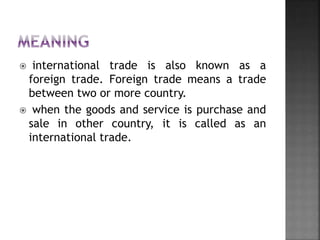
 international trade is also known as a
foreign trade. Foreign trade means a trade
between two or more country.
 when the goods and service is purchase and
sale in other country, it is called as an
international trade.
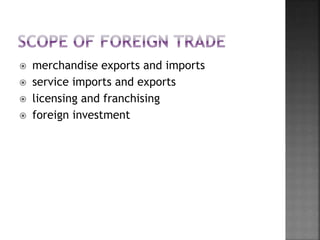
 merchandise exports and imports
 service imports and exports
 licensing and franchising
 foreign investment
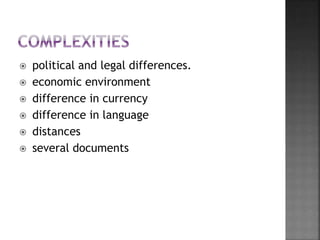
 political and legal differences.
 economic environment
 difference in currency
 difference in language
 distances
 several documents
 improve standard of living
 increase in real income
 lower price
 technological development
 rapid industrialization
 help in natural calamities
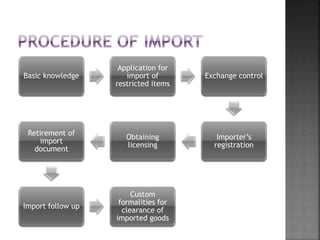
Basic knowledge
Application for
import of
restricted items
Exchange control
Importer’s
registration
Obtaining
licensing
Retirement of
import
document
Import follow up
Custom
formalities for
clearance of
imported goods
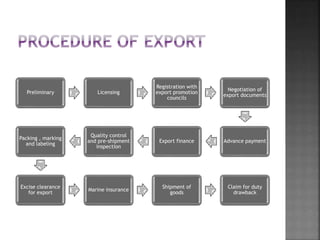
Preliminary Licensing
Registration with
export promotion
councils
Negotiation of
export documents
Advance paymentExport finance
Quality control
and pre-shipment
inspection
Packing , marking
and labeling
Excise clearance
for export
Marine insurance
Shipment of
goods
Claim for duty
drawback
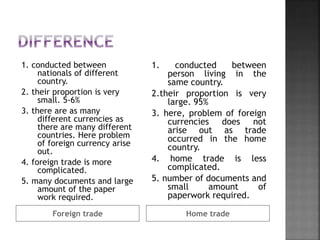
Foreign trade Home trade
1. conducted between
nationals of different
country.
2. their proportion is very
small. 5-6%
3. there are as many
different currencies as
there are many different
countries. Here problem
of foreign currency arise
out.
4. foreign trade is more
complicated.
5. many documents and large
amount of the paper
work required.
1. conducted between
person living in the
same country.
2.their proportion is very
large. 95%
3. here, problem of foreign
currencies does not
arise out as trade
occurred in the home
country.
4. home trade is less
complicated.
5. number of documents and
small amount of
paperwork required.
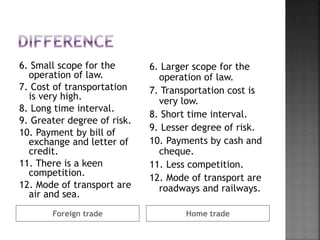
Foreign trade Home trade
6. Small scope for the
operation of law.
7. Cost of transportation
is very high.
8. Long time interval.
9. Greater degree of risk.
10. Payment by bill of
exchange and letter of
credit.
11. There is a keen
competition.
12. Mode of transport are
air and sea.
6. Larger scope for the
operation of law.
7. Transportation cost is
very low.
8. Short time interval.
9. Lesser degree of risk.
10. Payments by cash and
cheque.
11. Less competition.
12. Mode of transport are
roadways and railways.
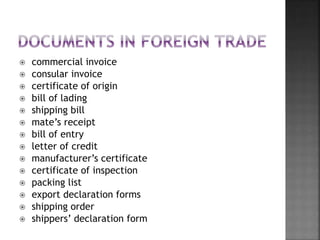
 commercial invoice
 consular invoice
 certificate of origin
 bill of lading
 shipping bill
 mate’s receipt
 bill of entry
 letter of credit
 manufacturer’s certificate
 certificate of inspection
 packing list
 export declaration forms
 shipping order
 shippers’ declaration form

International or foreign trade

  • 1.
  • 2.
     international tradeis also known as a foreign trade. Foreign trade means a trade between two or more country.  when the goods and service is purchase and sale in other country, it is called as an international trade.
  • 3.
     merchandise exportsand imports  service imports and exports  licensing and franchising  foreign investment
  • 4.
     political andlegal differences.  economic environment  difference in currency  difference in language  distances  several documents
  • 5.
     improve standardof living  increase in real income  lower price  technological development  rapid industrialization  help in natural calamities
  • 6.
    Basic knowledge Application for importof restricted items Exchange control Importer’s registration Obtaining licensing Retirement of import document Import follow up Custom formalities for clearance of imported goods
  • 7.
    Preliminary Licensing Registration with exportpromotion councils Negotiation of export documents Advance paymentExport finance Quality control and pre-shipment inspection Packing , marking and labeling Excise clearance for export Marine insurance Shipment of goods Claim for duty drawback
  • 8.
    Foreign trade Hometrade 1. conducted between nationals of different country. 2. their proportion is very small. 5-6% 3. there are as many different currencies as there are many different countries. Here problem of foreign currency arise out. 4. foreign trade is more complicated. 5. many documents and large amount of the paper work required. 1. conducted between person living in the same country. 2.their proportion is very large. 95% 3. here, problem of foreign currencies does not arise out as trade occurred in the home country. 4. home trade is less complicated. 5. number of documents and small amount of paperwork required.
  • 9.
    Foreign trade Hometrade 6. Small scope for the operation of law. 7. Cost of transportation is very high. 8. Long time interval. 9. Greater degree of risk. 10. Payment by bill of exchange and letter of credit. 11. There is a keen competition. 12. Mode of transport are air and sea. 6. Larger scope for the operation of law. 7. Transportation cost is very low. 8. Short time interval. 9. Lesser degree of risk. 10. Payments by cash and cheque. 11. Less competition. 12. Mode of transport are roadways and railways.
  • 10.
     commercial invoice consular invoice  certificate of origin  bill of lading  shipping bill  mate’s receipt  bill of entry  letter of credit  manufacturer’s certificate  certificate of inspection  packing list  export declaration forms  shipping order  shippers’ declaration form