

                          I N D E X                                 	
  
                                            Title                      Page

                  Foreword                                                 3

       1          About your Committee

                  1.1 What is the ECOSOC?

                  1.2 Who are the ECOSOC?                                  4

                  1.3 What is the function of the ECOSOC?

                  1.4 When is the ECOSOC called into session?

       2          About the Issue                                          5

                  2.1 Economical Advantages of Implementation	
            6

                  2.2 Economical and Political Difficulties	
              7

                  2.3 Contemporary Agreements and Proposals 	
             8

       3          Session Approach
                                                                           9
                  3.1 Particularities

       4          Recommended Research Resources.
                                                                           10
                  4.1 Documents and Websites

                  4.2 Guidance Questions                                   11

       6          Member Delegations                                       12

       7          References                                               14


                                                                           2	


       Welcome delegate, to the fifteenth edition of the Union and
Peace Model United Nations. The following document will provide
you with key information on the issue you, as the representative of
your assigned nation will be addressing. The information it contains
is focused towards guiding your investigation into the same key
points as the other delegates, yielding an active debate, which
generates an effective solution to the issue of concern. Please do
read comprehensively this document and keep in mind that it is only
the first step to a complete preparation. On behalf of all the Union
and Peace 2009 staff, I wish you good luck on your preparation and
debate.


                 Andres Gonzalez de Rosenzweig


                                                                3	


1. About Your Committee
1.1 What is the Economic and Social Council?
The Economic and Social Council is an organ, part of the United
Nations, which assists the General Assembly on the effort to address
issues concerning Economic progress and Social development,
seeking to promote cooperation among nations. The ECOSOC is the
principal coordinator of the 14 UN specialized agencies, holding
therefore a large agenda of issues to address. Its overall goals are:

                                  “ promoting higher standards of living, full employment, and
                                  economic and social progress;
                                  identifying solutions to international economic, social and health
                                  problems; facilitating international cultural and educational
                                  cooperation; and encouraging universal respect for human rights
                                  and fundamental freedom. “1

1.2 Who are the ECOSOC?
The ECOSOC is formed by 54 member states, which serve terms of 3
years. All members are designated by the General Assembly and
hold equal voting rights. These member states are represented by
delegations. Amongst these members, a variety of individuals from
member state delegations are selected to form the Bureau, who serve
as a chair to preside the session.
1.3 What is the function of the ECOSOC?
The ECOSOC mandate is very broad when appointing powers and
responsibilities to the council. The ECOSOC has the function of
developing studies, analyzing cases, appointing advisors, organizing
summits and many other capabilities, which take over 70% of the
United Nations human and financial resources in its operations.2
1.4 When is the ECOSOC called into session?
The ECOSOC holds regular meetings, throughout the year. The
session schedule of the ECOSOC includes also a high number of
meetings by agencies, funds, sub agencies, and other dependent
organs of the ECOSOC. The council as a whole traditionally meets
in July, having several scattered meetings throughout the year for
forums and conferences.


1	
  United Nations: UN Economic and Social Council: About ECOSOC	
  
2	
  Ibidem [United Nations: UN Economic and Social Council: About ECOSOC]	


                                                                                                                                                                                                                                   4	


2                                         About the issue.

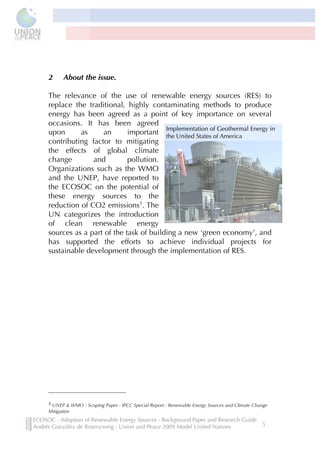
The relevance of the use of renewable energy sources (RES) to
replace the traditional, highly contaminating methods to produce
energy has been agreed as a point of key importance on several
occasions. It has been agreed
upon      as     an       important
contributing factor to mitigating
the effects of global climate
change        and         pollution.
Organizations such as the WMO
and the UNEP, have reported to
the ECOSOC on the potential of
these energy sources to the
reduction of CO2 emissions3. The
UN categorizes the introduction
of clean renewable energy
sources as a part of the task of building a new ‘green economy’, and
has supported the efforts to achieve individual projects for
sustainable development through the implementation of RES.


3	
  UNEP & WMO : Scoping Paper - IPCC Special Report - Renewable Energy Sources and Climate Change
Mitigation	
  

                                                                                                                                                                                                                                   5	


2.1 Economical Advantages of Implementation
          The implementation of modern renewable energy sources
     has been described by Achim Steiner, German expert on the
     subject and Director of UNEP, as a highly important part of a
     larger set of actions to protect the environment and as a source
     of opportunities to be harnessed only through international
     cooperation. In recent years the production of energy from
     alternate energy sources has experienced a downfall in costs,
     and an improving cent per kilowatt efficiency. An analytical
     comparison by the United States National Renewable Energy
     Laboratory has yielded the graphs4 that can be observed in
     Figure 1.
          The graphs illustrate historical tendencies up to 2002 and
     the predicted tendencies up to 2020. The predictions by the
     NREL conservatively predict a slowdown in the improvement
     cost efficiency; nevertheless it is known that recent advances
     have led to a higher efficiency.

                                                                           "What we see from our modeling results is that mitigation of
                                                                           climate change, this is possible...The models show that this is
                                                                           technically feasible — and perhaps more important — also
                                                                           economically feasible."
                                                                                                                                Dr. Brigitte Knopf, Researcher, Potsdam Institute for Climate
                                                                                                                                Impact Research5


                                          Another source of economical appeal on the implementation of
                                          RES is the reduced or non-existent cost of raw materials. The
                                          main expenditures of RES are maintenance and other internal
                                          operational costs, which also exist in traditional energy plants.
                                          Overall, the main cost of using RES is the initial cost of facilities
                                          and the related technology.


4	
  Nutall, Nick: "Global Green New Deal" - Environmentally-Focused Investment
5	
  Lacey, Stephen: The German Perspective, Part 1: Difficulties in Climate Negotiations


                                                                                                                                                                                                                                   6	


                                          2.2 Economical and Political Difficulties

                                               Several elements act against the economical feasibility of
                                          the generalized adoption of RES. The initial investment is
                                          sometimes too overwhelming for a corporation or a nation to
                                          assume, even when the nation has a profile of pioneering in the
                                          field, as has been the case of Germany6. Nations with a heavy
                                          economic burden such as Niger have embraced the RES
                                          adoption scheme as a possibility for sustainable development,
                                          but have also resisted this transition because, like many other
                                          African nations, they depend largely on their coal exports. The
                                          implementation of RES would represent a decrease in the
                                          demand for coal and fossil fuels. In addition, African Nations
                                          adopting RES that depend on water related technologies have
                                          reported great failures as droughts diminish water levels in the
                                          water flow systems such as dams and rivers, and have thus
                                          defended their right to maintain traditional Energy Sources7.


                                          Figure 1:


6	
  Lacey, Stephen; The German Perspective, Part 1: Difficulties in Climate Negotiations 	
  
7	
  African Press Agency: Niger to Implement Renewable Energy Programs to Alleviate Poverty.	


                                                                                                                                                                                                                                   7	


                                          2.3 Contemporary Agreements and Proposals

                                                                                     2.3.1     Agenda 21
                                                                                        In 1992, the United Nations drafted a program, which
                                                                                        has received international recognition by virtue of its
                                                                                        holistic nature. The program bases itself on sustainable
                                                                                        development and it covers basic aspects that range from
                                                                                        poverty to technical data sharing. Its principles have
                                                                                        served as a base for the 2002 Johannesburg summit,
                                                                                        which ratified the principles and called for a full
                                                                                        implementation of the protocol8. It has been suggested
                                                                                        that the principles serve as a base for the agreement on
                                                                                        the adoption of RES.

                                                                                     2.3.2     Eurosolar’s Proliferation Treaty
                                                                                        The European authority Euro solar, in 2001 drafted the
                                                                                        proposal for a treaty on the promotion of the
                                                                                        proliferation of RES. It is based on the 1970 NPT and the
                                                                                        Article 21 charter. The proposal has been discussed by
                                                                                        the World Council for Renewable Energies9 (WCRE) and
                                                                                        constitutes an important example of the recognition of
                                                                                        the need for an international agreement. The WCRE has
                                                                                        received US representatives in its calling for the creation
                                                                                        of an International agency to promote and regulate RES.

                                                                                     2.3.3    Copenhagen 2009
                                                                                        The United Nations called for a conference to be held in
                                                                                        Copenhagen in December of 2009, under the title of
                                                                                        Copenhagen Climate Change Conference, the
                                                                                        Conference is expected to be highly active and RES are
                                                                                        expected to be a key point for discussion.


8	
  United Nations Division for Sustainable Development Agenda 21 - Table of Contents.
9	
  EuroSolar International Proliferation Treaty for Renewable Energies	


                                                                                                                                                                                                                                   8	


3             Session Approach

     Not unlike other major reforms that concern the environment
and the reaction to the effects of pollution, the practical agreement
to promote and implement the replacement of traditional energy
sources represents a defining challenge to our generation. The
debate on the desirability, or the morale behind the implementation
of modern energy, is unnecessary, as the United Nations has already
defined an embracing position when dealing on this particular issue.
Our discussion is oriented towards the establishment of a worldwide
agreement on the handling the need for the adoption of renewable
energy sources in an economically feasible way, through the
principles of sustainable development. Key points to focus on are the
more practical issues, which might produce an international plan of
action.

              3.1 Particularities
              Special attention to the following concerns is suggested:
                   •    Problems with information sharing and international
                   cooperation might arise.

                  •    The project might face opposition from non-renewable
                  raw material providers, under the threat of losing demand
                  for products such as coal or oil.

                  •   Nations are likely to report lack of resources for the
                  conversion.

                  •   Cooperation problems might arise between the private
                  and the public owned energy producers.

                  •   Developed nations have argued lack of fair exchanges
                  from underdeveloped or developing nations.

                  •   A law to regulate transparency throughout all
                  processes might be necessary.


                                                                        9	


4 Recommended Research Resources
Your research, in order to be effective, must cover similar aspects
from your country as the research that is being done by your fellow
delegates on their assigned countries. To aid you in this task we’ve
compiled a set of questions to guide your research and debate.
Remember they only represent a suggestion and, as guidelines, are
not sufficient to function as the orientation of your whole
investigation. As well, we’ve compiled a set of websites that provide
important research resources; these websites represent a potential
catalyst for your investigation, and are meant to lead you into further
research.

              4.1 Documents and Websites

              UNEP: Video Resource: The Green Compromise
                  • http://www.unep.org/NewsCentre/videos/player_new.asp
                     ?w=480&h=272&f=/ne wscentre/videos/webcasts/2009-
                     3-20_Towards_a__global_green_new_deal-0
              UNEP: UNEP and Partners United to Combat Climate Change
                  • http://www.unep.org/pdf/081127_POZNANBKL_web.pdf
              United Nations Climate Change Conference Copenhagen 2009
                  • http://en.cop15.dk/
              Introduction to Energy Sources and their Application in the
              U.S.A.
                  • http://www.energy.gov/energysources/index.htm
              Center for a World in Balance - Agenda 2
                  • http://worldinbalance.net/agreements/1992-rio-
                     agenda21.php
              Iberdrola: World’s Largest Renewable Energy Operator
                 • http://www.iberdrolarenovables.es/wcren/ngc/en/flash/fl
                     ash_complejos/FuerzasNaturaleza/default.htm
              World Council for Renewable Energy
                  • http://www.wcre.org/


                                                                       10	


              4.2 Guidance Questions.

              • What has your nation’s historical position been when
                 debating RES?
               o Why?

              • How has your nation contributed to the issue, both locally
                 and globally?

              • What is your nation’s experience with RES?

              • What is the viewpoint of your nation regarding the
                 difficulties of reaching an agreement?
               o Do you have legislation on the matter?

              • What can your nation offer to the worldwide solution?

              • What is your nation’s actual benefit from getting involved?

              • Why could your contribution be appealing to the other
                 delegations?

              • How would your nation’s proposal fit into an ECOSOC
                 resolution?

              • What assistance does your country request from others?

              • What would your country be willing to give in exchange
                 for aid (if necessary)?

              • What would your country be willing to receive in
                 exchange for aid (if possible)?


                                                                         11	


                        Economic and Social Council


            MEMBER DELEGATIONS
                                     (1-10)

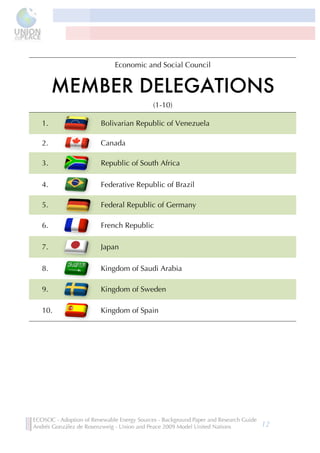
1.                 Bolivarian Republic of Venezuela

2.                 Canada	
  

3.                 Republic of South Africa	
  

4.                 Federative Republic of Brazil	
  

5.                 Federal Republic of Germany

6.                 French Republic	
  

7.                 Japan

8.                 Kingdom of Saudi Arabia

9.                 Kingdom of Sweden

10.                Kingdom of Spain


                                                       12	


                   Economic And Social Council


        MEMBER DELEGATIONS
                              (11-20)

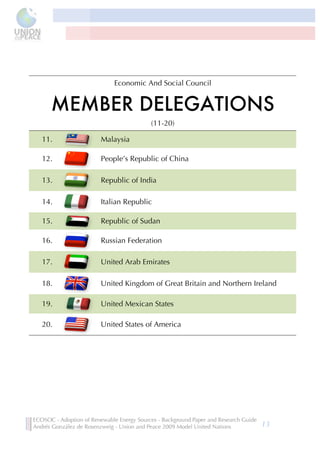
11.            Malaysia

12.            People’s Republic of China

13.            Republic of India

14.            Italian Republic

15.            Republic of Sudan

16.            Russian Federation

17.            United Arab Emirates

18.            United Kingdom of Great Britain and Northern Ireland

19.            United Mexican States

20.            United States of America


                                                              13	


6. References 	
  

United Nations:
UN Economic and Social Council: About ECOSOC

Background Information published by the United Nations.
Visited: April 10th, 2009 Available at: http://www.un.org//ecosoc/about/


UNEP & WMO Intergovernmental Panel on Climate Change: Renewable
Energy Sources and Climate Change Mitigation

Information published by the UNEP & WMO on discussions on the topic.
Visited: April 10th, 2009 Available at:
http://www.ipcc.ch/meetings/session28/doc3.pdf


Pontius, Nancy L.: U.S.-Indian Team Investigates Alternative Energy Source in
India

Background Information published by the United Nations.
Visited: April 10th, 2009 Available at: http://www.america.gov/st/energy-
english/2009/April/20090409151211abretnuh0.5346338.html&distid=ucs#ixz
z0CgNJoxXp


U.S. Department of Energy: Multi-Year Research, Development, and
Demonstration Plan:

Programmed Activities to 2025
Available at: http://www1.eere.energy.gov/geothermal/plans.html
Research Information published by the USDoE.
Visited: April 10th, 2009


Lacey, Stephen: The German Perspective, Part 1: Difficulties in Climate
Negotiations

Article considering various aspects of RES implementation policies.
Visited: April 11th, 2009 Available at:
http://www.renewableenergyworld.com/rea/news/article/2009/01/the-
german-perspective-part-1-difficulties-in-climate-negotiations-54409


                                                                           14	


African Press Agency: Niger to Implement Renewable Energy Programs to
Alleviate Poverty.
APA Article collected and published by the Net News Publisher service.
Visited: April 12th, 2009 Available at: http://www.netnewspublisher.com/niger-
to-implement- renewable-energy-programs-to-alleviate-poverty/


United Nations Division for Sustainable Development Agenda 21 - Table of
Contents.
Directory and content of the Agenda 21 program charter.
Visited: April 12th, 2009 Available at:
http://www.un.org/esa/sustdev/documents/agenda21/english/agenda21toc.h
tm


EuroSolar
International Proliferation Treaty for Renewable Energies
Proposal by Eurosolar on RES Proliferation.
Visited: April 12th, 2009 Available at:
http://www.eurosolar.de/en/images/stories/pdf/Int_Proliferation_Treaty_Draft
_en_jul01.pdf


Nutall, Nick:
"Global Green New Deal" - Environmentally-Focused Investment
Article Published by the UNEP
Visited: September 5th, 2009 Dated: October 22, 2008 Available at:
http://www.unep.org/Documents.Multilingual/Default.asp?DocumentID=548&
ArticleID=5957&l=en


                                                                          15