• During the last three and four decades
international trade has increased remarkably
The most important factors contributing to this
increase:-
Globalization
The formation of regional economic and political units
Developments in transportation and communication
Innovation in the field of information
telecommunications and technology
The possibility of concluding contracts electronically by
telefax, email or over the Internet
Every contract is governed by an applicable legal system.
When a dispute arises it is often uncertain which
country's law governs the transaction, which court
is to be approached for legal relief, or whether
there will be access to a favorable court at all.
The multiplicity of legal systems relevant to the
transaction results not only in problems of forum
shopping, but also in uncertainty as to the
respective rights and obligations of the parties to
the contract.
Although the parties are in general free to
choose the law applicable to their contract, in
practice, the choice of a legal system is often not
provided for in the contract.
Traditionally, trade terms only indicated that the
goods should be delivered in a particular way
and that certain basic costs should be paid by
either the seller or the buyer.
The questions are:-
who should clear the goods for export and/or
import?
who should pay the costs of loading and
discharging the goods?
how the risk of loss or damage to the goods
should be divided between them?
who should take out insurance as protection
against the risks?
All these are need to be answered!!
A more detailed elaboration of the trade term,
either by specific provisions in the contract of
sale or by the applicable law or custom of the
trade, was therefore required.
Because contracting parties normally do not
elaborate these points specifically, there was an
additional need for a more extensive
standardization of customs and practices in this
regard.
• The history and development of trade terms
reflect the history and development of
international trade generally.
• Trade terms evolution is not a purely legal
matter, but has been shaped by:
Economic, political and technological factors as well
as
Developments in transportation techniques,
Containerization and
 The movement towards paperless trading.
• Trade conducted in the late eighteenth and
nineteenth centuries differed considerably from
those prevailing today.
• The transfer of costs and risks followed the
methods of cargo handling at that time.
• Hence, costs and risks transferred at the
moment of shipment.
• The first Incoterms were issued in 1936. The
most recent version (8th Version) of Incoterms,
Incoterms 2010, were launched in September
2010 and became effective January 1, 2011.
• Def: The word INCOTERM is an abbreviation for
International Commercial Terms which provide a
common set of rules used for defining the
responsibilities of sellers and buyers in the delivery of
goods under sales contracts.
• They are widely used in international commercial
transactions.
Ashu/2009/ERCA
o Set international rules for commonly used
terms in foreign trade;
o Define obligations of both parties
involved in the transaction;
o Determine the distribution & transfer of
risks regarding the goods delivered from
seller to buyer;
o State the clear sharing of expenses
between the parties during transport;
oFirst conceived by International Chamber of
Commerce (ICC) in 1921 and implemented
starting from 1936, since they have been updated
6 times in order to keep pace with the evolution
of international trade.
oIn 1923, a Trade Terms Committee developed the
first 6 rules : FOB, FAS, FOT, FOR, Free
Delivered CIF and C&F, as the precursor for
what would later be known as INCOTERM
rules.
• In order to keep up with the continuous evolution of
commercial practices, types of goods and transport and
international law, INCOTERMS need to be regularly
updated by specialized experts.
• 1980 ‐ FCA was introduced, for dealing with cases where
the reception point was no longer the ship's rail, but a
point on land where goods were stored in a container.
• 1990 ‐ the seller was permitted to provide the proof
of delivery electronically by EDI‐messages instead
of paper documentation.
• 2000 ‐ export clearance and other formalities under
FAS are placed on the seller (previously buyer).
In FCA, it became the seller's obligation to load the goods
on the buyer's vehicle or the buyer's obligation to receive
the seller's arriving vehicle unloaded
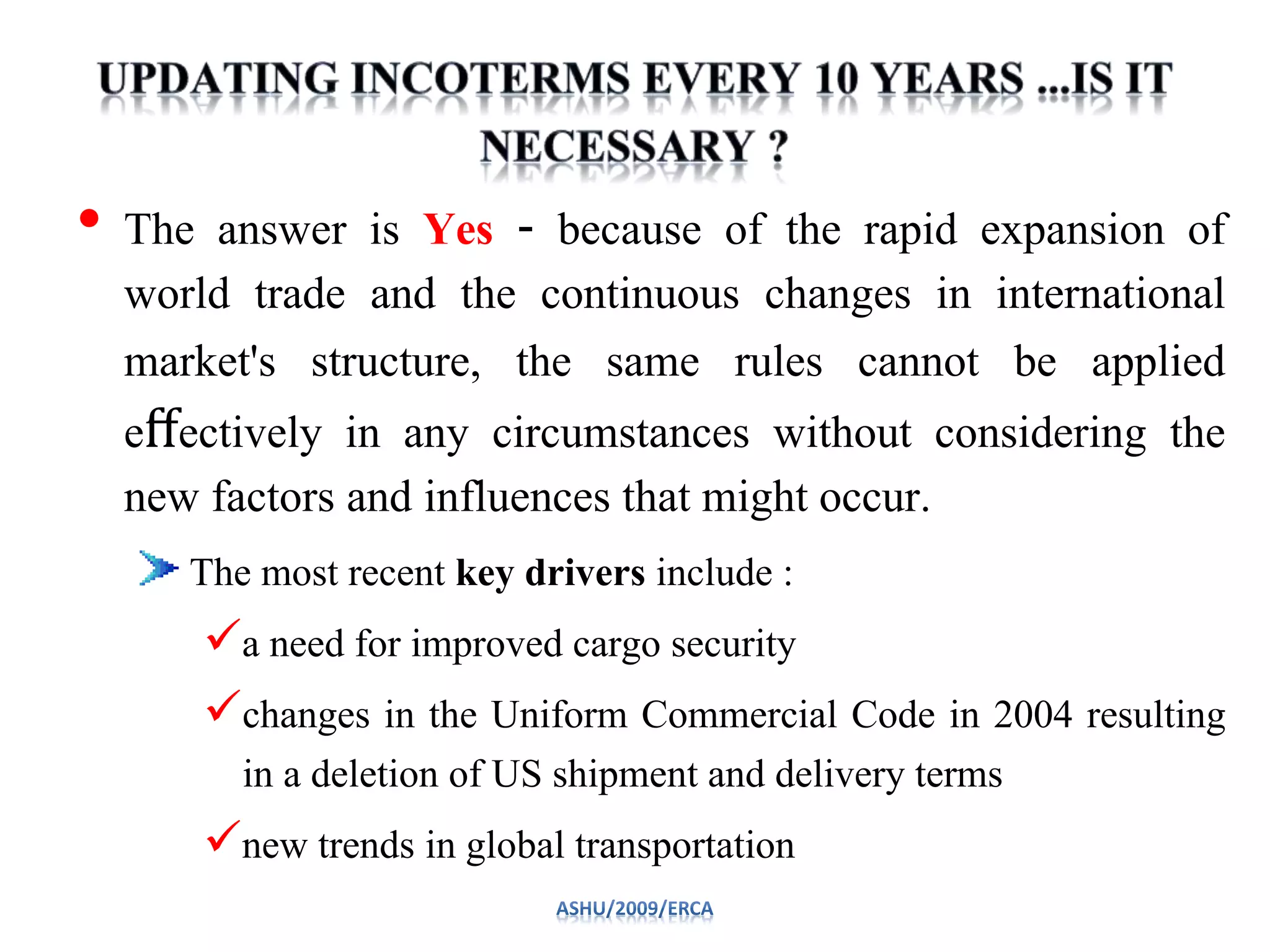
• The answer is Yes ‐ because of the rapid expansion of
world trade and the continuous changes in international
market's structure, the same rules cannot be applied
effectively in any circumstances without considering the
new factors and influences that might occur.
The most recent key drivers include :
a need for improved cargo security
changes in the Uniform Commercial Code in 2004 resulting
in a deletion of US shipment and delivery terms
new trends in global transportation
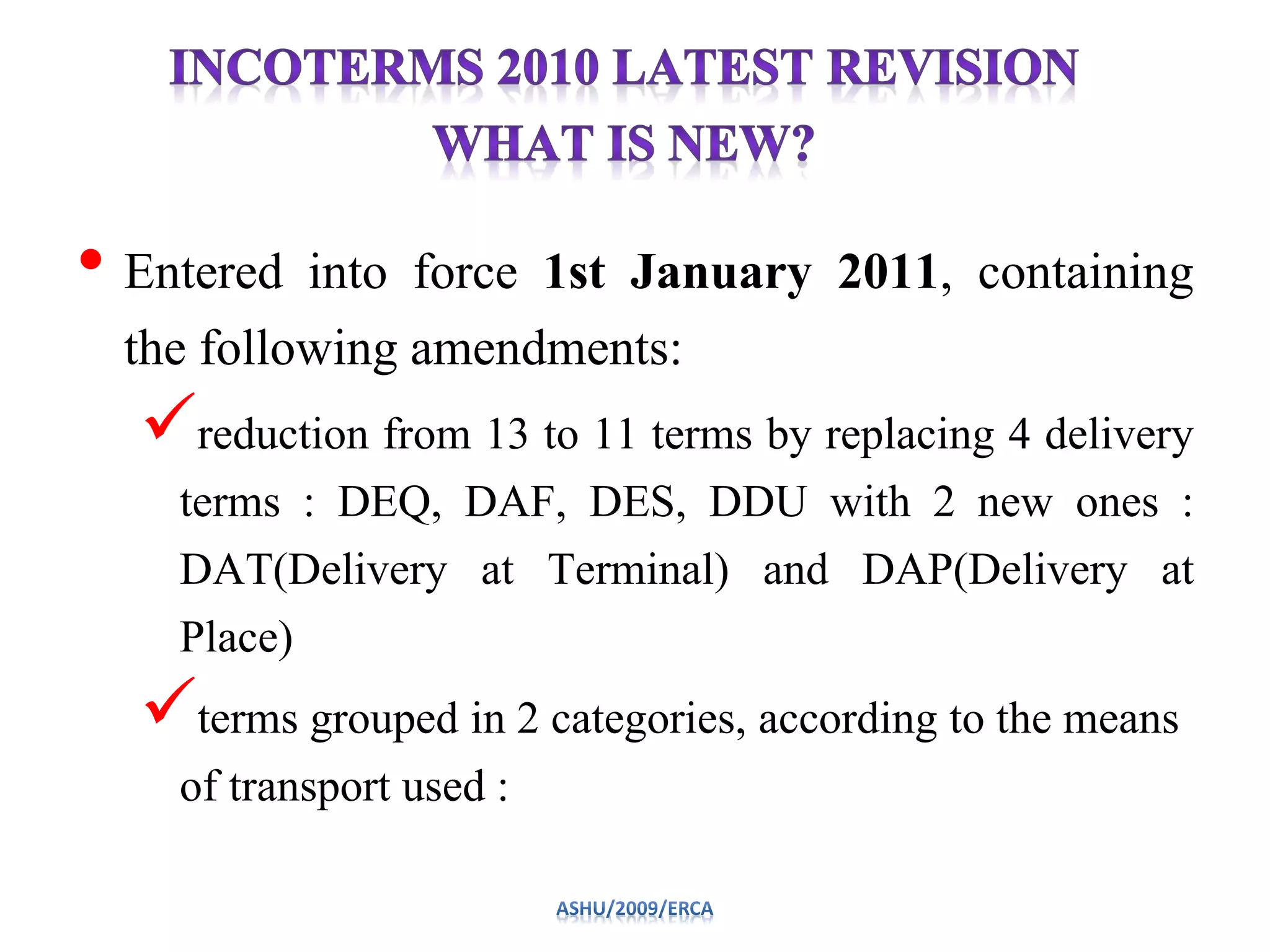
• Entered into force 1st January 2011, containing
the following amendments:
reduction from 13 to 11 terms by replacing 4 delivery
terms : DEQ, DAF, DES, DDU with 2 new ones :
DAT(Delivery at Terminal) and DAP(Delivery at
Place)
terms grouped in 2 categories, according to the means
of transport used :
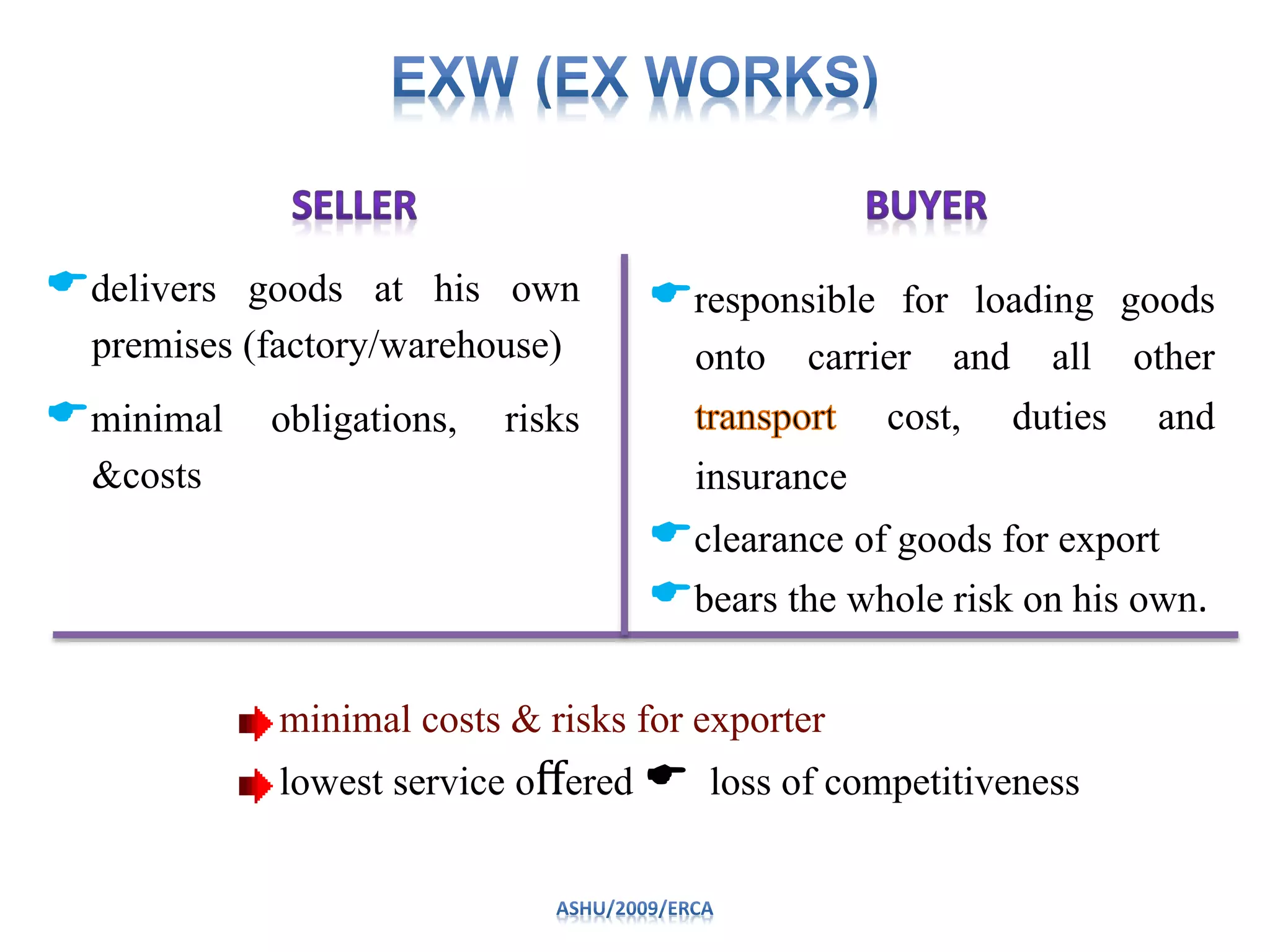
delivers goods at his own
premises (factory/warehouse)
minimal obligations, risks
&costs
responsible for loading goods
onto carrier and all other
cost, duties and
insurance
clearance of goods for export
bears the whole risk on his own.
minimal costs & risks for exporter
lowest service offered  loss of competitiveness
completes and bears costs of export
clearance and obtaining necessary
documents
delivers goods at agreed place to
carrier
liable for the load if delivery is
made on his premises
import clearance formalities
clearance of goods for export
responsible for unload if
delivery occurs in a facility or
transport infrastructure
flexible, various delivery points
any type of cargo and different payment methods
best suited for goods transported in containers
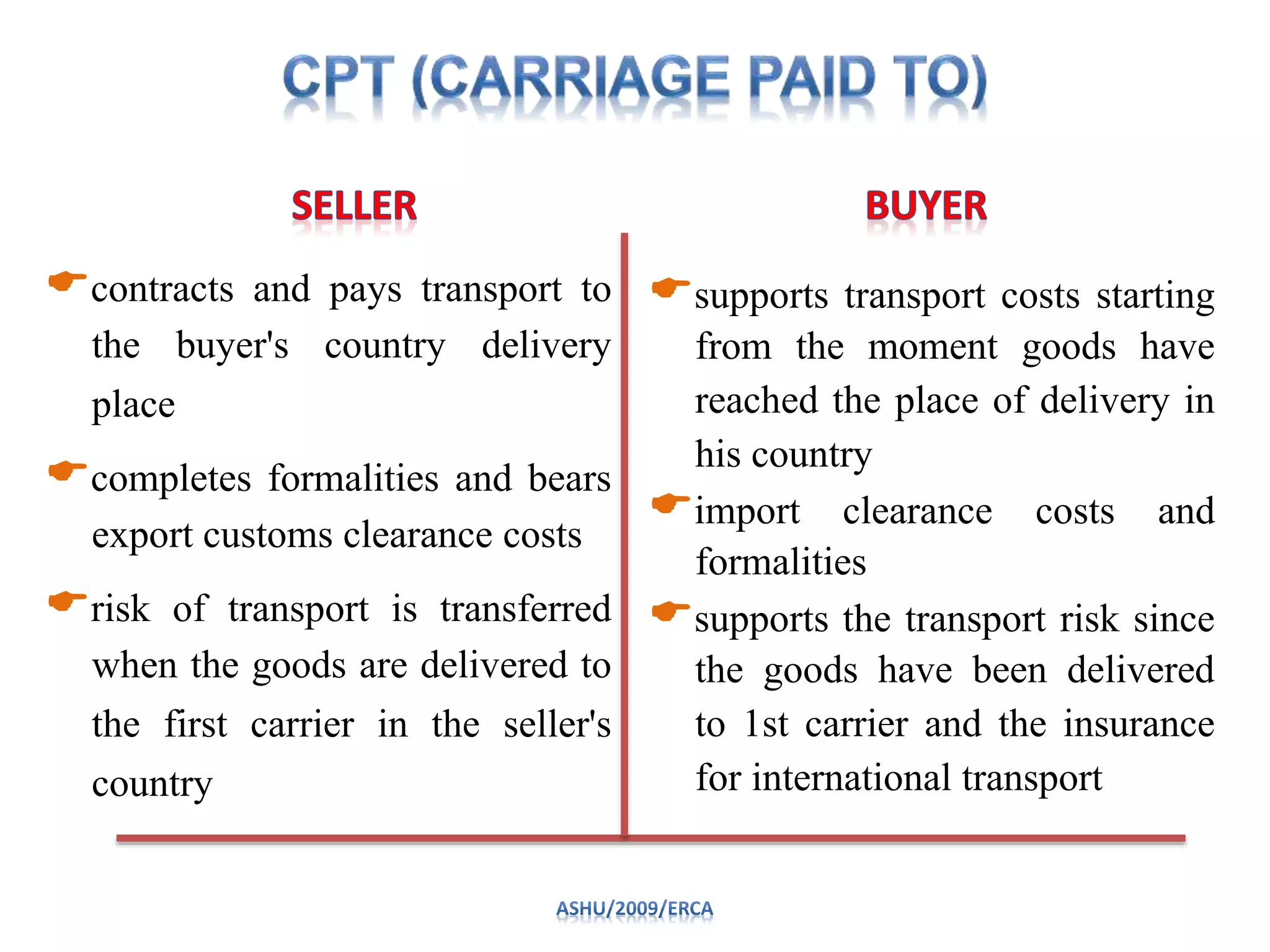
contracts and pays transport to
the buyer's country delivery
place
completes formalities and bears
export customs clearance costs
risk of transport is transferred
when the goods are delivered to
the first carrier in the seller's
country
supports transport costs starting
from the moment goods have
reached the place of delivery in
his country
import clearance costs and
formalities
supports the transport risk since
the goods have been delivered
to 1st carrier and the insurance
for international transport
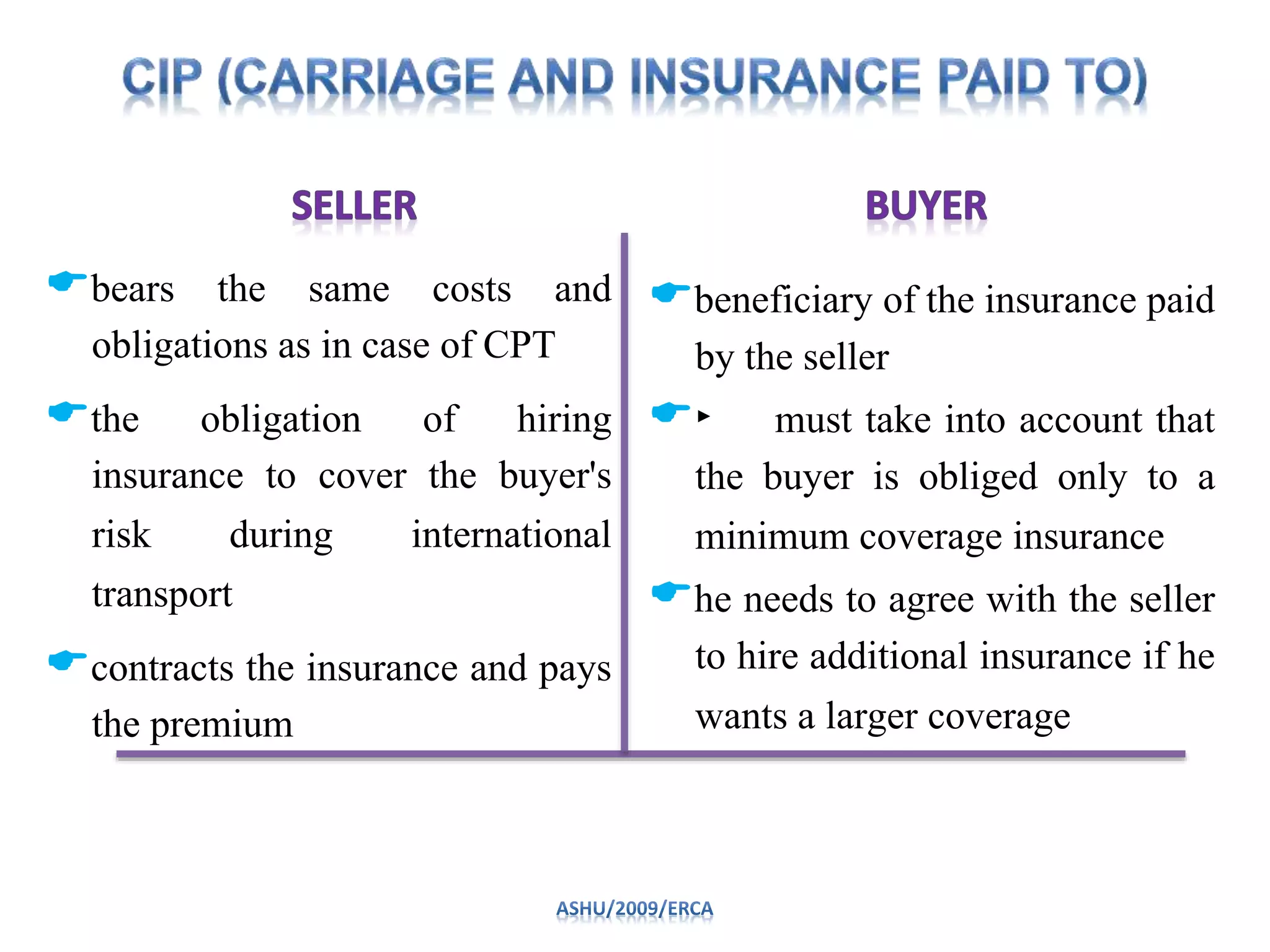
bears the same costs and
obligations as in case of CPT
the obligation of hiring
insurance to cover the buyer's
risk during international
transport
contracts the insurance and pays
the premium
beneficiary of the insurance paid
by the seller
‣ must take into account that
the buyer is obliged only to a
minimum coverage insurance
he needs to agree with the seller
to hire additional insurance if he
wants a larger coverage
delivers goods unloaded at a port
terminal or another place of
destination in the buyer's country
complete the formalities and bear
costs of customs clearance for
export
transport risk passes to the buyer at
the time of delivery to destination
country
import customs clearance
and tariffs paid
clearly mention the specific
point chosen for delivery

delivers goods ready for unloading in
the country of destination, in a place
other than a transport terminal, such
as the buyer's premises or a place
nearby
risk is transferred to buyer in the
same place where goods are delivered
complete formalities and bear export
clearance costs
pays the costs of import
clearance customs
useful for sales between
countries of same
economic area (EU) as
there are no import
customs
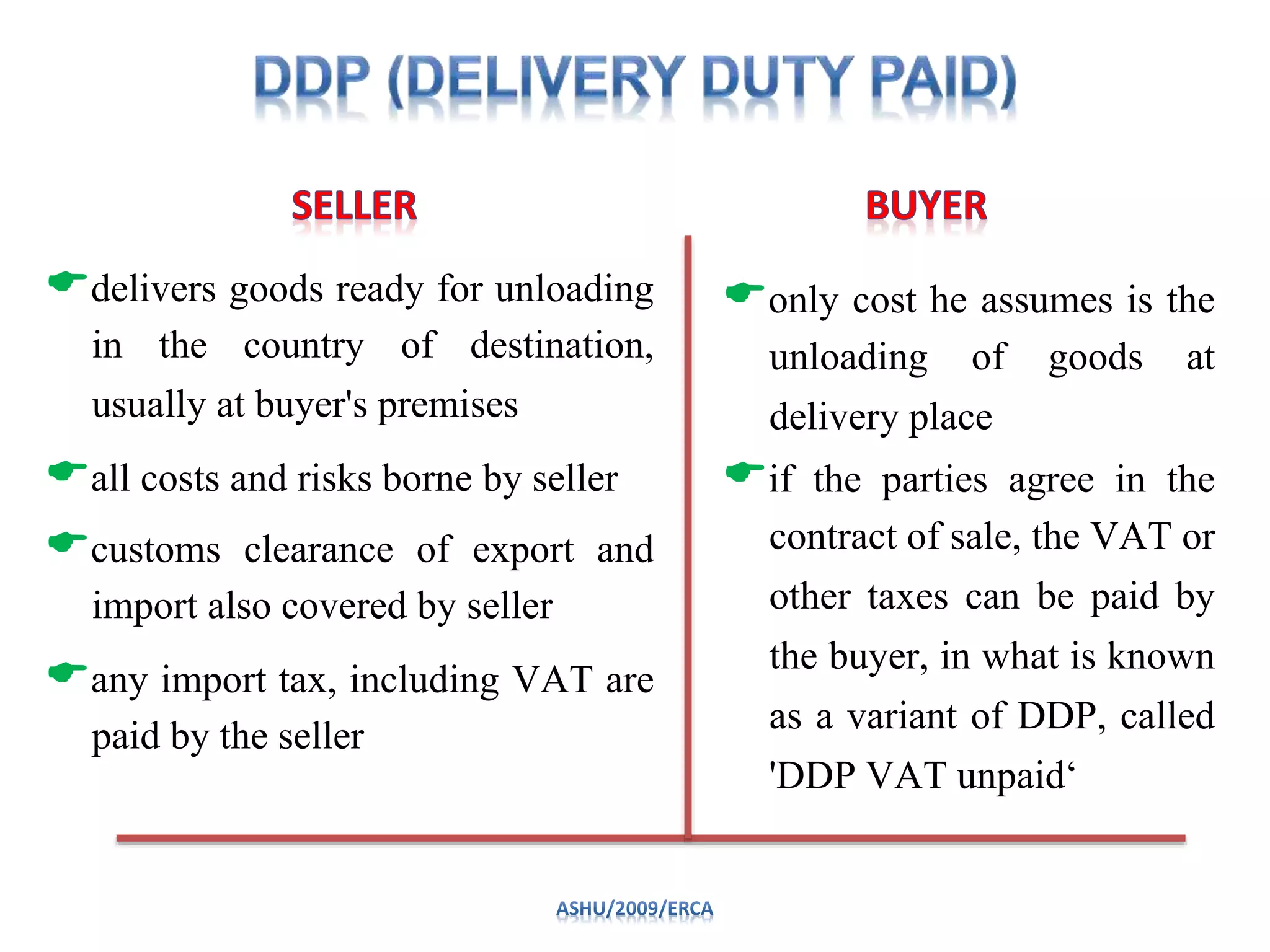
delivers goods ready for unloading
in the country of destination,
usually at buyer's premises
all costs and risks borne by seller
customs clearance of export and
import also covered by seller
any import tax, including VAT are
paid by the seller
only cost he assumes is the
unloading of goods at
delivery place
if the parties agree in the
contract of sale, the VAT or
other taxes can be paid by
the buyer, in what is known
as a variant of DDP, called
'DDP VAT unpaid‘
Ashu/2009/ERCA
delivers the goods placing them
alongside the ship chosen by the
buyer
export clearance must be
covered by the seller
responsible for loading the
goods on the ship
must have very good knowledge
of the practices in the port of
shipment
only used for certain commodities and materials that are
not packed and cannot be individualized (grain, timber,
minerals, etc.)
delivery is done in ports with specialized terminals
delivers goods by placing them
on board of the ship named by
the buyer
covers the terminal costs and
export clearance
assumes the transportation risk
after the goods have been
delivered on board of the ship

 oldest Incoterm and one of the most widely used
 preferably used with bulk, heavy loads and in case of complex
goods (machinery) whose loading involves certain risks
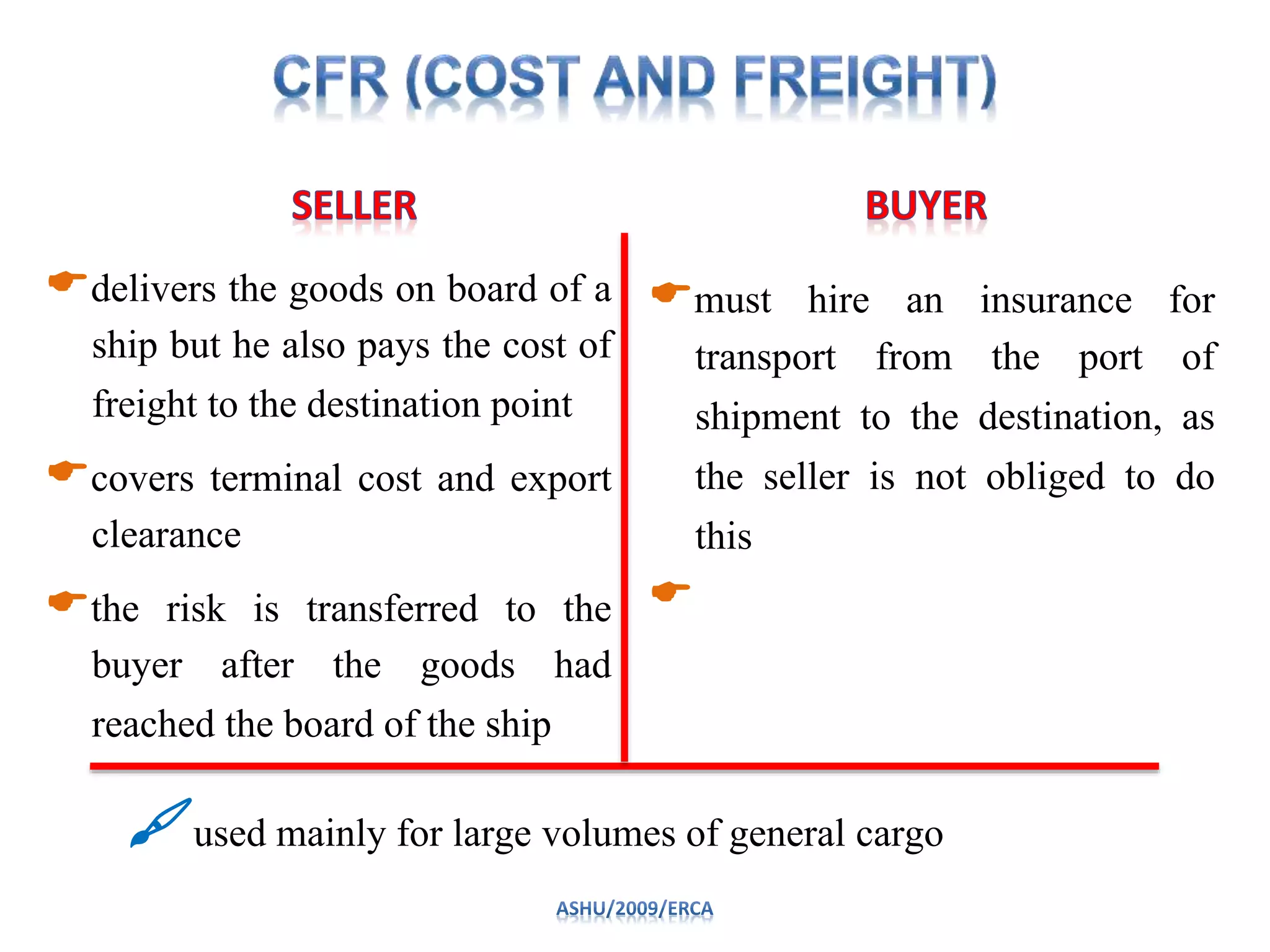
delivers the goods on board of a
ship but he also pays the cost of
freight to the destination point
covers terminal cost and export
clearance
the risk is transferred to the
buyer after the goods had
reached the board of the ship
must hire an insurance for
transport from the port of
shipment to the destination, as
the seller is not obliged to do
this

used mainly for large volumes of general cargo
same obligations that CFR implies
seller is obliged to hire insurance for
transport covering at least the way
from the port of shipping to the port of
destination
insurance shall cover the price of the
contract + 10%
he might want to hire
additional insurance, as
the seller is only obliged
to purchase a minimum
coverage insurance

 used for general cargo of consumer or industrial products of high value
CIF value is used in most of the customs to apply tariffs and import
taxes, facilitating the clearance of goods for export
Ashu/2009/ERCA
Ashu/2009/ERCA
Ashu/2009/ERCA

incoterms

  • 2.
    • During thelast three and four decades international trade has increased remarkably The most important factors contributing to this increase:- Globalization The formation of regional economic and political units Developments in transportation and communication Innovation in the field of information telecommunications and technology The possibility of concluding contracts electronically by telefax, email or over the Internet
  • 3.
    Every contract isgoverned by an applicable legal system. When a dispute arises it is often uncertain which country's law governs the transaction, which court is to be approached for legal relief, or whether there will be access to a favorable court at all. The multiplicity of legal systems relevant to the transaction results not only in problems of forum shopping, but also in uncertainty as to the respective rights and obligations of the parties to the contract.
  • 4.
    Although the partiesare in general free to choose the law applicable to their contract, in practice, the choice of a legal system is often not provided for in the contract. Traditionally, trade terms only indicated that the goods should be delivered in a particular way and that certain basic costs should be paid by either the seller or the buyer.
  • 5.
    The questions are:- whoshould clear the goods for export and/or import? who should pay the costs of loading and discharging the goods? how the risk of loss or damage to the goods should be divided between them? who should take out insurance as protection against the risks? All these are need to be answered!!
  • 6.
    A more detailedelaboration of the trade term, either by specific provisions in the contract of sale or by the applicable law or custom of the trade, was therefore required. Because contracting parties normally do not elaborate these points specifically, there was an additional need for a more extensive standardization of customs and practices in this regard.
  • 7.
    • The historyand development of trade terms reflect the history and development of international trade generally. • Trade terms evolution is not a purely legal matter, but has been shaped by: Economic, political and technological factors as well as Developments in transportation techniques, Containerization and  The movement towards paperless trading.
  • 8.
    • Trade conductedin the late eighteenth and nineteenth centuries differed considerably from those prevailing today. • The transfer of costs and risks followed the methods of cargo handling at that time. • Hence, costs and risks transferred at the moment of shipment. • The first Incoterms were issued in 1936. The most recent version (8th Version) of Incoterms, Incoterms 2010, were launched in September 2010 and became effective January 1, 2011.
  • 9.
    • Def: Theword INCOTERM is an abbreviation for International Commercial Terms which provide a common set of rules used for defining the responsibilities of sellers and buyers in the delivery of goods under sales contracts. • They are widely used in international commercial transactions.
  • 10.
  • 12.
    o Set internationalrules for commonly used terms in foreign trade; o Define obligations of both parties involved in the transaction; o Determine the distribution & transfer of risks regarding the goods delivered from seller to buyer; o State the clear sharing of expenses between the parties during transport;
  • 13.
    oFirst conceived byInternational Chamber of Commerce (ICC) in 1921 and implemented starting from 1936, since they have been updated 6 times in order to keep pace with the evolution of international trade. oIn 1923, a Trade Terms Committee developed the first 6 rules : FOB, FAS, FOT, FOR, Free Delivered CIF and C&F, as the precursor for what would later be known as INCOTERM rules.
  • 14.
    • In orderto keep up with the continuous evolution of commercial practices, types of goods and transport and international law, INCOTERMS need to be regularly updated by specialized experts. • 1980 ‐ FCA was introduced, for dealing with cases where the reception point was no longer the ship's rail, but a point on land where goods were stored in a container.
  • 15.
    • 1990 ‐the seller was permitted to provide the proof of delivery electronically by EDI‐messages instead of paper documentation. • 2000 ‐ export clearance and other formalities under FAS are placed on the seller (previously buyer). In FCA, it became the seller's obligation to load the goods on the buyer's vehicle or the buyer's obligation to receive the seller's arriving vehicle unloaded
  • 16.
    • The answeris Yes ‐ because of the rapid expansion of world trade and the continuous changes in international market's structure, the same rules cannot be applied effectively in any circumstances without considering the new factors and influences that might occur. The most recent key drivers include : a need for improved cargo security changes in the Uniform Commercial Code in 2004 resulting in a deletion of US shipment and delivery terms new trends in global transportation
  • 17.
    • Entered intoforce 1st January 2011, containing the following amendments: reduction from 13 to 11 terms by replacing 4 delivery terms : DEQ, DAF, DES, DDU with 2 new ones : DAT(Delivery at Terminal) and DAP(Delivery at Place) terms grouped in 2 categories, according to the means of transport used :
  • 20.
    delivers goods athis own premises (factory/warehouse) minimal obligations, risks &costs responsible for loading goods onto carrier and all other cost, duties and insurance clearance of goods for export bears the whole risk on his own. minimal costs & risks for exporter lowest service offered  loss of competitiveness
  • 21.
    completes and bearscosts of export clearance and obtaining necessary documents delivers goods at agreed place to carrier liable for the load if delivery is made on his premises import clearance formalities clearance of goods for export responsible for unload if delivery occurs in a facility or transport infrastructure flexible, various delivery points any type of cargo and different payment methods best suited for goods transported in containers
  • 22.
    contracts and paystransport to the buyer's country delivery place completes formalities and bears export customs clearance costs risk of transport is transferred when the goods are delivered to the first carrier in the seller's country supports transport costs starting from the moment goods have reached the place of delivery in his country import clearance costs and formalities supports the transport risk since the goods have been delivered to 1st carrier and the insurance for international transport
  • 23.
    bears the samecosts and obligations as in case of CPT the obligation of hiring insurance to cover the buyer's risk during international transport contracts the insurance and pays the premium beneficiary of the insurance paid by the seller ‣ must take into account that the buyer is obliged only to a minimum coverage insurance he needs to agree with the seller to hire additional insurance if he wants a larger coverage
  • 24.
    delivers goods unloadedat a port terminal or another place of destination in the buyer's country complete the formalities and bear costs of customs clearance for export transport risk passes to the buyer at the time of delivery to destination country import customs clearance and tariffs paid clearly mention the specific point chosen for delivery 
  • 25.
    delivers goods readyfor unloading in the country of destination, in a place other than a transport terminal, such as the buyer's premises or a place nearby risk is transferred to buyer in the same place where goods are delivered complete formalities and bear export clearance costs pays the costs of import clearance customs useful for sales between countries of same economic area (EU) as there are no import customs
  • 26.
    delivers goods readyfor unloading in the country of destination, usually at buyer's premises all costs and risks borne by seller customs clearance of export and import also covered by seller any import tax, including VAT are paid by the seller only cost he assumes is the unloading of goods at delivery place if the parties agree in the contract of sale, the VAT or other taxes can be paid by the buyer, in what is known as a variant of DDP, called 'DDP VAT unpaid‘
  • 27.
  • 28.
    delivers the goodsplacing them alongside the ship chosen by the buyer export clearance must be covered by the seller responsible for loading the goods on the ship must have very good knowledge of the practices in the port of shipment only used for certain commodities and materials that are not packed and cannot be individualized (grain, timber, minerals, etc.) delivery is done in ports with specialized terminals
  • 29.
    delivers goods byplacing them on board of the ship named by the buyer covers the terminal costs and export clearance assumes the transportation risk after the goods have been delivered on board of the ship   oldest Incoterm and one of the most widely used  preferably used with bulk, heavy loads and in case of complex goods (machinery) whose loading involves certain risks
  • 30.
    delivers the goodson board of a ship but he also pays the cost of freight to the destination point covers terminal cost and export clearance the risk is transferred to the buyer after the goods had reached the board of the ship must hire an insurance for transport from the port of shipment to the destination, as the seller is not obliged to do this  used mainly for large volumes of general cargo
  • 31.
    same obligations thatCFR implies seller is obliged to hire insurance for transport covering at least the way from the port of shipping to the port of destination insurance shall cover the price of the contract + 10% he might want to hire additional insurance, as the seller is only obliged to purchase a minimum coverage insurance   used for general cargo of consumer or industrial products of high value CIF value is used in most of the customs to apply tariffs and import taxes, facilitating the clearance of goods for export
  • 32.
  • 33.
  • 34.