Intermediate Accounting Kieso 13th Edition
Solutions Manual download pdf
https://testbankmall.com/product/intermediate-accounting-kieso-13th-
edition-solutions-manual/
Visit testbankmall.com to explore and download the complete
collection of test banks or solution manuals!
Here are some recommended products for you. Click the link to
download, or explore more at testbankmall.com
Intermediate Accounting Kieso Weygandt Warfield 14th
Edition Solutions Manual
https://testbankmall.com/product/intermediate-accounting-kieso-
weygandt-warfield-14th-edition-solutions-manual/
Solutions for Intermediate Accounting 15th Edition by
Kieso
https://testbankmall.com/product/solutions-for-intermediate-
accounting-15th-edition-by-kieso/
Intermediate Accounting 2014 FASB Update 15th Edition
Kieso Solutions Manual
https://testbankmall.com/product/intermediate-accounting-2014-fasb-
update-15th-edition-kieso-solutions-manual/
Solutions Manual to accompany Arbitrage Theory in
Continuous Time 2nd edition 9780199271269
https://testbankmall.com/product/solutions-manual-to-accompany-
arbitrage-theory-in-continuous-time-2nd-edition-9780199271269/
Society: The Basics, 5th Canadian Edition
https://testbankmall.com/product/society-the-basics-5th-canadian-
edition/
Test Bank for Personal Finance 12th Edition By Kapoor
https://testbankmall.com/product/test-bank-for-personal-finance-12th-
edition-by-kapoor/
Test Bank for Microeconomics, 10th Edition
https://testbankmall.com/product/test-bank-for-microeconomics-10th-
edition/
Solution Manual for Financial Accounting Theory, 7/E 7th
Edition William R. Scott
https://testbankmall.com/product/solution-manual-for-financial-
accounting-theory-7-e-7th-edition-william-r-scott/
Test Bank for Connect Core Concepts in Health, BRIEF, 16th
Edition, Paul Insel Walton Roth
https://testbankmall.com/product/test-bank-for-connect-core-concepts-
in-health-brief-16th-edition-paul-insel-walton-roth-3/
Test Bank for The MurderExamining Homicide 1st Edition
Kimberly A Davies
https://testbankmall.com/product/test-bank-for-the-murder-book-
examining-homicide-1st-edition-kimberly-a-davies/
1-2
Copyright © 2010 John Wiley & Sons, Inc. Kieso, Intermediate Accounting, 13/e, Solutions Manual (For Instructor Use Only)
1-2 Copyright © 2010 John Wiley & Sons, Inc. Kieso, Intermediate Accounting, 13/e, Solutions Manual (For Instructor Use Only)
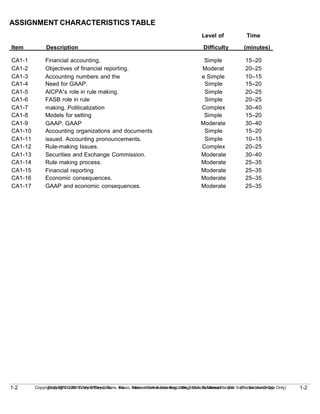
ASSIGNMENT CHARACTERISTICS TABLE
Level of Time
Item Description Difficulty (minutes)
CA1-1
CA1-2
CA1-3
Financial accounting.
Objectives of financial reporting.
Accounting numbers and the
environment.
Simple
Moderat
e Simple
15–20
20–25
10–15
CA1-4
CA1-5
Need for GAAP.
AICPA’s role in rule making.
Simple
Simple
15–20
20–25
CA1-6
CA1-7
FASB role in rule
making. Politicalization
of GAAP.
Simple
Complex
20–25
30–40
CA1-8
CA1-9
Models for setting
GAAP. GAAP
terminology.
Simple
Moderate
15–20
30–40
CA1-10
CA1-11
Accounting organizations and documents
issued. Accounting pronouncements.
Simple
Simple
15–20
10–15
CA1-12
CA1-13
Rule-making Issues.
Securities and Exchange Commission.
Complex
Moderate
20–25
30–40
CA1-14
CA1-15
Rule making process.
Financial reporting
pressures.
Moderate
Moderate
25–35
25–35
CA1-16
CA1-17
Economic consequences.
GAAP and economic consequences.
Moderate
Moderate
25–35
25–35
1-3
Copyright © 2010 John Wiley & Sons, Inc. Kieso, Intermediate Accounting, 13/e, Solutions Manual (For Instructor Use Only)
1-3 Copyright © 2010 John Wiley & Sons, Inc. Kieso, Intermediate Accounting, 13/e, Solutions Manual (For Instructor Use Only)
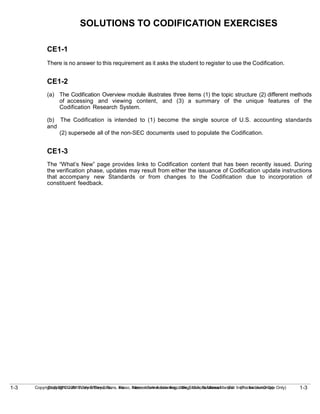
SOLUTIONS TO CODIFICATION EXERCISES
CE1-1
There is no answer to this requirement as it asks the student to register to use the Codification.
CE1-2
(a) The Codification Overview module illustrates three items (1) the topic structure (2) different methods
of accessing and viewing content, and (3) a summary of the unique features of the
Codification Research System.
(b) The Codification is intended to (1) become the single source of U.S. accounting standards
and
(2) supersede all of the non-SEC documents used to populate the Codification.
CE1-3
The “What’s New” page provides links to Codification content that has been recently issued. During
the verification phase, updates may result from either the issuance of Codification update instructions
that accompany new Standards or from changes to the Codification due to incorporation of
constituent feedback.
1-4
Copyright © 2010 John Wiley & Sons, Inc. Kieso, Intermediate Accounting, 13/e, Solutions Manual (For Instructor Use Only)
1-4 Copyright © 2010 John Wiley & Sons, Inc. Kieso, Intermediate Accounting, 13/e, Solutions Manual (For Instructor Use Only)
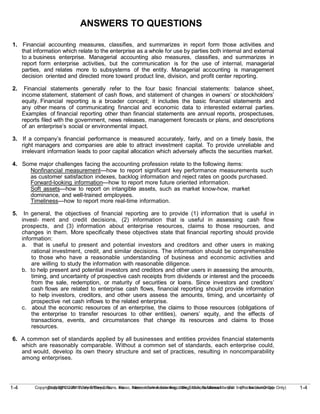
ANSWERS TO QUESTIONS
1. Financial accounting measures, classifies, and summarizes in report form those activities and
that information which relate to the enterprise as a whole for use by parties both internal and external
to a business enterprise. Managerial accounting also measures, classifies, and summarizes in
report form enterprise activities, but the communication is for the use of internal, managerial
parties, and relates more to subsystems of the entity. Managerial accounting is management
decision oriented and directed more toward product line, division, and profit center reporting.
2. Financial statements generally refer to the four basic financial statements: balance sheet,
income statement, statement of cash flows, and statement of changes in owners’ or stockholders’
equity. Financial reporting is a broader concept; it includes the basic financial statements and
any other means of communicating financial and economic data to interested external parties.
Examples of financial reporting other than financial statements are annual reports, prospectuses,
reports filed with the government, news releases, management forecasts or plans, and descriptions
of an enterprise’s social or environmental impact.
3. If a company’s financial performance is measured accurately, fairly, and on a timely basis, the
right managers and companies are able to attract investment capital. To provide unreliable and
irrelevant information leads to poor capital allocation which adversely affects the securities market.
4. Some major challenges facing the accounting profession relate to the following items:
Nonfinancial measurement—how to report significant key performance measurements such
as customer satisfaction indexes, backlog information and reject rates on goods purchased.
Forward-looking information—how to report more future oriented information.
Soft assets—how to report on intangible assets, such as market know-how, market
dominance, and well-trained employees.
Timeliness—how to report more real-time information.
5. In general, the objectives of financial reporting are to provide (1) information that is useful in
invest- ment and credit decisions, (2) information that is useful in assessing cash flow
prospects, and (3) information about enterprise resources, claims to those resources, and
changes in them. More specifically these objectives state that financial reporting should provide
information:
a. that is useful to present and potential investors and creditors and other users in making
rational investment, credit, and similar decisions. The information should be comprehensible
to those who have a reasonable understanding of business and economic activities and
are willing to study the information with reasonable diligence.
b. to help present and potential investors and creditors and other users in assessing the amounts,
timing, and uncertainty of prospective cash receipts from dividends or interest and the proceeds
from the sale, redemption, or maturity of securities or loans. Since investors and creditors’
cash flows are related to enterprise cash flows, financial reporting should provide information
to help investors, creditors, and other users assess the amounts, timing, and uncertainty of
prospective net cash inflows to the related enterprise.
c. about the economic resources of an enterprise, the claims to those resources (obligations of
the enterprise to transfer resources to other entities), owners’ equity, and the effects of
transactions, events, and circumstances that change its resources and claims to those
resources.
6. A common set of standards applied by all businesses and entities provides financial statements
which are reasonably comparable. Without a common set of standards, each enterprise could,
and would, develop its own theory structure and set of practices, resulting in noncomparability
among enterprises.
1-5
Copyright © 2010 John Wiley & Sons, Inc. Kieso, Intermediate Accounting, 13/e, Solutions Manual (For Instructor Use Only)
1-5 Copyright © 2010 John Wiley & Sons, Inc. Kieso, Intermediate Accounting, 13/e, Solutions Manual (For Instructor Use Only)
Questions Chapter 1 (Continued)
7. General-purpose financial statements are not likely to satisfy the specific needs of all interested
parties. Since the needs of interested parties such as creditors, managers, owners, governmental
agencies, and financial analysts vary considerably, it is unlikely that one set of financial statements
is equally appropriate for these varied uses.
8. The SEC has the power to prescribe, in whatever detail it desires, the accounting practices
and principles to be employed by the companies that fall within its jurisdiction. Because the SEC
receives audited financial statements from nearly all companies that issue securities to the public
or are listed on the stock exchanges, it is greatly interested in the content, accuracy, and
credibility of the statements. For many years the SEC relied on the AICPA to regulate the
profession and develop and enforce accounting principles. Lately, the SEC has assumed a more
active role in the develop- ment of accounting standards, especially in the area of disclosure
requirements. In December 1973, in ASR No. 150, the SEC said the FASB’s statements would
be presumed to carry substantial authoritative support and anything contrary to them to lack
such support. It thereby supports the development of accounting principles in the private sector.
9. The Committee on Accounting Procedure was a special committee of the American Institute of
CPAs that, between the years of 1939 and 1959, issued 51 Accounting Research Bulletins
dealing with a wide variety of timely accounting problems. These bulletins provided solutions
to immediate problems and narrowed the range of alternative practices. But, the Committee’s
problem-by-problem approach failed to provide a well-defined and well-structured body of
accounting theory that was so badly needed. The Committee on Accounting Procedure was
replaced in 1959 by the Accounting Principles Board.
10. The creation of the Accounting Principles Board was intended to advance the written expression
of accounting principles, to determine appropriate practices, and to narrow the differences
and inconsistencies in practice. To achieve its basic objectives, its mission was to develop an
overall conceptual framework to assist in the resolution of problems as they became evident
and to do substantive research on individual issues before pronouncements were issued.
11. Accounting Research Bulletins were pronouncements on accounting practice issued by
the Committee on Accounting Procedure between 1939 and 1959; since 1964 they have
been recognized as accepted accounting practice unless superseded in part or in whole by an
opinion of the APB or an FASB standard. APB Opinions were issued by the Accounting
Principles Board during the years 1959 through 1973 and, unless superseded by FASB
Statements, are recognized as accepted practice and constitute the requirements to be followed
by all business enterprises. FASB Statements are pronouncements of the Financial Accounting
Standards Board and currently represent the accounting profession’s authoritative
pronouncements on financial accounting and reporting practices.
12. The explanation should note that generally accepted accounting principles or standards
have “substantial authoritative support.” They consist of accounting practices, procedures,
theories, concepts, and methods which are recognized by a large majority of practicing
accountants as well as other members of the business and financial community. Bulletins issued
by the Committee on Accounting Procedure, opinions rendered by the Accounting Principles
Board, and statements issued by the Financial Accounting Standards Board constitute
“substantial authoritative support.”
13. It was believed that FASB Statements would carry greater weight than APB Opinions because
of significant differences between the FASB and the APB, namely: (1) The FASB has a smaller
mem- bership of full-time compensated members; (2) the FASB has greater autonomy and
increased independence; and (3) the FASB has broader representation than the APB.
1-6
Copyright © 2010 John Wiley & Sons, Inc. Kieso, Intermediate Accounting, 13/e, Solutions Manual (For Instructor Use Only)
1-6 Copyright © 2010 John Wiley & Sons, Inc. Kieso, Intermediate Accounting, 13/e, Solutions Manual (For Instructor Use Only)
Questions Chapter 1 (Continued)
14. The technical staff of the FASB conducts research on an identified accounting topic and prepares
a “preliminary views” that is released by the Board for public reaction. The Board analyzes
and evaluates the public response to the preliminary views, deliberates on the issues, and
issues an “exposure draft” for public comment. The preliminary views merely presents all facts and
alternatives related to a specific topic or problem, whereas the exposure draft is a tentative
“statement.” After studying the public’s reaction to the exposure draft, the Board may reevaluate
its position, revise the draft, and vote on the issuance of a final statement.
15. Statements of financial accounting standards constitute generally accepted accounting
principles and dictate acceptable financial accounting and reporting practices as promulgated
by the FASB. The first standards statement was issued by the FASB in 1973.
Statements of financial accounting concepts do not establish generally accepted accounting
principles. Rather, the concepts statements set forth fundamental objectives and concepts that
the FASB intends to use as a basis for developing future standards. The concepts serve as
guidelines in solving existing and emerging accounting problems in a consistent, sound
manner. Both the standards statements and the concepts statements may develop through the
same process from discussion memorandum, to exposure draft, to a final approved statement.
16. Rule 203 of the Code of Professional Conduct prohibits a member of the AICPA from expressing
an opinion that financial statements conform with GAAP if those statements contain a material
departure from an accounting principle promulgated by the FASB, or its predecessors, the
APB and the CAP, unless the member can demonstrate that because of unusual
circumstances the financial statements would otherwise have been misleading. Failure to follow
Rule 203 can lead to a loss of a CPA’s license to practice. This rule is extremely important
because it requires auditors to follow FASB standards.
17. FASB Standards, FASB Technical Bulletins, AICPA Practice Bulletins.
18. The chairman of the FASB was indicating that too much attention is put on the bottom line and
not enough on the development of quality products. Managers should be less concerned with
short- term results and be more concerned with the long-term results. In addition, short-term tax
benefits often lead to long-term problems.
The second part of his comment relates to accountants being overly concerned with following a
set of rules, so that if litigation ensues, they will be able to argue that they followed the rules
exactly. The problem with this approach is that accountants want more and more rules with
less reliance on professional judgment. Less professional judgment leads to inappropriate
use of accounting procedures in difficult situations.
In the accountants’ defense, recent legal decisions have imposed vast new liability on accountants.
The concept of accountant’s liability that has emerged in these cases is broad and expansive;
the number of classes of people to whom the accountant is held responsible are almost limitless.
19. FASB Staff Positions (FSP) are used to provide interpretive guidance and to make minor
amend- ments to existing standards. The due process used to issue a FSP is the same used
to issue a new standard.
1-7
Copyright © 2010 John Wiley & Sons, Inc. Kieso, Intermediate Accounting, 13/e, Solutions Manual (For Instructor Use Only)
1-7 Copyright © 2010 John Wiley & Sons, Inc. Kieso, Intermediate Accounting, 13/e, Solutions Manual (For Instructor Use Only)
Questions Chapter 1 (Continued)
20. The Emerging Issues Task Force often arrives at consensus conclusions on certain financial
report- ing issues. These consensus conclusions are then looked upon as GAAP by practitioners
because the SEC has indicated that it will view consensus solutions as preferred accounting and
will require persuasive justification for departing from them. Thus, at least for public companies
which are sub- ject to SEC oversight, consensus solutions developed by the Emerging Issues
Task Force are followed unless subsequently overturned by the FASB. It should be noted
that the FASB took greater direct ownership of GAAP established by the EITF by requiring that
consensus positions be ratified by the FASB.
21. The Financial Accounting Standards Board Accounting Standards Codification (Codifications)
is a compilation of all GAAP in one place. Its purpose is to integrate and synthesize existing
GAAP and not to create new GAAP. It creates one level of GAAP which is considered authoritative.
The FASB Codification Research Systems (CRS) is an-on-line real time data base which provides
easy access to the Codification. The Codification and the related CRS provide a topically
organized structure which is subdivided into topic, subtopics, sections, and paragraphs.
22. Hopefully, the codification will help users to better understand what GAAP is. If this occurs, the
rash of noncompliance with GAAP will be reduced and the time to research accounting issues
will be substantially reduced. In addition, through the electronic web-based format, GAAP can
be easily updated which will help users stay current.
23. The sources of pressure are innumerable, but the most intense and continuous pressure
to change or influence accounting principles or standards come from individual companies,
industry associations, governmental agencies, practicing accountants, academicians,
professional accoun- ting organizations, and public opinion.
24. Economic consequences means the impact of accounting reports on the wealth positions of
issuers and users of financial information and the decision-making behavior resulting from that
impact. In other words, accounting information impacts various users in many different ways
which leads to wealth transfers among these various groups.
If politics plays an important role in the development of accounting rules, the rules will be
subject to manipulation for the purpose of furthering whatever policy prevails at the moment.
No matter how well intentioned the rule maker may be, if information is designed to indicate that
investing in a particular enterprise involves less risk than it actually does, or is designed to
encourage invest- ment in a particular segment of the economy, financial reporting will suffer an
irreplaceable loss of credibility.
25. No one particular proposal is expected in answer to this question. The students’ proposals, however,
should be defensible relative to the following criteria:
(1) The method must be efficient, responsive, and
expeditious.
(2) The method must be free of bias and be above or insulated from pressure groups.
(3) The method must command widespread support if it does not have legislative
authority. (4) The method must produce sound yet practical accounting principles or
standards.
The students’ proposals might take the form of alterations of the existing methodology, an
accoun- ting court (as proposed by Leonard Spacek), or governmental device.
26. Concern exists about fraudulent financial reporting because it can undermine the entire financial
reporting process. Failure to provide information to users that is accurate can lead to inappropriate
allocations of resources in our economy. In addition, failure to detect massive fraud can lead
to additional governmental oversight of the accounting profession.
1-8
Copyright © 2010 John Wiley & Sons, Inc. Kieso, Intermediate Accounting, 13/e, Solutions Manual (For Instructor Use Only)
1-8 Copyright © 2010 John Wiley & Sons, Inc. Kieso, Intermediate Accounting, 13/e, Solutions Manual (For Instructor Use Only)
Questions Chapter 1 (Continued)
27. The expectations gap is the difference between what people think accountants should be doing
and what accountants think they can do. It is a difficult gap to close. The accounting profession
recognizes it must play an important role in narrowing this gap. To meet the needs of society, the
profession is continuing its efforts in developing accounting standards, such as numerous
pronouncements issued by the FASB, to serve as guidelines for recording and processing
business transactions in the changing economic environment.
28. The following are some of the key provisions of the Sarbanes-Oxley Act:
• Establishes an oversight board for accounting practices. The Public Company Accounting
Over- sight Board (PCAOB) has oversight and enforcement authority and establishes auditing,
quality control, and independence standards and rules.
• Implements stronger independence rules for auditors. Audit partners, for example, are
required to rotate every five years and auditors are prohibited from offering certain types of
consulting services to corporate clients.
• Requires CEOs and CFOs to personally certify that financial statements and disclosures
are accurate and complete and requires CEOs and CFOs to forfeit bonuses and profits when
there is an accounting restatement.
• Requires audit committees to be comprised of independent members and members with
finan- cial expertise.
• Requires codes of ethics for senior financial officers.
In addition, Section 404 of the Sarbanes-Oxley Act requires public companies to attest to
the effectiveness of their internal controls over financial reporting.
29. Accountants must perceive the moral dimensions of some situations because GAAP does
not define or cover all specific features that are to be reported in financial statements. In these
instances accountants must choose among alternatives. These accounting choices influence
whether par- ticular stakeholders may be harmed or benefited. Moral decision-making involves
awareness of potential harm or benefit and taking responsibility for the choices.
30. Some of the reasons for differences are:
(1) The objectives of financial reporting are often different in foreign
countries. (2) The institutional structures are often not comparable.
(3) Strong national tendencies are pervasive and therefore there is reluctance to adopt any
one country’s approach.
31. Relevant and reliable financial information is a necessity for viable capital markets. Unfortunately,
financial statements from companies outside the United States are often prepared using
different principles than U.S. GAAP. As a result, international companies have to develop
financial infor- mation in different ways. Beyond the additional costs these companies incur,
users of financial statements are often forced to understand at least two sets of GAAP. It is not
surprising that there is a growing demand for one set of high quality international standards.
32. Principles-based rules are considered to be based on accounting principles to result in financial
statements that are presented. Rules-based standards are generally quite detailed, and in
many instances follow a “check-box” mentality that some contend may shield auditors and
companies from legal liability. Because iGAAP tends to be simpler and less stringent in its
accounting and disclosure requirements, it is generally considered more principles-based than
U.S. GAAP.
1-9
Copyright © 2010 John Wiley & Sons, Inc. Kieso, Intermediate Accounting, 13/e, Solutions Manual (For Instructor Use Only)
1-9 Copyright © 2010 John Wiley & Sons, Inc. Kieso, Intermediate Accounting, 13/e, Solutions Manual (For Instructor Use Only)
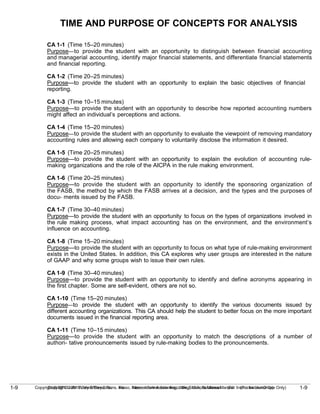
TIME AND PURPOSE OF CONCEPTS FOR ANALYSIS
CA 1-1 (Time 15–20 minutes)
Purpose—to provide the student with an opportunity to distinguish between financial accounting
and managerial accounting, identify major financial statements, and differentiate financial statements
and financial reporting.
CA 1-2 (Time 20–25 minutes)
Purpose—to provide the student with an opportunity to explain the basic objectives of financial
reporting.
CA 1-3 (Time 10–15 minutes)
Purpose—to provide the student with an opportunity to describe how reported accounting numbers
might affect an individual’s perceptions and actions.
CA 1-4 (Time 15–20 minutes)
Purpose—to provide the student with an opportunity to evaluate the viewpoint of removing mandatory
accounting rules and allowing each company to voluntarily disclose the information it desired.
CA 1-5 (Time 20–25 minutes)
Purpose—to provide the student with an opportunity to explain the evolution of accounting rule-
making organizations and the role of the AICPA in the rule making environment.
CA 1-6 (Time 20–25 minutes)
Purpose—to provide the student with an opportunity to identify the sponsoring organization of
the FASB, the method by which the FASB arrives at a decision, and the types and the purposes of
docu- ments issued by the FASB.
CA 1-7 (Time 30–40 minutes)
Purpose—to provide the student with an opportunity to focus on the types of organizations involved in
the rule making process, what impact accounting has on the environment, and the environment’s
influence on accounting.
CA 1-8 (Time 15–20 minutes)
Purpose—to provide the student with an opportunity to focus on what type of rule-making environment
exists in the United States. In addition, this CA explores why user groups are interested in the nature
of GAAP and why some groups wish to issue their own rules.
CA 1-9 (Time 30–40 minutes)
Purpose—to provide the student with an opportunity to identify and define acronyms appearing in
the first chapter. Some are self-evident, others are not so.
CA 1-10 (Time 15–20 minutes)
Purpose—to provide the student with an opportunity to identify the various documents issued by
different accounting organizations. This CA should help the student to better focus on the more important
documents issued in the financial reporting area.
CA 1-11 (Time 10–15 minutes)
Purpose—to provide the student with an opportunity to match the descriptions of a number of
authori- tative pronouncements issued by rule-making bodies to the pronouncements.
1-10
Copyright © 2010 John Wiley & Sons, Inc. Kieso, Intermediate Accounting, 13/e, Solutions Manual (For Instructor Use Only)
1-10 Copyright © 2010 John Wiley & Sons, Inc. Kieso, Intermediate Accounting, 13/e, Solutions Manual (For Instructor Use Only)
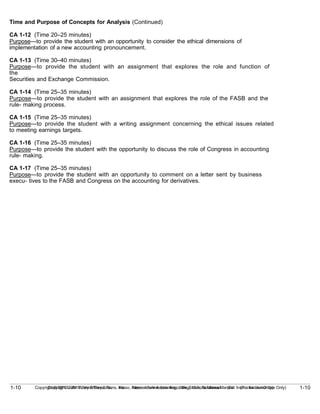
Time and Purpose of Concepts for Analysis (Continued)
CA 1-12 (Time 20–25 minutes)
Purpose—to provide the student with an opportunity to consider the ethical dimensions of
implementation of a new accounting pronouncement.
CA 1-13 (Time 30–40 minutes)
Purpose—to provide the student with an assignment that explores the role and function of
the
Securities and Exchange Commission.
CA 1-14 (Time 25–35 minutes)
Purpose—to provide the student with an assignment that explores the role of the FASB and the
rule- making process.
CA 1-15 (Time 25–35 minutes)
Purpose—to provide the student with a writing assignment concerning the ethical issues related
to meeting earnings targets.
CA 1-16 (Time 25–35 minutes)
Purpose—to provide the student with the opportunity to discuss the role of Congress in accounting
rule- making.
CA 1-17 (Time 25–35 minutes)
Purpose—to provide the student with an opportunity to comment on a letter sent by business
execu- tives to the FASB and Congress on the accounting for derivatives.
1-11
Copyright © 2010 John Wiley & Sons, Inc. Kieso, Intermediate Accounting, 13/e, Solutions Manual (For Instructor Use Only)
1-11 Copyright © 2010 John Wiley & Sons, Inc. Kieso, Intermediate Accounting, 13/e, Solutions Manual (For Instructor Use Only)
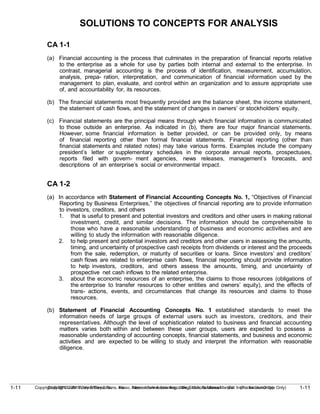
SOLUTIONS TO CONCEPTS FOR ANALYSIS
CA 1-1
(a) Financial accounting is the process that culminates in the preparation of financial reports relative
to the enterprise as a whole for use by parties both internal and external to the enterprise. In
contrast, managerial accounting is the process of identification, measurement, accumulation,
analysis, prepa- ration, interpretation, and communication of financial information used by the
management to plan, evaluate, and control within an organization and to assure appropriate use
of, and accountability for, its resources.
(b) The financial statements most frequently provided are the balance sheet, the income statement,
the statement of cash flows, and the statement of changes in owners’ or stockholders’ equity.
(c) Financial statements are the principal means through which financial information is communicated
to those outside an enterprise. As indicated in (b), there are four major financial statements.
However, some financial information is better provided, or can be provided only, by means
of financial reporting other than formal financial statements. Financial reporting (other than
financial statements and related notes) may take various forms. Examples include the company
president’s letter or supplementary schedules in the corporate annual reports, prospectuses,
reports filed with govern- ment agencies, news releases, management’s forecasts, and
descriptions of an enterprise’s social or environmental impact.
CA 1-2
(a) In accordance with Statement of Financial Accounting Concepts No. 1, “Objectives of Financial
Reporting by Business Enterprises,” the objectives of financial reporting are to provide information
to investors, creditors, and others
1. that is useful to present and potential investors and creditors and other users in making rational
investment, credit, and similar decisions. The information should be comprehensible to
those who have a reasonable understanding of business and economic activities and are
willing to study the information with reasonable diligence.
2. to help present and potential investors and creditors and other users in assessing the amounts,
timing, and uncertainty of prospective cash receipts from dividends or interest and the proceeds
from the sale, redemption, or maturity of securities or loans. Since investors’ and creditors’
cash flows are related to enterprise cash flows, financial reporting should provide information
to help investors, creditors, and others assess the amounts, timing, and uncertainty of
prospective net cash inflows to the related enterprise.
3. about the economic resources of an enterprise, the claims to those resources (obligations of
the enterprise to transfer resources to other entities and owners’ equity), and the effects of
trans- actions, events, and circumstances that change its resources and claims to those
resources.
(b) Statement of Financial Accounting Concepts No. 1 established standards to meet the
information needs of large groups of external users such as investors, creditors, and their
representatives. Although the level of sophistication related to business and financial accounting
matters varies both within and between these user groups, users are expected to possess a
reasonable understanding of accounting concepts, financial statements, and business and economic
activities and are expected to be willing to study and interpret the information with reasonable
diligence.
1-12
Copyright © 2010 John Wiley & Sons, Inc. Kieso, Intermediate Accounting, 13/e, Solutions Manual (For Instructor Use Only)
1-12 Copyright © 2010 John Wiley & Sons, Inc. Kieso, Intermediate Accounting, 13/e, Solutions Manual (For Instructor Use Only)
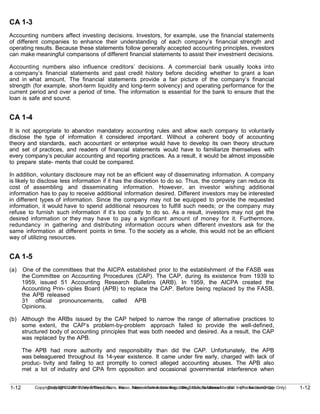
CA 1-3
Accounting numbers affect investing decisions. Investors, for example, use the financial statements
of different companies to enhance their understanding of each company’s financial strength and
operating results. Because these statements follow generally accepted accounting principles, investors
can make meaningful comparisons of different financial statements to assist their investment decisions.
Accounting numbers also influence creditors’ decisions. A commercial bank usually looks into
a company’s financial statements and past credit history before deciding whether to grant a loan
and in what amount. The financial statements provide a fair picture of the company’s financial
strength (for example, short-term liquidity and long-term solvency) and operating performance for the
current period and over a period of time. The information is essential for the bank to ensure that the
loan is safe and sound.
CA 1-4
It is not appropriate to abandon mandatory accounting rules and allow each company to voluntarily
disclose the type of information it considered important. Without a coherent body of accounting
theory and standards, each accountant or enterprise would have to develop its own theory structure
and set of practices, and readers of financial statements would have to familiarize themselves with
every company’s peculiar accounting and reporting practices. As a result, it would be almost impossible
to prepare state- ments that could be compared.
In addition, voluntary disclosure may not be an efficient way of disseminating information. A company
is likely to disclose less information if it has the discretion to do so. Thus, the company can reduce its
cost of assembling and disseminating information. However, an investor wishing additional
information has to pay to receive additional information desired. Different investors may be interested
in different types of information. Since the company may not be equipped to provide the requested
information, it would have to spend additional resources to fulfill such needs; or the company may
refuse to furnish such information if it’s too costly to do so. As a result, investors may not get the
desired information or they may have to pay a significant amount of money for it. Furthermore,
redundancy in gathering and distributing information occurs when different investors ask for the
same information at different points in time. To the society as a whole, this would not be an efficient
way of utilizing resources.
CA 1-5
(a) One of the committees that the AICPA established prior to the establishment of the FASB was
the Committee on Accounting Procedures (CAP). The CAP, during its existence from 1939 to
1959, issued 51 Accounting Research Bulletins (ARB). In 1959, the AICPA created the
Accounting Prin- ciples Board (APB) to replace the CAP. Before being replaced by the FASB,
the APB released
31 official pronouncements, called APB
Opinions.
(b) Although the ARBs issued by the CAP helped to narrow the range of alternative practices to
some extent, the CAP’s problem-by-problem approach failed to provide the well-defined,
structured body of accounting principles that was both needed and desired. As a result, the CAP
was replaced by the APB.
The APB had more authority and responsibility than did the CAP. Unfortunately, the APB
was beleaguered throughout its 14-year existence. It came under fire early, charged with lack of
produc- tivity and failing to act promptly to correct alleged accounting abuses. The APB also
met a lot of industry and CPA firm opposition and occasional governmental interference when
1-13
Copyright © 2010 John Wiley & Sons, Inc. Kieso, Intermediate Accounting, 13/e, Solutions Manual (For Instructor Use Only)
1-13 Copyright © 2010 John Wiley & Sons, Inc. Kieso, Intermediate Accounting, 13/e, Solutions Manual (For Instructor Use Only)
tackling numerous thorny accounting issues. In fear of governmental rule making, the accounting
profession investigated the ineffectiveness of the APB and replaced it with the FASB.
1-14
Copyright © 2010 John Wiley & Sons, Inc. Kieso, Intermediate Accounting, 13/e, Solutions Manual (For Instructor Use Only)
1-14 Copyright © 2010 John Wiley & Sons, Inc. Kieso, Intermediate Accounting, 13/e, Solutions Manual (For Instructor Use Only)
CA 1-5 (Continued)
Learning from prior experiences, the FASB has several significant differences from the APB.
The FASB has: (1) smaller membership, (2) full-time, compensated membership, (3) greater
autonomy, (4) increased independence, and (5) broader representation. In addition, the FASB
has its own research staff and relies on the expertise of various task force groups formed for
various projects. These features form the bases for the expectations of success and support
from the public. In addition, the due process taken by the FASB in establishing financial
accounting standards gives interested persons ample opportunity to make their views known.
Thus, the FASB is responsive to the needs and viewpoints of the entire economic community, not
just the public accounting profession.
(c) The AICPA has supplemented the FASB’s efforts in the present standard-setting environment.
The issue papers, which are prepared by the Accounting Standards Executive Committee
(AcSEC), identify current financial reporting problems for specific industries and present
alternative treat- ments of the issue. These papers provide the FASB with an early warning
device to insure timely issuance of FASB standards, Interpretations, and Staff Positions. In
situations where the FASB avoids the subject of an issue paper, AcSEC may issue a Statement
of Position to provide guidance for the reporting issue. AcSEC also issues Practice Bulletins
which indicate how the AICPA believes a given transaction should be reported.
Recently, the role of the AICPA in standard-setting has diminished. The FASB and the
AICPA agreed, that after a transition period, the AICPA and AcSEC no longer will issue
authoritative accounting guidance for public companies.
CA 1-6
(a) The Financial Accounting Foundation (FAF) is the sponsoring organization of the FASB. The
FAF selects the members of the FASB and its Advisory Council, funds their activities, and
generally oversees the FASB’s activities.
The FASB follows a due process in establishing a typical FASB Statement of Financial Accounting
Standards. The following steps are usually taken: (1) A topic or project is identified and placed
on the Board’s agenda. (2) A task force of experts from various sectors is assembled to
define problems, issues, and alternatives related to the topic. (3) Research and analysis are
conducted by the FASB technical staff. (4) A preliminary views document is drafted and
released. (5) A public hearing is often held, usually 60 days after the release of the preliminary
views. (6) The Board analyzes and evaluates the public response. (7) The Board deliberates on
the issues and prepares an exposure draft for release. (8) After a 30-day (minimum) exposure
period for public comment, the Board evaluates all of the responses received. (9) A committee
studies the exposure draft in relation to the public responses, reevaluates its position, and revises
the draft if necessary. (10) The full Board gives the revised draft final consideration and votes
on issuance of a Standards Statement. The passage of a new accounting standard in the form
of an FASB Statement requires the support of five of the seven Board members.
(b) The FASB issues three major types of pronouncements: Standards and Interpretations, Financial
Accounting Concepts, and Technical Bulletins. Financial accounting standards issued by the
FASB are considered GAAP. In addition, the FASB also issues interpretations that represent
modifications or extensions of existing standards and APB Opinions. These interpretations have
the same authority as standards and APB Opinions in guiding current accounting practices.
The Statements of Financial Accounting Concepts (SFAC) help the FASB to avoid the “problem-
by-problem approach.” These statements set forth fundamental objectives and concepts that
the Board will use in developing future standards of financial accounting and reporting.
They are intended to form a cohesive set of interrelated concepts, a body of theory or a
1-15
Copyright © 2010 John Wiley & Sons, Inc. Kieso, Intermediate Accounting, 13/e, Solutions Manual (For Instructor Use Only)
1-15 Copyright © 2010 John Wiley & Sons, Inc. Kieso, Intermediate Accounting, 13/e, Solutions Manual (For Instructor Use Only)
conceptual framework, that will serve as tools for solving existing and emerging problems in
a consistent, sound manner.
1-16
Copyright © 2010 John Wiley & Sons, Inc. Kieso, Intermediate Accounting, 13/e, Solutions Manual (For Instructor Use Only)
1-16 Copyright © 2010 John Wiley & Sons, Inc. Kieso, Intermediate Accounting, 13/e, Solutions Manual (For Instructor Use Only)
CA 1-6 (Continued)
The FASB may issue a technical bulletin when there is a need for guidelines on implementing
or applying FASB Standards or Interpretations, APB Opinions, Accounting Research Bulletins, or
emerging issues. A technical bulletin is issued only when (1) it is not expected to cause a major
change in accounting practice for a number of enterprises, (2) its cost of implementation is low,
and (3) the guidance provided by the bulletin does not conflict with any broad fundamental
accounting principle.
In addition, the FASB’s Emerging Issues Task Force (EITF) issues statements to provide guidance
on how to account for new and unusual financial transactions that have the potential for creating
diversity in reporting practices. The EITF identifies controversial accounting problems as they
arise and determines whether they can be quickly resolved or whether the FASB should become
involved in solving them. In essence, it becomes a “problem filter” for the FASB. Thus, it is
hoped that the FASB will be able to work on more pervasive long-term problems, while the EITF
deals with short- term emerging issues.
CA 1-7
(a) CAP. The Committee on Accounting Procedure, CAP, which was in existence from 1939 to
1959, was a natural outgrowth of AICPA committees which were in existence during the
period 1933 to
1938. The committee was formed in direct response to the criticism received by the accounting
profession during the financial crisis of 1929 and the years thereafter. The authorization to
issue pronouncements on matters of accounting principles and procedures was based on the
belief that the AICPA had the responsibility to establish practices that would become generally
accepted by the profession and by corporate management.
As a general rule, the CAP directed its attention, almost entirely, to resolving specific accounting
problems and topics rather than to the development of generally accepted accounting principles.
The committee voted on the acceptance of specific Accounting Research Bulletins published
by the committee. A two-thirds majority was required to issue a particular research bulletin. The
CAP did not have the authority to require acceptance of the issued bulletins by the general
membership of the AICPA, but rather received its authority only upon general acceptance of the
pronouncement by the members. That is, the bulletins set forth normative accounting procedures
that “should be” followed by the accounting profession, but were not “required” to be followed.
It was not until well after the demise of the CAP, in 1964, that the Council of the AICPA adopted
recommendations that departures from effective CAP Bulletins should be disclosed in financial
statements or in audit reports of members of the AICPA. The demise of the CAP could probably
be traced to four distinct factors: (1) the narrow nature of the subjects covered by the bulletins
issued by the CAP, (2) the lack of any theoretical groundwork in establishing the procedures
presented in the bulletins, (3) the lack of any real authority by the CAP in prescribing adherence
to the procedures described by the bulletins, and (4) the lack of any formal representation on
the CAP of interest groups such as corporate managers, governmental agencies, and security
analysts.
APB. The objectives of the APB were formulated mainly to correct the deficiencies of the CAP
as described above. The APB was thus charged with the responsibility of developing written
expression of generally accepted accounting principles through consideration of the research
done by other members of the AICPA in preparing Accounting Research Studies. The
committee was in turn given substantial authoritative standing in that all opinions of the APB
were to constitute substantial authoritative support for generally accepted accounting principles.
If an individual member of the AICPA decided that a principle or procedure outside of the official
1-17
Copyright © 2010 John Wiley & Sons, Inc. Kieso, Intermediate Accounting, 13/e, Solutions Manual (For Instructor Use Only)
1-17 Copyright © 2010 John Wiley & Sons, Inc. Kieso, Intermediate Accounting, 13/e, Solutions Manual (For Instructor Use Only)
pronouncements of the APB had substantial authoritative support, the member had to disclose
the departure from the official APB opinion in the financial statements of the firm in question.
1-18
Copyright © 2010 John Wiley & Sons, Inc. Kieso, Intermediate Accounting, 13/e, Solutions Manual (For Instructor Use Only)
1-18 Copyright © 2010 John Wiley & Sons, Inc. Kieso, Intermediate Accounting, 13/e, Solutions Manual (For Instructor Use Only)
CA 1-7 (Continued)
The membership of the committee comprising the APB was also extended to include representation
from industry, government, and academe. The opinions were also designed to include minority
dissents by members of the board. Exposure drafts of the proposed opinions were readily
distributed.
The demise of the APB occurred primarily because the purposes for which it was created were
not being accomplished. Broad generally accepted accounting principles were not being
developed. The research studies supposedly being undertaken in support of subsequent
opinions to be expressed by the APB were often ignored. The committee in essence became
a simple extension of the original CAP in that only very specific problem areas were being
addressed. Interest groups outside of the accounting profession questioned the appropriateness
and desirability of having the AICPA directly responsible for the establishment of GAAP.
Politicization of the establishment of GAAP had become a reality because of the far-reaching
effects involved in the questions being resolved.
FASB. The formal organization of the FASB represents an attempt to vest the responsibility
of establishing GAAP in an organization representing the diverse interest groups affected by the
use of GAAP. The FASB is independent of the AICPA. It is independent, in fact, of any private
or govern- mental organization. Individual CPAs, firms of CPAs, accounting educators, and
representatives of private industry will now have an opportunity to make known their views to the
FASB through their membership on the Board. Independence is facilitated through the funding
of the organization and payment of the members of the Board. Full-time members are paid by
the organization and the organization itself is funded solely through contributions. Thus, no one
interest group has a vested interest in the FASB.
Conclusion. The evolution of the current FASB certainly does represent “increasing politicization
of accounting standards setting.” Many of the efforts extended by the AICPA can be directly
attributed to the desire to satisfy the interests of many groups within our society. The
FASB represents, perhaps, just another step in this evolutionary process.
(b) Arguments for politicalization of the accounting rule-making process:
1. Accounting depends in large part on public confidence for its success. Consequently,
the critical issues are not solely technical, so all those having a bona fide interest in the
output of accounting should have some influence on that output.
2. There are numerous conflicts between the various interest groups. In the face of this, compro-
mise is necessary, particularly since the critical issues in accounting are value judgments,
not the type which are solvable, as we have traditionally assumed, using deterministic
models. Only in this way (reasonable compromise) will the financial community have
confidence in the fairness and objectivity of accounting rule-making.
3. Over the years, accountants have been unable to establish, on the basis of technical accoun-
ting elements, rules which would bring about the desired uniformity and acceptability.
This inability itself indicates rule-setting is primarily consensual in nature.
4. The public accounting profession, through bodies such as the Accounting Principles
Board, made rules which business enterprises and individuals “had” to follow. For many
years, these businesses and individuals had little say as to what the rules would be, in spite
of the fact that their economic well-being was influenced to a substantial degree by those
rules. It is only natural that they would try to influence or control the factors that determine
their economic well- being.
1-19
Copyright © 2010 John Wiley & Sons, Inc. Kieso, Intermediate Accounting, 13/e, Solutions Manual (For Instructor Use Only)
1-19 Copyright © 2010 John Wiley & Sons, Inc. Kieso, Intermediate Accounting, 13/e, Solutions Manual (For Instructor Use Only)
CA 1-7 (Continued)
(c) Arguments against the politicalization of the accounting rule-making process:
1. Many accountants feel that accounting is primarily technical in nature. Consequently, they
feel that substantive, basic research by objective, independent and fair-minded researchers
ultimately will result in the best solutions to critical issues, such as the concepts of income
and capital, even if it is accepted that there isn’t necessarily a single “right” solution.
2. Even if it is accepted that there are no “absolute truths” as far as critical issues are concerned,
many feel that professional accountants, taking into account the diverse interests of the
various groups using accounting information, are in the best position, because of their
independence, education, training, and objectivity, to decide what generally accepted
accounting principles ought to be.
3. The complex situations that arise in the business world require that trained accountants develop
the appropriate accounting principles.
4. The use of consensus to develop accounting principles would decrease the professional
status of the accountant.
5. This approach would lead to “lobbying” by various parties to influence the establishment of
ac- counting principles.
CA 1-8
(a) The public/private mixed approach appears to be the way rules are established in the United States.
In many respects, the FASB is a quasi-governmental agency in that its pronouncements are required
to be followed because the SEC has provided support for this approach. The SEC has the
ultimate power to establish GAAP but has chosen to permit the private sector to develop these
rules. By accepting the standards established by the FASB as authoritative, it has granted much
power to the FASB. (It might be useful to inform the students that not all countries follow this model.
For example, the purely political approach is used in France and West Germany. The private,
professional approach is employed in Australia, Canada, and the United Kingdom.)
(b) Publicly reported accounting numbers influence the distribution of scarce resources. Resources
are channeled where needed at returns commensurate with perceived risk. Thus, reported
accounting numbers have economic effects in that resources are transferred among entities and
individuals as a consequence of these numbers. It is not surprising then that individuals affected
by these numbers will be extremely interested in any proposed changes in the financial reporting
environment.
(c) The Accounting Standards Executive Committee (AcSEC of the AICPA), among other groups,
has presented a potential challenge to the exclusive right of the FASB to establish accounting
principles. Also, Congress has been attempting to legislate certain accounting practices,
particularly to help struggling industries.
Some possible reasons why other groups might wish to establish GAAP are:
1. As indicated in the previous answer, these rules have economic effects and therefore
certain groups would prefer to make their own rules to ensure that they receive just treatment.
2. Some believe the FASB does not act quickly to resolve accounting matters, either because
it is not that interested in the subject area or because it lacks the resources to do so.
3. Some argue that the FASB does not have the competence to legislate GAAP in certain
areas.
For example, many have argued that the FASB should not legislate GAAP for not-for-
profit enterprises because the problems are unique and not well known by the FASB.
1-20
Copyright © 2010 John Wiley & Sons, Inc. Kieso, Intermediate Accounting, 13/e, Solutions Manual (For Instructor Use Only)
1-20 Copyright © 2010 John Wiley & Sons, Inc. Kieso, Intermediate Accounting, 13/e, Solutions Manual (For Instructor Use Only)
CA 1-9
(a) AICPA. American Institute of Certified Public Accountants. The national organization of practicing
certified public accountants.
(b) CAP. Committee on Accounting Procedure. A committee of practicing CPAs which
issued
51 Accounting Research Bulletins between 1939 and 1959 and is a predecessor of the
FASB.
(c) ARB. Accounting Research Bulletins. Official pronouncements of the Committee on
Accounting
Procedure which, unless superseded, remain a primary source of GAAP.
(d) APB. Accounting Principles Board. A committee of public accountants, industry accountants
and academicians which issued 31 Opinions between 1959 and 1973. The APB replaced
the CAP and was itself replaced by the FASB. Its opinions, unless superseded, remain a
primary source of GAAP.
(e) FAF. Financial Accounting Foundation. An organization whose purpose is to select members
of the FASB and its Advisory Councils, fund their activities, and exercise general oversight.
(f) FASAC. Financial Accounting Standards Advisory Council. An organization whose purpose is
to consult with the FASB on issues, project priorities, and select task forces.
(g) SOP. Statements of Position. Statements issued by the AICPA (through the Accounting Standards
Executive Committee of its Accounting Standards Division) which are generally devoted to
emerging problems not addressed by the FASB or the SEC.
(h) GAAP. Generally accepted accounting principles. A common set of standards, principles,
and procedures which have substantial authoritative support and have been accepted as
appropriate because of universal application.
(i) CPA. Certified public accountant. An accountant who has fulfilled certain education and experience
requirements and passed a rigorous examination. Most CPAs offer auditing, tax, and management
consulting services to the general public.
(j) FASB. Financial Accounting Standards Board. The primary body which currently establishes
and improves financial accounting and reporting standards for the guidance of issuers, auditors,
users, and others.
(k) SEC. Securities and Exchange Commission. An independent regulatory agency of the
United
States government which administers the Securities Acts of 1933 and 1934 and other acts.
(l) IASB. International Accounting Standards Board. An international group, formed in 1973, that
is actively developing and issuing accounting standards that will have international appeal and
hopefully support.
CA 1-10
1. (b), (e)
2. (a)
3. (c)
4. (d)
1-21
Copyright © 2010 John Wiley & Sons, Inc. Kieso, Intermediate Accounting, 13/e, Solutions Manual (For Instructor Use Only)
1-21 Copyright © 2010 John Wiley & Sons, Inc. Kieso, Intermediate Accounting, 13/e, Solutions Manual (For Instructor Use Only)
CA 1-11
1. (d)
2. (f)
3. (c)
4. (e)
5. (a)
6. (b)
CA 1-12
(a) Inclusion or omission of information that materially affects net income harms particular
stakeholders.
Accountants must recognize that their decision to implement (or delay) reporting requirements
will have immediate consequences for some stakeholders.
(b) Yes. Because the FASB rule results in a fairer representation, it should be implemented as soon
as possible—regardless of its impact on net income. SEC Staff Bulletin No. 74 (December 30,
1987) requires a statement as to what the expected impact of the standard will be.
(c) The accountant’s responsibility is to provide financial statements that present fairly the financial
condition of the company. By advocating early implementation, Weller fulfills this task.
(d) Potential lenders and investors, who read the financial statements and rely on their fair represen-
tation of the financial condition of the company, have the most to gain by early implementation.
A stockholder who is considering the sale of stock may be harmed by early implementation
that lowers net income (and may lower the value of the stock).
CA 1-13
(a) The Securities and Exchange Commission (SEC) is an independent federal agency that receives
its authority from federal legislation enacted by Congress. The Securities and Exchange Act
of
1934 created the SEC.
(b) As a result of the Securities and Exchange Act of 1934, the SEC has legal authority relative
to accounting practices. The U.S. Congress has given the SEC broad regulatory power to
control accounting principles and procedures in order to fulfill its goal of full and fair disclosure.
(c) There is no direct relationship as the SEC was created by Congress and the Financial Accounting
Standards Board (FASB) was created by the private sector. However, the SEC historically
has followed a policy of relying on the private sector to establish financial accounting and reporting
stan- dards known as generally accepted accounting principles (GAAP). The SEC does not
necessarily agree with all of the pronouncements of the FASB. In cases of unresolved differences,
the SEC rules take precedence over FASB rules for companies within SEC jurisdiction.
1-22
Copyright © 2010 John Wiley & Sons, Inc. Kieso, Intermediate Accounting, 13/e, Solutions Manual (For Instructor Use Only)
1-22 Copyright © 2010 John Wiley & Sons, Inc. Kieso, Intermediate Accounting, 13/e, Solutions Manual (For Instructor Use Only)
CA 1-14
(a) The process by which a topic is selected or identified as appropriate for study by the
Financial
Accounting Standards Board (FASB) is described below.
• Problems or issues come to the attention of the FASB from
– the Emerging Issues Task Force which may identify significant emerging accounting
issues that it feels the FASB should address.
– the Financial Accounting Standards Advisory Council which addresses the FASB on
the priority of problems and encourages the FASB to undertake new projects.
– the Research and Technical Activities Staff of the FASB, which monitors business
perio- dicals for stories concerning unusual transactions or events and may detect an
emerging problem.
– the close contact it maintains with various business, industry, government, professional
financial groups, and the SEC.
– its staff which may learn of emerging problems as it responds to technical inquiries received
from preparers and auditors.
• Topics are then placed on the FASB agenda.
• The plan for major technical agenda projects is given prompt public notice in the
FASB’s newsletter “Status Report.”
• A task force of experts from various sectors is assembled to define problems, issues,
and alternatives related to the topic.
• The task force inputs are submitted to the FASB’s Technical Activities Division for
research and analysis.
(b) Once a topic is considered appropriate for consideration by the FASB, major steps in the
process leading to the issuance of a Statement of Financial Accounting Standards include the
following:
• Research and analysis is conducted by the FASB Technical Staff.
• A preliminary views is drafted and released for written comments.
• Written comments are submitted and a public hearing is held approximately 60 days after
the preliminary views is released.
• The Board analyzes and evaluates the public responses.
• The Board deliberates on the issues and prepares an exposure draft which is released
for public comment.
• After a 30-day (minimum) exposure period and possible public hearings from industry
groups, the Board evaluates all comments received.
• A committee studies the exposure draft in relation to the public responses, reevaluates
its position, and revises the draft if necessary.
1-23
Copyright © 2010 John Wiley & Sons, Inc. Kieso, Intermediate Accounting, 13/e, Solutions Manual (For Instructor Use Only)
1-23 Copyright © 2010 John Wiley & Sons, Inc. Kieso, Intermediate Accounting, 13/e, Solutions Manual (For Instructor Use Only)
• The full Board gives the revised final draft consideration and votes on the issuance of
a
Standards Statement.
1-24
Copyright © 2010 John Wiley & Sons, Inc. Kieso, Intermediate Accounting, 13/e, Solutions Manual (For Instructor Use Only)
1-24 Copyright © 2010 John Wiley & Sons, Inc. Kieso, Intermediate Accounting, 13/e, Solutions Manual (For Instructor Use Only)
CA 1-14 (Continued)
(c) At least three other organizations who can influence the setting of generally accepted accounting
principles include the
• American Institute of Certified Public Accountants.
• Securities and Exchange Commission.
• Financial Executives Institute.
CA 1-15
(a) The ethical issue in this case relates to making questionable entries to meet expected earnings
forecasts. As indicated in this chapter, businesses’ concentration on “maximizing the bottom
line,” “facing the challenges of competition,” and “stressing short-term results” places accountants
in an environment of conflict and pressure.
(b) Given that Normand has pleaded guilty, he certainly acted improperly. Doing the right thing,
making the right decision, is not always easy. Right is not always obvious, and the pressures to
“bend the rules,” “to play the game,” “to just ignore it” can be considerable.
(c) No doubt, Normand was in a difficult position. I am sure that he was concerned that if he failed
to go along, it would affect his job performance negatively or that he might be terminated. These
job pressures, time pressures, peer pressures often lead individuals astray. Can it happen to
you? One individual noted that at a seminar on ethics sponsored by the CMA Society of
Southern California, attendees were asked if they had ever been pressured to make
questionable entries. This individual noted that to the best of his recollection, everybody raised
a hand, and more than one had eventually chosen to resign.
(d) Major stakeholders are: (1) Troy Normand, (2) present and potential stockholders and creditors
of WorldCom, (3) employees, and (4) family. Recognize that WorldCom is the largest bankruptcy
in United States history, so many individuals are affected.
CA 1-16
(a) Considering the economic consequences of GAAP, it is not surprising that special interest
groups become vocal and critical (some supporting, some opposing) when rules are being
formulated. The FASB’s derivative accounting pronouncement is no exception. Many from the
banking industry, for example, criticized the rule as too complex and leading to unnecessary
earnings volatility. They also indicated that the proposal may discourage prudent risk management
activities and in some cases could present misleading financial information.
As a result, Congress is often approached to put pressure on the FASB to change its rulings. In
the stock option controversy, industry was quite effective in going to Congress to force the
FASB to change its conclusions. In the derivative controversy, Rep. Richard Baker introduced
a bill which would force the SEC to formally approve each standard issued by the FASB. Not
only would this process delay adoption, but could lead to additional politicalization of the rule-
making process. Dingell commented that Congress should stay out of the rule-making process
and defended the FASB’s approach to establishing GAAP.
1-25
Copyright © 2010 John Wiley & Sons, Inc. Kieso, Intermediate Accounting, 13/e, Solutions Manual (For Instructor Use Only)
1-25 Copyright © 2010 John Wiley & Sons, Inc. Kieso, Intermediate Accounting, 13/e, Solutions Manual (For Instructor Use Only)
CA 1-16 (Continued)
(b). Attempting to set GAAP by a political process will probably lead to the following
consequences: (a) Too many alternatives.
(b) Lack of clarity that will lead to inconsistent
application. (c) Lack of disclosure that reduces
transparency.
(d) Not comprehensive in scope.
Without an independent process, GAAP will be based on political compromise. A classic illustration
is what happened in the savings and loan industry. Applying generally accepted
accounting principles to the S&L industry would have forced regulators to restrict activities of
many S&Ls. Unfortunately, accounting principles were overridden by regulatory rules and the
resulting lack of transparency masked the problems. William Siedman, former FDIC Chairman
noted later that it was “the worst mistake in the history of government.”
Another indication of the problem of government intervention is shown in the accounting
standards used by some countries around the world. Completeness and transparency of
information needed by investors and creditors is not available in order to meet or achieve other
objectives.
CA 1-17
(a) The “due process” system involves the following:
1. Identifying topics and placing them on the Board’s agenda.
2. Research and analysis is conducted and preliminary views of pros and cons issued.
3. A public hearing is often held.
4. Board evaluates research and public responses and issues exposure draft.
5. Board evaluates responses and changes exposure draft, if necessary. Final statement is
then issued.
(b) Economic consequences mean the impact of accounting reports on the wealth positions of issuers
and users of financial information and the decision-making behavior resulting from that impact.
(c) Economic consequences indicated in the letter are: (1) concerns related to the potential impact
on the capital markets, (2) the weakening of companies’ ability to manage risk, and (3) the
adverse control implications of implementing costly and complex new rules imposed at the
same time as other major initiatives, including the Year 2000 issues and a single European
currency.
(d) The principal point of this letter is to delay the finalization of the derivatives standard. As indicated
in the letter, the authors of this letter urge the FASB to expose its new proposal for public
comment, following the established due process procedures that are essential to acceptance of
its standards and providing sufficient time for affected parties to understand and assess the
new approach. (Authors note: The FASB indicated in a follow-up letter that all due process
procedures had been followed and all affected parties had more than ample time to comment. In
addition, the FASB issued a follow-up standard, which delayed the effective date of the standard, in
part to give companies more time to develop the information systems needed for implementation of
the standard.)
(e) The reason why the letter was sent to Congress was to put additional pressure on the FASB to
delay or drop the issuance of a rule on derivatives. Unfortunately, in too many cases, when the
business community does not like the answer proposed by the FASB, it resorts to lobbying
members of Congress. The lobbying efforts usually involve developing some type of legislation
that will negate the rule. In some cases, efforts involve challenging the FASB’s authority to
develop rules in certain areas with additional Congressional oversight.
1-26
Copyright © 2010 John Wiley & Sons, Inc. Kieso, Intermediate Accounting, 13/e, Solutions Manual (For Instructor Use Only)
1-26 Copyright © 2010 John Wiley & Sons, Inc. Kieso, Intermediate Accounting, 13/e, Solutions Manual (For Instructor Use Only)
FINANCIAL REPORTING PROBLEM
(a) The key organizations involved in rule making in the U.S. are the AICPA,
FASB, and SEC. See also (c).
(b) Different authoritative literature pertaining to methods recording account-
ing transactions exists today. Some authoritative literature has received
more support from the profession than other literature. The literature
that has substantial authoritative support is the one most supported
by the profession and should be followed when recording accounting
transactions. These standards and procedures are called generally
accepted accounting principles (GAAP).
With implementation of the Codification, what qualifies as authoritative is
any literature contained in the Codification. The Codification changes
the way GAAP is documented, presented, and updated. It creates one
level of GAAP which is considered authoritative. All other accounting
literature is considered non-authoritative.
What happens if the Codification does not cover a certain type of trans-
action or event? In this case, other accounting literature should be
considered which includes FASB Concepts Statements, international
financial reporting standards and other professional literature.
(c) Rule-making in the U.S. has evolved through the work of the following
organizations:
1. American Institute of Certified Public Accountants (AICPA)—it is
the national professional organization of practicing Certified Public
Accountants (CPAs). Outgrowths of the AICPA have been the Com-
mittee on Accounting Procedure (CAP) which issued Accounting
Research Bulletins and the Accounting Principles Board (APB) whose
major purposes were to advance written expression of accounting
principles, determine appropriate practices, and narrow the areas of
difference and inconsistency in practice.
2. Financial Accounting Standards Board (FASB)—the mission of the
FASB is to establish and improve standards of financial accounting
and reporting for the guidance and education of the public, which
includes issuers, auditors, and users of the financial information.
1-27
Copyright © 2010 John Wiley & Sons, Inc. Kieso, Intermediate Accounting, 13/e, Solutions Manual (For Instructor Use Only)
1-27 Copyright © 2010 John Wiley & Sons, Inc. Kieso, Intermediate Accounting, 13/e, Solutions Manual (For Instructor Use Only)
FINANCIAL REPORTING PROBLEM (Continued)
3. Securities and Exchange Commission (SEC)—the SEC is an inde-
pendent regulatory agency of the United States government which
administers the Securities Act of 1933, the Securities Exchange Act
of 1934, and several other acts. The SEC has broad power to pre-
scribe the accounting practices and standards to be employed by
companies that fall within its jurisdiction.
(d) The SEC and the AICPA have been the authority for compliance with
GAAP. The SEC has indicated that financial statements conforming to
standards set by the FASB will be presumed to have authoritative support.
The AICPA, in Rule 203 of the Code of Professional Ethics, requires that
members prepare financial statements in accordance with GAAP. Failure
to follow Rule 203 can lead to the loss of a CPA’s license to practice.
1-28
Copyright © 2010 John Wiley & Sons, Inc. Kieso, Intermediate Accounting, 13/e, Solutions Manual (For Instructor Use Only)
1-28 Copyright © 2010 John Wiley & Sons, Inc. Kieso, Intermediate Accounting, 13/e, Solutions Manual (For Instructor Use Only)
INTERNATIONAL REPORTING PROBLEM
(a) The International Accounting Standards Board is an independent, pri-
vately funded accounting standards setter based in London, UK. The
Board is committed to developing, in the public interest, a single set of
high quality, understandable and enforceable global accounting standards
that require transparent and comparable information in general purpose
financial statements. In addition, the Board cooperates with national
accounting standards setters to achieve convergence in accounting
standards around the world.
(b) In summary, the following groups might gain most from harmonization
of financial reporting:
• Investors, investment analysts and stockbrokers: to facilitate interna-
tional comparisons for investment decisions.
• Credit grantors: for similar reasons to bullet point above.
• Multinational companies: as preparers, investors, appraisers of pro-
ducts or staff, and as movers of staff around the globe; also, as raisers
of finance on international markets (this also applies to some comp-
anies that are not multinationals).
• Governments: as tax collectors and hosts of multinationals; also inter-
ested are securities markets regulators and governmental and non-
governmental rule makers.
(c) The fundamental argument against harmonization is that, to the extent
that international differences in accounting practices result from under-
lying economic, legal, social, and other environmental factors, harmoni-
zation may not be justified. Different accounting has grown up to serve the
different needs of different users; this might suggest that the existing ac-
counting practice is “correct” for a given nation and should not be changed
merely to simplify the work of multinational companies or auditors.
There does seem to be strength in this point particularly for smaller com-
panies with no significant multinational activities or connections. To foist
upon a small private family company in Luxembourg lavish disclosure
requirements and the need to report a “true and fair” view may be an
expensive and unnecessary piece of harmonization.
1-29
Copyright © 2010 John Wiley & Sons, Inc. Kieso, Intermediate Accounting, 13/e, Solutions Manual (For Instructor Use Only)
1-29 Copyright © 2010 John Wiley & Sons, Inc. Kieso, Intermediate Accounting, 13/e, Solutions Manual (For Instructor Use Only)
INTERNATIONAL REPORTING PROBLEM (Continued)
The most obvious obstacle to harmonization is the sheer size and
deeprootedness of the differences in accounting. These differences
have grown up over the previous century because of differences in
users, legal systems, and so on. Thus, the differences are structural
rather than cosmetic, and require revolutionary action to remove them.
Note to instructor: For a more complete treatment of international ac-
counting standards, students should read Appendix 24B, “International
Accounting Standards.”
1-30
Copyright © 2010 John Wiley & Sons, Inc. Kieso, Intermediate Accounting, 13/e, Solutions Manual (For Instructor Use Only)
1-30 Copyright © 2010 John Wiley & Sons, Inc. Kieso, Intermediate Accounting, 13/e, Solutions Manual (For Instructor Use Only)
PROFESSIONAL RESEARCH
(a) Three ways:
a. Use the main menu following Original Pronouncements and then Statement of Financial Accounting
Concepts.
b. Query: “CON 1”, “Objectives of Financial Reporting”.
c. Search: Search within a single OP document type, Document title: Statement of
accounting concepts, Query for: No. 1 or 1.
(b) CON 1, Par. 7. Financial reporting includes not only financial statements but also other means
of communicating information that relates, directly or indirectly, to the information provided by
the accounting system—that is, information about an enterprise’s resources, obligations, earnings,
etc. Management may communicate information to those outside an enterprise by means of
financial reporting other than formal financial statements either because the information is
required to be disclosed by authoritative pronouncement, regulatory rule, or custom or because
management con- siders it useful to those outside the enterprise and discloses it voluntarily.
Information communicated by means of financial reporting other than financial statements may
take various forms and relate to various matters. Corporate annual reports, prospectuses, and
annual reports filed with the Securi- ties and Exchange Commission are common examples of
reports that include financial statements, other financial information, and nonfinancial information.
News releases, management’s forecasts or other descriptions of its plans or expectations, and
descriptions of an enterprise’s social or environ- mental impact are examples of reports giving
financial information other than financial statements or giving only nonfinancial information.
(c) CON 1, Par, 24 and 25: 24. Many people base economic decisions on their relationships to
and knowledge about business enterprises and thus are potentially interested in the
information provided by financial reporting. Among the potential users are owners, lenders,
suppliers, potential investors and creditors, employees, management, directors, customers,
financial analysts and advisors, brokers, underwriters, stock exchanges, lawyers, economists,
taxing authorities, regulatory authorities, legislators, financial press and reporting agencies,
labor unions, trade associations, business researchers, teachers and students, and the public.
Members and potential members of some groups—such as owners, creditors, and
employees—have or contemplate having direct economic interests in particular business
enterprises. Managers and directors, who are charged with managing the enterprise in the
interest of owners (paragraph 12), also have a direct interest. Members of other groups—such
as financial analysts and advisors, regulatory authorities, and labor unions—have derived or
indirect interests because they advise or represent those who have or contemplate having direct
interests.
Potential users of financial information most directly concerned with a particular business
enter- prise are generally interested in its ability to generate favorable cash flows because their
decisions relate to amounts, timing, and uncertainties of expected cash flows. To investors,
lenders, suppliers, and employees, a business enterprise is a source of cash in the form of
dividends or interest and perhaps appreciated market prices, repayment of borrowing, payment
for goods or services, or salaries or wages. They invest cash, goods, or services in an
enterprise and expect to obtain sufficient cash in return to make the investment worthwhile.
They are directly concerned with the ability of the enterprise to generate favorable cash flows
and may also be concerned with how the market’s perception of that ability affects the relative
1-31
Copyright © 2010 John Wiley & Sons, Inc. Kieso, Intermediate Accounting, 13/e, Solutions Manual (For Instructor Use Only)
1-31 Copyright © 2010 John Wiley & Sons, Inc. Kieso, Intermediate Accounting, 13/e, Solutions Manual (For Instructor Use Only)
prices of its securities. To customers, a business enterprise is a source of goods or services,
but only by obtaining sufficient cash to pay
Random documents with unrelated
content Scribd suggests to you:
The Project Gutenberg eBook of
Decatur and Somers
This ebook is for the use of anyone anywhere in the United States
and most other parts of the world at no cost and with almost no
restrictions whatsoever. You may copy it, give it away or re-use it
under the terms of the Project Gutenberg License included with this
ebook or online at www.gutenberg.org. If you are not located in the
United States, you will have to check the laws of the country where
you are located before using this eBook.
Title: Decatur and Somers
Author: Molly Elliot Seawell
Illustrator: Julian Oliver Davidson
George Gibbs
Frank Cresson Schell
W. Granville Smith
Release date: September 15, 2020 [eBook #63209]
Most recently updated: October 18, 2024
Language: English
Credits: E-text prepared by D A Alexander, Stephen Hutcheson,
and the Online Distributed Proofreading Team
(https://www.pgdp.net)
*** START OF THE PROJECT GUTENBERG EBOOK DECATUR AND
SOMERS ***
The Project Gutenberg eBook, Decatur and Somers, by
Molly Elliot Seawell, Illustrated by W. Granville Smith,
J. O. Davidson, George Gibbs, and F. Cresson Schell
The meeting of the two young captains.
DECATUR AND SOMERS
BY
M. ELLIOT SEAWELL
AUTHOR OF PAUL JONES, LITTLE JARVIS, MIDSHIPMAN PAULDING, CHILDREN OF
DESTINY, MAID MARIAN, THROCKMORTON, ETC.
ILLUSTRATED
THIRD EDITION
NEW YORK
D. APPLETON AND COMPANY
1896
Copyright, 1894,
By D. APPLETON AND COMPANY.
Electrotyped and Printed
at the Appleton Press, U. S. A.
The meeting of the two young captains.
The new master’s mate.
The sinking of the French privateer.
The Enterprise capturing the Tripolitan pirate.
The expedition to destroy the Philadelphia.
Exploding the “infernal” at Tripoli.
1
LIST OF ILLUSTRATIONS.
FACING PAGE
Frontispiece
W. Granville Smith
12
W. Granville Smith
23
J. O. Davidson
51
J. O. Davidson
108
George Gibbs
165
F. Cresson Schell
DECATUR AND SOMERS.
2
CHAPTER I.
The blue and beautiful Delaware Bay, bathed in a faint
haze, looked its loveliest, one evening about sunset, in
June, 1798. The sky above was clear, and, although
there was no moon, the stars were coming out brilliantly
in the sky, that was of a darker blue than the water. The
sun had gone down, but the west was rosy yet. The
green, low-lying country around looked ineffably
peaceful, and the only sound that broke the charmed
silence was the rattling of the capstan as a noble
frigate, lying in the stream, hove up her anchor.
Although the brief, enchanted twilight was over all the
earth and sea, the graceful outlines of this lovely frigate
were clearly defined against the opaline sky. She was
stoutly sparred, but in such exquisite proportions that
from her rail up she had the delicate beauty of a yacht.
But one look at her lofty hull, and the menacing
armament she carried showed that she could take care
of herself in a fight, as well as run away when she had
enough of it. Every rope and every spar was “ship-
shape and Bristol fashion.” Her bright work shone like
gold, and the rows of glistening hammocks in the
nettings were as white as snow. Everything about her
was painted an immaculate white, except the hull,
which was a polished black. A gorgeous figure-head
ornamented her keen bows, and across her stern, in
3
great gold letters, was her name—United States. Such,
indeed, was her official name, but from the day she had
first kissed the water she had been nicknamed “Old
Wagoner,” because of the steadiness with which she
traveled. Other vessels might be delayed by vexing
calms, but “Old Wagoner” was pretty sure to strike a
favoring breeze that seemed specially reserved for her.
And when old Boreas was in a rage, it was in vain that
he poured out all the fury of his tempests upon her. She
could go through a roaring gale like a stormy petrel, and
come out of it without losing a sail or a spar.
A little way off from “Old Wagoner” lay a trim and
handsome little sloop-of-war carrying twenty guns—the
Delaware—a fit companion for the great frigate. On
both ships were indications of speedy departure, and all
the orderly bustle that accompanies making sail on a
ship of war. The boats were all hoisted in except the
first cutter, and that was being pulled rapidly through
the fast-darkening water. In it was a very young
lieutenant, who was afterward to distinguish himself as
Commodore Stewart, and two young midshipmen, just
joined, and each of the three was destined to add
something to the reputation that “Old Wagoner” gained
in after-years, of having been a nursery of naval heroes.
Both of these young midshipmen were about eighteen.
One of them—Decatur—looked older, from his height
and strength, as well as from his easy and confident
address. The other one—Somers—seemed younger,
because of a singularly quiet and diffident manner. The
lieutenant, in the stern-sheets, engaged in steering the
cutter through the mist upon the water without colliding
with any of the fishing smacks with which the bay was
dotted, yet found time to ask some questions of the
4
young midshipmen, with whom he had long been well
acquainted.
“I think you two have always been together, have you
not?” he asked, keeping meanwhile a bright lookout.
“Yes,” answered Decatur, showing his white teeth in a
smile. “We have been together ever since we were
born, it seems to me. We both remember you when we
were at school in Philadelphia, although you were so
much older than we.”
“I recollect you both perfectly,” answered Stewart,
“although you were such little fellows. Somers was the
quietest fellow in the school, and you, Decatur, were the
noisiest.”
“I believe you,” said Decatur, laughing. “I could have
gone with my father on the Delaware,” pointing to the
smart little sloop-of-war, “but I could not think of leaving
Somers alone to fight it out in the steerage of the
United States all by himself.”
At this Somers turned his eyes on Stewart, with a laugh
in them. They were very black and soft, and full of
humor, although Somers neither laughed nor talked
much.
“Don’t mind Decatur, Mr. Stewart,” he said. “Captain
Decatur didn’t want him on the Delaware.”
“I should think not,” replied Stewart. “I can’t imagine
anything more uncomfortable than for a captain to have
his own son among the junior officers. Captains, you
know, have to understand what to see and what not to
see. But a captain with his own son in the steerage
would have to see everything.”
5
“Just what my father said,” added Decatur; “and,
besides, he really did tell me he would like to keep
Somers and me together for our first cruise, because
Somers is such a steady old coach that he is fit to be
the guardian of every midshipman in the navy.”
“I wish there were more like him, then,” said Stewart,
with rather a grim smile, remembering what a larky set
of youngsters the steerage of “Old Wagoner” harbored.
“Let me give you each one piece of advice,” he added,
as they drew close to the frigate’s great black hull, that
loomed up darkly in the uncertain haze. “Decatur, do
you be careful what you say to your messmates—
Somers, do you be careful what you allow your
messmates to say to you. Decatur will be too quick to
take the other midshipmen up, and you, Somers, will be
too slow.”
“Thank you, sir,” said both Somers and Decatur
together, who appreciated Stewart’s few words of
caution.
Just then the band on the poop of “Old Wagoner” burst
into “The Girl I Left Behind Me.” The music rang over
the darkening water with a charming sound, and the
capstan rattled around at the liveliest possible rate,
while the men worked, inspired by the melody. The boat
was quickly brought alongside, and, just as Stewart and
the two young midshipmen stepped on board, the
officer of the deck called out the quick order: “Strike the
bell eight! Call the watch!”
The boatswain, with his mates, had been standing
ready, and as soon as eight bells struck he piped up
“Attention!” and was answered by all his mates in quick
succession. Then he blew a musical winding call, ending
6
suddenly by singing out, in a rich bass, “All the watch!”
This, too, was answered, every voice deeper than the
other, and then the watch came tumbling up the
hatchways. The wheel and chain were relieved, the
officer of the deck perceived his own relief coming, and
put on a cheerful smile. While all the busy commotion of
relieving the watch was going on, Decatur and Somers
were paying their respects to Commodore Barry, who
commanded the ship—an old Revolutionary officer,
handsome and seamanlike, who gloried in his beautiful
ship, and was every inch a sailor.
The wind had been stealing up for some little time, and
as soon as the anchor was lifted, “Old Wagoner” shook
out all her plain sails and shaped her course for the
open sea.
Decatur and Somers, on going below, were introduced
to their messmates, Bainbridge, Spence, and others,
and were shown where to sling their hammocks.
Decatur directed everything in their joint arrangements,
Somers quietly acquiescing—so much so that he
overheard one of the midshipmen say knowingly to the
others, “I think our new messmate is the sort of fellow
who likes to be under the lee of the mizzenmast better
than any other place on deck.” Somers did not quite
take in that he was referred to, and went on very calmly
stowing his traps away. Decatur did not hear the
remark.
Dinner was served promptly in the steerage, and by that
time “Old Wagoner” was dashing along in great style,
with every sail drawing like a windlass.
At dinner the prospects of their cruise were freely
discussed. The United States Government having on
7
hand the quasi war with France, the frigate and the
sloop of war were under orders to sail to the West
Indies, and to clear out the great number of fleet
French privateers that were playing havoc with
American commerce. Each midshipman expressed the
conviction that “we’ll meet some of those rattling good
French frigates; and when ‘Old Wagoner’ barks up,
they’ll either have to leg it faster than she can, or they’ll
be chewed up—that’s certain.” Likewise all of them fully
believed that they would return from the cruise covered
with glory, and with a hundred thousand dollars each in
prize money. The views of the older officers up in the
wardroom were more conservative; but with a lot of
merry, reckless young midshipmen the roseate hue
always prevails.
Decatur, with his dashing manner, his fine figure, and
his ready laugh, became instantly popular. Somers’s
quietness was not very well understood, and before the
day was out, Decatur was asked with the frankness of
the steerage, if “Somers wasn’t a little—er—rather a
milksop?”
“You think so?” answered Decatur, with a grin. “Very
well. I’ve known Somers ever since I was born. We went
to our first school together—and our last—and I tell you,
for your own good, that you had better mind your p’s
and q’s with that sort of a milksop.”
Everything progressed very pleasantly for the first day
or two, but it was impossible that two new arrivals in
the steerage could escape the “running” which,
according to the code prevailing then, makes a man of a
midshipman. Decatur achieved an instant popularity, so
that the pranks played on him were comparatively mild,
and were taken with laughing good nature. Somers was
8
also amiable enough in regard to his “running.” In fact
he was too amiable, for his messmates rather resented
his want of spirit, as they mistakenly supposed.
Therefore it was that, three times in one day, Somers
was told that he was “too fond of the lee of the
mizzenmast.”
“That means,” said Somers quietly, and looking the
youngster in the face who last made the remark, “that
you think I haven’t much spunk? Very well. We shall
both be off duty until to-night. Couldn’t we go to some
quiet place in the hold where we could have it out?”
“Fighting is strictly prohibited on board ship,” sung out
Bainbridge, one of the older midshipmen, in a sarcastic
voice.
“Squabbling, you mean,” chimed in another one. “That,
I grant you, is unbecoming an officer and a gentleman;
but when two fellows have a falling out in the steerage,
why, the regulation squints exactly the other way; it
means that the two fellows must have it out, like
gentlemen, and no bad blood afterward.”
“Just what I think,” said Somers; “and as I hate fighting,
I want to get through with all I shall have to do in that
way in as short a time as possible; so I will settle with
two other young gentlemen to-day against whom I have
an account. Then, if I get my eye blacked, I will only
have one hauling over the coals for three scrimmages.”
“You don’t mean to fight three fellows in one day?”
asked Bainbridge in surprise.
“Yes,” answered Somers nonchalantly.—“Decatur, you
settle the particulars,” and he walked off, as composed
as ever.
9
“I told you fellows what a Trojan Somers was when he
was started,” remarked Decatur, “and now you’ll see for
yourselves. He is wiry and as strong as a buffalo, and he
is first-class with his fists, and—— Well, you’ll see!”
As these little affairs were conducted strictly according
to the code, they were arranged in a very business like
manner. Fair play was the watchword, and all the
midshipmen who were off duty assembled to see the
fun. When Somers had knocked the wind out of his first
adversary and brought him to apologize, it was
proposed that the other affairs should be postponed;
but Somers, being in for it, and the exercise rather
warming his blood, invited his persecutor Number Two
to “come on.” He came on, with disastrous results in the
way of a good, wholesome pounding and a swelled
nose. The third encounter following, Decatur begged
Somers to be allowed to take his place.
“Why, I’m like Paul Jones!” cried Somers, laughing, as
he sponged off his neck and head. “I haven’t begun to
fight yet.”
True it was that Somers was then perfectly able to do
up Number Three in fine style. As he stood astride over
his opponent, who frankly acknowledged himself
whipped, a mighty cheer went up from the surrounding
audience of midshipmen, and every one of them,
including his late opponents, came forward to shake
Somers’s hand. The noise of the cheer penetrated from
the hold up to the wardroom, where some of the
lieutenants were sitting around. Stewart smiled
significantly.
“I think I know what that means,” he said. “The fellows
have been running a rig on Somers, and I predict he
10
has come out ahead. That fellow has an indomitable
spirit under that quiet outside.”
Some hours afterward, when Somers had to report on
deck, he bore unmistakable marks of his encounters.
His nose was considerably larger than usual, one eye
had a black patch over it, and there was a bit of skin
missing from his chin.
Stewart, looking at him attentively, could scarcely keep
his face straight as he remarked:
“Falling down the ladder, I presume, Mr. Somers, from
your appearance. You should be careful, though, not to
fall down too often.”
“Yes, sir, I did fall down,” answered Somers, very
diplomatically, without mentioning that, when he fell, a
messmate was on top of him.
That day’s work established Somers’s popularity in the
steerage, and the three midshipmen whom he had
pommeled became his staunch friends. “And I’ll tell you
what,” he announced, “this is the last fighting I’ll do
while I am in this mess. You fellows may walk over me if
you like, before I will take the trouble to lick any more
of you.”
But nobody walked over him after that.
Decatur gave immediate promise of brilliancy as a
seaman; but Somers was not far behind, and his
uncommon steadiness recommended him highly to the
lieutenants. Stewart, dining one night in the cabin with
the commodore, was giving his impressions of the junior
officers to the commander, who wished to appoint a
11
master’s mate of the hold—a place always given to the
most reliable and best informed of the midshipmen.
“They are all as fine a lot of youngsters, sir, as I ever
saw. That young Decatur is a remarkable fellow. He
finds out more than any of the rest, because he never
has to ask the same thing twice. Before he had been on
board a week he knew every rope and where each is
belayed; and the clever youngster writes with a pencil,
behind the rail, everything he is told. There’s a very
good manual of seamanship written under the starboard
rail, and Decatur and Somers may be seen every day,
when they are not on duty, putting their heads together
and studying it out.”
“And how about young Somers?” asked the commodore.
“Somers is the only one who rivals Decatur, and I must
say I consider him the best-balanced young fellow of his
age I ever knew. His messmates have nicknamed him
‘Old Reliable.’ He is not so brilliant a boy as Decatur, but
he is steady to the utmost degree. Nothing flusters him.
He is never too early, and never too late; he goes on his
way quietly, and I do not think he has had a reproof
since he has been on board. And he evidently studied
seamanship thoroughly before he was commissioned—
just what I should expect of such a long-headed fellow.”
“Then Somers shall be master’s mate of the hold,” said
the commodore, decisively.
Next day Somers was sent for to the cabin and informed
of the commodore’s choice. He merely said: “Thank you,
sir; I shall do my best.” But Commodore Barry felt well
assured that Somers’s “best” was a good “best.”
12
Somers went down to the midshipmen’s dinner that day,
and said nothing of his appointment. Each of the reefers
was eager to get the place of trust, and they began
talking of it. Somers wished to tell them of his good
fortune, but a kind of bashfulness restrained him. He
turned red, though, and became more silent than usual.
Decatur, who sat next him, looked keenly at him.
“Somers, something is up, I see; and I believe—I
believe you are going to be master’s mate,” he said.
Somers blushed more than ever as he answered: “I am
master’s mate. I was appointed to-day.”
Decatur, with one stretch of his powerful arm, raised his
chum up standing.
“You good-for-nothing lubber, you are made master’s
mate, while Bainbridge and Spence, and all the rest of
us that are worth ten of you, are passed over! I’m going
to prefer charges against the commodore for gross
favoritism in giving you the appointment.”
Somers always submitted to this sort of horse-play from
Decatur without the slightest resistance, and the effect
was very comical. Decatur, after shaking him vigorously,
plumped him back in his chair, when Somers calmly
resumed his dinner as if nothing had occurred.
“Mr. Somers,” said Bainbridge politely—who was the
oldest midshipman on board, and, as caterer of the
mess, sat at the head of the table—“the officers of this
mess have very grave doubts of your fitness for the
place to which the unwarranted partiality of the
commodore has elevated you; and we desire to form
some idea of how extensive are your disqualifications.
Suppose, sir, this ship were proceeding with a fair wind,
13
under all sail except one topmast studding sail, and you
were officer of the deck. Suppose again, sir, that the
alarm were given, ‘Man overboard!’ and you should
perceive that my dignified corporosity was the man
overboard. Now, please state to me, Mr. Somers,
categorically, what would be the first thing you would
do in such an emergency?”
The new master’s mate.
Somers laid down his knife and fork, folded his arms
and reflected for a few moments, and finally answered:
“This is what I should do, Mr. Bainbridge: I should
immediately order the other topmast studding sail to be
14
set, if she’d draw, with a view to increase the speed of
the ship.”
A roar of laughter succeeded this, which was repressed
by Bainbridge sternly rapping for order.
“Gentlemen, this is not the undignified cabin or the
disorderly wardroom. This—please remember—is the
model mess of the ship, the steerage mess, and order
must be preserved, if I have to lick every one of you to
get it.”
“Spence,” said Decatur, holding out his plate and
trembling violently, “G-give me some of that salt horse.
It may be the l-l-last time, dear Spence, that we shall
ever eat salt horse together. When the discipline of this
ship is so relaxed that Somers, who doesn’t know a
marlin-spike from the mainmast, is promoted, it’s time
we were all making our wills. Our time is short, Spence;
so give me a good helping, old man.”
“I know more seamanship than all of you lubbers put
together,” quietly remarked Somers, going on with his
dinner.
“Hear! hear!” cried Bainbridge. “Mr. Somers, you are
facetious to-day.”
Decatur, at this, got up and went to the nook that he
and Somers occupied together. He came back with a
black bottle labeled “Cherry bounce.”
“Gentlemen,” said he, “Mr. Somers feels so acutely your
kind expressions of confidence in him, that he begs you
will drink his health in this bottle of cherry bounce which
he has been saving up for this auspicious occasion.”
Welcome to our website – the perfect destination for book lovers and
knowledge seekers. We believe that every book holds a new world,
offering opportunities for learning, discovery, and personal growth.
That’s why we are dedicated to bringing you a diverse collection of
books, ranging from classic literature and specialized publications to
self-development guides and children's books.
More than just a book-buying platform, we strive to be a bridge
connecting you with timeless cultural and intellectual values. With an
elegant, user-friendly interface and a smart search system, you can
quickly find the books that best suit your interests. Additionally,
our special promotions and home delivery services help you save time
and fully enjoy the joy of reading.
Join us on a journey of knowledge exploration, passion nurturing, and
personal growth every day!
testbankmall.com

Intermediate Accounting Kieso 13th Edition Solutions Manual

  • 1.
    Intermediate Accounting Kieso13th Edition Solutions Manual download pdf https://testbankmall.com/product/intermediate-accounting-kieso-13th- edition-solutions-manual/ Visit testbankmall.com to explore and download the complete collection of test banks or solution manuals!
  • 2.
    Here are somerecommended products for you. Click the link to download, or explore more at testbankmall.com Intermediate Accounting Kieso Weygandt Warfield 14th Edition Solutions Manual https://testbankmall.com/product/intermediate-accounting-kieso- weygandt-warfield-14th-edition-solutions-manual/ Solutions for Intermediate Accounting 15th Edition by Kieso https://testbankmall.com/product/solutions-for-intermediate- accounting-15th-edition-by-kieso/ Intermediate Accounting 2014 FASB Update 15th Edition Kieso Solutions Manual https://testbankmall.com/product/intermediate-accounting-2014-fasb- update-15th-edition-kieso-solutions-manual/ Solutions Manual to accompany Arbitrage Theory in Continuous Time 2nd edition 9780199271269 https://testbankmall.com/product/solutions-manual-to-accompany- arbitrage-theory-in-continuous-time-2nd-edition-9780199271269/
  • 3.
    Society: The Basics,5th Canadian Edition https://testbankmall.com/product/society-the-basics-5th-canadian- edition/ Test Bank for Personal Finance 12th Edition By Kapoor https://testbankmall.com/product/test-bank-for-personal-finance-12th- edition-by-kapoor/ Test Bank for Microeconomics, 10th Edition https://testbankmall.com/product/test-bank-for-microeconomics-10th- edition/ Solution Manual for Financial Accounting Theory, 7/E 7th Edition William R. Scott https://testbankmall.com/product/solution-manual-for-financial- accounting-theory-7-e-7th-edition-william-r-scott/ Test Bank for Connect Core Concepts in Health, BRIEF, 16th Edition, Paul Insel Walton Roth https://testbankmall.com/product/test-bank-for-connect-core-concepts- in-health-brief-16th-edition-paul-insel-walton-roth-3/
  • 4.
    Test Bank forThe MurderExamining Homicide 1st Edition Kimberly A Davies https://testbankmall.com/product/test-bank-for-the-murder-book- examining-homicide-1st-edition-kimberly-a-davies/
  • 5.
    1-2 Copyright © 2010John Wiley & Sons, Inc. Kieso, Intermediate Accounting, 13/e, Solutions Manual (For Instructor Use Only) 1-2 Copyright © 2010 John Wiley & Sons, Inc. Kieso, Intermediate Accounting, 13/e, Solutions Manual (For Instructor Use Only) ASSIGNMENT CHARACTERISTICS TABLE Level of Time Item Description Difficulty (minutes) CA1-1 CA1-2 CA1-3 Financial accounting. Objectives of financial reporting. Accounting numbers and the environment. Simple Moderat e Simple 15–20 20–25 10–15 CA1-4 CA1-5 Need for GAAP. AICPA’s role in rule making. Simple Simple 15–20 20–25 CA1-6 CA1-7 FASB role in rule making. Politicalization of GAAP. Simple Complex 20–25 30–40 CA1-8 CA1-9 Models for setting GAAP. GAAP terminology. Simple Moderate 15–20 30–40 CA1-10 CA1-11 Accounting organizations and documents issued. Accounting pronouncements. Simple Simple 15–20 10–15 CA1-12 CA1-13 Rule-making Issues. Securities and Exchange Commission. Complex Moderate 20–25 30–40 CA1-14 CA1-15 Rule making process. Financial reporting pressures. Moderate Moderate 25–35 25–35 CA1-16 CA1-17 Economic consequences. GAAP and economic consequences. Moderate Moderate 25–35 25–35
  • 6.
    1-3 Copyright © 2010John Wiley & Sons, Inc. Kieso, Intermediate Accounting, 13/e, Solutions Manual (For Instructor Use Only) 1-3 Copyright © 2010 John Wiley & Sons, Inc. Kieso, Intermediate Accounting, 13/e, Solutions Manual (For Instructor Use Only) SOLUTIONS TO CODIFICATION EXERCISES CE1-1 There is no answer to this requirement as it asks the student to register to use the Codification. CE1-2 (a) The Codification Overview module illustrates three items (1) the topic structure (2) different methods of accessing and viewing content, and (3) a summary of the unique features of the Codification Research System. (b) The Codification is intended to (1) become the single source of U.S. accounting standards and (2) supersede all of the non-SEC documents used to populate the Codification. CE1-3 The “What’s New” page provides links to Codification content that has been recently issued. During the verification phase, updates may result from either the issuance of Codification update instructions that accompany new Standards or from changes to the Codification due to incorporation of constituent feedback.

  • 7.
    1-4 Copyright © 2010John Wiley & Sons, Inc. Kieso, Intermediate Accounting, 13/e, Solutions Manual (For Instructor Use Only) 1-4 Copyright © 2010 John Wiley & Sons, Inc. Kieso, Intermediate Accounting, 13/e, Solutions Manual (For Instructor Use Only) ANSWERS TO QUESTIONS 1. Financial accounting measures, classifies, and summarizes in report form those activities and that information which relate to the enterprise as a whole for use by parties both internal and external to a business enterprise. Managerial accounting also measures, classifies, and summarizes in report form enterprise activities, but the communication is for the use of internal, managerial parties, and relates more to subsystems of the entity. Managerial accounting is management decision oriented and directed more toward product line, division, and profit center reporting. 2. Financial statements generally refer to the four basic financial statements: balance sheet, income statement, statement of cash flows, and statement of changes in owners’ or stockholders’ equity. Financial reporting is a broader concept; it includes the basic financial statements and any other means of communicating financial and economic data to interested external parties. Examples of financial reporting other than financial statements are annual reports, prospectuses, reports filed with the government, news releases, management forecasts or plans, and descriptions of an enterprise’s social or environmental impact. 3. If a company’s financial performance is measured accurately, fairly, and on a timely basis, the right managers and companies are able to attract investment capital. To provide unreliable and irrelevant information leads to poor capital allocation which adversely affects the securities market. 4. Some major challenges facing the accounting profession relate to the following items: Nonfinancial measurement—how to report significant key performance measurements such as customer satisfaction indexes, backlog information and reject rates on goods purchased. Forward-looking information—how to report more future oriented information. Soft assets—how to report on intangible assets, such as market know-how, market dominance, and well-trained employees. Timeliness—how to report more real-time information. 5. In general, the objectives of financial reporting are to provide (1) information that is useful in invest- ment and credit decisions, (2) information that is useful in assessing cash flow prospects, and (3) information about enterprise resources, claims to those resources, and changes in them. More specifically these objectives state that financial reporting should provide information: a. that is useful to present and potential investors and creditors and other users in making rational investment, credit, and similar decisions. The information should be comprehensible to those who have a reasonable understanding of business and economic activities and are willing to study the information with reasonable diligence. b. to help present and potential investors and creditors and other users in assessing the amounts, timing, and uncertainty of prospective cash receipts from dividends or interest and the proceeds from the sale, redemption, or maturity of securities or loans. Since investors and creditors’ cash flows are related to enterprise cash flows, financial reporting should provide information to help investors, creditors, and other users assess the amounts, timing, and uncertainty of prospective net cash inflows to the related enterprise. c. about the economic resources of an enterprise, the claims to those resources (obligations of the enterprise to transfer resources to other entities), owners’ equity, and the effects of transactions, events, and circumstances that change its resources and claims to those resources. 6. A common set of standards applied by all businesses and entities provides financial statements which are reasonably comparable. Without a common set of standards, each enterprise could, and would, develop its own theory structure and set of practices, resulting in noncomparability among enterprises.
  • 8.
    1-5 Copyright © 2010John Wiley & Sons, Inc. Kieso, Intermediate Accounting, 13/e, Solutions Manual (For Instructor Use Only) 1-5 Copyright © 2010 John Wiley & Sons, Inc. Kieso, Intermediate Accounting, 13/e, Solutions Manual (For Instructor Use Only) Questions Chapter 1 (Continued) 7. General-purpose financial statements are not likely to satisfy the specific needs of all interested parties. Since the needs of interested parties such as creditors, managers, owners, governmental agencies, and financial analysts vary considerably, it is unlikely that one set of financial statements is equally appropriate for these varied uses. 8. The SEC has the power to prescribe, in whatever detail it desires, the accounting practices and principles to be employed by the companies that fall within its jurisdiction. Because the SEC receives audited financial statements from nearly all companies that issue securities to the public or are listed on the stock exchanges, it is greatly interested in the content, accuracy, and credibility of the statements. For many years the SEC relied on the AICPA to regulate the profession and develop and enforce accounting principles. Lately, the SEC has assumed a more active role in the develop- ment of accounting standards, especially in the area of disclosure requirements. In December 1973, in ASR No. 150, the SEC said the FASB’s statements would be presumed to carry substantial authoritative support and anything contrary to them to lack such support. It thereby supports the development of accounting principles in the private sector. 9. The Committee on Accounting Procedure was a special committee of the American Institute of CPAs that, between the years of 1939 and 1959, issued 51 Accounting Research Bulletins dealing with a wide variety of timely accounting problems. These bulletins provided solutions to immediate problems and narrowed the range of alternative practices. But, the Committee’s problem-by-problem approach failed to provide a well-defined and well-structured body of accounting theory that was so badly needed. The Committee on Accounting Procedure was replaced in 1959 by the Accounting Principles Board. 10. The creation of the Accounting Principles Board was intended to advance the written expression of accounting principles, to determine appropriate practices, and to narrow the differences and inconsistencies in practice. To achieve its basic objectives, its mission was to develop an overall conceptual framework to assist in the resolution of problems as they became evident and to do substantive research on individual issues before pronouncements were issued. 11. Accounting Research Bulletins were pronouncements on accounting practice issued by the Committee on Accounting Procedure between 1939 and 1959; since 1964 they have been recognized as accepted accounting practice unless superseded in part or in whole by an opinion of the APB or an FASB standard. APB Opinions were issued by the Accounting Principles Board during the years 1959 through 1973 and, unless superseded by FASB Statements, are recognized as accepted practice and constitute the requirements to be followed by all business enterprises. FASB Statements are pronouncements of the Financial Accounting Standards Board and currently represent the accounting profession’s authoritative pronouncements on financial accounting and reporting practices. 12. The explanation should note that generally accepted accounting principles or standards have “substantial authoritative support.” They consist of accounting practices, procedures, theories, concepts, and methods which are recognized by a large majority of practicing accountants as well as other members of the business and financial community. Bulletins issued by the Committee on Accounting Procedure, opinions rendered by the Accounting Principles Board, and statements issued by the Financial Accounting Standards Board constitute “substantial authoritative support.” 13. It was believed that FASB Statements would carry greater weight than APB Opinions because of significant differences between the FASB and the APB, namely: (1) The FASB has a smaller mem- bership of full-time compensated members; (2) the FASB has greater autonomy and increased independence; and (3) the FASB has broader representation than the APB.
  • 9.
    1-6 Copyright © 2010John Wiley & Sons, Inc. Kieso, Intermediate Accounting, 13/e, Solutions Manual (For Instructor Use Only) 1-6 Copyright © 2010 John Wiley & Sons, Inc. Kieso, Intermediate Accounting, 13/e, Solutions Manual (For Instructor Use Only) Questions Chapter 1 (Continued) 14. The technical staff of the FASB conducts research on an identified accounting topic and prepares a “preliminary views” that is released by the Board for public reaction. The Board analyzes and evaluates the public response to the preliminary views, deliberates on the issues, and issues an “exposure draft” for public comment. The preliminary views merely presents all facts and alternatives related to a specific topic or problem, whereas the exposure draft is a tentative “statement.” After studying the public’s reaction to the exposure draft, the Board may reevaluate its position, revise the draft, and vote on the issuance of a final statement. 15. Statements of financial accounting standards constitute generally accepted accounting principles and dictate acceptable financial accounting and reporting practices as promulgated by the FASB. The first standards statement was issued by the FASB in 1973. Statements of financial accounting concepts do not establish generally accepted accounting principles. Rather, the concepts statements set forth fundamental objectives and concepts that the FASB intends to use as a basis for developing future standards. The concepts serve as guidelines in solving existing and emerging accounting problems in a consistent, sound manner. Both the standards statements and the concepts statements may develop through the same process from discussion memorandum, to exposure draft, to a final approved statement. 16. Rule 203 of the Code of Professional Conduct prohibits a member of the AICPA from expressing an opinion that financial statements conform with GAAP if those statements contain a material departure from an accounting principle promulgated by the FASB, or its predecessors, the APB and the CAP, unless the member can demonstrate that because of unusual circumstances the financial statements would otherwise have been misleading. Failure to follow Rule 203 can lead to a loss of a CPA’s license to practice. This rule is extremely important because it requires auditors to follow FASB standards. 17. FASB Standards, FASB Technical Bulletins, AICPA Practice Bulletins. 18. The chairman of the FASB was indicating that too much attention is put on the bottom line and not enough on the development of quality products. Managers should be less concerned with short- term results and be more concerned with the long-term results. In addition, short-term tax benefits often lead to long-term problems. The second part of his comment relates to accountants being overly concerned with following a set of rules, so that if litigation ensues, they will be able to argue that they followed the rules exactly. The problem with this approach is that accountants want more and more rules with less reliance on professional judgment. Less professional judgment leads to inappropriate use of accounting procedures in difficult situations. In the accountants’ defense, recent legal decisions have imposed vast new liability on accountants. The concept of accountant’s liability that has emerged in these cases is broad and expansive; the number of classes of people to whom the accountant is held responsible are almost limitless. 19. FASB Staff Positions (FSP) are used to provide interpretive guidance and to make minor amend- ments to existing standards. The due process used to issue a FSP is the same used to issue a new standard.
  • 10.
    1-7 Copyright © 2010John Wiley & Sons, Inc. Kieso, Intermediate Accounting, 13/e, Solutions Manual (For Instructor Use Only) 1-7 Copyright © 2010 John Wiley & Sons, Inc. Kieso, Intermediate Accounting, 13/e, Solutions Manual (For Instructor Use Only) Questions Chapter 1 (Continued) 20. The Emerging Issues Task Force often arrives at consensus conclusions on certain financial report- ing issues. These consensus conclusions are then looked upon as GAAP by practitioners because the SEC has indicated that it will view consensus solutions as preferred accounting and will require persuasive justification for departing from them. Thus, at least for public companies which are sub- ject to SEC oversight, consensus solutions developed by the Emerging Issues Task Force are followed unless subsequently overturned by the FASB. It should be noted that the FASB took greater direct ownership of GAAP established by the EITF by requiring that consensus positions be ratified by the FASB. 21. The Financial Accounting Standards Board Accounting Standards Codification (Codifications) is a compilation of all GAAP in one place. Its purpose is to integrate and synthesize existing GAAP and not to create new GAAP. It creates one level of GAAP which is considered authoritative. The FASB Codification Research Systems (CRS) is an-on-line real time data base which provides easy access to the Codification. The Codification and the related CRS provide a topically organized structure which is subdivided into topic, subtopics, sections, and paragraphs. 22. Hopefully, the codification will help users to better understand what GAAP is. If this occurs, the rash of noncompliance with GAAP will be reduced and the time to research accounting issues will be substantially reduced. In addition, through the electronic web-based format, GAAP can be easily updated which will help users stay current. 23. The sources of pressure are innumerable, but the most intense and continuous pressure to change or influence accounting principles or standards come from individual companies, industry associations, governmental agencies, practicing accountants, academicians, professional accoun- ting organizations, and public opinion. 24. Economic consequences means the impact of accounting reports on the wealth positions of issuers and users of financial information and the decision-making behavior resulting from that impact. In other words, accounting information impacts various users in many different ways which leads to wealth transfers among these various groups. If politics plays an important role in the development of accounting rules, the rules will be subject to manipulation for the purpose of furthering whatever policy prevails at the moment. No matter how well intentioned the rule maker may be, if information is designed to indicate that investing in a particular enterprise involves less risk than it actually does, or is designed to encourage invest- ment in a particular segment of the economy, financial reporting will suffer an irreplaceable loss of credibility. 25. No one particular proposal is expected in answer to this question. The students’ proposals, however, should be defensible relative to the following criteria: (1) The method must be efficient, responsive, and expeditious. (2) The method must be free of bias and be above or insulated from pressure groups. (3) The method must command widespread support if it does not have legislative authority. (4) The method must produce sound yet practical accounting principles or standards. The students’ proposals might take the form of alterations of the existing methodology, an accoun- ting court (as proposed by Leonard Spacek), or governmental device. 26. Concern exists about fraudulent financial reporting because it can undermine the entire financial reporting process. Failure to provide information to users that is accurate can lead to inappropriate allocations of resources in our economy. In addition, failure to detect massive fraud can lead to additional governmental oversight of the accounting profession.
  • 11.
    1-8 Copyright © 2010John Wiley & Sons, Inc. Kieso, Intermediate Accounting, 13/e, Solutions Manual (For Instructor Use Only) 1-8 Copyright © 2010 John Wiley & Sons, Inc. Kieso, Intermediate Accounting, 13/e, Solutions Manual (For Instructor Use Only) Questions Chapter 1 (Continued) 27. The expectations gap is the difference between what people think accountants should be doing and what accountants think they can do. It is a difficult gap to close. The accounting profession recognizes it must play an important role in narrowing this gap. To meet the needs of society, the profession is continuing its efforts in developing accounting standards, such as numerous pronouncements issued by the FASB, to serve as guidelines for recording and processing business transactions in the changing economic environment. 28. The following are some of the key provisions of the Sarbanes-Oxley Act: • Establishes an oversight board for accounting practices. The Public Company Accounting Over- sight Board (PCAOB) has oversight and enforcement authority and establishes auditing, quality control, and independence standards and rules. • Implements stronger independence rules for auditors. Audit partners, for example, are required to rotate every five years and auditors are prohibited from offering certain types of consulting services to corporate clients. • Requires CEOs and CFOs to personally certify that financial statements and disclosures are accurate and complete and requires CEOs and CFOs to forfeit bonuses and profits when there is an accounting restatement. • Requires audit committees to be comprised of independent members and members with finan- cial expertise. • Requires codes of ethics for senior financial officers. In addition, Section 404 of the Sarbanes-Oxley Act requires public companies to attest to the effectiveness of their internal controls over financial reporting. 29. Accountants must perceive the moral dimensions of some situations because GAAP does not define or cover all specific features that are to be reported in financial statements. In these instances accountants must choose among alternatives. These accounting choices influence whether par- ticular stakeholders may be harmed or benefited. Moral decision-making involves awareness of potential harm or benefit and taking responsibility for the choices. 30. Some of the reasons for differences are: (1) The objectives of financial reporting are often different in foreign countries. (2) The institutional structures are often not comparable. (3) Strong national tendencies are pervasive and therefore there is reluctance to adopt any one country’s approach. 31. Relevant and reliable financial information is a necessity for viable capital markets. Unfortunately, financial statements from companies outside the United States are often prepared using different principles than U.S. GAAP. As a result, international companies have to develop financial infor- mation in different ways. Beyond the additional costs these companies incur, users of financial statements are often forced to understand at least two sets of GAAP. It is not surprising that there is a growing demand for one set of high quality international standards. 32. Principles-based rules are considered to be based on accounting principles to result in financial statements that are presented. Rules-based standards are generally quite detailed, and in many instances follow a “check-box” mentality that some contend may shield auditors and companies from legal liability. Because iGAAP tends to be simpler and less stringent in its accounting and disclosure requirements, it is generally considered more principles-based than U.S. GAAP.
  • 12.
    1-9 Copyright © 2010John Wiley & Sons, Inc. Kieso, Intermediate Accounting, 13/e, Solutions Manual (For Instructor Use Only) 1-9 Copyright © 2010 John Wiley & Sons, Inc. Kieso, Intermediate Accounting, 13/e, Solutions Manual (For Instructor Use Only) TIME AND PURPOSE OF CONCEPTS FOR ANALYSIS CA 1-1 (Time 15–20 minutes) Purpose—to provide the student with an opportunity to distinguish between financial accounting and managerial accounting, identify major financial statements, and differentiate financial statements and financial reporting. CA 1-2 (Time 20–25 minutes) Purpose—to provide the student with an opportunity to explain the basic objectives of financial reporting. CA 1-3 (Time 10–15 minutes) Purpose—to provide the student with an opportunity to describe how reported accounting numbers might affect an individual’s perceptions and actions. CA 1-4 (Time 15–20 minutes) Purpose—to provide the student with an opportunity to evaluate the viewpoint of removing mandatory accounting rules and allowing each company to voluntarily disclose the information it desired. CA 1-5 (Time 20–25 minutes) Purpose—to provide the student with an opportunity to explain the evolution of accounting rule- making organizations and the role of the AICPA in the rule making environment. CA 1-6 (Time 20–25 minutes) Purpose—to provide the student with an opportunity to identify the sponsoring organization of the FASB, the method by which the FASB arrives at a decision, and the types and the purposes of docu- ments issued by the FASB. CA 1-7 (Time 30–40 minutes) Purpose—to provide the student with an opportunity to focus on the types of organizations involved in the rule making process, what impact accounting has on the environment, and the environment’s influence on accounting. CA 1-8 (Time 15–20 minutes) Purpose—to provide the student with an opportunity to focus on what type of rule-making environment exists in the United States. In addition, this CA explores why user groups are interested in the nature of GAAP and why some groups wish to issue their own rules. CA 1-9 (Time 30–40 minutes) Purpose—to provide the student with an opportunity to identify and define acronyms appearing in the first chapter. Some are self-evident, others are not so. CA 1-10 (Time 15–20 minutes) Purpose—to provide the student with an opportunity to identify the various documents issued by different accounting organizations. This CA should help the student to better focus on the more important documents issued in the financial reporting area. CA 1-11 (Time 10–15 minutes) Purpose—to provide the student with an opportunity to match the descriptions of a number of authori- tative pronouncements issued by rule-making bodies to the pronouncements.
  • 13.
    1-10 Copyright © 2010John Wiley & Sons, Inc. Kieso, Intermediate Accounting, 13/e, Solutions Manual (For Instructor Use Only) 1-10 Copyright © 2010 John Wiley & Sons, Inc. Kieso, Intermediate Accounting, 13/e, Solutions Manual (For Instructor Use Only) Time and Purpose of Concepts for Analysis (Continued) CA 1-12 (Time 20–25 minutes) Purpose—to provide the student with an opportunity to consider the ethical dimensions of implementation of a new accounting pronouncement. CA 1-13 (Time 30–40 minutes) Purpose—to provide the student with an assignment that explores the role and function of the Securities and Exchange Commission. CA 1-14 (Time 25–35 minutes) Purpose—to provide the student with an assignment that explores the role of the FASB and the rule- making process. CA 1-15 (Time 25–35 minutes) Purpose—to provide the student with a writing assignment concerning the ethical issues related to meeting earnings targets. CA 1-16 (Time 25–35 minutes) Purpose—to provide the student with the opportunity to discuss the role of Congress in accounting rule- making. CA 1-17 (Time 25–35 minutes) Purpose—to provide the student with an opportunity to comment on a letter sent by business execu- tives to the FASB and Congress on the accounting for derivatives.
  • 14.
    1-11 Copyright © 2010John Wiley & Sons, Inc. Kieso, Intermediate Accounting, 13/e, Solutions Manual (For Instructor Use Only) 1-11 Copyright © 2010 John Wiley & Sons, Inc. Kieso, Intermediate Accounting, 13/e, Solutions Manual (For Instructor Use Only) SOLUTIONS TO CONCEPTS FOR ANALYSIS CA 1-1 (a) Financial accounting is the process that culminates in the preparation of financial reports relative to the enterprise as a whole for use by parties both internal and external to the enterprise. In contrast, managerial accounting is the process of identification, measurement, accumulation, analysis, prepa- ration, interpretation, and communication of financial information used by the management to plan, evaluate, and control within an organization and to assure appropriate use of, and accountability for, its resources. (b) The financial statements most frequently provided are the balance sheet, the income statement, the statement of cash flows, and the statement of changes in owners’ or stockholders’ equity. (c) Financial statements are the principal means through which financial information is communicated to those outside an enterprise. As indicated in (b), there are four major financial statements. However, some financial information is better provided, or can be provided only, by means of financial reporting other than formal financial statements. Financial reporting (other than financial statements and related notes) may take various forms. Examples include the company president’s letter or supplementary schedules in the corporate annual reports, prospectuses, reports filed with govern- ment agencies, news releases, management’s forecasts, and descriptions of an enterprise’s social or environmental impact. CA 1-2 (a) In accordance with Statement of Financial Accounting Concepts No. 1, “Objectives of Financial Reporting by Business Enterprises,” the objectives of financial reporting are to provide information to investors, creditors, and others 1. that is useful to present and potential investors and creditors and other users in making rational investment, credit, and similar decisions. The information should be comprehensible to those who have a reasonable understanding of business and economic activities and are willing to study the information with reasonable diligence. 2. to help present and potential investors and creditors and other users in assessing the amounts, timing, and uncertainty of prospective cash receipts from dividends or interest and the proceeds from the sale, redemption, or maturity of securities or loans. Since investors’ and creditors’ cash flows are related to enterprise cash flows, financial reporting should provide information to help investors, creditors, and others assess the amounts, timing, and uncertainty of prospective net cash inflows to the related enterprise. 3. about the economic resources of an enterprise, the claims to those resources (obligations of the enterprise to transfer resources to other entities and owners’ equity), and the effects of trans- actions, events, and circumstances that change its resources and claims to those resources. (b) Statement of Financial Accounting Concepts No. 1 established standards to meet the information needs of large groups of external users such as investors, creditors, and their representatives. Although the level of sophistication related to business and financial accounting matters varies both within and between these user groups, users are expected to possess a reasonable understanding of accounting concepts, financial statements, and business and economic activities and are expected to be willing to study and interpret the information with reasonable diligence.
  • 15.
    1-12 Copyright © 2010John Wiley & Sons, Inc. Kieso, Intermediate Accounting, 13/e, Solutions Manual (For Instructor Use Only) 1-12 Copyright © 2010 John Wiley & Sons, Inc. Kieso, Intermediate Accounting, 13/e, Solutions Manual (For Instructor Use Only) CA 1-3 Accounting numbers affect investing decisions. Investors, for example, use the financial statements of different companies to enhance their understanding of each company’s financial strength and operating results. Because these statements follow generally accepted accounting principles, investors can make meaningful comparisons of different financial statements to assist their investment decisions. Accounting numbers also influence creditors’ decisions. A commercial bank usually looks into a company’s financial statements and past credit history before deciding whether to grant a loan and in what amount. The financial statements provide a fair picture of the company’s financial strength (for example, short-term liquidity and long-term solvency) and operating performance for the current period and over a period of time. The information is essential for the bank to ensure that the loan is safe and sound. CA 1-4 It is not appropriate to abandon mandatory accounting rules and allow each company to voluntarily disclose the type of information it considered important. Without a coherent body of accounting theory and standards, each accountant or enterprise would have to develop its own theory structure and set of practices, and readers of financial statements would have to familiarize themselves with every company’s peculiar accounting and reporting practices. As a result, it would be almost impossible to prepare state- ments that could be compared. In addition, voluntary disclosure may not be an efficient way of disseminating information. A company is likely to disclose less information if it has the discretion to do so. Thus, the company can reduce its cost of assembling and disseminating information. However, an investor wishing additional information has to pay to receive additional information desired. Different investors may be interested in different types of information. Since the company may not be equipped to provide the requested information, it would have to spend additional resources to fulfill such needs; or the company may refuse to furnish such information if it’s too costly to do so. As a result, investors may not get the desired information or they may have to pay a significant amount of money for it. Furthermore, redundancy in gathering and distributing information occurs when different investors ask for the same information at different points in time. To the society as a whole, this would not be an efficient way of utilizing resources. CA 1-5 (a) One of the committees that the AICPA established prior to the establishment of the FASB was the Committee on Accounting Procedures (CAP). The CAP, during its existence from 1939 to 1959, issued 51 Accounting Research Bulletins (ARB). In 1959, the AICPA created the Accounting Prin- ciples Board (APB) to replace the CAP. Before being replaced by the FASB, the APB released 31 official pronouncements, called APB Opinions. (b) Although the ARBs issued by the CAP helped to narrow the range of alternative practices to some extent, the CAP’s problem-by-problem approach failed to provide the well-defined, structured body of accounting principles that was both needed and desired. As a result, the CAP was replaced by the APB. The APB had more authority and responsibility than did the CAP. Unfortunately, the APB was beleaguered throughout its 14-year existence. It came under fire early, charged with lack of produc- tivity and failing to act promptly to correct alleged accounting abuses. The APB also met a lot of industry and CPA firm opposition and occasional governmental interference when
  • 16.
    1-13 Copyright © 2010John Wiley & Sons, Inc. Kieso, Intermediate Accounting, 13/e, Solutions Manual (For Instructor Use Only) 1-13 Copyright © 2010 John Wiley & Sons, Inc. Kieso, Intermediate Accounting, 13/e, Solutions Manual (For Instructor Use Only) tackling numerous thorny accounting issues. In fear of governmental rule making, the accounting profession investigated the ineffectiveness of the APB and replaced it with the FASB.
  • 17.
    1-14 Copyright © 2010John Wiley & Sons, Inc. Kieso, Intermediate Accounting, 13/e, Solutions Manual (For Instructor Use Only) 1-14 Copyright © 2010 John Wiley & Sons, Inc. Kieso, Intermediate Accounting, 13/e, Solutions Manual (For Instructor Use Only) CA 1-5 (Continued) Learning from prior experiences, the FASB has several significant differences from the APB. The FASB has: (1) smaller membership, (2) full-time, compensated membership, (3) greater autonomy, (4) increased independence, and (5) broader representation. In addition, the FASB has its own research staff and relies on the expertise of various task force groups formed for various projects. These features form the bases for the expectations of success and support from the public. In addition, the due process taken by the FASB in establishing financial accounting standards gives interested persons ample opportunity to make their views known. Thus, the FASB is responsive to the needs and viewpoints of the entire economic community, not just the public accounting profession. (c) The AICPA has supplemented the FASB’s efforts in the present standard-setting environment. The issue papers, which are prepared by the Accounting Standards Executive Committee (AcSEC), identify current financial reporting problems for specific industries and present alternative treat- ments of the issue. These papers provide the FASB with an early warning device to insure timely issuance of FASB standards, Interpretations, and Staff Positions. In situations where the FASB avoids the subject of an issue paper, AcSEC may issue a Statement of Position to provide guidance for the reporting issue. AcSEC also issues Practice Bulletins which indicate how the AICPA believes a given transaction should be reported. Recently, the role of the AICPA in standard-setting has diminished. The FASB and the AICPA agreed, that after a transition period, the AICPA and AcSEC no longer will issue authoritative accounting guidance for public companies. CA 1-6 (a) The Financial Accounting Foundation (FAF) is the sponsoring organization of the FASB. The FAF selects the members of the FASB and its Advisory Council, funds their activities, and generally oversees the FASB’s activities. The FASB follows a due process in establishing a typical FASB Statement of Financial Accounting Standards. The following steps are usually taken: (1) A topic or project is identified and placed on the Board’s agenda. (2) A task force of experts from various sectors is assembled to define problems, issues, and alternatives related to the topic. (3) Research and analysis are conducted by the FASB technical staff. (4) A preliminary views document is drafted and released. (5) A public hearing is often held, usually 60 days after the release of the preliminary views. (6) The Board analyzes and evaluates the public response. (7) The Board deliberates on the issues and prepares an exposure draft for release. (8) After a 30-day (minimum) exposure period for public comment, the Board evaluates all of the responses received. (9) A committee studies the exposure draft in relation to the public responses, reevaluates its position, and revises the draft if necessary. (10) The full Board gives the revised draft final consideration and votes on issuance of a Standards Statement. The passage of a new accounting standard in the form of an FASB Statement requires the support of five of the seven Board members. (b) The FASB issues three major types of pronouncements: Standards and Interpretations, Financial Accounting Concepts, and Technical Bulletins. Financial accounting standards issued by the FASB are considered GAAP. In addition, the FASB also issues interpretations that represent modifications or extensions of existing standards and APB Opinions. These interpretations have the same authority as standards and APB Opinions in guiding current accounting practices. The Statements of Financial Accounting Concepts (SFAC) help the FASB to avoid the “problem- by-problem approach.” These statements set forth fundamental objectives and concepts that the Board will use in developing future standards of financial accounting and reporting. They are intended to form a cohesive set of interrelated concepts, a body of theory or a
  • 18.
    1-15 Copyright © 2010John Wiley & Sons, Inc. Kieso, Intermediate Accounting, 13/e, Solutions Manual (For Instructor Use Only) 1-15 Copyright © 2010 John Wiley & Sons, Inc. Kieso, Intermediate Accounting, 13/e, Solutions Manual (For Instructor Use Only) conceptual framework, that will serve as tools for solving existing and emerging problems in a consistent, sound manner.
  • 19.
    1-16 Copyright © 2010John Wiley & Sons, Inc. Kieso, Intermediate Accounting, 13/e, Solutions Manual (For Instructor Use Only) 1-16 Copyright © 2010 John Wiley & Sons, Inc. Kieso, Intermediate Accounting, 13/e, Solutions Manual (For Instructor Use Only) CA 1-6 (Continued) The FASB may issue a technical bulletin when there is a need for guidelines on implementing or applying FASB Standards or Interpretations, APB Opinions, Accounting Research Bulletins, or emerging issues. A technical bulletin is issued only when (1) it is not expected to cause a major change in accounting practice for a number of enterprises, (2) its cost of implementation is low, and (3) the guidance provided by the bulletin does not conflict with any broad fundamental accounting principle. In addition, the FASB’s Emerging Issues Task Force (EITF) issues statements to provide guidance on how to account for new and unusual financial transactions that have the potential for creating diversity in reporting practices. The EITF identifies controversial accounting problems as they arise and determines whether they can be quickly resolved or whether the FASB should become involved in solving them. In essence, it becomes a “problem filter” for the FASB. Thus, it is hoped that the FASB will be able to work on more pervasive long-term problems, while the EITF deals with short- term emerging issues. CA 1-7 (a) CAP. The Committee on Accounting Procedure, CAP, which was in existence from 1939 to 1959, was a natural outgrowth of AICPA committees which were in existence during the period 1933 to 1938. The committee was formed in direct response to the criticism received by the accounting profession during the financial crisis of 1929 and the years thereafter. The authorization to issue pronouncements on matters of accounting principles and procedures was based on the belief that the AICPA had the responsibility to establish practices that would become generally accepted by the profession and by corporate management. As a general rule, the CAP directed its attention, almost entirely, to resolving specific accounting problems and topics rather than to the development of generally accepted accounting principles. The committee voted on the acceptance of specific Accounting Research Bulletins published by the committee. A two-thirds majority was required to issue a particular research bulletin. The CAP did not have the authority to require acceptance of the issued bulletins by the general membership of the AICPA, but rather received its authority only upon general acceptance of the pronouncement by the members. That is, the bulletins set forth normative accounting procedures that “should be” followed by the accounting profession, but were not “required” to be followed. It was not until well after the demise of the CAP, in 1964, that the Council of the AICPA adopted recommendations that departures from effective CAP Bulletins should be disclosed in financial statements or in audit reports of members of the AICPA. The demise of the CAP could probably be traced to four distinct factors: (1) the narrow nature of the subjects covered by the bulletins issued by the CAP, (2) the lack of any theoretical groundwork in establishing the procedures presented in the bulletins, (3) the lack of any real authority by the CAP in prescribing adherence to the procedures described by the bulletins, and (4) the lack of any formal representation on the CAP of interest groups such as corporate managers, governmental agencies, and security analysts. APB. The objectives of the APB were formulated mainly to correct the deficiencies of the CAP as described above. The APB was thus charged with the responsibility of developing written expression of generally accepted accounting principles through consideration of the research done by other members of the AICPA in preparing Accounting Research Studies. The committee was in turn given substantial authoritative standing in that all opinions of the APB were to constitute substantial authoritative support for generally accepted accounting principles. If an individual member of the AICPA decided that a principle or procedure outside of the official
  • 20.
    1-17 Copyright © 2010John Wiley & Sons, Inc. Kieso, Intermediate Accounting, 13/e, Solutions Manual (For Instructor Use Only) 1-17 Copyright © 2010 John Wiley & Sons, Inc. Kieso, Intermediate Accounting, 13/e, Solutions Manual (For Instructor Use Only) pronouncements of the APB had substantial authoritative support, the member had to disclose the departure from the official APB opinion in the financial statements of the firm in question.
  • 21.
    1-18 Copyright © 2010John Wiley & Sons, Inc. Kieso, Intermediate Accounting, 13/e, Solutions Manual (For Instructor Use Only) 1-18 Copyright © 2010 John Wiley & Sons, Inc. Kieso, Intermediate Accounting, 13/e, Solutions Manual (For Instructor Use Only) CA 1-7 (Continued) The membership of the committee comprising the APB was also extended to include representation from industry, government, and academe. The opinions were also designed to include minority dissents by members of the board. Exposure drafts of the proposed opinions were readily distributed. The demise of the APB occurred primarily because the purposes for which it was created were not being accomplished. Broad generally accepted accounting principles were not being developed. The research studies supposedly being undertaken in support of subsequent opinions to be expressed by the APB were often ignored. The committee in essence became a simple extension of the original CAP in that only very specific problem areas were being addressed. Interest groups outside of the accounting profession questioned the appropriateness and desirability of having the AICPA directly responsible for the establishment of GAAP. Politicization of the establishment of GAAP had become a reality because of the far-reaching effects involved in the questions being resolved. FASB. The formal organization of the FASB represents an attempt to vest the responsibility of establishing GAAP in an organization representing the diverse interest groups affected by the use of GAAP. The FASB is independent of the AICPA. It is independent, in fact, of any private or govern- mental organization. Individual CPAs, firms of CPAs, accounting educators, and representatives of private industry will now have an opportunity to make known their views to the FASB through their membership on the Board. Independence is facilitated through the funding of the organization and payment of the members of the Board. Full-time members are paid by the organization and the organization itself is funded solely through contributions. Thus, no one interest group has a vested interest in the FASB. Conclusion. The evolution of the current FASB certainly does represent “increasing politicization of accounting standards setting.” Many of the efforts extended by the AICPA can be directly attributed to the desire to satisfy the interests of many groups within our society. The FASB represents, perhaps, just another step in this evolutionary process. (b) Arguments for politicalization of the accounting rule-making process: 1. Accounting depends in large part on public confidence for its success. Consequently, the critical issues are not solely technical, so all those having a bona fide interest in the output of accounting should have some influence on that output. 2. There are numerous conflicts between the various interest groups. In the face of this, compro- mise is necessary, particularly since the critical issues in accounting are value judgments, not the type which are solvable, as we have traditionally assumed, using deterministic models. Only in this way (reasonable compromise) will the financial community have confidence in the fairness and objectivity of accounting rule-making. 3. Over the years, accountants have been unable to establish, on the basis of technical accoun- ting elements, rules which would bring about the desired uniformity and acceptability. This inability itself indicates rule-setting is primarily consensual in nature. 4. The public accounting profession, through bodies such as the Accounting Principles Board, made rules which business enterprises and individuals “had” to follow. For many years, these businesses and individuals had little say as to what the rules would be, in spite of the fact that their economic well-being was influenced to a substantial degree by those rules. It is only natural that they would try to influence or control the factors that determine their economic well- being.
  • 22.
    1-19 Copyright © 2010John Wiley & Sons, Inc. Kieso, Intermediate Accounting, 13/e, Solutions Manual (For Instructor Use Only) 1-19 Copyright © 2010 John Wiley & Sons, Inc. Kieso, Intermediate Accounting, 13/e, Solutions Manual (For Instructor Use Only) CA 1-7 (Continued) (c) Arguments against the politicalization of the accounting rule-making process: 1. Many accountants feel that accounting is primarily technical in nature. Consequently, they feel that substantive, basic research by objective, independent and fair-minded researchers ultimately will result in the best solutions to critical issues, such as the concepts of income and capital, even if it is accepted that there isn’t necessarily a single “right” solution. 2. Even if it is accepted that there are no “absolute truths” as far as critical issues are concerned, many feel that professional accountants, taking into account the diverse interests of the various groups using accounting information, are in the best position, because of their independence, education, training, and objectivity, to decide what generally accepted accounting principles ought to be. 3. The complex situations that arise in the business world require that trained accountants develop the appropriate accounting principles. 4. The use of consensus to develop accounting principles would decrease the professional status of the accountant. 5. This approach would lead to “lobbying” by various parties to influence the establishment of ac- counting principles. CA 1-8 (a) The public/private mixed approach appears to be the way rules are established in the United States. In many respects, the FASB is a quasi-governmental agency in that its pronouncements are required to be followed because the SEC has provided support for this approach. The SEC has the ultimate power to establish GAAP but has chosen to permit the private sector to develop these rules. By accepting the standards established by the FASB as authoritative, it has granted much power to the FASB. (It might be useful to inform the students that not all countries follow this model. For example, the purely political approach is used in France and West Germany. The private, professional approach is employed in Australia, Canada, and the United Kingdom.) (b) Publicly reported accounting numbers influence the distribution of scarce resources. Resources are channeled where needed at returns commensurate with perceived risk. Thus, reported accounting numbers have economic effects in that resources are transferred among entities and individuals as a consequence of these numbers. It is not surprising then that individuals affected by these numbers will be extremely interested in any proposed changes in the financial reporting environment. (c) The Accounting Standards Executive Committee (AcSEC of the AICPA), among other groups, has presented a potential challenge to the exclusive right of the FASB to establish accounting principles. Also, Congress has been attempting to legislate certain accounting practices, particularly to help struggling industries. Some possible reasons why other groups might wish to establish GAAP are: 1. As indicated in the previous answer, these rules have economic effects and therefore certain groups would prefer to make their own rules to ensure that they receive just treatment. 2. Some believe the FASB does not act quickly to resolve accounting matters, either because it is not that interested in the subject area or because it lacks the resources to do so. 3. Some argue that the FASB does not have the competence to legislate GAAP in certain areas. For example, many have argued that the FASB should not legislate GAAP for not-for- profit enterprises because the problems are unique and not well known by the FASB.
  • 23.
    1-20 Copyright © 2010John Wiley & Sons, Inc. Kieso, Intermediate Accounting, 13/e, Solutions Manual (For Instructor Use Only) 1-20 Copyright © 2010 John Wiley & Sons, Inc. Kieso, Intermediate Accounting, 13/e, Solutions Manual (For Instructor Use Only) CA 1-9 (a) AICPA. American Institute of Certified Public Accountants. The national organization of practicing certified public accountants. (b) CAP. Committee on Accounting Procedure. A committee of practicing CPAs which issued 51 Accounting Research Bulletins between 1939 and 1959 and is a predecessor of the FASB. (c) ARB. Accounting Research Bulletins. Official pronouncements of the Committee on Accounting Procedure which, unless superseded, remain a primary source of GAAP. (d) APB. Accounting Principles Board. A committee of public accountants, industry accountants and academicians which issued 31 Opinions between 1959 and 1973. The APB replaced the CAP and was itself replaced by the FASB. Its opinions, unless superseded, remain a primary source of GAAP. (e) FAF. Financial Accounting Foundation. An organization whose purpose is to select members of the FASB and its Advisory Councils, fund their activities, and exercise general oversight. (f) FASAC. Financial Accounting Standards Advisory Council. An organization whose purpose is to consult with the FASB on issues, project priorities, and select task forces. (g) SOP. Statements of Position. Statements issued by the AICPA (through the Accounting Standards Executive Committee of its Accounting Standards Division) which are generally devoted to emerging problems not addressed by the FASB or the SEC. (h) GAAP. Generally accepted accounting principles. A common set of standards, principles, and procedures which have substantial authoritative support and have been accepted as appropriate because of universal application. (i) CPA. Certified public accountant. An accountant who has fulfilled certain education and experience requirements and passed a rigorous examination. Most CPAs offer auditing, tax, and management consulting services to the general public. (j) FASB. Financial Accounting Standards Board. The primary body which currently establishes and improves financial accounting and reporting standards for the guidance of issuers, auditors, users, and others. (k) SEC. Securities and Exchange Commission. An independent regulatory agency of the United States government which administers the Securities Acts of 1933 and 1934 and other acts. (l) IASB. International Accounting Standards Board. An international group, formed in 1973, that is actively developing and issuing accounting standards that will have international appeal and hopefully support. CA 1-10 1. (b), (e) 2. (a) 3. (c) 4. (d)
  • 24.
    1-21 Copyright © 2010John Wiley & Sons, Inc. Kieso, Intermediate Accounting, 13/e, Solutions Manual (For Instructor Use Only) 1-21 Copyright © 2010 John Wiley & Sons, Inc. Kieso, Intermediate Accounting, 13/e, Solutions Manual (For Instructor Use Only) CA 1-11 1. (d) 2. (f) 3. (c) 4. (e) 5. (a) 6. (b) CA 1-12 (a) Inclusion or omission of information that materially affects net income harms particular stakeholders. Accountants must recognize that their decision to implement (or delay) reporting requirements will have immediate consequences for some stakeholders. (b) Yes. Because the FASB rule results in a fairer representation, it should be implemented as soon as possible—regardless of its impact on net income. SEC Staff Bulletin No. 74 (December 30, 1987) requires a statement as to what the expected impact of the standard will be. (c) The accountant’s responsibility is to provide financial statements that present fairly the financial condition of the company. By advocating early implementation, Weller fulfills this task. (d) Potential lenders and investors, who read the financial statements and rely on their fair represen- tation of the financial condition of the company, have the most to gain by early implementation. A stockholder who is considering the sale of stock may be harmed by early implementation that lowers net income (and may lower the value of the stock). CA 1-13 (a) The Securities and Exchange Commission (SEC) is an independent federal agency that receives its authority from federal legislation enacted by Congress. The Securities and Exchange Act of 1934 created the SEC. (b) As a result of the Securities and Exchange Act of 1934, the SEC has legal authority relative to accounting practices. The U.S. Congress has given the SEC broad regulatory power to control accounting principles and procedures in order to fulfill its goal of full and fair disclosure. (c) There is no direct relationship as the SEC was created by Congress and the Financial Accounting Standards Board (FASB) was created by the private sector. However, the SEC historically has followed a policy of relying on the private sector to establish financial accounting and reporting stan- dards known as generally accepted accounting principles (GAAP). The SEC does not necessarily agree with all of the pronouncements of the FASB. In cases of unresolved differences, the SEC rules take precedence over FASB rules for companies within SEC jurisdiction.
  • 25.
    1-22 Copyright © 2010John Wiley & Sons, Inc. Kieso, Intermediate Accounting, 13/e, Solutions Manual (For Instructor Use Only) 1-22 Copyright © 2010 John Wiley & Sons, Inc. Kieso, Intermediate Accounting, 13/e, Solutions Manual (For Instructor Use Only) CA 1-14 (a) The process by which a topic is selected or identified as appropriate for study by the Financial Accounting Standards Board (FASB) is described below. • Problems or issues come to the attention of the FASB from – the Emerging Issues Task Force which may identify significant emerging accounting issues that it feels the FASB should address. – the Financial Accounting Standards Advisory Council which addresses the FASB on the priority of problems and encourages the FASB to undertake new projects. – the Research and Technical Activities Staff of the FASB, which monitors business perio- dicals for stories concerning unusual transactions or events and may detect an emerging problem. – the close contact it maintains with various business, industry, government, professional financial groups, and the SEC. – its staff which may learn of emerging problems as it responds to technical inquiries received from preparers and auditors. • Topics are then placed on the FASB agenda. • The plan for major technical agenda projects is given prompt public notice in the FASB’s newsletter “Status Report.” • A task force of experts from various sectors is assembled to define problems, issues, and alternatives related to the topic. • The task force inputs are submitted to the FASB’s Technical Activities Division for research and analysis. (b) Once a topic is considered appropriate for consideration by the FASB, major steps in the process leading to the issuance of a Statement of Financial Accounting Standards include the following: • Research and analysis is conducted by the FASB Technical Staff. • A preliminary views is drafted and released for written comments. • Written comments are submitted and a public hearing is held approximately 60 days after the preliminary views is released. • The Board analyzes and evaluates the public responses. • The Board deliberates on the issues and prepares an exposure draft which is released for public comment. • After a 30-day (minimum) exposure period and possible public hearings from industry groups, the Board evaluates all comments received. • A committee studies the exposure draft in relation to the public responses, reevaluates its position, and revises the draft if necessary.
  • 26.
    1-23 Copyright © 2010John Wiley & Sons, Inc. Kieso, Intermediate Accounting, 13/e, Solutions Manual (For Instructor Use Only) 1-23 Copyright © 2010 John Wiley & Sons, Inc. Kieso, Intermediate Accounting, 13/e, Solutions Manual (For Instructor Use Only) • The full Board gives the revised final draft consideration and votes on the issuance of a Standards Statement.
  • 27.
    1-24 Copyright © 2010John Wiley & Sons, Inc. Kieso, Intermediate Accounting, 13/e, Solutions Manual (For Instructor Use Only) 1-24 Copyright © 2010 John Wiley & Sons, Inc. Kieso, Intermediate Accounting, 13/e, Solutions Manual (For Instructor Use Only) CA 1-14 (Continued) (c) At least three other organizations who can influence the setting of generally accepted accounting principles include the • American Institute of Certified Public Accountants. • Securities and Exchange Commission. • Financial Executives Institute. CA 1-15 (a) The ethical issue in this case relates to making questionable entries to meet expected earnings forecasts. As indicated in this chapter, businesses’ concentration on “maximizing the bottom line,” “facing the challenges of competition,” and “stressing short-term results” places accountants in an environment of conflict and pressure. (b) Given that Normand has pleaded guilty, he certainly acted improperly. Doing the right thing, making the right decision, is not always easy. Right is not always obvious, and the pressures to “bend the rules,” “to play the game,” “to just ignore it” can be considerable. (c) No doubt, Normand was in a difficult position. I am sure that he was concerned that if he failed to go along, it would affect his job performance negatively or that he might be terminated. These job pressures, time pressures, peer pressures often lead individuals astray. Can it happen to you? One individual noted that at a seminar on ethics sponsored by the CMA Society of Southern California, attendees were asked if they had ever been pressured to make questionable entries. This individual noted that to the best of his recollection, everybody raised a hand, and more than one had eventually chosen to resign. (d) Major stakeholders are: (1) Troy Normand, (2) present and potential stockholders and creditors of WorldCom, (3) employees, and (4) family. Recognize that WorldCom is the largest bankruptcy in United States history, so many individuals are affected. CA 1-16 (a) Considering the economic consequences of GAAP, it is not surprising that special interest groups become vocal and critical (some supporting, some opposing) when rules are being formulated. The FASB’s derivative accounting pronouncement is no exception. Many from the banking industry, for example, criticized the rule as too complex and leading to unnecessary earnings volatility. They also indicated that the proposal may discourage prudent risk management activities and in some cases could present misleading financial information. As a result, Congress is often approached to put pressure on the FASB to change its rulings. In the stock option controversy, industry was quite effective in going to Congress to force the FASB to change its conclusions. In the derivative controversy, Rep. Richard Baker introduced a bill which would force the SEC to formally approve each standard issued by the FASB. Not only would this process delay adoption, but could lead to additional politicalization of the rule- making process. Dingell commented that Congress should stay out of the rule-making process and defended the FASB’s approach to establishing GAAP.
  • 28.
    1-25 Copyright © 2010John Wiley & Sons, Inc. Kieso, Intermediate Accounting, 13/e, Solutions Manual (For Instructor Use Only) 1-25 Copyright © 2010 John Wiley & Sons, Inc. Kieso, Intermediate Accounting, 13/e, Solutions Manual (For Instructor Use Only) CA 1-16 (Continued) (b). Attempting to set GAAP by a political process will probably lead to the following consequences: (a) Too many alternatives. (b) Lack of clarity that will lead to inconsistent application. (c) Lack of disclosure that reduces transparency. (d) Not comprehensive in scope. Without an independent process, GAAP will be based on political compromise. A classic illustration is what happened in the savings and loan industry. Applying generally accepted accounting principles to the S&L industry would have forced regulators to restrict activities of many S&Ls. Unfortunately, accounting principles were overridden by regulatory rules and the resulting lack of transparency masked the problems. William Siedman, former FDIC Chairman noted later that it was “the worst mistake in the history of government.” Another indication of the problem of government intervention is shown in the accounting standards used by some countries around the world. Completeness and transparency of information needed by investors and creditors is not available in order to meet or achieve other objectives. CA 1-17 (a) The “due process” system involves the following: 1. Identifying topics and placing them on the Board’s agenda. 2. Research and analysis is conducted and preliminary views of pros and cons issued. 3. A public hearing is often held. 4. Board evaluates research and public responses and issues exposure draft. 5. Board evaluates responses and changes exposure draft, if necessary. Final statement is then issued. (b) Economic consequences mean the impact of accounting reports on the wealth positions of issuers and users of financial information and the decision-making behavior resulting from that impact. (c) Economic consequences indicated in the letter are: (1) concerns related to the potential impact on the capital markets, (2) the weakening of companies’ ability to manage risk, and (3) the adverse control implications of implementing costly and complex new rules imposed at the same time as other major initiatives, including the Year 2000 issues and a single European currency. (d) The principal point of this letter is to delay the finalization of the derivatives standard. As indicated in the letter, the authors of this letter urge the FASB to expose its new proposal for public comment, following the established due process procedures that are essential to acceptance of its standards and providing sufficient time for affected parties to understand and assess the new approach. (Authors note: The FASB indicated in a follow-up letter that all due process procedures had been followed and all affected parties had more than ample time to comment. In addition, the FASB issued a follow-up standard, which delayed the effective date of the standard, in part to give companies more time to develop the information systems needed for implementation of the standard.) (e) The reason why the letter was sent to Congress was to put additional pressure on the FASB to delay or drop the issuance of a rule on derivatives. Unfortunately, in too many cases, when the business community does not like the answer proposed by the FASB, it resorts to lobbying members of Congress. The lobbying efforts usually involve developing some type of legislation that will negate the rule. In some cases, efforts involve challenging the FASB’s authority to develop rules in certain areas with additional Congressional oversight.
  • 29.
    1-26 Copyright © 2010John Wiley & Sons, Inc. Kieso, Intermediate Accounting, 13/e, Solutions Manual (For Instructor Use Only) 1-26 Copyright © 2010 John Wiley & Sons, Inc. Kieso, Intermediate Accounting, 13/e, Solutions Manual (For Instructor Use Only) FINANCIAL REPORTING PROBLEM (a) The key organizations involved in rule making in the U.S. are the AICPA, FASB, and SEC. See also (c). (b) Different authoritative literature pertaining to methods recording account- ing transactions exists today. Some authoritative literature has received more support from the profession than other literature. The literature that has substantial authoritative support is the one most supported by the profession and should be followed when recording accounting transactions. These standards and procedures are called generally accepted accounting principles (GAAP). With implementation of the Codification, what qualifies as authoritative is any literature contained in the Codification. The Codification changes the way GAAP is documented, presented, and updated. It creates one level of GAAP which is considered authoritative. All other accounting literature is considered non-authoritative. What happens if the Codification does not cover a certain type of trans- action or event? In this case, other accounting literature should be considered which includes FASB Concepts Statements, international financial reporting standards and other professional literature. (c) Rule-making in the U.S. has evolved through the work of the following organizations: 1. American Institute of Certified Public Accountants (AICPA)—it is the national professional organization of practicing Certified Public Accountants (CPAs). Outgrowths of the AICPA have been the Com- mittee on Accounting Procedure (CAP) which issued Accounting Research Bulletins and the Accounting Principles Board (APB) whose major purposes were to advance written expression of accounting principles, determine appropriate practices, and narrow the areas of difference and inconsistency in practice. 2. Financial Accounting Standards Board (FASB)—the mission of the FASB is to establish and improve standards of financial accounting and reporting for the guidance and education of the public, which includes issuers, auditors, and users of the financial information.
  • 30.
    1-27 Copyright © 2010John Wiley & Sons, Inc. Kieso, Intermediate Accounting, 13/e, Solutions Manual (For Instructor Use Only) 1-27 Copyright © 2010 John Wiley & Sons, Inc. Kieso, Intermediate Accounting, 13/e, Solutions Manual (For Instructor Use Only) FINANCIAL REPORTING PROBLEM (Continued) 3. Securities and Exchange Commission (SEC)—the SEC is an inde- pendent regulatory agency of the United States government which administers the Securities Act of 1933, the Securities Exchange Act of 1934, and several other acts. The SEC has broad power to pre- scribe the accounting practices and standards to be employed by companies that fall within its jurisdiction. (d) The SEC and the AICPA have been the authority for compliance with GAAP. The SEC has indicated that financial statements conforming to standards set by the FASB will be presumed to have authoritative support. The AICPA, in Rule 203 of the Code of Professional Ethics, requires that members prepare financial statements in accordance with GAAP. Failure to follow Rule 203 can lead to the loss of a CPA’s license to practice.
  • 31.
    1-28 Copyright © 2010John Wiley & Sons, Inc. Kieso, Intermediate Accounting, 13/e, Solutions Manual (For Instructor Use Only) 1-28 Copyright © 2010 John Wiley & Sons, Inc. Kieso, Intermediate Accounting, 13/e, Solutions Manual (For Instructor Use Only) INTERNATIONAL REPORTING PROBLEM (a) The International Accounting Standards Board is an independent, pri- vately funded accounting standards setter based in London, UK. The Board is committed to developing, in the public interest, a single set of high quality, understandable and enforceable global accounting standards that require transparent and comparable information in general purpose financial statements. In addition, the Board cooperates with national accounting standards setters to achieve convergence in accounting standards around the world. (b) In summary, the following groups might gain most from harmonization of financial reporting: • Investors, investment analysts and stockbrokers: to facilitate interna- tional comparisons for investment decisions. • Credit grantors: for similar reasons to bullet point above. • Multinational companies: as preparers, investors, appraisers of pro- ducts or staff, and as movers of staff around the globe; also, as raisers of finance on international markets (this also applies to some comp- anies that are not multinationals). • Governments: as tax collectors and hosts of multinationals; also inter- ested are securities markets regulators and governmental and non- governmental rule makers. (c) The fundamental argument against harmonization is that, to the extent that international differences in accounting practices result from under- lying economic, legal, social, and other environmental factors, harmoni- zation may not be justified. Different accounting has grown up to serve the different needs of different users; this might suggest that the existing ac- counting practice is “correct” for a given nation and should not be changed merely to simplify the work of multinational companies or auditors. There does seem to be strength in this point particularly for smaller com- panies with no significant multinational activities or connections. To foist upon a small private family company in Luxembourg lavish disclosure requirements and the need to report a “true and fair” view may be an expensive and unnecessary piece of harmonization.
  • 32.
    1-29 Copyright © 2010John Wiley & Sons, Inc. Kieso, Intermediate Accounting, 13/e, Solutions Manual (For Instructor Use Only) 1-29 Copyright © 2010 John Wiley & Sons, Inc. Kieso, Intermediate Accounting, 13/e, Solutions Manual (For Instructor Use Only) INTERNATIONAL REPORTING PROBLEM (Continued) The most obvious obstacle to harmonization is the sheer size and deeprootedness of the differences in accounting. These differences have grown up over the previous century because of differences in users, legal systems, and so on. Thus, the differences are structural rather than cosmetic, and require revolutionary action to remove them. Note to instructor: For a more complete treatment of international ac- counting standards, students should read Appendix 24B, “International Accounting Standards.”
  • 33.
    1-30 Copyright © 2010John Wiley & Sons, Inc. Kieso, Intermediate Accounting, 13/e, Solutions Manual (For Instructor Use Only) 1-30 Copyright © 2010 John Wiley & Sons, Inc. Kieso, Intermediate Accounting, 13/e, Solutions Manual (For Instructor Use Only) PROFESSIONAL RESEARCH (a) Three ways: a. Use the main menu following Original Pronouncements and then Statement of Financial Accounting Concepts. b. Query: “CON 1”, “Objectives of Financial Reporting”. c. Search: Search within a single OP document type, Document title: Statement of accounting concepts, Query for: No. 1 or 1. (b) CON 1, Par. 7. Financial reporting includes not only financial statements but also other means of communicating information that relates, directly or indirectly, to the information provided by the accounting system—that is, information about an enterprise’s resources, obligations, earnings, etc. Management may communicate information to those outside an enterprise by means of financial reporting other than formal financial statements either because the information is required to be disclosed by authoritative pronouncement, regulatory rule, or custom or because management con- siders it useful to those outside the enterprise and discloses it voluntarily. Information communicated by means of financial reporting other than financial statements may take various forms and relate to various matters. Corporate annual reports, prospectuses, and annual reports filed with the Securi- ties and Exchange Commission are common examples of reports that include financial statements, other financial information, and nonfinancial information. News releases, management’s forecasts or other descriptions of its plans or expectations, and descriptions of an enterprise’s social or environ- mental impact are examples of reports giving financial information other than financial statements or giving only nonfinancial information. (c) CON 1, Par, 24 and 25: 24. Many people base economic decisions on their relationships to and knowledge about business enterprises and thus are potentially interested in the information provided by financial reporting. Among the potential users are owners, lenders, suppliers, potential investors and creditors, employees, management, directors, customers, financial analysts and advisors, brokers, underwriters, stock exchanges, lawyers, economists, taxing authorities, regulatory authorities, legislators, financial press and reporting agencies, labor unions, trade associations, business researchers, teachers and students, and the public. Members and potential members of some groups—such as owners, creditors, and employees—have or contemplate having direct economic interests in particular business enterprises. Managers and directors, who are charged with managing the enterprise in the interest of owners (paragraph 12), also have a direct interest. Members of other groups—such as financial analysts and advisors, regulatory authorities, and labor unions—have derived or indirect interests because they advise or represent those who have or contemplate having direct interests. Potential users of financial information most directly concerned with a particular business enter- prise are generally interested in its ability to generate favorable cash flows because their decisions relate to amounts, timing, and uncertainties of expected cash flows. To investors, lenders, suppliers, and employees, a business enterprise is a source of cash in the form of dividends or interest and perhaps appreciated market prices, repayment of borrowing, payment for goods or services, or salaries or wages. They invest cash, goods, or services in an enterprise and expect to obtain sufficient cash in return to make the investment worthwhile. They are directly concerned with the ability of the enterprise to generate favorable cash flows and may also be concerned with how the market’s perception of that ability affects the relative
  • 34.
    1-31 Copyright © 2010John Wiley & Sons, Inc. Kieso, Intermediate Accounting, 13/e, Solutions Manual (For Instructor Use Only) 1-31 Copyright © 2010 John Wiley & Sons, Inc. Kieso, Intermediate Accounting, 13/e, Solutions Manual (For Instructor Use Only) prices of its securities. To customers, a business enterprise is a source of goods or services, but only by obtaining sufficient cash to pay
  • 35.
    Random documents withunrelated content Scribd suggests to you:
  • 39.
    The Project GutenbergeBook of Decatur and Somers
  • 40.
    This ebook isfor the use of anyone anywhere in the United States and most other parts of the world at no cost and with almost no restrictions whatsoever. You may copy it, give it away or re-use it under the terms of the Project Gutenberg License included with this ebook or online at www.gutenberg.org. If you are not located in the United States, you will have to check the laws of the country where you are located before using this eBook. Title: Decatur and Somers Author: Molly Elliot Seawell Illustrator: Julian Oliver Davidson George Gibbs Frank Cresson Schell W. Granville Smith Release date: September 15, 2020 [eBook #63209] Most recently updated: October 18, 2024 Language: English Credits: E-text prepared by D A Alexander, Stephen Hutcheson, and the Online Distributed Proofreading Team (https://www.pgdp.net) *** START OF THE PROJECT GUTENBERG EBOOK DECATUR AND SOMERS ***
  • 41.
    The Project GutenbergeBook, Decatur and Somers, by Molly Elliot Seawell, Illustrated by W. Granville Smith, J. O. Davidson, George Gibbs, and F. Cresson Schell
  • 43.
    The meeting ofthe two young captains. DECATUR AND SOMERS BY M. ELLIOT SEAWELL AUTHOR OF PAUL JONES, LITTLE JARVIS, MIDSHIPMAN PAULDING, CHILDREN OF DESTINY, MAID MARIAN, THROCKMORTON, ETC. ILLUSTRATED THIRD EDITION NEW YORK D. APPLETON AND COMPANY 1896 Copyright, 1894, By D. APPLETON AND COMPANY.
  • 44.
    Electrotyped and Printed atthe Appleton Press, U. S. A.
  • 45.
    The meeting ofthe two young captains. The new master’s mate. The sinking of the French privateer. The Enterprise capturing the Tripolitan pirate. The expedition to destroy the Philadelphia. Exploding the “infernal” at Tripoli. 1 LIST OF ILLUSTRATIONS. FACING PAGE Frontispiece W. Granville Smith 12 W. Granville Smith 23 J. O. Davidson 51 J. O. Davidson 108 George Gibbs 165 F. Cresson Schell DECATUR AND SOMERS.
  • 46.
    2 CHAPTER I. The blueand beautiful Delaware Bay, bathed in a faint haze, looked its loveliest, one evening about sunset, in June, 1798. The sky above was clear, and, although there was no moon, the stars were coming out brilliantly in the sky, that was of a darker blue than the water. The sun had gone down, but the west was rosy yet. The green, low-lying country around looked ineffably peaceful, and the only sound that broke the charmed silence was the rattling of the capstan as a noble frigate, lying in the stream, hove up her anchor. Although the brief, enchanted twilight was over all the earth and sea, the graceful outlines of this lovely frigate were clearly defined against the opaline sky. She was stoutly sparred, but in such exquisite proportions that from her rail up she had the delicate beauty of a yacht. But one look at her lofty hull, and the menacing armament she carried showed that she could take care of herself in a fight, as well as run away when she had enough of it. Every rope and every spar was “ship- shape and Bristol fashion.” Her bright work shone like gold, and the rows of glistening hammocks in the nettings were as white as snow. Everything about her was painted an immaculate white, except the hull, which was a polished black. A gorgeous figure-head ornamented her keen bows, and across her stern, in
  • 47.
    3 great gold letters,was her name—United States. Such, indeed, was her official name, but from the day she had first kissed the water she had been nicknamed “Old Wagoner,” because of the steadiness with which she traveled. Other vessels might be delayed by vexing calms, but “Old Wagoner” was pretty sure to strike a favoring breeze that seemed specially reserved for her. And when old Boreas was in a rage, it was in vain that he poured out all the fury of his tempests upon her. She could go through a roaring gale like a stormy petrel, and come out of it without losing a sail or a spar. A little way off from “Old Wagoner” lay a trim and handsome little sloop-of-war carrying twenty guns—the Delaware—a fit companion for the great frigate. On both ships were indications of speedy departure, and all the orderly bustle that accompanies making sail on a ship of war. The boats were all hoisted in except the first cutter, and that was being pulled rapidly through the fast-darkening water. In it was a very young lieutenant, who was afterward to distinguish himself as Commodore Stewart, and two young midshipmen, just joined, and each of the three was destined to add something to the reputation that “Old Wagoner” gained in after-years, of having been a nursery of naval heroes. Both of these young midshipmen were about eighteen. One of them—Decatur—looked older, from his height and strength, as well as from his easy and confident address. The other one—Somers—seemed younger, because of a singularly quiet and diffident manner. The lieutenant, in the stern-sheets, engaged in steering the cutter through the mist upon the water without colliding with any of the fishing smacks with which the bay was dotted, yet found time to ask some questions of the
  • 48.
    4 young midshipmen, withwhom he had long been well acquainted. “I think you two have always been together, have you not?” he asked, keeping meanwhile a bright lookout. “Yes,” answered Decatur, showing his white teeth in a smile. “We have been together ever since we were born, it seems to me. We both remember you when we were at school in Philadelphia, although you were so much older than we.” “I recollect you both perfectly,” answered Stewart, “although you were such little fellows. Somers was the quietest fellow in the school, and you, Decatur, were the noisiest.” “I believe you,” said Decatur, laughing. “I could have gone with my father on the Delaware,” pointing to the smart little sloop-of-war, “but I could not think of leaving Somers alone to fight it out in the steerage of the United States all by himself.” At this Somers turned his eyes on Stewart, with a laugh in them. They were very black and soft, and full of humor, although Somers neither laughed nor talked much. “Don’t mind Decatur, Mr. Stewart,” he said. “Captain Decatur didn’t want him on the Delaware.” “I should think not,” replied Stewart. “I can’t imagine anything more uncomfortable than for a captain to have his own son among the junior officers. Captains, you know, have to understand what to see and what not to see. But a captain with his own son in the steerage would have to see everything.”
  • 49.
    5 “Just what myfather said,” added Decatur; “and, besides, he really did tell me he would like to keep Somers and me together for our first cruise, because Somers is such a steady old coach that he is fit to be the guardian of every midshipman in the navy.” “I wish there were more like him, then,” said Stewart, with rather a grim smile, remembering what a larky set of youngsters the steerage of “Old Wagoner” harbored. “Let me give you each one piece of advice,” he added, as they drew close to the frigate’s great black hull, that loomed up darkly in the uncertain haze. “Decatur, do you be careful what you say to your messmates— Somers, do you be careful what you allow your messmates to say to you. Decatur will be too quick to take the other midshipmen up, and you, Somers, will be too slow.” “Thank you, sir,” said both Somers and Decatur together, who appreciated Stewart’s few words of caution. Just then the band on the poop of “Old Wagoner” burst into “The Girl I Left Behind Me.” The music rang over the darkening water with a charming sound, and the capstan rattled around at the liveliest possible rate, while the men worked, inspired by the melody. The boat was quickly brought alongside, and, just as Stewart and the two young midshipmen stepped on board, the officer of the deck called out the quick order: “Strike the bell eight! Call the watch!” The boatswain, with his mates, had been standing ready, and as soon as eight bells struck he piped up “Attention!” and was answered by all his mates in quick succession. Then he blew a musical winding call, ending
  • 50.
    6 suddenly by singingout, in a rich bass, “All the watch!” This, too, was answered, every voice deeper than the other, and then the watch came tumbling up the hatchways. The wheel and chain were relieved, the officer of the deck perceived his own relief coming, and put on a cheerful smile. While all the busy commotion of relieving the watch was going on, Decatur and Somers were paying their respects to Commodore Barry, who commanded the ship—an old Revolutionary officer, handsome and seamanlike, who gloried in his beautiful ship, and was every inch a sailor. The wind had been stealing up for some little time, and as soon as the anchor was lifted, “Old Wagoner” shook out all her plain sails and shaped her course for the open sea. Decatur and Somers, on going below, were introduced to their messmates, Bainbridge, Spence, and others, and were shown where to sling their hammocks. Decatur directed everything in their joint arrangements, Somers quietly acquiescing—so much so that he overheard one of the midshipmen say knowingly to the others, “I think our new messmate is the sort of fellow who likes to be under the lee of the mizzenmast better than any other place on deck.” Somers did not quite take in that he was referred to, and went on very calmly stowing his traps away. Decatur did not hear the remark. Dinner was served promptly in the steerage, and by that time “Old Wagoner” was dashing along in great style, with every sail drawing like a windlass. At dinner the prospects of their cruise were freely discussed. The United States Government having on
  • 51.
    7 hand the quasiwar with France, the frigate and the sloop of war were under orders to sail to the West Indies, and to clear out the great number of fleet French privateers that were playing havoc with American commerce. Each midshipman expressed the conviction that “we’ll meet some of those rattling good French frigates; and when ‘Old Wagoner’ barks up, they’ll either have to leg it faster than she can, or they’ll be chewed up—that’s certain.” Likewise all of them fully believed that they would return from the cruise covered with glory, and with a hundred thousand dollars each in prize money. The views of the older officers up in the wardroom were more conservative; but with a lot of merry, reckless young midshipmen the roseate hue always prevails. Decatur, with his dashing manner, his fine figure, and his ready laugh, became instantly popular. Somers’s quietness was not very well understood, and before the day was out, Decatur was asked with the frankness of the steerage, if “Somers wasn’t a little—er—rather a milksop?” “You think so?” answered Decatur, with a grin. “Very well. I’ve known Somers ever since I was born. We went to our first school together—and our last—and I tell you, for your own good, that you had better mind your p’s and q’s with that sort of a milksop.” Everything progressed very pleasantly for the first day or two, but it was impossible that two new arrivals in the steerage could escape the “running” which, according to the code prevailing then, makes a man of a midshipman. Decatur achieved an instant popularity, so that the pranks played on him were comparatively mild, and were taken with laughing good nature. Somers was
  • 52.
    8 also amiable enoughin regard to his “running.” In fact he was too amiable, for his messmates rather resented his want of spirit, as they mistakenly supposed. Therefore it was that, three times in one day, Somers was told that he was “too fond of the lee of the mizzenmast.” “That means,” said Somers quietly, and looking the youngster in the face who last made the remark, “that you think I haven’t much spunk? Very well. We shall both be off duty until to-night. Couldn’t we go to some quiet place in the hold where we could have it out?” “Fighting is strictly prohibited on board ship,” sung out Bainbridge, one of the older midshipmen, in a sarcastic voice. “Squabbling, you mean,” chimed in another one. “That, I grant you, is unbecoming an officer and a gentleman; but when two fellows have a falling out in the steerage, why, the regulation squints exactly the other way; it means that the two fellows must have it out, like gentlemen, and no bad blood afterward.” “Just what I think,” said Somers; “and as I hate fighting, I want to get through with all I shall have to do in that way in as short a time as possible; so I will settle with two other young gentlemen to-day against whom I have an account. Then, if I get my eye blacked, I will only have one hauling over the coals for three scrimmages.” “You don’t mean to fight three fellows in one day?” asked Bainbridge in surprise. “Yes,” answered Somers nonchalantly.—“Decatur, you settle the particulars,” and he walked off, as composed as ever.
  • 53.
    9 “I told youfellows what a Trojan Somers was when he was started,” remarked Decatur, “and now you’ll see for yourselves. He is wiry and as strong as a buffalo, and he is first-class with his fists, and—— Well, you’ll see!” As these little affairs were conducted strictly according to the code, they were arranged in a very business like manner. Fair play was the watchword, and all the midshipmen who were off duty assembled to see the fun. When Somers had knocked the wind out of his first adversary and brought him to apologize, it was proposed that the other affairs should be postponed; but Somers, being in for it, and the exercise rather warming his blood, invited his persecutor Number Two to “come on.” He came on, with disastrous results in the way of a good, wholesome pounding and a swelled nose. The third encounter following, Decatur begged Somers to be allowed to take his place. “Why, I’m like Paul Jones!” cried Somers, laughing, as he sponged off his neck and head. “I haven’t begun to fight yet.” True it was that Somers was then perfectly able to do up Number Three in fine style. As he stood astride over his opponent, who frankly acknowledged himself whipped, a mighty cheer went up from the surrounding audience of midshipmen, and every one of them, including his late opponents, came forward to shake Somers’s hand. The noise of the cheer penetrated from the hold up to the wardroom, where some of the lieutenants were sitting around. Stewart smiled significantly. “I think I know what that means,” he said. “The fellows have been running a rig on Somers, and I predict he
  • 54.
    10 has come outahead. That fellow has an indomitable spirit under that quiet outside.” Some hours afterward, when Somers had to report on deck, he bore unmistakable marks of his encounters. His nose was considerably larger than usual, one eye had a black patch over it, and there was a bit of skin missing from his chin. Stewart, looking at him attentively, could scarcely keep his face straight as he remarked: “Falling down the ladder, I presume, Mr. Somers, from your appearance. You should be careful, though, not to fall down too often.” “Yes, sir, I did fall down,” answered Somers, very diplomatically, without mentioning that, when he fell, a messmate was on top of him. That day’s work established Somers’s popularity in the steerage, and the three midshipmen whom he had pommeled became his staunch friends. “And I’ll tell you what,” he announced, “this is the last fighting I’ll do while I am in this mess. You fellows may walk over me if you like, before I will take the trouble to lick any more of you.” But nobody walked over him after that. Decatur gave immediate promise of brilliancy as a seaman; but Somers was not far behind, and his uncommon steadiness recommended him highly to the lieutenants. Stewart, dining one night in the cabin with the commodore, was giving his impressions of the junior officers to the commander, who wished to appoint a
  • 55.
    11 master’s mate ofthe hold—a place always given to the most reliable and best informed of the midshipmen. “They are all as fine a lot of youngsters, sir, as I ever saw. That young Decatur is a remarkable fellow. He finds out more than any of the rest, because he never has to ask the same thing twice. Before he had been on board a week he knew every rope and where each is belayed; and the clever youngster writes with a pencil, behind the rail, everything he is told. There’s a very good manual of seamanship written under the starboard rail, and Decatur and Somers may be seen every day, when they are not on duty, putting their heads together and studying it out.” “And how about young Somers?” asked the commodore. “Somers is the only one who rivals Decatur, and I must say I consider him the best-balanced young fellow of his age I ever knew. His messmates have nicknamed him ‘Old Reliable.’ He is not so brilliant a boy as Decatur, but he is steady to the utmost degree. Nothing flusters him. He is never too early, and never too late; he goes on his way quietly, and I do not think he has had a reproof since he has been on board. And he evidently studied seamanship thoroughly before he was commissioned— just what I should expect of such a long-headed fellow.” “Then Somers shall be master’s mate of the hold,” said the commodore, decisively. Next day Somers was sent for to the cabin and informed of the commodore’s choice. He merely said: “Thank you, sir; I shall do my best.” But Commodore Barry felt well assured that Somers’s “best” was a good “best.”
  • 56.
    12 Somers went downto the midshipmen’s dinner that day, and said nothing of his appointment. Each of the reefers was eager to get the place of trust, and they began talking of it. Somers wished to tell them of his good fortune, but a kind of bashfulness restrained him. He turned red, though, and became more silent than usual. Decatur, who sat next him, looked keenly at him. “Somers, something is up, I see; and I believe—I believe you are going to be master’s mate,” he said. Somers blushed more than ever as he answered: “I am master’s mate. I was appointed to-day.” Decatur, with one stretch of his powerful arm, raised his chum up standing. “You good-for-nothing lubber, you are made master’s mate, while Bainbridge and Spence, and all the rest of us that are worth ten of you, are passed over! I’m going to prefer charges against the commodore for gross favoritism in giving you the appointment.” Somers always submitted to this sort of horse-play from Decatur without the slightest resistance, and the effect was very comical. Decatur, after shaking him vigorously, plumped him back in his chair, when Somers calmly resumed his dinner as if nothing had occurred. “Mr. Somers,” said Bainbridge politely—who was the oldest midshipman on board, and, as caterer of the mess, sat at the head of the table—“the officers of this mess have very grave doubts of your fitness for the place to which the unwarranted partiality of the commodore has elevated you; and we desire to form some idea of how extensive are your disqualifications. Suppose, sir, this ship were proceeding with a fair wind,
  • 57.
    13 under all sailexcept one topmast studding sail, and you were officer of the deck. Suppose again, sir, that the alarm were given, ‘Man overboard!’ and you should perceive that my dignified corporosity was the man overboard. Now, please state to me, Mr. Somers, categorically, what would be the first thing you would do in such an emergency?” The new master’s mate. Somers laid down his knife and fork, folded his arms and reflected for a few moments, and finally answered: “This is what I should do, Mr. Bainbridge: I should immediately order the other topmast studding sail to be
  • 58.
    14 set, if she’ddraw, with a view to increase the speed of the ship.” A roar of laughter succeeded this, which was repressed by Bainbridge sternly rapping for order. “Gentlemen, this is not the undignified cabin or the disorderly wardroom. This—please remember—is the model mess of the ship, the steerage mess, and order must be preserved, if I have to lick every one of you to get it.” “Spence,” said Decatur, holding out his plate and trembling violently, “G-give me some of that salt horse. It may be the l-l-last time, dear Spence, that we shall ever eat salt horse together. When the discipline of this ship is so relaxed that Somers, who doesn’t know a marlin-spike from the mainmast, is promoted, it’s time we were all making our wills. Our time is short, Spence; so give me a good helping, old man.” “I know more seamanship than all of you lubbers put together,” quietly remarked Somers, going on with his dinner. “Hear! hear!” cried Bainbridge. “Mr. Somers, you are facetious to-day.” Decatur, at this, got up and went to the nook that he and Somers occupied together. He came back with a black bottle labeled “Cherry bounce.” “Gentlemen,” said he, “Mr. Somers feels so acutely your kind expressions of confidence in him, that he begs you will drink his health in this bottle of cherry bounce which he has been saving up for this auspicious occasion.”
  • 59.
    Welcome to ourwebsite – the perfect destination for book lovers and knowledge seekers. We believe that every book holds a new world, offering opportunities for learning, discovery, and personal growth. That’s why we are dedicated to bringing you a diverse collection of books, ranging from classic literature and specialized publications to self-development guides and children's books. More than just a book-buying platform, we strive to be a bridge connecting you with timeless cultural and intellectual values. With an elegant, user-friendly interface and a smart search system, you can quickly find the books that best suit your interests. Additionally, our special promotions and home delivery services help you save time and fully enjoy the joy of reading. Join us on a journey of knowledge exploration, passion nurturing, and personal growth every day! testbankmall.com