Intermediate Accounting Kieso 13th Edition
Solutions Manual download pdf
http://testbankbell.com/product/intermediate-accounting-kieso-13th-
edition-solutions-manual/
Visit testbankbell.com to explore and download the complete
collection of test banks or solution manuals!
We have selected some products that you may be interested in
Click the link to download now or visit testbankbell.com
for more options!.
Intermediate Accounting Kieso Weygandt Warfield 14th
Edition Solutions Manual
http://testbankbell.com/product/intermediate-accounting-kieso-
weygandt-warfield-14th-edition-solutions-manual/
Solutions for Intermediate Accounting 15th Edition by
Kieso
http://testbankbell.com/product/solutions-for-intermediate-
accounting-15th-edition-by-kieso/
Intermediate Accounting 2014 FASB Update 15th Edition
Kieso Solutions Manual
http://testbankbell.com/product/intermediate-accounting-2014-fasb-
update-15th-edition-kieso-solutions-manual/
Test Bank for Chemistry, 13th Edition, Raymond Chang,
Jason Overby
http://testbankbell.com/product/test-bank-for-chemistry-13th-edition-
raymond-chang-jason-overby/
Solution Manual for Principles of Economics 7th Edition
Robert Frank Ben Bernanke Kate Antonovics Ori Heffetz
http://testbankbell.com/product/solution-manual-for-principles-of-
economics-7th-edition-robert-frank-ben-bernanke-kate-antonovics-ori-
heffetz/
International Economics Theory and Policy Krugman Obstfeld
9th Edition Solutions Manual
http://testbankbell.com/product/international-economics-theory-and-
policy-krugman-obstfeld-9th-edition-solutions-manual/
INSTRUCTOR MANUAL FOR ESSENTIALS OF ADVANCED FINANCIAL
ACCOUNTING BAKER, 1ST EDITION
http://testbankbell.com/product/instructor-manual-for-essentials-of-
advanced-financial-accounting-baker-1st-edition/
Test Bank for Employment Law for Human Resource Practice,
5th Edition
http://testbankbell.com/product/test-bank-for-employment-law-for-
human-resource-practice-5th-edition/
Test Bank for Williams’ Essentials of Nutrition and Diet
Therapy, 10th Edition Eleanor Schlenker Sara Long Roth
http://testbankbell.com/product/test-bank-for-williams-essentials-of-
nutrition-and-diet-therapy-10th-edition-eleanor-schlenker-sara-long-
roth/
Test Bank for Introductory Chemistry & SaplingPlus for
Introductory Chemistry, Unbnd/Psc Edition, Kevin Revell
http://testbankbell.com/product/test-bank-for-introductory-chemistry-
saplingplus-for-introductory-chemistry-unbnd-psc-edition-kevin-revell/
1-1
Copyright © 2010 John Wiley & Sons, Inc. Kieso, Intermediate Accounting, 13/e, Solutions Manual (For Instructor Use Only)
1-1 Copyright © 2010 John Wiley & Sons, Inc. Kieso, Intermediate Accounting, 13/e, Solutions Manual (For Instructor Use Only)
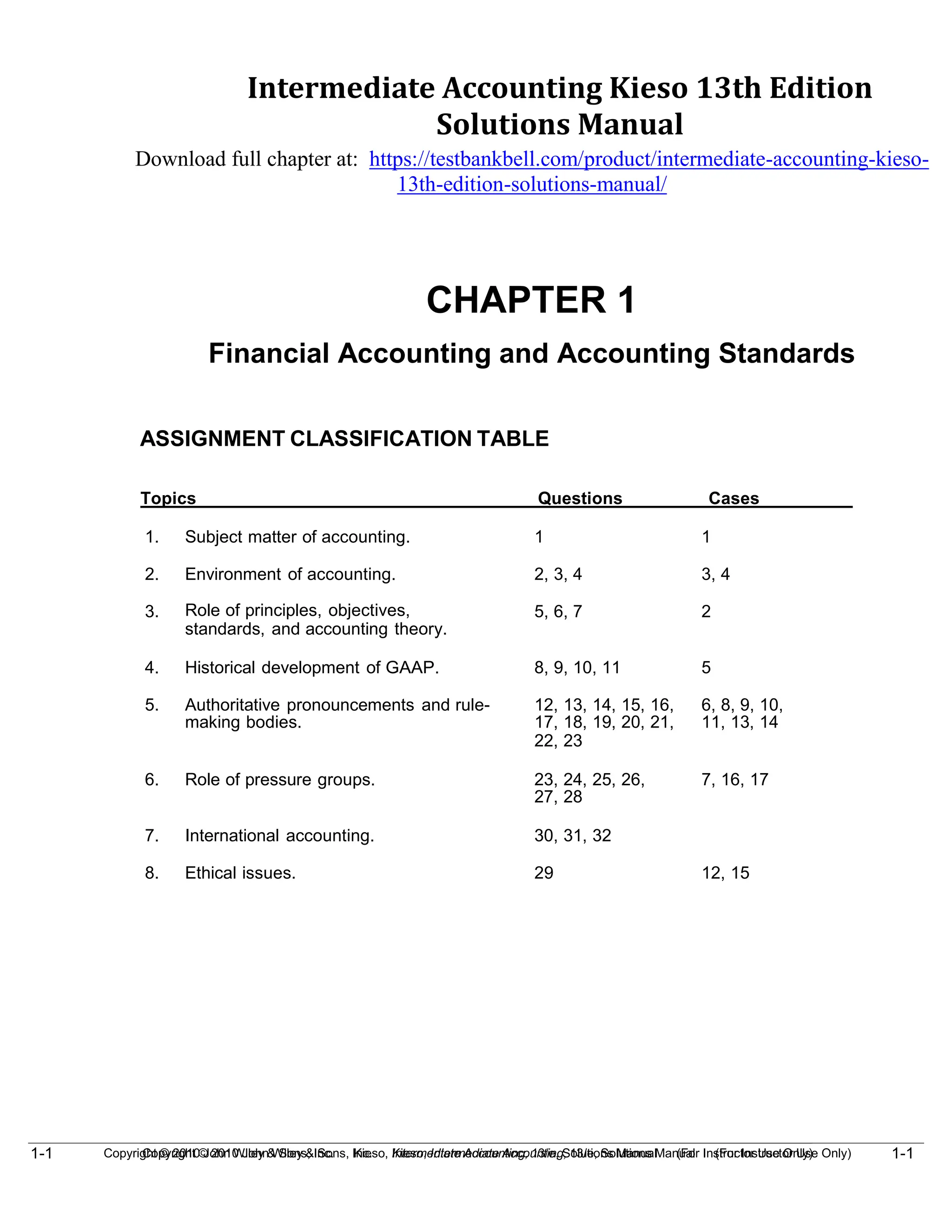
Intermediate Accounting Kieso 13th Edition
Solutions Manual
Download full chapter at: https://testbankbell.com/product/intermediate-accounting-kieso-
13th-edition-solutions-manual/
CHAPTER 1
Financial Accounting and Accounting Standards
ASSIGNMENT CLASSIFICATION TABLE
Topics Questions Cases
1. Subject matter of accounting. 1 1
2. Environment of accounting. 2, 3, 4 3, 4
3. Role of principles, objectives,
standards, and accounting theory.
5, 6, 7 2
4. Historical development of GAAP. 8, 9, 10, 11 5
5. Authoritative pronouncements and rule- 12, 13, 14, 15, 16, 6, 8, 9, 10,
making bodies. 17, 18, 19, 20, 21, 11, 13, 14
22, 23
6. Role of pressure groups. 23, 24, 25, 26, 7, 16, 17
27, 28
7. International accounting. 30, 31, 32
8. Ethical issues. 29 12, 15
1-2
Copyright © 2010 John Wiley & Sons, Inc. Kieso, Intermediate Accounting, 13/e, Solutions Manual (For Instructor Use Only)
1-2 Copyright © 2010 John Wiley & Sons, Inc. Kieso, Intermediate Accounting, 13/e, Solutions Manual (For Instructor Use Only)
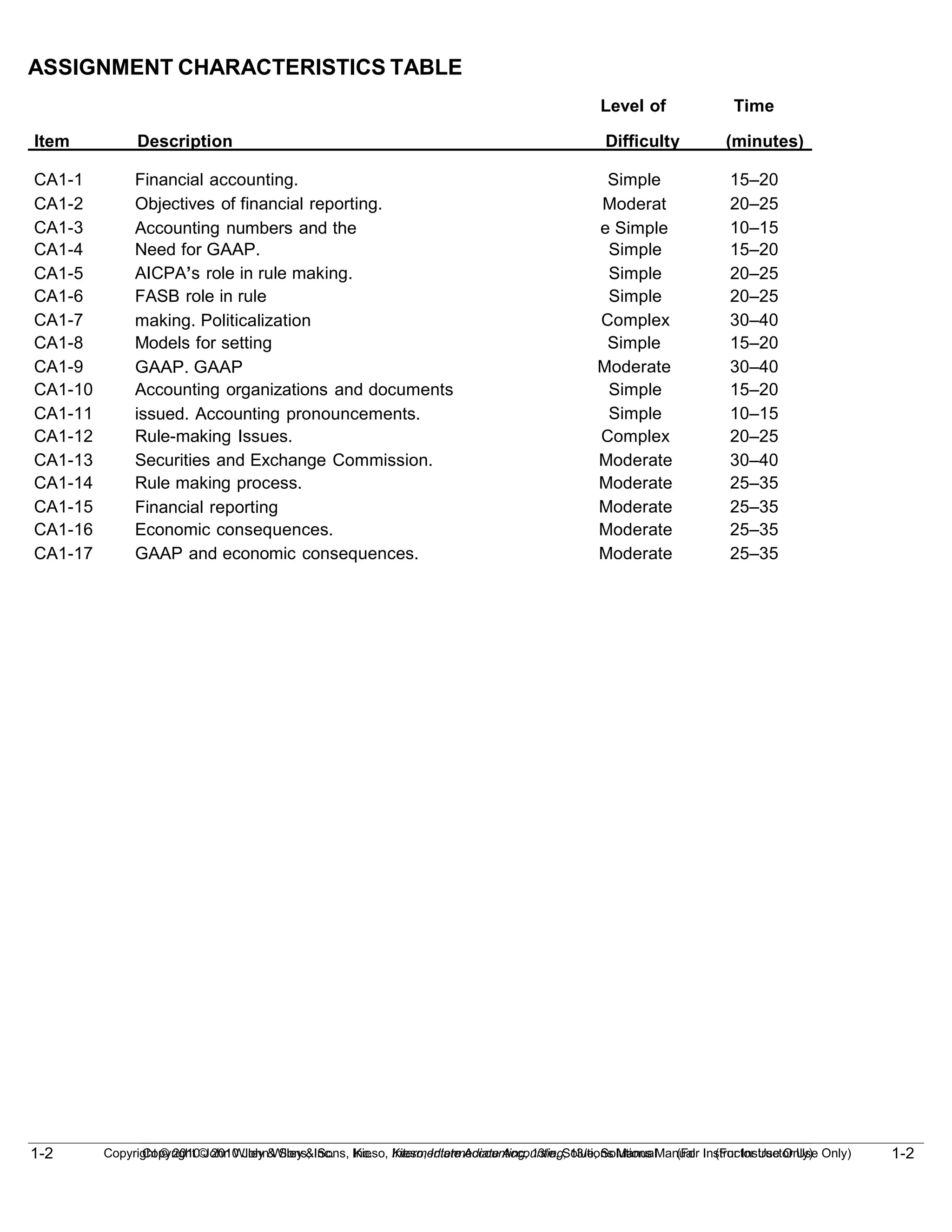
ASSIGNMENT CHARACTERISTICS TABLE
Level of Time
Item Description Difficulty (minutes)
CA1-1
CA1-2
CA1-3
Financial accounting.
Objectives of financial reporting.
Accounting numbers and the
environment.
Simple
Moderat
e Simple
15–20
20–25
10–15
CA1-4
CA1-5
Need for GAAP.
AICPA’s role in rule making.
Simple
Simple
15–20
20–25
CA1-6
CA1-7
FASB role in rule
making. Politicalization
of GAAP.
Simple
Complex
20–25
30–40
CA1-8
CA1-9
Models for setting
GAAP. GAAP
terminology.
Simple
Moderate
15–20
30–40
CA1-10
CA1-11
Accounting organizations and documents
issued. Accounting pronouncements.
Simple
Simple
15–20
10–15
CA1-12
CA1-13
Rule-making Issues.
Securities and Exchange Commission.
Complex
Moderate
20–25
30–40
CA1-14
CA1-15
Rule making process.
Financial reporting
pressures.
Moderate
Moderate
25–35
25–35
CA1-16
CA1-17
Economic consequences.
GAAP and economic consequences.
Moderate
Moderate
25–35
25–35
1-3
Copyright © 2010 John Wiley & Sons, Inc. Kieso, Intermediate Accounting, 13/e, Solutions Manual (For Instructor Use Only)
1-3 Copyright © 2010 John Wiley & Sons, Inc. Kieso, Intermediate Accounting, 13/e, Solutions Manual (For Instructor Use Only)
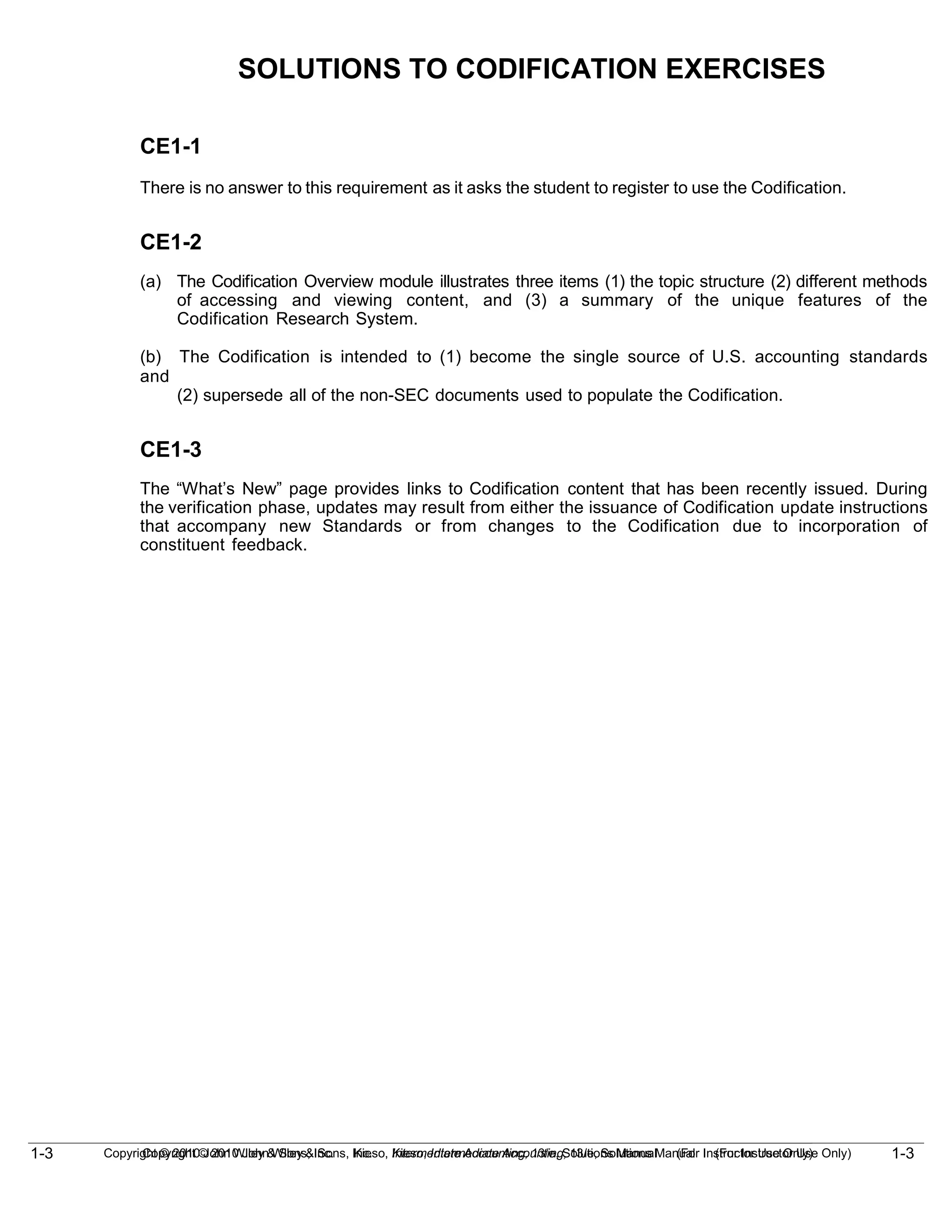
SOLUTIONS TO CODIFICATION EXERCISES
CE1-1
There is no answer to this requirement as it asks the student to register to use the Codification.
CE1-2
(a) The Codification Overview module illustrates three items (1) the topic structure (2) different methods
of accessing and viewing content, and (3) a summary of the unique features of the
Codification Research System.
(b) The Codification is intended to (1) become the single source of U.S. accounting standards
and
(2) supersede all of the non-SEC documents used to populate the Codification.
CE1-3
The “What’s New” page provides links to Codification content that has been recently issued. During
the verification phase, updates may result from either the issuance of Codification update instructions
that accompany new Standards or from changes to the Codification due to incorporation of
constituent feedback.
1-4
Copyright © 2010 John Wiley & Sons, Inc. Kieso, Intermediate Accounting, 13/e, Solutions Manual (For Instructor Use Only)
1-4 Copyright © 2010 John Wiley & Sons, Inc. Kieso, Intermediate Accounting, 13/e, Solutions Manual (For Instructor Use Only)
ANSWERS TO QUESTIONS
1. Financial accounting measures, classifies, and summarizes in report form those activities and
that information which relate to the enterprise as a whole for use by parties both internal and external
to a business enterprise. Managerial accounting also measures, classifies, and summarizes in
report form enterprise activities, but the communication is for the use of internal, managerial
parties, and relates more to subsystems of the entity. Managerial accounting is management
decision oriented and directed more toward product line, division, and profit center reporting.
2. Financial statements generally refer to the four basic financial statements: balance sheet,
income statement, statement of cash flows, and statement of changes in owners’ or stockholders’
equity. Financial reporting is a broader concept; it includes the basic financial statements and
any other means of communicating financial and economic data to interested external parties.
Examples of financial reporting other than financial statements are annual reports, prospectuses,
reports filed with the government, news releases, management forecasts or plans, and descriptions
of an enterprise’s social or environmental impact.
3. If a company’s financial performance is measured accurately, fairly, and on a timely basis, the
right managers and companies are able to attract investment capital. To provide unreliable and
irrelevant information leads to poor capital allocation which adversely affects the securities market.
4. Some major challenges facing the accounting profession relate to the following items:
Nonfinancial measurement—how to report significant key performance measurements such
as customer satisfaction indexes, backlog information and reject rates on goods purchased.
Forward-looking information—how to report more future oriented information.
Soft assets—how to report on intangible assets, such as market know-how, market
dominance, and well-trained employees.
Timeliness—how to report more real-time information.
5. In general, the objectives of financial reporting are to provide (1) information that is useful in
invest- ment and credit decisions, (2) information that is useful in assessing cash flow
prospects, and (3) information about enterprise resources, claims to those resources, and
changes in them. More specifically these objectives state that financial reporting should provide
information:
a. that is useful to present and potential investors and creditors and other users in making
rational investment, credit, and similar decisions. The information should be comprehensible
to those who have a reasonable understanding of business and economic activities and
are willing to study the information with reasonable diligence.
b. to help present and potential investors and creditors and other users in assessing the amounts,
timing, and uncertainty of prospective cash receipts from dividends or interest and the proceeds
from the sale, redemption, or maturity of securities or loans. Since investors and creditors’
cash flows are related to enterprise cash flows, financial reporting should provide information
to help investors, creditors, and other users assess the amounts, timing, and uncertainty of
prospective net cash inflows to the related enterprise.
c. about the economic resources of an enterprise, the claims to those resources (obligations of
the enterprise to transfer resources to other entities), owners’ equity, and the effects of
transactions, events, and circumstances that change its resources and claims to those
resources.
6. A common set of standards applied by all businesses and entities provides financial statements
which are reasonably comparable. Without a common set of standards, each enterprise could,
and would, develop its own theory structure and set of practices, resulting in noncomparability
among enterprises.
1-5
Copyright © 2010 John Wiley & Sons, Inc. Kieso, Intermediate Accounting, 13/e, Solutions Manual (For Instructor Use Only)
1-5 Copyright © 2010 John Wiley & Sons, Inc. Kieso, Intermediate Accounting, 13/e, Solutions Manual (For Instructor Use Only)
Questions Chapter 1 (Continued)
7. General-purpose financial statements are not likely to satisfy the specific needs of all interested
parties. Since the needs of interested parties such as creditors, managers, owners, governmental
agencies, and financial analysts vary considerably, it is unlikely that one set of financial statements
is equally appropriate for these varied uses.
8. The SEC has the power to prescribe, in whatever detail it desires, the accounting practices
and principles to be employed by the companies that fall within its jurisdiction. Because the SEC
receives audited financial statements from nearly all companies that issue securities to the public
or are listed on the stock exchanges, it is greatly interested in the content, accuracy, and
credibility of the statements. For many years the SEC relied on the AICPA to regulate the
profession and develop and enforce accounting principles. Lately, the SEC has assumed a more
active role in the develop- ment of accounting standards, especially in the area of disclosure
requirements. In December 1973, in ASR No. 150, the SEC said the FASB’s statements would
be presumed to carry substantial authoritative support and anything contrary to them to lack
such support. It thereby supports the development of accounting principles in the private sector.
9. The Committee on Accounting Procedure was a special committee of the American Institute of
CPAs that, between the years of 1939 and 1959, issued 51 Accounting Research Bulletins
dealing with a wide variety of timely accounting problems. These bulletins provided solutions
to immediate problems and narrowed the range of alternative practices. But, the Committee’s
problem-by-problem approach failed to provide a well-defined and well-structured body of
accounting theory that was so badly needed. The Committee on Accounting Procedure was
replaced in 1959 by the Accounting Principles Board.
10. The creation of the Accounting Principles Board was intended to advance the written expression
of accounting principles, to determine appropriate practices, and to narrow the differences
and inconsistencies in practice. To achieve its basic objectives, its mission was to develop an
overall conceptual framework to assist in the resolution of problems as they became evident
and to do substantive research on individual issues before pronouncements were issued.
11. Accounting Research Bulletins were pronouncements on accounting practice issued by
the Committee on Accounting Procedure between 1939 and 1959; since 1964 they have
been recognized as accepted accounting practice unless superseded in part or in whole by an
opinion of the APB or an FASB standard. APB Opinions were issued by the Accounting
Principles Board during the years 1959 through 1973 and, unless superseded by FASB
Statements, are recognized as accepted practice and constitute the requirements to be followed
by all business enterprises. FASB Statements are pronouncements of the Financial Accounting
Standards Board and currently represent the accounting profession’s authoritative
pronouncements on financial accounting and reporting practices.
12. The explanation should note that generally accepted accounting principles or standards
have “substantial authoritative support.” They consist of accounting practices, procedures,
theories, concepts, and methods which are recognized by a large majority of practicing
accountants as well as other members of the business and financial community. Bulletins issued
by the Committee on Accounting Procedure, opinions rendered by the Accounting Principles
Board, and statements issued by the Financial Accounting Standards Board constitute
“substantial authoritative support.”
13. It was believed that FASB Statements would carry greater weight than APB Opinions because
of significant differences between the FASB and the APB, namely: (1) The FASB has a smaller
mem- bership of full-time compensated members; (2) the FASB has greater autonomy and
increased independence; and (3) the FASB has broader representation than the APB.
1-6
Copyright © 2010 John Wiley & Sons, Inc. Kieso, Intermediate Accounting, 13/e, Solutions Manual (For Instructor Use Only)
1-6 Copyright © 2010 John Wiley & Sons, Inc. Kieso, Intermediate Accounting, 13/e, Solutions Manual (For Instructor Use Only)
Questions Chapter 1 (Continued)
14. The technical staff of the FASB conducts research on an identified accounting topic and prepares
a “preliminary views” that is released by the Board for public reaction. The Board analyzes
and evaluates the public response to the preliminary views, deliberates on the issues, and
issues an “exposure draft” for public comment. The preliminary views merely presents all facts and
alternatives related to a specific topic or problem, whereas the exposure draft is a tentative
“statement.” After studying the public’s reaction to the exposure draft, the Board may reevaluate
its position, revise the draft, and vote on the issuance of a final statement.
15. Statements of financial accounting standards constitute generally accepted accounting
principles and dictate acceptable financial accounting and reporting practices as promulgated
by the FASB. The first standards statement was issued by the FASB in 1973.
Statements of financial accounting concepts do not establish generally accepted accounting
principles. Rather, the concepts statements set forth fundamental objectives and concepts that
the FASB intends to use as a basis for developing future standards. The concepts serve as
guidelines in solving existing and emerging accounting problems in a consistent, sound
manner. Both the standards statements and the concepts statements may develop through the
same process from discussion memorandum, to exposure draft, to a final approved statement.
16. Rule 203 of the Code of Professional Conduct prohibits a member of the AICPA from expressing
an opinion that financial statements conform with GAAP if those statements contain a material
departure from an accounting principle promulgated by the FASB, or its predecessors, the
APB and the CAP, unless the member can demonstrate that because of unusual
circumstances the financial statements would otherwise have been misleading. Failure to follow
Rule 203 can lead to a loss of a CPA’s license to practice. This rule is extremely important
because it requires auditors to follow FASB standards.
17. FASB Standards, FASB Technical Bulletins, AICPA Practice Bulletins.
18. The chairman of the FASB was indicating that too much attention is put on the bottom line and
not enough on the development of quality products. Managers should be less concerned with
short- term results and be more concerned with the long-term results. In addition, short-term tax
benefits often lead to long-term problems.
The second part of his comment relates to accountants being overly concerned with following a
set of rules, so that if litigation ensues, they will be able to argue that they followed the rules
exactly. The problem with this approach is that accountants want more and more rules with
less reliance on professional judgment. Less professional judgment leads to inappropriate
use of accounting procedures in difficult situations.
In the accountants’ defense, recent legal decisions have imposed vast new liability on accountants.
The concept of accountant’s liability that has emerged in these cases is broad and expansive;
the number of classes of people to whom the accountant is held responsible are almost limitless.
19. FASB Staff Positions (FSP) are used to provide interpretive guidance and to make minor
amend- ments to existing standards. The due process used to issue a FSP is the same used
to issue a new standard.
1-7
Copyright © 2010 John Wiley & Sons, Inc. Kieso, Intermediate Accounting, 13/e, Solutions Manual (For Instructor Use Only)
1-7 Copyright © 2010 John Wiley & Sons, Inc. Kieso, Intermediate Accounting, 13/e, Solutions Manual (For Instructor Use Only)
Questions Chapter 1 (Continued)
20. The Emerging Issues Task Force often arrives at consensus conclusions on certain financial
report- ing issues. These consensus conclusions are then looked upon as GAAP by practitioners
because the SEC has indicated that it will view consensus solutions as preferred accounting and
will require persuasive justification for departing from them. Thus, at least for public companies
which are sub- ject to SEC oversight, consensus solutions developed by the Emerging Issues
Task Force are followed unless subsequently overturned by the FASB. It should be noted
that the FASB took greater direct ownership of GAAP established by the EITF by requiring that
consensus positions be ratified by the FASB.
21. The Financial Accounting Standards Board Accounting Standards Codification (Codifications)
is a compilation of all GAAP in one place. Its purpose is to integrate and synthesize existing
GAAP and not to create new GAAP. It creates one level of GAAP which is considered authoritative.
The FASB Codification Research Systems (CRS) is an-on-line real time data base which provides
easy access to the Codification. The Codification and the related CRS provide a topically
organized structure which is subdivided into topic, subtopics, sections, and paragraphs.
22. Hopefully, the codification will help users to better understand what GAAP is. If this occurs, the
rash of noncompliance with GAAP will be reduced and the time to research accounting issues
will be substantially reduced. In addition, through the electronic web-based format, GAAP can
be easily updated which will help users stay current.
23. The sources of pressure are innumerable, but the most intense and continuous pressure
to change or influence accounting principles or standards come from individual companies,
industry associations, governmental agencies, practicing accountants, academicians,
professional accoun- ting organizations, and public opinion.
24. Economic consequences means the impact of accounting reports on the wealth positions of
issuers and users of financial information and the decision-making behavior resulting from that
impact. In other words, accounting information impacts various users in many different ways
which leads to wealth transfers among these various groups.
If politics plays an important role in the development of accounting rules, the rules will be
subject to manipulation for the purpose of furthering whatever policy prevails at the moment.
No matter how well intentioned the rule maker may be, if information is designed to indicate that
investing in a particular enterprise involves less risk than it actually does, or is designed to
encourage invest- ment in a particular segment of the economy, financial reporting will suffer an
irreplaceable loss of credibility.
25. No one particular proposal is expected in answer to this question. The students’ proposals, however,
should be defensible relative to the following criteria:
(1) The method must be efficient, responsive, and
expeditious.
(2) The method must be free of bias and be above or insulated from pressure groups.
(3) The method must command widespread support if it does not have legislative
authority. (4) The method must produce sound yet practical accounting principles or
standards.
The students’ proposals might take the form of alterations of the existing methodology, an
accoun- ting court (as proposed by Leonard Spacek), or governmental device.
26. Concern exists about fraudulent financial reporting because it can undermine the entire financial
reporting process. Failure to provide information to users that is accurate can lead to inappropriate
allocations of resources in our economy. In addition, failure to detect massive fraud can lead
to additional governmental oversight of the accounting profession.
1-8
Copyright © 2010 John Wiley & Sons, Inc. Kieso, Intermediate Accounting, 13/e, Solutions Manual (For Instructor Use Only)
1-8 Copyright © 2010 John Wiley & Sons, Inc. Kieso, Intermediate Accounting, 13/e, Solutions Manual (For Instructor Use Only)
Questions Chapter 1 (Continued)
27. The expectations gap is the difference between what people think accountants should be doing
and what accountants think they can do. It is a difficult gap to close. The accounting profession
recognizes it must play an important role in narrowing this gap. To meet the needs of society, the
profession is continuing its efforts in developing accounting standards, such as numerous
pronouncements issued by the FASB, to serve as guidelines for recording and processing
business transactions in the changing economic environment.
28. The following are some of the key provisions of the Sarbanes-Oxley Act:
• Establishes an oversight board for accounting practices. The Public Company Accounting
Over- sight Board (PCAOB) has oversight and enforcement authority and establishes auditing,
quality control, and independence standards and rules.
• Implements stronger independence rules for auditors. Audit partners, for example, are
required to rotate every five years and auditors are prohibited from offering certain types of
consulting services to corporate clients.
• Requires CEOs and CFOs to personally certify that financial statements and disclosures
are accurate and complete and requires CEOs and CFOs to forfeit bonuses and profits when
there is an accounting restatement.
• Requires audit committees to be comprised of independent members and members with
finan- cial expertise.
• Requires codes of ethics for senior financial officers.
In addition, Section 404 of the Sarbanes-Oxley Act requires public companies to attest to
the effectiveness of their internal controls over financial reporting.
29. Accountants must perceive the moral dimensions of some situations because GAAP does
not define or cover all specific features that are to be reported in financial statements. In these
instances accountants must choose among alternatives. These accounting choices influence
whether par- ticular stakeholders may be harmed or benefited. Moral decision-making involves
awareness of potential harm or benefit and taking responsibility for the choices.
30. Some of the reasons for differences are:
(1) The objectives of financial reporting are often different in foreign
countries. (2) The institutional structures are often not comparable.
(3) Strong national tendencies are pervasive and therefore there is reluctance to adopt any
one country’s approach.
31. Relevant and reliable financial information is a necessity for viable capital markets. Unfortunately,
financial statements from companies outside the United States are often prepared using
different principles than U.S. GAAP. As a result, international companies have to develop
financial infor- mation in different ways. Beyond the additional costs these companies incur,
users of financial statements are often forced to understand at least two sets of GAAP. It is not
surprising that there is a growing demand for one set of high quality international standards.
32. Principles-based rules are considered to be based on accounting principles to result in financial
statements that are presented. Rules-based standards are generally quite detailed, and in
many instances follow a “check-box” mentality that some contend may shield auditors and
companies from legal liability. Because iGAAP tends to be simpler and less stringent in its
accounting and disclosure requirements, it is generally considered more principles-based than
U.S. GAAP.
1-9
Copyright © 2010 John Wiley & Sons, Inc. Kieso, Intermediate Accounting, 13/e, Solutions Manual (For Instructor Use Only)
1-9 Copyright © 2010 John Wiley & Sons, Inc. Kieso, Intermediate Accounting, 13/e, Solutions Manual (For Instructor Use Only)
TIME AND PURPOSE OF CONCEPTS FOR ANALYSIS
CA 1-1 (Time 15–20 minutes)
Purpose—to provide the student with an opportunity to distinguish between financial accounting
and managerial accounting, identify major financial statements, and differentiate financial statements
and financial reporting.
CA 1-2 (Time 20–25 minutes)
Purpose—to provide the student with an opportunity to explain the basic objectives of financial
reporting.
CA 1-3 (Time 10–15 minutes)
Purpose—to provide the student with an opportunity to describe how reported accounting numbers
might affect an individual’s perceptions and actions.
CA 1-4 (Time 15–20 minutes)
Purpose—to provide the student with an opportunity to evaluate the viewpoint of removing mandatory
accounting rules and allowing each company to voluntarily disclose the information it desired.
CA 1-5 (Time 20–25 minutes)
Purpose—to provide the student with an opportunity to explain the evolution of accounting rule-
making organizations and the role of the AICPA in the rule making environment.
CA 1-6 (Time 20–25 minutes)
Purpose—to provide the student with an opportunity to identify the sponsoring organization of
the FASB, the method by which the FASB arrives at a decision, and the types and the purposes of
docu- ments issued by the FASB.
CA 1-7 (Time 30–40 minutes)
Purpose—to provide the student with an opportunity to focus on the types of organizations involved in
the rule making process, what impact accounting has on the environment, and the environment’s
influence on accounting.
CA 1-8 (Time 15–20 minutes)
Purpose—to provide the student with an opportunity to focus on what type of rule-making environment
exists in the United States. In addition, this CA explores why user groups are interested in the nature
of GAAP and why some groups wish to issue their own rules.
CA 1-9 (Time 30–40 minutes)
Purpose—to provide the student with an opportunity to identify and define acronyms appearing in
the first chapter. Some are self-evident, others are not so.
CA 1-10 (Time 15–20 minutes)
Purpose—to provide the student with an opportunity to identify the various documents issued by
different accounting organizations. This CA should help the student to better focus on the more important
documents issued in the financial reporting area.
CA 1-11 (Time 10–15 minutes)
Purpose—to provide the student with an opportunity to match the descriptions of a number of
authori- tative pronouncements issued by rule-making bodies to the pronouncements.
1-10
Copyright © 2010 John Wiley & Sons, Inc. Kieso, Intermediate Accounting, 13/e, Solutions Manual (For Instructor Use Only)
1-10 Copyright © 2010 John Wiley & Sons, Inc. Kieso, Intermediate Accounting, 13/e, Solutions Manual (For Instructor Use Only)
Time and Purpose of Concepts for Analysis (Continued)
CA 1-12 (Time 20–25 minutes)
Purpose—to provide the student with an opportunity to consider the ethical dimensions of
implementation of a new accounting pronouncement.
CA 1-13 (Time 30–40 minutes)
Purpose—to provide the student with an assignment that explores the role and function of
the
Securities and Exchange Commission.
CA 1-14 (Time 25–35 minutes)
Purpose—to provide the student with an assignment that explores the role of the FASB and the
rule- making process.
CA 1-15 (Time 25–35 minutes)
Purpose—to provide the student with a writing assignment concerning the ethical issues related
to meeting earnings targets.
CA 1-16 (Time 25–35 minutes)
Purpose—to provide the student with the opportunity to discuss the role of Congress in accounting
rule- making.
CA 1-17 (Time 25–35 minutes)
Purpose—to provide the student with an opportunity to comment on a letter sent by business
execu- tives to the FASB and Congress on the accounting for derivatives.
1-11
Copyright © 2010 John Wiley & Sons, Inc. Kieso, Intermediate Accounting, 13/e, Solutions Manual (For Instructor Use Only)
1-11 Copyright © 2010 John Wiley & Sons, Inc. Kieso, Intermediate Accounting, 13/e, Solutions Manual (For Instructor Use Only)
SOLUTIONS TO CONCEPTS FOR ANALYSIS
CA 1-1
(a) Financial accounting is the process that culminates in the preparation of financial reports relative
to the enterprise as a whole for use by parties both internal and external to the enterprise. In
contrast, managerial accounting is the process of identification, measurement, accumulation,
analysis, prepa- ration, interpretation, and communication of financial information used by the
management to plan, evaluate, and control within an organization and to assure appropriate use
of, and accountability for, its resources.
(b) The financial statements most frequently provided are the balance sheet, the income statement,
the statement of cash flows, and the statement of changes in owners’ or stockholders’ equity.
(c) Financial statements are the principal means through which financial information is communicated
to those outside an enterprise. As indicated in (b), there are four major financial statements.
However, some financial information is better provided, or can be provided only, by means
of financial reporting other than formal financial statements. Financial reporting (other than
financial statements and related notes) may take various forms. Examples include the company
president’s letter or supplementary schedules in the corporate annual reports, prospectuses,
reports filed with govern- ment agencies, news releases, management’s forecasts, and
descriptions of an enterprise’s social or environmental impact.
CA 1-2
(a) In accordance with Statement of Financial Accounting Concepts No. 1, “Objectives of Financial
Reporting by Business Enterprises,” the objectives of financial reporting are to provide information
to investors, creditors, and others
1. that is useful to present and potential investors and creditors and other users in making rational
investment, credit, and similar decisions. The information should be comprehensible to
those who have a reasonable understanding of business and economic activities and are
willing to study the information with reasonable diligence.
2. to help present and potential investors and creditors and other users in assessing the amounts,
timing, and uncertainty of prospective cash receipts from dividends or interest and the proceeds
from the sale, redemption, or maturity of securities or loans. Since investors’ and creditors’
cash flows are related to enterprise cash flows, financial reporting should provide information
to help investors, creditors, and others assess the amounts, timing, and uncertainty of
prospective net cash inflows to the related enterprise.
3. about the economic resources of an enterprise, the claims to those resources (obligations of
the enterprise to transfer resources to other entities and owners’ equity), and the effects of
trans- actions, events, and circumstances that change its resources and claims to those
resources.
(b) Statement of Financial Accounting Concepts No. 1 established standards to meet the
information needs of large groups of external users such as investors, creditors, and their
representatives. Although the level of sophistication related to business and financial accounting
matters varies both within and between these user groups, users are expected to possess a
reasonable understanding of accounting concepts, financial statements, and business and economic
activities and are expected to be willing to study and interpret the information with reasonable
diligence.
1-12
Copyright © 2010 John Wiley & Sons, Inc. Kieso, Intermediate Accounting, 13/e, Solutions Manual (For Instructor Use Only)
1-12 Copyright © 2010 John Wiley & Sons, Inc. Kieso, Intermediate Accounting, 13/e, Solutions Manual (For Instructor Use Only)
CA 1-3
Accounting numbers affect investing decisions. Investors, for example, use the financial statements
of different companies to enhance their understanding of each company’s financial strength and
operating results. Because these statements follow generally accepted accounting principles, investors
can make meaningful comparisons of different financial statements to assist their investment decisions.
Accounting numbers also influence creditors’ decisions. A commercial bank usually looks into
a company’s financial statements and past credit history before deciding whether to grant a loan
and in what amount. The financial statements provide a fair picture of the company’s financial
strength (for example, short-term liquidity and long-term solvency) and operating performance for the
current period and over a period of time. The information is essential for the bank to ensure that the
loan is safe and sound.
CA 1-4
It is not appropriate to abandon mandatory accounting rules and allow each company to voluntarily
disclose the type of information it considered important. Without a coherent body of accounting
theory and standards, each accountant or enterprise would have to develop its own theory structure
and set of practices, and readers of financial statements would have to familiarize themselves with
every company’s peculiar accounting and reporting practices. As a result, it would be almost impossible
to prepare state- ments that could be compared.
In addition, voluntary disclosure may not be an efficient way of disseminating information. A company
is likely to disclose less information if it has the discretion to do so. Thus, the company can reduce its
cost of assembling and disseminating information. However, an investor wishing additional
information has to pay to receive additional information desired. Different investors may be interested
in different types of information. Since the company may not be equipped to provide the requested
information, it would have to spend additional resources to fulfill such needs; or the company may
refuse to furnish such information if it’s too costly to do so. As a result, investors may not get the
desired information or they may have to pay a significant amount of money for it. Furthermore,
redundancy in gathering and distributing information occurs when different investors ask for the
same information at different points in time. To the society as a whole, this would not be an efficient
way of utilizing resources.
CA 1-5
(a) One of the committees that the AICPA established prior to the establishment of the FASB was
the Committee on Accounting Procedures (CAP). The CAP, during its existence from 1939 to
1959, issued 51 Accounting Research Bulletins (ARB). In 1959, the AICPA created the
Accounting Prin- ciples Board (APB) to replace the CAP. Before being replaced by the FASB,
the APB released
31 official pronouncements, called APB
Opinions.
(b) Although the ARBs issued by the CAP helped to narrow the range of alternative practices to
some extent, the CAP’s problem-by-problem approach failed to provide the well-defined,
structured body of accounting principles that was both needed and desired. As a result, the CAP
was replaced by the APB.
The APB had more authority and responsibility than did the CAP. Unfortunately, the APB
was beleaguered throughout its 14-year existence. It came under fire early, charged with lack of
produc- tivity and failing to act promptly to correct alleged accounting abuses. The APB also
met a lot of industry and CPA firm opposition and occasional governmental interference when
1-13
Copyright © 2010 John Wiley & Sons, Inc. Kieso, Intermediate Accounting, 13/e, Solutions Manual (For Instructor Use Only)
1-13 Copyright © 2010 John Wiley & Sons, Inc. Kieso, Intermediate Accounting, 13/e, Solutions Manual (For Instructor Use Only)
tackling numerous thorny accounting issues. In fear of governmental rule making, the accounting
profession investigated the ineffectiveness of the APB and replaced it with the FASB.
1-14
Copyright © 2010 John Wiley & Sons, Inc. Kieso, Intermediate Accounting, 13/e, Solutions Manual (For Instructor Use Only)
1-14 Copyright © 2010 John Wiley & Sons, Inc. Kieso, Intermediate Accounting, 13/e, Solutions Manual (For Instructor Use Only)
CA 1-5 (Continued)
Learning from prior experiences, the FASB has several significant differences from the APB.
The FASB has: (1) smaller membership, (2) full-time, compensated membership, (3) greater
autonomy, (4) increased independence, and (5) broader representation. In addition, the FASB
has its own research staff and relies on the expertise of various task force groups formed for
various projects. These features form the bases for the expectations of success and support
from the public. In addition, the due process taken by the FASB in establishing financial
accounting standards gives interested persons ample opportunity to make their views known.
Thus, the FASB is responsive to the needs and viewpoints of the entire economic community, not
just the public accounting profession.
(c) The AICPA has supplemented the FASB’s efforts in the present standard-setting environment.
The issue papers, which are prepared by the Accounting Standards Executive Committee
(AcSEC), identify current financial reporting problems for specific industries and present
alternative treat- ments of the issue. These papers provide the FASB with an early warning
device to insure timely issuance of FASB standards, Interpretations, and Staff Positions. In
situations where the FASB avoids the subject of an issue paper, AcSEC may issue a Statement
of Position to provide guidance for the reporting issue. AcSEC also issues Practice Bulletins
which indicate how the AICPA believes a given transaction should be reported.
Recently, the role of the AICPA in standard-setting has diminished. The FASB and the
AICPA agreed, that after a transition period, the AICPA and AcSEC no longer will issue
authoritative accounting guidance for public companies.
CA 1-6
(a) The Financial Accounting Foundation (FAF) is the sponsoring organization of the FASB. The
FAF selects the members of the FASB and its Advisory Council, funds their activities, and
generally oversees the FASB’s activities.
The FASB follows a due process in establishing a typical FASB Statement of Financial Accounting
Standards. The following steps are usually taken: (1) A topic or project is identified and placed
on the Board’s agenda. (2) A task force of experts from various sectors is assembled to
define problems, issues, and alternatives related to the topic. (3) Research and analysis are
conducted by the FASB technical staff. (4) A preliminary views document is drafted and
released. (5) A public hearing is often held, usually 60 days after the release of the preliminary
views. (6) The Board analyzes and evaluates the public response. (7) The Board deliberates on
the issues and prepares an exposure draft for release. (8) After a 30-day (minimum) exposure
period for public comment, the Board evaluates all of the responses received. (9) A committee
studies the exposure draft in relation to the public responses, reevaluates its position, and revises
the draft if necessary. (10) The full Board gives the revised draft final consideration and votes
on issuance of a Standards Statement. The passage of a new accounting standard in the form
of an FASB Statement requires the support of five of the seven Board members.
(b) The FASB issues three major types of pronouncements: Standards and Interpretations, Financial
Accounting Concepts, and Technical Bulletins. Financial accounting standards issued by the
FASB are considered GAAP. In addition, the FASB also issues interpretations that represent
modifications or extensions of existing standards and APB Opinions. These interpretations have
the same authority as standards and APB Opinions in guiding current accounting practices.
The Statements of Financial Accounting Concepts (SFAC) help the FASB to avoid the “problem-
by-problem approach.” These statements set forth fundamental objectives and concepts that
the Board will use in developing future standards of financial accounting and reporting.
They are intended to form a cohesive set of interrelated concepts, a body of theory or a
1-15
Copyright © 2010 John Wiley & Sons, Inc. Kieso, Intermediate Accounting, 13/e, Solutions Manual (For Instructor Use Only)
1-15 Copyright © 2010 John Wiley & Sons, Inc. Kieso, Intermediate Accounting, 13/e, Solutions Manual (For Instructor Use Only)
conceptual framework, that will serve as tools for solving existing and emerging problems in
a consistent, sound manner.
1-16
Copyright © 2010 John Wiley & Sons, Inc. Kieso, Intermediate Accounting, 13/e, Solutions Manual (For Instructor Use Only)
1-16 Copyright © 2010 John Wiley & Sons, Inc. Kieso, Intermediate Accounting, 13/e, Solutions Manual (For Instructor Use Only)
CA 1-6 (Continued)
The FASB may issue a technical bulletin when there is a need for guidelines on implementing
or applying FASB Standards or Interpretations, APB Opinions, Accounting Research Bulletins, or
emerging issues. A technical bulletin is issued only when (1) it is not expected to cause a major
change in accounting practice for a number of enterprises, (2) its cost of implementation is low,
and (3) the guidance provided by the bulletin does not conflict with any broad fundamental
accounting principle.
In addition, the FASB’s Emerging Issues Task Force (EITF) issues statements to provide guidance
on how to account for new and unusual financial transactions that have the potential for creating
diversity in reporting practices. The EITF identifies controversial accounting problems as they
arise and determines whether they can be quickly resolved or whether the FASB should become
involved in solving them. In essence, it becomes a “problem filter” for the FASB. Thus, it is
hoped that the FASB will be able to work on more pervasive long-term problems, while the EITF
deals with short- term emerging issues.
CA 1-7
(a) CAP. The Committee on Accounting Procedure, CAP, which was in existence from 1939 to
1959, was a natural outgrowth of AICPA committees which were in existence during the
period 1933 to
1938. The committee was formed in direct response to the criticism received by the accounting
profession during the financial crisis of 1929 and the years thereafter. The authorization to
issue pronouncements on matters of accounting principles and procedures was based on the
belief that the AICPA had the responsibility to establish practices that would become generally
accepted by the profession and by corporate management.
As a general rule, the CAP directed its attention, almost entirely, to resolving specific accounting
problems and topics rather than to the development of generally accepted accounting principles.
The committee voted on the acceptance of specific Accounting Research Bulletins published
by the committee. A two-thirds majority was required to issue a particular research bulletin. The
CAP did not have the authority to require acceptance of the issued bulletins by the general
membership of the AICPA, but rather received its authority only upon general acceptance of the
pronouncement by the members. That is, the bulletins set forth normative accounting procedures
that “should be” followed by the accounting profession, but were not “required” to be followed.
It was not until well after the demise of the CAP, in 1964, that the Council of the AICPA adopted
recommendations that departures from effective CAP Bulletins should be disclosed in financial
statements or in audit reports of members of the AICPA. The demise of the CAP could probably
be traced to four distinct factors: (1) the narrow nature of the subjects covered by the bulletins
issued by the CAP, (2) the lack of any theoretical groundwork in establishing the procedures
presented in the bulletins, (3) the lack of any real authority by the CAP in prescribing adherence
to the procedures described by the bulletins, and (4) the lack of any formal representation on
the CAP of interest groups such as corporate managers, governmental agencies, and security
analysts.
APB. The objectives of the APB were formulated mainly to correct the deficiencies of the CAP
as described above. The APB was thus charged with the responsibility of developing written
expression of generally accepted accounting principles through consideration of the research
done by other members of the AICPA in preparing Accounting Research Studies. The
committee was in turn given substantial authoritative standing in that all opinions of the APB
were to constitute substantial authoritative support for generally accepted accounting principles.
If an individual member of the AICPA decided that a principle or procedure outside of the official
1-17
Copyright © 2010 John Wiley & Sons, Inc. Kieso, Intermediate Accounting, 13/e, Solutions Manual (For Instructor Use Only)
1-17 Copyright © 2010 John Wiley & Sons, Inc. Kieso, Intermediate Accounting, 13/e, Solutions Manual (For Instructor Use Only)
pronouncements of the APB had substantial authoritative support, the member had to disclose
the departure from the official APB opinion in the financial statements of the firm in question.
1-18
Copyright © 2010 John Wiley & Sons, Inc. Kieso, Intermediate Accounting, 13/e, Solutions Manual (For Instructor Use Only)
1-18 Copyright © 2010 John Wiley & Sons, Inc. Kieso, Intermediate Accounting, 13/e, Solutions Manual (For Instructor Use Only)
CA 1-7 (Continued)
The membership of the committee comprising the APB was also extended to include representation
from industry, government, and academe. The opinions were also designed to include minority
dissents by members of the board. Exposure drafts of the proposed opinions were readily
distributed.
The demise of the APB occurred primarily because the purposes for which it was created were
not being accomplished. Broad generally accepted accounting principles were not being
developed. The research studies supposedly being undertaken in support of subsequent
opinions to be expressed by the APB were often ignored. The committee in essence became
a simple extension of the original CAP in that only very specific problem areas were being
addressed. Interest groups outside of the accounting profession questioned the appropriateness
and desirability of having the AICPA directly responsible for the establishment of GAAP.
Politicization of the establishment of GAAP had become a reality because of the far-reaching
effects involved in the questions being resolved.
FASB. The formal organization of the FASB represents an attempt to vest the responsibility
of establishing GAAP in an organization representing the diverse interest groups affected by the
use of GAAP. The FASB is independent of the AICPA. It is independent, in fact, of any private
or govern- mental organization. Individual CPAs, firms of CPAs, accounting educators, and
representatives of private industry will now have an opportunity to make known their views to the
FASB through their membership on the Board. Independence is facilitated through the funding
of the organization and payment of the members of the Board. Full-time members are paid by
the organization and the organization itself is funded solely through contributions. Thus, no one
interest group has a vested interest in the FASB.
Conclusion. The evolution of the current FASB certainly does represent “increasing politicization
of accounting standards setting.” Many of the efforts extended by the AICPA can be directly
attributed to the desire to satisfy the interests of many groups within our society. The
FASB represents, perhaps, just another step in this evolutionary process.
(b) Arguments for politicalization of the accounting rule-making process:
1. Accounting depends in large part on public confidence for its success. Consequently,
the critical issues are not solely technical, so all those having a bona fide interest in the
output of accounting should have some influence on that output.
2. There are numerous conflicts between the various interest groups. In the face of this, compro-
mise is necessary, particularly since the critical issues in accounting are value judgments,
not the type which are solvable, as we have traditionally assumed, using deterministic
models. Only in this way (reasonable compromise) will the financial community have
confidence in the fairness and objectivity of accounting rule-making.
3. Over the years, accountants have been unable to establish, on the basis of technical accoun-
ting elements, rules which would bring about the desired uniformity and acceptability.
This inability itself indicates rule-setting is primarily consensual in nature.
4. The public accounting profession, through bodies such as the Accounting Principles
Board, made rules which business enterprises and individuals “had” to follow. For many
years, these businesses and individuals had little say as to what the rules would be, in spite
of the fact that their economic well-being was influenced to a substantial degree by those
rules. It is only natural that they would try to influence or control the factors that determine
their economic well- being.
1-19
Copyright © 2010 John Wiley & Sons, Inc. Kieso, Intermediate Accounting, 13/e, Solutions Manual (For Instructor Use Only)
1-19 Copyright © 2010 John Wiley & Sons, Inc. Kieso, Intermediate Accounting, 13/e, Solutions Manual (For Instructor Use Only)
CA 1-7 (Continued)
(c) Arguments against the politicalization of the accounting rule-making process:
1. Many accountants feel that accounting is primarily technical in nature. Consequently, they
feel that substantive, basic research by objective, independent and fair-minded researchers
ultimately will result in the best solutions to critical issues, such as the concepts of income
and capital, even if it is accepted that there isn’t necessarily a single “right” solution.
2. Even if it is accepted that there are no “absolute truths” as far as critical issues are concerned,
many feel that professional accountants, taking into account the diverse interests of the
various groups using accounting information, are in the best position, because of their
independence, education, training, and objectivity, to decide what generally accepted
accounting principles ought to be.
3. The complex situations that arise in the business world require that trained accountants develop
the appropriate accounting principles.
4. The use of consensus to develop accounting principles would decrease the professional
status of the accountant.
5. This approach would lead to “lobbying” by various parties to influence the establishment of
ac- counting principles.
CA 1-8
(a) The public/private mixed approach appears to be the way rules are established in the United States.
In many respects, the FASB is a quasi-governmental agency in that its pronouncements are required
to be followed because the SEC has provided support for this approach. The SEC has the
ultimate power to establish GAAP but has chosen to permit the private sector to develop these
rules. By accepting the standards established by the FASB as authoritative, it has granted much
power to the FASB. (It might be useful to inform the students that not all countries follow this model.
For example, the purely political approach is used in France and West Germany. The private,
professional approach is employed in Australia, Canada, and the United Kingdom.)
(b) Publicly reported accounting numbers influence the distribution of scarce resources. Resources
are channeled where needed at returns commensurate with perceived risk. Thus, reported
accounting numbers have economic effects in that resources are transferred among entities and
individuals as a consequence of these numbers. It is not surprising then that individuals affected
by these numbers will be extremely interested in any proposed changes in the financial reporting
environment.
(c) The Accounting Standards Executive Committee (AcSEC of the AICPA), among other groups,
has presented a potential challenge to the exclusive right of the FASB to establish accounting
principles. Also, Congress has been attempting to legislate certain accounting practices,
particularly to help struggling industries.
Some possible reasons why other groups might wish to establish GAAP are:
1. As indicated in the previous answer, these rules have economic effects and therefore
certain groups would prefer to make their own rules to ensure that they receive just treatment.
2. Some believe the FASB does not act quickly to resolve accounting matters, either because
it is not that interested in the subject area or because it lacks the resources to do so.
3. Some argue that the FASB does not have the competence to legislate GAAP in certain
areas.
For example, many have argued that the FASB should not legislate GAAP for not-for-
profit enterprises because the problems are unique and not well known by the FASB.
1-20
Copyright © 2010 John Wiley & Sons, Inc. Kieso, Intermediate Accounting, 13/e, Solutions Manual (For Instructor Use Only)
1-20 Copyright © 2010 John Wiley & Sons, Inc. Kieso, Intermediate Accounting, 13/e, Solutions Manual (For Instructor Use Only)
CA 1-9
(a) AICPA. American Institute of Certified Public Accountants. The national organization of practicing
certified public accountants.
(b) CAP. Committee on Accounting Procedure. A committee of practicing CPAs which
issued
51 Accounting Research Bulletins between 1939 and 1959 and is a predecessor of the
FASB.
(c) ARB. Accounting Research Bulletins. Official pronouncements of the Committee on
Accounting
Procedure which, unless superseded, remain a primary source of GAAP.
(d) APB. Accounting Principles Board. A committee of public accountants, industry accountants
and academicians which issued 31 Opinions between 1959 and 1973. The APB replaced
the CAP and was itself replaced by the FASB. Its opinions, unless superseded, remain a
primary source of GAAP.
(e) FAF. Financial Accounting Foundation. An organization whose purpose is to select members
of the FASB and its Advisory Councils, fund their activities, and exercise general oversight.
(f) FASAC. Financial Accounting Standards Advisory Council. An organization whose purpose is
to consult with the FASB on issues, project priorities, and select task forces.
(g) SOP. Statements of Position. Statements issued by the AICPA (through the Accounting Standards
Executive Committee of its Accounting Standards Division) which are generally devoted to
emerging problems not addressed by the FASB or the SEC.
(h) GAAP. Generally accepted accounting principles. A common set of standards, principles,
and procedures which have substantial authoritative support and have been accepted as
appropriate because of universal application.
(i) CPA. Certified public accountant. An accountant who has fulfilled certain education and experience
requirements and passed a rigorous examination. Most CPAs offer auditing, tax, and management
consulting services to the general public.
(j) FASB. Financial Accounting Standards Board. The primary body which currently establishes
and improves financial accounting and reporting standards for the guidance of issuers, auditors,
users, and others.
(k) SEC. Securities and Exchange Commission. An independent regulatory agency of the
United
States government which administers the Securities Acts of 1933 and 1934 and other acts.
(l) IASB. International Accounting Standards Board. An international group, formed in 1973, that
is actively developing and issuing accounting standards that will have international appeal and
hopefully support.
CA 1-10
1. (b), (e)
2. (a)
3. (c)
4. (d)
1-21
Copyright © 2010 John Wiley & Sons, Inc. Kieso, Intermediate Accounting, 13/e, Solutions Manual (For Instructor Use Only)
1-21 Copyright © 2010 John Wiley & Sons, Inc. Kieso, Intermediate Accounting, 13/e, Solutions Manual (For Instructor Use Only)
CA 1-11
1. (d)
2. (f)
3. (c)
4. (e)
5. (a)
6. (b)
CA 1-12
(a) Inclusion or omission of information that materially affects net income harms particular
stakeholders.
Accountants must recognize that their decision to implement (or delay) reporting requirements
will have immediate consequences for some stakeholders.
(b) Yes. Because the FASB rule results in a fairer representation, it should be implemented as soon
as possible—regardless of its impact on net income. SEC Staff Bulletin No. 74 (December 30,
1987) requires a statement as to what the expected impact of the standard will be.
(c) The accountant’s responsibility is to provide financial statements that present fairly the financial
condition of the company. By advocating early implementation, Weller fulfills this task.
(d) Potential lenders and investors, who read the financial statements and rely on their fair represen-
tation of the financial condition of the company, have the most to gain by early implementation.
A stockholder who is considering the sale of stock may be harmed by early implementation
that lowers net income (and may lower the value of the stock).
CA 1-13
(a) The Securities and Exchange Commission (SEC) is an independent federal agency that receives
its authority from federal legislation enacted by Congress. The Securities and Exchange Act
of
1934 created the SEC.
(b) As a result of the Securities and Exchange Act of 1934, the SEC has legal authority relative
to accounting practices. The U.S. Congress has given the SEC broad regulatory power to
control accounting principles and procedures in order to fulfill its goal of full and fair disclosure.
(c) There is no direct relationship as the SEC was created by Congress and the Financial Accounting
Standards Board (FASB) was created by the private sector. However, the SEC historically
has followed a policy of relying on the private sector to establish financial accounting and reporting
stan- dards known as generally accepted accounting principles (GAAP). The SEC does not
necessarily agree with all of the pronouncements of the FASB. In cases of unresolved differences,
the SEC rules take precedence over FASB rules for companies within SEC jurisdiction.
1-22
Copyright © 2010 John Wiley & Sons, Inc. Kieso, Intermediate Accounting, 13/e, Solutions Manual (For Instructor Use Only)
1-22 Copyright © 2010 John Wiley & Sons, Inc. Kieso, Intermediate Accounting, 13/e, Solutions Manual (For Instructor Use Only)
CA 1-14
(a) The process by which a topic is selected or identified as appropriate for study by the
Financial
Accounting Standards Board (FASB) is described below.
• Problems or issues come to the attention of the FASB from
– the Emerging Issues Task Force which may identify significant emerging accounting
issues that it feels the FASB should address.
– the Financial Accounting Standards Advisory Council which addresses the FASB on
the priority of problems and encourages the FASB to undertake new projects.
– the Research and Technical Activities Staff of the FASB, which monitors business
perio- dicals for stories concerning unusual transactions or events and may detect an
emerging problem.
– the close contact it maintains with various business, industry, government, professional
financial groups, and the SEC.
– its staff which may learn of emerging problems as it responds to technical inquiries received
from preparers and auditors.
• Topics are then placed on the FASB agenda.
• The plan for major technical agenda projects is given prompt public notice in the
FASB’s newsletter “Status Report.”
• A task force of experts from various sectors is assembled to define problems, issues,
and alternatives related to the topic.
• The task force inputs are submitted to the FASB’s Technical Activities Division for
research and analysis.
(b) Once a topic is considered appropriate for consideration by the FASB, major steps in the
process leading to the issuance of a Statement of Financial Accounting Standards include the
following:
• Research and analysis is conducted by the FASB Technical Staff.
• A preliminary views is drafted and released for written comments.
• Written comments are submitted and a public hearing is held approximately 60 days after
the preliminary views is released.
• The Board analyzes and evaluates the public responses.
• The Board deliberates on the issues and prepares an exposure draft which is released
for public comment.
• After a 30-day (minimum) exposure period and possible public hearings from industry
groups, the Board evaluates all comments received.
• A committee studies the exposure draft in relation to the public responses, reevaluates
its position, and revises the draft if necessary.
1-23
Copyright © 2010 John Wiley & Sons, Inc. Kieso, Intermediate Accounting, 13/e, Solutions Manual (For Instructor Use Only)
1-23 Copyright © 2010 John Wiley & Sons, Inc. Kieso, Intermediate Accounting, 13/e, Solutions Manual (For Instructor Use Only)
• The full Board gives the revised final draft consideration and votes on the issuance of
a
Standards Statement.
1-24
Copyright © 2010 John Wiley & Sons, Inc. Kieso, Intermediate Accounting, 13/e, Solutions Manual (For Instructor Use Only)
1-24 Copyright © 2010 John Wiley & Sons, Inc. Kieso, Intermediate Accounting, 13/e, Solutions Manual (For Instructor Use Only)
CA 1-14 (Continued)
(c) At least three other organizations who can influence the setting of generally accepted accounting
principles include the
• American Institute of Certified Public Accountants.
• Securities and Exchange Commission.
• Financial Executives Institute.
CA 1-15
(a) The ethical issue in this case relates to making questionable entries to meet expected earnings
forecasts. As indicated in this chapter, businesses’ concentration on “maximizing the bottom
line,” “facing the challenges of competition,” and “stressing short-term results” places accountants
in an environment of conflict and pressure.
(b) Given that Normand has pleaded guilty, he certainly acted improperly. Doing the right thing,
making the right decision, is not always easy. Right is not always obvious, and the pressures to
“bend the rules,” “to play the game,” “to just ignore it” can be considerable.
(c) No doubt, Normand was in a difficult position. I am sure that he was concerned that if he failed
to go along, it would affect his job performance negatively or that he might be terminated. These
job pressures, time pressures, peer pressures often lead individuals astray. Can it happen to
you? One individual noted that at a seminar on ethics sponsored by the CMA Society of
Southern California, attendees were asked if they had ever been pressured to make
questionable entries. This individual noted that to the best of his recollection, everybody raised
a hand, and more than one had eventually chosen to resign.
(d) Major stakeholders are: (1) Troy Normand, (2) present and potential stockholders and creditors
of WorldCom, (3) employees, and (4) family. Recognize that WorldCom is the largest bankruptcy
in United States history, so many individuals are affected.
CA 1-16
(a) Considering the economic consequences of GAAP, it is not surprising that special interest
groups become vocal and critical (some supporting, some opposing) when rules are being
formulated. The FASB’s derivative accounting pronouncement is no exception. Many from the
banking industry, for example, criticized the rule as too complex and leading to unnecessary
earnings volatility. They also indicated that the proposal may discourage prudent risk management
activities and in some cases could present misleading financial information.
As a result, Congress is often approached to put pressure on the FASB to change its rulings. In
the stock option controversy, industry was quite effective in going to Congress to force the
FASB to change its conclusions. In the derivative controversy, Rep. Richard Baker introduced
a bill which would force the SEC to formally approve each standard issued by the FASB. Not
only would this process delay adoption, but could lead to additional politicalization of the rule-
making process. Dingell commented that Congress should stay out of the rule-making process
and defended the FASB’s approach to establishing GAAP.
1-25
Copyright © 2010 John Wiley & Sons, Inc. Kieso, Intermediate Accounting, 13/e, Solutions Manual (For Instructor Use Only)
1-25 Copyright © 2010 John Wiley & Sons, Inc. Kieso, Intermediate Accounting, 13/e, Solutions Manual (For Instructor Use Only)
CA 1-16 (Continued)
(b). Attempting to set GAAP by a political process will probably lead to the following
consequences: (a) Too many alternatives.
(b) Lack of clarity that will lead to inconsistent
application. (c) Lack of disclosure that reduces
transparency.
(d) Not comprehensive in scope.
Without an independent process, GAAP will be based on political compromise. A classic illustration
is what happened in the savings and loan industry. Applying generally accepted
accounting principles to the S&L industry would have forced regulators to restrict activities of
many S&Ls. Unfortunately, accounting principles were overridden by regulatory rules and the
resulting lack of transparency masked the problems. William Siedman, former FDIC Chairman
noted later that it was “the worst mistake in the history of government.”
Another indication of the problem of government intervention is shown in the accounting
standards used by some countries around the world. Completeness and transparency of
information needed by investors and creditors is not available in order to meet or achieve other
objectives.
CA 1-17
(a) The “due process” system involves the following:
1. Identifying topics and placing them on the Board’s agenda.
2. Research and analysis is conducted and preliminary views of pros and cons issued.
3. A public hearing is often held.
4. Board evaluates research and public responses and issues exposure draft.
5. Board evaluates responses and changes exposure draft, if necessary. Final statement is
then issued.
(b) Economic consequences mean the impact of accounting reports on the wealth positions of issuers
and users of financial information and the decision-making behavior resulting from that impact.
(c) Economic consequences indicated in the letter are: (1) concerns related to the potential impact
on the capital markets, (2) the weakening of companies’ ability to manage risk, and (3) the
adverse control implications of implementing costly and complex new rules imposed at the
same time as other major initiatives, including the Year 2000 issues and a single European
currency.
(d) The principal point of this letter is to delay the finalization of the derivatives standard. As indicated
in the letter, the authors of this letter urge the FASB to expose its new proposal for public
comment, following the established due process procedures that are essential to acceptance of
its standards and providing sufficient time for affected parties to understand and assess the
new approach. (Authors note: The FASB indicated in a follow-up letter that all due process
procedures had been followed and all affected parties had more than ample time to comment. In
addition, the FASB issued a follow-up standard, which delayed the effective date of the standard, in
part to give companies more time to develop the information systems needed for implementation of
the standard.)
(e) The reason why the letter was sent to Congress was to put additional pressure on the FASB to
delay or drop the issuance of a rule on derivatives. Unfortunately, in too many cases, when the
business community does not like the answer proposed by the FASB, it resorts to lobbying
members of Congress. The lobbying efforts usually involve developing some type of legislation
that will negate the rule. In some cases, efforts involve challenging the FASB’s authority to
develop rules in certain areas with additional Congressional oversight.
1-26
Copyright © 2010 John Wiley & Sons, Inc. Kieso, Intermediate Accounting, 13/e, Solutions Manual (For Instructor Use Only)
1-26 Copyright © 2010 John Wiley & Sons, Inc. Kieso, Intermediate Accounting, 13/e, Solutions Manual (For Instructor Use Only)
FINANCIAL REPORTING PROBLEM
(a) The key organizations involved in rule making in the U.S. are the AICPA,
FASB, and SEC. See also (c).
(b) Different authoritative literature pertaining to methods recording account-
ing transactions exists today. Some authoritative literature has received
more support from the profession than other literature. The literature
that has substantial authoritative support is the one most supported
by the profession and should be followed when recording accounting
transactions. These standards and procedures are called generally
accepted accounting principles (GAAP).
With implementation of the Codification, what qualifies as authoritative is
any literature contained in the Codification. The Codification changes
the way GAAP is documented, presented, and updated. It creates one
level of GAAP which is considered authoritative. All other accounting
literature is considered non-authoritative.
What happens if the Codification does not cover a certain type of trans-
action or event? In this case, other accounting literature should be
considered which includes FASB Concepts Statements, international
financial reporting standards and other professional literature.
(c) Rule-making in the U.S. has evolved through the work of the following
organizations:
1. American Institute of Certified Public Accountants (AICPA)—it is
the national professional organization of practicing Certified Public
Accountants (CPAs). Outgrowths of the AICPA have been the Com-
mittee on Accounting Procedure (CAP) which issued Accounting
Research Bulletins and the Accounting Principles Board (APB) whose
major purposes were to advance written expression of accounting
principles, determine appropriate practices, and narrow the areas of
difference and inconsistency in practice.
2. Financial Accounting Standards Board (FASB)—the mission of the
FASB is to establish and improve standards of financial accounting
and reporting for the guidance and education of the public, which
includes issuers, auditors, and users of the financial information.
1-27
Copyright © 2010 John Wiley & Sons, Inc. Kieso, Intermediate Accounting, 13/e, Solutions Manual (For Instructor Use Only)
1-27 Copyright © 2010 John Wiley & Sons, Inc. Kieso, Intermediate Accounting, 13/e, Solutions Manual (For Instructor Use Only)
FINANCIAL REPORTING PROBLEM (Continued)
3. Securities and Exchange Commission (SEC)—the SEC is an inde-
pendent regulatory agency of the United States government which
administers the Securities Act of 1933, the Securities Exchange Act
of 1934, and several other acts. The SEC has broad power to pre-
scribe the accounting practices and standards to be employed by
companies that fall within its jurisdiction.
(d) The SEC and the AICPA have been the authority for compliance with
GAAP. The SEC has indicated that financial statements conforming to
standards set by the FASB will be presumed to have authoritative support.
The AICPA, in Rule 203 of the Code of Professional Ethics, requires that
members prepare financial statements in accordance with GAAP. Failure
to follow Rule 203 can lead to the loss of a CPA’s license to practice.
1-28
Copyright © 2010 John Wiley & Sons, Inc. Kieso, Intermediate Accounting, 13/e, Solutions Manual (For Instructor Use Only)
1-28 Copyright © 2010 John Wiley & Sons, Inc. Kieso, Intermediate Accounting, 13/e, Solutions Manual (For Instructor Use Only)
INTERNATIONAL REPORTING PROBLEM
(a) The International Accounting Standards Board is an independent, pri-
vately funded accounting standards setter based in London, UK. The
Board is committed to developing, in the public interest, a single set of
high quality, understandable and enforceable global accounting standards
that require transparent and comparable information in general purpose
financial statements. In addition, the Board cooperates with national
accounting standards setters to achieve convergence in accounting
standards around the world.
(b) In summary, the following groups might gain most from harmonization
of financial reporting:
• Investors, investment analysts and stockbrokers: to facilitate interna-
tional comparisons for investment decisions.
• Credit grantors: for similar reasons to bullet point above.
• Multinational companies: as preparers, investors, appraisers of pro-
ducts or staff, and as movers of staff around the globe; also, as raisers
of finance on international markets (this also applies to some comp-
anies that are not multinationals).
• Governments: as tax collectors and hosts of multinationals; also inter-
ested are securities markets regulators and governmental and non-
governmental rule makers.
(c) The fundamental argument against harmonization is that, to the extent
that international differences in accounting practices result from under-
lying economic, legal, social, and other environmental factors, harmoni-
zation may not be justified. Different accounting has grown up to serve the
different needs of different users; this might suggest that the existing ac-
counting practice is “correct” for a given nation and should not be changed
merely to simplify the work of multinational companies or auditors.
There does seem to be strength in this point particularly for smaller com-
panies with no significant multinational activities or connections. To foist
upon a small private family company in Luxembourg lavish disclosure
requirements and the need to report a “true and fair” view may be an
expensive and unnecessary piece of harmonization.
1-29
Copyright © 2010 John Wiley & Sons, Inc. Kieso, Intermediate Accounting, 13/e, Solutions Manual (For Instructor Use Only)
1-29 Copyright © 2010 John Wiley & Sons, Inc. Kieso, Intermediate Accounting, 13/e, Solutions Manual (For Instructor Use Only)
INTERNATIONAL REPORTING PROBLEM (Continued)
The most obvious obstacle to harmonization is the sheer size and
deeprootedness of the differences in accounting. These differences
have grown up over the previous century because of differences in
users, legal systems, and so on. Thus, the differences are structural
rather than cosmetic, and require revolutionary action to remove them.
Note to instructor: For a more complete treatment of international ac-
counting standards, students should read Appendix 24B, “International
Accounting Standards.”
1-30
Copyright © 2010 John Wiley & Sons, Inc. Kieso, Intermediate Accounting, 13/e, Solutions Manual (For Instructor Use Only)
1-30 Copyright © 2010 John Wiley & Sons, Inc. Kieso, Intermediate Accounting, 13/e, Solutions Manual (For Instructor Use Only)
PROFESSIONAL RESEARCH
(a) Three ways:
a. Use the main menu following Original Pronouncements and then Statement of Financial Accounting
Concepts.
b. Query: “CON 1”, “Objectives of Financial Reporting”.
c. Search: Search within a single OP document type, Document title: Statement of
accounting concepts, Query for: No. 1 or 1.
(b) CON 1, Par. 7. Financial reporting includes not only financial statements but also other means
of communicating information that relates, directly or indirectly, to the information provided by
the accounting system—that is, information about an enterprise’s resources, obligations, earnings,
etc. Management may communicate information to those outside an enterprise by means of
financial reporting other than formal financial statements either because the information is
required to be disclosed by authoritative pronouncement, regulatory rule, or custom or because
management con- siders it useful to those outside the enterprise and discloses it voluntarily.
Information communicated by means of financial reporting other than financial statements may
take various forms and relate to various matters. Corporate annual reports, prospectuses, and
annual reports filed with the Securi- ties and Exchange Commission are common examples of
reports that include financial statements, other financial information, and nonfinancial information.
News releases, management’s forecasts or other descriptions of its plans or expectations, and
descriptions of an enterprise’s social or environ- mental impact are examples of reports giving
financial information other than financial statements or giving only nonfinancial information.
(c) CON 1, Par, 24 and 25: 24. Many people base economic decisions on their relationships to
and knowledge about business enterprises and thus are potentially interested in the
information provided by financial reporting. Among the potential users are owners, lenders,
suppliers, potential investors and creditors, employees, management, directors, customers,
financial analysts and advisors, brokers, underwriters, stock exchanges, lawyers, economists,
taxing authorities, regulatory authorities, legislators, financial press and reporting agencies,
labor unions, trade associations, business researchers, teachers and students, and the public.
Members and potential members of some groups—such as owners, creditors, and
employees—have or contemplate having direct economic interests in particular business
enterprises. Managers and directors, who are charged with managing the enterprise in the
interest of owners (paragraph 12), also have a direct interest. Members of other groups—such
as financial analysts and advisors, regulatory authorities, and labor unions—have derived or
indirect interests because they advise or represent those who have or contemplate having direct
interests.
Potential users of financial information most directly concerned with a particular business
enter- prise are generally interested in its ability to generate favorable cash flows because their
decisions relate to amounts, timing, and uncertainties of expected cash flows. To investors,
lenders, suppliers, and employees, a business enterprise is a source of cash in the form of
dividends or interest and perhaps appreciated market prices, repayment of borrowing, payment
for goods or services, or salaries or wages. They invest cash, goods, or services in an
enterprise and expect to obtain sufficient cash in return to make the investment worthwhile.
They are directly concerned with the ability of the enterprise to generate favorable cash flows
and may also be concerned with how the market’s perception of that ability affects the relative
Exploring the Variety of Random
Documents with Different Content
Meantime, however, Randall had given a quick glance at his back. A
crafty smile leaped to his face, and, while still watching Merriwell’s
motionless figure, he reached out and seized the folded paper.
Tearing off one end with a quick motion, he emptied a flickering
white powder into the glass that stood beside the pitcher. Still
covertly eying Chip, he deftly obtained a second glass from the
closet shelf and placed it on the opposite side of the pitcher. Then he
poured water into both glasses.
The white powder dissolved instantly. At the sound of the pouring
water, Merry turned, and Randall straightened up with a smile that
set queerly on his features.
“I say, Merry,” he called, with seeming candor, “let’s drink a toast to
the success of the team to-day, and the continuance of our
friendship—a toast in aqua pura!”
“Bully!”
Merriwell stepped forward, with a smile. At this instant there was a
sudden interruption, however.
The door was flung open, and a panting cadet orderly appeared as
the startled Randall swung round.
“Mr. Randall! Colonel Gunn wants to see you at once in his office.”
This summons could mean only one thing—trouble. Randall had
already slipped into his clothes, and he seized his hat, instantly
forgetting everything else. Was it possible that his visit to the village
of the previous night had been discovered?
“Wait for me, Merry,” he said hastily. “I’ll probably be right back!”
“I’ll be here, old man,” Chip assured him, and Randall left hurriedly
with the orderly.
CHAPTER XXXII.
WHO GOT IT?
“Too bad we didn’t drink that toast!” murmured Merriwell, as the
echoing steps of the orderly and Randall died away down the
corridor. “Still, I’m mighty glad that Bob saw fit to come around. It’ll
clear things up wonderfully.”
He crossed the room and sank into a chair. Picking up a magazine,
he began to turn over its pages. As he did so, his hand went out to
the nearer of the two glasses, and he brought it to his lips, sipping
slowly.
With a sigh, he emptied the glass and replaced it on the table. Five
minutes passed, and Merry flung the magazine back to its place,
rising.
“Wonder what kind of a row Randall has got himself into now?” he
mused, going to the window and looking down on the campus, with
a frown.
Colonel Gunn was the principal of Fardale, and if Randall had been in
some kind of a scrape, it might injure his chances on the diamond.
However, there was a chance that the Southerner had been guilty of
some infraction of the military routine of the school which would
merely get him a “call-down” and a few black marks.
Suddenly Chip turned, as a sharp knock sounded at the door.
“Come in!”
The door opened. Merry gave a gasp of astonishment, for framed in
the doorway, stood Bully Carson. The latter turned and shut the
door, not observing him.
“You came over to see the game?” Merry asked pleasantly.
Bully whirled with a swift cry, his face black.
“You! Why—why—where’s Bob Randall? Isn’t this his room?”
The startled surprise of Colonel Carson’s son was quite evident. In
fact, he was wildly disconcerted. He had expected to see his cousin,
and instead he found Merriwell.
“Don’t get scared out, Bully,” said Chip. “Bob will be right back. I was
waiting for him myself, so I hope you won’t mind my company.”
Merry thoroughly enjoyed the confusion of the other. He bore Carson
no malice, for he knew that the other had been thoroughly punished
for his wrongdoings. He fancied that Bully’s confusion sprang from
fear at being found in Fardale—fear of new retribution for the past.
“Sit down,” he urged pleasantly. “Sit down and rest your eye, Bully.
One of ’em looks pretty tired. Hot day, isn’t it?”
Bully growled out something inarticulate and sank into a chair with a
scowl at Merry. Since he had blundered into it, he was determined to
stick.
As Chip remarked, it was a warm day for that time of year, and no
mistake. Bully Carson was heated by his walk from the village, and
he was perspiring profusely. He pulled out a handkerchief of purple
silk with red bars, and mopped at his face, eying Merry furtively.
Seeming to conclude that he was safe for the present, he regained
his composure slowly.
Chip knew that Carson was a thorough bully and coward. In fact, he
had himself presented Bully with that black eye, when the other had
attempted to “beat him up” in Carsonville the previous Saturday. He
scanned Bully’s attire with a humorous twinkle in his eyes.
“You ought to be more careful, Bully,” he remarked, with mock
solicitude. “If you were seen on the Fardale streets in those duds,
you’d be in danger of arrest.”
“Huh? What for?” Bully growled suspiciously. He looked down at
himself.
“For disturbing the peace,” said Chip, with a laugh, dropping on the
window seat.
“Think you’re cussed smart, don’t you?”
“Not a bit of it,” Chip gravely assured him. He found Bully capital
amusement. “I only wonder at your nerve in coming here!”
“You should worry,” retorted Bully, with a scowl. “Ain’t I got a right to
visit my cousin?”
“Sure. Only, if you had another cousin in jail, you’d have a better
right to visit him, seems to me.”
“Huh?” Carson turned pale and mopped at his face again. “What you
goin’ to do about it?”
Chip knew that he could have both Bully and his father arrested for
what had taken place at Carsonville. This, however, was far from his
thoughts.
“Nothing. Make yourself right at home, old man. Only I wouldn’t
advise you to light up that cigarette in here.”
Bully had started to roll a cigarette. He paused, looking up quickly.
“Why not?”
“It’s not allowed. Go ahead and suck it all you want to, but don’t
light it. We don’t approve of coffin nails at Fardale, and if the guards
smelled smoke they’d throw you out of here in a hurry.”
Carson grunted. Nevertheless, he apparently decided to take Chip’s
warning in good part. There was an undernote to Merry’s voice that
told him the other was not joking this time.
He finished rolling the cigarette, licked it, and carefully inserted it
into one corner of his mouth. Then he lolled back in his chair,
glanced around, and favored Chip with a black look.
“You fellers are goin’ to get the hide licked off you to-day,” he
announced. His confidence was returning, as Merry made no hostile
move.
“Thanks for the news,” said Chip easily. “Are you going to pitch?”
“No. We got a new feller named Green. He’ll show you dubs what
real pitchin’ is, and I’m goin’ to back him to the limit.”
“I hope he’ll show us more than you did,” and Frank settled himself
among the pillows in the window seat. “We’re always willing to be
shown, Bully.”
Bully grunted.
“You get yours to-day, all right.”
“Who’s Green?” asked Chip curiously. “Is he an amateur?”
“Sure!”
“And I suppose your father is going to bet on him, as usual?”
Bully grinned, and patted his pocket knowingly.
“Pop’s goin’ to do a little betting, I reckon. So’m I.”
“Why don’t you bet on Fardale, for a change?” Merry queried
pleasantly. “It might get you something, old man!”
“I suppose you think I’m a piker, hey?” scowled Bully. “I suppose you
think I ain’t got money myself?”
“You always were good at supposing,” said Chip. “This time you hit it
dead right.”
“That shows how much you know! I got a thousand dollars in cash,
right here in my pocket, and I’m goin’ to meet a feller now and bet
on the Clippers, see?”
Chip was somewhat amazed at this intelligence, though he gave no
sign of it. He knew that Colonel Carson himself was a heavy plunger,
but from what he had seen of Bully he had not thought that the
latter was exactly flush with money.
“You must have bet on Fardale during that Franklin game,” he
murmured gently. “Or has your respected father become generous?”
“None o’ your business,” said Bully, with a growl, finding the subject
abruptly distasteful. “Whew! I’m certainly het up. I guess I’ll run
along and place that bet, then come back here and find Bob.”
“Suit yourself,” chirped Merry. “If you’re warm, take a glass of water.
When you get outside, light that cigarette. Then you’ll get nice and
warm again, and it’ll fur up your tongue.”
Bully merely grunted at this sarcasm. He seemed to decide that part
of the advice was good, however, for he caught up the other glass
that Randall had filled and carried it across the table to his lips.
“I suppose you’ll pitch to-day?” he inquired, pausing.
“Once more your suppositions are correct,” returned Chip ironically.
Bully grunted and gulped down the water, replacing the glass on the
table with a deep sigh, then threw his sleeve across his lips.
“That certainly tastes good! Well, I hope you’ll get pounded out of
the box, Merriwell. Green will shut you fellers out without a hit.”
With this pleasant wish Bully came to his feet and moved toward the
door, inspecting a few pictures and pennants as he went.
“Don’t hurry,” pleaded Chip, with mock anxiety. “You’re not going to
tear yourself away so soon, I trust?”
“Tell Bob I’ll be back later,” said Bully, with a grunt.
“With pleasure. Maybe you’d like to have me throw the game for you
to-day?”
Carson merely scowled and passed outside, slamming the door
viciously after him. From the window Frank could see him start
across the campus in the direction of the riding hall, stopping to light
his cigarette.
“Big brute!” he thought, disgusted. “I wonder how Randall ever got
a cousin like that? But—what on earth is he doing here? If he and
Bob are getting thick, I feel sorry for Bob.”
This thought was disquieting to Merry. Could it be possible that
Carson was back of Randall’s queer actions?
It seemed improbable, for Randall had been keeping to himself, and
Carson had not been seen at Fardale previous to this. Yet Frank
knew that Bully possessed a crafty and cunning mind. He felt
disturbed over Carson’s impudence in daring to show himself about
the place.
“Oh, well, I guess Randall can take care of himself,” he mused, and
dismissed the subject lightly, and settled himself among the pillows
again.
He had been up early that morning, and it was a warm spring day.
Consequently, it was only natural that he should feel drowsy. Taking
advantage of the moment to relax utterly, Merry put back his head
and closed his eyes. Almost before he knew it, he had dropped off
into a light doze.
He was roused by a sharp knock at the door, and sprang up instantly
with a shout to enter. The door swung back and disclosed Colonel
Gunn’s orderly.
“You’re wanted at the office, Mr. Merriwell,” said the cadet, with
symptoms of flurried haste. “Colonel Gunn sent me after you on the
run.”
“What’s up?” queried Frank, in surprise. “Is Randall in trouble?”
“In up to his neck,” said the cadet. “But I’d better not say anything
about it, I guess.”
“All right,” and Merry seized his hat. “Come along!”
CHAPTER XXXIII.
ACCUSED OF THEFT.
Colonel Gunn was fat, ponderous, and highly dignified. He owned his
military title by virtue of having been an aid on the governor’s staff,
but none the less he was an extremely capable man.
Merry had no inkling of what trouble Randall was mixed up in, for
the orderly had wisely refrained from discussing it. Upon entering
the office of the principal, Chip found Colonel Gunn seated at his
desk. Before him was Randall, white-faced and evidently badly
frightened, while at one side stood the constable from Fardale
village.
To judge by the general air of things, the situation was anything but
pleasant for Bob Randall. Merry came to attention.
“Ah, Mr. Merriwell,” exclaimed the colonel, in his ponderous style, “I
sent for you at—ah—Mr. Randall’s request. There is a considerable—
ah—difficulty, and Mr. Randall seems to think that you can—ah—help
matters out. I’m sure I hope so.”
“Yes, sir,” returned Frank, quite in the dark as yet. “I didn’t know
that Randall was in any trouble, sir.”
“I did not intend to convey that—ah—intelligence, Merriwell. I
merely ventured the—ah—statement that there was a difficulty. You
will please note that there is not only a technical, but a moral,
difference—I might say a tremendous difference—between leveling
an accusation of—ah—guilt, or presupposing such a conclusion, and
making a statement of bare and unvarnished fact.”
Merry was tempted to smile, but knew better.
“Yes, sir,” he gravely answered. “I beg your pardon, Colonel Gunn,
for having unintentionally miscomprehended your prior remark. If I
may be allowed a word with Randall, sir, it might serve to——”
“Ah—certainly, certainly!” wheezed the colonel.
Merry turned. Until then, Randall had not dared to break silence,
knowing that the principal was a stickler for discipline. Now he
leaned over the table toward Frank, his face white and tense.
“Chip, I swear that I didn’t do it!” he cried passionately. “I never
dreamed of such a thing!”
“I hope not,” returned Frank, his eyes twinkling. Then, noting the
terrible strain that Randall labored under, he became serious. “What
is it, old man? What kind of trouble are you in?”
“This heah officeh says that I stole a thousand dollahs last night!”
cried out Randall, indicating the constable.
Merry smiled. To any one who knew Bob Randall, the preposterous
absurdity of such a charge was evident. Randall might be a
murderer, but never a thief.
“Why, old man,” said Frank, “surely there’s no evidence for such a
charge? You have plenty of money, for one thing. For another, any
one who knows you must believe you incapable of such a thing.”
“Yo’ sho’ ahe true blue, Chip!” Randall cried eagerly. “Of co’se, no
one would accuse a Randall of theft, except a low-down Yankee——”
Colonel Gunn cleared his throat heavily. His face looked troubled,
and Chip saw that he also found it hard to reconcile the charge with
Randall’s character.
“You—ah—are presupposing a good deal, gentlemen,” he declared
ponderously. “In the first place, allow me to make the assertion that
—ah—no one has accused Mr. Randall of the theft. Is that not right,
constable?”
“Yes, sir,” said the perplexed officer. “I didn’t accuse him, exactly. I
only wanted to know how much he knew.”
“A distinction with a difference,” said the colonel.
Frank made a grimace of despair. If he was going to get to the
bottom of this before time for mess, he would have to wade in.
“Excuse me, sir,” he exclaimed, “but I know nothing of the
circumstances referred to. I don’t see how I can help Randall, but if
you’ll be good enough to explain the nature of the difficulty I’ll be
only too glad to tell anything I know, or to do anything I can to help
out matters.”
“Ah—quite so, quite so, Merriwell!”
Colonel Gunn swung around in his chair, taking a paper from the
desk before him, and proceeded to elucidate.
“Putting up at the Dobbs Hotel in the village, Merriwell, is a
gentleman named—ah—Hostetter, Ezra Hostetter. It is his assertion
that at some time last night, some person or persons unknown did
feloniously gain admittance to his room at the hotel, and did—ah—
remove from beneath his pillow a black leather wallet, containing—
ah—certain papers. The wallet also contained a thousand dollars in
hundred-dollar bills.”
“He must have been pining for adventure, sir, to carry that much
around with him in currency,” observed Frank. The colonel’s mouth
twitched slightly. “But if the thieves are unknown, where does
Randall come in? He was in barracks last night, as would be easy to
prove.”
“That is just the—ah—difficulty,” observed the colonel heavily, fixing
his eye on Randall. “According to the inspector’s report, Mr. Randall
and his roommate were asleep at the proper time. But when I asked
Mr. Randall whether he had been to the village last night, he
admitted it. Is not that correct, sir?”
“Of course, Colonel Gunn,” said the Southerner proudly. “There was
a dummy in my bed to fool the inspector. But when you asked, of
course, I would not lie about it, sir.”
“A highly proper—ah—sentiment, Mr. Randall,” said the colonel. He
stopped Merry with uplifted hand. “One moment, sir! Mr. Randall
was seen to enter the hotel in question, and to leave, each time by
the back door, and in a stealthy manner. When I asked him for an
explanation, he—ah—asked that you be sent for.”
Merry looked at the Southerner in astonishment. Randall stood erect,
a dark flush in his cheeks, his eyes desperate. But he had regained
his self-control.
“I was frightened, Chip,” he said quietly. “Of course, you know
nothing about it, only the evidence seemed so terribly circumstantial
that you were the first person I thought of.”
“I’m glad you did think of me, old man,” said Chip, smiling. “But let’s
get this business straightened out. May I ask who observed Randall’s
entry and departure, Colonel Gunn?”
“Mr. Dobbs himself,” stated the colonel, referring to his paper. “But
allow me to—ah—mention that Mr. Randall makes no denial, and no
explanation.”
Frank glanced again at Randall, in perplexity.
“What’s the answer, old man?”
“I received a letter from my cousin, Edward Carson, the son of
Colonel Carson, of Carsonville,” said Randall. “He asked me to meet
him at the hotel on important business. I was unable to get away
before taps, so I left my room by means of a rope, and entered the
hotel quietly, hoping to avoid observation.”
“Ah, Mr. Randall,” wheezed the colonel, “and what, may I inquire,
was the nature of the—ah—important business to which your cousin
referred?”
“I must refuse to answer, sir,” and Randall suddenly went white. “I
give you my word, sir, that it was entirely personal and private. More
than that, I cannot say.”
A little silence ensued. Frank studied Randall, but could find no trace
of guilt in the dark, handsome features. Nor did he believe the
Southerner guilty.
“You know nothing of the theft, of course?”
“Nothing, Chip.”
“I must say, colonel,” exclaimed Frank, turning to the principal, “that
I do not think Randall at all guilty. He could have easily lied out of
the whole thing, and the inspector’s report would have borne him
out. The fact that he refused to do so must surely count in his
favor?”
“Most certainly, Merriwell. It has just—ah—occurred to me that if we
could locate this Carson, we might thus exonerate Mr. Randall
completely. Such a consummation would be—ah—highly pleasing to
me.”
“He ain’t at the village,” spoke up the constable. “Mr. Hostetter was
lookin’ fer him, sir.”
“Hostetter knew him, then?” inquired Chip quickly.
“They was friends,” replied the constable. Frank turned.
“Carson was at Randall’s room just before I left, Colonel Gunn. He
departed across the campus, and he might be easily located, I
think.”
“Ah—by all means!”
The principal hastily summoned his orderly and ordered a dozen
cadets dispatched in search of Carson, who could be easily
recognized by means of his black eye and patch. Randall was looking
at the floor, a tumult of emotions in his face.
How much Merry knew of the attempt to drug him, he could not
guess. Yet Frank was doing his best to help him out of his scrape.
The Southerner was smitten with remorse and self-condemnation,
but dared say nothing.
“We’ll clear you, old man,” said Merry warmly. “This might be a plot
to ruin your character—and knowing Carson, as I do, I would not put
it past him.”
He briefly recounted to Colonel Gunn his late experiences at
Carsonville. The principal, however, did not agree that there could be
any plot against Randall, and Frank himself had only suggested it as
a forlorn hope.
“Your anxiety for your friend—ah—does you honor, Merriwell. Yet I
would point out that until Mr. Dobbs volunteered his—ah—
information, Mr. Randall was not thought of in connection with the
unfortunate matter.”
Poor Randall was miserable enough, and looked it. He could not
doubt Frank’s sincerity in helping him, and his conscience smote
him. He wondered whether Merry had drank that glass of water, but
Frank gave no signs of being drugged.
Going over the facts once more, Merriwell was forced to admit that
things looked black for Randall. If he should be arrested and brought
before a jury, there was little doubt but that he would be convicted
on circumstantial evidence. And yet it was incredible that he should
have stolen the money!
One by one the searchers brought back word that there was no sign
of Carson anywhere about the grounds, and on telephoning the
hotel, Colonel Gunn found that he had not returned. Randall’s entire
hopes of vindication rested upon his cousin.
“I’m sure the constable will be willing that Randall should remain
here in your care, colonel,” suggested Merry. “Carson is sure to turn
up at the game, and he can be brought over at once to clear
Randall.”
“Good!” cried the colonel, the constable nodding assent. “And to
express my—ah—belief and confidence in Mr. Randall, he shall sit in
my box during the game!”
Randall tried to thank Merry with his eyes, as the bugles rang out for
mess, but Frank departed with an uneasy feeling that something
was certainly weighing on the Southerner’s mind. Could he be guilty
by any chance?
CHAPTER XXXIV.
A MYSTERY.
There was no doubt that the Clippers were a drawing card.
Although their team was one of the best in the Amateur League, the
rumor had spread abroad that it had been largely reconstructed by
Colonel Carson for this game, and the near-by towns had sent their
contingents of fans, in no little expectation.
Fardale field was crowded long before the time for the game. Before
two o’clock the grand stand was sold out. There was no overflow
crowd, since the long bleachers were full able to handle every one,
but automobiles were parked by the score at all available points, and
it looked as if ground rules would have to go into effect.
There had been a big shift in the Fardale team, also. News of this
had leaked out, and consequently both cadets and baseball fans
were eager to see what Captain Merriwell had done in the way of a
shake-up.
Man after man purchased a score card, and then gazed at it in blank
amazement. If he happened to be a Fardale rooter, the amazement
was tinctured with dismay. If he was a Clipper fan, he stared at his
card in perplexity, and began to ask questions of the men around
him.
This was the line-up that caused the crowd so much confusion:
FARDALE.
Lowe, 3d b.
O’Day, r. f.
Kess, 2d b.
Clancy, 1st b.
Merriwell, p.
Harker, ss.
McQuade, c.
Chester, l. f.
Lang, c. f.
CLIPPERS.
Ironton, ss.
Murray, 2d b.
Green, p.
Smith, 1st b.
Olcott, c.
Johnson, r. f.
Craven, 3d b.
Runge, l. f.
Merrell, c. f.
“That’s a queer proposition,” said a Clipper fan, turning to the man
behind him. “Who’s this fellow Green? And Smith?”
“Search me. All we got left o’ the old Clippers is short and second.”
Over in the Fardale bleachers there was little short of a sensation,
for Chip’s line-up had not been made public before the game.
“We’re gone!” groaned one man despairingly. “With Kess on second
and O’Day out in the field, it’s ‘good night’ for us!”
“Merriwell must be crazy,” exclaimed another. “That blundering
Dutchman can’t hit beans! And Lowe and Harker switched around,
and a substitute in left field! I wish Ted Crockett had remained
captain, by thunder!”
“Oh, pickles!” scoffed a plebe derisively. “Who left the door open for
you to get in? You wait and see what happens to those Clippers!”
None the less, Fardale was anxious. So were the Clipper
sympathizers. When the time for practice drew near, the crowd was
literally on its toes, watching for the first sight of the players. Both
teams were an unknown quantity, in their present shape, and the
only comfort remaining to Fardale was that Merriwell was slated to
pitch. The umpires were two Yale men, specially obtained for the
occasion.
Frank was forced to dismiss his worry over Bob Randall, as the time
for work drew near. Nothing had been seen of Bully Carson, and
Randall was due to witness the game from the principal’s box—partly
as a guest, partly under surveillance. The village constable was
somewhere about the field, hunting for Carson.
Colonel Carson himself was in evidence in the grand stand, laying as
many bets as he could find Fardale takers. Most of these latter were
out-of-town men, for there were few among the cadets themselves
who cared to do any gambling. The colonel knew nothing of his son,
it appeared, and had not seen him that day.
“I’ve heard a lot about this Merriwell guy,” stated a Fardale fan to the
world at large. “Has he got anything?”
“Has he!” A fat man below him turned around, brandishing a fan in
one hand and a pop bottle in the other. “Say, ever see the old Frank
Merriwell pitch?”
“Uh-huh, once.”
“Well, the kid is a chip of the old block, take it from me!”
“I guess I’ll not let Colonel Carson slide past me, then,” and the
Fardale rooter took out his pocketbook.
Finally a tremendous burst of cheering started in the bleachers and
gradually spread around the field. The two teams had arrived for
practice work! Every head was craned to look, and a howl of
expectation rose as the Clippers took the field first.
The howl rose to a roar of applause as the ball began to whip
around. The new Clipper infield was a wonder! Their precision was
magnificent, and the way they put the sphere to the bases made
Fardale gasp.
With Coach Trayne, Merry stood watching them work. Off to one
side, Green was limbering up with his catcher, Olcott. He was a tall,
slender, wiry man with a very brown face and terrific speed to his
practice ball.
Welcome to our website – the perfect destination for book lovers and
knowledge seekers. We believe that every book holds a new world,
offering opportunities for learning, discovery, and personal growth.
That’s why we are dedicated to bringing you a diverse collection of
books, ranging from classic literature and specialized publications to
self-development guides and children's books.
More than just a book-buying platform, we strive to be a bridge
connecting you with timeless cultural and intellectual values. With an
elegant, user-friendly interface and a smart search system, you can
quickly find the books that best suit your interests. Additionally,
our special promotions and home delivery services help you save time
and fully enjoy the joy of reading.
Join us on a journey of knowledge exploration, passion nurturing, and
personal growth every day!
testbankbell.com

Intermediate Accounting Kieso 13th Edition Solutions Manual

  • 1.
    Intermediate Accounting Kieso13th Edition Solutions Manual download pdf http://testbankbell.com/product/intermediate-accounting-kieso-13th- edition-solutions-manual/ Visit testbankbell.com to explore and download the complete collection of test banks or solution manuals!
  • 2.
    We have selectedsome products that you may be interested in Click the link to download now or visit testbankbell.com for more options!. Intermediate Accounting Kieso Weygandt Warfield 14th Edition Solutions Manual http://testbankbell.com/product/intermediate-accounting-kieso- weygandt-warfield-14th-edition-solutions-manual/ Solutions for Intermediate Accounting 15th Edition by Kieso http://testbankbell.com/product/solutions-for-intermediate- accounting-15th-edition-by-kieso/ Intermediate Accounting 2014 FASB Update 15th Edition Kieso Solutions Manual http://testbankbell.com/product/intermediate-accounting-2014-fasb- update-15th-edition-kieso-solutions-manual/ Test Bank for Chemistry, 13th Edition, Raymond Chang, Jason Overby http://testbankbell.com/product/test-bank-for-chemistry-13th-edition- raymond-chang-jason-overby/
  • 3.
    Solution Manual forPrinciples of Economics 7th Edition Robert Frank Ben Bernanke Kate Antonovics Ori Heffetz http://testbankbell.com/product/solution-manual-for-principles-of- economics-7th-edition-robert-frank-ben-bernanke-kate-antonovics-ori- heffetz/ International Economics Theory and Policy Krugman Obstfeld 9th Edition Solutions Manual http://testbankbell.com/product/international-economics-theory-and- policy-krugman-obstfeld-9th-edition-solutions-manual/ INSTRUCTOR MANUAL FOR ESSENTIALS OF ADVANCED FINANCIAL ACCOUNTING BAKER, 1ST EDITION http://testbankbell.com/product/instructor-manual-for-essentials-of- advanced-financial-accounting-baker-1st-edition/ Test Bank for Employment Law for Human Resource Practice, 5th Edition http://testbankbell.com/product/test-bank-for-employment-law-for- human-resource-practice-5th-edition/ Test Bank for Williams’ Essentials of Nutrition and Diet Therapy, 10th Edition Eleanor Schlenker Sara Long Roth http://testbankbell.com/product/test-bank-for-williams-essentials-of- nutrition-and-diet-therapy-10th-edition-eleanor-schlenker-sara-long- roth/
  • 4.
    Test Bank forIntroductory Chemistry & SaplingPlus for Introductory Chemistry, Unbnd/Psc Edition, Kevin Revell http://testbankbell.com/product/test-bank-for-introductory-chemistry- saplingplus-for-introductory-chemistry-unbnd-psc-edition-kevin-revell/
  • 5.
    1-1 Copyright © 2010John Wiley & Sons, Inc. Kieso, Intermediate Accounting, 13/e, Solutions Manual (For Instructor Use Only) 1-1 Copyright © 2010 John Wiley & Sons, Inc. Kieso, Intermediate Accounting, 13/e, Solutions Manual (For Instructor Use Only) Intermediate Accounting Kieso 13th Edition Solutions Manual Download full chapter at: https://testbankbell.com/product/intermediate-accounting-kieso- 13th-edition-solutions-manual/ CHAPTER 1 Financial Accounting and Accounting Standards ASSIGNMENT CLASSIFICATION TABLE Topics Questions Cases 1. Subject matter of accounting. 1 1 2. Environment of accounting. 2, 3, 4 3, 4 3. Role of principles, objectives, standards, and accounting theory. 5, 6, 7 2 4. Historical development of GAAP. 8, 9, 10, 11 5 5. Authoritative pronouncements and rule- 12, 13, 14, 15, 16, 6, 8, 9, 10, making bodies. 17, 18, 19, 20, 21, 11, 13, 14 22, 23 6. Role of pressure groups. 23, 24, 25, 26, 7, 16, 17 27, 28 7. International accounting. 30, 31, 32 8. Ethical issues. 29 12, 15
  • 6.
    1-2 Copyright © 2010John Wiley & Sons, Inc. Kieso, Intermediate Accounting, 13/e, Solutions Manual (For Instructor Use Only) 1-2 Copyright © 2010 John Wiley & Sons, Inc. Kieso, Intermediate Accounting, 13/e, Solutions Manual (For Instructor Use Only) ASSIGNMENT CHARACTERISTICS TABLE Level of Time Item Description Difficulty (minutes) CA1-1 CA1-2 CA1-3 Financial accounting. Objectives of financial reporting. Accounting numbers and the environment. Simple Moderat e Simple 15–20 20–25 10–15 CA1-4 CA1-5 Need for GAAP. AICPA’s role in rule making. Simple Simple 15–20 20–25 CA1-6 CA1-7 FASB role in rule making. Politicalization of GAAP. Simple Complex 20–25 30–40 CA1-8 CA1-9 Models for setting GAAP. GAAP terminology. Simple Moderate 15–20 30–40 CA1-10 CA1-11 Accounting organizations and documents issued. Accounting pronouncements. Simple Simple 15–20 10–15 CA1-12 CA1-13 Rule-making Issues. Securities and Exchange Commission. Complex Moderate 20–25 30–40 CA1-14 CA1-15 Rule making process. Financial reporting pressures. Moderate Moderate 25–35 25–35 CA1-16 CA1-17 Economic consequences. GAAP and economic consequences. Moderate Moderate 25–35 25–35
  • 7.
    1-3 Copyright © 2010John Wiley & Sons, Inc. Kieso, Intermediate Accounting, 13/e, Solutions Manual (For Instructor Use Only) 1-3 Copyright © 2010 John Wiley & Sons, Inc. Kieso, Intermediate Accounting, 13/e, Solutions Manual (For Instructor Use Only) SOLUTIONS TO CODIFICATION EXERCISES CE1-1 There is no answer to this requirement as it asks the student to register to use the Codification. CE1-2 (a) The Codification Overview module illustrates three items (1) the topic structure (2) different methods of accessing and viewing content, and (3) a summary of the unique features of the Codification Research System. (b) The Codification is intended to (1) become the single source of U.S. accounting standards and (2) supersede all of the non-SEC documents used to populate the Codification. CE1-3 The “What’s New” page provides links to Codification content that has been recently issued. During the verification phase, updates may result from either the issuance of Codification update instructions that accompany new Standards or from changes to the Codification due to incorporation of constituent feedback.
  • 8.
    1-4 Copyright © 2010John Wiley & Sons, Inc. Kieso, Intermediate Accounting, 13/e, Solutions Manual (For Instructor Use Only) 1-4 Copyright © 2010 John Wiley & Sons, Inc. Kieso, Intermediate Accounting, 13/e, Solutions Manual (For Instructor Use Only) ANSWERS TO QUESTIONS 1. Financial accounting measures, classifies, and summarizes in report form those activities and that information which relate to the enterprise as a whole for use by parties both internal and external to a business enterprise. Managerial accounting also measures, classifies, and summarizes in report form enterprise activities, but the communication is for the use of internal, managerial parties, and relates more to subsystems of the entity. Managerial accounting is management decision oriented and directed more toward product line, division, and profit center reporting. 2. Financial statements generally refer to the four basic financial statements: balance sheet, income statement, statement of cash flows, and statement of changes in owners’ or stockholders’ equity. Financial reporting is a broader concept; it includes the basic financial statements and any other means of communicating financial and economic data to interested external parties. Examples of financial reporting other than financial statements are annual reports, prospectuses, reports filed with the government, news releases, management forecasts or plans, and descriptions of an enterprise’s social or environmental impact. 3. If a company’s financial performance is measured accurately, fairly, and on a timely basis, the right managers and companies are able to attract investment capital. To provide unreliable and irrelevant information leads to poor capital allocation which adversely affects the securities market. 4. Some major challenges facing the accounting profession relate to the following items: Nonfinancial measurement—how to report significant key performance measurements such as customer satisfaction indexes, backlog information and reject rates on goods purchased. Forward-looking information—how to report more future oriented information. Soft assets—how to report on intangible assets, such as market know-how, market dominance, and well-trained employees. Timeliness—how to report more real-time information. 5. In general, the objectives of financial reporting are to provide (1) information that is useful in invest- ment and credit decisions, (2) information that is useful in assessing cash flow prospects, and (3) information about enterprise resources, claims to those resources, and changes in them. More specifically these objectives state that financial reporting should provide information: a. that is useful to present and potential investors and creditors and other users in making rational investment, credit, and similar decisions. The information should be comprehensible to those who have a reasonable understanding of business and economic activities and are willing to study the information with reasonable diligence. b. to help present and potential investors and creditors and other users in assessing the amounts, timing, and uncertainty of prospective cash receipts from dividends or interest and the proceeds from the sale, redemption, or maturity of securities or loans. Since investors and creditors’ cash flows are related to enterprise cash flows, financial reporting should provide information to help investors, creditors, and other users assess the amounts, timing, and uncertainty of prospective net cash inflows to the related enterprise. c. about the economic resources of an enterprise, the claims to those resources (obligations of the enterprise to transfer resources to other entities), owners’ equity, and the effects of transactions, events, and circumstances that change its resources and claims to those resources. 6. A common set of standards applied by all businesses and entities provides financial statements which are reasonably comparable. Without a common set of standards, each enterprise could, and would, develop its own theory structure and set of practices, resulting in noncomparability among enterprises.
  • 9.
    1-5 Copyright © 2010John Wiley & Sons, Inc. Kieso, Intermediate Accounting, 13/e, Solutions Manual (For Instructor Use Only) 1-5 Copyright © 2010 John Wiley & Sons, Inc. Kieso, Intermediate Accounting, 13/e, Solutions Manual (For Instructor Use Only) Questions Chapter 1 (Continued) 7. General-purpose financial statements are not likely to satisfy the specific needs of all interested parties. Since the needs of interested parties such as creditors, managers, owners, governmental agencies, and financial analysts vary considerably, it is unlikely that one set of financial statements is equally appropriate for these varied uses. 8. The SEC has the power to prescribe, in whatever detail it desires, the accounting practices and principles to be employed by the companies that fall within its jurisdiction. Because the SEC receives audited financial statements from nearly all companies that issue securities to the public or are listed on the stock exchanges, it is greatly interested in the content, accuracy, and credibility of the statements. For many years the SEC relied on the AICPA to regulate the profession and develop and enforce accounting principles. Lately, the SEC has assumed a more active role in the develop- ment of accounting standards, especially in the area of disclosure requirements. In December 1973, in ASR No. 150, the SEC said the FASB’s statements would be presumed to carry substantial authoritative support and anything contrary to them to lack such support. It thereby supports the development of accounting principles in the private sector. 9. The Committee on Accounting Procedure was a special committee of the American Institute of CPAs that, between the years of 1939 and 1959, issued 51 Accounting Research Bulletins dealing with a wide variety of timely accounting problems. These bulletins provided solutions to immediate problems and narrowed the range of alternative practices. But, the Committee’s problem-by-problem approach failed to provide a well-defined and well-structured body of accounting theory that was so badly needed. The Committee on Accounting Procedure was replaced in 1959 by the Accounting Principles Board. 10. The creation of the Accounting Principles Board was intended to advance the written expression of accounting principles, to determine appropriate practices, and to narrow the differences and inconsistencies in practice. To achieve its basic objectives, its mission was to develop an overall conceptual framework to assist in the resolution of problems as they became evident and to do substantive research on individual issues before pronouncements were issued. 11. Accounting Research Bulletins were pronouncements on accounting practice issued by the Committee on Accounting Procedure between 1939 and 1959; since 1964 they have been recognized as accepted accounting practice unless superseded in part or in whole by an opinion of the APB or an FASB standard. APB Opinions were issued by the Accounting Principles Board during the years 1959 through 1973 and, unless superseded by FASB Statements, are recognized as accepted practice and constitute the requirements to be followed by all business enterprises. FASB Statements are pronouncements of the Financial Accounting Standards Board and currently represent the accounting profession’s authoritative pronouncements on financial accounting and reporting practices. 12. The explanation should note that generally accepted accounting principles or standards have “substantial authoritative support.” They consist of accounting practices, procedures, theories, concepts, and methods which are recognized by a large majority of practicing accountants as well as other members of the business and financial community. Bulletins issued by the Committee on Accounting Procedure, opinions rendered by the Accounting Principles Board, and statements issued by the Financial Accounting Standards Board constitute “substantial authoritative support.” 13. It was believed that FASB Statements would carry greater weight than APB Opinions because of significant differences between the FASB and the APB, namely: (1) The FASB has a smaller mem- bership of full-time compensated members; (2) the FASB has greater autonomy and increased independence; and (3) the FASB has broader representation than the APB.
  • 10.
    1-6 Copyright © 2010John Wiley & Sons, Inc. Kieso, Intermediate Accounting, 13/e, Solutions Manual (For Instructor Use Only) 1-6 Copyright © 2010 John Wiley & Sons, Inc. Kieso, Intermediate Accounting, 13/e, Solutions Manual (For Instructor Use Only) Questions Chapter 1 (Continued) 14. The technical staff of the FASB conducts research on an identified accounting topic and prepares a “preliminary views” that is released by the Board for public reaction. The Board analyzes and evaluates the public response to the preliminary views, deliberates on the issues, and issues an “exposure draft” for public comment. The preliminary views merely presents all facts and alternatives related to a specific topic or problem, whereas the exposure draft is a tentative “statement.” After studying the public’s reaction to the exposure draft, the Board may reevaluate its position, revise the draft, and vote on the issuance of a final statement. 15. Statements of financial accounting standards constitute generally accepted accounting principles and dictate acceptable financial accounting and reporting practices as promulgated by the FASB. The first standards statement was issued by the FASB in 1973. Statements of financial accounting concepts do not establish generally accepted accounting principles. Rather, the concepts statements set forth fundamental objectives and concepts that the FASB intends to use as a basis for developing future standards. The concepts serve as guidelines in solving existing and emerging accounting problems in a consistent, sound manner. Both the standards statements and the concepts statements may develop through the same process from discussion memorandum, to exposure draft, to a final approved statement. 16. Rule 203 of the Code of Professional Conduct prohibits a member of the AICPA from expressing an opinion that financial statements conform with GAAP if those statements contain a material departure from an accounting principle promulgated by the FASB, or its predecessors, the APB and the CAP, unless the member can demonstrate that because of unusual circumstances the financial statements would otherwise have been misleading. Failure to follow Rule 203 can lead to a loss of a CPA’s license to practice. This rule is extremely important because it requires auditors to follow FASB standards. 17. FASB Standards, FASB Technical Bulletins, AICPA Practice Bulletins. 18. The chairman of the FASB was indicating that too much attention is put on the bottom line and not enough on the development of quality products. Managers should be less concerned with short- term results and be more concerned with the long-term results. In addition, short-term tax benefits often lead to long-term problems. The second part of his comment relates to accountants being overly concerned with following a set of rules, so that if litigation ensues, they will be able to argue that they followed the rules exactly. The problem with this approach is that accountants want more and more rules with less reliance on professional judgment. Less professional judgment leads to inappropriate use of accounting procedures in difficult situations. In the accountants’ defense, recent legal decisions have imposed vast new liability on accountants. The concept of accountant’s liability that has emerged in these cases is broad and expansive; the number of classes of people to whom the accountant is held responsible are almost limitless. 19. FASB Staff Positions (FSP) are used to provide interpretive guidance and to make minor amend- ments to existing standards. The due process used to issue a FSP is the same used to issue a new standard.
  • 11.
    1-7 Copyright © 2010John Wiley & Sons, Inc. Kieso, Intermediate Accounting, 13/e, Solutions Manual (For Instructor Use Only) 1-7 Copyright © 2010 John Wiley & Sons, Inc. Kieso, Intermediate Accounting, 13/e, Solutions Manual (For Instructor Use Only) Questions Chapter 1 (Continued) 20. The Emerging Issues Task Force often arrives at consensus conclusions on certain financial report- ing issues. These consensus conclusions are then looked upon as GAAP by practitioners because the SEC has indicated that it will view consensus solutions as preferred accounting and will require persuasive justification for departing from them. Thus, at least for public companies which are sub- ject to SEC oversight, consensus solutions developed by the Emerging Issues Task Force are followed unless subsequently overturned by the FASB. It should be noted that the FASB took greater direct ownership of GAAP established by the EITF by requiring that consensus positions be ratified by the FASB. 21. The Financial Accounting Standards Board Accounting Standards Codification (Codifications) is a compilation of all GAAP in one place. Its purpose is to integrate and synthesize existing GAAP and not to create new GAAP. It creates one level of GAAP which is considered authoritative. The FASB Codification Research Systems (CRS) is an-on-line real time data base which provides easy access to the Codification. The Codification and the related CRS provide a topically organized structure which is subdivided into topic, subtopics, sections, and paragraphs. 22. Hopefully, the codification will help users to better understand what GAAP is. If this occurs, the rash of noncompliance with GAAP will be reduced and the time to research accounting issues will be substantially reduced. In addition, through the electronic web-based format, GAAP can be easily updated which will help users stay current. 23. The sources of pressure are innumerable, but the most intense and continuous pressure to change or influence accounting principles or standards come from individual companies, industry associations, governmental agencies, practicing accountants, academicians, professional accoun- ting organizations, and public opinion. 24. Economic consequences means the impact of accounting reports on the wealth positions of issuers and users of financial information and the decision-making behavior resulting from that impact. In other words, accounting information impacts various users in many different ways which leads to wealth transfers among these various groups. If politics plays an important role in the development of accounting rules, the rules will be subject to manipulation for the purpose of furthering whatever policy prevails at the moment. No matter how well intentioned the rule maker may be, if information is designed to indicate that investing in a particular enterprise involves less risk than it actually does, or is designed to encourage invest- ment in a particular segment of the economy, financial reporting will suffer an irreplaceable loss of credibility. 25. No one particular proposal is expected in answer to this question. The students’ proposals, however, should be defensible relative to the following criteria: (1) The method must be efficient, responsive, and expeditious. (2) The method must be free of bias and be above or insulated from pressure groups. (3) The method must command widespread support if it does not have legislative authority. (4) The method must produce sound yet practical accounting principles or standards. The students’ proposals might take the form of alterations of the existing methodology, an accoun- ting court (as proposed by Leonard Spacek), or governmental device. 26. Concern exists about fraudulent financial reporting because it can undermine the entire financial reporting process. Failure to provide information to users that is accurate can lead to inappropriate allocations of resources in our economy. In addition, failure to detect massive fraud can lead to additional governmental oversight of the accounting profession.
  • 12.
    1-8 Copyright © 2010John Wiley & Sons, Inc. Kieso, Intermediate Accounting, 13/e, Solutions Manual (For Instructor Use Only) 1-8 Copyright © 2010 John Wiley & Sons, Inc. Kieso, Intermediate Accounting, 13/e, Solutions Manual (For Instructor Use Only) Questions Chapter 1 (Continued) 27. The expectations gap is the difference between what people think accountants should be doing and what accountants think they can do. It is a difficult gap to close. The accounting profession recognizes it must play an important role in narrowing this gap. To meet the needs of society, the profession is continuing its efforts in developing accounting standards, such as numerous pronouncements issued by the FASB, to serve as guidelines for recording and processing business transactions in the changing economic environment. 28. The following are some of the key provisions of the Sarbanes-Oxley Act: • Establishes an oversight board for accounting practices. The Public Company Accounting Over- sight Board (PCAOB) has oversight and enforcement authority and establishes auditing, quality control, and independence standards and rules. • Implements stronger independence rules for auditors. Audit partners, for example, are required to rotate every five years and auditors are prohibited from offering certain types of consulting services to corporate clients. • Requires CEOs and CFOs to personally certify that financial statements and disclosures are accurate and complete and requires CEOs and CFOs to forfeit bonuses and profits when there is an accounting restatement. • Requires audit committees to be comprised of independent members and members with finan- cial expertise. • Requires codes of ethics for senior financial officers. In addition, Section 404 of the Sarbanes-Oxley Act requires public companies to attest to the effectiveness of their internal controls over financial reporting. 29. Accountants must perceive the moral dimensions of some situations because GAAP does not define or cover all specific features that are to be reported in financial statements. In these instances accountants must choose among alternatives. These accounting choices influence whether par- ticular stakeholders may be harmed or benefited. Moral decision-making involves awareness of potential harm or benefit and taking responsibility for the choices. 30. Some of the reasons for differences are: (1) The objectives of financial reporting are often different in foreign countries. (2) The institutional structures are often not comparable. (3) Strong national tendencies are pervasive and therefore there is reluctance to adopt any one country’s approach. 31. Relevant and reliable financial information is a necessity for viable capital markets. Unfortunately, financial statements from companies outside the United States are often prepared using different principles than U.S. GAAP. As a result, international companies have to develop financial infor- mation in different ways. Beyond the additional costs these companies incur, users of financial statements are often forced to understand at least two sets of GAAP. It is not surprising that there is a growing demand for one set of high quality international standards. 32. Principles-based rules are considered to be based on accounting principles to result in financial statements that are presented. Rules-based standards are generally quite detailed, and in many instances follow a “check-box” mentality that some contend may shield auditors and companies from legal liability. Because iGAAP tends to be simpler and less stringent in its accounting and disclosure requirements, it is generally considered more principles-based than U.S. GAAP.
  • 13.
    1-9 Copyright © 2010John Wiley & Sons, Inc. Kieso, Intermediate Accounting, 13/e, Solutions Manual (For Instructor Use Only) 1-9 Copyright © 2010 John Wiley & Sons, Inc. Kieso, Intermediate Accounting, 13/e, Solutions Manual (For Instructor Use Only) TIME AND PURPOSE OF CONCEPTS FOR ANALYSIS CA 1-1 (Time 15–20 minutes) Purpose—to provide the student with an opportunity to distinguish between financial accounting and managerial accounting, identify major financial statements, and differentiate financial statements and financial reporting. CA 1-2 (Time 20–25 minutes) Purpose—to provide the student with an opportunity to explain the basic objectives of financial reporting. CA 1-3 (Time 10–15 minutes) Purpose—to provide the student with an opportunity to describe how reported accounting numbers might affect an individual’s perceptions and actions. CA 1-4 (Time 15–20 minutes) Purpose—to provide the student with an opportunity to evaluate the viewpoint of removing mandatory accounting rules and allowing each company to voluntarily disclose the information it desired. CA 1-5 (Time 20–25 minutes) Purpose—to provide the student with an opportunity to explain the evolution of accounting rule- making organizations and the role of the AICPA in the rule making environment. CA 1-6 (Time 20–25 minutes) Purpose—to provide the student with an opportunity to identify the sponsoring organization of the FASB, the method by which the FASB arrives at a decision, and the types and the purposes of docu- ments issued by the FASB. CA 1-7 (Time 30–40 minutes) Purpose—to provide the student with an opportunity to focus on the types of organizations involved in the rule making process, what impact accounting has on the environment, and the environment’s influence on accounting. CA 1-8 (Time 15–20 minutes) Purpose—to provide the student with an opportunity to focus on what type of rule-making environment exists in the United States. In addition, this CA explores why user groups are interested in the nature of GAAP and why some groups wish to issue their own rules. CA 1-9 (Time 30–40 minutes) Purpose—to provide the student with an opportunity to identify and define acronyms appearing in the first chapter. Some are self-evident, others are not so. CA 1-10 (Time 15–20 minutes) Purpose—to provide the student with an opportunity to identify the various documents issued by different accounting organizations. This CA should help the student to better focus on the more important documents issued in the financial reporting area. CA 1-11 (Time 10–15 minutes) Purpose—to provide the student with an opportunity to match the descriptions of a number of authori- tative pronouncements issued by rule-making bodies to the pronouncements.
  • 14.
    1-10 Copyright © 2010John Wiley & Sons, Inc. Kieso, Intermediate Accounting, 13/e, Solutions Manual (For Instructor Use Only) 1-10 Copyright © 2010 John Wiley & Sons, Inc. Kieso, Intermediate Accounting, 13/e, Solutions Manual (For Instructor Use Only) Time and Purpose of Concepts for Analysis (Continued) CA 1-12 (Time 20–25 minutes) Purpose—to provide the student with an opportunity to consider the ethical dimensions of implementation of a new accounting pronouncement. CA 1-13 (Time 30–40 minutes) Purpose—to provide the student with an assignment that explores the role and function of the Securities and Exchange Commission. CA 1-14 (Time 25–35 minutes) Purpose—to provide the student with an assignment that explores the role of the FASB and the rule- making process. CA 1-15 (Time 25–35 minutes) Purpose—to provide the student with a writing assignment concerning the ethical issues related to meeting earnings targets. CA 1-16 (Time 25–35 minutes) Purpose—to provide the student with the opportunity to discuss the role of Congress in accounting rule- making. CA 1-17 (Time 25–35 minutes) Purpose—to provide the student with an opportunity to comment on a letter sent by business execu- tives to the FASB and Congress on the accounting for derivatives.
  • 15.
    1-11 Copyright © 2010John Wiley & Sons, Inc. Kieso, Intermediate Accounting, 13/e, Solutions Manual (For Instructor Use Only) 1-11 Copyright © 2010 John Wiley & Sons, Inc. Kieso, Intermediate Accounting, 13/e, Solutions Manual (For Instructor Use Only) SOLUTIONS TO CONCEPTS FOR ANALYSIS CA 1-1 (a) Financial accounting is the process that culminates in the preparation of financial reports relative to the enterprise as a whole for use by parties both internal and external to the enterprise. In contrast, managerial accounting is the process of identification, measurement, accumulation, analysis, prepa- ration, interpretation, and communication of financial information used by the management to plan, evaluate, and control within an organization and to assure appropriate use of, and accountability for, its resources. (b) The financial statements most frequently provided are the balance sheet, the income statement, the statement of cash flows, and the statement of changes in owners’ or stockholders’ equity. (c) Financial statements are the principal means through which financial information is communicated to those outside an enterprise. As indicated in (b), there are four major financial statements. However, some financial information is better provided, or can be provided only, by means of financial reporting other than formal financial statements. Financial reporting (other than financial statements and related notes) may take various forms. Examples include the company president’s letter or supplementary schedules in the corporate annual reports, prospectuses, reports filed with govern- ment agencies, news releases, management’s forecasts, and descriptions of an enterprise’s social or environmental impact. CA 1-2 (a) In accordance with Statement of Financial Accounting Concepts No. 1, “Objectives of Financial Reporting by Business Enterprises,” the objectives of financial reporting are to provide information to investors, creditors, and others 1. that is useful to present and potential investors and creditors and other users in making rational investment, credit, and similar decisions. The information should be comprehensible to those who have a reasonable understanding of business and economic activities and are willing to study the information with reasonable diligence. 2. to help present and potential investors and creditors and other users in assessing the amounts, timing, and uncertainty of prospective cash receipts from dividends or interest and the proceeds from the sale, redemption, or maturity of securities or loans. Since investors’ and creditors’ cash flows are related to enterprise cash flows, financial reporting should provide information to help investors, creditors, and others assess the amounts, timing, and uncertainty of prospective net cash inflows to the related enterprise. 3. about the economic resources of an enterprise, the claims to those resources (obligations of the enterprise to transfer resources to other entities and owners’ equity), and the effects of trans- actions, events, and circumstances that change its resources and claims to those resources. (b) Statement of Financial Accounting Concepts No. 1 established standards to meet the information needs of large groups of external users such as investors, creditors, and their representatives. Although the level of sophistication related to business and financial accounting matters varies both within and between these user groups, users are expected to possess a reasonable understanding of accounting concepts, financial statements, and business and economic activities and are expected to be willing to study and interpret the information with reasonable diligence.
  • 16.
    1-12 Copyright © 2010John Wiley & Sons, Inc. Kieso, Intermediate Accounting, 13/e, Solutions Manual (For Instructor Use Only) 1-12 Copyright © 2010 John Wiley & Sons, Inc. Kieso, Intermediate Accounting, 13/e, Solutions Manual (For Instructor Use Only) CA 1-3 Accounting numbers affect investing decisions. Investors, for example, use the financial statements of different companies to enhance their understanding of each company’s financial strength and operating results. Because these statements follow generally accepted accounting principles, investors can make meaningful comparisons of different financial statements to assist their investment decisions. Accounting numbers also influence creditors’ decisions. A commercial bank usually looks into a company’s financial statements and past credit history before deciding whether to grant a loan and in what amount. The financial statements provide a fair picture of the company’s financial strength (for example, short-term liquidity and long-term solvency) and operating performance for the current period and over a period of time. The information is essential for the bank to ensure that the loan is safe and sound. CA 1-4 It is not appropriate to abandon mandatory accounting rules and allow each company to voluntarily disclose the type of information it considered important. Without a coherent body of accounting theory and standards, each accountant or enterprise would have to develop its own theory structure and set of practices, and readers of financial statements would have to familiarize themselves with every company’s peculiar accounting and reporting practices. As a result, it would be almost impossible to prepare state- ments that could be compared. In addition, voluntary disclosure may not be an efficient way of disseminating information. A company is likely to disclose less information if it has the discretion to do so. Thus, the company can reduce its cost of assembling and disseminating information. However, an investor wishing additional information has to pay to receive additional information desired. Different investors may be interested in different types of information. Since the company may not be equipped to provide the requested information, it would have to spend additional resources to fulfill such needs; or the company may refuse to furnish such information if it’s too costly to do so. As a result, investors may not get the desired information or they may have to pay a significant amount of money for it. Furthermore, redundancy in gathering and distributing information occurs when different investors ask for the same information at different points in time. To the society as a whole, this would not be an efficient way of utilizing resources. CA 1-5 (a) One of the committees that the AICPA established prior to the establishment of the FASB was the Committee on Accounting Procedures (CAP). The CAP, during its existence from 1939 to 1959, issued 51 Accounting Research Bulletins (ARB). In 1959, the AICPA created the Accounting Prin- ciples Board (APB) to replace the CAP. Before being replaced by the FASB, the APB released 31 official pronouncements, called APB Opinions. (b) Although the ARBs issued by the CAP helped to narrow the range of alternative practices to some extent, the CAP’s problem-by-problem approach failed to provide the well-defined, structured body of accounting principles that was both needed and desired. As a result, the CAP was replaced by the APB. The APB had more authority and responsibility than did the CAP. Unfortunately, the APB was beleaguered throughout its 14-year existence. It came under fire early, charged with lack of produc- tivity and failing to act promptly to correct alleged accounting abuses. The APB also met a lot of industry and CPA firm opposition and occasional governmental interference when
  • 17.
    1-13 Copyright © 2010John Wiley & Sons, Inc. Kieso, Intermediate Accounting, 13/e, Solutions Manual (For Instructor Use Only) 1-13 Copyright © 2010 John Wiley & Sons, Inc. Kieso, Intermediate Accounting, 13/e, Solutions Manual (For Instructor Use Only) tackling numerous thorny accounting issues. In fear of governmental rule making, the accounting profession investigated the ineffectiveness of the APB and replaced it with the FASB.
  • 18.
    1-14 Copyright © 2010John Wiley & Sons, Inc. Kieso, Intermediate Accounting, 13/e, Solutions Manual (For Instructor Use Only) 1-14 Copyright © 2010 John Wiley & Sons, Inc. Kieso, Intermediate Accounting, 13/e, Solutions Manual (For Instructor Use Only) CA 1-5 (Continued) Learning from prior experiences, the FASB has several significant differences from the APB. The FASB has: (1) smaller membership, (2) full-time, compensated membership, (3) greater autonomy, (4) increased independence, and (5) broader representation. In addition, the FASB has its own research staff and relies on the expertise of various task force groups formed for various projects. These features form the bases for the expectations of success and support from the public. In addition, the due process taken by the FASB in establishing financial accounting standards gives interested persons ample opportunity to make their views known. Thus, the FASB is responsive to the needs and viewpoints of the entire economic community, not just the public accounting profession. (c) The AICPA has supplemented the FASB’s efforts in the present standard-setting environment. The issue papers, which are prepared by the Accounting Standards Executive Committee (AcSEC), identify current financial reporting problems for specific industries and present alternative treat- ments of the issue. These papers provide the FASB with an early warning device to insure timely issuance of FASB standards, Interpretations, and Staff Positions. In situations where the FASB avoids the subject of an issue paper, AcSEC may issue a Statement of Position to provide guidance for the reporting issue. AcSEC also issues Practice Bulletins which indicate how the AICPA believes a given transaction should be reported. Recently, the role of the AICPA in standard-setting has diminished. The FASB and the AICPA agreed, that after a transition period, the AICPA and AcSEC no longer will issue authoritative accounting guidance for public companies. CA 1-6 (a) The Financial Accounting Foundation (FAF) is the sponsoring organization of the FASB. The FAF selects the members of the FASB and its Advisory Council, funds their activities, and generally oversees the FASB’s activities. The FASB follows a due process in establishing a typical FASB Statement of Financial Accounting Standards. The following steps are usually taken: (1) A topic or project is identified and placed on the Board’s agenda. (2) A task force of experts from various sectors is assembled to define problems, issues, and alternatives related to the topic. (3) Research and analysis are conducted by the FASB technical staff. (4) A preliminary views document is drafted and released. (5) A public hearing is often held, usually 60 days after the release of the preliminary views. (6) The Board analyzes and evaluates the public response. (7) The Board deliberates on the issues and prepares an exposure draft for release. (8) After a 30-day (minimum) exposure period for public comment, the Board evaluates all of the responses received. (9) A committee studies the exposure draft in relation to the public responses, reevaluates its position, and revises the draft if necessary. (10) The full Board gives the revised draft final consideration and votes on issuance of a Standards Statement. The passage of a new accounting standard in the form of an FASB Statement requires the support of five of the seven Board members. (b) The FASB issues three major types of pronouncements: Standards and Interpretations, Financial Accounting Concepts, and Technical Bulletins. Financial accounting standards issued by the FASB are considered GAAP. In addition, the FASB also issues interpretations that represent modifications or extensions of existing standards and APB Opinions. These interpretations have the same authority as standards and APB Opinions in guiding current accounting practices. The Statements of Financial Accounting Concepts (SFAC) help the FASB to avoid the “problem- by-problem approach.” These statements set forth fundamental objectives and concepts that the Board will use in developing future standards of financial accounting and reporting. They are intended to form a cohesive set of interrelated concepts, a body of theory or a
  • 19.
    1-15 Copyright © 2010John Wiley & Sons, Inc. Kieso, Intermediate Accounting, 13/e, Solutions Manual (For Instructor Use Only) 1-15 Copyright © 2010 John Wiley & Sons, Inc. Kieso, Intermediate Accounting, 13/e, Solutions Manual (For Instructor Use Only) conceptual framework, that will serve as tools for solving existing and emerging problems in a consistent, sound manner.
  • 20.
    1-16 Copyright © 2010John Wiley & Sons, Inc. Kieso, Intermediate Accounting, 13/e, Solutions Manual (For Instructor Use Only) 1-16 Copyright © 2010 John Wiley & Sons, Inc. Kieso, Intermediate Accounting, 13/e, Solutions Manual (For Instructor Use Only) CA 1-6 (Continued) The FASB may issue a technical bulletin when there is a need for guidelines on implementing or applying FASB Standards or Interpretations, APB Opinions, Accounting Research Bulletins, or emerging issues. A technical bulletin is issued only when (1) it is not expected to cause a major change in accounting practice for a number of enterprises, (2) its cost of implementation is low, and (3) the guidance provided by the bulletin does not conflict with any broad fundamental accounting principle. In addition, the FASB’s Emerging Issues Task Force (EITF) issues statements to provide guidance on how to account for new and unusual financial transactions that have the potential for creating diversity in reporting practices. The EITF identifies controversial accounting problems as they arise and determines whether they can be quickly resolved or whether the FASB should become involved in solving them. In essence, it becomes a “problem filter” for the FASB. Thus, it is hoped that the FASB will be able to work on more pervasive long-term problems, while the EITF deals with short- term emerging issues. CA 1-7 (a) CAP. The Committee on Accounting Procedure, CAP, which was in existence from 1939 to 1959, was a natural outgrowth of AICPA committees which were in existence during the period 1933 to 1938. The committee was formed in direct response to the criticism received by the accounting profession during the financial crisis of 1929 and the years thereafter. The authorization to issue pronouncements on matters of accounting principles and procedures was based on the belief that the AICPA had the responsibility to establish practices that would become generally accepted by the profession and by corporate management. As a general rule, the CAP directed its attention, almost entirely, to resolving specific accounting problems and topics rather than to the development of generally accepted accounting principles. The committee voted on the acceptance of specific Accounting Research Bulletins published by the committee. A two-thirds majority was required to issue a particular research bulletin. The CAP did not have the authority to require acceptance of the issued bulletins by the general membership of the AICPA, but rather received its authority only upon general acceptance of the pronouncement by the members. That is, the bulletins set forth normative accounting procedures that “should be” followed by the accounting profession, but were not “required” to be followed. It was not until well after the demise of the CAP, in 1964, that the Council of the AICPA adopted recommendations that departures from effective CAP Bulletins should be disclosed in financial statements or in audit reports of members of the AICPA. The demise of the CAP could probably be traced to four distinct factors: (1) the narrow nature of the subjects covered by the bulletins issued by the CAP, (2) the lack of any theoretical groundwork in establishing the procedures presented in the bulletins, (3) the lack of any real authority by the CAP in prescribing adherence to the procedures described by the bulletins, and (4) the lack of any formal representation on the CAP of interest groups such as corporate managers, governmental agencies, and security analysts. APB. The objectives of the APB were formulated mainly to correct the deficiencies of the CAP as described above. The APB was thus charged with the responsibility of developing written expression of generally accepted accounting principles through consideration of the research done by other members of the AICPA in preparing Accounting Research Studies. The committee was in turn given substantial authoritative standing in that all opinions of the APB were to constitute substantial authoritative support for generally accepted accounting principles. If an individual member of the AICPA decided that a principle or procedure outside of the official
  • 21.
    1-17 Copyright © 2010John Wiley & Sons, Inc. Kieso, Intermediate Accounting, 13/e, Solutions Manual (For Instructor Use Only) 1-17 Copyright © 2010 John Wiley & Sons, Inc. Kieso, Intermediate Accounting, 13/e, Solutions Manual (For Instructor Use Only) pronouncements of the APB had substantial authoritative support, the member had to disclose the departure from the official APB opinion in the financial statements of the firm in question.
  • 22.
    1-18 Copyright © 2010John Wiley & Sons, Inc. Kieso, Intermediate Accounting, 13/e, Solutions Manual (For Instructor Use Only) 1-18 Copyright © 2010 John Wiley & Sons, Inc. Kieso, Intermediate Accounting, 13/e, Solutions Manual (For Instructor Use Only) CA 1-7 (Continued) The membership of the committee comprising the APB was also extended to include representation from industry, government, and academe. The opinions were also designed to include minority dissents by members of the board. Exposure drafts of the proposed opinions were readily distributed. The demise of the APB occurred primarily because the purposes for which it was created were not being accomplished. Broad generally accepted accounting principles were not being developed. The research studies supposedly being undertaken in support of subsequent opinions to be expressed by the APB were often ignored. The committee in essence became a simple extension of the original CAP in that only very specific problem areas were being addressed. Interest groups outside of the accounting profession questioned the appropriateness and desirability of having the AICPA directly responsible for the establishment of GAAP. Politicization of the establishment of GAAP had become a reality because of the far-reaching effects involved in the questions being resolved. FASB. The formal organization of the FASB represents an attempt to vest the responsibility of establishing GAAP in an organization representing the diverse interest groups affected by the use of GAAP. The FASB is independent of the AICPA. It is independent, in fact, of any private or govern- mental organization. Individual CPAs, firms of CPAs, accounting educators, and representatives of private industry will now have an opportunity to make known their views to the FASB through their membership on the Board. Independence is facilitated through the funding of the organization and payment of the members of the Board. Full-time members are paid by the organization and the organization itself is funded solely through contributions. Thus, no one interest group has a vested interest in the FASB. Conclusion. The evolution of the current FASB certainly does represent “increasing politicization of accounting standards setting.” Many of the efforts extended by the AICPA can be directly attributed to the desire to satisfy the interests of many groups within our society. The FASB represents, perhaps, just another step in this evolutionary process. (b) Arguments for politicalization of the accounting rule-making process: 1. Accounting depends in large part on public confidence for its success. Consequently, the critical issues are not solely technical, so all those having a bona fide interest in the output of accounting should have some influence on that output. 2. There are numerous conflicts between the various interest groups. In the face of this, compro- mise is necessary, particularly since the critical issues in accounting are value judgments, not the type which are solvable, as we have traditionally assumed, using deterministic models. Only in this way (reasonable compromise) will the financial community have confidence in the fairness and objectivity of accounting rule-making. 3. Over the years, accountants have been unable to establish, on the basis of technical accoun- ting elements, rules which would bring about the desired uniformity and acceptability. This inability itself indicates rule-setting is primarily consensual in nature. 4. The public accounting profession, through bodies such as the Accounting Principles Board, made rules which business enterprises and individuals “had” to follow. For many years, these businesses and individuals had little say as to what the rules would be, in spite of the fact that their economic well-being was influenced to a substantial degree by those rules. It is only natural that they would try to influence or control the factors that determine their economic well- being.
  • 23.
    1-19 Copyright © 2010John Wiley & Sons, Inc. Kieso, Intermediate Accounting, 13/e, Solutions Manual (For Instructor Use Only) 1-19 Copyright © 2010 John Wiley & Sons, Inc. Kieso, Intermediate Accounting, 13/e, Solutions Manual (For Instructor Use Only) CA 1-7 (Continued) (c) Arguments against the politicalization of the accounting rule-making process: 1. Many accountants feel that accounting is primarily technical in nature. Consequently, they feel that substantive, basic research by objective, independent and fair-minded researchers ultimately will result in the best solutions to critical issues, such as the concepts of income and capital, even if it is accepted that there isn’t necessarily a single “right” solution. 2. Even if it is accepted that there are no “absolute truths” as far as critical issues are concerned, many feel that professional accountants, taking into account the diverse interests of the various groups using accounting information, are in the best position, because of their independence, education, training, and objectivity, to decide what generally accepted accounting principles ought to be. 3. The complex situations that arise in the business world require that trained accountants develop the appropriate accounting principles. 4. The use of consensus to develop accounting principles would decrease the professional status of the accountant. 5. This approach would lead to “lobbying” by various parties to influence the establishment of ac- counting principles. CA 1-8 (a) The public/private mixed approach appears to be the way rules are established in the United States. In many respects, the FASB is a quasi-governmental agency in that its pronouncements are required to be followed because the SEC has provided support for this approach. The SEC has the ultimate power to establish GAAP but has chosen to permit the private sector to develop these rules. By accepting the standards established by the FASB as authoritative, it has granted much power to the FASB. (It might be useful to inform the students that not all countries follow this model. For example, the purely political approach is used in France and West Germany. The private, professional approach is employed in Australia, Canada, and the United Kingdom.) (b) Publicly reported accounting numbers influence the distribution of scarce resources. Resources are channeled where needed at returns commensurate with perceived risk. Thus, reported accounting numbers have economic effects in that resources are transferred among entities and individuals as a consequence of these numbers. It is not surprising then that individuals affected by these numbers will be extremely interested in any proposed changes in the financial reporting environment. (c) The Accounting Standards Executive Committee (AcSEC of the AICPA), among other groups, has presented a potential challenge to the exclusive right of the FASB to establish accounting principles. Also, Congress has been attempting to legislate certain accounting practices, particularly to help struggling industries. Some possible reasons why other groups might wish to establish GAAP are: 1. As indicated in the previous answer, these rules have economic effects and therefore certain groups would prefer to make their own rules to ensure that they receive just treatment. 2. Some believe the FASB does not act quickly to resolve accounting matters, either because it is not that interested in the subject area or because it lacks the resources to do so. 3. Some argue that the FASB does not have the competence to legislate GAAP in certain areas. For example, many have argued that the FASB should not legislate GAAP for not-for- profit enterprises because the problems are unique and not well known by the FASB.
  • 24.
    1-20 Copyright © 2010John Wiley & Sons, Inc. Kieso, Intermediate Accounting, 13/e, Solutions Manual (For Instructor Use Only) 1-20 Copyright © 2010 John Wiley & Sons, Inc. Kieso, Intermediate Accounting, 13/e, Solutions Manual (For Instructor Use Only) CA 1-9 (a) AICPA. American Institute of Certified Public Accountants. The national organization of practicing certified public accountants. (b) CAP. Committee on Accounting Procedure. A committee of practicing CPAs which issued 51 Accounting Research Bulletins between 1939 and 1959 and is a predecessor of the FASB. (c) ARB. Accounting Research Bulletins. Official pronouncements of the Committee on Accounting Procedure which, unless superseded, remain a primary source of GAAP. (d) APB. Accounting Principles Board. A committee of public accountants, industry accountants and academicians which issued 31 Opinions between 1959 and 1973. The APB replaced the CAP and was itself replaced by the FASB. Its opinions, unless superseded, remain a primary source of GAAP. (e) FAF. Financial Accounting Foundation. An organization whose purpose is to select members of the FASB and its Advisory Councils, fund their activities, and exercise general oversight. (f) FASAC. Financial Accounting Standards Advisory Council. An organization whose purpose is to consult with the FASB on issues, project priorities, and select task forces. (g) SOP. Statements of Position. Statements issued by the AICPA (through the Accounting Standards Executive Committee of its Accounting Standards Division) which are generally devoted to emerging problems not addressed by the FASB or the SEC. (h) GAAP. Generally accepted accounting principles. A common set of standards, principles, and procedures which have substantial authoritative support and have been accepted as appropriate because of universal application. (i) CPA. Certified public accountant. An accountant who has fulfilled certain education and experience requirements and passed a rigorous examination. Most CPAs offer auditing, tax, and management consulting services to the general public. (j) FASB. Financial Accounting Standards Board. The primary body which currently establishes and improves financial accounting and reporting standards for the guidance of issuers, auditors, users, and others. (k) SEC. Securities and Exchange Commission. An independent regulatory agency of the United States government which administers the Securities Acts of 1933 and 1934 and other acts. (l) IASB. International Accounting Standards Board. An international group, formed in 1973, that is actively developing and issuing accounting standards that will have international appeal and hopefully support. CA 1-10 1. (b), (e) 2. (a) 3. (c) 4. (d)
  • 25.
    1-21 Copyright © 2010John Wiley & Sons, Inc. Kieso, Intermediate Accounting, 13/e, Solutions Manual (For Instructor Use Only) 1-21 Copyright © 2010 John Wiley & Sons, Inc. Kieso, Intermediate Accounting, 13/e, Solutions Manual (For Instructor Use Only) CA 1-11 1. (d) 2. (f) 3. (c) 4. (e) 5. (a) 6. (b) CA 1-12 (a) Inclusion or omission of information that materially affects net income harms particular stakeholders. Accountants must recognize that their decision to implement (or delay) reporting requirements will have immediate consequences for some stakeholders. (b) Yes. Because the FASB rule results in a fairer representation, it should be implemented as soon as possible—regardless of its impact on net income. SEC Staff Bulletin No. 74 (December 30, 1987) requires a statement as to what the expected impact of the standard will be. (c) The accountant’s responsibility is to provide financial statements that present fairly the financial condition of the company. By advocating early implementation, Weller fulfills this task. (d) Potential lenders and investors, who read the financial statements and rely on their fair represen- tation of the financial condition of the company, have the most to gain by early implementation. A stockholder who is considering the sale of stock may be harmed by early implementation that lowers net income (and may lower the value of the stock). CA 1-13 (a) The Securities and Exchange Commission (SEC) is an independent federal agency that receives its authority from federal legislation enacted by Congress. The Securities and Exchange Act of 1934 created the SEC. (b) As a result of the Securities and Exchange Act of 1934, the SEC has legal authority relative to accounting practices. The U.S. Congress has given the SEC broad regulatory power to control accounting principles and procedures in order to fulfill its goal of full and fair disclosure. (c) There is no direct relationship as the SEC was created by Congress and the Financial Accounting Standards Board (FASB) was created by the private sector. However, the SEC historically has followed a policy of relying on the private sector to establish financial accounting and reporting stan- dards known as generally accepted accounting principles (GAAP). The SEC does not necessarily agree with all of the pronouncements of the FASB. In cases of unresolved differences, the SEC rules take precedence over FASB rules for companies within SEC jurisdiction.
  • 26.
    1-22 Copyright © 2010John Wiley & Sons, Inc. Kieso, Intermediate Accounting, 13/e, Solutions Manual (For Instructor Use Only) 1-22 Copyright © 2010 John Wiley & Sons, Inc. Kieso, Intermediate Accounting, 13/e, Solutions Manual (For Instructor Use Only) CA 1-14 (a) The process by which a topic is selected or identified as appropriate for study by the Financial Accounting Standards Board (FASB) is described below. • Problems or issues come to the attention of the FASB from – the Emerging Issues Task Force which may identify significant emerging accounting issues that it feels the FASB should address. – the Financial Accounting Standards Advisory Council which addresses the FASB on the priority of problems and encourages the FASB to undertake new projects. – the Research and Technical Activities Staff of the FASB, which monitors business perio- dicals for stories concerning unusual transactions or events and may detect an emerging problem. – the close contact it maintains with various business, industry, government, professional financial groups, and the SEC. – its staff which may learn of emerging problems as it responds to technical inquiries received from preparers and auditors. • Topics are then placed on the FASB agenda. • The plan for major technical agenda projects is given prompt public notice in the FASB’s newsletter “Status Report.” • A task force of experts from various sectors is assembled to define problems, issues, and alternatives related to the topic. • The task force inputs are submitted to the FASB’s Technical Activities Division for research and analysis. (b) Once a topic is considered appropriate for consideration by the FASB, major steps in the process leading to the issuance of a Statement of Financial Accounting Standards include the following: • Research and analysis is conducted by the FASB Technical Staff. • A preliminary views is drafted and released for written comments. • Written comments are submitted and a public hearing is held approximately 60 days after the preliminary views is released. • The Board analyzes and evaluates the public responses. • The Board deliberates on the issues and prepares an exposure draft which is released for public comment. • After a 30-day (minimum) exposure period and possible public hearings from industry groups, the Board evaluates all comments received. • A committee studies the exposure draft in relation to the public responses, reevaluates its position, and revises the draft if necessary.
  • 27.
    1-23 Copyright © 2010John Wiley & Sons, Inc. Kieso, Intermediate Accounting, 13/e, Solutions Manual (For Instructor Use Only) 1-23 Copyright © 2010 John Wiley & Sons, Inc. Kieso, Intermediate Accounting, 13/e, Solutions Manual (For Instructor Use Only) • The full Board gives the revised final draft consideration and votes on the issuance of a Standards Statement.
  • 28.
    1-24 Copyright © 2010John Wiley & Sons, Inc. Kieso, Intermediate Accounting, 13/e, Solutions Manual (For Instructor Use Only) 1-24 Copyright © 2010 John Wiley & Sons, Inc. Kieso, Intermediate Accounting, 13/e, Solutions Manual (For Instructor Use Only) CA 1-14 (Continued) (c) At least three other organizations who can influence the setting of generally accepted accounting principles include the • American Institute of Certified Public Accountants. • Securities and Exchange Commission. • Financial Executives Institute. CA 1-15 (a) The ethical issue in this case relates to making questionable entries to meet expected earnings forecasts. As indicated in this chapter, businesses’ concentration on “maximizing the bottom line,” “facing the challenges of competition,” and “stressing short-term results” places accountants in an environment of conflict and pressure. (b) Given that Normand has pleaded guilty, he certainly acted improperly. Doing the right thing, making the right decision, is not always easy. Right is not always obvious, and the pressures to “bend the rules,” “to play the game,” “to just ignore it” can be considerable. (c) No doubt, Normand was in a difficult position. I am sure that he was concerned that if he failed to go along, it would affect his job performance negatively or that he might be terminated. These job pressures, time pressures, peer pressures often lead individuals astray. Can it happen to you? One individual noted that at a seminar on ethics sponsored by the CMA Society of Southern California, attendees were asked if they had ever been pressured to make questionable entries. This individual noted that to the best of his recollection, everybody raised a hand, and more than one had eventually chosen to resign. (d) Major stakeholders are: (1) Troy Normand, (2) present and potential stockholders and creditors of WorldCom, (3) employees, and (4) family. Recognize that WorldCom is the largest bankruptcy in United States history, so many individuals are affected. CA 1-16 (a) Considering the economic consequences of GAAP, it is not surprising that special interest groups become vocal and critical (some supporting, some opposing) when rules are being formulated. The FASB’s derivative accounting pronouncement is no exception. Many from the banking industry, for example, criticized the rule as too complex and leading to unnecessary earnings volatility. They also indicated that the proposal may discourage prudent risk management activities and in some cases could present misleading financial information. As a result, Congress is often approached to put pressure on the FASB to change its rulings. In the stock option controversy, industry was quite effective in going to Congress to force the FASB to change its conclusions. In the derivative controversy, Rep. Richard Baker introduced a bill which would force the SEC to formally approve each standard issued by the FASB. Not only would this process delay adoption, but could lead to additional politicalization of the rule- making process. Dingell commented that Congress should stay out of the rule-making process and defended the FASB’s approach to establishing GAAP.
  • 29.
    1-25 Copyright © 2010John Wiley & Sons, Inc. Kieso, Intermediate Accounting, 13/e, Solutions Manual (For Instructor Use Only) 1-25 Copyright © 2010 John Wiley & Sons, Inc. Kieso, Intermediate Accounting, 13/e, Solutions Manual (For Instructor Use Only) CA 1-16 (Continued) (b). Attempting to set GAAP by a political process will probably lead to the following consequences: (a) Too many alternatives. (b) Lack of clarity that will lead to inconsistent application. (c) Lack of disclosure that reduces transparency. (d) Not comprehensive in scope. Without an independent process, GAAP will be based on political compromise. A classic illustration is what happened in the savings and loan industry. Applying generally accepted accounting principles to the S&L industry would have forced regulators to restrict activities of many S&Ls. Unfortunately, accounting principles were overridden by regulatory rules and the resulting lack of transparency masked the problems. William Siedman, former FDIC Chairman noted later that it was “the worst mistake in the history of government.” Another indication of the problem of government intervention is shown in the accounting standards used by some countries around the world. Completeness and transparency of information needed by investors and creditors is not available in order to meet or achieve other objectives. CA 1-17 (a) The “due process” system involves the following: 1. Identifying topics and placing them on the Board’s agenda. 2. Research and analysis is conducted and preliminary views of pros and cons issued. 3. A public hearing is often held. 4. Board evaluates research and public responses and issues exposure draft. 5. Board evaluates responses and changes exposure draft, if necessary. Final statement is then issued. (b) Economic consequences mean the impact of accounting reports on the wealth positions of issuers and users of financial information and the decision-making behavior resulting from that impact. (c) Economic consequences indicated in the letter are: (1) concerns related to the potential impact on the capital markets, (2) the weakening of companies’ ability to manage risk, and (3) the adverse control implications of implementing costly and complex new rules imposed at the same time as other major initiatives, including the Year 2000 issues and a single European currency. (d) The principal point of this letter is to delay the finalization of the derivatives standard. As indicated in the letter, the authors of this letter urge the FASB to expose its new proposal for public comment, following the established due process procedures that are essential to acceptance of its standards and providing sufficient time for affected parties to understand and assess the new approach. (Authors note: The FASB indicated in a follow-up letter that all due process procedures had been followed and all affected parties had more than ample time to comment. In addition, the FASB issued a follow-up standard, which delayed the effective date of the standard, in part to give companies more time to develop the information systems needed for implementation of the standard.) (e) The reason why the letter was sent to Congress was to put additional pressure on the FASB to delay or drop the issuance of a rule on derivatives. Unfortunately, in too many cases, when the business community does not like the answer proposed by the FASB, it resorts to lobbying members of Congress. The lobbying efforts usually involve developing some type of legislation that will negate the rule. In some cases, efforts involve challenging the FASB’s authority to develop rules in certain areas with additional Congressional oversight.
  • 30.
    1-26 Copyright © 2010John Wiley & Sons, Inc. Kieso, Intermediate Accounting, 13/e, Solutions Manual (For Instructor Use Only) 1-26 Copyright © 2010 John Wiley & Sons, Inc. Kieso, Intermediate Accounting, 13/e, Solutions Manual (For Instructor Use Only) FINANCIAL REPORTING PROBLEM (a) The key organizations involved in rule making in the U.S. are the AICPA, FASB, and SEC. See also (c). (b) Different authoritative literature pertaining to methods recording account- ing transactions exists today. Some authoritative literature has received more support from the profession than other literature. The literature that has substantial authoritative support is the one most supported by the profession and should be followed when recording accounting transactions. These standards and procedures are called generally accepted accounting principles (GAAP). With implementation of the Codification, what qualifies as authoritative is any literature contained in the Codification. The Codification changes the way GAAP is documented, presented, and updated. It creates one level of GAAP which is considered authoritative. All other accounting literature is considered non-authoritative. What happens if the Codification does not cover a certain type of trans- action or event? In this case, other accounting literature should be considered which includes FASB Concepts Statements, international financial reporting standards and other professional literature. (c) Rule-making in the U.S. has evolved through the work of the following organizations: 1. American Institute of Certified Public Accountants (AICPA)—it is the national professional organization of practicing Certified Public Accountants (CPAs). Outgrowths of the AICPA have been the Com- mittee on Accounting Procedure (CAP) which issued Accounting Research Bulletins and the Accounting Principles Board (APB) whose major purposes were to advance written expression of accounting principles, determine appropriate practices, and narrow the areas of difference and inconsistency in practice. 2. Financial Accounting Standards Board (FASB)—the mission of the FASB is to establish and improve standards of financial accounting and reporting for the guidance and education of the public, which includes issuers, auditors, and users of the financial information.
  • 31.
    1-27 Copyright © 2010John Wiley & Sons, Inc. Kieso, Intermediate Accounting, 13/e, Solutions Manual (For Instructor Use Only) 1-27 Copyright © 2010 John Wiley & Sons, Inc. Kieso, Intermediate Accounting, 13/e, Solutions Manual (For Instructor Use Only) FINANCIAL REPORTING PROBLEM (Continued) 3. Securities and Exchange Commission (SEC)—the SEC is an inde- pendent regulatory agency of the United States government which administers the Securities Act of 1933, the Securities Exchange Act of 1934, and several other acts. The SEC has broad power to pre- scribe the accounting practices and standards to be employed by companies that fall within its jurisdiction. (d) The SEC and the AICPA have been the authority for compliance with GAAP. The SEC has indicated that financial statements conforming to standards set by the FASB will be presumed to have authoritative support. The AICPA, in Rule 203 of the Code of Professional Ethics, requires that members prepare financial statements in accordance with GAAP. Failure to follow Rule 203 can lead to the loss of a CPA’s license to practice.
  • 32.
    1-28 Copyright © 2010John Wiley & Sons, Inc. Kieso, Intermediate Accounting, 13/e, Solutions Manual (For Instructor Use Only) 1-28 Copyright © 2010 John Wiley & Sons, Inc. Kieso, Intermediate Accounting, 13/e, Solutions Manual (For Instructor Use Only) INTERNATIONAL REPORTING PROBLEM (a) The International Accounting Standards Board is an independent, pri- vately funded accounting standards setter based in London, UK. The Board is committed to developing, in the public interest, a single set of high quality, understandable and enforceable global accounting standards that require transparent and comparable information in general purpose financial statements. In addition, the Board cooperates with national accounting standards setters to achieve convergence in accounting standards around the world. (b) In summary, the following groups might gain most from harmonization of financial reporting: • Investors, investment analysts and stockbrokers: to facilitate interna- tional comparisons for investment decisions. • Credit grantors: for similar reasons to bullet point above. • Multinational companies: as preparers, investors, appraisers of pro- ducts or staff, and as movers of staff around the globe; also, as raisers of finance on international markets (this also applies to some comp- anies that are not multinationals). • Governments: as tax collectors and hosts of multinationals; also inter- ested are securities markets regulators and governmental and non- governmental rule makers. (c) The fundamental argument against harmonization is that, to the extent that international differences in accounting practices result from under- lying economic, legal, social, and other environmental factors, harmoni- zation may not be justified. Different accounting has grown up to serve the different needs of different users; this might suggest that the existing ac- counting practice is “correct” for a given nation and should not be changed merely to simplify the work of multinational companies or auditors. There does seem to be strength in this point particularly for smaller com- panies with no significant multinational activities or connections. To foist upon a small private family company in Luxembourg lavish disclosure requirements and the need to report a “true and fair” view may be an expensive and unnecessary piece of harmonization.
  • 33.
    1-29 Copyright © 2010John Wiley & Sons, Inc. Kieso, Intermediate Accounting, 13/e, Solutions Manual (For Instructor Use Only) 1-29 Copyright © 2010 John Wiley & Sons, Inc. Kieso, Intermediate Accounting, 13/e, Solutions Manual (For Instructor Use Only) INTERNATIONAL REPORTING PROBLEM (Continued) The most obvious obstacle to harmonization is the sheer size and deeprootedness of the differences in accounting. These differences have grown up over the previous century because of differences in users, legal systems, and so on. Thus, the differences are structural rather than cosmetic, and require revolutionary action to remove them. Note to instructor: For a more complete treatment of international ac- counting standards, students should read Appendix 24B, “International Accounting Standards.”
  • 34.
    1-30 Copyright © 2010John Wiley & Sons, Inc. Kieso, Intermediate Accounting, 13/e, Solutions Manual (For Instructor Use Only) 1-30 Copyright © 2010 John Wiley & Sons, Inc. Kieso, Intermediate Accounting, 13/e, Solutions Manual (For Instructor Use Only) PROFESSIONAL RESEARCH (a) Three ways: a. Use the main menu following Original Pronouncements and then Statement of Financial Accounting Concepts. b. Query: “CON 1”, “Objectives of Financial Reporting”. c. Search: Search within a single OP document type, Document title: Statement of accounting concepts, Query for: No. 1 or 1. (b) CON 1, Par. 7. Financial reporting includes not only financial statements but also other means of communicating information that relates, directly or indirectly, to the information provided by the accounting system—that is, information about an enterprise’s resources, obligations, earnings, etc. Management may communicate information to those outside an enterprise by means of financial reporting other than formal financial statements either because the information is required to be disclosed by authoritative pronouncement, regulatory rule, or custom or because management con- siders it useful to those outside the enterprise and discloses it voluntarily. Information communicated by means of financial reporting other than financial statements may take various forms and relate to various matters. Corporate annual reports, prospectuses, and annual reports filed with the Securi- ties and Exchange Commission are common examples of reports that include financial statements, other financial information, and nonfinancial information. News releases, management’s forecasts or other descriptions of its plans or expectations, and descriptions of an enterprise’s social or environ- mental impact are examples of reports giving financial information other than financial statements or giving only nonfinancial information. (c) CON 1, Par, 24 and 25: 24. Many people base economic decisions on their relationships to and knowledge about business enterprises and thus are potentially interested in the information provided by financial reporting. Among the potential users are owners, lenders, suppliers, potential investors and creditors, employees, management, directors, customers, financial analysts and advisors, brokers, underwriters, stock exchanges, lawyers, economists, taxing authorities, regulatory authorities, legislators, financial press and reporting agencies, labor unions, trade associations, business researchers, teachers and students, and the public. Members and potential members of some groups—such as owners, creditors, and employees—have or contemplate having direct economic interests in particular business enterprises. Managers and directors, who are charged with managing the enterprise in the interest of owners (paragraph 12), also have a direct interest. Members of other groups—such as financial analysts and advisors, regulatory authorities, and labor unions—have derived or indirect interests because they advise or represent those who have or contemplate having direct interests. Potential users of financial information most directly concerned with a particular business enter- prise are generally interested in its ability to generate favorable cash flows because their decisions relate to amounts, timing, and uncertainties of expected cash flows. To investors, lenders, suppliers, and employees, a business enterprise is a source of cash in the form of dividends or interest and perhaps appreciated market prices, repayment of borrowing, payment for goods or services, or salaries or wages. They invest cash, goods, or services in an enterprise and expect to obtain sufficient cash in return to make the investment worthwhile. They are directly concerned with the ability of the enterprise to generate favorable cash flows and may also be concerned with how the market’s perception of that ability affects the relative
  • 35.
    Exploring the Varietyof Random Documents with Different Content
  • 36.
    Meantime, however, Randallhad given a quick glance at his back. A crafty smile leaped to his face, and, while still watching Merriwell’s motionless figure, he reached out and seized the folded paper. Tearing off one end with a quick motion, he emptied a flickering white powder into the glass that stood beside the pitcher. Still covertly eying Chip, he deftly obtained a second glass from the closet shelf and placed it on the opposite side of the pitcher. Then he poured water into both glasses. The white powder dissolved instantly. At the sound of the pouring water, Merry turned, and Randall straightened up with a smile that set queerly on his features. “I say, Merry,” he called, with seeming candor, “let’s drink a toast to the success of the team to-day, and the continuance of our friendship—a toast in aqua pura!” “Bully!” Merriwell stepped forward, with a smile. At this instant there was a sudden interruption, however. The door was flung open, and a panting cadet orderly appeared as the startled Randall swung round. “Mr. Randall! Colonel Gunn wants to see you at once in his office.” This summons could mean only one thing—trouble. Randall had already slipped into his clothes, and he seized his hat, instantly forgetting everything else. Was it possible that his visit to the village of the previous night had been discovered? “Wait for me, Merry,” he said hastily. “I’ll probably be right back!” “I’ll be here, old man,” Chip assured him, and Randall left hurriedly with the orderly.
  • 38.
    CHAPTER XXXII. WHO GOTIT? “Too bad we didn’t drink that toast!” murmured Merriwell, as the echoing steps of the orderly and Randall died away down the corridor. “Still, I’m mighty glad that Bob saw fit to come around. It’ll clear things up wonderfully.” He crossed the room and sank into a chair. Picking up a magazine, he began to turn over its pages. As he did so, his hand went out to the nearer of the two glasses, and he brought it to his lips, sipping slowly. With a sigh, he emptied the glass and replaced it on the table. Five minutes passed, and Merry flung the magazine back to its place, rising. “Wonder what kind of a row Randall has got himself into now?” he mused, going to the window and looking down on the campus, with a frown. Colonel Gunn was the principal of Fardale, and if Randall had been in some kind of a scrape, it might injure his chances on the diamond. However, there was a chance that the Southerner had been guilty of some infraction of the military routine of the school which would merely get him a “call-down” and a few black marks. Suddenly Chip turned, as a sharp knock sounded at the door. “Come in!” The door opened. Merry gave a gasp of astonishment, for framed in the doorway, stood Bully Carson. The latter turned and shut the door, not observing him. “You came over to see the game?” Merry asked pleasantly.
  • 39.
    Bully whirled witha swift cry, his face black. “You! Why—why—where’s Bob Randall? Isn’t this his room?” The startled surprise of Colonel Carson’s son was quite evident. In fact, he was wildly disconcerted. He had expected to see his cousin, and instead he found Merriwell. “Don’t get scared out, Bully,” said Chip. “Bob will be right back. I was waiting for him myself, so I hope you won’t mind my company.” Merry thoroughly enjoyed the confusion of the other. He bore Carson no malice, for he knew that the other had been thoroughly punished for his wrongdoings. He fancied that Bully’s confusion sprang from fear at being found in Fardale—fear of new retribution for the past. “Sit down,” he urged pleasantly. “Sit down and rest your eye, Bully. One of ’em looks pretty tired. Hot day, isn’t it?” Bully growled out something inarticulate and sank into a chair with a scowl at Merry. Since he had blundered into it, he was determined to stick. As Chip remarked, it was a warm day for that time of year, and no mistake. Bully Carson was heated by his walk from the village, and he was perspiring profusely. He pulled out a handkerchief of purple silk with red bars, and mopped at his face, eying Merry furtively. Seeming to conclude that he was safe for the present, he regained his composure slowly. Chip knew that Carson was a thorough bully and coward. In fact, he had himself presented Bully with that black eye, when the other had attempted to “beat him up” in Carsonville the previous Saturday. He scanned Bully’s attire with a humorous twinkle in his eyes. “You ought to be more careful, Bully,” he remarked, with mock solicitude. “If you were seen on the Fardale streets in those duds, you’d be in danger of arrest.” “Huh? What for?” Bully growled suspiciously. He looked down at himself.
  • 40.
    “For disturbing thepeace,” said Chip, with a laugh, dropping on the window seat. “Think you’re cussed smart, don’t you?” “Not a bit of it,” Chip gravely assured him. He found Bully capital amusement. “I only wonder at your nerve in coming here!” “You should worry,” retorted Bully, with a scowl. “Ain’t I got a right to visit my cousin?” “Sure. Only, if you had another cousin in jail, you’d have a better right to visit him, seems to me.” “Huh?” Carson turned pale and mopped at his face again. “What you goin’ to do about it?” Chip knew that he could have both Bully and his father arrested for what had taken place at Carsonville. This, however, was far from his thoughts. “Nothing. Make yourself right at home, old man. Only I wouldn’t advise you to light up that cigarette in here.” Bully had started to roll a cigarette. He paused, looking up quickly. “Why not?” “It’s not allowed. Go ahead and suck it all you want to, but don’t light it. We don’t approve of coffin nails at Fardale, and if the guards smelled smoke they’d throw you out of here in a hurry.” Carson grunted. Nevertheless, he apparently decided to take Chip’s warning in good part. There was an undernote to Merry’s voice that told him the other was not joking this time. He finished rolling the cigarette, licked it, and carefully inserted it into one corner of his mouth. Then he lolled back in his chair, glanced around, and favored Chip with a black look. “You fellers are goin’ to get the hide licked off you to-day,” he announced. His confidence was returning, as Merry made no hostile move.
  • 41.
    “Thanks for thenews,” said Chip easily. “Are you going to pitch?” “No. We got a new feller named Green. He’ll show you dubs what real pitchin’ is, and I’m goin’ to back him to the limit.” “I hope he’ll show us more than you did,” and Frank settled himself among the pillows in the window seat. “We’re always willing to be shown, Bully.” Bully grunted. “You get yours to-day, all right.” “Who’s Green?” asked Chip curiously. “Is he an amateur?” “Sure!” “And I suppose your father is going to bet on him, as usual?” Bully grinned, and patted his pocket knowingly. “Pop’s goin’ to do a little betting, I reckon. So’m I.” “Why don’t you bet on Fardale, for a change?” Merry queried pleasantly. “It might get you something, old man!” “I suppose you think I’m a piker, hey?” scowled Bully. “I suppose you think I ain’t got money myself?” “You always were good at supposing,” said Chip. “This time you hit it dead right.” “That shows how much you know! I got a thousand dollars in cash, right here in my pocket, and I’m goin’ to meet a feller now and bet on the Clippers, see?” Chip was somewhat amazed at this intelligence, though he gave no sign of it. He knew that Colonel Carson himself was a heavy plunger, but from what he had seen of Bully he had not thought that the latter was exactly flush with money. “You must have bet on Fardale during that Franklin game,” he murmured gently. “Or has your respected father become generous?”
  • 42.
    “None o’ yourbusiness,” said Bully, with a growl, finding the subject abruptly distasteful. “Whew! I’m certainly het up. I guess I’ll run along and place that bet, then come back here and find Bob.” “Suit yourself,” chirped Merry. “If you’re warm, take a glass of water. When you get outside, light that cigarette. Then you’ll get nice and warm again, and it’ll fur up your tongue.” Bully merely grunted at this sarcasm. He seemed to decide that part of the advice was good, however, for he caught up the other glass that Randall had filled and carried it across the table to his lips. “I suppose you’ll pitch to-day?” he inquired, pausing. “Once more your suppositions are correct,” returned Chip ironically. Bully grunted and gulped down the water, replacing the glass on the table with a deep sigh, then threw his sleeve across his lips. “That certainly tastes good! Well, I hope you’ll get pounded out of the box, Merriwell. Green will shut you fellers out without a hit.” With this pleasant wish Bully came to his feet and moved toward the door, inspecting a few pictures and pennants as he went. “Don’t hurry,” pleaded Chip, with mock anxiety. “You’re not going to tear yourself away so soon, I trust?” “Tell Bob I’ll be back later,” said Bully, with a grunt. “With pleasure. Maybe you’d like to have me throw the game for you to-day?” Carson merely scowled and passed outside, slamming the door viciously after him. From the window Frank could see him start across the campus in the direction of the riding hall, stopping to light his cigarette. “Big brute!” he thought, disgusted. “I wonder how Randall ever got a cousin like that? But—what on earth is he doing here? If he and Bob are getting thick, I feel sorry for Bob.”
  • 43.
    This thought wasdisquieting to Merry. Could it be possible that Carson was back of Randall’s queer actions? It seemed improbable, for Randall had been keeping to himself, and Carson had not been seen at Fardale previous to this. Yet Frank knew that Bully possessed a crafty and cunning mind. He felt disturbed over Carson’s impudence in daring to show himself about the place. “Oh, well, I guess Randall can take care of himself,” he mused, and dismissed the subject lightly, and settled himself among the pillows again. He had been up early that morning, and it was a warm spring day. Consequently, it was only natural that he should feel drowsy. Taking advantage of the moment to relax utterly, Merry put back his head and closed his eyes. Almost before he knew it, he had dropped off into a light doze. He was roused by a sharp knock at the door, and sprang up instantly with a shout to enter. The door swung back and disclosed Colonel Gunn’s orderly. “You’re wanted at the office, Mr. Merriwell,” said the cadet, with symptoms of flurried haste. “Colonel Gunn sent me after you on the run.” “What’s up?” queried Frank, in surprise. “Is Randall in trouble?” “In up to his neck,” said the cadet. “But I’d better not say anything about it, I guess.” “All right,” and Merry seized his hat. “Come along!”
  • 45.
    CHAPTER XXXIII. ACCUSED OFTHEFT. Colonel Gunn was fat, ponderous, and highly dignified. He owned his military title by virtue of having been an aid on the governor’s staff, but none the less he was an extremely capable man. Merry had no inkling of what trouble Randall was mixed up in, for the orderly had wisely refrained from discussing it. Upon entering the office of the principal, Chip found Colonel Gunn seated at his desk. Before him was Randall, white-faced and evidently badly frightened, while at one side stood the constable from Fardale village. To judge by the general air of things, the situation was anything but pleasant for Bob Randall. Merry came to attention. “Ah, Mr. Merriwell,” exclaimed the colonel, in his ponderous style, “I sent for you at—ah—Mr. Randall’s request. There is a considerable— ah—difficulty, and Mr. Randall seems to think that you can—ah—help matters out. I’m sure I hope so.” “Yes, sir,” returned Frank, quite in the dark as yet. “I didn’t know that Randall was in any trouble, sir.” “I did not intend to convey that—ah—intelligence, Merriwell. I merely ventured the—ah—statement that there was a difficulty. You will please note that there is not only a technical, but a moral, difference—I might say a tremendous difference—between leveling an accusation of—ah—guilt, or presupposing such a conclusion, and making a statement of bare and unvarnished fact.” Merry was tempted to smile, but knew better. “Yes, sir,” he gravely answered. “I beg your pardon, Colonel Gunn, for having unintentionally miscomprehended your prior remark. If I
  • 46.
    may be alloweda word with Randall, sir, it might serve to——” “Ah—certainly, certainly!” wheezed the colonel. Merry turned. Until then, Randall had not dared to break silence, knowing that the principal was a stickler for discipline. Now he leaned over the table toward Frank, his face white and tense. “Chip, I swear that I didn’t do it!” he cried passionately. “I never dreamed of such a thing!” “I hope not,” returned Frank, his eyes twinkling. Then, noting the terrible strain that Randall labored under, he became serious. “What is it, old man? What kind of trouble are you in?” “This heah officeh says that I stole a thousand dollahs last night!” cried out Randall, indicating the constable. Merry smiled. To any one who knew Bob Randall, the preposterous absurdity of such a charge was evident. Randall might be a murderer, but never a thief. “Why, old man,” said Frank, “surely there’s no evidence for such a charge? You have plenty of money, for one thing. For another, any one who knows you must believe you incapable of such a thing.” “Yo’ sho’ ahe true blue, Chip!” Randall cried eagerly. “Of co’se, no one would accuse a Randall of theft, except a low-down Yankee——” Colonel Gunn cleared his throat heavily. His face looked troubled, and Chip saw that he also found it hard to reconcile the charge with Randall’s character. “You—ah—are presupposing a good deal, gentlemen,” he declared ponderously. “In the first place, allow me to make the assertion that —ah—no one has accused Mr. Randall of the theft. Is that not right, constable?” “Yes, sir,” said the perplexed officer. “I didn’t accuse him, exactly. I only wanted to know how much he knew.” “A distinction with a difference,” said the colonel.
  • 47.
    Frank made agrimace of despair. If he was going to get to the bottom of this before time for mess, he would have to wade in. “Excuse me, sir,” he exclaimed, “but I know nothing of the circumstances referred to. I don’t see how I can help Randall, but if you’ll be good enough to explain the nature of the difficulty I’ll be only too glad to tell anything I know, or to do anything I can to help out matters.” “Ah—quite so, quite so, Merriwell!” Colonel Gunn swung around in his chair, taking a paper from the desk before him, and proceeded to elucidate. “Putting up at the Dobbs Hotel in the village, Merriwell, is a gentleman named—ah—Hostetter, Ezra Hostetter. It is his assertion that at some time last night, some person or persons unknown did feloniously gain admittance to his room at the hotel, and did—ah— remove from beneath his pillow a black leather wallet, containing— ah—certain papers. The wallet also contained a thousand dollars in hundred-dollar bills.” “He must have been pining for adventure, sir, to carry that much around with him in currency,” observed Frank. The colonel’s mouth twitched slightly. “But if the thieves are unknown, where does Randall come in? He was in barracks last night, as would be easy to prove.” “That is just the—ah—difficulty,” observed the colonel heavily, fixing his eye on Randall. “According to the inspector’s report, Mr. Randall and his roommate were asleep at the proper time. But when I asked Mr. Randall whether he had been to the village last night, he admitted it. Is not that correct, sir?” “Of course, Colonel Gunn,” said the Southerner proudly. “There was a dummy in my bed to fool the inspector. But when you asked, of course, I would not lie about it, sir.” “A highly proper—ah—sentiment, Mr. Randall,” said the colonel. He stopped Merry with uplifted hand. “One moment, sir! Mr. Randall
  • 48.
    was seen toenter the hotel in question, and to leave, each time by the back door, and in a stealthy manner. When I asked him for an explanation, he—ah—asked that you be sent for.” Merry looked at the Southerner in astonishment. Randall stood erect, a dark flush in his cheeks, his eyes desperate. But he had regained his self-control. “I was frightened, Chip,” he said quietly. “Of course, you know nothing about it, only the evidence seemed so terribly circumstantial that you were the first person I thought of.” “I’m glad you did think of me, old man,” said Chip, smiling. “But let’s get this business straightened out. May I ask who observed Randall’s entry and departure, Colonel Gunn?” “Mr. Dobbs himself,” stated the colonel, referring to his paper. “But allow me to—ah—mention that Mr. Randall makes no denial, and no explanation.” Frank glanced again at Randall, in perplexity. “What’s the answer, old man?” “I received a letter from my cousin, Edward Carson, the son of Colonel Carson, of Carsonville,” said Randall. “He asked me to meet him at the hotel on important business. I was unable to get away before taps, so I left my room by means of a rope, and entered the hotel quietly, hoping to avoid observation.” “Ah, Mr. Randall,” wheezed the colonel, “and what, may I inquire, was the nature of the—ah—important business to which your cousin referred?” “I must refuse to answer, sir,” and Randall suddenly went white. “I give you my word, sir, that it was entirely personal and private. More than that, I cannot say.” A little silence ensued. Frank studied Randall, but could find no trace of guilt in the dark, handsome features. Nor did he believe the Southerner guilty.
  • 49.
    “You know nothingof the theft, of course?” “Nothing, Chip.” “I must say, colonel,” exclaimed Frank, turning to the principal, “that I do not think Randall at all guilty. He could have easily lied out of the whole thing, and the inspector’s report would have borne him out. The fact that he refused to do so must surely count in his favor?” “Most certainly, Merriwell. It has just—ah—occurred to me that if we could locate this Carson, we might thus exonerate Mr. Randall completely. Such a consummation would be—ah—highly pleasing to me.” “He ain’t at the village,” spoke up the constable. “Mr. Hostetter was lookin’ fer him, sir.” “Hostetter knew him, then?” inquired Chip quickly. “They was friends,” replied the constable. Frank turned. “Carson was at Randall’s room just before I left, Colonel Gunn. He departed across the campus, and he might be easily located, I think.” “Ah—by all means!” The principal hastily summoned his orderly and ordered a dozen cadets dispatched in search of Carson, who could be easily recognized by means of his black eye and patch. Randall was looking at the floor, a tumult of emotions in his face. How much Merry knew of the attempt to drug him, he could not guess. Yet Frank was doing his best to help him out of his scrape. The Southerner was smitten with remorse and self-condemnation, but dared say nothing. “We’ll clear you, old man,” said Merry warmly. “This might be a plot to ruin your character—and knowing Carson, as I do, I would not put it past him.”
  • 50.
    He briefly recountedto Colonel Gunn his late experiences at Carsonville. The principal, however, did not agree that there could be any plot against Randall, and Frank himself had only suggested it as a forlorn hope. “Your anxiety for your friend—ah—does you honor, Merriwell. Yet I would point out that until Mr. Dobbs volunteered his—ah— information, Mr. Randall was not thought of in connection with the unfortunate matter.” Poor Randall was miserable enough, and looked it. He could not doubt Frank’s sincerity in helping him, and his conscience smote him. He wondered whether Merry had drank that glass of water, but Frank gave no signs of being drugged. Going over the facts once more, Merriwell was forced to admit that things looked black for Randall. If he should be arrested and brought before a jury, there was little doubt but that he would be convicted on circumstantial evidence. And yet it was incredible that he should have stolen the money! One by one the searchers brought back word that there was no sign of Carson anywhere about the grounds, and on telephoning the hotel, Colonel Gunn found that he had not returned. Randall’s entire hopes of vindication rested upon his cousin. “I’m sure the constable will be willing that Randall should remain here in your care, colonel,” suggested Merry. “Carson is sure to turn up at the game, and he can be brought over at once to clear Randall.” “Good!” cried the colonel, the constable nodding assent. “And to express my—ah—belief and confidence in Mr. Randall, he shall sit in my box during the game!” Randall tried to thank Merry with his eyes, as the bugles rang out for mess, but Frank departed with an uneasy feeling that something was certainly weighing on the Southerner’s mind. Could he be guilty by any chance?
  • 53.
    CHAPTER XXXIV. A MYSTERY. Therewas no doubt that the Clippers were a drawing card. Although their team was one of the best in the Amateur League, the rumor had spread abroad that it had been largely reconstructed by Colonel Carson for this game, and the near-by towns had sent their contingents of fans, in no little expectation. Fardale field was crowded long before the time for the game. Before two o’clock the grand stand was sold out. There was no overflow crowd, since the long bleachers were full able to handle every one, but automobiles were parked by the score at all available points, and it looked as if ground rules would have to go into effect. There had been a big shift in the Fardale team, also. News of this had leaked out, and consequently both cadets and baseball fans were eager to see what Captain Merriwell had done in the way of a shake-up. Man after man purchased a score card, and then gazed at it in blank amazement. If he happened to be a Fardale rooter, the amazement was tinctured with dismay. If he was a Clipper fan, he stared at his card in perplexity, and began to ask questions of the men around him. This was the line-up that caused the crowd so much confusion:
  • 54.
    FARDALE. Lowe, 3d b. O’Day,r. f. Kess, 2d b. Clancy, 1st b. Merriwell, p. Harker, ss. McQuade, c. Chester, l. f. Lang, c. f. CLIPPERS. Ironton, ss. Murray, 2d b. Green, p. Smith, 1st b. Olcott, c. Johnson, r. f. Craven, 3d b. Runge, l. f. Merrell, c. f. “That’s a queer proposition,” said a Clipper fan, turning to the man behind him. “Who’s this fellow Green? And Smith?” “Search me. All we got left o’ the old Clippers is short and second.” Over in the Fardale bleachers there was little short of a sensation, for Chip’s line-up had not been made public before the game. “We’re gone!” groaned one man despairingly. “With Kess on second and O’Day out in the field, it’s ‘good night’ for us!” “Merriwell must be crazy,” exclaimed another. “That blundering Dutchman can’t hit beans! And Lowe and Harker switched around, and a substitute in left field! I wish Ted Crockett had remained captain, by thunder!” “Oh, pickles!” scoffed a plebe derisively. “Who left the door open for you to get in? You wait and see what happens to those Clippers!” None the less, Fardale was anxious. So were the Clipper sympathizers. When the time for practice drew near, the crowd was literally on its toes, watching for the first sight of the players. Both teams were an unknown quantity, in their present shape, and the only comfort remaining to Fardale was that Merriwell was slated to pitch. The umpires were two Yale men, specially obtained for the occasion.
  • 55.
    Frank was forcedto dismiss his worry over Bob Randall, as the time for work drew near. Nothing had been seen of Bully Carson, and Randall was due to witness the game from the principal’s box—partly as a guest, partly under surveillance. The village constable was somewhere about the field, hunting for Carson. Colonel Carson himself was in evidence in the grand stand, laying as many bets as he could find Fardale takers. Most of these latter were out-of-town men, for there were few among the cadets themselves who cared to do any gambling. The colonel knew nothing of his son, it appeared, and had not seen him that day. “I’ve heard a lot about this Merriwell guy,” stated a Fardale fan to the world at large. “Has he got anything?” “Has he!” A fat man below him turned around, brandishing a fan in one hand and a pop bottle in the other. “Say, ever see the old Frank Merriwell pitch?” “Uh-huh, once.” “Well, the kid is a chip of the old block, take it from me!” “I guess I’ll not let Colonel Carson slide past me, then,” and the Fardale rooter took out his pocketbook. Finally a tremendous burst of cheering started in the bleachers and gradually spread around the field. The two teams had arrived for practice work! Every head was craned to look, and a howl of expectation rose as the Clippers took the field first. The howl rose to a roar of applause as the ball began to whip around. The new Clipper infield was a wonder! Their precision was magnificent, and the way they put the sphere to the bases made Fardale gasp. With Coach Trayne, Merry stood watching them work. Off to one side, Green was limbering up with his catcher, Olcott. He was a tall, slender, wiry man with a very brown face and terrific speed to his practice ball.
  • 56.
    Welcome to ourwebsite – the perfect destination for book lovers and knowledge seekers. We believe that every book holds a new world, offering opportunities for learning, discovery, and personal growth. That’s why we are dedicated to bringing you a diverse collection of books, ranging from classic literature and specialized publications to self-development guides and children's books. More than just a book-buying platform, we strive to be a bridge connecting you with timeless cultural and intellectual values. With an elegant, user-friendly interface and a smart search system, you can quickly find the books that best suit your interests. Additionally, our special promotions and home delivery services help you save time and fully enjoy the joy of reading. Join us on a journey of knowledge exploration, passion nurturing, and personal growth every day! testbankbell.com