Visit https://testbankmall.com to download the full version and
browse more test banks or solution manuals
Solution Manual for Intermediate Accounting 17th
by Kieso
_____ Press the link below to begin your download _____
https://testbankmall.com/product/solution-manual-for-
intermediate-accounting-17th-by-kieso/
Access testbankmall.com now to download high-quality
test banks or solution manuals
Here are some recommended products for you. Click the link to
download, or explore more at testbankmall.com
Test Bank for Intermediate Accounting 17th by Kieso
https://testbankmall.com/product/test-bank-for-intermediate-
accounting-17th-by-kieso/
Test Bank for Intermediate Accounting, 17th Edition,
Donald E. Kieso
https://testbankmall.com/product/test-bank-for-intermediate-
accounting-17th-edition-donald-e-kieso/
Solution Manual for Intermediate Accounting, Volume 2,
12th Canadian by Kieso
https://testbankmall.com/product/solution-manual-for-intermediate-
accounting-volume-2-12th-canadian-by-kieso/
Marriages and Families Benokraitis 8th Edition Test Bank
https://testbankmall.com/product/marriages-and-families-
benokraitis-8th-edition-test-bank/
Test Bank for Communicating at Work, 12th Edition, Ronald
Adler Jeanne Marquardt Elmhorst
https://testbankmall.com/product/test-bank-for-communicating-at-
work-12th-edition-ronald-adler-jeanne-marquardt-elmhorst/
Solution Manual for Social Problems, 16th Edition, William
Kornblum
https://testbankmall.com/product/solution-manual-for-social-
problems-16th-edition-william-kornblum/
Quizzes for Software Engineering, 10/E 10th Edition Ian
Sommerville
https://testbankmall.com/product/quizzes-for-software-
engineering-10-e-10th-edition-ian-sommerville/
Solution Manual for Fundamentals of Aerodynamics, 6th
Edition John Anderson
https://testbankmall.com/product/solution-manual-for-fundamentals-of-
aerodynamics-6th-edition-john-anderson/
Test Bank for Career Counseling A Holistic Approach, 9th
Edition
https://testbankmall.com/product/test-bank-for-career-counseling-a-
holistic-approach-9th-edition/
Fundamentals of Nuclear Science and Engineering 3rd
Shultis Solution Manual
https://testbankmall.com/product/fundamentals-of-nuclear-science-and-
engineering-3rd-shultis-solution-manual/
Copyright © 2019 John Wiley & Sons, Inc. Kieso, Intermediate Accounting, 17/e, Solutions Manual (For Instructor Use Only) 1-1
1-2 Copyright © 2019 John Wiley & Sons, Inc. Kieso, Intermediate Accounting, 17/e, Solutions Manual (For Instructor Use Only)
ASSIGNMENT CLASSIFICATION TABLE (By Learning Objective)
Learning Objectives Questions Cases
1. Understand the financial reporting environment. 1, 2, 3, 4, 5, 6, 7 CA1.2, CA1.3, CA1.4,
CA1.5, CA1.6, CA1.7,
CA1.9
2. Identify the major policy-setting bodies and their 8, 9, 10, 11, 13, 14, 15, CA1.1, CA1.2, CA1.3,
role in the standard-setting process. 16, 18, 19 CA1.7, CA1.8, CA1.9,
CA1.10, CA1.11,
CA1.12, CA1.14
3. Explain the meaning of generally accepted 12, 14, 18, 19, 20, 21 CA1.2, CA1.3, CA1.7,
accounting principles (GAAP) and the role of the CA1.8, CA1.12
codification for GAAP.
4. Describe major challenges in the financial 16, 17, 21, 22, 23, 24, CA1.6, CA1.10,
reporting environment. 25, 26, 27, 28 CA1.11, CA1.13,
CA1.15, CA1.16,
CA1.17
Update footer throughout…
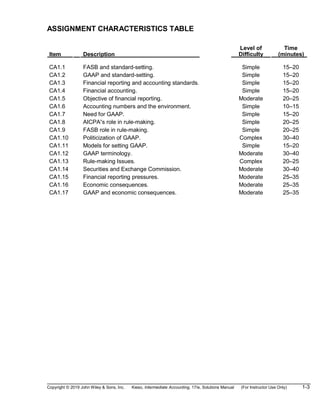
ASSIGNMENT CHARACTERISTICS TABLE
Item Description
Level of
Difficulty
Time
(minutes)
CA1.1 FASB and standard-setting. Simple 15–20
CA1.2 GAAP and standard-setting. Simple 15–20
CA1.3 Financial reporting and accounting standards. Simple 15–20
CA1.4 Financial accounting. Simple 15–20
CA1.5 Objective of financial reporting. Moderate 20–25
CA1.6 Accounting numbers and the environment. Simple 10–15
CA1.7 Need for GAAP. Simple 15–20
CA1.8 AICPA’s role in rule-making. Simple 20–25
CA1.9 FASB role in rule-making. Simple 20–25
CA1.10 Politicization of GAAP. Complex 30–40
CA1.11 Models for setting GAAP. Simple 15–20
CA1.12 GAAP terminology. Moderate 30–40
CA1.13 Rule-making Issues. Complex 20–25
CA1.14 Securities and Exchange Commission. Moderate 30–40
CA1.15 Financial reporting pressures. Moderate 25–35
CA1.16 Economic consequences. Moderate 25–35
CA1.17 GAAP and economic consequences. Moderate 25–35
Copyright © 2019 John Wiley & Sons, Inc. Kieso, Intermediate Accounting, 17/e, Solutions Manual (For Instructor Use Only) 1-3
1-4 Copyright © 2019 John Wiley & Sons, Inc. Kieso, Intermediate Accounting, 17/e, Solutions Manual (For Instructor Use Only)
(For Instructor Use Only) 1-4
Copyright © 2019 John Wiley & Sons, Inc. Kieso, Intermediate Accounting, 17/e, Solutions Manual
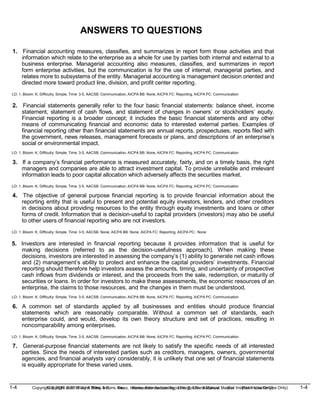
ANSWERS TO QUESTIONS
1. Financial accounting measures, classifies, and summarizes in report form those activities and that
information which relate to the enterprise as a whole for use by parties both internal and external to a
business enterprise. Managerial accounting also measures, classifies, and summarizes in report
form enterprise activities, but the communication is for the use of internal, managerial parties, and
relates more to subsystems of the entity. Managerial accounting is management decision oriented and
directed more toward product line, division, and profit center reporting.
LO: 1, Bloom: K, Difficulty: Simple, Time: 3-5, AACSB: Communication, AICPA BB: None, AICPA FC: Reporting, AICPA PC: Communication
2. Financial statements generally refer to the four basic financial statements: balance sheet, income
statement, statement of cash flows, and statement of changes in owners’ or stockholders’ equity.
Financial reporting is a broader concept; it includes the basic financial statements and any other
means of communicating financial and economic data to interested external parties. Examples of
financial reporting other than financial statements are annual reports, prospectuses, reports filed with
the government, news releases, management forecasts or plans, and descriptions of an enterprise’s
social or environmental impact.
LO: 1, Bloom: K, Difficulty: Simple, Time: 3-5, AACSB: Communication, AICPA BB: None, AICPA FC: Reporting, AICPA PC: Communication
3. If a company’s financial performance is measured accurately, fairly, and on a timely basis, the right
managers and companies are able to attract investment capital. To provide unreliable and irrelevant
information leads to poor capital allocation which adversely affects the securities market.
LO: 1, Bloom: K, Difficulty: Simple, Time: 3-5, AACSB: Communication, AICPA BB: None, AICPA FC: Reporting, AICPA PC: Communication
4. The objective of general purpose financial reporting is to provide financial information about the
reporting entity that is useful to present and potential equity investors, lenders, and other creditors
in decisions about providing resources to the entity through equity investments and loans or other
forms of credit. Information that is decision-useful to capital providers (investors) may also be useful
to other users of financial reporting who are not investors.
LO: 1, Bloom: K, Difficulty: Simple, Time: 3-5, AACSB: None, AICPA BB: None, AICPA FC: Reporting, AICPA PC:: None
5. Investors are interested in financial reporting because it provides information that is useful for
making decisions (referred to as the decision-usefulness approach). When making these
decisions, investors are interested in assessing the company’s (1) ability to generate net cash inflows
and (2) management’s ability to protect and enhance the capital providers’ investments. Financial
reporting should therefore help investors assess the amounts, timing, and uncertainty of prospective
cash inflows from dividends or interest, and the proceeds from the sale, redemption, or maturity of
securities or loans. In order for investors to make these assessments, the economic resources of an
enterprise, the claims to those resources, and the changes in them must be understood.
LO: 1, Bloom: K, Difficulty: Simple, Time: 3-5, AACSB: Communication, AICPA BB: None, AICPA FC: Reporting, AICPA PC: Communication
6. A common set of standards applied by all businesses and entities should produce financial
statements which are reasonably comparable. Without a common set of standards, each
enterprise could, and would, develop its own theory structure and set of practices, resulting in
noncomparability among enterprises.
LO: 1, Bloom: K, Difficulty: Simple, Time: 3-5, AACSB: Communication, AICPA BB: None, AICPA FC: Reporting, AICPA PC: Communication
7. General-purpose financial statements are not likely to satisfy the specific needs of all interested
parties. Since the needs of interested parties such as creditors, managers, owners, governmental
agencies, and financial analysts vary considerably, it is unlikely that one set of financial statements
is equally appropriate for these varied uses.
1-5 Copyright © 2019 John Wiley & Sons, Inc. Kieso, Intermediate Accounting, 17/e, Solutions Manual (For Instructor Use Only)
(For Instructor Use Only) 1-5
Copyright © 2019 John Wiley & Sons, Inc. Kieso, Intermediate Accounting, 17/e, Solutions Manual
LO: 1, Bloom: K, Difficulty: Simple, Time: 3-5, AACSB: Communication, AICPA BB: None, AICPA FC: Reporting, AICPA PC: Communication
Questions Chapter 1 (Continued)
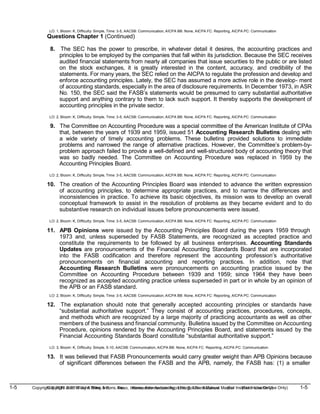
8. The SEC has the power to prescribe, in whatever detail it desires, the accounting practices and
principles to be employed by the companies that fall within its jurisdiction. Because the SEC receives
audited financial statements from nearly all companies that issue securities to the public or are listed
on the stock exchanges, it is greatly interested in the content, accuracy, and credibility of the
statements. For many years, the SEC relied on the AICPA to regulate the profession and develop and
enforce accounting principles. Lately, the SEC has assumed a more active role in the develop- ment
of accounting standards, especially in the area of disclosure requirements. In December 1973, in ASR
No. 150, the SEC said the FASB’s statements would be presumed to carry substantial authoritative
support and anything contrary to them to lack such support. It thereby supports the development of
accounting principles in the private sector.
LO: 2, Bloom: K, Difficulty: Simple, Time: 3-5, AACSB: Communication, AICPA BB: None, AICPA FC: Reporting, AICPA PC: Communication
9. The Committee on Accounting Procedure was a special committee of the American Institute of CPAs
that, between the years of 1939 and 1959, issued 51 Accounting Research Bulletins dealing with
a wide variety of timely accounting problems. These bulletins provided solutions to immediate
problems and narrowed the range of alternative practices. However, the Committee’s problem-by-
problem approach failed to provide a well-defined and well-structured body of accounting theory that
was so badly needed. The Committee on Accounting Procedure was replaced in 1959 by the
Accounting Principles Board.
LO: 2, Bloom: K, Difficulty: Simple, Time: 3-5, AACSB: Communication, AICPA BB: None, AICPA FC: Reporting, AICPA PC: Communication
10. The creation of the Accounting Principles Board was intended to advance the written expression
of accounting principles, to determine appropriate practices, and to narrow the differences and
inconsistencies in practice. To achieve its basic objectives, its mission was to develop an overall
conceptual framework to assist in the resolution of problems as they became evident and to do
substantive research on individual issues before pronouncements were issued.
LO: 2, Bloom: K, Difficulty: Simple, Time: 3-5, AACSB: Communication, AICPA BB: None, AICPA FC: Reporting, AICPA PC: Communication
11. APB Opinions were issued by the Accounting Principles Board during the years 1959 through
1973 and, unless superseded by FASB Statements, are recognized as accepted practice and
constitute the requirements to be followed by all business enterprises. Accounting Standards
Updates are pronouncements of the Financial Accounting Standards Board that are incorporated
into the FASB codification and therefore represent the accounting profession’s authoritative
pronouncements on financial accounting and reporting practices. In addition, note that
Accounting Research Bulletins were pronouncements on accounting practice issued by the
Committee on Accounting Procedure between 1939 and 1959; since 1964 they have been
recognized as accepted accounting practice unless superseded in part or in whole by an opinion of
the APB or an FASB standard.
LO: 2, Bloom: K, Difficulty: Simple, Time: 3-5, AACSB: Communication, AICPA BB: None, AICPA FC: Reporting, AICPA PC: Communication
12. The explanation should note that generally accepted accounting principles or standards have
“substantial authoritative support.” They consist of accounting practices, procedures, concepts,
and methods which are recognized by a large majority of practicing accountants as well as other
members of the business and financial community. Bulletins issued by the Committee on Accounting
Procedure, opinions rendered by the Accounting Principles Board, and statements issued by the
Financial Accounting Standards Board constitute “substantial authoritative support.”
LO: 3, Bloom: K, Difficulty: Simple, 5-10, AACSB: Communication, AICPA BB: None, AICPA FC: Reporting, AICPA PC: Communication
13. It was believed that FASB Pronouncements would carry greater weight than APB Opinions because
of significant differences between the FASB and the APB, namely, the FASB has: (1) a smaller
1-6 Copyright © 2019 John Wiley & Sons, Inc. Kieso, Intermediate Accounting, 17/e, Solutions Manual (For Instructor Use Only)
(For Instructor Use Only) 1-6
Copyright © 2019 John Wiley & Sons, Inc. Kieso, Intermediate Accounting, 17/e, Solutions Manual
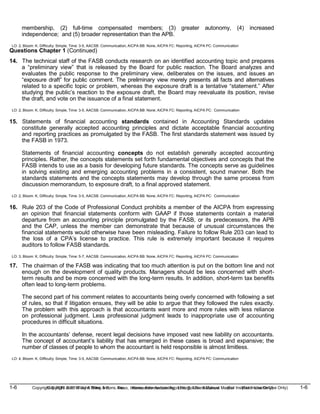
membership, (2) full-time compensated members; (3) greater autonomy, (4) increased
independence; and (5) broader representation than the APB.
LO: 2, Bloom: K, Difficulty: Simple, Time: 3-5, AACSB: Communication, AICPA BB: None, AICPA FC: Reporting, AICPA PC: Communication
Questions Chapter 1 (Continued)
14. The technical staff of the FASB conducts research on an identified accounting topic and prepares
a “preliminary view” that is released by the Board for public reaction. The Board analyzes and
evaluates the public response to the preliminary view, deliberates on the issues, and issues an
“exposure draft” for public comment. The preliminary view merely presents all facts and alternatives
related to a specific topic or problem, whereas the exposure draft is a tentative “statement.” After
studying the public’s reaction to the exposure draft, the Board may reevaluate its position, revise
the draft, and vote on the issuance of a final statement.
LO: 2, Bloom: K, Difficulty: Simple, Time: 3-5, AACSB: Communication, AICPA BB: None, AICPA FC: Reporting, AICPA PC: Communication
15. Statements of financial accounting standards contained in Accounting Standards updates
constitute generally accepted accounting principles and dictate acceptable financial accounting
and reporting practices as promulgated by the FASB. The first standards statement was issued by
the FASB in 1973.
Statements of financial accounting concepts do not establish generally accepted accounting
principles. Rather, the concepts statements set forth fundamental objectives and concepts that the
FASB intends to use as a basis for developing future standards. The concepts serve as guidelines
in solving existing and emerging accounting problems in a consistent, sound manner. Both the
standards statements and the concepts statements may develop through the same process from
discussion memorandum, to exposure draft, to a final approved statement.
LO: 2, Bloom: K, Difficulty: Simple, Time: 3-5, AACSB: Communication, AICPA BB: None, AICPA FC: Reporting, AICPA PC: Communication
16. Rule 203 of the Code of Professional Conduct prohibits a member of the AICPA from expressing
an opinion that financial statements conform with GAAP if those statements contain a material
departure from an accounting principle promulgated by the FASB, or its predecessors, the APB
and the CAP, unless the member can demonstrate that because of unusual circumstances the
financial statements would otherwise have been misleading. Failure to follow Rule 203 can lead to
the loss of a CPA’s license to practice. This rule is extremely important because it requires
auditors to follow FASB standards.
LO: 3, Bloom: K, Difficulty: Simple, Time: 5-7, AACSB: Communication, AICPA BB: None, AICPA FC: Reporting, AICPA PC: Communication
17. The chairman of the FASB was indicating that too much attention is put on the bottom line and not
enough on the development of quality products. Managers should be less concerned with short-
term results and be more concerned with the long-term results. In addition, short-term tax benefits
often lead to long-term problems.
The second part of his comment relates to accountants being overly concerned with following a set
of rules, so that if litigation ensues, they will be able to argue that they followed the rules exactly.
The problem with this approach is that accountants want more and more rules with less reliance
on professional judgment. Less professional judgment leads to inappropriate use of accounting
procedures in difficult situations.
In the accountants’ defense, recent legal decisions have imposed vast new liability on accountants.
The concept of accountant’s liability that has emerged in these cases is broad and expansive; the
number of classes of people to whom the accountant is held responsible is almost limitless.
LO: 4, Bloom: K, Difficulty: Simple, Time: 3-5, AACSB: Communication, AICPA BB: None, AICPA FC: Reporting, AICPA PC: Communication
1-7 Copyright © 2019 John Wiley & Sons, Inc. Kieso, Intermediate Accounting, 17/e, Solutions Manual (For Instructor Use Only)
(For Instructor Use Only) 1-7
Copyright © 2019 John Wiley & Sons, Inc. Kieso, Intermediate Accounting, 17/e, Solutions Manual
Questions Chapter 1 (Continued)
18. The Emerging Issues Task Force often arrives at consensus conclusions on certain financial report-
ing issues. These consensus conclusions are then looked upon as GAAP by practitioners because
the SEC has indicated that it will view consensus solutions as preferred accounting and will require
persuasive justification for departing from them. Thus, at least for public companies which are sub-
ject to SEC oversight, consensus solutions developed by the Emerging Issues Task Force are followed
unless subsequently overturned by the FASB. It should be noted that the FASB took greater
direct ownership of GAAP established by the EITF by requiring that consensus positions be ratified by
the FASB.
LO: 3, Bloom: K, Difficulty: Simple, Time: 5-7, AACSB: Communication, AICPA BB: None, AICPA FC: Reporting, AICPA PC: Communication
19. The Financial Accounting Standards Board Accounting Standards Codification (Codification) is a
compilation of all GAAP in one place. Its purpose is to integrate and synthesize existing GAAP and
not to create new GAAP. It creates one level of GAAP which is considered authoritative. The FASB
Codification Research Systems (CRS) is an online real-time data base which provides easy access
to the Codification. The Codification and the related CRS provide a topically organized structure which
is subdivided into topic, subtopics, sections, and paragraphs.
LO: 3, Bloom: K, Difficulty: Moderate, Time: 5-7, AACSB: Communication, AICPA BB: None, AICPA FC: Reporting, AICPA PC: Communication
20. It is hoped that the Codification will help users to better understand what GAAP is. If this occurs,
companies will be more likely to comply with GAAP and the time to research accounting issues will
be substantially reduced. In addition, through the electronic web-based format, GAAP can be easily
updated which will help users stay current.
LO: 3, Bloom: K, Difficulty: Simple, Time: 3-5, AACSB: Communication, AICPA BB: None, AICPA FC: Reporting, AICPA PC: Communication
21. The sources of pressure are innumerable, but the most intense and continuous pressure to
change or influence accounting principles or standards come from individual companies, industry
associations, governmental agencies, practicing accountants, academicians, professional accoun-
ting organizations, and public opinion.
LO: 3, Bloom: K, Difficulty: Simple, 5-10, AACSB: Communication, AICPA BB: None, AICPA FC: Reporting, AICPA PC: Communication
22. Economic consequences means the impact of accounting reports on the wealth positions of issuers
and users of financial information and the decision-making behavior resulting from that impact. In
other words, accounting information impacts various users in many different ways which leads to
wealth transfers among these various groups.
If politics plays an important role in the development of accounting rules, the rules will be subject
to manipulation for the purpose of furthering whatever policy prevails at the moment. No matter
how well intentioned the rule maker may be, if information is designed to indicate that investing in
a particular enterprise involves less risk than it actually does, or is designed to encourage invest-
ment in a particular segment of the economy, financial reporting will suffer an irreplaceable loss of
credibility.
LO: 4, Bloom: K, Difficulty: Simple, Time: 3-5, AACSB: Communication, AICPA BB: None, AICPA FC: Reporting, AICPA PC: Communication
23. No one particular proposal is expected in answer to this question. The students’ proposals, however,
should be defensible relative to the following criteria:
(1) The method must be efficient, responsive, and expeditious.
(2) The method must be free of bias and be above or insulated from pressure groups.
(3) The method must command widespread support if it does not have legislative authority.
(4) The method must produce sound yet practical accounting principles or standards.
The students’ proposals might take the form of alterations of the existing methodology, an accoun-
ting court (as proposed by Leonard Spacek), or governmental device.
1-8 Copyright © 2019 John Wiley & Sons, Inc. Kieso, Intermediate Accounting, 17/e, Solutions Manual (For Instructor Use Only)
(For Instructor Use Only) 1-8
Copyright © 2019 John Wiley & Sons, Inc. Kieso, Intermediate Accounting, 17/e, Solutions Manual
LO: 4, Bloom: C, Difficulty: Simple, Time: 3-5, AACSB: Communication, AICPA BB: None, AICPA FC: Reporting, AICPA PC: Communication
Questions Chapter 1 (Continued)
24. Concern exists about fraudulent financial reporting because it can undermine the entire financial
reporting process. Failure to provide information to users that is accurate can lead to inappropriate
allocations of resources in our economy. In addition, failure to detect massive fraud can lead to
additional governmental oversight of the accounting profession.
LO: 4, Bloom: K, Difficulty: Simple, Time: 3-5, AACSB: Communication, AICPA BB: None, AICPA FC: Reporting, AICPA PC: Communication
25. The expectations gap is the difference between what people think accountants should be doing and
what accountants think they can do. It is a difficult gap to close. The accounting profession recognizes
it must play an important role in narrowing this gap. To meet the needs of society, the profession is
continuing its efforts in developing accounting standards, such as numerous pronouncements issued
by the FASB, to serve as guidelines for recording and processing business transactions in the changing
economic environment.
LO: 4, Bloom: K, Difficulty: Simple, Time: 3-5, AACSB: Communication, AICPA BB: None, AICPA FC: Reporting, AICPA PC: Communication
26. The following are some of the key provisions of the Sarbanes-Oxley Act:
• Establishes an oversight board for accounting practices. The Public Company Accounting Over-
sight Board (PCAOB) has oversight and enforcement authority and establishes auditing, quality
control, and independence standards and rules.
• Implements stronger independence rules for auditors. Audit partners, for example, are required
to rotate every five years and auditors are prohibited from offering certain types of consulting
services to corporate clients.
• Requires CEOs and CFOs to personally certify that financial statements and disclosures are
accurate and complete and requires CEOs and CFOs to forfeit bonuses and profits when there
is an accounting restatement.
• Requires audit committees to be comprised of independent members and members with finan-
cial expertise.
• Requires codes of ethics for senior financial officers.
In addition, Section 404 of the Sarbanes-Oxley Act requires public companies to attest to the
effectiveness of their internal controls over financial reporting.
LO: 4, Bloom: K, Difficulty: Simple, Time: 3-5, AACSB: Communication, AICPA BB: None, AICPA FC: Reporting, AICPA PC: Communication
27. Some major challenges facing the accounting profession relate to the following items:
Nonfinancial measurement—how to report significant key performance measurements such as
customer satisfaction indexes, backlog information and reject rates on goods purchased.
Forward-looking information—how to report more future oriented information.
Soft assets—how to report on intangible assets, such as market know-how, market dominance,
and well-trained employees.
Timeliness—how to report more real-time information.
LO: 4, Bloom: K, Difficulty: Simple, Time: 3-5, AACSB: Communication, AICPA BB: None, AICPA FC: Reporting, AICPA PC: Communication
28. Accountants must perceive the moral dimensions of some situations because GAAP does not
define or cover all specific features that are to be reported in financial statements. In these instances
accountants must choose among alternatives. These accounting choices influence whether par-
ticular stakeholders may be harmed or benefited. Moral decision-making involves awareness of
potential harm or benefit and taking responsibility for the choices.
LO: 4, Bloom: K, Difficulty: Simple, Time: 3-5, AACSB: Ethics, Communication, AICPA BB: Professional Demeanor, AICPA FC: Reporting, AICPA PC:
Communication
1-9 Copyright © 2019 John Wiley & Sons, Inc. Kieso, Intermediate Accounting, 17/e, Solutions Manual (For Instructor Use Only)
(For Instructor Use Only) 1-9
Copyright © 2019 John Wiley & Sons, Inc. Kieso, Intermediate Accounting, 17/e, Solutions Manual
TIME AND PURPOSE OF CONCEPTS FOR ANALYSIS
CA 1.1 (Time 15–20 minutes)
Purpose—to provide the student with an opportunity to answer questions about FASB and standard
setting.
CA 1.2 (Time 15–20 minutes)
Purpose—to provide the student with an opportunity to answer questions about GAAP and standard
setting.
CA 1.3 (Time 15–20 minutes)
Purpose—to provide the student with an opportunity to answer questions about financial reporting and
accounting standards topics.
CA 1.4 (Time 15–20 minutes)
Purpose—to provide the student with an opportunity to distinguish between financial accounting and
managerial accounting, identify major financial statements, and differentiate financial statements and
financial reporting.
CA 1.5 (Time 20–25 minutes)
Purpose—to provide the student with an opportunity to explain the basic objective of financial reporting.
CA 1.6 (Time 10–15 minutes)
Purpose—to provide the student with an opportunity to describe how reported accounting numbers
might affect an individual’s perceptions and actions.
CA 1.7 (Time 15–20 minutes)
Purpose—to provide the student with an opportunity to evaluate the viewpoint of removing mandatory
accounting rules and allowing each company to voluntarily disclose the information it desired.
CA 1.8 (Time 20–25 minutes)
Purpose—to provide the student with an opportunity to explain the evolution of accounting rule-making
organizations and the role of the AICPA in the rule making environment.
CA 1.9 (Time 20–25 minutes)
Purpose—to provide the student with an opportunity to identify the sponsoring organization of the
FASB, the method by which the FASB arrives at a decision, and the types and the purposes of docu-
ments issued by the FASB.
CA 1.10 (Time 30–40 minutes)
Purpose—to provide the student with an opportunity to focus on the types of organizations involved in the
rule making process, what impact accounting has on the environment, and the environment’s influence
on accounting.
CA 1.11 (Time 15–20 minutes)
Purpose—to provide the student with an opportunity to focus on what type of rule-making environment
exists in the United States. In addition, this CA explores why user groups are interested in the nature of
GAAP and why some groups wish to issue their own rules.
CA 1.12 (Time 30–40 minutes)
Purpose—to provide the student with an opportunity to identify and define acronyms appearing in the first
chapter. Some are self-evident, others are not so.
1-10 Copyright © 2019 John Wiley & Sons, Inc. Kieso, Intermediate Accounting, 17/e, Solutions Manual (For Instructor Use Only)
(For Instructor Use Only) 1-10
Copyright © 2019 John Wiley & Sons, Inc. Kieso, Intermediate Accounting, 17/e, Solutions Manual
Time and Purpose of Concepts for Analysis (Continued)
CA 1.13 (Time 20–25 minutes)
Purpose—to provide the student with an opportunity to consider the ethical dimensions of implementation
of a new accounting pronouncement.
CA 1.14 (Time 30–40 minutes)
Purpose—to provide the student with an assignment that explores the role and function of the
Securities and Exchange Commission.
CA 1.15 (Time 25–35 minutes)
Purpose—to provide the student with a writing assignment concerning the ethical issues related to
meeting earnings targets.
CA 1.16 (Time 25–35 minutes)
Purpose—to provide the student with the opportunity to discuss the role of Congress in accounting rule-
making.
CA 1.17 (Time 25–35 minutes)
Purpose—to provide the student with an opportunity to comment on a letter sent by business execu-
tives to the FASB and Congress on the accounting for derivatives.
1-11 Copyright © 2019 John Wiley & Sons, Inc. Kieso, Intermediate Accounting, 17/e, Solutions Manual (For Instructor Use Only)
(For Instructor Use Only) 1-11
Copyright © 2019 John Wiley & Sons, Inc. Kieso, Intermediate Accounting, 17/e, Solutions Manual
SOLUTIONS TO CONCEPTS FOR ANALYSIS
CA 1.1
1. True
2. False. Any company claiming compliance with GAAP must comply with all standards and
interpretations, including disclosure requirements.
3. True
4. False. In establishing financial accounting standards, the FASB relies on two basic premises:
(1) the FASB should be responsive to the needs and viewpoints of the entire economic
community, not just the public accounting profession, and (2) it should operate in full view of the
public through a “due process” system that gives interested people ample opportunities to make their
view known.
LO: 2, Bloom: K, Difficulty: Simple, Time: 15-20, AACSB: AICPA BB: None, AICPA BB: None, AICPA FC: Reporting, AICPA PC: None
CA 1.2
1. False. In addition to providing decision-useful information about future cash flows, management
also is accountable to investors for the custody and safekeeping of the company’s economic
resources and for their efficient and profitable use; however, this is not considered an objective.
2. False. The objective of financial reporting is to provide financial information about the reporting
entity that is useful to present and potential equity investors, lenders, and other creditors in making
decisions in their capacity as capital providers.
3. False. The FASB follows the same due process procedures for interpretations and standards.
4. True
LO: 1, 2, Bloom: K, Difficulty: Simple, Time: 15-20, AACSB: AICPA BB: None, AICPA BB: None, AICPA FC: Reporting, AICPA PC: None
CA 1.3
1. (d)
2. (d)
3. (d)
4. (a)
5. (a)
6. (b)
7. (d)
8. (b)
LO: 1, 2, 4, Bloom: K, Difficulty: Simple, Time: 15-20, AACSB: AICPA BB: None, AICPA BB: None, AICPA FC: Reporting, AICPA PC: None
CA 1.4
(a) Financial accounting is the process that culminates in the preparation of financial reports relative to
the enterprise as a whole for use by parties both internal and external to the enterprise. In contrast,
managerial accounting is the process of identification, measurement, accumulation, analysis, prepa-
ration, interpretation, and communication of financial information used by the management to plan,
evaluate, and control within an organization and to assure appropriate use of, and accountability for,
its resources.
1-12 Copyright © 2019 John Wiley & Sons, Inc. Kieso, Intermediate Accounting, 17/e, Solutions Manual (For Instructor Use Only)
(For Instructor Use Only) 1-12
Copyright © 2019 John Wiley & Sons, Inc. Kieso, Intermediate Accounting, 17/e, Solutions Manual
CA 1.4 (Continued)
(b) The financial statements most frequently provided are the balance sheet, the income statement,
the statement of cash flows, and the statement of changes in owners’ or stockholders’ equity.
(c) Financial statements are the principal means through which financial information is communicated to
those outside an enterprise. As indicated in (b), there are four major financial statements. However,
some financial information is better provided, or can be provided only, by means of financial
reporting other than formal financial statements. Financial reporting (other than financial statements
and related notes) may take various forms. Examples include the company president’s letter or
supplementary schedules in the corporate annual reports, prospectuses, reports filed with govern-
ment agencies, news releases, management’s forecasts, and descriptions of an enterprise’s social
or environmental impact.
LO: 1, Bloom: K, Difficulty: Simple, Time: 15-20, AACSB: Communication, AICPA BB: None, AICPA FC: Reporting, AICPA PC: Communication
CA 1.5
(a) In accordance with Statement of Financial Accounting Concepts No. 1, “Objectives of Financial
Reporting by Business Enterprises,” the objectives of financial reporting are to provide information to
investors, creditors, and others
1. that is useful to present and potential investors and creditors and other users in making rational
investment, credit, and similar decisions. The information should be comprehensible to those
who have a reasonable understanding of business and economic activities and are willing to
study the information with reasonable diligence,
2. to help present and potential investors and creditors and other users in assessing the amounts,
timing, and uncertainty of prospective cash receipts from dividends or interest and the proceeds
from the sale, redemption, or maturity of securities or loans. Since investors’ and creditors’ cash
flows are related to enterprise cash flows, financial reporting should provide information to help
investors, creditors, and others assess the amounts, timing, and uncertainty of prospective net
cash inflows to the related enterprise, and
3. about the economic resources of an enterprise, the claims to those resources (obligations of the
enterprise to transfer resources to other entities and owners’ equity), and the effects of trans-
actions, events, and circumstances that change its resources and claims to those resources.
(b) Statement of Financial Accounting Concepts No. 1 establishes standards to meet the information
needs of large groups of external users such as investors, creditors, and their representatives.
Although the level of sophistication related to business and financial accounting matters varies both
within and between these user groups, users are expected to possess a reasonable understanding
of accounting concepts, financial statements, and business and economic activities and are expected
to be willing to study and interpret the information with reasonable diligence.
LO: 1, Bloom: K, Difficulty: Moderate, Time: 20-25, AACSB: Communication, AICPA BB: None, AICPA FC: Reporting, AICPA PC: Communication
1-13 Copyright © 2019 John Wiley & Sons, Inc. Kieso, Intermediate Accounting, 17/e, Solutions Manual (For Instructor Use Only)
(For Instructor Use Only) 1-13
Copyright © 2019 John Wiley & Sons, Inc. Kieso, Intermediate Accounting, 17/e, Solutions Manual
CA 1.6
Accounting numbers affect investing decisions. Investors, for example, use the financial statements of
different companies to enhance their understanding of each company’s financial strength and operating
results. Because these statements follow generally accepted accounting principles, investors can make
meaningful comparisons of different financial statements to assist their investment decisions.
Accounting numbers also influence creditors’ decisions. A commercial bank usually looks into a
company’s financial statements and past credit history before deciding whether to grant a loan and in
what amount. The financial statements provide a fair picture of the company’s financial strength (for
example, short-term liquidity and long-term solvency) and operating performance for the current period
and over a period of time. The information is essential for the bank to ensure that the loan is safe and
sound.
LO: 1, 4, Bloom: C, Difficulty: Simple, Time: 10-15, AACSB: Communication, AICPA BB: None, AICPA FC: Reporting, AICPA PC: Communication
CA 1.7
It is not appropriate to abandon mandatory accounting rules and allow each company to voluntarily disclose
the type of information it considers important. Without a coherent body of accounting theory and standards,
each accountant or enterprise would have to develop its own theory structure and set of practices, and
readers of financial statements would have to familiarize themselves with every company’s peculiar
accounting and reporting practices. As a result, it would be almost impossible to prepare state- ments that
could be compared.
In addition, voluntary disclosure may not be an efficient way of disseminating information. A company is
likely to disclose less information if it has the discretion to do so. Thus, the company can reduce its cost
of assembling and disseminating information. However, an investor wishing additional information has
to pay to receive additional information desired. Different investors may be interested in different types
of information. Since the company may not be equipped to provide the requested information, it would
have to spend additional resources to fulfill such needs; or the company may refuse to furnish such
information if it is too costly to do so. As a result, investors may not get the desired information or they
may have to pay a significant amount of money for it. Furthermore, redundancy in gathering and
distributing information occurs when different investors ask for the same information at different points
in time. To the society as a whole, this would not be an efficient way of utilizing resources.
LO: 1, 3, Bloom: AN, Difficulty: Simple, Time: 15-20, AACSB: Reflective Thinking, Communication, AICPA BB: None, AICPA FC: Reporting, AICPA PC:
Communication
CA 1.8
(a) One of the committees that the AICPA established prior to the establishment of the FASB was the
Committee on Accounting Procedures (CAP). The CAP, during its existence from 1939 to 1959,
issued 51 Accounting Research Bulletins (ARB). In 1959, the AICPA created the Accounting Prin-
ciples Board (APB) to replace the CAP. Before being replaced by the FASB, the APB released
31 official pronouncements, called APB Opinions.
(b) Although the ARBs issued by the CAP helped to narrow the range of alternative practices to some
extent, the CAP’s problem-by-problem approach failed to provide the well-defined, structured body
of accounting principles that was both needed and desired. As a result, the CAP was replaced by
the APB.
1-14 Copyright © 2019 John Wiley & Sons, Inc. Kieso, Intermediate Accounting, 17/e, Solutions Manual (For Instructor Use Only)
(For Instructor Use Only) 1-14
Copyright © 2019 John Wiley & Sons, Inc. Kieso, Intermediate Accounting, 17/e, Solutions Manual
CA 1.8 (Continued)
The APB had more authority and responsibility than did the CAP. Unfortunately, the APB was
beleaguered throughout its 14-year existence. It came under fire early, charged with lack of produc-
tivity and failing to act promptly to correct alleged accounting abuses. The APB also met a lot of
industry and CPA firm opposition and occasional governmental interference when tackling numerous
complicated accounting issues. In fear of governmental rule making, the accounting profession
investigated the ineffectiveness of the APB and replaced it with the FASB.
Learning from prior experiences, the FASB has several significant differences from the APB. The
FASB has: (1) smaller membership, (2) full-time, compensated membership, (3) greater autonomy,
(4) increased independence, and (5) broader representation. In addition, the FASB has its own
research staff and relies on the expertise of various task force groups formed for various projects.
These features form the bases for the expectations of success and support from the public. In addition,
the due process taken by the FASB in establishing financial accounting standards gives interested
persons ample opportunity to make their views known. Thus, the FASB is responsive to the needs
and viewpoints of the entire economic community, not just the public accounting profession.
(c) The AICPA supplements the FASB’s efforts in the present standard-setting environment. Their
issue papers, which are prepared by the Financial Reporting Executive Committee (FinREC) formerly
the Accounting Standards Executive Committee (AcSEC), identify current financial reporting
problems for specific industries and present alternative treatments of the issue. These papers provide
the FASB with an early warning device to insure timely issuance of FASB standards. In situations
where the FASB avoids the subject of an issue paper, FinREC may issue a Statement of Position to
provide guidance for the reporting issue. FinREC also issues Practice Bulletins which indicate how
the AICPA believes a given transaction should be reported.
Recently, the role of the AICPA in standard-setting has diminished. The FASB and the AICPA
agreed, that after a transition period, the AICPA and FinREC no longer issues authoritative
accounting guidance for public companies.
LO: 2, Bloom: K, Difficulty: Simple, Time: 20-25, AACSB: Communication, AICPA BB: None, AICPA FC: Reporting, AICPA PC: Communication
CA 1.9
(a) The Financial Accounting Foundation (FAF) is the sponsoring organization of the FASB. The FAF
selects the members of the FASB and its Advisory Council, funds their activities, and generally
oversees the FASB’s activities.
The FASB follows a due process in establishing a typical FASB Statement of Financial Accounting
Standards. The following steps are usually taken: (1) A topic or project is identified and placed on
the Board’s agenda. (2) A task force of experts from various sectors is assembled to define
problems, issues, and alternatives related to the topic. (3) Research and analysis are conducted by
the FASB technical staff. (4) A preliminary views document is drafted and released. (5) A public
hearing is often held, usually 60 days after the release of the preliminary views. (6) The Board analyzes
and evaluates the public response. (7) The Board deliberates on the issues and prepares an exposure
draft for release. (8) After a 30-day (minimum) exposure period for public comment, the Board
evaluates all of the responses received. (9) A committee studies the exposure draft in relation to the
public responses, reevaluates its position, and revises the draft if necessary. (10) The full Board gives
the revised draft final consideration and votes on issuance of a Standards Statement. The passage of
a new accounting standard in the form of an FASB Statement requires the support of four of the
seven Board members, before it is incorporated in the codification.
(b) The FASB issues two major types of pronouncements: Accounting Standards Updates (ASUs) and
Concepts Statements. ASUs issued by the FASB are considered GAAP.
1-15 Copyright © 2019 John Wiley & Sons, Inc. Kieso, Intermediate Accounting, 17/e, Solutions Manual (For Instructor Use Only)
(For Instructor Use Only) 1-15
Copyright © 2019 John Wiley & Sons, Inc. Kieso, Intermediate Accounting, 17/e, Solutions Manual
CA 1.9 (Continued)
ASU’s may be comprised of major standards projects, EITF consensus, or interpretations.
Regardless of nature, if approved by the FASB in an ASU, then the guidance is considered GAAP.
The Statements of Financial Accounting Concepts (SFAC) help the FASB to avoid the “problem-
by-problem approach.” These statements set forth fundamental objectives and concepts that the
Board will use in developing future standards of financial accounting and reporting. They
are intended to form a cohesive set of interrelated concepts, a body of theory or a conceptual
framework, that will serve as tools for solving existing and emerging problems in a consistent,
sound manner.
In addition, the FASB’s Emerging Issues Task Force (EITF) issues statements to provide guidance
on how to account for new and unusual financial transactions that have the potential for creating
diversity in reporting practices. The EITF identifies controversial accounting problems as they arise
and determines whether they can be quickly resolved or whether the FASB should become involved
in solving them. In essence, it becomes a “problem filter” for the FASB. Thus, the FASB is able to
work on more pervasive long-term problems, while the EITF deals with short-term emerging issues.
LO: 2, Bloom: K, Difficulty: Simple, Time: 20-25, AACSB: Communication, AICPA BB: None, AICPA FC: Reporting, AICPA PC: Communication
CA 1.10
(a) CAP. The Committee on Accounting Procedure, CAP, which was in existence from 1939 to 1959,
was an outgrowth of AICPA committees which were in existence during the period 1933 to 1938.
The committee was formed in direct response to the criticism received by the accounting profession
during the financial crisis of 1929 and the years thereafter. The authorization to issue pronouncements
on matters of accounting principles and procedures was based on the belief that the AICPA had the
responsibility to establish practices that would become generally accepted by the profession and by
corporate management.
As a general rule, the CAP directed its attention, almost entirely, to resolving specific accounting
problems and topics rather than to the development of generally accepted accounting principles.
The committee voted on the acceptance of specific Accounting Research Bulletins published by
the committee. A two-thirds majority was required to issue a particular research bulletin. The CAP
did not have the authority to require acceptance of the issued bulletins by the general membership
of the AICPA, but rather received its authority only upon general acceptance of the pronouncement
by the members. That is, the bulletins set forth normative accounting procedures that “should be”
followed by the accounting profession, but were not “required” to be followed.
In 1964, well after the demise of the CAP, the Council of the AICPA adopted recommendations that
departures from effective CAP Bulletins should be disclosed in financial statements or in audit
reports of members of the AICPA. The demise of the CAP could probably be traced to four distinct
factors: (1) the narrow nature of the subjects covered by the bulletins issued by the CAP, (2) the lack
of any theoretical groundwork in establishing the procedures presented in the bulletins, (3) the lack
of any real authority by the CAP in prescribing adherence to the procedures described by the bulletins,
and (4) the lack of any formal representation on the CAP of interest groups such as corporate
managers, governmental agencies, and security analysts.
1-16 Copyright © 2019 John Wiley & Sons, Inc. Kieso, Intermediate Accounting, 17/e, Solutions Manual (For Instructor Use Only)
(For Instructor Use Only) 1-16
Copyright © 2019 John Wiley & Sons, Inc. Kieso, Intermediate Accounting, 17/e, Solutions Manual
CA 1.10 (Continued)
APB. The objectives of the APB were formulated mainly to correct the deficiencies of the CAP as
described above. The APB was thus charged with the responsibility of developing written expression
of generally accepted accounting principles through consideration of the research done by other
members of the AICPA in preparing Accounting Research Studies. The committee was in turn
given substantial authoritative standing in that all opinions of the APB were to constitute substantial
authoritative support for generally accepted accounting principles. If an individual member of the
AICPA decided that a principle or procedure outside of the official pronouncements of the APB had
substantial authoritative support, the member had to disclose the departure from the official APB
opinion in the financial statements of the firm in question.
The membership of the committee comprising the APB was also extended to include representation
from industry, government, and academe. The opinions were also designed to include minority
dissents by members of the board. Exposure drafts of the proposed opinions were readily distributed.
The demise of the APB occurred primarily because the purposes for which it was created were not
being accomplished. Broad generally accepted accounting principles were not being developed. The
research studies supposedly being undertaken in support of subsequent opinions to be
expressed by the APB were often ignored. The committee in essence became a simple extension
of the original CAP in that only very specific problem areas were being addressed. Interest groups
outside of the accounting profession questioned the appropriateness and desirability of having the
AICPA directly responsible for the establishment of GAAP. Politicization of the establishment of
GAAP had become a reality because of the far-reaching effects involved in the questions being
resolved.
FASB. The formal organization of the FASB represents an attempt to vest the responsibility of
establishing GAAP in an organization representing the diverse interest groups affected by the use of
GAAP. The FASB is independent of the AICPA. It is independent, in fact, of any private or govern-
mental organization. Individual CPAs, firms of CPAs, accounting educators, and representatives of
private industry will now have an opportunity to make known their views to the FASB through their
membership on the Board. Independence is facilitated through the funding of the organization and
payment of the members of the Board. Full-time members are paid by the organization and the
organization itself is funded solely through contributions. Thus, no one interest group has a vested
interest in the FASB.
Conclusion. The evolution of the current FASB certainly does represent “increasing politicization
of accounting standards setting.” Many of the efforts extended by the AICPA can be directly attributed
to the desire to satisfy the interests of many groups within our society. The FASB represents,
perhaps, just another step in this evolutionary process.
(b) Arguments for politicization of the accounting rule-making process:
1. Accounting depends in large part on public confidence for its success. Consequently, the
critical issues are not solely technical, so all those having a bona fide interest in the output of
accounting should have some influence on that output.
2. There are numerous conflicts between the various interest groups. In the face of this, compro-
mise is necessary, particularly since the critical issues in accounting are value judgments, not
the type which are solvable, as we have traditionally assumed, using deterministic models.
Only in this way (reasonable compromise) will the financial community have confidence in the
fairness and objectivity of accounting rule-making.
3. Over the years, accountants have been unable to establish, on the basis of technical accoun-
ting elements, rules which would bring about the desired uniformity and acceptability. This
inability itself indicates rule-setting is primarily consensual in nature.
1-17 Copyright © 2019 John Wiley & Sons, Inc. Kieso, Intermediate Accounting, 17/e, Solutions Manual (For Instructor Use Only)
(For Instructor Use Only) 1-17
Copyright © 2019 John Wiley & Sons, Inc. Kieso, Intermediate Accounting, 17/e, Solutions Manual
CA 1.10 (Continued)
4. The public accounting profession, through bodies such as the Accounting Principles Board, made
rules which business enterprises and individuals “had” to follow. For many years, these
businesses and individuals had little say as to what the rules would be, in spite of the fact that
their economic well-being was influenced to a substantial degree by those rules. It is only
natural that they would try to influence or control the factors that determine their economic
well-being.
(c) Arguments against the politicization of the accounting rule-making process:
1. Many accountants feel that accounting is primarily technical in nature. Consequently, they feel
that substantive, basic research by objective, independent and fair-minded researchers ultimately
will result in the best solutions to critical issues, such as the concepts of income and capital,
even if it is accepted that there is not necessarily a single “right” solution.
2. Even if it is accepted that there are no “absolute truths” as far as critical issues are concerned,
many feel that professional accountants, taking into account the diverse interests of the various
groups using accounting information, are in the best position, because of their independence,
education, training, and objectivity, to decide what generally accepted accounting principles
ought to be.
3. The complex situations that arise in the business world require that trained accountants develop
the appropriate accounting principles.
4. The use of consensus to develop accounting principles would decrease the professional status
of the accountant.
5. This approach would lead to “lobbying” by various parties to influence the establishment of ac-
counting principles.
LO: 2, 4, Bloom: E, Difficulty: Complex, Time: 30-40, AACSB: Analytic, Communication, Ethics, AICPA BB: Professional Demeanor, AICPA FC: Reporting,
AICPA PC: Communication
CA 1.11
(a) The public/private mixed approach is the way rules are established in the United States. In many
respects, the FASB is a quasi-governmental agency in that its pronouncements are required to be
followed because the SEC has provided support for this approach. The SEC has the ultimate power
to establish GAAP but has chosen to permit the private sector to develop these rules. By accepting
the standards established by the FASB as authoritative, it has granted much power to the FASB.
(b) Publicly reported accounting numbers influence the distribution of scarce resources. Resources are
channeled where needed at returns commensurate with perceived risk. Thus, reported accounting
numbers have economic effects in that resources are transferred among entities and individuals as
a consequence of these numbers. It is not surprising then that individuals affected by these
numbers will be extremely interested in any proposed changes in the financial reporting
environment.
(c) The Accounting Standards Executive Committee (AcSEC of the AICPA), among other groups, has
presented a potential challenge to the exclusive right of the FASB to establish accounting principles.
Also, Congress has been attempting to legislate certain accounting practices, particularly to help
struggling industries.
Some possible reasons why other groups might wish to establish GAAP are:
1. As indicated in the previous answer, these rules have economic effects and therefore certain
groups would prefer to make their own rules to ensure that they receive just treatment.
2. Some believe the FASB does not act quickly to resolve accounting matters, either because it
is not that interested in the subject area or because it lacks the resources to do so.
1-18 Copyright © 2019 John Wiley & Sons, Inc. Kieso, Intermediate Accounting, 17/e, Solutions Manual (For Instructor Use Only)
(For Instructor Use Only) 1-18
Copyright © 2019 John Wiley & Sons, Inc. Kieso, Intermediate Accounting, 17/e, Solutions Manual
CA 1.11 (Continued)
3. Some argue that the FASB does not have the competence to legislate GAAP in certain areas.
For example, many have argued that the FASB should not legislate GAAP for not-for-profit
enterprises because the problems are unique and not well understood by the FASB.
LO: 2, 4, Bloom: C, Difficulty: Simple, Time: 15-20, AACSB: Communication, AICPA BB: None, AICPA FC: Reporting, AICPA PC: Communication
CA 1.12
(a) AICPA. American Institute of Certified Public Accountants. The national organization of practicing
certified public accountants.
(b) CAP. Committee on Accounting Procedure. A committee of practicing CPAs which issued
51 Accounting Research Bulletins between 1939 and 1959 and is a predecessor of the FASB.
(c) EITF. Emerging Issues Task Force. A sub-division of the FASB, which provides implementation
guidance to reduce diversity in practice in a timely basis. To become GAAP, EITF consensues
must be approved by the FASB.
(d) APB. Accounting Principles Board. A committee of public accountants, industry accountants and
academicians which issued 31 Opinions between 1959 and 1973. The APB replaced the CAP
and was itself replaced by the FASB. Its opinions, unless superseded, remain a primary source
of GAAP.
(e) FAF. Financial Accounting Foundation. An organization whose purpose is to select members of
the FASB and its Advisory Councils, fund their activities, and exercise general oversight.
(f) FASAC. Financial Accounting Standards Advisory Council. An organization whose purpose is to
consult with the FASB on issues, project priorities, and select task forces.
(g) GAAP. Generally Aaccepted Accounting Principles. A common set of standards, principles, and
procedures which have substantial authoritative support and have been accepted as appropriate
because of universal application.
(h) CPA. Certified Public Accountant. An accountant who has fulfilled certain education and experience
requirements and passed a rigorous examination. Most CPAs offer auditing, tax, and management
consulting services to the general public.
(i) FASB. Financial Accounting Standards Board. The primary body which currently establishes and
improves financial accounting and reporting standards for the guidance of issuers, auditors, users,
and others.
(j) SEC. Securities and Exchange Commission. An independent regulatory agency of the United
States government which administers the Securities Acts of 1933 and 1934 and other acts.
(k) IASB. International Accounting Standards Board. An international group, formed in 2001 (a
predecessor body was formed in 1973), that is actively developing and issuing accounting standards
that will have international appeal and hopefully support.
LO: 2, 3, Bloom: K, Difficulty: Moderate, Time: 30-40, AACSB: Communication, AICPA BB: None, AICPA FC: Reporting, AICPA PC: Communication
1-19 Copyright © 2019 John Wiley & Sons, Inc. Kieso, Intermediate Accounting, 17/e, Solutions Manual (For Instructor Use Only)
(For Instructor Use Only) 1-19
Copyright © 2019 John Wiley & Sons, Inc. Kieso, Intermediate Accounting, 17/e, Solutions Manual
CA 1.13
(a) Inclusion or omission of information that materially affects net income harms particular stakeholders.
Accountants must recognize that their decision to implement (or delay) reporting requirements will
have immediate consequences for some stakeholders.
(b) Yes. Because the FASB rule results in a fairer representation, it should be implemented as soon as
possible—regardless of its impact on net income. SEC Staff Bulletin No. 74 (December 30, 1987)
requires a statement as to what the expected impact of the standard will be.
(c) The accountant’s responsibility is to provide financial statements that present fairly the financial
condition of the company. By advocating early implementation, Weller fulfills this task.
(d) Potential lenders and investors, who read the financial statements and rely on their fair represen-
tation of the financial condition of the company, have the most to gain by early implementation. A
stockholder who is considering the sale of stock may be harmed by early implementation that lowers
net income (and may lower the value of the stock).
LO: 2, 4, Bloom: K, Difficulty: Complex, Time: 20-25, AACSB: Communication, AICPA BB: None, AICPA FC: Reporting, AICPA PC: Communication
CA 1.14
(a) The Securities and Exchange Commission (SEC) is an independent federal agency that receives
its authority from federal legislation enacted by Congress. The Securities and Exchange Act of
1934 created the SEC.
(b) As a result of the Securities and Exchange Act of 1934, the SEC has legal authority relative to
accounting practices. The U.S. Congress has given the SEC broad regulatory power to control
accounting principles and procedures in order to fulfill its goal of full and fair disclosure.
(c) There is no direct relationship as the SEC was created by Congress and the Financial Accounting
Standards Board (FASB) was created by the private sector. However, the SEC historically has
followed a policy of relying on the private sector to establish financial accounting and reporting stan-
dards known as generally accepted accounting principles (GAAP). The SEC does not necessarily
agree with all of the pronouncements of the FASB. In cases of unresolved differences, the SEC rules
take precedence over FASB rules for companies within SEC jurisdiction.
LO: 2, Bloom: K, Difficulty: Moderate, Time: 30-40, AACSB: Communication, AICPA BB: AICPA BB: None, AICPA FC: Reporting, AICPA PC: Communication
CA 1.15
(a) The ethical issue in this case relates to making questionable entries to meet expected earnings
forecasts. As indicated in this chapter, businesses’ concentration on “maximizing the bottom line,”
“facing the challenges of competition,” and “stressing short-term results” places accountants in an
environment of conflict and pressure.
(b) Given that Normand has pleaded guilty, he certainly acted improperly. Doing the right thing, making
the right decision, is not always easy. Right is not always obvious, and the pressures to “bend the
rules,” “to play the game,” “to just ignore it” can be considerable.
(c) No doubt, Normand was in a difficult position. He was concerned that if he failed to go along, it would
affect his job performance negatively or that he might be terminated. These job pressures, time
pressures, peer pressures often lead individuals astray. Can it happen to you? One individual noted
that at a seminar on ethics sponsored by the CMA Society of Southern California, attendees were
asked if they had ever been pressured to make questionable entries. This individual noted
1-20 Copyright © 2019 John Wiley & Sons, Inc. Kieso, Intermediate Accounting, 17/e, Solutions Manual (For Instructor Use Only)
(For Instructor Use Only) 1-20
Copyright © 2019 John Wiley & Sons, Inc. Kieso, Intermediate Accounting, 17/e, Solutions Manual
that to the best of his recollection, everybody raised a hand, and more than one had eventually
chosen to resign.
CA 1.15 (Continued)
(d) Major stakeholders were: (1) Troy Normand, (2) present and potential stockholders and creditors
of WorldCom, (3) employees, and (4) family. Recognize that WorldCom was at that time the
largest bankruptcy in United States history, so many individuals were affected.
LO: 4, Bloom: AN, Difficulty: Moderate, Time: 25-30, AACSB:Ethics, Analytic, Communication, AICPA BB: None, AICPA FC: Reporting, AICPA PC:
Communication
CA 1.16
(a) Considering the economic consequences of GAAP, it is not surprising that special interest groups
become vocal and critical (some supporting, some opposing) when rules are being formulated. The
FASB’s derivative accounting pronouncement is no exception. Many from the banking industry, for
example, criticized the rule as too complex and leading to unnecessary earnings volatility. They also
indicated that the proposal may discourage prudent risk management activities and in some cases
could present misleading financial information.
As a result, Congress is often approached to put pressure on the FASB to change its rulings. In the
stock option controversy, industry was quite effective in going to Congress to force the FASB to
change its conclusions. In the derivative controversy, Rep. Richard Baker introduced a bill which would
force the SEC to formally approve each standard issued by the FASB. Not only would this process
delay adoption, but could lead to additional politicalization of the rule-making process. Dingell
commented that Congress should stay out of the rule-making process and defended the FASB’s
approach to establishing GAAP.
(b) Attempting to set GAAP by a political process will probably lead to the following consequences:
(a) Too many alternatives.
(b) Lack of clarity that will lead to inconsistent application.
(c) Lack of disclosure that reduces transparency.
(d) Not comprehensive in scope.
Without an independent process, GAAP will be based on political compromise. A classic illustration is
what happened in the savings and loan industry. Applying generally accepted accounting principles
to the S&L industry would have forced regulators to restrict activities of many S&Ls. Unfortunately,
accounting principles were overridden by regulatory rules and the resulting lack of transparency
masked the problems. William Siedman, former FDIC Chairman noted later that it was “the worst
mistake in the history of government.”
Another indication of the problem of government intervention is shown in the accounting standards
used by some countries around the world. Completeness and transparency of information needed
by investors and creditors is not available in order to meet or achieve other objectives.
LO: 4, Bloom: C, Difficulty: Moderate, Time: 25-30, AACSB: Communication, AICPA BB: None, AICPA FC: Reporting, AICPA PC: Communication
1-21 Copyright © 2019 John Wiley & Sons, Inc. Kieso, Intermediate Accounting, 17/e, Solutions Manual (For Instructor Use Only)
(For Instructor Use Only) 1-21
Copyright © 2019 John Wiley & Sons, Inc. Kieso, Intermediate Accounting, 17/e, Solutions Manual
CA 1.17
(a) The “due process” system involves the following:
1. Identifying topics and placing them on the Board’s agenda.
2. Research and analysis is conducted and preliminary views of pros and cons issued.
3. A public hearing is often held.
4. Board evaluates research and public responses and issues exposure draft.
5. Board evaluates responses and changes exposure draft, if necessary. Final statement is then
issued.
(b) Economic consequences mean the impact of accounting reports on the wealth positions of
issuers and users of financial information and the decision-making behavior resulting from that
impact.
(c) Economic consequences indicated in the letter are: (1) concerns related to the potential impact
on the capital markets, (2) the weakening of companies’ ability to manage risk, and (3) the adverse
control implications of implementing costly and complex new rules imposed at the same time as
other major initiatives, including the Year 2000 issues and a single European currency.
(d) The principal point of this letter is to delay the finalization of the derivatives standard. As indicated in
the letter, the authors of this letter urge the FASB to expose its new proposal for public comment,
following the established due process procedures that are essential to acceptance of its standards
and providing sufficient time for affected parties to understand and assess the new approach.
(Authors note: The FASB indicated in a follow-up letter that all due process procedures had been
followed and all affected parties had more than ample time to comment. In addition, the FASB issued
a follow-up standard, which delayed the effective date of the standard, in part to give companies
more time to develop the information systems needed for implementation of the standard).
(e) The reason why the letter was sent to Congress was to put additional pressure on the FASB to delay
or drop the issuance of a rule on derivatives. Unfortunately, in too many cases, when the business
community does not like the answer proposed by the FASB, it resorts to lobbying members of
Congress. The lobbying efforts usually involve developing some type of legislation that will negate
the rule. In some cases, efforts involve challenging the FASB’s authority to develop rules in certain
areas with additional Congressional oversight.
LO: 4, Bloom: E, Difficulty: Moderate, Time: 25-30, AACSB: Communication, AICPA BB: None, AICPA FC: Reporting, AICPA PC: Communication
1-22 Copyright © 2019 John Wiley & Sons, Inc. Kieso, Intermediate Accounting, 17/e, Solutions Manual (For Instructor Use Only)
(For Instructor Use Only) 1-22
Copyright © 2019 John Wiley & Sons, Inc. Kieso, Intermediate Accounting, 17/e, Solutions Manual
FINANCIAL REPORTING PROBLEM
(a) The key organizations involved in rule making in the U.S. are the AICPA,
FASB, and SEC. See also (c).
(b) Different authoritative literature pertaining to methods recording account-
ing transactions exists today. Some authoritative literature has received
more support from the profession than other literature. The literature
that has substantial authoritative support is the one most supported
by the profession and should be followed when recording accounting
transactions. These standards and procedures are called generally
accepted accounting principles (GAAP).
With implementation of the Codification, what qualifies as authoritative is
any literature contained in the Codification. The Codification changes
the way GAAP is documented, presented, and updated. It creates one
level of GAAP which is considered authoritative. All other accounting
literature is considered non-authoritative.
What happens if the Codification does not cover a certain type of trans-
action or event? In this case, other accounting literature should be
considered which includes FASB Concepts Statements, international
financial reporting standards and other professional literature.
(c) Rule-making in the U.S. has evolved through the work of the following
organizations:
1. American Institute of Certified Public Accountants (AICPA)—it is
the national professional organization of practicing Certified Public
Accountants (CPAs). Outgrowths of the AICPA have been the Com-
mittee on Accounting Procedure (CAP) which issued Accounting
Research Bulletins and the Accounting Principles Board (APB) whose
major purposes were to advance written expression of accounting
principles, determine appropriate practices, and narrow the areas
of difference and inconsistency in practice.
2. Financial Accounting Standards Board (FASB)—the mission of the
FASB is to establish and improve standards of financial accounting
and reporting for the guidance and education of the public, which
includes issuers, auditors, and users of the financial information.
1-23 Copyright © 2019 John Wiley & Sons, Inc. Kieso, Intermediate Accounting, 17/e, Solutions Manual (For Instructor Use Only)
(For Instructor Use Only) 1-23
Copyright © 2019 John Wiley & Sons, Inc. Kieso, Intermediate Accounting, 17/e, Solutions Manual
FINANCIAL REPORTING PROBLEM (Continued)
3. Securities and Exchange Commission (SEC)—the SEC is an inde-
pendent regulatory agency of the United States government which
administers the Securities Act of 1933, the Securities Exchange Act
of 1934, the Sarbanes-Oxley Act, and several other acts. The SEC
has broad power to prescribe the accounting practices and
standards to be employed by companies that fall within its
jurisdiction.
(d) The SEC and the AICPA have been the authority for compliance with
GAAP. The SEC has indicated that financial statements conforming to
standards set by the FASB will be presumed to have authoritative support.
The AICPA, in Rule 203 of the Code of Professional Ethics, requires that
members prepare financial statements in accordance with GAAP. Failure
to follow Rule 203 can lead to the loss of a CPA’s license to practice.
LO: 2, 3, Bloom: K, Difficulty: Simple, Time: 20-25, AACSB: Communication, AICPA BB: None, AICPA FC: Reporting, AICPA PC: Communication
1-24 Copyright © 2019 John Wiley & Sons, Inc. Kieso, Intermediate Accounting, 17/e, Solutions Manual (For Instructor Use Only)
(For Instructor Use Only) 1-24
Copyright © 2019 John Wiley & Sons, Inc. Kieso, Intermediate Accounting, 17/e, Solutions Manual
SOLUTIONS TO CODIFICATION EXERCISES
CE1.1
The information at this link describes the elements offered in The FASB Accounting Standards
Codification. As indicated, the website offers several resources to enhance your working knowledge of
the Codification and the Codification Research System. This page includes links to help pages which
describe specific functions and features of the Codification. Links to frequently asked questions, the FASB
Learning Guide, and the Notice to Constituents are also available on this page.
Help pages
FAQ
Learning Guide
About the Codification—Notice of Constituents
LO: 3, Bloom: K, Difficulty: Simple, Time: 5-10, AACSB: Communication, Technology, AICPA BB: Technology, AICPA FC: Research, Reporting, Technology,
AICPA PC: Communication
CE1.2
The following information is provided at the Providing Feedback link:
The Codification includes a feature which can be used to submit content-related feedback or general,
system-related comments. The feedback system is not designed for comments on proposed
Accounting Standards Updates.
Content-related feedback
As a registered user of the FASB Accounting Standards Codification Research System website, you
are able and are encouraged to provide feedback, at the paragraph level, to the FASB about any content-
related matters. For specific information about the Codification and the feedback process, please
read the Notice to Constituents.
To provide content-related feedback:
Click the Submit feedback button beneath the paragraph for which you want to provide feedback. Enter
or copy/paste your comments in the text box. Note that formatting (lists, bold, etc.) is not retained and
there is a 4,000 character limit on feedback submissions.
Click SUBMIT. Your comments are sent to the FASB and reviewed by FASB staff. You can also
submit multiple comments for any given paragraph, if, for example, you determine that more
information would be useful to the FASB staff.
General feedback
Click here to provide general feedback on the Codification in general, the Codification Research
System website, and other system-related items that are not content specific.
LO: 3, Bloom: K, Difficulty: Simple, Time: 10-15, AACSB: Communication, Technology, AICPA BB: Technology, AICPA FC: Research, Reporting, Technology,
AICPA PC: Communication
1-25 Copyright © 2019 John Wiley & Sons, Inc. Kieso, Intermediate Accounting, 17/e, Solutions Manual (For Instructor Use Only)
(For Instructor Use Only) 1-25
Copyright © 2019 John Wiley & Sons, Inc. Kieso, Intermediate Accounting, 17/e, Solutions Manual
CE1.3
The “What’s New” page provides links to Codification content that has been recently issued. During the
verification phase, updates may result from either the issuance of Codification update instructions that
accompany new Standards or from changes to the Codification due to incorporation of constituent
feedback.
LO: 3, Bloom: K, Difficulty: Simple, Time: 5-10, AACSB: Communication, Technology, AICPA BB: Technology, AICPA FC: Research, Reporting, Technology,
AICPA PC: Communication
1-26 Copyright © 2019 John Wiley & Sons, Inc. Kieso, Intermediate Accounting, 17/e, Solutions Manual (For Instructor Use Only)
(For Instructor Use Only) 1-26
Copyright © 2019 John Wiley & Sons, Inc. Kieso, Intermediate Accounting, 17/e, Solutions Manual
RESEARCH CASE
(a) CON 1, Par. 32. The objectives begin with a broad focus on information
that is useful in investment and credit decisions; then narrow that focus
to investors’ and creditors’ primary interest in the prospects of receiving
cash from their investments in or loans to business enterprises and the
relation of those prospects to the enterprise’s prospects; and finally
focus on information about an enterprise’s economic resources, the
claims to those resources, and changes in them, including measures of
the enterprise’s performance, that is useful in assessing the enterprise’s
cash flow prospects.
(b) CON 1, Par. 7. Financial reporting includes not only financial statements
but also other means of communicating information that relates,
directly or indirectly, to the information provided by the accounting
system—that is, information about an enterprise’s resources, obligations,
earnings, etc. Management may communicate information to those
outside an enterprise by means of financial reporting other than formal
financial statements either because the information is required to be
disclosed by authoritative pronouncement, regulatory rule, or custom or
because management considers it useful to those outside the enterprise
and discloses it voluntarily. Information communicated by means of
financial reporting other than financial statements may take various forms
and relate to various matters. Corporate annual reports, prospectuses,
and annual reports filed with the Securities and Exchange Commission
are common examples of reports that include financial statements,
other financial information, and nonfinancial information. News releases,
management’s forecasts or other descriptions of its plans or expecta-
tions, and descriptions of an enterprise’s social or environmental impact
are examples of reports giving financial information other than financial
statements or giving only nonfinancial information.
(c) CON 1, Par, 24 and 25: 24. Many people base economic decisions on
their relationships to and knowledge about business enterprises and thus
are potentially interested in the information provided by financial
reporting. Among the potential users are owners, lenders, suppliers,
potential investors and creditors, employees, management, directors,
customers, financial analysts and advisors, brokers, underwriters, stock
exchanges, lawyers, economists, taxing authorities, regulatory authorities,
1-27 Copyright © 2019 John Wiley & Sons, Inc. Kieso, Intermediate Accounting, 17/e, Solutions Manual (For Instructor Use Only)
(For Instructor Use Only) 1-27
Copyright © 2019 John Wiley & Sons, Inc. Kieso, Intermediate Accounting, 17/e, Solutions Manual
RESEARCH CASE (Continued)
legislators, financial press and reporting agencies, labor unions, trade
associations, business researchers, teachers and students, and the
public. Members and potential members of some groups—such as
owners, creditors, and employees—have or contemplate having direct
economic interests in particular business enterprises. Managers and
directors, who are charged with managing the enterprise in the interest
of owners (paragraph 12), also have a direct interest. Members of other
groups—such as financial analysts and advisors, regulatory authorities,
and labor unions—have derived or indirect interests because they advise
or represent those who have or contemplate having direct interests.
Potential users of financial information most directly concerned with a
particular business enterprise are generally interested in its ability to
generate favorable cash flows because their decisions relate to amounts,
timing, and uncertainties of expected cash flows. To investors, lenders,
suppliers, and employees, a business enterprise is a source of cash in
the form of dividends or interest and perhaps appreciated market prices,
repayment of borrowing, payment for goods or services, or salaries or
wages. They invest cash, goods, or services in an enterprise and expect
to obtain sufficient cash in return to make the investment worthwhile.
They are directly concerned with the ability of the enterprise to generate
favorable cash flows and may also be concerned with how the market’s
perception of that ability affects the relative prices of its securities. To
customers, a business enterprise is a source of goods or services, but
only by obtaining sufficient cash to pay for the resources it uses and to
meet its other obligations can the enterprise provide those goods or
services. To managers, the cash flows of a business enterprise are a
significant part of their management responsibilities, including their
accountability to directors and owners. Many, if not most, of their
decisions have cash flow consequences for the enterprise. Thus, investors,
creditors, employees, customers, and managers significantly share a
common interest in an enterprise’s ability to generate favorable cash
flows. Other potential users of financial information share the same
interest, derived from investors, creditors, employees, customers, or
managers whom they advise or represent or derived from an interest in
how those groups (and especially stockholders) are faring.
LO: 1, Bloom: AN, Difficulty: Simple, Time: 25-30, AACSB: Analytic, Communication, AICPA BB: Technology, AICPA FC: Research, Reporting, Technology,
AICPA PC: Communication
1-28 Copyright © 2019 John Wiley & Sons, Inc. Kieso, Intermediate Accounting, 17/e, Solutions Manual (For Instructor Use Only)
(For Instructor Use Only) 1-28
Copyright © 2019 John Wiley & Sons, Inc. Kieso, Intermediate Accounting, 17/e, Solutions Manual
IFRS CONCEPTS AND APPLICATION
IFRS 1.1
The two organizations involved in international standard-setting are IOSCO
(International Organization of Securities Commissions) and the IASB
(International Accounting Standards Board.) The IOSCO does not set
accounting standards, but ensures that the global markets can operate in
an efficient and effective manner. Conversely, the IASB’s mission is to
develop a single set of high quality, understandable and international finan-
cial reporting standards (IFRSs) for general purpose financial statements.
LO: 5, Bloom: K, Difficulty: Simple, Time: 3-5, AACSB: Diversity, Communication, AICPA BB: None, AICPA FC: Reporting, AICPA PC: Communication
IFRS 1.2
The standards issued by these organizations are sometimes principles-
based, rules-based, tax-oriented, or business-based. In other words, they
often differ in concept and objective.
LO: 5, Bloom: K, Difficulty: Simple, Time: 3-5, AACSB: Diversity, Communication, AICPA BB: None, AICPA FC: Reporting, AICPA PC: Communication
IFRS 1.3
A single set of high quality accounting standards ensures adequate
comparability. Investors are able to make better investment decisions if
they receive financial information from a U.S. company that is comparable
to an international competitor.
LO: 5, Bloom: K, Difficulty: Simple, Time: 3-5, AACSB: Diversity, Communication, AICPA BB: None, AICPA FC: Reporting, AICPA PC: Communication
IFRS 1.4
The international standards must be of high quality and sufficiently
comprehensive. To achieve this goal, the IASB and the FASB have set up
an extensive work plan to achieve the objective of developing one set of
world-class international standards. This work plan actually started in 2002,
when an agreement was forged between the two Boards, where each
acknowledged their commitment to the development of high-quality,
compatible accounting standards that could be used for both domestic and
cross-border financial reporting (referred to as the Norwalk Agreement).
1-29 Copyright © 2019 John Wiley & Sons, Inc. Kieso, Intermediate Accounting, 17/e, Solutions Manual (For Instructor Use Only)
(For Instructor Use Only) 1-29
Copyright © 2019 John Wiley & Sons, Inc. Kieso, Intermediate Accounting, 17/e, Solutions Manual
IFRS 1.4 (Continued)
At that meeting, the FASB and the IASB pledged to use their best efforts to
(1) make their existing financial reporting standards fully compatible as soon
as is practicable, and (2) coordinate their future work programs to ensure
that once achieved, compatibility is maintained. This document was
reinforced in 2006 when the parties issued a memorandum of understanding
(MOU) which highlighted three principles:
• Convergence of accounting standards can best be achieved
through the development of high-quality common standards over
time.
• Trying to eliminate differences between two standards that are in
need of significant improvement is not the best use of the FASB’s
and the IASB’s resources—instead, a new common standard should
be developed that improves the financial information reported to
investors.
• Serving the needs of investors means that the Boards should seek
convergence by replacing standards in need of improvement with
jointly developed new standards.
Subsequently, in 2009 the Boards agreed on a process to complete a number
of major projects by 2011, including monthly joint meetings. As part of
achieving this goal, it is critical that the process by which the standards
are established be independent. And, it is necessary that the standards are
maintained, and emerging accounting issues are dealt with efficiently.
The SEC directed its staff to develop and execute a plan (“Work Plan”) to
enhance both the understanding of the SEC’s purpose and public
transparency in this area. The SEC Work Plan addresses such areas as
independence of standard-setting, investor understanding of IFRS, and
auditor readiness. Based on the staff report issued in 2012, it does not appear
that the SEC is ready to adopt IFRS any time soon. However, the SEC has
encouraged the FASB and IASB to continue their convergence efforts.
In 2016, the SEC indicated that it will not switch to IFRS in the near future.
As the SEC Chief Accountant noted: “I believe that for the foreseeable future,
the independent standard setting process of the FASB and U.S. GAAP
standards will be in the best interests of U.S. capital markets.”
LO: 5, Bloom: K, Difficulty: Simple, 20-25, AACSB: Diversity, Communication, AICPA BB: None, AICPA FC: Reporting, AICPA PC: Communication
1-30 Copyright © 2019 John Wiley & Sons, Inc. Kieso, Intermediate Accounting, 17/e, Solutions Manual (For Instructor Use Only)
(For Instructor Use Only) 1-30
Copyright © 2019 John Wiley & Sons, Inc. Kieso, Intermediate Accounting, 17/e, Solutions Manual
IFRS 1.5
(a) The International Accounting Standards Board is an independent, pri-
vately funded accounting standards setter based in London, UK. The
Board is committed to developing, in the public interest, a single set of
high quality, understandable and enforceable global accounting standards
that require transparent and comparable information in general purpose
financial statements. In addition, the Board cooperates with national
accounting standards setters to achieve convergence in accounting
standards around the world.
(b) In summary, the following groups might gain most from convergence
of financial reporting:
• Investors, investment analysts and stockbrokers: to facilitate interna-
tional comparisons for investment decisions.
• Credit grantors: for similar reasons to bullet point above.
• Multinational companies: as preparers, investors, appraisers of pro-
ducts or staff, and as movers of staff around the globe; also, as raisers
of finance on international markets (this also applies to some
companies that are not multinationals).
• Governments: as tax collectors and hosts of multinationals; also
interested are securities markets regulators and governmental and
nongovernmental rule makers.
(c) The fundamental argument against convergence is that, to the extent
that international differences in accounting practices result from under-
lying economic, legal, social, and other environmental factors, harmoni-
zation may not be justified. Different accounting has grown up to serve the
different needs of different users; this might suggest that the existing ac-
counting practice is “correct” for a given nation and should not be changed
merely to simplify the work of multinational companies or auditors.
There does seem to be strength in this point particularly for smaller com-
panies with no significant multinational activities or connections. To foist
upon a small private family company in Luxembourg lavish disclosure
requirements and the need to report a “true and fair” view may be an
expensive and unnecessary piece of convergence.
Other documents randomly have
different content
their feet the fertile plains of France presented themselves,—above,
ranges of magnificent heights towered in majestic grandeur to the
skies, and stretched into distance beyond the range of sight.
241
Although no military movements were made, this inactive
interval of a vigorous campaign was usefully employed by the allied
commander, in organizing anew the regiments that had suffered
most, concentrating the divisions, replacing exhausted stores, and
perfecting the whole matériel of the army. Those of the British near
the coast, compared with the corps that were blockading Pamplona,
lived comfortably in their mountain bivouacs; indeed, the task of
covering a blockade is the most disagreeable that falls to the
soldier’s lot. Exposed to cold and rain, continually on the alert, and
yet engaged in a duty devoid of enterprise and interest, nothing
could be more wearying to the troops employed; and desertions,
which during active service were infrequent, now became numerous,
and especially among the Spaniards and Irish.
The siege of San Sebastian was renewed. Guns, formerly
employed, were re-landed,—the trenches occupied again,—and a
large supply of heavy ordnance and mortars, received opportunely
from England, were placed in battery. Lord Wellington was reinforced
by a company of sappers and miners—and the navy, under Sir
George Collier, assisted him with both men and guns.
242
The
batteries were consequently enlarged—and a furious sortie by the
garrison on the night of the 24th producing little effect, on the 26th
a crushing fire opened from fifty-seven pieces of siege artillery.
On the same night the island of Santa Clara, situated at the
entrance of the harbour, and partially enfilading the defences of the
castle, was surprised and stormed by a mixed party of sailors and
soldiers, and its garrison made prisoners. On the 27th, a second
sortie on the whole front of the isthmus failed entirely, and the
assailants were instantly driven back. The siege and working
artillery
243
had been now augmented to eighty pieces—and on the
30th the breaches were so extensively battered down, that Lord
Wellington issued orders that they should be assaulted, and the next
morning was named for the attempt.
244
In the annals of modern warfare, perhaps there is no conflict
recorded which was so sanguinary and so desperate as the storming
of that well-defended breach. During the blockade, every resource of
military ingenuity was tried by the French governor—and the failure
of the first assault, with the subsequent raising of the siege,
emboldened the garrison, and rendered them the more confident of
holding out until Soult could advance and succour them. The time
from which the battering guns had been withdrawn, until they had
been again placed in battery, was assiduously employed in
constructing new defences and strengthening the old ones. But
though the place when reinvested was more formidable than before,
the besiegers appeared only the more determined to reduce it.
245
Morning broke gloomily—an intense mist obscured every object,
and the work of slaughter was for a time delayed. At nine the sea-
breeze cleared away the fog; the sun shone gloriously out—and in
two hours the forlorn hope issued from the trenches. The columns
succeeded,
246
—and every gun from the fortress that could bear,
opened on them with shot and shells. The appearance of the breach
was perfectly delusive; nothing living could reach the summit—no
courage, however desperate, could overcome the difficulties, for
they were alike unexpected and insurmountable. In vain the officers
rushed forward, and devotedly were they followed by their men.
From intrenched houses behind the breach, the traverses, and the
ramparts of the curtain, a withering discharge of musketry was
poured on the assailants, while the Mirador and Prince batteries
swept the approaches with their guns. To survive this concentrated
fire was impossible; the forlorn hope were cut off to a man, and the
heads of the columns annihilated. At last the debouches were
choked with the dead and wounded, and a further passage to the
breach rendered impracticable from the heap of corpses that were
piled upon each other.
247
Then, in that desperate moment, when hope might have been
supposed to be over, an expedient unparalleled in the records of war
was resorted to. The British batteries opened on the curtain—and
the storming parties heard with surprise the roar of cannon in the
rear, while, but a few feet above their heads, their iron shower
hissed horribly, and swept away the enemy and their defences.
This was the moment for a fresh effort. Another brigade was
moved forward—and favoured by an accidental explosion upon the
curtain, which confused the enemy while it encouraged the
assailants, the terre-plain was mounted, and the French driven from
the works. A long and obstinate resistance was continued in the
streets, which were in many places barricaded—but by five in the
evening opposition had ceased, and the town was in the possession
of the British. Seven hundred of the garrison were prisoners—and
the remainder were either disabled in the assault or shut up in the
castle.
The unfortunate town seemed alike devoted by friends and
enemies to destruction. The conquerors were roaming through the
streets—the castle firing on the houses beneath its guns—in many
places fires had broken out—and a storm of thunder, rain, and
lightning, added to the confusion of a scene which even in warfare
finds no parallel.
248
The assault of San Sebastian cost a large expense of life, there
being seven hundred and sixty-one killed, one thousand six hundred
and ninety-seven wounded, and forty-five missing, and in that
number many valuable officers were included. The head of the
engineer department, Sir Richard Fletcher, was killed—and Generals
Leith,
249
Oswald, and Robinson were returned in the list of wounded.
The Spanish corps of Friere formed a part of the covering army,
and occupied the heights of San Marcial. Their front and left flank
were covered by the Bidassao, and their right appuied upon the
Sierra de Haya. On these heights Longa’s guerillas were posted, and
the first division in rear of Irun. The reserve was behind the left.
The French shewed themselves at Yera on the 30th, and in
consequence, Generals Inglis and Ross were moved, the former to
the bridge of Lezeca, and the latter to a position on the Haya
mountain, while a Portuguese brigade secured it from being turned
on the right.
Two of the enemy’s divisions forded the river on the morning of
the 31st, and, in the front of the Spanish left wing, mounted the
heights with determined gallantry. On this occasion the Spaniards
behaved with courage worthy of their once chivalric name. Coolly
waiting until the French divisions had topped the heights, they
rushed forward with the bayonet, and bore them down the hill. So
completely were they broken by this sudden and unexpected charge,
that driven into the river by the impetuosity of their assailants, many
missed the fords and perished.
Undismayed by the repulse, a pontoon bridge was thrown across
the Bidassao—and passing fourteen thousand men, the French
advanced again with renewed confidence against the Spanish lines.
Wellington, in person, was present on the hill—his appearance was
enthusiastically hailed—and deeds afterwards attested how powerful
the influence of that presence proved. Before the French could gain
the summit, the Spanish battalions boldly advanced to meet them—a
bayonet rush was made—the enemy recoiled—the allies pressed
them closely—a panic resulted—some rushed into the deeps of the
Bidassao, and were drowned; others succeeded in finding the fords
and escaped. A multitude hurried towards the bridge, but it was
soon choked with fugitives—the pressure became too heavy for the
pontoons to support—it sank suddenly—and of those upon it at the
moment, few gained the other bank.
A renewed discomfiture, attended with such fatal consequences,
and achieved by troops they had hitherto despised, astonished and
chagrined the French officers; while the allied leader, surprised by
this brilliant display of unwonted heroism, bestowed his highest
commendation on the Spanish troops.
A simultaneous attack was made on the road leading to San
Sebastian by the right of the Haya mountain, which runs past the
village of Oyarzum. As the position was defective, the Portuguese
brigade, which with Inglis’s corps had been intrusted with its
defence, fell back on the bold and rocky ridge on which stands the
convent of San Antonio. Here, too, the French efforts were
unavailing, and the enemy retired in despair. In the mean time heavy
rains had caused a mountain flood—the river became impassable,
the fords could not be crossed, and the bridge of Vera offered the
only point by which they could retreat. That passage could not be
effected with rapidity—and before one half of the French column had
defiled, the light divisions were on the banks, and had opened a
severe and constant fire. This, with other losses, made the effort to
relieve San Sebastian a most infelicitous attempt. Two generals and
fifteen hundred men were lost on these occasions—and that, too, by
a signal repulse from a force invariably mentioned by the French
marshals as contemptible.
Vigorous measures were in preparation for the reduction of the
castle of San Sebastian. From the height of its escarp, and the
solidity of the masonry, La Mota could not be assaulted with any
certainty of success—and a regular investment was requisite to
obtain the place.
On the 1st of September the mortar-batteries commenced
throwing shells;
250
and as the castle was indifferently provided with
bomb-proof casemates, a considerable loss induced the governor
251
to offer a capitulation, but the terms were not such as could be
granted. Batteries with heavy ordnance were erected on the works
of the town, and on the 8th opened with such terrible effect, that in
two hours the place was unconditionally surrendered.
252
The
garrison amounted to eighteen hundred men, of whom nearly a third
were disabled.
253
San Sebastian was held to the last with excellent judgment and
dauntless gallantry. Indeed, the loss of the besiegers bore
melancholy confirmation of the fact,—for the reduction of that
fortress cost the allies nearly four thousand men.
* * * * *
Before we record the triumphant entrance into the French
territory by the allied troops, it may be necessary to casually notice
the proceedings of the Anglo-Sicilian army in the east of Spain.
Lord Wellington had arranged, as a part of the military
operations of the brilliant campaign of 1813, the liberation of
Valencia, by forcing Suchet from that province, and obliging him to
abandon afterwards the line of the Lower Ebro. This was perfectly
practicable. The Spanish commanders were in force in Catalonia,—
Del Parque in Murcia and Grenada,—the coast was open to the
English shipping—and Sir John Murray could embark at Alicant, and
land his army on any part of Catalonia that he pleased.
In pursuance of this plan, Sir John Murray appeared before
Tarragona on the 2nd of June, landed next morning, and invested
the place. His opening operations were successful. Fort Balaguer,
after a day’s bombardment, surrendered; and the French were
confined to the possession of the inner defences of the town.
The siege was proceeding with every promise of a successful
result, when Murray, learning that Suchet was advancing from
Valencia, and Mathieu from Barcelona, raised it with such
unnecessary precipitation, that nineteen battering guns were
abandoned in the trenches, and the infantry and cavalry reimbarked
with an ill-judged haste, that at the time not only produced
considerable dissatisfaction among the troops, but afterwards
subjected Sir John Murray to a court-martial. That it was a most
uncalled for proceeding on the part of the English general was
subsequently ascertained,—for, and at the same moment, Murray,
Suchet, and Mathieu were actually retiring from each other.
254
Murray suspected that he should be exposed to a combined attack—
Mathieu dared not venture singly on the English—and Suchet, having
left his artillery at Tortosa, feared to attack while unprovided with
that most essential arm.
Lord William Bentinck’s subsequent attempt on Tarragona, when
Suchet retreated from the Ebro into Catalonia, was equally
unsuccessful. Having moved from Villa Franca and advanced across
to Ordal, on the night of the 12th of September, he was furiously
attacked, and driven back on the main body, with a loss of four
guns, and a thousand men hors de combat. The British retreated,
pursued by Suchet and Decaen; and, after an affair between the
Brunswick hussars and a French cuirassier regiment, highly
creditable to the former, the English returned to Tarragona, and the
French to their cantonments on the Llobregat. Lord William resigned
the command to General Clinton, and resumed that which he had
previously held in Sicily.
PASSAGE OF THE BIDASSAO.
Passage of the Bidassao.—Fall of Pamplona.
The capture of San Sebastian permitted the allied leader to
prepare for a decisive movement so soon as the reduction of
Pamplona should warrant his advance across the frontier. The enemy
were strongly posted on the right bank of the Bidassao,
255
in front of
Vera—and preparatory to assuming the offensive, Wellington
determined to force that position and occupy it himself.
Every arrangement was made with his habitual secrecy. The
fords were sounded and marked by fishermen, who created no
suspicion, as, to all appearance, they were following their customary
avocation, and hence their proceedings were unnoticed by the
French videts. All was prepared for the attempt—and at midnight, on
the 6th of October, the British divisions got silently under arms. A
storm was raging furiously—thunder was pealing round them—
lightning, in quick and vivid flashes, flared across the murky sky—the
elemental uproar was reverberated among the alpine heights above
—and a wilder night was never chosen for a military operation.
Gradually the tempest exhausted its fury—the wind fell—the rain
ceased—an overwhelming heat succeeded—and when the morning
broke, the leading brigades, at seven different points, plunged into
the Bidassao; while a rocket rose from the ancient steeple of
Fontarabia, and the signal was answered from the heights by a
combined movement of all the divisions there drawn up in order of
battle.
Perfect success crowned this daring essay. The leading columns
were nearly across the river before the French fire opened. Ground,
difficult and broken in itself, had been carefully strengthened with
numerous field-works; but all gave way before the desperate valour
of the assailants. The light division, with the Spaniards under
Longa,
256
carried the intrenched position of Puerto-de-Vera. Redoubt
and abbatis were stoutly defended; but from all, in quick succession,
the enemy was driven at the point of the bayonet. Night fell—the
attack had everywhere succeeded—and the victors bivouacked on
the field they won; and, for the first time, the allied forces slept
upon French ground.
Here the British commander established himself, and awaited the
fall of Pamplona, which Soult’s repeated defeats rendered inevitable.
The garrison still obstinately held out: and when their provisions
were nearly exhausted, it was rumoured that they intended, rather
than surrender, to blow up the works, and take their chance of
escaping.
257
But an assurance from the Spanish commander, Don
Carlos, that, should the place be destroyed, he would hang the
governor and officers, and decimate the men, prevented the
attempt; and, on the 30th of October, the garrison yielded
themselves prisoners of war, and the place surrendered.
Winter had now set in, and a season of unusual severity
commenced. The allies were sadly exposed to the weather, and an
increasing difficulty was felt every day in procuring necessary
supplies. Forage became so scarce, that part of the cavalry had
nothing for their horses but grass; while the cattle for the soldiers’
rations, driven sometimes from the interior of Spain, perished in
immense numbers by the way, or reached the camp so wretchedly
reduced in condition as to be little better than carrion. Resources
from the sea could not be trusted to; for in blowing weather the
coast was scarcely approachable, and even in the sheltered harbour
of Passages, the transports could with difficulty ride to their
moorings, in consequence of the heavy swell that tumbled in from
the Atlantic. The cold became intense,—sentries were frozen at their
posts,—and a picket at Roncesvalles, regularly snowed up, was
saved with great difficulty. All this plainly shewed that the present
position of the allies was not tenable much longer, and that a
forward movement into France was unavoidable.
258
But great difficulties in advancing presented themselves; and, all
things considered, success was a matter of uncertainty. Soult’s army
had been powerfully reinforced by the last conscription; and for
three months the French marshal had been indefatigable in fortifying
the whole line of his position, and strengthening his defences,
wherever the ground would admit an enemy to approach. The field-
works extended from the sea to the river, as the right rested on St.
Jean-de-Luz, and the left on the Nivelle. The centre was at Mont La
Rhune and the heights of Sarré. The whole position passed in a half-
circle through Irogne, Ascain, Sarré, Ainhoue, and Espelette. Though
the centre was commanded by a higher ridge, a narrow valley
interposed between them. The entire front was covered with works,
and the sierras defended by a chain of redoubts. The centre was
particularly strong—in fact, it was a work regularly ditched and
palisaded.
To turn the position, by advancing Hill’s corps through St. Jean
Pied-de-Port, was first determined on; but, on consideration, this
plan of operations was abandoned,—and, strong as the centre was,
the allied leader resolved that on it his attack should be directed,
while the heights of Ainhoue, which formed its support, should, if
possible, be simultaneously carried.
A commander less nerved than Lord Wellington, would have
lacked resolution for this bold and masterly operation. Everything
was against him, and every chance favoured the enemy. The
weather was dreadful—the rain fell in torrents,—and while no army
could move, the French had the advantage of the delay to complete
the defences of a position which was already deemed perfect as art
and nature could render it. Nor did their powerful works produce in
the enemy a false security. Aware of the man and the troops which
threatened them—they were always ready for an attack—and their
outpost duty was rigidly attended to. Before day their corps were
under arms—and the whole line of defences continued fully
garrisoned until night permitted the troops to be withdrawn.
At last the weather moderated. On the 7th, Ainhoue was
reconnoitred by Wellington in person, and the plan of the attack
arranged. No operation could be more plain or straightforward. The
centre was to be carried by columns of divisions, and the right
centre turned. To all the corps their respective points of attack were
assigned,—while to the light division and Longa’s Spaniards the
storming of La Petite Rhune was confided. The latter were to be
supported by Alten’s cavalry, three brigades of British artillery, and
three mountain guns.
259
The 8th had been named for the attack—but the roads were so
dreadfully cut up, that neither the artillery nor Hill’s brigade could
get into position, and it was postponed for two days longer—when
the 10th dawned, a clear and moonlight morning. Long before day,
Lord Wellington, and several of the generals of division and brigade
with their respective staffs, had assembled in a small wood, five
hundred yards from the redoubt above the village of Sarré, waiting
for sufficient light to commence the arranged attack.
Nothing could exceed the courage and rapidity with which the
troops rushed on, and overcame every artificial and natural obstacle.
The 3rd and 7th advanced in front of the village—Downie’s Spanish
brigade attacked the right—while the left was turned by Cole’s, and
the whole of the first line of defences remained in possession of the
allies.
On this glorious occasion, the light division was preeminently
distinguished. By moonlight it moved from the greater La Rhune,
and formed in a ravine which separates the bolder from the lesser
height. This latter was occupied in force by the enemy, and covered
on every assailable point with intrenchments. As morning broke, the
British light troops rushed from the hollow which had concealed
them. To withstand their assault was impossible—work after work
was stormed; forward they went with irresistible bravery, and on the
summit of the hill united themselves with Cole’s division, and then
pushed on against the intrenched heights behind, which formed the
strongest part of the position. Here, a momentary check arrested
their progress—the supporting force (Spanish) were too slow, and
the ground too rugged for the horse artillery to get over it at speed.
The rifles were attacked in turn, and for a moment driven back by a
mass of the enemy. But the reserve came up; and again the light
troops rushed forward—the French gave way—and the whole of the
lower ridge was left in possession of the assailants.
For four hours the combat had raged, and on every point the
British were victorious. A more formidable position still remained
behind—and Wellington combined his efforts for a vigorous and
general attack.
This mountain position extended from Mondarin to Ascain—and
a long valley, through which the Nivelle flows, traversed it; where
the surface was unequal, the higher points were crowned with
redoubts, and the spaces of leveller surface occupied by the French
in line or column, as the nature of the ground best admitted. Men
inclined to fight never had a field that offered so many advantages;
and there were none, save the British leader and the splendid army
he commanded, who would have ventured to assault equal numbers
posted as the enemy were.
The dispositions were soon complete—the word was given—and
in six columns, with a chain of skirmishers in front, the allies
advanced to the attack.
To carry a strong work, or assail a body of infantry in close
column, placed on the crest of an acclivity that requires the
attacking force to halt frequently for breathing-time, requires a
desperate and enduring valour which few armies can boast—but
such bravery on that occasion characterised the allied divisions.
Masses posted on a steep height were forced from it by the bayonet,
though hand and foot were often required to enable the assaulting
party to reach them. Redoubts were carried at a run, or so rapidly
turned by the different brigades, that the defenders had scarcely
time to escape by the rear. Nothing could resist the dash and
intrepidity of the British; and over the whole extent of that
formidable position, on no point did the attack fail.
The French were driven from their works, and forced in great
confusion on the bridge of the Nivelle. One redoubt, from its
superior strength, had been obstinately maintained—but the
regiment that occupied it was completely cut off from retreating, and
the whole were made prisoners.
In every other point the British attack succeeded. Hill’s division
carried the heights of Ainhoue, the whole of the redoubts falling to
the British and Portuguese under Hamilton; while Stewart drove the
enemy from a parallel ridge in the rear—and the divisions, by an
united attack, forcing the enemy from their works at Espelette,
obliged them to retire towards Cambo,—thus gaining the rear of the
position originally occupied, and forcing Soult’s centre on his right.
The French marshal formed in great force on the high grounds
over Ascain and St. Pe, and Lord Wellington made instant
dispositions to attack him. Three divisions, the third, sixth, and
seventh, advanced against the heights—two by the left of the
Nivelle, and one, the sixth, by the right bank. As the position was
exceedingly strong, the enemy determined to hold it to the last, and
maintained a furious cannonade, supported by a heavy fire of
musketry. But the steady and imposing advance of the allies could
not be repelled—and the French retired hastily. The right of the
position was thus entirely cut through—and though for months the
Duke of Dalmatia had been arming every vulnerable point, and his
engineers had used their utmost skill in perfecting its defences, the
British commander’s dispositions were so admirably made and so
gallantly carried out, that his numerous and most difficult attacks
were crowned with brilliant success, unalloyed by a single failure.
Night ended the battle,—the firing ceased—Soult retreated and,
covered by the darkness, withdrew a beaten army, that had
numbered fully seventy thousand men. His killed and wounded
exceeded three thousand, besides a loss of fifty guns, and twelve
hundred prisoners. The allies reckoned their casualties at two
thousand four hundred killed and wounded; which, the nature of the
ground, the strength of its defences, and the corps d’armée that
held it, considered, was indeed a loss comparatively light.
PASSAGE OF THE ADOUR.
French and English positions.—Wellington advances.—The
left wing of the allies attacked.—Soult defeated.—The
French marshal attacks the right, and is severely
repulsed by General Hill.—Sir Rowland drives the French
from their position, and Soult retires within his lines.—
Defection of German regiments, who come over to the
allies.
Soult halted his different corps in the intrenched camp of
Bayonne, and Wellington cantoned his troops two miles in front of
his opponent, in lines extending from the sea to the Nivelle, his right
stretching to Cambo and his left resting on the coast. This change in
his cantonments was productive of serious advantages. His wearied
soldiery obtained rest and many comforts which in their mountain
bivouacs were unattainable; and though the enemy possessed
unlimited command of a well-supplied district for their foraging
parties, and the surface over which Lord Wellington might obtain
supplies was necessarily circumscribed, his direct communication
with the sea, and a month’s rest in tolerable quarters, recruited his
exhausted army and produced the best results.
260
But Wellington merely waited to mature his preparations—and,
to extend his line of supply, he determined to seize the strong
ground between the Nive and the Adour, and confine Soult to the
immediate vicinity of his own camp. Accordingly on the 9th of
December, the left wing of the allies, advancing by the road of St.
Jean de Luz, gained the heights domineering the intrenchments of
the French. The right forded the Nive above Cambo—while, by a
bridge of boats, Clinton crossed at Nostariz, and obliged the enemy,
to avoid being cut off, to fall back on Bayonne. At night, the French
having retired to their posts within the fortified position they had
occupied, Hope, with the left of the allies, recrossed the river to his
former cantonments, having a direct communication open with Sir
Rowland Hill, who had taken a position with his division, his right on
the Adour, his centre in the village of St. Pierre, and his left appuied
on the heights of Ville Franque. Morillo’s division was in observation
at Urcuray, and a cavalry corps at Hasparren.
The relative positions of the rival armies were greatly different.
Soult possessed immense advantages; his corps d’armée were
compactly bivouacked, with easy communications, every facility for
rapid concentration, and the citadel of Bayonne to protect him if he
found it necessary to fall back. The allies extended over an irregular
line intersected by the Nive, with bad roads, that rendered any rapid
reinforcement of a threatened point altogether impracticable. Hence,
Wellington was everywhere open to attack—and Soult could fall on
him with overwhelming numbers and force an unequal combat,
while but a part of the allies should be opposed to the combined
efforts of the enemy. The French marshal was aware of this—and it
was not long before he endeavoured to profit by his advantage.
The left of the allies, under Sir John Hope, had the fifth division
(Hay’s) posted on the heights of Barouillet, with Campbell’s
Portuguese brigade on a narrow ridge immediately in their front. At
Arrangues, the light division was formed on a strong height, at a
distance of two miles from the fifth.
The positions were separated by the low grounds between the
hills, and the corps were consequently unconnected. Although both
were strongly posted, still, in case of an attack, each must trust
entirely to his own resources, and repulse the enemy without
counting on support from the other.
Early on the 10th of December, Soult appeared on the road of
St. Jean de Luz, and in great force marched directly against the
allied left. The light and fifth divisions were simultaneously assailed
—the former driven back into its intrenchments, and Campbell’s
brigade forced back upon Hay’s at Barouillet. The intermediate
ground between the allied positions was now in the possession of
the enemy, and thus Soult was enabled to attack the right of the
fifth with vigour. Although assailed in front and flank, the allied
division gallantly withstood the assault; and when the position was
completely penetrated, and the orchard on the right forced and
occupied by the French with overwhelming numbers, still the British
and Portuguese held the heights, and, while whole sections fell, not
an inch of ground was yielded.
Another and a more determined effort was now made by the
French marshal, and made in vain—for by a bold and well-timed
movement of the 9th British and a Portuguese battalion, wheeling
round suddenly and charging the French rear, the enemy were
driven back with the loss of a number of prisoners. Fresh troops
were fast arriving—the guards came into action—and Lord
Wellington reached the battle-ground from the right. But the French
had been repulsed in their last attempt so decisively that they did
not venture to repeat it—evening closed—the firing gradually died
away—and the allied divisions held the same positions from which
Soult, with an immense numerical superiority in men and guns, had
vainly striven to force them.
The slaughter was great on both sides—and, wearied by long
sustained exertion, and weakened by its heavy loss, the fifth division
was relieved by the first, who occupied the post their comrades had
maintained so gloriously. The fourth and seventh were placed in
reserve, and enabled, in case of attack, to assist on either point,
should Soult, on the following morning, as was expected, again
attempt to make himself master of Barouillet.
Nothing could surpass the reckless gallantry displayed by the
British officers throughout this long and sanguinary struggle. Sir
John Hope, with his staff, was always seen where the contest was
most furious; and the only wonder was that in a combat so close
and murderous, one remarkable alike in personal appearance and
“daring deed,” should have outlived that desperate day. His escapes
indeed were many. He was wounded in the leg—contused in the
shoulder—four musket-bullets passed through his hat, and he lost
two horses. General Robinson, in command of the second brigade,
was badly wounded—and Wellington himself was constantly exposed
to fire. Unable to determine where the grand effort of his adversary
would be directed, he passed repeatedly from one point of the
position to the other—and that life, so valuable to all beside, seemed
“of light estimation” to himself alone.
The next sun rose to witness a renewal of the contest. In their
attack upon the light division at Arrangues, the French, driven from
the defended posts the château and churchyard afforded, retired to
the plateau of Bassusarry, and there established themselves for the
night. During the forenoon some slight affairs between the pickets
occurred; but at noon, the fusilade having ceased, the allies
collected wood, lighted fires, and cooked their dinners. At two, a
considerable stir was visible in the enemy’s line, and their pioneers
were seen cutting down the fence for the passage of artillery. Soult’s
first demonstration of attack was made against Arrangues; but that
was only to mask his real object. Presently his tirailleurs swarmed
out in front of Barouillet, attacked the British outposts, drove the
pickets back, and moving in strong columns by the Bayonne road,
furiously assailed the heights of the position. The wood-cutters,
surprised by the sudden onset of the French, hurried back to resume
their arms and join their regiments; while the enemy, mistaking the
cause of this rush to their alarm posts, supposed a panic had seized
the troops, and pressed forward with increased impetuosity. But the
same results attended their attempt upon the first as on the fifth
division; and the French were driven back with heavy loss. In the
contests of two days not an inch of ground was yielded—and the left
wing of the allies remained firm in its position, when night brought
the combat to a close.
During the 12th, Soult still continued in front of the heights of
Barouillet, and preserved throughout the day a threatening attitude.
No serious attack, however, was made; some sharp skirmishing
occurred between the pickets, and darkness ended these occasional
affairs.
The grand object of the French marshal in his sustained attacks
upon the allied left, was to force the position and penetrate to St.
Jean de Luz. Although so severely handled in his attempts upon the
10th and 11th, the bustle visible along his line, and the activity of
the officers of his staff during the morning of the 12th, shewed that
he still meditated a fresh effort. The imposing appearance of the
allied troops on the heights of Barouillet induced him to change his
intention; and he made arrangements to throw his whole disposable
force suddenly upon the right wing of the British, and attack Sir
Rowland Hill with overwhelming numbers.
This probable attack had been foreseen by Lord Wellington—
and, with his accustomed caution, means had been adopted to
render it unsuccessful. In the event of assistance being required, the
sixth division was placed at Hill’s disposal; and early on the morning
of the 13th, the third and fourth divisions moved towards the right
of the allied lines, and were held in readiness to pass the river
should circumstances demand it. As Lord Wellington had anticipated,
Soult marched his main body through Bayonne during the night of
the 12th, and at daylight, pushing forward thirty thousand men in
columns of great strength, attacked furiously the right wing of the
allies.
Hill had only fourteen thousand British and Portuguese to repel
the French marshal’s assault, but the ground he occupied was
capable of being vigorously defended. On the right, General Byng’s
brigade was formed in front of the Vieux Monguerre—occupying a
ridge, with the Adour upon the right, and the left flanked by several
mill-dams. General Pringle held the ridge of Ville Franque with his
brigade; the Nive ran in front of his left, and his right also appuied
on several mill-dams. The brigades of Generals Barnes and Ashworth
were posted on a range of heights opposite the village of St. Pierre—
while two Portuguese brigades were formed in reserve immediately
behind Ville Franque. The general form of the line nearly described a
crescent—and against its concave side, the efforts of the French
marshal were principally directed. The position extended from the
Adour to the Nive, occupying a space, from right to left, of four
miles.
The outposts stationed on the road from Bayonne to St. Jean
Pied de Port were driven back by the enemy’s tirailleurs, followed by
the main body of the French, who mounted the sloping ground in
front of the British position
261
—and supported by another division,
which moved by a hollow way between the left centre and Pringle’s
brigade, they came forward in massive columns. Sir Rowland Hill at
once perceived that Soult’s design was to force his centre, and carry
the heights of St. Pierre. To strengthen that part of the position, the
brigade of General Byng was promptly moved to the right of the
centre, leaving the third (Buffs) regiment and some light companies
at Vieux Monguerre—while a Portuguese brigade was marched from
behind Ville Franque to support the left. The sixth division was
apprised of the threatened attack, and an aide-de-camp was
despatched to order its immediate march upon the centre.
The French came on with all the confidence of superior strength,
and a full determination to break through the British position, and
thus achieve upon the right that object which they had essayed
upon the left, and twice in vain. Exposed to a tremendous fire of
grape from the British guns, and a withering fusilade from the light
infantry, they pressed steadily on, and, by strength of numbers,
succeeded in gaining ground in front of the heights. But further they
never could attain, as the supporting brigades joined on either flank,
and every continued essay to force the centre was repulsed. A long
and bloody combat, when renewed, produced no happier result, for
the allies obstinately held their position. The Buffs and light
companies, who had been forced by an overwhelming superiority to
retire for a time from Vieux Monguerre, re-formed, charged into the
village, and won it back at the point of the bayonet—when, after
exhausting his whole strength in hopeless efforts to break the British
line, Soult abandoned the attack, and reluctantly gave the order to
fall back.
Not satisfied with repelling the enemy’s attack, Hill in turn
became the assailant, and boldly pursued the broken columns as
they retired from the front of the position. On a high ground in
advance of his intrenched lines, Soult drew up in force, and
determined to fall back no further. The hill was instantly assaulted by
Byng’s brigade, led on by the general in person. Unchecked by a
storm of grape and a heavy fire of musketry, the British, reinforced
by a Portuguese brigade, carried the height, and the French were
beaten from a strong position with a serious loss in men, and the
capture of two pieces of cannon.
The third and sixth divisions came up as quickly as distance and
difficult roads would permit—but the contest was ended; and Hill,
262
unassisted by any supporting troops, had, with his own corps,
achieved a complete and glorious victory. Every effort, continued
with unabated vigour for five hours, and with decided advantages on
his side, had signally failed—and the Duke of Dalmatia was forced
again to retire within his fortified lines between the Nive and the
Adour, while the allies pushed their advanced posts to the verge of
the valley immediately in front of St. Pierre.
In these continued actions the loss on both sides was immense.
In the casualties of the 9th, 10th, 11th, 12th, and 13th of December,
the total, including four generals, amounted to five thousand and
sixty-one hors de combat.
The French loss was infinitely greater—it is but a moderate
estimate to place it at six thousand men. Indeed, no contests,
sanguinary as most of them had been during the Peninsular
campaigns, were attended with greater loss of life—and those well
accustomed to view a battle-field expressed astonishment at the
slaughter the limited spaces on which the repeated struggles had
occurred exhibited at the close of every succeeding engagement.
Soult, defeated in the presence of thousands of his countrymen,
and with every advantage locality could confer, had no apology to
offer for the failure of his attacks—and if any additional mortification
were necessary, the defection of the regiments of Nassau-Usingen
and Frankfort would have completed it. After the first attempt upon
the allied left, these regiments abandoned the service of Napoleon;
and, on an assurance of their being sent home, they came over in a
body to the fourth division.
263
The winter had now set in with severity, and ended all military
movements for a season.
264
The roads were impassable from
constant rain, and the low grounds heavily flooded. The French took
up cantonments on the right bank of the Adour; while the allies
occupied the country between the left of that river and the sea.
Every means were employed to render the troops comfortable in
their winter quarters—and to guard against surprise, telegraphs
were erected in communication with every post, which, by a simple
combination of flags, transmitted intelligence along the line of the
cantonments, and apprised the detached officers of the earliest
movement of the enemy. Abundant supplies, and the advantage of
an open communication with England, enabled the army to recruit
its strength
265
—and, with occasional interruptions of its quiet, the
year 1813 passed away—and another, “big with the fate of empires,”
was ushered in.
BATTLE OF ORTHEZ.
Weather changes.—Operations recommence.—Harispe
driven from his position by Wellington. Preparations for
passing the Adour.—Guards and Rifles cross over—are
attacked, but maintain their ground until reinforced.—
Soult takes a position at Orthez.
The intrenchments into which Soult, on the failure of his
attempts upon the allied positions, had withdrawn his troops,
covered the approach to Bayonne on the side opposite to Anglet,
retaining, however, the village and the range of heights from the
Biarits to the Nive. This strong camp rested its left flank on the river,
below the Château de Marrac and its walled gardens—the whole
position forming the segment of a circle, of which the cathedral of
Bayonne might have been considered a centre, the extension being
from the Nive to the Adour, opposite the Château de St. Bernard.
Soult prolonged his line to the confluence of the Bidouse below
Guiche, and established his head-quarters at Peyrehorade, at the
junction of the Gave de Pau with the Gave d’Oleron. The right of the
French army was commanded by Count Reille, the left by Clausel,
the centre by D’Erlon, and a division at St. Jean Pied de Port by
Harispe.
Six weeks passed on. The weather was too inclement to allow
movements to be made on either side—and the French marshal was
occupied in defending his extensive lines, and the allied general in
preparing secretly for passing the Adour.
266
In February the weather changed—the cross roads became
practicable—and Lord Wellington with his characteristic promptness,
commenced preparatory movements for the execution of his grand
conception.
To distract the attention of Soult from the defence of the Adour,
Wellington threatened the French left on the Bidouse, and directed
Hill’s corps against that of Harispe. The latter, leaving St. Jean Pied
de Port garrisoned, fell back on Hellete; retiring subsequently on the
heights of La Montagne, and next day uniting with another corps.
Thus strengthened, Harispe formed in order of battle on a very
strong position to the right of Garris.
The road, however, communicating with the bridge of St. Palais
was uncovered—and though evening had come on, and the second
division, with a Spanish corps under Morillo, were alone in hand,
Lord Wellington determined to force the position. The Spaniards
were desired to march rapidly on St. Palais, while, with Stewart’s
division, the heights should be carried. The attack was gallantly
made, the enemy offered a brave resistance,—but the position was
stormed in fine style, and held against every effort the French could
make for its recovery. The contest continued until darkness had
shrouded distant objects, while the battalions still fought with such
furious obstinacy, that volleys were interchanged within pistol range,
and the bayonet frequently resorted to. Finding it impossible to force
those enduring troops from the ground they seemed determined
upon keeping, Harispe, before Morillo could seize the bridge,
succeeded in retiring his beaten corps. Falling back upon the Gave
de Mauleon, he destroyed the bridge of Navarette; but the river was
forded by the British, Harispe’s position forced, and his division
driven behind Gave d’Oleron.
Soult instantly destroyed the communications, and rendered the
bridges over the Adour impassable. The centre of the allies being
now in force on the Bidouse, and concentrating on Sauveterre, the
French marshal retired from Bayonne, leaving a powerful garrison
behind him for the protection of that important city.
All necessary preparations for the passage of the Adour had
been completed, and from the co-operation of the British navy much
assistance was expected. That hope was fully realized; and the noble
exertions of the English sailors on the eastern coast of Spain, at St.
Sebastian, and at Passages, were crowned by the intrepidity with
which the bar of the Adour was crossed. Undaunted by the failure of
the leading vessels, which perished in the surf—with death before
their eyes, and their comrades swamping in the waters—on came
the succeeding chasse-marées.
267
At last the true channel was
discovered. Vessel succeeded vessel,—and before night a perfect
bridge was established over the Adour, able from its solidity to resist
a river current, and protected from any effort of the enemy by a line
of booms and spars, which stretched across the river as a security
against fire ships, or any other means which the French might
employ for its destruction
268
Before the flotilla had entered the Adour, or the pontoons had
arrived from Bedart, the guards attempted a passage of the river by
means of the small boats and a temporary raft formed of a few
pontoons, and worked as a flying bridge, by means of a hawser
extended from the opposite bank. As the strength of the tide
interrupted this precarious mode of passage, when only six
companies, with two of the 60th rifles, and a party of the rocket
corps, had crossed, the position of this small body, isolated as it was,
and open to the attack of overwhelming numbers, was dangerous in
the extreme.
269
Colonel Stopford, however, made the best
dispositions in his power for defence, and formed with one flank
upon the river, and the other appuied upon a morass, while the
heavy guns that had been placed in battery on the other shore,
swept the ground in front of the position with their fire. As had been
truly apprehended, an attack was made. The French advanced with
fifteen hundred men, and the guards and rifles received them
steadily—the rocket corps, on either flank, opening with this novel
and destructive projectile.
270
A few discharges completely arrested
the enemy’s advance, and they hastily retired from the attack; while
Welcome to our website – the perfect destination for book lovers and
knowledge seekers. We believe that every book holds a new world,
offering opportunities for learning, discovery, and personal growth.
That’s why we are dedicated to bringing you a diverse collection of
books, ranging from classic literature and specialized publications to
self-development guides and children's books.
More than just a book-buying platform, we strive to be a bridge
connecting you with timeless cultural and intellectual values. With an
elegant, user-friendly interface and a smart search system, you can
quickly find the books that best suit your interests. Additionally,
our special promotions and home delivery services help you save time
and fully enjoy the joy of reading.
Join us on a journey of knowledge exploration, passion nurturing, and
personal growth every day!
testbankmall.com


Solution Manual for Intermediate Accounting 17th by Kieso

  • 1.
    Visit https://testbankmall.com todownload the full version and browse more test banks or solution manuals Solution Manual for Intermediate Accounting 17th by Kieso _____ Press the link below to begin your download _____ https://testbankmall.com/product/solution-manual-for- intermediate-accounting-17th-by-kieso/ Access testbankmall.com now to download high-quality test banks or solution manuals
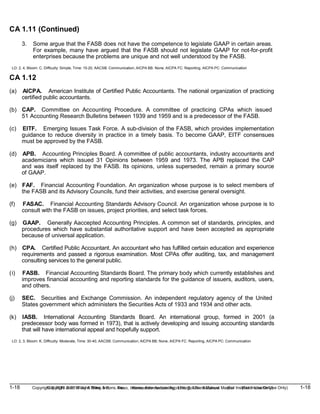
  • 2.
    Here are somerecommended products for you. Click the link to download, or explore more at testbankmall.com Test Bank for Intermediate Accounting 17th by Kieso https://testbankmall.com/product/test-bank-for-intermediate- accounting-17th-by-kieso/ Test Bank for Intermediate Accounting, 17th Edition, Donald E. Kieso https://testbankmall.com/product/test-bank-for-intermediate- accounting-17th-edition-donald-e-kieso/ Solution Manual for Intermediate Accounting, Volume 2, 12th Canadian by Kieso https://testbankmall.com/product/solution-manual-for-intermediate- accounting-volume-2-12th-canadian-by-kieso/ Marriages and Families Benokraitis 8th Edition Test Bank https://testbankmall.com/product/marriages-and-families- benokraitis-8th-edition-test-bank/
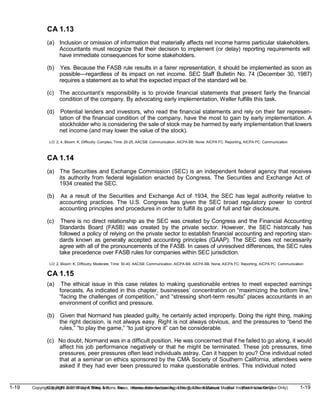
  • 3.
    Test Bank forCommunicating at Work, 12th Edition, Ronald Adler Jeanne Marquardt Elmhorst https://testbankmall.com/product/test-bank-for-communicating-at- work-12th-edition-ronald-adler-jeanne-marquardt-elmhorst/ Solution Manual for Social Problems, 16th Edition, William Kornblum https://testbankmall.com/product/solution-manual-for-social- problems-16th-edition-william-kornblum/ Quizzes for Software Engineering, 10/E 10th Edition Ian Sommerville https://testbankmall.com/product/quizzes-for-software- engineering-10-e-10th-edition-ian-sommerville/ Solution Manual for Fundamentals of Aerodynamics, 6th Edition John Anderson https://testbankmall.com/product/solution-manual-for-fundamentals-of- aerodynamics-6th-edition-john-anderson/ Test Bank for Career Counseling A Holistic Approach, 9th Edition https://testbankmall.com/product/test-bank-for-career-counseling-a- holistic-approach-9th-edition/
  • 4.
    Fundamentals of NuclearScience and Engineering 3rd Shultis Solution Manual https://testbankmall.com/product/fundamentals-of-nuclear-science-and- engineering-3rd-shultis-solution-manual/
  • 5.
    Copyright © 2019John Wiley & Sons, Inc. Kieso, Intermediate Accounting, 17/e, Solutions Manual (For Instructor Use Only) 1-1
  • 6.
    1-2 Copyright ©2019 John Wiley & Sons, Inc. Kieso, Intermediate Accounting, 17/e, Solutions Manual (For Instructor Use Only) ASSIGNMENT CLASSIFICATION TABLE (By Learning Objective) Learning Objectives Questions Cases 1. Understand the financial reporting environment. 1, 2, 3, 4, 5, 6, 7 CA1.2, CA1.3, CA1.4, CA1.5, CA1.6, CA1.7, CA1.9 2. Identify the major policy-setting bodies and their 8, 9, 10, 11, 13, 14, 15, CA1.1, CA1.2, CA1.3, role in the standard-setting process. 16, 18, 19 CA1.7, CA1.8, CA1.9, CA1.10, CA1.11, CA1.12, CA1.14 3. Explain the meaning of generally accepted 12, 14, 18, 19, 20, 21 CA1.2, CA1.3, CA1.7, accounting principles (GAAP) and the role of the CA1.8, CA1.12 codification for GAAP. 4. Describe major challenges in the financial 16, 17, 21, 22, 23, 24, CA1.6, CA1.10, reporting environment. 25, 26, 27, 28 CA1.11, CA1.13, CA1.15, CA1.16, CA1.17 Update footer throughout…
  • 7.
    ASSIGNMENT CHARACTERISTICS TABLE ItemDescription Level of Difficulty Time (minutes) CA1.1 FASB and standard-setting. Simple 15–20 CA1.2 GAAP and standard-setting. Simple 15–20 CA1.3 Financial reporting and accounting standards. Simple 15–20 CA1.4 Financial accounting. Simple 15–20 CA1.5 Objective of financial reporting. Moderate 20–25 CA1.6 Accounting numbers and the environment. Simple 10–15 CA1.7 Need for GAAP. Simple 15–20 CA1.8 AICPA’s role in rule-making. Simple 20–25 CA1.9 FASB role in rule-making. Simple 20–25 CA1.10 Politicization of GAAP. Complex 30–40 CA1.11 Models for setting GAAP. Simple 15–20 CA1.12 GAAP terminology. Moderate 30–40 CA1.13 Rule-making Issues. Complex 20–25 CA1.14 Securities and Exchange Commission. Moderate 30–40 CA1.15 Financial reporting pressures. Moderate 25–35 CA1.16 Economic consequences. Moderate 25–35 CA1.17 GAAP and economic consequences. Moderate 25–35 Copyright © 2019 John Wiley & Sons, Inc. Kieso, Intermediate Accounting, 17/e, Solutions Manual (For Instructor Use Only) 1-3
  • 8.
    1-4 Copyright ©2019 John Wiley & Sons, Inc. Kieso, Intermediate Accounting, 17/e, Solutions Manual (For Instructor Use Only) (For Instructor Use Only) 1-4 Copyright © 2019 John Wiley & Sons, Inc. Kieso, Intermediate Accounting, 17/e, Solutions Manual ANSWERS TO QUESTIONS 1. Financial accounting measures, classifies, and summarizes in report form those activities and that information which relate to the enterprise as a whole for use by parties both internal and external to a business enterprise. Managerial accounting also measures, classifies, and summarizes in report form enterprise activities, but the communication is for the use of internal, managerial parties, and relates more to subsystems of the entity. Managerial accounting is management decision oriented and directed more toward product line, division, and profit center reporting. LO: 1, Bloom: K, Difficulty: Simple, Time: 3-5, AACSB: Communication, AICPA BB: None, AICPA FC: Reporting, AICPA PC: Communication 2. Financial statements generally refer to the four basic financial statements: balance sheet, income statement, statement of cash flows, and statement of changes in owners’ or stockholders’ equity. Financial reporting is a broader concept; it includes the basic financial statements and any other means of communicating financial and economic data to interested external parties. Examples of financial reporting other than financial statements are annual reports, prospectuses, reports filed with the government, news releases, management forecasts or plans, and descriptions of an enterprise’s social or environmental impact. LO: 1, Bloom: K, Difficulty: Simple, Time: 3-5, AACSB: Communication, AICPA BB: None, AICPA FC: Reporting, AICPA PC: Communication 3. If a company’s financial performance is measured accurately, fairly, and on a timely basis, the right managers and companies are able to attract investment capital. To provide unreliable and irrelevant information leads to poor capital allocation which adversely affects the securities market. LO: 1, Bloom: K, Difficulty: Simple, Time: 3-5, AACSB: Communication, AICPA BB: None, AICPA FC: Reporting, AICPA PC: Communication 4. The objective of general purpose financial reporting is to provide financial information about the reporting entity that is useful to present and potential equity investors, lenders, and other creditors in decisions about providing resources to the entity through equity investments and loans or other forms of credit. Information that is decision-useful to capital providers (investors) may also be useful to other users of financial reporting who are not investors. LO: 1, Bloom: K, Difficulty: Simple, Time: 3-5, AACSB: None, AICPA BB: None, AICPA FC: Reporting, AICPA PC:: None 5. Investors are interested in financial reporting because it provides information that is useful for making decisions (referred to as the decision-usefulness approach). When making these decisions, investors are interested in assessing the company’s (1) ability to generate net cash inflows and (2) management’s ability to protect and enhance the capital providers’ investments. Financial reporting should therefore help investors assess the amounts, timing, and uncertainty of prospective cash inflows from dividends or interest, and the proceeds from the sale, redemption, or maturity of securities or loans. In order for investors to make these assessments, the economic resources of an enterprise, the claims to those resources, and the changes in them must be understood. LO: 1, Bloom: K, Difficulty: Simple, Time: 3-5, AACSB: Communication, AICPA BB: None, AICPA FC: Reporting, AICPA PC: Communication 6. A common set of standards applied by all businesses and entities should produce financial statements which are reasonably comparable. Without a common set of standards, each enterprise could, and would, develop its own theory structure and set of practices, resulting in noncomparability among enterprises. LO: 1, Bloom: K, Difficulty: Simple, Time: 3-5, AACSB: Communication, AICPA BB: None, AICPA FC: Reporting, AICPA PC: Communication 7. General-purpose financial statements are not likely to satisfy the specific needs of all interested parties. Since the needs of interested parties such as creditors, managers, owners, governmental agencies, and financial analysts vary considerably, it is unlikely that one set of financial statements is equally appropriate for these varied uses.
  • 9.
    1-5 Copyright ©2019 John Wiley & Sons, Inc. Kieso, Intermediate Accounting, 17/e, Solutions Manual (For Instructor Use Only) (For Instructor Use Only) 1-5 Copyright © 2019 John Wiley & Sons, Inc. Kieso, Intermediate Accounting, 17/e, Solutions Manual LO: 1, Bloom: K, Difficulty: Simple, Time: 3-5, AACSB: Communication, AICPA BB: None, AICPA FC: Reporting, AICPA PC: Communication Questions Chapter 1 (Continued) 8. The SEC has the power to prescribe, in whatever detail it desires, the accounting practices and principles to be employed by the companies that fall within its jurisdiction. Because the SEC receives audited financial statements from nearly all companies that issue securities to the public or are listed on the stock exchanges, it is greatly interested in the content, accuracy, and credibility of the statements. For many years, the SEC relied on the AICPA to regulate the profession and develop and enforce accounting principles. Lately, the SEC has assumed a more active role in the develop- ment of accounting standards, especially in the area of disclosure requirements. In December 1973, in ASR No. 150, the SEC said the FASB’s statements would be presumed to carry substantial authoritative support and anything contrary to them to lack such support. It thereby supports the development of accounting principles in the private sector. LO: 2, Bloom: K, Difficulty: Simple, Time: 3-5, AACSB: Communication, AICPA BB: None, AICPA FC: Reporting, AICPA PC: Communication 9. The Committee on Accounting Procedure was a special committee of the American Institute of CPAs that, between the years of 1939 and 1959, issued 51 Accounting Research Bulletins dealing with a wide variety of timely accounting problems. These bulletins provided solutions to immediate problems and narrowed the range of alternative practices. However, the Committee’s problem-by- problem approach failed to provide a well-defined and well-structured body of accounting theory that was so badly needed. The Committee on Accounting Procedure was replaced in 1959 by the Accounting Principles Board. LO: 2, Bloom: K, Difficulty: Simple, Time: 3-5, AACSB: Communication, AICPA BB: None, AICPA FC: Reporting, AICPA PC: Communication 10. The creation of the Accounting Principles Board was intended to advance the written expression of accounting principles, to determine appropriate practices, and to narrow the differences and inconsistencies in practice. To achieve its basic objectives, its mission was to develop an overall conceptual framework to assist in the resolution of problems as they became evident and to do substantive research on individual issues before pronouncements were issued. LO: 2, Bloom: K, Difficulty: Simple, Time: 3-5, AACSB: Communication, AICPA BB: None, AICPA FC: Reporting, AICPA PC: Communication 11. APB Opinions were issued by the Accounting Principles Board during the years 1959 through 1973 and, unless superseded by FASB Statements, are recognized as accepted practice and constitute the requirements to be followed by all business enterprises. Accounting Standards Updates are pronouncements of the Financial Accounting Standards Board that are incorporated into the FASB codification and therefore represent the accounting profession’s authoritative pronouncements on financial accounting and reporting practices. In addition, note that Accounting Research Bulletins were pronouncements on accounting practice issued by the Committee on Accounting Procedure between 1939 and 1959; since 1964 they have been recognized as accepted accounting practice unless superseded in part or in whole by an opinion of the APB or an FASB standard. LO: 2, Bloom: K, Difficulty: Simple, Time: 3-5, AACSB: Communication, AICPA BB: None, AICPA FC: Reporting, AICPA PC: Communication 12. The explanation should note that generally accepted accounting principles or standards have “substantial authoritative support.” They consist of accounting practices, procedures, concepts, and methods which are recognized by a large majority of practicing accountants as well as other members of the business and financial community. Bulletins issued by the Committee on Accounting Procedure, opinions rendered by the Accounting Principles Board, and statements issued by the Financial Accounting Standards Board constitute “substantial authoritative support.” LO: 3, Bloom: K, Difficulty: Simple, 5-10, AACSB: Communication, AICPA BB: None, AICPA FC: Reporting, AICPA PC: Communication 13. It was believed that FASB Pronouncements would carry greater weight than APB Opinions because of significant differences between the FASB and the APB, namely, the FASB has: (1) a smaller
  • 10.
    1-6 Copyright ©2019 John Wiley & Sons, Inc. Kieso, Intermediate Accounting, 17/e, Solutions Manual (For Instructor Use Only) (For Instructor Use Only) 1-6 Copyright © 2019 John Wiley & Sons, Inc. Kieso, Intermediate Accounting, 17/e, Solutions Manual membership, (2) full-time compensated members; (3) greater autonomy, (4) increased independence; and (5) broader representation than the APB. LO: 2, Bloom: K, Difficulty: Simple, Time: 3-5, AACSB: Communication, AICPA BB: None, AICPA FC: Reporting, AICPA PC: Communication Questions Chapter 1 (Continued) 14. The technical staff of the FASB conducts research on an identified accounting topic and prepares a “preliminary view” that is released by the Board for public reaction. The Board analyzes and evaluates the public response to the preliminary view, deliberates on the issues, and issues an “exposure draft” for public comment. The preliminary view merely presents all facts and alternatives related to a specific topic or problem, whereas the exposure draft is a tentative “statement.” After studying the public’s reaction to the exposure draft, the Board may reevaluate its position, revise the draft, and vote on the issuance of a final statement. LO: 2, Bloom: K, Difficulty: Simple, Time: 3-5, AACSB: Communication, AICPA BB: None, AICPA FC: Reporting, AICPA PC: Communication 15. Statements of financial accounting standards contained in Accounting Standards updates constitute generally accepted accounting principles and dictate acceptable financial accounting and reporting practices as promulgated by the FASB. The first standards statement was issued by the FASB in 1973. Statements of financial accounting concepts do not establish generally accepted accounting principles. Rather, the concepts statements set forth fundamental objectives and concepts that the FASB intends to use as a basis for developing future standards. The concepts serve as guidelines in solving existing and emerging accounting problems in a consistent, sound manner. Both the standards statements and the concepts statements may develop through the same process from discussion memorandum, to exposure draft, to a final approved statement. LO: 2, Bloom: K, Difficulty: Simple, Time: 3-5, AACSB: Communication, AICPA BB: None, AICPA FC: Reporting, AICPA PC: Communication 16. Rule 203 of the Code of Professional Conduct prohibits a member of the AICPA from expressing an opinion that financial statements conform with GAAP if those statements contain a material departure from an accounting principle promulgated by the FASB, or its predecessors, the APB and the CAP, unless the member can demonstrate that because of unusual circumstances the financial statements would otherwise have been misleading. Failure to follow Rule 203 can lead to the loss of a CPA’s license to practice. This rule is extremely important because it requires auditors to follow FASB standards. LO: 3, Bloom: K, Difficulty: Simple, Time: 5-7, AACSB: Communication, AICPA BB: None, AICPA FC: Reporting, AICPA PC: Communication 17. The chairman of the FASB was indicating that too much attention is put on the bottom line and not enough on the development of quality products. Managers should be less concerned with short- term results and be more concerned with the long-term results. In addition, short-term tax benefits often lead to long-term problems. The second part of his comment relates to accountants being overly concerned with following a set of rules, so that if litigation ensues, they will be able to argue that they followed the rules exactly. The problem with this approach is that accountants want more and more rules with less reliance on professional judgment. Less professional judgment leads to inappropriate use of accounting procedures in difficult situations. In the accountants’ defense, recent legal decisions have imposed vast new liability on accountants. The concept of accountant’s liability that has emerged in these cases is broad and expansive; the number of classes of people to whom the accountant is held responsible is almost limitless. LO: 4, Bloom: K, Difficulty: Simple, Time: 3-5, AACSB: Communication, AICPA BB: None, AICPA FC: Reporting, AICPA PC: Communication
  • 11.
    1-7 Copyright ©2019 John Wiley & Sons, Inc. Kieso, Intermediate Accounting, 17/e, Solutions Manual (For Instructor Use Only) (For Instructor Use Only) 1-7 Copyright © 2019 John Wiley & Sons, Inc. Kieso, Intermediate Accounting, 17/e, Solutions Manual Questions Chapter 1 (Continued) 18. The Emerging Issues Task Force often arrives at consensus conclusions on certain financial report- ing issues. These consensus conclusions are then looked upon as GAAP by practitioners because the SEC has indicated that it will view consensus solutions as preferred accounting and will require persuasive justification for departing from them. Thus, at least for public companies which are sub- ject to SEC oversight, consensus solutions developed by the Emerging Issues Task Force are followed unless subsequently overturned by the FASB. It should be noted that the FASB took greater direct ownership of GAAP established by the EITF by requiring that consensus positions be ratified by the FASB. LO: 3, Bloom: K, Difficulty: Simple, Time: 5-7, AACSB: Communication, AICPA BB: None, AICPA FC: Reporting, AICPA PC: Communication 19. The Financial Accounting Standards Board Accounting Standards Codification (Codification) is a compilation of all GAAP in one place. Its purpose is to integrate and synthesize existing GAAP and not to create new GAAP. It creates one level of GAAP which is considered authoritative. The FASB Codification Research Systems (CRS) is an online real-time data base which provides easy access to the Codification. The Codification and the related CRS provide a topically organized structure which is subdivided into topic, subtopics, sections, and paragraphs. LO: 3, Bloom: K, Difficulty: Moderate, Time: 5-7, AACSB: Communication, AICPA BB: None, AICPA FC: Reporting, AICPA PC: Communication 20. It is hoped that the Codification will help users to better understand what GAAP is. If this occurs, companies will be more likely to comply with GAAP and the time to research accounting issues will be substantially reduced. In addition, through the electronic web-based format, GAAP can be easily updated which will help users stay current. LO: 3, Bloom: K, Difficulty: Simple, Time: 3-5, AACSB: Communication, AICPA BB: None, AICPA FC: Reporting, AICPA PC: Communication 21. The sources of pressure are innumerable, but the most intense and continuous pressure to change or influence accounting principles or standards come from individual companies, industry associations, governmental agencies, practicing accountants, academicians, professional accoun- ting organizations, and public opinion. LO: 3, Bloom: K, Difficulty: Simple, 5-10, AACSB: Communication, AICPA BB: None, AICPA FC: Reporting, AICPA PC: Communication 22. Economic consequences means the impact of accounting reports on the wealth positions of issuers and users of financial information and the decision-making behavior resulting from that impact. In other words, accounting information impacts various users in many different ways which leads to wealth transfers among these various groups. If politics plays an important role in the development of accounting rules, the rules will be subject to manipulation for the purpose of furthering whatever policy prevails at the moment. No matter how well intentioned the rule maker may be, if information is designed to indicate that investing in a particular enterprise involves less risk than it actually does, or is designed to encourage invest- ment in a particular segment of the economy, financial reporting will suffer an irreplaceable loss of credibility. LO: 4, Bloom: K, Difficulty: Simple, Time: 3-5, AACSB: Communication, AICPA BB: None, AICPA FC: Reporting, AICPA PC: Communication 23. No one particular proposal is expected in answer to this question. The students’ proposals, however, should be defensible relative to the following criteria: (1) The method must be efficient, responsive, and expeditious. (2) The method must be free of bias and be above or insulated from pressure groups. (3) The method must command widespread support if it does not have legislative authority. (4) The method must produce sound yet practical accounting principles or standards. The students’ proposals might take the form of alterations of the existing methodology, an accoun- ting court (as proposed by Leonard Spacek), or governmental device.
  • 12.
    1-8 Copyright ©2019 John Wiley & Sons, Inc. Kieso, Intermediate Accounting, 17/e, Solutions Manual (For Instructor Use Only) (For Instructor Use Only) 1-8 Copyright © 2019 John Wiley & Sons, Inc. Kieso, Intermediate Accounting, 17/e, Solutions Manual LO: 4, Bloom: C, Difficulty: Simple, Time: 3-5, AACSB: Communication, AICPA BB: None, AICPA FC: Reporting, AICPA PC: Communication Questions Chapter 1 (Continued) 24. Concern exists about fraudulent financial reporting because it can undermine the entire financial reporting process. Failure to provide information to users that is accurate can lead to inappropriate allocations of resources in our economy. In addition, failure to detect massive fraud can lead to additional governmental oversight of the accounting profession. LO: 4, Bloom: K, Difficulty: Simple, Time: 3-5, AACSB: Communication, AICPA BB: None, AICPA FC: Reporting, AICPA PC: Communication 25. The expectations gap is the difference between what people think accountants should be doing and what accountants think they can do. It is a difficult gap to close. The accounting profession recognizes it must play an important role in narrowing this gap. To meet the needs of society, the profession is continuing its efforts in developing accounting standards, such as numerous pronouncements issued by the FASB, to serve as guidelines for recording and processing business transactions in the changing economic environment. LO: 4, Bloom: K, Difficulty: Simple, Time: 3-5, AACSB: Communication, AICPA BB: None, AICPA FC: Reporting, AICPA PC: Communication 26. The following are some of the key provisions of the Sarbanes-Oxley Act: • Establishes an oversight board for accounting practices. The Public Company Accounting Over- sight Board (PCAOB) has oversight and enforcement authority and establishes auditing, quality control, and independence standards and rules. • Implements stronger independence rules for auditors. Audit partners, for example, are required to rotate every five years and auditors are prohibited from offering certain types of consulting services to corporate clients. • Requires CEOs and CFOs to personally certify that financial statements and disclosures are accurate and complete and requires CEOs and CFOs to forfeit bonuses and profits when there is an accounting restatement. • Requires audit committees to be comprised of independent members and members with finan- cial expertise. • Requires codes of ethics for senior financial officers. In addition, Section 404 of the Sarbanes-Oxley Act requires public companies to attest to the effectiveness of their internal controls over financial reporting. LO: 4, Bloom: K, Difficulty: Simple, Time: 3-5, AACSB: Communication, AICPA BB: None, AICPA FC: Reporting, AICPA PC: Communication 27. Some major challenges facing the accounting profession relate to the following items: Nonfinancial measurement—how to report significant key performance measurements such as customer satisfaction indexes, backlog information and reject rates on goods purchased. Forward-looking information—how to report more future oriented information. Soft assets—how to report on intangible assets, such as market know-how, market dominance, and well-trained employees. Timeliness—how to report more real-time information. LO: 4, Bloom: K, Difficulty: Simple, Time: 3-5, AACSB: Communication, AICPA BB: None, AICPA FC: Reporting, AICPA PC: Communication 28. Accountants must perceive the moral dimensions of some situations because GAAP does not define or cover all specific features that are to be reported in financial statements. In these instances accountants must choose among alternatives. These accounting choices influence whether par- ticular stakeholders may be harmed or benefited. Moral decision-making involves awareness of potential harm or benefit and taking responsibility for the choices. LO: 4, Bloom: K, Difficulty: Simple, Time: 3-5, AACSB: Ethics, Communication, AICPA BB: Professional Demeanor, AICPA FC: Reporting, AICPA PC: Communication
  • 13.
    1-9 Copyright ©2019 John Wiley & Sons, Inc. Kieso, Intermediate Accounting, 17/e, Solutions Manual (For Instructor Use Only) (For Instructor Use Only) 1-9 Copyright © 2019 John Wiley & Sons, Inc. Kieso, Intermediate Accounting, 17/e, Solutions Manual TIME AND PURPOSE OF CONCEPTS FOR ANALYSIS CA 1.1 (Time 15–20 minutes) Purpose—to provide the student with an opportunity to answer questions about FASB and standard setting. CA 1.2 (Time 15–20 minutes) Purpose—to provide the student with an opportunity to answer questions about GAAP and standard setting. CA 1.3 (Time 15–20 minutes) Purpose—to provide the student with an opportunity to answer questions about financial reporting and accounting standards topics. CA 1.4 (Time 15–20 minutes) Purpose—to provide the student with an opportunity to distinguish between financial accounting and managerial accounting, identify major financial statements, and differentiate financial statements and financial reporting. CA 1.5 (Time 20–25 minutes) Purpose—to provide the student with an opportunity to explain the basic objective of financial reporting. CA 1.6 (Time 10–15 minutes) Purpose—to provide the student with an opportunity to describe how reported accounting numbers might affect an individual’s perceptions and actions. CA 1.7 (Time 15–20 minutes) Purpose—to provide the student with an opportunity to evaluate the viewpoint of removing mandatory accounting rules and allowing each company to voluntarily disclose the information it desired. CA 1.8 (Time 20–25 minutes) Purpose—to provide the student with an opportunity to explain the evolution of accounting rule-making organizations and the role of the AICPA in the rule making environment. CA 1.9 (Time 20–25 minutes) Purpose—to provide the student with an opportunity to identify the sponsoring organization of the FASB, the method by which the FASB arrives at a decision, and the types and the purposes of docu- ments issued by the FASB. CA 1.10 (Time 30–40 minutes) Purpose—to provide the student with an opportunity to focus on the types of organizations involved in the rule making process, what impact accounting has on the environment, and the environment’s influence on accounting. CA 1.11 (Time 15–20 minutes) Purpose—to provide the student with an opportunity to focus on what type of rule-making environment exists in the United States. In addition, this CA explores why user groups are interested in the nature of GAAP and why some groups wish to issue their own rules. CA 1.12 (Time 30–40 minutes) Purpose—to provide the student with an opportunity to identify and define acronyms appearing in the first chapter. Some are self-evident, others are not so.
  • 14.
    1-10 Copyright ©2019 John Wiley & Sons, Inc. Kieso, Intermediate Accounting, 17/e, Solutions Manual (For Instructor Use Only) (For Instructor Use Only) 1-10 Copyright © 2019 John Wiley & Sons, Inc. Kieso, Intermediate Accounting, 17/e, Solutions Manual Time and Purpose of Concepts for Analysis (Continued) CA 1.13 (Time 20–25 minutes) Purpose—to provide the student with an opportunity to consider the ethical dimensions of implementation of a new accounting pronouncement. CA 1.14 (Time 30–40 minutes) Purpose—to provide the student with an assignment that explores the role and function of the Securities and Exchange Commission. CA 1.15 (Time 25–35 minutes) Purpose—to provide the student with a writing assignment concerning the ethical issues related to meeting earnings targets. CA 1.16 (Time 25–35 minutes) Purpose—to provide the student with the opportunity to discuss the role of Congress in accounting rule- making. CA 1.17 (Time 25–35 minutes) Purpose—to provide the student with an opportunity to comment on a letter sent by business execu- tives to the FASB and Congress on the accounting for derivatives.
  • 15.
    1-11 Copyright ©2019 John Wiley & Sons, Inc. Kieso, Intermediate Accounting, 17/e, Solutions Manual (For Instructor Use Only) (For Instructor Use Only) 1-11 Copyright © 2019 John Wiley & Sons, Inc. Kieso, Intermediate Accounting, 17/e, Solutions Manual SOLUTIONS TO CONCEPTS FOR ANALYSIS CA 1.1 1. True 2. False. Any company claiming compliance with GAAP must comply with all standards and interpretations, including disclosure requirements. 3. True 4. False. In establishing financial accounting standards, the FASB relies on two basic premises: (1) the FASB should be responsive to the needs and viewpoints of the entire economic community, not just the public accounting profession, and (2) it should operate in full view of the public through a “due process” system that gives interested people ample opportunities to make their view known. LO: 2, Bloom: K, Difficulty: Simple, Time: 15-20, AACSB: AICPA BB: None, AICPA BB: None, AICPA FC: Reporting, AICPA PC: None CA 1.2 1. False. In addition to providing decision-useful information about future cash flows, management also is accountable to investors for the custody and safekeeping of the company’s economic resources and for their efficient and profitable use; however, this is not considered an objective. 2. False. The objective of financial reporting is to provide financial information about the reporting entity that is useful to present and potential equity investors, lenders, and other creditors in making decisions in their capacity as capital providers. 3. False. The FASB follows the same due process procedures for interpretations and standards. 4. True LO: 1, 2, Bloom: K, Difficulty: Simple, Time: 15-20, AACSB: AICPA BB: None, AICPA BB: None, AICPA FC: Reporting, AICPA PC: None CA 1.3 1. (d) 2. (d) 3. (d) 4. (a) 5. (a) 6. (b) 7. (d) 8. (b) LO: 1, 2, 4, Bloom: K, Difficulty: Simple, Time: 15-20, AACSB: AICPA BB: None, AICPA BB: None, AICPA FC: Reporting, AICPA PC: None CA 1.4 (a) Financial accounting is the process that culminates in the preparation of financial reports relative to the enterprise as a whole for use by parties both internal and external to the enterprise. In contrast, managerial accounting is the process of identification, measurement, accumulation, analysis, prepa- ration, interpretation, and communication of financial information used by the management to plan, evaluate, and control within an organization and to assure appropriate use of, and accountability for, its resources.
  • 16.
    1-12 Copyright ©2019 John Wiley & Sons, Inc. Kieso, Intermediate Accounting, 17/e, Solutions Manual (For Instructor Use Only) (For Instructor Use Only) 1-12 Copyright © 2019 John Wiley & Sons, Inc. Kieso, Intermediate Accounting, 17/e, Solutions Manual CA 1.4 (Continued) (b) The financial statements most frequently provided are the balance sheet, the income statement, the statement of cash flows, and the statement of changes in owners’ or stockholders’ equity. (c) Financial statements are the principal means through which financial information is communicated to those outside an enterprise. As indicated in (b), there are four major financial statements. However, some financial information is better provided, or can be provided only, by means of financial reporting other than formal financial statements. Financial reporting (other than financial statements and related notes) may take various forms. Examples include the company president’s letter or supplementary schedules in the corporate annual reports, prospectuses, reports filed with govern- ment agencies, news releases, management’s forecasts, and descriptions of an enterprise’s social or environmental impact. LO: 1, Bloom: K, Difficulty: Simple, Time: 15-20, AACSB: Communication, AICPA BB: None, AICPA FC: Reporting, AICPA PC: Communication CA 1.5 (a) In accordance with Statement of Financial Accounting Concepts No. 1, “Objectives of Financial Reporting by Business Enterprises,” the objectives of financial reporting are to provide information to investors, creditors, and others 1. that is useful to present and potential investors and creditors and other users in making rational investment, credit, and similar decisions. The information should be comprehensible to those who have a reasonable understanding of business and economic activities and are willing to study the information with reasonable diligence, 2. to help present and potential investors and creditors and other users in assessing the amounts, timing, and uncertainty of prospective cash receipts from dividends or interest and the proceeds from the sale, redemption, or maturity of securities or loans. Since investors’ and creditors’ cash flows are related to enterprise cash flows, financial reporting should provide information to help investors, creditors, and others assess the amounts, timing, and uncertainty of prospective net cash inflows to the related enterprise, and 3. about the economic resources of an enterprise, the claims to those resources (obligations of the enterprise to transfer resources to other entities and owners’ equity), and the effects of trans- actions, events, and circumstances that change its resources and claims to those resources. (b) Statement of Financial Accounting Concepts No. 1 establishes standards to meet the information needs of large groups of external users such as investors, creditors, and their representatives. Although the level of sophistication related to business and financial accounting matters varies both within and between these user groups, users are expected to possess a reasonable understanding of accounting concepts, financial statements, and business and economic activities and are expected to be willing to study and interpret the information with reasonable diligence. LO: 1, Bloom: K, Difficulty: Moderate, Time: 20-25, AACSB: Communication, AICPA BB: None, AICPA FC: Reporting, AICPA PC: Communication
  • 17.
    1-13 Copyright ©2019 John Wiley & Sons, Inc. Kieso, Intermediate Accounting, 17/e, Solutions Manual (For Instructor Use Only) (For Instructor Use Only) 1-13 Copyright © 2019 John Wiley & Sons, Inc. Kieso, Intermediate Accounting, 17/e, Solutions Manual CA 1.6 Accounting numbers affect investing decisions. Investors, for example, use the financial statements of different companies to enhance their understanding of each company’s financial strength and operating results. Because these statements follow generally accepted accounting principles, investors can make meaningful comparisons of different financial statements to assist their investment decisions. Accounting numbers also influence creditors’ decisions. A commercial bank usually looks into a company’s financial statements and past credit history before deciding whether to grant a loan and in what amount. The financial statements provide a fair picture of the company’s financial strength (for example, short-term liquidity and long-term solvency) and operating performance for the current period and over a period of time. The information is essential for the bank to ensure that the loan is safe and sound. LO: 1, 4, Bloom: C, Difficulty: Simple, Time: 10-15, AACSB: Communication, AICPA BB: None, AICPA FC: Reporting, AICPA PC: Communication CA 1.7 It is not appropriate to abandon mandatory accounting rules and allow each company to voluntarily disclose the type of information it considers important. Without a coherent body of accounting theory and standards, each accountant or enterprise would have to develop its own theory structure and set of practices, and readers of financial statements would have to familiarize themselves with every company’s peculiar accounting and reporting practices. As a result, it would be almost impossible to prepare state- ments that could be compared. In addition, voluntary disclosure may not be an efficient way of disseminating information. A company is likely to disclose less information if it has the discretion to do so. Thus, the company can reduce its cost of assembling and disseminating information. However, an investor wishing additional information has to pay to receive additional information desired. Different investors may be interested in different types of information. Since the company may not be equipped to provide the requested information, it would have to spend additional resources to fulfill such needs; or the company may refuse to furnish such information if it is too costly to do so. As a result, investors may not get the desired information or they may have to pay a significant amount of money for it. Furthermore, redundancy in gathering and distributing information occurs when different investors ask for the same information at different points in time. To the society as a whole, this would not be an efficient way of utilizing resources. LO: 1, 3, Bloom: AN, Difficulty: Simple, Time: 15-20, AACSB: Reflective Thinking, Communication, AICPA BB: None, AICPA FC: Reporting, AICPA PC: Communication CA 1.8 (a) One of the committees that the AICPA established prior to the establishment of the FASB was the Committee on Accounting Procedures (CAP). The CAP, during its existence from 1939 to 1959, issued 51 Accounting Research Bulletins (ARB). In 1959, the AICPA created the Accounting Prin- ciples Board (APB) to replace the CAP. Before being replaced by the FASB, the APB released 31 official pronouncements, called APB Opinions. (b) Although the ARBs issued by the CAP helped to narrow the range of alternative practices to some extent, the CAP’s problem-by-problem approach failed to provide the well-defined, structured body of accounting principles that was both needed and desired. As a result, the CAP was replaced by the APB.
  • 18.
    1-14 Copyright ©2019 John Wiley & Sons, Inc. Kieso, Intermediate Accounting, 17/e, Solutions Manual (For Instructor Use Only) (For Instructor Use Only) 1-14 Copyright © 2019 John Wiley & Sons, Inc. Kieso, Intermediate Accounting, 17/e, Solutions Manual CA 1.8 (Continued) The APB had more authority and responsibility than did the CAP. Unfortunately, the APB was beleaguered throughout its 14-year existence. It came under fire early, charged with lack of produc- tivity and failing to act promptly to correct alleged accounting abuses. The APB also met a lot of industry and CPA firm opposition and occasional governmental interference when tackling numerous complicated accounting issues. In fear of governmental rule making, the accounting profession investigated the ineffectiveness of the APB and replaced it with the FASB. Learning from prior experiences, the FASB has several significant differences from the APB. The FASB has: (1) smaller membership, (2) full-time, compensated membership, (3) greater autonomy, (4) increased independence, and (5) broader representation. In addition, the FASB has its own research staff and relies on the expertise of various task force groups formed for various projects. These features form the bases for the expectations of success and support from the public. In addition, the due process taken by the FASB in establishing financial accounting standards gives interested persons ample opportunity to make their views known. Thus, the FASB is responsive to the needs and viewpoints of the entire economic community, not just the public accounting profession. (c) The AICPA supplements the FASB’s efforts in the present standard-setting environment. Their issue papers, which are prepared by the Financial Reporting Executive Committee (FinREC) formerly the Accounting Standards Executive Committee (AcSEC), identify current financial reporting problems for specific industries and present alternative treatments of the issue. These papers provide the FASB with an early warning device to insure timely issuance of FASB standards. In situations where the FASB avoids the subject of an issue paper, FinREC may issue a Statement of Position to provide guidance for the reporting issue. FinREC also issues Practice Bulletins which indicate how the AICPA believes a given transaction should be reported. Recently, the role of the AICPA in standard-setting has diminished. The FASB and the AICPA agreed, that after a transition period, the AICPA and FinREC no longer issues authoritative accounting guidance for public companies. LO: 2, Bloom: K, Difficulty: Simple, Time: 20-25, AACSB: Communication, AICPA BB: None, AICPA FC: Reporting, AICPA PC: Communication CA 1.9 (a) The Financial Accounting Foundation (FAF) is the sponsoring organization of the FASB. The FAF selects the members of the FASB and its Advisory Council, funds their activities, and generally oversees the FASB’s activities. The FASB follows a due process in establishing a typical FASB Statement of Financial Accounting Standards. The following steps are usually taken: (1) A topic or project is identified and placed on the Board’s agenda. (2) A task force of experts from various sectors is assembled to define problems, issues, and alternatives related to the topic. (3) Research and analysis are conducted by the FASB technical staff. (4) A preliminary views document is drafted and released. (5) A public hearing is often held, usually 60 days after the release of the preliminary views. (6) The Board analyzes and evaluates the public response. (7) The Board deliberates on the issues and prepares an exposure draft for release. (8) After a 30-day (minimum) exposure period for public comment, the Board evaluates all of the responses received. (9) A committee studies the exposure draft in relation to the public responses, reevaluates its position, and revises the draft if necessary. (10) The full Board gives the revised draft final consideration and votes on issuance of a Standards Statement. The passage of a new accounting standard in the form of an FASB Statement requires the support of four of the seven Board members, before it is incorporated in the codification. (b) The FASB issues two major types of pronouncements: Accounting Standards Updates (ASUs) and Concepts Statements. ASUs issued by the FASB are considered GAAP.
  • 19.
    1-15 Copyright ©2019 John Wiley & Sons, Inc. Kieso, Intermediate Accounting, 17/e, Solutions Manual (For Instructor Use Only) (For Instructor Use Only) 1-15 Copyright © 2019 John Wiley & Sons, Inc. Kieso, Intermediate Accounting, 17/e, Solutions Manual CA 1.9 (Continued) ASU’s may be comprised of major standards projects, EITF consensus, or interpretations. Regardless of nature, if approved by the FASB in an ASU, then the guidance is considered GAAP. The Statements of Financial Accounting Concepts (SFAC) help the FASB to avoid the “problem- by-problem approach.” These statements set forth fundamental objectives and concepts that the Board will use in developing future standards of financial accounting and reporting. They are intended to form a cohesive set of interrelated concepts, a body of theory or a conceptual framework, that will serve as tools for solving existing and emerging problems in a consistent, sound manner. In addition, the FASB’s Emerging Issues Task Force (EITF) issues statements to provide guidance on how to account for new and unusual financial transactions that have the potential for creating diversity in reporting practices. The EITF identifies controversial accounting problems as they arise and determines whether they can be quickly resolved or whether the FASB should become involved in solving them. In essence, it becomes a “problem filter” for the FASB. Thus, the FASB is able to work on more pervasive long-term problems, while the EITF deals with short-term emerging issues. LO: 2, Bloom: K, Difficulty: Simple, Time: 20-25, AACSB: Communication, AICPA BB: None, AICPA FC: Reporting, AICPA PC: Communication CA 1.10 (a) CAP. The Committee on Accounting Procedure, CAP, which was in existence from 1939 to 1959, was an outgrowth of AICPA committees which were in existence during the period 1933 to 1938. The committee was formed in direct response to the criticism received by the accounting profession during the financial crisis of 1929 and the years thereafter. The authorization to issue pronouncements on matters of accounting principles and procedures was based on the belief that the AICPA had the responsibility to establish practices that would become generally accepted by the profession and by corporate management. As a general rule, the CAP directed its attention, almost entirely, to resolving specific accounting problems and topics rather than to the development of generally accepted accounting principles. The committee voted on the acceptance of specific Accounting Research Bulletins published by the committee. A two-thirds majority was required to issue a particular research bulletin. The CAP did not have the authority to require acceptance of the issued bulletins by the general membership of the AICPA, but rather received its authority only upon general acceptance of the pronouncement by the members. That is, the bulletins set forth normative accounting procedures that “should be” followed by the accounting profession, but were not “required” to be followed. In 1964, well after the demise of the CAP, the Council of the AICPA adopted recommendations that departures from effective CAP Bulletins should be disclosed in financial statements or in audit reports of members of the AICPA. The demise of the CAP could probably be traced to four distinct factors: (1) the narrow nature of the subjects covered by the bulletins issued by the CAP, (2) the lack of any theoretical groundwork in establishing the procedures presented in the bulletins, (3) the lack of any real authority by the CAP in prescribing adherence to the procedures described by the bulletins, and (4) the lack of any formal representation on the CAP of interest groups such as corporate managers, governmental agencies, and security analysts.
  • 20.
    1-16 Copyright ©2019 John Wiley & Sons, Inc. Kieso, Intermediate Accounting, 17/e, Solutions Manual (For Instructor Use Only) (For Instructor Use Only) 1-16 Copyright © 2019 John Wiley & Sons, Inc. Kieso, Intermediate Accounting, 17/e, Solutions Manual CA 1.10 (Continued) APB. The objectives of the APB were formulated mainly to correct the deficiencies of the CAP as described above. The APB was thus charged with the responsibility of developing written expression of generally accepted accounting principles through consideration of the research done by other members of the AICPA in preparing Accounting Research Studies. The committee was in turn given substantial authoritative standing in that all opinions of the APB were to constitute substantial authoritative support for generally accepted accounting principles. If an individual member of the AICPA decided that a principle or procedure outside of the official pronouncements of the APB had substantial authoritative support, the member had to disclose the departure from the official APB opinion in the financial statements of the firm in question. The membership of the committee comprising the APB was also extended to include representation from industry, government, and academe. The opinions were also designed to include minority dissents by members of the board. Exposure drafts of the proposed opinions were readily distributed. The demise of the APB occurred primarily because the purposes for which it was created were not being accomplished. Broad generally accepted accounting principles were not being developed. The research studies supposedly being undertaken in support of subsequent opinions to be expressed by the APB were often ignored. The committee in essence became a simple extension of the original CAP in that only very specific problem areas were being addressed. Interest groups outside of the accounting profession questioned the appropriateness and desirability of having the AICPA directly responsible for the establishment of GAAP. Politicization of the establishment of GAAP had become a reality because of the far-reaching effects involved in the questions being resolved. FASB. The formal organization of the FASB represents an attempt to vest the responsibility of establishing GAAP in an organization representing the diverse interest groups affected by the use of GAAP. The FASB is independent of the AICPA. It is independent, in fact, of any private or govern- mental organization. Individual CPAs, firms of CPAs, accounting educators, and representatives of private industry will now have an opportunity to make known their views to the FASB through their membership on the Board. Independence is facilitated through the funding of the organization and payment of the members of the Board. Full-time members are paid by the organization and the organization itself is funded solely through contributions. Thus, no one interest group has a vested interest in the FASB. Conclusion. The evolution of the current FASB certainly does represent “increasing politicization of accounting standards setting.” Many of the efforts extended by the AICPA can be directly attributed to the desire to satisfy the interests of many groups within our society. The FASB represents, perhaps, just another step in this evolutionary process. (b) Arguments for politicization of the accounting rule-making process: 1. Accounting depends in large part on public confidence for its success. Consequently, the critical issues are not solely technical, so all those having a bona fide interest in the output of accounting should have some influence on that output. 2. There are numerous conflicts between the various interest groups. In the face of this, compro- mise is necessary, particularly since the critical issues in accounting are value judgments, not the type which are solvable, as we have traditionally assumed, using deterministic models. Only in this way (reasonable compromise) will the financial community have confidence in the fairness and objectivity of accounting rule-making. 3. Over the years, accountants have been unable to establish, on the basis of technical accoun- ting elements, rules which would bring about the desired uniformity and acceptability. This inability itself indicates rule-setting is primarily consensual in nature.
  • 21.
    1-17 Copyright ©2019 John Wiley & Sons, Inc. Kieso, Intermediate Accounting, 17/e, Solutions Manual (For Instructor Use Only) (For Instructor Use Only) 1-17 Copyright © 2019 John Wiley & Sons, Inc. Kieso, Intermediate Accounting, 17/e, Solutions Manual CA 1.10 (Continued) 4. The public accounting profession, through bodies such as the Accounting Principles Board, made rules which business enterprises and individuals “had” to follow. For many years, these businesses and individuals had little say as to what the rules would be, in spite of the fact that their economic well-being was influenced to a substantial degree by those rules. It is only natural that they would try to influence or control the factors that determine their economic well-being. (c) Arguments against the politicization of the accounting rule-making process: 1. Many accountants feel that accounting is primarily technical in nature. Consequently, they feel that substantive, basic research by objective, independent and fair-minded researchers ultimately will result in the best solutions to critical issues, such as the concepts of income and capital, even if it is accepted that there is not necessarily a single “right” solution. 2. Even if it is accepted that there are no “absolute truths” as far as critical issues are concerned, many feel that professional accountants, taking into account the diverse interests of the various groups using accounting information, are in the best position, because of their independence, education, training, and objectivity, to decide what generally accepted accounting principles ought to be. 3. The complex situations that arise in the business world require that trained accountants develop the appropriate accounting principles. 4. The use of consensus to develop accounting principles would decrease the professional status of the accountant. 5. This approach would lead to “lobbying” by various parties to influence the establishment of ac- counting principles. LO: 2, 4, Bloom: E, Difficulty: Complex, Time: 30-40, AACSB: Analytic, Communication, Ethics, AICPA BB: Professional Demeanor, AICPA FC: Reporting, AICPA PC: Communication CA 1.11 (a) The public/private mixed approach is the way rules are established in the United States. In many respects, the FASB is a quasi-governmental agency in that its pronouncements are required to be followed because the SEC has provided support for this approach. The SEC has the ultimate power to establish GAAP but has chosen to permit the private sector to develop these rules. By accepting the standards established by the FASB as authoritative, it has granted much power to the FASB. (b) Publicly reported accounting numbers influence the distribution of scarce resources. Resources are channeled where needed at returns commensurate with perceived risk. Thus, reported accounting numbers have economic effects in that resources are transferred among entities and individuals as a consequence of these numbers. It is not surprising then that individuals affected by these numbers will be extremely interested in any proposed changes in the financial reporting environment. (c) The Accounting Standards Executive Committee (AcSEC of the AICPA), among other groups, has presented a potential challenge to the exclusive right of the FASB to establish accounting principles. Also, Congress has been attempting to legislate certain accounting practices, particularly to help struggling industries. Some possible reasons why other groups might wish to establish GAAP are: 1. As indicated in the previous answer, these rules have economic effects and therefore certain groups would prefer to make their own rules to ensure that they receive just treatment. 2. Some believe the FASB does not act quickly to resolve accounting matters, either because it is not that interested in the subject area or because it lacks the resources to do so.
  • 22.
    1-18 Copyright ©2019 John Wiley & Sons, Inc. Kieso, Intermediate Accounting, 17/e, Solutions Manual (For Instructor Use Only) (For Instructor Use Only) 1-18 Copyright © 2019 John Wiley & Sons, Inc. Kieso, Intermediate Accounting, 17/e, Solutions Manual CA 1.11 (Continued) 3. Some argue that the FASB does not have the competence to legislate GAAP in certain areas. For example, many have argued that the FASB should not legislate GAAP for not-for-profit enterprises because the problems are unique and not well understood by the FASB. LO: 2, 4, Bloom: C, Difficulty: Simple, Time: 15-20, AACSB: Communication, AICPA BB: None, AICPA FC: Reporting, AICPA PC: Communication CA 1.12 (a) AICPA. American Institute of Certified Public Accountants. The national organization of practicing certified public accountants. (b) CAP. Committee on Accounting Procedure. A committee of practicing CPAs which issued 51 Accounting Research Bulletins between 1939 and 1959 and is a predecessor of the FASB. (c) EITF. Emerging Issues Task Force. A sub-division of the FASB, which provides implementation guidance to reduce diversity in practice in a timely basis. To become GAAP, EITF consensues must be approved by the FASB. (d) APB. Accounting Principles Board. A committee of public accountants, industry accountants and academicians which issued 31 Opinions between 1959 and 1973. The APB replaced the CAP and was itself replaced by the FASB. Its opinions, unless superseded, remain a primary source of GAAP. (e) FAF. Financial Accounting Foundation. An organization whose purpose is to select members of the FASB and its Advisory Councils, fund their activities, and exercise general oversight. (f) FASAC. Financial Accounting Standards Advisory Council. An organization whose purpose is to consult with the FASB on issues, project priorities, and select task forces. (g) GAAP. Generally Aaccepted Accounting Principles. A common set of standards, principles, and procedures which have substantial authoritative support and have been accepted as appropriate because of universal application. (h) CPA. Certified Public Accountant. An accountant who has fulfilled certain education and experience requirements and passed a rigorous examination. Most CPAs offer auditing, tax, and management consulting services to the general public. (i) FASB. Financial Accounting Standards Board. The primary body which currently establishes and improves financial accounting and reporting standards for the guidance of issuers, auditors, users, and others. (j) SEC. Securities and Exchange Commission. An independent regulatory agency of the United States government which administers the Securities Acts of 1933 and 1934 and other acts. (k) IASB. International Accounting Standards Board. An international group, formed in 2001 (a predecessor body was formed in 1973), that is actively developing and issuing accounting standards that will have international appeal and hopefully support. LO: 2, 3, Bloom: K, Difficulty: Moderate, Time: 30-40, AACSB: Communication, AICPA BB: None, AICPA FC: Reporting, AICPA PC: Communication
  • 23.
    1-19 Copyright ©2019 John Wiley & Sons, Inc. Kieso, Intermediate Accounting, 17/e, Solutions Manual (For Instructor Use Only) (For Instructor Use Only) 1-19 Copyright © 2019 John Wiley & Sons, Inc. Kieso, Intermediate Accounting, 17/e, Solutions Manual CA 1.13 (a) Inclusion or omission of information that materially affects net income harms particular stakeholders. Accountants must recognize that their decision to implement (or delay) reporting requirements will have immediate consequences for some stakeholders. (b) Yes. Because the FASB rule results in a fairer representation, it should be implemented as soon as possible—regardless of its impact on net income. SEC Staff Bulletin No. 74 (December 30, 1987) requires a statement as to what the expected impact of the standard will be. (c) The accountant’s responsibility is to provide financial statements that present fairly the financial condition of the company. By advocating early implementation, Weller fulfills this task. (d) Potential lenders and investors, who read the financial statements and rely on their fair represen- tation of the financial condition of the company, have the most to gain by early implementation. A stockholder who is considering the sale of stock may be harmed by early implementation that lowers net income (and may lower the value of the stock). LO: 2, 4, Bloom: K, Difficulty: Complex, Time: 20-25, AACSB: Communication, AICPA BB: None, AICPA FC: Reporting, AICPA PC: Communication CA 1.14 (a) The Securities and Exchange Commission (SEC) is an independent federal agency that receives its authority from federal legislation enacted by Congress. The Securities and Exchange Act of 1934 created the SEC. (b) As a result of the Securities and Exchange Act of 1934, the SEC has legal authority relative to accounting practices. The U.S. Congress has given the SEC broad regulatory power to control accounting principles and procedures in order to fulfill its goal of full and fair disclosure. (c) There is no direct relationship as the SEC was created by Congress and the Financial Accounting Standards Board (FASB) was created by the private sector. However, the SEC historically has followed a policy of relying on the private sector to establish financial accounting and reporting stan- dards known as generally accepted accounting principles (GAAP). The SEC does not necessarily agree with all of the pronouncements of the FASB. In cases of unresolved differences, the SEC rules take precedence over FASB rules for companies within SEC jurisdiction. LO: 2, Bloom: K, Difficulty: Moderate, Time: 30-40, AACSB: Communication, AICPA BB: AICPA BB: None, AICPA FC: Reporting, AICPA PC: Communication CA 1.15 (a) The ethical issue in this case relates to making questionable entries to meet expected earnings forecasts. As indicated in this chapter, businesses’ concentration on “maximizing the bottom line,” “facing the challenges of competition,” and “stressing short-term results” places accountants in an environment of conflict and pressure. (b) Given that Normand has pleaded guilty, he certainly acted improperly. Doing the right thing, making the right decision, is not always easy. Right is not always obvious, and the pressures to “bend the rules,” “to play the game,” “to just ignore it” can be considerable. (c) No doubt, Normand was in a difficult position. He was concerned that if he failed to go along, it would affect his job performance negatively or that he might be terminated. These job pressures, time pressures, peer pressures often lead individuals astray. Can it happen to you? One individual noted that at a seminar on ethics sponsored by the CMA Society of Southern California, attendees were asked if they had ever been pressured to make questionable entries. This individual noted
  • 24.
    1-20 Copyright ©2019 John Wiley & Sons, Inc. Kieso, Intermediate Accounting, 17/e, Solutions Manual (For Instructor Use Only) (For Instructor Use Only) 1-20 Copyright © 2019 John Wiley & Sons, Inc. Kieso, Intermediate Accounting, 17/e, Solutions Manual that to the best of his recollection, everybody raised a hand, and more than one had eventually chosen to resign. CA 1.15 (Continued) (d) Major stakeholders were: (1) Troy Normand, (2) present and potential stockholders and creditors of WorldCom, (3) employees, and (4) family. Recognize that WorldCom was at that time the largest bankruptcy in United States history, so many individuals were affected. LO: 4, Bloom: AN, Difficulty: Moderate, Time: 25-30, AACSB:Ethics, Analytic, Communication, AICPA BB: None, AICPA FC: Reporting, AICPA PC: Communication CA 1.16 (a) Considering the economic consequences of GAAP, it is not surprising that special interest groups become vocal and critical (some supporting, some opposing) when rules are being formulated. The FASB’s derivative accounting pronouncement is no exception. Many from the banking industry, for example, criticized the rule as too complex and leading to unnecessary earnings volatility. They also indicated that the proposal may discourage prudent risk management activities and in some cases could present misleading financial information. As a result, Congress is often approached to put pressure on the FASB to change its rulings. In the stock option controversy, industry was quite effective in going to Congress to force the FASB to change its conclusions. In the derivative controversy, Rep. Richard Baker introduced a bill which would force the SEC to formally approve each standard issued by the FASB. Not only would this process delay adoption, but could lead to additional politicalization of the rule-making process. Dingell commented that Congress should stay out of the rule-making process and defended the FASB’s approach to establishing GAAP. (b) Attempting to set GAAP by a political process will probably lead to the following consequences: (a) Too many alternatives. (b) Lack of clarity that will lead to inconsistent application. (c) Lack of disclosure that reduces transparency. (d) Not comprehensive in scope. Without an independent process, GAAP will be based on political compromise. A classic illustration is what happened in the savings and loan industry. Applying generally accepted accounting principles to the S&L industry would have forced regulators to restrict activities of many S&Ls. Unfortunately, accounting principles were overridden by regulatory rules and the resulting lack of transparency masked the problems. William Siedman, former FDIC Chairman noted later that it was “the worst mistake in the history of government.” Another indication of the problem of government intervention is shown in the accounting standards used by some countries around the world. Completeness and transparency of information needed by investors and creditors is not available in order to meet or achieve other objectives. LO: 4, Bloom: C, Difficulty: Moderate, Time: 25-30, AACSB: Communication, AICPA BB: None, AICPA FC: Reporting, AICPA PC: Communication
  • 25.
    1-21 Copyright ©2019 John Wiley & Sons, Inc. Kieso, Intermediate Accounting, 17/e, Solutions Manual (For Instructor Use Only) (For Instructor Use Only) 1-21 Copyright © 2019 John Wiley & Sons, Inc. Kieso, Intermediate Accounting, 17/e, Solutions Manual CA 1.17 (a) The “due process” system involves the following: 1. Identifying topics and placing them on the Board’s agenda. 2. Research and analysis is conducted and preliminary views of pros and cons issued. 3. A public hearing is often held. 4. Board evaluates research and public responses and issues exposure draft. 5. Board evaluates responses and changes exposure draft, if necessary. Final statement is then issued. (b) Economic consequences mean the impact of accounting reports on the wealth positions of issuers and users of financial information and the decision-making behavior resulting from that impact. (c) Economic consequences indicated in the letter are: (1) concerns related to the potential impact on the capital markets, (2) the weakening of companies’ ability to manage risk, and (3) the adverse control implications of implementing costly and complex new rules imposed at the same time as other major initiatives, including the Year 2000 issues and a single European currency. (d) The principal point of this letter is to delay the finalization of the derivatives standard. As indicated in the letter, the authors of this letter urge the FASB to expose its new proposal for public comment, following the established due process procedures that are essential to acceptance of its standards and providing sufficient time for affected parties to understand and assess the new approach. (Authors note: The FASB indicated in a follow-up letter that all due process procedures had been followed and all affected parties had more than ample time to comment. In addition, the FASB issued a follow-up standard, which delayed the effective date of the standard, in part to give companies more time to develop the information systems needed for implementation of the standard). (e) The reason why the letter was sent to Congress was to put additional pressure on the FASB to delay or drop the issuance of a rule on derivatives. Unfortunately, in too many cases, when the business community does not like the answer proposed by the FASB, it resorts to lobbying members of Congress. The lobbying efforts usually involve developing some type of legislation that will negate the rule. In some cases, efforts involve challenging the FASB’s authority to develop rules in certain areas with additional Congressional oversight. LO: 4, Bloom: E, Difficulty: Moderate, Time: 25-30, AACSB: Communication, AICPA BB: None, AICPA FC: Reporting, AICPA PC: Communication
  • 26.
    1-22 Copyright ©2019 John Wiley & Sons, Inc. Kieso, Intermediate Accounting, 17/e, Solutions Manual (For Instructor Use Only) (For Instructor Use Only) 1-22 Copyright © 2019 John Wiley & Sons, Inc. Kieso, Intermediate Accounting, 17/e, Solutions Manual FINANCIAL REPORTING PROBLEM (a) The key organizations involved in rule making in the U.S. are the AICPA, FASB, and SEC. See also (c). (b) Different authoritative literature pertaining to methods recording account- ing transactions exists today. Some authoritative literature has received more support from the profession than other literature. The literature that has substantial authoritative support is the one most supported by the profession and should be followed when recording accounting transactions. These standards and procedures are called generally accepted accounting principles (GAAP). With implementation of the Codification, what qualifies as authoritative is any literature contained in the Codification. The Codification changes the way GAAP is documented, presented, and updated. It creates one level of GAAP which is considered authoritative. All other accounting literature is considered non-authoritative. What happens if the Codification does not cover a certain type of trans- action or event? In this case, other accounting literature should be considered which includes FASB Concepts Statements, international financial reporting standards and other professional literature. (c) Rule-making in the U.S. has evolved through the work of the following organizations: 1. American Institute of Certified Public Accountants (AICPA)—it is the national professional organization of practicing Certified Public Accountants (CPAs). Outgrowths of the AICPA have been the Com- mittee on Accounting Procedure (CAP) which issued Accounting Research Bulletins and the Accounting Principles Board (APB) whose major purposes were to advance written expression of accounting principles, determine appropriate practices, and narrow the areas of difference and inconsistency in practice. 2. Financial Accounting Standards Board (FASB)—the mission of the FASB is to establish and improve standards of financial accounting and reporting for the guidance and education of the public, which includes issuers, auditors, and users of the financial information.
  • 27.
    1-23 Copyright ©2019 John Wiley & Sons, Inc. Kieso, Intermediate Accounting, 17/e, Solutions Manual (For Instructor Use Only) (For Instructor Use Only) 1-23 Copyright © 2019 John Wiley & Sons, Inc. Kieso, Intermediate Accounting, 17/e, Solutions Manual FINANCIAL REPORTING PROBLEM (Continued) 3. Securities and Exchange Commission (SEC)—the SEC is an inde- pendent regulatory agency of the United States government which administers the Securities Act of 1933, the Securities Exchange Act of 1934, the Sarbanes-Oxley Act, and several other acts. The SEC has broad power to prescribe the accounting practices and standards to be employed by companies that fall within its jurisdiction. (d) The SEC and the AICPA have been the authority for compliance with GAAP. The SEC has indicated that financial statements conforming to standards set by the FASB will be presumed to have authoritative support. The AICPA, in Rule 203 of the Code of Professional Ethics, requires that members prepare financial statements in accordance with GAAP. Failure to follow Rule 203 can lead to the loss of a CPA’s license to practice. LO: 2, 3, Bloom: K, Difficulty: Simple, Time: 20-25, AACSB: Communication, AICPA BB: None, AICPA FC: Reporting, AICPA PC: Communication
  • 28.
    1-24 Copyright ©2019 John Wiley & Sons, Inc. Kieso, Intermediate Accounting, 17/e, Solutions Manual (For Instructor Use Only) (For Instructor Use Only) 1-24 Copyright © 2019 John Wiley & Sons, Inc. Kieso, Intermediate Accounting, 17/e, Solutions Manual SOLUTIONS TO CODIFICATION EXERCISES CE1.1 The information at this link describes the elements offered in The FASB Accounting Standards Codification. As indicated, the website offers several resources to enhance your working knowledge of the Codification and the Codification Research System. This page includes links to help pages which describe specific functions and features of the Codification. Links to frequently asked questions, the FASB Learning Guide, and the Notice to Constituents are also available on this page. Help pages FAQ Learning Guide About the Codification—Notice of Constituents LO: 3, Bloom: K, Difficulty: Simple, Time: 5-10, AACSB: Communication, Technology, AICPA BB: Technology, AICPA FC: Research, Reporting, Technology, AICPA PC: Communication CE1.2 The following information is provided at the Providing Feedback link: The Codification includes a feature which can be used to submit content-related feedback or general, system-related comments. The feedback system is not designed for comments on proposed Accounting Standards Updates. Content-related feedback As a registered user of the FASB Accounting Standards Codification Research System website, you are able and are encouraged to provide feedback, at the paragraph level, to the FASB about any content- related matters. For specific information about the Codification and the feedback process, please read the Notice to Constituents. To provide content-related feedback: Click the Submit feedback button beneath the paragraph for which you want to provide feedback. Enter or copy/paste your comments in the text box. Note that formatting (lists, bold, etc.) is not retained and there is a 4,000 character limit on feedback submissions. Click SUBMIT. Your comments are sent to the FASB and reviewed by FASB staff. You can also submit multiple comments for any given paragraph, if, for example, you determine that more information would be useful to the FASB staff. General feedback Click here to provide general feedback on the Codification in general, the Codification Research System website, and other system-related items that are not content specific. LO: 3, Bloom: K, Difficulty: Simple, Time: 10-15, AACSB: Communication, Technology, AICPA BB: Technology, AICPA FC: Research, Reporting, Technology, AICPA PC: Communication
  • 29.
    1-25 Copyright ©2019 John Wiley & Sons, Inc. Kieso, Intermediate Accounting, 17/e, Solutions Manual (For Instructor Use Only) (For Instructor Use Only) 1-25 Copyright © 2019 John Wiley & Sons, Inc. Kieso, Intermediate Accounting, 17/e, Solutions Manual CE1.3 The “What’s New” page provides links to Codification content that has been recently issued. During the verification phase, updates may result from either the issuance of Codification update instructions that accompany new Standards or from changes to the Codification due to incorporation of constituent feedback. LO: 3, Bloom: K, Difficulty: Simple, Time: 5-10, AACSB: Communication, Technology, AICPA BB: Technology, AICPA FC: Research, Reporting, Technology, AICPA PC: Communication
  • 30.
    1-26 Copyright ©2019 John Wiley & Sons, Inc. Kieso, Intermediate Accounting, 17/e, Solutions Manual (For Instructor Use Only) (For Instructor Use Only) 1-26 Copyright © 2019 John Wiley & Sons, Inc. Kieso, Intermediate Accounting, 17/e, Solutions Manual RESEARCH CASE (a) CON 1, Par. 32. The objectives begin with a broad focus on information that is useful in investment and credit decisions; then narrow that focus to investors’ and creditors’ primary interest in the prospects of receiving cash from their investments in or loans to business enterprises and the relation of those prospects to the enterprise’s prospects; and finally focus on information about an enterprise’s economic resources, the claims to those resources, and changes in them, including measures of the enterprise’s performance, that is useful in assessing the enterprise’s cash flow prospects. (b) CON 1, Par. 7. Financial reporting includes not only financial statements but also other means of communicating information that relates, directly or indirectly, to the information provided by the accounting system—that is, information about an enterprise’s resources, obligations, earnings, etc. Management may communicate information to those outside an enterprise by means of financial reporting other than formal financial statements either because the information is required to be disclosed by authoritative pronouncement, regulatory rule, or custom or because management considers it useful to those outside the enterprise and discloses it voluntarily. Information communicated by means of financial reporting other than financial statements may take various forms and relate to various matters. Corporate annual reports, prospectuses, and annual reports filed with the Securities and Exchange Commission are common examples of reports that include financial statements, other financial information, and nonfinancial information. News releases, management’s forecasts or other descriptions of its plans or expecta- tions, and descriptions of an enterprise’s social or environmental impact are examples of reports giving financial information other than financial statements or giving only nonfinancial information. (c) CON 1, Par, 24 and 25: 24. Many people base economic decisions on their relationships to and knowledge about business enterprises and thus are potentially interested in the information provided by financial reporting. Among the potential users are owners, lenders, suppliers, potential investors and creditors, employees, management, directors, customers, financial analysts and advisors, brokers, underwriters, stock exchanges, lawyers, economists, taxing authorities, regulatory authorities,
  • 31.
    1-27 Copyright ©2019 John Wiley & Sons, Inc. Kieso, Intermediate Accounting, 17/e, Solutions Manual (For Instructor Use Only) (For Instructor Use Only) 1-27 Copyright © 2019 John Wiley & Sons, Inc. Kieso, Intermediate Accounting, 17/e, Solutions Manual RESEARCH CASE (Continued) legislators, financial press and reporting agencies, labor unions, trade associations, business researchers, teachers and students, and the public. Members and potential members of some groups—such as owners, creditors, and employees—have or contemplate having direct economic interests in particular business enterprises. Managers and directors, who are charged with managing the enterprise in the interest of owners (paragraph 12), also have a direct interest. Members of other groups—such as financial analysts and advisors, regulatory authorities, and labor unions—have derived or indirect interests because they advise or represent those who have or contemplate having direct interests. Potential users of financial information most directly concerned with a particular business enterprise are generally interested in its ability to generate favorable cash flows because their decisions relate to amounts, timing, and uncertainties of expected cash flows. To investors, lenders, suppliers, and employees, a business enterprise is a source of cash in the form of dividends or interest and perhaps appreciated market prices, repayment of borrowing, payment for goods or services, or salaries or wages. They invest cash, goods, or services in an enterprise and expect to obtain sufficient cash in return to make the investment worthwhile. They are directly concerned with the ability of the enterprise to generate favorable cash flows and may also be concerned with how the market’s perception of that ability affects the relative prices of its securities. To customers, a business enterprise is a source of goods or services, but only by obtaining sufficient cash to pay for the resources it uses and to meet its other obligations can the enterprise provide those goods or services. To managers, the cash flows of a business enterprise are a significant part of their management responsibilities, including their accountability to directors and owners. Many, if not most, of their decisions have cash flow consequences for the enterprise. Thus, investors, creditors, employees, customers, and managers significantly share a common interest in an enterprise’s ability to generate favorable cash flows. Other potential users of financial information share the same interest, derived from investors, creditors, employees, customers, or managers whom they advise or represent or derived from an interest in how those groups (and especially stockholders) are faring. LO: 1, Bloom: AN, Difficulty: Simple, Time: 25-30, AACSB: Analytic, Communication, AICPA BB: Technology, AICPA FC: Research, Reporting, Technology, AICPA PC: Communication
  • 32.
    1-28 Copyright ©2019 John Wiley & Sons, Inc. Kieso, Intermediate Accounting, 17/e, Solutions Manual (For Instructor Use Only) (For Instructor Use Only) 1-28 Copyright © 2019 John Wiley & Sons, Inc. Kieso, Intermediate Accounting, 17/e, Solutions Manual IFRS CONCEPTS AND APPLICATION IFRS 1.1 The two organizations involved in international standard-setting are IOSCO (International Organization of Securities Commissions) and the IASB (International Accounting Standards Board.) The IOSCO does not set accounting standards, but ensures that the global markets can operate in an efficient and effective manner. Conversely, the IASB’s mission is to develop a single set of high quality, understandable and international finan- cial reporting standards (IFRSs) for general purpose financial statements. LO: 5, Bloom: K, Difficulty: Simple, Time: 3-5, AACSB: Diversity, Communication, AICPA BB: None, AICPA FC: Reporting, AICPA PC: Communication IFRS 1.2 The standards issued by these organizations are sometimes principles- based, rules-based, tax-oriented, or business-based. In other words, they often differ in concept and objective. LO: 5, Bloom: K, Difficulty: Simple, Time: 3-5, AACSB: Diversity, Communication, AICPA BB: None, AICPA FC: Reporting, AICPA PC: Communication IFRS 1.3 A single set of high quality accounting standards ensures adequate comparability. Investors are able to make better investment decisions if they receive financial information from a U.S. company that is comparable to an international competitor. LO: 5, Bloom: K, Difficulty: Simple, Time: 3-5, AACSB: Diversity, Communication, AICPA BB: None, AICPA FC: Reporting, AICPA PC: Communication IFRS 1.4 The international standards must be of high quality and sufficiently comprehensive. To achieve this goal, the IASB and the FASB have set up an extensive work plan to achieve the objective of developing one set of world-class international standards. This work plan actually started in 2002, when an agreement was forged between the two Boards, where each acknowledged their commitment to the development of high-quality, compatible accounting standards that could be used for both domestic and cross-border financial reporting (referred to as the Norwalk Agreement).
  • 33.
    1-29 Copyright ©2019 John Wiley & Sons, Inc. Kieso, Intermediate Accounting, 17/e, Solutions Manual (For Instructor Use Only) (For Instructor Use Only) 1-29 Copyright © 2019 John Wiley & Sons, Inc. Kieso, Intermediate Accounting, 17/e, Solutions Manual IFRS 1.4 (Continued) At that meeting, the FASB and the IASB pledged to use their best efforts to (1) make their existing financial reporting standards fully compatible as soon as is practicable, and (2) coordinate their future work programs to ensure that once achieved, compatibility is maintained. This document was reinforced in 2006 when the parties issued a memorandum of understanding (MOU) which highlighted three principles: • Convergence of accounting standards can best be achieved through the development of high-quality common standards over time. • Trying to eliminate differences between two standards that are in need of significant improvement is not the best use of the FASB’s and the IASB’s resources—instead, a new common standard should be developed that improves the financial information reported to investors. • Serving the needs of investors means that the Boards should seek convergence by replacing standards in need of improvement with jointly developed new standards. Subsequently, in 2009 the Boards agreed on a process to complete a number of major projects by 2011, including monthly joint meetings. As part of achieving this goal, it is critical that the process by which the standards are established be independent. And, it is necessary that the standards are maintained, and emerging accounting issues are dealt with efficiently. The SEC directed its staff to develop and execute a plan (“Work Plan”) to enhance both the understanding of the SEC’s purpose and public transparency in this area. The SEC Work Plan addresses such areas as independence of standard-setting, investor understanding of IFRS, and auditor readiness. Based on the staff report issued in 2012, it does not appear that the SEC is ready to adopt IFRS any time soon. However, the SEC has encouraged the FASB and IASB to continue their convergence efforts. In 2016, the SEC indicated that it will not switch to IFRS in the near future. As the SEC Chief Accountant noted: “I believe that for the foreseeable future, the independent standard setting process of the FASB and U.S. GAAP standards will be in the best interests of U.S. capital markets.” LO: 5, Bloom: K, Difficulty: Simple, 20-25, AACSB: Diversity, Communication, AICPA BB: None, AICPA FC: Reporting, AICPA PC: Communication
  • 34.
    1-30 Copyright ©2019 John Wiley & Sons, Inc. Kieso, Intermediate Accounting, 17/e, Solutions Manual (For Instructor Use Only) (For Instructor Use Only) 1-30 Copyright © 2019 John Wiley & Sons, Inc. Kieso, Intermediate Accounting, 17/e, Solutions Manual IFRS 1.5 (a) The International Accounting Standards Board is an independent, pri- vately funded accounting standards setter based in London, UK. The Board is committed to developing, in the public interest, a single set of high quality, understandable and enforceable global accounting standards that require transparent and comparable information in general purpose financial statements. In addition, the Board cooperates with national accounting standards setters to achieve convergence in accounting standards around the world. (b) In summary, the following groups might gain most from convergence of financial reporting: • Investors, investment analysts and stockbrokers: to facilitate interna- tional comparisons for investment decisions. • Credit grantors: for similar reasons to bullet point above. • Multinational companies: as preparers, investors, appraisers of pro- ducts or staff, and as movers of staff around the globe; also, as raisers of finance on international markets (this also applies to some companies that are not multinationals). • Governments: as tax collectors and hosts of multinationals; also interested are securities markets regulators and governmental and nongovernmental rule makers. (c) The fundamental argument against convergence is that, to the extent that international differences in accounting practices result from under- lying economic, legal, social, and other environmental factors, harmoni- zation may not be justified. Different accounting has grown up to serve the different needs of different users; this might suggest that the existing ac- counting practice is “correct” for a given nation and should not be changed merely to simplify the work of multinational companies or auditors. There does seem to be strength in this point particularly for smaller com- panies with no significant multinational activities or connections. To foist upon a small private family company in Luxembourg lavish disclosure requirements and the need to report a “true and fair” view may be an expensive and unnecessary piece of convergence.
  • 35.
    Other documents randomlyhave different content
  • 36.
    their feet thefertile plains of France presented themselves,—above, ranges of magnificent heights towered in majestic grandeur to the skies, and stretched into distance beyond the range of sight. 241 Although no military movements were made, this inactive interval of a vigorous campaign was usefully employed by the allied commander, in organizing anew the regiments that had suffered most, concentrating the divisions, replacing exhausted stores, and perfecting the whole matériel of the army. Those of the British near the coast, compared with the corps that were blockading Pamplona, lived comfortably in their mountain bivouacs; indeed, the task of covering a blockade is the most disagreeable that falls to the soldier’s lot. Exposed to cold and rain, continually on the alert, and yet engaged in a duty devoid of enterprise and interest, nothing could be more wearying to the troops employed; and desertions, which during active service were infrequent, now became numerous, and especially among the Spaniards and Irish. The siege of San Sebastian was renewed. Guns, formerly employed, were re-landed,—the trenches occupied again,—and a large supply of heavy ordnance and mortars, received opportunely from England, were placed in battery. Lord Wellington was reinforced by a company of sappers and miners—and the navy, under Sir George Collier, assisted him with both men and guns. 242 The batteries were consequently enlarged—and a furious sortie by the garrison on the night of the 24th producing little effect, on the 26th a crushing fire opened from fifty-seven pieces of siege artillery. On the same night the island of Santa Clara, situated at the entrance of the harbour, and partially enfilading the defences of the castle, was surprised and stormed by a mixed party of sailors and soldiers, and its garrison made prisoners. On the 27th, a second sortie on the whole front of the isthmus failed entirely, and the assailants were instantly driven back. The siege and working artillery 243 had been now augmented to eighty pieces—and on the 30th the breaches were so extensively battered down, that Lord
  • 37.
    Wellington issued ordersthat they should be assaulted, and the next morning was named for the attempt. 244 In the annals of modern warfare, perhaps there is no conflict recorded which was so sanguinary and so desperate as the storming of that well-defended breach. During the blockade, every resource of military ingenuity was tried by the French governor—and the failure of the first assault, with the subsequent raising of the siege, emboldened the garrison, and rendered them the more confident of holding out until Soult could advance and succour them. The time from which the battering guns had been withdrawn, until they had been again placed in battery, was assiduously employed in constructing new defences and strengthening the old ones. But though the place when reinvested was more formidable than before, the besiegers appeared only the more determined to reduce it. 245 Morning broke gloomily—an intense mist obscured every object, and the work of slaughter was for a time delayed. At nine the sea- breeze cleared away the fog; the sun shone gloriously out—and in two hours the forlorn hope issued from the trenches. The columns succeeded, 246 —and every gun from the fortress that could bear, opened on them with shot and shells. The appearance of the breach was perfectly delusive; nothing living could reach the summit—no courage, however desperate, could overcome the difficulties, for they were alike unexpected and insurmountable. In vain the officers rushed forward, and devotedly were they followed by their men. From intrenched houses behind the breach, the traverses, and the ramparts of the curtain, a withering discharge of musketry was poured on the assailants, while the Mirador and Prince batteries swept the approaches with their guns. To survive this concentrated fire was impossible; the forlorn hope were cut off to a man, and the heads of the columns annihilated. At last the debouches were choked with the dead and wounded, and a further passage to the breach rendered impracticable from the heap of corpses that were piled upon each other. 247
  • 38.
    Then, in thatdesperate moment, when hope might have been supposed to be over, an expedient unparalleled in the records of war was resorted to. The British batteries opened on the curtain—and the storming parties heard with surprise the roar of cannon in the rear, while, but a few feet above their heads, their iron shower hissed horribly, and swept away the enemy and their defences. This was the moment for a fresh effort. Another brigade was moved forward—and favoured by an accidental explosion upon the curtain, which confused the enemy while it encouraged the assailants, the terre-plain was mounted, and the French driven from the works. A long and obstinate resistance was continued in the streets, which were in many places barricaded—but by five in the evening opposition had ceased, and the town was in the possession of the British. Seven hundred of the garrison were prisoners—and the remainder were either disabled in the assault or shut up in the castle. The unfortunate town seemed alike devoted by friends and enemies to destruction. The conquerors were roaming through the streets—the castle firing on the houses beneath its guns—in many places fires had broken out—and a storm of thunder, rain, and lightning, added to the confusion of a scene which even in warfare finds no parallel. 248 The assault of San Sebastian cost a large expense of life, there being seven hundred and sixty-one killed, one thousand six hundred and ninety-seven wounded, and forty-five missing, and in that number many valuable officers were included. The head of the engineer department, Sir Richard Fletcher, was killed—and Generals Leith, 249 Oswald, and Robinson were returned in the list of wounded. The Spanish corps of Friere formed a part of the covering army, and occupied the heights of San Marcial. Their front and left flank were covered by the Bidassao, and their right appuied upon the Sierra de Haya. On these heights Longa’s guerillas were posted, and the first division in rear of Irun. The reserve was behind the left.
  • 39.
    The French shewedthemselves at Yera on the 30th, and in consequence, Generals Inglis and Ross were moved, the former to the bridge of Lezeca, and the latter to a position on the Haya mountain, while a Portuguese brigade secured it from being turned on the right. Two of the enemy’s divisions forded the river on the morning of the 31st, and, in the front of the Spanish left wing, mounted the heights with determined gallantry. On this occasion the Spaniards behaved with courage worthy of their once chivalric name. Coolly waiting until the French divisions had topped the heights, they rushed forward with the bayonet, and bore them down the hill. So completely were they broken by this sudden and unexpected charge, that driven into the river by the impetuosity of their assailants, many missed the fords and perished. Undismayed by the repulse, a pontoon bridge was thrown across the Bidassao—and passing fourteen thousand men, the French advanced again with renewed confidence against the Spanish lines. Wellington, in person, was present on the hill—his appearance was enthusiastically hailed—and deeds afterwards attested how powerful the influence of that presence proved. Before the French could gain the summit, the Spanish battalions boldly advanced to meet them—a bayonet rush was made—the enemy recoiled—the allies pressed them closely—a panic resulted—some rushed into the deeps of the Bidassao, and were drowned; others succeeded in finding the fords and escaped. A multitude hurried towards the bridge, but it was soon choked with fugitives—the pressure became too heavy for the pontoons to support—it sank suddenly—and of those upon it at the moment, few gained the other bank. A renewed discomfiture, attended with such fatal consequences, and achieved by troops they had hitherto despised, astonished and chagrined the French officers; while the allied leader, surprised by this brilliant display of unwonted heroism, bestowed his highest commendation on the Spanish troops.
  • 40.
    A simultaneous attackwas made on the road leading to San Sebastian by the right of the Haya mountain, which runs past the village of Oyarzum. As the position was defective, the Portuguese brigade, which with Inglis’s corps had been intrusted with its defence, fell back on the bold and rocky ridge on which stands the convent of San Antonio. Here, too, the French efforts were unavailing, and the enemy retired in despair. In the mean time heavy rains had caused a mountain flood—the river became impassable, the fords could not be crossed, and the bridge of Vera offered the only point by which they could retreat. That passage could not be effected with rapidity—and before one half of the French column had defiled, the light divisions were on the banks, and had opened a severe and constant fire. This, with other losses, made the effort to relieve San Sebastian a most infelicitous attempt. Two generals and fifteen hundred men were lost on these occasions—and that, too, by a signal repulse from a force invariably mentioned by the French marshals as contemptible. Vigorous measures were in preparation for the reduction of the castle of San Sebastian. From the height of its escarp, and the solidity of the masonry, La Mota could not be assaulted with any certainty of success—and a regular investment was requisite to obtain the place. On the 1st of September the mortar-batteries commenced throwing shells; 250 and as the castle was indifferently provided with bomb-proof casemates, a considerable loss induced the governor 251 to offer a capitulation, but the terms were not such as could be granted. Batteries with heavy ordnance were erected on the works of the town, and on the 8th opened with such terrible effect, that in two hours the place was unconditionally surrendered. 252 The garrison amounted to eighteen hundred men, of whom nearly a third were disabled. 253 San Sebastian was held to the last with excellent judgment and dauntless gallantry. Indeed, the loss of the besiegers bore
  • 41.
    melancholy confirmation ofthe fact,—for the reduction of that fortress cost the allies nearly four thousand men. * * * * * Before we record the triumphant entrance into the French territory by the allied troops, it may be necessary to casually notice the proceedings of the Anglo-Sicilian army in the east of Spain. Lord Wellington had arranged, as a part of the military operations of the brilliant campaign of 1813, the liberation of Valencia, by forcing Suchet from that province, and obliging him to abandon afterwards the line of the Lower Ebro. This was perfectly practicable. The Spanish commanders were in force in Catalonia,— Del Parque in Murcia and Grenada,—the coast was open to the English shipping—and Sir John Murray could embark at Alicant, and land his army on any part of Catalonia that he pleased. In pursuance of this plan, Sir John Murray appeared before Tarragona on the 2nd of June, landed next morning, and invested the place. His opening operations were successful. Fort Balaguer, after a day’s bombardment, surrendered; and the French were confined to the possession of the inner defences of the town. The siege was proceeding with every promise of a successful result, when Murray, learning that Suchet was advancing from Valencia, and Mathieu from Barcelona, raised it with such unnecessary precipitation, that nineteen battering guns were abandoned in the trenches, and the infantry and cavalry reimbarked with an ill-judged haste, that at the time not only produced considerable dissatisfaction among the troops, but afterwards subjected Sir John Murray to a court-martial. That it was a most uncalled for proceeding on the part of the English general was subsequently ascertained,—for, and at the same moment, Murray, Suchet, and Mathieu were actually retiring from each other. 254 Murray suspected that he should be exposed to a combined attack— Mathieu dared not venture singly on the English—and Suchet, having
  • 42.
    left his artilleryat Tortosa, feared to attack while unprovided with that most essential arm. Lord William Bentinck’s subsequent attempt on Tarragona, when Suchet retreated from the Ebro into Catalonia, was equally unsuccessful. Having moved from Villa Franca and advanced across to Ordal, on the night of the 12th of September, he was furiously attacked, and driven back on the main body, with a loss of four guns, and a thousand men hors de combat. The British retreated, pursued by Suchet and Decaen; and, after an affair between the Brunswick hussars and a French cuirassier regiment, highly creditable to the former, the English returned to Tarragona, and the French to their cantonments on the Llobregat. Lord William resigned the command to General Clinton, and resumed that which he had previously held in Sicily.
  • 43.
    PASSAGE OF THEBIDASSAO. Passage of the Bidassao.—Fall of Pamplona. The capture of San Sebastian permitted the allied leader to prepare for a decisive movement so soon as the reduction of Pamplona should warrant his advance across the frontier. The enemy were strongly posted on the right bank of the Bidassao, 255 in front of Vera—and preparatory to assuming the offensive, Wellington determined to force that position and occupy it himself. Every arrangement was made with his habitual secrecy. The fords were sounded and marked by fishermen, who created no suspicion, as, to all appearance, they were following their customary avocation, and hence their proceedings were unnoticed by the French videts. All was prepared for the attempt—and at midnight, on the 6th of October, the British divisions got silently under arms. A storm was raging furiously—thunder was pealing round them— lightning, in quick and vivid flashes, flared across the murky sky—the elemental uproar was reverberated among the alpine heights above —and a wilder night was never chosen for a military operation. Gradually the tempest exhausted its fury—the wind fell—the rain ceased—an overwhelming heat succeeded—and when the morning broke, the leading brigades, at seven different points, plunged into the Bidassao; while a rocket rose from the ancient steeple of Fontarabia, and the signal was answered from the heights by a combined movement of all the divisions there drawn up in order of battle.
  • 44.
    Perfect success crownedthis daring essay. The leading columns were nearly across the river before the French fire opened. Ground, difficult and broken in itself, had been carefully strengthened with numerous field-works; but all gave way before the desperate valour of the assailants. The light division, with the Spaniards under Longa, 256 carried the intrenched position of Puerto-de-Vera. Redoubt and abbatis were stoutly defended; but from all, in quick succession, the enemy was driven at the point of the bayonet. Night fell—the attack had everywhere succeeded—and the victors bivouacked on the field they won; and, for the first time, the allied forces slept upon French ground. Here the British commander established himself, and awaited the fall of Pamplona, which Soult’s repeated defeats rendered inevitable. The garrison still obstinately held out: and when their provisions were nearly exhausted, it was rumoured that they intended, rather than surrender, to blow up the works, and take their chance of escaping. 257 But an assurance from the Spanish commander, Don Carlos, that, should the place be destroyed, he would hang the governor and officers, and decimate the men, prevented the attempt; and, on the 30th of October, the garrison yielded themselves prisoners of war, and the place surrendered. Winter had now set in, and a season of unusual severity commenced. The allies were sadly exposed to the weather, and an increasing difficulty was felt every day in procuring necessary supplies. Forage became so scarce, that part of the cavalry had nothing for their horses but grass; while the cattle for the soldiers’ rations, driven sometimes from the interior of Spain, perished in immense numbers by the way, or reached the camp so wretchedly reduced in condition as to be little better than carrion. Resources from the sea could not be trusted to; for in blowing weather the coast was scarcely approachable, and even in the sheltered harbour of Passages, the transports could with difficulty ride to their moorings, in consequence of the heavy swell that tumbled in from the Atlantic. The cold became intense,—sentries were frozen at their
  • 45.
    posts,—and a picketat Roncesvalles, regularly snowed up, was saved with great difficulty. All this plainly shewed that the present position of the allies was not tenable much longer, and that a forward movement into France was unavoidable. 258 But great difficulties in advancing presented themselves; and, all things considered, success was a matter of uncertainty. Soult’s army had been powerfully reinforced by the last conscription; and for three months the French marshal had been indefatigable in fortifying the whole line of his position, and strengthening his defences, wherever the ground would admit an enemy to approach. The field- works extended from the sea to the river, as the right rested on St. Jean-de-Luz, and the left on the Nivelle. The centre was at Mont La Rhune and the heights of Sarré. The whole position passed in a half- circle through Irogne, Ascain, Sarré, Ainhoue, and Espelette. Though the centre was commanded by a higher ridge, a narrow valley interposed between them. The entire front was covered with works, and the sierras defended by a chain of redoubts. The centre was particularly strong—in fact, it was a work regularly ditched and palisaded. To turn the position, by advancing Hill’s corps through St. Jean Pied-de-Port, was first determined on; but, on consideration, this plan of operations was abandoned,—and, strong as the centre was, the allied leader resolved that on it his attack should be directed, while the heights of Ainhoue, which formed its support, should, if possible, be simultaneously carried. A commander less nerved than Lord Wellington, would have lacked resolution for this bold and masterly operation. Everything was against him, and every chance favoured the enemy. The weather was dreadful—the rain fell in torrents,—and while no army could move, the French had the advantage of the delay to complete the defences of a position which was already deemed perfect as art and nature could render it. Nor did their powerful works produce in the enemy a false security. Aware of the man and the troops which threatened them—they were always ready for an attack—and their
  • 46.
    outpost duty wasrigidly attended to. Before day their corps were under arms—and the whole line of defences continued fully garrisoned until night permitted the troops to be withdrawn. At last the weather moderated. On the 7th, Ainhoue was reconnoitred by Wellington in person, and the plan of the attack arranged. No operation could be more plain or straightforward. The centre was to be carried by columns of divisions, and the right centre turned. To all the corps their respective points of attack were assigned,—while to the light division and Longa’s Spaniards the storming of La Petite Rhune was confided. The latter were to be supported by Alten’s cavalry, three brigades of British artillery, and three mountain guns. 259 The 8th had been named for the attack—but the roads were so dreadfully cut up, that neither the artillery nor Hill’s brigade could get into position, and it was postponed for two days longer—when the 10th dawned, a clear and moonlight morning. Long before day, Lord Wellington, and several of the generals of division and brigade with their respective staffs, had assembled in a small wood, five hundred yards from the redoubt above the village of Sarré, waiting for sufficient light to commence the arranged attack. Nothing could exceed the courage and rapidity with which the troops rushed on, and overcame every artificial and natural obstacle. The 3rd and 7th advanced in front of the village—Downie’s Spanish brigade attacked the right—while the left was turned by Cole’s, and the whole of the first line of defences remained in possession of the allies. On this glorious occasion, the light division was preeminently distinguished. By moonlight it moved from the greater La Rhune, and formed in a ravine which separates the bolder from the lesser height. This latter was occupied in force by the enemy, and covered on every assailable point with intrenchments. As morning broke, the British light troops rushed from the hollow which had concealed them. To withstand their assault was impossible—work after work was stormed; forward they went with irresistible bravery, and on the
  • 47.
    summit of thehill united themselves with Cole’s division, and then pushed on against the intrenched heights behind, which formed the strongest part of the position. Here, a momentary check arrested their progress—the supporting force (Spanish) were too slow, and the ground too rugged for the horse artillery to get over it at speed. The rifles were attacked in turn, and for a moment driven back by a mass of the enemy. But the reserve came up; and again the light troops rushed forward—the French gave way—and the whole of the lower ridge was left in possession of the assailants. For four hours the combat had raged, and on every point the British were victorious. A more formidable position still remained behind—and Wellington combined his efforts for a vigorous and general attack. This mountain position extended from Mondarin to Ascain—and a long valley, through which the Nivelle flows, traversed it; where the surface was unequal, the higher points were crowned with redoubts, and the spaces of leveller surface occupied by the French in line or column, as the nature of the ground best admitted. Men inclined to fight never had a field that offered so many advantages; and there were none, save the British leader and the splendid army he commanded, who would have ventured to assault equal numbers posted as the enemy were. The dispositions were soon complete—the word was given—and in six columns, with a chain of skirmishers in front, the allies advanced to the attack. To carry a strong work, or assail a body of infantry in close column, placed on the crest of an acclivity that requires the attacking force to halt frequently for breathing-time, requires a desperate and enduring valour which few armies can boast—but such bravery on that occasion characterised the allied divisions. Masses posted on a steep height were forced from it by the bayonet, though hand and foot were often required to enable the assaulting party to reach them. Redoubts were carried at a run, or so rapidly turned by the different brigades, that the defenders had scarcely
  • 48.
    time to escapeby the rear. Nothing could resist the dash and intrepidity of the British; and over the whole extent of that formidable position, on no point did the attack fail. The French were driven from their works, and forced in great confusion on the bridge of the Nivelle. One redoubt, from its superior strength, had been obstinately maintained—but the regiment that occupied it was completely cut off from retreating, and the whole were made prisoners. In every other point the British attack succeeded. Hill’s division carried the heights of Ainhoue, the whole of the redoubts falling to the British and Portuguese under Hamilton; while Stewart drove the enemy from a parallel ridge in the rear—and the divisions, by an united attack, forcing the enemy from their works at Espelette, obliged them to retire towards Cambo,—thus gaining the rear of the position originally occupied, and forcing Soult’s centre on his right. The French marshal formed in great force on the high grounds over Ascain and St. Pe, and Lord Wellington made instant dispositions to attack him. Three divisions, the third, sixth, and seventh, advanced against the heights—two by the left of the Nivelle, and one, the sixth, by the right bank. As the position was exceedingly strong, the enemy determined to hold it to the last, and maintained a furious cannonade, supported by a heavy fire of musketry. But the steady and imposing advance of the allies could not be repelled—and the French retired hastily. The right of the position was thus entirely cut through—and though for months the Duke of Dalmatia had been arming every vulnerable point, and his engineers had used their utmost skill in perfecting its defences, the British commander’s dispositions were so admirably made and so gallantly carried out, that his numerous and most difficult attacks were crowned with brilliant success, unalloyed by a single failure. Night ended the battle,—the firing ceased—Soult retreated and, covered by the darkness, withdrew a beaten army, that had numbered fully seventy thousand men. His killed and wounded exceeded three thousand, besides a loss of fifty guns, and twelve
  • 49.
    hundred prisoners. Theallies reckoned their casualties at two thousand four hundred killed and wounded; which, the nature of the ground, the strength of its defences, and the corps d’armée that held it, considered, was indeed a loss comparatively light.
  • 50.
    PASSAGE OF THEADOUR. French and English positions.—Wellington advances.—The left wing of the allies attacked.—Soult defeated.—The French marshal attacks the right, and is severely repulsed by General Hill.—Sir Rowland drives the French from their position, and Soult retires within his lines.— Defection of German regiments, who come over to the allies. Soult halted his different corps in the intrenched camp of Bayonne, and Wellington cantoned his troops two miles in front of his opponent, in lines extending from the sea to the Nivelle, his right stretching to Cambo and his left resting on the coast. This change in his cantonments was productive of serious advantages. His wearied soldiery obtained rest and many comforts which in their mountain bivouacs were unattainable; and though the enemy possessed unlimited command of a well-supplied district for their foraging parties, and the surface over which Lord Wellington might obtain supplies was necessarily circumscribed, his direct communication with the sea, and a month’s rest in tolerable quarters, recruited his exhausted army and produced the best results. 260 But Wellington merely waited to mature his preparations—and, to extend his line of supply, he determined to seize the strong ground between the Nive and the Adour, and confine Soult to the immediate vicinity of his own camp. Accordingly on the 9th of December, the left wing of the allies, advancing by the road of St. Jean de Luz, gained the heights domineering the intrenchments of the French. The right forded the Nive above Cambo—while, by a
  • 51.
    bridge of boats,Clinton crossed at Nostariz, and obliged the enemy, to avoid being cut off, to fall back on Bayonne. At night, the French having retired to their posts within the fortified position they had occupied, Hope, with the left of the allies, recrossed the river to his former cantonments, having a direct communication open with Sir Rowland Hill, who had taken a position with his division, his right on the Adour, his centre in the village of St. Pierre, and his left appuied on the heights of Ville Franque. Morillo’s division was in observation at Urcuray, and a cavalry corps at Hasparren. The relative positions of the rival armies were greatly different. Soult possessed immense advantages; his corps d’armée were compactly bivouacked, with easy communications, every facility for rapid concentration, and the citadel of Bayonne to protect him if he found it necessary to fall back. The allies extended over an irregular line intersected by the Nive, with bad roads, that rendered any rapid reinforcement of a threatened point altogether impracticable. Hence, Wellington was everywhere open to attack—and Soult could fall on him with overwhelming numbers and force an unequal combat, while but a part of the allies should be opposed to the combined efforts of the enemy. The French marshal was aware of this—and it was not long before he endeavoured to profit by his advantage. The left of the allies, under Sir John Hope, had the fifth division (Hay’s) posted on the heights of Barouillet, with Campbell’s Portuguese brigade on a narrow ridge immediately in their front. At Arrangues, the light division was formed on a strong height, at a distance of two miles from the fifth. The positions were separated by the low grounds between the hills, and the corps were consequently unconnected. Although both were strongly posted, still, in case of an attack, each must trust entirely to his own resources, and repulse the enemy without counting on support from the other. Early on the 10th of December, Soult appeared on the road of St. Jean de Luz, and in great force marched directly against the allied left. The light and fifth divisions were simultaneously assailed
  • 52.
    —the former drivenback into its intrenchments, and Campbell’s brigade forced back upon Hay’s at Barouillet. The intermediate ground between the allied positions was now in the possession of the enemy, and thus Soult was enabled to attack the right of the fifth with vigour. Although assailed in front and flank, the allied division gallantly withstood the assault; and when the position was completely penetrated, and the orchard on the right forced and occupied by the French with overwhelming numbers, still the British and Portuguese held the heights, and, while whole sections fell, not an inch of ground was yielded. Another and a more determined effort was now made by the French marshal, and made in vain—for by a bold and well-timed movement of the 9th British and a Portuguese battalion, wheeling round suddenly and charging the French rear, the enemy were driven back with the loss of a number of prisoners. Fresh troops were fast arriving—the guards came into action—and Lord Wellington reached the battle-ground from the right. But the French had been repulsed in their last attempt so decisively that they did not venture to repeat it—evening closed—the firing gradually died away—and the allied divisions held the same positions from which Soult, with an immense numerical superiority in men and guns, had vainly striven to force them. The slaughter was great on both sides—and, wearied by long sustained exertion, and weakened by its heavy loss, the fifth division was relieved by the first, who occupied the post their comrades had maintained so gloriously. The fourth and seventh were placed in reserve, and enabled, in case of attack, to assist on either point, should Soult, on the following morning, as was expected, again attempt to make himself master of Barouillet. Nothing could surpass the reckless gallantry displayed by the British officers throughout this long and sanguinary struggle. Sir John Hope, with his staff, was always seen where the contest was most furious; and the only wonder was that in a combat so close and murderous, one remarkable alike in personal appearance and
  • 53.
    “daring deed,” shouldhave outlived that desperate day. His escapes indeed were many. He was wounded in the leg—contused in the shoulder—four musket-bullets passed through his hat, and he lost two horses. General Robinson, in command of the second brigade, was badly wounded—and Wellington himself was constantly exposed to fire. Unable to determine where the grand effort of his adversary would be directed, he passed repeatedly from one point of the position to the other—and that life, so valuable to all beside, seemed “of light estimation” to himself alone. The next sun rose to witness a renewal of the contest. In their attack upon the light division at Arrangues, the French, driven from the defended posts the château and churchyard afforded, retired to the plateau of Bassusarry, and there established themselves for the night. During the forenoon some slight affairs between the pickets occurred; but at noon, the fusilade having ceased, the allies collected wood, lighted fires, and cooked their dinners. At two, a considerable stir was visible in the enemy’s line, and their pioneers were seen cutting down the fence for the passage of artillery. Soult’s first demonstration of attack was made against Arrangues; but that was only to mask his real object. Presently his tirailleurs swarmed out in front of Barouillet, attacked the British outposts, drove the pickets back, and moving in strong columns by the Bayonne road, furiously assailed the heights of the position. The wood-cutters, surprised by the sudden onset of the French, hurried back to resume their arms and join their regiments; while the enemy, mistaking the cause of this rush to their alarm posts, supposed a panic had seized the troops, and pressed forward with increased impetuosity. But the same results attended their attempt upon the first as on the fifth division; and the French were driven back with heavy loss. In the contests of two days not an inch of ground was yielded—and the left wing of the allies remained firm in its position, when night brought the combat to a close. During the 12th, Soult still continued in front of the heights of Barouillet, and preserved throughout the day a threatening attitude. No serious attack, however, was made; some sharp skirmishing
  • 54.
    occurred between thepickets, and darkness ended these occasional affairs. The grand object of the French marshal in his sustained attacks upon the allied left, was to force the position and penetrate to St. Jean de Luz. Although so severely handled in his attempts upon the 10th and 11th, the bustle visible along his line, and the activity of the officers of his staff during the morning of the 12th, shewed that he still meditated a fresh effort. The imposing appearance of the allied troops on the heights of Barouillet induced him to change his intention; and he made arrangements to throw his whole disposable force suddenly upon the right wing of the British, and attack Sir Rowland Hill with overwhelming numbers. This probable attack had been foreseen by Lord Wellington— and, with his accustomed caution, means had been adopted to render it unsuccessful. In the event of assistance being required, the sixth division was placed at Hill’s disposal; and early on the morning of the 13th, the third and fourth divisions moved towards the right of the allied lines, and were held in readiness to pass the river should circumstances demand it. As Lord Wellington had anticipated, Soult marched his main body through Bayonne during the night of the 12th, and at daylight, pushing forward thirty thousand men in columns of great strength, attacked furiously the right wing of the allies. Hill had only fourteen thousand British and Portuguese to repel the French marshal’s assault, but the ground he occupied was capable of being vigorously defended. On the right, General Byng’s brigade was formed in front of the Vieux Monguerre—occupying a ridge, with the Adour upon the right, and the left flanked by several mill-dams. General Pringle held the ridge of Ville Franque with his brigade; the Nive ran in front of his left, and his right also appuied on several mill-dams. The brigades of Generals Barnes and Ashworth were posted on a range of heights opposite the village of St. Pierre— while two Portuguese brigades were formed in reserve immediately behind Ville Franque. The general form of the line nearly described a
  • 55.
    crescent—and against itsconcave side, the efforts of the French marshal were principally directed. The position extended from the Adour to the Nive, occupying a space, from right to left, of four miles. The outposts stationed on the road from Bayonne to St. Jean Pied de Port were driven back by the enemy’s tirailleurs, followed by the main body of the French, who mounted the sloping ground in front of the British position 261 —and supported by another division, which moved by a hollow way between the left centre and Pringle’s brigade, they came forward in massive columns. Sir Rowland Hill at once perceived that Soult’s design was to force his centre, and carry the heights of St. Pierre. To strengthen that part of the position, the brigade of General Byng was promptly moved to the right of the centre, leaving the third (Buffs) regiment and some light companies at Vieux Monguerre—while a Portuguese brigade was marched from behind Ville Franque to support the left. The sixth division was apprised of the threatened attack, and an aide-de-camp was despatched to order its immediate march upon the centre. The French came on with all the confidence of superior strength, and a full determination to break through the British position, and thus achieve upon the right that object which they had essayed upon the left, and twice in vain. Exposed to a tremendous fire of grape from the British guns, and a withering fusilade from the light infantry, they pressed steadily on, and, by strength of numbers, succeeded in gaining ground in front of the heights. But further they never could attain, as the supporting brigades joined on either flank, and every continued essay to force the centre was repulsed. A long and bloody combat, when renewed, produced no happier result, for the allies obstinately held their position. The Buffs and light companies, who had been forced by an overwhelming superiority to retire for a time from Vieux Monguerre, re-formed, charged into the village, and won it back at the point of the bayonet—when, after exhausting his whole strength in hopeless efforts to break the British
  • 56.
    line, Soult abandonedthe attack, and reluctantly gave the order to fall back. Not satisfied with repelling the enemy’s attack, Hill in turn became the assailant, and boldly pursued the broken columns as they retired from the front of the position. On a high ground in advance of his intrenched lines, Soult drew up in force, and determined to fall back no further. The hill was instantly assaulted by Byng’s brigade, led on by the general in person. Unchecked by a storm of grape and a heavy fire of musketry, the British, reinforced by a Portuguese brigade, carried the height, and the French were beaten from a strong position with a serious loss in men, and the capture of two pieces of cannon. The third and sixth divisions came up as quickly as distance and difficult roads would permit—but the contest was ended; and Hill, 262 unassisted by any supporting troops, had, with his own corps, achieved a complete and glorious victory. Every effort, continued with unabated vigour for five hours, and with decided advantages on his side, had signally failed—and the Duke of Dalmatia was forced again to retire within his fortified lines between the Nive and the Adour, while the allies pushed their advanced posts to the verge of the valley immediately in front of St. Pierre. In these continued actions the loss on both sides was immense. In the casualties of the 9th, 10th, 11th, 12th, and 13th of December, the total, including four generals, amounted to five thousand and sixty-one hors de combat. The French loss was infinitely greater—it is but a moderate estimate to place it at six thousand men. Indeed, no contests, sanguinary as most of them had been during the Peninsular campaigns, were attended with greater loss of life—and those well accustomed to view a battle-field expressed astonishment at the slaughter the limited spaces on which the repeated struggles had occurred exhibited at the close of every succeeding engagement.
  • 57.
    Soult, defeated inthe presence of thousands of his countrymen, and with every advantage locality could confer, had no apology to offer for the failure of his attacks—and if any additional mortification were necessary, the defection of the regiments of Nassau-Usingen and Frankfort would have completed it. After the first attempt upon the allied left, these regiments abandoned the service of Napoleon; and, on an assurance of their being sent home, they came over in a body to the fourth division. 263 The winter had now set in with severity, and ended all military movements for a season. 264 The roads were impassable from constant rain, and the low grounds heavily flooded. The French took up cantonments on the right bank of the Adour; while the allies occupied the country between the left of that river and the sea. Every means were employed to render the troops comfortable in their winter quarters—and to guard against surprise, telegraphs were erected in communication with every post, which, by a simple combination of flags, transmitted intelligence along the line of the cantonments, and apprised the detached officers of the earliest movement of the enemy. Abundant supplies, and the advantage of an open communication with England, enabled the army to recruit its strength 265 —and, with occasional interruptions of its quiet, the year 1813 passed away—and another, “big with the fate of empires,” was ushered in.
  • 58.
    BATTLE OF ORTHEZ. Weatherchanges.—Operations recommence.—Harispe driven from his position by Wellington. Preparations for passing the Adour.—Guards and Rifles cross over—are attacked, but maintain their ground until reinforced.— Soult takes a position at Orthez. The intrenchments into which Soult, on the failure of his attempts upon the allied positions, had withdrawn his troops, covered the approach to Bayonne on the side opposite to Anglet, retaining, however, the village and the range of heights from the Biarits to the Nive. This strong camp rested its left flank on the river, below the Château de Marrac and its walled gardens—the whole position forming the segment of a circle, of which the cathedral of Bayonne might have been considered a centre, the extension being from the Nive to the Adour, opposite the Château de St. Bernard. Soult prolonged his line to the confluence of the Bidouse below Guiche, and established his head-quarters at Peyrehorade, at the junction of the Gave de Pau with the Gave d’Oleron. The right of the French army was commanded by Count Reille, the left by Clausel, the centre by D’Erlon, and a division at St. Jean Pied de Port by Harispe. Six weeks passed on. The weather was too inclement to allow movements to be made on either side—and the French marshal was occupied in defending his extensive lines, and the allied general in preparing secretly for passing the Adour. 266
  • 59.
    In February theweather changed—the cross roads became practicable—and Lord Wellington with his characteristic promptness, commenced preparatory movements for the execution of his grand conception. To distract the attention of Soult from the defence of the Adour, Wellington threatened the French left on the Bidouse, and directed Hill’s corps against that of Harispe. The latter, leaving St. Jean Pied de Port garrisoned, fell back on Hellete; retiring subsequently on the heights of La Montagne, and next day uniting with another corps. Thus strengthened, Harispe formed in order of battle on a very strong position to the right of Garris. The road, however, communicating with the bridge of St. Palais was uncovered—and though evening had come on, and the second division, with a Spanish corps under Morillo, were alone in hand, Lord Wellington determined to force the position. The Spaniards were desired to march rapidly on St. Palais, while, with Stewart’s division, the heights should be carried. The attack was gallantly made, the enemy offered a brave resistance,—but the position was stormed in fine style, and held against every effort the French could make for its recovery. The contest continued until darkness had shrouded distant objects, while the battalions still fought with such furious obstinacy, that volleys were interchanged within pistol range, and the bayonet frequently resorted to. Finding it impossible to force those enduring troops from the ground they seemed determined upon keeping, Harispe, before Morillo could seize the bridge, succeeded in retiring his beaten corps. Falling back upon the Gave de Mauleon, he destroyed the bridge of Navarette; but the river was forded by the British, Harispe’s position forced, and his division driven behind Gave d’Oleron. Soult instantly destroyed the communications, and rendered the bridges over the Adour impassable. The centre of the allies being now in force on the Bidouse, and concentrating on Sauveterre, the French marshal retired from Bayonne, leaving a powerful garrison behind him for the protection of that important city.
  • 60.
    All necessary preparationsfor the passage of the Adour had been completed, and from the co-operation of the British navy much assistance was expected. That hope was fully realized; and the noble exertions of the English sailors on the eastern coast of Spain, at St. Sebastian, and at Passages, were crowned by the intrepidity with which the bar of the Adour was crossed. Undaunted by the failure of the leading vessels, which perished in the surf—with death before their eyes, and their comrades swamping in the waters—on came the succeeding chasse-marées. 267 At last the true channel was discovered. Vessel succeeded vessel,—and before night a perfect bridge was established over the Adour, able from its solidity to resist a river current, and protected from any effort of the enemy by a line of booms and spars, which stretched across the river as a security against fire ships, or any other means which the French might employ for its destruction 268 Before the flotilla had entered the Adour, or the pontoons had arrived from Bedart, the guards attempted a passage of the river by means of the small boats and a temporary raft formed of a few pontoons, and worked as a flying bridge, by means of a hawser extended from the opposite bank. As the strength of the tide interrupted this precarious mode of passage, when only six companies, with two of the 60th rifles, and a party of the rocket corps, had crossed, the position of this small body, isolated as it was, and open to the attack of overwhelming numbers, was dangerous in the extreme. 269 Colonel Stopford, however, made the best dispositions in his power for defence, and formed with one flank upon the river, and the other appuied upon a morass, while the heavy guns that had been placed in battery on the other shore, swept the ground in front of the position with their fire. As had been truly apprehended, an attack was made. The French advanced with fifteen hundred men, and the guards and rifles received them steadily—the rocket corps, on either flank, opening with this novel and destructive projectile. 270 A few discharges completely arrested the enemy’s advance, and they hastily retired from the attack; while
  • 61.
    Welcome to ourwebsite – the perfect destination for book lovers and knowledge seekers. We believe that every book holds a new world, offering opportunities for learning, discovery, and personal growth. That’s why we are dedicated to bringing you a diverse collection of books, ranging from classic literature and specialized publications to self-development guides and children's books. More than just a book-buying platform, we strive to be a bridge connecting you with timeless cultural and intellectual values. With an elegant, user-friendly interface and a smart search system, you can quickly find the books that best suit your interests. Additionally, our special promotions and home delivery services help you save time and fully enjoy the joy of reading. Join us on a journey of knowledge exploration, passion nurturing, and personal growth every day! testbankmall.com