INTERIOR
DESIGN
DINING ROOM
E
L
E
M
E
N
T
S
• DINING TABLE
• TABLE CLOTH
• CHAIRS
• SHELVES
• LIGHING
• CARPET
• WALL CURTAINS
• FAN / AC
• WASH BASIN
W
O
O
D
E
N
T
A
B
L
E
 Wood can be hardwood, softwood
or composite wood. If you settle on
a wood dining table, opt for
hardwood. Common hardwoods
include mahogany, oak, maple and
walnut. Hardwoods are both
attractive and long lasting.
G
L
A
S
S
T
A
B
L
E
 A glass tabletop is modern, airy
and elegant. Glass is also easy
to clean. A table with a glass
tabletop may have a graphite,
wooden or metal frame.
M
E
T
A
L
T
A
B
L
E
 Metal is sturdy and durable. A metal
tabletop is also modern, stain
resistant and cool to the touch. If
your dining space is industrial or
contemporary, a metal tabletop can
be a good fit.
M
A
R
B
L
E
T
A
B
L
E
 Marble is not just for kitchen
counter tops.Today, marble is a
common material for particular
luxurious dining table models.
Marble has an elegant rich tone.
Marble is also easy to clean.
L
A
M
I
N
A
T
E
T
A
B
L
E
 The laminate tabletop fits different styles
and budgets. Laminate tabletops have
different layers of materials that can
include PVC, high impact melamine and
some wood grain finish. Laminate is sturdy
and durable.
W
O
O
D
E
N
S
H
E
L
V
E
S
“Solid
wood” is a
common
term for
furniture
made from
lumber
planks.
P
L
Y
W
O
O
D
S
H
E
L
V
E
S
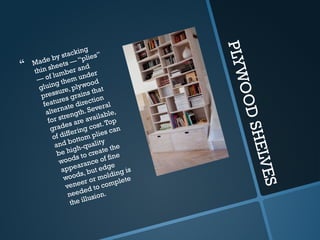
 Made by stacking
thin sheets — “plies”
— of lumber and
gluing them under
pressure, plywood
features grains that
alternate direction
for strength. Several
grades are available,
of differing cost.Top
and bottom plies can
be high-quality
woods to create the
appearance of fine
woods, but edge
veneer or molding is
needed to complete
the illusion.
P
A
R
T
I
C
L
E
W
O
O
D
S
H
E
L
V
E
S
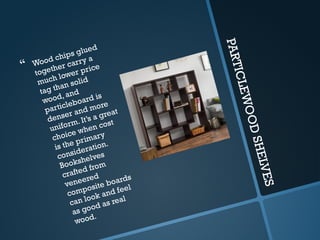
 Wood chips glued
together carry a
much lower price
tag than solid
wood, and
particleboard is
denser and more
uniform. It’s a great
choice when cost
is the primary
consideration.
Bookshelves
crafted from
veneered
composite boards
can look and feel
as good as real
wood.
M
D
F
S
H
E
L
V
E
S
 Wood fibers,
tiny chips and
sawdust
collected and
glued into
sheets form
medium-density
fiberboard
(MDF). Low-cost
MDF makes an
excellent base
for veneers;
plus, its strength
is consistent and
it shapes well.
M
E
T
A
L
S
H
E
L
V
E
S
 There’s a reason
most library
bookshelves are
made from metal:
Metal bookcases a
re resistant to
moisture and
fungus, their low-
friction shelves are
easier on books’
bindings and
metal’s strength-to-
weight ratio can’t
be beat.Their cost
usually comes in
below any other
material.
G
L
A
S
S
S
H
E
L
V
E
S
 Glass bookshelves weigh more than other types, but
if you plan on assembling your bookshelves only
once, the style points can be well worth it.Tempered
glass shelves (in wood or metal uprights, called
“standards”) give your home an unbeatable
contemporary feel, and glass bookcases’ smooth,
transparent surfaces add brilliant levity to a
decorating piece that might otherwise be notably
opaque and heavy.

INTERIOR DESIGN sdvsdvsdvsdvsd casdasdasdasda

  • 1.
  • 2.
    E L E M E N T S • DINING TABLE •TABLE CLOTH • CHAIRS • SHELVES • LIGHING • CARPET • WALL CURTAINS • FAN / AC • WASH BASIN
  • 3.
    W O O D E N T A B L E  Wood canbe hardwood, softwood or composite wood. If you settle on a wood dining table, opt for hardwood. Common hardwoods include mahogany, oak, maple and walnut. Hardwoods are both attractive and long lasting.
  • 4.
    G L A S S T A B L E  A glasstabletop is modern, airy and elegant. Glass is also easy to clean. A table with a glass tabletop may have a graphite, wooden or metal frame.
  • 5.
    M E T A L T A B L E  Metal issturdy and durable. A metal tabletop is also modern, stain resistant and cool to the touch. If your dining space is industrial or contemporary, a metal tabletop can be a good fit.
  • 6.
    M A R B L E T A B L E  Marble isnot just for kitchen counter tops.Today, marble is a common material for particular luxurious dining table models. Marble has an elegant rich tone. Marble is also easy to clean.
  • 7.
    L A M I N A T E T A B L E  The laminatetabletop fits different styles and budgets. Laminate tabletops have different layers of materials that can include PVC, high impact melamine and some wood grain finish. Laminate is sturdy and durable.
  • 8.
  • 9.
    P L Y W O O D S H E L V E S  Made bystacking thin sheets — “plies” — of lumber and gluing them under pressure, plywood features grains that alternate direction for strength. Several grades are available, of differing cost.Top and bottom plies can be high-quality woods to create the appearance of fine woods, but edge veneer or molding is needed to complete the illusion.
  • 10.
    P A R T I C L E W O O D S H E L V E S  Wood chipsglued together carry a much lower price tag than solid wood, and particleboard is denser and more uniform. It’s a great choice when cost is the primary consideration. Bookshelves crafted from veneered composite boards can look and feel as good as real wood.
  • 11.
    M D F S H E L V E S  Wood fibers, tinychips and sawdust collected and glued into sheets form medium-density fiberboard (MDF). Low-cost MDF makes an excellent base for veneers; plus, its strength is consistent and it shapes well.
  • 12.
    M E T A L S H E L V E S  There’s areason most library bookshelves are made from metal: Metal bookcases a re resistant to moisture and fungus, their low- friction shelves are easier on books’ bindings and metal’s strength-to- weight ratio can’t be beat.Their cost usually comes in below any other material.
  • 13.
    G L A S S S H E L V E S  Glass bookshelvesweigh more than other types, but if you plan on assembling your bookshelves only once, the style points can be well worth it.Tempered glass shelves (in wood or metal uprights, called “standards”) give your home an unbeatable contemporary feel, and glass bookcases’ smooth, transparent surfaces add brilliant levity to a decorating piece that might otherwise be notably opaque and heavy.