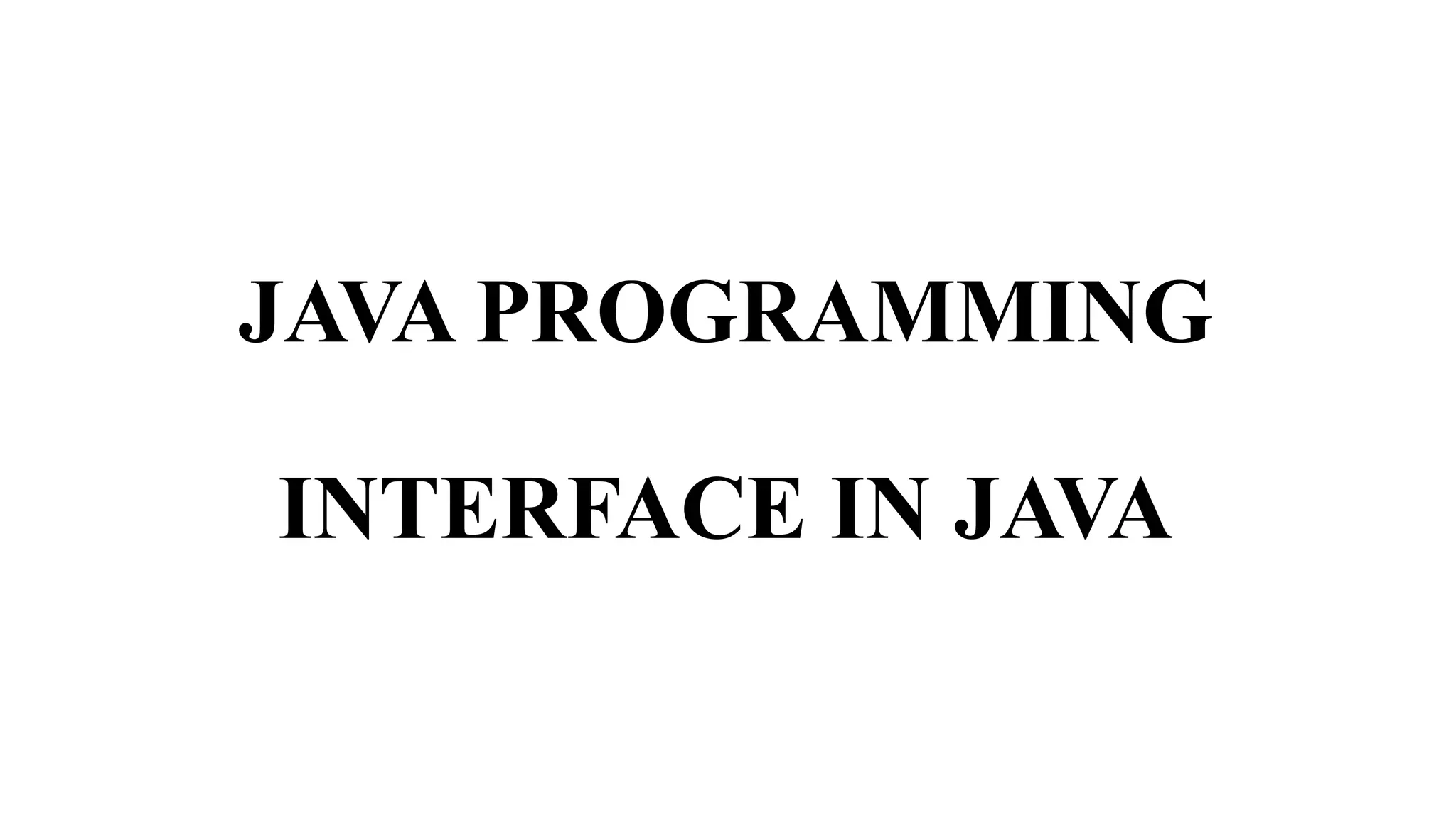
An interface in Java is a blueprint of a class that defines static constants and abstract methods. Interfaces are used to achieve abstraction and multiple inheritance in Java. An interface can only contain abstract methods without a method body. A class implementing an interface must implement all the methods declared in the interface. Interfaces allow for achieving loose coupling between classes.
INTERFACE IN JAVA
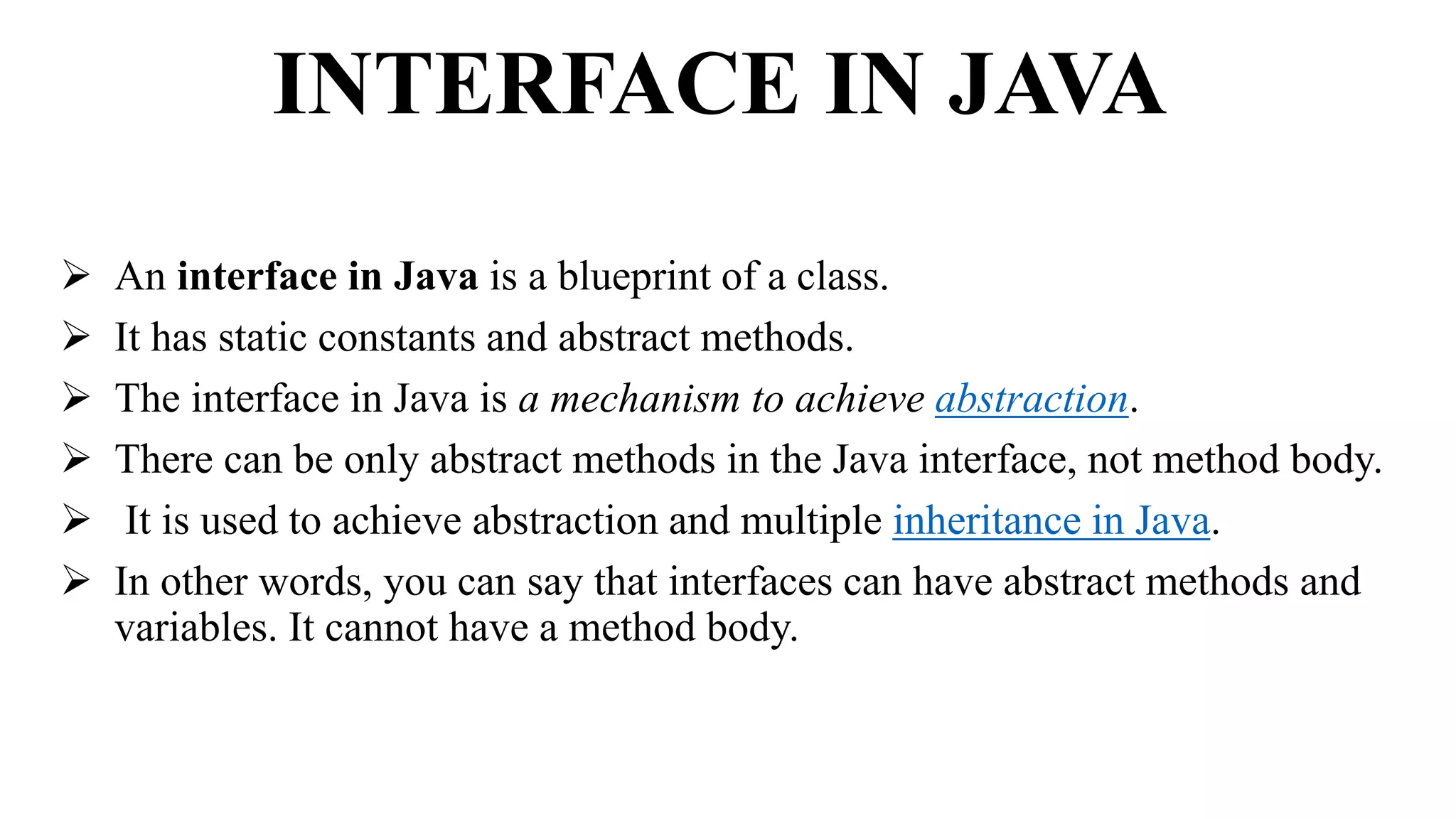
An interface in Java is a blueprint of a class.
It has static constants and abstract methods.
The interface in Java is a mechanism to achieve abstraction.
There can be only abstract methods in the Java interface, not method body.
It is used to achieve abstraction and multiple inheritance in Java.
In other words, you can say that interfaces can have abstract methods and
variables. It cannot have a method body.
3.
rface in Java
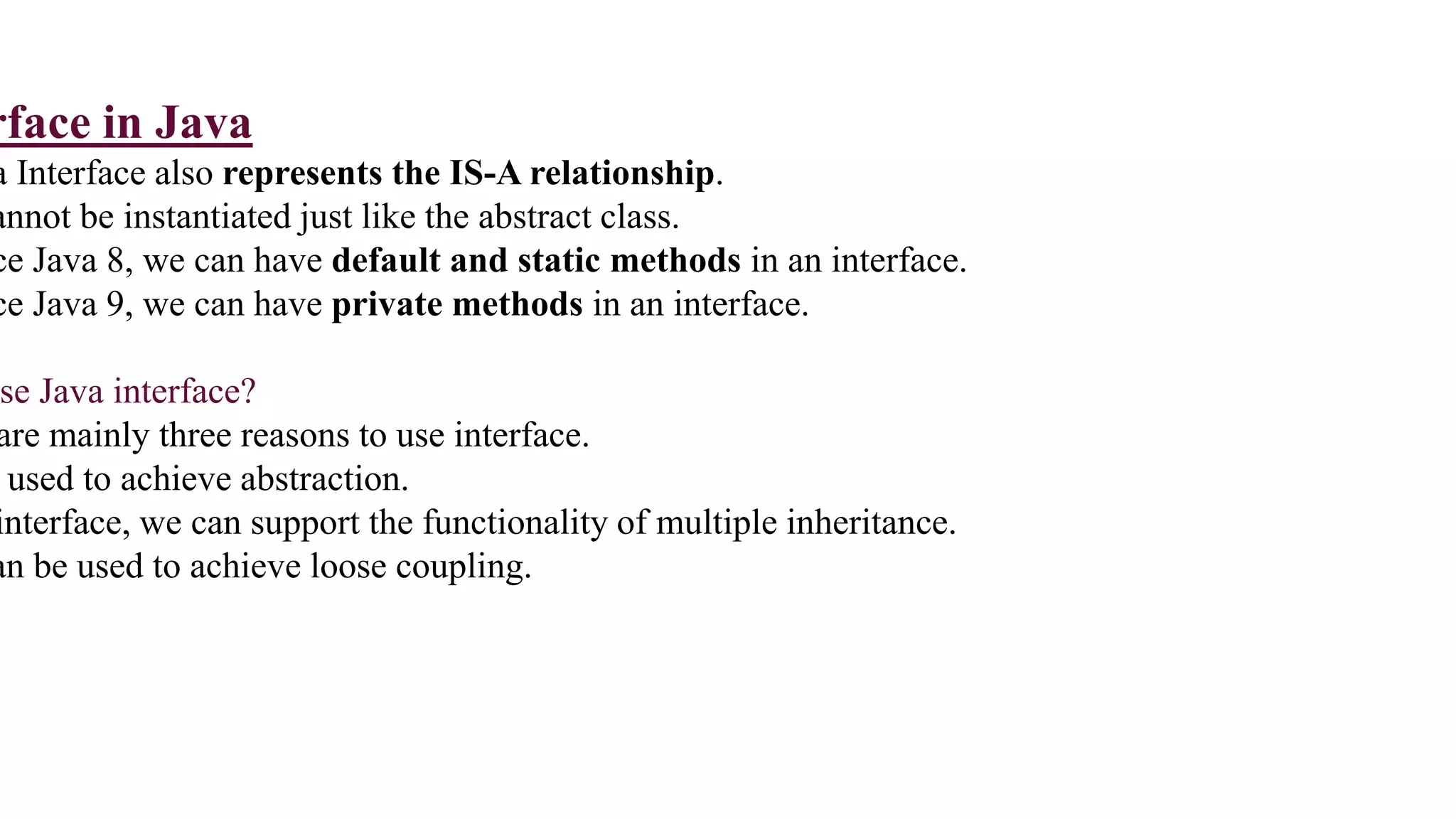
aInterface also represents the IS-A relationship.
annot be instantiated just like the abstract class.
ce Java 8, we can have default and static methods in an interface.
ce Java 9, we can have private methods in an interface.
se Java interface?
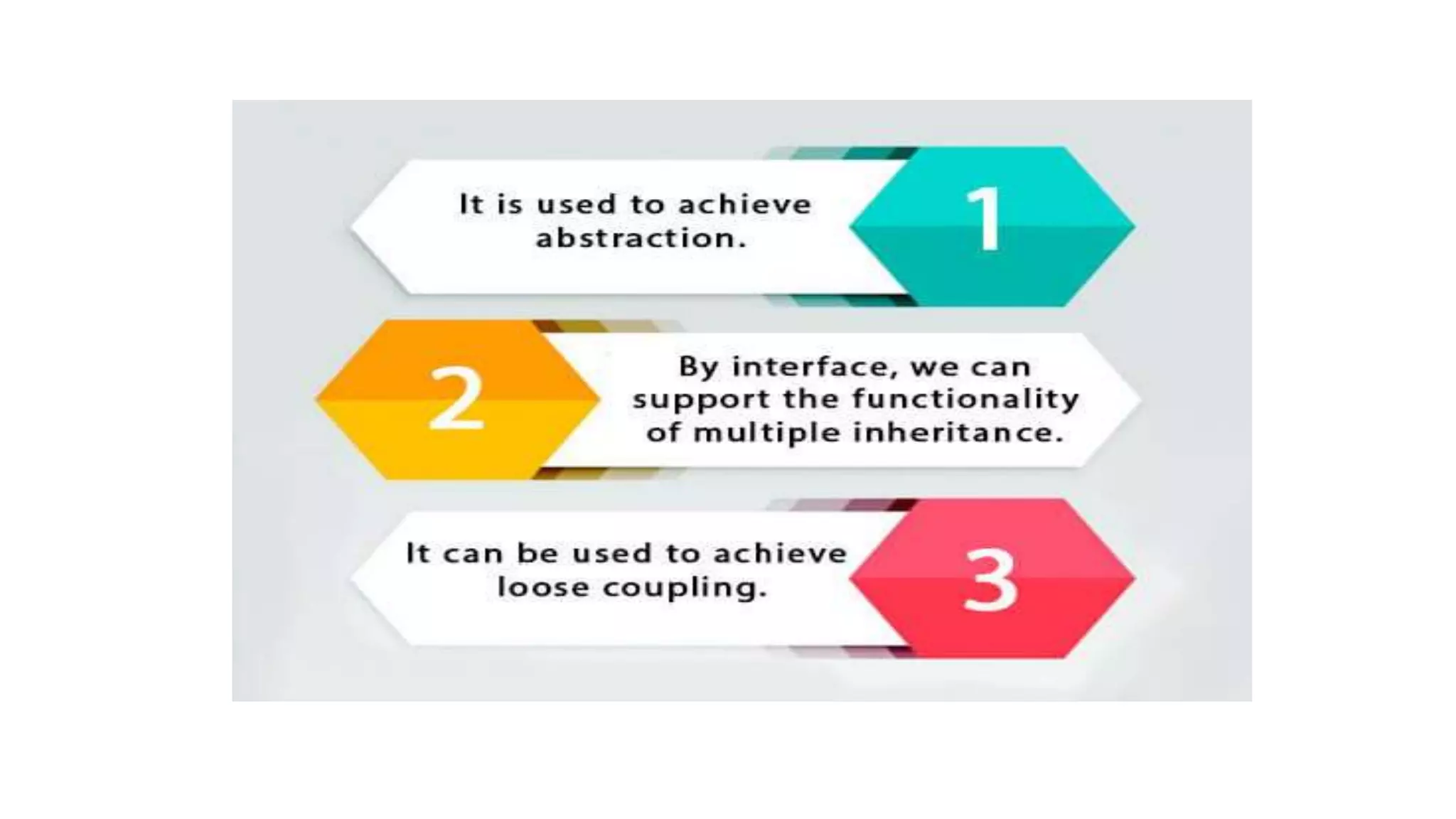
are mainly three reasons to use interface.
used to achieve abstraction.
interface, we can support the functionality of multiple inheritance.
an be used to achieve loose coupling.
5.
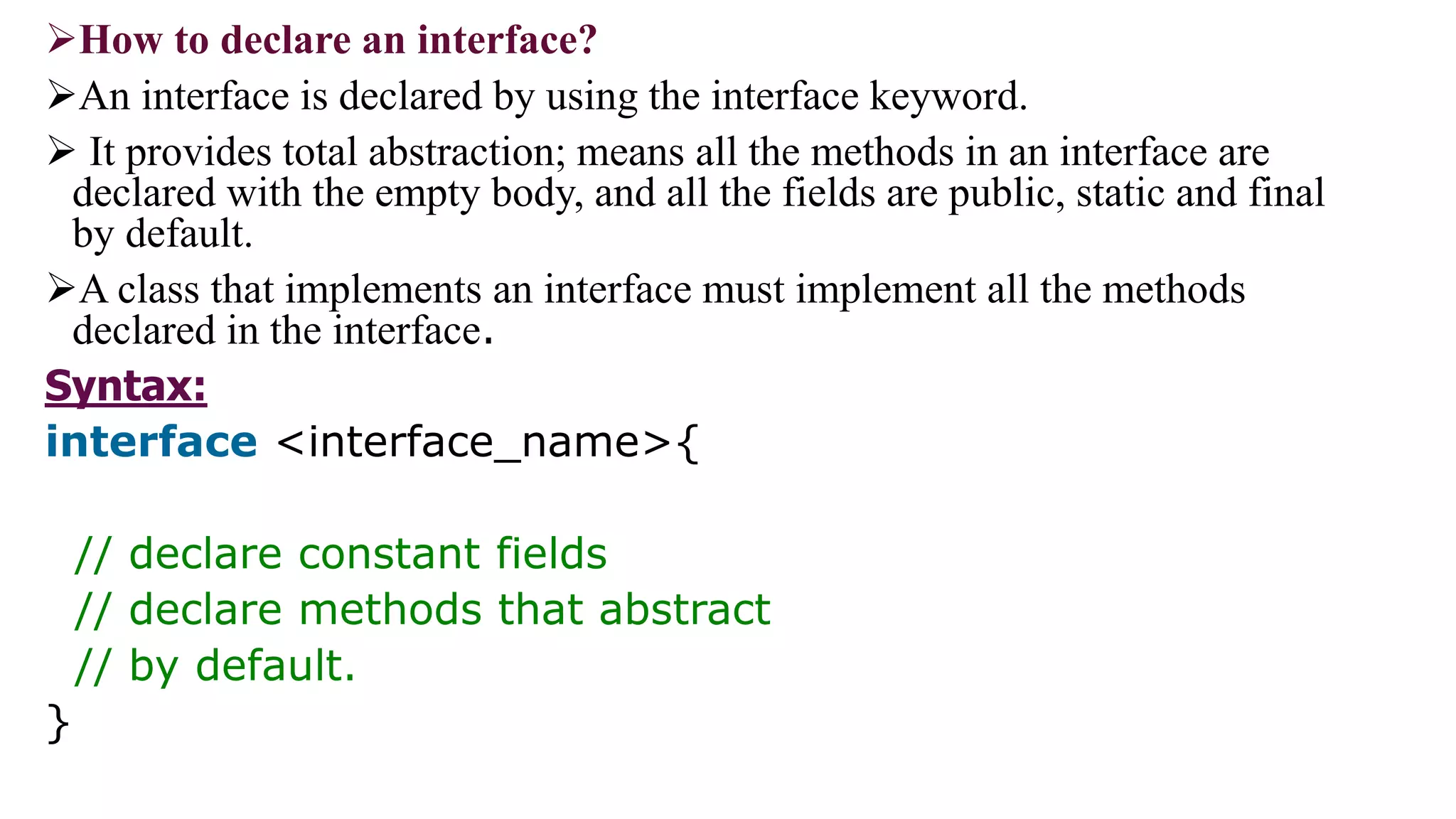
How to declarean interface?
An interface is declared by using the interface keyword.
It provides total abstraction; means all the methods in an interface are
declared with the empty body, and all the fields are public, static and final
by default.
A class that implements an interface must implement all the methods
declared in the interface.
Syntax:
interface <interface_name>{
// declare constant fields
// declare methods that abstract
// by default.
}
6.
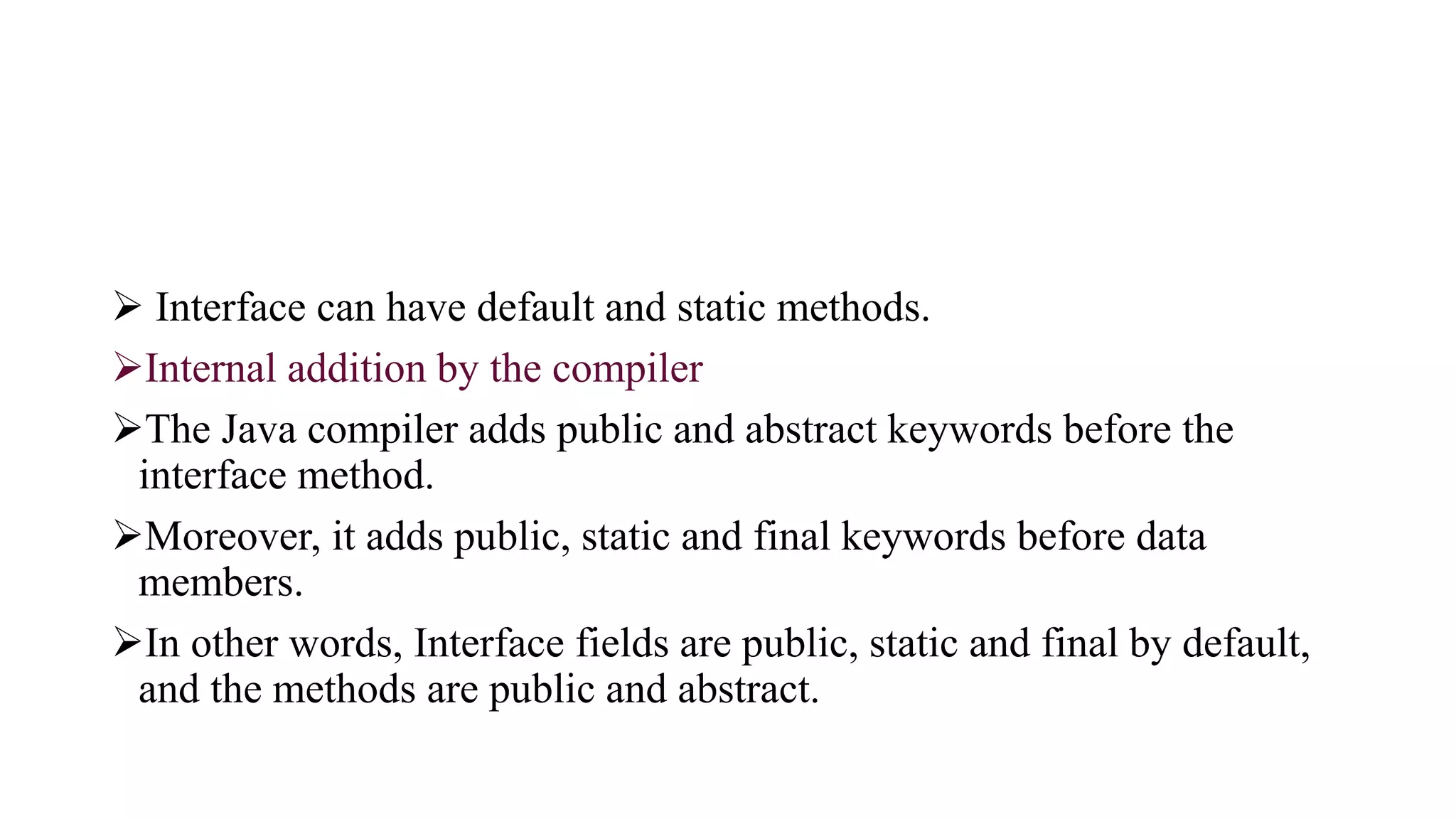
Interface canhave default and static methods.
Internal addition by the compiler
The Java compiler adds public and abstract keywords before the
interface method.
Moreover, it adds public, static and final keywords before data
members.
In other words, Interface fields are public, static and final by default,
and the methods are public and abstract.
7.
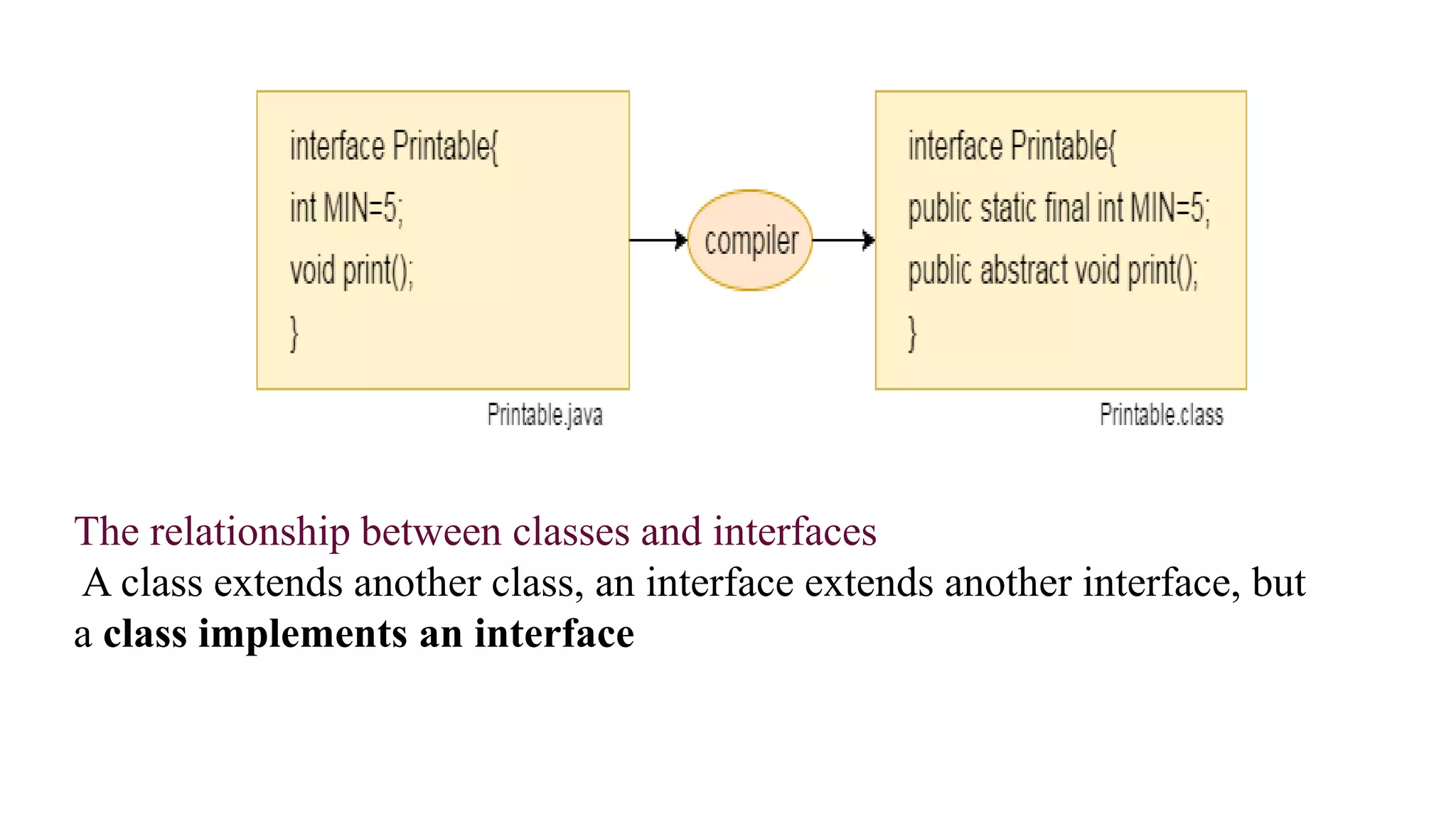
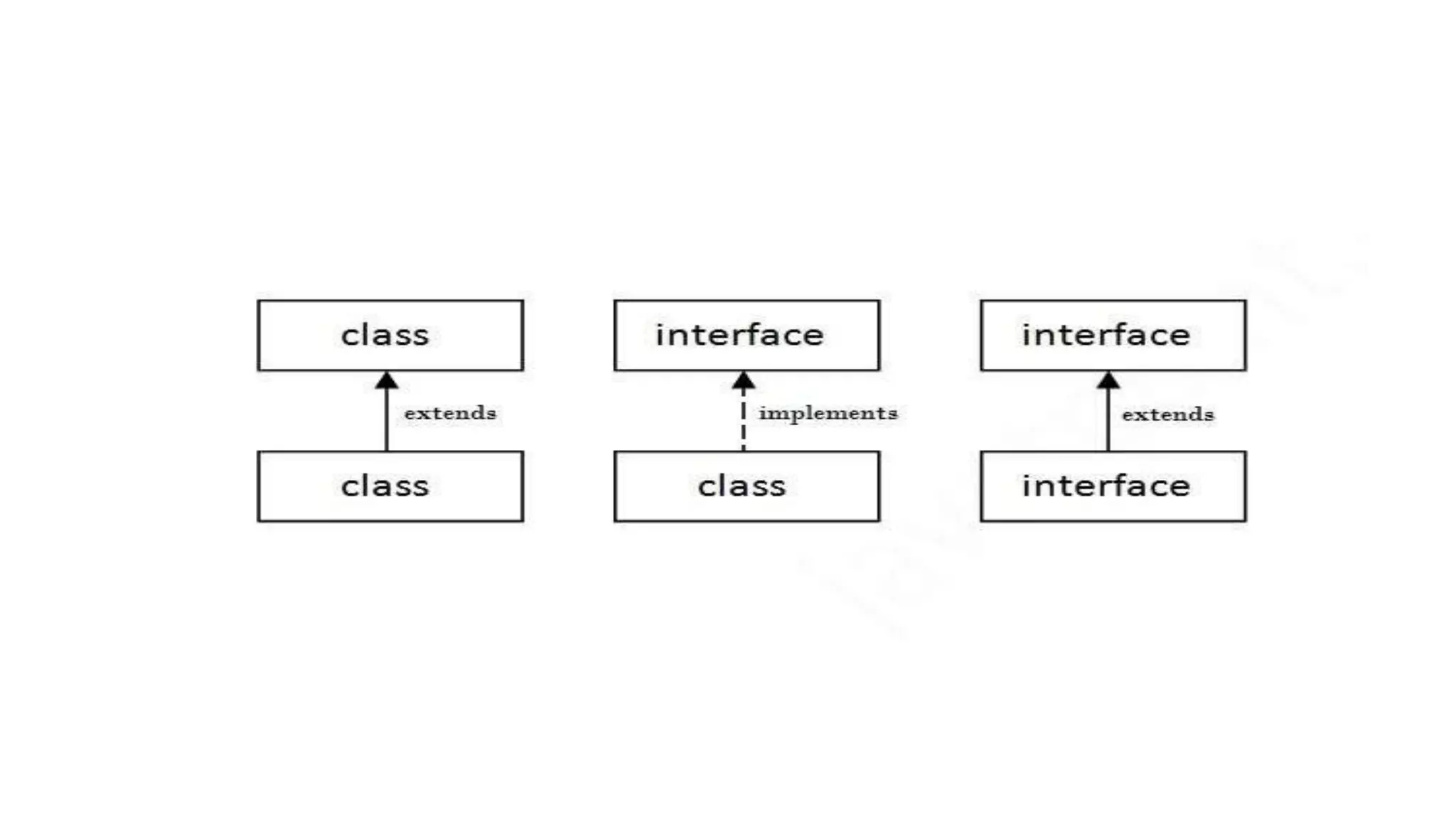
The relationship betweenclasses and interfaces
A class extends another class, an interface extends another interface, but
a class implements an interface
9.
Java Interface Example
Inthis example, the Printable interface has only one method, and its implementation is provided in the A6 class.
interface printable
{
void print();
}
class A6 implements printable
{
public void print()
{
System.out.println("Hello");
}
class A2
{
public static void main(String args[])
{
A6 obj = new A6();
obj.print();
}
}
OUTPUT
Hello
10.
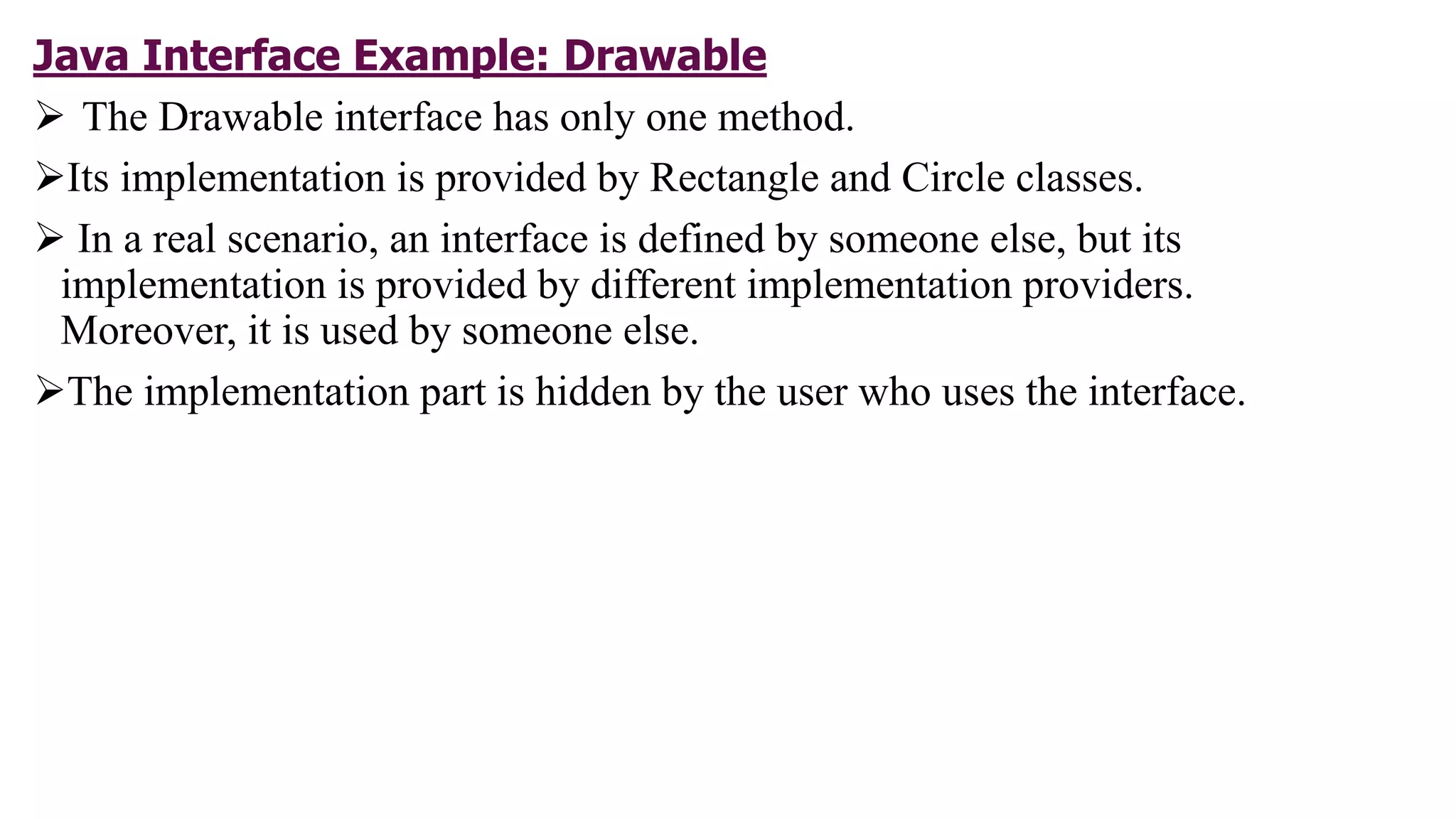
Java Interface Example:Drawable
The Drawable interface has only one method.
Its implementation is provided by Rectangle and Circle classes.
In a real scenario, an interface is defined by someone else, but its
implementation is provided by different implementation providers.
Moreover, it is used by someone else.
The implementation part is hidden by the user who uses the interface.
11.
//Interface declaration: byfirst user
interface Drawable
{
void draw();
}
//Implementation: by second user
class Rectangle implements Drawable
{
public void draw()
{
System.out.println("drawing rectangle");
}
}
class Circle implements Drawable
{
public void draw(){System.out.println("drawing circle");}
}
//Using interface: by third user
class TestInterface1
{
public static void main(String args[])
{
Drawable d=new Circle();//In real scenario, object is provided by method e.g. getDrawable()
d.draw();
}
}
OUTPUT
drawing circle
12.
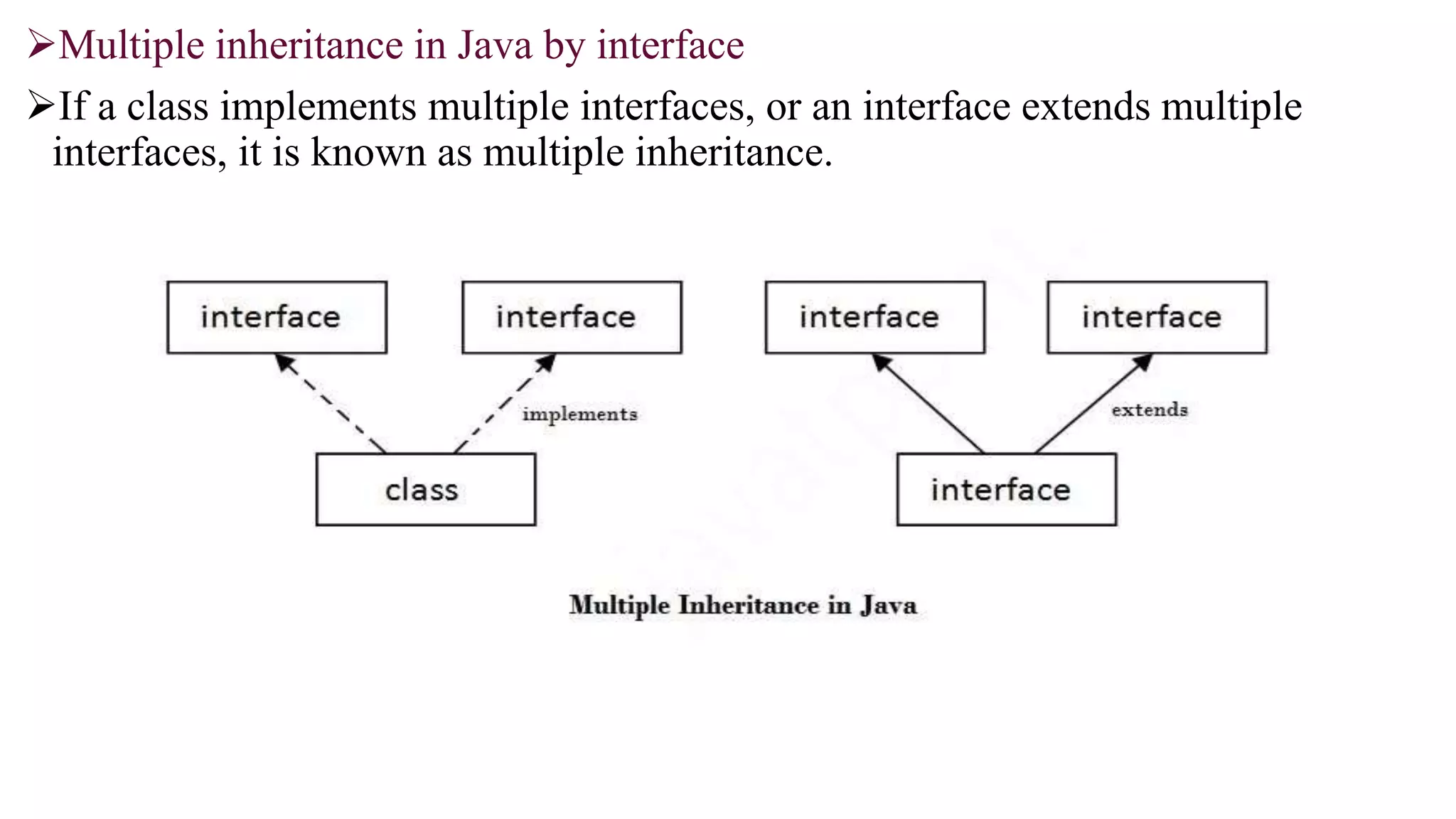
Multiple inheritance inJava by interface
If a class implements multiple interfaces, or an interface extends multiple
interfaces, it is known as multiple inheritance.
13.
Default Method inInterface
We can have method body in interface. But we need to make it default method.
interface Drawable
{
void draw();
default void msg()
{
System.out.println("default method");
}
}
class Rectangle implements Drawable
{
public void draw()
{
System.out.println("drawing rectangle");
}
}
class TestInterfaceDefault
{
public static void main(String args[])
{
Drawable d=new Rectangle();
d.draw();
d.msg();
}
}
OUTPUT
drawing rectangle
default method
14.
Static Method inInterface:
We can have static method in interface.
interface Drawable
{
void draw();
static int cube(int x)
{
return x*x*x;
}
}
class Rectangle implements Drawable
{
public void draw()
{
System.out.println("drawing rectangle");
}
}
class TestInterfaceStatic
{
public static void main(String args[])
{
Drawable d=new Rectangle();
d.draw();
System.out.println(Drawable.cube(3));
}
}
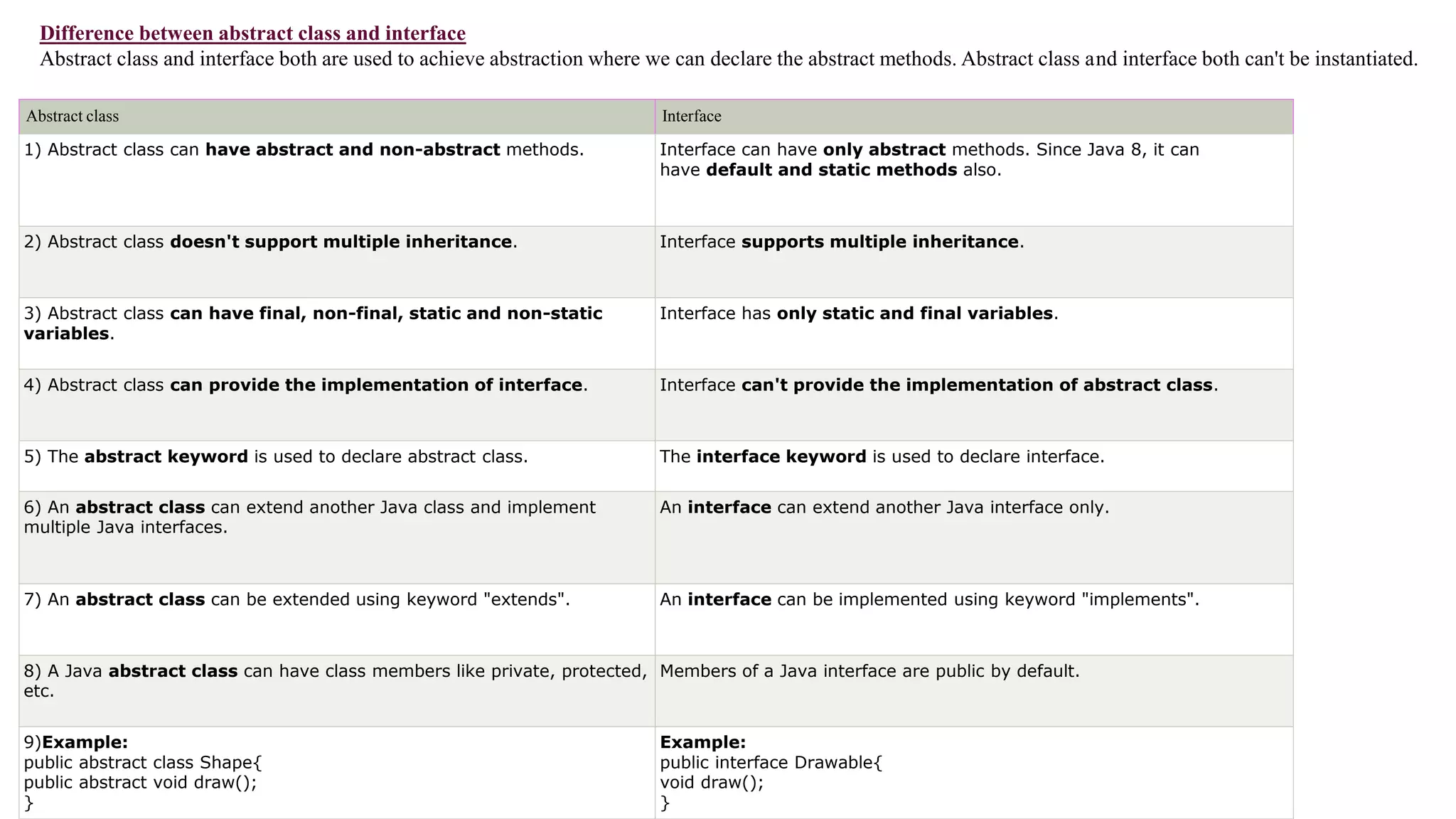
Abstract class Interface
1)Abstract class can have abstract and non-abstract methods. Interface can have only abstract methods. Since Java 8, it can
have default and static methods also.
2) Abstract class doesn't support multiple inheritance. Interface supports multiple inheritance.
3) Abstract class can have final, non-final, static and non-static
variables.
Interface has only static and final variables.
4) Abstract class can provide the implementation of interface. Interface can't provide the implementation of abstract class.
5) The abstract keyword is used to declare abstract class. The interface keyword is used to declare interface.
6) An abstract class can extend another Java class and implement
multiple Java interfaces.
An interface can extend another Java interface only.
7) An abstract class can be extended using keyword "extends". An interface can be implemented using keyword "implements".
8) A Java abstract class can have class members like private, protected,
etc.
Members of a Java interface are public by default.
9)Example:
public abstract class Shape{
public abstract void draw();
}
Example:
public interface Drawable{
void draw();
}
Difference between abstract class and interface
Abstract class and interface both are used to achieve abstraction where we can declare the abstract methods. Abstract class and interface both can't be instantiated.
![Java Interface Example
In this example, the Printable interface has only one method, and its implementation is provided in the A6 class.
interface printable
{
void print();
}
class A6 implements printable
{
public void print()
{
System.out.println("Hello");
}
class A2
{
public static void main(String args[])
{
A6 obj = new A6();
obj.print();
}
}
OUTPUT
Hello](https://image.slidesharecdn.com/interfaceinjava-220304093645/75/Interface-in-java-9-2048.jpg)
![//Interface declaration: by first user
interface Drawable
{
void draw();
}
//Implementation: by second user
class Rectangle implements Drawable
{
public void draw()
{
System.out.println("drawing rectangle");
}
}
class Circle implements Drawable
{
public void draw(){System.out.println("drawing circle");}
}
//Using interface: by third user
class TestInterface1
{
public static void main(String args[])
{
Drawable d=new Circle();//In real scenario, object is provided by method e.g. getDrawable()
d.draw();
}
}
OUTPUT
drawing circle](https://image.slidesharecdn.com/interfaceinjava-220304093645/75/Interface-in-java-11-2048.jpg)
![Default Method in Interface
We can have method body in interface. But we need to make it default method.
interface Drawable
{
void draw();
default void msg()
{
System.out.println("default method");
}
}
class Rectangle implements Drawable
{
public void draw()
{
System.out.println("drawing rectangle");
}
}
class TestInterfaceDefault
{
public static void main(String args[])
{
Drawable d=new Rectangle();
d.draw();
d.msg();
}
}
OUTPUT
drawing rectangle
default method](https://image.slidesharecdn.com/interfaceinjava-220304093645/75/Interface-in-java-13-2048.jpg)
![Static Method in Interface:
We can have static method in interface.
interface Drawable
{
void draw();
static int cube(int x)
{
return x*x*x;
}
}
class Rectangle implements Drawable
{
public void draw()
{
System.out.println("drawing rectangle");
}
}
class TestInterfaceStatic
{
public static void main(String args[])
{
Drawable d=new Rectangle();
d.draw();
System.out.println(Drawable.cube(3));
}
}](https://image.slidesharecdn.com/interfaceinjava-220304093645/75/Interface-in-java-14-2048.jpg)